



MMP
Matrix metalloproteinases
MMP Isoform Specific Products
-
MMP-1
(63)
View all products
-
MMP-2
(145)
View all products
-
MMP-3
(56)
View all products
-
MMP-8
(30)
View all products
-
MMP-9
(183)
View all products
-
MMP-13
(54)
View all products
-
MMP-14
(23)
View all products
-
MMP-17
(3)
View all products
-
ADAM10
(9)
View all products
-
ADAM17
(10)
View all products
-
MMP-7
(22)
View all products
-
MMP-12
(18)
View all products
-
MMP-10
(8)
View all products
-
MMP
(436)
View all products
-
ADAM8
(1)
View all products
-
MMP-19
(1)
View all products
All Product Categories
-
MMP Inhibitors
(592)
View all products
-
MMP Agonists
(2)
View all products
-
MMP Antagonist
(1)
View all products
-
MMP Activators
(35)
View all products
-
MMP Modulators
(3)
View all products
-
MMP Chemicals
(2)
View all products
-
MMP Inducers
(13)
View all products
-
MMP Degrader
(1)
View all products
-
MMP Controls
(5)
View all products
-
MMP Substrates
(14)
View all products
-
MMP Ligands
(3)
View all products
-
Matrix Metalloproteinases Proteins
(41)
View all products
-
MMP-1 Proteins
(2)
View all products
-
MMP-2 Proteins
(7)
View all products
-
MMP-3 Proteins
(2)
View all products
-
MMP-7 Proteins
(2)
View all products
-
MMP-10 Proteins
(1)
View all products
-
MMP-12 Proteins
(2)
View all products
-
MMP-8 Proteins
(7)
View all products
-
MMP-9 Proteins
(11)
View all products
-
MMP-13 Proteins
(1)
View all products
-
MMP-14 Proteins
(1)
View all products
-
ADAM8 Proteins
(4)
View all products
-
ADAM10 Proteins
(1)
View all products
-
ADAM17/TACE Proteins
(3)
View all products
-
MMP Related Products (790)
Related Products (790)

-
Recombinant Proteins (49)
-
Antibodies (15)
-
MMP Isoform Comparison
-
VDR agonist 4
 0 ImagesCat. No.: HY-178328CAS No.: 3136765-61-9VDR agonist 4 is an orally active potent VDR agonist. VDR agonist 4 exerts VDR-dependent antifibrotic activity by regulating multiple fibrosis-related genes to suppress α-SMA and collagen I production, thereby inhibiting hepatic stellate cell (HSC) activation. VDR agonist 4 improves CCl4 (HY-RS16594)-induced hepatic fibrosis in mice. VDR agonist 4 can be used for liver fibrosis research.
-
Mca-P-Cha-G-Nva-HA-Dap(DNP)-NH2
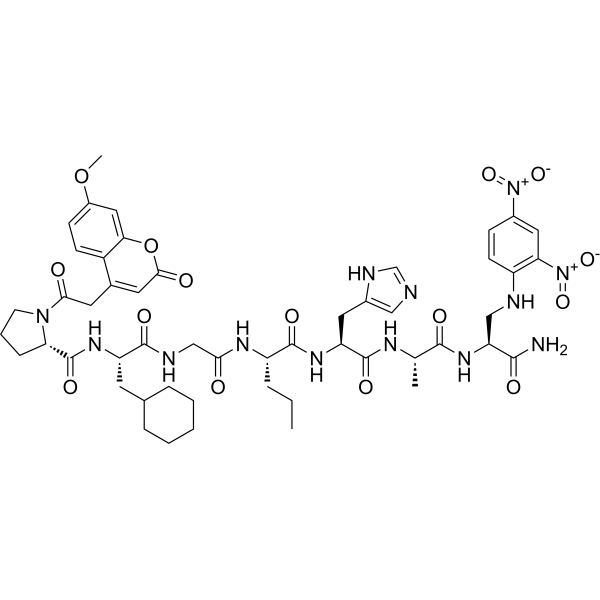 0 ImagesCat. No.: HY-P3098CAS No.: 256394-94-2
-
MMP2-IN-4
 0 ImagesCat. No.: HY-161707CAS No.: 92535-43-8MMP2-IN-4 (compound 3h) is a potent MMP2 inhibitor. MMP2-IN-4 inhibits MMP2, MMP9 and MMP12 with IC50s of 266.74, 402.75 and 1237.39 nM, respectively.
-
Chloramphenicol/BSA
 0 ImagesCat. No.: HY-161586Chloramphenicol/BSA is the antigen-adjuvant conjugate formed by the coupling of Chloramphenicol (HY-B0239) with Bovine Serum Albumin (BSA). By conjugating the antigen with a protein adjuvant, the production of antigen-specific antibodies in vaccine models can be enhanced. The conjugate does not affect protein folding or disrupt major epitopes, and it can enhance cross-presentation and the generation of antigen-specific T cells.
-
TAK-778
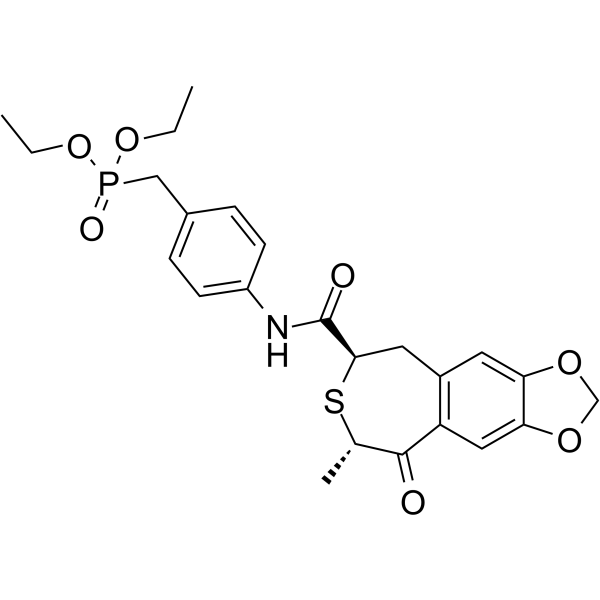 0 ImagesCat. No.: HY-100167CAS No.: 180185-61-9TAK-778 is a derivative of ipriflavone and has been shown to induce bone growth in in vitro and in vivo models.
-
CGS 27023A free base
 0 ImagesCat. No.: HY-18694ACAS No.: 161314-70-1CGS 27023A free base is a non-peptidic and orally active MMP inhibitor with the Ki values of 43, 33, 20 and 8 nM for MMP-3, MMP-1, MMP-2 amd MMP-9, respectively. CGS 27023A free base prevents cartilage degradation in stromelysin-induced rabbit cartilage degradation model. CGS 27023A free base can be used for study of arthritis.
-
DH-18
 0 ImagesCat. No.: HY-168605DH-18 is a matrix metalloproteinase-2 (MMP-2) inhibitor with the IC50 values of 139.45 nM, 518.11 nM and 833.34 nM for MMP-2, MMP-9 and MMP-8, respectively. DH-18 induces cell apoptosis and arrests cell cycle in the G0/G1 phase. DH-18 inhibits cell growth and can be used for study of chronic myeloid leukemia.
-
Trilinolein-d5
 0 ImagesCat. No.: HY-128393S2Trilinolein-d5 is the deuterium labeled Trilinolein (HY-128393). Trilinolein is an orally active triglyceride that inhibits the PI3K/Akt, Ras/MEK/ERK signaling pathways, and MMP-2. Trilinolein can reduce oxidative stress, induce apoptosis, and inhibit cell migration. Trilinolein can be used in the research fields of cardiovascular disease, cerebrovascular disease (such as cerebral ischemia), and non-small cell lung cancer.
-
Swertiamarin (Standard)
 0 ImagesCat. No.: HY-N0807RCAS No.: 17388-39-5Swertiamarin (Standard) is the analytical standard of Swertiamarin. This product is intended for research and analytical applications. Swertiamarin is an orally active iridoid compound with hypoglycemic, hypolipidemic, anti rheumatic and antioxidant activities, which can be used in the research of diabetes and arthritis.
-
T 26c sodium
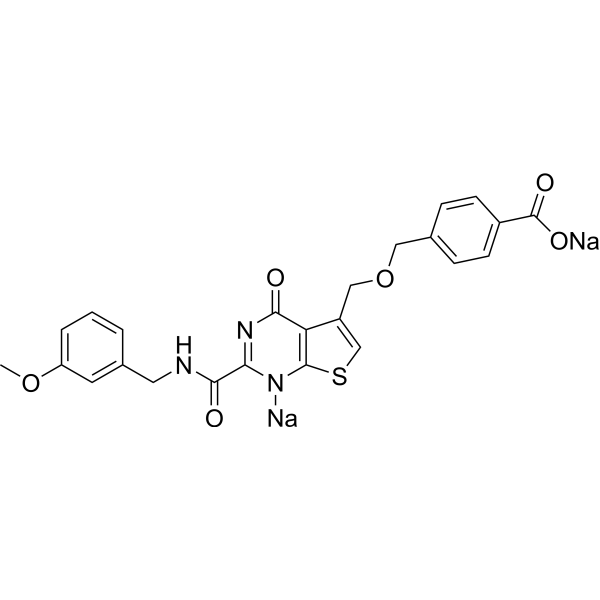 0 ImagesCat. No.: HY-100518ACAS No.: 869298-22-6T26c sodium is a potent and selective MMP13 inhibitor with IC50 value of 6.9 pM. T26c sodium can inhibit the degradation of bovine nasal septal cartilage explants.
-
Mca-Pro-Leu-Ala-Cys(Mob)-Trp-Ala-Arg-Dap(Dnp)-NH2 TFA
 0 ImagesCat. No.: HY-P3120ACAS No.: 2237216-67-8Mca-Pro-Leu-Ala-Cys(Mob)-Trp-Ala-Arg-Dap(Dnp)-NH2 TFA is a fluorogenic substrate for matrix metalloproteinase-14 (MMP-14). Mca-Pro-Leu-Ala-Cys(Mob)-Trp-Ala-Arg-Dap(Dnp)-NH2 TFA, upon cleavage by MMP-14, releases 7-methoxycoumarin-4-acetyl (Mca) (Ex/Em = 328/420 nm).
-
Propoxur-d3
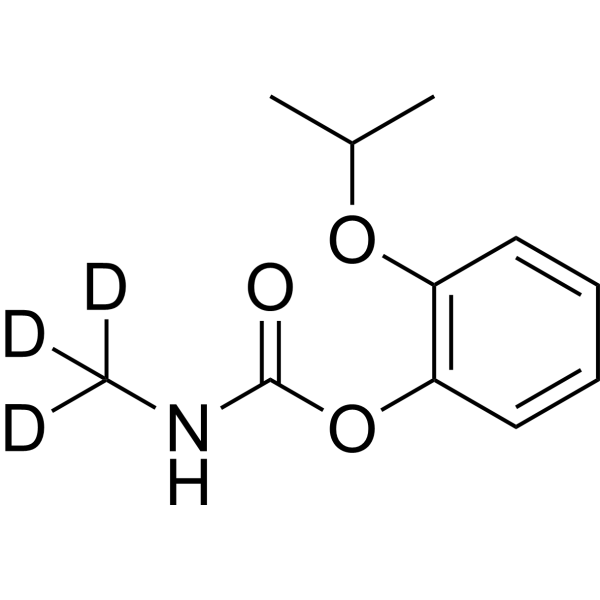 0 ImagesCat. No.: HY-B0916SCAS No.: 1219798-56-7Propoxur-d3 is the deuterated form of Propoxur (HY-B0916). Propoxur is a reversible, competitive, orally active AChE inhibitor that can cross the blood-brain barrier. Propoxur inhibits AChE activity to induce neurotoxicity, while promoting MMP-2 expression and enhancing tumor cell migration and invasion by inducing intracellular ROS generation and activating the ERK/Nrf2 signaling pathway. On the one hand, Propoxur inhibits AChE, leading to acetylcholine accumulation and causing neurological dysfunction; on the other hand, it promotes Nrf2 nuclear translocation through ROS-dependent ERK1/2 phosphorylation, and upregulates MMP-2 and other invasion-related proteins. Propoxur is also a carbamate insecticide used to combat turf, forestry, and household pests.
-
MMP13 Human Pre-designed siRNA Set A
 0 ImagesCat. No.: HY-RS08525
MMP13 Human Pre-designed siRNA Set A contains three designed siRNAs for MMP13 gene (Human), as well as a negative control, a positive control, and a FAM-labeled negative control.

-
Vitamin CK3 (Standard)
 0 ImagesVitamin CK3 (Standard) is the combination of Vitamin C and vitamin K3 (100:1 ratio). Vitamin CK3 (Standard) can decrease MMP activity. Vitamin CK3 (Standard) can reactivate DNases and cause cell autophagy. Vitamin CK3 (Standard) can be used for the research of cancer, such as lung cancer.
-
TAT (47-57) GGG-Cys(Npys)
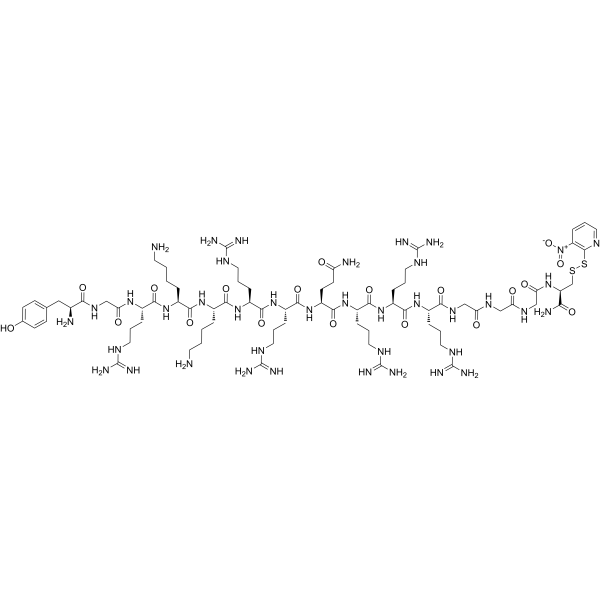 0 ImagesCat. No.: HY-P4123CAS No.: 1231898-26-2TAT (47-57) GGG-Cys (Npys) is a cell-penetrating peptide and delivery carrier derived from TAT. TAT (47-57) GGG-Cys (Npys) facilitates the translocation of conjugated drug molecules across cell membranes. TAT (47-57) GGG-Cys (Npys) acts as a delivery carrier for MT1-MMP inhibitors. TAT (47-57) GGG-Cys (Npys) is applicable to research on diseases associated with MT1-MMP activity, such as cancer, arthritis, heart disease, and vascular disorders.
-
23-Hydroxybetulinic acid (Standard)
 0 ImagesCat. No.: HY-N0566RCAS No.: 85999-40-2Synonyms: Anemosapogenin (Standard)23-Hydroxybetulinic acid (Standard) is the analytical standard of 23-Hydroxybetulinic acid (HY-N0566). This product is intended for research and analytical applications. 23-Hydroxybetulinic acid (Anemosapogenin) is an orally active triterpenoid with broad-spectrum anticancer activity. 23-Hydroxybetulinic acid reduces the levels of Bcl-2 and survivin, elevates the level of Bax, promotes the cleavage/activation of caspase-3 and caspase-9, and induces apoptosis via the endogenous mitochondrial pathway involving cytochrome C release and mitochondrial membrane potential disruption. 23-Hydroxybetulinic acid arrests the cell cycle at S and G1 phases, inhibits cancer cell proliferation, blocks the MAPK signaling pathway, regulates MMP2, and induces autophagic apoptosis by upregulating beclin-1. 23-Hydroxybetulinic acid inhibits the activity and efflux function of P-gp, increases the intracellular accumulation of chemotherapeutic drugs, and synergistically enhances cytotoxicity with Doxorubicin (HY-15142). 23-Hydroxybetulinic acid inhibits the phosphorylation and nuclear translocation of STAT6, blocks M2 macrophage polarization, and reduces M2 macrophage-mediated apoptosis resistance of colon cancer cells. 23-Hydroxybetulinic acid can be used in related studies on chronic myeloid leukemia, hepatocellular carcinoma, sarcoma 180, multidrug-resistant breast cancer, leukemia, Doxorubicin-induced cardiotoxicity, and colorectal cancer.




