



MMP-17
MMP-17, also known as membrane-type 4 matrix metalloproteinase (MT4-MMP), is a glycosylphosphatidylinositol (GPI)-anchored matrix metalloproteinase that localizes its catalytic activity to the cell surface and extracellular environment[1][2]. During development, MMP-17 shows regulated expression in vascular structures, neural tissues, and developing limbs, supporting roles in angiogenesis, neural crest cell migration, and tissue morphogenesis[2][3]. Mechanistically, MMP-17 participates in extracellular proteolysis and substrate processing, including cleavage of proteins such as osteopontin and pro-TNF, thereby influencing cellular signaling and tissue remodeling pathways[2]. In disease settings, MMP-17 has been implicated in inflammatory cartilage degradation, where genetic or pharmacological evidence links the enzyme to aggrecanolysis under inflammatory conditions[4][2]. MMP-17 also contributes to vascular homeostasis, and loss-of-function studies have associated reduced MMP-17 activity with altered vascular smooth muscle cell behavior and susceptibility to thoracic aortic aneurysm and dissection phenotypes[2]. Compared with related membrane-type MMP isoforms, MMP-17 is distinguished by its GPI anchor, limited extracellular matrix substrate repertoire, inability to activate pro-MMP-2, and greater sensitivity to TIMP-1 than TIMP-2, indicating a distinct regulatory and functional profile within the MT-MMP family[2][5]. For experimental applications, MMP-17 serves as a useful model for investigating cell-surface proteolysis, vascular remodeling, inflammatory tissue damage, and cancer-associated signaling pathways[2][6].
References:
- [1]. Itoh Y, et al. Membrane type 4 matrix metalloproteinase (MT4-MMP, MMP-17) is a glycosylphosphatidylinositol-anchored proteinase. The Journal of Biological Chemistry. 1999 Nov;274(48):34260-34266. [Content Brief]
- [2]. Yip C, et al. MT4-MMP: The GPI-Anchored Membrane-Type Matrix Metalloprotease with Multiple Functions in Diseases. Int J Mol Sci. 2019 Jan 16;20(2):354. [Content Brief]
- [3]. Matrix-metalloproteinase-17. sciencedirect.topics.
- [4]. Clements KM, et al. Matrix metalloproteinase 17 is necessary for cartilage aggrecan degradation in an inflammatory environment. Ann Rheum Dis. 2011;70(4):683-689.
- [5]. English WR, et al. Membrane type 4 matrix metalloproteinase (MMP17) has tumor necrosis factor-alpha convertase activity but does not activate pro-MMP2. J Biol Chem. 2000;275(19):14046-14055.
- [6]. Sohail A, et al. MT4-(MMP17) and MT6-MMP (MMP25), A unique set of membrane-anchored matrix metalloproteinases: properties and expression in cancer. Cancer Metastasis Rev. 2008 Jun;27(2):289-302. [Content Brief]
All Product Categories
-
MMP-17 Related Products (3)
Related Products (3)

-
KP-457
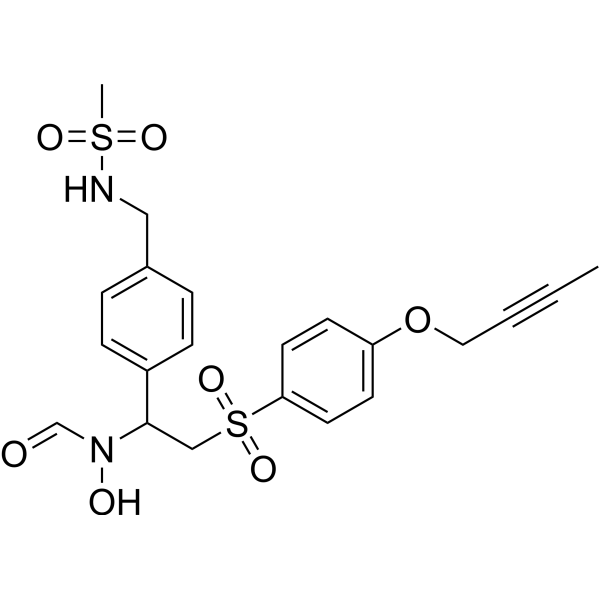 0 ImagesKP-457 is a selective a disintegrin and metalloproteinase 17 (ADAM17) inhibitor, with higher selectivity for ADAM17 than for other MMPs and ADAM10, and IC50s are 11.1 nM (ADAM17), 748 nM (ADAM10), 717 nM (MMP2), 9760 nM (MMP3), 2200 nM (MMP8), 5410 nM (MMP9), 930 nM (MMP13), 2140 nM (MMP14), and 7100 nM (MMP17), respectively.
-
Anti-inflammatory agent 121
 0 ImagesCat. No.: HY-137839CAS No.: 927827-98-3Anti-inflammatory agent 121 is a protease inhibitor, with IC50 values against different targets as follows: 1.3 μM (Staphylococcus aureus type I staphylokinase), 2.2 μM (Staphylococcus aureus type II staphylokinase), 2.3 μM (human MMP-1), 2.7 μM (human MMP-2), 1.4 μM (human MMP-8), 4.6 μM (human MMP-9), and 79 μM (human ADAM17). Anti-inflammatory agent 121 inhibits the activities of staphylococcal serine protease glutamyl endopeptidase (V8 protease) and cysteine protease staphylococcal protease B in Staphylococcus aureus cultures. Anti-inflammatory agent 121 inhibits protease activity in skin wash samples, metalloprotease (staphylokinase) activity in Staphylococcus aureus culture supernatants, and staphylokinase-mediated activation of pro-urokinase-type plasminogen activator (pro-uPA). Anti-inflammatory agent 121 can be used in the research of atopic dermatitis.
-
Antibacterial agent 315
 0 ImagesCat. No.: HY-180115LP07 is an antibacterial agent targeting Pseudomonas aeruginosa with MIC values for both wild-type and efflux pump-deficient P. aeruginosa PA14 of both 8 μg/mL. LP07 exerts its antibacterial effect by directly disrupting the structural integrity of the bacterial cell membrane. LP07 moderately inhibits MMP-17 and MMP-19, but has no significant inhibitory effect on other MMP subtypes. LP07 does not inhibit the activity of LpxC enzyme. LP07 can be used for research on Pseudomonas aeruginosa infections.



