



CDK
Cyclin dependent kinase
CDKs (Cyclin-dependent kinases) are serine-threonine kinases first discovered for their role in regulating the cell cycle. They are also involved in regulating transcription, mRNA processing, and the differentiation of nerve cells. CDKs are relatively small proteins, with molecular weights ranging from 34 to 40 kDa, and contain little more than the kinase domain. In fact, yeast cells can proliferate normally when their CDK gene has been replaced with the homologous human gene. By definition, a CDK binds a regulatory protein called a cyclin. Without cyclin, CDK has little kinase activity; only the cyclin-CDK complex is an active kinase.
There are around 20 Cyclin-dependent kinases (CDK1-20) known till date. CDK1, 4 and 5 are involved in cell cycle, and CDK 7, 8, 9 and 11 are associated with transcription.
CDK levels remain relatively constant throughout the cell cycle and most regulation is post-translational. Most knowledge of CDK structure and function is based on CDKs of S. pombe (Cdc2), S. cerevisia (CDC28), and vertebrates (CDC2 and CDK2). The four major mechanisms of CDK regulation are cyclin binding, CAK phosphorylation, regulatory inhibitory phosphorylation, and binding of CDK inhibitory subunits (CKIs).
CDK Isoform Specific Products
-
CDK
(487)
View all products
-
CDK1
(195)
View all products
-
CDK2
(314)
View all products
-
CDK3
(28)
View all products
-
CDK4
(231)
View all products
-
CDK5
(98)
View all products
-
CDK6
(178)
View all products
-
CDK7
(118)
View all products
-
CDK8
(57)
View all products
-
CDK9
(204)
View all products
-
CDK11
(9)
View all products
-
CDK12
(52)
View all products
-
CDK13
(26)
View all products
-
CDK14
(6)
View all products
-
CDK16
(8)
View all products
-
CDK19
(25)
View all products
-
CDC
(21)
View all products
-
CLK
(31)
View all products
-
Pho85
(1)
View all products
-
CDK10
(1)
View all products
-
CDK15
(1)
View all products
-
CDK17
(2)
View all products
-
CDK18
(1)
View all products
-
CDK20
(1)
View all products
-
PITSLRE
(1)
View all products
All Product Categories
-
CDK Inhibitors
(1074)
View all products
-
CDK Agonists
(3)
View all products
-
CDK Antagonists
(2)
View all products
-
CDK Activators
(18)
View all products
-
CDK Modulators
(15)
View all products
-
CDK Degraders
(94)
View all products
-
CDK Controls
(4)
View all products
-
CDK Substrate
(1)
View all products
-
CDK Ligands
(16)
View all products
-
Cyclin-Dependent Kinases (CDKs) Proteins
(80)
View all products
-
Cyclin Dependent Kinase 1 (CDK1) Proteins
(9)
View all products
-
Cyclin-Dependent Kinase 2 (CDK2) Proteins
(12)
View all products
-
Cyclin-Dependent Kinase 3 (CDK3) Proteins
(6)
View all products
-
Cyclin-Dependent Kinase 4 (CDK4) Proteins
(4)
View all products
-
Cyclin-Dependent Kinase 5 (CDK5) Proteins
(5)
View all products
-
Cyclin-Dependent Kinase 6 (CDK6) Proteins
(6)
View all products
-
Cyclin-Dependent Kinase 7 (CDK7) Proteins
(4)
View all products
-
CDK Related Products (1349)
Related Products (1349)

-
Recombinant Proteins (82)
-
Antibodies (42)
-
CDK Isoform Comparison
-
CP-07
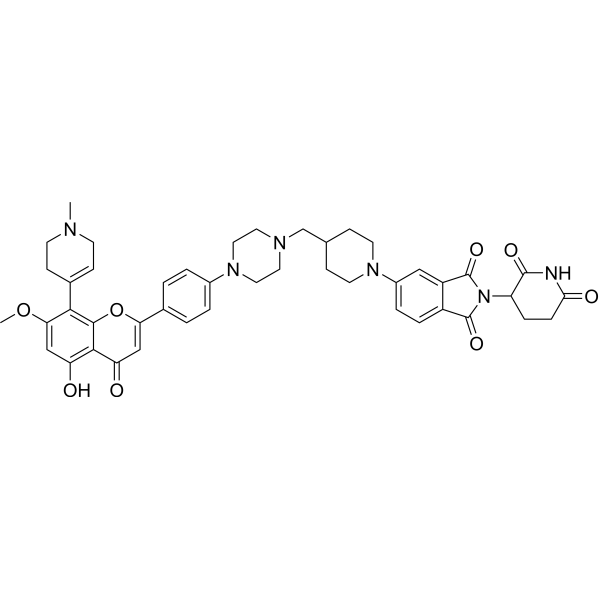 0 ImagesCat. No.: HY-149495CP-07 is a selective flavonoid-based PROTAC degrader that targets and degrades CDK9. CP-07 exhibits an IC50 of 3.3 nM against CDK9/cyclin T1, and induces CDK9 degradation in a concentration-dependent manner in 22RV1 cells with a DC50 of 43 nM. CP-07 rapidly triggers ligand-dependent and proteasome-dependent degradation of CDK9. CP-07 can be applied in prostate cancer-related research.
-
CDK4/6-IN-24
 0 ImagesCat. No.: HY-172146CAS No.: 2662813-96-7CDK4/6-IN-24 (Compound A) is the inhibitor for CDK4/6. CDK4/6-IN-24 exhibits board-spectrum antitumor activity that inhibits multi cancer cells with IC50 of submicromolar levels.
-
CDK2-IN-54
 0 ImagesCat. No.: HY-180630CAS No.: 3106928-15-5CDK2-IN-54 (Formula I) is a CDK2 inhibitor. CDK2-IN-54 can be used in cancer research such as triple-negative breast cancer, ovarian cancer, bladder cancer, and uterine cancer.
-
Anticancer agent 238
 0 ImagesCat. No.: HY-162670Anticancer agent 238 (compound 5) is an anticancer agent with a notably strong binding affinity towards the CDK-5 enzyme. Anticancer agent 238 shows a strong efficacy agains HCT116 and MCF7 cells, with IC50 values of 13.46 µM and 16.43 µM, respectively.
-
PROTAC CDK9 degrader-11
 0 ImagesCat. No.: HY-170978CAS No.: 3039540-19-4PROTAC CDK9 degrader-11 is an orally active, selective CDK9 PROTAC degrader with a DC50 of 1.09 nM. PROTAC CDK9 degrader-11 recruits CRBN to form a ternary complex and degrades CDK9 via the ubiquitin-proteasome pathway, thereby inhibiting RNA polymerase II phosphorylation and downregulating the expression of anti-apoptotic and pro-oncogenic genes, ultimately inducing apoptosis. PROTAC CDK9 degrader-11 is suitable for research on small-cell lung cancer (SCLC).
-
Cyproheptadine-d3
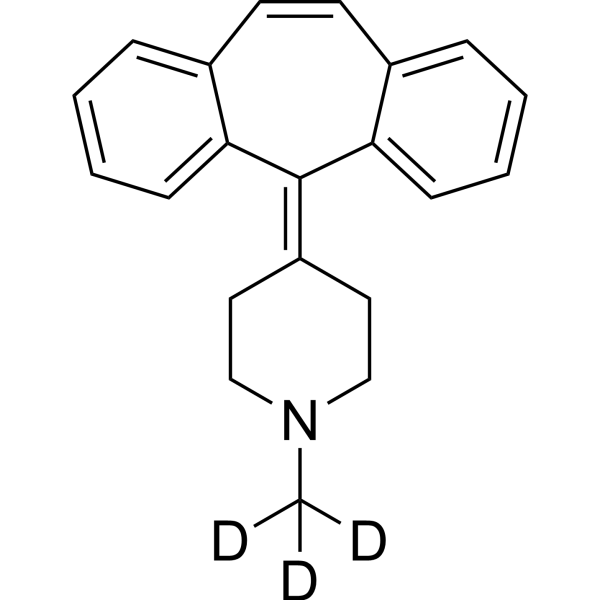 0 ImagesCat. No.: HY-B1622SCAS No.: 2712455-05-3Cyproheptadine-d3 is the d3-labeled Cyproheptadine (HY-B1622). Cyproheptadine acts as a p38 MAP kinase activator, CHK2 activator, histamine H1 receptor inhibitor and serotonin receptor inhibitor. Cyproheptadine mediates cell cycle arrest via G1 phase arrest, G1/S transition arrest, G0/G1 phase arrest, reduced expression of cyclins D1/D2/D3, upregulated expression of HBP1, p16, p21, p27, and decreased phosphorylation of retinoblastoma protein. Cyproheptadine induces Apoptosis by increasing PARP and cleaved PARP, as well as activating the mitochondrial caspase pathway. Cyproheptadine inhibits tumor growth with extremely low toxicity to normal cells. Cyproheptadine can be used in research related to hepatocellular carcinoma, multiple myeloma and acute myeloid leukemia.
-
CDK6-IN-2
 0 ImagesCat. No.: HY-181483CDK6-IN-2 is a CDK6 covalent inhibitor with an IC50 of 0.013 μM. CDK6-IN-2 inhibits the proliferation and migration of triple-negative breast cancer cells, and induces cell cycle arrest and apoptosis. CDK6-IN-2 induces ROS accumulation and mitochondrial damage through cellular metabolic reprogramming. CDK6-IN-2 exhibits anti-tumor activity and can be used for the research of triple-negative breast cancer.
-
Carbonic anhydrase inhibitor 14
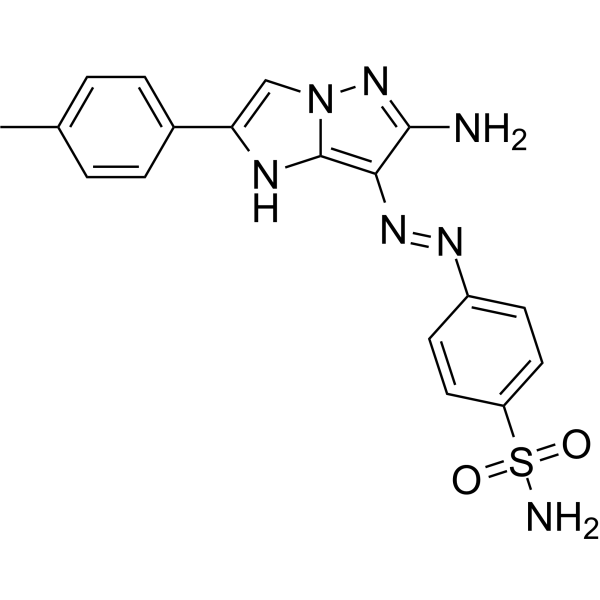 0 ImagesCat. No.: HY-150570CAS No.: 2410402-75-2Carbonic anhydrase inhibitor 14 (Compound 8b) is a carbonic anhydrase (CA) inhibitor with Ki values of 1203, 99.7, 9.4 and 27.7 nM against hCA I, hCA II, hCA IX and hCA XII, respectively. Carbonic anhydrase inhibitor 14 can also inhibit CDK2 with an IC50 of 20.3 μM. Carbonic anhydrase inhibitor 14 shows antitumor activity.
-
PI3Kα-IN-26
 0 ImagesCat. No.: HY-176281PI3Kα-IN-26 (Compound 11e) is a PI3Kα inhibitor with an IC50 of 75.31 nM. PI3Kα-IN-26 has a broad-spectrum anticancer activity, such as leukemia, colon and breast cancer, without significant cytotoxic effect on the normal Vero cells (mean IC50s of 2.74, 3.50, 3.34 and 85.29 μM, respectively).
-
CDK4/6-IN-21 maleate
 0 ImagesCat. No.: HY-164376ACAS No.: 2765997-88-2
-
CDK4/6-IN-20
 0 ImagesCat. No.: HY-162530CAS No.: 3033950-84-1CDK4/6-IN-20 (Compound II-5) is a CDK4/CDK6 inhibitor with IC50 values of 1.9, 14.2 nM, respectively. CDK4/6-IN-20 also inhibits cell proliferation and can be used in cancer research.
-
17β-HSD10/CDK5-IN-1
 0 ImagesCat. No.: HY-18328017β-HSD10/CDK5-IN-1 is a poent dual 17β-HSD10 and CDK5 inhibitor with IC50s of 2.44 and 0.26 μM for 17β-HSD10 and CDK5, respectively. 17β-HSD10/CDK5-IN-1 reduces ROS accumulation, attenuates pathological Tau phosphorylation, reduces Aβ plaque deposition, and ameliorates cognitive deficits in Alzheimer's mice. 17β-HSD10/CDK5-IN-1 can be used for the research of Alzheimer's disease.
-
17β-HSD10-IN-4
 0 ImagesCat. No.: HY-18202817β-HSD10-IN-4 is a selective brain-penetrant 17β-HSD10 inhibitor with an IC50 of 6.33 μM. 17β-HSD10-IN-4 forms key interactions with the 17β-HSD10 catalytic triad to functionally inhibit the enzyme, without altering its protein levels. 17β-HSD10-IN-4 restores mitochondrial function, reduces ROS levels, increases ATP production, and suppresses cytochrome c release. 17β-HSD10-IN-4 attenuates CDK5/p25 activation, reduces Tau hyperphosphorylation, Aβ plaque load and restores brain-derived neurotrophic factor levels. 17β-HSD10-IN-4 improves cognitive function.17β-HSD10-IN-4 can be used for the research of Alzheimer's disease.
-
Palbociclib-C4-Boc
 0 ImagesCat. No.: HY-176365CAS No.: 2139329-48-7Palbociclib-C4-Boc is a Target Protein Ligand-Linker Conjugate that incorporates a ligand for CDK4/6 Palbociclib (HY-50767) and a PROTAC linker (HY-W007803), which recruits E3 ligases. Palbociclib-C4-Boc can be used for synthesis of PROTAC BSJ-03-204 (HY-136250).
-
A09-003
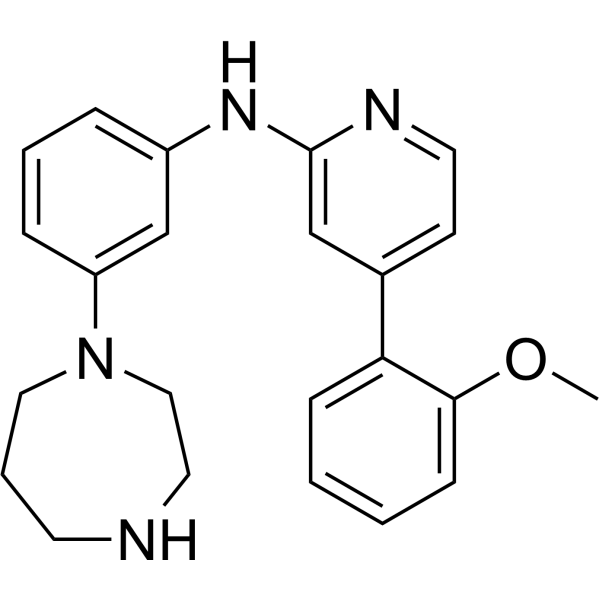 0 ImagesCat. No.: HY-155245CAS No.: 2911646-14-3
-
CDK9-IN-37
 0 ImagesCat. No.: HY-173481CDK9-IN-37 (Compound 24) is a CDK9 inhibitor (EC50: 5.5 nM) with weak inhibition on other CDK isoforms, showing high selectivity. CDK9-IN-37 has significant antiproliferative activity against acute myeloid leukemia MOLM-13 cells (IC50: 0.034 μM). CDK9-IN-37 inhibits the CDK9 signaling pathway, reduces the phosphorylation level of RNAP II CTD (Ser2), downregulates the anti-apoptotic protein McI-1, induces cell apoptosis, and arrests the cell cycle at the G2/M phase. CDK9-IN-37 can be used in the study of acute myeloid leukemia (AML).


-
G721-0282
 0 ImagesG721-0282 is an orally active CHI3L1 inhibitor. G721-0282 can reduce the expression of inflammatory proteins and cytokines. G721-0282 inhibits the activation of the NF-κB signaling pathway. G721-0282 inhibits neuroinflammation and reduces anxious behavior. G721-0282 significantly inhibits the proliferation of osteosarcoma (OS) cells by suppressing the STAT3 signaling pathway. G721-0282 induces OS cell apoptosis by upregulating pro-apoptotic protein levels and downregulating anti-apoptotic protein levels. G721-0282 can be used for researches on neuroinflammatory conditions and cancer.




