
1. Search Result
Search Result
Results for "

14-3-3 protein

" in MedChemExpress (MCE) Product Catalog:

16

Inhibitors & Agonists

2

Peptides

3

Natural
Products

20

Recombinant Proteins

10

Antibodies

Cat. No. Product Name Target Research Areas Chemical Structure
  • HY-122815

    Fusicoccin A

    Apoptosis Cancer
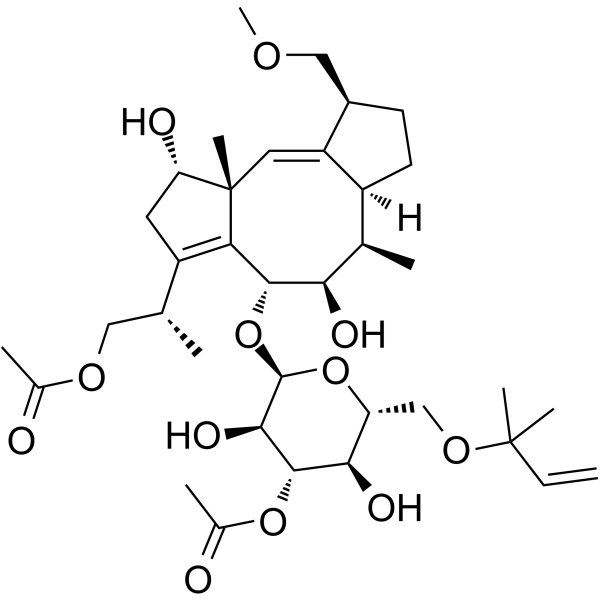
    Fusicoccin (Fusicoccin A), a fungal pytotoxin, is a stabilizer of specific 14-3-3 protein-protein interactions. Fusicoccin sabilizes H +-ATPase/14-3-3 cmplex in pants, maintaining the enzyme in activated state. Fusicoccin also stabilizes 14-3-3 protein interactions with binding partners containing a C-terminal 14-3-3 recognition motif (a mode 3 motif), such as ERα, GPIbα, TASK3, CTFR, and p53. Fusicoccin induces apoptosis in cancer cells and has anticancer activity .
    Fusicoccin
  • HY-115501

    Ser/Thr Protease Cancer
    (E)-FOBISIN101 is a 14-3-3 protein-protein interaction (14-3-3 protein-protein interaction) inhibitor, with IC50 values of 9.3 and 16.4 μM for disrupting the binding of 14-3-3ζ or 14-3-3γ to PRAS40, respectively. (E)-FOBISIN101 inhibits the binding of 14-3-3 to Raf-1 and proline-rich AKT substrate, and neutralizes the ability of 14-3-3 to activate exotoxin S ADP-ribosyltransferase. (E)-FOBISIN101 is applicable to 14-3-3-mediated cancer research .
    (E)-FOBISIN101
  • HY-177590

    MMP Others
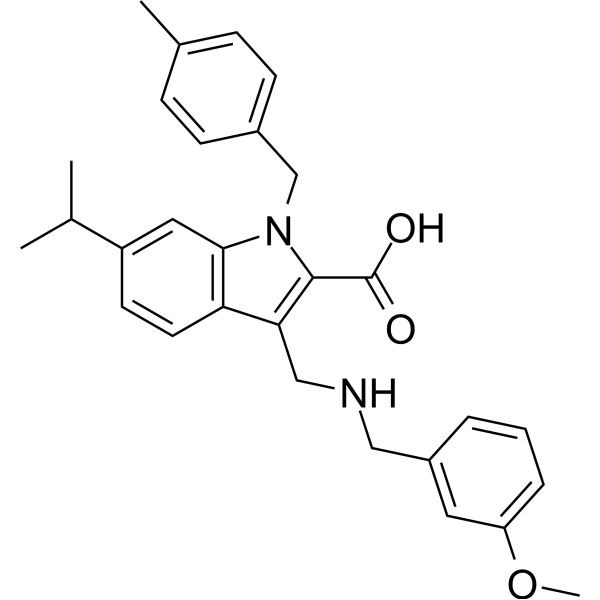
    14-3-3-IN-2 is a 14-3-3 protein inhibitor with an IC50 of 15 nM. 14-3-3-IN-2 can disrupt the interaction of 14-3-3α with aminopeptidase N and down-regulate 14-3-3α increased MMP-1 mRNA levels .
    14-3-3-IN-2
  • HY-P1380A

    Apoptosis Bcl-2 Family Caspase Cancer
    Difopein TFA is a 14-3-3 protein inhibitor. Difopein TFA acts as an apoptosis inducer, regulates apoptosis-related proteins, downregulates Bcl-2, upregulates Bax, activates caspase-9 and caspase-3, and induces nuclear fragmentation, membrane-enclosed apoptotic bodies and DNA ladder formation. Difopein TFA serves as a tumor growth inhibitor, which inhibits the proliferation of glioma cells and induces their apoptosis in in vivo nude mouse models. Difopein TFA is applicable to glioma-related research .
    Difopein TFA
  • HY-146302
    14-3-3η Protein inhibitor 1
    2 Publications Verification

    Apoptosis Cancer
    14-3-3η Protein inhibitor 1 (Compound C11) is a 14-3-3η protein inhibitor with a KD of 35 µM. 14-3-3η Protein inhibitor 1 shows inhibitory activities against several typical human liver cancer cell lines. 14-3-3η Protein inhibitor 1 induces cell apoptosis and G1-S cell cycle arrest with good metabolic stability .
    14-3-3η Protein inhibitor 1
  • HY-W1005067

    Molecular Glues Hippo (MST) Estrogen Receptor/ERR Others
    EN171 is a covalent ligand that covalently targets both C38 and C96 on 14-3-3 to enhance 14-3-3 interactions with ERα, YAP and TAZ, leading to impaired estrogen receptor and Hippo pathway transcriptional activity. EN171 can not only be used as a molecular glue to enhance native protein interactions but can also be used as a covalent 14-3-3 recruiter in heterobifunctional molecules to sequester nuclear neo-substrates such as BRD4 and BLC6 into the cytosol .
    EN171
  • HY-161611

    YAP Others
    14-3-3-IN-1 (Compound 2) is an inhibitor for 14-3-3 proteins in Arabidopsis thaliana, with an IC50 of 1.21 μM. 14-3-3-IN-1 exhibits different inhibitory activities against different 14-3-3 isomers. 14-3-3-IN-1 promotes the closure of stomata on leaves .
    14-3-3-IN-1
  • HY-170593

    Molecular Glues Metabolic Disease
    ChREBPα/14-3-3 regulator-1 (Compound 43) is a selective molecular gel that can stabilize the interaction of carbohydrate response element binding protein (ChREBP) with 14-3-3 proteins (EC50: 3.8 μM). ChREBPα/14-3-3 regulator-1 effectively protects β cells from glucolipotoxicity and maintains cell function, and can be used in the study of type 2 diabetes .
    ChREBPα/14-3-3 regulator-1
  • HY-N13798

    NF-κB Biochemical Assay Reagents Inflammation/Immunology
    ADHPE is a stabilizer of 14-3-3σ and p65 protein complex. ADHPE inhibits NF-κB (p65) signaling pathway and reduces the inflammatory response. ADHPE can be used for pediatric pneumonia-related acute lung injury and acute respiratory distress syndrome study .
    ADHPE
  • HY-179576

    PROTACs Estrogen Receptor/ERR Others
    CV2a is a 14-3-3-directed molecular glue-based PROTAC that selectively targets the ERα protein complex with an EC50 of 0.10 μM. CV2a cooperatively recruits VHL to the 14-3-3/ERα complex and promotes robust polyubiquitination of the 14-3-3ζ/ERα complex .
    CV2a
  • HY-P1380

    Apoptosis Bcl-2 Family Caspase Cancer
    Difopein is a 14-3-3 protein inhibitor. Difopein acts as an apoptosis inducer, regulates apoptosis-related proteins, downregulates Bcl-2, upregulates Bax, activates caspase-9 and caspase-3, and induces nuclear fragmentation, membrane-enclosed apoptotic bodies and DNA ladder formation. Difopein serves as a tumor growth inhibitor, which inhibits the proliferation of glioma cells and induces their apoptosis in in vivo nude mouse models. Difopein is applicable to glioma-related research .
    Difopein
  • HY-N19296

    Drug Derivative Cancer
    Blapsin B is a potent 14-3-3 inhibitor and a naturally occurring compound from Blaps japanensis. Blapsin B potently inhibits 14-3-3 protein-protein interactions (PPIs) with an IC50 value of 10.0 μM in the ELISA assay and 2.5 μM in the FP assay, respectively. Blapsin B modulates signaling pathways involved in cell proliferation and transformation. Blapsin B can be used for cancer research .
    Blapsin B
  • HY-P2986B

    Endogenous Metabolite Metabolic Disease
    Apo D-Amino Acid Oxidase, Porcine (EC 1.4.3.3) is entirely present as a monomeric protein.
    Apo D-Amino Acid Oxidase, Porcine
  • HY-181617

    12-hFC

    Drug Derivative Cancer
    12-Hydroxyfusicoccin (12-hFC) is a Fusicoccin (HY-122815) derivative. 12-Hydroxyfusicoccin lacks antiproliferative activity and is inactive to protein-protein interactionin and protein synthesis in cancer cells .
    12-Hydroxyfusicoccin
  • HY-W457608

    Drug Derivative Cancer
    CU7218 competitively binds to the phosphopeptide-binding pocket of 14-3-3ε and blocks its interaction with the 9J10 peptide. CU7218 can be used in cancer research .
    CU7218
  • HY-182304

    Amyloid-β α-synuclein Amylin Receptor Tau Protein SOD Neurological Disease
    CLR01 sodium is a blood-brain barrier-permeable anti-aggregation agent. CLR01 sodium inhibits the de novo aggregation of Amyloid-β 40/42, α-synuclein, IAPP, tau protein and SOD1. CLR01 sodium reduces amyloid plaque burden in the cortex of triple-transgenic mice and improves the memory and motor abilities of these mice. CLR01 sodium can be used in research related to Alzheimer's disease, Parkinson's disease, and amyotrophic lateral sclerosis (ALS) .
    CLR01 sodium

Inquiry Online

Your information is safe with us. * Required Fields.

Salutation


Country or Region *

Applicant Name *


Organization Name *

Department *


Email Address *


Product Name *

Cat. No.


Requested quantity *

Phone Number *


Remarks

Inquiry Online

Inquiry Information

Product Name:
Cat. No.:
Quantity:
MCE Japan Authorized Agent:

