



14-3-3 theta Antibody (YA1955)(PBS only)
(Synonyms: YWHAQ; 14-3-3 protein theta; 14-3-3 protein T-cell; 14-3-3 protein tau; Protein HS1)14-3-3 theta Antibody (YA1955) is a Rabbit-derived and non-conjugated IgG monoclonal antibody, targeting to 14-3-3 theta.
-
Host:
Rabbit
-
Isotype:
IgG
-
Application:
WB
-
Reactivity :
Human, Mouse, Rat
-
Formulation:
Supplied in PBS, pH 7.4.
-
Conjugation:
Non-conjugated


To place orders, for customer services and technical support, please contact: MedChemExpress USA
Tel: 609-228-6898 E-mail: [email protected] [email protected]





Applications
| Application |
WB

WB: Western Blot
|
|---|---|
| Dilution Ratio | 1:500-1:1000 |


Product Details
14-3-3 theta Antibody (YA1955) is a Rabbit-derived and non-conjugated IgG monoclonal antibody, targeting to 14-3-3 theta.
-
Host Rabbit

-
Species ReactivityHuman, Mouse, Rat

-
Observed Molecular WeightObserved band size: 28 kDa
Note: Due to possible protein modifications or aggregation, the molecular weight should be confirmed by actual measurement, and the predicted value is for reference only.

-
Calculated Molecular Weight Predicted band size: 28 kDa

A synthetic peptide of human 14-3-3 Theta/Tau
Affinity Purified
Non-conjugated
IgG


Product Properties
-
Appearance
Solution
-
Formulation
Supplied in PBS, pH 7.4.
-
Storage & Stability
Stored at -20°C for 1 year. Avoid repeated freeze / thaw cycles.
-
Shipping
Shipping with blue ice.


Verification Images
-
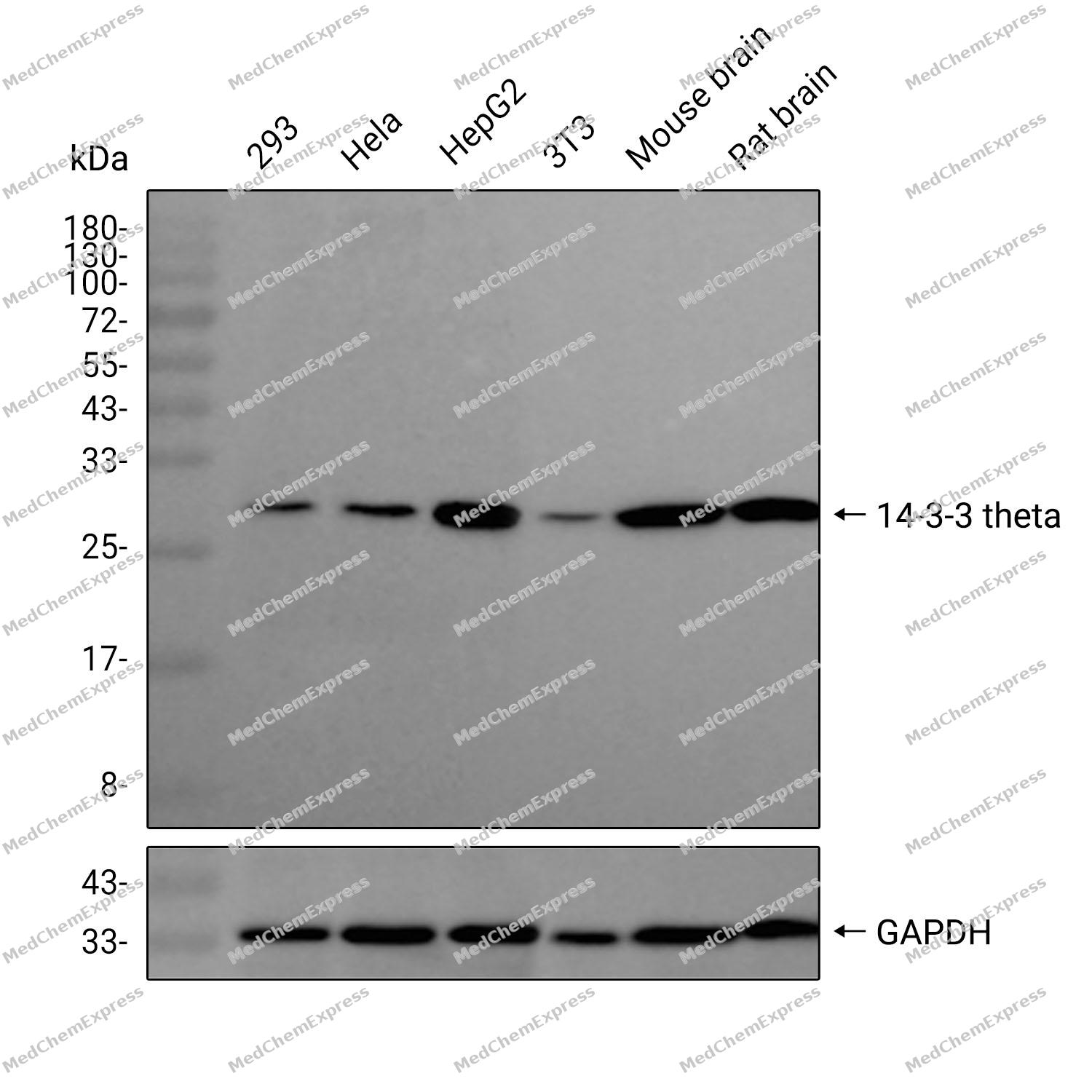 Western blot analysis was performed on extracts from 293 (lane 1, 15 μg), Hela (lane 2, 15 μg), HepG2 (lane 3, 15 μg), 3T3 (lane 4, 15 μg), Mouse brain (lane 5, 15 μg), and Rat brain (lane 6, 15 μg) using 14-3-3 theta Rabbit mAb.Proteins were transferred to a PVDF membrane and blocked with 5% non-fat milk in TBST at 4°C overnight.The primary antibody (1:1000 dilution) and the loading control antibody (GAPDH, HY-P80137, 1:20000 dilution) were incubated in 5% non-fat milk in TBST for 1 hour at 37°C.Goat Anti-Rabbit IgG-HRP Secondary Antibody (1:20000 dilution) was then applied for 40 minutes at 37°C.


Background
-
Function
Adapter protein implicated in the regulation of a large spectrum of both general and specialized signaling pathways. Binds to a large number of partners, usually by recognition of a phosphoserine or phosphothreonine motif. Binding generally results in the modulation of the activity of the binding partner. Negatively regulates the kinase activity of PDPK1
-
Subcellular Localization
Cytoplasm
-
Expression
Tissue_specificity:This gene is highly expressed in the brain, heart, and pancreas, and less so in the kidneys and placenta. Compared with controls, gene expression is upregulated in the lumbar spinal cord of sporadic amyotrophic lateral sclerosis (ALS) , with the highest expression levels in the predominantly motor neuron involvement. -
Subunit
Homodimer. Interacts with CDK16 (By similarity). Interacts with RGS7 (phosphorylated form) (PubMed:10862767).
-
SwissProt ID
-
Synonyms
YWHAQ; 14-3-3 protein theta; 14-3-3 protein T-cell; 14-3-3 protein tau; Protein HS1
-
Research Field
Neuroscience


Documentation
References
[1]. Obsilova V, et al. Structural insights into the functional roles of 14-3-3 proteins. Front Mol Biosci. 2022;9:1016071. [Content Brief]
[2]. Muslin AJ, et al. Interaction of 14-3-3 with signaling proteins is mediated by the recognition of phosphoserine. Cell. 1996;84(6):889-897. [Content Brief]
[3]. Yang X, et al. Structural basis for protein-protein interactions in the 14-3-3 protein family. Proc Natl Acad Sci U S A. 2006;103(46):17237-17242. [Content Brief]
[4]. Gardino AK, et al. 14-3-3 proteins as signaling integration points for cell cycle control and apoptosis. Semin Cell Dev Biol. 2011;22(7):688-695. [Content Brief]
[5]. Pennington KL, et al. The dynamic and stress-adaptive signaling hub of 14-3-3: emerging mechanisms of regulation and context-dependent protein-protein interactions. Oncogene. 2018;37(42):5587-5604. [Content Brief]
[6]. Li Z, et al. 14-3-3σ, the double-edged sword of human cancers. Am J Transl Res. 2009;1(4):326-340. [Content Brief]
[7]. Maksymowych WP, et al. Serum 14-3-3η is a novel marker that complements current serological measurements to enhance detection of patients with rheumatoid arthritis. J Rheumatol. 2014;41(11):2104-2113. [Content Brief]
[8]. Aghazadeh Y, et al. The role of the 14-3-3 protein family in health, disease, and drug development. Drug Discov Today. 2016;21(2):278-287. [Content Brief]

 Powered by Bioz
