




Search Result
Results for "
cell epitope
" in MedChemExpress (MCE) Product Catalog:
164
Biochemical Assay Reagents
| Cat. No. |
Product Name |
Target |
Research Areas |
Chemical Structure |
-
- HY-P99634
-
|
PankoMab; DS-3939a antibody
|
Mucin
|
Cancer
|
|
Gatipotuzumab (PankoMab) is a humanized monoclonal antibody which recognizes the tumor-specific epitope of mucin-1 (TA-MUC1). Gatipotuzumab reveals a potent tumor-specific antibody-dependent cell cytotoxicity (ADCC) .
|
-
-
- HY-P6312
-
|
|
MHC
|
Inflammation/Immunology
|
|
ESAT6 Epitope is a ESAT6 CD4 + T cell epitope. ESAT6 Epitope binds to MHC class I molecules with an IC50 value of approximately 180 nM. ESAT6 Epitope has weak immunogenicity. ESAT6 Epitope can be used in studies related to pulmonary tuberculosis .
|
-
-
- HY-P2511
-
-
-
- HY-P2560
-
|
|
Arenavirus
|
Infection
Inflammation/Immunology
|
|
LCMV GP (61-80) is a peptide fragment derived from lymphocytic choriomeningitis virus (LCMV) glycoprotein (GP), and corresponds to amino acids 61-80. LCMV GP (61-80) is a specific epitope which can induce CD4 + T-cell response .
|
-
-
- HY-P99674
-
|
GEN-3009
|
Transmembrane Glycoprotein
|
Cancer
|
|
Ivicentamab (GEN-3009) is a bispecific antibody targeting CD37 with dual epitopes. Ivicentamab carries an E430G mutation in the Fc region, which efficiently promotes IgG hexamer formation on the surface of target cells. Ivicentamab provides the parental variable regions for an H429F-engineered anti-CD37 bispecific antibody, enabling it to exert complement-dependent cytotoxicity in Daudi lymphoma cells. Ivicentamab is mainly used in lymphoma-related research .
|
-
-
- HY-161543
-
|
|
Biochemical Assay Reagents
|
Inflammation/Immunology
|
|
DHT/KLH is a conjugate of DHT (dihydrotestosterone) and keyhole limpet hemocyanin (KLH). By conjugating the antigen with a protein adjuvant, the production of antigen-specific antibodies in vaccine models can be enhanced. The conjugate does not affect protein folding or disrupt linear epitopes, and it can enhance cross-presentation and the generation of antigen-specific T cells.
|
-
-
- HY-P99454
-
|
ABBV-838
|
Antibody-Drug Conjugates (ADCs)
|
Cancer
|
|
Azintuxizumab vedotin (ABBV-838) is an antibody–drug conjugate (ADC) targeting a unique epitope of CD2 subset 1, a cell-surface glycoprotein expressed on multiple myeloma cells .
|
-
-
- HY-P2455
-
|
Listeriolysin O (91-99)
|
Bacterial
|
Infection
Inflammation/Immunology
|
|
LLO (91-99) (Listeriolysin O (91-99)) is an exotoxin and class I MHC-restricted T-cell epitope of listeriolysin (LLO). LLO (91-99) is processed by antigen-presenting cells, binds to MHC class I molecules and is presented to the cell surface. LLO (91-99) induces CTL responses and effectively eliminates Listeria from infected cells. LLO (91-99) can be used in the research of Listeria infections (e.g., listeriosis) .
|
-
-
- HY-161553
-
|
|
Biochemical Assay Reagents
|
Inflammation/Immunology
|
|
Biotin/KLH is an antigen-adjuvant conjugate that consists of Biotin and Keyhole Limpet Hemocyanin (KLH). By conjugating the antigen with a protein adjuvant, the production of antigen-specific antibodies in vaccine models can be enhanced. The conjugate does not affect protein folding or disrupt major epitopes, and it can enhance cross-presentation and the generation of antigen-specific T cells.
|
-
-
- HY-161533
-
|
|
Biochemical Assay Reagents
|
Inflammation/Immunology
|
|
Digoxin/BSA is an antigen-adjuvant conjugate of Digoxin (HY-B1049) and Bovine Serum Albumin (BSA). By conjugating the antigen with a protein adjuvant, the production of antigen-specific antibodies in vaccine models can be enhanced. The conjugate does not affect protein folding or disrupt major epitopes, and it can enhance cross-presentation and the generation of antigen-specific T cells.
|
-
-
- HY-161560
-
|
|
Biochemical Assay Reagents
|
Inflammation/Immunology
|
|
Tacrolimus/BSA is the antigen-adjuvant conjugate formed by the conjugation of Tacrolimus (HY-13756) with Bovine Serum Albumin (BSA). By conjugating the antigen with a protein adjuvant, it can enhance the production of antigen-specific antibodies in vaccine models. The conjugate does not affect protein folding or disrupt major epitopes, and it can enhance cross-presentation and the generation of antigen-specific T cells.
|
-
-
- HY-P5425A
-
|
|
Transmembrane Glycoprotein
|
Cancer
|
|
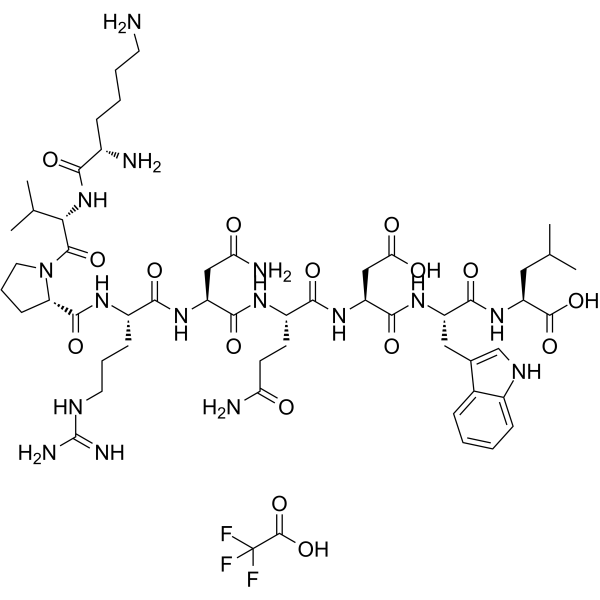
Tetanus Toxin (830–844) TFA is a biological active peptide. (tetanus toxin-derived peptide TT830–844 CD4 + T-cell epitope. This promiscuous CD4 + T-cell epitope can bind to a wide range of HLA–DRB molecules and is thus expected to activate CD4 + T-cell responses in a large part of the human population) .
|
-
-
- HY-N10631
-
|
|
Endogenous Metabolite
|
Infection
Inflammation/Immunology
Cancer
|
|
Paucimannose is a mannosidic N-glycan epitope. It acts as a carcinoembryonic antigen, and a marker for cancer, stem cell properties and inflammation. Paucimannose mainly exists in plants and invertebrates. It consists of oligomannose-type N-glycans that preferentially bind to mannose-binding lectin. Paucimannose localizes on the surface of resting cells and translocates upon cell activation. It can be used in studies related to Pseudomonas aeruginosa infection, cancer and pancreatitis .
|
-
-
- HY-P3723
-
|
|
IFNAR
|
Inflammation/Immunology
|
|
MBP (83-99) is a MBP-specific T cell lines recognizing the immunodominant epitope. MBP (83-99) induces proliferation and IFN-γ secreting of T cells .
|
-
-
- HY-P10582A
-
|
|
MHC
|
Inflammation/Immunology
|
|
SIYNFEKL TFA is a variant of major MHC class I-restricted epitope SIINFEKL. SIYNFEKL TFA is an antigenic peptide, that can stimulate specific T cells in experimental settings to study the competitive interaction between T cell. SIYNFEKL TFA exhibits low affinity for the OT-I T cell receptor (TCR), and can be used for detection of CD8+ T cells .
|
-
-
- HY-P10581A
-
|
|
MHC
|
Inflammation/Immunology
|
|
SIIVFEKL TFA is a variant of the major MHC class I-restricted epitope SIINFEKL. SIIVFEKL TFA is an antigenic peptide, that can stimulate specific T cells in experimental settings to study the competitive interaction between T cells. SIIVFEKL TFA exhibits low affinity for the OT-I T cell receptor (TCR), and can be used for detection of CD8+ T cells .
|
-
-
- HY-161541
-
|
|
Biochemical Assay Reagents
|
Inflammation/Immunology
|
|
Estradiol/BSA is the antigen-adjuvant conjugate formed by the coupling of Estradiol (HY-B0141) with Bovine Serum Albumin (BSA). By coupling the antigen with a protein adjuvant, the production of antigen-specific antibodies in vaccine models can be enhanced. The conjugate does not affect protein folding or disrupt major epitopes, and it can enhance cross-presentation and the generation of antigen-specific T cells.
|
-
-
- HY-161552
-
|
|
Biochemical Assay Reagents
|
Inflammation/Immunology
|
|
T3/BSA is an antigen-adjuvant conjugate of T3 (thyroid hormone) and bovine serum albumin (BSA). By conjugating the antigen with a protein adjuvant, the production of antigen-specific antibodies in vaccine models can be enhanced. The conjugate does not affect protein folding or disrupt major epitopes, and it can enhance cross-presentation and the generation of antigen-specific T cells.
|
-
-
- HY-161526
-
|
|
Biochemical Assay Reagents
|
Inflammation/Immunology
|
|
T3/KLH is an antigen-adjuvant conjugate formed by the coupling of T3 (thyroid hormone) with keyhole limpet hemocyanin (KLH). By coupling the antigen with the protein adjuvant, the production of antigen-specific antibodies in vaccine models can be enhanced. The conjugate does not affect protein folding or disrupt major epitopes, and it can enhance cross-presentation and the generation of antigen-specific T cells.
|
-
-
- HY-P991000
-
|
AU-007; BD-8; BDG8
|
Interleukin Related
|
Cardiovascular Disease
Inflammation/Immunology
Cancer
|
|
Imneskibart (AU-007) is a human monoclonal antibody that binds to the CD25-binding epitope of interleukin-2 (IL-2), blocking the binding of IL-2 to the trimeric IL-2 receptor while retaining the ability to bind to the dimeric IL-2 receptor. Imneskibart expands effector T cell and NK cell populations, reduces regulatory T cells, increases the effector T cell/regulatory T cell ratio, and alleviates vascular leakage. Imneskibart can be used in research related to melanoma and non-small cell lung cancer. The corresponding isotype control is: Human IgG1 kappa, Isotype Control (HY-P99001) .
|
-
-
- HY-P4032
-
|
|
HCV
|
Inflammation/Immunology
|
|
HCV Peptide (35-44), a HCV core protein at positions 35 to 44, is a HLA-A2-restricted CTL epitope. HCV Peptide (35-44) inhibits NK cell activity via two distinct mechanisms, directly via KIR2DL2/3, and synergistically via the CD94:NKG2A receptor .
|
-
-
- HY-P10593
-
|
|
Transmembrane Glycoprotein
Influenza Virus
|
Cancer
|
|
Influenza A NP (383-391) (HLA-B27) is a peptide sequence derived from tetanus toxin. Influenza A NP (383-391) (HLA-B27) is a broadly immunogenic CD4+ T helper cell epitope that enhances CD8+ cytotoxic T lymphocyte (CTL) responses. Influenza A NP (383-391) (HLA-B27) can be used in breast cancer research .
|
-
-
- HY-161566
-
|
|
Biochemical Assay Reagents
|
Inflammation/Immunology
|
|
DHT/BSA is an antigen-adjuvant conjugate formed by the coupling of DHT (dihydrotestosterone) and bovine serum albumin (BSA). By conjugating the antigen with the protein adjuvant, the production of antigen-specific antibodies in vaccine models can be enhanced. The conjugate does not affect protein folding or disrupt major epitopes, and it can enhance cross-presentation and the generation of antigen-specific T cells.
|
-
-
- HY-158279
-
|
|
Antibiotic
Bacterial
|
Inflammation/Immunology
|
|
Gentamicin/OVA is an antigen-adjuvant conjugate conjugate of Gentamicin (HY-A0276A) and ovalbumin (OVA). By conjugating the antigen with a protein adjuvant, the production of antigen-specific antibodies in vaccine models can be enhanced. The conjugate does not affect protein folding or disrupt major epitopes, and can enhance cross-presentation and the production of antigen-specific T cells.
|
-
-
- HY-155983
-
|
|
Nucleoside Antimetabolite/Analog
|
Cancer
|
|
E07 aptamer is an aptamer that targets human EGFR. E07 aptamer can compete with EGF for binding, binds to a novel epitope on EGFR. E07 aptamer binds to cells expressing EGFR, blocks receptor autophosphorylation, and prevents proliferation of tumor cells in three-dimensional matrices. E07 aptamer can be used for tomor disease research .
|
-
-
- HY-P10663
-
-
-
- HY-P5745
-
|
|
Transmembrane Glycoprotein
|
Cancer
|
|
TYVPANASL is a MHC I-binding CD8 T cell epitope of nine amino acids from HER2/neu. TYVPANASL can be used to prepare J-LEAPS vaccine .
|
-
-
- HY-P5745A
-
|
|
MHC
EGFR
|
Cancer
|
|
TYVPANASL TFA is a MHC I-binding CD8 T cell epitope of nine amino acids from HER2/neu. TYVPANASL TFA can be used to prepare J-LEAPS vaccine .
|
-
-
- HY-P10382
-
|
|
MHC
|
Inflammation/Immunology
|
|
M133 peptide is a coronavirus-specific CD4 T cell epitope. M133 peptide is immunodominant in mice infected with the neurotropic coronavirus (the JHM strain of mouse hepatitis virus). M133 peptide forms a complex with MHC II molecules, which is recognized by specific TCRs, thereby activating CD4 T cells .
|
-
-
- HY-161544
-
|
|
Biochemical Assay Reagents
|
Inflammation/Immunology
|
|
Cholyglycine/BSA is a conjugate of Cholyglycine and Bovine Serum Albumin (BSA). By conjugating the antigen with a protein adjuvant, the production of antigen-specific antibodies in vaccine models can be enhanced. The conjugate does not affect protein folding or disrupt major epitopes, and it can enhance cross-presentation and the production of antigen-specific T cells.
|
-
-
- HY-161587
-
|
|
Biochemical Assay Reagents
|
Inflammation/Immunology
|
|
Chloramphenicol/OVA is a conjugate of Chloramphenicol (HY-B0239) and Ovalbumin (OVA). By conjugating the antigen with a protein adjuvant, the production of antigen-specific antibodies in vaccine models can be enhanced. The conjugate does not affect protein folding or disrupt major epitopes and can enhance cross-presentation and the production of antigen-specific T cells.
|
-
-
- HY-161581
-
|
|
Biochemical Assay Reagents
|
Inflammation/Immunology
|
|
Metronidazole/OVA is a conjugate of Metronidazole (HY-B0318) and Ovalbumin (OVA). By conjugating the antigen with protein adjuvants, the production of antigen-specific antibodies in vaccine models can be enhanced. The conjugate does not affect protein folding or disrupt the primary epitopes, and it can enhance cross-presentation and the generation of antigen-specific T cells.
|
-
-
- HY-161583
-
|
|
Biochemical Assay Reagents
|
Inflammation/Immunology
|
|
Marijuana/BSA is the antigen-adjuvant conjugate of Marijuana and Bovine Serum Albumin (BSA). By conjugating the antigen with a protein adjuvant, the production of antigen-specific antibodies in vaccine models can be enhanced. The conjugate does not affect protein folding or destroy major epitopes, and it can enhance cross-presentation and the production of antigen-specific T cells.
|
-
-
- HY-161549
-
|
|
Biochemical Assay Reagents
|
Inflammation/Immunology
|
|
Phosphotyrosine/BSA is an antigen-adjuvant conjugate formed by coupling Phosphotyrosine with Bovine Serum Albumin (BSA). By conjugating the antigen with protein adjuvants, the production of antigen-specific antibodies in vaccine models can be enhanced. The conjugate does not affect protein folding or disrupt major epitopes, and it can enhance cross-presentation and the generation of antigen-specific T cells.
|
-
-
- HY-161548
-
|
|
Biochemical Assay Reagents
|
Inflammation/Immunology
|
|
Metronidazole/KLH is a conjugate of Metronidazole (HY-B0318) and Keyhole Limpet Hemocyanin (KLH). By conjugating the antigen with the protein adjuvant, the production of antigen-specific antibodies in vaccine models can be enhanced. The conjugate does not affect protein folding or disrupt major epitopes and can enhance cross-presentation and the generation of antigen-specific T cells.
|
-
-
- HY-161562
-
|
|
Biochemical Assay Reagents
|
Inflammation/Immunology
|
|
PROMETON/BSA is an antigen-adjuvant conjugate formed by the coupling of PROMETON with bovine serum albumin (BSA). By coupling the antigen to the protein adjuvant, the production of antigen-specific antibodies in vaccine models can be enhanced. The conjugate does not affect protein folding or disrupt major epitopes, and it can enhance cross-presentation and the production of antigen-specific T cells.
|
-
-
- HY-161529
-
|
|
Angiotensin Receptor
|
Inflammation/Immunology
|
|
Angiotensin I/BSA is an antigen-adjuvant conjugate of Angiotensin I and bovine serum albumin (BSA). By conjugating the antigen with a protein adjuvant, the production of antigen-specific antibodies in vaccine models can be enhanced. The conjugate does not affect protein folding or disrupt major epitopes, and it can enhance cross-presentation and the generation of antigen-specific T cells.
|
-
-
- HY-161531
-
|
|
Biochemical Assay Reagents
|
Inflammation/Immunology
|
|
Diethylstilbestrol/BSA is a conjugate of Diethylstilbestrol (HY-14598) and Bovine Serum Albumin (BSA). By conjugating the antigen with a protein adjuvant, the production of antigen-specific antibodies in vaccine models can be enhanced. The conjugate does not affect protein folding or disrupt major epitopes, and it can enhance cross-presentation and the production of antigen-specific T cells.
|
-
-
- HY-163556
-
|
|
Biochemical Assay Reagents
|
Inflammation/Immunology
|
|
COT/BSA is the antigen-adjuvant conjugate of COT (cyclooctatetraene) and Bovine Serum Albumin (BSA). By conjugating the antigen with a protein adjuvant, the production of antigen-specific antibodies in vaccine models can be enhanced. The conjugate does not affect protein folding or disrupt major epitopes and can enhance cross-presentation and the generation of antigen-specific T cells.
|
-
-
- HY-161542
-
|
|
Biochemical Assay Reagents
|
Inflammation/Immunology
|
|
Isoniazid/BSA is an antigen-adjuvant conjugate of Isoniazid (HY-B0329) and Bovine Serum Albumin (BSA). By conjugating the antigen with a protein adjuvant, the production of antigen-specific antibodies in vaccine models can be enhanced. The conjugate does not affect protein folding or disrupt major epitopes, and it can enhance cross-presentation and the generation of antigen-specific T cells.
|
-
-
- HY-161540
-
|
|
Biochemical Assay Reagents
|
Inflammation/Immunology
|
|
Oxytetracycline/OVA is an antigen-adjuvant conjugate formed by the coupling of Oxytetracycline (HY-B0275) with ovalbumin (OVA). By conjugating the antigen with a protein adjuvant, it enhances the production of antigen-specific antibodies in vaccine models. The conjugate does not affect protein folding or destroy the major epitopes, and it can enhance cross-presentation and the generation of antigen-specific T cells.
|
-
-
- HY-163555
-
|
|
Biochemical Assay Reagents
|
Inflammation/Immunology
|
|
BZO/BSA is an antigen-adjuvant conjugate formed by the coupling of BZO (benzodiazepine) with bovine serum albumin (BSA). By conjugating the antigen with a protein adjuvant, the production of antigen-specific antibodies in vaccine models can be enhanced. The conjugate does not affect protein folding or disrupt major epitopes, and it can enhance cross-presentation and the production of antigen-specific T cells.
|
-
-
- HY-161555
-
|
|
Biochemical Assay Reagents
|
Inflammation/Immunology
|
|
Clenbuterol/KLH is an antigen-adjuvant conjugate of Clenbuterol (HY-B1615) and Keyhole Limpet Hemocyanin (KLH). By conjugating the antigen with a protein adjuvant, the production of antigen-specific antibodies in vaccine models can be enhanced. The conjugate does not affect protein folding or disrupt major epitopes, and it can enhance cross-presentation and the generation of antigen-specific T cells.
|
-
-
- HY-161554
-
|
|
Biochemical Assay Reagents
|
Inflammation/Immunology
|
|
Clenbuterol/BSA is an antigen-adjuvant conjugate of Clenbuterol (HY-B1615) and Bovine Serum Albumin (BSA). By conjugating the antigen with a protein adjuvant, it can enhance the production of antigen-specific antibodies in vaccine models. The conjugate does not affect protein folding or disrupt major epitopes, and it can enhance cross-presentation and the generation of antigen-specific T cells.
|
-
-
- HY-161532
-
|
|
Biochemical Assay Reagents
|
Inflammation/Immunology
|
|
Eugenol/OVA is an antigen-adjuvant conjugate formed by the conjugation of Eugenol (HY-N0337) with Ovalbumin (OVA). By conjugating the antigen with a protein adjuvant, the production of antigen-specific antibodies in vaccine models can be enhanced. The conjugate does not affect protein folding or disrupt key epitopes, and it can enhance cross-presentation and the generation of antigen-specific T cells.
|
-
-
- HY-161591
-
|
|
Biochemical Assay Reagents
|
Inflammation/Immunology
|
|
SEM/BSA is an antigen-adjuvant conjugate formed by the conjugation of SEM (furanesalin) with bovine serum albumin (BSA). By conjugating the antigen with a protein adjuvant, the production of antigen-specific antibodies in vaccine models can be enhanced. The conjugate does not affect protein folding or disrupt major epitopes, and it can enhance cross-presentation and the generation of antigen-specific T cells.
|
-
-
- HY-161594
-
|
|
Biochemical Assay Reagents
|
Inflammation/Immunology
|
|
Furazolidone/BSA is the antigen-adjuvant conjugate of Furazolidone (HY-B1336) and bovine serum albumin (BSA). By conjugating the antigen with the protein adjuvant, the production of antigen-specific antibodies in vaccine models can be enhanced. The conjugate does not affect protein folding or disrupt the major epitopes, and it can enhance cross-presentation and the generation of antigen-specific T cells.
|
-
-
- HY-161530
-
|
|
Angiotensin Receptor
|
Inflammation/Immunology
|
|
Angiotensin II/BSA is an antigen-adjuvant conjugate formed by the coupling of Angiotensin II with bovine serum albumin (BSA). By coupling the antigen with a protein adjuvant, the production of antigen-specific antibodies in vaccine models can be enhanced. The conjugate does not affect protein folding or disrupt major epitopes, and it can enhance cross-presentation and the generation of antigen-specific T cells.
|
-
-
- HY-161558
-
|
|
Biochemical Assay Reagents
|
Inflammation/Immunology
|
|
Ractopamine/KLH is an antigen-adjuvant conjugate of Ractopamine (HY-113781) and Keyhole Limpet Hemocyanin (KLH). By conjugating the antigen with a protein adjuvant, the production of antigen-specific antibodies in vaccine models can be enhanced. The conjugate does not affect protein folding or disrupt major epitopes, and it can enhance cross-presentation and the production of antigen-specific T cells.
|
-
-
- HY-163553
-
|
|
Biochemical Assay Reagents
|
Inflammation/Immunology
|
|
Metronidazole/BSA is an antigen-adjuvant conjugate of Metronidazole (HY-B0318) and Bovine Serum Albumin (BSA). By conjugating the antigen with the protein adjuvant, the production of antigen-specific antibodies in vaccine models can be enhanced. The conjugate does not affect protein folding or disrupt major epitopes, and it can enhance cross-presentation and the production of antigen-specific T cells.
|
-
- HY-P10607
-
|
|
EBV
|
Cancer
|
|
IALYLQQNW is a specific nonapeptide sequence derived from the tumor-associated antigen latent membrane protein 1 (LMP1) encoded by Epstein-Barr virus (EBV). As a latent T-cell epitope, IALYLQQNW is able to activate EBV-specific cytotoxic T lymphocytes (CTLs), which are able to recognize and kill EBV-infected cells expressing LMP1. IALYLQQNW plays an important role in the immune response against EBV-associated tumors and can be used in the study of Hodgkin's disease and nasopharyngeal carcinoma .
|
-
- HY-161580
-
|
|
Biochemical Assay Reagents
|
Inflammation/Immunology
|
|
3-Nitrotyrosine/BSA is an antigen-adjuvant conjugate formed by the conjugation of 3-Nitrotyrosine with Bovine Serum Albumin (BSA). By conjugating the antigen with a protein adjuvant, the production of antigen-specific antibodies in vaccine models can be enhanced. The conjugate does not affect protein folding or disrupt major epitopes, and it enhances cross-presentation and the generation of antigen-specific T cells.
|
-
- HY-161590
-
|
|
Biochemical Assay Reagents
|
Inflammation/Immunology
|
|
AHD/BSA is the antigen-adjuvant conjugate of AHD (furan-2-carboxylic acid) and Bovine Serum Albumin (BSA). By conjugating the antigen with the protein adjuvant, the production of antigen-specific antibodies in vaccine models can be enhanced. The conjugate does not affect protein folding or destroy the main epitopes, and it can enhance cross-presentation and the generation of antigen-specific T cells.
|
-
- HY-161586
-
-
- HY-161546
-
|
|
Biochemical Assay Reagents
|
Inflammation/Immunology
|
|
Melamine/KLH is an antigen-adjuvant conjugate formed by coupling Melamine (HY-Y1117) with Keyhole Limpet Hemocyanin (KLH). By conjugating the antigen with a protein adjuvant, the production of antigen-specific antibodies in vaccine models can be enhanced. The conjugate does not affect protein folding or disrupt the primary epitopes, and can enhance cross-presentation and the generation of antigen-specific T cells.
|
-
- HY-161535
-
|
|
Biochemical Assay Reagents
|
Inflammation/Immunology
|
|
Oxytetracycline/BSA is an antigen-adjuvant conjugate formed by the coupling of Oxytetracycline (HY-B0275) with Bovine Serum Albumin (BSA). By conjugating the antigen with the protein adjuvant, the production of antigen-specific antibodies in vaccine models can be enhanced. The conjugate does not affect protein folding or disrupt major epitopes, and it can enhance cross-presentation and the production of antigen-specific T cells.
|
-
- HY-161528
-
|
|
Biochemical Assay Reagents
|
Inflammation/Immunology
|
|
T3/OVA is an antigen-adjuvant conjugate formed by conjugating T3 (thyroxine) with ovalbumin (OVA). By conjugating the antigen with protein adjuvants, the production of antigen-specific antibodies in vaccine models can be enhanced. The conjugate does not affect protein folding or disrupt major epitopes, and it can enhance cross-presentation and the generation of antigen-specific T cells.
|
-
- HY-161557
-
|
|
Biochemical Assay Reagents
|
Inflammation/Immunology
|
|
Ractopamine/BSA is an antigen-adjuvant conjugate formed by the conjugation of Ractopamine (HY-113781) with Bovine Serum Albumin (BSA). By conjugating the antigen with a protein adjuvant, the production of antigen-specific antibodies in vaccine models can be enhanced. The conjugate does not affect protein folding or disrupt major epitopes, and it can enhance cross-presentation and the generation of antigen-specific T cells.
|
-
- HY-161589
-
|
|
Biochemical Assay Reagents
|
Inflammation/Immunology
|
|
GABA/KLH is an antigen-adjuvant conjugate formed by the coupling of GABA (γ-aminobutyric acid) with keyhole limpet hemocyanin (KLH). By coupling the antigen with a protein adjuvant, it can enhance the production of antigen-specific antibodies in vaccine models. The conjugate does not affect protein folding or disrupt major epitopes, and it can enhance cross-presentation and the generation of antigen-specific T cells.
|
-
- HY-161534
-
|
|
Biochemical Assay Reagents
|
Inflammation/Immunology
|
|
Sulfadiazine/BSA is an antigen-adjuvant conjugate formed by the conjugation of Sulfadiazine (HY-B0273) with Bovine Serum Albumin (BSA). By conjugating the antigen with the protein adjuvant, the production of antigen-specific antibodies in vaccine models can be enhanced. The conjugate does not affect protein folding or disrupt major epitopes, and it can enhance cross-presentation and the generation of antigen-specific T cells.
|
-
- HY-161588
-
|
|
Biochemical Assay Reagents
|
Inflammation/Immunology
|
|
GABA/BSA is an antigen-adjuvant conjugate formed by the coupling of GABA (γ-aminobutyric acid) with Bovine Serum Albumin (BSA). By coupling the antigen with a protein adjuvant, the production of antigen-specific antibodies in vaccine models can be enhanced. The conjugate does not affect protein folding or disrupt major epitopes, and it can enhance cross-presentation and the generation of antigen-specific T cells.
|
-
- HY-161559
-
|
|
Biochemical Assay Reagents
|
Inflammation/Immunology
|
|
Sudan I/OVA is an antigen-adjuvant conjugate formed by coupling Sudan I (HY-D0024) with Ovalbumin (OVA). By conjugating the antigen with a protein adjuvant, the production of antigen-specific antibodies in vaccine models can be enhanced. The conjugate does not affect protein folding or disrupt the main epitopes, and it can enhance cross-presentation and the generation of antigen-specific T cells.
|
-
- HY-161585
-
|
|
Biochemical Assay Reagents
|
Inflammation/Immunology
|
|
Diethylstilbestrol/KLH is an antigen-adjuvant conjugate formed by the coupling of Diethylstilbestrol (HY-14598) with Keyhole Limpet Hemocyanin (KLH). By conjugating the antigen with a protein adjuvant, the production of antigen-specific antibodies in vaccine models can be enhanced. The conjugate does not affect protein folding or disrupt major epitopes, and it can enhance cross-presentation and the generation of antigen-specific T cells.
|
-
- HY-161545
-
|
|
Biochemical Assay Reagents
|
Inflammation/Immunology
|
|
Sudan I/BSA is the antigen-adjuvant conjugate formed by Sudan I (HY-D0024) and Bovine Serum Albumin (BSA). By conjugating the antigen with a protein adjuvant, the production of antigen-specific antibodies in vaccine models can be enhanced. The conjugate does not affect protein folding or disrupt major epitopes, and it can enhance cross-presentation and the generation of antigen-specific T cells.
|
-
- HY-161556
-
|
|
Biochemical Assay Reagents
|
Inflammation/Immunology
|
|
Alginic acid/KLH is an antigen-adjuvant conjugate formed by the coupling of Alginic acid (HY-W127758) with Keyhole Limpet Hemocyanin (KLH). By conjugating the antigen with the protein adjuvant, the production of antigen-specific antibodies in vaccine models can be enhanced. The conjugate does not affect protein folding or disrupt major epitopes, and it can enhance cross-presentation and the generation of antigen-specific T cells.
|
-
- HY-161584
-
|
|
Biochemical Assay Reagents
|
Inflammation/Immunology
|
|
Sudan I/KLH is an antigen-adjuvant conjugate formed by the coupling of Sudan I (HY-D0024) with Keyhole Limpet Hemocyanin (KLH). By conjugating the antigen with a protein adjuvant, the production of antigen-specific antibodies in vaccine models can be enhanced. The conjugate does not affect protein folding or disrupt major epitopes, and it can enhance cross-presentation and the generation of antigen-specific T cells.
|
-
- HY-161565
-
|
|
Biochemical Assay Reagents
|
Inflammation/Immunology
|
|
Gastrin(1-17)/BSA is an antigen-adjuvant conjugate formed by the coupling of Gastrin(1-17) and Bovine Serum Albumin (BSA). By conjugating the antigen with a protein adjuvant, the production of antigen-specific antibodies in vaccine models can be enhanced. The conjugate does not affect protein folding or destroy major epitopes, and it can enhance cross-presentation and the production of antigen-specific T cells.
|
-
- HY-163552
-
|
|
Prostaglandin Receptor
|
Inflammation/Immunology
|
|
Prostaglandin F2a/BSA is an antigen-adjuvant conjugate formed by the conjugation of Prostaglandin F2a with Bovine Serum Albumin (BSA). By conjugating the antigen with a protein adjuvant, the production of antigen-specific antibodies in vaccine models can be enhanced. The conjugate does not affect protein folding or disrupt major epitopes and can enhance cross-presentation as well as the generation of antigen-specific T cells.
|
-
- HY-161563
-
|
|
Biochemical Assay Reagents
|
Inflammation/Immunology
|
|
4,4'-Sulfonyldiphenol/BSA is the antigen-adjuvant conjugate of 4,4'-Sulfonyldiphenol (HY-W011927) and Bovine Serum Albumin (BSA). By conjugating the antigen with a protein adjuvant, the production of antigen-specific antibodies in vaccine models can be enhanced. The conjugate does not affect protein folding or disrupt major epitopes, and it can enhance cross-presentation and the production of antigen-specific T cells.
|
-
- HY-161551
-
|
|
Biochemical Assay Reagents
|
Inflammation/Immunology
|
|
25-OH Vitamin D3/KLH is an antigen-adjuvant conjugate of 25-OH Vitamin D3 (HY-158285) and Keyhole Limpet Hemocyanin (KLH). By conjugating the antigen with the protein adjuvant, the production of antigen-specific antibodies in vaccine models can be enhanced. The conjugate does not affect protein folding or disrupt major epitopes, and it can enhance cross-presentation and the generation of antigen-specific T cells.
|
-
- HY-161525
-
|
|
Biochemical Assay Reagents
|
Inflammation/Immunology
|
|
1-(2-Aminoethyl)-1H-pyrazol-4-ylphosphonic acid linker/BSA is the conjugate of 1-(2-Aminoethyl)-1H-pyrazol-4-ylphosphonic acid linker and bovine serum albumin (BSA). By conjugating the antigen with a protein adjuvant, it enhances the production of antigen-specific antibodies in vaccine models. The conjugate does not affect protein folding or disrupt key epitopes, and it can enhance cross-presentation and the generation of antigen-specific T cells.
|
-
- HY-NP0241D
-
|
Chick cyanogen bromide digested peptide 12
|
Biochemical Assay Reagents
|
Inflammation/Immunology
|
|
Chick CB12 of type II collagen (Chick cyanogen bromide digested peptide 12) is a cyanobromide digested peptide (CB-peptide) fragment of type II collagen, which can be used to study B cell and T cell epitopes of type II collagen. This product is pepsin-free, making it ideal for studying T cell epitope specificity through proliferation assays. Chick CB12 of type II collagen can also be used as an antigen for analyzing antibody epitope specificity via ELISA .
|
-
- HY-P5503
-
|
|
HIV
|
Others
|
|
Pol (476-484), HIV-1 RT Epitope is a biological active peptide. (This is a reverse transcriptase (RT) epitope (Pol residues 476-484). Within HIV-1 RT the peptide appears to be the dominant HLA A*0201-restricted epitope. Was used to investigate possible mechanisms behind HIV-1 escape from CTL. IV9 is the actual epitope processed and presented in HIV-1-infected cell lines.)
|
-
- HY-P5294
-
|
|
EBV
|
Cancer
|
|
YLLEMLWRL is an HLA-A2-restricted T cell epitope sequence corresponding to codon 125-133. Among them, YLLEMLWRL sequence is the main mutation site of HLA-A2-restricted CTL epitope sequence .
|
-
- HY-P5305A
-
|
|
GABA Receptor
|
Metabolic Disease
|
|
GAD65(247-266) epitope TFA is the T cell epitopes of islet antigens,binding to I-A g7 (type I diabetes-associated molecule) competitively with poor affinity. GAD65 refers to Glutamic Acid Decarboxylase 65,involved in the conversion of glutamate to gamma-aminobutyric acid (GABA) .
|
-
- HY-P11179
-
-
- HY-P1854
-
|
|
Amyloid-β
|
Neurological Disease
|
|
β-Amyloid (1-9), an N-terminal fragment of beta amyloid, consists of amino acid residues 1 to 9. β-Amyloid (1-9) contains a B cell epitope, but it does not include T cell epitopes. Omission of residues 1 to 9 from the full-length Alzheimer'sβ-Amyloid peptide 1 to 40 does not prevent the peptide from forming amyloid fibrils or eliminate fibril polymorphism .
|
-
- HY-P3070
-
|
|
MHC
|
Infection
Others
|
|
H2-D b restricted epitopes VSV Nucleoprotein (52-59) is a 9-mer peptide derived from the nucleoprotein of Vesicular Stomatitis Virus (VSV). H2-D b restricted epitopes VSV Nucleoprotein (52-59) binds to MHC class I molecules and presents itself to CD8+ T cells, thereby activating cytotoxic T lymphocytes (CTLs), which can recognize and kill cells expressing the corresponding antigen. H2-D b restricted epitopes VSV Nucleoprotein (52-59) can be used in the development of CTL vaccines against Ebola virus .
|
-
- HY-P5930
-
|
MDM2 32-46
|
Ligands for E3 Ligase
|
Cancer
|
|
HOXB7 8–25 (MDM2 32-46) is an MDM2-derived peptide epitope and can elicit antigen-specifc and tumor-reactive CD4 + T cell responses .
|
-
- HY-P1857
-
|
|
Influenza Virus
|
Infection
|
|
CEF7, Influenza Virus NP (380-388) is a HLA-B *08 restricted influenza virus nucleoprotein epitope. Influenza virus NP functions as a key adapter molecule between virus and host cell processes .
|
-
- HY-P2561
-
|
|
Influenza Virus
|
Infection
Inflammation/Immunology
|
|
Influenza Matrix Protein (61-72) is a peptide fragment derived from matrix protein of influenza viruses, corresponds to amino acids 61-72. Influenza Matrix Protein (61-72) is a specific epitope which can induce CD4 + T-cell response .
|
-
- HY-P992097
-
|
|
Transmembrane Glycoprotein
|
Infection
|
|
Fanolesomab is an anti-human CD15-targeting monoclonal antibody. Fanolesomab binds to the CD15 epitope on white blood cells to enable imaging of white blood cell distribution, migration, and infection sites. Fanolesomab can be used for the research of infection .
|
-
- HY-161561
-
|
|
Biochemical Assay Reagents
|
Inflammation/Immunology
|
|
PROMETON/OVA is an antigen-adjuvant conjugate formed by the coupling of PROMETON and ovalbumin (OVA). By conjugating the antigen with a protein adjuvant, the production of antigen-specific antibodies in vaccine models can be enhanced. The conjugate does not affect protein folding or disrupt major epitopes and enhances cross-presentation and the production of antigen-specific T cells.
|
-
- HY-163550
-
|
|
Biochemical Assay Reagents
|
Inflammation/Immunology
|
|
5-MethylCytosine/BSA is a conjugate of 5-MethylCytosine (HY-W008091) and Bovine Serum Albumin (BSA). By conjugating the antigen with the protein adjuvant, the production of antigen-specific antibodies in vaccine models can be enhanced. The conjugate does not affect protein folding or destroy key epitopes, and it can enhance cross-presentation and the generation of antigen-specific T cells.
|
-
- HY-P991904
-
|
|
CD20
|
Cancer
|
|
TG20 is an anti-CD20 monoclonal antibody that binds to a specific discontinuous epitope on CD20 with a Kd of 10–20 nM. TG20 exhibits enhanced antibody-dependent cellular cytotoxicity (ADCC). TG20 also enhances complement-dependent cytotoxicity (CDC) activity. TG20 can be used in research on B-cell lymphomas .
|
-
- HY-NP0243
-
|
Mouse cyanogen bromide digested peptide 8
|
Biochemical Assay Reagents
|
Inflammation/Immunology
|
|
Mouse CB8 of type II collagen (Mouse cyanogen bromide digested peptide 8) is a cyanobromide digested peptide (CB-peptide) fragment of type II collagen, which can be used to study B cell and T cell epitopes of type II collagen. This product is pepsin-free, making it ideal for studying T cell epitope specificity through proliferation assays. Mouse CB8 of type II collagen can also be used as an antigen for analyzing antibody epitope specificity via ELISA .
|
-
- HY-NP0241
-
|
Chick cyanogen bromide digested peptide 8
|
Biochemical Assay Reagents
|
Inflammation/Immunology
|
|
Chick CB8 of type II collagen (Chick cyanogen bromide digested peptide 8) is a cyanobromide digested peptide (CB-peptide) fragment of type II collagen, which can be used to study B cell and T cell epitopes of type II collagen. This product is pepsin-free, making it ideal for studying T cell epitope specificity through proliferation assays. Chick CB8 of type II collagen can also be used as an antigen for analyzing antibody epitope specificity via ELISA .
|
-
- HY-NP0240B
-
|
Bovine cyanogen bromide digested peptide 10
|
Biochemical Assay Reagents
|
Inflammation/Immunology
|
|
Bovine CB10 of type II collagen (Bovine cyanogen bromide digested peptide 10) is a cyanobromide digested peptide (CB-peptide) fragment of type II collagen, which can be used to study B cell and T cell epitopes of type II collagen. This product is pepsin-free, making it ideal for studying T cell epitope specificity through proliferation assays. Bovine CB10 of type II collagen can also be used as an antigen for analyzing antibody epitope specificity via ELISA .
|
-
- HY-NP0243B
-
|
Mouse cyanogen bromide digested peptide 11
|
Biochemical Assay Reagents
|
Inflammation/Immunology
|
|
Mouse CB11 of type II collagen (Mouse cyanogen bromide digested peptide 11) is a cyanobromide digested peptide (CB-peptide) fragment of type II collagen, which can be used to study B cell and T cell epitopes of type II collagen. This product is pepsin-free, making it ideal for studying T cell epitope specificity through proliferation assays. Mouse CB11 of type II collagen can also be used as an antigen for analyzing antibody epitope specificity via ELISA .
|
-
- HY-NP0241B
-
|
Chick cyanogen bromide digested peptide 10
|
Biochemical Assay Reagents
|
Inflammation/Immunology
|
|
Chick CB10 of type II collagen (Chick cyanogen bromide digested peptide 10) is a cyanobromide digested peptide (CB-peptide) fragment of type II collagen, which can be used to study B cell and T cell epitopes of type II collagen. This product is pepsin-free, making it ideal for studying T cell epitope specificity through proliferation assays. Chick CB10 of type II collagen can also be used as an antigen for analyzing antibody epitope specificity via ELISA .
|
-
- HY-NP0240
-
|
Bovine cyanogen bromide digested peptide 8
|
Biochemical Assay Reagents
|
Inflammation/Immunology
|
|
Bovine CB8 of type II collagen (Bovine cyanogen bromide digested peptide 8) is a cyanobromide digested peptide (CB-peptide) fragment of type II collagen, which can be used to study B cell and T cell epitopes of type II collagen. This product is pepsin-free, making it ideal for studying T cell epitope specificity through proliferation assays. Bovine CB8 of type II collagen can also be used as an antigen for analyzing antibody epitope specificity via ELISA .
|
-
- HY-NP0240D
-
|
Bovine cyanogen bromide digested peptide 12
|
Biochemical Assay Reagents
|
Inflammation/Immunology
|
|
Bovine CB12 of type II collagen (Bovine cyanogen bromide digested peptide 12) is a cyanobromide digested peptide (CB-peptide) fragment of type II collagen, which can be used to study B cell and T cell epitopes of type II collagen. This product is pepsin-free, making it ideal for studying T cell epitope specificity through proliferation assays. Bovine CB12 of type II collagen can also be used as an antigen for analyzing antibody epitope specificity via ELISA .
|
-
- HY-NP0241C
-
|
Chick Cyanogen bromide digested peptide 11
|
Biochemical Assay Reagents
|
Inflammation/Immunology
|
|
Chick CB11 of type II collagen (Chick cyanogen bromide digested peptide 11) is a cyanobromide digested peptide (CB-peptide) fragment of type II collagen, which can be used to study B cell and T cell epitopes of type II collagen. This product is pepsin-free, making it ideal for studying T cell epitope specificity through proliferation assays. Chick CB11 of type II collagen can also be used as an antigen for analyzing antibody epitope specificity via ELISA .
|
-
- HY-NP0243A
-
|
Mouse cyanogen bromide digested peptide 10
|
Biochemical Assay Reagents
|
Inflammation/Immunology
|
|
Mouse CB10 of type II collagen (Mouse cyanogen bromide digested peptide 10) is a cyanobromide digested peptide (CB-peptide) fragment of type II collagen, which can be used to study B cell and T cell epitopes of type II collagen. This product is pepsin-free, making it ideal for studying T cell epitope specificity through proliferation assays. Mouse CB10 of type II collagen can also be used as an antigen for analyzing antibody epitope specificity via ELISA .
|
-
- HY-NP0241A
-
|
Chick cyanogen bromide digested peptide 9
|
Biochemical Assay Reagents
|
Inflammation/Immunology
|
|
Chick CB9 of type II collagen (Chick cyanogen bromide digested peptide 9) is a cyanobromide digested peptide (CB-peptide) fragment of type II collagen, which can be used to study B cell and T cell epitopes of type II collagen. This product is pepsin-free, making it ideal for studying T cell epitope specificity through proliferation assays. Chick CB9 of type II collagen can also be used as an antigen for analyzing antibody epitope specificity via ELISA .
|
-
- HY-NP0240C
-
|
Bovine cyanogen bromide digested peptide 11
|
Biochemical Assay Reagents
|
Inflammation/Immunology
|
|
Bovine CB11 of type II collagen (Bovine cyanogen bromide digested peptide 11) is a cyanobromide digested peptide (CB-peptide) fragment of type II collagen, which can be used to study B cell and T cell epitopes of type II collagen. This product is pepsin-free, making it ideal for studying T cell epitope specificity through proliferation assays. Bovine CB11 of type II collagen can also be used as an antigen for analyzing antibody epitope specificity via ELISA .
|
-
- HY-NP0240A
-
|
Bovine cyanogen bromide digested peptide 9.7
|
Biochemical Assay Reagents
|
Inflammation/Immunology
|
|
Bovine CB9.7 of type II collagen (Bovine cyanogen bromide digested peptide 9.7) is a cyanobromide digested peptide (CB-peptide) fragment of type II collagen, which can be used to study B cell and T cell epitopes of type II collagen. This product is pepsin-free, making it ideal for studying T cell epitope specificity through proliferation assays. Bovine CB9.7 of type II collagen can also be used as an antigen for analyzing antibody epitope specificity via ELISA .
|
-
- HY-P11383
-
|
|
AIM2
MHC
|
Cancer
|
|
AIM2-derived decapeptide is an AIM2-derived decapeptide and HLA-A1-restricted T-cell epitope. AIM2-derived decapeptide can be used in the research of melanoma .
|
-
- HY-P991854
-
|
|
Interleukin Related
|
Inflammation/Immunology
|
|
Anti-iNKT Cell Antibody (6B11) recognizes an epitope on T cell receptor (TCR) V alpha 24-J alpha 18. Anti-iNKT Cell Antibody is specific for cloned and primary human but not rodent iNKT and the human invariant TCR-α. Recommend Isotype Controls: Mouse IgG1 kappa, Isotype Control (HY-P99977) .
|
-
- HY-P11407
-
|
|
HIV
|
Infection
|
|
HIV-1 GAG peptide A-I is a specific HIV-1 Gag peptide sequence, known to be a CD8 + T cell epitope. HIV-1 GAG peptide A-I can be used for the research of HIV vaccines. .
|
-
- HY-P0323
-
|
LCMV GP(33-41) C-peptide
|
Arenavirus
|
Infection
|
|
GP(33-41), a 9-aa-long peptide, is the optimal sequence of the GP1 epitope of lymphocytic choriomeningitis virus, and can upregulate H-2D b molecules at the RMA-S (Db Kb) cell surface with a SC50 of 344 nM .
|
-
- HY-106374
-
|
|
VEGFR
|
Cancer
|
|
Elpamotide is an epitope peptide derived from VEGFR2. Elpamotide induces cytotoxic T lymphocytes (CTLs) to kill VEGFR2-expressing endothelial cells. Elpamotide has potential immunostimulatory and antineoplastic activities. Elpamotide can be used in the research of cancer, such as pancreatic cancer .
|
-
- HY-NP0211
-
|
|
Biochemical Assay Reagents
|
Inflammation/Immunology
|
|
DHT-OVA is a conjugate of DHT (Dihydrotestosterone) and OVA peptide. By conjugating the antigen with a protein adjuvant, the production of antigen-specific antibodies in vaccine models can be enhanced. The conjugate does not affect protein folding or disrupt linear epitopes, and it can enhance cross-presentation and the generation of antigen-specific T cells.
|
-
- HY-P992362
-
|
|
CD73
|
Cancer
|
|
HBM1007 is a fully human monoclonal antibody targeting CD73. HBM1007 is an extracellular enzyme expressed on the surface of stromal cells and tumor cells, capable of converting extracellular adenosine monophosphate (AMP) into adenosine, and recognizing CD73 via a unique antigenic epitope. HBM1007 inhibits both CD73-dependent and CD73-independent enzyme activities.
|
-
- HY-P5333
-
|
UB311 immunogen I
|
Amyloid-β
|
Others
|
|
Aβ1-14-εK-KKK-MvF5 Th (UB311 immunogen I) is a biological active peptide. (one of UB-311's Aβ1–14–targeting peptides (B-cell epitope))
|
-
- HY-NP0250
-
|
|
Biochemical Assay Reagents
|
Inflammation/Immunology
|
|
Kanamycin-BSA is a conjugate of Kanamycin (HY-16566) and BSA. By conjugating the antigen with protein adjuvants, the production of antigen-specific antibodies in vaccine models can be enhanced. The conjugate does not affect protein folding or disrupt the primary epitopes, and it can enhance cross-presentation and the generation of antigen-specific T cells .
|
-
- HY-NP0254A
-
|
|
Biochemical Assay Reagents
|
Inflammation/Immunology
|
|
Thyroxin-BSA is a conjugate of Thyroxin (HY-101406) and BSA. By conjugating the antigen with protein adjuvants, the production of antigen-specific antibodies in vaccine models can be enhanced. The conjugate does not affect protein folding or disrupt the primary epitopes, and it can enhance cross-presentation and the generation of antigen-specific T cells .
|
-
- HY-NP0249A
-
|
|
Biochemical Assay Reagents
|
Inflammation/Immunology
|
|
Neomycin-BSA is a conjugate of Neomycin (HY-150520) and BSA. By conjugating the antigen with protein adjuvants, the production of antigen-specific antibodies in vaccine models can be enhanced. The conjugate does not affect protein folding or disrupt the primary epitopes, and it can enhance cross-presentation and the generation of antigen-specific T cells .
|
-
- HY-NP0247
-
|
|
Biochemical Assay Reagents
|
Inflammation/Immunology
|
|
Sulfadimidine-BSA is a conjugate of Sulfadimidine (HY-B0035) and BSA. By conjugating the antigen with protein adjuvants, the production of antigen-specific antibodies in vaccine models can be enhanced. The conjugate does not affect protein folding or disrupt the primary epitopes, and it can enhance cross-presentation and the generation of antigen-specific T cells .
|
-
- HY-NP0250A
-
|
|
Biochemical Assay Reagents
|
Inflammation/Immunology
|
|
Kanamycin-OVA is a conjugate of Kanamycin (HY-16566) and Ovalbumin (OVA). By conjugating the antigen with protein adjuvants, the production of antigen-specific antibodies in vaccine models can be enhanced. The conjugate does not affect protein folding or disrupt the primary epitopes, and it can enhance cross-presentation and the generation of antigen-specific T cells .
|
-
- HY-161557A
-
|
|
Biochemical Assay Reagents
|
Inflammation/Immunology
|
|
Ractopamine-OVA is a conjugate of Ractopamine (HY-113781) and Ovalbumin (OVA). By conjugating the antigen with protein adjuvants, the production of antigen-specific antibodies in vaccine models can be enhanced. The conjugate does not affect protein folding or disrupt the primary epitopes, and it can enhance cross-presentation and the generation of antigen-specific T cells .
|
-
- HY-NP0249
-
|
|
Biochemical Assay Reagents
|
Inflammation/Immunology
|
|
Neomycin-OVA is a conjugate of Neomycin (HY-150520) and Ovalbumin (OVA). By conjugating the antigen with protein adjuvants, the production of antigen-specific antibodies in vaccine models can be enhanced. The conjugate does not affect protein folding or disrupt the primary epitopes, and it can enhance cross-presentation and the generation of antigen-specific T cells .
|
-
- HY-B1091B
-
|
MPD/BSA
|
Biochemical Assay Reagents
|
Others
|
|
Methylphenidate/BSA (MPD/BSA) is an antigen-adjuvant conjugate conjugate of Methylphenidate and BSA. By conjugating the antigen with a protein adjuvant, the production of antigen-specific antibodies in vaccine models can be enhanced. The conjugate does not affect protein folding or disrupt major epitopes, and can enhance cross-presentation and the production of antigen-specific T cells.
|
-
- HY-B1380A
-
|
CAR/BSA
|
Biochemical Assay Reagents
|
Others
|
|
Carisoprodol/BSA (CAR/BSA) is an antigen-adjuvant conjugate conjugate of Carisoprodol and BSA. By conjugating the antigen with a protein adjuvant, the production of antigen-specific antibodies in vaccine models can be enhanced. The conjugate does not affect protein folding or disrupt major epitopes, and can enhance cross-presentation and the production of antigen-specific T cells.
|
-
- HY-NP0251
-
|
|
Biochemical Assay Reagents
|
Inflammation/Immunology
|
|
Ofloxacin-BSA is a conjugate of Ofloxacin (HY-B0125) and BS. By conjugating the antigen with protein adjuvants, the production of antigen-specific antibodies in vaccine models can be enhanced. The conjugate does not affect protein folding or disrupt the primary epitopes, and it can enhance cross-presentation and the generation of antigen-specific T cells .
|
-
- HY-NP0255
-
|
|
Biochemical Assay Reagents
|
Inflammation/Immunology
|
|
Amoxicillin-BSA is a conjugate of Amoxicillin (HY-B0467A) and BSA. By conjugating the antigen with protein adjuvants, the production of antigen-specific antibodies in vaccine models can be enhanced. The conjugate does not affect protein folding or disrupt the primary epitopes, and it can enhance cross-presentation and the generation of antigen-specific T cells .
|
-
- HY-161554A
-
|
|
Biochemical Assay Reagents
|
Inflammation/Immunology
|
|
Clenbuterol-OVA is a conjugate of Clenbuterol (HY-101406) and Ovalbumin (OVA). By conjugating the antigen with protein adjuvants, the production of antigen-specific antibodies in vaccine models can be enhanced. The conjugate does not affect protein folding or disrupt the primary epitopes, and it can enhance cross-presentation and the generation of antigen-specific T cells .
|
-
- HY-171435A
-
|
PCP/BSA
|
Biochemical Assay Reagents
|
Others
|
|
Phencyclidine/BSA (PCP/BSA) is an antigen-adjuvant conjugate conjugate of Phencyclidine and BSA. By conjugating the antigen with a protein adjuvant, the production of antigen-specific antibodies in vaccine models can be enhanced. The conjugate does not affect protein folding or disrupt major epitopes, and can enhance cross-presentation and the production of antigen-specific T cells.
|
-
- HY-NP0252
-
|
|
Biochemical Assay Reagents
|
Inflammation/Immunology
|
|
Sulfamonomethoxine-BSA is a conjugate of Sulfamonomethoxine (HY-B0946) and BSA. By conjugating the antigen with protein adjuvants, the production of antigen-specific antibodies in vaccine models can be enhanced. The conjugate does not affect protein folding or disrupt the primary epitopes, and it can enhance cross-presentation and the generation of antigen-specific T cells .
|
-
- HY-NP0253A
-
|
|
Biochemical Assay Reagents
|
Inflammation/Immunology
|
|
Salbutamol-BSA is a conjugate of Salbutamol (HY-B1037) and BSA. By conjugating the antigen with protein adjuvants, the production of antigen-specific antibodies in vaccine models can be enhanced. The conjugate does not affect protein folding or disrupt the primary epitopes, and it can enhance cross-presentation and the generation of antigen-specific T cells .
|
-
- HY-NP0248
-
|
|
Biochemical Assay Reagents
|
Inflammation/Immunology
|
|
Ciprofloxacin-BSA is a conjugate of Ciprofloxacin (HY-B0356) and BSA. By conjugating the antigen with protein adjuvants, the production of antigen-specific antibodies in vaccine models can be enhanced. The conjugate does not affect protein folding or disrupt the primary epitopes, and it can enhance cross-presentation and the generation of antigen-specific T cells .
|
-
- HY-NP0254
-
|
|
Biochemical Assay Reagents
|
Inflammation/Immunology
|
|
Thyroxin-OVA is a conjugate of Thyroxin (HY-101406) and Ovalbumin (OVA). By conjugating the antigen with protein adjuvants, the production of antigen-specific antibodies in vaccine models can be enhanced. The conjugate does not affect protein folding or disrupt the primary epitopes, and it can enhance cross-presentation and the generation of antigen-specific T cells .
|
-
- HY-NP0253
-
|
|
Biochemical Assay Reagents
|
Inflammation/Immunology
|
|
Salbutamol-OVA is a conjugate of Salbutamol (HY-B1037) and Ovalbumin (OVA). By conjugating the antigen with protein adjuvants, the production of antigen-specific antibodies in vaccine models can be enhanced. The conjugate does not affect protein folding or disrupt the primary epitopes, and it can enhance cross-presentation and the generation of antigen-specific T cells .
|
-
- HY-161534A
-
|
|
Biochemical Assay Reagents
|
Inflammation/Immunology
|
|
Sulfadiazine-OVA is a conjugate of Sulfadiazinen (HY-B0273) and Ovalbumin (OVA). By conjugating the antigen with protein adjuvants, the production of antigen-specific antibodies in vaccine models can be enhanced. The conjugate does not affect protein folding or disrupt the primary epitopes, and it can enhance cross-presentation and the generation of antigen-specific T cells .
|
-
- HY-NP0246
-
|
|
Biochemical Assay Reagents
|
Inflammation/Immunology
|
|
Sulfamerazine-OVA is a conjugate of Sulfamerazine (HY-B0512) and Ovalbumin (OVA). By conjugating the antigen with protein adjuvants, the production of antigen-specific antibodies in vaccine models can be enhanced. The conjugate does not affect protein folding or disrupt the primary epitopes, and it can enhance cross-presentation and the generation of antigen-specific T cells .
|
-
- HY-NP0247A
-
|
|
Biochemical Assay Reagents
|
Inflammation/Immunology
|
|
Sulfadimidine-OVA is a conjugate of Sulfadimidine (HY-B0035) and Ovalbumin (OVA). By conjugating the antigen with protein adjuvants, the production of antigen-specific antibodies in vaccine models can be enhanced. The conjugate does not affect protein folding or disrupt the primary epitopes, and it can enhance cross-presentation and the generation of antigen-specific T cells .
|
-
- HY-P11713
-
|
|
EBV
MHC
|
Infection
Cancer
|
|
EBNA3B 399-408 is an immunodominant HLA-A11-restricted cytotoxic T-lymphocyte epitope in EBNA3B. EBNA3B 399-408 can be used in the research of EBV infection, empyema-associated lymphoma, and nasal natural killer cell lymphoma .
|
-
- HY-103447A
-
|
|
Biochemical Assay Reagents
|
Others
|
|
Zearalenone/KLH is an antigen-adjuvant conjugate conjugate of Zearalenone (HY-103447) and KLH. By conjugating the antigen with a protein adjuvant, the production of antigen-specific antibodies in vaccine models can be enhanced. The conjugate does not affect protein folding or disrupt major epitopes, and can enhance cross-presentation and the production of antigen-specific T cells.
|
-
- HY-NP0255A
-
|
|
Biochemical Assay Reagents
|
Inflammation/Immunology
|
|
Amoxicillin-OVA is a conjugate of Amoxicillin (HY-B0467A) and Ovalbumin (OVA). By conjugating the antigen with protein adjuvants, the production of antigen-specific antibodies in vaccine models can be enhanced. The conjugate does not affect protein folding or disrupt the primary epitopes, and it can enhance cross-presentation and the generation of antigen-specific T cells .
|
-
- HY-NP217A
-
|
|
Biochemical Assay Reagents
|
Others
|
|
Valine/BSA is an antigen-adjuvant conjugate conjugate of Valine (HY-N0717) and BSA. By conjugating the antigen with a protein adjuvant, the production of antigen-specific antibodies in vaccine models can be enhanced. The conjugate does not affect protein folding or disrupt major epitopes, and can enhance cross-presentation and the production of antigen-specific T cells.
|
-
- HY-NP209B
-
|
|
Biochemical Assay Reagents
|
Others
|
|
Succinic?acid-KLH is an antigen-adjuvant conjugate conjugate of Succinic acid (HY-N0420) and KLH. By conjugating the antigen with a protein adjuvant, the production of antigen-specific antibodies in vaccine models can be enhanced. The conjugate does not affect protein folding or disrupt major epitopes, and can enhance cross-presentation and the production of antigen-specific T cells.
|
-
- HY-NP0252A
-
|
|
Biochemical Assay Reagents
|
Inflammation/Immunology
|
|
Sulfamonomethoxine-OVA is a conjugate of Sulfamonomethoxine (HY-B0946) and Ovalbumin (OVA). By conjugating the antigen with protein adjuvants, the production of antigen-specific antibodies in vaccine models can be enhanced. The conjugate does not affect protein folding or disrupt the primary epitopes, and it can enhance cross-presentation and the generation of antigen-specific T cells .
|
-
- HY-NP209
-
|
|
Biochemical Assay Reagents
|
Others
|
|
Succinic?acid-BSA is an antigen-adjuvant conjugate conjugate of Succinic acid (HY-N0420) and BSA. By conjugating the antigen with a protein adjuvant, the production of antigen-specific antibodies in vaccine models can be enhanced. The conjugate does not affect protein folding or disrupt major epitopes, and can enhance cross-presentation and the production of antigen-specific T cells.
|
-
- HY-183207
-
|
|
Biochemical Assay Reagents
|
Others
|
|
CD56 peptide/BSA is an antigen-adjuvant conjugate conjugate of CD56 peptide and BSA. By conjugating the antigen with a protein adjuvant, the production of antigen-specific antibodies in vaccine models can be enhanced. The conjugate does not affect protein folding or disrupt major epitopes, and can enhance cross-presentation and the production of antigen-specific T cells.
|
-
- HY-NP0248A
-
|
|
Biochemical Assay Reagents
|
Inflammation/Immunology
|
|
Ciprofloxacin-OVA is a conjugate of Ciprofloxacin (HY-B0356) and Ovalbumin (OVA). By conjugating the antigen with protein adjuvants, the production of antigen-specific antibodies in vaccine models can be enhanced. The conjugate does not affect protein folding or disrupt the primary epitopes, and it can enhance cross-presentation and the generation of antigen-specific T cells .
|
-
- HY-183209A
-
|
|
Biochemical Assay Reagents
|
Others
|
|
Puromycin-KLH is an antigen-adjuvant conjugate conjugate of Puromycin (HY-B1743) and KLH. By conjugating the antigen with a protein adjuvant, the production of antigen-specific antibodies in vaccine models can be enhanced. The conjugate does not affect protein folding or disrupt major epitopes, and can enhance cross-presentation and the production of antigen-specific T cells.
|
-
- HY-NP217B
-
|
|
Biochemical Assay Reagents
|
Others
|
|
Valine/KLH is an antigen-adjuvant conjugate conjugate of Valine (HY-N0717) and KLH. By conjugating the antigen with a protein adjuvant, the production of antigen-specific antibodies in vaccine models can be enhanced. The conjugate does not affect protein folding or disrupt major epitopes, and can enhance cross-presentation and the production of antigen-specific T cells.
|
-
- HY-NP0251A
-
|
|
Biochemical Assay Reagents
|
Inflammation/Immunology
|
|
Ofloxacin-OVA is a conjugate of Ofloxacin (HY-B0125) and Ovalbumin (OVA). By conjugating the antigen with protein adjuvants, the production of antigen-specific antibodies in vaccine models can be enhanced. The conjugate does not affect protein folding or disrupt the primary epitopes, and it can enhance cross-presentation and the generation of antigen-specific T cells .
|
-
- HY-P990073
-
|
REGN-5093
|
c-Met/HGFR
|
Cancer
|
|
Davutamig (REGN-5093) is a human IgG4-kappa, anti-MET bispecific antibody. Davutamig binds 2 distinct epitopes of MET, blocking ligand binding and inducing MET internalization and degradation. Davutamig is applicable to the research of advanced non-small cell lung cancer with MET gene abnormalities .
|
-
- HY-B0015B
-
|
|
Biochemical Assay Reagents
|
Others
|
|
Paclitaxel-BSA is an antigen-adjuvant conjugate conjugate of Paclitaxel (HY-B0015) and BSA. By conjugating the antigen with a protein adjuvant, the production of antigen-specific antibodies in vaccine models can be enhanced. The conjugate does not affect protein folding or disrupt major epitopes, and can enhance cross-presentation and the production of antigen-specific T cells.
|
-
- HY-B0015C
-
|
|
Biochemical Assay Reagents
|
Others
|
|
Paclitaxel-KLH is an antigen-adjuvant conjugate conjugate of Paclitaxel (HY-B0015) and KLH. By conjugating the antigen with a protein adjuvant, the production of antigen-specific antibodies in vaccine models can be enhanced. The conjugate does not affect protein folding or disrupt major epitopes, and can enhance cross-presentation and the production of antigen-specific T cells.
|
-
- HY-P4046
-
|
|
HIV
|
Inflammation/Immunology
|
|
HBV Seq2 aa:179-186 serve as effective motifs for CTL response in H-2b system after in vitro restimulation of the primed T cells. HBV Seq2 aa:179-186 is a novel epitope identified on the surface antigen of hepatitis B virus .
|
-
- HY-NP0207A
-
|
|
Biochemical Assay Reagents
|
Others
|
|
Vomitoxin/KLH is an antigen-adjuvant conjugate conjugate of Vomitoxin (HY-N6684) and KLH. By conjugating the antigen with a protein adjuvant, the production of antigen-specific antibodies in vaccine models can be enhanced. The conjugate does not affect protein folding or disrupt major epitopes, and can enhance cross-presentation and the production of antigen-specific T cells.
|
-
- HY-183209
-
|
|
Biochemical Assay Reagents
|
Others
|
|
Puromycin-BSA is an antigen-adjuvant conjugate conjugate of Puromycin (HY-B1743) and BSA. By conjugating the antigen with a protein adjuvant, the production of antigen-specific antibodies in vaccine models can be enhanced. The conjugate does not affect protein folding or disrupt major epitopes, and can enhance cross-presentation and the production of antigen-specific T cells.
|
-
- HY-183211B
-
|
|
Biochemical Assay Reagents
|
Others
|
|
Glycyrrhizic acid/KLH is an antigen-adjuvant conjugate conjugate of Glycyrrhizic acid (HY-N0184) and KLH. By conjugating the antigen with a protein adjuvant, the production of antigen-specific antibodies in vaccine models can be enhanced. The conjugate does not affect protein folding or disrupt major epitopes, and can enhance cross-presentation and the production of antigen-specific T cells.
|
-
- HY-183208
-
|
|
Biochemical Assay Reagents
|
Others
|
|
Ki-67 peptide/BSA is an antigen-adjuvant conjugate conjugate of Ki-67 peptide and BSA. By conjugating the antigen with a protein adjuvant, the production of antigen-specific antibodies in vaccine models can be enhanced. The conjugate does not affect protein folding or disrupt major epitopes, and can enhance cross-presentation and the production of antigen-specific T cells.
|
-
- HY-183211A
-
|
|
Biochemical Assay Reagents
|
Inflammation/Immunology
|
|
Glycyrrhizic acid/OVA is an antigen-adjuvant conjugate conjugate of Glycyrrhizic acid (HY-N0184) and ovalbumin (OVA). By conjugating the antigen with a protein adjuvant, the production of antigen-specific antibodies in vaccine models can be enhanced. The conjugate does not affect protein folding or disrupt major epitopes, and can enhance cross-presentation and the production of antigen-specific T cells.
|
-
- HY-183209B
-
|
|
Biochemical Assay Reagents
|
Others
|
|
Puromycin-OVA is an antigen-adjuvant conjugate conjugate of Puromycin (HY-B1743) and ovalbumin (OVA). By conjugating the antigen with a protein adjuvant, the production of antigen-specific antibodies in vaccine models can be enhanced. The conjugate does not affect protein folding or disrupt major epitopes, and can enhance cross-presentation and the production of antigen-specific T cells.
|
-
- HY-NP0245
-
|
|
Biochemical Assay Reagents
|
Inflammation/Immunology
|
|
Retinoic acid-HSA is a conjugate of Retinoic acid (HY-14649) and Human serum albumin (HSA). By conjugating the antigen with protein adjuvants, the production of antigen-specific antibodies in vaccine models can be enhanced. The conjugate does not affect protein folding or disrupt the primary epitopes, and it can enhance cross-presentation and the generation of antigen-specific T cells .
|
-
- HY-B1277C
-
|
THP/BSA
|
Biochemical Assay Reagents
|
Others
|
|
Trihexyphenidyl/BSA (THP/BSA) is an antigen-adjuvant conjugate conjugate of Trihexyphenidyl (HY-B1277A) and BSA. By conjugating the antigen with a protein adjuvant, the production of antigen-specific antibodies in vaccine models can be enhanced. The conjugate does not affect protein folding or disrupt major epitopes, and can enhance cross-presentation and the production of antigen-specific T cells.
|
-
- HY-P0323A
-
|
LCMV GP(33-41) C-peptide TFA
|
Arenavirus
|
Infection
|
|
GP(33-41) TFA, a 9-aa-long peptide, is the optimal sequence of the GP1 epitope of lymphocytic choriomeningitis virus. GP(33-41) TFA can upregulate H-2D b molecules at the RMA-S (Db Kb) cell surface with a SC50 of 344 nM .
|
-
- HY-183210
-
|
|
Biochemical Assay Reagents
|
Others
|
|
Ochratoxin A/BSA is an antigen-adjuvant conjugate conjugate of Ochratoxin A (HY-N6788) and BSA. By conjugating the antigen with a protein adjuvant, the production of antigen-specific antibodies in vaccine models can be enhanced. The conjugate does not affect protein folding or disrupt major epitopes, and can enhance cross-presentation and the production of antigen-specific T cells.
|
-
- HY-NP209A
-
|
|
Biochemical Assay Reagents
|
Others
|
|
Succinic acid-OVA is an antigen-adjuvant conjugate conjugate of Succinic acid (HY-N0420) and ovalbumin (OVA). By conjugating the antigen with a protein adjuvant, the production of antigen-specific antibodies in vaccine models can be enhanced. The conjugate does not affect protein folding or disrupt major epitopes, and can enhance cross-presentation and the production of antigen-specific T cells.
|
-
- HY-B0015A
-
|
|
Biochemical Assay Reagents
|
Others
|
|
Paclitaxel-OVA is an antigen-adjuvant conjugate conjugate of Paclitaxel (HY-B0015) and ovalbumin (OVA). By conjugating the antigen with a protein adjuvant, the production of antigen-specific antibodies in vaccine models can be enhanced. The conjugate does not affect protein folding or disrupt major epitopes, and can enhance cross-presentation and the production of antigen-specific T cells.
|
-
- HY-NP217
-
|
|
Biochemical Assay Reagents
|
Inflammation/Immunology
|
|
Valine/OVA is an antigen-adjuvant conjugate conjugate of Valine (HY-N0717) and ovalbumin (OVA). By conjugating the antigen with a protein adjuvant, the production of antigen-specific antibodies in vaccine models can be enhanced. The conjugate does not affect protein folding or disrupt major epitopes, and can enhance cross-presentation and the production of antigen-specific T cells.
|
-
- HY-P5499
-
|
|
MHC
|
Others
|
|
CMV pp65(13-27) is a biological active peptide. (This peptide is derived from amino acid residues 13 to 27 of the 65k lower matrix phosphoprotein of the human cytomegalovirus. It contains a nine-amino-acid sequence (LGPISGHVL) that matches the consensus binding motif for a major histocompatibility complex H2-Dd T-cell epitope.)
|
-
- HY-P5472
-
|
|
Transmembrane Glycoprotein
|
Others
|
|
Tumour-associated MUC1 epitope is a biological active peptide. (This sequence is the hallmark of MUC1 mucin. MUC1 is a highly glycosylated type I transmembrane glycoprotein with a unique extracellular domain consisting of a variable number of tandem repeats (VNTR) of this 20 amino acid peptide. It is overexpressed on the cell surface of many human adenocarcinomas and hematological malignancies, including multiple myeloma and B-cell lymphoma, making MUC1 broadly applicable target for immunotherapeutic strategies.)
|
-
- HY-P992376
-
|
NBE-002 Antibody
|
ROR
|
Cancer
|
|
huXBR1-402 (NBE-002 Antibody) is a high-affinity (Kd=5.8 nM) humanized chimeric rabbit/human monoclonal antibody that targets ROR1. huXBR1-402 specifically binds to the Ig/Fz domain epitope of human ROR1, directly inhibits the proliferation of ROR1-positive tumor cells and induces apoptosis of leukemia cells (apoptosis) .
|
-
- HY-158268B
-
|
|
Biochemical Assay Reagents
|
Others
|
|
4-Hydroxynonenal/KLH is an antigen-adjuvant conjugate conjugate of 4-Hydroxynonenal (HY-113466) and KLH. By conjugating the antigen with a protein adjuvant, the production of antigen-specific antibodies in vaccine models can be enhanced. The conjugate does not affect protein folding or disrupt major epitopes, and can enhance cross-presentation and the production of antigen-specific T cells.
|
-
- HY-158268A
-
|
|
Biochemical Assay Reagents
|
Inflammation/Immunology
|
|
4-Hydroxynonenal/OVA is an antigen-adjuvant conjugate conjugate of 4-Hydroxynonenal (HY-113466) and ovalbumin (OVA). By conjugating the antigen with a protein adjuvant, the production of antigen-specific antibodies in vaccine models can be enhanced. The conjugate does not affect protein folding or disrupt major epitopes, and can enhance cross-presentation and the production of antigen-specific T cells.
|
-
- HY-P992058
-
|
ART-140; DNP-001; EGX-040
|
Transmembrane Glycoprotein
|
Cancer
|
|
Leukotuximab (ART-140; EGX-040) is an anti-JL1 mAb and an anti-leukemic agent. Leukotuximab targets the JL1 epitope of CD43 and exerts cytotoxic effects on JL1-positive leukemia cells. Except for thymocytes and some bone marrow mononuclear cells, Leukotuximab causes no damage to most normal tissues. Leukotuximab can be used in the research of acute myeloid leukemia, acute lymphoblastic leukemia, and myelodysplastic syndrome .
|
-
- HY-P1837
-
|
|
Influenza Virus
HSV
|
Infection
|
|
Influenza HA (518-526) is an H-2d-restricted CTL epitope derived from influenza virus hemagglutinin. Influenza HA (518-526) is highly conserved across various H5N1, some H9N2, and H1N1 strains. Influenza HA (518-526) binds to the mouse MHC class I allele K d to form a complex, which is then recognized by specific CD8 + T cells. Influenza HA (518-526) is an immunodominant epitope in influenza-infected BALB/c mice, and it stimulates CD8 + T cells to secrete IFN-γ to induce a robust immune response. Currently, Influenza HA (518-526) is widely used in research related to respiratory syncytial virus (RSV), influenza virus, and H5N1 influenza .
|
-
- HY-P991954
-
|
|
Complement System
Syk
|
Inflammation/Immunology
Cancer
|
|
GT103 is a human-derived monoclonal antibody targeting complement factor H (CFH). GT103 binds to a conformationally distinct epitope of CFH on tumor cells. GT103 activates the classical complement pathway, induces complement-dependent cytotoxicity, and triggers antibody-dependent cellular phagocytosis (ADCP) of tumor cells. GT103 increases calreticulin translocation to tumor cell plasma membranes. GT103 mediates B-cell activation via Syk kinase phosphorylation. GT103 inhibits tumor growth and metastasis in animal models. GT103 can be used for the research of non-small cell lung cancer .
|
-
- HY-N0045C
-
|
|
Biochemical Assay Reagents
|
Others
|
|
Ginsenoside Rg1/KLH is an antigen-adjuvant conjugate conjugate of Ginsenoside Rg1 (HY-N0045) and KLH. By conjugating the antigen with a protein adjuvant, the production of antigen-specific antibodies in vaccine models can be enhanced. The conjugate does not affect protein folding or disrupt major epitopes, and can enhance cross-presentation and the production of antigen-specific T cells.
|
-
- HY-P991771
-
|
|
Flavivirus
|
Infection
|
|
Anti-WNV E protein DI-DII Antibody (E53) reacts with an epitope in domain I and II of the envelope (E) protein. Anti-WNV E protein DI-DII Antibody (E53) blocks Vero cell infection with WNV in vitro. Recommend Isotype Controls: Mouse IgG2a kappa, Isotype Control (HY-P99978) .
|
-
- HY-P991792
-
|
|
Phosphatase
|
Cancer
|
|
Anti-Rat pan-CD45 Antibody (OX1) reacts with a common epitope present on all isotypes of rat CD45. CD45 is largely expressed in the lymphoid system, but it is also found in all hematopoietic cells except erythrocytes and platelets. Recommend Isotype Controls: Mouse IgG1 kappa, Isotype Control (HY-P99977) .
|
-
- HY-N0045A
-
|
|
Biochemical Assay Reagents
|
Others
|
|
Ginsenoside Rg1/BSA is an antigen-adjuvant conjugate conjugate of Ginsenoside Rg1 (HY-N0045) and BSA. By conjugating the antigen with a protein adjuvant, the production of antigen-specific antibodies in vaccine models can be enhanced. The conjugate does not affect protein folding or disrupt major epitopes, and can enhance cross-presentation and the production of antigen-specific T cells.
|
-
- HY-P5502
-
|
|
Influenza Virus
|
Others
|
|
Influenza NP (311-325) is a biologically active peptide derived from the influenza virus nucleoprotein (NP). The NP protein is an MHC class II restricted epitope that elicits host immune responses during viral infection. Influenza NP (311-325) elicits the most potent interferon gamma (IFN-γ) production without stimulating CD8 T cells in mice.
|
-
- HY-P5295
-
|
|
Fluorescent Dye
|
Others
|
|
Cy3-Ova (323-339) is an Cy3 labled OVA Peptide (323-339) (HY-P0286). Cy3 is a fluorescent dye belonging to the Cyanine family and is a fluorescent light product of Cy5. Cyanine is commonly used in fluorescence microscopy, cell imaging, and molecular biology experiments. OVA Peptide (323-339) represents the T and B cell epitopes of ovalbumin (OVA). OVA Peptide (323-339) has limited immunogenic efficacy in activating OVA-sensitized and attacked mouse spleen cells .
|
-
- HY-P992004
-
|
RA15-7, HuRA15-7Acc
|
Folate Receptor (FR)
|
Cancer
|
|
KHK2805 (RA15-7) is a humanized antibody against folate receptor α (FOLR1), with a Kd of 0.647 nM for human FOLR1. KHK2805 binds to a unique epitope of FOLR1 and mediates antibody-dependent cellular cytotoxicity and complement-dependent cytotoxicity against FOLR1-expressing cells. KHK2805 exhibits cytotoxicity against both ovarian cancer cells and Platinum (HY-W096169D)-resistant ovarian cancer cells. KHK2805 can be used for the research of tumors such as ovarian cancer .
|
-
- HY-P992457
-
|
|
Glycoprotein VI
Interleukin Related
|
Cancer
|
|
SAR444200 is a nanobody T-cell engager targeting GPC3 (glypican-3) and TCRαβ (T-cell receptor αβ). SAR444200 has a KD of 0.023 nM for human GPC3 and a KD of 5.2 nM for human TCRαβ. SAR444200 mediates T-cell-dependent cytotoxicity, with high selectivity and killing activity against GPC3-positive tumor cells. SAR444200 binds to GPC3 in a dual-epitope manner, and binds to TCRαβ via its N-terminal nanobody, forming an artificial immunological synapse between T cells and tumor cells. SAR444200 can be used for the research of GPC3 + solid tumors, including liver cancer, lung squamous cell carcinoma and melanoma .
|
-
- HY-P1585
-
|
Hgp100 (25-33)
|
MHC
|
Cancer
|
|
Gp100 (25-33), human (Hgp100 (25-33)) is the amino acids 25-33 fragment of the human melanoma antigen. Gp100 (25-33), human is a 9-amino acid (AA) epitope restricted by MHC class I H-2D b and recognized by the T cells. Gp100 (25-33), human has immunogenicity and induces specific T cells. Gp100 (25-33), human can be used for the cancer research, such as melanoma .
|
-
- HY-N0045B
-
|
|
Biochemical Assay Reagents
|
Inflammation/Immunology
|
|
Ginsenoside Rg1/OVA is an antigen-adjuvant conjugate conjugate of Ginsenoside Rg1 (HY-N0045) and ovalbumin (OVA). By conjugating the antigen with a protein adjuvant, the production of antigen-specific antibodies in vaccine models can be enhanced. The conjugate does not affect protein folding or disrupt major epitopes, and can enhance cross-presentation and the production of antigen-specific T cells.
|
-
- HY-183211
-
|
|
Biochemical Assay Reagents
|
Others
|
|
Ginsenoside Rg1/OVA is an antigen-adjuvant conjugate conjugate of Ginsenoside Rg1 (HY-N0045) and ovalbumin (OVA). By conjugating the antigen with a protein adjuvant, the production of antigen-specific antibodies in vaccine models can be enhanced. The conjugate does not affect protein folding or disrupt major epitopes, and can enhance cross-presentation and the production of antigen-specific T cells.
|
-
- HY-P990833
-
|
|
Mesothelin
|
Cancer
|
|
Anti-Mesothelin Antibody (YP218) is a kind of rabbit IgG chimeric antibody, targeting to human Mesothelin. Anti-Mesothelin Antibody (YP218) reacts with a epitope in the C-terminal end close to the tumor cell surface of human mesothelin (MSLN). Anti-Mesothelin Antibody (YP218) can be used for the research of cancer, such as A431/H9 tumor .
|
-
- HY-158278A
-
|
|
Biochemical Assay Reagents
|
Inflammation/Immunology
|
|
Aflatoxin B1/OVA is an antigen-adjuvant conjugate conjugate of Aflatoxin B1 (HY-N6615) and ovalbumin (OVA). By conjugating the antigen with a protein adjuvant, the production of antigen-specific antibodies in vaccine models can be enhanced. The conjugate does not affect protein folding or disrupt major epitopes, and can enhance cross-presentation and the production of antigen-specific T cells.
|
-
- HY-P11127
-
|
|
Transmembrane Glycoprotein
MHC
|
Inflammation/Immunology
|
|
MBP (111-129) is a polypeptide that constitutes an immunodominant epitope cluster restricted by HLA-DRB1*0401. MBP (111-129) is an antagonist for the clone HD4-1C2 TCR and an agonist for clone MS2-3C8 TCR. MBP (111-129) can be used for on multiple sclerosis and T cell biology .
|
-
- HY-P991958
-
|
|
CTLA-4
|
Cancer
|
|
GIGA-564 is a fully human anti-CTLA4 IgG1 monoclonal antibody with a Kd of 9.8 nM. GIGA-564 binds to a unique epitope of CTLA-4, mediates FcR-dependent signaling pathways, depletes CTLA-4-highly-expressing regulatory T cells within tumors, and inhibits the proliferation of peripheral regulatory T cells. GIGA-564 exhibits anti-tumor activity in mouse models. GIGA-564 can be used for tumor research .
|
-
- HY-P1585A
-
|
Hgp100 (25-33) TFA
|
MHC
|
Cancer
|
|
Gp100 (25-33), human TFA (Hgp100 (25-33) (TFA)) is the amino acids 25-33 fragment of the human melanoma antigen. Gp100 (25-33), human TFA is a 9-amino acid (AA) epitope restricted by MHC class I H-2D b and recognized by the T cells. Gp100 (25-33), human TFA has immunogenicity and induces specific T cells. Gp100 (25-33), human TFA can be used for the cancer research, such as melanoma .
|
-
- HY-171191
-
|
|
Antibody-Drug Conjugates (ADCs)
Microtubule/Tubulin
c-Met/HGFR
|
Cancer
|
|
REGN5093-M114 is a bispecific antibody-drug conjugate (ADC) that targets two epitopes of the MET receptor tyrosine kinase inhibits the proliferation of NSCLC cells, exhibits antitumor efficacy in mouse models. REGN5093-M114 is composed of the human monoclonal anti-MET antibody Davutamig (HY-P990073) and the tubulin-inhibiting linker-payload (HY-148528) .
|
-
- HY-P10662
-
|
|
MHC
|
Infection
Inflammation/Immunology
|
|
HLA-B*0801-binding EBV peptide is an Epstein-Barr virus (EBV) epitope FLRGRAYGL. HLA-B*0801-binding EBV peptide can bind to the HLA-B*0801 molecule. HLA-B*0801-binding EBV peptide can be presented to CD8+ T cells through HLA-B*0801 to activate a specific immune response .
|
-
- HY-158459
-
|
A2G2F2(a1-3) glycan
|
E-Selectin
Biochemical Assay Reagents
|
Others
|
|
A2G2F2 glycan (A2G2F2(a1-3) glycan) is a Lewis X polysaccharide containing two Lewis X epitopes and is a symmetric N-glycan. SLeX is a ligand for the cell adhesion molecule E-selectin, which is specifically expressed at sites of inflammatory lesions. Designing SLeX-polysaccharide conjugates to deliver drugs to inflammatory lesions .
|
-
- HY-P10497
-
|
|
Bacterial
|
Infection
Inflammation/Immunology
|
|
EBV BZLF1 (190-197) is an immunodominant CEF-controlling peptide derived from Epstein-Barr virus (EBV). EBV BZLF1 (190-197) is a suitable epitope for CD8+ T cells to stimulate the release of IFNg. CTL responses to EBV BZLF1 (190-197) are diverse and cross-recognize similar peptides from both host self-proteins and bacterial proteins. EBV BZLF1 (190-197) can be used to study autoimmune diseases .
|
-
- HY-W795993
-
|
|
Transmembrane Glycoprotein
|
Inflammation/Immunology
|
|
TJU103 is a CD4 inhibitor. TJU103 inhibits autoreactive CD4 + T cells by disrupting the function of the CD4 during activation. TJU103 decreases mononuclear cell infiltration in brain and spinal cord tissue of experimental allergic encephalomyelitis (EAE) mice model. TJU103 downregulates Th1 and Th2 cytokine levels in response to proteolipid protein epitope 139-151 (PLPe) and exhibits inhibitory effects both after the appearance of EAE symptoms and upon rechallenge with Ag. TJU103 can be used for autoimmune diseases like EAE and sclerosis (MS) research .
|
-
- HY-P99045
-
|
HRS7; hRS7
|
ADC Antibody
TROP2
|
Cancer
|
|
Sacituzumab is a humanized IgG1 monoclonal antibody targeting Trophoblast cell surface antigen 2 (TROP2). Sacituzumab demonstrates a lack of antitumor effects alone and does not inhibit the function of TROP-2 during tumor metastasis, binding to the linear epitopes of TROP-2 protein. Sacituzumab can be used for the synthesis of antibody-drug conjugates (ADC) drug Sacituzumab govitecan (HY-132254). Sacituzumab govitecan can be used in the field of triple-negative breast cancer .
|
-
- HY-P10497A
-
|
|
Bacterial
|
Infection
Inflammation/Immunology
|
|
EBV BZLF1 (190-197) TFA is an immunodominant CEF-controlling peptide derived from Epstein-Barr virus (EBV). EBV BZLF1 (190-197) TFA is a suitable epitope for CD8+ T cells to stimulate the release of IFNg. CTL responses to EBV BZLF1 (190-197) TFA are diverse and cross-recognize similar peptides from both host self-proteins and bacterial proteins. EBV BZLF1 (190-197) TFA can be used to study autoimmune diseases .
|
-
- HY-161493
-
-
- HY-158274
-
-
- HY-161486
-
-
- HY-158299
-
-
- HY-158276
-
|
|
Antibiotic
|
Inflammation/Immunology
|
|
Rifampin/KLH is a biochemical reagent that can be used as a biological material or organic compound for life science related research .
|
-
- HY-158283
-
-
- HY-158282
-
-
- HY-161488
-
-
- HY-161477
-
-
- HY-158289
-
-
- HY-158275
-
-
- HY-158285
-
-
- HY-161481
-
-
- HY-161489
-
|
|
Antibiotic
|
Inflammation/Immunology
|
|
Enrofloxacin/BSA is a biochemical reagent that can be used as a biological material or organic compound for life science related research .
|
-
- HY-158273
-
-
- HY-158270
-
|
|
Antibiotic
|
Inflammation/Immunology
|
|
Ethambutol-KLH is a biochemical reagent that can be used as a biological material or organic compound for life science related research .
|
-
- HY-161487
-
-
- HY-158290
-
-
- HY-158298
-
-
- HY-158288
-
|
|
Autophagy
|
Inflammation/Immunology
|
|
Pyrazinamide-BSA is a biochemical reagent that can be used as a biological material or organic compound for life science related research .
|
-
- HY-161482
-
-
- HY-158287
-
-
- HY-158291
-
-
- HY-158297
-
-
- HY-158293
-
-
- HY-158295
-
-
- HY-158267
-
-
- HY-158300
-
-
- HY-161490
-
|
|
TSPO
|
Inflammation/Immunology
|
|
AMOZ/BSA is a biochemical reagent that can be used as a biological material or organic compound for life science related research .
|
-
- HY-161484
-
|
|
Bacterial
|
Inflammation/Immunology
|
|
Penicillin G/OVA is a biochemical reagent that can be used as a biological material or organic compound for life science related research .
|
-
- HY-161485
-
|
|
Bacterial
|
Inflammation/Immunology
|
|
Gentamicin/BSA is a biochemical reagent that can be used as a biological material or organic compound for life science related research .
|
-
- HY-161478
-
-
- HY-158268
-
-
- HY-158292
-
-
- HY-158280
-
-
- HY-158286
-
-
- HY-158284
-
|
|
Bacterial
|
Inflammation/Immunology
|
|
Penicillin G/BSA is a biochemical reagent that can be used as a biological material or organic compound for life science related research .
|
-
- HY-161480
-
-
- HY-158269
-
-
- HY-158277
-
-
- HY-161479
-
-
- HY-P992367
-
|
|
TROP2
|
Cancer
|
|
hIMB1636 is a humanized monoclonal antibody targeting Trop2. By binding to the conformational Trop2 epitope, hIMB1636 regulates related signaling pathways, triggers lysosomal endocytosis, and further induces apoptosis, cell cycle arrest, and antibody-dependent cellular cytotoxicity. hIMB1636 effectively inhibits tumor cell proliferation, migration and in vivo tumor growth, and also exerts bystander killing effect and mediates long-term retention. hIMB1636 can be conjugated with NOTA/DOTA for radiolabeling to enable immuno-PET imaging, or prepared as hIMB1636-LDP-AE to significantly inhibit the growth of breast cancer and lung cancer xenografts .
|
-
- HY-P10393
-
|
ERα (295-311)
|
Apoptosis
|
Cancer
|
|
ERα17p (ERα 295-311) is the epitope of the CaM binding site on the estrogen receptor α (ER), which interacts with calmodulin (CaM) in a calcium-dependent manner. ERα17p regulates the migration of cancer cells MCF-7, SK-BR-3, T47D, and MDA-MB-231 through Rho/ROCK and PI3K/Akt signaling pathways. ERα17p inhibits proliferations of breast cancer cells, induces apoptosis, and inhibits tumor growth in mouse models .
|
-
- HY-P99045A
-
|
|
ADC Antibody
TROP2
|
Cancer
|
|
Sacituzumab (powder) is a humanized IgG1 monoclonal antibody targeting Trophoblast cell surface antigen 2 (TROP2). Sacituzumab (powder) demonstrates a lack of antitumor effects alone and does not inhibit the function of TROP-2 during tumor metastasis, binding to the linear epitopes of TROP-2 protein. Sacituzumab (powder) can be used for the synthesis of antibody-drug conjugates (ADC) drug Sacituzumab govitecan (HY-132254). Sacituzumab govitecan can be used in the field of triple-negative breast cancer .
|
-
- HY-P991952
-
|
|
CTLA-4
|
Cancer
|
|
ADU-1604 is a humanized IgG1 CTLA-4 antibody. ADU-1604 binds to a unique epitope on CTLA-4 and achieves full blockade of both CD80 and CD86 interactions. ADU-1604 enhances human T cell responses. ADU-1604 demonstrates a favorable tolerability profile. ADU-1604 can be used for melanoma research. Recommend Isotype Controls: Human IgG1 kappa, Isotype Control (HY-P99001) .
|
-
- HY-P992437
-
|
|
CD44
Apoptosis
|
Inflammation/Immunology
Cancer
|
|
PF-03475952 is a fully human IgG2 monoclonal antibody targeting CD44. PF-03475952 binds an epitope in CD44’s constant exons, blocks CD44-hyaluronic acid interaction, reduces cell surface CD44, and does not cross-react with rodent CD44 or LYVE-1. PF-03475952 induces cancer cell apoptosis, inhibits LPS (HY-D1056)-induced leukocyte cytokine release and cancer metastasis, and reduces CD44 expression on circulating CD3+ lymphocytes in cynomolgus monkeys. PF-03475952 can be used for the research of rheumatoid arthritis and hepatocellular carcinoma .
|
-
- HY-P990716
-
|
AZD7789
|
PD-1/PD-L1
Tim3
|
Inflammation/Immunology
|
|
Sabestomig (AZD7789) is a monovalent bispecific antibody targeting PD-1 and TIM-3. Sabestomig binds to PD-1 and an epitope in the TIM-3 IgV domain outside the phosphatidylserine-binding cleft, thereby precisely regulating immune responses. Sabestomig promotes IL-2 production, efferocytosis and cross-presentation of tumor antigens, and enhances the release of anti-tumor T cell cytokines, cytotoxicity, and secretion of IFN-γ. Sabestomig inhibits the growth of solid tumors, prolongs the duration of tumor suppression, and significantly enhances anti-tumor responses following anti-PD-1 therapy. Sabestomig has been used in studies related to non-small cell lung cancer and classical Hodgkin lymphoma .
|
-
- HY-P99126
-
|
|
Transmembrane Glycoprotein
CD44
|
Inflammation/Immunology
Cancer
|
|
Anti-Mouse/Human CD44 Antibody (IM7) is an anti-huamn and mouse CD44 IgG2b monoclonal antibody that recognizes a conserved epitope outside the HA-binding domain of the CD44 molecule. Anti-Mouse/Human CD44 Antibody (IM7) exerts a potent anti-inflammatory effect by inducing the shedding of cell surface CD44, significantly improving symptoms in mice with rheumatoid arthritis without affecting relevant immune responses. Anti-Mouse/Human CD44 Antibody (IM7) can be used for researches on inflammation conditions and cancer such as arthritis and osteosarcoma .
|
-
- HY-P99147
-
|
|
CD3
|
Infection
Inflammation/Immunology
|
|
Anti-Mouse TCR V gamma 2 Antibody (UC3-10A6) is an Armenian Hamster-derived IgG antibody inhibitor, targeting to mouse TCR V gamma 2. Anti-Mouse TCR V gamma 2 Antibody (UC3-10A6) reacts with an epitope on the delta chain of the mouse Vγ2 TCR (V gamma 2 T cell receptor). Anti-Mouse TCR V gamma 2 Antibody (UC3-10A6) can deplete γδ T cell. Anti-Mouse TCR V gamma 2 Antibody (UC3-10A6) can be used for the researches of infection and immunology, such as herpes simplex virus-1 (HSV-1) infection .
|
-
- HY-P990090
-
|
CBP-201
|
Interleukin Related
STAT
|
Inflammation/Immunology
|
|
Rademikibart (CBP-201) is a human monoclonal antibody targeting IL-4Rα and IL-4Rα inhibitor with a KD of 20.7 pM when binding to human IL-4Rα epitopes . Rademikibart does not bind to IL-4Rα from other species. Rademikibart inhibits IL-4 and IL-13-mediated STAT6 signaling, TF-1 cell proliferation and thymus activation regulated chemokine (TRAC) production. Rademikibart can be used for the research of atopic dermatitis and asthma .
|
-
- HY-P5470
-
|
|
EBV
IFNAR
|
Inflammation/Immunology
|
|
LMP2A (426-434) is a HLA-A2-restricted cytotoxic T lymphocyte (CTL) epitope of Epstein-Barr virus (EBV) latent membrane protein 2A (LMP2A). LMP2A (426-434) can trigger an immune response in individuals expressing different HLA-A*02 subtypes (A*02:01, A*02:03, A*02:06 and A*02:07). LMP2A (426-434) can induce a strong IFN-γ secretion response, stimulating the production of a high proportion of CD8 + IFN-γ + T cells. LMP2A (426-434) induces specific CTLs to effectively kill target cells expressing LMP2A. LMP2A (426-434) can be used to study EBV-related malignant tumors (such as Hodgkin's disease and nasopharyngeal carcinoma) .
|
-
- HY-P11303
-
|
|
CD74
MHC
|
Neurological Disease
Cancer
|
|
PADRE peptide is a pan-HLA-DR binding epitope and immunostimulant. PADRE peptide binds to the peptide-binding groove of MHC class II molecules for presentation to CD4 + T cells, thereby effectively stimulating specific immune responses. PADRE peptide not only enhances anti-tumor immune responses, inhibits tumor growth and prolongs survival; it also significantly increases the frequency of E7-specific CD8 + T cells and improves therapeutic efficacy against TC-1 tumors when used in combination with E7 peptide-based vaccines and poly (I:C). The intensity of the immune response induced by PADRE peptide is lower than that of the Ii-PADRE DNA vaccine, and it fails to enhance the immune effect of CRT-E7 DNA. PADRE peptide is widely applicable to research on related tumors such as melanoma, glioblastoma and cervical cancer .
|
-
- HY-P990854
-
|
|
Transmembrane Glycoprotein
|
Cancer
|
|
Anti-CEACAM1/3/5/6/8 Antibody (6G5j) is a kind of mouse IgG1 κ chimeric antibody, targeting to human CEACAM1/3/5/6/8. Anti-CEACAM1/3/5/6/8 Antibody (6G5j) reacts with an antigen epitope shared by human carcinoembryonic antigen-related cell adhesion molecule (CEACAM) 1, 3, 5, 6, and 8. Anti-CEACAM1/3/5/6/8 Antibody (6G5j) can be used for the detections of western blot, ELISA, immunofluorescence immunohistochemistry and flow cytometry in cancer .
|
-
- HY-P992080
-
|
|
Influenza Virus
|
Infection
|
|
Anti-Flu A (H7N9) HA/Hemagglutinin Antibody (m826) is a humanized monoclonal antibody targeting H7N9. Anti-Flu A (H7N9) HA/Hemagglutinin Antibody (m826) induces antibody-dependent cellular cytotoxicity (ADCC) against cells expressing H7N9 HA. Anti-Flu A (H7N9) HA/Hemagglutinin Antibody (m826) is applicable to studies related to H7N9 avian influenza virus infection .
|
-
- HY-106187B
-
|
|
|
Cancer
|
|
MART-1 (27-35) (human) (TFA) is the amino acid fragment spanning positions 27 to 35 of the MART-1 protein, and it represents an immunogenic epitope recognizable by HLA-A2-restricted melanoma-specific tumor-infiltrating lymphocytes (TILs). MART-1 (27-35) (human) (TFA) can be used in studies related to melanoma .
|
-
- HY-P992352
-
|
|
|
|
|
ES005 is an anti-tumor compound and LAG3 inhibitor. ES005 blocks the interactions of LAG3 with MHC-II, LSECtin and FGL1, thereby effectively reversing the LAG3-mediated inhibition of T cell activation and NFAT reporter gene expression. ES005 exhibits significant tumor growth inhibitory effects in syngeneic mouse breast tumor models using humanized LAG3 knock-in mice. ES005 can be used for breast tumor-related research .
|
-
- HY-N18500
-
|
Adlumidine
|
SARS-CoV
Virus Protease
|
Cardiovascular Disease
Infection
|
|
(+)-Adlumidine (Adlumidine) is an isoquinoline alkaloid. (+)-Adlumidine efficiently binds to two key targets of SARS-CoV-2, Mpro and RBD, with IC50 values of 953.86 nM and 9.48 μM, respectively. (+)-Adlumidine exerts significant positive inotropic effects and certain positive chronotropic effects on cultured mouse embryonic cardiomyocytes. (+)-Adlumidine can be used for research on cardiovascular-related diseases and SARS-CoV-2 infection.
|
-
- HY-P991446
-
|
|
Influenza Virus
|
Infection
|
|
MEDI-8852 is a human IgG1 monoclonal antibody against influenza A virus hemagglutinin (HA). MEDI-8852 binds to the conserved HA stalk epitope and neutralizes viral infectivity. MEDI-8852 reduces viral titers in mouse lung tissues. MEDI-8852 is applicable to research related to pandemic influenza . Recommended isotype control: Human IgG1 kappa, Isotype Control (HY-P99001).
|
-
| Cat. No. |
Product Name |
Type |
-
- HY-171191
-
|
|
Fluorescent Dyes
|
|
REGN5093-M114 is a bispecific antibody-drug conjugate (ADC) that targets two epitopes of the MET receptor tyrosine kinase inhibits the proliferation of NSCLC cells, exhibits antitumor efficacy in mouse models. REGN5093-M114 is composed of the human monoclonal anti-MET antibody Davutamig (HY-P990073) and the tubulin-inhibiting linker-payload (HY-148528) .
|
| Cat. No. |
Product Name |
Type |
-
- HY-161543
-
|
|
Biochemical Assay Reagents
|
|
DHT/KLH is a conjugate of DHT (dihydrotestosterone) and keyhole limpet hemocyanin (KLH). By conjugating the antigen with a protein adjuvant, the production of antigen-specific antibodies in vaccine models can be enhanced. The conjugate does not affect protein folding or disrupt linear epitopes, and it can enhance cross-presentation and the generation of antigen-specific T cells.
|
-
- HY-161553
-
|
|
Biochemical Assay Reagents
|
|
Biotin/KLH is an antigen-adjuvant conjugate that consists of Biotin and Keyhole Limpet Hemocyanin (KLH). By conjugating the antigen with a protein adjuvant, the production of antigen-specific antibodies in vaccine models can be enhanced. The conjugate does not affect protein folding or disrupt major epitopes, and it can enhance cross-presentation and the generation of antigen-specific T cells.
|
-
- HY-161533
-
|
|
Biochemical Assay Reagents
|
|
Digoxin/BSA is an antigen-adjuvant conjugate of Digoxin (HY-B1049) and Bovine Serum Albumin (BSA). By conjugating the antigen with a protein adjuvant, the production of antigen-specific antibodies in vaccine models can be enhanced. The conjugate does not affect protein folding or disrupt major epitopes, and it can enhance cross-presentation and the generation of antigen-specific T cells.
|
-
- HY-161560
-
|
|
Biochemical Assay Reagents
|
|
Tacrolimus/BSA is the antigen-adjuvant conjugate formed by the conjugation of Tacrolimus (HY-13756) with Bovine Serum Albumin (BSA). By conjugating the antigen with a protein adjuvant, it can enhance the production of antigen-specific antibodies in vaccine models. The conjugate does not affect protein folding or disrupt major epitopes, and it can enhance cross-presentation and the generation of antigen-specific T cells.
|
-
- HY-161541
-
|
|
Biochemical Assay Reagents
|
|
Estradiol/BSA is the antigen-adjuvant conjugate formed by the coupling of Estradiol (HY-B0141) with Bovine Serum Albumin (BSA). By coupling the antigen with a protein adjuvant, the production of antigen-specific antibodies in vaccine models can be enhanced. The conjugate does not affect protein folding or disrupt major epitopes, and it can enhance cross-presentation and the generation of antigen-specific T cells.
|
-
- HY-161552
-
|
|
Biochemical Assay Reagents
|
|
T3/BSA is an antigen-adjuvant conjugate of T3 (thyroid hormone) and bovine serum albumin (BSA). By conjugating the antigen with a protein adjuvant, the production of antigen-specific antibodies in vaccine models can be enhanced. The conjugate does not affect protein folding or disrupt major epitopes, and it can enhance cross-presentation and the generation of antigen-specific T cells.
|
-
- HY-161526
-
|
|
Biochemical Assay Reagents
|
|
T3/KLH is an antigen-adjuvant conjugate formed by the coupling of T3 (thyroid hormone) with keyhole limpet hemocyanin (KLH). By coupling the antigen with the protein adjuvant, the production of antigen-specific antibodies in vaccine models can be enhanced. The conjugate does not affect protein folding or disrupt major epitopes, and it can enhance cross-presentation and the generation of antigen-specific T cells.
|
-
- HY-161566
-
|
|
Biochemical Assay Reagents
|
|
DHT/BSA is an antigen-adjuvant conjugate formed by the coupling of DHT (dihydrotestosterone) and bovine serum albumin (BSA). By conjugating the antigen with the protein adjuvant, the production of antigen-specific antibodies in vaccine models can be enhanced. The conjugate does not affect protein folding or disrupt major epitopes, and it can enhance cross-presentation and the generation of antigen-specific T cells.
|
-
- HY-158279
-
|
|
Biochemical Assay Reagents
|
|
Gentamicin/OVA is an antigen-adjuvant conjugate conjugate of Gentamicin (HY-A0276A) and ovalbumin (OVA). By conjugating the antigen with a protein adjuvant, the production of antigen-specific antibodies in vaccine models can be enhanced. The conjugate does not affect protein folding or disrupt major epitopes, and can enhance cross-presentation and the production of antigen-specific T cells.
|
-
- HY-161544
-
|
|
Biochemical Assay Reagents
|
|
Cholyglycine/BSA is a conjugate of Cholyglycine and Bovine Serum Albumin (BSA). By conjugating the antigen with a protein adjuvant, the production of antigen-specific antibodies in vaccine models can be enhanced. The conjugate does not affect protein folding or disrupt major epitopes, and it can enhance cross-presentation and the production of antigen-specific T cells.
|
-
- HY-161587
-
|
|
Biochemical Assay Reagents
|
|
Chloramphenicol/OVA is a conjugate of Chloramphenicol (HY-B0239) and Ovalbumin (OVA). By conjugating the antigen with a protein adjuvant, the production of antigen-specific antibodies in vaccine models can be enhanced. The conjugate does not affect protein folding or disrupt major epitopes and can enhance cross-presentation and the production of antigen-specific T cells.
|
-
- HY-161581
-
|
|
Biochemical Assay Reagents
|
|
Metronidazole/OVA is a conjugate of Metronidazole (HY-B0318) and Ovalbumin (OVA). By conjugating the antigen with protein adjuvants, the production of antigen-specific antibodies in vaccine models can be enhanced. The conjugate does not affect protein folding or disrupt the primary epitopes, and it can enhance cross-presentation and the generation of antigen-specific T cells.
|
-
- HY-161583
-
|
|
Biochemical Assay Reagents
|
|
Marijuana/BSA is the antigen-adjuvant conjugate of Marijuana and Bovine Serum Albumin (BSA). By conjugating the antigen with a protein adjuvant, the production of antigen-specific antibodies in vaccine models can be enhanced. The conjugate does not affect protein folding or destroy major epitopes, and it can enhance cross-presentation and the production of antigen-specific T cells.
|
-
- HY-161549
-
|
|
Biochemical Assay Reagents
|
|
Phosphotyrosine/BSA is an antigen-adjuvant conjugate formed by coupling Phosphotyrosine with Bovine Serum Albumin (BSA). By conjugating the antigen with protein adjuvants, the production of antigen-specific antibodies in vaccine models can be enhanced. The conjugate does not affect protein folding or disrupt major epitopes, and it can enhance cross-presentation and the generation of antigen-specific T cells.
|
-
- HY-161548
-
|
|
Biochemical Assay Reagents
|
|
Metronidazole/KLH is a conjugate of Metronidazole (HY-B0318) and Keyhole Limpet Hemocyanin (KLH). By conjugating the antigen with the protein adjuvant, the production of antigen-specific antibodies in vaccine models can be enhanced. The conjugate does not affect protein folding or disrupt major epitopes and can enhance cross-presentation and the generation of antigen-specific T cells.
|
-
- HY-161562
-
|
|
Biochemical Assay Reagents
|
|
PROMETON/BSA is an antigen-adjuvant conjugate formed by the coupling of PROMETON with bovine serum albumin (BSA). By coupling the antigen to the protein adjuvant, the production of antigen-specific antibodies in vaccine models can be enhanced. The conjugate does not affect protein folding or disrupt major epitopes, and it can enhance cross-presentation and the production of antigen-specific T cells.
|
-
- HY-161529
-
|
|
Biochemical Assay Reagents
|
|
Angiotensin I/BSA is an antigen-adjuvant conjugate of Angiotensin I and bovine serum albumin (BSA). By conjugating the antigen with a protein adjuvant, the production of antigen-specific antibodies in vaccine models can be enhanced. The conjugate does not affect protein folding or disrupt major epitopes, and it can enhance cross-presentation and the generation of antigen-specific T cells.
|
-
- HY-161531
-
|
|
Biochemical Assay Reagents
|
|
Diethylstilbestrol/BSA is a conjugate of Diethylstilbestrol (HY-14598) and Bovine Serum Albumin (BSA). By conjugating the antigen with a protein adjuvant, the production of antigen-specific antibodies in vaccine models can be enhanced. The conjugate does not affect protein folding or disrupt major epitopes, and it can enhance cross-presentation and the production of antigen-specific T cells.
|
-
- HY-163556
-
|
|
Biochemical Assay Reagents
|
|
COT/BSA is the antigen-adjuvant conjugate of COT (cyclooctatetraene) and Bovine Serum Albumin (BSA). By conjugating the antigen with a protein adjuvant, the production of antigen-specific antibodies in vaccine models can be enhanced. The conjugate does not affect protein folding or disrupt major epitopes and can enhance cross-presentation and the generation of antigen-specific T cells.
|
-
- HY-161542
-
|
|
Biochemical Assay Reagents
|
|
Isoniazid/BSA is an antigen-adjuvant conjugate of Isoniazid (HY-B0329) and Bovine Serum Albumin (BSA). By conjugating the antigen with a protein adjuvant, the production of antigen-specific antibodies in vaccine models can be enhanced. The conjugate does not affect protein folding or disrupt major epitopes, and it can enhance cross-presentation and the generation of antigen-specific T cells.
|
-
- HY-161540
-
|
|
Biochemical Assay Reagents
|
|
Oxytetracycline/OVA is an antigen-adjuvant conjugate formed by the coupling of Oxytetracycline (HY-B0275) with ovalbumin (OVA). By conjugating the antigen with a protein adjuvant, it enhances the production of antigen-specific antibodies in vaccine models. The conjugate does not affect protein folding or destroy the major epitopes, and it can enhance cross-presentation and the generation of antigen-specific T cells.
|
-
- HY-163555
-
|
|
Biochemical Assay Reagents
|
|
BZO/BSA is an antigen-adjuvant conjugate formed by the coupling of BZO (benzodiazepine) with bovine serum albumin (BSA). By conjugating the antigen with a protein adjuvant, the production of antigen-specific antibodies in vaccine models can be enhanced. The conjugate does not affect protein folding or disrupt major epitopes, and it can enhance cross-presentation and the production of antigen-specific T cells.
|
-
- HY-161555
-
|
|
Biochemical Assay Reagents
|
|
Clenbuterol/KLH is an antigen-adjuvant conjugate of Clenbuterol (HY-B1615) and Keyhole Limpet Hemocyanin (KLH). By conjugating the antigen with a protein adjuvant, the production of antigen-specific antibodies in vaccine models can be enhanced. The conjugate does not affect protein folding or disrupt major epitopes, and it can enhance cross-presentation and the generation of antigen-specific T cells.
|
-
- HY-161554
-
|
|
Biochemical Assay Reagents
|
|
Clenbuterol/BSA is an antigen-adjuvant conjugate of Clenbuterol (HY-B1615) and Bovine Serum Albumin (BSA). By conjugating the antigen with a protein adjuvant, it can enhance the production of antigen-specific antibodies in vaccine models. The conjugate does not affect protein folding or disrupt major epitopes, and it can enhance cross-presentation and the generation of antigen-specific T cells.
|
-
- HY-161532
-
|
|
Biochemical Assay Reagents
|
|
Eugenol/OVA is an antigen-adjuvant conjugate formed by the conjugation of Eugenol (HY-N0337) with Ovalbumin (OVA). By conjugating the antigen with a protein adjuvant, the production of antigen-specific antibodies in vaccine models can be enhanced. The conjugate does not affect protein folding or disrupt key epitopes, and it can enhance cross-presentation and the generation of antigen-specific T cells.
|
-
- HY-161591
-
|
|
Biochemical Assay Reagents
|
|
SEM/BSA is an antigen-adjuvant conjugate formed by the conjugation of SEM (furanesalin) with bovine serum albumin (BSA). By conjugating the antigen with a protein adjuvant, the production of antigen-specific antibodies in vaccine models can be enhanced. The conjugate does not affect protein folding or disrupt major epitopes, and it can enhance cross-presentation and the generation of antigen-specific T cells.
|
-
- HY-161594
-
|
|
Biochemical Assay Reagents
|
|
Furazolidone/BSA is the antigen-adjuvant conjugate of Furazolidone (HY-B1336) and bovine serum albumin (BSA). By conjugating the antigen with the protein adjuvant, the production of antigen-specific antibodies in vaccine models can be enhanced. The conjugate does not affect protein folding or disrupt the major epitopes, and it can enhance cross-presentation and the generation of antigen-specific T cells.
|
-
- HY-161530
-
|
|
Biochemical Assay Reagents
|
|
Angiotensin II/BSA is an antigen-adjuvant conjugate formed by the coupling of Angiotensin II with bovine serum albumin (BSA). By coupling the antigen with a protein adjuvant, the production of antigen-specific antibodies in vaccine models can be enhanced. The conjugate does not affect protein folding or disrupt major epitopes, and it can enhance cross-presentation and the generation of antigen-specific T cells.
|
-
- HY-161558
-
|
|
Biochemical Assay Reagents
|
|
Ractopamine/KLH is an antigen-adjuvant conjugate of Ractopamine (HY-113781) and Keyhole Limpet Hemocyanin (KLH). By conjugating the antigen with a protein adjuvant, the production of antigen-specific antibodies in vaccine models can be enhanced. The conjugate does not affect protein folding or disrupt major epitopes, and it can enhance cross-presentation and the production of antigen-specific T cells.
|
-
- HY-163553
-
|
|
Biochemical Assay Reagents
|
|
Metronidazole/BSA is an antigen-adjuvant conjugate of Metronidazole (HY-B0318) and Bovine Serum Albumin (BSA). By conjugating the antigen with the protein adjuvant, the production of antigen-specific antibodies in vaccine models can be enhanced. The conjugate does not affect protein folding or disrupt major epitopes, and it can enhance cross-presentation and the production of antigen-specific T cells.
|
-
- HY-161580
-
|
|
Biochemical Assay Reagents
|
|
3-Nitrotyrosine/BSA is an antigen-adjuvant conjugate formed by the conjugation of 3-Nitrotyrosine with Bovine Serum Albumin (BSA). By conjugating the antigen with a protein adjuvant, the production of antigen-specific antibodies in vaccine models can be enhanced. The conjugate does not affect protein folding or disrupt major epitopes, and it enhances cross-presentation and the generation of antigen-specific T cells.
|
-
- HY-161590
-
|
|
Biochemical Assay Reagents
|
|
AHD/BSA is the antigen-adjuvant conjugate of AHD (furan-2-carboxylic acid) and Bovine Serum Albumin (BSA). By conjugating the antigen with the protein adjuvant, the production of antigen-specific antibodies in vaccine models can be enhanced. The conjugate does not affect protein folding or destroy the main epitopes, and it can enhance cross-presentation and the generation of antigen-specific T cells.
|
-
- HY-161586
-
|
|
Biochemical Assay Reagents
|
|
Chloramphenicol/BSA is the antigen-adjuvant conjugate formed by the coupling of Chloramphenicol (HY-B0239) with Bovine Serum Albumin (BSA). By conjugating the antigen with a protein adjuvant, the production of antigen-specific antibodies in vaccine models can be enhanced. The conjugate does not affect protein folding or disrupt major epitopes, and it can enhance cross-presentation and the generation of antigen-specific T cells.
|
-
- HY-161546
-
|
|
Biochemical Assay Reagents
|
|
Melamine/KLH is an antigen-adjuvant conjugate formed by coupling Melamine (HY-Y1117) with Keyhole Limpet Hemocyanin (KLH). By conjugating the antigen with a protein adjuvant, the production of antigen-specific antibodies in vaccine models can be enhanced. The conjugate does not affect protein folding or disrupt the primary epitopes, and can enhance cross-presentation and the generation of antigen-specific T cells.
|
-
- HY-161535
-
|
|
Biochemical Assay Reagents
|
|
Oxytetracycline/BSA is an antigen-adjuvant conjugate formed by the coupling of Oxytetracycline (HY-B0275) with Bovine Serum Albumin (BSA). By conjugating the antigen with the protein adjuvant, the production of antigen-specific antibodies in vaccine models can be enhanced. The conjugate does not affect protein folding or disrupt major epitopes, and it can enhance cross-presentation and the production of antigen-specific T cells.
|
-
- HY-161528
-
|
|
Biochemical Assay Reagents
|
|
T3/OVA is an antigen-adjuvant conjugate formed by conjugating T3 (thyroxine) with ovalbumin (OVA). By conjugating the antigen with protein adjuvants, the production of antigen-specific antibodies in vaccine models can be enhanced. The conjugate does not affect protein folding or disrupt major epitopes, and it can enhance cross-presentation and the generation of antigen-specific T cells.
|
-
- HY-161557
-
|
|
Biochemical Assay Reagents
|
|
Ractopamine/BSA is an antigen-adjuvant conjugate formed by the conjugation of Ractopamine (HY-113781) with Bovine Serum Albumin (BSA). By conjugating the antigen with a protein adjuvant, the production of antigen-specific antibodies in vaccine models can be enhanced. The conjugate does not affect protein folding or disrupt major epitopes, and it can enhance cross-presentation and the generation of antigen-specific T cells.
|
-
- HY-161589
-
|
|
Biochemical Assay Reagents
|
|
GABA/KLH is an antigen-adjuvant conjugate formed by the coupling of GABA (γ-aminobutyric acid) with keyhole limpet hemocyanin (KLH). By coupling the antigen with a protein adjuvant, it can enhance the production of antigen-specific antibodies in vaccine models. The conjugate does not affect protein folding or disrupt major epitopes, and it can enhance cross-presentation and the generation of antigen-specific T cells.
|
-
- HY-161534
-
|
|
Biochemical Assay Reagents
|
|
Sulfadiazine/BSA is an antigen-adjuvant conjugate formed by the conjugation of Sulfadiazine (HY-B0273) with Bovine Serum Albumin (BSA). By conjugating the antigen with the protein adjuvant, the production of antigen-specific antibodies in vaccine models can be enhanced. The conjugate does not affect protein folding or disrupt major epitopes, and it can enhance cross-presentation and the generation of antigen-specific T cells.
|
-
- HY-161588
-
|
|
Biochemical Assay Reagents
|
|
GABA/BSA is an antigen-adjuvant conjugate formed by the coupling of GABA (γ-aminobutyric acid) with Bovine Serum Albumin (BSA). By coupling the antigen with a protein adjuvant, the production of antigen-specific antibodies in vaccine models can be enhanced. The conjugate does not affect protein folding or disrupt major epitopes, and it can enhance cross-presentation and the generation of antigen-specific T cells.
|
-
- HY-161559
-
|
|
Biochemical Assay Reagents
|
|
Sudan I/OVA is an antigen-adjuvant conjugate formed by coupling Sudan I (HY-D0024) with Ovalbumin (OVA). By conjugating the antigen with a protein adjuvant, the production of antigen-specific antibodies in vaccine models can be enhanced. The conjugate does not affect protein folding or disrupt the main epitopes, and it can enhance cross-presentation and the generation of antigen-specific T cells.
|
-
- HY-161585
-
|
|
Biochemical Assay Reagents
|
|
Diethylstilbestrol/KLH is an antigen-adjuvant conjugate formed by the coupling of Diethylstilbestrol (HY-14598) with Keyhole Limpet Hemocyanin (KLH). By conjugating the antigen with a protein adjuvant, the production of antigen-specific antibodies in vaccine models can be enhanced. The conjugate does not affect protein folding or disrupt major epitopes, and it can enhance cross-presentation and the generation of antigen-specific T cells.
|
-
- HY-163551
-
|
|
Biochemical Assay Reagents
|
|
The BNP peptide/KLH is an antigen-adjuvant conjugate formed by linking BNP peptide (human brain natriuretic peptide) with keyhole limpet hemocyanin (KLH). By conjugating the antigen with a protein adjuvant, the production of antigen-specific antibodies in vaccine models can be enhanced. The conjugate does not affect protein folding or damage the major epitopes, and it can enhance cross-presentation and the generation of antigen-specific T cells.
|
-
- HY-161545
-
|
|
Biochemical Assay Reagents
|
|
Sudan I/BSA is the antigen-adjuvant conjugate formed by Sudan I (HY-D0024) and Bovine Serum Albumin (BSA). By conjugating the antigen with a protein adjuvant, the production of antigen-specific antibodies in vaccine models can be enhanced. The conjugate does not affect protein folding or disrupt major epitopes, and it can enhance cross-presentation and the generation of antigen-specific T cells.
|
-
- HY-161556
-
|
|
Biochemical Assay Reagents
|
|
Alginic acid/KLH is an antigen-adjuvant conjugate formed by the coupling of Alginic acid (HY-W127758) with Keyhole Limpet Hemocyanin (KLH). By conjugating the antigen with the protein adjuvant, the production of antigen-specific antibodies in vaccine models can be enhanced. The conjugate does not affect protein folding or disrupt major epitopes, and it can enhance cross-presentation and the generation of antigen-specific T cells.
|
-
- HY-161584
-
|
|
Biochemical Assay Reagents
|
|
Sudan I/KLH is an antigen-adjuvant conjugate formed by the coupling of Sudan I (HY-D0024) with Keyhole Limpet Hemocyanin (KLH). By conjugating the antigen with a protein adjuvant, the production of antigen-specific antibodies in vaccine models can be enhanced. The conjugate does not affect protein folding or disrupt major epitopes, and it can enhance cross-presentation and the generation of antigen-specific T cells.
|
-
- HY-161565
-
|
|
Biochemical Assay Reagents
|
|
Gastrin(1-17)/BSA is an antigen-adjuvant conjugate formed by the coupling of Gastrin(1-17) and Bovine Serum Albumin (BSA). By conjugating the antigen with a protein adjuvant, the production of antigen-specific antibodies in vaccine models can be enhanced. The conjugate does not affect protein folding or destroy major epitopes, and it can enhance cross-presentation and the production of antigen-specific T cells.
|
-
- HY-163552
-
|
|
Biochemical Assay Reagents
|
|
Prostaglandin F2a/BSA is an antigen-adjuvant conjugate formed by the conjugation of Prostaglandin F2a with Bovine Serum Albumin (BSA). By conjugating the antigen with a protein adjuvant, the production of antigen-specific antibodies in vaccine models can be enhanced. The conjugate does not affect protein folding or disrupt major epitopes and can enhance cross-presentation as well as the generation of antigen-specific T cells.
|
-
- HY-161563
-
|
|
Biochemical Assay Reagents
|
|
4,4'-Sulfonyldiphenol/BSA is the antigen-adjuvant conjugate of 4,4'-Sulfonyldiphenol (HY-W011927) and Bovine Serum Albumin (BSA). By conjugating the antigen with a protein adjuvant, the production of antigen-specific antibodies in vaccine models can be enhanced. The conjugate does not affect protein folding or disrupt major epitopes, and it can enhance cross-presentation and the production of antigen-specific T cells.
|
-
- HY-161551
-
|
|
Biochemical Assay Reagents
|
|
25-OH Vitamin D3/KLH is an antigen-adjuvant conjugate of 25-OH Vitamin D3 (HY-158285) and Keyhole Limpet Hemocyanin (KLH). By conjugating the antigen with the protein adjuvant, the production of antigen-specific antibodies in vaccine models can be enhanced. The conjugate does not affect protein folding or disrupt major epitopes, and it can enhance cross-presentation and the generation of antigen-specific T cells.
|
- HY-161525
-
|
|
Biochemical Assay Reagents
|
|
1-(2-Aminoethyl)-1H-pyrazol-4-ylphosphonic acid linker/BSA is the conjugate of 1-(2-Aminoethyl)-1H-pyrazol-4-ylphosphonic acid linker and bovine serum albumin (BSA). By conjugating the antigen with a protein adjuvant, it enhances the production of antigen-specific antibodies in vaccine models. The conjugate does not affect protein folding or disrupt key epitopes, and it can enhance cross-presentation and the generation of antigen-specific T cells.
|
- HY-NP0241D
-
|
Chick cyanogen bromide digested peptide 12
|
Biochemical Assay Reagents
|
|
Chick CB12 of type II collagen (Chick cyanogen bromide digested peptide 12) is a cyanobromide digested peptide (CB-peptide) fragment of type II collagen, which can be used to study B cell and T cell epitopes of type II collagen. This product is pepsin-free, making it ideal for studying T cell epitope specificity through proliferation assays. Chick CB12 of type II collagen can also be used as an antigen for analyzing antibody epitope specificity via ELISA .
|
- HY-NP0211
-
|
|
Biochemical Assay Reagents
|
|
DHT-OVA is a conjugate of DHT (Dihydrotestosterone) and OVA peptide. By conjugating the antigen with a protein adjuvant, the production of antigen-specific antibodies in vaccine models can be enhanced. The conjugate does not affect protein folding or disrupt linear epitopes, and it can enhance cross-presentation and the generation of antigen-specific T cells.
|
- HY-NP0250
-
|
|
Biochemical Assay Reagents
|
|
Kanamycin-BSA is a conjugate of Kanamycin (HY-16566) and BSA. By conjugating the antigen with protein adjuvants, the production of antigen-specific antibodies in vaccine models can be enhanced. The conjugate does not affect protein folding or disrupt the primary epitopes, and it can enhance cross-presentation and the generation of antigen-specific T cells .
|
- HY-NP0255
-
|
|
Biochemical Assay Reagents
|
|
Amoxicillin-BSA is a conjugate of Amoxicillin (HY-B0467A) and BSA. By conjugating the antigen with protein adjuvants, the production of antigen-specific antibodies in vaccine models can be enhanced. The conjugate does not affect protein folding or disrupt the primary epitopes, and it can enhance cross-presentation and the generation of antigen-specific T cells .
|
- HY-NP0248
-
|
|
Biochemical Assay Reagents
|
|
Ciprofloxacin-BSA is a conjugate of Ciprofloxacin (HY-B0356) and BSA. By conjugating the antigen with protein adjuvants, the production of antigen-specific antibodies in vaccine models can be enhanced. The conjugate does not affect protein folding or disrupt the primary epitopes, and it can enhance cross-presentation and the generation of antigen-specific T cells .
|
- HY-NP0246
-
|
|
Biochemical Assay Reagents
|
|
Sulfamerazine-OVA is a conjugate of Sulfamerazine (HY-B0512) and Ovalbumin (OVA). By conjugating the antigen with protein adjuvants, the production of antigen-specific antibodies in vaccine models can be enhanced. The conjugate does not affect protein folding or disrupt the primary epitopes, and it can enhance cross-presentation and the generation of antigen-specific T cells .
|
- HY-NP0247A
-
|
|
Biochemical Assay Reagents
|
|
Sulfadimidine-OVA is a conjugate of Sulfadimidine (HY-B0035) and Ovalbumin (OVA). By conjugating the antigen with protein adjuvants, the production of antigen-specific antibodies in vaccine models can be enhanced. The conjugate does not affect protein folding or disrupt the primary epitopes, and it can enhance cross-presentation and the generation of antigen-specific T cells .
|
- HY-161561
-
|
|
Biochemical Assay Reagents
|
|
PROMETON/OVA is an antigen-adjuvant conjugate formed by the coupling of PROMETON and ovalbumin (OVA). By conjugating the antigen with a protein adjuvant, the production of antigen-specific antibodies in vaccine models can be enhanced. The conjugate does not affect protein folding or disrupt major epitopes and enhances cross-presentation and the production of antigen-specific T cells.
|
- HY-163550
-
|
|
Biochemical Assay Reagents
|
|
5-MethylCytosine/BSA is a conjugate of 5-MethylCytosine (HY-W008091) and Bovine Serum Albumin (BSA). By conjugating the antigen with the protein adjuvant, the production of antigen-specific antibodies in vaccine models can be enhanced. The conjugate does not affect protein folding or destroy key epitopes, and it can enhance cross-presentation and the generation of antigen-specific T cells.
|
- HY-161527
-
|
|
Biochemical Assay Reagents
|
|
1-(2-Aminoethyl)-1H-pyrazol-4-ylphosphonic acid-OVA is a conjugate of 1-(2-Aminoethyl)-1H-pyrazol-4-ylphosphonic acid and ovalbumin (OVA). By conjugating the antigen with a protein adjuvant, the production of antigen-specific antibodies in vaccine models can be enhanced. The conjugate does not affect protein folding or disrupt major epitopes, and it can enhance cross-presentation and the production of antigen-specific T cells.
|
- HY-NP0243
-
|
Mouse cyanogen bromide digested peptide 8
|
Biochemical Assay Reagents
|
|
Mouse CB8 of type II collagen (Mouse cyanogen bromide digested peptide 8) is a cyanobromide digested peptide (CB-peptide) fragment of type II collagen, which can be used to study B cell and T cell epitopes of type II collagen. This product is pepsin-free, making it ideal for studying T cell epitope specificity through proliferation assays. Mouse CB8 of type II collagen can also be used as an antigen for analyzing antibody epitope specificity via ELISA .
|
- HY-NP0241
-
|
Chick cyanogen bromide digested peptide 8
|
Biochemical Assay Reagents
|
|
Chick CB8 of type II collagen (Chick cyanogen bromide digested peptide 8) is a cyanobromide digested peptide (CB-peptide) fragment of type II collagen, which can be used to study B cell and T cell epitopes of type II collagen. This product is pepsin-free, making it ideal for studying T cell epitope specificity through proliferation assays. Chick CB8 of type II collagen can also be used as an antigen for analyzing antibody epitope specificity via ELISA .
|
- HY-NP0240B
-
|
Bovine cyanogen bromide digested peptide 10
|
Biochemical Assay Reagents
|
|
Bovine CB10 of type II collagen (Bovine cyanogen bromide digested peptide 10) is a cyanobromide digested peptide (CB-peptide) fragment of type II collagen, which can be used to study B cell and T cell epitopes of type II collagen. This product is pepsin-free, making it ideal for studying T cell epitope specificity through proliferation assays. Bovine CB10 of type II collagen can also be used as an antigen for analyzing antibody epitope specificity via ELISA .
|
- HY-NP0243B
-
|
Mouse cyanogen bromide digested peptide 11
|
Biochemical Assay Reagents
|
|
Mouse CB11 of type II collagen (Mouse cyanogen bromide digested peptide 11) is a cyanobromide digested peptide (CB-peptide) fragment of type II collagen, which can be used to study B cell and T cell epitopes of type II collagen. This product is pepsin-free, making it ideal for studying T cell epitope specificity through proliferation assays. Mouse CB11 of type II collagen can also be used as an antigen for analyzing antibody epitope specificity via ELISA .
|
- HY-NP0241B
-
|
Chick cyanogen bromide digested peptide 10
|
Biochemical Assay Reagents
|
|
Chick CB10 of type II collagen (Chick cyanogen bromide digested peptide 10) is a cyanobromide digested peptide (CB-peptide) fragment of type II collagen, which can be used to study B cell and T cell epitopes of type II collagen. This product is pepsin-free, making it ideal for studying T cell epitope specificity through proliferation assays. Chick CB10 of type II collagen can also be used as an antigen for analyzing antibody epitope specificity via ELISA .
|
- HY-NP0240
-
|
Bovine cyanogen bromide digested peptide 8
|
Biochemical Assay Reagents
|
|
Bovine CB8 of type II collagen (Bovine cyanogen bromide digested peptide 8) is a cyanobromide digested peptide (CB-peptide) fragment of type II collagen, which can be used to study B cell and T cell epitopes of type II collagen. This product is pepsin-free, making it ideal for studying T cell epitope specificity through proliferation assays. Bovine CB8 of type II collagen can also be used as an antigen for analyzing antibody epitope specificity via ELISA .
|
- HY-NP0240D
-
|
Bovine cyanogen bromide digested peptide 12
|
Biochemical Assay Reagents
|
|
Bovine CB12 of type II collagen (Bovine cyanogen bromide digested peptide 12) is a cyanobromide digested peptide (CB-peptide) fragment of type II collagen, which can be used to study B cell and T cell epitopes of type II collagen. This product is pepsin-free, making it ideal for studying T cell epitope specificity through proliferation assays. Bovine CB12 of type II collagen can also be used as an antigen for analyzing antibody epitope specificity via ELISA .
|
- HY-NP0241C
-
|
Chick Cyanogen bromide digested peptide 11
|
Biochemical Assay Reagents
|
|
Chick CB11 of type II collagen (Chick cyanogen bromide digested peptide 11) is a cyanobromide digested peptide (CB-peptide) fragment of type II collagen, which can be used to study B cell and T cell epitopes of type II collagen. This product is pepsin-free, making it ideal for studying T cell epitope specificity through proliferation assays. Chick CB11 of type II collagen can also be used as an antigen for analyzing antibody epitope specificity via ELISA .
|
- HY-NP0243A
-
|
Mouse cyanogen bromide digested peptide 10
|
Biochemical Assay Reagents
|
|
Mouse CB10 of type II collagen (Mouse cyanogen bromide digested peptide 10) is a cyanobromide digested peptide (CB-peptide) fragment of type II collagen, which can be used to study B cell and T cell epitopes of type II collagen. This product is pepsin-free, making it ideal for studying T cell epitope specificity through proliferation assays. Mouse CB10 of type II collagen can also be used as an antigen for analyzing antibody epitope specificity via ELISA .
|
- HY-NP0241A
-
|
Chick cyanogen bromide digested peptide 9
|
Biochemical Assay Reagents
|
|
Chick CB9 of type II collagen (Chick cyanogen bromide digested peptide 9) is a cyanobromide digested peptide (CB-peptide) fragment of type II collagen, which can be used to study B cell and T cell epitopes of type II collagen. This product is pepsin-free, making it ideal for studying T cell epitope specificity through proliferation assays. Chick CB9 of type II collagen can also be used as an antigen for analyzing antibody epitope specificity via ELISA .
|
- HY-NP0240C
-
|
Bovine cyanogen bromide digested peptide 11
|
Biochemical Assay Reagents
|
|
Bovine CB11 of type II collagen (Bovine cyanogen bromide digested peptide 11) is a cyanobromide digested peptide (CB-peptide) fragment of type II collagen, which can be used to study B cell and T cell epitopes of type II collagen. This product is pepsin-free, making it ideal for studying T cell epitope specificity through proliferation assays. Bovine CB11 of type II collagen can also be used as an antigen for analyzing antibody epitope specificity via ELISA .
|
- HY-NP0240A
-
|
Bovine cyanogen bromide digested peptide 9.7
|
Biochemical Assay Reagents
|
|
Bovine CB9.7 of type II collagen (Bovine cyanogen bromide digested peptide 9.7) is a cyanobromide digested peptide (CB-peptide) fragment of type II collagen, which can be used to study B cell and T cell epitopes of type II collagen. This product is pepsin-free, making it ideal for studying T cell epitope specificity through proliferation assays. Bovine CB9.7 of type II collagen can also be used as an antigen for analyzing antibody epitope specificity via ELISA .
|
- HY-NP0254A
-
|
|
Biochemical Assay Reagents
|
|
Thyroxin-BSA is a conjugate of Thyroxin (HY-101406) and BSA. By conjugating the antigen with protein adjuvants, the production of antigen-specific antibodies in vaccine models can be enhanced. The conjugate does not affect protein folding or disrupt the primary epitopes, and it can enhance cross-presentation and the generation of antigen-specific T cells .
|
- HY-NP0249A
-
|
|
Biochemical Assay Reagents
|
|
Neomycin-BSA is a conjugate of Neomycin (HY-150520) and BSA. By conjugating the antigen with protein adjuvants, the production of antigen-specific antibodies in vaccine models can be enhanced. The conjugate does not affect protein folding or disrupt the primary epitopes, and it can enhance cross-presentation and the generation of antigen-specific T cells .
|
- HY-NP0247
-
|
|
Biochemical Assay Reagents
|
|
Sulfadimidine-BSA is a conjugate of Sulfadimidine (HY-B0035) and BSA. By conjugating the antigen with protein adjuvants, the production of antigen-specific antibodies in vaccine models can be enhanced. The conjugate does not affect protein folding or disrupt the primary epitopes, and it can enhance cross-presentation and the generation of antigen-specific T cells .
|
- HY-NP0250A
-
|
|
Biochemical Assay Reagents
|
|
Kanamycin-OVA is a conjugate of Kanamycin (HY-16566) and Ovalbumin (OVA). By conjugating the antigen with protein adjuvants, the production of antigen-specific antibodies in vaccine models can be enhanced. The conjugate does not affect protein folding or disrupt the primary epitopes, and it can enhance cross-presentation and the generation of antigen-specific T cells .
|
- HY-161557A
-
|
|
Biochemical Assay Reagents
|
|
Ractopamine-OVA is a conjugate of Ractopamine (HY-113781) and Ovalbumin (OVA). By conjugating the antigen with protein adjuvants, the production of antigen-specific antibodies in vaccine models can be enhanced. The conjugate does not affect protein folding or disrupt the primary epitopes, and it can enhance cross-presentation and the generation of antigen-specific T cells .
|
- HY-NP0249
-
|
|
Biochemical Assay Reagents
|
|
Neomycin-OVA is a conjugate of Neomycin (HY-150520) and Ovalbumin (OVA). By conjugating the antigen with protein adjuvants, the production of antigen-specific antibodies in vaccine models can be enhanced. The conjugate does not affect protein folding or disrupt the primary epitopes, and it can enhance cross-presentation and the generation of antigen-specific T cells .
|
- HY-B1091B
-
|
MPD/BSA
|
Biochemical Assay Reagents
|
|
Methylphenidate/BSA (MPD/BSA) is an antigen-adjuvant conjugate conjugate of Methylphenidate and BSA. By conjugating the antigen with a protein adjuvant, the production of antigen-specific antibodies in vaccine models can be enhanced. The conjugate does not affect protein folding or disrupt major epitopes, and can enhance cross-presentation and the production of antigen-specific T cells.
|
- HY-B1380A
-
|
CAR/BSA
|
Biochemical Assay Reagents
|
|
Carisoprodol/BSA (CAR/BSA) is an antigen-adjuvant conjugate conjugate of Carisoprodol and BSA. By conjugating the antigen with a protein adjuvant, the production of antigen-specific antibodies in vaccine models can be enhanced. The conjugate does not affect protein folding or disrupt major epitopes, and can enhance cross-presentation and the production of antigen-specific T cells.
|
- HY-NP0251
-
|
|
Biochemical Assay Reagents
|
|
Ofloxacin-BSA is a conjugate of Ofloxacin (HY-B0125) and BS. By conjugating the antigen with protein adjuvants, the production of antigen-specific antibodies in vaccine models can be enhanced. The conjugate does not affect protein folding or disrupt the primary epitopes, and it can enhance cross-presentation and the generation of antigen-specific T cells .
|
- HY-161554A
-
|
|
Biochemical Assay Reagents
|
|
Clenbuterol-OVA is a conjugate of Clenbuterol (HY-101406) and Ovalbumin (OVA). By conjugating the antigen with protein adjuvants, the production of antigen-specific antibodies in vaccine models can be enhanced. The conjugate does not affect protein folding or disrupt the primary epitopes, and it can enhance cross-presentation and the generation of antigen-specific T cells .
|
- HY-171435A
-
|
PCP/BSA
|
Biochemical Assay Reagents
|
|
Phencyclidine/BSA (PCP/BSA) is an antigen-adjuvant conjugate conjugate of Phencyclidine and BSA. By conjugating the antigen with a protein adjuvant, the production of antigen-specific antibodies in vaccine models can be enhanced. The conjugate does not affect protein folding or disrupt major epitopes, and can enhance cross-presentation and the production of antigen-specific T cells.
|
- HY-NP0252
-
|
|
Biochemical Assay Reagents
|
|
Sulfamonomethoxine-BSA is a conjugate of Sulfamonomethoxine (HY-B0946) and BSA. By conjugating the antigen with protein adjuvants, the production of antigen-specific antibodies in vaccine models can be enhanced. The conjugate does not affect protein folding or disrupt the primary epitopes, and it can enhance cross-presentation and the generation of antigen-specific T cells .
|
- HY-NP0253A
-
|
|
Biochemical Assay Reagents
|
|
Salbutamol-BSA is a conjugate of Salbutamol (HY-B1037) and BSA. By conjugating the antigen with protein adjuvants, the production of antigen-specific antibodies in vaccine models can be enhanced. The conjugate does not affect protein folding or disrupt the primary epitopes, and it can enhance cross-presentation and the generation of antigen-specific T cells .
|
- HY-NP0254
-
|
|
Biochemical Assay Reagents
|
|
Thyroxin-OVA is a conjugate of Thyroxin (HY-101406) and Ovalbumin (OVA). By conjugating the antigen with protein adjuvants, the production of antigen-specific antibodies in vaccine models can be enhanced. The conjugate does not affect protein folding or disrupt the primary epitopes, and it can enhance cross-presentation and the generation of antigen-specific T cells .
|
- HY-NP0253
-
|
|
Biochemical Assay Reagents
|
|
Salbutamol-OVA is a conjugate of Salbutamol (HY-B1037) and Ovalbumin (OVA). By conjugating the antigen with protein adjuvants, the production of antigen-specific antibodies in vaccine models can be enhanced. The conjugate does not affect protein folding or disrupt the primary epitopes, and it can enhance cross-presentation and the generation of antigen-specific T cells .
|
- HY-161534A
-
|
|
Biochemical Assay Reagents
|
|
Sulfadiazine-OVA is a conjugate of Sulfadiazinen (HY-B0273) and Ovalbumin (OVA). By conjugating the antigen with protein adjuvants, the production of antigen-specific antibodies in vaccine models can be enhanced. The conjugate does not affect protein folding or disrupt the primary epitopes, and it can enhance cross-presentation and the generation of antigen-specific T cells .
|
- HY-103447A
-
|
|
Biochemical Assay Reagents
|
|
Zearalenone/KLH is an antigen-adjuvant conjugate conjugate of Zearalenone (HY-103447) and KLH. By conjugating the antigen with a protein adjuvant, the production of antigen-specific antibodies in vaccine models can be enhanced. The conjugate does not affect protein folding or disrupt major epitopes, and can enhance cross-presentation and the production of antigen-specific T cells.
|
- HY-NP0255A
-
|
|
Biochemical Assay Reagents
|
|
Amoxicillin-OVA is a conjugate of Amoxicillin (HY-B0467A) and Ovalbumin (OVA). By conjugating the antigen with protein adjuvants, the production of antigen-specific antibodies in vaccine models can be enhanced. The conjugate does not affect protein folding or disrupt the primary epitopes, and it can enhance cross-presentation and the generation of antigen-specific T cells .
|
- HY-NP217A
-
|
|
Biochemical Assay Reagents
|
|
Valine/BSA is an antigen-adjuvant conjugate conjugate of Valine (HY-N0717) and BSA. By conjugating the antigen with a protein adjuvant, the production of antigen-specific antibodies in vaccine models can be enhanced. The conjugate does not affect protein folding or disrupt major epitopes, and can enhance cross-presentation and the production of antigen-specific T cells.
|
- HY-NP209B
-
|
|
Biochemical Assay Reagents
|
|
Succinic?acid-KLH is an antigen-adjuvant conjugate conjugate of Succinic acid (HY-N0420) and KLH. By conjugating the antigen with a protein adjuvant, the production of antigen-specific antibodies in vaccine models can be enhanced. The conjugate does not affect protein folding or disrupt major epitopes, and can enhance cross-presentation and the production of antigen-specific T cells.
|
- HY-NP0252A
-
|
|
Biochemical Assay Reagents
|
|
Sulfamonomethoxine-OVA is a conjugate of Sulfamonomethoxine (HY-B0946) and Ovalbumin (OVA). By conjugating the antigen with protein adjuvants, the production of antigen-specific antibodies in vaccine models can be enhanced. The conjugate does not affect protein folding or disrupt the primary epitopes, and it can enhance cross-presentation and the generation of antigen-specific T cells .
|
- HY-NP209
-
|
|
Biochemical Assay Reagents
|
|
Succinic?acid-BSA is an antigen-adjuvant conjugate conjugate of Succinic acid (HY-N0420) and BSA. By conjugating the antigen with a protein adjuvant, the production of antigen-specific antibodies in vaccine models can be enhanced. The conjugate does not affect protein folding or disrupt major epitopes, and can enhance cross-presentation and the production of antigen-specific T cells.
|
- HY-183207
-
|
|
Biochemical Assay Reagents
|
|
CD56 peptide/BSA is an antigen-adjuvant conjugate conjugate of CD56 peptide and BSA. By conjugating the antigen with a protein adjuvant, the production of antigen-specific antibodies in vaccine models can be enhanced. The conjugate does not affect protein folding or disrupt major epitopes, and can enhance cross-presentation and the production of antigen-specific T cells.
|
- HY-NP0248A
-
|
|
Biochemical Assay Reagents
|
|
Ciprofloxacin-OVA is a conjugate of Ciprofloxacin (HY-B0356) and Ovalbumin (OVA). By conjugating the antigen with protein adjuvants, the production of antigen-specific antibodies in vaccine models can be enhanced. The conjugate does not affect protein folding or disrupt the primary epitopes, and it can enhance cross-presentation and the generation of antigen-specific T cells .
|
- HY-183209A
-
|
|
Biochemical Assay Reagents
|
|
Puromycin-KLH is an antigen-adjuvant conjugate conjugate of Puromycin (HY-B1743) and KLH. By conjugating the antigen with a protein adjuvant, the production of antigen-specific antibodies in vaccine models can be enhanced. The conjugate does not affect protein folding or disrupt major epitopes, and can enhance cross-presentation and the production of antigen-specific T cells.
|
- HY-NP217B
-
|
|
Biochemical Assay Reagents
|
|
Valine/KLH is an antigen-adjuvant conjugate conjugate of Valine (HY-N0717) and KLH. By conjugating the antigen with a protein adjuvant, the production of antigen-specific antibodies in vaccine models can be enhanced. The conjugate does not affect protein folding or disrupt major epitopes, and can enhance cross-presentation and the production of antigen-specific T cells.
|
- HY-NP0251A
-
|
|
Biochemical Assay Reagents
|
|
Ofloxacin-OVA is a conjugate of Ofloxacin (HY-B0125) and Ovalbumin (OVA). By conjugating the antigen with protein adjuvants, the production of antigen-specific antibodies in vaccine models can be enhanced. The conjugate does not affect protein folding or disrupt the primary epitopes, and it can enhance cross-presentation and the generation of antigen-specific T cells .
|
- HY-B0015B
-
|
|
Biochemical Assay Reagents
|
|
Paclitaxel-BSA is an antigen-adjuvant conjugate conjugate of Paclitaxel (HY-B0015) and BSA. By conjugating the antigen with a protein adjuvant, the production of antigen-specific antibodies in vaccine models can be enhanced. The conjugate does not affect protein folding or disrupt major epitopes, and can enhance cross-presentation and the production of antigen-specific T cells.
|
- HY-B0015C
-
|
|
Biochemical Assay Reagents
|
|
Paclitaxel-KLH is an antigen-adjuvant conjugate conjugate of Paclitaxel (HY-B0015) and KLH. By conjugating the antigen with a protein adjuvant, the production of antigen-specific antibodies in vaccine models can be enhanced. The conjugate does not affect protein folding or disrupt major epitopes, and can enhance cross-presentation and the production of antigen-specific T cells.
|
- HY-NP0207A
-
|
|
Biochemical Assay Reagents
|
|
Vomitoxin/KLH is an antigen-adjuvant conjugate conjugate of Vomitoxin (HY-N6684) and KLH. By conjugating the antigen with a protein adjuvant, the production of antigen-specific antibodies in vaccine models can be enhanced. The conjugate does not affect protein folding or disrupt major epitopes, and can enhance cross-presentation and the production of antigen-specific T cells.
|
- HY-183209
-
|
|
Biochemical Assay Reagents
|
|
Puromycin-BSA is an antigen-adjuvant conjugate conjugate of Puromycin (HY-B1743) and BSA. By conjugating the antigen with a protein adjuvant, the production of antigen-specific antibodies in vaccine models can be enhanced. The conjugate does not affect protein folding or disrupt major epitopes, and can enhance cross-presentation and the production of antigen-specific T cells.
|
- HY-183211B
-
|
|
Biochemical Assay Reagents
|
|
Glycyrrhizic acid/KLH is an antigen-adjuvant conjugate conjugate of Glycyrrhizic acid (HY-N0184) and KLH. By conjugating the antigen with a protein adjuvant, the production of antigen-specific antibodies in vaccine models can be enhanced. The conjugate does not affect protein folding or disrupt major epitopes, and can enhance cross-presentation and the production of antigen-specific T cells.
|
- HY-183208
-
|
|
Biochemical Assay Reagents
|
|
Ki-67 peptide/BSA is an antigen-adjuvant conjugate conjugate of Ki-67 peptide and BSA. By conjugating the antigen with a protein adjuvant, the production of antigen-specific antibodies in vaccine models can be enhanced. The conjugate does not affect protein folding or disrupt major epitopes, and can enhance cross-presentation and the production of antigen-specific T cells.
|
- HY-183211A
-
|
|
Biochemical Assay Reagents
|
|
Glycyrrhizic acid/OVA is an antigen-adjuvant conjugate conjugate of Glycyrrhizic acid (HY-N0184) and ovalbumin (OVA). By conjugating the antigen with a protein adjuvant, the production of antigen-specific antibodies in vaccine models can be enhanced. The conjugate does not affect protein folding or disrupt major epitopes, and can enhance cross-presentation and the production of antigen-specific T cells.
|
- HY-183209B
-
|
|
Biochemical Assay Reagents
|
|
Puromycin-OVA is an antigen-adjuvant conjugate conjugate of Puromycin (HY-B1743) and ovalbumin (OVA). By conjugating the antigen with a protein adjuvant, the production of antigen-specific antibodies in vaccine models can be enhanced. The conjugate does not affect protein folding or disrupt major epitopes, and can enhance cross-presentation and the production of antigen-specific T cells.
|
- HY-NP0245
-
|
|
Biochemical Assay Reagents
|
|
Retinoic acid-HSA is a conjugate of Retinoic acid (HY-14649) and Human serum albumin (HSA). By conjugating the antigen with protein adjuvants, the production of antigen-specific antibodies in vaccine models can be enhanced. The conjugate does not affect protein folding or disrupt the primary epitopes, and it can enhance cross-presentation and the generation of antigen-specific T cells .
|
- HY-B1277C
-
|
THP/BSA
|
Biochemical Assay Reagents
|
|
Trihexyphenidyl/BSA (THP/BSA) is an antigen-adjuvant conjugate conjugate of Trihexyphenidyl (HY-B1277A) and BSA. By conjugating the antigen with a protein adjuvant, the production of antigen-specific antibodies in vaccine models can be enhanced. The conjugate does not affect protein folding or disrupt major epitopes, and can enhance cross-presentation and the production of antigen-specific T cells.
|
- HY-183210
-
|
|
Biochemical Assay Reagents
|
|
Ochratoxin A/BSA is an antigen-adjuvant conjugate conjugate of Ochratoxin A (HY-N6788) and BSA. By conjugating the antigen with a protein adjuvant, the production of antigen-specific antibodies in vaccine models can be enhanced. The conjugate does not affect protein folding or disrupt major epitopes, and can enhance cross-presentation and the production of antigen-specific T cells.
|
- HY-NP209A
-
|
|
Biochemical Assay Reagents
|
|
Succinic acid-OVA is an antigen-adjuvant conjugate conjugate of Succinic acid (HY-N0420) and ovalbumin (OVA). By conjugating the antigen with a protein adjuvant, the production of antigen-specific antibodies in vaccine models can be enhanced. The conjugate does not affect protein folding or disrupt major epitopes, and can enhance cross-presentation and the production of antigen-specific T cells.
|
- HY-B0015A
-
|
|
Biochemical Assay Reagents
|
|
Paclitaxel-OVA is an antigen-adjuvant conjugate conjugate of Paclitaxel (HY-B0015) and ovalbumin (OVA). By conjugating the antigen with a protein adjuvant, the production of antigen-specific antibodies in vaccine models can be enhanced. The conjugate does not affect protein folding or disrupt major epitopes, and can enhance cross-presentation and the production of antigen-specific T cells.
|
- HY-NP217
-
|
|
Biochemical Assay Reagents
|
|
Valine/OVA is an antigen-adjuvant conjugate conjugate of Valine (HY-N0717) and ovalbumin (OVA). By conjugating the antigen with a protein adjuvant, the production of antigen-specific antibodies in vaccine models can be enhanced. The conjugate does not affect protein folding or disrupt major epitopes, and can enhance cross-presentation and the production of antigen-specific T cells.
|
- HY-158268B
-
|
|
Biochemical Assay Reagents
|
|
4-Hydroxynonenal/KLH is an antigen-adjuvant conjugate conjugate of 4-Hydroxynonenal (HY-113466) and KLH. By conjugating the antigen with a protein adjuvant, the production of antigen-specific antibodies in vaccine models can be enhanced. The conjugate does not affect protein folding or disrupt major epitopes, and can enhance cross-presentation and the production of antigen-specific T cells.
|
- HY-158268A
-
|
|
Biochemical Assay Reagents
|
|
4-Hydroxynonenal/OVA is an antigen-adjuvant conjugate conjugate of 4-Hydroxynonenal (HY-113466) and ovalbumin (OVA). By conjugating the antigen with a protein adjuvant, the production of antigen-specific antibodies in vaccine models can be enhanced. The conjugate does not affect protein folding or disrupt major epitopes, and can enhance cross-presentation and the production of antigen-specific T cells.
|
- HY-N0045C
-
|
|
Biochemical Assay Reagents
|
|
Ginsenoside Rg1/KLH is an antigen-adjuvant conjugate conjugate of Ginsenoside Rg1 (HY-N0045) and KLH. By conjugating the antigen with a protein adjuvant, the production of antigen-specific antibodies in vaccine models can be enhanced. The conjugate does not affect protein folding or disrupt major epitopes, and can enhance cross-presentation and the production of antigen-specific T cells.
|
- HY-N0045A
-
|
|
Biochemical Assay Reagents
|
|
Ginsenoside Rg1/BSA is an antigen-adjuvant conjugate conjugate of Ginsenoside Rg1 (HY-N0045) and BSA. By conjugating the antigen with a protein adjuvant, the production of antigen-specific antibodies in vaccine models can be enhanced. The conjugate does not affect protein folding or disrupt major epitopes, and can enhance cross-presentation and the production of antigen-specific T cells.
|
- HY-N0045B
-
|
|
Biochemical Assay Reagents
|
|
Ginsenoside Rg1/OVA is an antigen-adjuvant conjugate conjugate of Ginsenoside Rg1 (HY-N0045) and ovalbumin (OVA). By conjugating the antigen with a protein adjuvant, the production of antigen-specific antibodies in vaccine models can be enhanced. The conjugate does not affect protein folding or disrupt major epitopes, and can enhance cross-presentation and the production of antigen-specific T cells.
|
- HY-183211
-
|
|
Biochemical Assay Reagents
|
|
Ginsenoside Rg1/OVA is an antigen-adjuvant conjugate conjugate of Ginsenoside Rg1 (HY-N0045) and ovalbumin (OVA). By conjugating the antigen with a protein adjuvant, the production of antigen-specific antibodies in vaccine models can be enhanced. The conjugate does not affect protein folding or disrupt major epitopes, and can enhance cross-presentation and the production of antigen-specific T cells.
|
- HY-158278A
-
|
|
Biochemical Assay Reagents
|
|
Aflatoxin B1/OVA is an antigen-adjuvant conjugate conjugate of Aflatoxin B1 (HY-N6615) and ovalbumin (OVA). By conjugating the antigen with a protein adjuvant, the production of antigen-specific antibodies in vaccine models can be enhanced. The conjugate does not affect protein folding or disrupt major epitopes, and can enhance cross-presentation and the production of antigen-specific T cells.
|
- HY-158459
-
|
A2G2F2(a1-3) glycan
|
Biochemical Assay Reagents
|
|
A2G2F2 glycan (A2G2F2(a1-3) glycan) is a Lewis X polysaccharide containing two Lewis X epitopes and is a symmetric N-glycan. SLeX is a ligand for the cell adhesion molecule E-selectin, which is specifically expressed at sites of inflammatory lesions. Designing SLeX-polysaccharide conjugates to deliver drugs to inflammatory lesions .
|
- HY-161493
-
|
|
Biochemical Assay Reagents
|
|
1-(2-Aminoethyl)-1H-pyrazol-4-ylphosphonic acid/BSA is a biochemical reagent that can be used as a biological material or organic compound for life science related research .
|
- HY-158274
-
|
|
Biochemical Assay Reagents
|
|
Gibberellins/BSA is a biochemical reagent that can be used as a biological material or organic compound for life science related research .
|
- HY-161486
-
|
|
Biochemical Assay Reagents
|
|
AOZ/OVA is a biochemical reagent that can be used as a biological material or organic compound for life science related research .
|
- HY-158299
-
|
|
Biochemical Assay Reagents
|
|
Periplogenin/BSA is a biochemical reagent that can be used as a biological material or organic compound for life science related research .
|
- HY-158276
-
|
|
Biochemical Assay Reagents
|
|
Rifampin/KLH is a biochemical reagent that can be used as a biological material or organic compound for life science related research .
|
- HY-158283
-
|
|
Biochemical Assay Reagents
|
|
Ethambutol-BSA is a biochemical reagent that can be used as a biological material or organic compound for life science related research .
|
- HY-158282
-
|
|
Biochemical Assay Reagents
|
|
Pyrazinamide-KLH is a biochemical reagent that can be used as a biological material or organic compound for life science related research .
|
- HY-161488
-
|
|
Biochemical Assay Reagents
|
|
Eugenol/BSA is a biochemical reagent that can be used as a biological material or organic compound for life science related research .
|
- HY-161477
-
|
|
Biochemical Assay Reagents
|
|
Histamine/BSA is a biochemical reagent that can be used as a biological material or organic compound for life science related research .
|
- HY-158289
-
|
|
Biochemical Assay Reagents
|
|
Isoniazid-KLH is a biochemical reagent that can be used as a biological material or organic compound for life science related research .
|
- HY-158275
-
|
|
Biochemical Assay Reagents
|
|
Rifampin/BSA is a biochemical reagent that can be used as a biological material or organic compound for life science related research .
|
- HY-158285
-
|
|
Biochemical Assay Reagents
|
|
25-OH Vitamin D3/BSA is a biochemical reagent that can be used as a biological material or organic compound for life science related research .
|
- HY-161481
-
|
|
Biochemical Assay Reagents
|
|
Melamine/bov igG is a biochemical reagent that can be used as a biological material or organic compound for life science related research .
|
- HY-161489
-
|
|
Biochemical Assay Reagents
|
|
Enrofloxacin/BSA is a biochemical reagent that can be used as a biological material or organic compound for life science related research .
|
- HY-158273
-
|
|
Biochemical Assay Reagents
|
|
2,4-D/BSA is a biochemical reagent that can be used as a biological material or organic compound for life science related research .
|
- HY-158270
-
|
|
Biochemical Assay Reagents
|
|
Ethambutol-KLH is a biochemical reagent that can be used as a biological material or organic compound for life science related research .
|
- HY-161487
-
|
|
Biochemical Assay Reagents
|
|
AOZ/BSA is a biochemical reagent that can be used as a biological material or organic compound for life science related research .
|
- HY-158290
-
|
|
Biochemical Assay Reagents
|
|
Natrexone/BSA is a biochemical reagent that can be used as a biological material or organic compound for life science related research .
|
- HY-158298
-
|
|
Biochemical Assay Reagents
|
|
Penicillin/BSA is a biochemical reagent that can be used as a biological material or organic compound for life science related research .
|
- HY-158288
-
|
|
Biochemical Assay Reagents
|
|
Pyrazinamide-BSA is a biochemical reagent that can be used as a biological material or organic compound for life science related research .
|
- HY-161482
-
|
|
Biochemical Assay Reagents
|
|
Alginic acid/BSA is a biochemical reagent that can be used as a biological material or organic compound for life science related research .
|
- HY-158287
-
|
|
Biochemical Assay Reagents
|
|
2,4-D/KLH is a biochemical reagent that can be used as a biological material or organic compound for life science related research .
|
- HY-158291
-
|
|
Biochemical Assay Reagents
|
|
Periplogenin/KLH is a biochemical reagent that can be used as a biological material or organic compound for life science related research .
|
- HY-158297
-
|
|
Biochemical Assay Reagents
|
|
Histamine/OVA is a biochemical reagent that can be used as a biological material or organic compound for life science related research .
|
- HY-158293
-
|
|
Biochemical Assay Reagents
|
|
Toosendanin/OVA is a biochemical reagent that can be used as a biological material or organic compound for life science related research .
|
- HY-158295
-
|
|
Biochemical Assay Reagents
|
|
IAA/BSA is a biochemical reagent that can be used as a biological material or organic compound for life science related research .
|
- HY-158267
-
|
|
Biochemical Assay Reagents
|
|
Enrofloxacin/OVA is a biochemical reagent that can be used as a biological material or organic compound for life science related research .
|
- HY-158300
-
|
|
Biochemical Assay Reagents
|
|
HCY/BSA is a biochemical reagent that can be used as a biological material or organic compound for life science related research .
|
- HY-161490
-
|
|
Biochemical Assay Reagents
|
|
AMOZ/BSA is a biochemical reagent that can be used as a biological material or organic compound for life science related research .
|
- HY-161484
-
|
|
Biochemical Assay Reagents
|
|
Penicillin G/OVA is a biochemical reagent that can be used as a biological material or organic compound for life science related research .
|
- HY-161485
-
|
|
Biochemical Assay Reagents
|
|
Gentamicin/BSA is a biochemical reagent that can be used as a biological material or organic compound for life science related research .
|
- HY-161478
-
|
|
Biochemical Assay Reagents
|
|
Phosphoserine/BSA is a biochemical reagent that can be used as a biological material or organic compound for life science related research .
|
- HY-158268
-
|
|
Biochemical Assay Reagents
|
|
4-Hydroxynonenal/BSA is a biochemical reagent that can be used as a biological material or organic compound for life science related research .
|
- HY-158292
-
|
|
Biochemical Assay Reagents
|
|
Digoxin-OVA is a biochemical reagent that can be used as a biological material or organic compound for life science related research .
|
- HY-158280
-
|
|
Biochemical Assay Reagents
|
|
Streptomycin/KLH is a biochemical reagent that can be used as a biological material or organic compound for life science related research .
|
- HY-158286
-
|
|
Biochemical Assay Reagents
|
|
Streptomycin/OVA is a biochemical reagent that can be used as a biological material or organic compound for life science related research .
|
- HY-158284
-
|
|
Biochemical Assay Reagents
|
|
Penicillin G/BSA is a biochemical reagent that can be used as a biological material or organic compound for life science related research .
|
- HY-161480
-
|
|
Biochemical Assay Reagents
|
|
Melamine/BSA is a biochemical reagent that can be used as a biological material or organic compound for life science related research .
|
- HY-158269
-
|
|
Biochemical Assay Reagents
|
|
T4-BSA is a biochemical reagent that can be used as a biological material or organic compound for life science related research .
|
- HY-158294
-
|
|
Biochemical Assay Reagents
|
|
Toosendanin/BSA is a biochemical reagent that can be used as a biological material or organic compound for life science related research .
|
- HY-158277
-
|
|
Biochemical Assay Reagents
|
|
Streptomycin/BSA is a biochemical reagent that can be used as a biological material or organic compound for life science related research .
|
- HY-161479
-
|
|
Biochemical Assay Reagents
|
|
Melamine/OVA is a biochemical reagent that can be used as a biological material or organic compound for life science related research .
|
| Cat. No. |
Product Name |
Target |
Research Area |
-
- HY-P0286
-
|
|
Peptides
|
Inflammation/Immunology
|
|
OVA Peptide (323-339) represents a T and B cell epitope of Ovalbumin (Ova), which is important in the generation and development of immediate hypersensitivity responses in BALB/c mice.
|
-
- HY-P6312
-
|
|
MHC
|
Inflammation/Immunology
|
|
ESAT6 Epitope is a ESAT6 CD4 + T cell epitope. ESAT6 Epitope binds to MHC class I molecules with an IC50 value of approximately 180 nM. ESAT6 Epitope has weak immunogenicity. ESAT6 Epitope can be used in studies related to pulmonary tuberculosis .
|
-
- HY-P2511
-
-
- HY-P2560
-
|
|
Arenavirus
|
Infection
Inflammation/Immunology
|
|
LCMV GP (61-80) is a peptide fragment derived from lymphocytic choriomeningitis virus (LCMV) glycoprotein (GP), and corresponds to amino acids 61-80. LCMV GP (61-80) is a specific epitope which can induce CD4 + T-cell response .
|
-
- HY-P11303
-
|
|
CD74
MHC
|
Neurological Disease
Cancer
|
|
PADRE peptide is a pan-HLA-DR binding epitope and immunostimulant. PADRE peptide binds to the peptide-binding groove of MHC class II molecules for presentation to CD4 + T cells, thereby effectively stimulating specific immune responses. PADRE peptide not only enhances anti-tumor immune responses, inhibits tumor growth and prolongs survival; it also significantly increases the frequency of E7-specific CD8 + T cells and improves therapeutic efficacy against TC-1 tumors when used in combination with E7 peptide-based vaccines and poly (I:C). The intensity of the immune response induced by PADRE peptide is lower than that of the Ii-PADRE DNA vaccine, and it fails to enhance the immune effect of CRT-E7 DNA. PADRE peptide is widely applicable to research on related tumors such as melanoma, glioblastoma and cervical cancer .
|
-
- HY-P10531
-
|
|
Peptides
|
Others
|
|
ALFA-tag is a small and stable α-helical structure composed of 15 amino acids. ALFA-tag is highly hydrophilic and can be placed at the N-terminus, C-terminus, or between two independently folded domains of the target protein without affecting the function of the protein. ALFA-tag is widely used as an epitope tag and is used for the detection and manipulation of proteins in living cells .
|
-
- HY-P1585
-
|
Hgp100 (25-33)
|
MHC
|
Cancer
|
|
Gp100 (25-33), human (Hgp100 (25-33)) is the amino acids 25-33 fragment of the human melanoma antigen. Gp100 (25-33), human is a 9-amino acid (AA) epitope restricted by MHC class I H-2D b and recognized by the T cells. Gp100 (25-33), human has immunogenicity and induces specific T cells. Gp100 (25-33), human can be used for the cancer research, such as melanoma .
|
-
- HY-P2506
-
|
Mgp100 (25-33)
|
Peptides
|
Cancer
|
|
Gp100 (25-33), mouse sequence is found in residues 25 to 33 of the mouse self/tumor antigen glycoprotein (mgp100). Mgp100 is an enzyme involved in pigment synthesis, and the epitope fragment is expressed in both normal melanocytes and melanoma cells .
|
-
- HY-P2455
-
|
Listeriolysin O (91-99)
|
Bacterial
|
Infection
Inflammation/Immunology
|
|
LLO (91-99) (Listeriolysin O (91-99)) is an exotoxin and class I MHC-restricted T-cell epitope of listeriolysin (LLO). LLO (91-99) is processed by antigen-presenting cells, binds to MHC class I molecules and is presented to the cell surface. LLO (91-99) induces CTL responses and effectively eliminates Listeria from infected cells. LLO (91-99) can be used in the research of Listeria infections (e.g., listeriosis) .
|
-
- HY-P5470
-
|
|
EBV
IFNAR
|
Inflammation/Immunology
|
|
LMP2A (426-434) is a HLA-A2-restricted cytotoxic T lymphocyte (CTL) epitope of Epstein-Barr virus (EBV) latent membrane protein 2A (LMP2A). LMP2A (426-434) can trigger an immune response in individuals expressing different HLA-A*02 subtypes (A*02:01, A*02:03, A*02:06 and A*02:07). LMP2A (426-434) can induce a strong IFN-γ secretion response, stimulating the production of a high proportion of CD8 + IFN-γ + T cells. LMP2A (426-434) induces specific CTLs to effectively kill target cells expressing LMP2A. LMP2A (426-434) can be used to study EBV-related malignant tumors (such as Hodgkin's disease and nasopharyngeal carcinoma) .
|
-
- HY-P2514
-
|
|
Peptides
|
Inflammation/Immunology
|
|
TET 830 modified/T-helper epitope from tetanus toxoid is a modified T-helper epitope from tetanus toxoid. TET 830 modified/T-helper epitope from tetanus toxoid induces T-cells responses and is used as a helper peptide in vaccinations .
|
-
- HY-P5425A
-
|
|
Transmembrane Glycoprotein
|
Cancer
|
|
Tetanus Toxin (830–844) TFA is a biological active peptide. (tetanus toxin-derived peptide TT830–844 CD4 + T-cell epitope. This promiscuous CD4 + T-cell epitope can bind to a wide range of HLA–DRB molecules and is thus expected to activate CD4 + T-cell responses in a large part of the human population) .
|
-
- HY-P0323A
-
|
LCMV GP(33-41) C-peptide TFA
|
Arenavirus
|
Infection
|
|
GP(33-41) TFA, a 9-aa-long peptide, is the optimal sequence of the GP1 epitope of lymphocytic choriomeningitis virus. GP(33-41) TFA can upregulate H-2D b molecules at the RMA-S (Db Kb) cell surface with a SC50 of 344 nM .
|
-
- HY-P5499
-
|
|
MHC
|
Others
|
|
CMV pp65(13-27) is a biological active peptide. (This peptide is derived from amino acid residues 13 to 27 of the 65k lower matrix phosphoprotein of the human cytomegalovirus. It contains a nine-amino-acid sequence (LGPISGHVL) that matches the consensus binding motif for a major histocompatibility complex H2-Dd T-cell epitope.)
|
-
- HY-P1837
-
|
|
Influenza Virus
HSV
|
Infection
|
|
Influenza HA (518-526) is an H-2d-restricted CTL epitope derived from influenza virus hemagglutinin. Influenza HA (518-526) is highly conserved across various H5N1, some H9N2, and H1N1 strains. Influenza HA (518-526) binds to the mouse MHC class I allele K d to form a complex, which is then recognized by specific CD8 + T cells. Influenza HA (518-526) is an immunodominant epitope in influenza-infected BALB/c mice, and it stimulates CD8 + T cells to secrete IFN-γ to induce a robust immune response. Currently, Influenza HA (518-526) is widely used in research related to respiratory syncytial virus (RSV), influenza virus, and H5N1 influenza .
|
-
- HY-P1585A
-
|
Hgp100 (25-33) TFA
|
MHC
|
Cancer
|
|
Gp100 (25-33), human TFA (Hgp100 (25-33) (TFA)) is the amino acids 25-33 fragment of the human melanoma antigen. Gp100 (25-33), human TFA is a 9-amino acid (AA) epitope restricted by MHC class I H-2D b and recognized by the T cells. Gp100 (25-33), human TFA has immunogenicity and induces specific T cells. Gp100 (25-33), human TFA can be used for the cancer research, such as melanoma .
|
-
- HY-P3723
-
|
|
IFNAR
|
Inflammation/Immunology
|
|
MBP (83-99) is a MBP-specific T cell lines recognizing the immunodominant epitope. MBP (83-99) induces proliferation and IFN-γ secreting of T cells .
|
-
- HY-P10582A
-
|
|
MHC
|
Inflammation/Immunology
|
|
SIYNFEKL TFA is a variant of major MHC class I-restricted epitope SIINFEKL. SIYNFEKL TFA is an antigenic peptide, that can stimulate specific T cells in experimental settings to study the competitive interaction between T cell. SIYNFEKL TFA exhibits low affinity for the OT-I T cell receptor (TCR), and can be used for detection of CD8+ T cells .
|
-
- HY-P10581A
-
|
|
MHC
|
Inflammation/Immunology
|
|
SIIVFEKL TFA is a variant of the major MHC class I-restricted epitope SIINFEKL. SIIVFEKL TFA is an antigenic peptide, that can stimulate specific T cells in experimental settings to study the competitive interaction between T cells. SIIVFEKL TFA exhibits low affinity for the OT-I T cell receptor (TCR), and can be used for detection of CD8+ T cells .
|
-
- HY-P2506A
-
|
Mgp100 (25-33) TFA
|
Peptides
|
Cancer
|
|
Gp100 (25-33), mouse TFA sequence is found in residues 25 to 33 of the mouse self/tumor antigen glycoprotein (mgp100). Mgp100 is an enzyme involved in pigment synthesis, and the epitope fragment is expressed in both normal melanocytes and melanoma cells .
|
-
- HY-P2479
-
|
|
Peptides
|
Inflammation/Immunology
|
|
Peripheral Myelin Protein P2 (53-78), bovine is derived from bovine peripheral myelin P2 protein amino acid residues 53-78. Peripheral Myelin Protein P2 (53-78), bovine is a T cell epitope for the induction of experimental autoimmune neuritis (EAN) in Lewis rats .
|
-
- HY-P10503
-
|
|
Peptides
|
Cardiovascular Disease
Others
Inflammation/Immunology
|
|
S2-16 is a synthetic peptide from the S2 region of cardiac myosin. S2-16 is a cryptic epitope that induces myocarditis in Lewis rats. A cryptic epitope is an epitope that is not recognized by antibodies or T cells after the animal is immunized with the intact antigen. S2-16 can be used to study the mechanism of autoimmune myocarditis .
|
-
- HY-P5425
-
|
|
Peptides
|
Others
|
|
Tetanus Toxin (830–844) is a biological active peptide. (tetanus toxin-derived peptide TT830–844 CD4+ T-cell epitope. This promiscuous CD4+ T-cell epitope can bind to a wide range of HLA–DRB molecules and is thus expected to activate CD4+ T-cell responses in a large part of the human population)
|
-
- HY-P5457
-
|
|
Peptides
|
Others
|
|
BMP-2 Epitope (73-92) is a biological active peptide. (This is amino acids 73 to 92 fragment of bone morphogenetic protein (BMP) knuckle epitope. It is a member of transforming growth factor beta (TGF-b). This peptide fragment is able to raise alkaline phosphate activity in murine multipotent mesenchymal cells.)
|
-
- HY-106374
-
|
|
VEGFR
|
Cancer
|
|
Elpamotide is an epitope peptide derived from VEGFR2. Elpamotide induces cytotoxic T lymphocytes (CTLs) to kill VEGFR2-expressing endothelial cells. Elpamotide has potential immunostimulatory and antineoplastic activities. Elpamotide can be used in the research of cancer, such as pancreatic cancer .
|
-
- HY-P4032
-
|
|
HCV
|
Inflammation/Immunology
|
|
HCV Peptide (35-44), a HCV core protein at positions 35 to 44, is a HLA-A2-restricted CTL epitope. HCV Peptide (35-44) inhibits NK cell activity via two distinct mechanisms, directly via KIR2DL2/3, and synergistically via the CD94:NKG2A receptor .
|
-
- HY-P10593
-
|
|
Transmembrane Glycoprotein
Influenza Virus
|
Cancer
|
|
Influenza A NP (383-391) (HLA-B27) is a peptide sequence derived from tetanus toxin. Influenza A NP (383-391) (HLA-B27) is a broadly immunogenic CD4+ T helper cell epitope that enhances CD8+ cytotoxic T lymphocyte (CTL) responses. Influenza A NP (383-391) (HLA-B27) can be used in breast cancer research .
|
-
- HY-P0323
-
|
LCMV GP(33-41) C-peptide
|
Arenavirus
|
Infection
|
|
GP(33-41), a 9-aa-long peptide, is the optimal sequence of the GP1 epitope of lymphocytic choriomeningitis virus, and can upregulate H-2D b molecules at the RMA-S (Db Kb) cell surface with a SC50 of 344 nM .
|
-
- HY-P5502
-
|
|
Influenza Virus
|
Others
|
|
Influenza NP (311-325) is a biologically active peptide derived from the influenza virus nucleoprotein (NP). The NP protein is an MHC class II restricted epitope that elicits host immune responses during viral infection. Influenza NP (311-325) elicits the most potent interferon gamma (IFN-γ) production without stimulating CD8 T cells in mice.
|
-
- HY-P10497
-
|
|
Bacterial
|
Infection
Inflammation/Immunology
|
|
EBV BZLF1 (190-197) is an immunodominant CEF-controlling peptide derived from Epstein-Barr virus (EBV). EBV BZLF1 (190-197) is a suitable epitope for CD8+ T cells to stimulate the release of IFNg. CTL responses to EBV BZLF1 (190-197) are diverse and cross-recognize similar peptides from both host self-proteins and bacterial proteins. EBV BZLF1 (190-197) can be used to study autoimmune diseases .
|
-
- HY-P10497A
-
|
|
Bacterial
|
Infection
Inflammation/Immunology
|
|
EBV BZLF1 (190-197) TFA is an immunodominant CEF-controlling peptide derived from Epstein-Barr virus (EBV). EBV BZLF1 (190-197) TFA is a suitable epitope for CD8+ T cells to stimulate the release of IFNg. CTL responses to EBV BZLF1 (190-197) TFA are diverse and cross-recognize similar peptides from both host self-proteins and bacterial proteins. EBV BZLF1 (190-197) TFA can be used to study autoimmune diseases .
|
-
- HY-P10663
-
-
- HY-P5745
-
|
|
Transmembrane Glycoprotein
|
Cancer
|
|
TYVPANASL is a MHC I-binding CD8 T cell epitope of nine amino acids from HER2/neu. TYVPANASL can be used to prepare J-LEAPS vaccine .
|
-
- HY-P5745A
-
|
|
MHC
EGFR
|
Cancer
|
|
TYVPANASL TFA is a MHC I-binding CD8 T cell epitope of nine amino acids from HER2/neu. TYVPANASL TFA can be used to prepare J-LEAPS vaccine .
|
-
- HY-P10339
-
|
|
Peptides
|
Inflammation/Immunology
|
|
SMCY peptide inhibits the binding of iodinated standard peptide to HLA-B7 with an IC50 of 34 nM. As an epitope of the H-Y antigen, SMCY peptide can be presented by the HLA-B7 molecule and recognized by specific T cells, leading to transplant rejection .
|
-
- HY-P10382
-
|
|
MHC
|
Inflammation/Immunology
|
|
M133 peptide is a coronavirus-specific CD4 T cell epitope. M133 peptide is immunodominant in mice infected with the neurotropic coronavirus (the JHM strain of mouse hepatitis virus). M133 peptide forms a complex with MHC II molecules, which is recognized by specific TCRs, thereby activating CD4 T cells .
|
-
- HY-P10607
-
|
|
EBV
|
Cancer
|
|
IALYLQQNW is a specific nonapeptide sequence derived from the tumor-associated antigen latent membrane protein 1 (LMP1) encoded by Epstein-Barr virus (EBV). As a latent T-cell epitope, IALYLQQNW is able to activate EBV-specific cytotoxic T lymphocytes (CTLs), which are able to recognize and kill EBV-infected cells expressing LMP1. IALYLQQNW plays an important role in the immune response against EBV-associated tumors and can be used in the study of Hodgkin's disease and nasopharyngeal carcinoma .
|
-
- HY-P10535
-
|
|
Peptides
|
Others
|
|
The AAV-8 NSL epitope is a specific CD8+ T cell epitope identified from the capsid of an adeno-associated virus (AAV) serotype 8. The AAV-8 NSL epitope has a high affinity for MHC I molecules and is able to bind to MHC I molecules, thereby activating CD8+ T cells. The AAV-8 NSL epitope can be used to study the impact of T cell-mediated immune responses on AAV-mediated gene transfer .
|
-
- HY-P5503
-
|
|
HIV
|
Others
|
|
Pol (476-484), HIV-1 RT Epitope is a biological active peptide. (This is a reverse transcriptase (RT) epitope (Pol residues 476-484). Within HIV-1 RT the peptide appears to be the dominant HLA A*0201-restricted epitope. Was used to investigate possible mechanisms behind HIV-1 escape from CTL. IV9 is the actual epitope processed and presented in HIV-1-infected cell lines.)
|
-
- HY-P5496
-
|
|
Peptides
|
Others
|
|
AAV2 Epitope is a biological active peptide. (This peptide is the capsid derived immunodominant adeno-associated virus 2 (AAV2), CD8 T cell epitope. Liver toxicity observed in a clinical trial of AAV2 delivered systemically to patients with hemophilia was ascribed to killing of vector-transduced hepatocytes by capsid-specific T-cells.)
|
-
- HY-P5294
-
|
|
EBV
|
Cancer
|
|
YLLEMLWRL is an HLA-A2-restricted T cell epitope sequence corresponding to codon 125-133. Among them, YLLEMLWRL sequence is the main mutation site of HLA-A2-restricted CTL epitope sequence .
|
-
- HY-P4628
-
|
LRH-1 peptide
|
Peptides
|
Inflammation/Immunology
|
|
TPNQRQNVC is a nonapeptide and is the epitope of HLA-B0702. TPNQRQNVC induces a CD8+ T cell immune response .
|
-
- HY-P5305A
-
|
|
GABA Receptor
|
Metabolic Disease
|
|
GAD65(247-266) epitope TFA is the T cell epitopes of islet antigens,binding to I-A g7 (type I diabetes-associated molecule) competitively with poor affinity. GAD65 refers to Glutamic Acid Decarboxylase 65,involved in the conversion of glutamate to gamma-aminobutyric acid (GABA) .
|
-
- HY-P5442
-
|
|
Peptides
|
Others
|
|
MOG (44-54), mouse, human, rat is a biological active peptide. (minimal binding epitope for the CD8 + MOG‐specific T cell)
|
-
- HY-P11179
-
-
- HY-P1854
-
|
|
Amyloid-β
|
Neurological Disease
|
|
β-Amyloid (1-9), an N-terminal fragment of beta amyloid, consists of amino acid residues 1 to 9. β-Amyloid (1-9) contains a B cell epitope, but it does not include T cell epitopes. Omission of residues 1 to 9 from the full-length Alzheimer'sβ-Amyloid peptide 1 to 40 does not prevent the peptide from forming amyloid fibrils or eliminate fibril polymorphism .
|
-
- HY-P3070
-
|
|
MHC
|
Infection
Others
|
|
H2-D b restricted epitopes VSV Nucleoprotein (52-59) is a 9-mer peptide derived from the nucleoprotein of Vesicular Stomatitis Virus (VSV). H2-D b restricted epitopes VSV Nucleoprotein (52-59) binds to MHC class I molecules and presents itself to CD8+ T cells, thereby activating cytotoxic T lymphocytes (CTLs), which can recognize and kill cells expressing the corresponding antigen. H2-D b restricted epitopes VSV Nucleoprotein (52-59) can be used in the development of CTL vaccines against Ebola virus .
|
-
- HY-P5930
-
|
MDM2 32-46
|
Ligands for E3 Ligase
|
Cancer
|
|
HOXB7 8–25 (MDM2 32-46) is an MDM2-derived peptide epitope and can elicit antigen-specifc and tumor-reactive CD4 + T cell responses .
|
-
- HY-P1857
-
|
|
Influenza Virus
|
Infection
|
|
CEF7, Influenza Virus NP (380-388) is a HLA-B *08 restricted influenza virus nucleoprotein epitope. Influenza virus NP functions as a key adapter molecule between virus and host cell processes .
|
-
- HY-P4145
-
|
|
Peptides
|
Inflammation/Immunology
Cancer
|
|
Quazomotide is a WT1 class II peptide epitope with sequences of RSDELVRHHNMHQRNMTKL. Quazomotide stimulates a peptide-specific CD4(+) response, to recognize WT1(+) tumor cells. Quazomotide is an immunological agent for active immunization, as well as an antineoplastic agent .
|
- HY-P1914
-
|
|
Peptides
|
Cancer
|
|
NY-BR-1 p904 (A2) is an HLA-A2-restricted NY-BR-1 epitope. T-cell clone specific for NY-BR-1 p904 can recognize breast tumor cells expressing NY-BR-1 .
|
- HY-P10491
-
|
|
Peptides
|
Cancer
|
|
MAGE A4 (230-239) is a peptide sequence derived from the MAGE-A4 protein. MAGE A4 (230-239) is an immunogenic epitope that can activate T cells and trigger the killing of tumor cells expressing MAGE-A4. MAGE A4 (230-239) is used in the development of next-generation T cell-based immunotherapies .
|
- HY-P2561
-
|
|
Influenza Virus
|
Infection
Inflammation/Immunology
|
|
Influenza Matrix Protein (61-72) is a peptide fragment derived from matrix protein of influenza viruses, corresponds to amino acids 61-72. Influenza Matrix Protein (61-72) is a specific epitope which can induce CD4 + T-cell response .
|
- HY-P5332
-
|
UB311 immunogen II
|
Peptides
|
Others
|
|
Aβ1-14-εK-HBsAg3 Th (UB311 immunogen II) is a biological active peptide. (one of UB-311's Aβ1–14–targeting peptides (B-cell epitope))
|
- HY-P5333
-
|
UB311 immunogen I
|
Amyloid-β
|
Others
|
|
Aβ1-14-εK-KKK-MvF5 Th (UB311 immunogen I) is a biological active peptide. (one of UB-311's Aβ1–14–targeting peptides (B-cell epitope))
|
- HY-P10522
-
|
|
Peptides
|
Others
|
|
MBP Ac1-9 refers to a peptide fragment of myelin basic protein (MBP). MBP Ac1-9 is an immunodominant epitope in the experimental autoimmune encephalomyelitis (EAE) model, which can induce T cell immune response and lead to pathological changes similar to multiple sclerosis. MBP Ac1-9 can be used to study T cell activation and autoimmune response .
|
- HY-P4046
-
|
|
HIV
|
Inflammation/Immunology
|
|
HBV Seq2 aa:179-186 serve as effective motifs for CTL response in H-2b system after in vitro restimulation of the primed T cells. HBV Seq2 aa:179-186 is a novel epitope identified on the surface antigen of hepatitis B virus .
|
- HY-P5472
-
|
|
Transmembrane Glycoprotein
|
Others
|
|
Tumour-associated MUC1 epitope is a biological active peptide. (This sequence is the hallmark of MUC1 mucin. MUC1 is a highly glycosylated type I transmembrane glycoprotein with a unique extracellular domain consisting of a variable number of tandem repeats (VNTR) of this 20 amino acid peptide. It is overexpressed on the cell surface of many human adenocarcinomas and hematological malignancies, including multiple myeloma and B-cell lymphoma, making MUC1 broadly applicable target for immunotherapeutic strategies.)
|
- HY-P5295
-
|
|
Fluorescent Dye
|
Others
|
|
Cy3-Ova (323-339) is an Cy3 labled OVA Peptide (323-339) (HY-P0286). Cy3 is a fluorescent dye belonging to the Cyanine family and is a fluorescent light product of Cy5. Cyanine is commonly used in fluorescence microscopy, cell imaging, and molecular biology experiments. OVA Peptide (323-339) represents the T and B cell epitopes of ovalbumin (OVA). OVA Peptide (323-339) has limited immunogenic efficacy in activating OVA-sensitized and attacked mouse spleen cells .
|
- HY-P11127
-
|
|
Transmembrane Glycoprotein
MHC
|
Inflammation/Immunology
|
|
MBP (111-129) is a polypeptide that constitutes an immunodominant epitope cluster restricted by HLA-DRB1*0401. MBP (111-129) is an antagonist for the clone HD4-1C2 TCR and an agonist for clone MS2-3C8 TCR. MBP (111-129) can be used for on multiple sclerosis and T cell biology .
|
- HY-P10662
-
|
|
MHC
|
Infection
Inflammation/Immunology
|
|
HLA-B*0801-binding EBV peptide is an Epstein-Barr virus (EBV) epitope FLRGRAYGL. HLA-B*0801-binding EBV peptide can bind to the HLA-B*0801 molecule. HLA-B*0801-binding EBV peptide can be presented to CD8+ T cells through HLA-B*0801 to activate a specific immune response .
|
- HY-P10393
-
|
ERα (295-311)
|
Apoptosis
|
Cancer
|
|
ERα17p (ERα 295-311) is the epitope of the CaM binding site on the estrogen receptor α (ER), which interacts with calmodulin (CaM) in a calcium-dependent manner. ERα17p regulates the migration of cancer cells MCF-7, SK-BR-3, T47D, and MDA-MB-231 through Rho/ROCK and PI3K/Akt signaling pathways. ERα17p inhibits proliferations of breast cancer cells, induces apoptosis, and inhibits tumor growth in mouse models .
|
- HY-P10492
-
|
|
Peptides
|
Others
Metabolic Disease
|
|
Tregitope 289 is a peptide derived from the Fc region of immunoglobulin G (IgG) and is a highly conserved T cell epitope that stimulates the expansion of natural regulatory T cells. Co-delivery of Tregitope 289 with type 1 diabetes (T1D) antigens delays the development of hyperglycemia and reduces the incidence of diabetes in the NOD mouse model. Tregitope 289 can be used to study T1D and other autoimmune diseases .
|
- HY-P11383
-
|
|
AIM2
MHC
|
Cancer
|
|
AIM2-derived decapeptide is an AIM2-derived decapeptide and HLA-A1-restricted T-cell epitope. AIM2-derived decapeptide can be used in the research of melanoma .
|
- HY-P11407
-
|
|
HIV
|
Infection
|
|
HIV-1 GAG peptide A-I is a specific HIV-1 Gag peptide sequence, known to be a CD8 + T cell epitope. HIV-1 GAG peptide A-I can be used for the research of HIV vaccines. .
|
- HY-P11713
-
|
|
EBV
MHC
|
Infection
Cancer
|
|
EBNA3B 399-408 is an immunodominant HLA-A11-restricted cytotoxic T-lymphocyte epitope in EBNA3B. EBNA3B 399-408 can be used in the research of EBV infection, empyema-associated lymphoma, and nasal natural killer cell lymphoma .
|
- HY-106187B
-
|
|
|
Cancer
|
|
MART-1 (27-35) (human) (TFA) is the amino acid fragment spanning positions 27 to 35 of the MART-1 protein, and it represents an immunogenic epitope recognizable by HLA-A2-restricted melanoma-specific tumor-infiltrating lymphocytes (TILs). MART-1 (27-35) (human) (TFA) can be used in studies related to melanoma .
|
| Cat. No. |
Product Name |
Target |
Research Area |
Image |
-
- HY-P99045
-
|
HRS7; hRS7
|
ADC Antibody
TROP2
|
Cancer
|
|
Sacituzumab is a humanized IgG1 monoclonal antibody targeting Trophoblast cell surface antigen 2 (TROP2). Sacituzumab demonstrates a lack of antitumor effects alone and does not inhibit the function of TROP-2 during tumor metastasis, binding to the linear epitopes of TROP-2 protein. Sacituzumab can be used for the synthesis of antibody-drug conjugates (ADC) drug Sacituzumab govitecan (HY-132254). Sacituzumab govitecan can be used in the field of triple-negative breast cancer .
|
-
(5)
-
- HY-P99634
-
|
PankoMab; DS-3939a antibody
|
Mucin
|
Cancer
|
|
Gatipotuzumab (PankoMab) is a humanized monoclonal antibody which recognizes the tumor-specific epitope of mucin-1 (TA-MUC1). Gatipotuzumab reveals a potent tumor-specific antibody-dependent cell cytotoxicity (ADCC) .
|
-
(5)
-
- HY-P99045A
-
|
|
ADC Antibody
TROP2
|
Cancer
|
|
Sacituzumab (powder) is a humanized IgG1 monoclonal antibody targeting Trophoblast cell surface antigen 2 (TROP2). Sacituzumab (powder) demonstrates a lack of antitumor effects alone and does not inhibit the function of TROP-2 during tumor metastasis, binding to the linear epitopes of TROP-2 protein. Sacituzumab (powder) can be used for the synthesis of antibody-drug conjugates (ADC) drug Sacituzumab govitecan (HY-132254). Sacituzumab govitecan can be used in the field of triple-negative breast cancer .
|
-
(5)
-
- HY-P99126
-
|
|
Transmembrane Glycoprotein
CD44
|
Inflammation/Immunology
Cancer
|
|
Anti-Mouse/Human CD44 Antibody (IM7) is an anti-huamn and mouse CD44 IgG2b monoclonal antibody that recognizes a conserved epitope outside the HA-binding domain of the CD44 molecule. Anti-Mouse/Human CD44 Antibody (IM7) exerts a potent anti-inflammatory effect by inducing the shedding of cell surface CD44, significantly improving symptoms in mice with rheumatoid arthritis without affecting relevant immune responses. Anti-Mouse/Human CD44 Antibody (IM7) can be used for researches on inflammation conditions and cancer such as arthritis and osteosarcoma .
|
-
(5)
-
- HY-P991319
-
|
|
Inhibitory Antibodies
|
Cancer
|
|
TAB-004 is a murine IgG1 monoclonal antibody that specifically binds to the tumor-associated hypoglycosylated mucin 1 (tMUC1), with high selectivity for human tMUC1. TAB-004 can be conjugated with Indocyanine green (ICG) (HY-D0711) for in vivo targeted imaging. TAB-004 can be used for the research of early detection, tumor progression monitoring and cancer stem cell targeting in breast cancer and pancreatic cancer.
|
-
(5)
-
- HY-P991446
-
|
|
Influenza Virus
|
Infection
|
|
MEDI-8852 is a human IgG1 monoclonal antibody against influenza A virus hemagglutinin (HA). MEDI-8852 binds to the conserved HA stalk epitope and neutralizes viral infectivity. MEDI-8852 reduces viral titers in mouse lung tissues. MEDI-8852 is applicable to research related to pandemic influenza . Recommended isotype control: Human IgG1 kappa, Isotype Control (HY-P99001).
|
-
(5)
-
- HY-P99674
-
|
GEN-3009
|
Transmembrane Glycoprotein
|
Cancer
|
|
Ivicentamab (GEN-3009) is a bispecific antibody targeting CD37 with dual epitopes. Ivicentamab carries an E430G mutation in the Fc region, which efficiently promotes IgG hexamer formation on the surface of target cells. Ivicentamab provides the parental variable regions for an H429F-engineered anti-CD37 bispecific antibody, enabling it to exert complement-dependent cytotoxicity in Daudi lymphoma cells. Ivicentamab is mainly used in lymphoma-related research .
|
-
(5)
-
- HY-P990073
-
|
REGN-5093
|
c-Met/HGFR
|
Cancer
|
|
Davutamig (REGN-5093) is a human IgG4-kappa, anti-MET bispecific antibody. Davutamig binds 2 distinct epitopes of MET, blocking ligand binding and inducing MET internalization and degradation. Davutamig is applicable to the research of advanced non-small cell lung cancer with MET gene abnormalities .
|
-
(5)
-
- HY-P990090
-
|
CBP-201
|
Interleukin Related
STAT
|
Inflammation/Immunology
|
|
Rademikibart (CBP-201) is a human monoclonal antibody targeting IL-4Rα and IL-4Rα inhibitor with a KD of 20.7 pM when binding to human IL-4Rα epitopes . Rademikibart does not bind to IL-4Rα from other species. Rademikibart inhibits IL-4 and IL-13-mediated STAT6 signaling, TF-1 cell proliferation and thymus activation regulated chemokine (TRAC) production. Rademikibart can be used for the research of atopic dermatitis and asthma .
|
-
(5)
-
- HY-P990833
-
|
|
Mesothelin
|
Cancer
|
|
Anti-Mesothelin Antibody (YP218) is a kind of rabbit IgG chimeric antibody, targeting to human Mesothelin. Anti-Mesothelin Antibody (YP218) reacts with a epitope in the C-terminal end close to the tumor cell surface of human mesothelin (MSLN). Anti-Mesothelin Antibody (YP218) can be used for the research of cancer, such as A431/H9 tumor .
|
-
(5)
-
- HY-P991000
-
|
AU-007; BD-8; BDG8
|
Interleukin Related
|
Cardiovascular Disease
Inflammation/Immunology
Cancer
|
|
Imneskibart (AU-007) is a human monoclonal antibody that binds to the CD25-binding epitope of interleukin-2 (IL-2), blocking the binding of IL-2 to the trimeric IL-2 receptor while retaining the ability to bind to the dimeric IL-2 receptor. Imneskibart expands effector T cell and NK cell populations, reduces regulatory T cells, increases the effector T cell/regulatory T cell ratio, and alleviates vascular leakage. Imneskibart can be used in research related to melanoma and non-small cell lung cancer. The corresponding isotype control is: Human IgG1 kappa, Isotype Control (HY-P99001) .
|
-
(5)
-
- HY-P991792
-
|
|
Phosphatase
|
Cancer
|
|
Anti-Rat pan-CD45 Antibody (OX1) reacts with a common epitope present on all isotypes of rat CD45. CD45 is largely expressed in the lymphoid system, but it is also found in all hematopoietic cells except erythrocytes and platelets. Recommend Isotype Controls: Mouse IgG1 kappa, Isotype Control (HY-P99977) .
|
-
(5)
-
- HY-P990716
-
|
AZD7789
|
PD-1/PD-L1
Tim3
|
Inflammation/Immunology
|
|
Sabestomig (AZD7789) is a monovalent bispecific antibody targeting PD-1 and TIM-3. Sabestomig binds to PD-1 and an epitope in the TIM-3 IgV domain outside the phosphatidylserine-binding cleft, thereby precisely regulating immune responses. Sabestomig promotes IL-2 production, efferocytosis and cross-presentation of tumor antigens, and enhances the release of anti-tumor T cell cytokines, cytotoxicity, and secretion of IFN-γ. Sabestomig inhibits the growth of solid tumors, prolongs the duration of tumor suppression, and significantly enhances anti-tumor responses following anti-PD-1 therapy. Sabestomig has been used in studies related to non-small cell lung cancer and classical Hodgkin lymphoma .
|
-
(5)
-
- HY-P99147
-
|
|
CD3
|
Infection
Inflammation/Immunology
|
|
Anti-Mouse TCR V gamma 2 Antibody (UC3-10A6) is an Armenian Hamster-derived IgG antibody inhibitor, targeting to mouse TCR V gamma 2. Anti-Mouse TCR V gamma 2 Antibody (UC3-10A6) reacts with an epitope on the delta chain of the mouse Vγ2 TCR (V gamma 2 T cell receptor). Anti-Mouse TCR V gamma 2 Antibody (UC3-10A6) can deplete γδ T cell. Anti-Mouse TCR V gamma 2 Antibody (UC3-10A6) can be used for the researches of infection and immunology, such as herpes simplex virus-1 (HSV-1) infection .
|
-
(5)
-
- HY-P990854
-
|
|
Transmembrane Glycoprotein
|
Cancer
|
|
Anti-CEACAM1/3/5/6/8 Antibody (6G5j) is a kind of mouse IgG1 κ chimeric antibody, targeting to human CEACAM1/3/5/6/8. Anti-CEACAM1/3/5/6/8 Antibody (6G5j) reacts with an antigen epitope shared by human carcinoembryonic antigen-related cell adhesion molecule (CEACAM) 1, 3, 5, 6, and 8. Anti-CEACAM1/3/5/6/8 Antibody (6G5j) can be used for the detections of western blot, ELISA, immunofluorescence immunohistochemistry and flow cytometry in cancer .
|
-
(5)
-
- HY-P992097
-
|
|
Transmembrane Glycoprotein
|
Infection
|
|
Fanolesomab is an anti-human CD15-targeting monoclonal antibody. Fanolesomab binds to the CD15 epitope on white blood cells to enable imaging of white blood cell distribution, migration, and infection sites. Fanolesomab can be used for the research of infection .
|
-
(5)
-
- HY-P991904
-
|
|
CD20
|
Cancer
|
|
TG20 is an anti-CD20 monoclonal antibody that binds to a specific discontinuous epitope on CD20 with a Kd of 10–20 nM. TG20 exhibits enhanced antibody-dependent cellular cytotoxicity (ADCC). TG20 also enhances complement-dependent cytotoxicity (CDC) activity. TG20 can be used in research on B-cell lymphomas .
|
-
(5)
-
- HY-P991854
-
|
|
Interleukin Related
|
Inflammation/Immunology
|
|
Anti-iNKT Cell Antibody (6B11) recognizes an epitope on T cell receptor (TCR) V alpha 24-J alpha 18. Anti-iNKT Cell Antibody is specific for cloned and primary human but not rodent iNKT and the human invariant TCR-α. Recommend Isotype Controls: Mouse IgG1 kappa, Isotype Control (HY-P99977) .
|
-
(5)
-
- HY-P992362
-
|
|
CD73
|
Cancer
|
|
HBM1007 is a fully human monoclonal antibody targeting CD73. HBM1007 is an extracellular enzyme expressed on the surface of stromal cells and tumor cells, capable of converting extracellular adenosine monophosphate (AMP) into adenosine, and recognizing CD73 via a unique antigenic epitope. HBM1007 inhibits both CD73-dependent and CD73-independent enzyme activities.
|
-
(5)
-
- HY-P992414
-
|
|
Inhibitory Antibodies
|
Cancer
|
|
MS17-38 is a monoclonal antibody targeting PODXL-v2. MS17-38 binds to a specific conformational epitope of PODXL-v2 on gastric cancer cells, modulates target function, inhibits gastric cancer cell growth and migration, and blocks tumor growth and lung metastasis. MS17-38 can be used for the research of gastric cancer .
|
-
(5)
-
- HY-P992376
-
|
NBE-002 Antibody
|
ROR
|
Cancer
|
|
huXBR1-402 (NBE-002 Antibody) is a high-affinity (Kd=5.8 nM) humanized chimeric rabbit/human monoclonal antibody that targets ROR1. huXBR1-402 specifically binds to the Ig/Fz domain epitope of human ROR1, directly inhibits the proliferation of ROR1-positive tumor cells and induces apoptosis of leukemia cells (apoptosis) .
|
-
(5)
-
- HY-P992058
-
|
ART-140; DNP-001; EGX-040
|
Transmembrane Glycoprotein
|
Cancer
|
|
Leukotuximab (ART-140; EGX-040) is an anti-JL1 mAb and an anti-leukemic agent. Leukotuximab targets the JL1 epitope of CD43 and exerts cytotoxic effects on JL1-positive leukemia cells. Except for thymocytes and some bone marrow mononuclear cells, Leukotuximab causes no damage to most normal tissues. Leukotuximab can be used in the research of acute myeloid leukemia, acute lymphoblastic leukemia, and myelodysplastic syndrome .
|
-
(5)
-
- HY-P991954
-
|
|
Complement System
Syk
|
Inflammation/Immunology
Cancer
|
|
GT103 is a human-derived monoclonal antibody targeting complement factor H (CFH). GT103 binds to a conformationally distinct epitope of CFH on tumor cells. GT103 activates the classical complement pathway, induces complement-dependent cytotoxicity, and triggers antibody-dependent cellular phagocytosis (ADCP) of tumor cells. GT103 increases calreticulin translocation to tumor cell plasma membranes. GT103 mediates B-cell activation via Syk kinase phosphorylation. GT103 inhibits tumor growth and metastasis in animal models. GT103 can be used for the research of non-small cell lung cancer .
|
-
(5)
-
- HY-P991771
-
|
|
Flavivirus
|
Infection
|
|
Anti-WNV E protein DI-DII Antibody (E53) reacts with an epitope in domain I and II of the envelope (E) protein. Anti-WNV E protein DI-DII Antibody (E53) blocks Vero cell infection with WNV in vitro. Recommend Isotype Controls: Mouse IgG2a kappa, Isotype Control (HY-P99978) .
|
-
(5)
-
- HY-P992004
-
|
RA15-7, HuRA15-7Acc
|
Folate Receptor (FR)
|
Cancer
|
|
KHK2805 (RA15-7) is a humanized antibody against folate receptor α (FOLR1), with a Kd of 0.647 nM for human FOLR1. KHK2805 binds to a unique epitope of FOLR1 and mediates antibody-dependent cellular cytotoxicity and complement-dependent cytotoxicity against FOLR1-expressing cells. KHK2805 exhibits cytotoxicity against both ovarian cancer cells and Platinum (HY-W096169D)-resistant ovarian cancer cells. KHK2805 can be used for the research of tumors such as ovarian cancer .
|
-
(5)
-
- HY-P992457
-
|
|
Glycoprotein VI
Interleukin Related
|
Cancer
|
|
SAR444200 is a nanobody T-cell engager targeting GPC3 (glypican-3) and TCRαβ (T-cell receptor αβ). SAR444200 has a KD of 0.023 nM for human GPC3 and a KD of 5.2 nM for human TCRαβ. SAR444200 mediates T-cell-dependent cytotoxicity, with high selectivity and killing activity against GPC3-positive tumor cells. SAR444200 binds to GPC3 in a dual-epitope manner, and binds to TCRαβ via its N-terminal nanobody, forming an artificial immunological synapse between T cells and tumor cells. SAR444200 can be used for the research of GPC3 + solid tumors, including liver cancer, lung squamous cell carcinoma and melanoma .
|
-
(5)
-
- HY-P991958
-
|
|
CTLA-4
|
Cancer
|
|
GIGA-564 is a fully human anti-CTLA4 IgG1 monoclonal antibody with a Kd of 9.8 nM. GIGA-564 binds to a unique epitope of CTLA-4, mediates FcR-dependent signaling pathways, depletes CTLA-4-highly-expressing regulatory T cells within tumors, and inhibits the proliferation of peripheral regulatory T cells. GIGA-564 exhibits anti-tumor activity in mouse models. GIGA-564 can be used for tumor research .
|
-
(5)
-
- HY-P992367
-
|
|
TROP2
|
Cancer
|
|
hIMB1636 is a humanized monoclonal antibody targeting Trop2. By binding to the conformational Trop2 epitope, hIMB1636 regulates related signaling pathways, triggers lysosomal endocytosis, and further induces apoptosis, cell cycle arrest, and antibody-dependent cellular cytotoxicity. hIMB1636 effectively inhibits tumor cell proliferation, migration and in vivo tumor growth, and also exerts bystander killing effect and mediates long-term retention. hIMB1636 can be conjugated with NOTA/DOTA for radiolabeling to enable immuno-PET imaging, or prepared as hIMB1636-LDP-AE to significantly inhibit the growth of breast cancer and lung cancer xenografts .
|
-
(5)
-
- HY-P991952
-
|
|
CTLA-4
|
Cancer
|
|
ADU-1604 is a humanized IgG1 CTLA-4 antibody. ADU-1604 binds to a unique epitope on CTLA-4 and achieves full blockade of both CD80 and CD86 interactions. ADU-1604 enhances human T cell responses. ADU-1604 demonstrates a favorable tolerability profile. ADU-1604 can be used for melanoma research. Recommend Isotype Controls: Human IgG1 kappa, Isotype Control (HY-P99001) .
|
-
(5)
-
- HY-P992437
-
|
|
CD44
Apoptosis
|
Inflammation/Immunology
Cancer
|
|
PF-03475952 is a fully human IgG2 monoclonal antibody targeting CD44. PF-03475952 binds an epitope in CD44’s constant exons, blocks CD44-hyaluronic acid interaction, reduces cell surface CD44, and does not cross-react with rodent CD44 or LYVE-1. PF-03475952 induces cancer cell apoptosis, inhibits LPS (HY-D1056)-induced leukocyte cytokine release and cancer metastasis, and reduces CD44 expression on circulating CD3+ lymphocytes in cynomolgus monkeys. PF-03475952 can be used for the research of rheumatoid arthritis and hepatocellular carcinoma .
|
-
(5)
-
- HY-P992080
-
|
|
Influenza Virus
|
Infection
|
|
Anti-Flu A (H7N9) HA/Hemagglutinin Antibody (m826) is a humanized monoclonal antibody targeting H7N9. Anti-Flu A (H7N9) HA/Hemagglutinin Antibody (m826) induces antibody-dependent cellular cytotoxicity (ADCC) against cells expressing H7N9 HA. Anti-Flu A (H7N9) HA/Hemagglutinin Antibody (m826) is applicable to studies related to H7N9 avian influenza virus infection .
|
-
(5)
-
- HY-P992352
-
|
|
|
|
|
ES005 is an anti-tumor compound and LAG3 inhibitor. ES005 blocks the interactions of LAG3 with MHC-II, LSECtin and FGL1, thereby effectively reversing the LAG3-mediated inhibition of T cell activation and NFAT reporter gene expression. ES005 exhibits significant tumor growth inhibitory effects in syngeneic mouse breast tumor models using humanized LAG3 knock-in mice. ES005 can be used for breast tumor-related research .
|
-
(5)
| Cat. No. |
Product Name |
Category |
Target |
Chemical Structure |
Your information is safe with us. * Required Fields.
Inquiry Information
- Product Name:
- Cat. No.:
- Quantity:
- MCE Japan Authorized Agent:

