



Paucimannose

Based on 1 Customer Validation
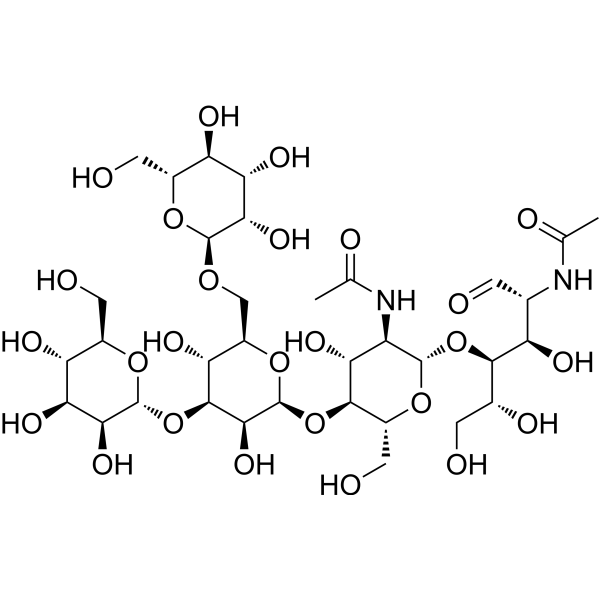
Paucimannose is a mannosidic N-glycan epitope. It acts as a carcinoembryonic antigen, and a marker for cancer, stem cell properties and inflammation. Paucimannose mainly exists in plants and invertebrates. It consists of oligomannose-type N-glycans that preferentially bind to mannose-binding lectin. Paucimannose localizes on the surface of resting cells and translocates upon cell activation. It can be used in studies related to Pseudomonas aeruginosa infection, cancer and pancreatitis.
For research use only. We do not sell to patients.
- CAS No.: 70858-45-6
- Formula: C34H58N2O26
- Molecular Weight:910.82
-
Storage:Powder -20°C, 3 years , 4°C, 2 years ; In solvent -80°C, 6 months , -20°C, 1 month

To place orders, for customer services and technical support, please contact: MedChemExpress USA
Tel: 609-228-6898 E-mail: [email protected] [email protected]


-
 Biological Activity
-
Chemical Information
- Protocols
- Purity & Documentation
- References
-
 Help & FAQs


All Endogenous Metabolite Isoforms
More

Biological Activity
Description
IC50 & Target
[1]|
Human Endogenous Metabolite |
In Vitro
Paucimannose-enriched neutrophil elastase glycoforms exhibit preferential binding to mannose-binding lectin, with multivalent low-mannose structures showing the highest affinity, while sialylated glycoforms are excluded[1].
MedChemExpress (MCE) has not independently confirmed the accuracy of these methods. They are for reference only.


Chemical Information
-
CAS No. 70858-45-6
-
Appearance Solid
-
Molecular Weight 910.82
-
Formula C34H58N2O26
-
Color White to off-white
-
SMILES
OC[C@@H](O[C@H]([C@@H]([C@H]1O)NC(C)=O)O[C@H]([C@H](O)CO)[C@H](O)[C@H](C=O)NC(C)=O)[C@H]1O[C@H]2[C@H]([C@H]([C@@H]([C@H](O2)CO[C@H]3O[C@@H]([C@H]([C@@H]([C@@H]3O)O)O)CO)O)O[C@H]4O[C@@H]([C@H]([C@@H]([C@@H]4O)O)O)CO)O
-
Shipping
Room temperature in continental US; may vary elsewhere.
-
Storage
Powder -20°C 3 years 4°C 2 years In solvent -80°C 6 months -20°C 1 month


Purity & Documentation
-
Data Sheet (277 KB)
-
SDS (251 KB)
- English - EN (251 KB)
- Français - FR (251 KB)
- Deutsch - DE (251 KB)
- Norwegian - NO (251 KB)
- Español - ES (251 KB)
- Swedish - SV (251 KB)
- Italian - IT (251 KB)
- Korean - KR (251 KB)
- Portuguese - PT (251 KB)
-
Handling Instructions (2659 KB)
References
[1]. Loke I, et al. Paucimannose-Rich N-glycosylation of Spatiotemporally Regulated Human Neutrophil Elastase Modulates Its Immune Functions. Mol Cell Proteomics. 2017 Aug;16(8):1507-1527. [Content Brief]
[3]. Dahmen AC, et al. Paucimannosidic glycoepitopes are functionally involved in proliferation of neural progenitor cells in the subventricular zone. Glycobiology. 2015;25(8):869-880. [Content Brief]

Calculators
Concentration (start) × Volume (start) = Concentration (final) × Volume (final)


Paucimannose Related Classifications
HY-N10631 Related Classifications
 Powered by Bioz