1. 疾患モデリングル製品 Anti-infection Neuronal Signaling GPCR/G Protein Epigenetics TGF-beta/Smad
  2. Nervous System Disease Models Bacterial mGluR PKC
  3. Amyotrophic Lateral Sclerosis/Parkinson–Dementia Complex (ALS/PDC) Models
  4. β-N-methylamino-L-alanine hydrochloride

β-N-methylamino-L-alanine (hydrochloride)  (Synonyms: BMAA (hydrochloride); L-BMAA 塩酸塩)

製品番号: HY-W015546 純度: 98.0%
COA 取扱説明書 Technical Support

β-N-methylamino-L-alanine hydrochloride (BMAA hydrochloride) is a neurotoxin produced by cyanobacteria. β-N-methylamino-L-alanine hydrochloride activates mGluR3 and inhibits PKC. β-N-methylamino-L-alanine hydrochloride can be used in the research of neurodegenerative diseases and immune diseases.

商品は「研究用試薬」です。人や動物の医療用・臨床診断用・食品用の製品ではありません。
研究用途以外に使用した場合、当社は一切の責任を負いかねます。

β-N-methylamino-L-alanine hydrochloride

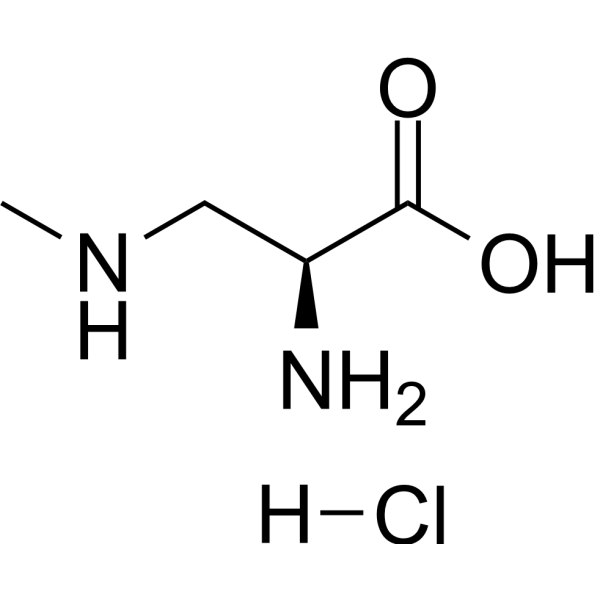
β-N-methylamino-L-alanine (hydrochloride) 構造式

CAS 番号 : 16012-55-8

容量 価格(税別) 在庫状況 数量
Solid + Solvent (Highly Recommended)
10 mM * 1 mL in Water
ready for reconstitution
USD 55 在庫あり
Solution
10 mM * 1 mL in Water USD 55 在庫あり
Solid
5 mg $50 在庫あり
10 mg $65 在庫あり
25 mg $96 在庫あり
50 mg $135 在庫あり
100 mg $215 在庫あり
200 mg   お問い合わせ  
500 mg   お問い合わせ  

* アイテムを追加する前、数量をご選択ください

This product is a controlled substance and not for sale in your territory.

カスタマーレビュー

Based on 2 publication(s) in Google Scholar

Other Forms of β-N-methylamino-L-alanine hydrochloride:

Top Publications Citing Use of Products
  • 生物活性

  • 純度とドキュメンテーション

  • 参考文献

  • カスタマーレビュー

製品説明

β-N-methylamino-L-alanine hydrochloride (BMAA hydrochloride) is a neurotoxin produced by cyanobacteria. β-N-methylamino-L-alanine hydrochloride activates mGluR3 and inhibits PKC. β-N-methylamino-L-alanine hydrochloride can be used in the research of neurodegenerative diseases and immune diseases[1][2][3][4][5][6][7][8][9][10][11][12][13].

IC50 & Target[4]

mGluR3


体外実験

β-N-methylamino-L-alanine hydrochloride (0.05-3 mM, 24 h) inhibits melatonin synthesis by mGluR3 activation and PKC inhibitions in primary pinealocytes[4].
β-N-Methylamino-L-Alanine (500 μM, 21 days) hydrochloride shows toxicity in PC12 cells[7].
β-N-methylamino-L-alanine (1-3 mM, 48 h) hydrochloride suppresses cell cycle progression at the G1/S checkpoint and proliferation in non-neuronal cells NIH3T3[9].
β-N-methylamino-L-alanine (50-1000 µM, 24 h) hydrochloride perturbs alanine, aspartate and glutamate metabolism pathways in human neuroblastoma cells[10].
β-N-methylamino-L-alanine (1.5-2.0 mM, 24 h) hydrochloride alters morphology, ATP levels and reduces proliferation of fish immune cells (CLC)[11].

MedChemExpress (MCE) has not independently confirmed the accuracy of these methods. They are for reference only.

Cell Viability Assay[9]

Cell Line: NIH3T3, HEK293T
Concentration: 1, 3 mM
Incubation Time: 48 h
Result: Suppressed the proliferation of NIH3T3 cells and HEK293T cells.
体内実験

β-N-methylamino-L-alanine (460 mg/kg, s.c., daily, 2 weeks) hydrochloride inhibits melatonin synthesis in a Wistar rat model[4].
β-N-methylamino-L-alanine (BMAA-HCl, 400 mg kg, s.c.) hydrochloride induces developmental neurotoxicity in a rat model[5].
β-N-methylamino-L-alanine (100-350 mg/kg, i.p., 5 consecutive days) hydrochloride causes neurological and pathological phenotypes mimicking Amyotrophic Lateral Sclerosis (ALS) in male rats[6].
β-N-methylamino-L-alanine (5-10 nmol, intravitreal injections) hydrochloride induces in vivo retinal cell death in mice[8].
β-N-methylamino-L-alanine (250 mg/kg, i.p., 5 consecutive days) hydrochloride produces oxidative damage in liver and kidney of rats, with the significant increase of lipid peroxidation and high catalase activity[12].
β-N-methylamino-L-alanine (40-460 mg/kg, s.c., 2 days) hydrochloride perturbs the intermediary metabolism in neonatal rats, with impairments in learning and memory function[13].

Note:
Please do not refer to only one article to determine the experimental conditions. It is recommended to determine the optimal experimental conditions (animal strain, age, dosage, frequency and cycle, detection time and indicators, etc.) through preliminary experiments before the formal experiment.

β-N-methylamino-L-alanine hydrochloride can be used to induce amyotrophic lateral sclerosis (ALS) models[6].

1. Induction of amyotrophic lateral sclerosis[6]
Background
β-N-methylamino-L-alanine hydrochloride activates NMDA receptors and metabolite glutamate receptors (mGluR1/5) by mimicking glutamate, leading to intracellular calcium overload, inducing oxidative stress, damaging organelles such as the endoplasmic reticulum and mitochondria, and ultimately causing neuronal degeneration and excitatory necrosis.
Specific Modeling Methods
1. Rats: Male Wistar rats
Administration: 200-350 mg/kg • i.p. • once a day for 5 days
Note
(1) Should begin from weaning/21 days after birth to avoid interference during the critical period of newborn rats brain development
Modeling Indicators
Neurological Function Score: 0 points: The entire sole of the hind limbs touches the ground when walking. When the tail is suspended, the hind limbs are in a T-shape with coordinated kicking movements, and there is a resistant response to stimulation from the tail; 1-3 points: When the tail is suspended, it cannot make a T-shaped movement with its hind legs, resulting in uncoordinated kicking; 4 points: When walking, they do not place the entire sole of their hind feet on the ground; they walk on their toes; 5 points: When the tail is suspended, the hind legs will extend backward. When pulled from the tail, the hind legs will often separate from the body and gradually lose their resistance; 6 points: When turning, the hind legs remain under the body, the posture adjustment is slow, and there are uncoordinated kicks when the tail is suspended; 7 points: Begin to walk sideways, the resistance disappears, and their hind limbs separate from their body. 8 points: When walking, the hind legs slip; when the tail is suspended, the hind legs are brought together, and the hind legs are clearly separated from the body; 9 points: Loss of coordination while walking, with a noticeable tendency to walk sideways; 10 points: Complete loss of hind limb motor function, muscle spasms, and whole-body tremors. The scores increased significantly after modeling, manifested as hind limb coordination disorder, irregular kicking, decreased muscle strength, and in severe cases, loss of hind limb control (score ≥ 7 points).
Histological Analysis: The endoplasmic reticulum of lumbar spinal cord motor neurons is fragmented, ribosomes dissociate, and mitochondria swell, vacuolate, or even degenerate; oligodendrocytes exhibit apoptosis-characteristic nuclear morphology.
Molecular changes: Increased caspase-3 expression in the perinuclear region of motor neurons; elevated total protein and phosphorylated form (P-Ser9-GSK3β) of GSK3β in the lumbar spinal cord and motor cortex, and increased content of high molecular weight TDP-43 aggregates; decreased NAA content, and significantly reduced NAA/Cr, NAA/Cho, and NAA/(Cho+Cr) ratios.

MedChemExpress (MCE) has not independently confirmed the accuracy of these methods. They are for reference only.

分子量

154.60

分子式

C4H11ClN2O2

CAS 番号
Appearance

Solid

Color

White to yellow

SMILES

N[C@@H](CNC)C(O)=O.[H]Cl

Structure Classification
Initial Source

cyanobacteria

輸送条件

Room temperature in continental US; may vary elsewhere.

保管条件

-20°C, sealed storage, away from moisture

*In solvent : -80°C, 6 months; -20°C, 1 month (sealed storage, away from moisture)

溶剤 & 溶解度
体外: 

H2O : 31.25 mg/mL (202.13 mM; ultrasonic and warming and heat to 60°C)

Preparing
Stock Solutions
Concentration Solvent Mass 1 mg 5 mg 10 mg
1 mM 6.4683 mL 32.3415 mL 64.6831 mL
5 mM 1.2937 mL 6.4683 mL 12.9366 mL
10 mM 0.6468 mL 3.2342 mL 6.4683 mL
View the Complete Stock Solution Preparation Table

* Please refer to the solubility information to select the appropriate solvent. Once prepared, please aliquot and store the solution to prevent product inactivation from repeated freeze-thaw cycles.
Storage method and period of stock solution: -80°C, 6 months; -20°C, 1 month (sealed storage, away from moisture). When stored at -80°C, please use it within 6 months. When stored at -20°C, please use it within 1 month.

* Note: If you choose water as the stock solution, please dilute it to the working solution, then filter and sterilize it with a 0.22 μm filter before use.

  • Molarity Calculator

  • Dilution Calculator

Mass (g) = Concentration (mol/L) × Volume (L) × Molecular Weight (g/mol)

Mass
=
Concentration
×
Volume
×
Molecular Weight *

Concentration (start) × Volume (start) = Concentration (final) × Volume (final)

一般には略語で表示されます:C1V1 = C2V2

濃度 (開始)

C1

×
体積 (開始)

V1

=
濃度 (終了)

C2

×
体積 (終了)

V2

体内:

For the following dissolution methods, please prepare the working solution directly. It is recommended to prepare fresh solutions and use them promptly within a short period of time.
The percentages shown for the solvents indicate their volumetric ratio in the final prepared solution. If precipitation or phase separation occurs during preparation, heat and/or sonication can be used to aid dissolution.

  • Protocol 1

    Add each solvent one by one:  PBS

    Solubility: 25 mg/mL (161.71 mM); Clear solution; Need ultrasonic

In Vivo Dissolution Calculator
Please enter the basic information of animal experiments:

Dosage

mg/kg

Animal weight
(per animal)

g

Dosing volume
(per animal)

μL

Number of animals

Recommended: Prepare an additional quantity of animals to account for potential losses during experiments.
Calculation results:
Working solution concentration: mg/mL
This product has good water solubility, please refer to the measured solubility data in water/PBS/Saline for details.
The concentration of the stock solution you require exceeds the measured solubility. The following solution is for reference only.If necessary, please contact MedChemExpress (MCE).
純度とドキュメンテーション

純度: 98.0%

参考文献

Complete Stock Solution Preparation Table

* Please refer to the solubility information to select the appropriate solvent. Once prepared, please aliquot and store the solution to prevent product inactivation from repeated freeze-thaw cycles.
Storage method and period of stock solution: -80°C, 6 months; -20°C, 1 month (sealed storage, away from moisture). When stored at -80°C, please use it within 6 months. When stored at -20°C, please use it within 1 month.

Optional Solvent Concentration Solvent Mass 1 mg 5 mg 10 mg 25 mg
H2O 1 mM 6.4683 mL 32.3415 mL 64.6831 mL 161.7076 mL
5 mM 1.2937 mL 6.4683 mL 12.9366 mL 32.3415 mL
10 mM 0.6468 mL 3.2342 mL 6.4683 mL 16.1708 mL
15 mM 0.4312 mL 2.1561 mL 4.3122 mL 10.7805 mL
20 mM 0.3234 mL 1.6171 mL 3.2342 mL 8.0854 mL
25 mM 0.2587 mL 1.2937 mL 2.5873 mL 6.4683 mL
30 mM 0.2156 mL 1.0781 mL 2.1561 mL 5.3903 mL
40 mM 0.1617 mL 0.8085 mL 1.6171 mL 4.0427 mL
50 mM 0.1294 mL 0.6468 mL 1.2937 mL 3.2342 mL
60 mM 0.1078 mL 0.5390 mL 1.0781 mL 2.6951 mL
80 mM 0.0809 mL 0.4043 mL 0.8085 mL 2.0213 mL
100 mM 0.0647 mL 0.3234 mL 0.6468 mL 1.6171 mL

* Note: If you choose water as the stock solution, please dilute it to the working solution, then filter and sterilize it with a 0.22 μm filter before use.

  • No file chosen (Maximum size is: 1024 Kb)
  • If you have published this work, please enter the PubMed ID.
  • Your name will appear on the site.
  • Molarity Calculator

  • Dilution Calculator

The molarity calculator equation

Mass (g) = Concentration (mol/L) × Volume (L) × Molecular Weight (g/mol)

質量   濃度   体積   分子量 *
= × ×

The dilution calculator equation

Concentration (start) × Volume (start) = Concentration (final) × Volume (final)

一般には略語で表示されます:C1V1 = C2V2

濃度 (開始) × 体積 (開始) = 濃度 (終了) × 体積 (終了)
× = ×
C1   V1   C2   V2
Help & FAQs
  • Do most proteins show cross-species activity?

    Species cross-reactivity must be investigated individually for each product. Many human cytokines will produce a nice response in mouse cell lines, and many mouse proteins will show activity on human cells. Other proteins may have a lower specific activity when used in the opposite species.

最近チェックした製品:

オンラインお問い合わせ

Your information is safe with us. * Required Fields.

製品名


カスタマ需要量 *

お名前 *


タイトル

メールアドレス *


電話番号 *

デパートメント


組纖名 *

市区町村

都道府県

国或いは地域 *


必ず会社名を記載ください。個人への返信は行いません。

備考

バルクお問い合わせ

Inquiry Information

製品名:
β-N-methylamino-L-alanine hydrochloride
製品番号:
HY-W015546
数量:
MCE 日本正規代理店: