1. GPCR/G Protein Neuronal Signaling Membrane Transporter/Ion Channel Metabolic Enzyme/Protease PI3K/Akt/mTOR NF-κB
  2. Opioid Receptor iGluR MMP PI3K Akt NF-κB
  3. Tianeptine

Tianeptine is an atypical antidepressant. Tianeptine is a moderate-intensity agonist of the μ-opioid receptor (MOR), and to a lesser extent, is an agonist of the δ-opioid receptor (DOR). Tianeptine is a glutamate modulator that can enhance AMPA receptor and antagonize NMDA receptor. tianeptine increases sensitivity of the α1 adrenergic receptor, which only manifests in chronic treatment. Tianeptine exerts neuroprotective effects under stress/inflammation-induced conditions, exhibiting anti-inflammatory and antioxidant properties. Tianeptine inhibits MMP-9 by suppressing the PI3K/Akt-mediated NF-κB pathway. Tianeptine can be used to alleviate symptoms of depression and anxiety, but does not cause sedative effects.

商品は「研究用試薬」です。人や動物の医療用・臨床診断用・食品用の製品ではありません。
研究用途以外に使用した場合、当社は一切の責任を負いかねます。

Tianeptine

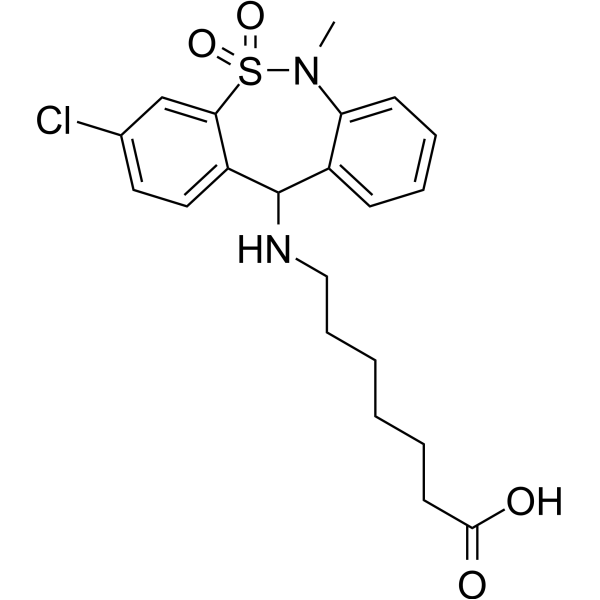
Tianeptine 構造式

CAS 番号 : 72797-41-2

容量 価格(税別) 在庫状況 数量
Solid + Solvent (Highly Recommended)
10 mM * 1 mL in DMSO
ready for reconstitution
USD 30 在庫あり
Solution
10 mM * 1 mL in DMSO USD 30 在庫あり
Solid
5 mg $28 在庫あり
10 mg $40 在庫あり
25 mg $60 在庫あり
50 mg $78 在庫あり
100 mg $114 在庫あり
200 mg   お問い合わせ  
500 mg   お問い合わせ  

* アイテムを追加する前、数量をご選択ください

This product is a controlled substance and not for sale in your territory.

カスタマーレビュー

Based on 1 publication(s) in Google Scholar

Other Forms of Tianeptine:

Top Publications Citing Use of Products
  • 生物活性

  • 純度とドキュメンテーション

  • 参考文献

  • カスタマーレビュー

製品説明

Tianeptine is an atypical antidepressant. Tianeptine is a moderate-intensity agonist of the μ-opioid receptor (MOR), and to a lesser extent, is an agonist of the δ-opioid receptor (DOR). Tianeptine is a glutamate modulator that can enhance AMPA receptor and antagonize NMDA receptor. tianeptine increases sensitivity of the α1 adrenergic receptor, which only manifests in chronic treatment. Tianeptine exerts neuroprotective effects under stress/inflammation-induced conditions, exhibiting anti-inflammatory and antioxidant properties. Tianeptine inhibits MMP-9 by suppressing the PI3K/Akt-mediated NF-κB pathway. Tianeptine can be used to alleviate symptoms of depression and anxiety, but does not cause sedative effects[1][2][3][4][5].

IC50 & Target[2][5]

μ Opioid Receptor/MOR


δ Opioid Receptor/DOR


MMP-9


Akt


PI3K


NF-κB


体外実験

Tianeptine inhibits the polarization of microglia/macrophages to a pro-inflammatory (M1) phenotype by stimulating MOR, and increases the activity of antioxidant enzymes such as superoxide dismutase (SOD) and catalase, thereby alleviating oxidative stress damage[2].
Tianeptine can increase BDNF and NGF levels in brain regions such as the hippocampus and amygdala, and promote neurogenesis in the dentate gyrus of the hippocampus[2].
Tianeptine (0.1-100 μM, 14 days) significantly reduces hypoxia-induced LDH release in rat embryonic cortical neurons[4].
Tianeptine (10 μM) does not reduce neuronal apoptosis induced directly by NMDA (HY-17551), but shows a slight but significant protective effect in the presence of IL-1β in mouse cortical neurons[4].
Tianeptine demonstrates low cardiotoxicity and minimal risk of CYP-mediated drug-drug interactions (DDIs)[1].
Tianeptine sodium salt (125-500 µM, 24 h) suppresses TNF-α-induced expression of MMP-9 in human carcinoma cells MDA-MB-231 via suppression of the PI3K/Akt-mediated NF-κB pathway[5].

MedChemExpress (MCE) has not independently confirmed the accuracy of these methods. They are for reference only.

Cell Invasion Assay[5]

Cell Line: LNCaP cells
Concentration: 500 μM
Incubation Time: 24 h
Result: Significantly attenuated TNF-α-stimulated cancer cell invasion.

Western Blot Analysis[5]

Cell Line: LNCaP cells
Concentration: 125, 250, 500 μM
Incubation Time: 1, 6 h
Result: Dose-dependent inhibited MMP-9 expression.
Blocked TNF-α-induced IκBα degradation and p65/p50 nuclear translocation.
Inhibited TNF-α-induced phosphorylation of PI3K and Akt.
体内実験

Tianeptine (10 and 50 mg/kg, i.p., single dose) selectively antagonizes the physiological and behavioral effects (weight loss) induced by increased central 5-HT, but does not affect the effects (corticosterone release) induced by increased peripheral 5-HT[1].
Tianeptine does not modify the rate of extracellular serotonin in rats, so it does not increase or decrease the reuptake of serotonin[2].
Tianeptine improves cognitive deficits and memory impairment caused by stress, and enhances learning ability and spatial memory[2].
Tianeptine (5-10 mg/kg, i.p., single dose) exhibits significant analgesic effects in both the hot-plate and tail-flick thermal pain models in mice without causing motor impairment[3].
Tianeptine (1-10 mg/kg, i.p., single dose or twice daily for 5 days) shows neuroprotective effect which is not achieved by directly antagonizing NMDA receptors, but is only fully stimulated in pathological conditions with inflammatory/cytokine provocation[4].

MedChemExpress (MCE) has not independently confirmed the accuracy of these methods. They are for reference only.

Animal Model: Corticosterone release assay established in male Wistar rats, weighing initially 260-280 g[1]
Dosage: 10 mg/kg (without Benserazide (HY-121275)) and 50 mg/kg (with Benserazide)
Administration: Intraperitoneal injection (i.p.), single dose
Result: Did not antagonize 5-HTP-induced peripheral corticosterone release.
Specifically antagonized the appetite suppression and weight loss effects caused by increased central 5-HT.
Animal Model: Hot-plate and tail-flick model established in adult male Swiss Webster mice (25-32 g)[3]
Dosage: 5 and 10 mg/kg
Administration: Intraperitoneal injection (i.p.), single dose
Result: Significantly prolonged the latency of pain response in both the tail-flick and hot plate tests, demonstrating a strong analgesic effect at 10 mg/kg.
Completely blocked the analgesic effect in both pain models pretreatment with pCPA (HY-B1368).
Did not affect the performance of mice on the rotating rod.
Animal Model: Model of cerebral cortex and white matter area damage established in Newborn Swiss mice on postnatal day 5 (P5)[4]
Dosage: 1, 3 and 10 mg/kg
Administration: Intraperitoneal injection (i.p.), single dose or twice daily for 5 days
Result: Failed to alleviate the underlying impairment caused by ibotenate with acute or chronic administration.
Effectively reversed damage exacerbated by chronic IL-1β pretreatment.
臨床実験
分子量

436.95

分子式

C21H25ClN2O4S

CAS 番号
Appearance

Solid

Color

White to off-white

SMILES

O=C(CCCCCCNC(C1=CC=CC=C1N2C)C3=CC=C(C=C3S2(=O)=O)Cl)O

輸送条件

Room temperature in continental US; may vary elsewhere.

保管条件
Powder -20°C 3 years
  4°C 2 years
In solvent -80°C 6 months
  -20°C 1 month
溶剤 & 溶解度
体外: 

DMSO : 10 mg/mL (22.89 mM; Need ultrasonic; Hygroscopic DMSO has a significant impact on the solubility of product, please use newly opened DMSO)

Preparing
Stock Solutions
Concentration Solvent Mass 1 mg 5 mg 10 mg
1 mM 2.2886 mL 11.4430 mL 22.8859 mL
5 mM 0.4577 mL 2.2886 mL 4.5772 mL
10 mM 0.2289 mL 1.1443 mL 2.2886 mL
View the Complete Stock Solution Preparation Table

* Please refer to the solubility information to select the appropriate solvent. Once prepared, please aliquot and store the solution to prevent product inactivation from repeated freeze-thaw cycles.
Storage method and period of stock solution: -80°C, 6 months; -20°C, 1 month. When stored at -80°C, please use it within 6 months. When stored at -20°C, please use it within 1 month.

  • Molarity Calculator

  • Dilution Calculator

Mass (g) = Concentration (mol/L) × Volume (L) × Molecular Weight (g/mol)

Mass
=
Concentration
×
Volume
×
Molecular Weight *

Concentration (start) × Volume (start) = Concentration (final) × Volume (final)

一般には略語で表示されます:C1V1 = C2V2

濃度 (開始)

C1

×
体積 (開始)

V1

=
濃度 (終了)

C2

×
体積 (終了)

V2

体内:

Select the appropriate dissolution method based on your experimental animal and administration route.

For the following dissolution methods, please ensure to first prepare a clear stock solution using an In Vitro approach and then sequentially add co-solvents:
To ensure reliable experimental results, the clarified stock solution can be appropriately stored based on storage conditions. As for the working solution for in vivo experiments, it is recommended to prepare freshly and use it on the same day.
The percentages shown for the solvents indicate their volumetric ratio in the final prepared solution. If precipitation or phase separation occurs during preparation, heat and/or sonication can be used to aid dissolution.

  • Protocol 1

    Add each solvent one by one:  10% DMSO    40% PEG300    5% Tween-80    45% Saline

    Solubility: ≥ 1 mg/mL (2.29 mM); Clear solution

    This protocol yields a clear solution of ≥ 1 mg/mL (saturation unknown).

    Taking 1 mL working solution as an example, add 100 μL DMSO stock solution (10.0 mg/mL) to 400 μL PEG300, and mix evenly; then add 50 μL Tween-80 and mix evenly; then add 450 μL Saline to adjust the volume to 1 mL.

    Preparation of Saline: Dissolve 0.9 g sodium chloride in ddH₂O and dilute to 100 mL to obtain a clear Saline solution.
  • Protocol 2

    Add each solvent one by one:  10% DMSO    90% (20% SBE-β-CD in Saline)

    Solubility: ≥ 1 mg/mL (2.29 mM); Clear solution

    This protocol yields a clear solution of ≥ 1 mg/mL (saturation unknown).

    Taking 1 mL working solution as an example, add 100 μL DMSO stock solution (10.0 mg/mL) to 900 μL 20% SBE-β-CD in Saline, and mix evenly.

    Preparation of 20% SBE-β-CD in Saline (4°C, storage for one week): 2 g SBE-β-CD powder is dissolved in 10 mL Saline, completely dissolve until clear.
In Vivo Dissolution Calculator
Please enter the basic information of animal experiments:

Dosage

mg/kg

Animal weight
(per animal)

g

Dosing volume
(per animal)

μL

Number of animals

Recommended: Prepare an additional quantity of animals to account for potential losses during experiments.
Please enter your animal formula composition:
%
DMSO +
+
%
Tween-80 +
%
Saline
Recommended: Keep the proportion of DMSO in working solution below 2% if your animal is weak.
The co-solvents required include: DMSO, . All of co-solvents are available by MedChemExpress (MCE). , Tween 80. All of co-solvents are available by MedChemExpress (MCE).
Calculation results:
Working solution concentration: mg/mL
Method for preparing stock solution: mg drug dissolved in μL  DMSO (Stock solution concentration: mg/mL).
The concentration of the stock solution you require exceeds the measured solubility. The following solution is for reference only. If necessary, please contact MedChemExpress (MCE).
Method for preparing in vivo working solution for animal experiments: Take μL DMSO stock solution, add μL . μL , mix evenly, next add μL Tween 80, mix evenly, then add μL Saline.
 If the continuous dosing period exceeds half a month, please choose this protocol carefully.
Please ensure that the stock solution in the first step is dissolved to a clear state, and add co-solvents in sequence. You can use ultrasonic heating (ultrasonic cleaner, recommended frequency 20-40 kHz), vortexing, etc. to assist dissolution.
純度とドキュメンテーション

純度: 99.84%

参考文献

Complete Stock Solution Preparation Table

* Please refer to the solubility information to select the appropriate solvent. Once prepared, please aliquot and store the solution to prevent product inactivation from repeated freeze-thaw cycles.
Storage method and period of stock solution: -80°C, 6 months; -20°C, 1 month. When stored at -80°C, please use it within 6 months. When stored at -20°C, please use it within 1 month.

Optional Solvent Concentration Solvent Mass 1 mg 5 mg 10 mg 25 mg
DMSO 1 mM 2.2886 mL 11.4430 mL 22.8859 mL 57.2148 mL
5 mM 0.4577 mL 2.2886 mL 4.5772 mL 11.4430 mL
10 mM 0.2289 mL 1.1443 mL 2.2886 mL 5.7215 mL
15 mM 0.1526 mL 0.7629 mL 1.5257 mL 3.8143 mL
20 mM 0.1144 mL 0.5721 mL 1.1443 mL 2.8607 mL
  • No file chosen (Maximum size is: 1024 Kb)
  • If you have published this work, please enter the PubMed ID.
  • Your name will appear on the site.
  • Molarity Calculator

  • Dilution Calculator

The molarity calculator equation

Mass (g) = Concentration (mol/L) × Volume (L) × Molecular Weight (g/mol)

質量   濃度   体積   分子量 *
= × ×

The dilution calculator equation

Concentration (start) × Volume (start) = Concentration (final) × Volume (final)

一般には略語で表示されます:C1V1 = C2V2

濃度 (開始) × 体積 (開始) = 濃度 (終了) × 体積 (終了)
× = ×
C1   V1   C2   V2
Help & FAQs
  • Do most proteins show cross-species activity?

    Species cross-reactivity must be investigated individually for each product. Many human cytokines will produce a nice response in mouse cell lines, and many mouse proteins will show activity on human cells. Other proteins may have a lower specific activity when used in the opposite species.

最近チェックした製品:

オンラインお問い合わせ

Your information is safe with us. * Required Fields.

製品名


カスタマ需要量 *

お名前 *


タイトル

メールアドレス *


電話番号 *

デパートメント


組纖名 *

市区町村

都道府県

国或いは地域 *


必ず会社名を記載ください。個人への返信は行いません。

備考

バルクお問い合わせ

Inquiry Information

製品名:
Tianeptine
製品番号:
HY-90003
数量:
MCE 日本正規代理店: