Search Result
Results for "
carbonyls
" in MedChemExpress (MCE) Product Catalog:
25
Biochemical Assay Reagents
23
Isotope-Labeled Compounds
| Cat. No. |
Product Name |
Target |
Research Areas |
Chemical Structure |
-
- HY-100215
-
-
-
- HY-111434A
-
|
UAA crosslinker 1 hydrochloride
|
Amino Acid Derivatives
|
Cancer
|
|
N6-[(2-Azidoethoxy)carbonyl]-L-lysine hydrochloride (UAA crosslinker 1 hydrochloride) is a click chemistry-reactive amino acid derivative. N6-[(2-Azidoethoxy)carbonyl]-L-lysine hydrochloride mediates the generation of antibody-drug conjugates (ADCs). N6-[(2-Azidoethoxy)carbonyl]-L-lysine hydrochloride is used for site-specific incorporation into recombinant proteins, or for synthesizing chemical probes and tools for biological research .
|
-
-
- HY-W048727
-
-
-
- HY-76440
-
|
Oxetan-3-one
|
Biochemical Assay Reagents
|
Others
|
|
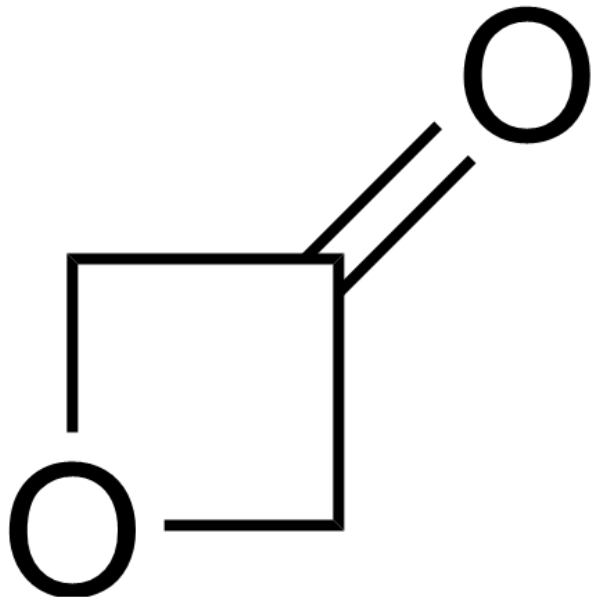
3-Oxetanone (Oxetan-3-one) is a four-membered cyclic ketone and strained cyclic ether derivative with measurable molecular g-value, magnetic susceptibility anisotropy and molecular quadrupole moment. 3-Oxetanone acts not only as a hydrogen bond acceptor, a tetrel donor and a weak hydrogen bond acceptor, but also forms a classic O-H···O hydrogen bond with H2O via the ether oxygen atom. Alternatively, it forms a C···O tetrel bond with formaldehyde using its carbonyl group as a tetrel donor, while acting as a proton acceptor to form a C-H···O weak hydrogen bond with formaldehyde. 3-Oxetanone can be used to prepare various oxetanes .
|
-
-
- HY-W013182
-
-
-
- HY-D0099
-
|
|
Fluorescent Dye
|
Others
|
|
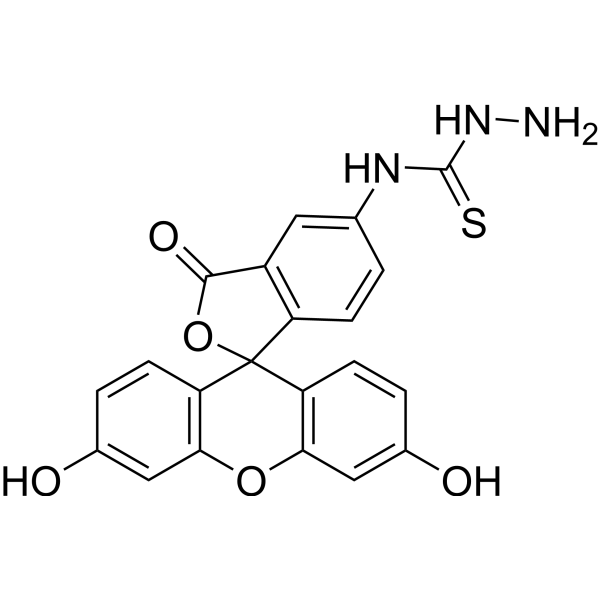
Fluorescein-5-thiosemicarbazide is a amine containing fluorescent probe that can be used for labeling saccharides and protein carbonyl derivatives .
|
-
-
- HY-124197
-
|
|
Fluorescent Dye
|
Others
|
|
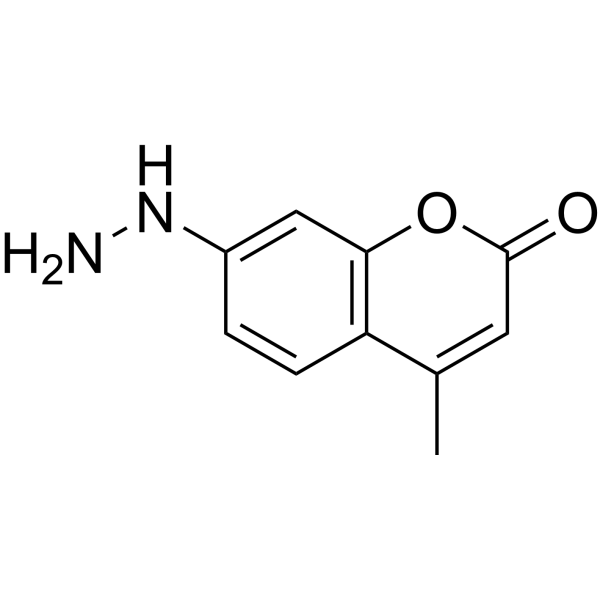
Coumarin hydrazine is a fluorescent chemical probe (λex=420–450/λem=468nm) to label cellular protein- and lipid-bound carbonyls .
|
-
-
- HY-111434
-
|
UAA crosslinker 1
|
Amino Acid Derivatives
|
Cancer
|
|
N6-[(2-Azidoethoxy) carbonyl]-L-lysine (UAA crosslinker 1) is a click chemistry-reactive amino acid derivative. N6-[(2-Azidoethoxy) carbonyl]-L-lysine mediates the generation of antibody-drug conjugates (ADCs). N6-[(2-Azidoethoxy) carbonyl]-L-lysine is used for site-specific incorporation into recombinant proteins, or for synthesizing chemical probes and tools for biological research .
|
-
-
- HY-23185
-
-
-
- HY-W048911
-
-
-
- HY-W090626
-
-
-
- HY-W008731
-
-
-
- HY-W011186
-
-
-
- HY-42374
-
|
|
PROTAC Linkers
|
Cancer
|
|
trans-4-[[(1,1-Dimethylethoxy)carbonyl]amino]cyclohexaneacetic acid is a PROTAC linker that can be used in the synthesis of PROTACs.
|
-
-
- HY-Y0007
-
|
L-Alanine, N-carboxy-, N-benzyl ester (6CI,7CI); (S)-2-(Benzyloxycarbonylamino)propanoic acid
|
Amino Acid Derivatives
|
Others
|
|
N-[(Benzyloxy)carbonyl]-L-alanine is an alanine derivative .
|
-
-
- HY-W011722
-
-
-
- HY-W012381
-
-
-
- HY-W067360
-
-
-
- HY-W111209
-
-
-
- HY-W048680
-
-
-
- HY-21206
-
|
|
Drug Intermediate
|
Others
|
|
1-(((4-Nitrophenoxy)carbonyl)oxy)ethyl isobutyrate is a drug intermediate for synthesis of various active compounds.
|
-
-
- HY-W048703
-
-
-
- HY-125501
-
|
Biotin-(AC5)2-hydrazide
|
Biochemical Assay Reagents
|
Others
|
|
Biotin-XX hydrazide (Biotin-(AC5)2-hydrazide) is a carbonyl-reactive biotinylation reagent which contains two aminohexanoic acid spacers. Biotin-XX hydrazide has higher efficiency of avidin-binding .
|
-
-
- HY-34887
-
|
|
Drug Derivative
|
Others
|
|
Acridone-4-carboxylic acid (ACA) (Compound 2c) is a heme-interacting acridone derivatives that prevents free heme-mediated protein oxidation and degradation. Acridone-4-carboxylic acid inhibits protein carbonyl formation with an IC50 of 43 μM .
|
-
-
- HY-W010293
-
|
|
Drug Intermediate
|
Others
|
|
Ethyl 4-oxopentanoate is a carbonyl substrate targeting Rhodococcus erythropolis carbonyl reductase (RECR) .
|
-
-
- HY-W092111
-
-
-
- HY-W052310
-
-
-
- HY-Z1081
-
|
4-((Benzyloxy)carbonyl)benzoic acid
|
Drug Intermediate
|
Others
|
|
Monobenzyl Terephthalate (4-((Benzyloxy)carbonyl)benzoic acid) is a drug intermediate for synthesis of various active compounds.
|
-
-
- HY-W021675
-
|
|
PROTAC Linkers
|
Cancer
|
|
2-(1-((Benzyloxy)carbonyl)piperidin-4-yl)acetic acid is a PROTAC linker that can be used in the synthesis of PROTACs.
|
-
-
- HY-151774
-
|
|
Fluorescent Dye
|
Others
|
|
TAMRA hydrazide (6-isomer) is a click chemistry reagent that can be coupled to carbonyl compounds. The dye hydrazide in TAMRA hydrazide (6-isomer) labels carbonyl compounds such as aldehydes and ketones. TAMRA in TAMRA hydrazide (6-isomer) is a xanthene red fluorophore that reacts with terminal alkynes .
|
-
-
- HY-Y0555
-
-
-
- HY-W009244
-
-
-
- HY-78008
-
-
-
- HY-W273180
-
|
|
PROTAC Linkers
|
Cancer
|
|
Tert-butyl 3-(((benzyloxy)carbonyl)amino)propanoate is a PROTAC linker that can be used in the synthesis of PROTACs.
|
-
-
- HY-W013793
-
-
-
- HY-77630
-
-
-
- HY-W067091
-
-
-
- HY-34663
-
|
(2R)-2-(tert-Butoxycarbonylamino)-2-phenylethanoic acid; (R)-2-((tert-Butoxycarbonyl)amino)-2-phenylacetic acid; (R)-2-[(tert-Butoxycarbonyl)amino]-2-phenylacetic acid
|
Amino Acid Derivatives
|
Others
|
|
(αR)-α-[[(1,1-Dimethylethoxy)carbonyl]amino]benzeneacetic acid is a Glycine (HY-Y0966) derivative .
|
-
-
- HY-P4901
-
-
-
- HY-D1619
-
|
|
Fluorescent Dye
|
Others
|
|
Cyanine3 hydrazide dichloride is a carbonyl reactive dye. Cyanine3 hydrazide dichloride allows the labelling of various carbonyl-containing molecules such as antibodies and other glycoproteins after oxidation by periodate, proteins or reducing sugars after oxidative stress or deamination .
|
-
-
- HY-151690
-
|
|
Fluorescent Dye
|
Others
|
|
FAM hydrazide, 6-isomer is a hydrazide derivative of fluorescein (FAM). FAM is a xanthene dye, a parent of fluorescein dye series. FAM hydrazide, 6-isomer can be used for the labeling of carbonyl compounds, aldehydes, and ketones .
|
-
-
- HY-132264
-
|
|
Fluorescent Dye
|
Others
|
|
FAM hydrazide, 6-isomer hydrochloride is a hydrazide derivative of fluorescein (FAM). FAM is a xanthene dye, a parent of fluorescein dye series. FAM hydrazide, 6-isomer hydrochloride can be used for the labeling of carbonyl compounds, aldehydes, and ketones .
|
-
-
- HY-D1324
-
|
|
Fluorescent Dye
|
Others
|
|
Cyanine5.5 hydrazide, an analog of Cyanine5.5 fluorophore, is a near-infrared (NIR) fluorescent dye. Cyanine5.5 hydrazide is used for labeling of biomolecules through the condensation between the hydrazide groups and the carbonyl groups. (λex=684 nm, λem=710 nm) .
|
-
-
- HY-W101713
-
-
-
- HY-W777679
-
-
-
- HY-Z1081R
-
|
|
Reference Standards
|
Inflammation/Immunology
|
|
4-((Benzyloxy)carbonyl)benzoic acid (Standard) is the analytical standard of 4-((Benzyloxy)carbonyl)benzoic acid. This product is intended for research and analytical applications.
|
-
-
- HY-CE00705
-
-
-
- HY-CE00721
-
-
-
- HY-W709114
-
|
|
Isotope-Labeled Compounds
|
Others
|
|
2-((2-Hydroxybutoxy)carbonyl)benzoic acid-d4 is the deuterium labeled 2-((2-Hydroxybutoxy)carbonyl)benzoic acid (HY-W709111).
|
-
-
- HY-125161
-
|
|
Bacterial
Antibiotic
|
Others
|
|
MT0703 is an aminothiazolyl glycyl cephalosporin with a 1,5-dihydroxy-4-pyridone-2-carbonyl group and has good anti-Pseudomonas activity.
|
-
- HY-W709118
-
|
|
Isotope-Labeled Compounds
|
Others
|
|
2-(((5-Carboxypentyl)oxy)carbonyl)benzoic acid-d4 is the deuterium labeled 2-(((5-Carboxypentyl)oxy)carbonyl)benzoic acid (HY-W709117).
|
-
- HY-CE01980
-
-
- HY-CE00570
-
|
2-Hydroxy-4-isopropenylcyclohexane-1-carbonyl-coenzyme A
|
Biochemical Assay Reagents
|
Metabolic Disease
|
|
2-Hydroxy-4-isopropenylcyclohexane-1-carbonyl-CoA (2-Hydroxy-4-isopropenylcyclohexane-1-carbonyl-coenzyme A) is a coenzyme A derivative.
|
-
- HY-W048828
-
-
- HY-152879
-
|
|
Nucleoside Antimetabolite/Analog
|
Others
|
|
5-Benzylamino carbonyl-3’-O-acetyl-2’-O-methyluridine is a thymidine analogue. Analogs of this series have insertional activity towards replicated DNA. They can be used to label cells and track DNA synthesis .
|
-
- HY-W035914
-
-
- HY-W654275
-
|
Mono(2-ethylhexyl) terephthalate-d4
|
Isotope-Labeled Compounds
|
Others
|
|
4-(((2-Ethylhexyl)oxy)carbonyl)benzoic acid-d4 (Mono(2-ethylhexyl) terephthalate-d4) is the deuterium labeled 4-(((2-Ethylhexyl)oxy)carbonyl)benzoic acid (HY-W006369).
|
-
- HY-W049802
-
|
|
Complement System
|
Inflammation/Immunology
|
|
N-((Allyloxy)carbonyl)-N-methyl-L-alanine is a Alanine derivative. N-((Allyloxy)carbonyl)-N-methyl-L-alanine can be used for the synthesis of inhibitors of complement factor D. Complement factor D inhibitors can be used in the research of immune system related disease .
|
-
- HY-41532S
-
-
- HY-154684
-
|
|
Nucleoside Antimetabolite/Analog
|
Cancer
|
|
5-Benzylamino carbonyl-3’-O-acetyl-2’-O-methyl-5’-O-DMTr-uridine is a thymidine analog. Analogs of this series have insertional activity towards replicated DNA. They can be used to label cells and track DNA synthesis .
|
-
- HY-79775
-
-
- HY-157449
-
|
|
Others
|
Cancer
|
|
CBR1-IN-5 (compound 13o) is a potent inhibitor of CBR1 with an IC50 of 0.1 μM .
|
-
- HY-34261
-
|
|
PROTAC Linkers
|
Cancer
|
|
4-[[(1,1-Dimethylethoxy)carbonyl]amino]benzeneacetic acid is a PROTAC linker that can be used in the synthesis of PROTACs.
|
-
- HY-W324406
-
|
|
Fluorescent Dye
|
Others
|
|
1,2-Diamino-3,4-ethylenedioxybenzene is a carbonyl-reactive fluorometric labeling agent.
|
-
- HY-154779R
-
|
|
Nucleoside Antimetabolite/Analog
Reference Standards
|
Cancer
|
|
5′-Deoxy-5-fluoro-N-[(2-methylbutoxy)carbonyl]cytidine (Standard) is the analytical standard of 5′-Deoxy-5-fluoro-N-[(2-methylbutoxy)carbonyl]cytidine. This product is intended for research and analytical applications. 5′-Deoxy-5-fluoro-N-[(2-methylbutoxy)carbonyl]cytidine is a purine nucleoside analog. Purine nucleoside analogs have broad antitumor activity targeting indolent lymphoid malignancies. Anticancer mechanisms in this process rely on inhibition of DNA synthesis, induction of apoptosis, etc .
|
-
- HY-79930
-
|
|
Amino Acid Derivatives
|
Others
|
|
D-Phenylalanine, N-[N-[(1,1-dimethylethoxy)carbonyl]-L-leucyl]-, phenylmethyl ester is a phenylalanine derivative .
|
-
- HY-W048701
-
-
- HY-W011567
-
-
- HY-79909
-
|
|
Amino Acid Derivatives
|
Others
|
|
L-Phenylalanine, N-[N-[(1,1-dimethylethoxy)carbonyl]-D-leucyl]-, phenylmethyl ester is a phenylalanine derivative .
|
-
- HY-W051937
-
-
- HY-79919
-
|
|
Amino Acid Derivatives
|
Others
|
|
D-Phenylalanine, N-[N-[(1,1-dimethylethoxy)carbonyl]-D-leucyl]-, phenylmethyl ester is a phenylalanine derivative .
|
-
- HY-W022134
-
-
- HY-140746
-
|
|
PROTAC Linkers
|
Cancer
|
|
Benzyloxy carbonyl-PEG3-NHS ester is a PEG-based PROTAC linker that can be used in the synthesis of PROTACs .
|
-
- HY-W026072
-
-
- HY-W048334
-
-
- HY-160124
-
|
|
FGFR
|
Cancer
|
|
Infigratinib-Boc is a derivative of Infigratinib containing a Boc (t-Butyloxy carbonyl) group. Infigratinib is an ATP-competitive pan-FGFR inhibitor .
|
-
- HY-W723905
-
-
- HY-CE01308
-
-
- HY-CE01676
-
|
L-[(N-Hydroxyamino)carbonyl]phenylalanine-coenzyme A
|
Biochemical Assay Reagents
|
Metabolic Disease
|
|
L-[(N-Hydroxyamino)carbonyl]phenylalanine-CoA (L-[(N-Hydroxyamino)carbonyl]phenylalanine-coenzyme A) is a coenzyme A derivative .
|
-
- HY-CE01952
-
-
- HY-W679138
-
|
|
E1/E2/E3 Enzyme
Heme Oxygenase (HO)
|
Neurological Disease
|
|
N,N-dimethyldithiocarbamate potassium is a ubiquitin-activating enzyme E1 inhibitor. N,N-dimethyldithiocarbamate potassium inhibits the activation of E1 and reduces the level of activated ubiquitinated E1 (ub-E1). N,N-dimethyldithiocarbamate potassium increases intracellular copper levels, enhances oxidative stress, elevates protein carbonyl levels, and upregulates the expression of HO-1 . N,N-dimethyldithiocarbamate potassium is applicable to research related to Parkinson's disease .
|
-
- HY-W705422
-
-
- HY-141721S
-
-
- HY-W703481
-
-
- HY-CE01295
-
-
- HY-100215R
-
|
|
Biochemical Assay Reagents
Reference Standards
|
Others
|
|
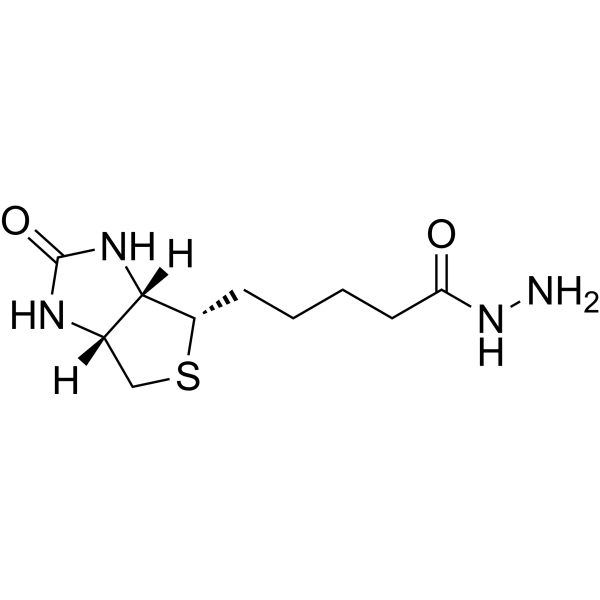
Biotin Hydrazide (Standard) is the analytical standard of Biotin Hydrazide (HY-100215). This product is intended for research and analytical applications. Biotin Hydrazide is a carbonyl-reactive biotinylation reagent, which is a carbonyl probe.
|
-
- HY-W837593
-
|
|
Isotope-Labeled Compounds
Amino Acid Derivatives
|
Others
|
|
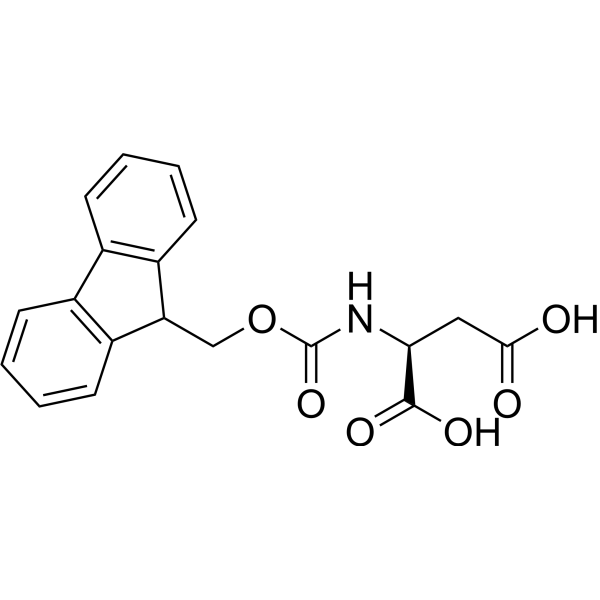
(((9H-Fluoren-9-yl)methoxy)carbonyl)-L-aspartic acid- 15N is the 15N-labeled (((9H-Fluoren-9-yl)methoxy)carbonyl)-L-aspartic acid (HY-W013182). (((9H-Fluoren-9-yl)methoxy)carbonyl)-L-aspartic acid is an aspartic acid derivative .
|
-
- HY-CE01562
-
-
- HY-CE01434
-
-
- HY-W697750
-
|
Tiglaldehyde
|
Biochemical Assay Reagents
|
Cancer
|
|
trans-2-Methyl-2-butenal (Tiglaldehyde) is an adduct former that can be found in cigarette smoke, and very weakly inhibits growth of cancer cells and normal mouse cells. trans-2-Methyl-2-butenal forms adducts with glutathione (GSH) via Michael addition.trans-2-Methyl-2-butenal is an α,β-unsaturated carbonyl compound .
|
-
- HY-CE00573
-
-
- HY-141745S
-
|
|
Isotope-Labeled Compounds
|
Others
|
|
2-(((4-Methyl-7-oxooctyl)oxy)carbonyl)benzoic acid-d4 is the deuterium labeled 2-(((4-Methyl-7-oxooctyl)oxy)carbonyl)benzoic acid .
|
-
- HY-W002671R
-
|
|
Reference Standards
|
|
|
N-(1,4-Benzodioxan-2-carbonyl)piperazine hydrochloride (Standard) is the analytical standard of N-(1,4-Benzodioxan-2-carbonyl)piperazine hydrochloride. This product is intended for research and analytical applications.
|
-
- HY-W112977
-
|
|
MOFs
|
Others
|
|
5,5'-Carbonyldiisophthalicacid (5,5'-carbonyl-di-isophthalic acid) is a metal-organic framework (MOF).
|
-
- HY-W456308
-
|
|
MOFs
|
Others
|
|
Ferrocene, 1,1′-bis[(3-pyridinylamino)carbonyl]- is a metal-organic framework (MOF).
|
-
- HY-W243924
-
|
|
MOFs
|
Others
|
|
(R)-5-(2-Carboxypyrrolidine-1-carbonyl)isophthalic acid is a metal-organic framework (MOF).
|
-
- HY-W573219
-
|
|
PROTAC Linkers
|
Cancer
|
|
6-(((Benzyloxy)carbonyl)amino)hexyl 4-methylbenzenesulfonate is a PROTAC linker that can be used in the synthesis of PROTACs.
|
-
- HY-W998821
-
|
|
MOFs
|
Others
|
|
((5-Carboxylatofuran-2-carbonyl)oxy)(hydroxy)aluminum(iii) is a metal-organic framework (MOF).
|
-
- HY-Z3727R
-
|
|
Reference Standards
|
|
|
N2-[(1,1-Dimethylethoxy)carbonyl]-N5-[imino(nitroamino)methyl]-D-ornithine (Afatinib Impurity) (Standard) is the analytical standard of N2-[(1,1-Dimethylethoxy)carbonyl]-N5-[imino(nitroamino)methyl]-D-ornithine (Afatinib Impurity). This product is intended for research and analytical applications.
|
-
- HY-43459
-
-
- HY-W024030
-
|
|
PROTAC Linkers
|
Cancer
|
|
3-(1-((Benzyloxy)carbonyl)piperidin-4-yl)propanoic acid is a PROTAC linker that can be used in the synthesis of PROTACs.
|
-
- HY-W008977
-
-
- HY-W834431
-
|
|
MOFs
|
Others
|
|
4,4-((Ethane-1,2-diylbis(oxy))bis(carbonyl))dibenzoic acid is a metal-organic framework (MOF).
|
-
- HY-W190929
-
|
|
Biochemical Assay Reagents
|
Others
|
|
Diethyl 4-aminoheptanedioate contains a primary amine which can react with carboxylic acids, activated NHS esters and other carbonyls.
|
-
- HY-W011049
-
-
- HY-21983
-
|
|
Amino Acid Derivatives
|
Others
|
|
O-Acetyl-N-[(1,1-dimethylethoxy)carbonyl]-L-threonine is a compound containing both an amino group and a carboxyl group.
|
-
- HY-Y1147
-
|
Maleic acid diethyl ester
|
Biochemical Assay Reagents
|
Others
|
|
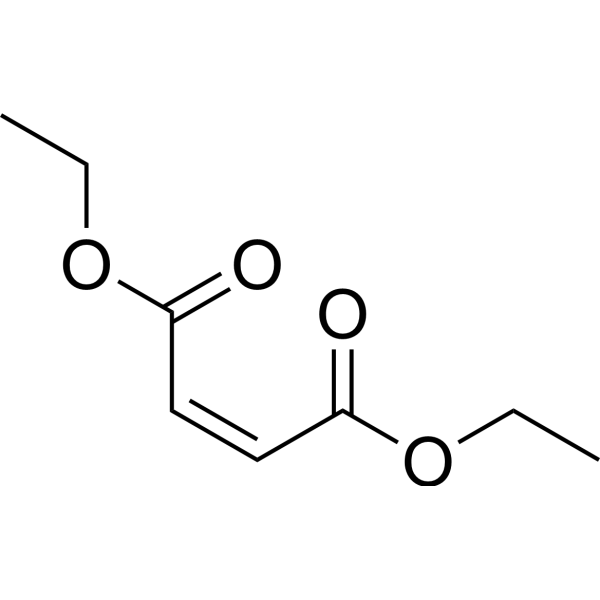
Diethyl maleate (DEM) is an orally available, effective glutathione (GSH) depletor that crosses the blood-brain barrier. Diethyl maleate covalently binds irreversibly to GSH via glutathione S-transferase with an in vitro IC50 of 0.1-0.5 mM. Diethyl maleate selectively depletes GSH in liver, lung, and brain tissues, exacerbating oxidative stress and enhancing hyperbaric oxygen toxicity. Diethyl maleate promotes precursor amino acid uptake and in turn promotes GSH synthesis by upregulating the activity of the cystine-glutamate transporter XO -. Diethyl maleate can be used to study redox homeostasis and GSH protection mechanisms in oxidative stress-related diseases such as hyperbaric oxygen injury and metabolic diseases[1][2][3].
|
-
- HY-154662
-
|
|
Nucleoside Antimetabolite/Analog
|
Cancer
|
|
2’-Deoxy-2’-fluoro-N3-(2S)-(2-amino-3-carbonyl] propyl-beta-D-arabinouridine is a purine nucleoside analog. Purine nucleoside analogs have broad antitumor activity targeting indolent lymphoid malignancies. Anticancer mechanisms in this process rely on inhibition of DNA synthesis, induction of apoptosis, etc .
|
-
- HY-165702S
-
|
|
Isotope-Labeled Compounds
|
Others
|
|
2-Pyridinesulfonamide, N-[[(4,6-dimethoxy-2-pyrimidinyl)amino]carbonyl]-3-(2,2,2-trifluoroethoxy)-d6 is deuterium labeled 2-Pyridinesulfonamide, N-[[(4,6-dimethoxy-2-pyrimidinyl)amino]carbonyl]-3-(2,2,2-trifluoroethoxy) .
|
-
- HY-154724
-
|
|
Nucleoside Antimetabolite/Analog
|
Cancer
|
|
2’-Deoxy-2’-fluoro-N3-(2S)-[2-(tert-butoxy-carbonyl)-amino-3-carbonyl]propyluridine is a purine nucleoside analog. Purine nucleoside analogs have broad antitumor activity targeting indolent lymphoid malignancies. Anticancer mechanisms in this process rely on inhibition of DNA synthesis, induction of apoptosis, etc .
|
-
- HY-181631S
-
|
|
Isotope-Labeled Compounds
|
Others
|
|
4-[[[(2-((tert-Butoxycarbonyl)amino)ethyl)amino]carbonyl]methyl]-7-hydroxy-2H-chromen-2-one-d9 is the deuterium labeled 4-[[[(2-((tert-Butoxycarbonyl)amino)ethyl)amino]carbonyl]methyl]-7-hydroxy-2H-chromen-2-one.
|
-
- HY-W854304
-
|
|
PROTAC Linkers
|
Cancer
|
|
16-[[(9H-Fluoren-9-ylmethoxy)carbonyl]amino]hexadecanoic acid is a PROTAC linker that can be used in the synthesis of PROTACs.
|
-
- HY-W072732
-
-
- HY-W048918
-
-
- HY-W150273
-
|
|
Biochemical Assay Reagents
|
Others
|
|
6-Aminocoumarin hydrochloride is a coumarin dye, which belongs to the donor-acceptor compounds as it contains a donor amine group and an acceptor carbonyl group .
|
-
- HY-41051
-
|
N-tert-Butoxycarbonyl-N-methyl-L-valine; N-tert-Butoxycarbonyl-N-methylvaline
|
Amino Acid Derivatives
|
Others
|
|
(2S)-2-[[(tert-Butoxy)carbonyl](methyl)amino]-3-methylbutanoic acid is a valine derivative .
|
-
- HY-W048668
-
-
- HY-W036329
-
-
- HY-41802
-
|
|
Drug Intermediate
|
Others
|
|
1-((Benzyloxy)carbonyl)-5-oxopiperidine-2-carboxylic acid is a drug intermediate for synthesis of various active compounds.
|
-
- HY-W009049
-
-
- HY-N8737
-
|
|
Others
|
Others
|
|
Desrhamnosylmartynosideis extracted from the root of Scutellaria prostrata. Desrhamnosylmartynoside has absorption bands assignable to hydroxyl,α,β-unsanturate carbonyl groups .
|
-
- HY-W057279
-
|
|
PROTAC Linkers
|
Cancer
|
|
Methyl 3-{[(tert-butoxy)carbonyl]amino}cyclobutane-1-carboxylate is a PROTAC linker that can be used in the synthesis of PROTACs.
|
-
- HY-W048708
-
-
- HY-I0109
-
-
- HY-W013207
-
-
- HY-34470
-
-
- HY-W022226
-
-
- HY-W040416
-
-
- HY-W022228
-
-
- HY-W023145
-
-
- HY-140745
-
|
|
PROTAC Linkers
|
Cancer
|
|
Benzyloxy carbonyl-PEG3-C2-acid is a PEG-based PROTAC linker that can be used in the synthesis of PROTACs .
|
-
- HY-W301135
-
|
|
PROTAC Linkers
|
Cancer
|
|
10-((((9h-Fluoren-9-yl)methoxy)carbonyl)amino)decanoic acid is a PROTAC linker that can be used in the synthesis of PROTACs.
|
-
- HY-W048693
-
-
- HY-W010745
-
-
- HY-W053702
-
-
- HY-22002
-
-
- HY-W009008
-
-
- HY-W010719
-
-
- HY-157452
-
|
|
Carbonyl Reductase
|
Cancer
|
|
(8S)-Methyl zearalenone (ZEA analogue 5) is a selective CBR1 (carbonyl reductase 1) inhibitor, with an IC50 of 0.21 μM .
|
-
- HY-W011088
-
-
- HY-141685
-
|
|
CDK
GSK-3
VEGFR
FGFR
|
Cancer
|
|
3-Methylthienyl-carbonyl-JNJ-7706621 is a potent and selective inhibitor of cyclin-dependent kinase (CDK), with IC50s of 6.4 nM and 2 nM for CDK1/cyclin B and CDK2/cyclin A, respectively. 3-Methylthienyl-carbonyl-JNJ-7706621 also shows potent inhibition of GSK-3 (IC50=0.041 μM) and modest potency against CDK4, VEGF-R2, and FGF-R2 (IC50=0.11, 0.13, 0.22 μM, respectively). 3-Methylthienyl-carbonyl-JNJ-7706621 can be used for the research of cancer .
|
-
- HY-140095
-
|
|
PROTAC Linkers
|
Cancer
|
|
N-(Propargyl-PEG4-carbonyl)-N-bis(PEG1-methyl ester) is a PEG-based PROTAC linker that can be used in the synthesis of PROTACs . N-(Propargyl-PEG4-carbonyl)-N-bis(PEG1-methyl ester) is a click chemistry reagent, it contains an Alkyne group and can undergo copper-catalyzed azide-alkyne cycloaddition (CuAAc) with molecules containing Azide groups.
|
-
- HY-154835
-
|
|
Biochemical Assay Reagents
|
Others
|
|
N6-[[(4-Azidophenyl)methoxy]carbonyl]-L-lysine is an unnatural amino acid . N6-[[(4-Azidophenyl)methoxy]carbonyl]-L-lysine is a click chemistry reagent, it contains an Azide group and can undergo copper-catalyzed azide-alkyne cycloaddition reaction (CuAAc) with molecules containing Alkyne groups. It can also undergo strain-promoted alkyne-azide cycloaddition (SPAAC) reactions with molecules containing DBCO or BCN groups.
|
-
- HY-W349542
-
|
|
PROTAC Linkers
|
Cancer
|
|
Tert-butyl 4-(piperazine-1-carbonyl)piperidine-1-carboxylate is a PROTAC linker that can be used in the synthesis of PROTACs.
|
-
- HY-W045082
-
|
|
PROTAC Linkers
|
Cancer
|
|
tert-Butyl 4-(piperidine-4-carbonyl)piperazine-1-carboxylate is a PROTAC linker that can be used in the synthesis of PROTACs.
|
-
- HY-W168255
-
|
|
PROTAC Linkers
|
Cancer
|
|
1'-[(tert-Butoxy)carbonyl]-[1,3'-biazetidine]-3-carboxylic acid is a PROTAC linker that can be used in the synthesis of PROTACs.
|
-
- HY-W036324
-
-
- HY-W107032
-
|
|
PROTAC Linkers
|
Cancer
|
|
6-((((9H-Fluoren-9-yl)methoxy)carbonyl)(methyl)amino)hexanoic acid is a PROTAC linker that can be used in the synthesis of PROTACs.
|
-
- HY-28448
-
|
|
MOFs
|
Others
|
|
((5-Carboxylato-1H-pyrazole-3-carbonyl)oxy)(hydroxy)aluminum(III) is a metal-organic framework (MOF).
|
-
- HY-W129500
-
|
|
Biochemical Assay Reagents
|
Others
|
|
N-[[Bis[4-(dimethylamino)phenyl]amino]carbonyl]glycine sodium can be used as a biomonitoring reagent to measure redox activity through a colorimetric reaction.
|
-
- HY-157445
-
-
- HY-W036322
-
-
- HY-34540
-
|
(αS)-α-[[(9H-Fluoren-9-ylmethoxy)carbonyl]amino]-2-pyridinepropanoic acid
|
Amino Acid Derivatives
|
Others
|
|
(αS)-α-[[(9H-Fluoren-9-ylmethoxy)carbonyl]amino]-2-pyridinepropanoic acid is an alanine derivative .
|
-
- HY-140750
-
|
|
PROTAC Linkers
|
Cancer
|
|
Benzyloxy carbonyl-PEG3-C2-Boc is an alkyl/ether-based PROTAC linker that can be used in the synthesis of PROTACs .
|
-
- HY-W011001
-
-
- HY-W111382
-
-
- HY-W013163
-
-
- HY-W002481
-
-
- HY-W349243
-
|
|
PROTAC Linkers
|
Cancer
|
|
3-(4-((((9H-fluoren-9-yl)methoxy)carbonyl)amino)phenyl)propanoic acid is a PROTAC linker that can be used in the synthesis of PROTACs.
|
-
- HY-W036352
-
-
- HY-W089229
-
-
- HY-W010747
-
-
- HY-W178562
-
|
5-[(tert-Butyloxycarbonyl)amino]-isophthalic acid
|
MOFs
|
Others
|
|
5-{[(tert-Butoxy)carbonyl]amino}benzene-1,3-dicarboxylic acid (5-[(tert-Butyloxycarbonyl)amino]-isophthalic acid) is a metal-organic framework (MOF).
|
-
- HY-N13299
-
|
|
Endogenous Metabolite
|
Others
|
|
Glucoberteroin is a glucosinolate, which could be isolated from Degenia velebitica. Glucoberteroin inhibits protein glycosylation and carbonylation, decreases the production of carbonyl protein, and contributes to the preventation of skin-aging .
|
-
- HY-W095751
-
|
|
PROTAC Linkers
|
Cancer
|
|
2-(4-(((((9H-Fluoren-9-yl)methoxy)carbonyl)amino)methyl)phenyl)acetic acid is a PROTAC linker that can be used in the synthesis of PROTACs.
|
-
- HY-W048677
-
-
- HY-W010837
-
-
- HY-W018849
-
-
- HY-N18104
-
|
|
Others
|
Others
|
|
Picrasin G is a bitter principle. Picrasin G can be isolated from Picrasma quassioides .
|
-
- HY-151695
-
|
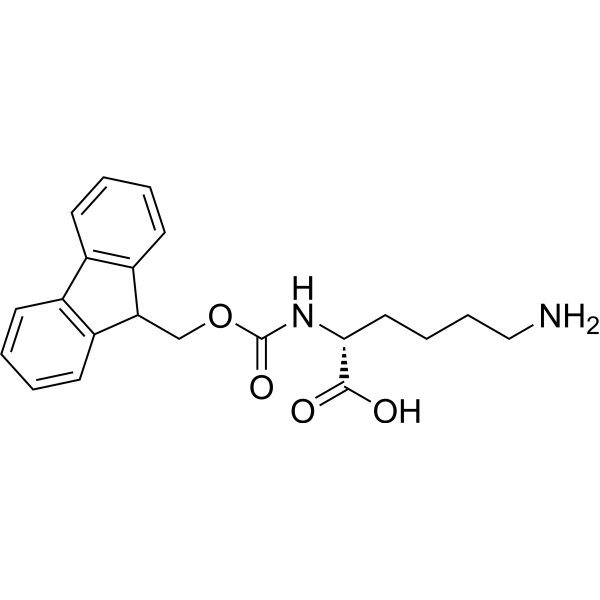
N2-Fmoc-N6-[(propargyloxy)carbonyl]-L-lysine
|
ADC Linker
|
Others
|
|
Fmoc-L-Lys(Pryoc)-OH (N2-Fmoc-N6-[(propargyloxy)carbonyl]-L-lysine) is a click chemistry reagent containing an azide group .
|
-
- HY-W017425
-
|
Phenylhydrazine acetate
|
Biochemical Assay Reagents
|
Others
|
|
N'-Phenylacetohydrazide consists of a phenyl group attached to the acetylhydrazide functional group via a hydrazine bond. This compound is commonly used as a reagent in organic chemistry for the determination of carbonyl compounds such as aldehydes and ketones.
|
-
- HY-W063820
-
|
|
Drug Intermediate
|
Others
|
|
(2S)-1-[(tert-Butoxy)carbonyl]-2-methylazetidine-2-carboxylic acid is a drug intermediate for synthesis of various active compounds.
|
-
- HY-W057101
-
|
|
PROTAC Linkers
|
Cancer
|
|
Methyl 6-{[(tert-butoxy)carbonyl]amino}spiro[3.3]heptane-2-carboxylate is a PROTAC linker that can be used in the synthesis of PROTACs.
|
-
- HY-N13179
-
|
|
Others
|
Others
|
Wilforic acid A is a triterpene compound that can be isolated from the Tripterygium wilfordii. Wilforic acid A shows a hydroxyl absorption band at 3402 cm -1 and a carbonyl absorption band at 1702 cm -1 .
|
-
- HY-W010984
-
-
- HY-W010930
-
|
|
Amino Acid Derivatives
|
Others
|
|
(R)-2-((((9H-Fluoren-9-yl)methoxy)carbonyl)amino)-3-(4-chlorophenyl)propanoic acid is a phenylalanine derivative .
|
-
- HY-W010958
-
|
|
Amino Acid Derivatives
|
Others
|
|
(S)-2-((((9H-Fluoren-9-yl)methoxy)carbonyl)amino)-3-(3-cyanophenyl)propanoic acid is a phenylalanine derivative .
|
-
- HY-W045221
-
-
- HY-W037120
-
|
|
Amino Acid Derivatives
|
Others
|
|
N-(((9H-Fluoren-9-yl)methoxy)carbonyl)-S-((4-methoxyphenyl)diphenylmethyl)-D-cysteine is a cysteine derivative .
|
-
- HY-W087880
-
|
|
PROTAC Linkers
|
Cancer
|
|
2-(4-(((9H-Fluoren-9-yl)methoxy)carbonyl)piperazin-1-yl)acetic acid is a PROTAC linker that can be used in the synthesis of PROTACs.
|
-
- HY-W800684
-
|
|
Biochemical Assay Reagents
|
Others
|
|
Benzyloxy carbonyl-PEG4-NHS ester is a reagent with a benzyl protecting group and an NHS ester. The NHS ester reacts with primary amines (-NH2). The benzyl protecting group can be removed by hydrogenolysis.
|
-
- HY-W011203
-
|
|
Amino Acid Derivatives
|
Others
|
|
(S)-2-(5-Amino-2-(((benzyloxy)carbonyl)amino)-5-oxopentanamido)acetic acid is a Glycine (HY-Y0966) derivative .
|
-
- HY-W103299
-
|
|
PROTAC Linkers
|
Cancer
|
|
2-(1-(((9H-Fluoren-9-yl)methoxy)carbonyl)piperidin-4-yl)acetic acid is a PROTAC linker that can be used in the synthesis of PROTACs.
|
-
- HY-W748705
-
|
|
Isotope-Labeled Compounds
|
Others
|
|
Aminomethanephosphonic acid- 13C, 15N is 13C and 15N labeled (((((9H-Fluoren-9-yl)methoxy)carbonyl)amino)methyl)phosphonic acid .
|
-
- HY-132270
-
|
|
Fluorescent Dye
|
Others
|
|
FAM amine, 5-isomer is a fluorescein linker that undergoes enzymatic transamination. The addition of the amine group makes the compound more reactive with carboxylic acids, activated NHS ester and other carbonyl groups.
|
-
- HY-W048704
-
|
|
Amino Acid Derivatives
|
Others
|
|
N2-(((9H-Fluoren-9-yl)methoxy)carbonyl)-N6-((4-methoxyphenyl)diphenylmethyl)-L-lysine is a lysine derivative .
|
-
- HY-W130212
-
|
|
Amino Acid Derivatives
|
Others
|
|
(R)-2-((((9H-Fluoren-9-yl)methoxy)carbonyl)amino)-3-(2-(trifluoromethyl)phenyl)propanoic acid is a phenylalanine derivative .
|
-
- HY-W998707
-
|
|
Fluorescent Dye
|
Others
|
|
TAMRA amine, 5-isomer hydrochloride is a rhodamine dye with excitation/emission maximum 553/575 nm. The amine group is reactive with carboxylic acids, activated NHS esters, carbonyls (ketone, aldehyde) etc.
|
-
- HY-W160250
-
|
|
PROTAC Linkers
|
Cancer
|
|
3-(1-{[(9h-fluoren-9-yl)methoxy]carbonyl}piperidin-4-yl)propanoic acid is a PROTAC linker that can be used in the synthesis of PROTACs.
|
-
- HY-W060248
-
|
|
PROTAC Linkers
|
Cancer
|
|
2-[(tert-Butoxy)carbonyl]-2-azaspiro[3.5]nonane-7-carboxylic acid is a PROTAC linker that can be used in the synthesis of PROTACs.
|
-
- HY-W110126
-
|
|
Amino Acid Derivatives
|
Others
|
|
(S)-3-((((9H-Fluoren-9-yl)methoxy)carbonyl)amino)-6-((tert-butoxycarbonyl)amino)hexanoic acid is a lysine derivative .
|
-
- HY-W011848S
-
|
2-((Benzyloxy)carbonyl)benzoic acid-d4
|
Isotope-Labeled Compounds
Endogenous Metabolite
|
Metabolic Disease
|
|
Monobenzyl phthalate-d4 is the deuterium labeled Monobenzyl phthalate. Monobenzyl phthalate (2-((Benzyloxy)carbonyl)benzoic acid) is the urinary metabolite exposuring to phthalates, such as, diethylhexyl phthalate (DEHP) .
|
-
- HY-D0066
-
|
DCCH
|
Fluorescent Dye
|
Others
|
|
7-Diethylaminocoumarin-3-carbohydrazide is a coumarin. 7-Diethylaminocoumarin-3-carbohydrazide can be used to detect sugar chains and quantify biological carbonyl compounds .
|
-
- HY-W013760
-
-
- HY-W000843
-
-
- HY-W005913
-
-
- HY-W158606
-
|
|
PROTAC Linkers
|
Cancer
|
|
2-[4-({[(9h-fluoren-9-yl)methoxy]carbonyl}amino)piperidin-1-yl]acetic acid is a PROTAC linker that can be used in the synthesis of PROTACs.
|
-
- HY-W048691
-
-
- HY-W017069
-
|
|
Amino Acid Derivatives
|
Others
|
|
(S)-3-((((9H-Fluoren-9-yl)methoxy)carbonyl)amino)-4-(allyloxy)-4-oxobutanoic acid is an aspartic acid derivative .
|
-
- HY-W011003
-
-
- HY-W008667
-
|
|
Amino Acid Derivatives
|
Others
|
|
(S)-2-((((9H-Fluoren-9-yl)methoxy)carbonyl)amino)-5-(tert-butoxy)-5-oxopentanoic acid hydrate is a glutamic acid derivative .
|
-
- HY-155587
-
|
|
Carbonyl Reductase
Src
|
Cancer
|
|
Hydroxy-PP is a potent carbonyl reductase 1 (CBR1) inhibitor with an IC50 value of 0.78 μM. Hydroxy-PP also potently inhibits the cytoplasmic tyrosine kinase Fyn with an IC50 value of 5 nM .
|
-
- HY-Y0134
-
|
|
Amino Acid Derivatives
|
Others
|
|
(S)-2-((((9H-fluoren-9-yl)methoxy)carbonyl)amino)-5-(tert-butoxy)-5-oxopentanoic acid is a glutamic acid derivative .
|
-
- HY-W060224
-
|
|
PROTAC Linkers
|
Cancer
|
|
2-{2-[(tert-Butoxy)carbonyl]-2-azaspiro[3.3]heptan-6-yl}acetic acid is a PROTAC linker that can be used in the synthesis of PROTACs.
|
-
- HY-W011056
-
-
- HY-W048681
-
-
- HY-W009038
-
-
- HY-23861
-
|
Fmoc-N,N-dimethyl-L-Glutamine
|
Amino Acid Derivatives
|
Others
|
|
N2-(((9H-Fluoren-9-yl)methoxy)carbonyl)-N5,N5-dimethyl-L-glutamine is a glutamine derivative .
|
-
- HY-W011019
-
-
- HY-78192
-
|
|
Biochemical Assay Reagents
|
Others
|
|
N-[N-[(1,1-Dimethylethoxy)carbonyl]-2-methylalanyl]-D-tryptophan is a biochemical reagent that can be used as a biological material or organic compound for life science related research.
|
-
- HY-W013108
-
|
|
Amino Acid Derivatives
|
Others
|
|
(S)-2-((((9H-Fluoren-9-yl)methoxy)carbonyl)amino)-3-(4-((tert-butoxycarbonyl)amino)phenyl)propanoic acid is a phenylalanine derivative .
|
-
- HY-166670S
-
-
- HY-W002301
-
|
|
Amino Acid Derivatives
|
Others
|
|
(2S)-4-(benzyloxy)-2-{[(9H-fluoren-9-ylmethoxy)carbonyl]amino}-4-oxobutanoic acid is an aspartic acid derivative .
|
-
- HY-W047794
-
-
- HY-W338047
-
|
|
PROTAC Linkers
|
Cancer
|
|
2-(4-(2-((((9H-Fluoren-9-yl)methoxy)carbonyl)amino)ethyl)piperazin-1-yl)acetic acid (dihydrochloride) is a PROTAC linker that can be used in the synthesis of PROTACs.
|
-
- HY-W011848R
-
|
2-((Benzyloxy)carbonyl)benzoic acid (Standard)
|
Reference Standards
Endogenous Metabolite
|
Metabolic Disease
|
|
Monobenzyl phthalate (Standard) is the analytical standard of Monobenzyl phthalate. This product is intended for research and analytical applications. Monobenzyl phthalate (2-((Benzyloxy)carbonyl)benzoic acid) is the urinary metabolite exposuring to phthalates, such as, diethylhexyl phthalate (DEHP) .
|
-
- HY-W062148
-
|
trans-3-[[(1,1-Dimethylethoxy)carbonyl]amino]-cyclobutaneacetic Acid
|
PROTAC Linkers
|
Cancer
|
|
2-(trans-3-((tert-Butoxycarbonyl)amino)cyclobutyl)acetic acid (trans-3-[[(1,1-Dimethylethoxy)carbonyl]amino]-cyclobutaneacetic Acid) is a PROTAC linker that can be used in the synthesis of PROTACs.
|
-
- HY-W800843
-
|
|
Liposome
|
Cancer
|
|
tert-Butyl 3-(7-((undecan-3-yloxy)carbonyl)heptylamino)propylcarbamate is an aminolipid featuring a Boc-protected primary amine, a propylamine spacer attached to an octanoate chain and a C11 chain.
|
-
- HY-W130397
-
|
|
Drug Derivative
|
Others
|
|
(S)-2-((((9H-Fluoren-9-yl)methoxy)carbonyl)(methyl)amino)-4-oxo-4-(tritylamino)butanoic acid is an asparagine derivative .
|
-
- HY-W036333
-
-
- HY-N16396
-
|
|
Drug Derivative
|
Others
|
|
Ampelanol is a derivative of Altersolanol A (HY-125461). Ampelanol has no anticancer and anti-inflammatory activity through the reduction of one of a carbonyl group and removal of hydroxyl substituents within Altersolanol A. Ampelanol can be used as a negative control .
|
-
- HY-W077284
-
|
FMoc-N-Me-Abu(4)-OH
|
PROTAC Linkers
|
Cancer
|
|
4-((((9H-Fluoren-9-yl)methoxy)carbonyl)(methyl)amino)butanoic acid (FMoc-N-Me-Abu(4)-OH) is a PROTAC linker that can be used in the synthesis of PROTACs.
|
-
- HY-172284
-
|
|
Fluorescent Dye
|
Others
|
|
6-TAMRA cadaverine has achieved prominence as a dye for oligonucleotide labeling and automated DNA sequencing applications. The amino group (NH2) is reactive with carboxylic acids, activated NHS esters, carbonyls (ketone, aldehyde), etc.
|
-
- HY-20128
-
|
|
Drug Intermediate
|
Others
|
|
Piperazin-2-one is a piperazine ring derivative containing amide and ester carbonyl groups. As an important intermediate, Piperazin-2-one can be used for the synthesis of various active compounds .
|
-
- HY-W800681
-
|
|
Biochemical Assay Reagents
|
Others
|
|
Benzyloxy carbonyl-PEG4-acid is a linker with a benzyl protecting group and a carboxylic acid. The carboxylic acid can undergo reactions with primary amines with the help of activators (EDC or HATU). The benzyl protecting group can be removed via hydrogenolysis.
|
-
- HY-121710
-
|
7-Monohydroxyethylrutoside
|
Carbonyl Reductase
|
Cardiovascular Disease
|
|
MonoHER (7-Monohydroxyethylrutoside) is a Carbonyl reductase 1 (CBR1) inhibitor and can be used as a cardioprotective agent. MonoHER inhibits the activity of CBR1 V88 and CBR1 I88 in a concentration-dependent manner .
|
-
- HY-W837135
-
|
|
Ligands for E3 Ligase
|
Cancer
|
|
5-Hydrazinyl thalidomide hydrochloride is a Thalidomide analogue featuring a hydrazine. PROTAC linkers are made to recruit E3 ligase for the ubiquitinylation of target proteins. The hydrazine may be used for further derivatization via reactions with various carbonyl groups.
|
-
- HY-W005294S
-
|
|
Isotope-Labeled Compounds
|
Others
|
|
Methyl 2-(2-(((benzyloxy)carbonyl)amino)propan-2-yl)-5-hydroxy-1-methyl-6-oxo-1,6-dihydropyrimidine-4-carboxylate-d3 is the deuterium labeled Methyl 2-(2-(((benzyloxy)carbonyl)amino)propan-2-yl)-5-hydroxy-1-methyl-6-oxo-1,6-dihydropyrimidine-4-carboxylate .
|
-
- HY-134903
-
|
|
mTOR
|
Cancer
|
|
(32-Carbonyl)-RMC-5552 is a potent mTOR inhibitor. (32-Carbonyl)-RMC-5552 inhibits mTORC1 and mTORC2 substrate (p-P70S6K-(T389), p-4E-BP1-(T37/36), AND p-AKT1/2/3-(S473)) phosphorylation with pIC50s of > 9, >9 and between 8 and 9, respectively (patent WO2019212990A1, example 2) .
|
-
- HY-W053701
-
|
|
Amino Acid Derivatives
|
Others
|
|
N2-(((9H-Fluoren-9-yl)methoxy)carbonyl)-N6-((5-(dimethylamino)naphthalen-1-yl)sulfonyl)-L-lysine is a lysine derivative .
|
-
- HY-D2764
-
|
|
Fluorescent Dye
|
Others
|
|
Difluorocarboxyfluorescein cadaverine, 5-isomer is a carbonyl reactive building block used to modify carboxylic groups in the presence of activators (e.g. EDC, or DCC) or activated esters (e.g. NHS esters) through a stable amide bond.
|
-
- HY-W800651
-
|
|
Biochemical Assay Reagents
|
Others
|
|
Biotin-SS-Amine hydrochloride is a cleavable biotinylation reagent. The amine group can react with carboxylic acids, activated NHS esters and other carbonyl groups. The disulfide bond in this linker can be cleaved using reducing agents such as DTT, BME and TCEP.
|
-
- HY-W047845
-
|
|
Amino Acid Derivatives
|
Others
|
|
N-(((9H-Fluoren-9-yl)methoxy)carbonyl)-N-(2-hydroxy-4-methoxybenzyl)glycine is a Glycine (HY-Y0966) derivative .
|
-
- HY-W048913
-
|
|
Amino Acid Derivatives
|
Others
|
|
N2-(((9H-Fluoren-9-yl)methoxy)carbonyl)-N2-(2-((5-sulfonaphthalen-1-yl)amino)ethyl)-L-glutamine is a glutamine derivative .
|
-
- HY-N12966
-
|
|
Others
|
Others
|
|
(±)9,10-DiHODE (compound 4) is a plant oxylipin compound that reduces the carbonyl group of α-ketoalcohols to form adjacent diols. They act as important signaling molecules in plants and play a role in regulating growth and flowering processes .
|
-
- HY-42418
-
|
|
Drug Intermediate
|
Others
|
|
3-Methyl-N-{[(2-methyl-2-propanyl)oxy]carbonyl}-L-valyl-(4R)-4-hydroxy-L-proline is a drug intermediate for synthesis of various active compounds.
|
-
- HY-D2751
-
|
|
Fluorescent Dye
|
Others
|
|
BP Fluor 488 Cadaverine is a carboxyl/carbonyl reactive building block used widely to modify carboxylic groups in the presence of activators (e.g. EDC or DCC) or activated esters (e.g. NHS esters) through a stable amide bond.
|
-
- HY-W053705
-
-
- HY-W190918
-
|
|
Biochemical Assay Reagents
|
Others
|
|
endo-BCN-PEG4-amine is a click chemistry crosslinker reagent. The BCN groupis very reactive with azide-tagged molecules. The amino group is reactive with carboxylic acids, activated NHS esters, carbonyls (ketone, aldehyde) etc.
|
-
- HY-157447
-
|
|
Carbonyl Reductase
|
Cancer
|
|
CBR1-IN-4 (Compound 13p) is a human carbonyl reductase 1 (CBR1) inhibitor (IC50=0.09 μM). CBR1-IN-4 can be used in cancer research .
|
-
- HY-W190921
-
|
|
Biochemical Assay Reagents
|
Others
|
|
t-Butyl 3-(hydroxypropoxyl)-propanoate contains reactive hydroxyl and t-butyl protected carboxyl moieties. The hydroxyl group can react to further derivatize the compound. The t-butyl carbonyl group can be deprotected under acidic conditions.
|
-
- HY-W190915
-
|
|
Biochemical Assay Reagents
|
Others
|
|
4,7,10,13,16–Pentaoxanonadecane-1,19-diamine is a PEG based linker with two terminal amine groups. The amine group is reactive with carboxylic acids, activated NHS esters, carbonyls (ketone, aldehyde) etc.
|
-
- HY-163458
-
|
|
Interleukin Related
|
Inflammation/Immunology
|
|
Anti-inflammatory agent 77 (C12) is a β-cycloacinamide derived mono-carbonyl curcumin analog and an inhibitor of interleukin-6 (IL-6). Anti-inflammatory agent 77 can be used in the study of wound healing .
|
-
- HY-109001
-
|
ABT-957
|
Proteasome
|
Neurological Disease
|
|
Alicapistat (ABT-957) is an orally active selective inhibitor of human calpains 1 and 2 for the potential application of Alzheimer's disease (AD) . Alicapistat mitigates the metabolic liability of carbonyl reduction and inhibits calpain 1 with an IC50 value of 395 nM .
|
-
- HY-W591379
-
|
|
Biochemical Assay Reagents
|
Others
|
|
Amino-PEG19-amine is a PEG linker containing two amine functional groups. The hydrophilic PEG spacer increases solubility in aqueous media. The amino groups are reactive with carboxylic acids, activated NHS esters, carbonyls (ketone, aldehyde), etc.
|
-
- HY-79880
-
|
1,1'-Carbonyldiimidazole
|
MOFs
|
Others
|
|
N,N'-Carbonyldiimidazole (1,1'-Carbonyldiimidazole) is a highly reactive carboxylating reagent that can activate hydroxyl groups to form reactive carbonyl groups. N,N'-Carbonyldiimidazole can be used as a coupling agent and a peptide synthesis reagent .
|
-
- HY-W143230
-
|
4-Benzyloxybutanal
|
Biochemical Assay Reagents
|
Others
|
|
4-(Benzyloxy)butanal (4-Benzyloxybutanal) is a linker with an acid labile, benzyl protecting group and a reactive primary aldehyde. The primary aldehyde can react with hydrazide and aminooxy groups which are commonly used in biomolecular probes for labeling and crosslinking carbonyls (oxidized carbohydrates).
|
-
- HY-121206
-
|
|
Environmental Pollutants
Antibiotic
|
Infection
|
|
(-)-Isopulegol is prepared directly from the treatment of essential oil of citronella under solid supported acid catalysis and solvent-free microwave assisted ene-cyclisation. (-)-Isopulegol shows high activity in reacting with carbonyl compounds. (-)-Isopulegol can be used for antiviral activity research .
|
-
- HY-W190904
-
|
|
Biochemical Assay Reagents
|
Others
|
|
2-Amino-1,3-bis(tert-butyldimethylsilanoxy)propane has a TBDMS, acid labile protecting group. TBDMS is used for the protection of alcohol groups. The primary amine is able to react with carboxylic acids, active NHS esters and other carbonyl compounds.
|
-
- HY-124197S
-
|
|
Isotope-Labeled Compounds
Fluorescent Dye
|
Others
|
|
Coumarin hydrazine-d7 is the deuterium labeled Coumarin hydrazine (HY-124197). Coumarin hydrazine is a fluorescent chemical probe (λex=420–450/λem=468nm) to label cellular protein- and lipid-bound carbonyls .
|
-
- HY-W008446
-
|
|
Amino Acid Derivatives
|
Others
|
|
(2S,4R)-4-((((9H-Fluoren-9-yl)methoxy)carbonyl)amino)-1-(tert-butoxycarbonyl)pyrrolidine-2-carboxylic acid is a proline derivative .
|
-
- HY-W793100
-
|
|
Biochemical Assay Reagents
|
Others
|
|
Endo-BCN-PEG2-Biotin is a PEG linker containing a BCN group and a terminal carboxylic acid. The BCN groupis very reactive with azide-tagged molecules. The amino group is reactive with carboxylic acids, activated NHS esters, carbonyls (ketone, aldehyde) etc.
|
-
- HY-W154175
-
|
|
Biochemical Assay Reagents
|
Others
|
|
Boc-DODA is a linker containing a Boc-protected amino group and a terminal amine. The Boc group can be deprotected under mild acidic conditions to form the free amine. The terminal amine is reactive with carboxylic acids, activated NHS esters, carbonyls (ketone, aldehyde) etc.
|
-
- HY-43562
-
|
|
Drug Intermediate
|
Others
|
|
(2S,5S)-1-(((9H-Fluoren-9-yl)methoxy)carbonyl)-5-phenylpyrrolidine-2-carboxylic acid is a drug intermediate for synthesis of various active compounds.
|
-
- HY-W036320
-
|
|
Amino Acid Derivatives
|
Others
|
|
N2-(((9H-Fluoren-9-yl)methoxy)carbonyl)-Nw-((4-methoxy-2,3,6-trimethylphenyl)sulfonyl)-N2-methyl-L-arginine is an arginine derivative .
|
-
- HY-128851
-
|
|
Endogenous Metabolite
Fatty Acid Synthase (FASN)
|
Metabolic Disease
Cancer
|
|
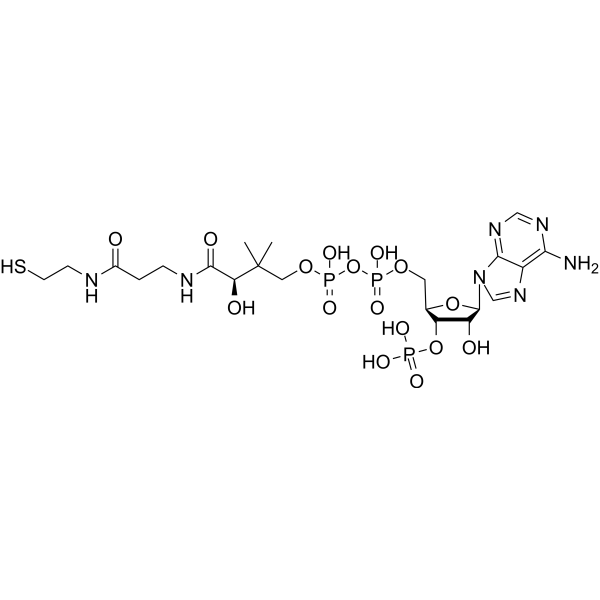
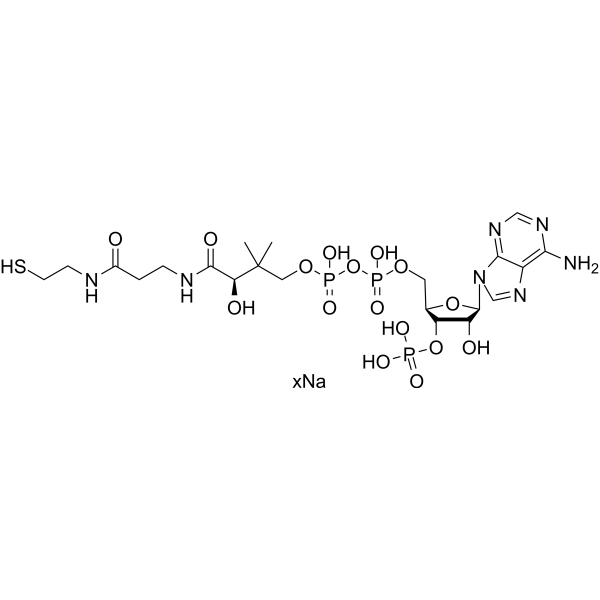
Coenzyme A (CoASH) is a ubiquitous and essential cofactor, which is an acyl group carrier and carbonyl-activating group for the citric acid cycle and fatty acid metabolism. Coenzyme A plays a central role in the oxidation of pyruvate in the citric acid cycle and the metabolism of carboxylic acids, including short- and long-chain fatty acids .
|
-
- HY-128851A
-
|
|
Endogenous Metabolite
Fatty Acid Synthase (FASN)
|
Metabolic Disease
Cancer
|
|
Coenzyme A (CoASH) is a ubiquitous and essential cofactor, which is an acyl group carrier and carbonyl-activating group for the citric acid cycle and fatty acid metabolism. Coenzyme A plays a central role in the oxidation of pyruvate in the citric acid cycle and the metabolism of carboxylic acids, including short- and long-chain fatty acids .
|
-
- HY-128851B
-
|
|
Endogenous Metabolite
Fatty Acid Synthase (FASN)
|
Metabolic Disease
Cancer
|
|
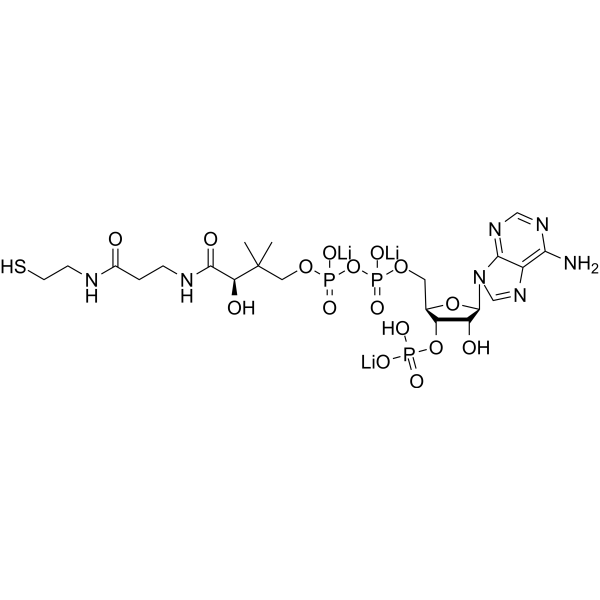
Coenzyme A (CoASH) sodium is a ubiquitous and essential cofactor, which is an acyl group carrier and carbonyl-activating group for the citric acid cycle and fatty acid metabolism. Coenzyme A plays a central role in the oxidation of pyruvate in the citric acid cycle and the metabolism of carboxylic acids, including short- and long-chain fatty acids .
|
-
- HY-W590569
-
|
|
Biochemical Assay Reagents
|
Others
|
|
Azido-PEG12-amine is a water soluble PEG compound. The azide group enables Click Chemistry. The amine group is reactive with carboxylic acids, activated NHS esters, carbonyls (ketone, aldehyde), etc. The hydrophilic PEG arm increases solubility in aqueous media.
|
-
- HY-W012971
-
|
|
Biochemical Assay Reagents
|
Others
|
|
5-Amino-1-pentanol is a linker containing a hydroxyl group and amine group. The hydroxyl group enables further derivatization or replacement with other reactive functional groups. The amine group is reactive with carboxylic acids, activated NHS esters, carbonyls (ketone, aldehyde) etc.
|
-
- HY-W778655
-
|
|
Isotope-Labeled Compounds
|
Others
|
|
Desmethylene oxobexarotene methyl ester- 13C4 is the 13C-labeled Methyl 4-(3,5,5,8,8-pentamethyl-5,6,7,8-tetrahydronaphthalene-2-carbonyl)benzoate (HY-W130051).
|
-
- HY-W747533
-
|
C8 Ceramine; Ceramine (d18:1/8:0)
|
Drug Derivative
|
Others
|
|
C8 Ceramine is an analog of ceramide in which the carbonyl group of the ceramide is replaced by a methylene group. At a concentration of 10 μM, C8 ceramine induces maximal DNA fragmentation in U937 cells after 6 hours of incubation, compared to 12 hours for C8 ceramide.
|
-
- HY-W479025
-
|
|
Biochemical Assay Reagents
|
Others
|
|
Fmoc-DODA hydrochloride is a linker with an Fmoc-protected amine and a terminal amine group. The Fmoc group can be deprotected under basic condition to obtain the free amine which can be used for further conjugations. The amino group is reactive with carboxylic acids, activated NHS esters, carbonyls (ketone, aldehyde) etc.
|
-
- HY-W879032
-
|
|
Biochemical Assay Reagents
|
Others
|
|
Endo-BCN-PEG4-Pomalidomide is a PEG derivative composed of BCN, PEG4 and Pomalidomide (HY-10984). The BCN groupis very reactive with azide-tagged molecules. The amino group is reactive with carboxylic acids, activated NHS esters, carbonyls (ketone, aldehyde) etc .
|
-
- HY-77826
-
|
|
Epigenetic Reader Domain
|
Cancer
|
|
4-Chloro-N-methylpicolinamide (Compound 3) is a BAZ2A bromodomain inhibitor with a Kd of >500 μM. 4-Chloro-N-methylpicolinamide forms a weak hydrogen bond with the carbonyl oxygen of Pro1817. 4-Chloro-N-methylpicolinamide can be used in the research of invasive prostate cancer .
|
-
- HY-W590588
-
|
|
Biochemical Assay Reagents
|
Others
|
|
Diethyl acetal-PEG4-amine is a PEG reagent containing an amino (NH2) group and a terminal diethyl acetal protecting group, which can be deprotected to form the free aldehyde. NH2 group is reactive with carboxylic acids, activated NHS esters, carbonyls (ketone, aldehyde), etc.
|
-
- HY-W048215
-
|
|
Amino Acid Derivatives
|
Others
|
|
N2-(((9H-Fluoren-9-yl)methoxy)carbonyl)-N6-(2-(7-methoxy-2-oxo-2H-chromen-4-yl)acetyl)-L-lysine is a lysine derivative .
|
-
- HY-161998
-
|
|
Bacterial
Urease
|
Others
|
Urease-IN-16 (compound 4e) is a urease inhibitor, with an IC50 value of 132 μmol/L. Urease-IN-16 can coordinate with the nickel atom through the oxygen atoms of carbonyl or boronic acid groups. Urease-IN-16 shows great potential as an additive in the development of efficient fertilizers and medical applications .
|
-
- HY-128429R
-
|
(E)-2-Hexenal (Standard)
|
Fungal
Biochemical Assay Reagents
Reference Standards
|
Infection
|
|
Trans-2-Hexenal (Standard) is the analytical standard of Trans-2-Hexenal. This product is intended for research and analytical applications. Trans-2-Hexenal can be used for the determination of low-molecular-weight carbonyl compounds which are reactive with biological nucleophiles in biological samples .
|
-
- HY-W591965
-
|
|
Biochemical Assay Reagents
|
Others
|
|
t-Boc-Aminooxy-pentane-amine is a linker containing an aminooxy group and a primary amine. The aminooxy group can be used in bioconjugation. It reacts with an aldehyde to form an oxime bond. If a reductant is used, it will form a hydroxylamine linkage. The amino group is reactive with carboxylic acids, activated NHS esters, carbonyls (ketone, aldehyde) etc.
|
-
- HY-154779
-
|
|
Nucleoside Antimetabolite/Analog
|
Cancer
|
|
5′-Deoxy-5-fluoro-N-[(2-methylbutoxy)carbonyl]cytidine is a purine nucleoside analog. Purine nucleoside analogs have broad antitumor activity targeting indolent lymphoid malignancies. Anticancer mechanisms in this process rely on inhibition of DNA synthesis, induction of apoptosis, etc .
|
-
- HY-D1336
-
|
|
Fluorescent Dye
|
|
|
FAM amine, 6-isomer is a fluorescein derivative with an amine group and contains an isomer of the fluorophore. Can be used to modify biomolecules through enzymatic transamination. Its fatty amine groups can also react with electrophiles such as activated esters. The amine can also be conjugated to carbonyl compounds (aldehydes and ketones) by reductive amination.
|
-
- HY-N10777
-
|
|
Others
|
Cancer
|
|
1-Ketoaethiopinone is an abietane-diterpenoid. 1-Ketoaethiopinone has an α, β-unsaturated carbonyl function. 1-Ketoaethiopinone shows cytotoxic activity against human cancer cell lines MOLT-4 (human lymphoblastic leukemia) and MCF-7 (human breast adenocarcinoma) .
|
-
- HY-W153502
-
|
|
Biochemical Assay Reagents
|
Others
|
|
MeNH-PEG2-OH is a PEG linker containing a hydroxyl group with a methylamine group. The hydrophilic PEG spacer increases solubility in aqueous media. The hydroxyl group enables further derivatization or replacement with other reactive functional groups. The methylamine group is reactive with carboxylic acids, carbonyls (ketone, aldehyde) etc.
|
-
- HY-P4900
-
|
|
Caspase
|
Others
|
|
Fluorescein-6-carbonyl-Asp(OMe)-Glu(OMe)-Val-DL-Asp(OMe)-fluoromethylketone is a cell-permeable, non-toxic inhibitor that binds irreversibly to activated caspase-3 in apoptotic cells. The fluorescence intensity can be measured by flow cytometry, microwell plate reader, or fluorescence microscopy .
|
-
- HY-W879044
-
|
Endo-BCN-PEG15-NH2
|
Biochemical Assay Reagents
|
Others
|
|
Endo-BCN-PEG15-amine (Endo-BCN-PEG15-NH2) is a click chemistry crosslinker reagent. The BCN groupis very reactive with azide-tagged molecules. The amino group is reactive with carboxylic acids, activated NHS esters, carbonyls (ketone, aldehyde) etc .
|
-
- HY-172285
-
|
|
Fluorescent Dye
|
Others
|
|
Cy3 hydrazide is a cyanine dye linker containing hydrazide, which can be used to label aldehydes and ketones. This reagent allows to label various carbonyl-containing molecules such as antibodies and other glycoproteins after periodate oxidation, proteins after oxidative stress or deamination, or reducing saccarides. Cyanine3 is compatible with a number of fluorescent instruments.
|
-
- HY-W879025
-
|
Endo-BCN-PEG8-NH2
|
Biochemical Assay Reagents
|
Others
|
|
Endo-BCN-PEG8-amine (Endo-BCN-PEG8-NH2) is a click chemistry crosslinker reagent. The BCN groupis very reactive with azide-tagged molecules. The amino group is reactive with carboxylic acids, activated NHS esters, carbonyls (ketone, aldehyde) etc .
|
-
- HY-W879045
-
|
Endo-BCN-PEG5-NH2
|
Biochemical Assay Reagents
|
Others
|
|
Endo-BCN-PEG5-amine (Endo-BCN-PEG5-NH2) is a click chemistry crosslinker reagent. The BCN groupis very reactive with azide-tagged molecules. The amino group is reactive with carboxylic acids, activated NHS esters, carbonyls (ketone, aldehyde) etc .
|
-
- HY-154647
-
|
|
Nucleoside Antimetabolite/Analog
|
Cancer
|
|
N3-(2S)-[2-(tert-Butoxycarbonyl)amino-3-(tert-butoxy carbonyl)]propyluridine is a uridine analog. Uridine has potential antiepileptic effects, and its analogs can be used to study anticonvulsant and anxiolytic activities, as well as to develop new antihypertensive agents .
|
-
- HY-W076556
-
|
((Allyloxy)carbonyl)-L-valyl-L-alanine
|
Biochemical Assay Reagents
|
Others
|
|
Alloc-Val-Ala-OH (((Allyloxy)carbonyl)-L-valyl-L-alanine) is a building block in the synthesis of Tesirine, a clinical antibody-drug conjugate (ADC) pyrrolobenzodiazepine (PBD) dimer payload. The Val-Ala will specifically be cleaved by Cathepsin B. The Alloc group is stable to treatment with piperidine and TFA, but can be easily removed under mild conditions by palladium catalyzed allyl transfer.
|
-
- HY-W092344
-
|
|
Biochemical Assay Reagents
|
Others
|
|
1,5-Bis-Boc-1,5,9-triazanonane is a linker containing two Boc-protected amino groups and a terminal amine. The Boc groups can be deprotected under mild acidic conditions to form the free amines. The terminal amine is reactive with carboxylic acids, activated NHS esters, carbonyls (ketone, aldehyde) etc.
|
-
- HY-77817
-
|
2-Formylpyrrole
|
Others
|
Others
|
|
Pyrrole-2-carboxaldehyde (2-Formylpyrrole) has vibrational and electronic characteristics used to establish the existence of dimeric form in solid phase and monomeric form in solution phase. Pyrrole-2-carboxaldehyde is a five membered N-heterocyclic system containing pyrrole group as a proton donor and carbonyl group as a proton acceptor .
|
-
- HY-W074541
-
|
Trimethylacetohydrazideammonium chloride
|
Biochemical Assay Reagents
|
Others
|
|
Girard's reagent T is often used in analytical chemistry as a derivatizing agent for carbonyl compounds. Girard's reagent T reacts with ketones and aldehydes to form stable hydrazones that can be readily analyzed by various techniques including chromatography and spectrophotometry. In addition, Girard's Reagent T has been used in the synthesis of a variety of organic compounds, including pharmaceuticals and agrochemicals.
|
-
- HY-121206R
-
|
|
Antibiotic
Reference Standards
|
Infection
|
|
(-)-Isopulegol (Standard) is the analytical standard of (-)-Isopulegol. This product is intended for research and analytical applications. (-)-Isopulegol is prepared directly from the treatment of essential oil of citronella under solid supported acid catalysis and solvent-free microwave assisted ene-cyclisation. (-)-Isopulegol shows high activity in reacting with carbonyl compounds. (-)-Isopulegol can be used for antiviral activity research .
|
-
- HY-W1113139
-
|
|
Biochemical Assay Reagents
|
Others
|
|
H2N-PEG4-C3-OH is a PEG linker with a terminal amino group that can react with carboxylic acids, activated NHS esters, carbonyls (ketone, aldehyde), etc. Hydroxyl group can react with a variety of functional groups. PEG spacer improves the compound's aqueous solubility.
|
-
- HY-42213
-
|
|
Biochemical Assay Reagents
|
Others
|
|
N1,N4-Bis-Boc-spermidine is a linker containing an amino group with two Boc-protected amino groups. The amino group is reactive with carboxylic acids, activated NHS esters, carbonyls (ketone, aldehyde) etc. The Boc group can be deprotected under mild acidic conditions to form the free amine.
|
-
- HY-42222
-
|
|
Biochemical Assay Reagents
|
Others
|
|
N1,N5-Bis-Boc-spermidine is a linker containing an amino group with two Boc-protected amino groups. The amino group is reactive with carboxylic acids, activated NHS esters, carbonyls (ketone, aldehyde) etc. The Boc group can be deprotected under mild acidic conditions to form the free amine.
|
-
- HY-W016618
-
|
Ethyl benzoylformate; Phenylglyoxylic acid ethyl ester
|
Drug Intermediate
Biochemical Assay Reagents
Carboxylesterase (CES)
|
Others
|
|
Ethyl phenylglyoxylate (Ethyl benzoylformate), the ethyl ester of phenylglyoxylic acid, is used as a synthetic reagent. Ethyl phenylglyoxylate is also a poor substrate but a potent inhibitor of chicken liver carboxylesterase. Additionally, Ethyl phenylglyoxylate exhibits photoreactivity, where its excited triplet carbonyl can initiate intermolecular hydrogen abstraction, radical coupling and cross-linking reactions .
|
-
- HY-W273413
-
|
NBD-H
|
Fluorescent Dye
|
Cancer
|
|
4-Hydrazino-7-nitro-benzofurazan hydrazine adduct (NBD-H) is a fluorescent reagent used for protein labeling .
|
-
- HY-W008525
-
|
|
Biochemical Assay Reagents
|
Others
|
|
Tris (perfluorophenyl) borane is a biochemical reagent that can be used as a biomaterial or organic compound for life science-related research .
|
-
- HY-WAA0302
-
|
|
Biochemical Assay Reagents
|
Others
|
|
1,4-Bis-Boc-1,4,7-triazaheptane is a PEG derivative containing an amino group with two Boc-protected amino groups. The amino group is reactive with carboxylic acids, activated NHS esters, carbonyls (ketone, aldehyde) etc. The Boc group can be deprotected under mild acidic conditions to form the free amine.
|
-
- HY-128851R
-
|
|
Reference Standards
Fatty Acid Synthase (FASN)
Endogenous Metabolite
|
Metabolic Disease
Cancer
|
|
Coenzyme A (Standard) is the analytical standard of Coenzyme A. This product is intended for research and analytical applications. Coenzyme A (CoASH) is a ubiquitous and essential cofactor, which is an acyl group carrier and carbonyl-activating group for the citric acid cycle and fatty acid metabolism. Coenzyme A plays a central role in the oxidation of pyruvate in the citric acid cycle and the metabolism of carboxylic acids, including short- and long-chain fatty acids[1].
|
-
- HY-109001R
-
|
ABT-957 (Standard)
|
Reference Standards
Proteasome
|
Neurological Disease
|
|
Alicapistat (Standard) is the analytical standard of Alicapistat (HY-109001). This product is intended for research and analytical applications. Alicapistat (ABT-957) is an orally active selective inhibitor of human calpains 1 and 2 for the potential application of Alzheimer's disease (AD) . Alicapistat mitigates the metabolic liability of carbonyl reduction and inhibits calpain 1 with an IC50 value of 395 nM .
|
-
- HY-W800654
-
|
|
Biochemical Assay Reagents
|
Others
|
|
Mal-PEG5-amine is a PEG linker containing a maleimide group and an amine group. The hydrophilic PEG spacer increases solubility in aqueous media. The amine group is reactive with carboxylic acids, activated NHS esters, carbonyls (ketone, aldehyde) etc. The maleimide group will react with a thiol group to form a covalent bond, enabling the connection of biomolecule with a thiol.
|
-
- HY-20128S
-
|
|
Isotope-Labeled Compounds
Drug Intermediate
|
Others
|
|
Piperazin-2-one-d6 is the deuterium labeled Piperazin-2-one (HY-20128). Piperazin-2-one is a piperazine ring derivative containing amide and ester carbonyl groups. As an important intermediate, Piperazin-2-one can be used for the synthesis of various active compounds .
|
-
- HY-W190922
-
|
|
Biochemical Assay Reagents
|
Others
|
|
Mal-PEG4-amine is a PEG linker containing a maleimide group and an amine group. The hydrophilic PEG spacer increases solubility in aqueous media. The amine group is reactive with carboxylic acids, activated NHS esters, carbonyls (ketone, aldehyde) etc. The maleimide group will react with a thiol group to form a covalent bond, enabling the connection of biomolecule with a thiol.
|
-
- HY-23629
-
|
|
PROTAC Linkers
|
Cancer
|
|
16-Aminohexadecanoic acid is an alkane chain with terminal carboxlic acid and amine groups. 16-Aminohexadecanoic acid can be used as a PROTAC linker in the synthesis of PROTACs. The amino group (NH2) is reactive with carboxylic acids, activated NHS esters, carbonyls (ketone, aldehyde) etc. The terminal carboxylic acid can react with primary amine groups of activated NHS ester to form a stable amide bond.
|
-
- HY-W728451
-
|
|
FAAH
|
Cardiovascular Disease
Neurological Disease
|
|
URB694 is a carbamate FAAH inhibitor that irreversibly carbamoylate the nucleophile catalytic serine in FAAH active site. URB694 exhibits antidepressant-like activity and cardioprotective effects. URB694 can be used to prepare 11C-Carbonyl-URB694 for in vivo positron emission tomography (PET) imaging studies of the brain FAAH .
|
-
- HY-W401143
-
|
|
PROTAC Linkers
|
Cancer
|
|
15-Aminopentadecanoic Acid can be used as a PROTAC linker in the synthesis of PROTACs. 15-Aminopentadecanoic Acid is an alkane chain with terminal carboxlic acid and amine groups. The amino group (NH2) is reactive with carboxylic acids, activated NHS esters, carbonyls (ketone, aldehyde) etc. The terminal carboxylic acid can react with primary amine groups of activated NHS ester to form a stable amide bond.
|
-
- HY-154726
-
|
|
Nucleoside Antimetabolite/Analog
|
Cancer
|
|
2’-Deoxy-2’-fluoro- N3-(2S)-(2-amino-3-carbonyl)-propyluridine is a purine nucleoside analog. Purine nucleoside analogs have broad antitumor activity targeting indolent lymphoid malignancies. Anticancer mechanisms in this process rely on inhibition of DNA synthesis, induction of apoptosis, etc .
|
-
- HY-W440807
-
|
|
Liposome
|
Others
|
|
Oleoyl-Gly-Lys-(m-PEG11)-NH2 is a PEG-lipid molecule featuring an oleoyl amide linked to a Gly-Lys dipeptide and a methoxy PEG11 chain on the C-terminus of the lysine. The lysine primary amine may be used in a wide variety of reactions with carboxylic acids, NHS esters, and carbonyl groups. The PEG linker provides aqueous solubility.
|
-
- HY-W101722
-
|
|
PROTAC Linkers
|
Cancer
|
|
tert-Butyl (9-aminononyl)carbamate is an alkane chain with terminal amine and Boc-protected amino groups. The compound can be used as a PROTAC linker in the synthesis of PROTACs and other conjugation applications. Amine group is reactive with carboxylic acids, activated NHS esters, carbonyls (ketone, aldehyde) etc. The Boc group can be deprotected under mild acidic conditions to form the free amine.
|
-
- HY-W105727
-
|
|
PROTAC Linkers
|
Cancer
|
|
9-Aminononanoic acid can be used as a PROTAC linker and other conjugation in the synthesis of PROTACs. 9-Aminononanoic acid is an alkane chain with terminal carboxlic acid and amine groups. The amino group (NH2) is reactive with carboxylic acids, activated NHS esters, carbonyls (ketone, aldehyde) etc. The terminal carboxylic acid can react with primary amine groups of activated NHS ester to form a stable amide bond.
|
-
- HY-W105744
-
|
|
PROTAC Linkers
|
Cancer
|
|
10-Aminodecanoic acid is an alkane chain with terminal carboxlic acid and amine groups. 10-Aminodecanoic acid can be used as a PROTAC linker in the synthesis of PROTACs and other conjugation applications. The amino group (NH2) is reactive with carboxylic acids, activated NHS esters, carbonyls (ketone, aldehyde) etc. The terminal carboxylic acid can react with primary amine groups of activated NHS ester to form a stable amide bond.
|
-
- HY-W800649
-
|
|
Biochemical Assay Reagents
|
Others
|
|
Aminooxy-PEG2-amine hydrochloride (compound L3) is an aqueous soluble crosslinker. The aminooxy group can be used in bioconjugation. It reacts with an aldehyde to form an oxime bond, if a reductant is used, it will form a hydroxylamine linkage. The amino group is reactive with carboxylic acids, activated NHS esters, carbonyls (ketone, aldehyde) etc. Aminooxy compounds are very reactive and sensitive; they cannot be stored for long term .
|
-
- HY-141147
-
|
|
Drug-Linker Conjugates for ADC
|
Cancer
|
|
7-O-(Amino-PEG4)-paclitaxel is a PEG-class Drug-linker conjugates for ADC, containing a paclitaxel moiety and a amino group. The amine group is reactive with carboxylic acids, activated NHS esters, carbonyls (ketone, aldehyde) etc. 7-O-(Amino-PEG4)-paclitaxel can be used in the synthesis of Antibody-Drug Conjugates (ADCs) .
|
-
- HY-Y1361
-
|
D-(-)-Tartaric acid diethyl ester
|
Biochemical Assay Reagents
Drug Intermediate
|
Others
|
|
Diethyl D-(-)-tartrate (D-(-)-Tartaric acid diethyl ester) is a biochemical reagent that can be used as a biological material or organic compound for life science related research. Diethyl D(-)-tartrate can also react with fatty carbonyl compounds to form bis(sodium carboxylate) types of surfactants, which have good water solubility, strong ability to lower surface tension, and can be easily decomposed under acidic conditions .
|
-
- HY-W587397S
-
|
|
Isotope-Labeled Compounds
|
Others
|
|
Benzoic acid, 4,4′-[[6-[[4-[[(1,1-dimethy-d4 is deuterium labeled Benzoic acid, 4,4′-[[6-[[4-[[(1,1-dimethylethyl)amino]carbonyl]phenyl]amino]-1,3,5-triazine-2,4-diyl]diimino]bis-, 1,1′-bis(2-ethylhexyl) ester .
|
-
- HY-W776829
-
|
|
Biochemical Assay Reagents
|
Others
|
|
2,3-O-Carbonyl-1,4,6-tri-O-acetyl-α-D-mannopyranose is a class of biochemical reagents used in glycobiology research. Glycobiology studies the structure, synthesis, biology, and evolution of sugars. It involves carbohydrate chemistry, enzymology of glycan formation and degradation, protein-glycan recognition, and the role of glycans in biological systems. This field is closely related to basic research, biomedicine, and biotechnology .
|
-
- HY-32933
-
|
|
Carbonic Anhydrase
|
Metabolic Disease
|
|
4-Acetylphenylboronic acid is a potent inhibitor of carbonic anhydrases II(CA II), with IC50s of 246 μM and 281.40 μM for bovine CA II (bCA II) and human CA II (hCA II). 4-Acetylphenylboronic acid can be obtained via mechanochemistry and solvent evaporation. 4-Acetylphenylboronic acid has a loss of the carbonyl group at 500-550 K .
|
-
- HY-40228
-
|
(R)-2-Methylpropane-2-sulfinamide
|
Biochemical Assay Reagents
|
Others
|
|
(R)-(+)-tert-Butylsulfinamide ((R)-2-Methylpropane-2-sulfinamide) is a chiral reagent commonly used in the asymmetric synthesis of compounds such as amines, amino acids, and amino alcohols. (R)-(+)-tert-Butylsulfinamide achieves stereoselective reactions by condensing with carbonyl groups to form sulfinyl imine intermediates, and after the reaction, this group can be removed under acidic conditions to obtain the target product .
|
-
- HY-79880R
-
|
1,1'-Carbonyldiimidazole (Standard)
|
Biochemical Assay Reagents
Reference Standards
|
Others
|
|
N,N'-Carbonyldiimidazole (Standard) (1,1'-Carbonyldiimidazole (Standard)) is the analytical standard of N,N'-Carbonyldiimidazole (HY-79880). This product is intended for research and analytical applications. N,N'-Carbonyldiimidazole (1,1'-Carbonyldiimidazole) is a highly reactive carboxylating reagent that can activate hydroxyl groups to form reactive carbonyl groups. N,N'-Carbonyldiimidazole can be used as a coupling agent and a peptide synthesis reagent .
|
-
- HY-141148
-
|
|
Drug-Linker Conjugates for ADC
|
Cancer
|
|
7-O-(Cbz-N-amido-PEG4)-paclitaxel is a PEG-class Drug-linker conjugates for ADC, containing a paclitaxel moiety and a amino group. The amine group is reactive with carboxylic acids, activated NHS esters, carbonyls (ketone, aldehyde) etc. 7-O-(Cbz-N-amido-PEG4)-paclitaxel can be used in the synthesis of Antibody-Drug Conjugates (ADCs) .
|
-
- HY-109001A
-
|
(1S,2R)-ABT-957
|
Proteasome
|
Neurological Disease
|
|
(1S,2R)-Alicapistat ((1S,2R)-ABT-957) is an orally active selective inhibitor of human calpains 1 and 2 for the potential application of Alzheimer's disease (AD) . (1S,2R)-Alicapistat mitigates the metabolic liability of carbonyl reduction and inhibits calpain 1 with an IC50 value of 395 nM .
|
-
- HY-E70385A
-
|
|
Endogenous Metabolite
|
Metabolic Disease
|
|
Oxalate oxidase, B. subtilis (EC 1.2.3.4) is a redox enzyme that acts on the donor aldehyde or carbonyl group, using oxygen as the acceptor. Oxalate oxidase, B is involved in the metabolism of glyoxylate and dicarboxylic acids. Oxalate oxidase, B has two cofactors: FAD and manganese. Oxalate oxidase, B has three substrates: oxalic acid, O2, and H +, and two products: CO2 and H2O2.
|
-
- HY-W131541
-
|
|
PROTAC Linkers
|
Cancer
|
|
tert-Butyl (11-aminoundecyl)carbamate is an alkane chain with terminal amine and Boc-protected amino groups. tert-Butyl (11-aminoundecyl)carbamate can be used as a PROTAC linker in the synthesis of PROTACs and other conjugation applications. Amine group is reactive with carboxylic acids, activated NHS esters, carbonyls (ketone, aldehyde) etc. The Boc group can be deprotected under mild acidic conditions to form the free amine.
|
-
- HY-N0548
-
|
|
Glutathione S-transferase
|
Cancer
|
|
α-Angelica lactone is a naturally occurring anticarcinogen and an vinylogous nucleophile. α-Angelica lactone can give the chiral δ-amino γ,γ-disubstituted butenolide carbonyl derivatives and exhibitselectrophilic trapping at the γ-carbon. α-Angelica lactone exerts strong chemoprotective effects by selective enhancement of glutathione-S-thansferase (GST) and UDP-glucononosyltransferase (UGT) detoxification enzymes .
|
-
- HY-W190720
-
|
|
Biochemical Assay Reagents
|
Others
|
|
Fmoc-NH-PEG4-HZ-BOC is a PEG reagent containing an Fmoc-protected amine and a Boc-protected hydrazide. The Fmoc group can be deprotected under basic condition to obtain the free amine which can be used for further conjugations. The hydrophilic PEG spacer increases solubility in aqueous media. The Boc can be deprotected under mild acidic conditions to form a reactive hydrazide, which can then be coupled with various carbonyl groups.
|
-
- HY-146332
-
|
|
P-selectin
|
Cardiovascular Disease
|
|
Collagen-IN-1 (compound 3), an ortho-carbonyl hydroquinone derivative, is a selective inhibitor on collagen. Collagen-IN-1 inhibits agonist-induced platelet aggregation in a non-competitive manner with an IC50 value of 1.77 μM. Collagen-IN-1 reduces the expression of P-selectin, activation of glycoprotein IIb/IIIa, and release of adenosine triphosphate and CD63 from platelet. Collagen-IN-1 has the potential for platelet-related thrombosis diseases research .
|
-
- HY-W016618R
-
|
Ethyl benzoylformate (Standard); Phenylglyoxylic acid ethyl ester (Standard)
|
Drug Intermediate
Reference Standards
Biochemical Assay Reagents
Carboxylesterase (CES)
|
Others
|
|
Ethyl phenylglyoxylate (Ethyl benzoylformate) (Standard) is the analytical standard of Ethyl phenylglyoxylate (HY-W016618). This product is intended for research and analytical applications. Ethyl phenylglyoxylate (Ethyl benzoylformate), the ethyl ester of phenylglyoxylic acid, is used as a synthetic reagent. Ethyl phenylglyoxylate is also a poor substrate but a potent inhibitor of chicken liver carboxylesterase. Additionally, Ethyl phenylglyoxylate exhibits photoreactivity, where its excited triplet carbonyl can initiate intermolecular hydrogen abstraction, radical coupling and cross-linking reactions .
|
-
- HY-W348348
-
|
|
Biochemical Assay Reagents
|
Others
|
|
CbzNH-PEG3-CH2CH2NH2 is a PEG linker containing an amine group and a benzyl (Cbz) protecting group. The hydrophilic PEG spacer increases the water solubility of a compound in aqueous media. Amine group is reactive with carboxylic acids, activated NHS esters, carbonyls (ketone, aldehyde), etc. The benzyl protecting group can be removed via hydrogenolysis to form a free amine.
|
-
- HY-42773
-
|
1-Boc-1,8-diaminooctane
|
PROTAC Linkers
|
Cancer
|
|
tert-Butyl (8-aminooctyl)carbamate (1-Boc-1,8-diaminooctane) can be used as a PROTAC linker in the synthesis of PROTACs. tert-butyl (8-aminooctyl)carbamate is an alkane chain with terminal amine and Boc-protected amino groups. Amine group is reactive with carboxylic acids, activated NHS esters, carbonyls (ketone, aldehyde) etc. The Boc group can be deprotected under mild acidic conditions to form the free amine.
|
-
- HY-W190905
-
|
|
Biochemical Assay Reagents
|
Others
|
|
N4, N9-di-Boc-spermine is a spermine linker containing two a Boc-protected amino groups and two amine groups. The Boc groups can be deprotected under mild acidic conditions to form the free amine. The amino groups are reactive with carboxylic acids, activated NHS esters, carbonyls (ketone, aldehyde) etc. Spermidine is a polyamine that modulates various cellular activities like cellular development and differentiation, stability of DNA, and apoptosis.
|
-
- HY-128429
-
|
(E)-2-Hexenal
|
Environmental Pollutants
Biochemical Assay Reagents
Fungal
|
Infection
|
|
trans-2-Hexenal ((E)-2-Hexenal) is a volatile compound widely present in fresh plants, vegetables, and fruits, with a unique leafy aroma. trans-2-Hexenal has antifungal activity and can also inhibit the germination of soybean seeds and the growth of seedlings. In addition, trans-2-Hexenal can be used to determine low-molecular-weight carbonyl compounds that are reactive with biological nucleophiles in biological samples .
|
-
- HY-77817R
-
|
2-Formylpyrrole (Standard)
|
Reference Standards
Others
|
Others
|
|
Pyrrole-2-carboxaldehyde (2-Formylpyrrole) (Standard) is the analytical standard of Pyrrole-2-carboxaldehyde. This product is intended for research and analytical applications. Pyrrole-2-carboxaldehyde has vibrational and electronic characteristics used to establish the existence of dimeric form in solid phase and monomeric form in solution phase. Pyrrole-2-carboxaldehyde is a five membered N-heterocyclic system containing pyrrole group as a proton donor and carbonyl group as a proton acceptor .
|
-
- HY-W047688
-
|
1-Boc-1,10-diaminodecane
|
PROTAC Linkers
|
Cancer
|
|
tert-Butyl (10-aminodecyl) carbamate (1-Boc-1,10-diaminodecane) is a synthetic intermediate that serves as a PROTAC linker in PROTAC synthesis and other conjugation applications. tert-Butyl (10-aminodecyl) carbamate is an alkane chain with a terminal amine and a Boc-protected amino group. The amine group can react with carboxylic acids, active NHS esters, carbonyl groups (ketones, aldehydes), etc. The Boc group can be deprotected under mild acidic conditions to form a free amine .
|
-
- HY-W701476
-
|
Ethyl benzoylformate-d5; Phenylglyoxylic acid ethyl ester-d5
|
Isotope-Labeled Compounds
Biochemical Assay Reagents
Drug Intermediate
Carboxylesterase (CES)
|
Others
|
|
Ethyl phenylglyoxylate-d5 (Ethyl benzoylformate-d5; Phenylglyoxylic acid ethyl ester-d5) is the deuterium labeled Ethyl phenylglyoxylate (HY-W016618). Ethyl phenylglyoxylate (Ethyl benzoylformate), the ethyl ester of phenylglyoxylic acid, is used as a synthetic reagent. Ethyl phenylglyoxylate is also a poor substrate but a potent inhibitor of chicken liver carboxylesterase. Additionally, Ethyl phenylglyoxylate exhibits photoreactivity, where its excited triplet carbonyl can initiate intermolecular hydrogen abstraction, radical coupling and cross-linking reactions .
|
-
- HY-15941
-
|
Fluorescein 5(6)-isothiocyanate; Fluorescein isothiocyanate 5- and 6- isomers
|
Fluorescent Dye
|
Others
|
|
5(6)-FITC (Fluorescein 5(6)-isothiocyanate) is an amine-reactive derivative of a fluorescent dye, characterized by high absorbance and excellent fluorescence quantum yield. The isothiocyanate group of FITC can react with various functional groups on proteins, including amines, thiols, imidazoles, tyrosines and carbonyls, enabling the labeling of proteins such as antibodies and lectins. 5(6)-FITC has a wide range of applications, including flow cytometry, immunofluorescence, protease assays and conjugation. The maximum excitation/emission wavelengths are 492/518 nm .
|
-
- HY-402912
-
|
|
Drug Intermediate
|
Others
|
|
((1R,8S,9s)-Bicyclonon-4-yn-9-yl) methyl (N-(2-(2-(((N,N-bis (2-(((4-nitrophenoxy) carbonyl) oxy) ethyl) sulfamoyl) carbamoyl) oxy) ethoxy) ethyl) sulfamoyl) carbamate is a bifunctional linker component containing a bicyclonon-4-yne click probe and a hydrophilic carbamoyl sulfamide group, which is used for the synthesis of antibody-drug conjugates .
|
-
- HY-W010341
-
|
|
Biochemical Assay Reagents
|
Others
|
|
2-Pyridinecarbohydrazide is a versatile heterocyclic building block widely used in medicinal chemistry and coordination chemistry, and it finds extensive applications in various synthetic fields. 2-Pyridinecarbohydrazide reacts with the reducing end of carbohydrates to enhance mass spectrometry ionization efficiency, enabling isomer-specific identification of monosaccharides, disaccharides, ketoses/aldoses, and quantitative mass spectrometry imaging of biological tissues .
|
-
- HY-N0548R
-
|
|
Glutathione S-transferase
Reference Standards
|
Cancer
|
|
α-Angelica lactone (Standard) is the analytical standard of α-Angelica lactone. This product is intended for research and analytical applications. α-Angelica lactone is a naturally occurring anticarcinogen and an vinylogous nucleophile. α-Angelica lactone can give the chiral δ-amino γ,γ-disubstituted butenolide carbonyl derivatives and exhibitselectrophilic trapping at the γ-carbon. α-Angelica lactone exerts strong chemoprotective effects by selective enhancement of glutathione-S-thansferase (GST) and UDP-glucononosyltransferase (UGT) detoxification enzymes .
|
-
- HY-W145090
-
|
p-Dimethylaminopyridine N-oxide
|
Biochemical Assay Reagents
|
Others
|
|
4-Dimethylaminopyridine N-oxide (p-Dimethylaminopyridine N-oxide) is an Efficient Oxidizing Agent for Alkyl Halides .
|
-
- HY-134635
-
|
|
Bacterial
Fungal
HIV
CDK
|
Infection
Cancer
|
|
Dehydrozingerone is a ginger-derived component and cyclin D1 inhibitor that downregulates cyclin D1 expression and induces cell cycle G1 phase arrest. Dehydrozingerone reduces the proliferative capacity of castration-resistant prostate cancer cells under in vitro conditions. Dehydrozingerone reduces subcutaneous tumor growth by inhibiting cell proliferation and angiogenesis. Dehydrozingerone exerts antibacterial and antifungal activities via its α,β-unsaturated carbonyl conjugated system. Dehydrozingerone can be used in studies related to castration-resistant prostate cancer, bacterial infections, and food spoilage fungal infections .
|
-
- HY-D2765
-
|
|
Biochemical Assay Reagents
|
Others
|
|
BP Fluor 405 Cadaverine is a carbonyl-reactive building block used to modify carboxylic groups in the presence of activators (e.g. EDC or DCC) or activated esters (e.g. NHS esters) through a stable amide bond. Another common application for BP Fluor 405 Cadaverine is cell fixing by treatment with formaldehyde or glutaraldehyde.
BP Fluor 405 is a water-soluble, blue-fluorescent dye that is often used in multi-color applications, including flow cytometry and super-resolution microscopy using STORM. Its excitation is ideally suited for the 407 nm spectral line of the krypton laser or the 408 nm violet laser diode.
|
-
- HY-117580
-
|
OH-PRED
|
Drug Metabolite
|
Inflammation/Immunology
|
|
16α-Hydroxyprednisolone (OH-PRED) is a stereoselective metabolite of the 22(R) epimer of the glucocorticoid Budesonide (HY-13580). 16α-Hydroxyprednisolone formation is catalyzed by isoenzymes within the cytochrome P450 3A (CYP3A) subfamily. 16α-Hydroxyprednisolone formation can be inhibited by antibodies targeting the CYP3A subfamily .
|
-
- HY-128429S
-
|
(E)-2-Hexenal-d2-1
|
Isotope-Labeled Compounds
Fungal
Biochemical Assay Reagents
|
Infection
|
|
trans-2-Hexenal-d2-1 is the deuterium labeled trans-2-Hexenal (HY-128429). trans-2-Hexenal ((E)-2-Hexenal) is a volatile compound widely present in fresh plants, vegetables, and fruits, with a unique leafy aroma. trans-2-Hexenal has antifungal activity and can also inhibit the germination of soybean seeds and the growth of seedlings. In addition, trans-2-Hexenal can be used to determine low-molecular-weight carbonyl compounds that are reactive with biological nucleophiles in biological samples .
|
-
- HY-178191
-
|
|
Guanylate Cyclase
Autophagy
AMPK
TGF-β Receptor
|
Cardiovascular Disease
|
|
sGC stimulator 1 is a carbonyl sulfide (COS)/H2S-donor hybrid soluble guanylyl cyclase (sGC) stimulator (EC50 = 496 nM). sGC stimulator 1 exhibits a well-characterized H2S-releasing property. sGC stimulator 1 reduces fibrosis in TGF-β1-treated cardiac fibroblasts by increasing cGMP and H2S levels. sGC stimulator 1 can exert anti-fibrotic effects by activating sGC and increasing H2S. sGC stimulator 1 can be used for the study of heart failure (HF) .
|
-
- HY-W714797
-
|
|
Isotope-Labeled Compounds
|
Others
|
|
Nintedanib demethyl-O-glucuronic acid-d3 is the deuterium labeled (2R,3R,4R,5S,6S)-3,4,5-Trihydroxy-6-(((Z)-3-(((4-(N-methyl-2-(4-methylpiperazin-1-yl)acetamido)phenyl)amino)(phenyl)methylene)-2-oxoindoline-6-carbonyl)oxy)tetrahydro-2H-pyran-2-carboxylic acid (HY-W712456).
|
-
- HY-N12639
-
|
|
TRP Channel
|
Others
|
|
β-Sanshool is found in Zanthoxylum bungeanum and has a unique pungent taste. β-Sanshool is a TRPV1 activator that activates TRPV1 to increase intracellular calcium concentration. β-Sanshool has antioxidant effects and enhances free radical scavenging activity. β-Sanshool increases the thermal denaturation temperature and stabilizes protein structures. β-Sanshool induces sensory experiences of numbness and bitterness .
|
-
- HY-66019
-
|
Fluorescein 5-isothiocyanate
|
Fluorescent Dye
|
Inflammation/Immunology
|
|
FITC (Fluorescein Isothiocyanate), is one of the green fluorescein derivatives widely used in biology. FITC has the characteristics of high absorptivity and excellent fluorescence quantum yield. The isothiocyanate group of FITC can be combined with amino, sulfhydryl, imidazole, tyrosyl, carbonyl and other groups on the protein, so as to achieve protein labeling including antibodies and lectins. In addition to its use as a protein marker, FITC can also be used as a fluorescent protein tracer to rapidly identify pathogens by labeling antibodies, or for microsequencing of proteins and peptides (HPLC). The maximum excitation wavelength of FITC is 494 nm. Once excited, it fluoresces yellow-green at a maximum emission wavelength of 520 nm. In addition, FITC is also a hapten that can induce contact hypersensitivity (CHS) and induce an atopic dermatitis model .
|
-
- HY-DY1007
-
|
|
Fluorescent Dye
|
Inflammation/Immunology
|
FITC (Fluorescein Isothiocyanate) (solution) , is one of the green fluorescein derivatives widely used in biology. FITC has the characteristics of high absorptivity and excellent fluorescence quantum yield. The isothiocyanate group of FITC can be combined with amino, sulfhydryl, imidazole, tyrosyl, carbonyl and other groups on the protein, so as to achieve protein labeling including antibodies and lectins. In addition to its use as a protein marker, FITC can also be used as a fluorescent protein tracer to rapidly identify pathogens by labeling antibodies, or for microsequencing of proteins and peptides (HPLC). The maximum excitation wavelength of FITC is 494 nm. Once excited, it fluoresces yellow-green at a maximum emission wavelength of 520 nm. In addition, FITC is also a hapten that can induce contact hypersensitivity (CHS) and induce an atopic dermatitis model . Solvent and concentration: DMSO: 20 mM The 1 mL volume is defined as the base specification. All larger sizes correspond to incremental volumes of this base.
|
-
- HY-182024
-
|
|
SARS-CoV
Virus Protease
|
Infection
|
|
SARS-CoV-2 3CLpro-IN-36 is a SARS-CoV-2 3CLpro inhibitor and antiviral agent with a human sub-micromolar IC50 against SARS-CoV-2 3CLpro.SARS-CoV-2 3CLpro-IN-36 forms a covalent bond with catalytic Cys145 of SARS-CoV-2 3CLpro; its tetrazole core occupies the S1 pocket and interacts with His163, while its chloroacetamide carbonyl forms hydrogen bonds with the backbone amides of Gly143 and Ser144 in the oxyanion hole.SARS-CoV-2 3CLpro-IN-36 reduces SARS-CoV-2 replication in infected cells.SARS-CoV-2 3CLpro-IN-36 can be used for the research of SARS-CoV-2 infection .
|
-
| Cat. No. |
Product Name |
Type |
-
- HY-66019
-
|
Fluorescein 5-isothiocyanate
|
Fluorescent Dyes
|
|
FITC (Fluorescein Isothiocyanate), is one of the green fluorescein derivatives widely used in biology. FITC has the characteristics of high absorptivity and excellent fluorescence quantum yield. The isothiocyanate group of FITC can be combined with amino, sulfhydryl, imidazole, tyrosyl, carbonyl and other groups on the protein, so as to achieve protein labeling including antibodies and lectins. In addition to its use as a protein marker, FITC can also be used as a fluorescent protein tracer to rapidly identify pathogens by labeling antibodies, or for microsequencing of proteins and peptides (HPLC). The maximum excitation wavelength of FITC is 494 nm. Once excited, it fluoresces yellow-green at a maximum emission wavelength of 520 nm. In addition, FITC is also a hapten that can induce contact hypersensitivity (CHS) and induce an atopic dermatitis model .
|
-
- HY-15941
-
|
Fluorescein 5(6)-isothiocyanate; Fluorescein isothiocyanate 5- and 6- isomers
|
Fluorescent Dyes
|
|
5(6)-FITC (Fluorescein 5(6)-isothiocyanate) is an amine-reactive derivative of a fluorescent dye, characterized by high absorbance and excellent fluorescence quantum yield. The isothiocyanate group of FITC can react with various functional groups on proteins, including amines, thiols, imidazoles, tyrosines and carbonyls, enabling the labeling of proteins such as antibodies and lectins. 5(6)-FITC has a wide range of applications, including flow cytometry, immunofluorescence, protease assays and conjugation. The maximum excitation/emission wavelengths are 492/518 nm .
|
-
- HY-DY1007
-
|
|
Fluorescent Dyes
|
FITC (Fluorescein Isothiocyanate) (solution) , is one of the green fluorescein derivatives widely used in biology. FITC has the characteristics of high absorptivity and excellent fluorescence quantum yield. The isothiocyanate group of FITC can be combined with amino, sulfhydryl, imidazole, tyrosyl, carbonyl and other groups on the protein, so as to achieve protein labeling including antibodies and lectins. In addition to its use as a protein marker, FITC can also be used as a fluorescent protein tracer to rapidly identify pathogens by labeling antibodies, or for microsequencing of proteins and peptides (HPLC). The maximum excitation wavelength of FITC is 494 nm. Once excited, it fluoresces yellow-green at a maximum emission wavelength of 520 nm. In addition, FITC is also a hapten that can induce contact hypersensitivity (CHS) and induce an atopic dermatitis model . Solvent and concentration: DMSO: 20 mM The 1 mL volume is defined as the base specification. All larger sizes correspond to incremental volumes of this base.
|
-
- HY-W273413
-
|
NBD-H
|
Fluorescent Dyes
|
|
4-Hydrazino-7-nitro-benzofurazan hydrazine adduct (NBD-H) is a fluorescent reagent used for protein labeling .
|
-
- HY-D1336
-
|
|
Fluorescent Dyes
|
|
FAM amine, 6-isomer is a fluorescein derivative with an amine group and contains an isomer of the fluorophore. Can be used to modify biomolecules through enzymatic transamination. Its fatty amine groups can also react with electrophiles such as activated esters. The amine can also be conjugated to carbonyl compounds (aldehydes and ketones) by reductive amination.
|
-
- HY-D0099
-
|
|
Fluorescent Dyes
|
|
Fluorescein-5-thiosemicarbazide is a amine containing fluorescent probe that can be used for labeling saccharides and protein carbonyl derivatives .
|
-
- HY-124197
-
|
|
Fluorescent Dyes
|
|
Coumarin hydrazine is a fluorescent chemical probe (λex=420–450/λem=468nm) to label cellular protein- and lipid-bound carbonyls .
|
-
- HY-D2751
-
|
|
Fluorescent Dyes
|
|
BP Fluor 488 Cadaverine is a carboxyl/carbonyl reactive building block used widely to modify carboxylic groups in the presence of activators (e.g. EDC or DCC) or activated esters (e.g. NHS esters) through a stable amide bond.
|
-
- HY-W998707
-
|
|
Fluorescent Dyes
|
|
TAMRA amine, 5-isomer hydrochloride is a rhodamine dye with excitation/emission maximum 553/575 nm. The amine group is reactive with carboxylic acids, activated NHS esters, carbonyls (ketone, aldehyde) etc.
|
-
- HY-D0066
-
|
DCCH
|
Fluorescent Dyes
|
|
7-Diethylaminocoumarin-3-carbohydrazide is a coumarin. 7-Diethylaminocoumarin-3-carbohydrazide can be used to detect sugar chains and quantify biological carbonyl compounds .
|
-
- HY-151774
-
|
|
Fluorescent Dyes
|
|
TAMRA hydrazide (6-isomer) is a click chemistry reagent that can be coupled to carbonyl compounds. The dye hydrazide in TAMRA hydrazide (6-isomer) labels carbonyl compounds such as aldehydes and ketones. TAMRA in TAMRA hydrazide (6-isomer) is a xanthene red fluorophore that reacts with terminal alkynes .
|
-
- HY-172285
-
|
|
Fluorescent Dyes
|
|
Cy3 hydrazide is a cyanine dye linker containing hydrazide, which can be used to label aldehydes and ketones. This reagent allows to label various carbonyl-containing molecules such as antibodies and other glycoproteins after periodate oxidation, proteins after oxidative stress or deamination, or reducing saccarides. Cyanine3 is compatible with a number of fluorescent instruments.
|
-
- HY-D1619
-
|
|
Fluorescent Dyes
|
|
Cyanine3 hydrazide dichloride is a carbonyl reactive dye. Cyanine3 hydrazide dichloride allows the labelling of various carbonyl-containing molecules such as antibodies and other glycoproteins after oxidation by periodate, proteins or reducing sugars after oxidative stress or deamination .
|
-
- HY-151690
-
|
|
Fluorescent Dyes
|
|
FAM hydrazide, 6-isomer is a hydrazide derivative of fluorescein (FAM). FAM is a xanthene dye, a parent of fluorescein dye series. FAM hydrazide, 6-isomer can be used for the labeling of carbonyl compounds, aldehydes, and ketones .
|
-
- HY-132264
-
|
|
Fluorescent Dyes
|
|
FAM hydrazide, 6-isomer hydrochloride is a hydrazide derivative of fluorescein (FAM). FAM is a xanthene dye, a parent of fluorescein dye series. FAM hydrazide, 6-isomer hydrochloride can be used for the labeling of carbonyl compounds, aldehydes, and ketones .
|
-
- HY-D1324
-
|
|
Fluorescent Dyes
|
|
Cyanine5.5 hydrazide, an analog of Cyanine5.5 fluorophore, is a near-infrared (NIR) fluorescent dye. Cyanine5.5 hydrazide is used for labeling of biomolecules through the condensation between the hydrazide groups and the carbonyl groups. (λex=684 nm, λem=710 nm) .
|
-
- HY-W324406
-
|
|
Fluorescent Dyes
|
|
1,2-Diamino-3,4-ethylenedioxybenzene is a carbonyl-reactive fluorometric labeling agent.
|
-
- HY-132270
-
|
|
Fluorescent Dyes
|
|
FAM amine, 5-isomer is a fluorescein linker that undergoes enzymatic transamination. The addition of the amine group makes the compound more reactive with carboxylic acids, activated NHS ester and other carbonyl groups.
|
-
- HY-172284
-
|
|
Fluorescent Dyes
|
|
6-TAMRA cadaverine has achieved prominence as a dye for oligonucleotide labeling and automated DNA sequencing applications. The amino group (NH2) is reactive with carboxylic acids, activated NHS esters, carbonyls (ketone, aldehyde), etc.
|
-
- HY-D2764
-
|
|
Fluorescent Dyes
|
|
Difluorocarboxyfluorescein cadaverine, 5-isomer is a carbonyl reactive building block used to modify carboxylic groups in the presence of activators (e.g. EDC, or DCC) or activated esters (e.g. NHS esters) through a stable amide bond.
|
-
- HY-D2765
-
|
|
Fluorescent Dyes
|
|
BP Fluor 405 Cadaverine is a carbonyl-reactive building block used to modify carboxylic groups in the presence of activators (e.g. EDC or DCC) or activated esters (e.g. NHS esters) through a stable amide bond. Another common application for BP Fluor 405 Cadaverine is cell fixing by treatment with formaldehyde or glutaraldehyde.
BP Fluor 405 is a water-soluble, blue-fluorescent dye that is often used in multi-color applications, including flow cytometry and super-resolution microscopy using STORM. Its excitation is ideally suited for the 407 nm spectral line of the krypton laser or the 408 nm violet laser diode.
|
| Cat. No. |
Product Name |
Type |
-
- HY-128851B
-
|
|
Biochemical Assay Reagents
|
|
Coenzyme A (CoASH) sodium is a ubiquitous and essential cofactor, which is an acyl group carrier and carbonyl-activating group for the citric acid cycle and fatty acid metabolism. Coenzyme A plays a central role in the oxidation of pyruvate in the citric acid cycle and the metabolism of carboxylic acids, including short- and long-chain fatty acids .
|
-
- HY-Y1147
-
|
Maleic acid diethyl ester
|
Biochemical Assay Reagents
|
|
Diethyl maleate (DEM) is an orally available, effective glutathione (GSH) depletor that crosses the blood-brain barrier. Diethyl maleate covalently binds irreversibly to GSH via glutathione S-transferase with an in vitro IC50 of 0.1-0.5 mM. Diethyl maleate selectively depletes GSH in liver, lung, and brain tissues, exacerbating oxidative stress and enhancing hyperbaric oxygen toxicity. Diethyl maleate promotes precursor amino acid uptake and in turn promotes GSH synthesis by upregulating the activity of the cystine-glutamate transporter XO -. Diethyl maleate can be used to study redox homeostasis and GSH protection mechanisms in oxidative stress-related diseases such as hyperbaric oxygen injury and metabolic diseases[1][2][3].
|
-
- HY-100215
-
-
- HY-20128
-
|
|
Biochemical Assay Reagents
|
|
Piperazin-2-one is a piperazine ring derivative containing amide and ester carbonyl groups. As an important intermediate, Piperazin-2-one can be used for the synthesis of various active compounds .
|
-
- HY-128851A
-
|
|
Biochemical Assay Reagents
|
|
Coenzyme A (CoASH) is a ubiquitous and essential cofactor, which is an acyl group carrier and carbonyl-activating group for the citric acid cycle and fatty acid metabolism. Coenzyme A plays a central role in the oxidation of pyruvate in the citric acid cycle and the metabolism of carboxylic acids, including short- and long-chain fatty acids .
|
-
- HY-40228
-
|
(R)-2-Methylpropane-2-sulfinamide
|
Biochemical Assay Reagents
|
|
(R)-(+)-tert-Butylsulfinamide ((R)-2-Methylpropane-2-sulfinamide) is a chiral reagent commonly used in the asymmetric synthesis of compounds such as amines, amino acids, and amino alcohols. (R)-(+)-tert-Butylsulfinamide achieves stereoselective reactions by condensing with carbonyl groups to form sulfinyl imine intermediates, and after the reaction, this group can be removed under acidic conditions to obtain the target product .
|
-
- HY-76440
-
|
Oxetan-3-one
|
Biochemical Assay Reagents
|
|
3-Oxetanone (Oxetan-3-one) is a four-membered cyclic ketone and strained cyclic ether derivative with measurable molecular g-value, magnetic susceptibility anisotropy and molecular quadrupole moment. 3-Oxetanone acts not only as a hydrogen bond acceptor, a tetrel donor and a weak hydrogen bond acceptor, but also forms a classic O-H···O hydrogen bond with H2O via the ether oxygen atom. Alternatively, it forms a C···O tetrel bond with formaldehyde using its carbonyl group as a tetrel donor, while acting as a proton acceptor to form a C-H···O weak hydrogen bond with formaldehyde. 3-Oxetanone can be used to prepare various oxetanes .
|
-
- HY-W879045
-
|
Endo-BCN-PEG5-NH2
|
Biochemical Assay Reagents
|
|
Endo-BCN-PEG5-amine (Endo-BCN-PEG5-NH2) is a click chemistry crosslinker reagent. The BCN groupis very reactive with azide-tagged molecules. The amino group is reactive with carboxylic acids, activated NHS esters, carbonyls (ketone, aldehyde) etc .
|
-
- HY-W074541
-
|
Trimethylacetohydrazideammonium chloride
|
Biochemical Assay Reagents
|
|
Girard's reagent T is often used in analytical chemistry as a derivatizing agent for carbonyl compounds. Girard's reagent T reacts with ketones and aldehydes to form stable hydrazones that can be readily analyzed by various techniques including chromatography and spectrophotometry. In addition, Girard's Reagent T has been used in the synthesis of a variety of organic compounds, including pharmaceuticals and agrochemicals.
|
-
- HY-W008525
-
|
|
Biochemical Assay Reagents
|
|
Tris (perfluorophenyl) borane is a biochemical reagent that can be used as a biomaterial or organic compound for life science-related research .
|
-
- HY-W094507
-
|
|
Biochemical Assay Reagents
|
|
Sodium selenide serves as a valuable selenylation reagent in organic synthesis, facilitating the introduction of seleno groups to a wide range of organic substrates, including alkenes, alkynes, and carbonyl compounds, while also playing a crucial role in the synthesis of organoselenium compounds that are beneficial in numerous organic reactions.
|
-
- HY-W017425
-
|
Phenylhydrazine acetate
|
Biochemical Assay Reagents
|
|
N'-Phenylacetohydrazide consists of a phenyl group attached to the acetylhydrazide functional group via a hydrazine bond. This compound is commonly used as a reagent in organic chemistry for the determination of carbonyl compounds such as aldehydes and ketones.
|
-
- HY-77961
-
|
N-ε-Maleimidocaproic acid hydrazide TFA
|
Biochemical Assay Reagents
|
|
6-Maleimidocaproic acid hydrazide TFA is a carbonyl and sulfhydryl reactive heterobifunctional crosslinking reagent .
|
-
- HY-Y1361
-
|
D-(-)-Tartaric acid diethyl ester
|
Biochemical Assay Reagents
|
|
Diethyl D-(-)-tartrate (D-(-)-Tartaric acid diethyl ester) is a biochemical reagent that can be used as a biological material or organic compound for life science related research. Diethyl D(-)-tartrate can also react with fatty carbonyl compounds to form bis(sodium carboxylate) types of surfactants, which have good water solubility, strong ability to lower surface tension, and can be easily decomposed under acidic conditions .
|
-
- HY-125501
-
|
Biotin-(AC5)2-hydrazide
|
Biochemical Assay Reagents
|
|
Biotin-XX hydrazide (Biotin-(AC5)2-hydrazide) is a carbonyl-reactive biotinylation reagent which contains two aminohexanoic acid spacers. Biotin-XX hydrazide has higher efficiency of avidin-binding .
|
-
- HY-W879032
-
|
|
Biochemical Assay Reagents
|
|
Endo-BCN-PEG4-Pomalidomide is a PEG derivative composed of BCN, PEG4 and Pomalidomide (HY-10984). The BCN groupis very reactive with azide-tagged molecules. The amino group is reactive with carboxylic acids, activated NHS esters, carbonyls (ketone, aldehyde) etc .
|
-
- HY-W879025
-
|
Endo-BCN-PEG8-NH2
|
Biochemical Assay Reagents
|
|
Endo-BCN-PEG8-amine (Endo-BCN-PEG8-NH2) is a click chemistry crosslinker reagent. The BCN groupis very reactive with azide-tagged molecules. The amino group is reactive with carboxylic acids, activated NHS esters, carbonyls (ketone, aldehyde) etc .
|
-
- HY-W101713
-
-
- HY-W777679
-
-
- HY-W129500
-
|
|
Biochemical Assay Reagents
|
|
N-[[Bis[4-(dimethylamino)phenyl]amino]carbonyl]glycine sodium can be used as a biomonitoring reagent to measure redox activity through a colorimetric reaction.
|
-
- HY-W879044
-
|
Endo-BCN-PEG15-NH2
|
Biochemical Assay Reagents
|
|
Endo-BCN-PEG15-amine (Endo-BCN-PEG15-NH2) is a click chemistry crosslinker reagent. The BCN groupis very reactive with azide-tagged molecules. The amino group is reactive with carboxylic acids, activated NHS esters, carbonyls (ketone, aldehyde) etc .
|
-
- HY-100215R
-
|
|
Biochemical Assay Reagents
|
|
Biotin Hydrazide (Standard) is the analytical standard of Biotin Hydrazide (HY-100215). This product is intended for research and analytical applications. Biotin Hydrazide is a carbonyl-reactive biotinylation reagent, which is a carbonyl probe.
|
-
- HY-W150273
-
|
|
Biochemical Assay Reagents
|
|
6-Aminocoumarin hydrochloride is a coumarin dye, which belongs to the donor-acceptor compounds as it contains a donor amine group and an acceptor carbonyl group .
|
-
- HY-W793100
-
|
|
Biochemical Assay Reagents
|
|
Endo-BCN-PEG2-Biotin is a PEG linker containing a BCN group and a terminal carboxylic acid. The BCN groupis very reactive with azide-tagged molecules. The amino group is reactive with carboxylic acids, activated NHS esters, carbonyls (ketone, aldehyde) etc.
|
-
- HY-W776829
-
|
|
Biochemical Assay Reagents
|
|
2,3-O-Carbonyl-1,4,6-tri-O-acetyl-α-D-mannopyranose is a class of biochemical reagents used in glycobiology research. Glycobiology studies the structure, synthesis, biology, and evolution of sugars. It involves carbohydrate chemistry, enzymology of glycan formation and degradation, protein-glycan recognition, and the role of glycans in biological systems. This field is closely related to basic research, biomedicine, and biotechnology .
|
| Cat. No. |
Product Name |
Target |
Research Area |
- HY-W089229
-
- HY-W010747
-
- HY-W017069
-
|
|
Amino Acid Derivatives
|
Others
|
|
(S)-3-((((9H-Fluoren-9-yl)methoxy)carbonyl)amino)-4-(allyloxy)-4-oxobutanoic acid is an aspartic acid derivative .
|
- HY-W011003
-
- HY-W048681
-
- HY-W011019
-
- HY-W092111
-
- HY-W052310
-
- HY-22002
-
- HY-W048677
-
- HY-W010930
-
|
|
Amino Acid Derivatives
|
Others
|
|
(R)-2-((((9H-Fluoren-9-yl)methoxy)carbonyl)amino)-3-(4-chlorophenyl)propanoic acid is a phenylalanine derivative .
|
- HY-W010958
-
|
|
Amino Acid Derivatives
|
Others
|
|
(S)-2-((((9H-Fluoren-9-yl)methoxy)carbonyl)amino)-3-(3-cyanophenyl)propanoic acid is a phenylalanine derivative .
|
- HY-W130212
-
|
|
Amino Acid Derivatives
|
Others
|
|
(R)-2-((((9H-Fluoren-9-yl)methoxy)carbonyl)amino)-3-(2-(trifluoromethyl)phenyl)propanoic acid is a phenylalanine derivative .
|
- HY-W013760
-
- HY-W048691
-
- HY-W013108
-
|
|
Amino Acid Derivatives
|
Others
|
|
(S)-2-((((9H-Fluoren-9-yl)methoxy)carbonyl)amino)-3-(4-((tert-butoxycarbonyl)amino)phenyl)propanoic acid is a phenylalanine derivative .
|
- HY-Y0555
-
- HY-W009244
-
- HY-78008
-
- HY-W013793
-
- HY-77630
-
- HY-W067091
-
- HY-34663
-
|
(2R)-2-(tert-Butoxycarbonylamino)-2-phenylethanoic acid; (R)-2-((tert-Butoxycarbonyl)amino)-2-phenylacetic acid; (R)-2-[(tert-Butoxycarbonyl)amino]-2-phenylacetic acid
|
Amino Acid Derivatives
|
Others
|
|
(αR)-α-[[(1,1-Dimethylethoxy)carbonyl]amino]benzeneacetic acid is a Glycine (HY-Y0966) derivative .
|
- HY-W048708
-
- HY-W022226
-
- HY-W048693
-
- HY-W036324
-
- HY-W010837
-
- HY-P4901
-
- HY-W048828
-
- HY-W035914
-
- HY-W049802
-
|
|
Complement System
|
Inflammation/Immunology
|
|
N-((Allyloxy)carbonyl)-N-methyl-L-alanine is a Alanine derivative. N-((Allyloxy)carbonyl)-N-methyl-L-alanine can be used for the synthesis of inhibitors of complement factor D. Complement factor D inhibitors can be used in the research of immune system related disease .
|
- HY-79775
-
- HY-79930
-
|
|
Amino Acid Derivatives
|
Others
|
|
D-Phenylalanine, N-[N-[(1,1-dimethylethoxy)carbonyl]-L-leucyl]-, phenylmethyl ester is a phenylalanine derivative .
|
- HY-W048701
-
- HY-W011567
-
- HY-79909
-
|
|
Amino Acid Derivatives
|
Others
|
|
L-Phenylalanine, N-[N-[(1,1-dimethylethoxy)carbonyl]-D-leucyl]-, phenylmethyl ester is a phenylalanine derivative .
|
- HY-W051937
-
- HY-79919
-
|
|
Amino Acid Derivatives
|
Others
|
|
D-Phenylalanine, N-[N-[(1,1-dimethylethoxy)carbonyl]-D-leucyl]-, phenylmethyl ester is a phenylalanine derivative .
|
- HY-W022134
-
- HY-W026072
-
- HY-W048334
-
- HY-W072732
-
- HY-W036329
-
- HY-W002481
-
- HY-W036352
-
- HY-W037120
-
|
|
Amino Acid Derivatives
|
Others
|
|
N-(((9H-Fluoren-9-yl)methoxy)carbonyl)-S-((4-methoxyphenyl)diphenylmethyl)-D-cysteine is a cysteine derivative .
|
- HY-W110126
-
|
|
Amino Acid Derivatives
|
Others
|
|
(S)-3-((((9H-Fluoren-9-yl)methoxy)carbonyl)amino)-6-((tert-butoxycarbonyl)amino)hexanoic acid is a lysine derivative .
|
- HY-78824
-
|
|
Peptides
|
Others
|
|
Glycine, N-[(1,1-dimethylethoxy)carbonyl]thio-L-phenylalanyl-, methyl ester (compound 3b) is a polypeptide compound containing sulfamide, can be used to synthesis peptide-agent coupling compounds .
|
- HY-43459
-
- HY-W047794
-
- HY-W130397
-
|
|
Drug Derivative
|
Others
|
|
(S)-2-((((9H-Fluoren-9-yl)methoxy)carbonyl)(methyl)amino)-4-oxo-4-(tritylamino)butanoic acid is an asparagine derivative .
|
- HY-W036333
-
- HY-W053701
-
|
|
Amino Acid Derivatives
|
Others
|
|
N2-(((9H-Fluoren-9-yl)methoxy)carbonyl)-N6-((5-(dimethylamino)naphthalen-1-yl)sulfonyl)-L-lysine is a lysine derivative .
|
- HY-W047845
-
|
|
Amino Acid Derivatives
|
Others
|
|
N-(((9H-Fluoren-9-yl)methoxy)carbonyl)-N-(2-hydroxy-4-methoxybenzyl)glycine is a Glycine (HY-Y0966) derivative .
|
- HY-W048913
-
|
|
Amino Acid Derivatives
|
Others
|
|
N2-(((9H-Fluoren-9-yl)methoxy)carbonyl)-N2-(2-((5-sulfonaphthalen-1-yl)amino)ethyl)-L-glutamine is a glutamine derivative .
|
- HY-W053705
-
- HY-W008446
-
|
|
Amino Acid Derivatives
|
Others
|
|
(2S,4R)-4-((((9H-Fluoren-9-yl)methoxy)carbonyl)amino)-1-(tert-butoxycarbonyl)pyrrolidine-2-carboxylic acid is a proline derivative .
|
- HY-W036320
-
|
|
Amino Acid Derivatives
|
Others
|
|
N2-(((9H-Fluoren-9-yl)methoxy)carbonyl)-Nw-((4-methoxy-2,3,6-trimethylphenyl)sulfonyl)-N2-methyl-L-arginine is an arginine derivative .
|
- HY-W048215
-
|
|
Amino Acid Derivatives
|
Others
|
|
N2-(((9H-Fluoren-9-yl)methoxy)carbonyl)-N6-(2-(7-methoxy-2-oxo-2H-chromen-4-yl)acetyl)-L-lysine is a lysine derivative .
|
- HY-P4900
-
|
|
Caspase
|
Others
|
|
Fluorescein-6-carbonyl-Asp(OMe)-Glu(OMe)-Val-DL-Asp(OMe)-fluoromethylketone is a cell-permeable, non-toxic inhibitor that binds irreversibly to activated caspase-3 in apoptotic cells. The fluorescence intensity can be measured by flow cytometry, microwell plate reader, or fluorescence microscopy .
|
| Cat. No. |
Product Name |
Category |
Target |
Chemical Structure |
| Cat. No. |
Product Name |
Chemical Structure |
-
- HY-W011848S
-
|
|
|
Monobenzyl phthalate-d4 is the deuterium labeled Monobenzyl phthalate. Monobenzyl phthalate (2-((Benzyloxy)carbonyl)benzoic acid) is the urinary metabolite exposuring to phthalates, such as, diethylhexyl phthalate (DEHP) .
|
-
-
- HY-20128S
-
|
|
|
Piperazin-2-one-d6 is the deuterium labeled Piperazin-2-one (HY-20128). Piperazin-2-one is a piperazine ring derivative containing amide and ester carbonyl groups. As an important intermediate, Piperazin-2-one can be used for the synthesis of various active compounds .
|
-
-
- HY-W709114
-
|
|
|
2-((2-Hydroxybutoxy)carbonyl)benzoic acid-d4 is the deuterium labeled 2-((2-Hydroxybutoxy)carbonyl)benzoic acid (HY-W709111).
|
-
-
- HY-W709118
-
|
|
|
2-(((5-Carboxypentyl)oxy)carbonyl)benzoic acid-d4 is the deuterium labeled 2-(((5-Carboxypentyl)oxy)carbonyl)benzoic acid (HY-W709117).
|
-
-
- HY-W654275
-
|
|
|
4-(((2-Ethylhexyl)oxy)carbonyl)benzoic acid-d4 (Mono(2-ethylhexyl) terephthalate-d4) is the deuterium labeled 4-(((2-Ethylhexyl)oxy)carbonyl)benzoic acid (HY-W006369).
|
-
-
- HY-41532S
-
|
|
|
Cyclopropane-carbonyl Chloride-d5 is the deuterium labeled Cyclopropanecarboxylic acid chloride .
|
-
-
- HY-165702S
-
|
|
|
2-Pyridinesulfonamide, N-[[(4,6-dimethoxy-2-pyrimidinyl)amino]carbonyl]-3-(2,2,2-trifluoroethoxy)-d6 is deuterium labeled 2-Pyridinesulfonamide, N-[[(4,6-dimethoxy-2-pyrimidinyl)amino]carbonyl]-3-(2,2,2-trifluoroethoxy) .
|
-
-
- HY-166670S
-
|
|
|
Ketoconazole carbonyl- 13C (Ketoconazol- 13C) is 13C labeled Ketoconazole. Ketoconazole (R-41400) is an imidazole anti-fungal agent, a CYP3A4 and CYP24A1 inhibitor.
|
-
-
- HY-W005294S
-
|
|
|
Methyl 2-(2-(((benzyloxy)carbonyl)amino)propan-2-yl)-5-hydroxy-1-methyl-6-oxo-1,6-dihydropyrimidine-4-carboxylate-d3 is the deuterium labeled Methyl 2-(2-(((benzyloxy)carbonyl)amino)propan-2-yl)-5-hydroxy-1-methyl-6-oxo-1,6-dihydropyrimidine-4-carboxylate .
|
-
-
- HY-W701476
-
|
|
|
Ethyl phenylglyoxylate-d5 (Ethyl benzoylformate-d5; Phenylglyoxylic acid ethyl ester-d5) is the deuterium labeled Ethyl phenylglyoxylate (HY-W016618). Ethyl phenylglyoxylate (Ethyl benzoylformate), the ethyl ester of phenylglyoxylic acid, is used as a synthetic reagent. Ethyl phenylglyoxylate is also a poor substrate but a potent inhibitor of chicken liver carboxylesterase. Additionally, Ethyl phenylglyoxylate exhibits photoreactivity, where its excited triplet carbonyl can initiate intermolecular hydrogen abstraction, radical coupling and cross-linking reactions .
|
-
-
- HY-128429S
-
|
|
|
trans-2-Hexenal-d2-1 is the deuterium labeled trans-2-Hexenal (HY-128429). trans-2-Hexenal ((E)-2-Hexenal) is a volatile compound widely present in fresh plants, vegetables, and fruits, with a unique leafy aroma. trans-2-Hexenal has antifungal activity and can also inhibit the germination of soybean seeds and the growth of seedlings. In addition, trans-2-Hexenal can be used to determine low-molecular-weight carbonyl compounds that are reactive with biological nucleophiles in biological samples .
|
-
-
- HY-W714797
-
|
|
|
Nintedanib demethyl-O-glucuronic acid-d3 is the deuterium labeled (2R,3R,4R,5S,6S)-3,4,5-Trihydroxy-6-(((Z)-3-(((4-(N-methyl-2-(4-methylpiperazin-1-yl)acetamido)phenyl)amino)(phenyl)methylene)-2-oxoindoline-6-carbonyl)oxy)tetrahydro-2H-pyran-2-carboxylic acid (HY-W712456).
|
-
-
- HY-W723905
-
|
|
|
Morpholine-4-carbonyl-d8 chloride is the deuterium labeled Morpholine-4-carbonyl chloride.
|
-
-
- HY-W705422
-
|
|
|
2-((Heptyloxy)carbonyl)benzoic acid-d4 is the deuterium labeled 2-((Heptyloxy)carbonyl)benzoic acid (HY-W705420).
|
-
-
- HY-141721S
-
|
|
|
2-(((7-Methyloctyl)oxy)carbonyl)benzoic acid-d4 is the deuterium labeled 2-(((7-Methyloctyl)oxy)carbonyl)benzoic acid .
|
-
-
- HY-W703481
-
|
|
|
2-((4-Carboxybutoxy)carbonyl)benzoic acid-d4 is the deuterium labeled 2-((4-Carboxybutoxy)carbonyl)benzoate (HY-W703480).
|
-
-
- HY-W837593
-
|
|
|
(((9H-Fluoren-9-yl)methoxy)carbonyl)-L-aspartic acid- 15N is the 15N-labeled (((9H-Fluoren-9-yl)methoxy)carbonyl)-L-aspartic acid (HY-W013182). (((9H-Fluoren-9-yl)methoxy)carbonyl)-L-aspartic acid is an aspartic acid derivative .
|
-
-
- HY-141745S
-
|
|
|
2-(((4-Methyl-7-oxooctyl)oxy)carbonyl)benzoic acid-d4 is the deuterium labeled 2-(((4-Methyl-7-oxooctyl)oxy)carbonyl)benzoic acid .
|
-
-
- HY-181631S
-
|
|
|
4-[[[(2-((tert-Butoxycarbonyl)amino)ethyl)amino]carbonyl]methyl]-7-hydroxy-2H-chromen-2-one-d9 is the deuterium labeled 4-[[[(2-((tert-Butoxycarbonyl)amino)ethyl)amino]carbonyl]methyl]-7-hydroxy-2H-chromen-2-one.
|
-
-
- HY-W748705
-
|
|
|
Aminomethanephosphonic acid- 13C, 15N is 13C and 15N labeled (((((9H-Fluoren-9-yl)methoxy)carbonyl)amino)methyl)phosphonic acid .
|
-
-
- HY-124197S
-
|
|
|
Coumarin hydrazine-d7 is the deuterium labeled Coumarin hydrazine (HY-124197). Coumarin hydrazine is a fluorescent chemical probe (λex=420–450/λem=468nm) to label cellular protein- and lipid-bound carbonyls .
|
-
-
- HY-W778655
-
|
|
|
Desmethylene oxobexarotene methyl ester- 13C4 is the 13C-labeled Methyl 4-(3,5,5,8,8-pentamethyl-5,6,7,8-tetrahydronaphthalene-2-carbonyl)benzoate (HY-W130051).
|
-
-
- HY-W587397S
-
|
|
|
Benzoic acid, 4,4′-[[6-[[4-[[(1,1-dimethy-d4 is deuterium labeled Benzoic acid, 4,4′-[[6-[[4-[[(1,1-dimethylethyl)amino]carbonyl]phenyl]amino]-1,3,5-triazine-2,4-diyl]diimino]bis-, 1,1′-bis(2-ethylhexyl) ester .
|
-
| Cat. No. |
Product Name |
|
Classification |
-
- HY-111434A
-
|
UAA crosslinker 1 hydrochloride
|
|
Azide
|
|
N6-[(2-Azidoethoxy)carbonyl]-L-lysine hydrochloride (UAA crosslinker 1 hydrochloride) is a click chemistry-reactive amino acid derivative. N6-[(2-Azidoethoxy)carbonyl]-L-lysine hydrochloride mediates the generation of antibody-drug conjugates (ADCs). N6-[(2-Azidoethoxy)carbonyl]-L-lysine hydrochloride is used for site-specific incorporation into recombinant proteins, or for synthesizing chemical probes and tools for biological research .
|
-
- HY-W879045
-
|
Endo-BCN-PEG5-NH2
|
|
BCN
|
|
Endo-BCN-PEG5-amine (Endo-BCN-PEG5-NH2) is a click chemistry crosslinker reagent. The BCN groupis very reactive with azide-tagged molecules. The amino group is reactive with carboxylic acids, activated NHS esters, carbonyls (ketone, aldehyde) etc .
|
-
- HY-W590569
-
|
|
|
Azide
|
|
Azido-PEG12-amine is a water soluble PEG compound. The azide group enables Click Chemistry. The amine group is reactive with carboxylic acids, activated NHS esters, carbonyls (ketone, aldehyde), etc. The hydrophilic PEG arm increases solubility in aqueous media.
|
-
- HY-111434
-
|
UAA crosslinker 1
|
|
Azide
|
|
N6-[(2-Azidoethoxy) carbonyl]-L-lysine (UAA crosslinker 1) is a click chemistry-reactive amino acid derivative. N6-[(2-Azidoethoxy) carbonyl]-L-lysine mediates the generation of antibody-drug conjugates (ADCs). N6-[(2-Azidoethoxy) carbonyl]-L-lysine is used for site-specific incorporation into recombinant proteins, or for synthesizing chemical probes and tools for biological research .
|
-
- HY-151695
-
|
N2-Fmoc-N6-[(propargyloxy)carbonyl]-L-lysine
|
|
Alkynes
|
|
Fmoc-L-Lys(Pryoc)-OH (N2-Fmoc-N6-[(propargyloxy)carbonyl]-L-lysine) is a click chemistry reagent containing an azide group .
|
-
- HY-140095
-
|
|
|
PROTAC Synthesis
Alkynes
|
|
N-(Propargyl-PEG4-carbonyl)-N-bis(PEG1-methyl ester) is a PEG-based PROTAC linker that can be used in the synthesis of PROTACs . N-(Propargyl-PEG4-carbonyl)-N-bis(PEG1-methyl ester) is a click chemistry reagent, it contains an Alkyne group and can undergo copper-catalyzed azide-alkyne cycloaddition (CuAAc) with molecules containing Azide groups.
|
-
- HY-W879032
-
|
|
|
BCN
|
|
Endo-BCN-PEG4-Pomalidomide is a PEG derivative composed of BCN, PEG4 and Pomalidomide (HY-10984). The BCN groupis very reactive with azide-tagged molecules. The amino group is reactive with carboxylic acids, activated NHS esters, carbonyls (ketone, aldehyde) etc .
|
-
- HY-154835
-
|
|
|
Azide
|
|
N6-[[(4-Azidophenyl)methoxy]carbonyl]-L-lysine is an unnatural amino acid . N6-[[(4-Azidophenyl)methoxy]carbonyl]-L-lysine is a click chemistry reagent, it contains an Azide group and can undergo copper-catalyzed azide-alkyne cycloaddition reaction (CuAAc) with molecules containing Alkyne groups. It can also undergo strain-promoted alkyne-azide cycloaddition (SPAAC) reactions with molecules containing DBCO or BCN groups.
|
| Cat. No. |
Product Name |
|
Classification |
-
- HY-152879
-
|
|
|
Nucleoside Analogs
Uridine
|
|
5-Benzylamino carbonyl-3’-O-acetyl-2’-O-methyluridine is a thymidine analogue. Analogs of this series have insertional activity towards replicated DNA. They can be used to label cells and track DNA synthesis .
|
-
- HY-154684
-
|
|
|
Nucleoside Analogs
Uridine
|
|
5-Benzylamino carbonyl-3’-O-acetyl-2’-O-methyl-5’-O-DMTr-uridine is a thymidine analog. Analogs of this series have insertional activity towards replicated DNA. They can be used to label cells and track DNA synthesis .
|
-
- HY-154662
-
|
|
|
Nucleoside Analogs
Uridine
|
|
2’-Deoxy-2’-fluoro-N3-(2S)-(2-amino-3-carbonyl] propyl-beta-D-arabinouridine is a purine nucleoside analog. Purine nucleoside analogs have broad antitumor activity targeting indolent lymphoid malignancies. Anticancer mechanisms in this process rely on inhibition of DNA synthesis, induction of apoptosis, etc .
|
-
- HY-154724
-
|
|
|
Nucleoside Analogs
Uridine
|
|
2’-Deoxy-2’-fluoro-N3-(2S)-[2-(tert-butoxy-carbonyl)-amino-3-carbonyl]propyluridine is a purine nucleoside analog. Purine nucleoside analogs have broad antitumor activity targeting indolent lymphoid malignancies. Anticancer mechanisms in this process rely on inhibition of DNA synthesis, induction of apoptosis, etc .
|
-
- HY-W800843
-
|
|
|
Cationic Lipids
|
|
tert-Butyl 3-(7-((undecan-3-yloxy)carbonyl)heptylamino)propylcarbamate is an aminolipid featuring a Boc-protected primary amine, a propylamine spacer attached to an octanoate chain and a C11 chain.
|
-
- HY-154779
-
|
|
|
Nucleoside Analogs
Cytidine
|
|
5′-Deoxy-5-fluoro-N-[(2-methylbutoxy)carbonyl]cytidine is a purine nucleoside analog. Purine nucleoside analogs have broad antitumor activity targeting indolent lymphoid malignancies. Anticancer mechanisms in this process rely on inhibition of DNA synthesis, induction of apoptosis, etc .
|
-
- HY-154647
-
|
|
|
Nucleoside Analogs
Uridine
|
|
N3-(2S)-[2-(tert-Butoxycarbonyl)amino-3-(tert-butoxy carbonyl)]propyluridine is a uridine analog. Uridine has potential antiepileptic effects, and its analogs can be used to study anticonvulsant and anxiolytic activities, as well as to develop new antihypertensive agents .
|
-
- HY-154726
-
|
|
|
Nucleoside Analogs
Uridine
|
|
2’-Deoxy-2’-fluoro- N3-(2S)-(2-amino-3-carbonyl)-propyluridine is a purine nucleoside analog. Purine nucleoside analogs have broad antitumor activity targeting indolent lymphoid malignancies. Anticancer mechanisms in this process rely on inhibition of DNA synthesis, induction of apoptosis, etc .
|
-
- HY-W440807
-
|
|
|
Pegylated Lipids
|
|
Oleoyl-Gly-Lys-(m-PEG11)-NH2 is a PEG-lipid molecule featuring an oleoyl amide linked to a Gly-Lys dipeptide and a methoxy PEG11 chain on the C-terminus of the lysine. The lysine primary amine may be used in a wide variety of reactions with carboxylic acids, NHS esters, and carbonyl groups. The PEG linker provides aqueous solubility.
|
Your information is safe with us. * Required Fields.
Inquiry Information
- Product Name:
- Cat. No.:
- Quantity:
- MCE Japan Authorized Agent: