Search Result
Results for "
3'-OH group
" in MedChemExpress (MCE) Product Catalog:
52
Biochemical Assay Reagents
10
Isotope-Labeled Compounds
| Cat. No. |
Product Name |
Target |
Research Areas |
Chemical Structure |
-
- HY-W011210
-
|
|
Amino Acid Derivatives
|
Others
|
|
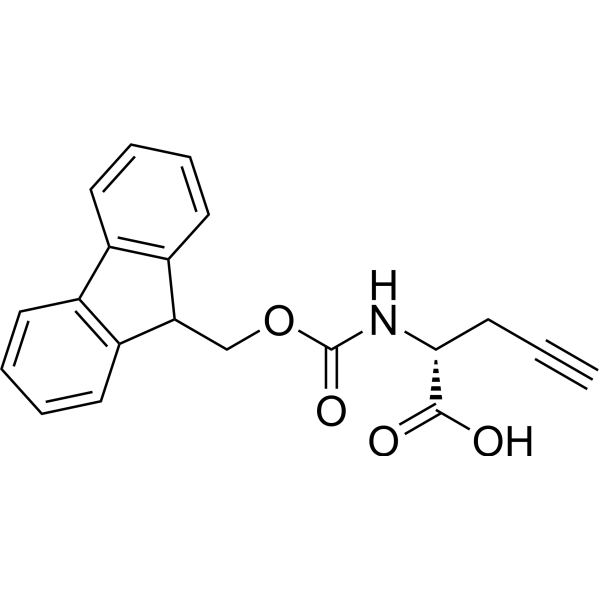
Fmoc-Pra-OH is a Glycine (HY-Y0966) derivative . Fmoc-Pra-OH is a click chemistry reagent, it contains an Alkyne group and can undergo copper-catalyzed azide-alkyne cycloaddition (CuAAc) with molecules containing Azide groups.
|
-
-
- HY-W013081
-
|
|
Amino Acid Derivatives
|
Others
|
|
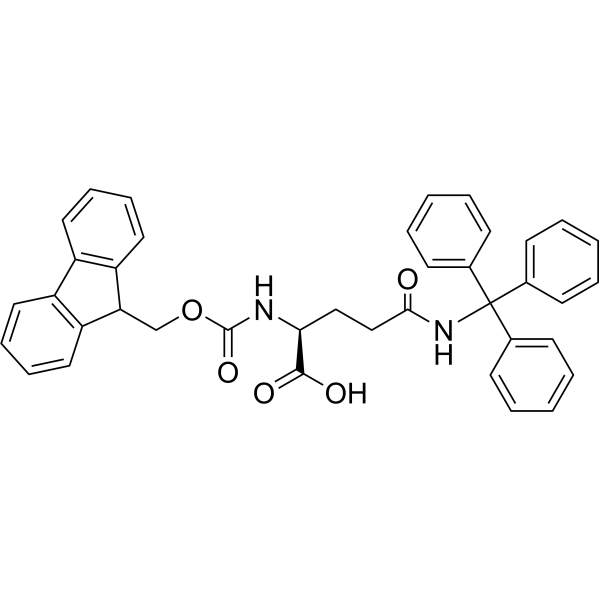
Fmoc-Gln(Trt)-OH is a glutamine derivative containing amine protecting group Fmoc. Fmoc-Gln(Trt)-OH can be used in solid-phase peptide synthesis .
|
-
-
- HY-P10069
-
|
|
Drug Intermediate
ADC Linker
|
Others
|
|
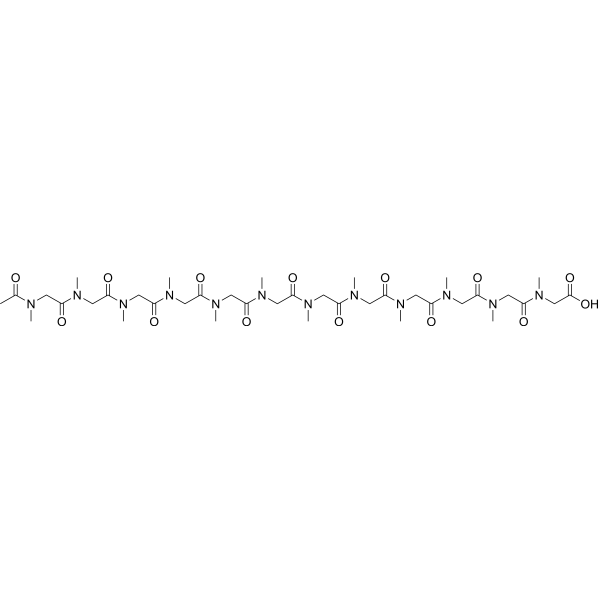
Ac-pSar12-OH is a water-soluble polymer of the polysarcosine class and can be used as a linker. Ac-pSar12-OH is a linear polypeptide derivative composed of 12 arginine units. Ac-pSar12-OH N-terminus is modified with an acetyl group, while the C-terminus retains a free hydroxyl group, which can help enhance the stability of the polypeptide .
|
-
-
- HY-W048688
-
|
|
Amino Acid Derivatives
|
Others
|
|
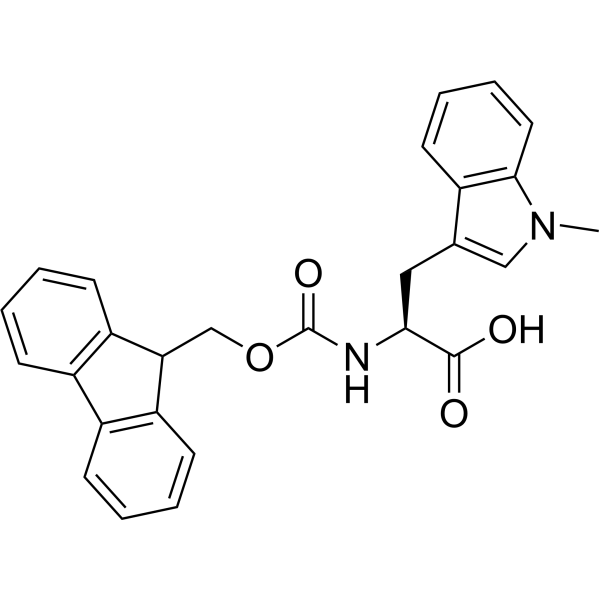
Fmoc-Trp(Me)-OH is an amino acid derivative. Fmoc-Trp(Me)-OH is formed by introducing a methyl group onto the nitrogen atom (N-1 position) of the indole ring of tryptophan (Trp) and protecting the amino group with Fmoc (9-fluorenylmethyloxycarbonyl). Fmoc-Trp(Me)-OH can be used in the synthesis of proteins or peptides .
|
-
-
- HY-138521
-
|
|
ADC Linker
|
Cancer
|
|
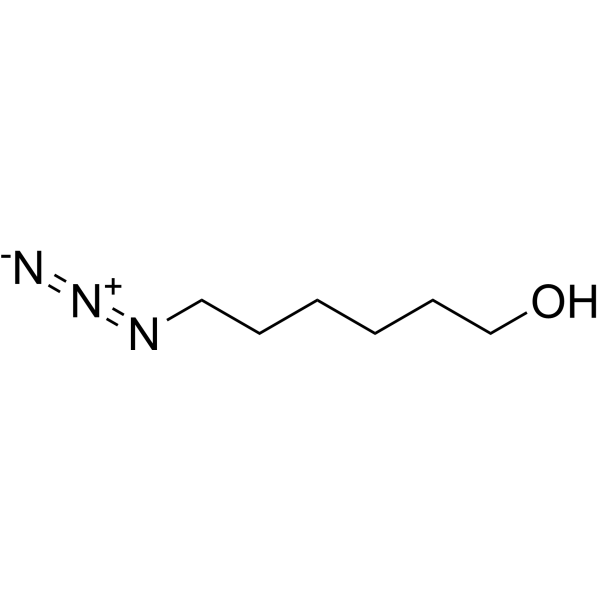
Azido-C6-OH is a cleavable ADC linker used in the synthesis of antibody-drug conjugates (ADCs) . Azido-C6-OH is a click chemistry reagent, it contains an Azide group and can undergo copper-catalyzed azide-alkyne cycloaddition reaction (CuAAc) with molecules containing Alkyne groups. It can also undergo strain-promoted alkyne-azide cycloaddition (SPAAC) reactions with molecules containing DBCO or BCN groups.
|
-
-
- HY-W008395
-
|
|
Amino Acid Derivatives
|
Others
|
|
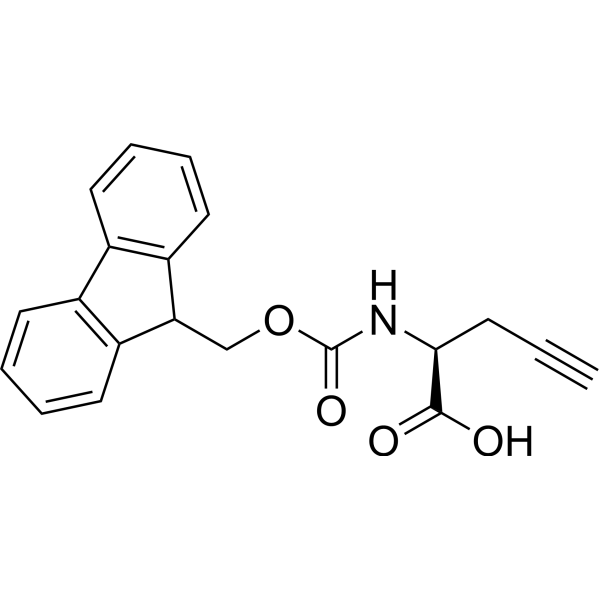
Fmoc-D-Pra-OH is a Glycine (HY-Y0966) derivative . Fmoc-D-Pra-OH is a click chemistry reagent, it contains an Alkyne group and can undergo copper-catalyzed azide-alkyne cycloaddition (CuAAc) with molecules containing Azide groups.
|
-
-
- HY-130147
-
|
|
PROTAC Linkers
|
Cancer
|
|
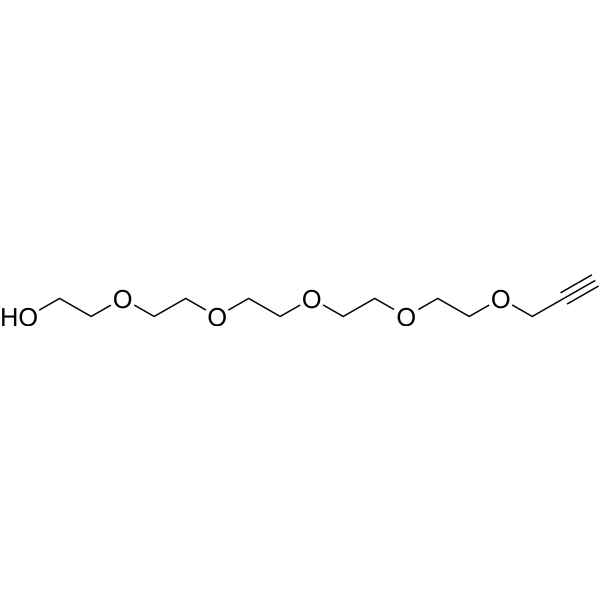
Propargyl-PEG5-OH is a PEG-based PROTAC linker can be used in the synthesis of PROTACs. Propargyl-PEG5-OH is a click chemistry reagent, it contains an Alkyne group and can undergo copper-catalyzed azide-alkyne cycloaddition (CuAAc) with molecules containing Azide groups.
|
-
-
- HY-130925
-
|
|
ADC Linker
|
Cancer
|
|
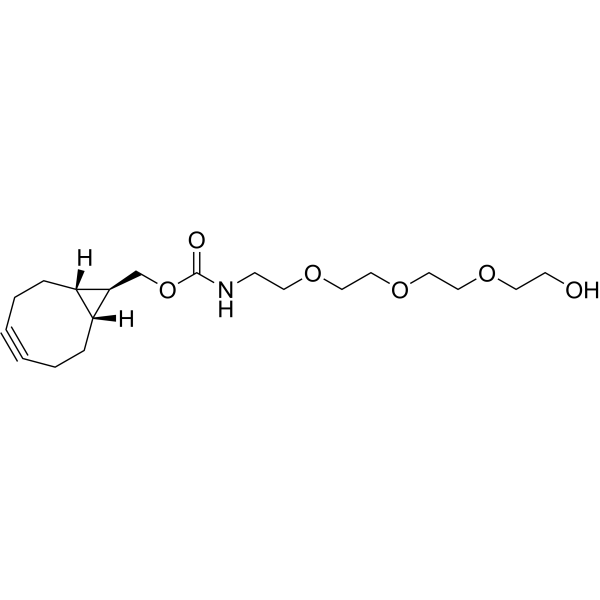
BCN-PEG3-OH is a non-cleavable 4 unit PEG ADC linker used in the synthesis of antibody-drug conjugates (ADCs) . BCN-PEG3-OH is a click chemistry reagent, it contains a BCN group that can undergo strain-promoted alkyne-azide cycloaddition (SPAAC) with molecules containing Azide groups.
|
-
-
- HY-W142062
-
|
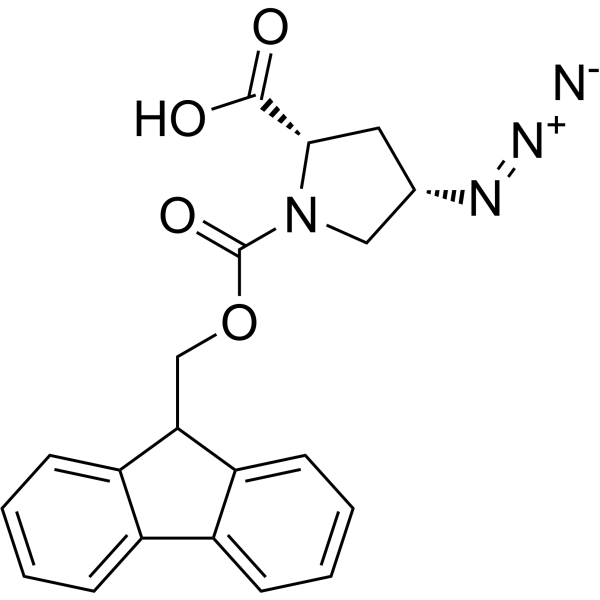
Fmoc-(2S,4S)-4-azidoproline
|
Amino Acid Derivatives
|
Others
|
|
cis-Fmoc-Pro(4-N3)-OH is a proline derivative . cis-Fmoc-Pro(4-N3)-OH is a click chemistry reagent, it contains an Azide group and can undergo copper-catalyzed azide-alkyne cycloaddition reaction (CuAAc) with molecules containing Alkyne groups. It can also undergo strain-promoted alkyne-azide cycloaddition (SPAAC) reactions with molecules containing DBCO or BCN groups.
|
-
-
- HY-130541
-
|
|
PROTAC Linkers
|
Cancer
|
|
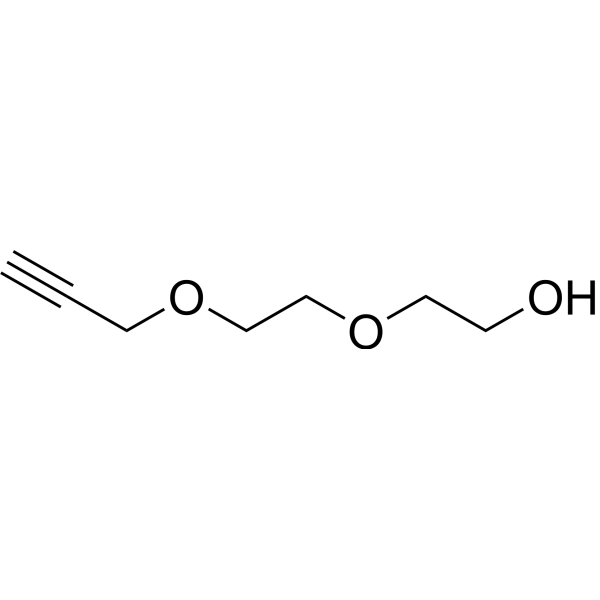
Propargyl-PEG2-OH is a PEG-based PROTAC linker can be used in the synthesis of Thalidomide-O-PEG2-propargyl (HY-126458) . Propargyl-PEG2-OH is a click chemistry reagent, it contains an Alkyne group and can undergo copper-catalyzed azide-alkyne cycloaddition (CuAAc) with molecules containing Azide groups.
|
-
-
- HY-151675
-
|
|
Biochemical Assay Reagents
|
Others
|
|
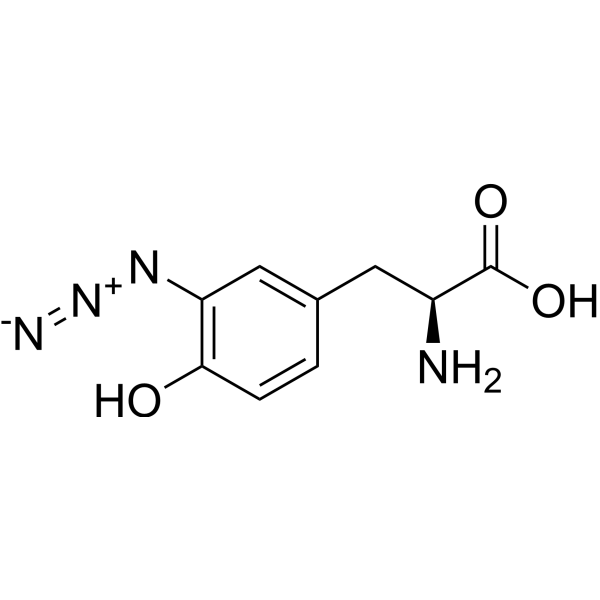
H-L-Tyr(3-N3)-OH is a click chemistry reagent containing an azide . H-L-Tyr(3-N3)-OH is a click chemistry reagent, it contains an Azide group and can undergo copper-catalyzed azide-alkyne cycloaddition reaction (CuAAc) with molecules containing Alkyne groups. It can also undergo strain-promoted alkyne-azide cycloaddition (SPAAC) reactions with molecules containing DBCO or BCN groups .
|
-
-
- HY-W142161
-
|
Fmoc-MeHis(Trt)-OH
|
Amino Acid Derivatives
|
Others
|
|
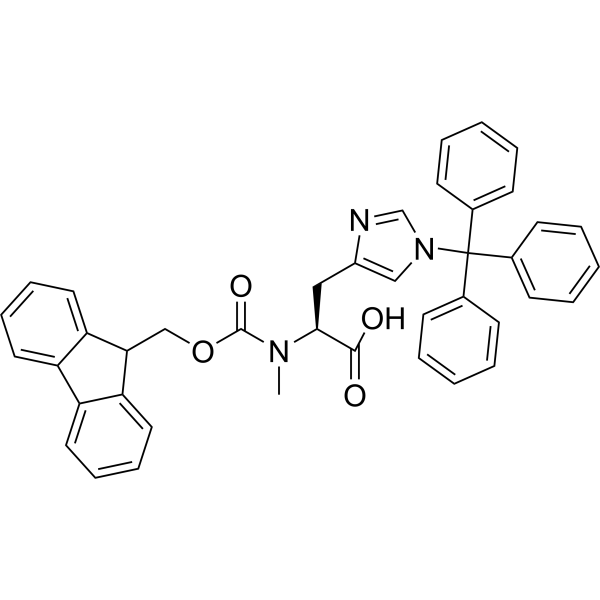
Fmoc-N-Me-His(Trt)-OH (Fmoc-MeHis(Trt)-OH) is an Amino acid derivative containing a carboxyl group. Fmoc-N-Me-His(Trt)-OH can be used for the synthesis of Fmoc-MeHis (Trt)-Leu-OH and N-methyl peptides .
|
-
-
- HY-151859
-
|
|
Biochemical Assay Reagents
|
Others
|
|
N3-Gly-Gly-Gly-OH is a click chemistry reagent containing an azide group. N3-Gly-Gly-OH undergoes copper-catalyzed azide-alkyne cycloaddition (CuAAc) with molecules containing an alkyne group. N3-Gly-Gly-OH also undergoes strain-promoted alkyne-azide cycloaddition (SPAAC) with molecules containing DBCO or BCN groups. N3-Gly-Gly-Gly-OH can be used to construct peptide-like ADC linkers via click chemistry .
|
-
-
- HY-174967C
-
|
|
Biochemical Assay Reagents
|
Others
|
|
4-Arm-PEG20000-OH is a PEG derivative with a four-arm structure and a hydroxyl (OH) functional group. 4-Arm-PEG20000-OH reacts with functional groups on biomolecules (such as proteins, peptides, antibodies, etc.) through hydroxyl groups and can be used for drug delivery .
|
-
-
- HY-W077219
-
|
Boc-Arg(Mtr)-OH
|
Amino Acid Derivatives
|
Others
|
|
Boc-L-Arg(Mtr)-OH (Boc-Arg(Mtr)-OH) is an amino acid derivative with a Boc protecting group, which can be used to synthesize peptides with antithrombotic activity .
|
-
-
- HY-151653
-
|
O-Propargyl-D-tyrosine
|
ADC Linker
|
Others
|
|
H-D-Tyr(Propargyl)-OH is a click chemistry reagent containing an Azide . H-D-Tyr(Propargyl)-OH is a click chemistry reagent, it contains an Alkyne group and can undergo copper-catalyzed azide-alkyne cycloaddition (CuAAc) with molecules containing Azide groups.
|
-
-
- HY-W009229
-
|
|
Biochemical Assay Reagents
|
Others
|
|
Boc-Glu(OtBu)-OH is a protected glutamic acid derivative with two protecting groups: Boc- and OTBu. Boc-Glu(OtBu)-OH can be used in the study of peptide compound synthesis .
|
-
-
- HY-151732
-
|
|
ADC Linker
|
Others
|
|
Z-D-Dbu(N3)-OH is a click chemistry reagent containing an azide group. Z-D-Dbu(N3)-OH can be used for the research of various biochemical . It contains an azide group and can undergo copper-catalyzed azide-alkyne cycloaddition (CuAAc) with molecules containing alkyne groups. It can also undergo ring strain-promoted alkyne-azide cycloaddition (SPAAC) with molecules containing DBCO or BCN groups.
|
-
-
- HY-W041983
-
-
-
- HY-151733
-
|
|
ADC Linker
|
Others
|
|
Fmoc-D-Dbu(N3)-OH is a click chemistry reagent containing an Azide . Fmoc-D-Dbu(N3)-OH is a click chemistry reagent, it contains an Azide group and can undergo copper-catalyzed azide-alkyne cycloaddition reaction (CuAAc) with molecules containing Alkyne groups. It can also undergo strain-promoted alkyne-azide cycloaddition (SPAAC) reactions with molecules containing DBCO or BCN groups.
|
-
-
- HY-D2882
-
|
Rhodamine B-PEG400-OH
|
Fluorescent Dye
|
Others
|
|
RB-PEG400-OH (Rhodamine B-PEG400-OH) is a fluorescent dye composed of Rhodamine B (HY-Y0016), PEG and a Hydroxyl group. RB-PEG400-OH can be used for fluorescent labeling and imaging (Ex/Em=546/610 nm) .
|
-
-
- HY-W419374
-
|
|
Amino Acid Derivatives
|
Others
|
|
ivDde-Lys(Fmoc)-OH is a derivative of amino acid with protecting groups. ivDde-Lys(Fmoc)-OH can be used for peptide synthesis .
|
-
-
- HY-151684
-
|
|
ADC Linker
|
Others
|
|
Boc-Ser(O-propargyl)-OH is a click chemistry reagent containing an alkynes group. Boc-Ser(O-propargyl)-OH can be used for the research of various biochemical .
|
-
-
- HY-151859A
-
|
|
Biochemical Assay Reagents
|
Others
|
|
N3-Gly-Gly-OH DCHA is a click chemistry reagent containing an azide group. N3-Gly-Gly-OH DCHA undergoes copper-catalyzed azide-alkyne cycloaddition (CuAAc) with molecules containing an alkyne group. N3-Gly-Gly-OH DCHA also undergoes strain-promoted alkyne-azide cycloaddition (SPAAC) with molecules containing DBCO or BCN groups. N3-Gly-Gly-OH DCHA can be used to construct peptide-like ADC linkers via click chemistry .
|
-
-
- HY-174963C
-
|
|
Biochemical Assay Reagents
|
Others
|
|
DBCO-PEG2000-OH is a PEG derivative composed of DBCO, PEG, and hydroxyl groups. DBCO-PEG2000-OH contains a DBCO group that can undergo strain-promoted alkyne-azide cycloaddition (SPAAC) with molecules containing Azide groups .
|
-
-
- HY-151671
-
|
|
ADC Linker
|
Others
|
|
Fmoc-L-MeLys(N3)-OH is a click chemistry reagent containing an azide. Fmoc-L-MeLys(N3)-OH is a SPPS building-block for the introduction of N-Me-Lys that can be modified at the N3-group using Click-chemistry . Fmoc-L-MeLys(N3)-OH is a click chemistry reagent, it contains an Azide group and can undergo copper-catalyzed azide-alkyne cycloaddition reaction (CuAAc) with molecules containing Alkyne groups. It can also undergo strain-promoted alkyne-azide cycloaddition (SPAAC) reactions with molecules containing DBCO or BCN groups.
|
-
-
- HY-117045
-
|
|
PROTAC Linkers
|
Cancer
|
|
Propargyl-PEG12-OH is a PEG-based PROTAC linker can be used in the synthesis of PROTACs. Propargyl-PEG12-OH is a click chemistry reagent, it contains an Alkyne group and can undergo copper-catalyzed azide-alkyne cycloaddition (CuAAc) with molecules containing Azide groups.
|
-
-
- HY-151660
-
|
|
ADC Linker
|
Others
|
|
Fmoc-D-Lys(N3)-OH is a click chemistry reagent containing an azide group. Fmoc-D-Lys(N3)-OH can be used for the research of various biochemical . It contains an azide group and can undergo copper-catalyzed azide-alkyne cycloaddition (CuAAc) with molecules containing alkyne groups. It can also undergo ring strain-promoted alkyne-azide cycloaddition (SPAAC) with molecules containing DBCO or BCN groups.
|
-
-
- HY-W009673
-
|
N-Boc-L-pyroglutamic acid
|
Amino Acid Derivatives
Biochemical Assay Reagents
|
Others
|
|
Boc-Pyr-OH is a Boc-protected pyroglutamic acid derivative. Boc-Pyr-OH stabilizes the amino group of pyroglutamic acid through the Boc protecting group, preventing unwanted reactions during peptide synthesis. Boc-Pyr-OH can be used in the research of thyrotropin-releasing hormone (TRH) synthesis .
|
-
-
- HY-151838
-
|
|
ADC Linker
|
Others
|
|
(2S,3S)-H-Abu(3-N3)-OH (hydrochloride) is a click chemistry reagent containing an azide group . (2S,3S)-H-Abu(3-N3)-OH (hydrochloride) is a click chemistry reagent, it contains an Azide group and can undergo copper-catalyzed azide-alkyne cycloaddition reaction (CuAAc) with molecules containing Alkyne groups. It can also undergo strain-promoted alkyne-azide cycloaddition (SPAAC) reactions with molecules containing DBCO or BCN groups.
|
-
-
- HY-151722
-
|
|
ADC Linker
|
Cancer
|
|
Boc-D-Orn(N3)-OH (CHA) is a click chemistry reagent containing an azide group. It contains an azide group and can undergo copper-catalyzed azide-alkyne cycloaddition (CuAAc) with molecules containing alkyne groups. It can also undergo ring strain-promoted alkyne-azide cycloaddition (SPAAC) with molecules containing DBCO or BCN groups.
|
-
-
- HY-164272
-
|
|
Microtubule/Tubulin
|
Cancer
|
|
2'-O-TBDMS-Paclitaxel is a paclitaxel (HY-B0015) derivative which 2'-OH group is protected as a tert-butyldimethylsilyl (TBDMS) ether .
|
-
-
- HY-141186A
-
|
|
PROTAC Linkers
|
Cancer
|
|
(R)-TCO-OH is an alkyl chain-based PROTAC linker that can be used in the synthesis of PROTACs . (R)-TCO-OH is a click chemistry reagent, it contains a TCO group that can undergo an inverse electron demand Diels-Alder reaction (iEDDA) with molecules containing Tetrazine groups.
|
-
-
- HY-174967A
-
|
|
Biochemical Assay Reagents
|
Others
|
|
4-Arm-PEG5000-OH is a PEG derivative with a four-arm structure and a hydroxyl (OH) functional group. 4-Arm-PEG5000-OH reacts with functional groups on biomolecules (such as proteins, peptides, antibodies, etc.) through hydroxyl groups and can be used for drug delivery .
|
-
-
- HY-W190743
-
|
|
Biochemical Assay Reagents
|
Others
|
|
Br-PEG8-OH is a PEG derivative that consists of a bromine atom (Br), eight PEG units, and a hydroxyl group (-OH). The bromine group is a common functional group in chemical reactions and can be used for alkylation reactions, coupling reactions, or the introduction of other functional groups. Br-PEG8-OH can be used as a polymer-based material or as a modifier for biomolecules .
|
-
-
- HY-174963
-
|
|
Biochemical Assay Reagents
|
Others
|
|
DBCO-PEG400-OH is a PEG derivative composed of DBCO, PEG, and hydroxyl groups. DBCO-PEG400-OH contains a DBCO group that can undergo strain-promoted alkyne-azide cycloaddition (SPAAC) with molecules containing Azide groups .
|
-
-
- HY-174963D
-
|
|
Biochemical Assay Reagents
|
Others
|
|
DBCO-PEG3400-OH is a PEG derivative composed of DBCO, PEG, and hydroxyl groups. DBCO-PEG3400-OH contains a DBCO group that can undergo strain-promoted alkyne-azide cycloaddition (SPAAC) with molecules containing Azide groups .
|
-
-
- HY-174963E
-
|
|
Biochemical Assay Reagents
|
Others
|
|
DBCO-PEG5000-OH is a PEG derivative composed of DBCO, PEG, and hydroxyl groups. DBCO-PEG5000-OH contains a DBCO group that can undergo strain-promoted alkyne-azide cycloaddition (SPAAC) with molecules containing Azide groups .
|
-
-
- HY-174963A
-
|
|
Biochemical Assay Reagents
|
Others
|
|
DBCO-PEG600-OH is a PEG derivative composed of DBCO, PEG, and hydroxyl groups. DBCO-PEG600-OH contains a DBCO group that can undergo strain-promoted alkyne-azide cycloaddition (SPAAC) with molecules containing Azide groups .
|
-
-
- HY-174963B
-
|
|
Biochemical Assay Reagents
|
Others
|
|
DBCO-PEG1000-OH is a PEG derivative composed of DBCO, PEG, and hydroxyl groups. DBCO-PEG1000-OH contains a DBCO group that can undergo strain-promoted alkyne-azide cycloaddition (SPAAC) with molecules containing Azide groups .
|
-
-
- HY-W1120392
-
-
-
- HY-174951
-
-
-
- HY-130374
-
|
|
PROTAC Linkers
|
Cancer
|
|
Propargyl-PEG8-OH is a PEG-based PROTAC linker can be used in the synthesis of PROTACs . Propargyl-PEG8-OH is a click chemistry reagent, it contains an Alkyne group and can undergo copper-catalyzed azide-alkyne cycloaddition (CuAAc) with molecules containing Azide groups.
|
-
-
- HY-126977
-
|
|
PROTAC Linkers
|
Cancer
|
|
Propargyl-PEG9-OH is a PEG-based PROTAC linker can be used in the synthesis of PROTACs . Propargyl-PEG9-OH is a click chemistry reagent, it contains an Alkyne group and can undergo copper-catalyzed azide-alkyne cycloaddition (CuAAc) with molecules containing Azide groups.
|
-
-
- HY-117100
-
|
|
PROTAC Linkers
|
Cancer
|
|
Propargyl-PEG14-OH is a PEG-based PROTAC linker can be used in the synthesis of PROTACs. Propargyl-PEG14-OH is a click chemistry reagent, it contains an Alkyne group and can undergo copper-catalyzed azide-alkyne cycloaddition (CuAAc) with molecules containing Azide groups .
|
-
-
- HY-138735
-
|
|
PROTAC Linkers
|
Cancer
|
|
Propargyl-PEG13-OH is a PEG-based PROTAC linker that can be used in the synthesis of PROTACs . Propargyl-PEG13-OH is a click chemistry reagent, it contains an Alkyne group and can undergo copper-catalyzed azide-alkyne cycloaddition (CuAAc) with molecules containing Azide groups.
|
-
-
- HY-151694
-
|
|
ADC Linker
|
Others
|
|
H-L-Orn(N3)-OH (hydrochloride) is a click chemistry reagent containing an azide group. H-L-Orn(N3)-OH (hydrochloride) can be used for the research of various biochemical . It contains an azide group and can undergo copper-catalyzed azide-alkyne cycloaddition (CuAAc) with molecules containing alkyne groups. It can also undergo ring strain-promoted alkyne-azide cycloaddition (SPAAC) with molecules containing DBCO or BCN groups.
|
-
-
- HY-151778
-
|
|
ADC Linker
|
Others
|
|
Fmoc-Abg(N3)-OH is a click chemistry reagent containing an azide group. Fmoc-Abg(N3)-OH has the potential to synthesize peptide nucleic acids (PNA) and peptoids. It contains an azide group and can undergo copper-catalyzed azide-alkyne cycloaddition (CuAAc) with molecules containing alkyne groups. It can also undergo ring strain-promoted alkyne-azide cycloaddition (SPAAC) with molecules containing DBCO or BCN groups.
|
-
-
- HY-151737
-
|
|
ADC Linker
|
Others
|
|
Z-L-Dbu(N3)-OH is a click chemistry reagent containing an Azide . Z-L-Dbu(N3)-OH is a click chemistry reagent, it contains an Azide group and can undergo copper-catalyzed azide-alkyne cycloaddition reaction (CuAAc) with molecules containing Alkyne groups. It can also undergo strain-promoted alkyne-azide cycloaddition (SPAAC) reactions with molecules containing DBCO or BCN groups.
|
-
-
- HY-W337644
-
|
|
Amino Acid Derivatives
|
Others
|
|
Fmoc-L-Homoarg(Et)2-OH hydrochloride is a derivative of amino acid with protecting groups. Fmoc-L-Dap(Boc,Me)-OH can be used for synthesis of homoarginine containing peptide .
|
-
- HY-D2796B
-
|
|
Fluorescent Dye
|
Others
|
|
FITC-PEG5000-OH is a fluorescent dye composed of polyethylene glycol (PEG), FITC (HY-66019) and a Hydroxyl group. FITC-PEG5000-OH can be used for fluorescent labeling and imaging .
|
-
- HY-D2796C
-
|
|
Fluorescent Dye
|
Others
|
|
FITC-PEG10000-OH is a fluorescent dye composed of polyethylene glycol (PEG), FITC (HY-66019) and a Hydroxyl group. FITC-PEG10000-OH can be used for fluorescent labeling and imaging .
|
-
- HY-D2796
-
|
|
Fluorescent Dye
|
Others
|
|
FITC-PEG400-OH is a fluorescent dye composed of polyethylene glycol (PEG), FITC (HY-66019) and a Hydroxyl group. FITC-PEG400-OH can be used for fluorescent labeling and imaging .
|
-
- HY-W010712S1
-
|
|
Isotope-Labeled Compounds
Amino Acid Derivatives
|
Others
|
|
Fmoc-His(Trt)-OH- 15N3 is the 15N labeled Fmoc-His(Trt)-OH (HY-W010712). Fmoc-His (Trt)-OH is a histidine derivative. Fmoc-His(Trt)-OH has trityl (Trt) group to protect the side-chain of His. Fmoc-His(Trt)-OH has Fmoc group to protect -αNH2. Fmoc-His(Trt)-OH can be used for solid phase synthesis of peptides, providing protection against racemization and by-product formation .
|
-
- HY-140808
-
|
|
PROTAC Linkers
|
Cancer
|
|
Azido-PEG3-C3-OH is a PEG-based PROTAC linker that can be used in the synthesis of PROTACs . Azido-PEG3-C3-OH is a click chemistry reagent, it contains an Azide group and can undergo copper-catalyzed azide-alkyne cycloaddition reaction (CuAAc) with molecules containing Alkyne groups. It can also undergo strain-promoted alkyne-azide cycloaddition (SPAAC) reactions with molecules containing DBCO or BCN groups.
|
-
- HY-138471
-
|
|
PROTAC Linkers
|
Cancer
|
|
Azido-PEG2-C6-OH is a PEG-based PROTAC linker that can be used in the synthesis of PROTACs . Azido-PEG2-C6-OH is a click chemistry reagent, it contains an Azide group and can undergo copper-catalyzed azide-alkyne cycloaddition reaction (CuAAc) with molecules containing Alkyne groups. It can also undergo strain-promoted alkyne-azide cycloaddition (SPAAC) reactions with molecules containing DBCO or BCN groups.
|
-
- HY-151836
-
|
|
ADC Linker
|
Others
|
|
(2S,3R)-H-Abu(3-N3)-OH (hydrochloride) is a click chemistry reagent containing an azide group . (2S,3R)-H-Abu(3-N3)-OH (hydrochloride) is a click chemistry reagent, it contains an Azide group and can undergo copper-catalyzed azide-alkyne cycloaddition reaction (CuAAc) with molecules containing Alkyne groups. It can also undergo strain-promoted alkyne-azide cycloaddition (SPAAC) reactions with molecules containing DBCO or BCN groups.
|
-
- HY-140809
-
|
|
PROTAC Linkers
|
Cancer
|
|
Azido-PEG4-(CH2)3OH is a PEG-based PROTAC linker that can be used in the synthesis of PROTACs . Azido-PEG4-(CH2)3OH is a click chemistry reagent, it contains an Azide group and can undergo copper-catalyzed azide-alkyne cycloaddition reaction (CuAAc) with molecules containing Alkyne groups. It can also undergo strain-promoted alkyne-azide cycloaddition (SPAAC) reactions with molecules containing DBCO or BCN groups.
|
-
- HY-151639
-
|
|
ADC Linker
|
Others
|
|
(2S,4R)-H-L-Pro(4-N3)-OH is a click chemistry reagent containing an azide group. (2S,4R)-H-L-Pro(4-N3)-OH can be used for the research of various biochemical studies . It contains an azide group and can undergo copper-catalyzed azide-alkyne cycloaddition (CuAAc) with molecules containing alkyne groups. It can also undergo ring strain-promoted alkyne-azide cycloaddition (SPAAC) with molecules containing DBCO or BCN groups.
|
-
- HY-151839
-
|
|
ADC Linker
|
Others
|
|
(2R,4R)-H-D-Pro(4-N3)-OH (hydrochloride) is a click chemistry reagent containing an azide group . (2R,4R)-H-D-Pro(4-N3)-OH (hydrochloride) is a click chemistry reagent, it contains an Azide group and can undergo copper-catalyzed azide-alkyne cycloaddition reaction (CuAAc) with molecules containing Alkyne groups. It can also undergo strain-promoted alkyne-azide cycloaddition (SPAAC) reactions with molecules containing DBCO or BCN groups.
|
-
- HY-151689
-
|
|
ADC Linker
|
Others
|
|
(2S,3R)-Fmoc-Abu(3-N3)-OH is a click chemistry reagent containing an azide group. (2S,3R)-Fmoc-Abu(3-N3)-OH can be used for the research of various biochemical . It contains an azide group and can undergo copper-catalyzed azide-alkyne cycloaddition (CuAAc) with molecules containing alkyne groups. It can also undergo ring strain-promoted alkyne-azide cycloaddition (SPAAC) with molecules containing DBCO or BCN groups.
|
-
- HY-151760
-
|
|
ADC Linker
|
Others
|
|
(2R,4S)-H-D-Pro(4-N3)-OH is a click chemistry reagent containing an azide group . (2R,4S)-H-D-Pro(4-N3)-OH is a click chemistry reagent, it contains an Azide group and can undergo copper-catalyzed azide-alkyne cycloaddition reaction (CuAAc) with molecules containing Alkyne groups. It can also undergo strain-promoted alkyne-azide cycloaddition (SPAAC) reactions with molecules containing DBCO or BCN groups.
|
-
- HY-151639A
-
|
|
ADC Linker
|
Others
|
|
(2S,4R)-H-L-Pro(4-N3)-OH (hydrochloride) is a click chemistry reagent containing an azide group. (2S,4R)-H-L-Pro(4-N3)-OH (hydrochloride) can be used for the research of various biochemical studies . It contains an azide group and can undergo copper-catalyzed azide-alkyne cycloaddition (CuAAc) with molecules containing alkyne groups. It can also undergo ring strain-promoted alkyne-azide cycloaddition (SPAAC) with molecules containing DBCO or BCN groups.
|
-
- HY-W109214
-
|
|
Amino Acid Derivatives
|
Others
|
|
Fmoc-L-Dap(Boc,Me)-OH is a derivative of amino acid with protecting groups. Fmoc-L-Dap(Boc,Me)-OH can be used for synthesis of diaminopropionic acid containing peptide .
|
-
- HY-151785
-
|
|
ADC Linker
|
Others
|
|
H-L-Dbu(N3)-OH is a click chemistry reagent containing an azide group . It contains an azide group and can undergo copper-catalyzed azide-alkyne cycloaddition (CuAAc) with molecules containing alkyne groups. It can also undergo ring strain-promoted alkyne-azide cycloaddition (SPAAC) with molecules containing DBCO or BCN groups.
|
-
- HY-Y1636S1
-
-
- HY-151850
-
|
|
ADC Linker
|
Others
|
|
(2S,4R)-Fmoc-L-Pro(4-N3)-OH is a click chemistry reagent containing an azide . (2S,4R)-Fmoc-L-Pro(4-N3)-OH is a click chemistry reagent, it contains an Azide group and can undergo copper-catalyzed azide-alkyne cycloaddition reaction (CuAAc) with molecules containing Alkyne groups. It can also undergo strain-promoted alkyne-azide cycloaddition (SPAAC) reactions with molecules containing DBCO or BCN groups.
|
-
- HY-174967
-
|
|
Biochemical Assay Reagents
|
Others
|
|
4-Arm-PEG2000-OH is a PEG derivative with a four-arm structure and a hydroxyl (OH) functional group. 4-Arm-PEG2000-OH reacts with functional groups on biomolecules (such as proteins, peptides, antibodies, etc.) through hydroxyl groups and can be used for drug delivery .
|
-
- HY-174967B
-
|
|
Biochemical Assay Reagents
|
Others
|
|
4-Arm-PEG10000-OH is a PEG derivative with a four-arm structure and a hydroxyl (OH) functional group. 4-Arm-PEG10000-OH reacts with functional groups on biomolecules (such as proteins, peptides, antibodies, etc.) through hydroxyl groups and can be used for drug delivery .
|
-
- HY-174963H
-
|
|
Biochemical Assay Reagents
|
Others
|
|
DBCO-PEG10000-OH is a PEG derivative composed of DBCO, PEG, and hydroxyl groups. DBCO-PEG10000-OH contains a DBCO group that can undergo strain-promoted alkyne-azide cycloaddition (SPAAC) with molecules containing Azide groups .
|
-
- HY-183164D
-
|
|
Biochemical Assay Reagents
|
Others
|
|
Glucose-PEG10000-OH is a conjugate composed of glucose, PEG chains, and hydroxyl groups (-OH). Glucose-PEG10000-OH combines the targeted recognition capability of glucose with the modification flexibility of hydroxyl groups, enabling applications such as targeted drug delivery systems and nanoparticle modification.
|
-
- HY-183164
-
|
|
Biochemical Assay Reagents
|
Others
|
|
Glucose-PEG1000-OH is a conjugate composed of glucose, PEG chains, and hydroxyl groups (-OH). Glucose-PEG1000-OH combines the targeted recognition capability of glucose with the modification flexibility of hydroxyl groups, enabling applications such as targeted drug delivery systems and nanoparticle modification.
|
-
- HY-183164B
-
|
|
Biochemical Assay Reagents
|
Others
|
|
Glucose-PEG3400-OH is a conjugate composed of glucose, PEG chains, and hydroxyl groups (-OH). Glucose-PEG3400-OH combines the targeted recognition capability of glucose with the modification flexibility of hydroxyl groups, enabling applications such as targeted drug delivery systems and nanoparticle modification.
|
-
- HY-183164A
-
|
|
Biochemical Assay Reagents
|
Others
|
|
Glucose-PEG2000-OH is a conjugate composed of glucose, PEG chains, and hydroxyl groups (-OH). Glucose-PEG2000-OH combines the targeted recognition capability of glucose with the modification flexibility of hydroxyl groups, enabling applications such as targeted drug delivery systems and nanoparticle modification.
|
-
- HY-183164C
-
|
|
Biochemical Assay Reagents
|
Others
|
|
Glucose-PEG5000-OH is a conjugate composed of glucose, PEG chains, and hydroxyl groups (-OH). Glucose-PEG5000-OH combines the targeted recognition capability of glucose with the modification flexibility of hydroxyl groups, enabling applications such as targeted drug delivery systems and nanoparticle modification.
|
-
- HY-W796380
-
|
Acryloyl-PEG3-OH
|
Biochemical Assay Reagents
|
Others
|
|
Allyl-PEG3-OH (Acryloyl-PEG3-OH) is a PEG derivative with a hydroxyl (OH) functional group that can be used for drug delivery.
|
-
- HY-174951B
-
-
- HY-174919
-
|
|
Biochemical Assay Reagents
|
Others
|
|
Br-PEG10-OH is a PEG derivative with a hydroxyl (OH) functional group and thioacetate (AS) and can be used for drug delivery .
|
-
- HY-174951A
-
-
- HY-174951C
-
-
- HY-W190757
-
|
mPEG14-OH
|
Biochemical Assay Reagents
|
Others
|
|
mPEG14-Alcohol (mPEG14-OH) is a PEG derivative with a hydroxyl (OH) functional group that can be used for drug delivery .
|
-
- HY-D2796A
-
|
|
Fluorescent Dye
|
Others
|
|
FITC-PEG1000-OH is a fluorescent dye composed of polyethylene glycol (PEG), FITC (HY-66019) and a Hydroxyl group. FITC-PEG1000-OH can be used for fluorescent labeling and imaging .
|
-
- HY-137649C
-
-
- HY-174915
-
|
|
Biochemical Assay Reagents
|
Others
|
|
Biotin-PEG7-OH is a PEG derivative composed of Biotin, 7 PEG units and a hydroxyl (-OH) group. Biotin can form a stable non-covalent bond with streptavidin.
|
-
- HY-W153502
-
|
|
Biochemical Assay Reagents
|
Others
|
|
MeNH-PEG2-OH is a PEG linker containing a hydroxyl group with a methylamine group. The hydrophilic PEG spacer increases solubility in aqueous media. The hydroxyl group enables further derivatization or replacement with other reactive functional groups. The methylamine group is reactive with carboxylic acids, carbonyls (ketone, aldehyde) etc.
|
-
- HY-183132A
-
|
|
Biochemical Assay Reagents
|
Others
|
|
DSG-PEG2000-OH is a conjugate composed of dimyristic glycerol (DMG), a PEG chain, and terminal hydroxyl groups (-OH). DSG-PEG2000-OH combines the membrane compatibility of phospholipids with the flexibility of hydroxyl modification, making it suitable for research in biomaterial construction and drug delivery.
|
-
- HY-183132B
-
|
|
Biochemical Assay Reagents
|
Others
|
|
DSG-PEG3400-OH is a conjugate composed of dimyristic glycerol (DMG), a PEG chain, and terminal hydroxyl groups (-OH). DSG-PEG3400-OH combines the membrane compatibility of phospholipids with the flexibility of hydroxyl modification, making it suitable for research in biomaterial construction and drug delivery.
|
-
- HY-183132D
-
|
|
Biochemical Assay Reagents
|
Others
|
|
DSG-PEG10000-OH is a conjugate composed of dimyristic glycerol (DMG), a PEG chain, and terminal hydroxyl groups (-OH). DSG-PEG10000-OH combines the membrane compatibility of phospholipids with the flexibility of hydroxyl modification, making it suitable for research in biomaterial construction and drug delivery.
|
-
- HY-183132
-
|
|
Biochemical Assay Reagents
|
Others
|
|
DSG-PEG1000-OH is a conjugate composed of dimyristic glycerol (DMG), a PEG chain, and terminal hydroxyl groups (-OH). DSG-PEG1000-OH combines the membrane compatibility of phospholipids with the flexibility of hydroxyl modification, making it suitable for research in biomaterial construction and drug delivery.
|
-
- HY-D2882B
-
|
Rhodamine B-PEG1000-OH
|
Fluorescent Dye
|
Others
|
|
RB-PEG1000-OH (Rhodamine B-PEG1000-OH) is a fluorescent dye composed of Rhodamine B (HY-Y0016), PEG and a Hydroxyl group. RB-PEG1000-OH can be used for fluorescent labeling and imaging (Ex/Em=546/610 nm) .
|
-
- HY-D2882E
-
|
Rhodamine B-PEG5000-OH
|
Fluorescent Dye
|
Others
|
|
RB-PEG5000-OH (Rhodamine B-PEG5000-OH) is a fluorescent dye composed of Rhodamine B (HY-Y0016), PEG and a Hydroxyl group. RB-PEG5000-OH can be used for fluorescent labeling and imaging (Ex/Em=546/610 nm) .
|
-
- HY-D2882D
-
|
Rhodamine B-PEG3400-OH
|
Fluorescent Dye
|
Others
|
|
RB-PEG3400-OH (Rhodamine B-PEG3400-OH) is a fluorescent dye composed of Rhodamine B (HY-Y0016), PEG and a Hydroxyl group. RB-PEG3400-OH can be used for fluorescent labeling and imaging (Ex/Em=546/610 nm) .
|
-
- HY-D2882H
-
|
Rhodamine B-PEG10000-OH
|
Fluorescent Dye
|
Others
|
|
RB-PEG10000-OH (Rhodamine B-PEG10000-OH) is a fluorescent dye composed of Rhodamine B (HY-Y0016), PEG and a Hydroxyl group. RB-PEG10000-OH can be used for fluorescent labeling and imaging (Ex/Em=546/610 nm) .
|
-
- HY-D2882C
-
|
Rhodamine B-PEG2000-OH
|
Fluorescent Dye
|
Others
|
|
RB-PEG2000-OH (Rhodamine B-PEG2000-OH) is a fluorescent dye composed of Rhodamine B (HY-Y0016), PEG and a Hydroxyl group. RB-PEG2000-OH can be used for fluorescent labeling and imaging (Ex/Em=546/610 nm) .
|
-
- HY-D2882A
-
|
Rhodamine B-PEG600-OH
|
Fluorescent Dye
|
Others
|
|
RB-PEG600-OH (Rhodamine B-PEG600-OH) is a fluorescent dye composed of Rhodamine B (HY-Y0016), PEG and a Hydroxyl group. RB-PEG600-OH can be used for fluorescent labeling and imaging (Ex/Em=546/610 nm) .
|
-
- HY-137648C
-
-
- HY-W784624
-
|
|
Drug Intermediate
|
Others
|
|
Boc‑PNA‑C (Z)‑OH is a cytosine-containing peptide nucleic acid monomer, in which the amino group and cytosine are protected by tert-butoxycarbonyl (Boc) and benzyloxycarbonyl groups, respectively. Boc‑PNA‑C (Z)‑OH can be used for the synthesis of peptide nucleic acids .
|
-
- HY-160513
-
|
|
DNA/RNA Synthesis
|
Others
|
|
Fmoc‑PNA‑Abasic(Boc)‑OH is a synthetic peptide nucleic acid modified with Fmoc and Boc protecting groups. Fmoc‑PNA‑Abasic(Boc)‑OH can be used in molecular biology research.
|
-
- HY-P11687
-
|
|
Drug Intermediate
|
Others
|
|
Fmoc-PNA-M(Boc)-OH is a peptide nucleic acid monomer with Fmoc and Boc protecting groups. Fmoc-PNA-M(Boc)-OH can be used for synthesis of peptide nucleic acid .
|
-
- HY-W1113139
-
|
|
Biochemical Assay Reagents
|
Others
|
|
H2N-PEG4-C3-OH is a PEG linker with a terminal amino group that can react with carboxylic acids, activated NHS esters, carbonyls (ketone, aldehyde), etc. Hydroxyl group can react with a variety of functional groups. PEG spacer improves the compound's aqueous solubility.
|
-
- HY-151718A
-
|
|
ADC Linker
|
Others
|
|
Boc-L-Tyr(PEG(3)-N3)-OH DCHA is a click chemistry reagent containing an azide group. It contains an azide group and can undergo copper-catalyzed azide-alkyne cycloaddition (CuAAc) with molecules containing alkyne groups. It can also undergo ring strain-promoted alkyne-azide cycloaddition (SPAAC) with molecules containing DBCO or BCN groups.
|
-
- HY-151677A
-
|
|
ADC Linker
|
Others
|
|
(2R,4S)-Boc-D-Pro(4-N3)-OH DCHA is a click chemistry reagent containing an azide . (2R,4S)-Boc-D-Pro(4-N3)-OH (DCHA) is a click chemistry reagent, it contains an Azide group and can undergo copper-catalyzed azide-alkyne cycloaddition reaction (CuAAc) with molecules containing Alkyne groups. It can also undergo strain-promoted alkyne-azide cycloaddition (SPAAC) reactions with molecules containing DBCO or BCN groups.
|
-
- HY-151677
-
|
|
ADC Linker
|
Others
|
|
(2R,4S)-Boc-D-Pro(4-N3)-OH is a click chemistry reagent containing an azide . (2R,4S)-Boc-D-Pro(4-N3)-OH is a click chemistry reagent, it contains an Azide group and can undergo copper-catalyzed azide-alkyne cycloaddition reaction (CuAAc) with molecules containing Alkyne groups. It can also undergo strain-promoted alkyne-azide cycloaddition (SPAAC) reactions with molecules containing DBCO or BCN groups.
|
-
- HY-151715
-
|
|
Biochemical Assay Reagents
|
Others
|
|
N3-D-Dap(Fmoc)-OH is a click chemistry reagent. N3-D-Dap(Fmoc)-OH can be used as a component for coupling by click reaction and as an orthogonally protected diaminocarboxylic acid derivative. N3-D-Dap(Fmoc)-OH contains an azide group and can undergo copper-catalyzed azide-alkyne cycloaddition (CuAAc) with molecules containing alkyne groups. N3-D-Dap(Fmoc)-OH can also undergo ring strain-promoted alkyne-azide cycloaddition (SPAAC) with molecules containing DBCO or BCN groups .
|
-
- HY-130935
-
|
|
ADC Linker
|
Cancer
|
|
DBCO-Val-Cit-OH is a cleavable ADC linker used in the synthesis of antibody-drug conjugates (ADCs) . DBCO-Val-Cit-OH is a click chemistry reagent, it contains a DBCO group that can undergo strain-promoted alkyne-azide cycloaddition (SPAAC) with molecules containing Azide groups.
|
-
- HY-151683A
-
|
|
ADC Linker
|
Others
|
|
H-L-Ser(Propargyl)-OH hydrochloride is a click chemistry reagent containing an alkyne group .
|
-
- HY-151683
-
|
|
ADC Linker
|
Others
|
|
H-L-Ser(Propargyl)-OH is a click chemistry reagent containing an alkyne group .
|
-
- HY-W250992
-
|
|
ADC Linker
|
Others
|
|
Boc-L-Lys(N3)-OH CHA is a click chemistry reagent containing an azide . It contains an azide group and can undergo copper-catalyzed azide-alkyne cycloaddition (CuAAc) with molecules containing alkyne groups. It can also undergo ring strain-promoted alkyne-azide cycloaddition (SPAAC) with molecules containing DBCO or BCN groups.
|
-
- HY-185404
-
|
|
Drug Intermediate
|
Others
|
|
DSPE-PEG8-OH is a monodisperse lipid-polyethylene glycol conjugate featuring a hydrophobic 1,2-distearoyl-sn-glycero-3-phosphoethanolamine (DSPE) anchor, an 8-unit discrete (PEG8) spacer, and a terminal hydroxyl (-OH) group. DSPE-PEG8-OH is primarily used in liposome formulation, nanoparticle surface modification, and targeted drug delivery systems.
|
-
- HY-P11688
-
|
|
Biochemical Assay Reagents
|
Others
|
Fmoc-PNA-M (Bhoc)-OH is a standard peptide nucleic acid (PNA) monomer building block. Fmoc-PNA-M (Bhoc)-OH carries two protecting groups, Fmoc and Bhoc, and is specifically designed for solid-phase and automated PNA synthesis. Fmoc-PNA-M (Bhoc)-OH efficiently participates in the construction of sequence-specific PNA probes. Through its protecting group strategy, Fmoc-PNA-M (Bhoc)-OH ensures the accuracy and efficiency of PNA synthesis, and is one of the important raw materials for PNA synthesis at present .
|
-
- HY-W845699
-
|
|
Amino Acid Derivatives
|
Others
|
|
H-His-Arg-OH is a dipeptide containing guanidine groups. H-His-Arg-OH can be used as a dissociating agent to reduce the critical micelle concentration and form a stable nano lotion .
|
-
- HY-W010712
-
|
|
Amino Acid Derivatives
|
Others
|
|
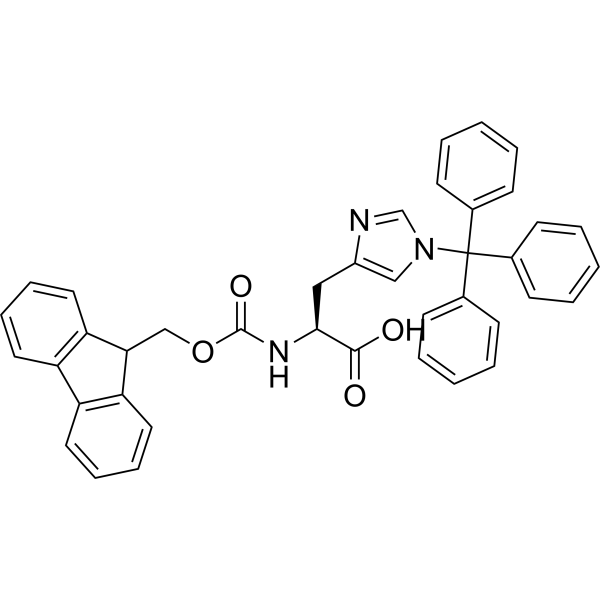
Fmoc-His(Trt)-OH is a histidine derivative with a trityl (Trt) group protecting the His side chain. Fmoc-His(Trt)-OH also has an Fmoc group protecting the α-NH2 group. Fmoc-His(Trt)-OH can be used in solid-phase peptide synthesis to prevent racemization and byproduct formation. Fmoc-His(Trt)-OH acts as a protected histidine precursor in solid-phase peptide synthesis (SPPS), participating in peptide chain construction through amide bond formation. Fmoc-His(Trt)-OH can be precisely incorporated into the target peptide sequence, ensuring correct peptide chain synthesis and reducing impurity formation. Fmoc-His(Trt)-OH is mainly used in the solid-phase synthesis research of pharmaceutical peptides and bioactive peptides, and is particularly suitable for the preparation of peptide drugs requiring precise control of histidine configuration .
|
-
- HY-151780
-
|
|
ADC Linker
|
Others
|
|
Fmoc-L-Dap(Pentynoyl)-OH is a click chemistry reagent containing an azide group. Fmoc-L-Dap(Pentynoyl)-OH serves as an amino acid building block for introducing alkyne functions into peptide sequences by standard Fmoc/tBu protocols. The alkyne residue can be engaged for copper catalyzed click reaction with organic azides or with tetrazines for copper-free conjugations . Fmoc-L-Dap(Pentynoyl)-OH is a click chemistry reagent, it contains an Alkyne group and can undergo copper-catalyzed azide-alkyne cycloaddition (CuAAc) with molecules containing Azide groups.
|
-
- HY-W008034
-
|
Fmoc-L-Trp(Boc)-OH
|
Amino Acid Derivatives
|
Cancer
|
|
Fmoc-Trp(Boc)-OH (Fmoc-L-Trp(Boc)-OH) is an amino acid derivative with protective groups. Fmoc-Trp(Boc)-OH can self-assemble into stable and pH-responsive spherical nanoparticles, which can load and release bioactive molecules, with good biocompatibility and high cell uptake rate. Fmoc-Trp(Boc)-OH can be used in research on drug delivery .
|
-
- HY-164732
-
|
|
Amino Acid Derivatives
Biochemical Assay Reagents
|
Others
|
|
Fmoc-Lys (DOTA)-OH is an Fmoc-protected Lysine derivative with metal-chelating properties, containing the macrocyclic chelator DOTA. Fmoc-Lys (DOTA)-OH undergoes metallation with Tb or Lu. Fmoc-Lys (DOTA)-OH utilizes metal coordination to protect the carboxyl groups of DOTA. Fmoc-Lys (DOTA)-OH can be used in solid-phase peptide synthesis research .
|
-
- HY-130936
-
|
|
ADC Linker
|
Cancer
|
|
DBCO-Val-Cit-PABC-OH is a cleavable ADC linker used in the synthesis of antibody-drug conjugates (ADCs) . DBCO-Val-Cit-PABC-OH is a click chemistry reagent, it contains a DBCO group that can undergo strain-promoted alkyne-azide cycloaddition (SPAAC) with molecules containing Azide groups.
|
-
- HY-183132C
-
|
|
Biochemical Assay Reagents
|
Others
|
|
DSG-PEG1000-OH is a conjugate composed of dimyristic glycerol (DMG), a PEG chain, and terminal hydroxyl groups (-OH). DMG-PEG1000-Glucose combines the membrane compatibility of phospholipids with the flexibility of hydroxyl modification, making it suitable for research in biomaterial construction and drug delivery.
|
-
- HY-151718
-
|
|
ADC Linker
|
Others
|
|
Boc-L-Tyr(PEG(3)-N3)-OH is a click chemistry agent containing azide. It contains an azide group and can undergo copper-catalyzed azide-alkyne cycloaddition (CuAAc) with molecules containing alkyne groups. It can also undergo ring strain-promoted alkyne-azide cycloaddition (SPAAC) with molecules containing DBCO or BCN groups.
|
-
- HY-151684A
-
|
|
ADC Linker
|
Others
|
|
Boc-Ser(O-propargyl)-OH (DCHA) is a click chemistry reagent containing a propynyl group.
|
-
- HY-157202
-
-
- HY-P11682
-
|
|
DNA/RNA Synthesis
|
Others
|
|
Boc-PNA-M(Z)-OH is a protected peptide nucleic acid (PNA) monomer used in solid-phase peptide synthesis (SPPS). Boc-PNA-M(Z)-OH consists of an adenyl base protected with a benzyloxycarbonyl (Z) group and a backbone protected with a tert-butyloxycarbonyl (Boc) group, typically used for creating PNA oligomers.
|
-
- HY-Y1636
-
-
- HY-W047799
-
|
|
Amino Acid Derivatives
|
Others
|
|
Fmoc-Phe(4-CONH2)-OH is an amino acid derivative with an Fmoc protecting group, which can be used to synthesize a small-sized HTLV-I protease inhibitor with hydrophilicity .
|
-
- HY-W013081S
-
|
|
Isotope-Labeled Compounds
Amino Acid Derivatives
|
Others
|
|
Fmoc-Gln(Trt)-OH- 13C5, 15N2 is the 13C-labeled and 15N-labeled Fmoc-Gln(Trt)-OH (HY-W013081). Fmoc-Gln(Trt)-OH is a glutamine derivative containing amine protecting group Fmoc. Fmoc-Gln(Trt)-OH can be used in solid-phase peptide synthesis .
|
-
- HY-Y1169S
-
|
|
Isotope-Labeled Compounds
Amino Acid Derivatives
|
Others
|
|
Fmoc-Asp(OtBu)-OH- 15N is the 15N-labeled Fmoc-Asp(OtBu)-OH (HY-Y1169). Fmoc-Asp(OtBu)-OH (4-tert-Butyl N-(fluoren-9-ylmethoxycarbonyl)-L-aspartate) is an aspartate derivative containing amine protecting group Fmoc. Fmoc-Asp(OtBu)-OH can be used for peptide synthesis .
|
-
- HY-151669
-
|
|
ADC Linker
|
Others
|
|
Fmoc-D-Aha-OH is a click chemistry reagent containing an azide . Fmoc-D-Aha-OH is a click chemistry reagent, it contains an Azide group and can undergo copper-catalyzed azide-alkyne cycloaddition reaction (CuAAc) with molecules containing Alkyne groups. It can also undergo strain-promoted alkyne-azide cycloaddition (SPAAC) reactions with molecules containing DBCO or BCN groups.
|
-
- HY-151762
-
|
|
ADC Linker
|
Others
|
|
(2R,4S)-Fmoc-D-Pro(4-N3)-OH is a click chemistry reagent containing an azide group. It contains an azide group and can undergo copper-catalyzed azide-alkyne cycloaddition (CuAAc) with molecules containing alkyne groups. It can also undergo ring strain-promoted alkyne-azide cycloaddition (SPAAC) with molecules containing DBCO or BCN groups.
|
-
- HY-151734
-
|
|
ADC Linker
|
Others
|
|
(2R,3S)-Fmoc-Abu(3-N3)-OH is a click chemistry reagent containing an azide group . It contains an azide group and can undergo copper-catalyzed azide-alkyne cycloaddition (CuAAc) with molecules containing alkyne groups. It can also undergo ring strain-promoted alkyne-azide cycloaddition (SPAAC) with molecules containing DBCO or BCN groups.
|
-
- HY-151693
-
|
|
ADC Linker
|
Others
|
|
H-L-Tyr(2-azidoethyl)-OH hydrochloride is a unnatural Tyrosine derivative. H-L-Tyr(2-azidoethyl)-OH hydrochloride is a click chemistry reagent containing an azide group . It contains an azide group and can undergo copper-catalyzed azide-alkyne cycloaddition (CuAAc) with molecules containing alkyne groups. It can also undergo ring strain-promoted alkyne-azide cycloaddition (SPAAC) with molecules containing DBCO or BCN groups.
|
-
- HY-151841
-
|
|
ADC Linker
|
Others
|
|
N3-L-Lys(Boc)-OH is a click chemistry reagent containing an azide group . N3-L-Lys(Boc)-OH is a click chemistry reagent, it contains an Azide group and can undergo copper-catalyzed azide-alkyne cycloaddition reaction (CuAAc) with molecules containing Alkyne groups. It can also undergo strain-promoted alkyne-azide cycloaddition (SPAAC) reactions with molecules containing DBCO or BCN groups.
|
-
- HY-151693A
-
|
|
ADC Linker
|
Others
|
|
H-L-Tyr(2-azidoethyl)-OH is a unnatural Tyrosine derivative. H-L-Tyr(2-azidoethyl)-OH is a click chemistry reagent containing an azide group . It contains an azide group and can undergo copper-catalyzed azide-alkyne cycloaddition (CuAAc) with molecules containing alkyne groups. It can also undergo ring strain-promoted alkyne-azide cycloaddition (SPAAC) with molecules containing DBCO or BCN groups.
|
-
- HY-151848
-
|
|
ADC Linker
|
Others
|
|
(2R,4R)-Boc-D-Pro(4-N3)-OH is a click chemistry reagent containing an azide group. It contains an azide group and can undergo copper-catalyzed azide-alkyne cycloaddition (CuAAc) with molecules containing alkyne groups. It can also undergo ring strain-promoted alkyne-azide cycloaddition (SPAAC) with molecules containing DBCO or BCN groups.
|
-
- HY-151843
-
|
|
ADC Linker
|
Others
|
|
N3-L-Lys(Fmoc)-OH is a click chemistry reagent containing an azide group . N3-L-Lys(Fmoc)-OH is a click chemistry reagent, it contains an Azide group and can undergo copper-catalyzed azide-alkyne cycloaddition reaction (CuAAc) with molecules containing Alkyne groups. It can also undergo strain-promoted alkyne-azide cycloaddition (SPAAC) reactions with molecules containing DBCO or BCN groups.
|
-
- HY-151760A
-
|
|
ADC Linker
|
Others
|
|
(2R,4S)-H-D-Pro(4-N3)-OH hydrochloride is a click chemistry reagent containing an azide group. It contains an azide group and can undergo copper-catalyzed azide-alkyne cycloaddition (CuAAc) with molecules containing alkyne groups. It can also undergo ring strain-promoted alkyne-azide cycloaddition (SPAAC) with molecules containing DBCO or BCN groups.
|
-
- HY-157248
-
-
- HY-151664
-
|
|
ADC Linker
|
Others
|
|
H-alpha-Prg-D-Ala-OH is a click chemistry reagent containing an azide group .
|
-
- HY-W736950A
-
|
|
Amino Acid Derivatives
|
Others
|
|
H-L-Cys(MDNPE)-OH hydrochloride is a cysteine derivative with a short peptide sequence attached to the thiol group of cysteine.
|
-
- HY-P11697
-
|
|
Drug Intermediate
|
Others
|
|
Fmoc-PNA-maleimide-OH is a Fmoc-protected functionalized peptide nucleic acid monomer featuring a maleimide group for thiol-reactive conjugation. Fmoc-PNA-maleimide-OH can be used in constructing PNA conjugates for molecular assembly applications.
|
-
- HY-Y1169S1
-
|
|
Isotope-Labeled Compounds
|
Others
|
|
Fmoc-Asp(OtBu)-OH- 13C4, 15N is the 13C and 15N labeled Fmoc-Asp(OtBu)-OH . Fmoc-Asp(OtBu)-OH (4-tert-Butyl N-(fluoren-9-ylmethoxycarbonyl)-L-aspartate) is a aspartate derivative containing amine protecting group Fmoc. Fmoc-Asp(OtBu)-OH can be used for peptide synthesis .
|
-
- HY-151661
-
|
L-azidovaline (CHA)
|
ADC Linker
|
Others
|
|
N3-L-Val-OH (CHA) is a click chemistry containing an azide group, a valine derivative. N3-L-Val-OH (CHA) can also be used as a synthetic intermediate for Valaciclovir (Valacyclovir) . It contains an azide group and can undergo copper-catalyzed azide-alkyne cycloaddition (CuAAc) with molecules containing alkyne groups. It can also undergo ring strain-promoted alkyne-azide cycloaddition (SPAAC) with molecules containing DBCO or BCN groups.
|
-
- HY-151709
-
|
|
ADC Linker
|
Others
|
|
N3-L-Cit-OH is a click chemistry reagent containing an azide group. N3-L-Cit-OH can be used to construct peptidomimetic ADC linkers using Click-chemistry . It contains an azide group and can undergo copper-catalyzed azide-alkyne cycloaddition (CuAAc) with molecules containing alkyne groups. It can also undergo ring strain-promoted alkyne-azide cycloaddition (SPAAC) with molecules containing DBCO or BCN groups.
|
-
- HY-151658
-
|
|
ADC Linker
|
Others
|
|
H-L-Lys(N3-Gly)-OH is a click chemistry containing an azide group, a lysine derivative. H-L-Lys(N3-Gly)-OH can be incorporated into proteins for click modifications . It contains an azide group and can undergo copper-catalyzed azide-alkyne cycloaddition (CuAAc) with molecules containing alkyne groups. It can also undergo ring strain-promoted alkyne-azide cycloaddition (SPAAC) with molecules containing DBCO or BCN groups.
|
-
- HY-151658A
-
|
|
ADC Linker
|
Others
|
|
H-L-Lys(N3-Gly)-OH hydrochloride is a click chemistry containing an azide group, a lysine derivative. H-L-Lys(N3-Gly)-OH hydrochloride can be incorporated into proteins for click modifications . It contains an azide group and can undergo copper-catalyzed azide-alkyne cycloaddition (CuAAc) with molecules containing alkyne groups. It can also undergo ring strain-promoted alkyne-azide cycloaddition (SPAAC) with molecules containing DBCO or BCN groups.
|
-
- HY-151735
-
|
|
ADC Linker
|
Others
|
|
N3-L-Dab(Boc)-OH is a click chemistry reagent containing an azide group. N3-L-Dab(Boc)-OH can be used for the research of various biochemical . It contains an azide group and can undergo copper-catalyzed azide-alkyne cycloaddition (CuAAc) with molecules containing alkyne groups. It can also undergo ring strain-promoted alkyne-azide cycloaddition (SPAAC) with molecules containing DBCO or BCN groups.
|
-
- HY-151703
-
|
|
ADC Linker
|
Others
|
|
Boc-D-Lys(N3)-OH is a Boc-protected amino acid derivative, can be used as a click chemistry reagent and an intermediate for synthesis of linkers . It contains an azide group and can undergo copper-catalyzed azide-alkyne cycloaddition (CuAAc) with molecules containing alkyne groups. It can also undergo ring strain-promoted alkyne-azide cycloaddition (SPAAC) with molecules containing DBCO or BCN groups.
|
-
- HY-151721
-
|
|
Drug Intermediate
|
Others
|
|
H-D-Orn(N3)-OH hydrochloride is a drug intermediate that can be introduced at the 5' end of oligonucleotides with a protected C6 amino linker by MMT, facilitating the subsequent deprotection and coupling of functional groups such as dyes and biotin.
|
-
- HY-D1175
-
-
- HY-W441376
-
|
|
Ligands for E3 Ligase
|
Cancer
|
|
Thalidomide-1-Me,4-OH is a Thalidomide (HY-14658) analogue. Thalidomide-1-Me,4-OH contains an extra methyl group on the glutarimide moiety of thalidomide, which is known to abrogate its ability to bind the E3 ligase CRBN. Thalidomide is a ligand for E3 ligase, which ubiquitinylates proteins, thus committing their fate to proteolytic destruction.
|
-
- HY-Y1636S
-
-
- HY-W025936
-
|
|
Drug Intermediate
|
Others
|
|
Fmoc‑PNA‑G (Bhoc)‑OH is a guanine-containing peptide nucleic acid monomer, in which both Bhoc on the nucleobase and Fmoc on the backbone serve as protecting groups. Fmoc‑PNA‑G (Bhoc)‑OH is applicable for the synthesis of peptide nucleic acids .
|
-
- HY-W008034S
-
|
Fmoc-L-Trp(Boc)-OH-13C11,15N2
|
Isotope-Labeled Compounds
Amino Acid Derivatives
|
Cancer
|
|
Fmoc-Trp(Boc)-OH- 13C11, 15N2 (Fmoc-L-Trp(Boc)-OH- 13C11, 15N2) is the 13C-labeled and 15N-labeled Fmoc-Trp(Boc)-OH (HY-W008034). Fmoc-Trp(Boc)-OH (Fmoc-L-Trp(Boc)-OH) is an amino acid derivative with protective groups. Fmoc-Trp(Boc)-OH can self-assemble into stable and pH-responsive spherical nanoparticles, which can load and release bioactive molecules, with good biocompatibility and high cell uptake rate. Fmoc-Trp(Boc)-OH can be used in research on drug delivery .
|
-
- HY-W784623
-
|
|
Drug Intermediate
|
Others
|
|
Boc-PNA-A(Z)-OH is a Boc-protected peptide nucleic acid monomer with a benzyloxycarbonyl protecting group on the adenine base .
|
-
- HY-137002
-
|
|
Amino Acid Derivatives
Biochemical Assay Reagents
|
Others
|
|
Fmoc-N-Me-Arg(Pbf)-OH is an amino acid derivative containing a guanidinium protecting group on the arginine side chain. Fmoc-N-Me-Arg(Pbf)-OH is used in the synthesis of neurotensin-derived NTS1 ligands for PET imaging .
|
-
- HY-Y1169
-
|
4-tert-Butyl N-(fluoren-9-ylmethoxycarbonyl)-L-aspartate; Fmoc-L-Asp(OtBu)-OH
|
Amino Acid Derivatives
|
Others
|
|
Fmoc-Asp(OtBu)-OH (4-tert-Butyl N-(fluoren-9-ylmethoxycarbonyl)-L-aspartate) is an aspartate derivative containing amine protecting group Fmoc. Fmoc-Asp(OtBu)-OH can be used for peptide synthesis .
|
-
- HY-137649A
-
|
|
Nucleoside Antimetabolite/Analog
|
Others
|
|
Sp-2'-O-Me-CTPαS tetrasodium is an analog of CTP. Sp-2'-O-Me-CTPαS tetrasodium can be used enzymatically to introduce thiophosphate and modified 2'-OH groups into RNA.
|
-
- HY-151709A
-
|
|
ADC Linker
|
Others
|
|
N3-L-Cit-OH DCHA is a click chemistry reagent containing an azide group. N3-L-Cit-OH DCHA can be used to construct peptidomimetic ADC linkers using Click-chemistry . It contains an azide group and can undergo copper-catalyzed azide-alkyne cycloaddition (CuAAc) with molecules containing alkyne groups. It can also undergo ring strain-promoted alkyne-azide cycloaddition (SPAAC) with molecules containing DBCO or BCN groups.
|
-
- HY-151678
-
|
|
ADC Linker
|
Others
|
|
N3-L-Lys(Mtt)-OH is a click chemistry reagent containing an azide group. N3-L-Lys(Mtt)-OH can introduce azide functions into the amino acid building block of peptide sequences at the N-terminal position. It contains an azide group and can undergo copper-catalyzed azide-alkyne cycloaddition (CuAAc) with molecules containing alkyne groups. It can also undergo ring strain-promoted alkyne-azide cycloaddition (SPAAC) with molecules containing DBCO or BCN groups.
|
-
- HY-151761
-
|
|
ADC Linker
|
Others
|
|
H-L-Lys(4-N3-Z)-OH hydrochloride is a click chemistry reagent containing an azide group. H-L-Lys(4-N3-Z)-OH hydrochloride contains a lysine-modified azide moiety and as a bioorthogonal ligation handle. H-L-Lys(4-N3-Z)-OH hydrochloride is an infrared probe and a photo-affinity reagent . It contains an azide group and can undergo copper-catalyzed azide-alkyne cycloaddition (CuAAc) with molecules containing alkyne groups. It can also undergo ring strain-promoted alkyne-azide cycloaddition (SPAAC) with molecules containing DBCO or BCN groups.
|
-
- HY-W101723
-
|
|
PROTAC Linkers
|
Cancer
|
|
Boc-12-Ado-OH can be used as a PROTAC linker in the synthesis of PROTACs. Boc-12-Ado-OH is an alkane chain with terminal carboxlic acid and Boc-protected amino groups. The terminal carboxylic acid can react with primary amine groups in the presence of activators (e.g. EDC, or HATU) to form a stable amide bond. The Boc group can be deprotected under mild acidic conditions to form the free amine.
|
-
- HY-155902D
-
|
Maleimide-PEG10000-Hydroxy
|
Biochemical Assay Reagents
|
Others
|
|
Mal-PEG10000-OH (Maleimide-PEG10000-Hydroxy) is a linear heteroterminal bifunctional PEG product with maleimide and hydroxyl groups. Mal-PEG10000-OH can be used as a macroinitiator to obtain amphiphilic diblock copolymers through ring-opening polymerization of Lactate (Lactic Acid) (HY-B2227). Nanoparticles prepared using amphiphilic block copolymers can form active drug delivery systems .
|
-
- HY-155902E
-
|
Maleimide-PEG20000-Hydroxy
|
Biochemical Assay Reagents
|
Others
|
|
Mal-PEG20000-OH (Maleimide-PEG20000-Hydroxy) is a linear heteroterminal bifunctional PEG product with maleimide and hydroxyl groups. Mal-PEG20000-OH can be used as a macroinitiator to obtain amphiphilic diblock copolymers through ring-opening polymerization of Lactate (Lactic Acid) (HY-B2227). Nanoparticles prepared using amphiphilic block copolymers can form active drug delivery systems .
|
-
- HY-155902H
-
|
Maleimide-PEG40000-Hydroxy
|
Biochemical Assay Reagents
|
Others
|
|
Mal-PEG40000-OH (Maleimide-PEG40000-Hydroxy) is a linear heteroterminal bifunctional PEG product with maleimide and hydroxyl groups. Mal-PEG40000-OH can be used as a macroinitiator to obtain amphiphilic diblock copolymers through ring-opening polymerization of Lactate (Lactic Acid) (HY-B2227). Nanoparticles prepared using amphiphilic block copolymers can form active drug delivery systems .
|
-
- HY-155902C
-
|
Maleimide-PEG3400-Hydroxy
|
Biochemical Assay Reagents
|
Others
|
|
Mal-PEG3400-OH (Maleimide-PEG3400-Hydroxy) is a linear heteroterminal bifunctional PEG product with maleimide and hydroxyl groups. Mal-PEG3400-OH can be used as a macroinitiator to obtain amphiphilic diblock copolymers through ring-opening polymerization of Lactate (Lactic Acid) (HY-B2227). Nanoparticles prepared using amphiphilic block copolymers can form active drug delivery systems .
|
-
- HY-130922
-
|
|
ADC Linker
|
Cancer
|
|
BCN-PEG1-Val-Cit-OH is a cleavable 1 unit PEG ADC linker used in the synthesis of antibody-drug conjugates (ADCs) . BCN-PEG1-Val-Cit-OH is a click chemistry reagent, it contains a BCN group that can undergo strain-promoted alkyne-azide cycloaddition (SPAAC) with molecules containing Azide groups.
|
-
- HY-174928C
-
|
|
Biochemical Assay Reagents
|
Others
|
|
HO-PEG5000-AS is a PEG derivative with a hydroxyl (OH) functional group and a thioacetate (AS) and can be used for drug delivery.
|
-
- HY-174928
-
|
|
Biochemical Assay Reagents
|
Others
|
|
HO-PEG1000-AS is a PEG derivative with a hydroxyl (OH) functional group and a thioacetate (AS) and can be used for drug delivery.
|
-
- HY-P11696
-
|
|
Drug Intermediate
|
Others
|
|
H-Aeg(Fmoc)-OH hydrochloride is an Fmoc-protected aminoethylglycine monomer with a free carboxyl group and can be used for peptide nucleic acid synthesis.
|
-
- HY-174928B
-
|
|
Biochemical Assay Reagents
|
Others
|
|
HO-PEG3400-AS is a PEG derivative with a hydroxyl (OH) functional group and a thioacetate (AS) and can be used for drug delivery.
|
-
- HY-174886
-
-
- HY-174928A
-
|
|
Biochemical Assay Reagents
|
Others
|
|
HO-PEG2000-AS is a PEG derivative with a hydroxyl (OH) functional group and a thioacetate (AS) and can be used for drug delivery.
|
-
- HY-179477
-
|
|
Amino Acid Derivatives
Drug Intermediate
|
Others
|
|
Fmoc-β-Ala-Asp(OMpe)-OH is a specialized amino acid derivative used in solid-phase peptide synthesis (SPPS). Fmoc-β-Ala-Asp(OMpe)-OH consists of a beta-alanine spacer linked to an aspartic acid residue, where the beta-carboxyl group is protected with a 3-methylpentyl ester (OMpe) to prevent aspartimide formation during synthesis. Fmoc-β-Ala-Asp(OMpe)-OH a useful building block for creating peptides that contain aspartic acid, as the OMpe group is designed to minimize unwanted side reactions .
|
-
- HY-151729
-
|
|
ADC Linker
|
Others
|
|
N3-D-Dab(Boc)-OH is a click chemistry reagent containing an Azide . N3-D-Dab(Boc)-OH is a click chemistry reagent, it contains an Azide group and can undergo copper-catalyzed azide-alkyne cycloaddition reaction (CuAAc) with molecules containing Alkyne groups. It can also undergo strain-promoted alkyne-azide cycloaddition (SPAAC) reactions with molecules containing DBCO or BCN groups.
|
-
- HY-151654
-
|
|
ADC Linker
|
Others
|
|
N3-D-Lys(Boc)-OH is a click chemistry reagent containing an Azide . N3-D-Lys(Boc)-OH is a click chemistry reagent, it contains an Azide group and can undergo copper-catalyzed azide-alkyne cycloaddition reaction (CuAAc) with molecules containing Alkyne groups. It can also undergo strain-promoted alkyne-azide cycloaddition (SPAAC) reactions with molecules containing DBCO or BCN groups.
|
-
- HY-126672
-
|
|
ADC Linker
|
Cancer
|
|
Mal-amide-PEG4-Val-Cit-PAB-OH is a cleavable ADC linker containing a Maleimide group. Mal-amide-PEG4-Val-Cit-PAB-OH is used in the synthesis of antibody-drug conjugates (ADCs) .
|
-
- HY-174931B
-
|
|
Biochemical Assay Reagents
|
Others
|
|
HO-PEG3400-NH-Fmoc is a PEG derivative with an Fmoc protecting group and a hydroxyl (OH) reactive group. Fmoc is a commonly used amino protecting group that protects the amino group from unwanted reactions until it is removed for a specific coupling reaction.
|
-
- HY-174931C
-
|
|
Biochemical Assay Reagents
|
Others
|
|
HO-PEG5000-NH-Fmoc is a PEG derivative with an Fmoc protecting group and a hydroxyl (OH) reactive group. Fmoc is a commonly used amino protecting group that protects the amino group from unwanted reactions until it is removed for a specific coupling reaction.
|
-
- HY-174931A
-
|
|
Biochemical Assay Reagents
|
Others
|
|
HO-PEG2000-NH-Fmoc is a PEG derivative with an Fmoc protecting group and a hydroxyl (OH) reactive group. Fmoc is a commonly used amino protecting group that protects the amino group from unwanted reactions until it is removed for a specific coupling reaction.
|
-
- HY-174931
-
|
|
Biochemical Assay Reagents
|
Others
|
|
HO-PEG1000-NH-Fmoc is a PEG derivative with an Fmoc protecting group and a hydroxyl (OH) reactive group. Fmoc is a commonly used amino protecting group that protects the amino group from unwanted reactions until it is removed for a specific coupling reaction.
|
-
- HY-151681
-
|
cis-4-Azido-N-Fmoc-D-proline
|
ADC Linker
|
Others
|
|
(2R,4R)-Fmoc-D-Pro(4-N3)-OH (cis-4-Azido-N-Fmoc-D-proline) is a click chemistry reagent containing an azide group . It contains an azide group and can undergo copper-catalyzed azide-alkyne cycloaddition (CuAAc) with molecules containing alkyne groups. It can also undergo ring strain-promoted alkyne-azide cycloaddition (SPAAC) with molecules containing DBCO or BCN groups.
|
-
- HY-185069C
-
|
|
Phosphoramidites
DNA/RNA Synthesis
|
Others
|
|
Unylinker-OH Resin (Substitution:300±25 µmol/g) is a macroporous polystyrene resin functionalized with Unylinker active groups with uniform particle size and uniform active groups. It is used for oligonucleotides synthesis.
|
-
- HY-185069B
-
|
|
DNA/RNA Synthesis
|
Others
|
|
Unylinker-OH Resin (Substitution:250±25 µmol/g) is a macroporous polystyrene resin functionalized with Unylinker active groups with uniform particle size and uniform active groups. It is used for oligonucleotides synthesis.
|
-
- HY-185069
-
|
|
DNA/RNA Synthesis
|
Others
|
|
Unylinker-OH Resin (Substitution:150±25 mmol/g) is a macroporous polystyrene resin functionalized with Unylinker active groups with uniform particle size and uniform active groups. It is used for oligonucleotides synthesis.
|
-
- HY-185069A
-
|
|
DNA/RNA Synthesis
|
Others
|
|
Unylinker-OH Resin (Substitution:200±25 µmol/g) is a macroporous polystyrene resin functionalized with Unylinker active groups with uniform particle size and uniform active groups. It is used for oligonucleotides synthesis.
|
-
- HY-185069D
-
|
|
DNA/RNA Synthesis
|
Others
|
|
Unylinker-OH Resin (Substitution:350±25 µmol/g) is a macroporous polystyrene resin functionalized with Unylinker active groups with uniform particle size and uniform active groups. It is used for oligonucleotides synthesis.
|
-
- HY-130934
-
|
|
ADC Linker
|
Cancer
|
|
TCO-PEG1-Val-Cit-OH is a cleavable 1 unit PEG ADC linker used in the synthesis of antibody-drug conjugates (ADCs) . TCO-PEG1-Val-Cit-OH is a click chemistry reagent, it contains a TCO group that can undergo an inverse electron demand Diels-Alder reaction (iEDDA) with molecules containing Tetrazine groups.
|
-
- HY-130923
-
|
|
ADC Linker
|
Cancer
|
|
BCN-PEG1-Val-Cit-PABC-OH is a cleavable 1 unit PEG ADC linker used in the synthesis of antibody-drug conjugates (ADCs) . BCN-PEG1-Val-Cit-PABC-OH is a click chemistry reagent, it contains a BCN group that can undergo strain-promoted alkyne-azide cycloaddition (SPAAC) with molecules containing Azide groups.
|
-
- HY-137648A
-
-
- HY-P11681
-
|
|
DNA/RNA Synthesis
|
Others
|
|
Boc-PNA-J(Z)-OH is a protected peptide nucleic acid (PNA) monomer used in solid-phase synthesis. Boc-PNA-J(Z)-OH features a 2,6-diaminopurine (J) base, protected by a carboxybenzyl (Z) group, attached to a Boc-protected aminoethylglycinate backbone. Boc-PNA-J(Z)-OH allows for the synthesis of PNA sequences with enhanced binding affinity and stability.
|
-
- HY-W101495S
-
-
- HY-P11694
-
|
|
Biochemical Assay Reagents
|
Neurological Disease
|
|
Alloc-Aeg (Fmoc)-OH is a protected serine triphosphate building block and an Nα-Fmoc protected amino acid. Alloc-Aeg (Fmoc)-OH contains serine protected by α-N-allyloxycarbonyl (Alloc) and bis (allyl) phosphate groups, and it can be used in the synthesis of peptide nucleic acids (PNAs). Alloc-Aeg (Fmoc)-OH is applicable to research related to Alzheimer's disease .
|
-
- HY-Y1169S2
-
|
4-tert-Butyl N-(fluoren-9-ylmethoxycarbonyl)-L-aspartate-d3; Fmoc-L-Asp(OtBu)-OH-d3
|
Isotope-Labeled Compounds
Amino Acid Derivatives
|
Others
|
|
Fmoc-Asp(OtBu)-OH-d3 (4-tert-Butyl N-(fluoren-9-ylmethoxycarbonyl)-L-aspartate-d3) is deuterium labeled Fmoc-Asp(OtBu)-OH. Fmoc-Asp(OtBu)-OH (4-tert-Butyl N-(fluoren-9-ylmethoxycarbonyl)-L-aspartate) is a aspartate derivative containing amine protecting group Fmoc. Fmoc-Asp(OtBu)-OH can be used for peptide synthesis .
|
-
- HY-W590561
-
|
|
Biochemical Assay Reagents
|
Others
|
|
Fmoc-Asp(biotinyl-PEG)-OH is a biotinylation reagent with a Fmoc-protected amino group. The Fmoc group can be deprotected under basic conditions to obtain the free amine which can be used for further conjugations.
|
-
- HY-130966
-
|
|
ADC Linker
|
Cancer
|
|
TCO-PEG1-Val-Cit-PABC-OH is a cleavable 1 unit PEG ADC linker used in the synthesis of antibody-drug conjugates (ADCs) . TCO-PEG1-Val-Cit-PABC-OH is a click chemistry reagent, it contains a TCO group that can undergo an inverse electron demand Diels-Alder reaction (iEDDA) with molecules containing Tetrazine groups.
|
-
- HY-136034
-
|
|
ADC Linker
|
Cancer
|
|
Azido-PEG1-Val-Cit-OH is a cleavable 1 unit PEG ADC linker used in the synthesis of antibody-drug conjugates (ADCs) . Azido-PEG1-Val-Cit-OH is a click chemistry reagent, it contains an Azide group and can undergo copper-catalyzed azide-alkyne cycloaddition reaction (CuAAc) with molecules containing Alkyne groups. It can also undergo strain-promoted alkyne-azide cycloaddition (SPAAC) reactions with molecules containing DBCO or BCN groups.
|
-
- HY-W019032
-
|
|
Amino Acid Derivatives
|
Others
|
|
Fmoc-D-Dab(Boc)-OH is an amino acid derivative with an Fmoc protecting group, which can be used to synthesize peptides with antibacterial activity .
|
-
- HY-P11684
-
|
|
DNA/RNA Synthesis
|
Others
|
|
Fmoc-PNA-C(Boc)-OH is a protected peptide nucleic acid (PNA) monomer for solid-phase synthesis. Fmoc-PNA-C(Boc)-OH possesses Fmoc-protected skeletal amino groups and Boc-protected cytosine bases, designed to construct stable synthetic DNA analogs. Fmoc-PNA-C(Boc)-OH can be used to prepare highly specific, enzyme-stable antisense probes and diagnostic probes.
|
-
- HY-W008024
-
|
|
Amino Acid Derivatives
|
Others
|
|
Fmoc-Dab(Boc)-OH is an amino acid derivative with an Fmoc protecting group that can be used to synthesize somatostatin analogs that inhibit neointima formation induced by balloon injury in rats without altering growth hormone release. Fmoc-Dab(Boc)-OH can be used for the synthesis of peptides .
|
-
- HY-151749
-
|
|
ADC Linker
|
Others
|
|
N3-D-Lys(Fmoc)-OH is a click chemistry reagent containing an azide group. Click chemistry is a powerful chemical reaction with excellent bioorthogonality features: biocompatible, rapid and highly specific in biological environments . N3-D-Lys(Fmoc)-OH is a click chemistry reagent, it contains an Azide group and can undergo copper-catalyzed azide-alkyne cycloaddition reaction (CuAAc) with molecules containing Alkyne groups. It can also undergo strain-promoted alkyne-azide cycloaddition (SPAAC) reactions with molecules containing DBCO or BCN groups.
|
-
- HY-151736
-
|
|
ADC Linker
|
Others
|
|
N3-L-Dap(Boc)-OH is a click chemistry reagent containing an azide group. Click chemistry is a powerful chemical reaction with excellent bioorthogonality features: biocompatible, rapid and highly specific in biological environments . N3-L-Dap(Boc)-OH is a click chemistry reagent, it contains an Azide group and can undergo copper-catalyzed azide-alkyne cycloaddition reaction (CuAAc) with molecules containing Alkyne groups. It can also undergo strain-promoted alkyne-azide cycloaddition (SPAAC) reactions with molecules containing DBCO or BCN groups.
|
-
- HY-140149
-
|
|
ADC Linker
PROTAC Linkers
|
Cancer
|
|
Azido-PEG4-Val-Cit-PAB-OH is a cleavable 4 unit PEG ADC linker used in the synthesis of antibody-drug conjugates (ADCs) . Azido-PEG4-Val-Cit-PAB-OH is also a PEG-based PROTAC linker that can be used in the synthesis of PROTACs . Azido-PEG4-Val-Cit-PAB-OH is a click chemistry reagent, it contains an Azide group and can undergo copper-catalyzed azide-alkyne cycloaddition reaction (CuAAc) with molecules containing Alkyne groups. It can also undergo strain-promoted alkyne-azide cycloaddition (SPAAC) reactions with molecules containing DBCO or BCN groups.
|
-
- HY-P11689
-
|
|
Biochemical Assay Reagents
|
Others
|
|
Fmoc-PNA-J (Bhoc)-OH is a protected peptide nucleic acid (PNA) monomer building block used for solid-phase synthesis of PNA oligomers. Fmoc-PNA-J (Bhoc)-OH carries Fmoc/Bhoc protecting groups and functions as a standard Fmoc-protected PNA monomer .
|
-
- HY-140569
-
|
|
PROTAC Linkers
|
Cancer
|
|
N-(PEG1-OH)-N-Boc-PEG2-propargyl is a PEG-based PROTAC linker that can be used in the synthesis of PROTACs . N-(PEG1-OH)-N-Boc-PEG2-propargyl is a click chemistry reagent, it contains an Alkyne group and can undergo copper-catalyzed azide-alkyne cycloaddition (CuAAc) with molecules containing Azide groups.
|
-
- HY-151679
-
|
|
ADC Linker
|
Others
|
|
Fmoc-L-Lys(4-N3-Z)-OH is a click chemistry reagent containing an azide group. Fmoc-L-Lys(4-N3-Z)-OH acts as Lysine building-block for SPPS containing an Azide moiety as a bioorthogonal ligation handle, an infrared probe and a photo-affinity reagent. It can be decaged by trans-cyclooctenols via a strain-promoted 1,3-dipolar cycloaddition . Fmoc-L-Lys(4-N3-Z)-OH is a click chemistry reagent, it contains an Azide group and can undergo copper-catalyzed azide-alkyne cycloaddition reaction (CuAAc) with molecules containing Alkyne groups. It can also undergo strain-promoted alkyne-azide cycloaddition (SPAAC) reactions with molecules containing DBCO or BCN groups.
|
-
- HY-E71135
-
-
- HY-P4632
-
|
γ-Glu-Leu
|
Amino Acid Derivatives
|
Others
|
|
H-γ-Glu-Leu-OH (γ-Glu-Leu) is a dipeptide consisting of γ-glutamic acid and leucine, terminated by a hydroxyl group .
|
-
- HY-136137
-
|
|
ADC Linker
|
Cancer
|
|
Azide-PEG1-Val-Cit-PABC-OH is a cleavable 1 unit PEG ADC linker used in the synthesis of antibody-drug conjugates (ADCs) . Azide-PEG1-Val-Cit-PABC-OH is a click chemistry reagent, it contains an Azide group and can undergo copper-catalyzed azide-alkyne cycloaddition reaction (CuAAc) with molecules containing Alkyne groups. It can also undergo strain-promoted alkyne-azide cycloaddition (SPAAC) reactions with molecules containing DBCO or BCN groups.
|
-
- HY-140148
-
|
|
ADC Linker
|
Cancer
|
|
Azido-PEG3-Val-Cit-PAB-OH is a cleavable 3 unit PEG ADC linker used in the synthesis of antibody-drug conjugates (ADCs) . Azido-PEG3-Val-Cit-PAB-OH is a click chemistry reagent, it contains an Azide group and can undergo copper-catalyzed azide-alkyne cycloaddition reaction (CuAAc) with molecules containing Alkyne groups. It can also undergo strain-promoted alkyne-azide cycloaddition (SPAAC) reactions with molecules containing DBCO or BCN groups.
|
-
- HY-151858
-
|
|
Biochemical Assay Reagents
|
Others
|
|
Boc-L-Lys(N3)-OH is a click chemistry reagent containing an azide group. Click chemistry has great potential for use in binding between nucleic acids, lipids, proteins, and other molecules, and has been used in many research fields because of its beneficial characteristics, including high yield, high specificity, and simplicity . It contains an azide group and can undergo copper-catalyzed azide-alkyne cycloaddition (CuAAc) with molecules containing alkyne groups. It can also undergo ring strain-promoted alkyne-azide cycloaddition (SPAAC) with molecules containing DBCO or BCN groups.
|
-
- HY-151849
-
|
|
ADC Linker
|
Others
|
|
Z-L-Dap(N3)-OH is a click chemistry reagent containing an azide group. Click chemistry has great potential for use in binding between nucleic acids, lipids, proteins, and other molecules, and has been used in many research fields because of its beneficial characteristics, including high yield, high specificity, and simplicity . It contains an azide group and can undergo copper-catalyzed azide-alkyne cycloaddition (CuAAc) with molecules containing alkyne groups. It can also undergo ring strain-promoted alkyne-azide cycloaddition (SPAAC) with molecules containing DBCO or BCN groups.
|
-
- HY-151785A
-
|
|
ADC Linker
|
Others
|
|
H-L-Dbu(N3)-OH is a click chemistry reagent containing an azide group. Click chemistry has great potential for use in binding between nucleic acids, lipids, proteins, and other molecules, and has been used in many research fields because of its beneficial characteristics, including high yield, high specificity, and simplicity . It contains an azide group and can undergo copper-catalyzed azide-alkyne cycloaddition (CuAAc) with molecules containing alkyne groups. It can also undergo ring strain-promoted alkyne-azide cycloaddition (SPAAC) with molecules containing DBCO or BCN groups.
|
-
- HY-W048739
-
|
|
Amino Acid Derivatives
|
Others
|
|
Fmoc-α-Me-Leu-OH is a leucine derivative with an Fmoc protecting group, which can be used to synthesize peptides with oxytocin receptor agonist activity .
|
-
- HY-W008876
-
-
- HY-151814
-
|
|
ADC Linker
|
Others
|
|
(2S,4S)-Fmoc-L-Pro(4-NHPoc)-OH is a click chemistry reagent containing an azide group.
|
-
- HY-W010922
-
|
|
Amino Acid Derivatives
|
Others
|
|
Fmoc-Dap(Boc)-OH is an amino acid derivative with an Fmoc protecting group, which can be used to synthesize bicyclic peptide tachykinin NK2 antagonists .
|
-
- HY-W047788
-
|
|
Amino Acid Derivatives
|
Others
|
|
H-Dab(Boc)-OH is an amino acid derivative with a Boc protecting group, which can be used to synthesize methotrexate (MTX) analogs with antitumor and antifolate activities .
|
-
- HY-118894
-
|
|
DNA/RNA Synthesis
|
|
|
AB-182 is an aziridine derivative and antitumor agent.AB-182 shows synergistic antitumor effects in conjunction with x-irradiation. Intermediate hydrolysis products of AB-182 may block the repair of x-irradiation-induced breaks in the DNA strands by phosphorylating their free 3'-OH end groups.
|
-
- HY-151668A
-
|
|
ADC Linker
|
Others
|
|
Z-L-Aha-OH (DCHA) is a click chemistry reagent containing azide group . It contains an azide group and can undergo copper-catalyzed azide-alkyne cycloaddition (CuAAc) with molecules containing alkyne groups. It can also undergo ring strain-promoted alkyne-azide cycloaddition (SPAAC) with molecules containing DBCO or BCN groups.
|
-
- HY-151668
-
|
|
ADC Linker
|
Others
|
|
Z-L-Aha-OH is a click chemistry reagent containing azide group . It contains an azide group and can undergo copper-catalyzed azide-alkyne cycloaddition (CuAAc) with molecules containing alkyne groups. It can also undergo ring strain-promoted alkyne-azide cycloaddition (SPAAC) with molecules containing DBCO or BCN groups.
|
-
- HY-151763
-
|
|
ADC Linker
|
Others
|
|
Boc-L-Aza-OH CHA is a click chemistry reagent containing an azide group. It contains an azide group and can undergo copper-catalyzed azide-alkyne cycloaddition (CuAAc) with molecules containing alkyne groups. It can also undergo ring strain-promoted alkyne-azide cycloaddition (SPAAC) with molecules containing DBCO or BCN groups.
|
-
- HY-151723
-
|
|
ADC Linker
|
Others
|
|
H-D-Aha-OH (hydrochloride) is a click chemistry reagent containing an azide group. It contains an azide group and can undergo copper-catalyzed azide-alkyne cycloaddition (CuAAc) with molecules containing alkyne groups. It can also undergo ring strain-promoted alkyne-azide cycloaddition (SPAAC) with molecules containing DBCO or BCN groups.
|
-
- HY-78574
-
|
|
Nucleoside Antimetabolite/Analog
|
Others
|
|
N-Benzoylcytidine is a modified cytidine analogue that can be phosphorylated by uracil-cytidine kinase (UCK1 and UCK2). N-Benzoylcytidine can be used to synthesize 2-OH protective groups for solid-phase RNA synthesis, as well as synthetic oligonucleotides for UV induction and targeted gene silencing in zebrafish embryos .
|
-
- HY-P11685
-
|
|
DNA/RNA Synthesis
|
Others
|
|
Fmoc-PNA-thioU(PMB)-OH is a nucleobase-modified peptide nucleic acid (PNA) monomer used in solid-phase synthesis. Fmoc-PNA-thioU(PMB)-OH features a thiouracil base protected with a p-methoxybenzyl (PMB) group on an Fmoc-protected backbone, designed for incorporating modified PNA bases into oligonucleotides to study binding properties.
|
-
- HY-E71194
-
|
|
Biochemical Assay Reagents
|
Others
|
|
15-Hydroxyicosatetraenoate dehydrogenase (EC 1.1.1.232) belongs to the family of oxidoreductases, specifically those acting on the CH-OH group of donor with NAD+ or NADP+ as acceptor.
|
-
- HY-W106325
-
|
|
Amino Acid Derivatives
|
Others
|
|
Fmoc-N-Me-D-Trp(Boc)-OH is an amino acid derivative with an Fmoc protecting group, which can be used to synthesize somatostatin-dopamine chimeric analogs .
|
-
- HY-E71268
-
|
|
Biochemical Assay Reagents
|
Others
|
|
β-Alanopine dehydrogenase (EC 1.5.1.26) belongs to the family of oxidoreductases, specifically those acting on the CH-OH group of donor with NAD+ or NADP+ as acceptor.
|
-
- HY-W548477
-
|
|
Amino Acid Derivatives
|
Others
|
|
H-Lys(Fmoc)-OH hydrochloride is an amino acid derivative with an Fmoc protecting group, which can be used to synthesize diacylated GLP-1 derivatives with antidiabetic activity .
|
-
- HY-151703A
-
|
|
ADC Linker
|
Others
|
|
Boc-D-Lys(N3)-OH CHA is a click chemistry reagent containing an azide group. Click chemistry has great potential for use in binding between nucleic acids, lipids, proteins, and other molecules, and has been used in many research fields because of its beneficial characteristics, including high yield, high specificity, and simplicity . It contains an azide group and can undergo copper-catalyzed azide-alkyne cycloaddition (CuAAc) with molecules containing alkyne groups. It can also undergo ring strain-promoted alkyne-azide cycloaddition (SPAAC) with molecules containing DBCO or BCN groups.
|
-
- HY-W111226
-
|
|
Amyloid-β
Amino Acid Derivatives
|
Cardiovascular Disease
Neurological Disease
|
|
Fmoc-His (3-Me)-OH is a histidine derivative with a methylated imidazole group. Fmoc-His (3-Me)-OH can be used for the synthesis of the chemically modified tripeptide His (3-methyl)-Arg-Trp (H (3-Me)-RW). Fmoc-His (3-Me)-OH serves as a resin in Fmoc solid-phase synthesis for the generation of the His-(3-Me)-Gly-Lys peptide. Fmoc-His (3-Me)-OH is a building block for the synthesis of NAHIS02-(p-Met). Fmoc-His (3-Me)-OH can be applied in research related to Alzheimer's disease .
|
-
- HY-151650
-
|
|
ADC Linker
|
Others
|
|
N3-O2Oc-O2Oc-OH is a click chemistry reagent containing an azide . N3-O2Oc-O2Oc-OH is a click chemistry reagent, it contains an Azide group and can undergo copper-catalyzed azide-alkyne cycloaddition reaction (CuAAc) with molecules containing Alkyne groups. It can also undergo strain-promoted alkyne-azide cycloaddition (SPAAC) reactions with molecules containing DBCO or BCN groups.
|
-
- HY-P11686
-
|
|
DNA/RNA Synthesis
|
Others
|
|
Fmoc-PNA-G(Boc)-OH is a synthetic peptide nucleic acid (PNA) modified with Fmoc and Boc protecting groups, designed for precise synthesis and targeted binding to complementary DNA or RNA sequences. Fmoc-PNA-G(Boc)-OH serves as a versatile tool in molecular biology, offering robustness, specificity, and applicability across various research and diagnostic fields.
|
-
- HY-E71149
-
|
|
Biochemical Assay Reagents
|
Metabolic Disease
|
|
1,3-Propanediol dehydrogenase (EC 1.1.1.202) belongs to the family of oxidoreductases, specifically those acting on the CH-OH group of donor with NAD+ or NADP+ as acceptor.
|
-
- HY-W101889
-
|
N-Boc-N'-xanthyl-L-glutamine
|
Amino Acid Derivatives
|
Others
|
|
Boc-Gln(Xan)-OH (N-Boc-N'-xanthyl-L-glutamine) is an amino acid derivative with a Boc protecting group, which can be used to synthesize peptides with antigenic activity .
|
-
- HY-W013154
-
|
|
Amino Acid Derivatives
|
Others
|
|
Fmoc-Tic-OH is an amino acid derivative with an Fmoc protecting group, which can be used to synthesize bioactive peptide mimetics, such as the biotinylated derivative of the opioid receptor antagonist TIPP .
|
-
- HY-E71203
-
|
|
Biochemical Assay Reagents
|
Others
|
|
16α-Hydroxysteroid dehydrogenase (EC 1.1.1.147) belongs to the family of oxidoreductases, specifically those acting on the CH-OH group of donor with NAD+ or NADP+ as acceptor.
|
-
- HY-151825
-
|
|
ADC Linker
|
Others
|
|
Fmoc-L-Phe(4-NH-Poc)-OH is a click chemistry reagent containing an azide group. Used as an orthogonally protected building block in solid-phase peptide synthesis. Poc-group can be further modified using Click-chemistry .
|
-
- HY-116655A
-
|
|
Biochemical Assay Reagents
|
Others
|
|
Hydroxy-PEG1-acid sodium is a PEG linker containing a hydroxyl group with a terminal carboxylic acid (as sodium salt form). The free acid form is not stable due to the reaction of OH with PEG-COOH group to form polymer. The sodium salt form is stable for storage and shipping. The hydrophilic PEG spacer increases solubility in aqueous media. The hydroxyl group enables further derivatization or replacement with other reactive functional groups.
|
-
- HY-151674
-
|
|
ADC Linker
|
Others
|
|
N3-L-Cys(Trt)-OH (CHA) is a click chemistry reagent containing an azide group. It contains an azide group and can undergo copper-catalyzed azide-alkyne cycloaddition (CuAAc) with molecules containing alkyne groups. It can also undergo ring strain-promoted alkyne-azide cycloaddition (SPAAC) with molecules containing DBCO or BCN groups.
|
-
- HY-151731
-
|
|
ADC Linker
|
Others
|
|
N3-1,4-trans-CHC-OH is a click chemistry reagent containing an azide group. It contains an azide group and can undergo copper-catalyzed azide-alkyne cycloaddition (CuAAc) with molecules containing alkyne groups. It can also undergo ring strain-promoted alkyne-azide cycloaddition (SPAAC) with molecules containing DBCO or BCN groups.
|
-
- HY-W102456
-
|
L-4-Acetylphenylalanine
|
Biochemical Assay Reagents
Amino Acid Derivatives
|
Others
|
|
H-Phe(4-Ac)-OH (L-4-Acetylphenylalanine) is a keto-amino acid that can be converted from α-keto acids containing an acetyl group. H-Phe(4-Ac)-OH can be added to the amber position to form mutant Z-domain proteins. H-Phe(4-Ac)-OH is used as a functional amino acid in peptide modification to achieve chemical bonding between peptides and solid surfaces .
|
-
- HY-151687
-
|
|
ADC Linker
|
Others
|
|
Fmoc-L-Tyr(2-azidoethyl)-OH is a click chemistry reagent containing an azide group. Fmoc-L-Tyr(2-azidoethyl)-OH is unnatural Fmoc-protected Tyrosine derivative bears an azidoethyl substitution as reactive handle e.g. for biorthogonal conjugations, via a Cu(I)-catalyzed 1,3-dipolar Click cycloaddition with alkynes. And azido-UAAs can be employed as IR reporters . It contains an azide group and can undergo copper-catalyzed azide-alkyne cycloaddition (CuAAc) with molecules containing alkyne groups. It can also undergo ring strain-promoted alkyne-azide cycloaddition (SPAAC) with molecules containing DBCO or BCN groups.
|
-
- HY-151663
-
|
Fmoc-Abu(3-N3)-OH (2R,3R)
|
ADC Linker
|
Others
|
|
Fmoc-Abu(3-N3) (Fmoc-Abu(3-N3)-OH) (2R,3R) is a click chemistry reagent containing an azide group. Fmoc-Abu(3-N3) (2R,3R) can be used for the research of various biochemical . It contains an azide group and can undergo copper-catalyzed azide-alkyne cycloaddition (CuAAc) with molecules containing alkyne groups. It can also undergo ring strain-promoted alkyne-azide cycloaddition (SPAAC) with molecules containing DBCO or BCN groups.
|
-
- HY-151738
-
|
|
ADC Linker
|
Others
|
|
Fmoc-Aeg(N3)-OH is a click chemistry reagent containing an Azide. Alkylating the Nitrogen of an amide bond results in peptoid structures, which leads to conformational restrains, like N-methylation and allows backbone derivatisation. Altering cytotoxicity, bacterial cell selectivity and receptor pharmacology through formation of peptoid derivatives have been published for Cilengitide, Piscidin 1, and MC3, MC4 and MC5 receptor agonist. This building block enables design of macrocycles through intermolecular crosslinking or backbone stabilization through intermolecular ring-closure. This compound is a potential building block for the construction of (customized) peptide nucleic acids (PNAs) and for peptoid synthesis . Fmoc-Aeg(N3)-OH is a click chemistry reagent, it contains an Azide group and can undergo copper-catalyzed azide-alkyne cycloaddition reaction (CuAAc) with molecules containing Alkyne groups. It can also undergo strain-promoted alkyne-azide cycloaddition (SPAAC) reactions with molecules containing DBCO or BCN groups.
|
-
- HY-W007056
-
-
- HY-E71250
-
|
|
Biochemical Assay Reagents
|
Others
|
|
α-Santonin 1,2-reductase (EC 1.3.1.47) belongs to the family of oxidoreductases, specifically those acting on the CH-OH group of donor with NAD+ or NADP+ as acceptor.
|
-
- HY-151695
-
|
N2-Fmoc-N6-[(propargyloxy)carbonyl]-L-lysine
|
ADC Linker
|
Others
|
|
Fmoc-L-Lys(Pryoc)-OH (N2-Fmoc-N6-[(propargyloxy)carbonyl]-L-lysine) is a click chemistry reagent containing an azide group .
|
-
- HY-W091365
-
|
N-Boc-N'-xanthyl-L-asparagine
|
Amino Acid Derivatives
|
Others
|
|
Boc-Asn(Xan)-OH (N-Boc-N'-xanthyl-L-asparagine) is an amino acid derivative with a Boc protecting group, which can be used to synthesize locust fat growth hormone .
|
-
- HY-W101305
-
|
|
Amino Acid Derivatives
|
Others
|
|
Fmoc-Pen(Acm)-OH is an amino acid derivative with an Fmoc protecting group that can be used to synthesize chemically modified cyclic peptides containing cell adhesion recognition (CAR) sequences .
|
-
- HY-151782A
-
|
|
ADC Linker
|
Others
|
|
H-(Gly)3-Lys(N3)-OH (hydrochloride) is a click chemistry reagent. Click chemistry has great potential for use in binding between nucleic acids, lipids, proteins, and other molecules, and has been used in many research fields because of its beneficial characteristics, including high yield, high specificity, and simplicity . It contains an azide group and can undergo copper-catalyzed azide-alkyne cycloaddition (CuAAc) with molecules containing alkyne groups. It can also undergo ring strain-promoted alkyne-azide cycloaddition (SPAAC) with molecules containing DBCO or BCN groups.
|
-
- HY-172333
-
|
|
Fluorescent Dye
|
Others
|
|
HCy-Lyso is a lysosome-targeting turn-on fluorescent probe based on hydrocyanine. HCy-Lyso integrates a hydrocyanine moiety for selective recognition of hydroxyl radicals (•OH) and a morpholine group for lysosome targeting. Upon reacting with •OH, HCy-Lyso undergoes an extension of its π-conjugation system, producing a strong fluorescence signal at 598 nm when excited at 510 nm .
|
-
- HY-P11691
-
|
|
Biochemical Assay Reagents
|
Others
|
|
Fmoc-PNA-D (tetraBoc)-OH is an Fmoc/Boc-protected diaminopurine peptide nucleic acid (PNA) monomer suitable for standard Fmoc solid-phase synthesis. Fmoc-PNA-D (tetraBoc)-OH carries Boc-protected exocyclic amino groups and can be incorporated into pseudo-complementary PNA oligomers for applications in antigenic peptide nucleic acid and DNA nanotechnology research .
|
-
- HY-151754
-
|
|
ADC Linker
|
Others
|
|
DACN(Tos2,6-OH) is a click chemistry reagent containing an Azide. The alkyne moiety within the ring has a unique bent structure and high reactivity toward cycloaddition reactions. The reactivity of an alkyne heavily depends on the electronic and steric characteristics of the substituents as well as structural strain. In comparison to nonbent acyclic alkynes, cyclononyne alkynes show remarkably high reactivity. Such strain-promoted azide-alkyne cycloadditions (SPAAC) using cycloalkynes have served for reliable molecular conjugation in a broad range of fields. The nitrogens are used as connection points for a variety of functional units. In comparison to cyclooctynes, DACNs possess high thermal and chemical stability along with comparable click reactivity . DACN(Tos2,6-OH) is a click chemistry reagent, it contains an Alkyne group and can undergo copper-catalyzed azide-alkyne cycloaddition (CuAAc) with molecules containing Azide groups.
|
-
- HY-151777
-
|
|
ADC Linker
|
Others
|
|
N3-Gly-Gly-Gly-Gly-Gly-OH is a click chemistry reagent containing an azide group. It contains an azide group and can undergo copper-catalyzed azide-alkyne cycloaddition (CuAAc) with molecules containing alkyne groups. It can also undergo ring strain-promoted alkyne-azide cycloaddition (SPAAC) with molecules containing DBCO or BCN groups.
|
-
- HY-E71108
-
|
|
Biochemical Assay Reagents
|
Metabolic Disease
|
|
(S)-2-Hydroxy-fatty-acid dehydrogenase (EC 1.1.1.99) belongs to the family of oxidoreductases, specifically those acting on the CH-OH group of donor with NAD+ or NADP+ as acceptor.
|
-
- HY-E71086
-
|
|
Biochemical Assay Reagents
|
Metabolic Disease
|
|
(R)-2-Hydroxy-fatty-acid dehydrogenase (EC 1.1.1.98) belongs to the family of oxidoreductases, specifically those acting on the CH-OH group of donor with NAD+ or NADP+ as acceptor.
|
-
- HY-W008064
-
|
Fmoc-L-Citrulline
|
Amino Acid Derivatives
|
Cancer
|
|
Fmoc-Cit-OH (Fmoc-L-Citrulline) is an amino acid derivative with an Fmoc protecting group, which can be used to synthesize a degradable ADC linker composed of a valine-citrulline (Val-Cit) motif .
|
-
- HY-151826
-
|
|
ADC Linker
|
Others
|
|
Fmoc-D-Lys(pentynoyl)-OH is a click chemistry reagent containing an azide group. Used to introduce alkyne functionality into peptides that can be further modified using Click-chemistry .
|
-
- HY-151865
-
|
|
ADC Linker
|
Others
|
|
(2S,4S)-H-L-Pro(4-N3)-OH is a click chemistry reagent containing an azide group. Click chemistry has great potential for use in binding between nucleic acids, lipids, proteins, and other molecules, and has been used in many research fields because of its beneficial characteristics, including high yield, high specificity, and simplicity . It contains an azide group and can undergo copper-catalyzed azide-alkyne cycloaddition (CuAAc) with molecules containing alkyne groups. It can also undergo ring strain-promoted alkyne-azide cycloaddition (SPAAC) with molecules containing DBCO or BCN groups.
|
-
- HY-P2848
-
|
ChOx
|
Endogenous Metabolite
|
Others
|
|
Cholesterol oxidase, Microorganism (ChOx) is a bacterial flavin oxidase containing FAD, commonly used in biochemical research. Cholesterol oxidase catalyzes the oxidation of the C(3)-OH group of cholesterol (and other sterols) to cholest-5-en-3-one and isomerizes it to cholest-4-en-3-one .
|
-
- HY-151786
-
|
|
ADC Linker
|
Others
|
|
Fmoc-L-Lys(Pentynoyl-DIM)-OH is a click chemistry reagent containing an azide. Fmoc-L-Lys(Pentynoyl-DIM)-OH can be used as a SPPS building block for the “helping hand” strategy for purification of highly insoluble peptides. Solubilizing residues are attached to the Lys side-chains using Click-chemistry. The solubilizing tag can be removed with 1M hydrazine or hydroxylamine solution . It contains an azide group and can undergo copper-catalyzed azide-alkyne cycloaddition (CuAAc) with molecules containing alkyne groups. It can also undergo ring strain-promoted alkyne-azide cycloaddition (SPAAC) with molecules containing DBCO or BCN groups.
|
-
- HY-W048697
-
|
|
Amino Acid Derivatives
|
Others
|
|
Fmoc-D-Pen(Trt)-OH is an amino acid derivative with an Fmoc protecting group, which can be used to synthesize analogs of cyclic lanthionine enkephalin, a δ-opioid receptor selective ligand .
|
-
- HY-W048825
-
|
|
Amino Acid Derivatives
|
Others
|
|
Fmoc-Ala-Ala-OH is a self-assembling fluorenylmethoxycarbonyl dipeptide, a small amphiphilic building block composed of a dipeptide linked to a fluorenylmethoxycarbonyl (Fmoc) group. Under conditions of pH < 4, Fmoc-Ala-Ala-OH spontaneously assembles to form a nanofiber network, constructing a hydrogel scaffold with a water content exceeding 99% (w/w). The fibers have a diameter of approximately 22 nm, matching the size of extracellular matrix (ECM) components. Fmoc-Ala-Ala-OH supports cell adhesion, proliferation, and maintains of cell phenotype. Fmoc-Ala-Ala-OH's function is to mimic the ECM, providing a 3D growth microenvironment for cells, and Fmoc-Ala-Ala-OH is primarily used in tissue engineering and 3D cell culture, particularly suitable for in vitro culture studies of cells such as chondrocytes[1] .
|
-
- HY-151746
-
|
|
ADC Linker
|
Others
|
|
N3-Gly-Gly-Gly-OH is a oligo-Gly click chemistry reagent containing an azide group. Oligo-Gly also has been used as linker to combine different subunits of dimeric or oligomeric proteins or to create artificial multi-domain proteins. By modification into Gly-Gly-Gly-Ser motifs high solubility can be achieved . N3-Gly-Gly-Gly-OH is a click chemistry reagent, it contains an Azide group and can undergo copper-catalyzed azide-alkyne cycloaddition reaction (CuAAc) with molecules containing Alkyne groups. It can also undergo strain-promoted alkyne-azide cycloaddition (SPAAC) reactions with molecules containing DBCO or BCN groups.
|
-
- HY-151829
-
|
|
ADC Linker
|
Others
|
|
Fmoc-L-Asn(EDA-N3)-OH is a click chemistry reagent containing an azide group. This building block is reported in literature for the modification of Amanitin via Click Chemistry. Alpha-Amanitin is the deadliest member of the amatoxin peptide family produced by the death-cap mushroom A. phalloides. It is an orally available, rigid, bicyclic octapeptide and one of the most lethal known natural products (LD50 = 50-100 μg/kg) acting as highly selective allosteric inhibitor of the RNA polymerase II . It contains an azide group and can undergo copper-catalyzed azide-alkyne cycloaddition (CuAAc) with molecules containing alkyne groups. It can also undergo ring strain-promoted alkyne-azide cycloaddition (SPAAC) with molecules containing DBCO or BCN groups.
|
-
- HY-W046355
-
-
- HY-W009118
-
|
|
Amino Acid Derivatives
|
Others
|
|
Fmoc-5-Ava-OH is an amino acid derivative with an Fmoc protecting group, which can be used to synthesize fatty acid-based dimeric peptides with PSD-95 inhibitory activity .
|
-
- HY-W010835
-
|
Boc-S-trityl-D-cysteine
|
Amino Acid Derivatives
|
Others
|
|
Boc-D-Cys(Trt)-OH (Boc-S-trityl-D-cysteine) is an amino acid derivative with a Boc protecting group, which can be used to synthesize the bicyclic depsipeptide histone deacetylase inhibitor spirocysteine .
|
-
- HY-W048722
-
|
Fmoc-D-2-Thienylalanine
|
Amino Acid Derivatives
|
Others
|
|
Fmoc-D-Thi-OH (Fmoc-D-2-Thienylalanine) is an amino acid derivative with an Fmoc protecting group, which can be used to synthesize AS-Z-P with thrombin inhibitory activity .
|
-
- HY-151865A
-
|
|
ADC Linker
|
Others
|
|
(2S,4S)-H-L-Pro(4-N3)-OH (hydrochloride) is a click chemistry reagent. Click chemistry has great potential for use in binding between nucleic acids, lipids, proteins, and other molecules, and has been used in many research fields because of its beneficial characteristics, including high yield, high specificity, and simplicity . It contains an azide group and can undergo copper-catalyzed azide-alkyne cycloaddition (CuAAc) with molecules containing alkyne groups. It can also undergo ring strain-promoted alkyne-azide cycloaddition (SPAAC) with molecules containing DBCO or BCN groups.
|
-
- HY-P11680
-
|
|
DNA/RNA Synthesis
|
Others
|
|
BOC-PNA-thioU(PMB)-OH is a peptide nucleic acid (PNA) monomer characterized by a PMB protecting group on its thiouracil, which enhances its binding affinity to adenine. BOC-PNA-thioU(PMB)-OH exhibits excellent resistance to enzymatic degradation and strong hybridization properties, making it valuable for applications in gene diagnosis, antisense therapy, and other molecular biology fields requiring higher binding strength and greater functionalization.
|
-
- HY-W141765
-
|
|
Biochemical Assay Reagents
|
Others
|
|
Fmoc-Cit-PAB-OH is a peptide linker containing an Fmoc-protected amine and citrulline residue. The Fmoc group can be deprotected under basic conditions to obtain the free amine, which can be used for further conjugations.
|
-
- HY-W089230
-
|
N,N'-Di-tert-butoxycarbonyl-L-histidine
|
Amino Acid Derivatives
|
Others
|
|
Boc-His(Boc)-OH (N,N'-Di-tert-butoxycarbonyl-L-histidine) is an amino acid derivative with an Fmoc protecting group, which can be used to synthesize the dodecapeptide α-mating factor of Saccharomyces cerevisiae .
|
-
- HY-W101495
-
|
N-Boc-L-leucine monOHydrate
|
Amino Acid Derivatives
|
Others
|
|
Boc-Leu-OH hydrate (N-Boc-L-leucine monohydrate) is an amino acid derivative with a Boc protecting group, which can be used to synthesize L-prolyl-L-leucyl-glycinamide peptide, a peptide mimetic with dopamine receptor modulatory activity .
|
-
- HY-W800804
-
|
|
Biochemical Assay Reagents
|
Others
|
|
Fmoc-Ala-PAB-OH is a peptide linker containing an Fmoc-protected amine and an alanine residue. The Fmoc group can be deprotected under basic condition to obtain the free amine which can be used for further conjugations.
|
-
- HY-151748
-
|
|
ADC Linker
|
Others
|
|
N3-L-Orn(Fmoc)-OH is a Fmoc-protected ornithine derivative, can be used as a click chemistry reagent. It contains an azide group and can undergo copper-catalyzed azide-alkyne cycloaddition (CuAAc) with molecules containing alkyne groups. It can also undergo ring strain-promoted alkyne-azide cycloaddition (SPAAC) with molecules containing DBCO or BCN groups.
|
-
- HY-151676
-
|
N-Boc-O-(2-azidoethyl)-L-tyrosine
|
ADC Linker
|
Others
|
|
Boc-L-Tyr(2-azidoethyl)-OH (N-Boc-O-(2-azidoethyl)-L-tyrosine) is a click chemistry reagent containing an azide group . It contains an azide group and can undergo copper-catalyzed azide-alkyne cycloaddition (CuAAc) with molecules containing alkyne groups. It can also undergo ring strain-promoted alkyne-azide cycloaddition (SPAAC) with molecules containing DBCO or BCN groups.
|
-
- HY-W041989
-
-
- HY-W048730
-
|
|
Amino Acid Derivatives
|
Others
|
|
Fmoc-Phe(4-tBu)-OH is an amino acid derivative with an Fmoc protecting group, which can be used to synthesize rOicPaPhe(p-Me)-NH(2) with platelet aggregation activation inhibitory activity .
|
-
- HY-B1863
-
|
|
Environmental Pollutants
Cholinesterase (ChE)
Fungal
|
Infection
|
|
Iprobenfos is an organophosphorus fungicide and is widely used to control the rice blast fungus. Iprobenfos can phosphorylate the -OH group on the serine residue in the active (esteratic) site of ChEs and so inhibit both AChE and BChE activity .
|
-
- HY-W540123
-
|
|
Biochemical Assay Reagents
|
Cancer
|
Fmoc-PNA-A(Bhoc)-OH is a protected peptide nucleic acid (PNA) monomer carrying an adenine base. Fmoc-PNA-A(Bhoc)-OH contains Fmoc and benzhydryloxycarbonyl (Bhoc) protecting groups, and serves as a standard building block designed specifically for solid-phase PNA synthesis. Fmoc-PNA-A(Bhoc)-OH can be efficiently used to synthesize PNA-based sequence-specific hybridization probes. These probes have broad applications in molecular biology research; for example, they can be used in HER2-expressing tumor-related studies, providing tools for disease diagnosis and mechanism exploration .
|
-
- HY-151828
-
|
|
ADC Linker
|
Others
|
|
N3-Gly-Aeg(Fmoc)-OH is a click chemistry reagent containing an azide group. PNA building-block that can be further modified using Click-chemistry . It contains an azide group and can undergo copper-catalyzed azide-alkyne cycloaddition (CuAAc) with molecules containing alkyne groups. It can also undergo ring strain-promoted alkyne-azide cycloaddition (SPAAC) with molecules containing DBCO or BCN groups.
|
-
- HY-151659
-
|
|
ADC Linker
|
Others
|
|
Fmoc-L-Lys(N3-Gly)-OH is a click chemistry reagent containing a lysine-containing azidoacetyl group building-block for SPPS and can be used for various biochemical studies . It contains an azide group and can undergo copper-catalyzed azide-alkyne cycloaddition (CuAAc) with molecules containing alkyne groups. It can also undergo ring strain-promoted alkyne-azide cycloaddition (SPAAC) with molecules containing DBCO or BCN groups.
|
-
- HY-Y1353
-
|
|
Biochemical Assay Reagents
|
Others
Metabolic Disease
|
|
Di-tert-butyl dicarbonate (tBOC) is a covalent modification agent for hydroxyl groups (-OH) on the chitosan molecular chain. Di-tert-butyl dicarbonate selectively modifies chitosan and stabilizes the material structure through hydrophobic encapsulation. Di-tert-butyl dicarbonate reacts with the -OH groups of chitosan to form a hydrophobic layer, and in conjunction with triethylamine (TEA), removes trifluoroacetic acid (TFA) salts produced during the electrospinning process, preserving the nanofiber structure and high porosity of the membrane, and improving the material's cytocompatibility and mineralization-promoting ability. Di-tert-butyl dicarbonate can be used in research in the field of guided bone regeneration (GBR) .
|
-
- HY-W013153
-
|
|
Amino Acid Derivatives
|
Others
|
|
Fmoc-D-Tic-OH is an amino acid derivative with an Fmoc protecting group, which can be used to synthesize bioactive peptide mimetics, such as [desArg 10]HOE 140, which has bradykinin B1 antagonist activity .
|
-
- HY-E71004
-
|
|
Biochemical Assay Reagents
|
Metabolic Disease
|
|
L-α-glycerophosphate oxidase, microorganism (EC 1.1.3.21), is an oxidoreductase that acts on the CH-OH group of donor molecules and uses oxygen as an acceptor. L-α-glycerophosphate oxidase participates in glycerophospholipid metabolism and utilizes a cofactor, FAD.
|
-
- HY-W800667
-
|
|
Biochemical Assay Reagents
|
Others
|
|
Hydroxy-PEG4-acid sodium is a PEG linker containing a hydroxyl group with a terminal carboxylic acid (as sodium salt form). The free acid form is not stable due to the reaction of OH with PEG-COOH group to form polymer. The sodium salt form is stable for storage and shipping. The terminal carboxylic acid can react with primary amine groups in the presence of activators (e.g. EDC, or HATU) to form a stable amide bond. The hydrophilic PEG spacer increases solubility in aqueous media. The hydroxyl group enables further derivatization or replacement with other reactive functional groups.
|
-
- HY-W190934
-
|
|
Biochemical Assay Reagents
|
Others
|
|
Fmoc-Ala-Pro-OH is a linker with an Fmoc-protected amine and a terminal carboxylic acid. The Fmoc group can be deprotected under basic condition to obtain the free amine which can be used for further conjugations. The terminal carboxylic acid can be reacted with primary amine groups in the presence of activators (e.g. EDC, or HATU) to form a stable amide bond.
|
-
- HY-W006937
-
|
Boc-p-amino-D-Phe(Fmoc)-OH; Boc-D-phe(4-NH-fmoc)-OH
|
Amino Acid Derivatives
|
Others
|
|
Boc-D-(4-fmoc)-aminophenylalanine (Boc-p-amino-D-Phe(Fmoc)-OH) is an amino acid derivative with an Fmoc protecting group, which can be used to synthesize peptides with gonadotropin-releasing hormone antagonist activity .
|
-
- HY-43781
-
|
|
Biochemical Assay Reagents
|
Others
|
|
Fmoc-Lys(Boc)-PAB-OH is a peptide linker containing an Fmoc-protected amine and a Boc-protected lysine residue. The Fmoc group can be deprotected under basic condition to obtain the free amine which can be used for further conjugations.
|
-
- HY-E71004A
-
|
|
Biochemical Assay Reagents
|
Metabolic Disease
|
|
L-α-glycerophosphate oxidase, Pediococcus sp. (EC 1.1.3.21), is an oxidoreductase that acts on the CH-OH group of donor molecules and uses oxygen as an acceptor. L-α-glycerophosphate oxidase participates in glycerophospholipid metabolism and utilizes a cofactor, FAD.
|
-
- HY-151781
-
|
|
ADC Linker
|
Others
|
|
Fmoc-L-Dap(Poc)-OH is a click chemistry reagent containing an azide group. Amino acid building block suitable for side chain Click conjugation with standard protocols and together with tetrazine linkers in copper-free Click conjugation (Diels-Alder) .
|
-
- HY-P0229A
-
|
Rnase T1 (animal free)
|
DNA/RNA Synthesis
|
Others
|
|
Ribonuclease T1 (animal free) (Rnase T1 (animal free)) (EC 4.6.1.24) is an endonuclease that specifically degrades single-stranded RNA. Ribonuclease T1 forms a nucleoside 2′, 3′-cyclic phosphate intermediate to cleave the phosphodiester bond between the 3′-guanosine residue and the 5′-OH group of the adjacent nucleoside to produce a 3′-GMP-terminated oligonucleotide. This product does not contain ingredients of animal origin .
|
-
- HY-E71167
-
|
|
Biochemical Assay Reagents
|
Others
|
|
1,6-Dihydroxycyclohexa-2,4-diene-1-carboxylate dehydrogenase (EC 1.3.1.25) belongs to the family of oxidoreductases, specifically those acting on the CH-OH group of donor with NAD+ or NADP+ as acceptor.
|
-
- HY-W048718
-
|
Fmoc-D-α-t-butylglycine
|
Amino Acid Derivatives
|
Others
|
|
Fmoc-D-Tle-OH (Fmoc-D-α-t-butylglycine) is an amino acid derivative with an Fmoc protecting group, which can be used to synthesize chelating agents that can form a single stereoisomer-enriched form after coordination with metal centers .
|
-
- HY-132316S
-
|
|
Isotope-Labeled Compounds
|
Endocrinology
|
|
(rac)-2,4-O-Dimethylzearalenone-d6 is deuterium labeled (rac)-2,4-O-Dimethylzearalenone. (rac)-2,4-O-Dimethylzearalenone is a Zearalenone analog with blocked resorcinol OH groups
|
-
- HY-P2848C
-
|
|
Endogenous Metabolite
|
Metabolic Disease
|
|
Cholesterol Oxidase, Pseudomonas sp. (EC 1.1.3.6) belongs to the oxidoreductase family, acts on the CH-OH group of the donor molecule, and uses oxygen as the acceptor. Cholesterol Oxidase, Pseudomonas sp. (EC 1.1.3.6) participates in the biosynthesis of bile acids.
|
-
- HY-P1859A
-
|
|
Biochemical Assay Reagents
|
Others
|
|
MCA-SEVNLDAEFR-K(Dnp)-RR, amide (acetate) is synthesized from MCA-SEVNLDAEFR-K(Dnp)-RR, amide (HY-P1859) by losing the H of the -OH group of acetic acid. MCA-SEVNLDAEFR-K(Dnp)-RR, amide is a FRET-based substrate.
|
-
- HY-151837
-
|
|
ADC Linker
|
Others
|
|
H-L-Phe(4-NH-Poc)-OH (hydrochloride) is a click chemistry reagent containing an azide group. Used as a modified Phe or Tyr analogue in protein and peptide biosynthesis. Propargyloxycarbonyl, commonly abbreviated as Poc or Pryoc, can either be used as alkyne component for standard Click conjugation or in combination with tetrazine linkers in copper-free Diels-Alder type Click reactions. It also has applications as unusual protecting group for amines, hydroxy functions and as esters. All 3 are stable to neat TFA, but can be cleaved at ambient temperature with Co2(CO)8 in TFA:DCM. Deprotection with other transition metals like palladium have also been reported . H-L-Phe(4-NH-Poc)-OH (hydrochloride) is a click chemistry reagent, it contains an Alkyne group and can undergo copper-catalyzed azide-alkyne cycloaddition (CuAAc) with molecules containing Azide groups.
|
-
- HY-151824
-
|
|
ADC Linker
|
Others
|
|
Boc-L-Phe(4-NH-Poc)-OH is a click chemistry reagent containing an azide group. Used as an orthogonally protected building block in peptide synthesis. Propargyloxycarbonyl, commonly abbreviated as Poc or Pryoc, can either be used as alkyne component for standard Click conjugation or in combination with tetrazine linkers in copper-free Diels-Alder type Click reactions. It also has applications as unusual protecting group for amines, hydroxy functions and as esters. All 3 are stable to neat TFA, but can be cleaved at ambient temperature with Co2(CO)8 in TFA:DCM. Deprotection with other transition metals like palladium have also been reported . Boc-L-Phe(4-NH-Poc)-OH is a click chemistry reagent, it contains an Alkyne group and can undergo copper-catalyzed azide-alkyne cycloaddition (CuAAc) with molecules containing Azide groups.
|
-
- HY-P3000B
-
|
|
Biochemical Assay Reagents
|
Metabolic Disease
|
|
Myo-Inositol Dehydrogenase, Enterobacter aerogenes (EC 1.1.1.18) is an oxidoreductase that acts on the donor CH-OH group and uses NAD+ or NADP+ as the acceptor. Myo-Inositol Dehydrogenase, Enterobacter aerogenes (EC 1.1.1.18) is involved in inositol metabolism and inositol phosphate metabolism.
|
-
- HY-P3000A
-
|
|
Biochemical Assay Reagents
|
Metabolic Disease
|
|
Myo-Inositol Dehydrogenase, Bacillus subtilis (EC 1.1.1.18) is an oxidoreductase that acts on the donor CH-OH group and uses NAD+ or NADP+ as the acceptor. Myo-Inositol Dehydrogenase, Bacillus subtilis (EC 1.1.1.18) is involved in inositol metabolism and inositol phosphate metabolism.
|
-
- HY-D1549
-
|
|
Fluorescent Dye
|
Others
|
|
o-Pah is a BODIPY derivative with an -NH2 and -OH substituted meso-Ph group. o-Pah exhibits metal-induced J-aggregation in the presence of Cu 2+ and a specific fluorescence enhancement for Hg 2+ (Ex/Em=483/(495-600) nM) .
|
-
- HY-151764A
-
|
|
ADC Linker
|
Others
|
|
N3-D-Orn(Boc)-OH (CHA) is a Boc-protected pentanoic amino acid derivative, can be used as a click chemistry reagent and has been used to synthesis antibody-drug conjugates (ADC) . It contains an azide group and can undergo copper-catalyzed azide-alkyne cycloaddition (CuAAc) with molecules containing alkyne groups. It can also undergo ring strain-promoted alkyne-azide cycloaddition (SPAAC) with molecules containing DBCO or BCN groups.
|
-
- HY-151764
-
|
|
ADC Linker
|
Others
|
|
N3-D-Orn(Boc)-OH is a Boc-protected pentanoic amino acid derivative, can be used as a click chemistry reagent and has been used to synthesis antibody-drug conjugates (ADC) . It contains an azide group and can undergo copper-catalyzed azide-alkyne cycloaddition (CuAAc) with molecules containing alkyne groups. It can also undergo ring strain-promoted alkyne-azide cycloaddition (SPAAC) with molecules containing DBCO or BCN groups.
|
-
- HY-P2897
-
|
D-LDH
|
Lactate Dehydrogenase
|
Others
|
|
D-Lactate dehydrogenase, Microorganism (D-LDH) is an oxidoreductase that uses NAD + or NADP + as an acceptor and acts on the donor CH-OH group, and can catalyze the oxidation of D-lactate to pyruvate. D-Lactate dehydrogenase widely exists in bacteria and fungi, and is often used in biochemical research .
|
-
- HY-P2897C
-
|
|
Biochemical Assay Reagents
|
Metabolic Disease
|
|
D-Lactic Dehydrogenase, Leuconostoc mesenteroides (EC 1.1.1.28) is an oxidoreductase that acts on the CH-OH group in the donor molecule and uses cytochrome as the acceptor. D-Lactic Dehydrogenase, Leuconostoc mesenteroides (EC 1.1.1.28) is involved in pyruvate metabolism. It uses a cofactor, namely FAD.
|
-
- HY-P2994A
-
|
|
Endogenous Metabolite
|
Metabolic Disease
|
|
D-3-hydroxybutyrate dehydrogenase, Pseudomonas sp. (EC 1.1.1.30) is a redox enzyme that acts on the donor CH-OH group and uses NAD+ or NADP+ as the acceptor. D-3-hydroxybutyrate dehydrogenase is involved in the synthesis and degradation of ketone bodies and butyrate metabolism.
|
-
- HY-185273
-
|
|
DNA/RNA Synthesis
|
Others
|
|
3'-O-(2-Nitrobenzyl)-dGTP is a reversible terminator. 3'-O-(2-Nitrobenzyl)-dGTP can be recognized and incorporated by DNA polymerases, thereby temporarily terminating DNA primer extension; after the 2-nitrobenzyl blocking group is removed via laser irradiation, a free 3'-OH can be regenerated to allow subsequent polymerase-mediated extension. 3'-O-(2-Nitrobenzyl)-dGTP can be used in DNA sequencing studies .
|
-
- HY-131642
-
|
H-Gla-OH
|
mGluR
|
Neurological Disease
|
|
L-γ-Carboxyglutamic acid (H-Gla-OH) is a mGluR2 antagonist with an IC50 of 102 μM. L-γ-Carboxyglutamic acid binds to the mGluR2 receptor site via the overlapping extended amino acid conformation of its amino and carboxyl groups with glutamic acid, and its additional acidic group locates in a restricted region, thereby blocking the full activation of the receptor. L-γ-Carboxyglutamic acid can be used for the research of neurological disorders .
|
-
- HY-403689
-
|
|
Biochemical Assay Reagents
|
Others
|
|
Fmoc-PNA-J(Boc)-OH is a nucleobase-modified PNA monomer (2-aminopyridine PNA monomer M) with Fmoc and Boc protecting groups, used for solid-phase synthesis of PNAs that form stable Hoogsteen triple helices with double-stranded RNA at physiologically relevant conditions .
|
-
- HY-151784
-
|
|
ADC Linker
|
Others
|
|
Boc-D-Aza-OH is a click chemistry reagent containing an azide group. Click chemistry has great potential for use in binding between nucleic acids, lipids, proteins, and other molecules, and has been used in many research fields because of its beneficial characteristics, including high yield, high specificity, and simplicity . It contains an azide group and can undergo copper-catalyzed azide-alkyne cycloaddition (CuAAc) with molecules containing alkyne groups. It can also undergo ring strain-promoted alkyne-azide cycloaddition (SPAAC) with molecules containing DBCO or BCN groups.
|
-
- HY-185274
-
|
|
DNA/RNA Synthesis
|
Others
|
|
3'-O-(2-Nitrobenzyl)-dTTP acts as a reversible terminator for DNA chain elongation. 3'-O-(2-Nitrobenzyl)-dTTP interacts with 9°N polymerase (exo-) A485L/Y409V, gets recognized and incorporated into the elongating DNA chain, thereby temporarily terminating the polymerase reaction. 3'-O-(2-Nitrobenzyl)-dTTP carries a 3'-O-(2-nitrobenzyl) blocking group, which can be removed by laser irradiation to regenerate the free 3'-OH − group and restore polymerase activity. 3'-O-(2-Nitrobenzyl)-dTTP is applicable in DNA sequencing studies .
|
-
- HY-E71009
-
|
|
Biochemical Assay Reagents
|
Metabolic Disease
|
|
N-Acylmannosamine 1-Dehydrogenase, Pseudomonas sp. (EC 1.1.1.233) acts on the CH-OH group of donor with NAD+ or NADP+ as acceptor. The two substrates of this enzyme are N-acyl-D-mannosamine and NAD+, whereas its 3 products are N-acyl-D-mannosaminolactone, NADH, and H+.
|
-
- HY-151861
-
|
|
ADC Linker
|
Others
|
|
N3-Aca-Aca-OH is a click chemistry reagent containing an azide group. Click chemistry has great potential for use in binding between nucleic acids, lipids, proteins, and other molecules, and has been used in many research fields because of its beneficial characteristics, including high yield, high specificity, and simplicity . It contains an azide group and can undergo copper-catalyzed azide-alkyne cycloaddition (CuAAc) with molecules containing alkyne groups. It can also undergo ring strain-promoted alkyne-azide cycloaddition (SPAAC) with molecules containing DBCO or BCN groups.
|
-
- HY-151779
-
|
|
ADC Linker
|
Others
|
|
N3-L-Dab(Fmoc)-OH is a click chemistry reagent containing an azide group. Click chemistry has great potential for use in binding between nucleic acids, lipids, proteins, and other molecules, and has been used in many research fields because of its beneficial characteristics, including high yield, high specificity, and simplicity . It contains an azide group and can undergo copper-catalyzed azide-alkyne cycloaddition (CuAAc) with molecules containing alkyne groups. It can also undergo ring strain-promoted alkyne-azide cycloaddition (SPAAC) with molecules containing DBCO or BCN groups.
|
-
- HY-151845
-
|
|
ADC Linker
|
Others
|
|
N3-PhAc-OH is a click chemistry reagent containing an azide group. Click chemistry has great potential for use in binding between nucleic acids, lipids, proteins, and other molecules, and has been used in many research fields because of its beneficial characteristics, including high yield, high specificity, and simplicity . It contains an azide group and can undergo copper-catalyzed azide-alkyne cycloaddition (CuAAc) with molecules containing alkyne groups. It can also undergo ring strain-promoted alkyne-azide cycloaddition (SPAAC) with molecules containing DBCO or BCN groups.
|
-
- HY-151787
-
|
|
ADC Linker
|
Others
|
|
Fmoc-L-Lys(N3-Aca-DIM)-OH is a click chemistry reagent containing an azide group. Used as a SPPS building-block for the “helping hand” strategy for purification of highly insoluble peptides. Solubilizing residues are attached to the Lys side-chains using Click-chemistry. The solubilizing tag can be removed with 1M hydrazine or hydroxylamine solution . It contains an azide group and can undergo copper-catalyzed azide-alkyne cycloaddition (CuAAc) with molecules containing alkyne groups. It can also undergo ring strain-promoted alkyne-azide cycloaddition (SPAAC) with molecules containing DBCO or BCN groups.
|
-
- HY-W010507
-
|
Methyl (R)-(-)-3-hydroxybutyrate
|
Biochemical Assay Reagents
|
Others
|
|
(R)-Methyl 3-hydroxybutanoate, (R)-Methyl 3-hydroxybutanoate is an enantiomer, from the perspective of the methyl (-CH3) group, the hydroxyl (-OH) group on the third carbon atom The group faces to the right, a colorless transparent liquid, soluble in organic solvents such as ethanol and ether, insoluble in water, (R)-Methyl 3-hydroxybutanoate is usually used to synthesize various organic compounds (including drugs, agricultural chemicals and flavoring agents) It can also be used as a chiral auxiliary in asymmetric synthetic reactions involving the formation of chemical bonds in a stereoselective manner.
|
-
- HY-137397
-
|
8-OH-EFV
|
Apoptosis
JNK
|
Cancer
|
|
8-Hydroxyefavirenz (8-OH-EFV) is a primary metabolite of (HY-10572). 8-Hydroxyefavirenz induces apoptosis via a JNK- and BimEL-dependent mechanism in primary human hepatocytes. 8-Hydroxyefavirenz can be used in research of cancer . 8-Hydroxyefavirenz is a click chemistry reagent, it contains an Alkyne group and can undergo copper-catalyzed azide-alkyne cycloaddition (CuAAc) with molecules containing Azide groups.
|
-
- HY-P2743B
-
|
|
Biochemical Assay Reagents
|
Metabolic Disease
|
|
Choline oxidase, Arthrobacter globiformis (EC 1.1.3.17) is an oxidoreductase that acts on the CH-OH group in a donor molecule and uses oxygen as an acceptor. The two substrates of Choline oxidase, Arthrobacter globiformis (EC 1.1.3.17) are choline and O2, and the two products are betaine aldehyde and H2O2.
|
-
- HY-P2743A
-
|
|
Biochemical Assay Reagents
|
Metabolic Disease
|
|
Choline oxidase, Alcaligenes sp. (EC 1.1.3.17) is an oxidoreductase that acts on the CH-OH group in a donor molecule and uses oxygen as an acceptor. The two substrates of Choline oxidase, Alcaligenes sp. (EC 1.1.3.17) are choline and O2, and the two products are betaine aldehyde and H2O2.
|
-
- HY-151846
-
|
|
ADC Linker
|
Others
|
|
Boc-L-Pra-OH (DCHA) is a click chemistry reagent containing an azide group. Click chemistry has great potential for use in binding between nucleic acids, lipids, proteins, and other molecules, and has been used in many research fields because of its beneficial characteristics, including high yield, high specificity, and simplicity .
|
-
- HY-139014
-
|
H-L-Lys(Poc)-OH
|
Fluorescent Dye
|
Cancer
|
|
N-ε-propargyloxycarbonyl-L-lysine (H-L-Lys(Poc)-OH) is a lysine-based unnatural amino acid (UAA). N-ε-propargyloxycarbonyl-L-lysine is widely used for bio-conjugation of fluorescent probes in diverse organisms from E. coli to mammalian cells even in animals . N-ε-propargyloxycarbonyl-L-lysine is a click chemistry reagent, it contains an Alkyne group and can undergo copper-catalyzed azide-alkyne cycloaddition (CuAAc) with molecules containing Azide groups.
|
-
- HY-128676
-
|
H-L-Lys(Poc)-OH hydrochloride
|
Amino Acid Derivatives
|
Cancer
|
|
N-ε-propargyloxycarbonyl-L-lysine (H-L-Lys(Poc)-OH) hydrochloride is a lysine-based unnatural amino acid (UAA). N-ε-propargyloxycarbonyl-L-lysine is widely used for bio-conjugation of fluorescent probes in diverse organisms from E. coli to mammalian cells even in animals . N-ε-propargyloxycarbonyl-L-lysine (hydrochloride) is a click chemistry reagent, it contains an Alkyne group and can undergo copper-catalyzed azide-alkyne cycloaddition (CuAAc) with molecules containing Azide groups.
|
-
- HY-151856
-
|
|
ADC Linker
|
Others
|
|
N3-1,4-cis-CHC-OH is a click chemistry reagent containing an azide group. Click chemistry has great potential for use in binding between nucleic acids, lipids, proteins, and other molecules, and has been used in many research fields because of its beneficial characteristics, including high yield, high specificity, and simplicity . It contains an azide group and can undergo copper-catalyzed azide-alkyne cycloaddition (CuAAc) with molecules containing alkyne groups. It can also undergo ring strain-promoted alkyne-azide cycloaddition (SPAAC) with molecules containing DBCO or BCN groups.
|
-
- HY-175083
-
|
|
Drug Derivative
PI3K
|
Others
|
|
PtdIns-(4,5)-P2-biotin trisodium is a Biotin-labeled PtdIns-(4,5)-P2 analog. PtdIns-(4,5)-P2-biotin trisodium is an affinity probe of PI3Kγ. PI3Kγ can catalyse the phosphorylation of PtdIns-(4,5)-P2 at the 3′-OH group, giving rise to the second messenger PtdIns(3,4,5)-P3 .
|
-
- HY-W419403
-
|
|
ADC Linker
|
Others
|
|
Boc-D-Aza-OH (CHA) is a click chemistry reagent. Click chemistry has great potential for use in binding between nucleic acids, lipids, proteins, and other molecules, and has been used in many research fields because of its beneficial characteristics, including high yield, high specificity, and simplicity . It contains an azide group and can undergo copper-catalyzed azide-alkyne cycloaddition (CuAAc) with molecules containing alkyne groups. It can also undergo ring strain-promoted alkyne-azide cycloaddition (SPAAC) with molecules containing DBCO or BCN groups.
|
-
- HY-151853A
-
|
|
ADC Linker
|
Others
|
|
N3-L-Leu-OH (BHA) is a click chemistry reagent. Click chemistry has great potential for use in binding between nucleic acids, lipids, proteins, and other molecules, and has been used in many research fields because of its beneficial characteristics, including high yield, high specificity, and simplicity . It contains an azide group and can undergo copper-catalyzed azide-alkyne cycloaddition (CuAAc) with molecules containing alkyne groups. It can also undergo ring strain-promoted alkyne-azide cycloaddition (SPAAC) with molecules containing DBCO or BCN groups.
|
-
- HY-W076556
-
|
((Allyloxy)carbonyl)-L-valyl-L-alanine
|
Biochemical Assay Reagents
|
Others
|
|
Alloc-Val-Ala-OH (((Allyloxy)carbonyl)-L-valyl-L-alanine) is a building block in the synthesis of Tesirine, a clinical antibody-drug conjugate (ADC) pyrrolobenzodiazepine (PBD) dimer payload. The Val-Ala will specifically be cleaved by Cathepsin B. The Alloc group is stable to treatment with piperidine and TFA, but can be easily removed under mild conditions by palladium catalyzed allyl transfer.
|
-
- HY-B1863R
-
|
|
Reference Standards
Fungal
Cholinesterase (ChE)
|
Infection
|
|
Iprobenfos (Standard) is the analytical standard of Iprobenfos (HY-B1863). This product is intended for research and analytical applications. Iprobenfos is an organophosphorus fungicide and is widely used to control the rice blast fungus. Iprobenfos can phosphorylate the -OH group on the serine residue in the active (esteratic) site of ChEs and so inhibit both AChE and BChE activity .
|
-
- HY-P2756B
-
|
|
Biochemical Assay Reagents
|
Metabolic Disease
|
|
Alcohol Oxidase, Pichia pastoris (EC 1.1.3.13) is a redox enzyme that acts on the CH-OH group in donor molecules and uses oxygen as an acceptor. The two substrates of Alcohol Oxidase, Pichia pastoris (EC 1.1.3.13) are primary alcohols and O2, while its two products are aldehydes and H2O2.
|
-
- HY-P2756A
-
|
|
Biochemical Assay Reagents
|
Metabolic Disease
|
|
Alcohol oxidase, Hansenula sp. (EC 1.1.3.13) is a redox enzyme that acts on the CH-OH group in donor molecules and uses oxygen as an acceptor. The two substrates of Alcohol Oxidase, Hansenula sp. (EC 1.1.3.13) are primary alcohols and O2, while its two products are aldehydes and H2O2.
|
-
- HY-W800622
-
|
|
ADC Linker
|
Cancer
|
|
Fmoc-PEG4-Val-Cit-PAB-OH is an enzyme-cleavable ADC linker featuring a Boc-protected amine, a hydrophilic PEG spacer, and a Val-Cit-PAB dipeptide. The benzylic alcohol on the PAB can be used to attach with reactive groups such as PNP for conjugation with drug payloads. The Fmoc protecting group may be removed with piperidine to reveal a primary amine which may be used in coupling reactions to form amides. The Val-Cit-PAB is cleaved by cellular proteases for efficient release of payloads to the cell.
|
-
- HY-W800625
-
|
|
ADC Linker
|
Cancer
|
|
Boc-PEG4-Val-Cit-PAB-OH is an enzyme-cleavable ADC linker featuring a Boc-protected amine, a hydrophilic PEG spacer, and a Val-Cit-PAB dipeptide. The benzylic alcohol on the PAB can be used to attach with reactive groups such as PNP for conjugation with drug payloads. The Boc protecting group may be removed with acid to reveal a primary amine which may be used in coupling reactions to form amides. The Val-Cit-PAB is cleaved by cellular proteases for efficient release of payloads to the cell.
|
-
- HY-W800621
-
|
|
ADC Linker
|
Cancer
|
|
Fmoc-PEG2-Val-Cit-PAB-OH is an enzyme-cleavable ADC linker featuring a Boc-protected amine, a hydrophilic PEG spacer, and a Val-Cit-PAB dipeptide. The benzylic alcohol on the PAB can be used to attach with reactive groups such as PNP for conjugation with drug payloads. The Fmoc protecting group may be removed with piperidine to reveal a primary amine for use in coupling reactions to form amides. The Val-Cit-PAB is cleaved by cellular proteases for efficient release of payloads to the cell.
|
-
- HY-W800623
-
|
|
ADC Linker
|
Cancer
|
|
Fmoc-PEG6-Val-Cit-PAB-OH is an enzyme-cleavable ADC linker featuring a Boc-protected amine, a hydrophilic PEG spacer, and a Val-Cit-PAB dipeptide. The benzylic alcohol on the PAB can be used to attach with reactive groups such as PNP for conjugation with drug payloads. The Fmoc protecting group may be removed with piperidine to reveal a primary amine which may be used in coupling reactions to form amides. The Val-Cit-PAB is cleaved by cellular proteases for efficient release of payloads to the cell.
|
-
- HY-W800624
-
|
|
ADC Linker
|
Cancer
|
|
Boc-PEG2-Val-Cit-PAB-OH is an enzyme-cleavable ADC linker featuring a Boc-protected amine, a hydrophilic PEG spacer, and a Val-Cit-PAB dipeptide. The benzylic alcohol on the PAB can be used to attach with reactive groups such as PNP for conjugation with drug payloads. The Boc protecting group may be removed with acid to reveal a primary amine which may be used in coupling reactions to form amides. The Val-Cit-PAB is cleaved by cellular proteases for efficient release of payloads to the cell.
|
-
- HY-P3186B
-
|
|
Endogenous Metabolite
|
Metabolic Disease
|
|
Glucose dehydrogenase, Pseudomonas sp. (EC 1.1.1.47) is an oxidoreductase that acts on the CH-OH group of a donor molecule and uses NAD + or NADP + as an acceptor. The three substrates of glucose dehydrogenase are β-D-glucose, NAD +, and NADP +, while its four products are D-gluconic acid-1,5-lactone, NADH, NADPH, and H +.
|
-
- HY-158712
-
|
|
|
Others
|
|
3'-ONH2-dATP (sodium) solution (100 mM) is a 3'-O-blocked reversible terminator deoxynucleotide triphosphate.3'-ONH2-dATP (sodium) solution (100 mM) stops DNA polymerization after single-nucleotide addition to an initiator strand, and its 3'-ONH2 blocking group can be removed to restore a free 3'-OH for subsequent extension.3'-ONH2-dATP (sodium) solution (100 mM) incorporates into an oligonucleotide chain by engineered terminal deoxynucleotidyl transferase from Zonotrichia albicollis to enable template-free, stepwise de novo enzymatic DNA synthesis .
|
-
- HY-112624L
-
|
Dextran 10; Dextran D10; Dextran T10(MW 8000-12000)
|
Biochemical Assay Reagents
|
Cancer
|
|
Dextran T10 (MW 10,000) (Dextran 10) is a dehydrated glucose polymer with an average molecular weight of 10,000. Dextran T10 (MW 10,000) is composed of repeated glucose units, and it has abundant hydroxyl (-OH) groups, which can be used as a natural "magnetic marker" for chemical exchange saturation transfer (CEST) MRI imaging .
|
-
- HY-E70922
-
|
|
Endogenous Metabolite
|
Metabolic Disease
|
|
Yeast 6-Phosphogluconic Dehydrogenase (EC 1.1.1.44) belongs to the oxidoreductase family. It is an oxidoreductase that acts on the CH-OH group of the donor molecule and uses NAD+ or NADP+ as the acceptor. Yeast 6-Phosphogluconic Dehydrogenase has two substrates: 6-phosphate-D-gluconic acid and NADP+, and three products: D-ribulose-5-phosphate, CO2, and NADPH.
|
-
- HY-138106
-
|
|
Amino Acid Derivatives
|
Others
|
|
Fmoc-D-Cit-OH is citrulline with an Fmoc protecting group, which can be used to synthesize bioactive peptide mimetics, such as H-Dmt-D-Cit-Aba-b-Ala-NMe-30,50-(CF3)2-Bn and H-Dmt-D-Cit-Aba-b-Ala-NMe-Bn with neurokinin-1 antagonist activity .
|
-
- HY-152919
-
|
|
ADC Linker
|
Cancer
|
|
Mal-amide-PEG8-Val-Cit-PAB-OH is a cleavable ADC linker featuring a maleimide, a hydrophilic PEG spacer, a Val-Cit dipeptide, and a PAB functional group. Maleimide is used to covalently bind free thiols on the cysteine residues of proteins. The Val-Cit dipeptide is cleaved by cellular proteases within the cell to allow for efficient payload delivery with the help of the PAB structure.
|
-
- HY-185272
-
|
|
DNA/RNA Synthesis
|
Others
|
|
3'-O-(2-Nitrobenzyl)-dCTP is a reversible terminator. 3'-O-(2-Nitrobenzyl)-dCTP can be recognized and incorporated by polymerases, thereby temporarily terminating primer extension during DNA synthesis. After incorporation into the extending DNA strand, 3'-O-(2-Nitrobenzyl)-dCTP temporarily halts the DNA polymerase extension reaction, and its 3'-O-(2-nitrobenzyl) blocking group can be removed by laser irradiation to regenerate a free 3'-OH for subsequent primer extension cycles. 3'-O-(2-Nitrobenzyl)-dCTP is applicable for resolving homopolymeric regions in DNA templates .
|
-
- HY-W190943
-
|
|
Drug-Linker Conjugates for ADC
|
Cancer
|
|
Azido-PEG4-Val-Cit-PAB-MMAE is a agent-linker conjugate for ADC by using the anti-mitotic agent, monomethyl auristatin E (MMAE, a tubulin inhibitor), linked via the cleavable linker Azido-PEG4-Val-Cit-PAB-OH . Azido-PEG4-Val-Cit-PAB-MMAE is a click chemistry reagent, it contains an Azide group and can undergo copper-catalyzed azide-alkyne cycloaddition reaction (CuAAc) with molecules containing Alkyne groups. It can also undergo strain-promoted alkyne-azide cycloaddition (SPAAC) reactions with molecules containing DBCO or BCN groups.
|
-
- HY-P0229
-
|
Rnase T1
|
DNA/RNA Synthesis
|
Others
|
|
Ribonulease T1, Aspergillus oryzae (Rnase T1), is commonly used in biochemical research. Ribonuclease T1 is an endonuclease that can specifically degrade single stranded RNA. Ribonuclease T1 can form nucleoside 2 ', 3 '-cyclic phosphoric acid intermediates to cut the phosphodiester bond between 3' -guanosine residues and adjacent nucleoside 5 '-OH groups to produce 3' -GMP terminal oligonucleotides .
|
-
- HY-E70945
-
|
|
Endogenous Metabolite
|
Metabolic Disease
|
|
6-Phosphogluconic Dehydrogenase, Sheep (EC 1.1.1.44) belongs to the oxidoreductase family. Its two substrates are 6-phosphate-D-gluconic acid and NADP+, and its three products are D-ribulose-5-phosphate, CO2, and NADPH. 6-Phosphogluconic Dehydrogenase, Sheep (EC 1.1.1.44) refers to an oxidoreductase that acts on the CH-OH group of the donor molecule and uses NAD+ or NADP+ as the acceptor.
|
-
- HY-E70891
-
|
|
Endogenous Metabolite
|
Metabolic Disease
|
|
β-Galactose Dehydrogenase S, Pseudomonas fluorescens (EC 1.1.1.48) belongs to the oxidoreductase family and is an oxidoreductase that acts on the CH-OH group as a donor and uses NAD+ or NADP+ as an acceptor. β-Galactose Dehydrogenase S, Pseudomonas fluorescens, is involved in galactose metabolism. The enzyme's two substrates are D-galactose and NAD+, while its three products are D-galactonide-1,4-lactone, NADH, and H+.
|
-
- HY-P2901A
-
|
|
Aldose Reductase
|
Metabolic Disease
|
|
3α-Hydroxysteroid Dehydrogenase, Pseudomonas testosteroni (EC 1.1.1.50) belongs to the oxidoreductase family. Its three substrates are androstenedione, NAD+, and NADP+, while its four products are 5α-androstane-3,17-dione, NADH, NADPH, and H+. 3α-Hydroxysteroid Dehydrogenase, Pseudomonas testosteroni, acts on the CH-OH group of the donor molecule, with NAD+ or NADP+ as the acceptor.
|
-
- HY-P2733D
-
|
|
Endogenous Metabolite
|
Metabolic Disease
|
|
Glycerol 3-phosphate Oxidase, Streptococcus thermophilus (EC 1.1.3.21), is an oxidoreductase that acts on the CH-OH group in donor molecules and uses oxygen as an acceptor. Glycerol 3-phosphate Oxidase participates in glycerophospholipid metabolism and utilizes a cofactor, FAD. The two substrates of Glycerol 3-phosphate Oxidase are sn-glycerol-3-phosphate and O2, while its two products are glycerophosphate and H2O2.
|
-
- HY-E70977
-
|
|
Biochemical Assay Reagents
|
Metabolic Disease
|
|
6-phospho-D-gluconate dehydrogenase, E. coli (EC 1.1.1.44) is an oxidoreductase that acts on the CH-OH group of a donor molecule and uses NAD+ or NADP+ as an acceptor. The two substrates of 6-phospho-D-gluconate dehydrogenase, E. coli (EC 1.1.1.44) are 6-phospho-D-gluconate and NADP+, while its three products are D-ribulose-5-phosphate, CO2, and NADPH.
|
-
- HY-42771
-
|
|
E3 Ligase Ligand-Linker Conjugates
Autophagy
Apoptosis
|
Cancer
|
|
Thalidomide-4-O-CH2-COO(t-Bu) is t-Bu modified Thalidomide (HY-14658), which is the final step intermediate in the synthesis of Thalidomide-4-OH (HY-123096). Thalidomide-4-O-CH2-COO(t-Bu) acts as a Cereblon ligand to recruit CRBN proteins. The t-Bu protecting group at the end of Thalidomide-4-O-CH2-COO(t-Bu) can be removed under acidic conditions to participate in the synthesis of PROTAC molecules. Thalidomide-4-O-CH2-COO(t-Bu) is a key intermediate in the synthesis of CRBN-based designed PROTAC molecules.
|
-
- HY-P10667
-
|
|
Integrin
|
Cancer
|
|
Ac-MRGDH-NH2 is a pentapeptide containing the RGD sequence. Ac-MRGDH-NH2 can be used to synthesize the diastereoisomeric prodrugs Λ- and Δ-[Ru(Ph2phen)2(κS,κN-(Ac-MRGDH-NH2))]Cl2. In these prodrugs, Ac-MRGDH-NH2 serves as a photolabile protecting group for the cytotoxic bis-aqua ruthenium warhead [Ru(Ph2phen)2(OH2)2]2+, and Ac-MRGDH-NH2 possesses integrin targeting ability and photosubstitution properties. Therefore, Ac-MRGDH-NH2 can be utilized in research on tumor-targeted photodynamic activation chemotherapy (PACT) .
|
-
- HY-N13356
-
|
gamma-Glutamylthreonine; H-γ-Glu-Thr-OH; γ-Glu-Thr
|
Bacterial
Peptide-Drug Conjugates (PDCs)
Drug Metabolite
|
Infection
Inflammation/Immunology
|
|
L-gamma-Glutamyl-L-threonine (gamma-Glutamylthreonine; H-γ-Glu-Thr-OH; γ-Glu-Thr) is a dipeptide obtained through the formal condensation of the L-glutamic acid side chain carboxyl group and the L-threonine amino group. L-gamma-Glutamyl-L-threonine is present in high concentrations in human urine and exhibits antibacterial activity against Gram-negative bacterial. L-gamma-Glutamyl-L-threonine is also a flavor compound. Gamma-Glutamylthreonine is a metabolite catalyzed by γ-glutamyl transpeptidase and is associated with immune regulation. Gamma-Glutamylthreonine can be used in research on inflammation and bacterial infections .
|
-
- HY-W800618
-
|
|
ADC Linker
|
Others
|
|
NH2-PEG3-Val-Cit-PAB-OH is a cleavable ADC linker featuring a primary amine, a hydrophilic PEG spacer, a Val-Cit dipeptide, and a PAB group. The benzylic alcohol on the PAB can be used to attach with reactive groups such as PNP for conjugation with drug payloads. The primary amine is free to perform a wide variety of reactions such as coupling with carboxylic acids, reductive aminations with ketones or aldehydes, or other more specialized uses such as in SNAr reactions or heterocyclic chemistry. The Val-Cit dipeptide is cleaved by cellular proteases within the cell to allow for efficient payload delivery via an elimination mechanism within the PAB structure.
|
-
- HY-W800617
-
|
|
ADC Linker
|
Cancer
|
|
NH2-PEG1-Val-Cit-PAB-OH is a cleavable ADC linker intermediate featuring a primary amine, a hydrophilic PEG spacer, a Val-Cit dipeptide, and a PAB group. The benzylic alcohol on the PAB can be used to attach with reactive groups such as PNP for conjugation with drug payloads. The primary amine is free to perform a wide variety of reactions such as coupling with carboxylic acids, reductive aminations with ketones or aldehydes, or other more specialized uses such as in SNAr reactions or heterocyclic chemistry. The Val-Cit dipeptide is cleaved by cellular proteases within the cell to allow for efficient payload delivery via an elimination mechanism within the PAB structure.
|
-
- HY-W800619
-
|
|
ADC Linker
|
Others
|
|
NH2-PEG4-Val-Cit-PAB-OH is a cleavable ADC linker featuring a primary amine, a hydrophilic PEG spacer, a Val-Cit dipeptide, and a PAB group. The benzylic alcohol on the PAB can be used to attach with reactive groups such as PNP for conjugation with drug payloads. The primary amine is free to perform a wide variety of reactions such as coupling with carboxylic acids, reductive aminations with ketones or aldehydes, or other more specialized uses such as in SNAr reactions or heterocyclic chemistry. The Val-Cit dipeptide is cleaved by cellular proteases within the cell to allow for efficient payload delivery via an elimination mechanism within the PAB structure.
|
-
- HY-W800620
-
|
|
ADC Linker
|
Others
|
|
NH2-PEG6-Val-Cit-PAB-OH is a cleavable ADC linker featuring a primary amine, a hydrophilic PEG spacer, a Val-Cit dipeptide, and a PAB group. The benzylic alcohol on the PAB can be used to attach with reactive groups such as PNP for conjugation with drug payloads. The primary amine is free to perform a wide variety of reactions such as coupling with carboxylic acids, reductive aminations with ketones or aldehydes, or other more specialized uses such as in SNAr reactions or heterocyclic chemistry. The Val-Cit dipeptide is cleaved by cellular proteases within the cell to allow for efficient payload delivery via an elimination mechanism within the PAB structure.
|
-
- HY-W110925
-
|
|
Biochemical Assay Reagents
|
Others
|
|
Alkali blue 6B monosodium (IND) is a basic dye that can be used as a reagent in biochemical and medical research. Alkali blue 6B monosodium (IND) interacts with various proteins, and can be used in protein adsorption studies. Alkali blue 6B monosodium (IND) contains SO3H -, NH and OH groups that may react with divalent heavy metal ions, and can be used for the removal of heavy metals from aqua .
|
-
- HY-151766
-
|
|
ADC Linker
|
Others
|
|
DACN(Tos,Suc-OH) is a click chemistry reagent containing a cycloalkyne group. The alkyne moiety within the ring has a unique bent structure and high reactivity toward cycloaddition reactions. Such strain-promoted azide-alkyne cycloadditions (SPAAC) using cycloalkynes have served for reliable molecular conjugation in a broad range of fields. The nitrogens are used as connection points for a variety of functional units. DACNs possess high thermal and chemical stability along with comparable click reactivity .
|
-
- HY-34611
-
|
N-Boc-L-2,4-diaminobutyric acid; Boc-Dab-OH
|
Drug Intermediate
ASCT
|
Neurological Disease
Cancer
|
|
Boc-L-2,4-Diaminobutyric acid (N-Boc-L-2,4-diaminobutyric acid; Boc-Dab-OH) is a versatile synthetic starting material with a cleavable protecting group. Boc-L-2,4-Diaminobutyric acid not only reduces the backbone cleavage rate by protecting the side-chain γ-amino group, but also triggers intramolecular cyclization of self-immolative linkers under acidic cleavage conditions, thus constructing stimuli-responsive materials. Boc-L-2,4-Diaminobutyric acid is also an important building block for bioactive molecules. It can be used in the synthesis of ASCT2 (SLC1A5) inhibitors and carboxynorspermine, and can also serve as an internal standard to support the quantitative detection of specific intracellular amino acids by UPLC-QQQ-MS .
|
-
- HY-W044285
-
|
|
Amino Acid Derivatives
|
Others
|
|
Fmoc-D-4-Aph(cBm)-OH is an amino acid derivative with an Fmoc protecting group, which can be used to synthesize biologically active peptide mimetics, such as Ac-D2Nal-D4Cpa-D3Pal-Ser-4Aph/4Amf(P)-D4Aph/D4Amf(Q)-Leu-ILys-Pro-DAla-NH2 with gonadotropin-releasing hormone (GnRH) antagonist activity .
|
-
- HY-W243460
-
|
|
Biochemical Assay Reagents
|
Others
|
|
EDTA copper (II) disodium salt, 97% is a negatively charged copper (II)-ethylenediaminetetraacetic acid chelate and also an adsorption substrate. EDTA copper (II) disodium salt, 97% forms amide bonds with chitosan amino groups in weakly acidic (pH 3-5) solutions, while it forms the CuEDTA (OH) 3− hydroxyl complex in strongly alkaline (pH > 12) solutions. EDTA copper (II) disodium salt, 97% can be adsorbed onto granular activated carbon, with electrostatic interactions dominating its pH-dependent adsorption behavior. EDTA copper (II) disodium salt, 97% can be used to eliminate the inhibition of enzyme-catalyzed reactions caused by trace heavy metals .
|
-
| Cat. No. |
Product Name |
Type |
-
- HY-D2882
-
|
Rhodamine B-PEG400-OH
|
Fluorescent Dyes
|
|
RB-PEG400-OH (Rhodamine B-PEG400-OH) is a fluorescent dye composed of Rhodamine B (HY-Y0016), PEG and a Hydroxyl group. RB-PEG400-OH can be used for fluorescent labeling and imaging (Ex/Em=546/610 nm) .
|
-
- HY-D1175
-
|
|
Fluorescent Dyes
|
|
Alizarin cyanin green F is an alizarin dye that reacts with calcium possibly via sulfonic acid and/or OH groups.
|
-
- HY-D2796B
-
|
|
Fluorescent Dyes
|
|
FITC-PEG5000-OH is a fluorescent dye composed of polyethylene glycol (PEG), FITC (HY-66019) and a Hydroxyl group. FITC-PEG5000-OH can be used for fluorescent labeling and imaging .
|
-
- HY-D2796C
-
|
|
Fluorescent Dyes
|
|
FITC-PEG10000-OH is a fluorescent dye composed of polyethylene glycol (PEG), FITC (HY-66019) and a Hydroxyl group. FITC-PEG10000-OH can be used for fluorescent labeling and imaging .
|
-
- HY-D2796
-
|
|
Fluorescent Dyes
|
|
FITC-PEG400-OH is a fluorescent dye composed of polyethylene glycol (PEG), FITC (HY-66019) and a Hydroxyl group. FITC-PEG400-OH can be used for fluorescent labeling and imaging .
|
-
- HY-D1549
-
|
|
Fluorescent Dyes
|
|
o-Pah is a BODIPY derivative with an -NH2 and -OH substituted meso-Ph group. o-Pah exhibits metal-induced J-aggregation in the presence of Cu 2+ and a specific fluorescence enhancement for Hg 2+ (Ex/Em=483/(495-600) nM) .
|
-
- HY-D2796A
-
|
|
Fluorescent Dyes
|
|
FITC-PEG1000-OH is a fluorescent dye composed of polyethylene glycol (PEG), FITC (HY-66019) and a Hydroxyl group. FITC-PEG1000-OH can be used for fluorescent labeling and imaging .
|
-
- HY-D2882B
-
|
Rhodamine B-PEG1000-OH
|
Fluorescent Dyes
|
|
RB-PEG1000-OH (Rhodamine B-PEG1000-OH) is a fluorescent dye composed of Rhodamine B (HY-Y0016), PEG and a Hydroxyl group. RB-PEG1000-OH can be used for fluorescent labeling and imaging (Ex/Em=546/610 nm) .
|
-
- HY-D2882E
-
|
Rhodamine B-PEG5000-OH
|
Fluorescent Dyes
|
|
RB-PEG5000-OH (Rhodamine B-PEG5000-OH) is a fluorescent dye composed of Rhodamine B (HY-Y0016), PEG and a Hydroxyl group. RB-PEG5000-OH can be used for fluorescent labeling and imaging (Ex/Em=546/610 nm) .
|
-
- HY-D2882D
-
|
Rhodamine B-PEG3400-OH
|
Fluorescent Dyes
|
|
RB-PEG3400-OH (Rhodamine B-PEG3400-OH) is a fluorescent dye composed of Rhodamine B (HY-Y0016), PEG and a Hydroxyl group. RB-PEG3400-OH can be used for fluorescent labeling and imaging (Ex/Em=546/610 nm) .
|
-
- HY-D2882H
-
|
Rhodamine B-PEG10000-OH
|
Fluorescent Dyes
|
|
RB-PEG10000-OH (Rhodamine B-PEG10000-OH) is a fluorescent dye composed of Rhodamine B (HY-Y0016), PEG and a Hydroxyl group. RB-PEG10000-OH can be used for fluorescent labeling and imaging (Ex/Em=546/610 nm) .
|
-
- HY-D2882C
-
|
Rhodamine B-PEG2000-OH
|
Fluorescent Dyes
|
|
RB-PEG2000-OH (Rhodamine B-PEG2000-OH) is a fluorescent dye composed of Rhodamine B (HY-Y0016), PEG and a Hydroxyl group. RB-PEG2000-OH can be used for fluorescent labeling and imaging (Ex/Em=546/610 nm) .
|
-
- HY-D2882A
-
|
Rhodamine B-PEG600-OH
|
Fluorescent Dyes
|
|
RB-PEG600-OH (Rhodamine B-PEG600-OH) is a fluorescent dye composed of Rhodamine B (HY-Y0016), PEG and a Hydroxyl group. RB-PEG600-OH can be used for fluorescent labeling and imaging (Ex/Em=546/610 nm) .
|
| Cat. No. |
Product Name |
Type |
-
- HY-112624L
-
|
Dextran 10; Dextran D10; Dextran T10(MW 8000-12000)
|
Biochemical Assay Reagents
|
|
Dextran T10 (MW 10,000) (Dextran 10) is a dehydrated glucose polymer with an average molecular weight of 10,000. Dextran T10 (MW 10,000) is composed of repeated glucose units, and it has abundant hydroxyl (-OH) groups, which can be used as a natural "magnetic marker" for chemical exchange saturation transfer (CEST) MRI imaging .
|
-
- HY-W008034
-
|
Fmoc-L-Trp(Boc)-OH
|
Biochemical Assay Reagents
|
|
Fmoc-Trp(Boc)-OH (Fmoc-L-Trp(Boc)-OH) is an amino acid derivative with protective groups. Fmoc-Trp(Boc)-OH can self-assemble into stable and pH-responsive spherical nanoparticles, which can load and release bioactive molecules, with good biocompatibility and high cell uptake rate. Fmoc-Trp(Boc)-OH can be used in research on drug delivery .
|
-
- HY-W013081
-
|
|
Biochemical Assay Reagents
|
|
Fmoc-Gln(Trt)-OH is a glutamine derivative containing amine protecting group Fmoc. Fmoc-Gln(Trt)-OH can be used in solid-phase peptide synthesis .
|
-
- HY-158712
-
|
|
Biochemical Assay Reagents
|
|
3'-ONH2-dATP (sodium) solution (100 mM) is a 3'-O-blocked reversible terminator deoxynucleotide triphosphate.3'-ONH2-dATP (sodium) solution (100 mM) stops DNA polymerization after single-nucleotide addition to an initiator strand, and its 3'-ONH2 blocking group can be removed to restore a free 3'-OH for subsequent extension.3'-ONH2-dATP (sodium) solution (100 mM) incorporates into an oligonucleotide chain by engineered terminal deoxynucleotidyl transferase from Zonotrichia albicollis to enable template-free, stepwise de novo enzymatic DNA synthesis .
|
-
- HY-W010507
-
|
Methyl (R)-(-)-3-hydroxybutyrate
|
Biochemical Assay Reagents
|
|
(R)-Methyl 3-hydroxybutanoate, (R)-Methyl 3-hydroxybutanoate is an enantiomer, from the perspective of the methyl (-CH3) group, the hydroxyl (-OH) group on the third carbon atom The group faces to the right, a colorless transparent liquid, soluble in organic solvents such as ethanol and ether, insoluble in water, (R)-Methyl 3-hydroxybutanoate is usually used to synthesize various organic compounds (including drugs, agricultural chemicals and flavoring agents) It can also be used as a chiral auxiliary in asymmetric synthetic reactions involving the formation of chemical bonds in a stereoselective manner.
|
-
- HY-174967C
-
|
|
Biochemical Assay Reagents
|
|
4-Arm-PEG20000-OH is a PEG derivative with a four-arm structure and a hydroxyl (OH) functional group. 4-Arm-PEG20000-OH reacts with functional groups on biomolecules (such as proteins, peptides, antibodies, etc.) through hydroxyl groups and can be used for drug delivery .
|
-
- HY-W009229
-
|
|
Biochemical Assay Reagents
|
|
Boc-Glu(OtBu)-OH is a protected glutamic acid derivative with two protecting groups: Boc- and OTBu. Boc-Glu(OtBu)-OH can be used in the study of peptide compound synthesis .
|
-
- HY-W110925
-
|
|
Biochemical Assay Reagents
|
|
Alkali blue 6B monosodium (IND) is a basic dye that can be used as a reagent in biochemical and medical research. Alkali blue 6B monosodium (IND) interacts with various proteins, and can be used in protein adsorption studies. Alkali blue 6B monosodium (IND) contains SO3H -, NH and OH groups that may react with divalent heavy metal ions, and can be used for the removal of heavy metals from aqua .
|
-
- HY-174963C
-
|
|
Biochemical Assay Reagents
|
|
DBCO-PEG2000-OH is a PEG derivative composed of DBCO, PEG, and hydroxyl groups. DBCO-PEG2000-OH contains a DBCO group that can undergo strain-promoted alkyne-azide cycloaddition (SPAAC) with molecules containing Azide groups .
|
-
- HY-W009673
-
|
N-Boc-L-pyroglutamic acid
|
Biochemical Assay Reagents
|
|
Boc-Pyr-OH is a Boc-protected pyroglutamic acid derivative. Boc-Pyr-OH stabilizes the amino group of pyroglutamic acid through the Boc protecting group, preventing unwanted reactions during peptide synthesis. Boc-Pyr-OH can be used in the research of thyrotropin-releasing hormone (TRH) synthesis .
|
-
- HY-155902C
-
|
Maleimide-PEG3400-Hydroxy
|
Biochemical Assay Reagents
|
|
Mal-PEG3400-OH (Maleimide-PEG3400-Hydroxy) is a linear heteroterminal bifunctional PEG product with maleimide and hydroxyl groups. Mal-PEG3400-OH can be used as a macroinitiator to obtain amphiphilic diblock copolymers through ring-opening polymerization of Lactate (Lactic Acid) (HY-B2227). Nanoparticles prepared using amphiphilic block copolymers can form active drug delivery systems .
|
-
- HY-174967A
-
|
|
Biochemical Assay Reagents
|
|
4-Arm-PEG5000-OH is a PEG derivative with a four-arm structure and a hydroxyl (OH) functional group. 4-Arm-PEG5000-OH reacts with functional groups on biomolecules (such as proteins, peptides, antibodies, etc.) through hydroxyl groups and can be used for drug delivery .
|
-
- HY-W190743
-
|
|
Biochemical Assay Reagents
|
|
Br-PEG8-OH is a PEG derivative that consists of a bromine atom (Br), eight PEG units, and a hydroxyl group (-OH). The bromine group is a common functional group in chemical reactions and can be used for alkylation reactions, coupling reactions, or the introduction of other functional groups. Br-PEG8-OH can be used as a polymer-based material or as a modifier for biomolecules .
|
-
- HY-174963
-
|
|
Biochemical Assay Reagents
|
|
DBCO-PEG400-OH is a PEG derivative composed of DBCO, PEG, and hydroxyl groups. DBCO-PEG400-OH contains a DBCO group that can undergo strain-promoted alkyne-azide cycloaddition (SPAAC) with molecules containing Azide groups .
|
-
- HY-174963D
-
|
|
Biochemical Assay Reagents
|
|
DBCO-PEG3400-OH is a PEG derivative composed of DBCO, PEG, and hydroxyl groups. DBCO-PEG3400-OH contains a DBCO group that can undergo strain-promoted alkyne-azide cycloaddition (SPAAC) with molecules containing Azide groups .
|
-
- HY-174963E
-
|
|
Biochemical Assay Reagents
|
|
DBCO-PEG5000-OH is a PEG derivative composed of DBCO, PEG, and hydroxyl groups. DBCO-PEG5000-OH contains a DBCO group that can undergo strain-promoted alkyne-azide cycloaddition (SPAAC) with molecules containing Azide groups .
|
-
- HY-174963A
-
|
|
Biochemical Assay Reagents
|
|
DBCO-PEG600-OH is a PEG derivative composed of DBCO, PEG, and hydroxyl groups. DBCO-PEG600-OH contains a DBCO group that can undergo strain-promoted alkyne-azide cycloaddition (SPAAC) with molecules containing Azide groups .
|
-
- HY-174963B
-
|
|
Biochemical Assay Reagents
|
|
DBCO-PEG1000-OH is a PEG derivative composed of DBCO, PEG, and hydroxyl groups. DBCO-PEG1000-OH contains a DBCO group that can undergo strain-promoted alkyne-azide cycloaddition (SPAAC) with molecules containing Azide groups .
|
-
- HY-W1120392
-
|
|
Biochemical Assay Reagents
|
|
HO-PEG36-OH is a PEG derivative with a hydroxyl (OH) functional group that can be used for drug delivery .
|
-
- HY-174951
-
|
|
Biochemical Assay Reagents
|
|
Pyrene-PEG1000-OH is a PEG derivative with Pyrene and hydroxyl (OH) functional groups that can be used for drug delivery .
|
-
- HY-155902D
-
|
Maleimide-PEG10000-Hydroxy
|
Biochemical Assay Reagents
|
|
Mal-PEG10000-OH (Maleimide-PEG10000-Hydroxy) is a linear heteroterminal bifunctional PEG product with maleimide and hydroxyl groups. Mal-PEG10000-OH can be used as a macroinitiator to obtain amphiphilic diblock copolymers through ring-opening polymerization of Lactate (Lactic Acid) (HY-B2227). Nanoparticles prepared using amphiphilic block copolymers can form active drug delivery systems .
|
-
- HY-174931
-
|
|
Biochemical Assay Reagents
|
|
HO-PEG1000-NH-Fmoc is a PEG derivative with an Fmoc protecting group and a hydroxyl (OH) reactive group. Fmoc is a commonly used amino protecting group that protects the amino group from unwanted reactions until it is removed for a specific coupling reaction.
|
-
- HY-174967
-
|
|
Biochemical Assay Reagents
|
|
4-Arm-PEG2000-OH is a PEG derivative with a four-arm structure and a hydroxyl (OH) functional group. 4-Arm-PEG2000-OH reacts with functional groups on biomolecules (such as proteins, peptides, antibodies, etc.) through hydroxyl groups and can be used for drug delivery .
|
-
- HY-174967B
-
|
|
Biochemical Assay Reagents
|
|
4-Arm-PEG10000-OH is a PEG derivative with a four-arm structure and a hydroxyl (OH) functional group. 4-Arm-PEG10000-OH reacts with functional groups on biomolecules (such as proteins, peptides, antibodies, etc.) through hydroxyl groups and can be used for drug delivery .
|
-
- HY-174963H
-
|
|
Biochemical Assay Reagents
|
|
DBCO-PEG10000-OH is a PEG derivative composed of DBCO, PEG, and hydroxyl groups. DBCO-PEG10000-OH contains a DBCO group that can undergo strain-promoted alkyne-azide cycloaddition (SPAAC) with molecules containing Azide groups .
|
-
- HY-183164D
-
|
|
Biochemical Assay Reagents
|
|
Glucose-PEG10000-OH is a conjugate composed of glucose, PEG chains, and hydroxyl groups (-OH). Glucose-PEG10000-OH combines the targeted recognition capability of glucose with the modification flexibility of hydroxyl groups, enabling applications such as targeted drug delivery systems and nanoparticle modification.
|
-
- HY-183164
-
|
|
Biochemical Assay Reagents
|
|
Glucose-PEG1000-OH is a conjugate composed of glucose, PEG chains, and hydroxyl groups (-OH). Glucose-PEG1000-OH combines the targeted recognition capability of glucose with the modification flexibility of hydroxyl groups, enabling applications such as targeted drug delivery systems and nanoparticle modification.
|
-
- HY-183164B
-
|
|
Biochemical Assay Reagents
|
|
Glucose-PEG3400-OH is a conjugate composed of glucose, PEG chains, and hydroxyl groups (-OH). Glucose-PEG3400-OH combines the targeted recognition capability of glucose with the modification flexibility of hydroxyl groups, enabling applications such as targeted drug delivery systems and nanoparticle modification.
|
-
- HY-183164A
-
|
|
Biochemical Assay Reagents
|
|
Glucose-PEG2000-OH is a conjugate composed of glucose, PEG chains, and hydroxyl groups (-OH). Glucose-PEG2000-OH combines the targeted recognition capability of glucose with the modification flexibility of hydroxyl groups, enabling applications such as targeted drug delivery systems and nanoparticle modification.
|
-
- HY-183164C
-
|
|
Biochemical Assay Reagents
|
|
Glucose-PEG5000-OH is a conjugate composed of glucose, PEG chains, and hydroxyl groups (-OH). Glucose-PEG5000-OH combines the targeted recognition capability of glucose with the modification flexibility of hydroxyl groups, enabling applications such as targeted drug delivery systems and nanoparticle modification.
|
-
- HY-W796380
-
|
Acryloyl-PEG3-OH
|
Biochemical Assay Reagents
|
|
Allyl-PEG3-OH (Acryloyl-PEG3-OH) is a PEG derivative with a hydroxyl (OH) functional group that can be used for drug delivery.
|
-
- HY-174951B
-
|
|
Biochemical Assay Reagents
|
|
Pyrene-PEG3400-OH is a PEG derivative with Pyrene and hydroxyl (OH) functional groups that can be used for drug delivery .
|
-
- HY-174919
-
|
|
Biochemical Assay Reagents
|
|
Br-PEG10-OH is a PEG derivative with a hydroxyl (OH) functional group and thioacetate (AS) and can be used for drug delivery .
|
-
- HY-174951A
-
|
|
Biochemical Assay Reagents
|
|
Pyrene-PEG2000-OH is a PEG derivative with Pyrene and hydroxyl (OH) functional groups that can be used for drug delivery .
|
-
- HY-174951C
-
|
|
Biochemical Assay Reagents
|
|
Pyrene-PEG5000-OH is a PEG derivative with Pyrene and hydroxyl (OH) functional groups that can be used for drug delivery .
|
-
- HY-W190757
-
|
mPEG14-OH
|
Biochemical Assay Reagents
|
|
mPEG14-Alcohol (mPEG14-OH) is a PEG derivative with a hydroxyl (OH) functional group that can be used for drug delivery .
|
-
- HY-174915
-
|
|
Biochemical Assay Reagents
|
|
Biotin-PEG7-OH is a PEG derivative composed of Biotin, 7 PEG units and a hydroxyl (-OH) group. Biotin can form a stable non-covalent bond with streptavidin.
|
-
- HY-183132A
-
|
|
Biochemical Assay Reagents
|
|
DSG-PEG2000-OH is a conjugate composed of dimyristic glycerol (DMG), a PEG chain, and terminal hydroxyl groups (-OH). DSG-PEG2000-OH combines the membrane compatibility of phospholipids with the flexibility of hydroxyl modification, making it suitable for research in biomaterial construction and drug delivery.
|
-
- HY-183132B
-
|
|
Biochemical Assay Reagents
|
|
DSG-PEG3400-OH is a conjugate composed of dimyristic glycerol (DMG), a PEG chain, and terminal hydroxyl groups (-OH). DSG-PEG3400-OH combines the membrane compatibility of phospholipids with the flexibility of hydroxyl modification, making it suitable for research in biomaterial construction and drug delivery.
|
-
- HY-183132D
-
|
|
Biochemical Assay Reagents
|
|
DSG-PEG10000-OH is a conjugate composed of dimyristic glycerol (DMG), a PEG chain, and terminal hydroxyl groups (-OH). DSG-PEG10000-OH combines the membrane compatibility of phospholipids with the flexibility of hydroxyl modification, making it suitable for research in biomaterial construction and drug delivery.
|
-
- HY-183132
-
|
|
Biochemical Assay Reagents
|
|
DSG-PEG1000-OH is a conjugate composed of dimyristic glycerol (DMG), a PEG chain, and terminal hydroxyl groups (-OH). DSG-PEG1000-OH combines the membrane compatibility of phospholipids with the flexibility of hydroxyl modification, making it suitable for research in biomaterial construction and drug delivery.
|
-
- HY-183132C
-
|
|
Biochemical Assay Reagents
|
|
DSG-PEG1000-OH is a conjugate composed of dimyristic glycerol (DMG), a PEG chain, and terminal hydroxyl groups (-OH). DMG-PEG1000-Glucose combines the membrane compatibility of phospholipids with the flexibility of hydroxyl modification, making it suitable for research in biomaterial construction and drug delivery.
|
-
- HY-155902E
-
|
Maleimide-PEG20000-Hydroxy
|
Biochemical Assay Reagents
|
|
Mal-PEG20000-OH (Maleimide-PEG20000-Hydroxy) is a linear heteroterminal bifunctional PEG product with maleimide and hydroxyl groups. Mal-PEG20000-OH can be used as a macroinitiator to obtain amphiphilic diblock copolymers through ring-opening polymerization of Lactate (Lactic Acid) (HY-B2227). Nanoparticles prepared using amphiphilic block copolymers can form active drug delivery systems .
|
-
- HY-155902H
-
|
Maleimide-PEG40000-Hydroxy
|
Biochemical Assay Reagents
|
|
Mal-PEG40000-OH (Maleimide-PEG40000-Hydroxy) is a linear heteroterminal bifunctional PEG product with maleimide and hydroxyl groups. Mal-PEG40000-OH can be used as a macroinitiator to obtain amphiphilic diblock copolymers through ring-opening polymerization of Lactate (Lactic Acid) (HY-B2227). Nanoparticles prepared using amphiphilic block copolymers can form active drug delivery systems .
|
-
- HY-174928C
-
|
|
Biochemical Assay Reagents
|
|
HO-PEG5000-AS is a PEG derivative with a hydroxyl (OH) functional group and a thioacetate (AS) and can be used for drug delivery.
|
-
- HY-174928
-
|
|
Biochemical Assay Reagents
|
|
HO-PEG1000-AS is a PEG derivative with a hydroxyl (OH) functional group and a thioacetate (AS) and can be used for drug delivery.
|
-
- HY-174928B
-
|
|
Biochemical Assay Reagents
|
|
HO-PEG3400-AS is a PEG derivative with a hydroxyl (OH) functional group and a thioacetate (AS) and can be used for drug delivery.
|
-
- HY-174886
-
|
|
Biochemical Assay Reagents
|
|
mPEG40-Alcohol is a PEG derivative with a hydroxyl (OH) functional group that can be used for drug delivery .
|
-
- HY-174928A
-
|
|
Biochemical Assay Reagents
|
|
HO-PEG2000-AS is a PEG derivative with a hydroxyl (OH) functional group and a thioacetate (AS) and can be used for drug delivery.
|
-
- HY-174931B
-
|
|
Biochemical Assay Reagents
|
|
HO-PEG3400-NH-Fmoc is a PEG derivative with an Fmoc protecting group and a hydroxyl (OH) reactive group. Fmoc is a commonly used amino protecting group that protects the amino group from unwanted reactions until it is removed for a specific coupling reaction.
|
- HY-174931C
-
|
|
Biochemical Assay Reagents
|
|
HO-PEG5000-NH-Fmoc is a PEG derivative with an Fmoc protecting group and a hydroxyl (OH) reactive group. Fmoc is a commonly used amino protecting group that protects the amino group from unwanted reactions until it is removed for a specific coupling reaction.
|
- HY-174931A
-
|
|
Biochemical Assay Reagents
|
|
HO-PEG2000-NH-Fmoc is a PEG derivative with an Fmoc protecting group and a hydroxyl (OH) reactive group. Fmoc is a commonly used amino protecting group that protects the amino group from unwanted reactions until it is removed for a specific coupling reaction.
|
| Cat. No. |
Product Name |
Target |
Research Area |
-
- HY-Y1636
-
-
- HY-Y1169
-
|
4-tert-Butyl N-(fluoren-9-ylmethoxycarbonyl)-L-aspartate; Fmoc-L-Asp(OtBu)-OH
|
Amino Acid Derivatives
|
Others
|
|
Fmoc-Asp(OtBu)-OH (4-tert-Butyl N-(fluoren-9-ylmethoxycarbonyl)-L-aspartate) is an aspartate derivative containing amine protecting group Fmoc. Fmoc-Asp(OtBu)-OH can be used for peptide synthesis .
|
-
- HY-W010712
-
|
|
Amino Acid Derivatives
|
Others
|
|
Fmoc-His(Trt)-OH is a histidine derivative with a trityl (Trt) group protecting the His side chain. Fmoc-His(Trt)-OH also has an Fmoc group protecting the α-NH2 group. Fmoc-His(Trt)-OH can be used in solid-phase peptide synthesis to prevent racemization and byproduct formation. Fmoc-His(Trt)-OH acts as a protected histidine precursor in solid-phase peptide synthesis (SPPS), participating in peptide chain construction through amide bond formation. Fmoc-His(Trt)-OH can be precisely incorporated into the target peptide sequence, ensuring correct peptide chain synthesis and reducing impurity formation. Fmoc-His(Trt)-OH is mainly used in the solid-phase synthesis research of pharmaceutical peptides and bioactive peptides, and is particularly suitable for the preparation of peptide drugs requiring precise control of histidine configuration .
|
-
- HY-W011210
-
|
|
Amino Acid Derivatives
|
Others
|
|
Fmoc-Pra-OH is a Glycine (HY-Y0966) derivative . Fmoc-Pra-OH is a click chemistry reagent, it contains an Alkyne group and can undergo copper-catalyzed azide-alkyne cycloaddition (CuAAc) with molecules containing Azide groups.
|
-
- HY-W048825
-
|
|
Amino Acid Derivatives
|
Others
|
|
Fmoc-Ala-Ala-OH is a self-assembling fluorenylmethoxycarbonyl dipeptide, a small amphiphilic building block composed of a dipeptide linked to a fluorenylmethoxycarbonyl (Fmoc) group. Under conditions of pH < 4, Fmoc-Ala-Ala-OH spontaneously assembles to form a nanofiber network, constructing a hydrogel scaffold with a water content exceeding 99% (w/w). The fibers have a diameter of approximately 22 nm, matching the size of extracellular matrix (ECM) components. Fmoc-Ala-Ala-OH supports cell adhesion, proliferation, and maintains of cell phenotype. Fmoc-Ala-Ala-OH's function is to mimic the ECM, providing a 3D growth microenvironment for cells, and Fmoc-Ala-Ala-OH is primarily used in tissue engineering and 3D cell culture, particularly suitable for in vitro culture studies of cells such as chondrocytes[1] .
|
-
- HY-P10069
-
|
|
Drug Intermediate
ADC Linker
|
Others
|
|
Ac-pSar12-OH is a water-soluble polymer of the polysarcosine class and can be used as a linker. Ac-pSar12-OH is a linear polypeptide derivative composed of 12 arginine units. Ac-pSar12-OH N-terminus is modified with an acetyl group, while the C-terminus retains a free hydroxyl group, which can help enhance the stability of the polypeptide .
|
-
- HY-W048739
-
|
|
Amino Acid Derivatives
|
Others
|
|
Fmoc-α-Me-Leu-OH is a leucine derivative with an Fmoc protecting group, which can be used to synthesize peptides with oxytocin receptor agonist activity .
|
-
- HY-N13356
-
|
gamma-Glutamylthreonine; H-γ-Glu-Thr-OH; γ-Glu-Thr
|
Bacterial
Peptide-Drug Conjugates (PDCs)
Drug Metabolite
|
Infection
Inflammation/Immunology
|
|
L-gamma-Glutamyl-L-threonine (gamma-Glutamylthreonine; H-γ-Glu-Thr-OH; γ-Glu-Thr) is a dipeptide obtained through the formal condensation of the L-glutamic acid side chain carboxyl group and the L-threonine amino group. L-gamma-Glutamyl-L-threonine is present in high concentrations in human urine and exhibits antibacterial activity against Gram-negative bacterial. L-gamma-Glutamyl-L-threonine is also a flavor compound. Gamma-Glutamylthreonine is a metabolite catalyzed by γ-glutamyl transpeptidase and is associated with immune regulation. Gamma-Glutamylthreonine can be used in research on inflammation and bacterial infections .
|
-
- HY-W008395
-
|
|
Amino Acid Derivatives
|
Others
|
|
Fmoc-D-Pra-OH is a Glycine (HY-Y0966) derivative . Fmoc-D-Pra-OH is a click chemistry reagent, it contains an Alkyne group and can undergo copper-catalyzed azide-alkyne cycloaddition (CuAAc) with molecules containing Azide groups.
|
-
- HY-137002
-
|
|
Amino Acid Derivatives
Biochemical Assay Reagents
|
Others
|
|
Fmoc-N-Me-Arg(Pbf)-OH is an amino acid derivative containing a guanidinium protecting group on the arginine side chain. Fmoc-N-Me-Arg(Pbf)-OH is used in the synthesis of neurotensin-derived NTS1 ligands for PET imaging .
|
-
- HY-W008876
-
-
- HY-W142062
-
|
Fmoc-(2S,4S)-4-azidoproline
|
Amino Acid Derivatives
|
Others
|
|
cis-Fmoc-Pro(4-N3)-OH is a proline derivative . cis-Fmoc-Pro(4-N3)-OH is a click chemistry reagent, it contains an Azide group and can undergo copper-catalyzed azide-alkyne cycloaddition reaction (CuAAc) with molecules containing Alkyne groups. It can also undergo strain-promoted alkyne-azide cycloaddition (SPAAC) reactions with molecules containing DBCO or BCN groups.
|
-
- HY-W010922
-
|
|
Amino Acid Derivatives
|
Others
|
|
Fmoc-Dap(Boc)-OH is an amino acid derivative with an Fmoc protecting group, which can be used to synthesize bicyclic peptide tachykinin NK2 antagonists .
|
-
- HY-W111226
-
|
|
Amyloid-β
Amino Acid Derivatives
|
Cardiovascular Disease
Neurological Disease
|
|
Fmoc-His (3-Me)-OH is a histidine derivative with a methylated imidazole group. Fmoc-His (3-Me)-OH can be used for the synthesis of the chemically modified tripeptide His (3-methyl)-Arg-Trp (H (3-Me)-RW). Fmoc-His (3-Me)-OH serves as a resin in Fmoc solid-phase synthesis for the generation of the His-(3-Me)-Gly-Lys peptide. Fmoc-His (3-Me)-OH is a building block for the synthesis of NAHIS02-(p-Met). Fmoc-His (3-Me)-OH can be applied in research related to Alzheimer's disease .
|
-
- HY-W007056
-
-
- HY-P4632
-
|
γ-Glu-Leu
|
Amino Acid Derivatives
|
Others
|
|
H-γ-Glu-Leu-OH (γ-Glu-Leu) is a dipeptide consisting of γ-glutamic acid and leucine, terminated by a hydroxyl group .
|
-
- HY-W047788
-
|
|
Amino Acid Derivatives
|
Others
|
|
H-Dab(Boc)-OH is an amino acid derivative with a Boc protecting group, which can be used to synthesize methotrexate (MTX) analogs with antitumor and antifolate activities .
|
-
- HY-W008064
-
|
Fmoc-L-Citrulline
|
Amino Acid Derivatives
|
Cancer
|
|
Fmoc-Cit-OH (Fmoc-L-Citrulline) is an amino acid derivative with an Fmoc protecting group, which can be used to synthesize a degradable ADC linker composed of a valine-citrulline (Val-Cit) motif .
|
-
- HY-W009118
-
|
|
Amino Acid Derivatives
|
Others
|
|
Fmoc-5-Ava-OH is an amino acid derivative with an Fmoc protecting group, which can be used to synthesize fatty acid-based dimeric peptides with PSD-95 inhibitory activity .
|
-
- HY-W142161
-
|
Fmoc-MeHis(Trt)-OH
|
Amino Acid Derivatives
|
Others
|
|
Fmoc-N-Me-His(Trt)-OH (Fmoc-MeHis(Trt)-OH) is an Amino acid derivative containing a carboxyl group. Fmoc-N-Me-His(Trt)-OH can be used for the synthesis of Fmoc-MeHis (Trt)-Leu-OH and N-methyl peptides .
|
-
- HY-W019032
-
|
|
Amino Acid Derivatives
|
Others
|
|
Fmoc-D-Dab(Boc)-OH is an amino acid derivative with an Fmoc protecting group, which can be used to synthesize peptides with antibacterial activity .
|
-
- HY-W008024
-
|
|
Amino Acid Derivatives
|
Others
|
|
Fmoc-Dab(Boc)-OH is an amino acid derivative with an Fmoc protecting group that can be used to synthesize somatostatin analogs that inhibit neointima formation induced by balloon injury in rats without altering growth hormone release. Fmoc-Dab(Boc)-OH can be used for the synthesis of peptides .
|
-
- HY-W013154
-
|
|
Amino Acid Derivatives
|
Others
|
|
Fmoc-Tic-OH is an amino acid derivative with an Fmoc protecting group, which can be used to synthesize bioactive peptide mimetics, such as the biotinylated derivative of the opioid receptor antagonist TIPP .
|
-
- HY-W048697
-
|
|
Amino Acid Derivatives
|
Others
|
|
Fmoc-D-Pen(Trt)-OH is an amino acid derivative with an Fmoc protecting group, which can be used to synthesize analogs of cyclic lanthionine enkephalin, a δ-opioid receptor selective ligand .
|
-
- HY-34611
-
|
N-Boc-L-2,4-diaminobutyric acid; Boc-Dab-OH
|
Drug Intermediate
ASCT
|
Neurological Disease
Cancer
|
|
Boc-L-2,4-Diaminobutyric acid (N-Boc-L-2,4-diaminobutyric acid; Boc-Dab-OH) is a versatile synthetic starting material with a cleavable protecting group. Boc-L-2,4-Diaminobutyric acid not only reduces the backbone cleavage rate by protecting the side-chain γ-amino group, but also triggers intramolecular cyclization of self-immolative linkers under acidic cleavage conditions, thus constructing stimuli-responsive materials. Boc-L-2,4-Diaminobutyric acid is also an important building block for bioactive molecules. It can be used in the synthesis of ASCT2 (SLC1A5) inhibitors and carboxynorspermine, and can also serve as an internal standard to support the quantitative detection of specific intracellular amino acids by UPLC-QQQ-MS .
|
-
- HY-W077219
-
|
Boc-Arg(Mtr)-OH
|
Amino Acid Derivatives
|
Others
|
|
Boc-L-Arg(Mtr)-OH (Boc-Arg(Mtr)-OH) is an amino acid derivative with a Boc protecting group, which can be used to synthesize peptides with antithrombotic activity .
|
-
- HY-W046355
-
-
- HY-W048722
-
|
Fmoc-D-2-Thienylalanine
|
Amino Acid Derivatives
|
Others
|
|
Fmoc-D-Thi-OH (Fmoc-D-2-Thienylalanine) is an amino acid derivative with an Fmoc protecting group, which can be used to synthesize AS-Z-P with thrombin inhibitory activity .
|
-
- HY-W041989
-
-
- HY-W048730
-
|
|
Amino Acid Derivatives
|
Others
|
|
Fmoc-Phe(4-tBu)-OH is an amino acid derivative with an Fmoc protecting group, which can be used to synthesize rOicPaPhe(p-Me)-NH(2) with platelet aggregation activation inhibitory activity .
|
-
- HY-W041983
-
-
- HY-W419374
-
|
|
Amino Acid Derivatives
|
Others
|
|
ivDde-Lys(Fmoc)-OH is a derivative of amino acid with protecting groups. ivDde-Lys(Fmoc)-OH can be used for peptide synthesis .
|
-
- HY-W047799
-
|
|
Amino Acid Derivatives
|
Others
|
|
Fmoc-Phe(4-CONH2)-OH is an amino acid derivative with an Fmoc protecting group, which can be used to synthesize a small-sized HTLV-I protease inhibitor with hydrophilicity .
|
-
- HY-W101305
-
|
|
Amino Acid Derivatives
|
Others
|
|
Fmoc-Pen(Acm)-OH is an amino acid derivative with an Fmoc protecting group that can be used to synthesize chemically modified cyclic peptides containing cell adhesion recognition (CAR) sequences .
|
-
- HY-W089230
-
|
N,N'-Di-tert-butoxycarbonyl-L-histidine
|
Amino Acid Derivatives
|
Others
|
|
Boc-His(Boc)-OH (N,N'-Di-tert-butoxycarbonyl-L-histidine) is an amino acid derivative with an Fmoc protecting group, which can be used to synthesize the dodecapeptide α-mating factor of Saccharomyces cerevisiae .
|
-
- HY-W101495
-
|
N-Boc-L-leucine monOHydrate
|
Amino Acid Derivatives
|
Others
|
|
Boc-Leu-OH hydrate (N-Boc-L-leucine monohydrate) is an amino acid derivative with a Boc protecting group, which can be used to synthesize L-prolyl-L-leucyl-glycinamide peptide, a peptide mimetic with dopamine receptor modulatory activity .
|
-
- HY-157248
-
-
- HY-W010835
-
|
Boc-S-trityl-D-cysteine
|
Amino Acid Derivatives
|
Others
|
|
Boc-D-Cys(Trt)-OH (Boc-S-trityl-D-cysteine) is an amino acid derivative with a Boc protecting group, which can be used to synthesize the bicyclic depsipeptide histone deacetylase inhibitor spirocysteine .
|
-
- HY-W013153
-
|
|
Amino Acid Derivatives
|
Others
|
|
Fmoc-D-Tic-OH is an amino acid derivative with an Fmoc protecting group, which can be used to synthesize bioactive peptide mimetics, such as [desArg 10]HOE 140, which has bradykinin B1 antagonist activity .
|
-
- HY-W048718
-
|
Fmoc-D-α-t-butylglycine
|
Amino Acid Derivatives
|
Others
|
|
Fmoc-D-Tle-OH (Fmoc-D-α-t-butylglycine) is an amino acid derivative with an Fmoc protecting group, which can be used to synthesize chelating agents that can form a single stereoisomer-enriched form after coordination with metal centers .
|
-
- HY-138106
-
|
|
Amino Acid Derivatives
|
Others
|
|
Fmoc-D-Cit-OH is citrulline with an Fmoc protecting group, which can be used to synthesize bioactive peptide mimetics, such as H-Dmt-D-Cit-Aba-b-Ala-NMe-30,50-(CF3)2-Bn and H-Dmt-D-Cit-Aba-b-Ala-NMe-Bn with neurokinin-1 antagonist activity .
|
-
- HY-W044285
-
|
|
Amino Acid Derivatives
|
Others
|
|
Fmoc-D-4-Aph(cBm)-OH is an amino acid derivative with an Fmoc protecting group, which can be used to synthesize biologically active peptide mimetics, such as Ac-D2Nal-D4Cpa-D3Pal-Ser-4Aph/4Amf(P)-D4Aph/D4Amf(Q)-Leu-ILys-Pro-DAla-NH2 with gonadotropin-releasing hormone (GnRH) antagonist activity .
|
-
- HY-W337644
-
|
|
Amino Acid Derivatives
|
Others
|
|
Fmoc-L-Homoarg(Et)2-OH hydrochloride is a derivative of amino acid with protecting groups. Fmoc-L-Dap(Boc,Me)-OH can be used for synthesis of homoarginine containing peptide .
|
-
- HY-W109214
-
|
|
Amino Acid Derivatives
|
Others
|
|
Fmoc-L-Dap(Boc,Me)-OH is a derivative of amino acid with protecting groups. Fmoc-L-Dap(Boc,Me)-OH can be used for synthesis of diaminopropionic acid containing peptide .
|
-
- HY-W106325
-
|
|
Amino Acid Derivatives
|
Others
|
|
Fmoc-N-Me-D-Trp(Boc)-OH is an amino acid derivative with an Fmoc protecting group, which can be used to synthesize somatostatin-dopamine chimeric analogs .
|
-
- HY-W548477
-
|
|
Amino Acid Derivatives
|
Others
|
|
H-Lys(Fmoc)-OH hydrochloride is an amino acid derivative with an Fmoc protecting group, which can be used to synthesize diacylated GLP-1 derivatives with antidiabetic activity .
|
-
- HY-W101889
-
|
N-Boc-N'-xanthyl-L-glutamine
|
Amino Acid Derivatives
|
Others
|
|
Boc-Gln(Xan)-OH (N-Boc-N'-xanthyl-L-glutamine) is an amino acid derivative with a Boc protecting group, which can be used to synthesize peptides with antigenic activity .
|
-
- HY-W091365
-
|
N-Boc-N'-xanthyl-L-asparagine
|
Amino Acid Derivatives
|
Others
|
|
Boc-Asn(Xan)-OH (N-Boc-N'-xanthyl-L-asparagine) is an amino acid derivative with a Boc protecting group, which can be used to synthesize locust fat growth hormone .
|
-
- HY-W006937
-
|
Boc-p-amino-D-Phe(Fmoc)-OH; Boc-D-phe(4-NH-fmoc)-OH
|
Amino Acid Derivatives
|
Others
|
|
Boc-D-(4-fmoc)-aminophenylalanine (Boc-p-amino-D-Phe(Fmoc)-OH) is an amino acid derivative with an Fmoc protecting group, which can be used to synthesize peptides with gonadotropin-releasing hormone antagonist activity .
|
-
- HY-P10667
-
|
|
Integrin
|
Cancer
|
|
Ac-MRGDH-NH2 is a pentapeptide containing the RGD sequence. Ac-MRGDH-NH2 can be used to synthesize the diastereoisomeric prodrugs Λ- and Δ-[Ru(Ph2phen)2(κS,κN-(Ac-MRGDH-NH2))]Cl2. In these prodrugs, Ac-MRGDH-NH2 serves as a photolabile protecting group for the cytotoxic bis-aqua ruthenium warhead [Ru(Ph2phen)2(OH2)2]2+, and Ac-MRGDH-NH2 possesses integrin targeting ability and photosubstitution properties. Therefore, Ac-MRGDH-NH2 can be utilized in research on tumor-targeted photodynamic activation chemotherapy (PACT) .
|
- HY-W784624
-
|
|
Drug Intermediate
|
Others
|
|
Boc‑PNA‑C (Z)‑OH is a cytosine-containing peptide nucleic acid monomer, in which the amino group and cytosine are protected by tert-butoxycarbonyl (Boc) and benzyloxycarbonyl groups, respectively. Boc‑PNA‑C (Z)‑OH can be used for the synthesis of peptide nucleic acids .
|
- HY-160513
-
|
|
DNA/RNA Synthesis
|
Others
|
|
Fmoc‑PNA‑Abasic(Boc)‑OH is a synthetic peptide nucleic acid modified with Fmoc and Boc protecting groups. Fmoc‑PNA‑Abasic(Boc)‑OH can be used in molecular biology research.
|
- HY-P11687
-
|
|
Drug Intermediate
|
Others
|
|
Fmoc-PNA-M(Boc)-OH is a peptide nucleic acid monomer with Fmoc and Boc protecting groups. Fmoc-PNA-M(Boc)-OH can be used for synthesis of peptide nucleic acid .
|
- HY-P11688
-
|
|
Biochemical Assay Reagents
|
Others
|
Fmoc-PNA-M (Bhoc)-OH is a standard peptide nucleic acid (PNA) monomer building block. Fmoc-PNA-M (Bhoc)-OH carries two protecting groups, Fmoc and Bhoc, and is specifically designed for solid-phase and automated PNA synthesis. Fmoc-PNA-M (Bhoc)-OH efficiently participates in the construction of sequence-specific PNA probes. Through its protecting group strategy, Fmoc-PNA-M (Bhoc)-OH ensures the accuracy and efficiency of PNA synthesis, and is one of the important raw materials for PNA synthesis at present .
|
- HY-W845699
-
|
|
Amino Acid Derivatives
|
Others
|
|
H-His-Arg-OH is a dipeptide containing guanidine groups. H-His-Arg-OH can be used as a dissociating agent to reduce the critical micelle concentration and form a stable nano lotion .
|
- HY-W845699A
-
|
|
Peptides
|
Others
|
|
H-His-Arg-OH acetate is a dipeptide containing guanidine groups. H-His-Arg-OH acetate can be used as a dissociating agent to reduce the critical micelle concentration and form a stable nano lotion .
|
- HY-P11682
-
|
|
DNA/RNA Synthesis
|
Others
|
|
Boc-PNA-M(Z)-OH is a protected peptide nucleic acid (PNA) monomer used in solid-phase peptide synthesis (SPPS). Boc-PNA-M(Z)-OH consists of an adenyl base protected with a benzyloxycarbonyl (Z) group and a backbone protected with a tert-butyloxycarbonyl (Boc) group, typically used for creating PNA oligomers.
|
- HY-P11697
-
|
|
Drug Intermediate
|
Others
|
|
Fmoc-PNA-maleimide-OH is a Fmoc-protected functionalized peptide nucleic acid monomer featuring a maleimide group for thiol-reactive conjugation. Fmoc-PNA-maleimide-OH can be used in constructing PNA conjugates for molecular assembly applications.
|
- HY-W025936
-
|
|
Drug Intermediate
|
Others
|
|
Fmoc‑PNA‑G (Bhoc)‑OH is a guanine-containing peptide nucleic acid monomer, in which both Bhoc on the nucleobase and Fmoc on the backbone serve as protecting groups. Fmoc‑PNA‑G (Bhoc)‑OH is applicable for the synthesis of peptide nucleic acids .
|
- HY-W784623
-
|
|
Drug Intermediate
|
Others
|
|
Boc-PNA-A(Z)-OH is a Boc-protected peptide nucleic acid monomer with a benzyloxycarbonyl protecting group on the adenine base .
|
- HY-P11696
-
|
|
Drug Intermediate
|
Others
|
|
H-Aeg(Fmoc)-OH hydrochloride is an Fmoc-protected aminoethylglycine monomer with a free carboxyl group and can be used for peptide nucleic acid synthesis.
|
- HY-P11681
-
|
|
DNA/RNA Synthesis
|
Others
|
|
Boc-PNA-J(Z)-OH is a protected peptide nucleic acid (PNA) monomer used in solid-phase synthesis. Boc-PNA-J(Z)-OH features a 2,6-diaminopurine (J) base, protected by a carboxybenzyl (Z) group, attached to a Boc-protected aminoethylglycinate backbone. Boc-PNA-J(Z)-OH allows for the synthesis of PNA sequences with enhanced binding affinity and stability.
|
- HY-P11694
-
|
|
Biochemical Assay Reagents
|
Neurological Disease
|
|
Alloc-Aeg (Fmoc)-OH is a protected serine triphosphate building block and an Nα-Fmoc protected amino acid. Alloc-Aeg (Fmoc)-OH contains serine protected by α-N-allyloxycarbonyl (Alloc) and bis (allyl) phosphate groups, and it can be used in the synthesis of peptide nucleic acids (PNAs). Alloc-Aeg (Fmoc)-OH is applicable to research related to Alzheimer's disease .
|
- HY-P11684
-
|
|
DNA/RNA Synthesis
|
Others
|
|
Fmoc-PNA-C(Boc)-OH is a protected peptide nucleic acid (PNA) monomer for solid-phase synthesis. Fmoc-PNA-C(Boc)-OH possesses Fmoc-protected skeletal amino groups and Boc-protected cytosine bases, designed to construct stable synthetic DNA analogs. Fmoc-PNA-C(Boc)-OH can be used to prepare highly specific, enzyme-stable antisense probes and diagnostic probes.
|
- HY-P11689
-
|
|
Biochemical Assay Reagents
|
Others
|
|
Fmoc-PNA-J (Bhoc)-OH is a protected peptide nucleic acid (PNA) monomer building block used for solid-phase synthesis of PNA oligomers. Fmoc-PNA-J (Bhoc)-OH carries Fmoc/Bhoc protecting groups and functions as a standard Fmoc-protected PNA monomer .
|
- HY-P11685
-
|
|
DNA/RNA Synthesis
|
Others
|
|
Fmoc-PNA-thioU(PMB)-OH is a nucleobase-modified peptide nucleic acid (PNA) monomer used in solid-phase synthesis. Fmoc-PNA-thioU(PMB)-OH features a thiouracil base protected with a p-methoxybenzyl (PMB) group on an Fmoc-protected backbone, designed for incorporating modified PNA bases into oligonucleotides to study binding properties.
|
- HY-P11686
-
|
|
DNA/RNA Synthesis
|
Others
|
|
Fmoc-PNA-G(Boc)-OH is a synthetic peptide nucleic acid (PNA) modified with Fmoc and Boc protecting groups, designed for precise synthesis and targeted binding to complementary DNA or RNA sequences. Fmoc-PNA-G(Boc)-OH serves as a versatile tool in molecular biology, offering robustness, specificity, and applicability across various research and diagnostic fields.
|
- HY-P11691
-
|
|
Biochemical Assay Reagents
|
Others
|
|
Fmoc-PNA-D (tetraBoc)-OH is an Fmoc/Boc-protected diaminopurine peptide nucleic acid (PNA) monomer suitable for standard Fmoc solid-phase synthesis. Fmoc-PNA-D (tetraBoc)-OH carries Boc-protected exocyclic amino groups and can be incorporated into pseudo-complementary PNA oligomers for applications in antigenic peptide nucleic acid and DNA nanotechnology research .
|
- HY-P11680
-
|
|
DNA/RNA Synthesis
|
Others
|
|
BOC-PNA-thioU(PMB)-OH is a peptide nucleic acid (PNA) monomer characterized by a PMB protecting group on its thiouracil, which enhances its binding affinity to adenine. BOC-PNA-thioU(PMB)-OH exhibits excellent resistance to enzymatic degradation and strong hybridization properties, making it valuable for applications in gene diagnosis, antisense therapy, and other molecular biology fields requiring higher binding strength and greater functionalization.
|
- HY-W540123
-
|
|
Biochemical Assay Reagents
|
Cancer
|
Fmoc-PNA-A(Bhoc)-OH is a protected peptide nucleic acid (PNA) monomer carrying an adenine base. Fmoc-PNA-A(Bhoc)-OH contains Fmoc and benzhydryloxycarbonyl (Bhoc) protecting groups, and serves as a standard building block designed specifically for solid-phase PNA synthesis. Fmoc-PNA-A(Bhoc)-OH can be efficiently used to synthesize PNA-based sequence-specific hybridization probes. These probes have broad applications in molecular biology research; for example, they can be used in HER2-expressing tumor-related studies, providing tools for disease diagnosis and mechanism exploration .
|
- HY-P1859A
-
|
|
Biochemical Assay Reagents
|
Others
|
|
MCA-SEVNLDAEFR-K(Dnp)-RR, amide (acetate) is synthesized from MCA-SEVNLDAEFR-K(Dnp)-RR, amide (HY-P1859) by losing the H of the -OH group of acetic acid. MCA-SEVNLDAEFR-K(Dnp)-RR, amide is a FRET-based substrate.
|
- HY-403689
-
|
|
Biochemical Assay Reagents
|
Others
|
|
Fmoc-PNA-J(Boc)-OH is a nucleobase-modified PNA monomer (2-aminopyridine PNA monomer M) with Fmoc and Boc protecting groups, used for solid-phase synthesis of PNAs that form stable Hoogsteen triple helices with double-stranded RNA at physiologically relevant conditions .
|
| Cat. No. |
Product Name |
Chemical Structure |
-
- HY-Y1636S
-
|
|
|
Fmoc-Arg(Pbf)-OH- 13C6, 15N4 is the 13C-labeled and 15N-labeled Fmoc-Arg(Pbf)-OH (HY-Y1636). Fmoc-Arg(Pbf)-OH is an arginine derivative containing amine protecting group Fmoc. Fmoc-Arg(Pbf)-OH is a building block for the introduction of Arg into SPPS (Solid-Phase Peptide Synthesis) .
|
-
-
- HY-W013081S
-
|
|
|
Fmoc-Gln(Trt)-OH- 13C5, 15N2 is the 13C-labeled and 15N-labeled Fmoc-Gln(Trt)-OH (HY-W013081). Fmoc-Gln(Trt)-OH is a glutamine derivative containing amine protecting group Fmoc. Fmoc-Gln(Trt)-OH can be used in solid-phase peptide synthesis .
|
-
-
- HY-W010712S1
-
|
|
|
Fmoc-His(Trt)-OH- 15N3 is the 15N labeled Fmoc-His(Trt)-OH (HY-W010712). Fmoc-His (Trt)-OH is a histidine derivative. Fmoc-His(Trt)-OH has trityl (Trt) group to protect the side-chain of His. Fmoc-His(Trt)-OH has Fmoc group to protect -αNH2. Fmoc-His(Trt)-OH can be used for solid phase synthesis of peptides, providing protection against racemization and by-product formation .
|
-
-
- HY-Y1636S1
-
|
|
|
Fmoc-Arg(Pbf)-OH- 13C6 is the 13C labeled Fmoc-Arg(Pbf)-OH . Fmoc-Arg(Pbf)-OH is an arginine derivative containing amine protecting group Fmoc. Fmoc-Arg(Pbf)-OH is a building block for the introduction of Arg into SPPS (Solid-Phase Peptide Synthesis) .
|
-
-
- HY-Y1169S1
-
|
|
|
Fmoc-Asp(OtBu)-OH- 13C4, 15N is the 13C and 15N labeled Fmoc-Asp(OtBu)-OH . Fmoc-Asp(OtBu)-OH (4-tert-Butyl N-(fluoren-9-ylmethoxycarbonyl)-L-aspartate) is a aspartate derivative containing amine protecting group Fmoc. Fmoc-Asp(OtBu)-OH can be used for peptide synthesis .
|
-
-
- HY-W008034S
-
|
|
|
Fmoc-Trp(Boc)-OH- 13C11, 15N2 (Fmoc-L-Trp(Boc)-OH- 13C11, 15N2) is the 13C-labeled and 15N-labeled Fmoc-Trp(Boc)-OH (HY-W008034). Fmoc-Trp(Boc)-OH (Fmoc-L-Trp(Boc)-OH) is an amino acid derivative with protective groups. Fmoc-Trp(Boc)-OH can self-assemble into stable and pH-responsive spherical nanoparticles, which can load and release bioactive molecules, with good biocompatibility and high cell uptake rate. Fmoc-Trp(Boc)-OH can be used in research on drug delivery .
|
-
-
- HY-W101495S
-
|
|
|
Boc-Leu-OH·H2O- 13C is a 13C-labeled Boc-Leu-OH (HY-W101495). Boc-Leu-OH hydrate (N-Boc-L-leucine monohydrate) is an amino acid derivative with a Boc protecting group, which can be used to synthesize L-prolyl-L-leucyl-glycinamide peptide, a peptide mimetic with dopamine receptor modulatory activity .
|
-
-
- HY-Y1169S2
-
|
|
|
Fmoc-Asp(OtBu)-OH-d3 (4-tert-Butyl N-(fluoren-9-ylmethoxycarbonyl)-L-aspartate-d3) is deuterium labeled Fmoc-Asp(OtBu)-OH. Fmoc-Asp(OtBu)-OH (4-tert-Butyl N-(fluoren-9-ylmethoxycarbonyl)-L-aspartate) is a aspartate derivative containing amine protecting group Fmoc. Fmoc-Asp(OtBu)-OH can be used for peptide synthesis .
|
-
-
- HY-Y1169S
-
|
|
|
Fmoc-Asp(OtBu)-OH- 15N is the 15N-labeled Fmoc-Asp(OtBu)-OH (HY-Y1169). Fmoc-Asp(OtBu)-OH (4-tert-Butyl N-(fluoren-9-ylmethoxycarbonyl)-L-aspartate) is an aspartate derivative containing amine protecting group Fmoc. Fmoc-Asp(OtBu)-OH can be used for peptide synthesis .
|
-
-
- HY-132316S
-
|
|
|
(rac)-2,4-O-Dimethylzearalenone-d6 is deuterium labeled (rac)-2,4-O-Dimethylzearalenone. (rac)-2,4-O-Dimethylzearalenone is a Zearalenone analog with blocked resorcinol OH groups
|
-
| Cat. No. |
Product Name |
|
Classification |
-
- HY-W011210
-
|
|
|
Alkynes
|
|
Fmoc-Pra-OH is a Glycine (HY-Y0966) derivative . Fmoc-Pra-OH is a click chemistry reagent, it contains an Alkyne group and can undergo copper-catalyzed azide-alkyne cycloaddition (CuAAc) with molecules containing Azide groups.
|
-
- HY-138521
-
|
|
|
Azide
ADC Synthesis
|
|
Azido-C6-OH is a cleavable ADC linker used in the synthesis of antibody-drug conjugates (ADCs) . Azido-C6-OH is a click chemistry reagent, it contains an Azide group and can undergo copper-catalyzed azide-alkyne cycloaddition reaction (CuAAc) with molecules containing Alkyne groups. It can also undergo strain-promoted alkyne-azide cycloaddition (SPAAC) reactions with molecules containing DBCO or BCN groups.
|
-
- HY-W008395
-
|
|
|
Alkynes
|
|
Fmoc-D-Pra-OH is a Glycine (HY-Y0966) derivative . Fmoc-D-Pra-OH is a click chemistry reagent, it contains an Alkyne group and can undergo copper-catalyzed azide-alkyne cycloaddition (CuAAc) with molecules containing Azide groups.
|
-
- HY-130147
-
|
|
|
Alkynes
PROTAC Synthesis
|
|
Propargyl-PEG5-OH is a PEG-based PROTAC linker can be used in the synthesis of PROTACs. Propargyl-PEG5-OH is a click chemistry reagent, it contains an Alkyne group and can undergo copper-catalyzed azide-alkyne cycloaddition (CuAAc) with molecules containing Azide groups.
|
-
- HY-130925
-
|
|
|
BCN
ADC Synthesis
|
|
BCN-PEG3-OH is a non-cleavable 4 unit PEG ADC linker used in the synthesis of antibody-drug conjugates (ADCs) . BCN-PEG3-OH is a click chemistry reagent, it contains a BCN group that can undergo strain-promoted alkyne-azide cycloaddition (SPAAC) with molecules containing Azide groups.
|
-
- HY-W142062
-
|
Fmoc-(2S,4S)-4-azidoproline
|
|
Azide
|
|
cis-Fmoc-Pro(4-N3)-OH is a proline derivative . cis-Fmoc-Pro(4-N3)-OH is a click chemistry reagent, it contains an Azide group and can undergo copper-catalyzed azide-alkyne cycloaddition reaction (CuAAc) with molecules containing Alkyne groups. It can also undergo strain-promoted alkyne-azide cycloaddition (SPAAC) reactions with molecules containing DBCO or BCN groups.
|
-
- HY-130541
-
|
|
|
Alkynes
PROTAC Synthesis
|
|
Propargyl-PEG2-OH is a PEG-based PROTAC linker can be used in the synthesis of Thalidomide-O-PEG2-propargyl (HY-126458) . Propargyl-PEG2-OH is a click chemistry reagent, it contains an Alkyne group and can undergo copper-catalyzed azide-alkyne cycloaddition (CuAAc) with molecules containing Azide groups.
|
-
- HY-130923
-
|
|
|
BCN
ADC Synthesis
|
|
BCN-PEG1-Val-Cit-PABC-OH is a cleavable 1 unit PEG ADC linker used in the synthesis of antibody-drug conjugates (ADCs) . BCN-PEG1-Val-Cit-PABC-OH is a click chemistry reagent, it contains a BCN group that can undergo strain-promoted alkyne-azide cycloaddition (SPAAC) with molecules containing Azide groups.
|
-
- HY-151675
-
|
|
|
Azide
|
|
H-L-Tyr(3-N3)-OH is a click chemistry reagent containing an azide . H-L-Tyr(3-N3)-OH is a click chemistry reagent, it contains an Azide group and can undergo copper-catalyzed azide-alkyne cycloaddition reaction (CuAAc) with molecules containing Alkyne groups. It can also undergo strain-promoted alkyne-azide cycloaddition (SPAAC) reactions with molecules containing DBCO or BCN groups .
|
-
- HY-151859
-
|
|
|
Azide
|
|
N3-Gly-Gly-Gly-OH is a click chemistry reagent containing an azide group. N3-Gly-Gly-OH undergoes copper-catalyzed azide-alkyne cycloaddition (CuAAc) with molecules containing an alkyne group. N3-Gly-Gly-OH also undergoes strain-promoted alkyne-azide cycloaddition (SPAAC) with molecules containing DBCO or BCN groups. N3-Gly-Gly-Gly-OH can be used to construct peptide-like ADC linkers via click chemistry .
|
-
- HY-151669
-
|
|
|
Azide
|
|
Fmoc-D-Aha-OH is a click chemistry reagent containing an azide . Fmoc-D-Aha-OH is a click chemistry reagent, it contains an Azide group and can undergo copper-catalyzed azide-alkyne cycloaddition reaction (CuAAc) with molecules containing Alkyne groups. It can also undergo strain-promoted alkyne-azide cycloaddition (SPAAC) reactions with molecules containing DBCO or BCN groups.
|
-
- HY-151721
-
|
|
|
Azide
|
|
H-D-Orn(N3)-OH hydrochloride is a drug intermediate that can be introduced at the 5' end of oligonucleotides with a protected C6 amino linker by MMT, facilitating the subsequent deprotection and coupling of functional groups such as dyes and biotin.
|
-
- HY-151858
-
|
|
|
Azide
|
|
Boc-L-Lys(N3)-OH is a click chemistry reagent containing an azide group. Click chemistry has great potential for use in binding between nucleic acids, lipids, proteins, and other molecules, and has been used in many research fields because of its beneficial characteristics, including high yield, high specificity, and simplicity . It contains an azide group and can undergo copper-catalyzed azide-alkyne cycloaddition (CuAAc) with molecules containing alkyne groups. It can also undergo ring strain-promoted alkyne-azide cycloaddition (SPAAC) with molecules containing DBCO or BCN groups.
|
-
- HY-151653
-
|
O-Propargyl-D-tyrosine
|
|
Alkynes
|
|
H-D-Tyr(Propargyl)-OH is a click chemistry reagent containing an Azide . H-D-Tyr(Propargyl)-OH is a click chemistry reagent, it contains an Alkyne group and can undergo copper-catalyzed azide-alkyne cycloaddition (CuAAc) with molecules containing Azide groups.
|
-
- HY-151715
-
|
|
|
Azide
|
|
N3-D-Dap(Fmoc)-OH is a click chemistry reagent. N3-D-Dap(Fmoc)-OH can be used as a component for coupling by click reaction and as an orthogonally protected diaminocarboxylic acid derivative. N3-D-Dap(Fmoc)-OH contains an azide group and can undergo copper-catalyzed azide-alkyne cycloaddition (CuAAc) with molecules containing alkyne groups. N3-D-Dap(Fmoc)-OH can also undergo ring strain-promoted alkyne-azide cycloaddition (SPAAC) with molecules containing DBCO or BCN groups .
|
-
- HY-130936
-
|
|
|
DBCO
ADC Synthesis
|
|
DBCO-Val-Cit-PABC-OH is a cleavable ADC linker used in the synthesis of antibody-drug conjugates (ADCs) . DBCO-Val-Cit-PABC-OH is a click chemistry reagent, it contains a DBCO group that can undergo strain-promoted alkyne-azide cycloaddition (SPAAC) with molecules containing Azide groups.
|
-
- HY-151693
-
|
|
|
Azide
|
|
H-L-Tyr(2-azidoethyl)-OH hydrochloride is a unnatural Tyrosine derivative. H-L-Tyr(2-azidoethyl)-OH hydrochloride is a click chemistry reagent containing an azide group . It contains an azide group and can undergo copper-catalyzed azide-alkyne cycloaddition (CuAAc) with molecules containing alkyne groups. It can also undergo ring strain-promoted alkyne-azide cycloaddition (SPAAC) with molecules containing DBCO or BCN groups.
|
-
- HY-151661
-
|
L-azidovaline (CHA)
|
|
Azide
|
|
N3-L-Val-OH (CHA) is a click chemistry containing an azide group, a valine derivative. N3-L-Val-OH (CHA) can also be used as a synthetic intermediate for Valaciclovir (Valacyclovir) . It contains an azide group and can undergo copper-catalyzed azide-alkyne cycloaddition (CuAAc) with molecules containing alkyne groups. It can also undergo ring strain-promoted alkyne-azide cycloaddition (SPAAC) with molecules containing DBCO or BCN groups.
|
-
- HY-151761
-
|
|
|
Labeling and Fluorescence Imaging
Azide
|
|
H-L-Lys(4-N3-Z)-OH hydrochloride is a click chemistry reagent containing an azide group. H-L-Lys(4-N3-Z)-OH hydrochloride contains a lysine-modified azide moiety and as a bioorthogonal ligation handle. H-L-Lys(4-N3-Z)-OH hydrochloride is an infrared probe and a photo-affinity reagent . It contains an azide group and can undergo copper-catalyzed azide-alkyne cycloaddition (CuAAc) with molecules containing alkyne groups. It can also undergo ring strain-promoted alkyne-azide cycloaddition (SPAAC) with molecules containing DBCO or BCN groups.
|
-
- HY-130966
-
|
|
|
ADC Synthesis
TCO
|
|
TCO-PEG1-Val-Cit-PABC-OH is a cleavable 1 unit PEG ADC linker used in the synthesis of antibody-drug conjugates (ADCs) . TCO-PEG1-Val-Cit-PABC-OH is a click chemistry reagent, it contains a TCO group that can undergo an inverse electron demand Diels-Alder reaction (iEDDA) with molecules containing Tetrazine groups.
|
-
- HY-140149
-
|
|
|
PROTAC Synthesis
ADC Synthesis
Azide
|
|
Azido-PEG4-Val-Cit-PAB-OH is a cleavable 4 unit PEG ADC linker used in the synthesis of antibody-drug conjugates (ADCs) . Azido-PEG4-Val-Cit-PAB-OH is also a PEG-based PROTAC linker that can be used in the synthesis of PROTACs . Azido-PEG4-Val-Cit-PAB-OH is a click chemistry reagent, it contains an Azide group and can undergo copper-catalyzed azide-alkyne cycloaddition reaction (CuAAc) with molecules containing Alkyne groups. It can also undergo strain-promoted alkyne-azide cycloaddition (SPAAC) reactions with molecules containing DBCO or BCN groups.
|
-
- HY-151814
-
|
|
|
Alkynes
|
|
(2S,4S)-Fmoc-L-Pro(4-NHPoc)-OH is a click chemistry reagent containing an azide group.
|
-
- HY-151732
-
|
|
|
Azide
|
|
Z-D-Dbu(N3)-OH is a click chemistry reagent containing an azide group. Z-D-Dbu(N3)-OH can be used for the research of various biochemical . It contains an azide group and can undergo copper-catalyzed azide-alkyne cycloaddition (CuAAc) with molecules containing alkyne groups. It can also undergo ring strain-promoted alkyne-azide cycloaddition (SPAAC) with molecules containing DBCO or BCN groups.
|
-
- HY-151733
-
|
|
|
Azide
|
|
Fmoc-D-Dbu(N3)-OH is a click chemistry reagent containing an Azide . Fmoc-D-Dbu(N3)-OH is a click chemistry reagent, it contains an Azide group and can undergo copper-catalyzed azide-alkyne cycloaddition reaction (CuAAc) with molecules containing Alkyne groups. It can also undergo strain-promoted alkyne-azide cycloaddition (SPAAC) reactions with molecules containing DBCO or BCN groups.
|
-
- HY-151684
-
|
|
|
Alkynes
|
|
Boc-Ser(O-propargyl)-OH is a click chemistry reagent containing an alkynes group. Boc-Ser(O-propargyl)-OH can be used for the research of various biochemical .
|
-
- HY-151859A
-
|
|
|
Azide
|
|
N3-Gly-Gly-OH DCHA is a click chemistry reagent containing an azide group. N3-Gly-Gly-OH DCHA undergoes copper-catalyzed azide-alkyne cycloaddition (CuAAc) with molecules containing an alkyne group. N3-Gly-Gly-OH DCHA also undergoes strain-promoted alkyne-azide cycloaddition (SPAAC) with molecules containing DBCO or BCN groups. N3-Gly-Gly-OH DCHA can be used to construct peptide-like ADC linkers via click chemistry .
|
-
- HY-130935
-
|
|
|
DBCO
ADC Synthesis
|
|
DBCO-Val-Cit-OH is a cleavable ADC linker used in the synthesis of antibody-drug conjugates (ADCs) . DBCO-Val-Cit-OH is a click chemistry reagent, it contains a DBCO group that can undergo strain-promoted alkyne-azide cycloaddition (SPAAC) with molecules containing Azide groups.
|
-
- HY-151762
-
|
|
|
Azide
|
|
(2R,4S)-Fmoc-D-Pro(4-N3)-OH is a click chemistry reagent containing an azide group. It contains an azide group and can undergo copper-catalyzed azide-alkyne cycloaddition (CuAAc) with molecules containing alkyne groups. It can also undergo ring strain-promoted alkyne-azide cycloaddition (SPAAC) with molecules containing DBCO or BCN groups.
|
-
- HY-151841
-
|
|
|
Azide
|
|
N3-L-Lys(Boc)-OH is a click chemistry reagent containing an azide group . N3-L-Lys(Boc)-OH is a click chemistry reagent, it contains an Azide group and can undergo copper-catalyzed azide-alkyne cycloaddition reaction (CuAAc) with molecules containing Alkyne groups. It can also undergo strain-promoted alkyne-azide cycloaddition (SPAAC) reactions with molecules containing DBCO or BCN groups.
|
-
- HY-151693A
-
|
|
|
Azide
|
|
H-L-Tyr(2-azidoethyl)-OH is a unnatural Tyrosine derivative. H-L-Tyr(2-azidoethyl)-OH is a click chemistry reagent containing an azide group . It contains an azide group and can undergo copper-catalyzed azide-alkyne cycloaddition (CuAAc) with molecules containing alkyne groups. It can also undergo ring strain-promoted alkyne-azide cycloaddition (SPAAC) with molecules containing DBCO or BCN groups.
|
-
- HY-151843
-
|
|
|
Azide
|
|
N3-L-Lys(Fmoc)-OH is a click chemistry reagent containing an azide group . N3-L-Lys(Fmoc)-OH is a click chemistry reagent, it contains an Azide group and can undergo copper-catalyzed azide-alkyne cycloaddition reaction (CuAAc) with molecules containing Alkyne groups. It can also undergo strain-promoted alkyne-azide cycloaddition (SPAAC) reactions with molecules containing DBCO or BCN groups.
|
-
- HY-151703
-
|
|
|
Azide
|
|
Boc-D-Lys(N3)-OH is a Boc-protected amino acid derivative, can be used as a click chemistry reagent and an intermediate for synthesis of linkers . It contains an azide group and can undergo copper-catalyzed azide-alkyne cycloaddition (CuAAc) with molecules containing alkyne groups. It can also undergo ring strain-promoted alkyne-azide cycloaddition (SPAAC) with molecules containing DBCO or BCN groups.
|
-
- HY-151709A
-
|
|
|
Azide
ADC Synthesis
|
|
N3-L-Cit-OH DCHA is a click chemistry reagent containing an azide group. N3-L-Cit-OH DCHA can be used to construct peptidomimetic ADC linkers using Click-chemistry . It contains an azide group and can undergo copper-catalyzed azide-alkyne cycloaddition (CuAAc) with molecules containing alkyne groups. It can also undergo ring strain-promoted alkyne-azide cycloaddition (SPAAC) with molecules containing DBCO or BCN groups.
|
-
- HY-151678
-
|
|
|
Azide
|
|
N3-L-Lys(Mtt)-OH is a click chemistry reagent containing an azide group. N3-L-Lys(Mtt)-OH can introduce azide functions into the amino acid building block of peptide sequences at the N-terminal position. It contains an azide group and can undergo copper-catalyzed azide-alkyne cycloaddition (CuAAc) with molecules containing alkyne groups. It can also undergo ring strain-promoted alkyne-azide cycloaddition (SPAAC) with molecules containing DBCO or BCN groups.
|
-
- HY-151729
-
|
|
|
Azide
|
|
N3-D-Dab(Boc)-OH is a click chemistry reagent containing an Azide . N3-D-Dab(Boc)-OH is a click chemistry reagent, it contains an Azide group and can undergo copper-catalyzed azide-alkyne cycloaddition reaction (CuAAc) with molecules containing Alkyne groups. It can also undergo strain-promoted alkyne-azide cycloaddition (SPAAC) reactions with molecules containing DBCO or BCN groups.
|
-
- HY-151681
-
|
cis-4-Azido-N-Fmoc-D-proline
|
|
Azide
|
|
(2R,4R)-Fmoc-D-Pro(4-N3)-OH (cis-4-Azido-N-Fmoc-D-proline) is a click chemistry reagent containing an azide group . It contains an azide group and can undergo copper-catalyzed azide-alkyne cycloaddition (CuAAc) with molecules containing alkyne groups. It can also undergo ring strain-promoted alkyne-azide cycloaddition (SPAAC) with molecules containing DBCO or BCN groups.
|
-
- HY-151749
-
|
|
|
Azide
|
|
N3-D-Lys(Fmoc)-OH is a click chemistry reagent containing an azide group. Click chemistry is a powerful chemical reaction with excellent bioorthogonality features: biocompatible, rapid and highly specific in biological environments . N3-D-Lys(Fmoc)-OH is a click chemistry reagent, it contains an Azide group and can undergo copper-catalyzed azide-alkyne cycloaddition reaction (CuAAc) with molecules containing Alkyne groups. It can also undergo strain-promoted alkyne-azide cycloaddition (SPAAC) reactions with molecules containing DBCO or BCN groups.
|
-
- HY-151736
-
|
|
|
Azide
|
|
N3-L-Dap(Boc)-OH is a click chemistry reagent containing an azide group. Click chemistry is a powerful chemical reaction with excellent bioorthogonality features: biocompatible, rapid and highly specific in biological environments . N3-L-Dap(Boc)-OH is a click chemistry reagent, it contains an Azide group and can undergo copper-catalyzed azide-alkyne cycloaddition reaction (CuAAc) with molecules containing Alkyne groups. It can also undergo strain-promoted alkyne-azide cycloaddition (SPAAC) reactions with molecules containing DBCO or BCN groups.
|
-
- HY-151679
-
|
|
|
Azide
|
|
Fmoc-L-Lys(4-N3-Z)-OH is a click chemistry reagent containing an azide group. Fmoc-L-Lys(4-N3-Z)-OH acts as Lysine building-block for SPPS containing an Azide moiety as a bioorthogonal ligation handle, an infrared probe and a photo-affinity reagent. It can be decaged by trans-cyclooctenols via a strain-promoted 1,3-dipolar cycloaddition . Fmoc-L-Lys(4-N3-Z)-OH is a click chemistry reagent, it contains an Azide group and can undergo copper-catalyzed azide-alkyne cycloaddition reaction (CuAAc) with molecules containing Alkyne groups. It can also undergo strain-promoted alkyne-azide cycloaddition (SPAAC) reactions with molecules containing DBCO or BCN groups.
|
-
- HY-140148
-
|
|
|
ADC Synthesis
Azide
|
|
Azido-PEG3-Val-Cit-PAB-OH is a cleavable 3 unit PEG ADC linker used in the synthesis of antibody-drug conjugates (ADCs) . Azido-PEG3-Val-Cit-PAB-OH is a click chemistry reagent, it contains an Azide group and can undergo copper-catalyzed azide-alkyne cycloaddition reaction (CuAAc) with molecules containing Alkyne groups. It can also undergo strain-promoted alkyne-azide cycloaddition (SPAAC) reactions with molecules containing DBCO or BCN groups.
|
-
- HY-151849
-
|
|
|
Azide
|
|
Z-L-Dap(N3)-OH is a click chemistry reagent containing an azide group. Click chemistry has great potential for use in binding between nucleic acids, lipids, proteins, and other molecules, and has been used in many research fields because of its beneficial characteristics, including high yield, high specificity, and simplicity . It contains an azide group and can undergo copper-catalyzed azide-alkyne cycloaddition (CuAAc) with molecules containing alkyne groups. It can also undergo ring strain-promoted alkyne-azide cycloaddition (SPAAC) with molecules containing DBCO or BCN groups.
|
-
- HY-174963C
-
|
|
|
DBCO
|
|
DBCO-PEG2000-OH is a PEG derivative composed of DBCO, PEG, and hydroxyl groups. DBCO-PEG2000-OH contains a DBCO group that can undergo strain-promoted alkyne-azide cycloaddition (SPAAC) with molecules containing Azide groups .
|
-
- HY-151671
-
|
|
|
Azide
|
|
Fmoc-L-MeLys(N3)-OH is a click chemistry reagent containing an azide. Fmoc-L-MeLys(N3)-OH is a SPPS building-block for the introduction of N-Me-Lys that can be modified at the N3-group using Click-chemistry . Fmoc-L-MeLys(N3)-OH is a click chemistry reagent, it contains an Azide group and can undergo copper-catalyzed azide-alkyne cycloaddition reaction (CuAAc) with molecules containing Alkyne groups. It can also undergo strain-promoted alkyne-azide cycloaddition (SPAAC) reactions with molecules containing DBCO or BCN groups.
|
-
- HY-117045
-
|
|
|
PROTAC Synthesis
Alkynes
|
|
Propargyl-PEG12-OH is a PEG-based PROTAC linker can be used in the synthesis of PROTACs. Propargyl-PEG12-OH is a click chemistry reagent, it contains an Alkyne group and can undergo copper-catalyzed azide-alkyne cycloaddition (CuAAc) with molecules containing Azide groups.
|
-
- HY-151660
-
|
|
|
Azide
|
|
Fmoc-D-Lys(N3)-OH is a click chemistry reagent containing an azide group. Fmoc-D-Lys(N3)-OH can be used for the research of various biochemical . It contains an azide group and can undergo copper-catalyzed azide-alkyne cycloaddition (CuAAc) with molecules containing alkyne groups. It can also undergo ring strain-promoted alkyne-azide cycloaddition (SPAAC) with molecules containing DBCO or BCN groups.
|
-
- HY-151838
-
|
|
|
Azide
|
|
(2S,3S)-H-Abu(3-N3)-OH (hydrochloride) is a click chemistry reagent containing an azide group . (2S,3S)-H-Abu(3-N3)-OH (hydrochloride) is a click chemistry reagent, it contains an Azide group and can undergo copper-catalyzed azide-alkyne cycloaddition reaction (CuAAc) with molecules containing Alkyne groups. It can also undergo strain-promoted alkyne-azide cycloaddition (SPAAC) reactions with molecules containing DBCO or BCN groups.
|
-
- HY-151722
-
|
|
|
Azide
|
|
Boc-D-Orn(N3)-OH (CHA) is a click chemistry reagent containing an azide group. It contains an azide group and can undergo copper-catalyzed azide-alkyne cycloaddition (CuAAc) with molecules containing alkyne groups. It can also undergo ring strain-promoted alkyne-azide cycloaddition (SPAAC) with molecules containing DBCO or BCN groups.
|
-
- HY-141186A
-
|
|
|
PROTAC Synthesis
TCO
|
|
(R)-TCO-OH is an alkyl chain-based PROTAC linker that can be used in the synthesis of PROTACs . (R)-TCO-OH is a click chemistry reagent, it contains a TCO group that can undergo an inverse electron demand Diels-Alder reaction (iEDDA) with molecules containing Tetrazine groups.
|
-
- HY-W250992
-
|
|
|
Azide
|
|
Boc-L-Lys(N3)-OH CHA is a click chemistry reagent containing an azide . It contains an azide group and can undergo copper-catalyzed azide-alkyne cycloaddition (CuAAc) with molecules containing alkyne groups. It can also undergo ring strain-promoted alkyne-azide cycloaddition (SPAAC) with molecules containing DBCO or BCN groups.
|
-
- HY-151780
-
|
|
|
Alkynes
|
|
Fmoc-L-Dap(Pentynoyl)-OH is a click chemistry reagent containing an azide group. Fmoc-L-Dap(Pentynoyl)-OH serves as an amino acid building block for introducing alkyne functions into peptide sequences by standard Fmoc/tBu protocols. The alkyne residue can be engaged for copper catalyzed click reaction with organic azides or with tetrazines for copper-free conjugations . Fmoc-L-Dap(Pentynoyl)-OH is a click chemistry reagent, it contains an Alkyne group and can undergo copper-catalyzed azide-alkyne cycloaddition (CuAAc) with molecules containing Azide groups.
|
- HY-151734
-
|
|
|
Azide
|
|
(2R,3S)-Fmoc-Abu(3-N3)-OH is a click chemistry reagent containing an azide group . It contains an azide group and can undergo copper-catalyzed azide-alkyne cycloaddition (CuAAc) with molecules containing alkyne groups. It can also undergo ring strain-promoted alkyne-azide cycloaddition (SPAAC) with molecules containing DBCO or BCN groups.
|
- HY-151723
-
|
|
|
Azide
|
|
H-D-Aha-OH (hydrochloride) is a click chemistry reagent containing an azide group. It contains an azide group and can undergo copper-catalyzed azide-alkyne cycloaddition (CuAAc) with molecules containing alkyne groups. It can also undergo ring strain-promoted alkyne-azide cycloaddition (SPAAC) with molecules containing DBCO or BCN groups.
|
- HY-151763
-
|
|
|
Azide
|
|
Boc-L-Aza-OH CHA is a click chemistry reagent containing an azide group. It contains an azide group and can undergo copper-catalyzed azide-alkyne cycloaddition (CuAAc) with molecules containing alkyne groups. It can also undergo ring strain-promoted alkyne-azide cycloaddition (SPAAC) with molecules containing DBCO or BCN groups.
|
- HY-174963
-
|
|
|
DBCO
|
|
DBCO-PEG400-OH is a PEG derivative composed of DBCO, PEG, and hydroxyl groups. DBCO-PEG400-OH contains a DBCO group that can undergo strain-promoted alkyne-azide cycloaddition (SPAAC) with molecules containing Azide groups .
|
- HY-174963D
-
|
|
|
DBCO
|
|
DBCO-PEG3400-OH is a PEG derivative composed of DBCO, PEG, and hydroxyl groups. DBCO-PEG3400-OH contains a DBCO group that can undergo strain-promoted alkyne-azide cycloaddition (SPAAC) with molecules containing Azide groups .
|
- HY-174963E
-
|
|
|
DBCO
|
|
DBCO-PEG5000-OH is a PEG derivative composed of DBCO, PEG, and hydroxyl groups. DBCO-PEG5000-OH contains a DBCO group that can undergo strain-promoted alkyne-azide cycloaddition (SPAAC) with molecules containing Azide groups .
|
- HY-174963A
-
|
|
|
DBCO
|
|
DBCO-PEG600-OH is a PEG derivative composed of DBCO, PEG, and hydroxyl groups. DBCO-PEG600-OH contains a DBCO group that can undergo strain-promoted alkyne-azide cycloaddition (SPAAC) with molecules containing Azide groups .
|
- HY-174963B
-
|
|
|
DBCO
|
|
DBCO-PEG1000-OH is a PEG derivative composed of DBCO, PEG, and hydroxyl groups. DBCO-PEG1000-OH contains a DBCO group that can undergo strain-promoted alkyne-azide cycloaddition (SPAAC) with molecules containing Azide groups .
|
- HY-130374
-
|
|
|
PROTAC Synthesis
Alkynes
|
|
Propargyl-PEG8-OH is a PEG-based PROTAC linker can be used in the synthesis of PROTACs . Propargyl-PEG8-OH is a click chemistry reagent, it contains an Alkyne group and can undergo copper-catalyzed azide-alkyne cycloaddition (CuAAc) with molecules containing Azide groups.
|
- HY-126977
-
|
|
|
Alkynes
PROTAC Synthesis
|
|
Propargyl-PEG9-OH is a PEG-based PROTAC linker can be used in the synthesis of PROTACs . Propargyl-PEG9-OH is a click chemistry reagent, it contains an Alkyne group and can undergo copper-catalyzed azide-alkyne cycloaddition (CuAAc) with molecules containing Azide groups.
|
- HY-138735
-
|
|
|
Alkynes
PROTAC Synthesis
|
|
Propargyl-PEG13-OH is a PEG-based PROTAC linker that can be used in the synthesis of PROTACs . Propargyl-PEG13-OH is a click chemistry reagent, it contains an Alkyne group and can undergo copper-catalyzed azide-alkyne cycloaddition (CuAAc) with molecules containing Azide groups.
|
- HY-151694
-
|
|
|
Azide
|
|
H-L-Orn(N3)-OH (hydrochloride) is a click chemistry reagent containing an azide group. H-L-Orn(N3)-OH (hydrochloride) can be used for the research of various biochemical . It contains an azide group and can undergo copper-catalyzed azide-alkyne cycloaddition (CuAAc) with molecules containing alkyne groups. It can also undergo ring strain-promoted alkyne-azide cycloaddition (SPAAC) with molecules containing DBCO or BCN groups.
|
- HY-151778
-
|
|
|
Azide
|
|
Fmoc-Abg(N3)-OH is a click chemistry reagent containing an azide group. Fmoc-Abg(N3)-OH has the potential to synthesize peptide nucleic acids (PNA) and peptoids. It contains an azide group and can undergo copper-catalyzed azide-alkyne cycloaddition (CuAAc) with molecules containing alkyne groups. It can also undergo ring strain-promoted alkyne-azide cycloaddition (SPAAC) with molecules containing DBCO or BCN groups.
|
- HY-151737
-
|
|
|
Azide
|
|
Z-L-Dbu(N3)-OH is a click chemistry reagent containing an Azide . Z-L-Dbu(N3)-OH is a click chemistry reagent, it contains an Azide group and can undergo copper-catalyzed azide-alkyne cycloaddition reaction (CuAAc) with molecules containing Alkyne groups. It can also undergo strain-promoted alkyne-azide cycloaddition (SPAAC) reactions with molecules containing DBCO or BCN groups.
|
- HY-140808
-
|
|
|
Azide
PROTAC Synthesis
|
|
Azido-PEG3-C3-OH is a PEG-based PROTAC linker that can be used in the synthesis of PROTACs . Azido-PEG3-C3-OH is a click chemistry reagent, it contains an Azide group and can undergo copper-catalyzed azide-alkyne cycloaddition reaction (CuAAc) with molecules containing Alkyne groups. It can also undergo strain-promoted alkyne-azide cycloaddition (SPAAC) reactions with molecules containing DBCO or BCN groups.
|
- HY-138471
-
|
|
|
Azide
PROTAC Synthesis
|
|
Azido-PEG2-C6-OH is a PEG-based PROTAC linker that can be used in the synthesis of PROTACs . Azido-PEG2-C6-OH is a click chemistry reagent, it contains an Azide group and can undergo copper-catalyzed azide-alkyne cycloaddition reaction (CuAAc) with molecules containing Alkyne groups. It can also undergo strain-promoted alkyne-azide cycloaddition (SPAAC) reactions with molecules containing DBCO or BCN groups.
|
- HY-151836
-
|
|
|
Azide
|
|
(2S,3R)-H-Abu(3-N3)-OH (hydrochloride) is a click chemistry reagent containing an azide group . (2S,3R)-H-Abu(3-N3)-OH (hydrochloride) is a click chemistry reagent, it contains an Azide group and can undergo copper-catalyzed azide-alkyne cycloaddition reaction (CuAAc) with molecules containing Alkyne groups. It can also undergo strain-promoted alkyne-azide cycloaddition (SPAAC) reactions with molecules containing DBCO or BCN groups.
|
- HY-140809
-
|
|
|
PROTAC Synthesis
Azide
|
|
Azido-PEG4-(CH2)3OH is a PEG-based PROTAC linker that can be used in the synthesis of PROTACs . Azido-PEG4-(CH2)3OH is a click chemistry reagent, it contains an Azide group and can undergo copper-catalyzed azide-alkyne cycloaddition reaction (CuAAc) with molecules containing Alkyne groups. It can also undergo strain-promoted alkyne-azide cycloaddition (SPAAC) reactions with molecules containing DBCO or BCN groups.
|
- HY-151639
-
|
|
|
Azide
|
|
(2S,4R)-H-L-Pro(4-N3)-OH is a click chemistry reagent containing an azide group. (2S,4R)-H-L-Pro(4-N3)-OH can be used for the research of various biochemical studies . It contains an azide group and can undergo copper-catalyzed azide-alkyne cycloaddition (CuAAc) with molecules containing alkyne groups. It can also undergo ring strain-promoted alkyne-azide cycloaddition (SPAAC) with molecules containing DBCO or BCN groups.
|
- HY-151839
-
|
|
|
Azide
|
|
(2R,4R)-H-D-Pro(4-N3)-OH (hydrochloride) is a click chemistry reagent containing an azide group . (2R,4R)-H-D-Pro(4-N3)-OH (hydrochloride) is a click chemistry reagent, it contains an Azide group and can undergo copper-catalyzed azide-alkyne cycloaddition reaction (CuAAc) with molecules containing Alkyne groups. It can also undergo strain-promoted alkyne-azide cycloaddition (SPAAC) reactions with molecules containing DBCO or BCN groups.
|
- HY-151689
-
|
|
|
Azide
|
|
(2S,3R)-Fmoc-Abu(3-N3)-OH is a click chemistry reagent containing an azide group. (2S,3R)-Fmoc-Abu(3-N3)-OH can be used for the research of various biochemical . It contains an azide group and can undergo copper-catalyzed azide-alkyne cycloaddition (CuAAc) with molecules containing alkyne groups. It can also undergo ring strain-promoted alkyne-azide cycloaddition (SPAAC) with molecules containing DBCO or BCN groups.
|
- HY-151760
-
|
|
|
Azide
|
|
(2R,4S)-H-D-Pro(4-N3)-OH is a click chemistry reagent containing an azide group . (2R,4S)-H-D-Pro(4-N3)-OH is a click chemistry reagent, it contains an Azide group and can undergo copper-catalyzed azide-alkyne cycloaddition reaction (CuAAc) with molecules containing Alkyne groups. It can also undergo strain-promoted alkyne-azide cycloaddition (SPAAC) reactions with molecules containing DBCO or BCN groups.
|
- HY-151639A
-
|
|
|
Azide
|
|
(2S,4R)-H-L-Pro(4-N3)-OH (hydrochloride) is a click chemistry reagent containing an azide group. (2S,4R)-H-L-Pro(4-N3)-OH (hydrochloride) can be used for the research of various biochemical studies . It contains an azide group and can undergo copper-catalyzed azide-alkyne cycloaddition (CuAAc) with molecules containing alkyne groups. It can also undergo ring strain-promoted alkyne-azide cycloaddition (SPAAC) with molecules containing DBCO or BCN groups.
|
- HY-151785
-
|
|
|
Azide
|
|
H-L-Dbu(N3)-OH is a click chemistry reagent containing an azide group . It contains an azide group and can undergo copper-catalyzed azide-alkyne cycloaddition (CuAAc) with molecules containing alkyne groups. It can also undergo ring strain-promoted alkyne-azide cycloaddition (SPAAC) with molecules containing DBCO or BCN groups.
|
- HY-151850
-
|
|
|
Azide
|
|
(2S,4R)-Fmoc-L-Pro(4-N3)-OH is a click chemistry reagent containing an azide . (2S,4R)-Fmoc-L-Pro(4-N3)-OH is a click chemistry reagent, it contains an Azide group and can undergo copper-catalyzed azide-alkyne cycloaddition reaction (CuAAc) with molecules containing Alkyne groups. It can also undergo strain-promoted alkyne-azide cycloaddition (SPAAC) reactions with molecules containing DBCO or BCN groups.
|
- HY-151718A
-
|
|
|
Azide
|
|
Boc-L-Tyr(PEG(3)-N3)-OH DCHA is a click chemistry reagent containing an azide group. It contains an azide group and can undergo copper-catalyzed azide-alkyne cycloaddition (CuAAc) with molecules containing alkyne groups. It can also undergo ring strain-promoted alkyne-azide cycloaddition (SPAAC) with molecules containing DBCO or BCN groups.
|
- HY-151677A
-
|
|
|
Azide
|
|
(2R,4S)-Boc-D-Pro(4-N3)-OH DCHA is a click chemistry reagent containing an azide . (2R,4S)-Boc-D-Pro(4-N3)-OH (DCHA) is a click chemistry reagent, it contains an Azide group and can undergo copper-catalyzed azide-alkyne cycloaddition reaction (CuAAc) with molecules containing Alkyne groups. It can also undergo strain-promoted alkyne-azide cycloaddition (SPAAC) reactions with molecules containing DBCO or BCN groups.
|
- HY-151677
-
|
|
|
Azide
|
|
(2R,4S)-Boc-D-Pro(4-N3)-OH is a click chemistry reagent containing an azide . (2R,4S)-Boc-D-Pro(4-N3)-OH is a click chemistry reagent, it contains an Azide group and can undergo copper-catalyzed azide-alkyne cycloaddition reaction (CuAAc) with molecules containing Alkyne groups. It can also undergo strain-promoted alkyne-azide cycloaddition (SPAAC) reactions with molecules containing DBCO or BCN groups.
|
- HY-151683A
-
|
|
|
Alkynes
|
|
H-L-Ser(Propargyl)-OH hydrochloride is a click chemistry reagent containing an alkyne group .
|
- HY-151683
-
|
|
|
Alkynes
|
|
H-L-Ser(Propargyl)-OH is a click chemistry reagent containing an alkyne group .
|
- HY-151718
-
|
|
|
Azide
|
|
Boc-L-Tyr(PEG(3)-N3)-OH is a click chemistry agent containing azide. It contains an azide group and can undergo copper-catalyzed azide-alkyne cycloaddition (CuAAc) with molecules containing alkyne groups. It can also undergo ring strain-promoted alkyne-azide cycloaddition (SPAAC) with molecules containing DBCO or BCN groups.
|
- HY-151684A
-
|
|
|
Alkynes
|
|
Boc-Ser(O-propargyl)-OH (DCHA) is a click chemistry reagent containing a propynyl group.
|
- HY-151848
-
|
|
|
Azide
|
|
(2R,4R)-Boc-D-Pro(4-N3)-OH is a click chemistry reagent containing an azide group. It contains an azide group and can undergo copper-catalyzed azide-alkyne cycloaddition (CuAAc) with molecules containing alkyne groups. It can also undergo ring strain-promoted alkyne-azide cycloaddition (SPAAC) with molecules containing DBCO or BCN groups.
|
- HY-151760A
-
|
|
|
Azide
|
|
(2R,4S)-H-D-Pro(4-N3)-OH hydrochloride is a click chemistry reagent containing an azide group. It contains an azide group and can undergo copper-catalyzed azide-alkyne cycloaddition (CuAAc) with molecules containing alkyne groups. It can also undergo ring strain-promoted alkyne-azide cycloaddition (SPAAC) with molecules containing DBCO or BCN groups.
|
- HY-151664
-
|
|
|
Alkynes
|
|
H-alpha-Prg-D-Ala-OH is a click chemistry reagent containing an azide group .
|
- HY-151658A
-
|
|
|
Azide
|
|
H-L-Lys(N3-Gly)-OH hydrochloride is a click chemistry containing an azide group, a lysine derivative. H-L-Lys(N3-Gly)-OH hydrochloride can be incorporated into proteins for click modifications . It contains an azide group and can undergo copper-catalyzed azide-alkyne cycloaddition (CuAAc) with molecules containing alkyne groups. It can also undergo ring strain-promoted alkyne-azide cycloaddition (SPAAC) with molecules containing DBCO or BCN groups.
|
- HY-151709
-
|
|
|
ADC Synthesis
Azide
|
|
N3-L-Cit-OH is a click chemistry reagent containing an azide group. N3-L-Cit-OH can be used to construct peptidomimetic ADC linkers using Click-chemistry . It contains an azide group and can undergo copper-catalyzed azide-alkyne cycloaddition (CuAAc) with molecules containing alkyne groups. It can also undergo ring strain-promoted alkyne-azide cycloaddition (SPAAC) with molecules containing DBCO or BCN groups.
|
- HY-151658
-
|
|
|
Azide
|
|
H-L-Lys(N3-Gly)-OH is a click chemistry containing an azide group, a lysine derivative. H-L-Lys(N3-Gly)-OH can be incorporated into proteins for click modifications . It contains an azide group and can undergo copper-catalyzed azide-alkyne cycloaddition (CuAAc) with molecules containing alkyne groups. It can also undergo ring strain-promoted alkyne-azide cycloaddition (SPAAC) with molecules containing DBCO or BCN groups.
|
- HY-151735
-
|
|
|
Azide
|
|
N3-L-Dab(Boc)-OH is a click chemistry reagent containing an azide group. N3-L-Dab(Boc)-OH can be used for the research of various biochemical . It contains an azide group and can undergo copper-catalyzed azide-alkyne cycloaddition (CuAAc) with molecules containing alkyne groups. It can also undergo ring strain-promoted alkyne-azide cycloaddition (SPAAC) with molecules containing DBCO or BCN groups.
|
- HY-130922
-
|
|
|
ADC Synthesis
BCN
|
|
BCN-PEG1-Val-Cit-OH is a cleavable 1 unit PEG ADC linker used in the synthesis of antibody-drug conjugates (ADCs) . BCN-PEG1-Val-Cit-OH is a click chemistry reagent, it contains a BCN group that can undergo strain-promoted alkyne-azide cycloaddition (SPAAC) with molecules containing Azide groups.
|
- HY-151654
-
|
|
|
Azide
|
|
N3-D-Lys(Boc)-OH is a click chemistry reagent containing an Azide . N3-D-Lys(Boc)-OH is a click chemistry reagent, it contains an Azide group and can undergo copper-catalyzed azide-alkyne cycloaddition reaction (CuAAc) with molecules containing Alkyne groups. It can also undergo strain-promoted alkyne-azide cycloaddition (SPAAC) reactions with molecules containing DBCO or BCN groups.
|
- HY-130934
-
|
|
|
ADC Synthesis
TCO
|
|
TCO-PEG1-Val-Cit-OH is a cleavable 1 unit PEG ADC linker used in the synthesis of antibody-drug conjugates (ADCs) . TCO-PEG1-Val-Cit-OH is a click chemistry reagent, it contains a TCO group that can undergo an inverse electron demand Diels-Alder reaction (iEDDA) with molecules containing Tetrazine groups.
|
- HY-136034
-
|
|
|
ADC Synthesis
Azide
|
|
Azido-PEG1-Val-Cit-OH is a cleavable 1 unit PEG ADC linker used in the synthesis of antibody-drug conjugates (ADCs) . Azido-PEG1-Val-Cit-OH is a click chemistry reagent, it contains an Azide group and can undergo copper-catalyzed azide-alkyne cycloaddition reaction (CuAAc) with molecules containing Alkyne groups. It can also undergo strain-promoted alkyne-azide cycloaddition (SPAAC) reactions with molecules containing DBCO or BCN groups.
|
- HY-140569
-
|
|
|
Alkynes
PROTAC Synthesis
|
|
N-(PEG1-OH)-N-Boc-PEG2-propargyl is a PEG-based PROTAC linker that can be used in the synthesis of PROTACs . N-(PEG1-OH)-N-Boc-PEG2-propargyl is a click chemistry reagent, it contains an Alkyne group and can undergo copper-catalyzed azide-alkyne cycloaddition (CuAAc) with molecules containing Azide groups.
|
- HY-136137
-
|
|
|
Azide
ADC Synthesis
|
|
Azide-PEG1-Val-Cit-PABC-OH is a cleavable 1 unit PEG ADC linker used in the synthesis of antibody-drug conjugates (ADCs) . Azide-PEG1-Val-Cit-PABC-OH is a click chemistry reagent, it contains an Azide group and can undergo copper-catalyzed azide-alkyne cycloaddition reaction (CuAAc) with molecules containing Alkyne groups. It can also undergo strain-promoted alkyne-azide cycloaddition (SPAAC) reactions with molecules containing DBCO or BCN groups.
|
- HY-151785A
-
|
|
|
Azide
|
|
H-L-Dbu(N3)-OH is a click chemistry reagent containing an azide group. Click chemistry has great potential for use in binding between nucleic acids, lipids, proteins, and other molecules, and has been used in many research fields because of its beneficial characteristics, including high yield, high specificity, and simplicity . It contains an azide group and can undergo copper-catalyzed azide-alkyne cycloaddition (CuAAc) with molecules containing alkyne groups. It can also undergo ring strain-promoted alkyne-azide cycloaddition (SPAAC) with molecules containing DBCO or BCN groups.
|
- HY-151668A
-
|
|
|
Azide
|
|
Z-L-Aha-OH (DCHA) is a click chemistry reagent containing azide group . It contains an azide group and can undergo copper-catalyzed azide-alkyne cycloaddition (CuAAc) with molecules containing alkyne groups. It can also undergo ring strain-promoted alkyne-azide cycloaddition (SPAAC) with molecules containing DBCO or BCN groups.
|
- HY-151668
-
|
|
|
Azide
|
|
Z-L-Aha-OH is a click chemistry reagent containing azide group . It contains an azide group and can undergo copper-catalyzed azide-alkyne cycloaddition (CuAAc) with molecules containing alkyne groups. It can also undergo ring strain-promoted alkyne-azide cycloaddition (SPAAC) with molecules containing DBCO or BCN groups.
|
- HY-151703A
-
|
|
|
Azide
|
|
Boc-D-Lys(N3)-OH CHA is a click chemistry reagent containing an azide group. Click chemistry has great potential for use in binding between nucleic acids, lipids, proteins, and other molecules, and has been used in many research fields because of its beneficial characteristics, including high yield, high specificity, and simplicity . It contains an azide group and can undergo copper-catalyzed azide-alkyne cycloaddition (CuAAc) with molecules containing alkyne groups. It can also undergo ring strain-promoted alkyne-azide cycloaddition (SPAAC) with molecules containing DBCO or BCN groups.
|
- HY-174963H
-
|
|
|
DBCO
|
|
DBCO-PEG10000-OH is a PEG derivative composed of DBCO, PEG, and hydroxyl groups. DBCO-PEG10000-OH contains a DBCO group that can undergo strain-promoted alkyne-azide cycloaddition (SPAAC) with molecules containing Azide groups .
|
- HY-151650
-
|
|
|
Azide
|
|
N3-O2Oc-O2Oc-OH is a click chemistry reagent containing an azide . N3-O2Oc-O2Oc-OH is a click chemistry reagent, it contains an Azide group and can undergo copper-catalyzed azide-alkyne cycloaddition reaction (CuAAc) with molecules containing Alkyne groups. It can also undergo strain-promoted alkyne-azide cycloaddition (SPAAC) reactions with molecules containing DBCO or BCN groups.
|
- HY-151825
-
|
|
|
Alkynes
|
|
Fmoc-L-Phe(4-NH-Poc)-OH is a click chemistry reagent containing an azide group. Used as an orthogonally protected building block in solid-phase peptide synthesis. Poc-group can be further modified using Click-chemistry .
|
- HY-151674
-
|
|
|
Azide
|
|
N3-L-Cys(Trt)-OH (CHA) is a click chemistry reagent containing an azide group. It contains an azide group and can undergo copper-catalyzed azide-alkyne cycloaddition (CuAAc) with molecules containing alkyne groups. It can also undergo ring strain-promoted alkyne-azide cycloaddition (SPAAC) with molecules containing DBCO or BCN groups.
|
- HY-151731
-
|
|
|
Azide
|
|
N3-1,4-trans-CHC-OH is a click chemistry reagent containing an azide group. It contains an azide group and can undergo copper-catalyzed azide-alkyne cycloaddition (CuAAc) with molecules containing alkyne groups. It can also undergo ring strain-promoted alkyne-azide cycloaddition (SPAAC) with molecules containing DBCO or BCN groups.
|
- HY-151687
-
|
|
|
Azide
|
|
Fmoc-L-Tyr(2-azidoethyl)-OH is a click chemistry reagent containing an azide group. Fmoc-L-Tyr(2-azidoethyl)-OH is unnatural Fmoc-protected Tyrosine derivative bears an azidoethyl substitution as reactive handle e.g. for biorthogonal conjugations, via a Cu(I)-catalyzed 1,3-dipolar Click cycloaddition with alkynes. And azido-UAAs can be employed as IR reporters . It contains an azide group and can undergo copper-catalyzed azide-alkyne cycloaddition (CuAAc) with molecules containing alkyne groups. It can also undergo ring strain-promoted alkyne-azide cycloaddition (SPAAC) with molecules containing DBCO or BCN groups.
|
- HY-151663
-
|
Fmoc-Abu(3-N3)-OH (2R,3R)
|
|
Azide
|
|
Fmoc-Abu(3-N3) (Fmoc-Abu(3-N3)-OH) (2R,3R) is a click chemistry reagent containing an azide group. Fmoc-Abu(3-N3) (2R,3R) can be used for the research of various biochemical . It contains an azide group and can undergo copper-catalyzed azide-alkyne cycloaddition (CuAAc) with molecules containing alkyne groups. It can also undergo ring strain-promoted alkyne-azide cycloaddition (SPAAC) with molecules containing DBCO or BCN groups.
|
- HY-151738
-
|
|
|
Azide
|
|
Fmoc-Aeg(N3)-OH is a click chemistry reagent containing an Azide. Alkylating the Nitrogen of an amide bond results in peptoid structures, which leads to conformational restrains, like N-methylation and allows backbone derivatisation. Altering cytotoxicity, bacterial cell selectivity and receptor pharmacology through formation of peptoid derivatives have been published for Cilengitide, Piscidin 1, and MC3, MC4 and MC5 receptor agonist. This building block enables design of macrocycles through intermolecular crosslinking or backbone stabilization through intermolecular ring-closure. This compound is a potential building block for the construction of (customized) peptide nucleic acids (PNAs) and for peptoid synthesis . Fmoc-Aeg(N3)-OH is a click chemistry reagent, it contains an Azide group and can undergo copper-catalyzed azide-alkyne cycloaddition reaction (CuAAc) with molecules containing Alkyne groups. It can also undergo strain-promoted alkyne-azide cycloaddition (SPAAC) reactions with molecules containing DBCO or BCN groups.
|
- HY-151695
-
|
N2-Fmoc-N6-[(propargyloxy)carbonyl]-L-lysine
|
|
Alkynes
|
|
Fmoc-L-Lys(Pryoc)-OH (N2-Fmoc-N6-[(propargyloxy)carbonyl]-L-lysine) is a click chemistry reagent containing an azide group .
|
- HY-151782A
-
|
|
|
Azide
|
|
H-(Gly)3-Lys(N3)-OH (hydrochloride) is a click chemistry reagent. Click chemistry has great potential for use in binding between nucleic acids, lipids, proteins, and other molecules, and has been used in many research fields because of its beneficial characteristics, including high yield, high specificity, and simplicity . It contains an azide group and can undergo copper-catalyzed azide-alkyne cycloaddition (CuAAc) with molecules containing alkyne groups. It can also undergo ring strain-promoted alkyne-azide cycloaddition (SPAAC) with molecules containing DBCO or BCN groups.
|
- HY-151777
-
|
|
|
Azide
|
|
N3-Gly-Gly-Gly-Gly-Gly-OH is a click chemistry reagent containing an azide group. It contains an azide group and can undergo copper-catalyzed azide-alkyne cycloaddition (CuAAc) with molecules containing alkyne groups. It can also undergo ring strain-promoted alkyne-azide cycloaddition (SPAAC) with molecules containing DBCO or BCN groups.
|
- HY-151826
-
|
|
|
Alkynes
|
|
Fmoc-D-Lys(pentynoyl)-OH is a click chemistry reagent containing an azide group. Used to introduce alkyne functionality into peptides that can be further modified using Click-chemistry .
|
- HY-151865
-
|
|
|
Azide
|
|
(2S,4S)-H-L-Pro(4-N3)-OH is a click chemistry reagent containing an azide group. Click chemistry has great potential for use in binding between nucleic acids, lipids, proteins, and other molecules, and has been used in many research fields because of its beneficial characteristics, including high yield, high specificity, and simplicity . It contains an azide group and can undergo copper-catalyzed azide-alkyne cycloaddition (CuAAc) with molecules containing alkyne groups. It can also undergo ring strain-promoted alkyne-azide cycloaddition (SPAAC) with molecules containing DBCO or BCN groups.
|
- HY-151786
-
|
|
|
Alkynes
Azide
|
|
Fmoc-L-Lys(Pentynoyl-DIM)-OH is a click chemistry reagent containing an azide. Fmoc-L-Lys(Pentynoyl-DIM)-OH can be used as a SPPS building block for the “helping hand” strategy for purification of highly insoluble peptides. Solubilizing residues are attached to the Lys side-chains using Click-chemistry. The solubilizing tag can be removed with 1M hydrazine or hydroxylamine solution . It contains an azide group and can undergo copper-catalyzed azide-alkyne cycloaddition (CuAAc) with molecules containing alkyne groups. It can also undergo ring strain-promoted alkyne-azide cycloaddition (SPAAC) with molecules containing DBCO or BCN groups.
|
- HY-151746
-
|
|
|
Azide
|
|
N3-Gly-Gly-Gly-OH is a oligo-Gly click chemistry reagent containing an azide group. Oligo-Gly also has been used as linker to combine different subunits of dimeric or oligomeric proteins or to create artificial multi-domain proteins. By modification into Gly-Gly-Gly-Ser motifs high solubility can be achieved . N3-Gly-Gly-Gly-OH is a click chemistry reagent, it contains an Azide group and can undergo copper-catalyzed azide-alkyne cycloaddition reaction (CuAAc) with molecules containing Alkyne groups. It can also undergo strain-promoted alkyne-azide cycloaddition (SPAAC) reactions with molecules containing DBCO or BCN groups.
|
- HY-151829
-
|
|
|
Azide
|
|
Fmoc-L-Asn(EDA-N3)-OH is a click chemistry reagent containing an azide group. This building block is reported in literature for the modification of Amanitin via Click Chemistry. Alpha-Amanitin is the deadliest member of the amatoxin peptide family produced by the death-cap mushroom A. phalloides. It is an orally available, rigid, bicyclic octapeptide and one of the most lethal known natural products (LD50 = 50-100 μg/kg) acting as highly selective allosteric inhibitor of the RNA polymerase II . It contains an azide group and can undergo copper-catalyzed azide-alkyne cycloaddition (CuAAc) with molecules containing alkyne groups. It can also undergo ring strain-promoted alkyne-azide cycloaddition (SPAAC) with molecules containing DBCO or BCN groups.
|
- HY-151865A
-
|
|
|
Azide
|
|
(2S,4S)-H-L-Pro(4-N3)-OH (hydrochloride) is a click chemistry reagent. Click chemistry has great potential for use in binding between nucleic acids, lipids, proteins, and other molecules, and has been used in many research fields because of its beneficial characteristics, including high yield, high specificity, and simplicity . It contains an azide group and can undergo copper-catalyzed azide-alkyne cycloaddition (CuAAc) with molecules containing alkyne groups. It can also undergo ring strain-promoted alkyne-azide cycloaddition (SPAAC) with molecules containing DBCO or BCN groups.
|
- HY-151748
-
|
|
|
Azide
|
|
N3-L-Orn(Fmoc)-OH is a Fmoc-protected ornithine derivative, can be used as a click chemistry reagent. It contains an azide group and can undergo copper-catalyzed azide-alkyne cycloaddition (CuAAc) with molecules containing alkyne groups. It can also undergo ring strain-promoted alkyne-azide cycloaddition (SPAAC) with molecules containing DBCO or BCN groups.
|
- HY-151676
-
|
N-Boc-O-(2-azidoethyl)-L-tyrosine
|
|
Azide
|
|
Boc-L-Tyr(2-azidoethyl)-OH (N-Boc-O-(2-azidoethyl)-L-tyrosine) is a click chemistry reagent containing an azide group . It contains an azide group and can undergo copper-catalyzed azide-alkyne cycloaddition (CuAAc) with molecules containing alkyne groups. It can also undergo ring strain-promoted alkyne-azide cycloaddition (SPAAC) with molecules containing DBCO or BCN groups.
|
- HY-151828
-
|
|
|
Azide
|
|
N3-Gly-Aeg(Fmoc)-OH is a click chemistry reagent containing an azide group. PNA building-block that can be further modified using Click-chemistry . It contains an azide group and can undergo copper-catalyzed azide-alkyne cycloaddition (CuAAc) with molecules containing alkyne groups. It can also undergo ring strain-promoted alkyne-azide cycloaddition (SPAAC) with molecules containing DBCO or BCN groups.
|
- HY-151659
-
|
|
|
Azide
|
|
Fmoc-L-Lys(N3-Gly)-OH is a click chemistry reagent containing a lysine-containing azidoacetyl group building-block for SPPS and can be used for various biochemical studies . It contains an azide group and can undergo copper-catalyzed azide-alkyne cycloaddition (CuAAc) with molecules containing alkyne groups. It can also undergo ring strain-promoted alkyne-azide cycloaddition (SPAAC) with molecules containing DBCO or BCN groups.
|
- HY-151781
-
|
|
|
Alkynes
|
|
Fmoc-L-Dap(Poc)-OH is a click chemistry reagent containing an azide group. Amino acid building block suitable for side chain Click conjugation with standard protocols and together with tetrazine linkers in copper-free Click conjugation (Diels-Alder) .
|
- HY-151837
-
|
|
|
Alkynes
|
|
H-L-Phe(4-NH-Poc)-OH (hydrochloride) is a click chemistry reagent containing an azide group. Used as a modified Phe or Tyr analogue in protein and peptide biosynthesis. Propargyloxycarbonyl, commonly abbreviated as Poc or Pryoc, can either be used as alkyne component for standard Click conjugation or in combination with tetrazine linkers in copper-free Diels-Alder type Click reactions. It also has applications as unusual protecting group for amines, hydroxy functions and as esters. All 3 are stable to neat TFA, but can be cleaved at ambient temperature with Co2(CO)8 in TFA:DCM. Deprotection with other transition metals like palladium have also been reported . H-L-Phe(4-NH-Poc)-OH (hydrochloride) is a click chemistry reagent, it contains an Alkyne group and can undergo copper-catalyzed azide-alkyne cycloaddition (CuAAc) with molecules containing Azide groups.
|
- HY-151824
-
|
|
|
Alkynes
|
|
Boc-L-Phe(4-NH-Poc)-OH is a click chemistry reagent containing an azide group. Used as an orthogonally protected building block in peptide synthesis. Propargyloxycarbonyl, commonly abbreviated as Poc or Pryoc, can either be used as alkyne component for standard Click conjugation or in combination with tetrazine linkers in copper-free Diels-Alder type Click reactions. It also has applications as unusual protecting group for amines, hydroxy functions and as esters. All 3 are stable to neat TFA, but can be cleaved at ambient temperature with Co2(CO)8 in TFA:DCM. Deprotection with other transition metals like palladium have also been reported . Boc-L-Phe(4-NH-Poc)-OH is a click chemistry reagent, it contains an Alkyne group and can undergo copper-catalyzed azide-alkyne cycloaddition (CuAAc) with molecules containing Azide groups.
|
- HY-151764A
-
|
|
|
ADC Synthesis
Azide
|
|
N3-D-Orn(Boc)-OH (CHA) is a Boc-protected pentanoic amino acid derivative, can be used as a click chemistry reagent and has been used to synthesis antibody-drug conjugates (ADC) . It contains an azide group and can undergo copper-catalyzed azide-alkyne cycloaddition (CuAAc) with molecules containing alkyne groups. It can also undergo ring strain-promoted alkyne-azide cycloaddition (SPAAC) with molecules containing DBCO or BCN groups.
|
- HY-151764
-
|
|
|
ADC Synthesis
Azide
|
|
N3-D-Orn(Boc)-OH is a Boc-protected pentanoic amino acid derivative, can be used as a click chemistry reagent and has been used to synthesis antibody-drug conjugates (ADC) . It contains an azide group and can undergo copper-catalyzed azide-alkyne cycloaddition (CuAAc) with molecules containing alkyne groups. It can also undergo ring strain-promoted alkyne-azide cycloaddition (SPAAC) with molecules containing DBCO or BCN groups.
|
- HY-151784
-
|
|
|
Azide
|
|
Boc-D-Aza-OH is a click chemistry reagent containing an azide group. Click chemistry has great potential for use in binding between nucleic acids, lipids, proteins, and other molecules, and has been used in many research fields because of its beneficial characteristics, including high yield, high specificity, and simplicity . It contains an azide group and can undergo copper-catalyzed azide-alkyne cycloaddition (CuAAc) with molecules containing alkyne groups. It can also undergo ring strain-promoted alkyne-azide cycloaddition (SPAAC) with molecules containing DBCO or BCN groups.
|
- HY-151861
-
|
|
|
Azide
|
|
N3-Aca-Aca-OH is a click chemistry reagent containing an azide group. Click chemistry has great potential for use in binding between nucleic acids, lipids, proteins, and other molecules, and has been used in many research fields because of its beneficial characteristics, including high yield, high specificity, and simplicity . It contains an azide group and can undergo copper-catalyzed azide-alkyne cycloaddition (CuAAc) with molecules containing alkyne groups. It can also undergo ring strain-promoted alkyne-azide cycloaddition (SPAAC) with molecules containing DBCO or BCN groups.
|
- HY-151779
-
|
|
|
Azide
|
|
N3-L-Dab(Fmoc)-OH is a click chemistry reagent containing an azide group. Click chemistry has great potential for use in binding between nucleic acids, lipids, proteins, and other molecules, and has been used in many research fields because of its beneficial characteristics, including high yield, high specificity, and simplicity . It contains an azide group and can undergo copper-catalyzed azide-alkyne cycloaddition (CuAAc) with molecules containing alkyne groups. It can also undergo ring strain-promoted alkyne-azide cycloaddition (SPAAC) with molecules containing DBCO or BCN groups.
|
- HY-151845
-
|
|
|
Azide
|
|
N3-PhAc-OH is a click chemistry reagent containing an azide group. Click chemistry has great potential for use in binding between nucleic acids, lipids, proteins, and other molecules, and has been used in many research fields because of its beneficial characteristics, including high yield, high specificity, and simplicity . It contains an azide group and can undergo copper-catalyzed azide-alkyne cycloaddition (CuAAc) with molecules containing alkyne groups. It can also undergo ring strain-promoted alkyne-azide cycloaddition (SPAAC) with molecules containing DBCO or BCN groups.
|
- HY-151787
-
|
|
|
Azide
|
|
Fmoc-L-Lys(N3-Aca-DIM)-OH is a click chemistry reagent containing an azide group. Used as a SPPS building-block for the “helping hand” strategy for purification of highly insoluble peptides. Solubilizing residues are attached to the Lys side-chains using Click-chemistry. The solubilizing tag can be removed with 1M hydrazine or hydroxylamine solution . It contains an azide group and can undergo copper-catalyzed azide-alkyne cycloaddition (CuAAc) with molecules containing alkyne groups. It can also undergo ring strain-promoted alkyne-azide cycloaddition (SPAAC) with molecules containing DBCO or BCN groups.
|
- HY-151846
-
|
|
|
Alkynes
|
|
Boc-L-Pra-OH (DCHA) is a click chemistry reagent containing an azide group. Click chemistry has great potential for use in binding between nucleic acids, lipids, proteins, and other molecules, and has been used in many research fields because of its beneficial characteristics, including high yield, high specificity, and simplicity .
|
- HY-139014
-
|
H-L-Lys(Poc)-OH
|
|
Alkynes
Labeling and Fluorescence Imaging
|
|
N-ε-propargyloxycarbonyl-L-lysine (H-L-Lys(Poc)-OH) is a lysine-based unnatural amino acid (UAA). N-ε-propargyloxycarbonyl-L-lysine is widely used for bio-conjugation of fluorescent probes in diverse organisms from E. coli to mammalian cells even in animals . N-ε-propargyloxycarbonyl-L-lysine is a click chemistry reagent, it contains an Alkyne group and can undergo copper-catalyzed azide-alkyne cycloaddition (CuAAc) with molecules containing Azide groups.
|
- HY-128676
-
|
H-L-Lys(Poc)-OH hydrochloride
|
|
Alkynes
Labeling and Fluorescence Imaging
|
|
N-ε-propargyloxycarbonyl-L-lysine (H-L-Lys(Poc)-OH) hydrochloride is a lysine-based unnatural amino acid (UAA). N-ε-propargyloxycarbonyl-L-lysine is widely used for bio-conjugation of fluorescent probes in diverse organisms from E. coli to mammalian cells even in animals . N-ε-propargyloxycarbonyl-L-lysine (hydrochloride) is a click chemistry reagent, it contains an Alkyne group and can undergo copper-catalyzed azide-alkyne cycloaddition (CuAAc) with molecules containing Azide groups.
|
- HY-151856
-
|
|
|
Azide
|
|
N3-1,4-cis-CHC-OH is a click chemistry reagent containing an azide group. Click chemistry has great potential for use in binding between nucleic acids, lipids, proteins, and other molecules, and has been used in many research fields because of its beneficial characteristics, including high yield, high specificity, and simplicity . It contains an azide group and can undergo copper-catalyzed azide-alkyne cycloaddition (CuAAc) with molecules containing alkyne groups. It can also undergo ring strain-promoted alkyne-azide cycloaddition (SPAAC) with molecules containing DBCO or BCN groups.
|
- HY-W419403
-
|
|
|
Azide
|
|
Boc-D-Aza-OH (CHA) is a click chemistry reagent. Click chemistry has great potential for use in binding between nucleic acids, lipids, proteins, and other molecules, and has been used in many research fields because of its beneficial characteristics, including high yield, high specificity, and simplicity . It contains an azide group and can undergo copper-catalyzed azide-alkyne cycloaddition (CuAAc) with molecules containing alkyne groups. It can also undergo ring strain-promoted alkyne-azide cycloaddition (SPAAC) with molecules containing DBCO or BCN groups.
|
- HY-151853A
-
|
|
|
Azide
|
|
N3-L-Leu-OH (BHA) is a click chemistry reagent. Click chemistry has great potential for use in binding between nucleic acids, lipids, proteins, and other molecules, and has been used in many research fields because of its beneficial characteristics, including high yield, high specificity, and simplicity . It contains an azide group and can undergo copper-catalyzed azide-alkyne cycloaddition (CuAAc) with molecules containing alkyne groups. It can also undergo ring strain-promoted alkyne-azide cycloaddition (SPAAC) with molecules containing DBCO or BCN groups.
|
- HY-W190943
-
|
|
|
Azide
ADC Synthesis
|
|
Azido-PEG4-Val-Cit-PAB-MMAE is a agent-linker conjugate for ADC by using the anti-mitotic agent, monomethyl auristatin E (MMAE, a tubulin inhibitor), linked via the cleavable linker Azido-PEG4-Val-Cit-PAB-OH . Azido-PEG4-Val-Cit-PAB-MMAE is a click chemistry reagent, it contains an Azide group and can undergo copper-catalyzed azide-alkyne cycloaddition reaction (CuAAc) with molecules containing Alkyne groups. It can also undergo strain-promoted alkyne-azide cycloaddition (SPAAC) reactions with molecules containing DBCO or BCN groups.
|
| Cat. No. |
Product Name |
|
Classification |
-
- HY-185069C
-
|
|
|
Phosphoramidites
Uracil
|
|
Unylinker-OH Resin (Substitution:300±25 µmol/g) is a macroporous polystyrene resin functionalized with Unylinker active groups with uniform particle size and uniform active groups. It is used for oligonucleotides synthesis.
|
-
- HY-185273
-
|
|
|
Nucleotide Analogs
Guanine Nucleotide
|
|
3'-O-(2-Nitrobenzyl)-dGTP is a reversible terminator. 3'-O-(2-Nitrobenzyl)-dGTP can be recognized and incorporated by DNA polymerases, thereby temporarily terminating DNA primer extension; after the 2-nitrobenzyl blocking group is removed via laser irradiation, a free 3'-OH can be regenerated to allow subsequent polymerase-mediated extension. 3'-O-(2-Nitrobenzyl)-dGTP can be used in DNA sequencing studies .
|
-
- HY-185274
-
|
|
|
Nucleotide Analogs
Thymine Nucleotide
|
|
3'-O-(2-Nitrobenzyl)-dTTP acts as a reversible terminator for DNA chain elongation. 3'-O-(2-Nitrobenzyl)-dTTP interacts with 9°N polymerase (exo-) A485L/Y409V, gets recognized and incorporated into the elongating DNA chain, thereby temporarily terminating the polymerase reaction. 3'-O-(2-Nitrobenzyl)-dTTP carries a 3'-O-(2-nitrobenzyl) blocking group, which can be removed by laser irradiation to regenerate the free 3'-OH − group and restore polymerase activity. 3'-O-(2-Nitrobenzyl)-dTTP is applicable in DNA sequencing studies .
|
-
- HY-185272
-
|
|
|
Nucleotide Analogs
Cytidine Nucleotide
|
|
3'-O-(2-Nitrobenzyl)-dCTP is a reversible terminator. 3'-O-(2-Nitrobenzyl)-dCTP can be recognized and incorporated by polymerases, thereby temporarily terminating primer extension during DNA synthesis. After incorporation into the extending DNA strand, 3'-O-(2-Nitrobenzyl)-dCTP temporarily halts the DNA polymerase extension reaction, and its 3'-O-(2-nitrobenzyl) blocking group can be removed by laser irradiation to regenerate a free 3'-OH for subsequent primer extension cycles. 3'-O-(2-Nitrobenzyl)-dCTP is applicable for resolving homopolymeric regions in DNA templates .
|
Your information is safe with us. * Required Fields.
Inquiry Information
- Product Name:
- Cat. No.:
- Quantity:
- MCE Japan Authorized Agent:

