



Di-tert-butyl dicarbonate

Based on 1 Customer Validation
Di-tert-butyl dicarbonate (tBOC) is a covalent modification agent for hydroxyl groups (-OH) on the chitosan molecular chain. Di-tert-butyl dicarbonate selectively modifies chitosan and stabilizes the material structure through hydrophobic encapsulation. Di-tert-butyl dicarbonate reacts with the -OH groups of chitosan to form a hydrophobic layer, and in conjunction with triethylamine (TEA), removes trifluoroacetic acid (TFA) salts produced during the electrospinning process, preserving the nanofiber structure and high porosity of the membrane, and improving the material's cytocompatibility and mineralization-promoting ability. Di-tert-butyl dicarbonate can be used in research in the field of guided bone regeneration (GBR).
For research use only. We do not sell to patients.
- Purity : 98.31%
- CAS No.: 24424-99-5
- Formula: C10H18O5
- Molecular Weight:218.25
-
Storage:
4°C, stored under nitrogen
* In solvent : -80°C, 6 months; -20°C, 1 month (stored under nitrogen)


To place orders, for customer services and technical support, please contact: MedChemExpress USA
Tel: 609-228-6898 E-mail: [email protected] [email protected]


-
 Biological Activity
-
Chemical Information
-
Solvent & Solubility
- Protocols
- Purity & Documentation
- References
-
 Help & FAQs


-

HY-Y1703
HATUPeptide Coupling Reagent -

HY-Y0373
tert-Butyl carbazateBiochemical Assay Reagents -
HY-Y0971
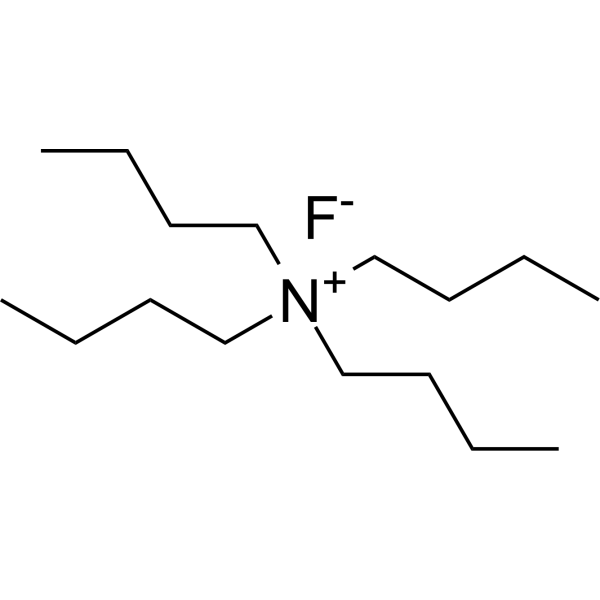
Tetrabutylammonium fluoride (solution),1M in THFBiochemical Assay Reagent -

HY-123798
N,O-Bis(trimethylsilyl)trifluoroacetamide with trimethylchlorosilaneSilanizing Reagent -
HY-W000438
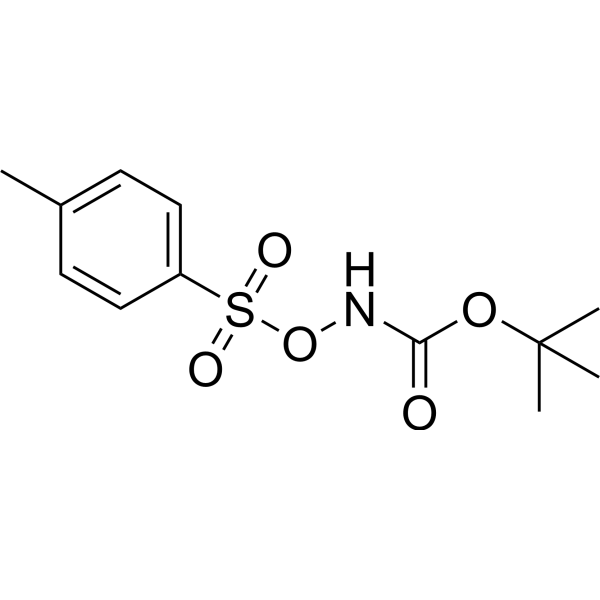
N-Boc-O-tosyl hydroxylamineNitrogen Source -
HY-D0178
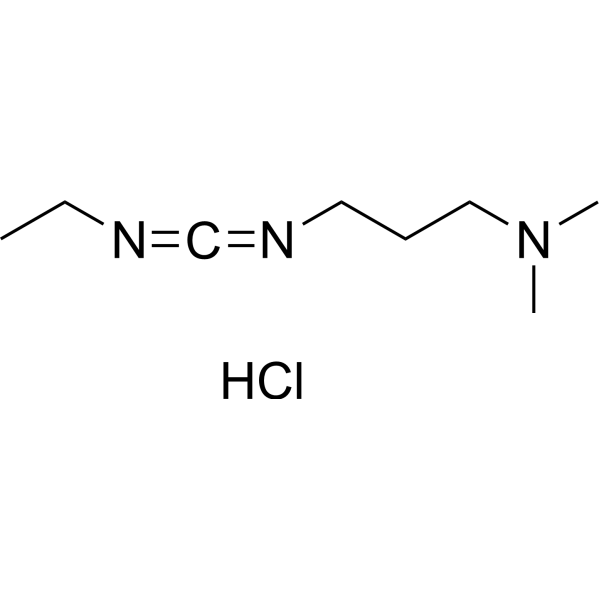
1-Ethyl-(3-dimethylaminopropyl)carbodiimide hydrochlorideCarbodiimide Reagent -
HY-W017758
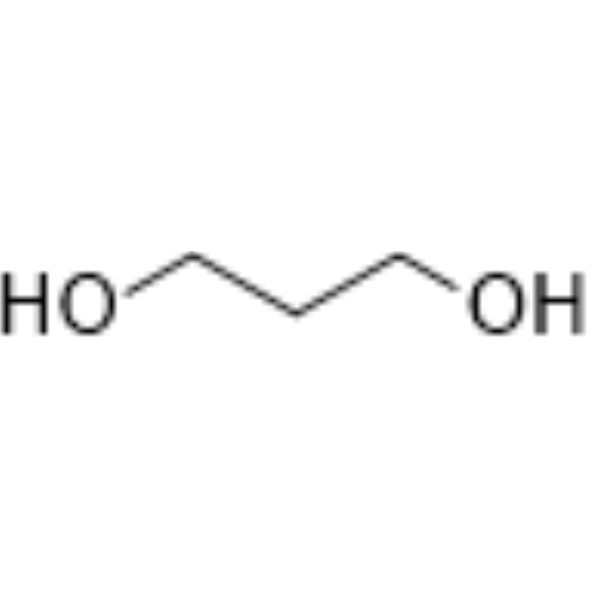
1,3-PropanediolSolvent -

HY-Z0275
HOATPeptide Bond-forming Reagent -

HY-W017758R
1,3-Propanediol (Standard)


Biological Activity
Description
In Vitro
Although electrospun chitosan membranes (ESCMs) possess potential for guided bone regeneration (GBR) due to their biocompatibility, biodegradability, and nanofiber structure (mimicking the natural extracellular matrix ECM), they suffer from the following drawbacks: a) structural instability due to solvent residue, b) excessive surface hydrophilicity, and c) poor cell adhesion. Di-tert-butyl dicarbonate (tBOC) can be combined with TEA to form a "two-step treatment system" to first address the structural stability problem of ESCMs and then optimize their surface properties. The modification process is as follows:
TEA pretreatment: removes TFA salt while preserving the nanofiber structure;
tBOC covalent modification: constructs a hydrophobic protective layer, stabilizing the structure and regulating surface hydrophilicity, thereby enhancing cell-membrane interaction.
Di-tert-butyl dicarbonate-modified electrospun chitosan membranes can increase the adhesion rate of fibroblasts and osteoblasts by 30-50%[1].
MedChemExpress (MCE) has not independently confirmed the accuracy of these methods. They are for reference only. Further protocols information, click here.


Chemical Information
-
CAS No. 24424-99-5
-
Appearance Solid-Liquid Mixture
-
Molecular Weight 218.25
-
Formula C10H18O5
-
Color Colorless to off-white
-
SMILES
O=C(OC(C)(C)C)OC(OC(C)(C)C)=O
-
Shipping
Room temperature in continental US; may vary elsewhere.
-
Storage
4°C, stored under nitrogen
* In solvent : -80°C, 6 months; -20°C, 1 month (stored under nitrogen)


Solvent & Solubility
In Vitro:
DMSO : 200 mg/mL (916.38 mM; Need ultrasonic; Hygroscopic DMSO has a significant impact on the solubility of product, please use newly opened DMSO)
Please refer to the solubility information to select the appropriate solvent. Once prepared, please aliquot and store the solution to prevent product inactivation from repeated freeze-thaw cycles.
Storage method and period of stock solution: -80°C, 6 months; -20°C, 1 month (stored under nitrogen). When stored at -80°C, please use it within 6 months. When stored at -20°C, please use it within 1 month.
Please refer to the solubility information to select the appropriate solvent. Once prepared, please aliquot and store the solution to prevent product inactivation from repeated freeze-thaw cycles.
Storage method and period of stock solution: -80°C, 6 months; -20°C, 1 month (stored under nitrogen). When stored at -80°C, please use it within 6 months. When stored at -20°C, please use it within 1 month.
Concentration (start) × Volume (start) = Concentration (final) × Volume (final)
In Vivo:
Select the appropriate dissolution method based on your experimental animal and administration route.
- For the following dissolution methods, please ensure to first prepare a clear stock solution using an In Vitro approach and then sequentially add co-solvents:
- To ensure reliable experimental results, the clarified stock solution can be appropriately stored based on storage conditions. As for the working solution for In Vivo experiments, it is recommended to prepare freshly and use it on the same day.
- The percentages shown for the solvents indicate their volumetric ratio in the final prepared solution. If precipitation or phase separation occurs during preparation, heat and/or sonication can be used to aid dissolution.
Add each solvent one by one: 10% DMSO 40% PEG300 5% Tween-80 45% Saline
Solubility: ≥ 5 mg/mL (22.91 mM); Clear solution
This protocol yields a clear solution of ≥ 5 mg/mL (saturation unknown).
Taking 1 mL working solution as an example, add 100 μL DMSO stock solution (50.0 mg/mL) to 400 μL PEG300, and mix evenly; then add 50 μL Tween-80 and mix evenly; then add 450 μL Saline to adjust the volume to 1 mL.
Preparation of Saline: Dissolve 0.9 g sodium chloride in ddH₂O and dilute to 100 mL to obtain a clear Saline solution.
Add each solvent one by one: 10% DMSO 90% (20% SBE-β-CD in Saline)
Solubility: ≥ 5 mg/mL (22.91 mM); Clear solution
This protocol yields a clear solution of ≥ 5 mg/mL (saturation unknown).
Taking 1 mL working solution as an example, add 100 μL DMSO stock solution (50.0 mg/mL) to 900 μL 20% SBE-β-CD in Saline, and mix evenly.
Preparation of 20% SBE-β-CD in Saline (4°C, storage for one week): 2 g SBE-β-CD powder is dissolved in 10 mL Saline, completely dissolve until clear.
In Vivo Dissolution Calculator
Please enter the basic information of animal experiments:
-
-
-
-
Recommended: Prepare an additional quantity of animals to account for potential losses during experiments.
Please enter your animal formula composition:
-
%DMSO +
Recommended: Keep the proportion of DMSO in working solution below 2% if your animal is weak.
-
%+
-
+%Tween-80 + +
-
%Saline +
The co-solvents required include: DMSO, . All of co-solvents are available by MedChemExpress (MCE). , Tween 80. All of co-solvents are available by MedChemExpress (MCE).
Working solution concentration: 0.22 mg/mL
Method for preparing stock solution: mg drug dissolved in μL DMSO. Stock solution concentration: mg/mL. * In solvent : -80°C, 6 months; -20°C, 1 month (stored under nitrogen)
1. Take μL DMSO stock solution;
2. Add μL .
μL , mix evenly;
3. Then add μL Tween 80, mix evenly;
4. Then add μL
Please ensure that the stock solution in the first step is dissolved to a clear state, and add co-solvents in sequence. You can use ultrasonic heating (ultrasonic cleaner, recommended frequency 20-40 kHz), vortexing, etc. to assist dissolution.

Protocols
-
Mesenchymal stromal/stem cell osteogenic differentiation
Mesenchymal stromal/stem cells can be induced toward an osteoblast-like lineage in vitro by culture in osteogenic medium containing dexamethasone, ascorbic acid or ascorbate-2-phosphate, and β-glycerophosphate; the differentiation process is commonly evaluated by alkaline phosphatase activity, osteogenic marker expression, collagenous matrix formation, and calcium-rich matrix mineralization. The main readouts are alkaline phosphatase activity as an early osteogenic marker and Alizarin Red S staining as a calcium-deposit readout for mineralized extracellular matrix; Alizarin Red S can be inspected microscopically or extracted and measured colorimetrically at 405 nm.


Purity & Documentation
-
Data Sheet (270 KB)
-
SDS (312 KB)
- English - EN (312 KB)
- Français - FR (312 KB)
- Deutsch - DE (312 KB)
- Norwegian - NO (312 KB)
- Español - ES (312 KB)
- Swedish - SV (312 KB)
- Italian - IT (312 KB)
- Korean - KR (312 KB)
- Portuguese - PT (312 KB)
-
Handling Instructions (2659 KB)
References


Complete Stock Solution Preparation Table
Please refer to the solubility information to select the appropriate solvent. Once prepared, please aliquot and store the solution to prevent product inactivation from repeated freeze-thaw cycles.
Storage method and period of stock solution: -80°C, 6 months; -20°C, 1 month (stored under nitrogen). When stored at -80°C, please use it within 6 months. When stored at -20°C, please use it within 1 month.
| Optional Solvent | Concentration Solvent Mass | 1 mg | 5 mg | 10 mg | 25 mg |
|---|---|---|---|---|---|
| DMSO | 1 mM | 4.5819 mL | 22.9095 mL | 45.8190 mL | 114.5475 mL |
| 5 mM | 0.9164 mL | 4.5819 mL | 9.1638 mL | 22.9095 mL | |
| 10 mM | 0.4582 mL | 2.2910 mL | 4.5819 mL | 11.4548 mL | |
| 15 mM | 0.3055 mL | 1.5273 mL | 3.0546 mL | 7.6365 mL | |
| 20 mM | 0.2291 mL | 1.1455 mL | 2.2910 mL | 5.7274 mL | |
| 25 mM | 0.1833 mL | 0.9164 mL | 1.8328 mL | 4.5819 mL | |
| 30 mM | 0.1527 mL | 0.7637 mL | 1.5273 mL | 3.8183 mL | |
| 40 mM | 0.1145 mL | 0.5727 mL | 1.1455 mL | 2.8637 mL | |
| 50 mM | 0.0916 mL | 0.4582 mL | 0.9164 mL | 2.2910 mL | |
| 60 mM | 0.0764 mL | 0.3818 mL | 0.7637 mL | 1.9091 mL | |
| 80 mM | 0.0573 mL | 0.2864 mL | 0.5727 mL | 1.4318 mL | |
| 100 mM | 0.0458 mL | 0.2291 mL | 0.4582 mL | 1.1455 mL |


Di-tert-butyl dicarbonate Related Classifications
HY-Y1353 Related Classifications
 Powered by Bioz