Search Result
Results for "
Rhodamine
" in MedChemExpress (MCE) Product Catalog:
40
Biochemical Assay Reagents
| Cat. No. |
Product Name |
Target |
Research Areas |
Chemical Structure |
-
- HY-D0816
-
|
RH-123; R-22420
|
Fluorescent Dye
|
Cardiovascular Disease
|
|
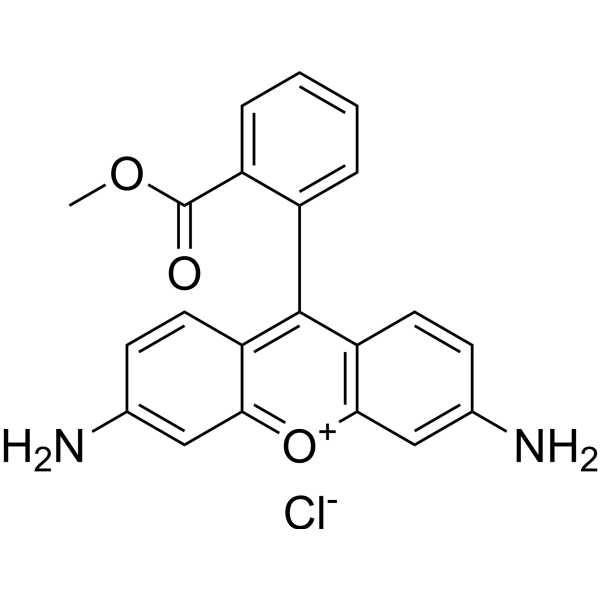
Rhodamine dyes are membrane-permeable cationic fluorescent probes that specifically recognize mitochondrial membrane potentials, thereby attaching to mitochondria and producing bright fluorescence, and at certain concentrations, rhodamine dyes have low toxicity to cells, so they are commonly used to detect mitochondria in animal cells, plant cells, and microorganisms .
|
-
-
- HY-Y0016
-
|
Basic Violet 10; Brilliant Pink B; Rhodamine O; TetraethylRhodamine
|
Environmental Pollutants
Fluorescent Dye
|
Others
|
|
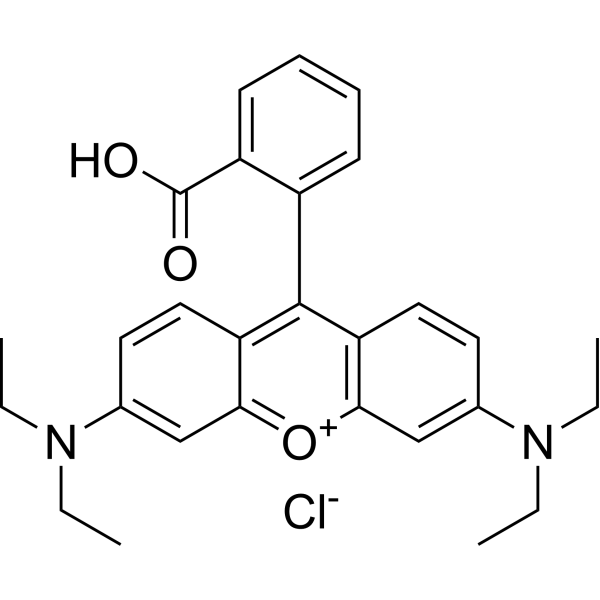
Rhodamine B is a staining fluorescent dye, commonly used for dyeing textiles, paper, soap, leather, and agents.
|
-
-
- HY-D0309
-
|
Basic Red 1
|
Environmental Pollutants
Fluorescent Dye
|
Cancer
|
|
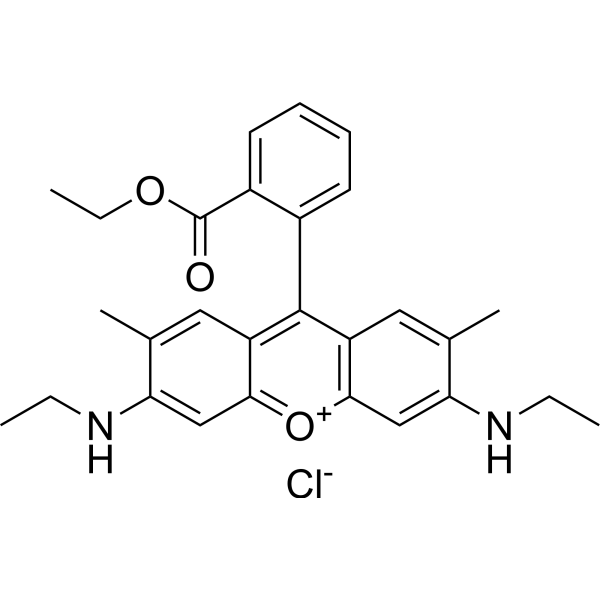
Rhodamine dyes are membrane-permeable cationic fluorescent probes that specifically recognize mitochondrial membrane potentials, thereby attaching to mitochondria and producing bright fluorescence, and at certain concentrations, rhodamine dyes have low toxicity to cells, so they are commonly used to detect mitochondria in animal cells, plant cells, and microorganisms .
|
-
-
- HY-D0817
-
|
Rhodamine 110 chloride; RH110
|
Fluorescent Dye
|
Others
|
|
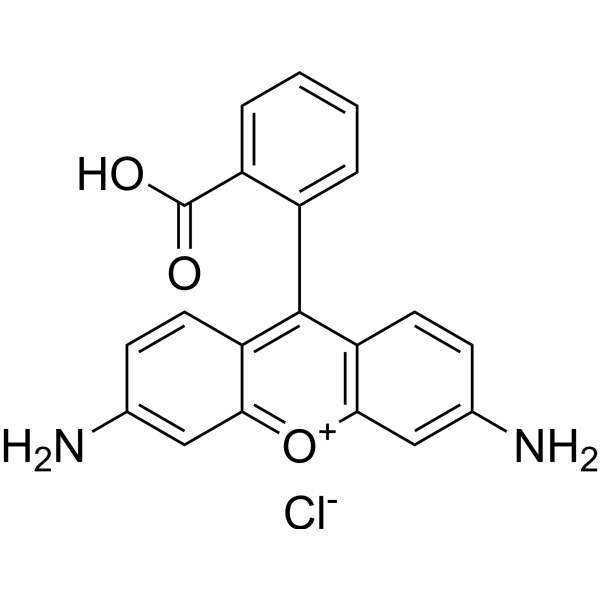
Rhodamine 110 is a sensitive and selective substrate for assaying proteinases in solution or inside living cells. The excitation wavelength is 498 nm and the emission wavelength is 521 nm .
|
-
-
- HY-123645
-
|
|
Fluorescent Dye
|
Others
|
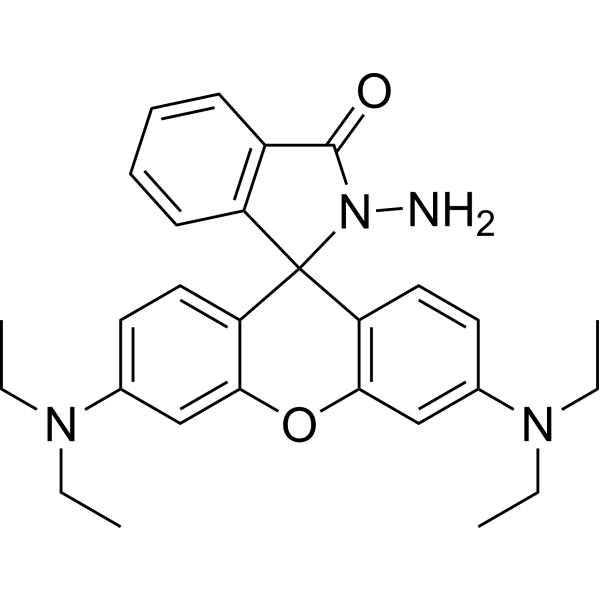
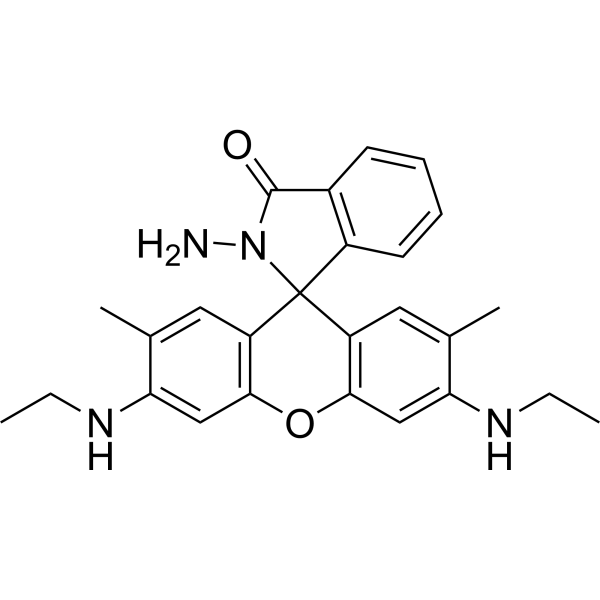
Rhodamine B hydrazide is a fluorescent derivative based on rhodamine B, containing the spirocyclic structure of Rhodamine B (HY-Y0016), which can be used to detect copper ions (Cu 2+), mercury ions, peroxynitrite, hydroxyl radicals and nitric oxide (NO) .
Excitation/emission wavelength:
Conventional detection: 510/578 nm.
Sulfite detection: 554 nm absorption, 574 nm emission (due to the formation of Rhodamine B fluorescent product).
|
-
-
- HY-D1269
-
|
|
Fluorescent Dye
|
Others
|
|
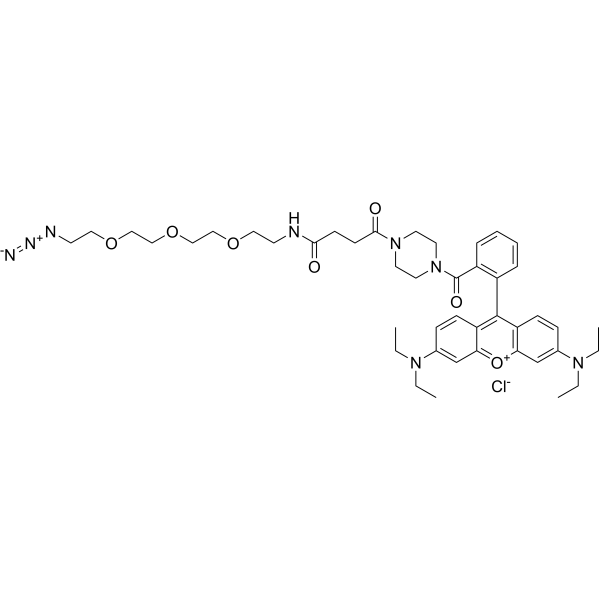
Rhodamine-N3 chloride is an azide-rhodamine fluorescent dye that can be used to label biomolecules containing alkyne groups . Rhodamine-N3 chloride is a click chemistry reagent, it contains an Azide group and can undergo copper-catalyzed azide-alkyne cycloaddition reaction (CuAAc) with molecules containing Alkyne groups. It can also undergo strain-promoted alkyne-azide cycloaddition (SPAAC) reactions with molecules containing DBCO or BCN groups (Ex/Em = 544/576 nm).
|
-
-
- HY-D2367
-
|
N-Hydroxysuccinimidyl Rhodamine B ester
|
Fluorescent Dye
|
Others
|
|
Rhodamine B NHS ester (N-Hydroxysuccinimidyl rhodamine B ester) is an amine-reactive fluorescent probe (λex/λem: 564/589 nm, respectively). Rhodamine B NHS ester could react with Glycine (HY-Y0966) .
|
-

-
- HY-D0304
-
|
Solvent red 49
|
Fluorescent Dye
|
Others
|
|
Rhodamine B base (Solvent red 49) is a fluorescent dye (Ex=543 nM; Em=565 nM) .
|
-

-
- HY-D1044
-
|
Rhodamine 640 chloride
|
Fluorescent Dye
|
Cancer
|
|
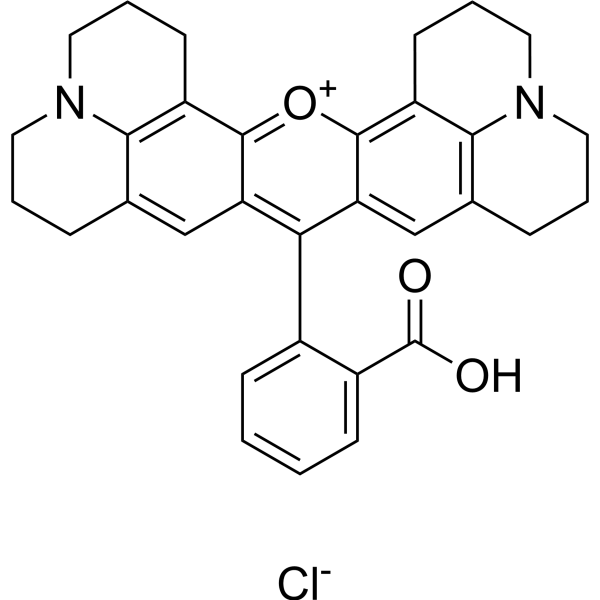
Rhodamine 101 chloride (Rhodamine 640 chloride) is a fluorescent dye with excitation and emission maxima at 565 nM and 595 nM, respectively. Rhodamine 101 chloride binds to intracellular proteins and emits specific fluorescence. Rhodamine 101 chloride can be used in colon cancer research .
|
-
-
- HY-101876
-
|
|
Fluorescent Dye
|
Others
|
|
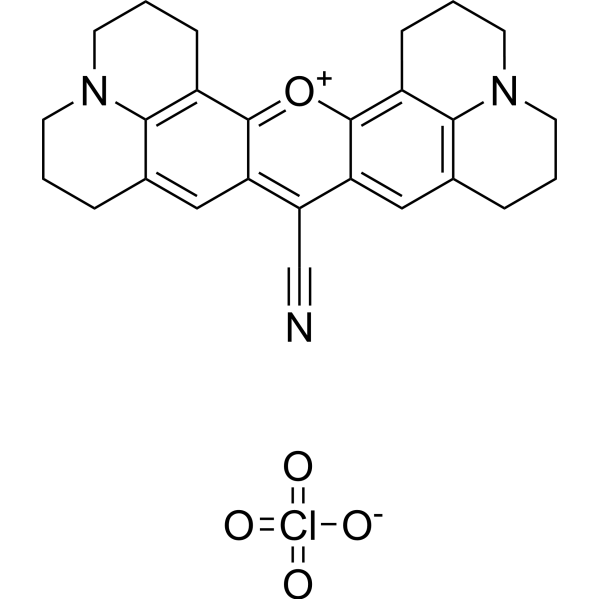
Rhodamine dyes are membrane-permeable cationic fluorescent probes that specifically recognize mitochondrial membrane potentials, thereby attaching to mitochondria and producing bright fluorescence, and at certain concentrations, rhodamine dyes have low toxicity to cells, so they are commonly used to detect mitochondria in animal cells, plant cells, and microorganisms .
|
-
-
- HY-D1747
-
-
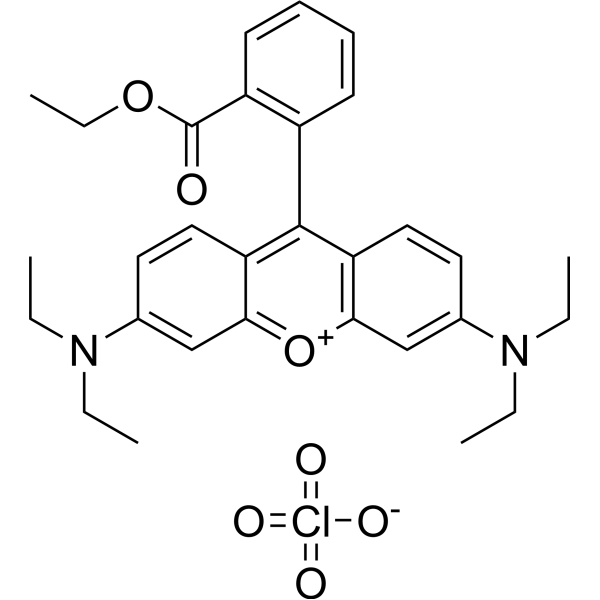
-
- HY-D1599
-
|
R6GH
|
Fluorescent Dye
|
Others
|
|
Rhodamine 6G hydrazide (R6GH) is a fluorescent dye. Rhodamine 6G hydrazide can be used in selective colorimetric and fluorescent sensing .
|
-
-
- HY-DY1077
-
|
|
Fluorescent Dye
|
Others
|
Rhodamine B (solution) is a staining fluorescent dye, commonly used for dyeing textiles, paper, soap, leather, and agents.
Solvent and concentration: DMSO: 10 mM
|
-

-
- HY-138396
-
|
|
PROTAC Linkers
|
Cancer
|
|
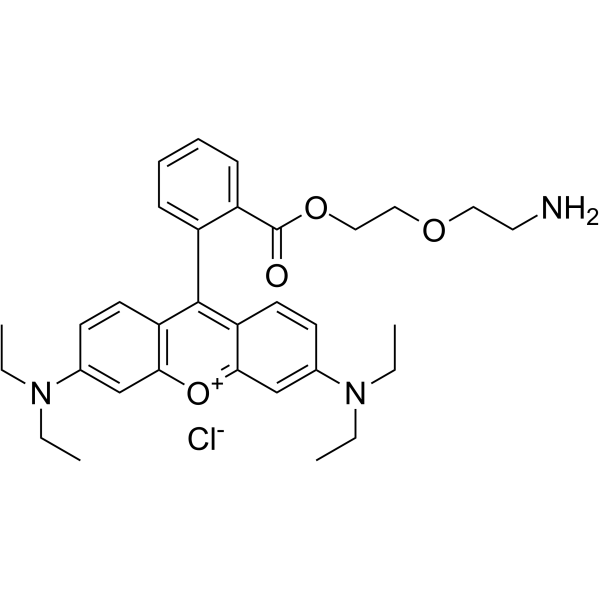
Rhodamine B PEG2-NH2 is a PEG-based PROTAC linker that can be used in the synthesis of PROTACs .
|
-
-
- HY-D1174
-
|
|
Fluorescent Dye
|
Others
|
|
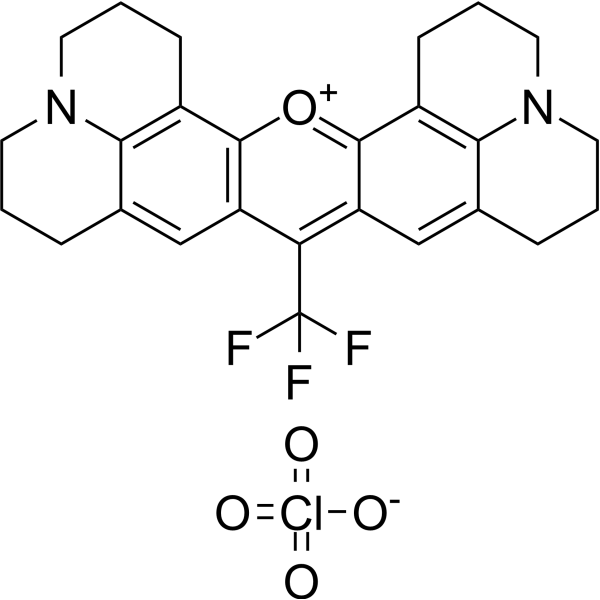
Rhodamine 700, a Lambdachrome laser dye, is one of the few rhodamine dyes with near infrared fluorescence. Rhodamine 700 can be used for mitochondrial staining .
|
-
-
- HY-D2893K
-
|
Rhodamine B-PEG8000-Rhodamine B
|
Fluorescent Dye
|
Others
|
|
RB-PEG8000-RB (Rhodamine B-PEG8000-Rhodamine B) a fluorescent dye composed of two Rhodamine B (HY-Y0016) and PEG. RB-PEG8000-RB can be used for fluorescent labeling and imaging (Ex/Em=546/610 nm) .
|
-

-
- HY-DY1054
-
|
|
Fluorescent Dye
|
Cardiovascular Disease
|
Rhodamine dyes are membrane-permeable cationic fluorescent probes that specifically recognize mitochondrial membrane potentials, thereby attaching to mitochondria and producing bright fluorescence, and at certain concentrations, rhodamine dyes have low toxicity to cells, so they are commonly used to detect mitochondria in animal cells, plant cells, and microorganisms .
Solvent and concentration: DMSO: 5 mM
|
-

-
- HY-158739
-
|
|
Fluorescent Dye
|
Cancer
|
|
Rhodamine dithenoyl hydrazide (probe 1) possesses excellent recognition and selectivity for Fe 3+ ion. Rhodamine dithenoyl hydrazide exhibits Excitation/Emission maxima of 543/550-700 nm, respectively .
|
-

-
- HY-Y0016R
-
|
Basic Violet 10 (Standard); Brilliant Pink B (Standard); Rhodamine O (Standard); TetraethylRhodamine (Standard)
|
Fluorescent Dye
Reference Standards
|
Others
|
|
Rhodamine B (Standard) is the analytical standard of Rhodamine B. This product is intended for research and analytical applications. Rhodamine B is a staining fluorescent dye, commonly used for dyeing textiles, paper, soap, leather, and agents.
|
-

-
- HY-D2892J
-
|
|
Fluorescent Dye
|
Others
|
|
Rhodamine-PEG20000 a fluorescent PEG derivative composed of Rhodamine B (HY-Y0016) and PEG. Rhodamine-PEG20000 can be used for fluorescent labeling and imaging (Ex/Em=546/610 nm) .
|
-

-
- HY-D1240
-
|
|
Biochemical Assay Reagents
|
Others
|
|
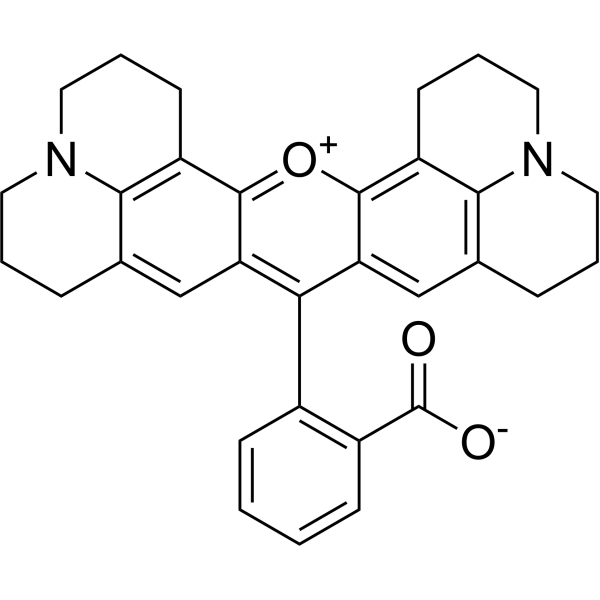
Rhodamine 101 inner salt is a bright fluorescent dye with excitation and emission maxima at 565 and 595 nm, respectively. It can be used in various biological applications such as fluorescence microscopy, flow cytometry, fluorescence correlation spectroscopy, and ELISA.
|
-
-
- HY-D0309R
-
|
Basic Red 1 (Standard)
|
Fluorescent Dye
Reference Standards
|
Cancer
|
|
Rhodamine 6G (Standard) is the analytical standard of Rhodamine 6G. This product is intended for research and analytical applications. Rhodamine dyes are membrane-permeable cationic fluorescent probes that specifically recognize mitochondrial membrane potentials, thereby attaching to mitochondria and producing bright fluorescence, and at certain concentrations, rhodamine dyes have low toxicity to cells, so they are commonly used to detect mitochondria in animal cells, plant cells, and microorganisms .
|
-

-
- HY-D2893M
-
|
Rhodamine B-PEG20000-Rhodamine B
|
Fluorescent Dye
|
Others
|
|
RB-PEG20000-RB (Rhodamine B-PEG20000-Rhodamine B) a fluorescent dye composed of two Rhodamine B (HY-Y0016) and PEG. RB-PEG20000-RB can be used for fluorescent labeling and imaging (Ex/Em=546/610 nm) .
|
-

-
- HY-D2882
-
|
Rhodamine B-PEG400-OH
|
Fluorescent Dye
|
Others
|
|
RB-PEG400-OH (Rhodamine B-PEG400-OH) is a fluorescent dye composed of Rhodamine B (HY-Y0016), PEG and a Hydroxyl group. RB-PEG400-OH can be used for fluorescent labeling and imaging (Ex/Em=546/610 nm) .
|
-

-
- HY-D1440
-
|
|
Fluorescent Dye
|
Others
|
|
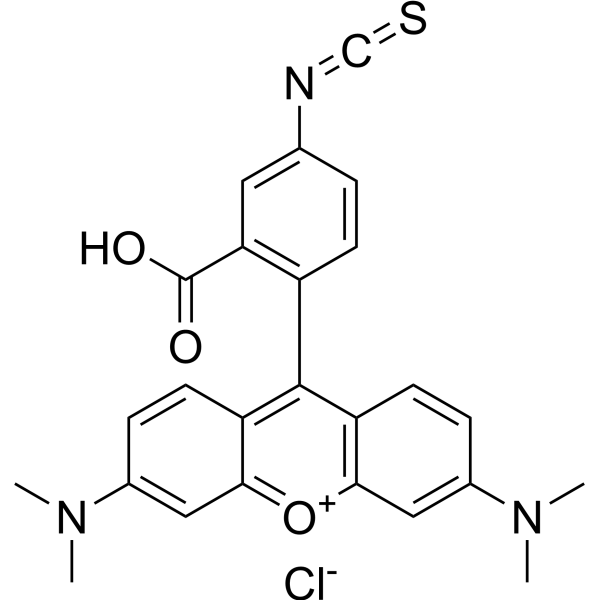
Rhodamine B, tetramethyl-, isothiocyanate (Tetramethylrhodamine B isothiocyante) is a fluorescent dye. Rhodamine B, tetramethyl-, isothiocyanate has a strong two-photon absorption at about 830 nm .
|
-
-
- HY-D1044A
-
|
Rhodamine 640 hydrochloride
|
Fluorescent Dye
|
Others
|
|
Rhodamine 101 chloride (Rhodamine 640 chloride) hydrochloride is a bright fluorescent dye with excitation and emission maxima of 565 and 595 nm, respectively .
|
-

-
- HY-D2893A
-
|
Rhodamine B-PEG400-Rhodamine B
|
Fluorescent Dye
|
Others
|
|
RB-PEG400-RB (Rhodamine B-PEG400-Rhodamine B) a fluorescent dye composed of two Rhodamine B (HY-Y0016) and PEG. RB-PEG400-RB can be used for fluorescent labeling and imaging (Ex/Em=546/610 nm) .
|
-

-
- HY-D2893J
-
|
Rhodamine B-PEG6000-Rhodamine B
|
Fluorescent Dye
|
Others
|
|
RB-PEG6000-RB (Rhodamine B-PEG6000-Rhodamine B) a fluorescent dye composed of two Rhodamine B (HY-Y0016) and PEG. RB-PEG6000-RB can be used for fluorescent labeling and imaging (Ex/Em=546/610 nm) .
|
-

-
- HY-D2893H
-
|
Rhodamine B-PEG5000-Rhodamine B
|
Fluorescent Dye
|
Others
|
|
RB-PEG5000-RB (Rhodamine B-PEG5000-Rhodamine B) a fluorescent dye composed of two Rhodamine B (HY-Y0016) and PEG. RB-PEG5000-RB can be used for fluorescent labeling and imaging (Ex/Em=546/610 nm) .
|
-

-
- HY-D2893L
-
|
Rhodamine B-PEG10000-Rhodamine B
|
Fluorescent Dye
|
Others
|
|
RB-PEG10000-RB (Rhodamine B-PEG10000-Rhodamine B) a fluorescent dye composed of two Rhodamine B (HY-Y0016) and PEG. RB-PEG10000-RB can be used for fluorescent labeling and imaging (Ex/Em=546/610 nm) .
|
-

-
- HY-D2892D
-
|
|
Fluorescent Dye
|
Others
|
|
Rhodamine-PEG2000 a fluorescent PEG derivative composed of Rhodamine B (HY-Y0016) and PEG. Rhodamine-PEG2000 can be used for fluorescent labeling and imaging (Ex/Em=546/610 nm) .
|
-

-
- HY-D2892E
-
|
|
Fluorescent Dye
|
Others
|
|
Rhodamine-PEG5000 a fluorescent PEG derivative composed of Rhodamine B (HY-Y0016) and PEG. Rhodamine-PEG5000 can be used for fluorescent labeling and imaging (Ex/Em=546/610 nm) .
|
-

-
- HY-D2892B
-
|
|
Fluorescent Dye
|
Others
|
|
Rhodamine-PEG750 a fluorescent PEG derivative composed of Rhodamine B (HY-Y0016) and PEG. Rhodamine-PEG750 can be used for fluorescent labeling and imaging (Ex/Em=546/610 nm) .
|
-

-
- HY-D2892C
-
|
|
Fluorescent Dye
|
Others
|
|
Rhodamine-PEG1000 a fluorescent PEG derivative composed of Rhodamine B (HY-Y0016) and PEG. Rhodamine-PEG1000 can be used for fluorescent labeling and imaging (Ex/Em=546/610 nm) .
|
-

-
- HY-W247103
-
|
|
Fluorescent Dye
|
Others
|
|
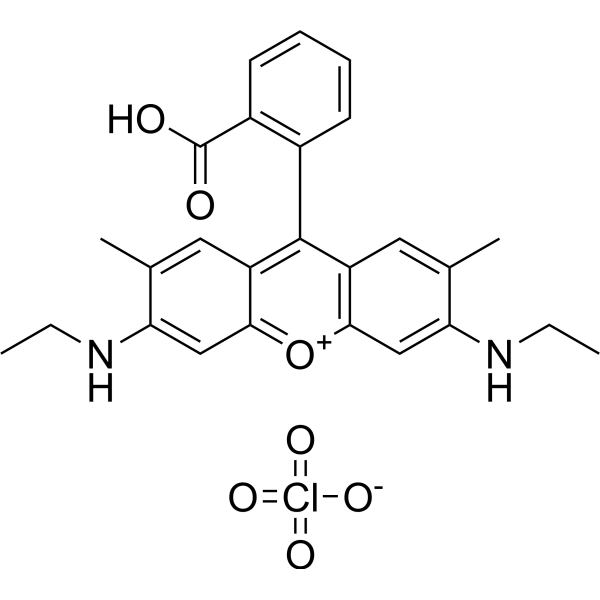
Rhodamine 19 perchlorate is a metal free organic dye for dye sensitized solar cells.
|
-
-
- HY-D1750
-
|
|
Fluorescent Dye
|
Others
|
|
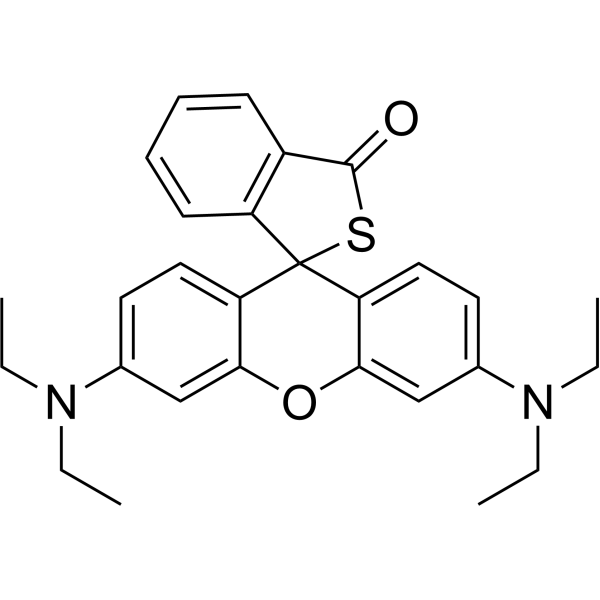
Rhodamine B thiolactone is a high-sensitive Hg 2+ indicator used for measuring Hg 2+ concentration.
|
-
-
- HY-D1748
-
|
|
Fluorescent Dye
|
Others
|
|
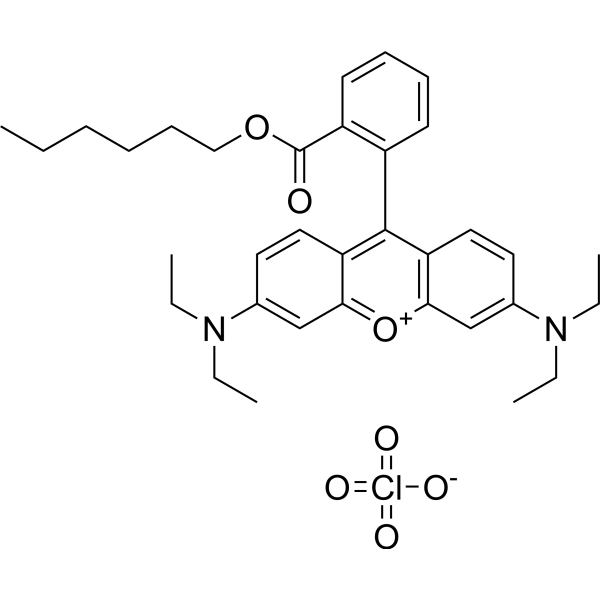
Rhodamine B hexyl ester perchlorate is a cell-permeant, orange-fluorescent dye for mitochondria.
|
-
-
- HY-D2881H
-
|
Rhodamine B-PEG10000-COOH
|
Fluorescent Dye
|
Others
|
|
RB-PEG10000-COOH (Rhodamine B-PEG10000-COOH) is a fluorescent dye composed of Rhodamine B (HY-Y0016), PEG and a COOH. RRB-PEG10000-COOH can be used for fluorescent labeling and imaging (Ex/Em=546/610 nm) .
|
-

-
- HY-D2881A
-
|
Rhodamine B-PEG600-COOH
|
Fluorescent Dye
|
Others
|
|
RB-PEG600-COOH (Rhodamine B-PEG600-COOH) is a fluorescent dye composed of Rhodamine B (HY-Y0016), PEG and a COOH. RRB-PEG600-COOH can be used for fluorescent labeling and imaging (Ex/Em=546/610 nm) .
|
-

-
- HY-D2887H
-
|
Rhodamine B-PEG10000-DSPE
|
Fluorescent Dye
|
Others
|
|
RB-PEG10000-DSPE (Rhodamine B-PEG10000-DSPE) is a PEG phospholipid labeled Rhodamine B (HY-Y0016). RB-PEG10000-DSPE can be used to prepare liposomes or nanoparticles for nutrients delivery such as mRNA or DNA vaccine (Ex/Em=546/610 nm) .
|
-

-
- HY-D2887C
-
|
Rhodamine B-PEG2000-DSPE
|
Fluorescent Dye
|
Others
|
|
RB-PEG2000-DSPE (Rhodamine B-PEG2000-DSPE) is a PEG phospholipid labeled Rhodamine B (HY-Y0016). RB-PEG2000-DSPE can be used to prepare liposomes or nanoparticles for nutrients delivery such as mRNA or DNA vaccine (Ex/Em=546/610 nm) .
|
-

-
- HY-D2887D
-
|
Rhodamine B-PEG3400-DSPE
|
Fluorescent Dye
|
Others
|
|
RB-PEG3400-DSPE (Rhodamine B-PEG3400-DSPE) is a PEG phospholipid labeled Rhodamine B (HY-Y0016). RB-PEG3400-DSPE can be used to prepare liposomes or nanoparticles for nutrients delivery such as mRNA or DNA vaccine (Ex/Em=546/610 nm) .
|
-

-
- HY-D2887A
-
|
Rhodamine B-PEG600-DSPE
|
Fluorescent Dye
|
Others
|
|
RB-PEG600-DSPE (Rhodamine B-PEG600-DSPE) is a PEG phospholipid labeled Rhodamine B (HY-Y0016). RB-PEG600-DSPE can be used to prepare liposomes or nanoparticles for nutrients delivery such as mRNA or DNA vaccine (Ex/Em=546/610 nm) .
|
-

-
- HY-D2883E
-
|
Rhodamine B-PEG5000-SH
|
Fluorescent Dye
|
Others
|
|
RB-PEG5000-SH (Rhodamine B-PEG5000-SH) is a fluorescent dye composed of Rhodamine B (HY-Y0016), PEG and sulfhydryl (SH). SH is highly reactive and can react with a variety of functional groups (such as maleimide) to form stable thioether bonds (Ex/Em=546/610 nm) .
|
-

-
- HY-D2883D
-
|
Rhodamine B-PEG3400-SH
|
Fluorescent Dye
|
Others
|
|
RB-PEG3400-SH (Rhodamine B-PEG3400-SH) is a fluorescent dye composed of Rhodamine B (HY-Y0016), PEG and sulfhydryl (SH). SH is highly reactive and can react with a variety of functional groups (such as maleimide) to form stable thioether bonds (Ex/Em=546/610 nm) .
|
-

-
- HY-D2883
-
|
Rhodamine B-PEG400-SH
|
Fluorescent Dye
|
Others
|
|
RB-PEG400-SH (Rhodamine B-PEG400-SH) is a fluorescent dye composed of Rhodamine B (HY-Y0016), PEG and sulfhydryl (SH). SH is highly reactive and can react with a variety of functional groups (such as maleimide) to form stable thioether bonds (Ex/Em=546/610 nm) .
|
-

-
- HY-D2885H
-
|
Rhodamine B-PEG10000-Mal
|
Fluorescent Dye
|
Others
|
|
RB-PEG10000-Mal (Rhodamine B-PEG10000-Mal) is a fluorescent dye composed of Rhodamine B (HY-Y0016), PEG and Maleimide (HY-W007324) (Mal). RB-PEG10000-Mal can be used for fluorescent labeling and imaging (Ex/Em=546/610 nm) .
|
-

-
- HY-D2885E
-
|
Rhodamine B-PEG5000-Mal
|
Fluorescent Dye
|
Others
|
|
RB-PEG5000-Mal (Rhodamine B-PEG5000-Mal) is a fluorescent dye composed of Rhodamine B (HY-Y0016), PEG and Maleimide (HY-W007324) (Mal). RB-PEG5000-Mal can be used for fluorescent labeling and imaging (Ex/Em=546/610 nm) .
|
-

-
- HY-D2885C
-
|
Rhodamine B-PEG2000-Mal
|
Fluorescent Dye
|
Others
|
|
RB-PEG2000-Mal (Rhodamine B-PEG2000-Mal) is a fluorescent dye composed of Rhodamine B (HY-Y0016), PEG and Maleimide (HY-W007324) (Mal). RB-PEG2000-Mal can be used for fluorescent labeling and imaging (Ex/Em=546/610 nm) .
|
-

-
- HY-D2885D
-
|
Rhodamine B-PEG3400-Mal
|
Fluorescent Dye
|
Others
|
|
RB-PEG3400-Mal (Rhodamine B-PEG3400-Mal) is a fluorescent dye composed of Rhodamine B (HY-Y0016), PEG and Maleimide (HY-W007324) (Mal). RB-PEG3400-Mal can be used for fluorescent labeling and imaging (Ex/Em=546/610 nm) .
|
-

- HY-D3035
-
|
|
Fluorescent Dye
|
Others
|
|
Rhodamine-Alginate is a Rhodamine B (HY-Y0016)-labeled alginate. Rhodamine-Alginate combines the polysaccharide properties of alginate with the fluorescence properties of Rhodamine B, playing an important role in fields such as fluorescent labeling, cell imaging, and drug delivery research (Ex/Em = 546/610 nm) .
|
-

- HY-D2893D
-
|
Rhodamine B-PEG2000-Rhodamine B
|
Fluorescent Dye
|
Others
|
|
RB-PEG2000-RB (Rhodamine B-PEG2000-Rhodamine B) a fluorescent dye composed of two Rhodamine B (HY-Y0016) and PEG. RB-PEG2000-RB can be used for fluorescent labeling and imaging (Ex/Em=546/610 nm) .
|
-

- HY-D2893E
-
|
Rhodamine B-PEG4000-Rhodamine B
|
Fluorescent Dye
|
Others
|
|
RB-PEG4000-RB (Rhodamine B-PEG4000-Rhodamine B) a fluorescent dye composed of two Rhodamine B (HY-Y0016) and PEG. RB-PEG4000-RB can be used for fluorescent labeling and imaging (Ex/Em=546/610 nm) .
|
-

- HY-D2893
-
|
Rhodamine B-PEG600-Rhodamine B
|
Fluorescent Dye
|
Others
|
|
RB-PEG600-RB (Rhodamine B-PEG600-Rhodamine B) a fluorescent dye composed of two Rhodamine B (HY-Y0016) and PEG. RB-PEG600-RB can be used for fluorescent labeling and imaging (Ex/Em=546/610 nm) .
|
-

- HY-D2893B
-
|
Rhodamine B-PEG1000-Rhodamine B
|
Fluorescent Dye
|
Others
|
|
RB-PEG1000-RB (Rhodamine B-PEG1000-Rhodamine B) a fluorescent dye composed of two Rhodamine B (HY-Y0016) and PEG. RB-PEG1000-RB can be used for fluorescent labeling and imaging (Ex/Em=546/610 nm) .
|
-

- HY-D2893C
-
|
Rhodamine B-PEG3400-Rhodamine B
|
Fluorescent Dye
|
Others
|
|
RB-PEG3400-RB (Rhodamine B-PEG3400-Rhodamine B) a fluorescent dye composed of two Rhodamine B (HY-Y0016) and PEG. RB-PEG3400-RB can be used for fluorescent labeling and imaging (Ex/Em=546/610 nm) .
|
-

- HY-203233
-
|
|
Fluorescent Dye
|
Others
|
|
Rhodamine-DHPE is a fluorescently labeled phosphatidylethanolamine lipid that labels phospholipid bilayers. Rhodamine-DHPE serves as a fluorescence quenching substrate and membrane stain. The fluorescence lifetime of Rhodamine-DHPE decreases significantly in the presence of Cu 2+-PS complexes. Rhodamine-DHPE effectively stains the membranes of human red blood cells and mouse fibroblasts, and supports lifetime-resolved imaging via pump-probe fluorescence microscopy .
|
-

- HY-D3038
-
|
|
Fluorescent Dye
|
Others
|
|
Rhodamine B-Heparin is a Rhodamine B (HY-Y0016)-labeled heparin. Rhodamine B-Heparin is widely used in fluorescent labeling, molecular tracking, and visualization studies (Ex/Em = 546/610 nm) .
|
-

- HY-D2892H
-
|
|
Fluorescent Dye
|
Others
|
|
Rhodamine-PEG10000 a fluorescent PEG derivative composed of Rhodamine B (HY-Y0016) and PEG. Rhodamine-PEG10000 can be used for fluorescent labeling and imaging (Ex/Em=546/610 nm) .
|
-

- HY-D2892A
-
|
|
Fluorescent Dye
|
Others
|
|
Rhodamine-PEG550 a fluorescent PEG derivative composed of Rhodamine B (HY-Y0016) and PEG. Rhodamine-PEG550 can be used for fluorescent labeling and imaging (Ex/Em=546/610 nm) .
|
-

- HY-D2892
-
|
|
Fluorescent Dye
|
Others
|
|
Rhodamine-PEG350 a fluorescent PEG derivative composed of Rhodamine B (HY-Y0016) and PEG. Rhodamine-PEG350 can be used for fluorescent labeling and imaging (Ex/Em=546/610 nm) .
|
-

- HY-D3315
-
|
|
Fluorescent Dye
|
Others
|
|
Rhodamine B carbohydrazide is a fluorescent derivative based on Rhodamine B (HY-Y0016) that contains the spirocyclic structure of Rhodamine B; it can be used for the detection of copper ions (Cu 2+), mercury ions, peroxynitrite, hydroxyl radicals, and nitric oxide (NO).
|
-

- HY-D3048
-
|
|
Fluorescent Dye
|
Others
|
|
Rhodamine B-Chitosan (MW 3000) is a Rhodamine B (HY-Y0016)-labeled chitosan with a molecular weight of 3000. Rhodamine B-Chitosan (MW 3000) combines the polysaccharide properties of chitosan with the fluorescence properties of Rhodamine B, playing an important role in fields such as fluorescent labeling, cell imaging, and drug delivery research (Ex/Em = 546/610 nm) .
|
-

- HY-D3048D
-
|
|
Fluorescent Dye
|
Others
|
|
Rhodamine B-Chitosan (MW 40000) is a Rhodamine B (HY-Y0016)-labeled chitosan with a molecular weight of 40,000. Rhodamine B-Chitosan (MW 40000) combines the polysaccharide properties of chitosan with the fluorescence properties of Rhodamine B, playing an important role in fields such as fluorescent labeling, cell imaging, and drug delivery research (Ex/Em = 546/610 nm) .
|
-

- HY-D3048A
-
|
|
Fluorescent Dye
|
Others
|
|
Rhodamine B-Chitosan (MW 5000) is a Rhodamine B (HY-Y0016)-labeled chitosan with a molecular weight of 5,000. Rhodamine B-Chitosan (MW 5000) combines the polysaccharide properties of chitosan with the fluorescence properties of Rhodamine B, playing an important role in fields such as fluorescent labeling, cell imaging, and drug delivery research (Ex/Em = 546/610 nm) .
|
-

- HY-D3048E
-
|
|
Fluorescent Dye
|
Others
|
|
Rhodamine B-Chitosan (MW 100000) is a Rhodamine B (HY-Y0016)-labeled chitosan with a molecular weight of 100,000. Rhodamine B-Chitosan (MW 100000) combines the polysaccharide properties of chitosan with the fluorescence properties of Rhodamine B, playing an important role in fields such as fluorescent labeling, cell imaging, and drug delivery research (Ex/Em = 546/610 nm) .
|
-

- HY-D3048B
-
|
|
Fluorescent Dye
|
Others
|
|
Rhodamine B-Chitosan (MW 10000) is a Rhodamine B (HY-Y0016)-labeled chitosan with a molecular weight of 10,000. Rhodamine B-Chitosan (MW 10000) combines the polysaccharide properties of chitosan with the fluorescence properties of Rhodamine B, playing an important role in fields such as fluorescent labeling, cell imaging, and drug delivery research (Ex/Em = 546/610 nm) .
|
-

- HY-D3048I
-
|
|
Fluorescent Dye
|
Others
|
|
Rhodamine B-Chitosan (MW 10000) is a Rhodamine B (HY-Y0016)-labeled chitosan with a molecular weight of 10,000. Rhodamine B-Chitosan (MW 10000) combines the polysaccharide properties of chitosan with the fluorescence properties of Rhodamine B, playing an important role in fields such as fluorescent labeling, cell imaging, and drug delivery research (Ex/Em = 546/610 nm) .
|
-

- HY-D3048H
-
|
|
Fluorescent Dye
|
Others
|
|
Rhodamine B-Chitosan (MW 200000) is a Rhodamine B (HY-Y0016)-labeled chitosan with a molecular weight of 200,000. Rhodamine B-Chitosan (MW 200000) combines the polysaccharide properties of chitosan with the fluorescence properties of Rhodamine B, playing an important role in fields such as fluorescent labeling, cell imaging, and drug delivery research (Ex/Em = 546/610 nm) .
|
-

- HY-D3048C
-
|
|
Fluorescent Dye
|
Others
|
|
Rhodamine B-Chitosan (MW 20000) is a Rhodamine B (HY-Y0016)-labeled chitosan with a molecular weight of 20,000. Rhodamine B-Chitosan (MW 20000) combines the polysaccharide properties of chitosan with the fluorescence properties of Rhodamine B, playing an important role in fields such as fluorescent labeling, cell imaging, and drug delivery research (Ex/Em = 546/610 nm) .
|
-

- HY-D3047A
-
|
|
Fluorescent Dye
|
Others
|
|
Rhodamine B-Dextran (MW 5000) is a Rhodamine B (HY-Y0016)-labeled dextran with a molecular weight of 5000. Rhodamine B-Chitosan (MW 5000) plays an important role in fluorescent labeling, cell imaging, vascular imaging, and drug delivery research (Ex/Em = 546/610 nm) .
|
-

- HY-D3047
-
|
|
Fluorescent Dye
|
Others
|
|
Rhodamine B-Dextran (MW 3000) is a Rhodamine B (HY-Y0016)-labeled dextran with a molecular weight of 3000. Rhodamine B-Chitosan (MW 3000) plays an important role in fluorescent labeling, cell imaging, vascular imaging, and drug delivery research (Ex/Em = 546/610 nm) .
|
-

- HY-D3047I
-
|
|
Fluorescent Dye
|
Others
|
|
Rhodamine B-Dextran (MW 500000) is a Rhodamine B (HY-Y0016)-labeled dextran with a molecular weight of 500,000. Rhodamine B-Chitosan (MW 500000) plays an important role in fluorescent labeling, cell imaging, vascular imaging, and drug delivery research (Ex/Em = 546/610 nm) .
|
-

- HY-D3047H
-
|
|
Fluorescent Dye
|
Others
|
|
Rhodamine B-Dextran (MW 200000) is a Rhodamine B (HY-Y0016)-labeled dextran with a molecular weight of 200,000. Rhodamine B-Chitosan (MW 200000) plays an important role in fluorescent labeling, cell imaging, vascular imaging, and drug delivery research (Ex/Em = 546/610 nm) .
|
-

- HY-D3047C
-
|
|
Fluorescent Dye
|
Others
|
|
Rhodamine B-Dextran (MW 20000) is a Rhodamine B (HY-Y0016)-labeled dextran with a molecular weight of 20,000. Rhodamine B-Chitosan (MW 20000) plays an important role in fluorescent labeling, cell imaging, vascular imaging, and drug delivery research (Ex/Em = 546/610 nm) .
|
-

- HY-D3047D
-
|
|
Fluorescent Dye
|
Others
|
|
Rhodamine B-Dextran (MW 40000) is a Rhodamine B (HY-Y0016)-labeled dextran with a molecular weight of 40,000. Rhodamine B-Chitosan (MW 40000) plays an important role in fluorescent labeling, cell imaging, vascular imaging, and drug delivery research (Ex/Em = 546/610 nm) .
|
-

- HY-D3047E
-
|
|
Fluorescent Dye
|
Others
|
|
Rhodamine B-Dextran (MW 100000) is a Rhodamine B (HY-Y0016)-labeled dextran with a molecular weight of 100,000. Rhodamine B-Chitosan (MW 100000) plays an important role in fluorescent labeling, cell imaging, vascular imaging, and drug delivery research (Ex/Em = 546/610 nm) .
|
-

- HY-D3047B
-
|
|
Fluorescent Dye
|
Others
|
|
Rhodamine B-Dextran (MW 10000) is a Rhodamine B (HY-Y0016)-labeled dextran with a molecular weight of 10,000. Rhodamine B-Chitosan (MW 10000) plays an important role in fluorescent labeling, cell imaging, vascular imaging, and drug delivery research (Ex/Em = 546/610 nm) .
|
-

- HY-D2881
-
|
Rhodamine B-PEG400-COOH
|
Fluorescent Dye
|
Others
|
|
RB-PEG400-COOH (Rhodamine B-PEG400-COOH) is a fluorescent dye composed of Rhodamine B (HY-Y0016), PEG and a COOH. RRB-PEG400-COOH can be used for fluorescent labeling and imaging (Ex/Em=546/610 nm) .
|
-

- HY-D2881C
-
|
Rhodamine B-PEG2000-COOH
|
Fluorescent Dye
|
Others
|
|
RB-PEG2000-COOH (Rhodamine B-PEG2000-COOH) is a fluorescent dye composed of Rhodamine B (HY-Y0016), PEG and a COOH. RRB-PEG2000-COOH can be used for fluorescent labeling and imaging (Ex/Em=546/610 nm) .
|
-

- HY-D2881D
-
|
Rhodamine B-PEG3400-COOH
|
Fluorescent Dye
|
Others
|
|
RB-PEG3400-COOH (Rhodamine B-PEG3400-COOH) is a fluorescent dye composed of Rhodamine B (HY-Y0016), PEG and a COOH. RRB-PEG3400-COOH can be used for fluorescent labeling and imaging (Ex/Em=546/610 nm) .
|
-

- HY-D2881E
-
|
Rhodamine B-PEG5000-COOH
|
Fluorescent Dye
|
Others
|
|
RB-PEG5000-COOH (Rhodamine B-PEG5000-COOH) is a fluorescent dye composed of Rhodamine B (HY-Y0016), PEG and a COOH. RRB-PEG5000-COOH can be used for fluorescent labeling and imaging (Ex/Em=546/610 nm) .
|
-

- HY-D2882B
-
|
Rhodamine B-PEG1000-OH
|
Fluorescent Dye
|
Others
|
|
RB-PEG1000-OH (Rhodamine B-PEG1000-OH) is a fluorescent dye composed of Rhodamine B (HY-Y0016), PEG and a Hydroxyl group. RB-PEG1000-OH can be used for fluorescent labeling and imaging (Ex/Em=546/610 nm) .
|
-

- HY-D2882E
-
|
Rhodamine B-PEG5000-OH
|
Fluorescent Dye
|
Others
|
|
RB-PEG5000-OH (Rhodamine B-PEG5000-OH) is a fluorescent dye composed of Rhodamine B (HY-Y0016), PEG and a Hydroxyl group. RB-PEG5000-OH can be used for fluorescent labeling and imaging (Ex/Em=546/610 nm) .
|
-

- HY-D2882D
-
|
Rhodamine B-PEG3400-OH
|
Fluorescent Dye
|
Others
|
|
RB-PEG3400-OH (Rhodamine B-PEG3400-OH) is a fluorescent dye composed of Rhodamine B (HY-Y0016), PEG and a Hydroxyl group. RB-PEG3400-OH can be used for fluorescent labeling and imaging (Ex/Em=546/610 nm) .
|
-

- HY-D2882H
-
|
Rhodamine B-PEG10000-OH
|
Fluorescent Dye
|
Others
|
|
RB-PEG10000-OH (Rhodamine B-PEG10000-OH) is a fluorescent dye composed of Rhodamine B (HY-Y0016), PEG and a Hydroxyl group. RB-PEG10000-OH can be used for fluorescent labeling and imaging (Ex/Em=546/610 nm) .
|
-

- HY-D2882C
-
|
Rhodamine B-PEG2000-OH
|
Fluorescent Dye
|
Others
|
|
RB-PEG2000-OH (Rhodamine B-PEG2000-OH) is a fluorescent dye composed of Rhodamine B (HY-Y0016), PEG and a Hydroxyl group. RB-PEG2000-OH can be used for fluorescent labeling and imaging (Ex/Em=546/610 nm) .
|
-

- HY-D2882A
-
|
Rhodamine B-PEG600-OH
|
Fluorescent Dye
|
Others
|
|
RB-PEG600-OH (Rhodamine B-PEG600-OH) is a fluorescent dye composed of Rhodamine B (HY-Y0016), PEG and a Hydroxyl group. RB-PEG600-OH can be used for fluorescent labeling and imaging (Ex/Em=546/610 nm) .
|
-

- HY-D2887
-
|
Rhodamine B-PEG400-DSPE
|
Fluorescent Dye
|
Others
|
|
RB-PEG400-DSPE (Rhodamine B-PEG400-DSPE) is a PEG phospholipid labeled Rhodamine B (HY-Y0016). RB-PEG400-DSPE can be used to prepare liposomes or nanoparticles for nutrients delivery such as mRNA or DNA vaccine (Ex/Em=546/610 nm) .
|
-

- HY-D2883A
-
|
Rhodamine B-PEG600-SH
|
Fluorescent Dye
|
Others
|
|
RB-PEG600-SH (Rhodamine B-PEG600-SH) is a fluorescent dye composed of Rhodamine B (HY-Y0016), PEG and sulfhydryl (SH). SH is highly reactive and can react with a variety of functional groups (such as maleimide) to form stable thioether bonds (Ex/Em=546/610 nm) .
|
-

- HY-D2887E
-
|
Rhodamine B-PEG5000-DSPE
|
Fluorescent Dye
|
Others
|
|
RB-PEG5000-DSPE (Rhodamine B-PEG5000-DSPE) is a PEG phospholipid labeled Rhodamine B (HY-Y0016). RB-PEG5000-DSPE can be used to prepare liposomes or nanoparticles for nutrients delivery such as mRNA or DNA vaccine (Ex/Em=546/610 nm) .
|
-

- HY-D2883B
-
|
Rhodamine B-PEG1000-SH
|
Fluorescent Dye
|
Others
|
|
RB-PEG1000-SH (Rhodamine B-PEG1000-SH) is a fluorescent dye composed of Rhodamine B (HY-Y0016), PEG and sulfhydryl (SH). SH is highly reactive and can react with a variety of functional groups (such as maleimide) to form stable thioether bonds (Ex/Em=546/610 nm) .
|
-

- HY-D2883C
-
|
Rhodamine B-PEG2000-SH
|
Fluorescent Dye
|
Others
|
|
RB-PEG2000-SH (Rhodamine B-PEG2000-SH) is a fluorescent dye composed of Rhodamine B (HY-Y0016), PEG and sulfhydryl (SH). SH is highly reactive and can react with a variety of functional groups (such as maleimide) to form stable thioether bonds (Ex/Em=546/610 nm) .
|
-

- HY-D2883H
-
|
Rhodamine B-PEG10000-SH
|
Fluorescent Dye
|
Others
|
|
RB-PEG10000-SH (Rhodamine B-PEG10000-SH) is a fluorescent dye composed of Rhodamine B (HY-Y0016), PEG and sulfhydryl (SH). SH is highly reactive and can react with a variety of functional groups (such as maleimide) to form stable thioether bonds (Ex/Em=546/610 nm) .
|
-

- HY-D2881B
-
|
Rhodamine B-PEG-COOH (MW 1000)
|
Fluorescent Dye
|
Others
|
|
RB-PEG-COOH (MW 1000) (Rhodamine B-PEG-COOH (MW 1000)) is a fluorescent dye composed of Rhodamine B (HY-Y0016), PEG and a COOH. RRB-PEG-COOH (MW 1000) can be used for fluorescent labeling and imaging (Ex/Em = 546/610 nm) .
|
-

- HY-D2885
-
|
Rhodamine B-PEG400-Mal
|
Fluorescent Dye
|
Others
|
|
RB-PEG400-Mal (Rhodamine B-PEG400-Mal) is a fluorescent dye composed of Rhodamine B (HY-Y0016), PEG and Maleimide (HY-W007324) (Mal). RB-PEG400-Mal can be used for fluorescent labeling and imaging (Ex/Em=546/610 nm) .
|
-

- HY-D2885A
-
|
Rhodamine B-PEG600-Mal
|
Fluorescent Dye
|
Others
|
|
RB-PEG600-Mal (Rhodamine B-PEG600-Mal) is a fluorescent dye composed of Rhodamine B (HY-Y0016), PEG and Maleimide (HY-W007324) (Mal). RB-PEG600-Mal can be used for fluorescent labeling and imaging (Ex/Em=546/610 nm) .
|
-

- HY-D2885B
-
|
Rhodamine B-PEG1000-Mal
|
Fluorescent Dye
|
Others
|
|
RB-PEG1000-Mal (Rhodamine B-PEG1000-Mal) is a fluorescent dye composed of Rhodamine B (HY-Y0016), PEG and Maleimide (HY-W007324) (Mal). RB-PEG1000-Mal can be used for fluorescent labeling and imaging (Ex/Em=546/610 nm) .
|
-

- HY-D2884D
-
|
Rhodamine B-PEG3400-NHS
|
Fluorescent Dye
|
Others
|
|
RB-PEG3400-NHS (Rhodamine B-PEG3400-NHS) is a fluorescent dye composed of Rhodamine B (HY-Y0016), PEG and a hydroxysuccinimide (NHS) group. The NHS group can react with amine-containing groups. RB-PEG3400-NHS can be used for fluorescent labeling and imaging (Ex/Em=546/610 nm) .
|
-

- HY-D2888C
-
|
Rhodamine B-PEG2000-FA
|
Fluorescent Dye
|
Others
|
|
RB-PEG2000-FA (Rhodamine B-PEG2000-FA) is a fluorescent dye composed of Rhodamine B (HY-Y0016), PEG and Folic acid (FA) (HY-16637). RB-PEG2000-FA can be used for cell imaging, folate receptor targeting and detection (Ex/Em=546/610 nm) .
|
-

- HY-D2888E
-
|
Rhodamine B-PEG5000-FA
|
Fluorescent Dye
|
Others
|
|
RB-PEG5000-FA (Rhodamine B-PEG5000-FA) is a fluorescent dye composed of Rhodamine B (HY-Y0016), PEG and Folic acid (FA) (HY-16637). RB-PEG5000-FA can be used for cell imaging, folate receptor targeting and detection (Ex/Em=546/610 nm) .
|
-

- HY-D2884A
-
|
Rhodamine B-PEG600-NHS
|
Fluorescent Dye
|
Others
|
|
RB-PEG600-NHS (Rhodamine B-PEG600-NHS) is a fluorescent dye composed of Rhodamine B (HY-Y0016), PEG and a hydroxysuccinimide (NHS) group. The NHS group can react with amine-containing groups. RB-PEG600-NHS can be used for fluorescent labeling and imaging (Ex/Em=546/610 nm) .
|
-

- HY-D2888A
-
|
Rhodamine B-PEG600-FA
|
Fluorescent Dye
|
Others
|
|
RB-PEG600-FA (Rhodamine B-PEG600-FA) is a fluorescent dye composed of Rhodamine B (HY-Y0016), PEG and Folic acid (FA) (HY-16637). RB-PEG600-FA can be used for cell imaging, folate receptor targeting and detection (Ex/Em=546/610 nm) .
|
-

- HY-D2888B
-
|
Rhodamine B-PEG1000-FA
|
Fluorescent Dye
|
Others
|
|
RB-PEG1000-FA (Rhodamine B-PEG1000-FA) is a fluorescent dye composed of Rhodamine B (HY-Y0016), PEG and Folic acid (FA) (HY-16637). RB-PEG1000-FA can be used for cell imaging, folate receptor targeting and detection (Ex/Em=546/610 nm) .
|
-

- HY-D2888
-
|
Rhodamine B-PEG400-FA
|
Fluorescent Dye
|
Others
|
|
RB-PEG400-FA (Rhodamine B-PEG400-FA) is a fluorescent dye composed of Rhodamine B (HY-Y0016), PEG and Folic acid (FA) (HY-16637). RB-PEG400-FA can be used for cell imaging, folate receptor targeting and detection (Ex/Em=546/610 nm) .
|
-

- HY-D2884B
-
|
Rhodamine B-PEG1000-NHS
|
Fluorescent Dye
|
Others
|
|
RB-PEG1000-NHS (Rhodamine B-PEG1000-NHS) is a fluorescent dye composed of Rhodamine B (HY-Y0016), PEG and a hydroxysuccinimide (NHS) group. The NHS group can react with amine-containing groups. RB-PEG1000-NHS can be used for fluorescent labeling and imaging (Ex/Em=546/610 nm) .
|
-

- HY-D2884E
-
|
Rhodamine B-PEG5000-NHS
|
Fluorescent Dye
|
Others
|
|
RB-PEG5000-NHS (Rhodamine B-PEG5000-NHS) is a fluorescent dye composed of Rhodamine B (HY-Y0016), PEG and a hydroxysuccinimide (NHS) group. The NHS group can react with amine-containing groups. RB-PEG5000-NHS can be used for fluorescent labeling and imaging (Ex/Em=546/610 nm) .
|
-

- HY-D2884H
-
|
Rhodamine B-PEG10000-NHS
|
Fluorescent Dye
|
Others
|
|
RB-PEG10000-NHS (Rhodamine B-PEG10000-NHS) is a fluorescent dye composed of Rhodamine B (HY-Y0016), PEG and a hydroxysuccinimide (NHS) group. The NHS group can react with amine-containing groups. RB-PEG10000-NHS can be used for fluorescent labeling and imaging (Ex/Em=546/610 nm) .
|
-

- HY-D2888H
-
|
Rhodamine B-PEG10000-FA
|
Fluorescent Dye
|
Others
|
|
RB-PEG10000-FA (Rhodamine B-PEG10000-FA) is a fluorescent dye composed of Rhodamine B (HY-Y0016), PEG and Folic acid (FA) (HY-16637). RB-PEG10000-FA can be used for cell imaging, folate receptor targeting and detection (Ex/Em=546/610 nm) .
|
-

- HY-D2888D
-
|
Rhodamine B-PEG3400-FA
|
Fluorescent Dye
|
Others
|
|
RB-PEG3400-FA (Rhodamine B-PEG3400-FA) is a fluorescent dye composed of Rhodamine B (HY-Y0016), PEG and Folic acid (FA) (HY-16637). RB-PEG3400-FA can be used for cell imaging, folate receptor targeting and detection (Ex/Em=546/610 nm) .
|
-

- HY-D2884C
-
|
Rhodamine B-PEG2000-NHS
|
Fluorescent Dye
|
Others
|
|
RB-PEG2000-NHS (Rhodamine B-PEG2000-NHS) is a fluorescent dye composed of Rhodamine B (HY-Y0016), PEG and a hydroxysuccinimide (NHS) group. The NHS group can react with amine-containing groups. RB-PEG2000-NHS can be used for fluorescent labeling and imaging (Ex/Em=546/610 nm) .
|
-

- HY-D2884
-
|
Rhodamine B-PEG400-NHS
|
Fluorescent Dye
|
Others
|
|
RB-PEG400-NHS (Rhodamine B-PEG400-NHS) is a fluorescent dye composed of Rhodamine B (HY-Y0016), PEG and a hydroxysuccinimide (NHS) group. The NHS group can react with amine-containing groups. RB-PEG400-NHS can be used for fluorescent labeling and imaging (Ex/Em=546/610 nm) .
|
-

- HY-D2887B
-
|
Rhodamine B-PEG-DSPE (MW 1000)
|
Fluorescent Dye
|
Others
|
|
RB-PEG-DSPE (MW 1000) (Rhodamine B-PEG-DSPE (MW 1000)) is a PEG phospholipid labeled Rhodamine B (HY-Y0016). RB-PEG-DSPE (MW 1000) can be used to prepare liposomes or nanoparticles for nutrients delivery such as mRNA or DNA vaccine (Ex/Em = 546/610 nm) .
|
-

- HY-D2889D
-
|
Rhodamine B-PEG3400-Biotin
|
Fluorescent Dye
|
Others
|
|
RB-PEG3400-Biotin (Rhodamine B-PEG3400-Biotin) is a fluorescent dye composed of Rhodamine B (HY-Y0016), PEG and a Biotin. Biotin can bind with high affinity to streptavidin or avidin. RB-PEG3400-Biotin plays an important role in the specific capture and detection of biomolecules (Ex/Em=546/610 nm) .
|
-

- HY-D2889B
-
|
Rhodamine B-PEG1000-Biotin
|
Fluorescent Dye
|
Others
|
|
RB-PEG1000-Biotin (Rhodamine B-PEG1000-Biotin) is a fluorescent dye composed of Rhodamine B (HY-Y0016), PEG and a Biotin. Biotin can bind with high affinity to streptavidin or avidin. RB-PEG1000-Biotin plays an important role in the specific capture and detection of biomolecules (Ex/Em=546/610 nm) .
|
-

- HY-D2889A
-
|
Rhodamine B-PEG600-Biotin
|
Fluorescent Dye
|
Others
|
|
RB-PEG600-Biotin (Rhodamine B-PEG600-Biotin) is a fluorescent dye composed of Rhodamine B (HY-Y0016), PEG and a Biotin. Biotin can bind with high affinity to streptavidin or avidin. RB-PEG600-Biotin plays an important role in the specific capture and detection of biomolecules (Ex/Em=546/610 nm) .
|
-

- HY-D2889H
-
|
Rhodamine B-PEG10000-Biotin
|
Fluorescent Dye
|
Others
|
|
RB-PEG10000-Biotin (Rhodamine B-PEG10000-Biotin) is a fluorescent dye composed of Rhodamine B (HY-Y0016), PEG and a Biotin. Biotin can bind with high affinity to streptavidin or avidin. RB-PEG10000-Biotin plays an important role in the specific capture and detection of biomolecules (Ex/Em=546/610 nm) .
|
-

- HY-D2889C
-
|
Rhodamine B-PEG2000-Biotin
|
Fluorescent Dye
|
Others
|
|
RB-PEG2000-Biotin (Rhodamine B-PEG2000-Biotin) is a fluorescent dye composed of Rhodamine B (HY-Y0016), PEG and a Biotin. Biotin can bind with high affinity to streptavidin or avidin. RB-PEG2000-Biotin plays an important role in the specific capture and detection of biomolecules (Ex/Em=546/610 nm) .
|
-

- HY-D2889E
-
|
Rhodamine B-PEG5000-Biotin
|
Fluorescent Dye
|
Others
|
|
RB-PEG5000-Biotin (Rhodamine B-PEG5000-Biotin) is a fluorescent dye composed of Rhodamine B (HY-Y0016), PEG and a Biotin. Biotin can bind with high affinity to streptavidin or avidin. RB-PEG5000-Biotin plays an important role in the specific capture and detection of biomolecules (Ex/Em=546/610 nm) .
|
-

- HY-D2889
-
|
Rhodamine B-PEG400-Biotin
|
Fluorescent Dye
|
Others
|
|
RB-PEG400-Biotin (Rhodamine B-PEG400-Biotin) is a fluorescent dye composed of Rhodamine B (HY-Y0016), PEG and a Biotin. Biotin can bind with high affinity to streptavidin or avidin. RB-PEG400-Biotin plays an important role in the specific capture and detection of biomolecules (Ex/Em=546/610 nm) .
|
-

- HY-W127780
-
|
Basic Red 1 perchlorate
|
Biochemical Assay Reagents
|
Others
|
|
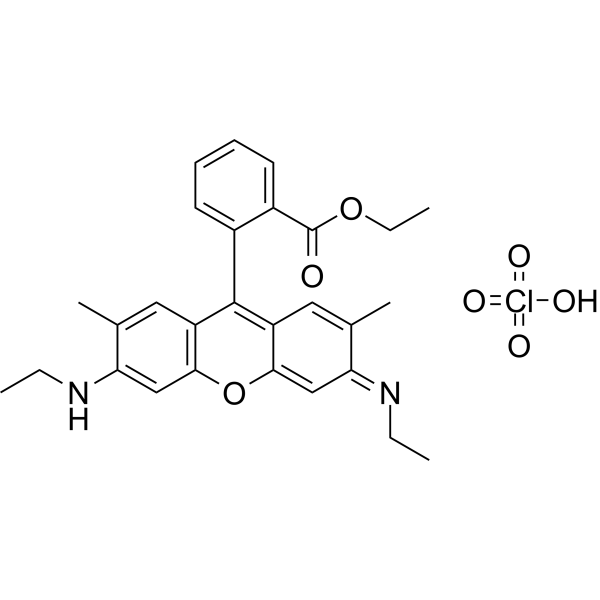
Rhodamine 6G perchlorate is a biochemical reagent that can be used as a biological material or organic compound for life science related research.
|
-
- HY-D2895E
-
|
Rhodamine B-PEG5000-NH2
|
Fluorescent Dye
|
Others
|
|
RB-PEG5000-NH2 (Rhodamine B-PEG5000-NH2) is a fluorescent dye composed of Rhodamine B (HY-Y0016), PEG and an amino group. The reactive primary amine or NH2 groups can react rapidly with activated carboxylic acids such as NHS esters to form stable amide bonds (Ex/Em=546/610 nm) .
|
-

- HY-D2895A
-
|
Rhodamine B-PEG600-NH2
|
Fluorescent Dye
|
Others
|
|
RB-PEG600-NH2 (Rhodamine B-PEG600-NH2) is a fluorescent dye composed of Rhodamine B (HY-Y0016), PEG and an amino group. The reactive primary amine or NH2 groups can react rapidly with activated carboxylic acids such as NHS esters to form stable amide bonds (Ex/Em=546/610 nm) .
|
-

- HY-D2895C
-
|
Rhodamine B-PEG2000-NH2
|
Fluorescent Dye
|
Others
|
|
RB-PEG2000-NH2 (Rhodamine B-PEG2000-NH2) is a fluorescent dye composed of Rhodamine B (HY-Y0016), PEG and an amino group. The reactive primary amine or NH2 groups can react rapidly with activated carboxylic acids such as NHS esters to form stable amide bonds (Ex/Em=546/610 nm) .
|
-

- HY-D2895H
-
|
Rhodamine B-PEG10000-NH2
|
Fluorescent Dye
|
Others
|
|
RB-PEG10000-NH2 (Rhodamine B-PEG10000-NH2) is a fluorescent dye composed of Rhodamine B (HY-Y0016), PEG and an amino group. The reactive primary amine or NH2 groups can react rapidly with activated carboxylic acids such as NHS esters to form stable amide bonds (Ex/Em=546/610 nm) .
|
-

- HY-D2895D
-
|
Rhodamine B-PEG3400-NH2
|
Fluorescent Dye
|
Others
|
|
RB-PEG3400-NH2 (Rhodamine B-PEG3400-NH2) is a fluorescent dye composed of Rhodamine B (HY-Y0016), PEG and an amino group. The reactive primary amine or NH2 groups can react rapidly with activated carboxylic acids such as NHS esters to form stable amide bonds (Ex/Em=546/610 nm) .
|
-

- HY-D2895B
-
|
Rhodamine B-PEG1000-NH2
|
Fluorescent Dye
|
Others
|
|
RB-PEG1000-NH2 (Rhodamine B-PEG1000-NH2) is a fluorescent dye composed of Rhodamine B (HY-Y0016), PEG and an amino group. The reactive primary amine or NH2 groups can react rapidly with activated carboxylic acids such as NHS esters to form stable amide bonds (Ex/Em=546/610 nm) .
|
-

- HY-D2895
-
|
Rhodamine B-PEG400-NH2
|
Fluorescent Dye
|
Others
|
|
RB-PEG400-NH2 (Rhodamine B-PEG400-NH2) is a fluorescent dye composed of Rhodamine B (HY-Y0016), PEG and an amino group. The reactive primary amine or NH2 groups can react rapidly with activated carboxylic acids such as NHS esters to form stable amide bonds (Ex/Em=546/610 nm) .
|
-

- HY-112697
-
|
|
Biochemical Assay Reagents
|
Others
|
|
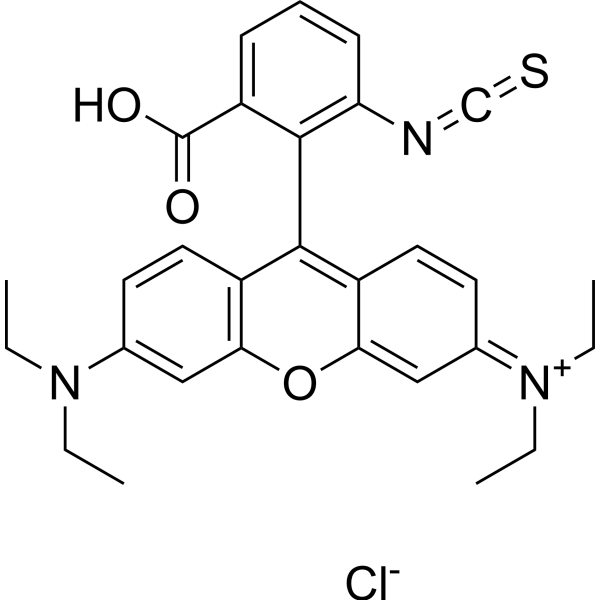
Rhodamine B isothiocyanate (RBITC) is a fluorescent dye commonly used in biological imaging and labeling applications. It has an isothiocyanate functional group that can be covalently attached to amino groups on proteins and other biomolecules, making it useful for fluorescent labeling of cells and tissues. RBITC fluoresces bright orange-red under green light excitation, which makes it easy to detect and track labeled molecules in complex samples. Due to its stability and sensitivity, RBITC has been widely used in various research fields, including cell biology, immunology, and neurobiology.
|
-
- HY-D2886A
-
|
Rhodamine B-PEG600-N3
|
Fluorescent Dye
|
Others
|
|
RB-PEG600-N3 (Rhodamine B-PEG600-N3) is a fluorescent dye composed of Rhodamine B (HY-Y0016), PEG and azide group (N3). RB-PEG600-N3 is a click chemistry reagent, it contains an Azide group and can undergo copper-catalyzed azide-alkyne cycloaddition reaction (CuAAc) with molecules containing Alkyne groups. It can also undergo strain-promoted alkyne-azide cycloaddition (SPAAC) reactions with molecules containing DBCO or BCN groups (Ex/Em=546/610 nm) .
|
-

- HY-D2886B
-
|
Rhodamine B-PEG1000-N3
|
Fluorescent Dye
|
Others
|
|
RB-PEG1000-N3 (Rhodamine B-PEG1000-N3) is a fluorescent dye composed of Rhodamine B (HY-Y0016), PEG and azide group (N3). RB-PEG1000-N3 is a click chemistry reagent, it contains an Azide group and can undergo copper-catalyzed azide-alkyne cycloaddition reaction (CuAAc) with molecules containing Alkyne groups. It can also undergo strain-promoted alkyne-azide cycloaddition (SPAAC) reactions with molecules containing DBCO or BCN groups (Ex/Em=546/610 nm) .
|
-

- HY-D2886C
-
|
Rhodamine B-PEG2000-N3
|
Fluorescent Dye
|
Others
|
|
RB-PEG2000-N3 (Rhodamine B-PEG2000-N3) is a fluorescent dye composed of Rhodamine B (HY-Y0016), PEG and azide group (N3). RB-PEG2000-N3 is a click chemistry reagent, it contains an Azide group and can undergo copper-catalyzed azide-alkyne cycloaddition reaction (CuAAc) with molecules containing Alkyne groups. It can also undergo strain-promoted alkyne-azide cycloaddition (SPAAC) reactions with molecules containing DBCO or BCN groups (Ex/Em=546/610 nm) .
|
-

- HY-D2886E
-
|
Rhodamine B-PEG5000-N3
|
Fluorescent Dye
|
Others
|
|
RB-PEG5000-N3 (Rhodamine B-PEG5000-N3) is a fluorescent dye composed of Rhodamine B (HY-Y0016), PEG and azide group (N3). RB-PEG5000-N3 is a click chemistry reagent, it contains an Azide group and can undergo copper-catalyzed azide-alkyne cycloaddition reaction (CuAAc) with molecules containing Alkyne groups. It can also undergo strain-promoted alkyne-azide cycloaddition (SPAAC) reactions with molecules containing DBCO or BCN groups (Ex/Em=546/610 nm) .
|
-

- HY-D2886
-
|
Rhodamine B-PEG400-N3
|
Fluorescent Dye
|
Others
|
|
RB-PEG400-N3 (Rhodamine B-PEG400-N3) is a fluorescent dye composed of Rhodamine B (HY-Y0016), PEG and azide group (N3). RB-PEG400-N3 is a click chemistry reagent, it contains an Azide group and can undergo copper-catalyzed azide-alkyne cycloaddition reaction (CuAAc) with molecules containing Alkyne groups. It can also undergo strain-promoted alkyne-azide cycloaddition (SPAAC) reactions with molecules containing DBCO or BCN groups (Ex/Em=546/610 nm) .
|
-

- HY-D2886H
-
|
Rhodamine B-PEG10000-N3
|
Fluorescent Dye
|
Others
|
|
RB-PEG10000-N3 (Rhodamine B-PEG10000-N3) is a fluorescent dye composed of Rhodamine B (HY-Y0016), PEG and azide group (N3). RB-PEG10000-N3 is a click chemistry reagent, it contains an Azide group and can undergo copper-catalyzed azide-alkyne cycloaddition reaction (CuAAc) with molecules containing Alkyne groups. It can also undergo strain-promoted alkyne-azide cycloaddition (SPAAC) reactions with molecules containing DBCO or BCN groups (Ex/Em=546/610 nm) .
|
-

- HY-D2886D
-
|
Rhodamine B-PEG3400-N3
|
Fluorescent Dye
|
Others
|
|
RB-PEG3400-N3 (Rhodamine B-PEG3400-N3) is a fluorescent dye composed of Rhodamine B (HY-Y0016), PEG and azide group (N3). RB-PEG3400-N3 is a click chemistry reagent, it contains an Azide group and can undergo copper-catalyzed azide-alkyne cycloaddition reaction (CuAAc) with molecules containing Alkyne groups. It can also undergo strain-promoted alkyne-azide cycloaddition (SPAAC) reactions with molecules containing DBCO or BCN groups (Ex/Em=546/610 nm) .
|
-

- HY-D3348
-
-

- HY-P4403
-
|
(Z-Asp-Glu-Val-Asp)₂-Rhodamine 110
|
Fluorescent Dye
Apoptosis
Caspase
|
Others
|
|
Z-DEVD-R110 ((Z-Asp-Glu-Val-Asp)2-Rhodamine 110) is a fluorogenic caspase-3/7 substrate. Z-DEVD-R110 can be used to detect apoptosis. Z-DEVD-R110 is a rhodamine derivative with two four–amino acid (DEVD) peptides linked to the fuorophore .
|
-

- HY-P11476
-
-

- HY-117468
-
|
|
Fluorescent Dye
|
Others
|
|
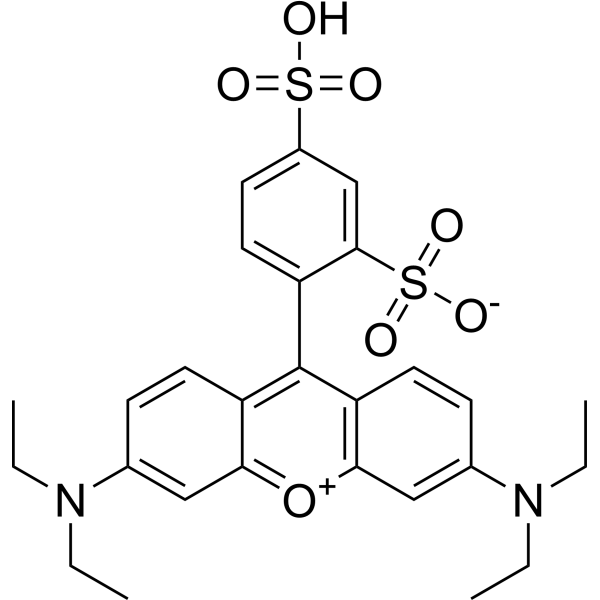
Lissamine rhodamine B is a red-fluorescent dye, it is a derivative of rhodamine. Lissamine rhodamine B can be used as a fluorescent probe to develop competitive aptamer fluorescence anisotropy/polarization (FA/FP) assays .
|
-
- HY-D3027
-
|
HSA-Rhodamine
|
Fluorescent Dye
|
Others
|
|
Human Serum Albumin-Rhodamine (HSA-Rhodamine) is a Rhodamine B (HY-Y0016) labeled serum albumin. Human Serum Albumin-Rhodamine plays an important role in fluorescent labeling, drug delivery research, and other fields (Ex/Em = 546/610 nm) .
|
-

- HY-P10322
-
|
|
Fluorescent Dye
|
Cancer
|
|
Z-IETD-R110 is a fluorescent substrate of caspases. Z-IETD-R110 acts as a substrate for caspase-8. When caspase-8 is activated, it can recognize and cut Z-IETD-R110, releasing fluorophore, which can be detected by fluorescence microscopy. Z-IETD-R110 can be used to study oxidative stress-induced apoptosis, particularly in pancreatic acinar cells .
|
-

- HY-P10450
-
|
D2R; (D)2-Rhodamine 110
|
Caspase
|
Others
|
|
(Asp)2-Rhodamine 110 (D2R) is a fluorescent caspase substrate .
|
-

- HY-NP0158
-
|
UEA I (Rhodamine)
|
Fluorescent Dye
|
Others
|
|
Ulex Europaeus Agglutinin I Rhodamine (UEA I Rhodamine) is a fluorescently labeled lectin. Ulex Europaeus Agglutinin I Rhodamine exhibits specificity for cell surface glycoconjugates containing α-L-fucosyl groups. Ulex Europaeus Agglutinin I Rhodamine can be used in combination with other lectins for double staining .
|
-

- HY-NP0156
-
|
PNA (Rhodamine)
|
Fluorescent Dye
|
Others
|
|
Peanut Agglutinin (PNA) Rhodamine is a plant lectin that can be used as a probe to specifically bind biomolecules (such as polysaccharides, peptides, etc.).Peanut Agglutinin (PNA) Rhodamine is a biological material or organic compound that can be used in life science research .
|
-

- HY-NP0153
-
|
Con A (Rhodamine)
|
Fluorescent Dye
|
Others
|
|
Concanavalin A (Con A) Rhodamine is a plant lectin that can be used as a probe to specifically bind biomolecules (such as polysaccharides, peptides, etc.).Concanavalin A (Con A) Rhodamine is a biological material or organic compound that can be used in life science research .
|
-

- HY-D3059
-
-

- HY-NP0159
-
|
WGA (Rhodamine)
|
Fluorescent Dye
|
Others
|
|
Wheat Germ Agglutinin (WGA) Rhodamine is a plant lectin that can be used as a probe to specifically bind biomolecules (such as polysaccharides, peptides, etc.).Wheat Germ Agglutinin (WGA) Rhodamine is a biological material or organic compound that can be used in life science research .
|
-

- HY-NP0154
-
|
DBA (Rhodamine)
|
Fluorescent Dye
|
Others
|
|
Dolichos Biflorus Agglutinin (DBA) Rhodamine is a plant lectin that can be used as a probe to specifically bind biomolecules (such as polysaccharides, peptides, etc.).Dolichos Biflorus Agglutinin (DBA) Rhodamine is a biological material or organic compound that can be used in life science research .
|
-

- HY-N15888
-
|
|
Fluorescent Dye
|
Others
|
|
Palmitic acid-lissamine rhodamine is a lissamine rhodamine-labeled Palmitic acid (HY-N0830).
|
-

- HY-W440934
-
|
|
Liposome
|
Others
|
|
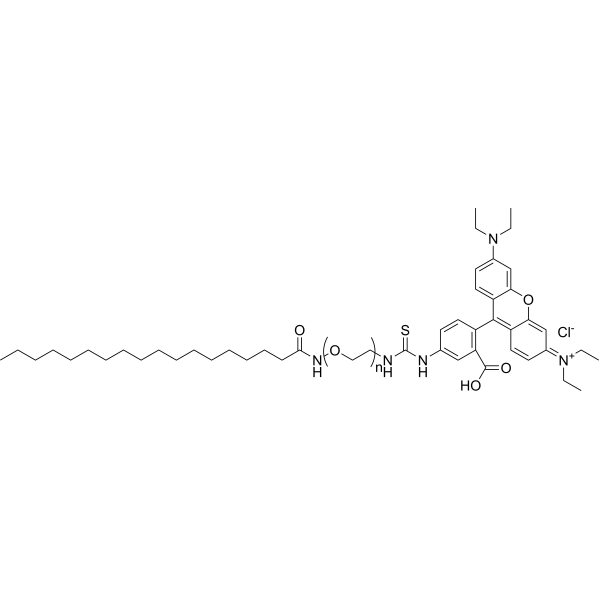
Stearic acid-PEG2000-Rhodamine is an amphiphilic PEG polymer which can form micelles in water. The rhodamine can be used for staining sample and easily traced by fluorescence microscopy. Rhodamine has maximum absorption at 570 nm and emission around 595 nm.
|
-
- HY-166833
-
|
|
Biochemical Assay Reagents
|
Others
|
|
DOPE-PEG5000-Rhodamine B is a phospholipid. Phospholipids have good biocompatibility and significant amphiphilic characteristics, making them the main and suitable dosage form or excipient in drug formulations, thereby achieving better therapeutic effects. DOPE-PEG5000-Rhodamine Bcan be used in drug delivery research .
|
-

- HY-W440936
-
|
|
Liposome
|
Others
|
|
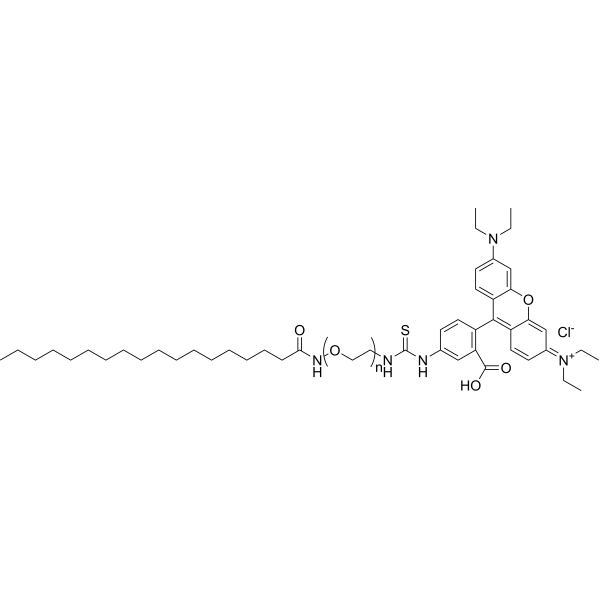
Stearic acid-PEG5000-Rhodamine is a fatty acid containing PEG polymer which can self assemble in an aqueous solution to form micelles. The polymer can be used to prepare nanoparticles for drug encapsulation. The red dye rhodamine can be easily traced by fluorescence microscopy. Rhodamine has maximum absorption at 570 nm and emission around 595 nm.
|
-
- HY-W440935
-
|
|
Liposome
|
Others
|
|
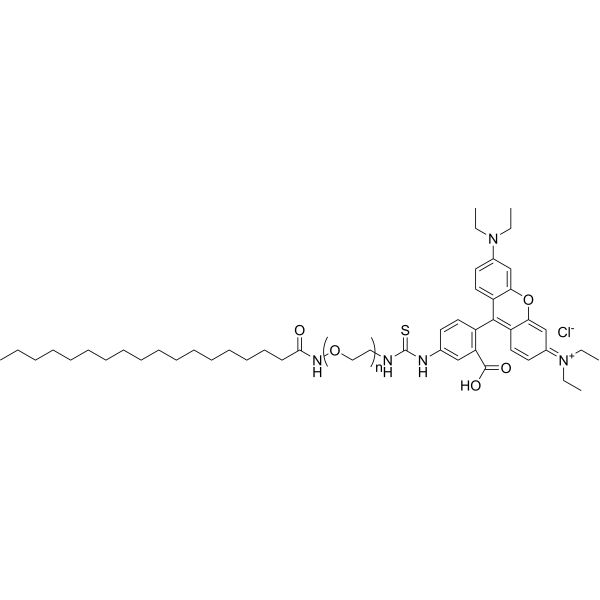
Stearic acid-PEG3400-Rhodamine is a fatty acid containing PEG polymer which can self assemble in an aqueous solution to form micelles. The polymer can be used to prepare nanoparticles for drug encapsulation. The red dye rhodamine can be easily traced by fluorescence microscopy. Rhodamine has maximum absorption at 570 nm and emission around 595 nm.
|
-
- HY-166883
-
-

- HY-W440921
-
|
|
Liposome
|
Others
|
|
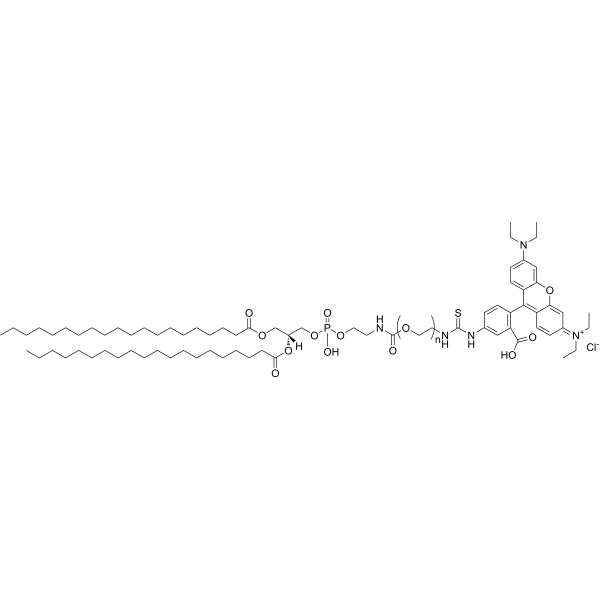
DSPE-PEG5000-Rhodamine is a phospholipid polyPEG with red fluorescent. The polymer can form lipid bilayer and be used to prepare nanoparticles or liposomes for targeted drug delivery. Rhodamine has maximum absorption at 570 nm and emission around 595 nm and can be easily traced using an imaging technique.
|
-
- HY-W440920
-
|
|
Liposome
|
Others
|
|
DSPE-PEG3400-Rhodamine is a phospholipid polyPEG with red fluorescent. The polymer can form lipid bilayer and be used to prepare nanoparticles or liposomes for targeted drug delivery. Rhodamine has maximum absorption at 570 nm and emission around 595 nm and can be easily traced using an imaging technique.
|
-
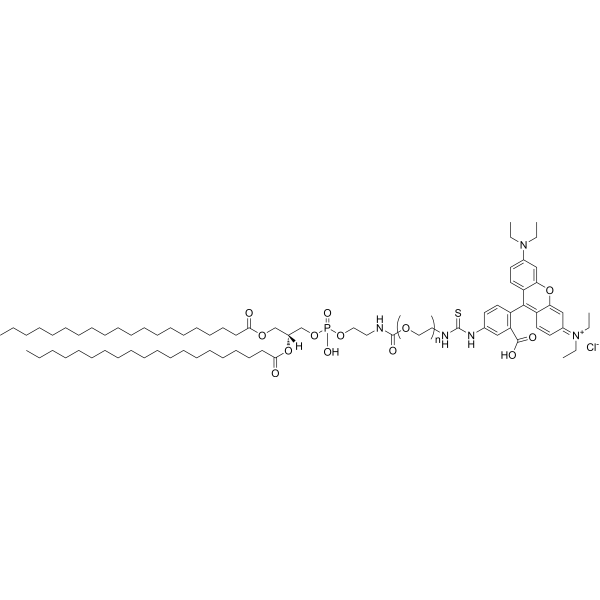
- HY-NP0157
-
|
RCA I (Rhodamine)
|
Fluorescent Dye
|
Others
|
|
Ricinus Communis Agglutinin I (RCA I) Rhodamine is a plant lectin that can be used as a probe to specifically bind biomolecules (such as polysaccharides, peptides, etc.).Ricinus Communis Agglutinin I (RCA I) Rhodamine is a biological material or organic compound that can be used in life science research .
|
-

- HY-D3052
-
|
|
Fluorescent Dye
|
Others
|
|
5(6)-carbonylated rhodamine 110 maleimide is a maleimide-based fluorescent reagent based on 5(6)-carbonylated rhodamine 110. Maleimide can be labeled by forming a stable thioester structure through an affinity addition reaction with a thiol group (-SH) (Ex/Em = 502/527 nm).
|
-

- HY-W440919
-
|
|
Liposome
|
Others
|
|
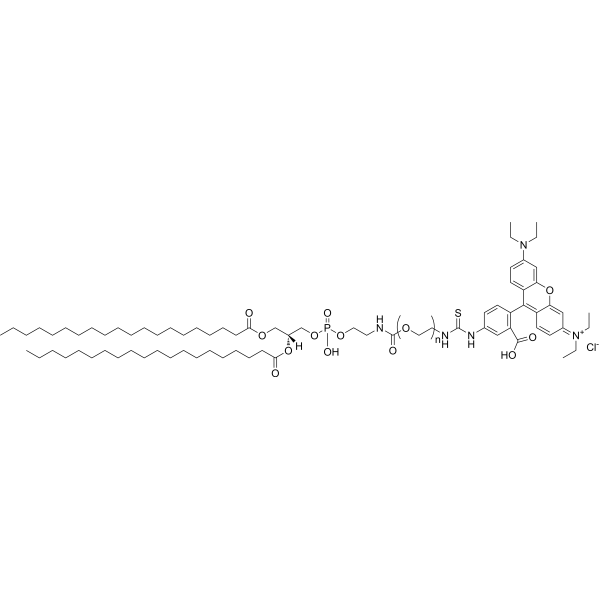
DSPE-PEG2000-Rhodamine is a dye functionalized phospholipid. The amphiphilic polymer can form lipid bilayer in water and be used to encapsulate therapeutic agents, such as liposomal anticancer drug or mRNA vaccine. Rhodamine has maximum absorption at 570 nm and emission around 595 nm and can be easily traced using an imaging technique.
|
-
- HY-D3049
-
|
|
Fluorescent Dye
|
Others
|
|
5(6)-carbonylated rhodamine 110 NHS ester is a reactive ester fluorescent reagent based on 5(6)-carbonylated rhodamine 110. NHS ester is a highly reactive ester capable of covalently coupling with primary amine groups in molecules such as proteins, peptides, amino sugars, and nucleic acids to form stable amide bonds (Ex/Em = 502/527 nm).
|
-

- HY-D3051
-
|
|
Fluorescent Dye
|
Others
|
|
5(6)-carbonylated rhodamine 110 amine is a primary amine fluorescent reagent based on 5(6)-carbonylated rhodamine 110. Primary amines can be covalently linked with various functional groups such as carboxylic acids, active esters (e.g., NHS esters), and isothiocyanates to achieve labeling (Ex/Em = 502/527 nm).
|
-

- HY-NP0155
-
|
GSL I (Rhodamine)
|
Fluorescent Dye
|
Others
|
|
Griffonia (Bandeiraea) Simplicifolia Lectin I (GSL I) Rhodamine is a plant lectin that can be used as a probe to specifically bind biomolecules (such as polysaccharides, peptides, etc.).Griffonia (Bandeiraea) Simplicifolia Lectin I (GSL I) Rhodamine is a biological material or organic compound that can be used in life science research .
|
-

- HY-D3050
-
|
|
Fluorescent Dye
|
Others
|
|
5(6)-carbonylated rhodamine 110 X NHS ester is a reactive ester fluorescent reagent based on 5(6)-carbonylated rhodamine 110 X. NHS ester is a highly reactive ester capable of covalently coupling with primary amine groups in molecules such as proteins, peptides, amino sugars, and nucleic acids to form stable amide bonds (Ex/Em = 496/522 nm).
|
-

- HY-NP147
-
|
|
Fluorescent Dye
|
Others
|
|
Phaseolus Vulgaris Leucoagglutinin Rhodamine is a plant lectin that can be used as a probe to specifically bind biomolecules (such as polysaccharides, peptides, etc.). Phaseolus Vulgaris Leucoagglutinin Rhodamine is a biological material or organic compound that can be used in life science research .
|
-

- HY-W127703
-
|
|
Fluorescent Dye
Biochemical Assay Reagents
|
Others
|
|
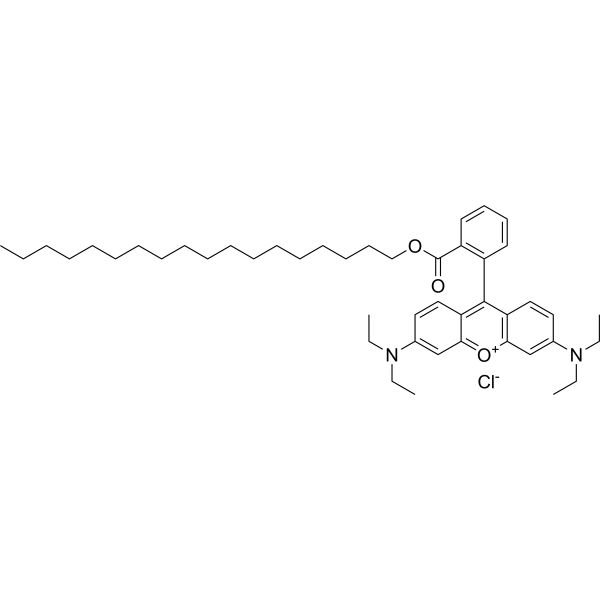
Octadecyl Rhodamine B chloride is an amphiphilic fluorescent probe with both membrane-binding ability and fluorescent properties, which easily forms aggregates in aqueous phase leading to self-quenching. Octadecyl Rhodamine B chloride can be used for cell membrane staining and further applied in membrane biology research. The maximum absorption/emission wavelengths of Octadecyl Rhodamine B chloride monomer in Triton X-100 are 565 nm/585 nm; the absorption peaks of aggregates in water are blue-shifted to 524 nm and 574 nm, with significantly quenched fluorescence .
|
-
- HY-D3056
-
|
|
Fluorescent Dye
|
Others
|
|
5(6)-Rhodamine 6G maleimide is a maleimide-based fluorescent reagent based on Rhodamine 6G (HY-D0309). Maleimide can be labeled by forming a stable thioester structure through an affinity addition reaction with a thiol group (-SH) (Ex/Em = 526/547 nm).
|
-

- HY-D1377
-
|
|
Fluorescent Dye
|
Others
|
|
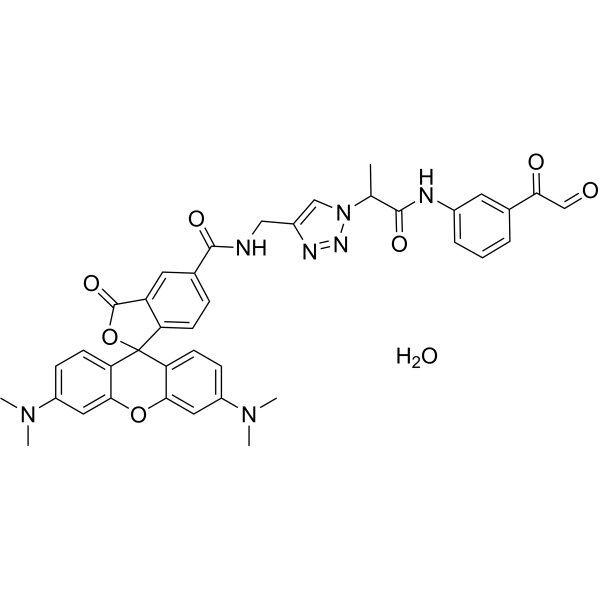
Citrulline-specific probe-rhodamine hydrate is a specific probe for citrulline (Citrulline) combined with a rhodamine fluorescent group. Citrulline is the hydrolysis product of arginine catalyzed by protein arginine deiminase (PAD). PAD is abnormally activated in many diseases, leading to increased citrulline levels. Citrulline-specific probe-rhodamine hydrate is a biological probe that can identify diseases showing abnormal increases in PAD activity and may be effectively used in animal models of ulcerative colitis .
|
-
- HY-D1769
-
|
|
Fluorescent Dye
|
Others
|
|
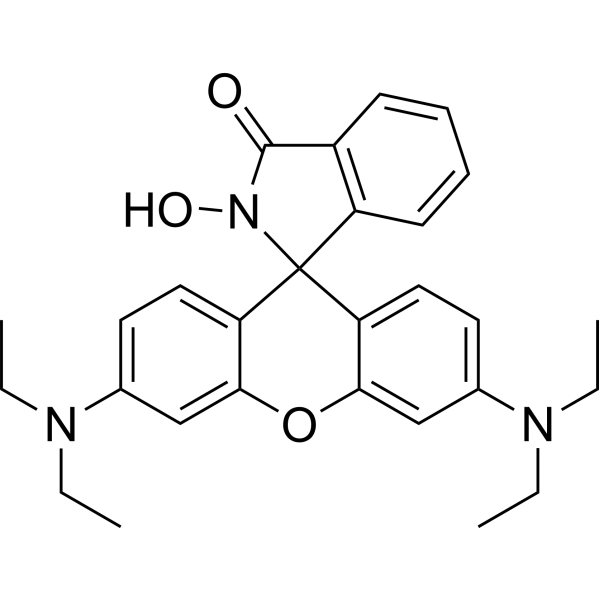
N-hydroxy Rhodamine B amide is a ClO - indicator, which is hydrolyzed to prduce fluorescence in the presence of ClO -. The fluorescence intensity of N-hydroxy Rhodamine B amide is proportional to the product, thus can be used to quantify ClO -.
|
-
- HY-D3054
-
|
|
Fluorescent Dye
|
Others
|
|
5(6)-Rhodamine 6G amine is a primary amine fluorescent reagent based on Rhodamine 6G (HY-D0309). Primary amines can be covalently linked with various functional groups such as carboxylic acids, active esters (e.g., NHS esters), and isothiocyanates to achieve labeling (Ex/Em = 526/547 nm).
|
-

- HY-D3053
-
|
|
Fluorescent Dye
|
Others
|
|
5(6)-Rhodamine 6G NHS ester is a reactive ester fluorescent reagent based on Rhodamine 6G (HY-D0309). NHS ester is a highly reactive ester capable of covalently coupling with primary amine groups in molecules such as proteins, peptides, amino sugars, and nucleic acids to form stable amide bonds (Ex/Em = 526/547 nm).
|
-

- HY-166654
-
|
|
Biochemical Assay Reagents
|
Others
|
|
DSPE-Amide-PEG2000-Rhodamine is a phospholipid. Phospholipids have good biocompatibility and significant amphiphilic characteristics, making them the main and suitable dosage form or excipient in drug formulations, thereby achieving better therapeutic effects. DSPE-Amide-PEG2000-Rhodaminecan be used in drug delivery research .
|
-

- HY-D0784
-
5-ROX
1 Publications Verification
5-Carboxy-X-Rhodamine
|
Fluorescent Dye
|
Others
|
|
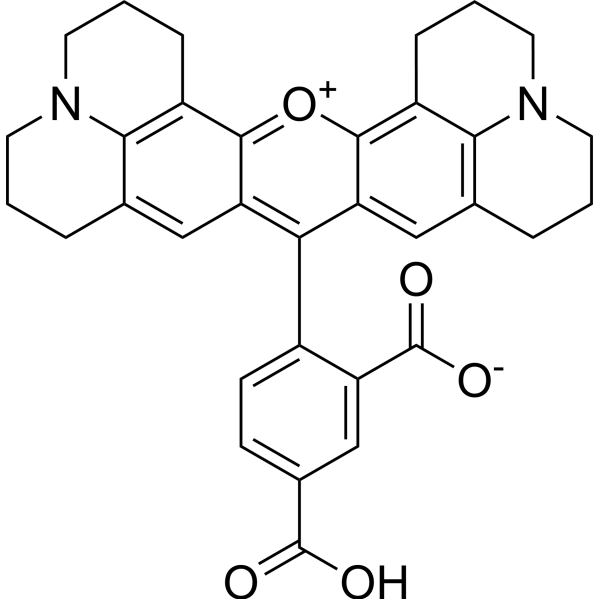
5-ROX (5-Carboxy-X-rhodamine), a rhodamine dye, exhibits strong fluorescence property in aqueous buffer with the λexit of 580 nm (ε=3.6×10 4 M -1 cm -1), and λemit of 604 nm (=0.94) .
|
-
- HY-175046
-
|
|
Fluorescent Dye
|
Others
|
|
C12 Lissamine-rhodamine galactosylceramide (d18:1/12:0) (Lissamine-rhodamine B-dodecanoyl Galactosylceramide) is a fluorescently labeled version of C12 galactosylceramide.
|
-

- HY-W099393
-
-

- HY-D2894B
-
|
4Arm-PEG10000-Rhodamine B
|
Fluorescent Dye
|
Others
|
|
4Arm-PEG10000-RB (4Arm-PEG10000-Rhodamine B) is a fluorescent dye composed of Rhodamine B (HY-Y0016) and PEG with a four-arm structure. 4Arm-PEG10000-RB can be used for drug delivery and fluorescence imaging (Ex/Em=546/610 nm) .
|
-

- HY-D2894A
-
|
4Arm-PEG5000-Rhodamine B
|
Fluorescent Dye
|
Others
|
|
4Arm-PEG5000-RB (4Arm-PEG5000-Rhodamine B) is a fluorescent dye composed of Rhodamine B (HY-Y0016) and PEG with a four-arm structure. 4Arm-PEG5000-RB can be used for drug delivery and fluorescence imaging (Ex/Em=546/610 nm) .
|
-

- HY-D2894
-
|
4Arm-PEG2000-Rhodamine B
|
Fluorescent Dye
|
Others
|
|
4Arm-PEG2000-RB (4Arm-PEG2000-Rhodamine B) is a fluorescent dye composed of Rhodamine B (HY-Y0016) and PEG with a four-arm structure. 4Arm-PEG2000-RB can be used for drug delivery and fluorescence imaging (Ex/Em=546/610 nm) .
|
-

- HY-D2894C
-
|
4Arm-PEG20000-Rhodamine B
|
Fluorescent Dye
|
Others
|
|
4Arm-PEG20000-RB (4Arm-PEG20000-Rhodamine B) is a fluorescent dye composed of Rhodamine B (HY-Y0016) and PEG with a four-arm structure. 4Arm-PEG20000-RB can be used for drug delivery and fluorescence imaging (Ex/Em=546/610 nm) .
|
-

- HY-136884
-
|
|
Fluorescent Dye
|
Others
|
|
DAR-4M is a fluorescent indicator for nitric oxide (NO) based on the rhodamine chromophore (Ex/Em= 550/572 nm) .
|
-

- HY-D1086
-
|
6-ROX, SE
|
DNA Stain
|
Others
|
|
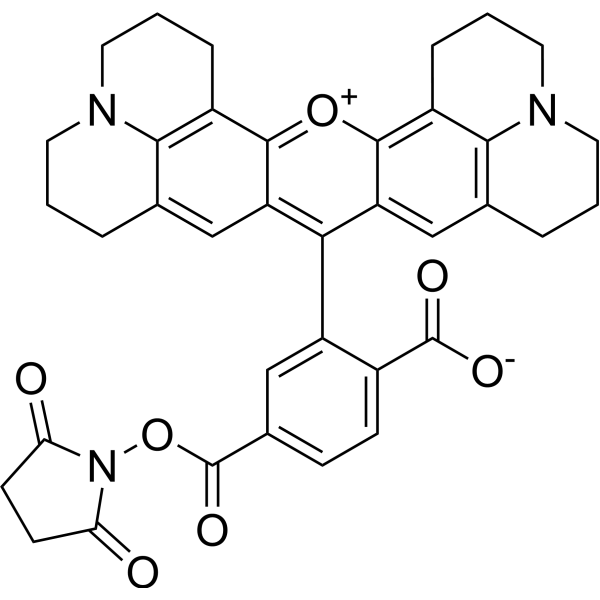
6-Carboxy-X-rhodamine, succinimidyl ester (6-ROX, SE) is a fluorescent dye for oligonucleotide labeling and automated DNA sequencing .
|
-
- HY-D0053A
-
|
6-Carboxy-X-Rhodamine hydrochloride
|
Fluorescent Dye
|
Others
|
|
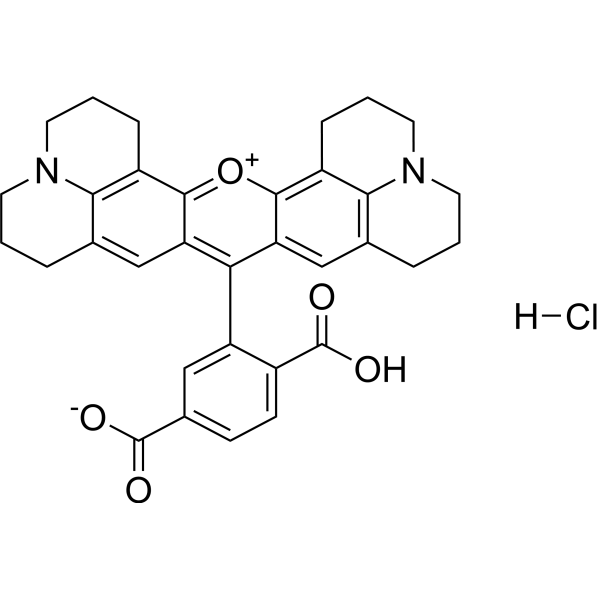
6-ROX (6-Carboxy-X-rhodamine) hydrochloride, a fluorescent marker of oligonucleotides, acts as a receptor coupled to 5-FAM and as a donor in FRET imaging. Excitation wavelength: 568 nm. Emission wavelength: 568 nm.
|
-
- HY-D1522
-
-
![N,N'-Bis[2-(acetamido)ethyl]-N,N'-dimethyl rhodamine](//file.medchemexpress.com/product_pic/hy-d1522.gif)
- HY-N15859
-
-

- HY-D0043
-
|
5(6)-Carboxy-X-Rhodamine
|
DNA Stain
|
Others
|
|
5(6)-ROX (5(6)-Carboxy-X-rhodamine) is a nucleic acid fluorescent label which can be used as a reference dye for real-time polymerase chain reaction (Em/Ex = 605/585 nm) .
|
-
- HY-P3106
-
|
(Z-Ala-Ala-Ala-Ala)2Rhodamine110; bis-CBZ-L-alanyl-L-arginine amide Rhodamine 110
|
Fluorescent Dye
|
Others
|
|
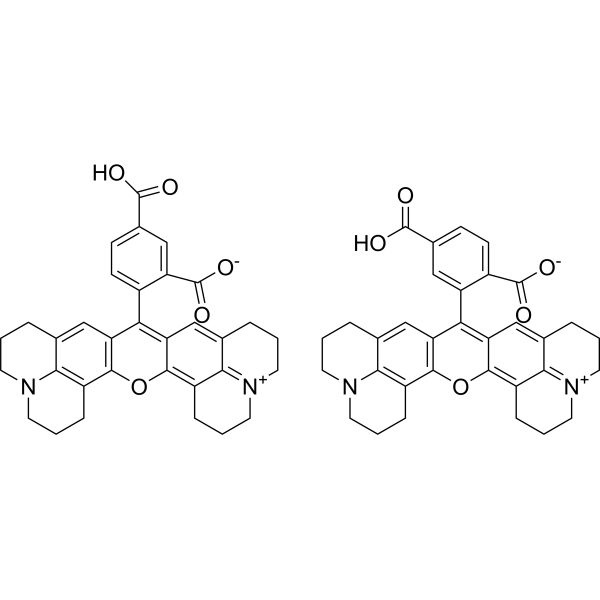
(Z-Ala-Ala-Ala-Ala)2Rh110 is a sensitive fluorogenic elastase substrate. The colorless and nonfluorescent (Z-Ala-Ala-Ala-Ala)2Rh110 is selectively cleaved by elastase to yield the highly fluorescent compound rhodamine 110, which can be analyzed with an excitation wavelength of 485 nm and emission wavelength of 525 nm.
|
-

- HY-D0139
-
|
|
Fluorescent Dye
|
Others
|
|
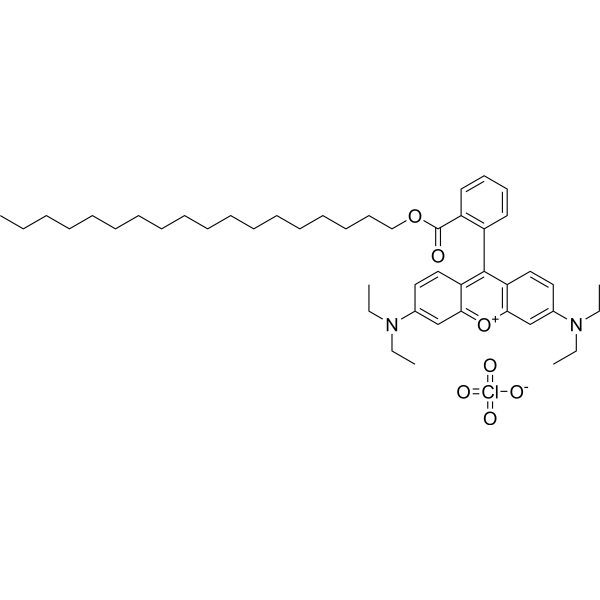
Octadecyl Rhodamine B (perchlorate) is a multifunctional dye. Dyes are important tools in biological experiments. They can help researchers observe and analyze cell structures, track biomolecules, evaluate cell functions, distinguish cell types, detect biomolecules, study tissue pathology and monitor microorganisms. Their applications range from basic scientific research to clinical A wide range of diagnostics. Dyes are also widely used in traditional fields such as textile dyeing, as well as in emerging fields such as functional textile processing, food pigments and dye-sensitized solar cells.
|
-
- HY-D1266
-
|
NO-red
|
Fluorescent Dye
|
Others
|
|
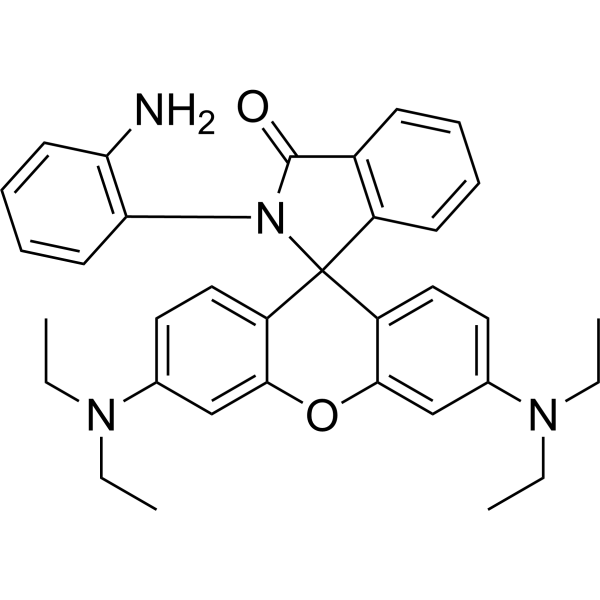
RB-OPD (NO-red) is a o-phenylenediamine (OPD)-locked rhodamine nitric oxide (NO) fluorescent probe with great sensitivity and selectivity (λex=550 nm, λem=590 nm) .
|
-
- HY-101878
-
|
SulfoRhodamine 101; SR101
|
Fluorescent Dye
|
Neurological Disease
|
|
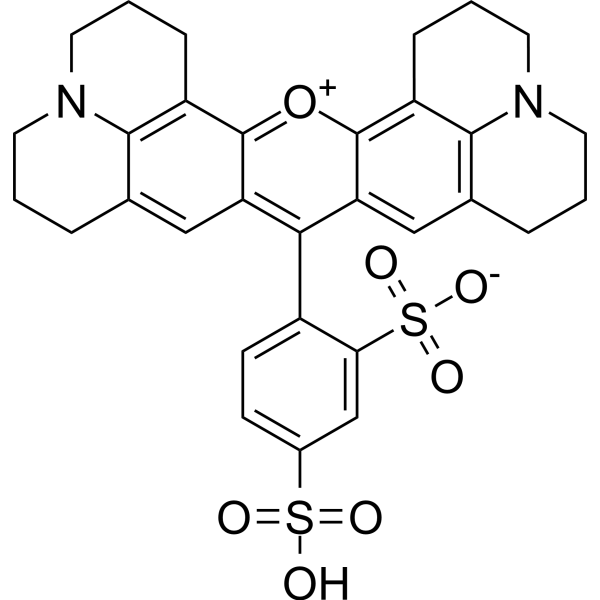
Texas Red (Sulforhodamine 101) is an amphoteric rhodamine red fluorescent dye (excitation/emission: 586/605 nm). Texas Red is used extensively for investigating neuronal morphology and acts as acell type-selective fluorescent marker of astrocytes bothin vivoand in slice preparations .
|
-
- HY-167482
-
|
|
Biochemical Assay Reagents
|
Others
|
|
PLLA2000-PEG3000-RhB is a terminal rhodamine-labeled polylactic acid derivative. PLLA2000-PEG3000-RhB can be used to label nanomicelles for real-time monitoring of drug release in vivo .
|
-

- HY-167480
-
|
|
Biochemical Assay Reagents
|
Others
|
|
PLLA3000-PEG1000-RhB is a terminal rhodamine-labeled polylactic acid derivative. PLLA3000-PEG1000-RhB can be used to label nanomicelles for real-time monitoring of drug release in vivo .
|
-

- HY-167491
-
|
|
Biochemical Assay Reagents
|
Others
|
|
PLLA10000-PEG2000-RhB is a terminal rhodamine-labeled polylactic acid derivative. PLLA10000-PEG2000-RhB can be used to label nanomicelles for real-time monitoring of drug release in vivo .
|
-

- HY-167488
-
|
|
Biochemical Assay Reagents
|
Others
|
|
PLLA1000-PEG1000-RhB is a terminal rhodamine-labeled polylactic acid derivative. PLLA1000-PEG1000-RhB can be used to label nanomicelles for real-time monitoring of drug release in vivo .
|
-

- HY-167486
-
|
|
Biochemical Assay Reagents
|
Others
|
|
PLLA1000-PEG3000-RhB is a terminal rhodamine-labeled polylactic acid derivative. PLLA1000-PEG3000-RhB can be used to label nanomicelles for real-time monitoring of drug release in vivo .
|
-

- HY-167490
-
|
|
Biochemical Assay Reagents
|
Others
|
|
PLLA10000-PEG3000-RhB is a terminal rhodamine-labeled polylactic acid derivative. PLLA10000-PEG3000-RhB can be used to label nanomicelles for real-time monitoring of drug release in vivo .
|
-

- HY-167484
-
|
|
Biochemical Assay Reagents
|
Others
|
|
PLLA2000-PEG1000-RhB is a terminal rhodamine-labeled polylactic acid derivative. PLLA2000-PEG1000-RhB can be used to label nanomicelles for real-time monitoring of drug release in vivo .
|
-

- HY-167487
-
|
|
Biochemical Assay Reagents
|
Others
|
|
PLLA1000-PEG2000-RhB is a terminal rhodamine-labeled polylactic acid derivative. PLLA1000-PEG2000-RhB can be used to label nanomicelles for real-time monitoring of drug release in vivo .
|
-

- HY-167483
-
|
|
Biochemical Assay Reagents
|
Others
|
|
PLLA2000-PEG2000-RhB is a terminal rhodamine-labeled polylactic acid derivative. PLLA2000-PEG2000-RhB can be used to label nanomicelles for real-time monitoring of drug release in vivo .
|
-

- HY-167485
-
|
|
Biochemical Assay Reagents
|
Others
|
|
PLLA1000-PEG5000-RhB is a terminal rhodamine-labeled polylactic acid derivative. PLLA1000-PEG5000-RhB can be used to label nanomicelles for real-time monitoring of drug release in vivo .
|
-

- HY-167492
-
|
|
Biochemical Assay Reagents
|
Others
|
|
PLLA10000-PEG1000-RhB is a terminal rhodamine-labeled polylactic acid derivative. PLLA10000-PEG1000-RhB can be used to label nanomicelles for real-time monitoring of drug release in vivo .
|
-

- HY-167489
-
|
|
Biochemical Assay Reagents
|
Others
|
|
PLLA10000-PEG5000-RhB is a terminal rhodamine-labeled polylactic acid derivative. PLLA10000-PEG5000-RhB can be used to label nanomicelles for real-time monitoring of drug release in vivo .
|
-

- HY-167481
-
|
|
Biochemical Assay Reagents
|
Others
|
|
PLLA2000-PEG5000-RhB is a terminal rhodamine-labeled polylactic acid derivative. PLLA2000-PEG5000-RhB can be used to label nanomicelles for real-time monitoring of drug release in vivo .
|
-

- HY-162543
-
|
18:1 Lissamine Rhodamine PE
|
Fluorescent Dye
|
Others
|
|
18:1 Liss Rhod (18:1 Lissamine rhodamine) PE is a fluorescent phospholipid and fluorescent probe.18:1 Liss Rhod PE admixes into phospholipid inks for large-scale monitoring of dip-pen nanolithography-generated lithographic structures via fluorescence microscopy.18:1 Liss Rhod PE undergoes phase separation or self-quenching under certain conditions in thin lipid membrane stacks .
|
-

- HY-101878R
-
|
SulfoRhodamine 101 (Standard); SR101 (Standard)
|
Fluorescent Dye
Reference Standards
|
Neurological Disease
|
|
Texas Red (Standard) is the analytical standard of Texas Red (HY-101878). This product is intended for research and analytical applications. Texas Red (Sulforhodamine 101) is an amphoteric rhodamine red fluorescent dye (excitation/emission: 586/605 nm). Texas Red is used extensively for investigating neuronal morphology and acts as acell type-selective fluorescent marker of astrocytes bothin vivoand in slice preparations .
|
-

- HY-DY1056
-
|
|
Fluorescent Dye
|
Neurological Disease
|
Texas Red (Sulforhodamine 101) (solution) is an amphoteric rhodamine red fluorescent dye (excitation/emission: 586/605 nm). Texas Red is used extensively for investigating neuronal morphology and acts as acell type-selective fluorescent marker of astrocytes bothin vivoand in slice preparations .
Solvent and concentration: DMSO: 10 mM
The 1 mL volume is defined as the base specification. All larger sizes correspond to incremental volumes of this base.
|
-

- HY-D3244
-
|
|
Fluorescent Dye
|
Others
|
|
RDDB is a rhodamine-based turn-on fluorescent and colorimetric chemosensor selective for Mn 2+, with a limit of detection of 5×10 -8 M (excitation wavelength: 480-550 nm; fluorescence signal collection range: >590 nm). In the presence of Mn 2+, RDDB undergoes a spirolactam ring-opening reaction of its rhodamine hydrazide moiety, resulting in turn-on fluorescence and a color change. RDDB can be used for intracellular Mn 2+ imaging .
|
-

- HY-158082C
-
|
Tetramethyl Rhodamine isothiocyanate glucan, MW 70000
|
Fluorescent Dye
|
Others
|
|
TRITC-dextran MW 70000 (Tetramethyl rhodamine isothiocyanate glucan, MW 70000) is a fluorescent dye with a molecular weight of 70 kD. The excitation wavelength of TRITC-dextran MW 70000 is 555 nm, and its emission wavelength is 570 nm. TRITC-dextran MW 70000 is used for drug delivery because TRITC maintains stability over a wide pH range (i.e., pH 2-11) and exhibits photobleaching resistance .
|
-

- HY-158082E
-
|
Tetramethyl Rhodamine isothiocyanate glucan, MW 500000
|
Fluorescent Dye
|
Others
|
|
TRITC-dextran, MW 500000 (Tetramethyl rhodamine isothiocyanate glucan, MW 500000) is a fluorescent dye, with the molecular weight of 500 kD. TRITC-dextran, MW 500000 exhibits an excitation wavelength of 555 nm. TRITC-dextran, MW 500000 is follicular and vessel penetrate, which is dependent on the molecular weight. TRITC-dextran, MW 500000 is utilized in drug delivery for the stability of TRITC over a wide pH range (i.e. pH 2–11) and resistance to photo-bleaching .
|
-

- HY-158082D
-
|
Tetramethyl Rhodamine isothiocyanate glucan, MW 150000
|
Fluorescent Dye
|
Others
|
|
TRITC-dextran, MW 150000 (Tetramethyl rhodamine isothiocyanate glucan, MW 150000) is a fluorescent dye, with the molecular weight of 150 kD. TRITC-dextran, MW 150000 exhibits an excitation wavelength of 555 nm. TRITC-dextran, MW 150000 is follicular and vessel penetrate, which is dependent on the molecular weight. TRITC-dextran, MW 150000 is utilized in drug delivery for the stability of TRITC over a wide pH range (i.e. pH 2–11) and resistance to photo-bleaching .
|
-
- HY-158082H
-
|
Tetramethyl Rhodamine isothiocyanate glucan, MW 2000000
|
Fluorescent Dye
|
Others
|
|
TRITC-dextran, MW 2000000 (Tetramethyl rhodamine isothiocyanate glucan, MW 2000000) is a fluorescent dye, with the molecular weight of 2000 kD. TRITC-dextran, MW 2000000 exhibits an excitation wavelength of 555 nm. TRITC-dextran, MW 2000000 is follicular and vessel penetrate, which is dependent on the molecular weight. TRITC-dextran, MW 2000000 is utilized in drug delivery for the stability of TRITC over a wide pH range (i.e. pH 2–11) and resistance to photo-bleaching .
|
-

- HY-158082
-
|
Tetramethyl Rhodamine isothiocyanate glucan, MW 4000
|
Fluorescent Dye
|
Others
|
|
TRITC-dextran MW 4000 (Tetramethyl rhodamine isothiocyanate glucan, MW 4000) is a fluorescent dye, with the molecular weight of 4 kD. TRITC-dextran MW 4000 exhibits an excitation wavelength of 555 nm. TRITC-dextran MW 4000 is vessel penetrate, which could label blood plasma to visualize the vasculature. TRITC-dextran MW 4000 is utilized in drug delivery for the stability of TRITC over a wide pH range (i.e. pH 2–11) and resistance to photo-bleaching .
|
-

- HY-158082A
-
|
Tetramethyl Rhodamine isothiocyanate glucan, MW 20000
|
Fluorescent Dye
|
Others
|
|
TRITC-dextran, MW 20000 (Tetramethyl rhodamine isothiocyanate glucan, MW 20000) is a fluorescent dye, with the molecular weight of 20 kD. TRITC-dextran MW 20000 exhibits an excitation wavelength of 555 nm. TRITC-dextran MW 20000 is vessel penetrate, which could label blood plasma to visualize the vasculature. TRITC-dextran MW 20000 is utilized in drug delivery for the stability of TRITC over a wide pH range (i.e. pH 2–11) and resistance to photo-bleaching .
|
-

- HY-158082B
-
|
Tetramethyl Rhodamine isothiocyanate glucan, MW 40000
|
Fluorescent Dye
|
Others
|
|
TRITC-dextran (Tetramethyl rhodamine isothiocyanate glucan), MW 40000 is a TRITC (HY-D0791)-labeled neutral 40 kDa fluorescent polysaccharide probe. TRITC-dextran, MW 40000 forms a membrane layer on the surface of protocells composed of protamine/folate condensates, and is used to assess membrane fluidity via fluorescence recovery after photobleaching. TRITC-dextran, MW 40000 can also be used to evaluate the anti-bacterial invasion ability and colloidal stability of coated condensates, as well as analyze the permeability of vascular and lymphatic endothelial cell layers .
|
-
- HY-D1915
-
|
|
Fluorescent Dye
|
Others
|
|
ATTO 390 is a new fluorescent marker based on the Rhodamine structure. It has strong absorption, high fluorescence quantum yield, high thermal stability and photochemical stability, and is suitable for single molecule detection and high-resolution microscopy.
|
-
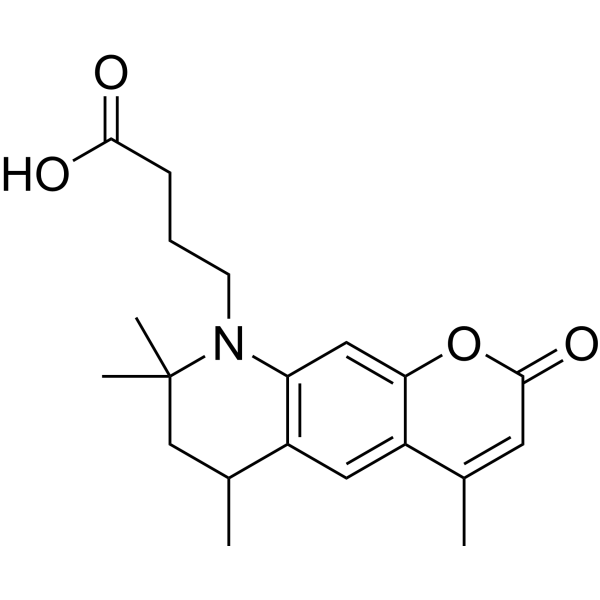
- HY-D2038
-
|
|
Fluorescent Dye
|
Others
|
|
ATTO 550 alkyne is a new fluorescent marker based on the Rhodamine structure. It has strong absorption, high fluorescence quantum yield, high thermal stability and photochemical stability, and is suitable for single molecule detection and high-resolution microscopy. ATTO 550 alkyne is an alkyne derivative of ATTO 550 and can be used to label proteins or antibodies.
|
-

- HY-D1305
-
|
|
Fluorescent Dye
|
Others
|
|
ATTO 488 carboxylic acid is a new fluorescent label based on the Rhodamine structure. It has strong absorption, high fluorescence quantum yield, high thermal stability and photochemical stability, and is suitable for single molecule detection and high-resolution microscopy. ATTO 488 carboxylic acid is a carboxylic acid derivative of ATTO 488, which can be used to label proteins or antibodies.
|
-
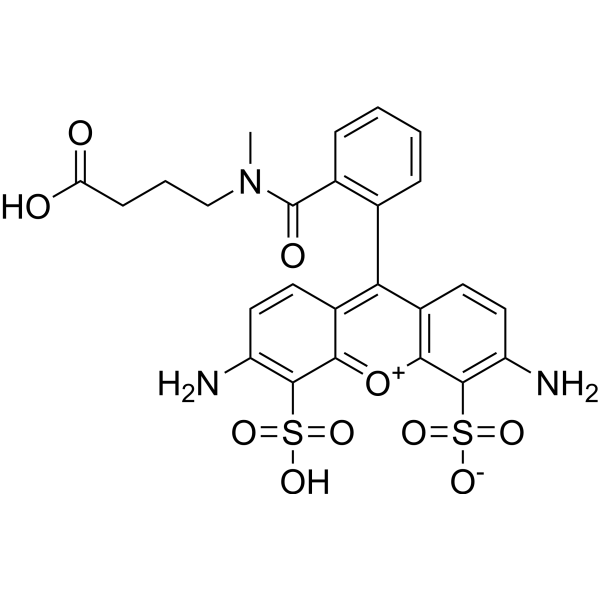
- HY-D1957
-
|
|
Fluorescent Dye
|
Others
|
|
ATTO 633 NHS ester is a new fluorescent marker based on the Rhodamine structure. It has strong absorption, high fluorescence quantum yield, high thermal stability and photochemical stability, and is suitable for single molecule detection and high-resolution microscopy. ATTO 633 NHS ester is an NHS ester derivative of ATTO 633 that can be used to label proteins or antibodies.
|
-
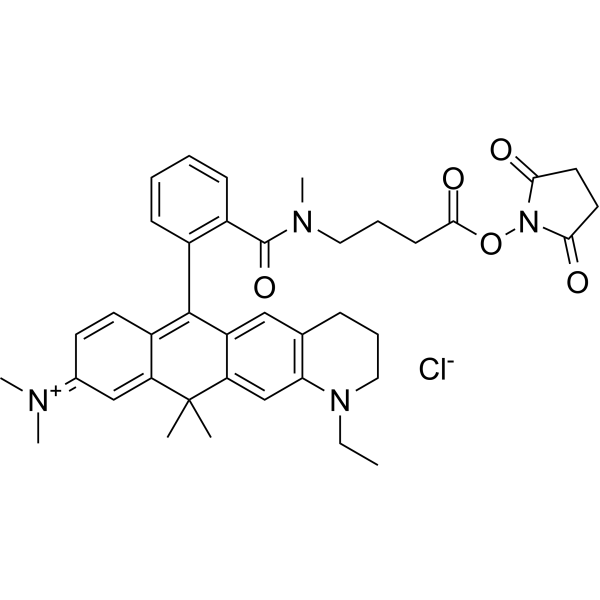
- HY-D2019
-
|
|
Fluorescent Dye
|
Others
|
|
ATTO 550 NHS ester is a new fluorescent marker based on the Rhodamine structure. It has strong absorption, high fluorescence quantum yield, high thermal stability and photochemical stability, and is suitable for single molecule detection and high-resolution microscopy. ATTO 550 NHS ester is an NHS ester derivative of ATTO 550 that can be used to label proteins or antibodies.
|
-

- HY-153524
-
|
|
Fluorescent Dye
|
Others
|
|
ATTO 425 NHS ester is a new fluorescent marker based on the Rhodamine structure. It has strong absorption, high fluorescence quantum yield, high thermal stability and photochemical stability, and is suitable for single molecule detection and high-resolution microscopy. ATTO 425 NHS ester is an NHS ester derivative of ATTO 425 that can be used to label proteins or antibodies.
|
-
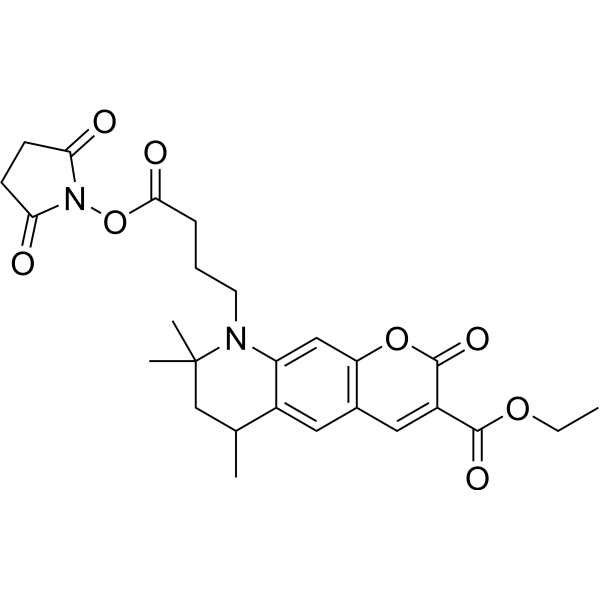
- HY-D1929
-
|
|
Fluorescent Dye
|
Others
|
|
ATTO 594 NHS ester is a new fluorescent marker based on the Rhodamine structure. It has strong absorption, high fluorescence quantum yield, high thermal stability and photochemical stability, and is suitable for single molecule detection and high-resolution microscopy. ATTO 594 NHS ester is an NHS ester derivative of ATTO 594 that can be used to label proteins or antibodies.
|
-

- HY-D2014
-
|
|
Fluorescent Dye
|
Others
|
|
ATTO 565 alkyne is a new fluorescent marker based on the Rhodamine structure. It has strong absorption, high fluorescence quantum yield, high thermal stability and photochemical stability, and is suitable for single molecule detection and high-resolution microscopy. ATTO 565 alkyne is an alkyne derivative of ATTO 565 and can be used to label proteins or antibodies.
|
-
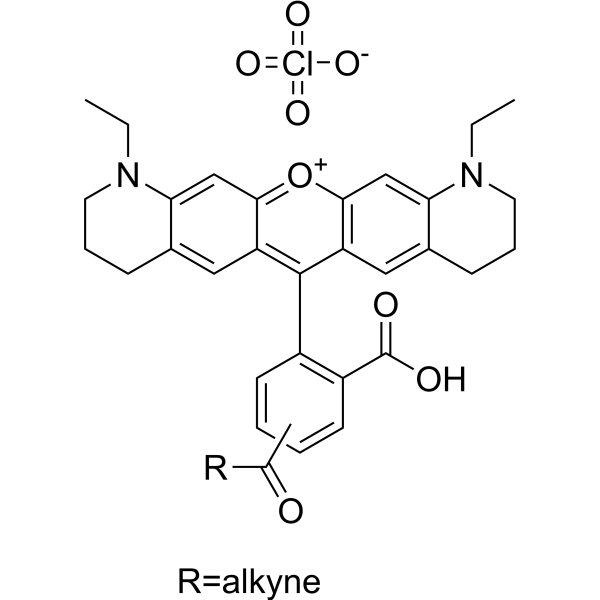
- HY-D2035
-
|
|
Fluorescent Dye
|
Others
|
|
ATTO 514 alkyne is a new fluorescent marker based on the Rhodamine structure. It has strong absorption, high fluorescence quantum yield, high thermal stability and photochemical stability, and is suitable for single molecule detection and high-resolution microscopy. ATTO 514 alkyne is an alkyne derivative of ATTO 514 and can be used to label proteins or antibodies.
|
-

- HY-D2002
-
|
|
Fluorescent Dye
|
Others
|
|
ATTO 488 maleimide is a new fluorescent marker based on the Rhodamine structure. It has strong absorption, high fluorescence quantum yield, high thermal stability and photochemical stability, and is suitable for single molecule detection and high-resolution microscopy. ATTO 488 maleimide is a maleimide derivative of ATTO 488, which can be used to label proteins or antibodies.
|
-

- HY-D2047
-
|
|
Fluorescent Dye
|
Others
|
|
ATTO 532 maleimide is a new fluorescent marker based on the Rhodamine structure. It has strong absorption, high fluorescence quantum yield, high thermal stability and photochemical stability, and is suitable for single molecule detection and high-resolution microscopy. ATTO 532 maleimide is a maleimide derivative of ATTO 532, which can be used to label proteins or antibodies.
|
-
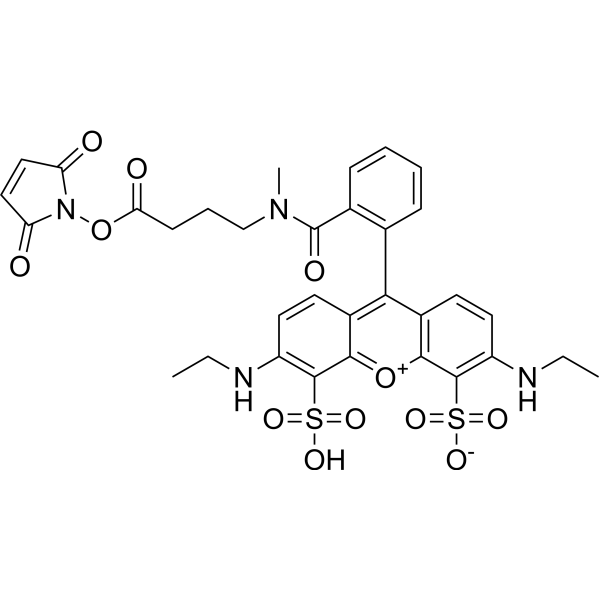
- HY-D2016
-
|
|
Fluorescent Dye
|
Others
|
|
ATTO 565 cadaverine is a new fluorescent marker based on the Rhodamine structure. It has strong absorption, high fluorescence quantum yield, high thermal stability and photochemical stability, and is suitable for single molecule detection and high-resolution microscopy. ATTO 565 cadaverine is a cadaverine derivative of ATTO 565, which can be used to label proteins or antibodies.
|
-
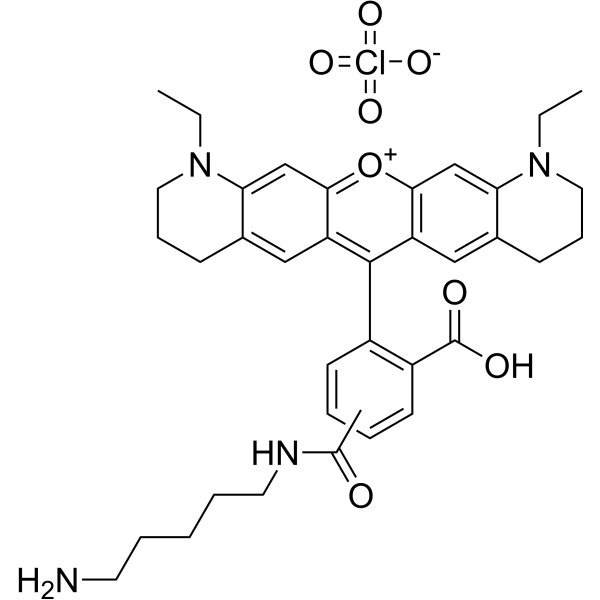
- HY-D1959
-
|
|
Fluorescent Dye
|
Others
|
|
ATTO 565 NHS ester is a new fluorescent marker based on the Rhodamine structure. It has strong absorption, high fluorescence quantum yield, high thermal stability and photochemical stability, and is suitable for single molecule detection and high-resolution microscopy. ATTO 565 NHS ester is an NHS ester derivative of ATTO 565 that can be used to label proteins or antibodies.
|
-
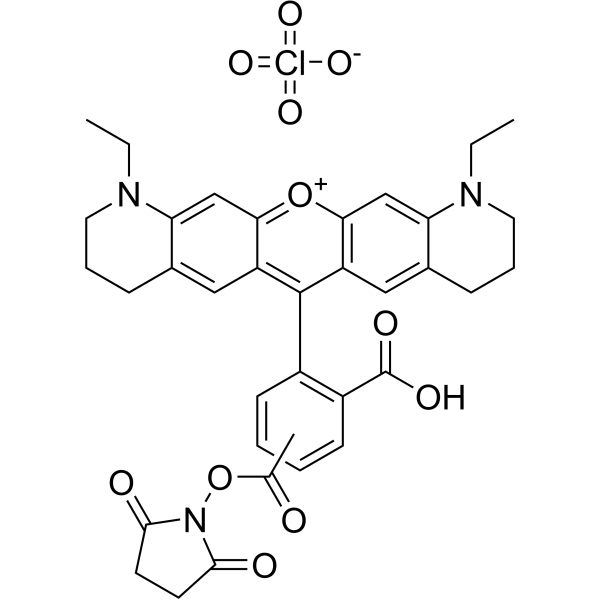
- HY-D1939
-
|
|
Fluorescent Dye
|
Others
|
|
ATTO 465 amine is a new fluorescent marker based on the Rhodamine structure. It has strong absorption, high fluorescence quantum yield, high thermal stability and photochemical stability, and is suitable for single molecule detection and high-resolution microscopy. ATTO 465 amine is an amine derivative of ATTO 465 and can be used to label proteins or antibodies.
|
-

- HY-D2063
-
|
|
Fluorescent Dye
|
Others
|
|
ATTO 740 maleimide is a new fluorescent marker based on the Rhodamine structure. It has strong absorption, high fluorescence quantum yield, high thermal stability and photochemical stability, and is suitable for single molecule detection and high-resolution microscopy. ATTO 740 maleimide is a maleimide derivative of ATTO 740, which can be used to label proteins or antibodies.
|
-

- HY-D2015
-
|
|
Fluorescent Dye
|
Others
|
|
ATTO 488 alkyne is a new fluorescent marker based on the Rhodamine structure. It has strong absorption, high fluorescence quantum yield, high thermal stability and photochemical stability, and is suitable for single molecule detection and high-resolution microscopy. ATTO 488 alkyne is an alkyne derivative of ATTO 488 and can be used to label proteins or antibodies.
|
-

- HY-D1933
-
|
|
Fluorescent Dye
|
Others
|
|
ATTO 590 maleimide is a new fluorescent marker based on the Rhodamine structure. It has strong absorption, high fluorescence quantum yield, high thermal stability and photochemical stability, and is suitable for single molecule detection and high-resolution microscopy. ATTO 590 maleimide is a maleimide derivative of ATTO 590, which can be used to label proteins or antibodies.
|
-
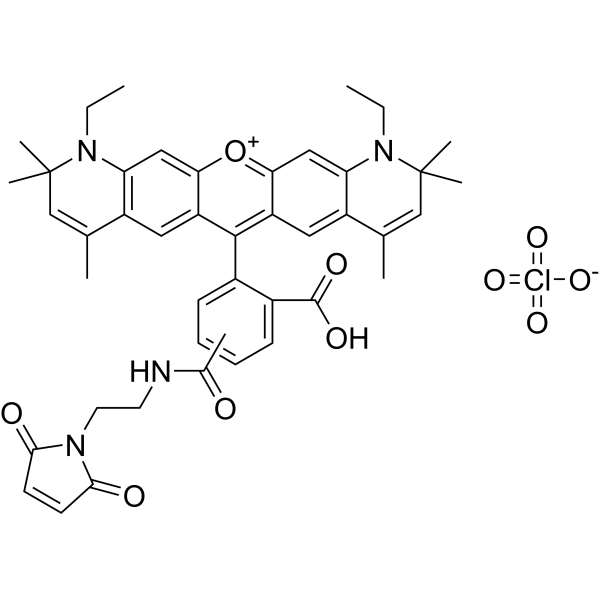
- HY-D2059
-
|
|
Fluorescent Dye
|
Others
|
|
ATTO 700 maleimide is a new fluorescent marker based on the Rhodamine structure. It has strong absorption, high fluorescence quantum yield, high thermal stability and photochemical stability, and is suitable for single molecule detection and high-resolution microscopy. ATTO 700 maleimide is a maleimide derivative of ATTO 700, which can be used to label proteins or antibodies.
|
-

- HY-D2058
-
|
|
Fluorescent Dye
|
Others
|
|
ATTO 700 NHS ester is a new fluorescent marker based on the Rhodamine structure. It has strong absorption, high fluorescence quantum yield, high thermal stability and photochemical stability, and is suitable for single molecule detection and high-resolution microscopy. ATTO 700 NHS ester is an NHS ester derivative of ATTO 700 that can be used to label proteins or antibodies.
|
-

- HY-D2026
-
|
|
Fluorescent Dye
|
Others
|
|
ATTO 514 NHS ester is a new fluorescent marker based on the Rhodamine structure. It has strong absorption, high fluorescence quantum yield, high thermal stability and photochemical stability, and is suitable for single molecule detection and high-resolution microscopy. ATTO 514 NHS ester is an NHS ester derivative of ATTO 514 that can be used to label proteins or antibodies.
|
-

- HY-D1999
-
|
|
Fluorescent Dye
|
Others
|
|
ATTO 665 NHS ester is a new fluorescent marker based on the Rhodamine structure. It has strong absorption, high fluorescence quantum yield, high thermal stability and photochemical stability, and is suitable for single molecule detection and high-resolution microscopy. ATTO 665 NHS ester is an NHS ester derivative of ATTO 665 that can be used to label proteins or antibodies.
|
-

- HY-D1932
-
|
|
Fluorescent Dye
|
Others
|
|
ATTO 590 NHS ester is a new fluorescent marker based on the Rhodamine structure. It has strong absorption, high fluorescence quantum yield, high thermal stability and photochemical stability, and is suitable for single molecule detection and high-resolution microscopy. ATTO 590 NHS ester is an NHS ester derivative of ATTO 590 that can be used to label proteins or antibodies.
|
-
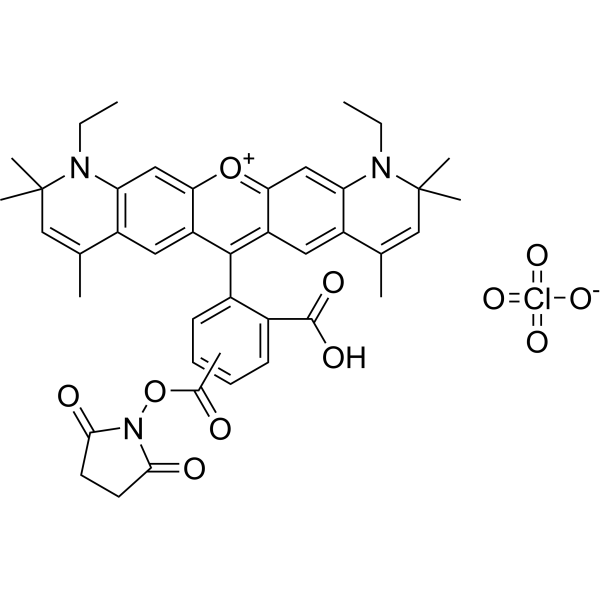
- HY-D2073
-
|
|
Fluorescent Dye
|
Others
|
|
ATTO 680 NHS ester is a new fluorescent marker based on the Rhodamine structure. It has strong absorption, high fluorescence quantum yield, high thermal stability and photochemical stability, and is suitable for single molecule detection and high-resolution microscopy. ATTO 680 NHS ester is an NHS ester derivative of ATTO 680 that can be used to label proteins or antibodies.
|
-
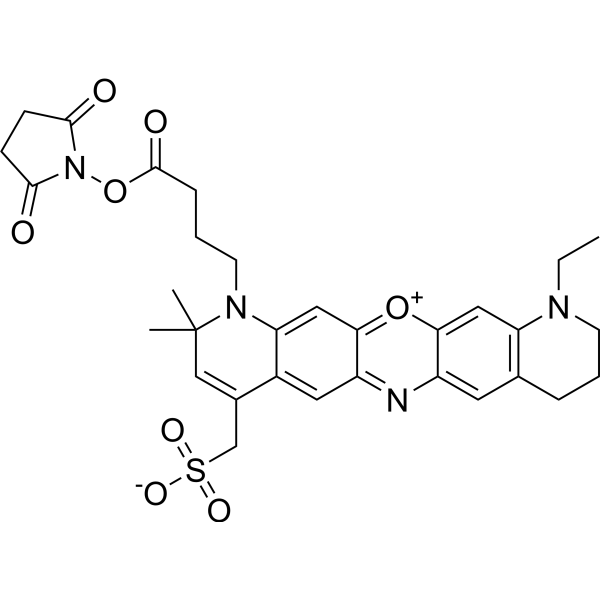
- HY-D2074
-
|
|
Fluorescent Dye
|
Others
|
|
ATTO 680 maleimide is a new fluorescent marker based on the Rhodamine structure. It has strong absorption, high fluorescence quantum yield, high thermal stability and photochemical stability, and is suitable for single molecule detection and high-resolution microscopy. ATTO 680 maleimide is a maleimide derivative of ATTO 680, which can be used to label proteins or antibodies.
|
-

- HY-D2021
-
|
|
Fluorescent Dye
|
Others
|
|
ATTO 550 maleimide is a new fluorescent marker based on the Rhodamine structure. It has strong absorption, high fluorescence quantum yield, high thermal stability and photochemical stability, and is suitable for single molecule detection and high-resolution microscopy. ATTO 550 maleimide is a maleimide derivative of ATTO 550, which can be used to label proteins or antibodies.
|
-

- HY-D1917
-
|
|
Fluorescent Dye
|
Others
|
|
ATTO 390 NHS ester is a new fluorescent marker based on the Rhodamine structure. It has strong absorption, high fluorescence quantum yield, high thermal stability and photochemical stability, and is suitable for single molecule detection and high-resolution microscopy. ATTO 390 NHS ester is an NHS ester derivative of ATTO 390 that can be used to label proteins or antibodies.
|
-
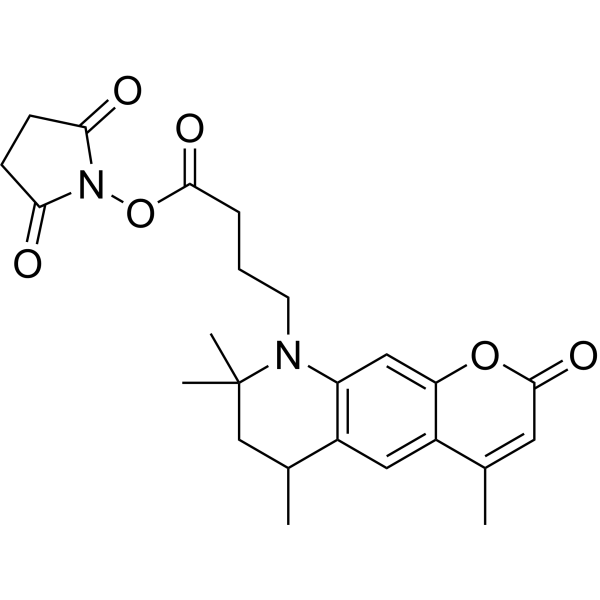
- HY-D1961
-
|
|
Fluorescent Dye
|
Others
|
|
ATTO 565 maleimide is a new fluorescent marker based on the Rhodamine structure. It has strong absorption, high fluorescence quantum yield, high thermal stability and photochemical stability, and is suitable for single molecule detection and high-resolution microscopy. ATTO 565 maleimide is a maleimide derivative of ATTO 565, which can be used to label proteins or antibodies.
|
-
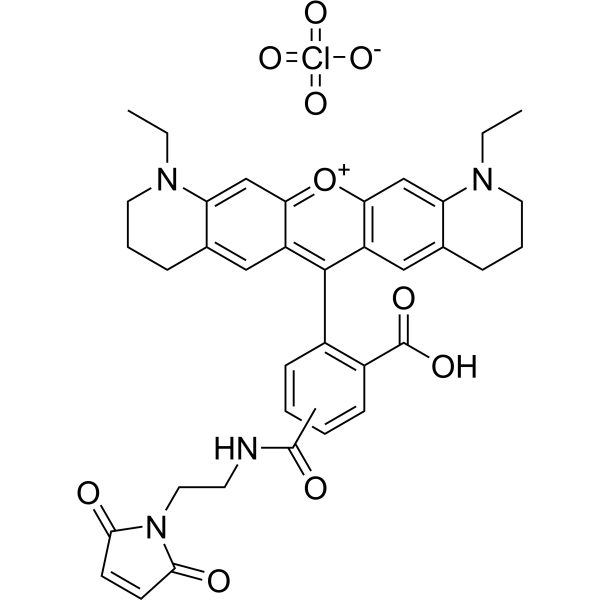
- HY-D2046
-
|
|
Fluorescent Dye
|
Others
|
|
ATTO 532 NHS ester is a new fluorescent marker based on the Rhodamine structure. It has strong absorption, high fluorescence quantum yield, high thermal stability and photochemical stability, and is suitable for single molecule detection and high-resolution microscopy. ATTO 532 NHS ester is an NHS ester derivative of ATTO 532 that can be used to label proteins or antibodies.
|
-
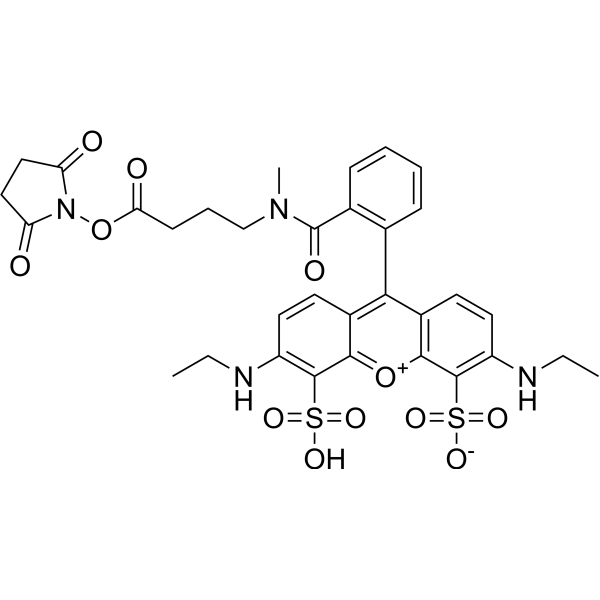
- HY-D2052
-
|
|
Fluorescent Dye
|
Others
|
|
ATTO 532 iodacetamid is a new fluorescent marker based on the Rhodamine structure. It has strong absorption, high fluorescence quantum yield, high thermal stability and photochemical stability, and is suitable for single molecule detection and high-resolution microscopy. ATTO 532 iodacetamid is an iodoacetamide derivative of ATTO 532, which can be used to label proteins or antibodies.
|
-
- HY-D2001
-
|
|
Fluorescent Dye
|
Others
|
|
ATTO 488 NHS ester is a new fluorescent marker based on the Rhodamine structure. It has strong absorption, high fluorescence quantum yield, high thermal stability and photochemical stability, and is suitable for single molecule detection and high-resolution microscopy. ATTO 488 NHS ester is an NHS ester derivative of ATTO 488 that can be used to label proteins or antibodies.
|
-
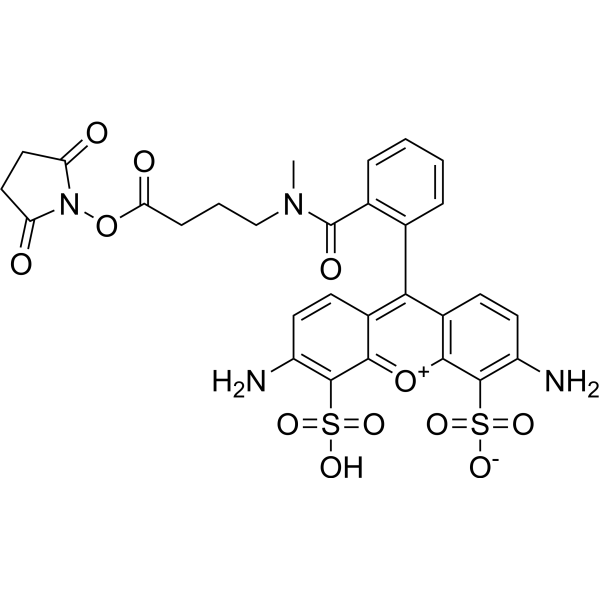
- HY-D1935
-
|
|
Fluorescent Dye
|
Others
|
|
ATTO 465 NHS ester is a new fluorescent marker based on the Rhodamine structure. It has strong absorption, high fluorescence quantum yield, high thermal stability and photochemical stability, and is suitable for single molecule detection and high-resolution microscopy. ATTO 465 NHS ester is an NHS ester derivative of ATTO 465 that can be used to label proteins or antibodies.
|
-
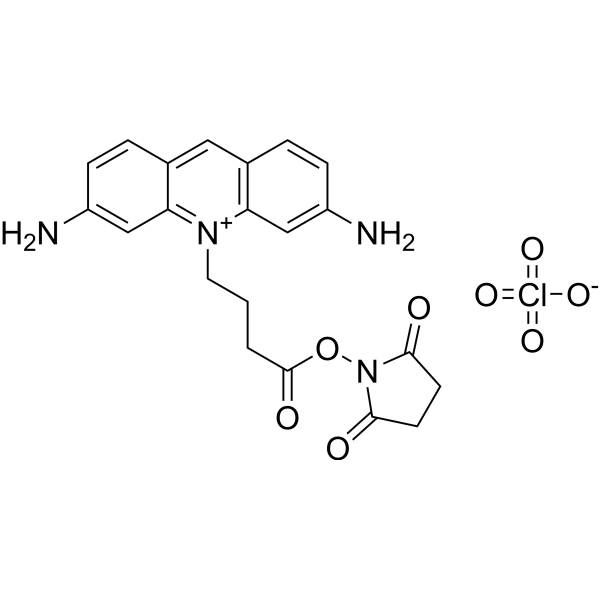
- HY-D1946
-
|
|
Fluorescent Dye
|
Others
|
|
ATTO 590 alkyne is a new fluorescent marker based on the Rhodamine structure. It has strong absorption, high fluorescence quantum yield, high thermal stability and photochemical stability, and is suitable for single molecule detection and high-resolution microscopy. ATTO 590 alkyne is an alkyne derivative of ATTO 590 and can be used to label proteins or antibodies.
|
-

- HY-D2001A
-
|
|
Fluorescent Dye
|
Others
|
|
TTO 488 NHS ester TEA is a new fluorescent marker based on the Rhodamine structure. It has strong absorption, high fluorescence quantum yield, high thermal stability and photochemical stability, and is suitable for single molecule detection and high-resolution microscopy. TTO 488 NHS ester TEA is an NHS ester derivative of ATTO 488 that can be used to label proteins or antibodies.
|
-

- HY-D3349
-
-

- HY-D0053
-
|
6-Carboxy-X-Rhodamine
|
Fluorescent Dye
|
Others
|
|
6-ROX is a selective fluorescent probe and potential inhibitor of COX-2. 6-ROX binds to the active site of COX-2 and inhibits its conversion of arachidonic acid into prostaglandins. 6-ROX is often used in the field of optical imaging related to tumors and inflammation, and helps detect diseased tissues with high expression of COX-2 .
|
-
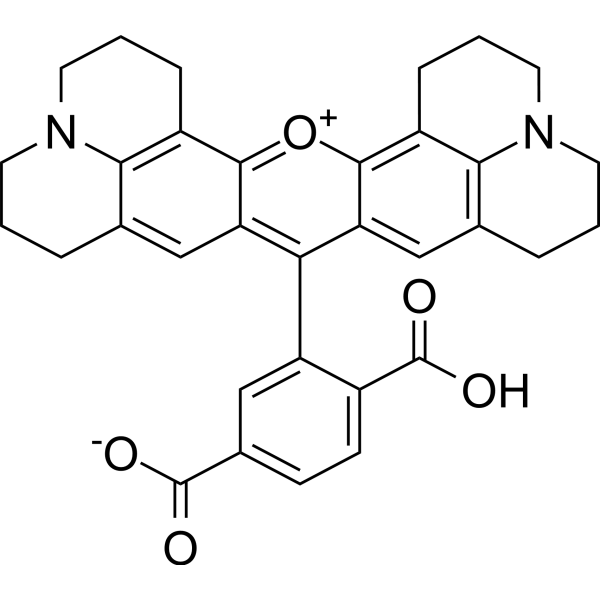
- HY-D0984
-
|
|
Fluorescent Dye
|
Inflammation/Immunology
|
|
Rhodamine dyes are membrane-permeable cationic fluorescent probes that specifically recognize mitochondrial membrane potentials, thereby attaching to mitochondria and producing bright fluorescence, and at certain concentrations, rhodamine dyes have low toxicity to cells, so they are commonly used to detect mitochondria in animal cells, plant cells, and microorganisms .
|
-
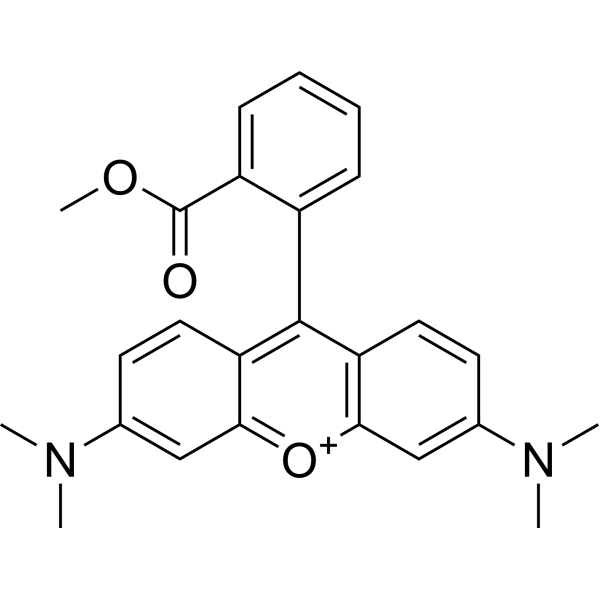
- HY-D0985A
-
TMRE
Maximum Cited Publications
75 Publications Verification
TetramethylRhodamine ethyl ester perchlorate
|
Fluorescent Dye
|
Others
|
|
Rhodamine dyes are membrane-permeable cationic fluorescent probes that specifically recognize mitochondrial membrane potentials, thereby attaching to mitochondria and producing bright fluorescence, and at certain concentrations, rhodamine dyes have low toxicity to cells, so they are commonly used to detect mitochondria in animal cells, plant cells, and microorganisms .
|
-
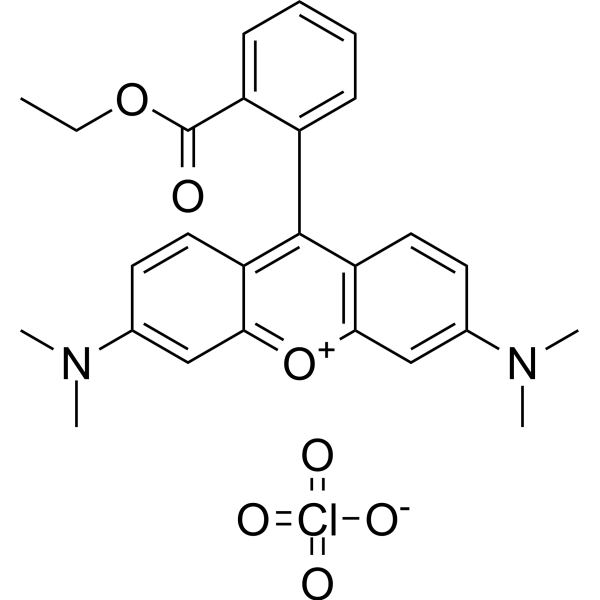
- HY-D0984A
-
|
T668
|
Fluorescent Dye
|
Others
|
|
Rhodamine dyes are membrane-permeable cationic fluorescent probes that specifically recognize mitochondrial membrane potentials, thereby attaching to mitochondria and producing bright fluorescence, and at certain concentrations, rhodamine dyes have low toxicity to cells, so they are commonly used to detect mitochondria in animal cells, plant cells, and microorganisms .
|
-
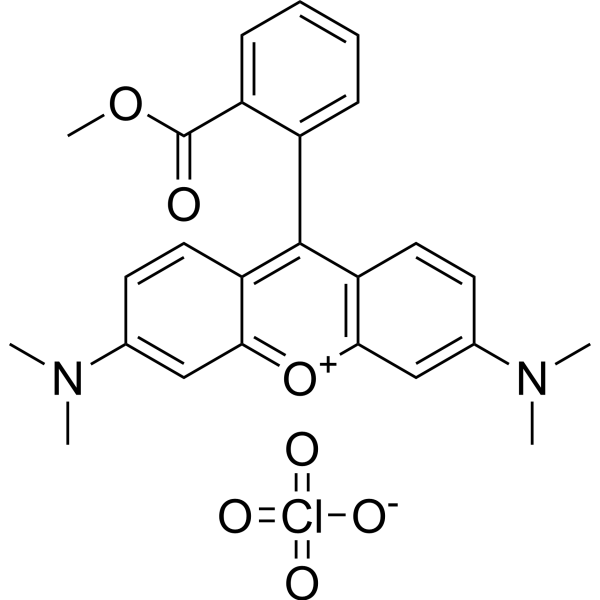
- HY-D1395
-
-
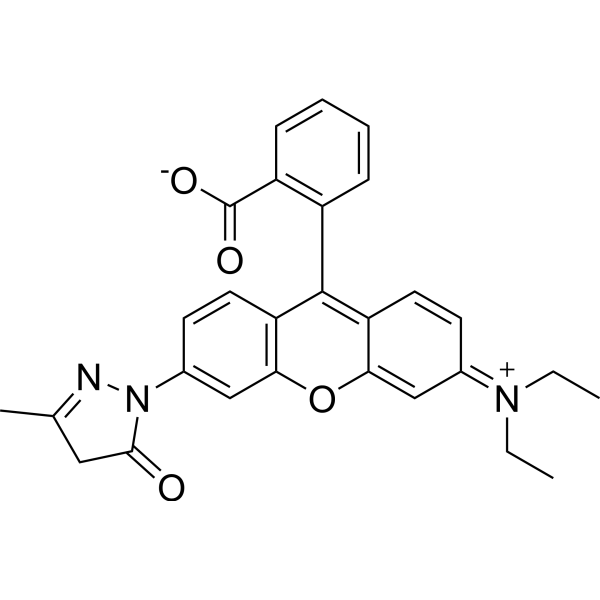
- HY-D2743
-
|
|
Fluorescent Dye
|
Others
|
|
ROX alkyne, 6-isomer is an alkyne derivative of the bright red-emitting dye ROX (Rhodamine X, Rhodamine 101). Due to its quantum yield approaching unity, ROX is a popular dye for qPCR and microscopy applications. It is used for fluorescent labeling of azide-containing biomolecules via copper-catalyzed click reaction.
|
-

- HY-D2040
-
|
|
Fluorescent Dye
|
Others
|
|
ROX tetrazine is a derivative of ROX (Rhodamine X, Rhodamine 101) dye, a red-emitting fluorophore possessing high brightness and fluorescence quantum yield. This compound contains tetrazine moiety that reacts with trans-cycloalkenes and other strained olefins in inverse electron demand Diels-Alder reaction (IEDDA). The reaction is very quick and specific.
|
-

- HY-DY1023
-
|
|
Fluorescent Dye
|
Others
|
Rhodamine dyes are membrane-permeable cationic fluorescent probes that specifically recognize mitochondrial membrane potentials, thereby attaching to mitochondria and producing bright fluorescence, and at certain concentrations, rhodamine dyes have low toxicity to cells, so they are commonly used to detect mitochondria in animal cells, plant cells, and microorganisms .
Solvent and concentration: DMSO: 10 mM
|
-

- HY-DY1042
-
|
|
Fluorescent Dye
|
Others
|
Rhodamine dyes are membrane-permeable cationic fluorescent probes that specifically recognize mitochondrial membrane potentials, thereby attaching to mitochondria and producing bright fluorescence, and at certain concentrations, rhodamine dyes have low toxicity to cells, so they are commonly used to detect mitochondria in animal cells, plant cells, and microorganisms .
Solvent and concentration: DMSO: 10 mM
|
-

- HY-D2740
-
|
|
Fluorescent Dye
|
Others
|
|
ROX azide, 6-isomer is an alkyne-reactive derivative of ROX (Rhodamine X, Rhodamine 101) dye. ROX is a red-emitting fluorophore possessing high brightness and fluorescence quantum yield. This reagent is a pure 6-isomer. It is used for labeling alkyne and cycloalkyne-containing biomolecules via copper-catalyzed and copper-free click chemistry reactions.
|
-

- HY-D1774
-
-
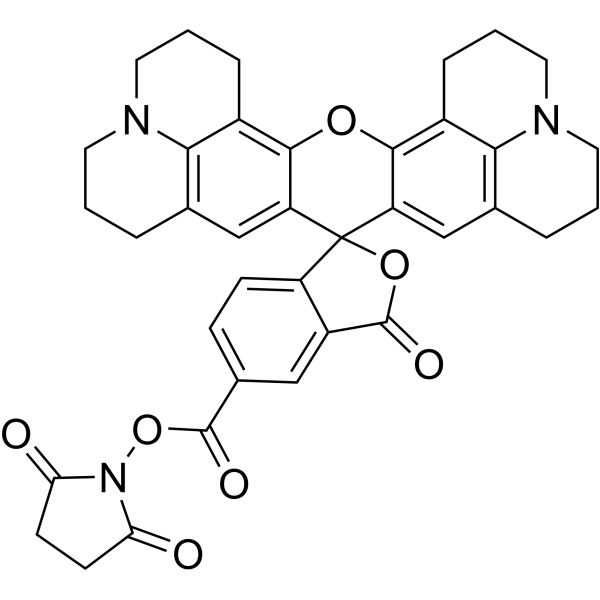
- HY-D0828
-
|
|
DNA Stain
MOFs
|
Others
|
|
3,6-Dichlorotrimellitic acid is the key precursor that is used for preparing a variety of dichlorinated fluoresceins and rhodamines such as TET and HEX.
|
-
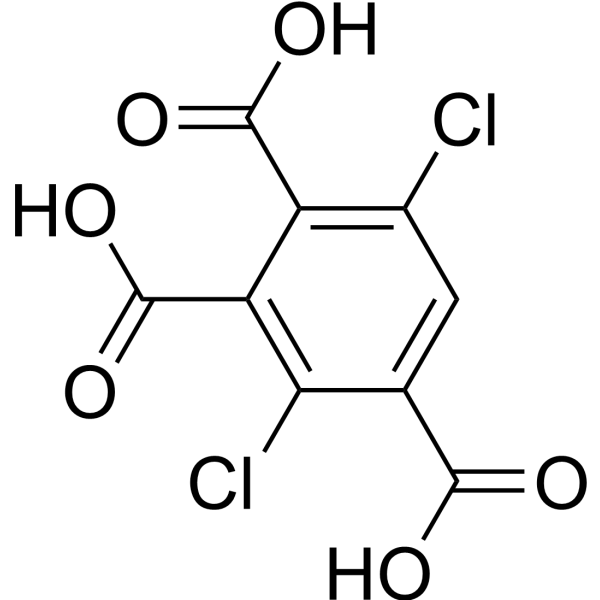
- HY-D0829
-
|
|
DNA Stain
|
Others
|
|
3,6-Dichlorotrimellitic anhydride is the key precursor that is used for preparing a variety of dichlorinated fluoresceins and rhodamines such as TET and HEX.
|
-
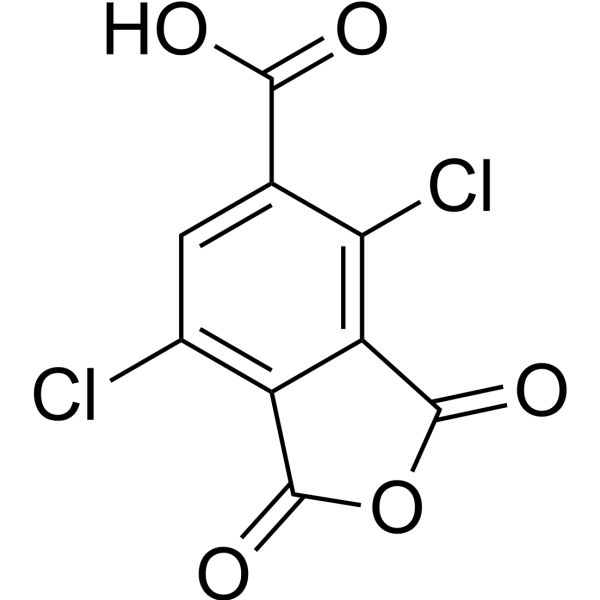
- HY-172268
-
|
|
Fluorescent Dye
|
Others
|
|
R6G phosphoramidite for oligonucleotide synthesis, pure 6-isomer. R6G (rhodamine 6G) is a xanthene dye of the rhodamine family with high fluorescence quantum yield and high molar extinction coefficient. Relative to those of fluorescein, the absorption (518 nm) and emission (542 nm) maxima of 6-R6G are shifted into the long-wave region.
|
-

- HY-W247098
-
|
DHR 6G
|
Reactive Oxygen Species (ROS)
|
Cancer
|
|
Dihydrorhodamine 6G (DHR 6G) is the reduced form of Rhodamine 6G, which is used as fluorescent mitochondrial dye. It is nonfluorescent, but it readily enters most of the cells and is oxidized by oxidative species or by cellular redox systems to the fluorescent rhodamine 6G that accumulates in mitochondrial membranes. Dihydrorhodamine 6G is useful for detecting reactive oxygen species (ROS) including superoxide .
|
-
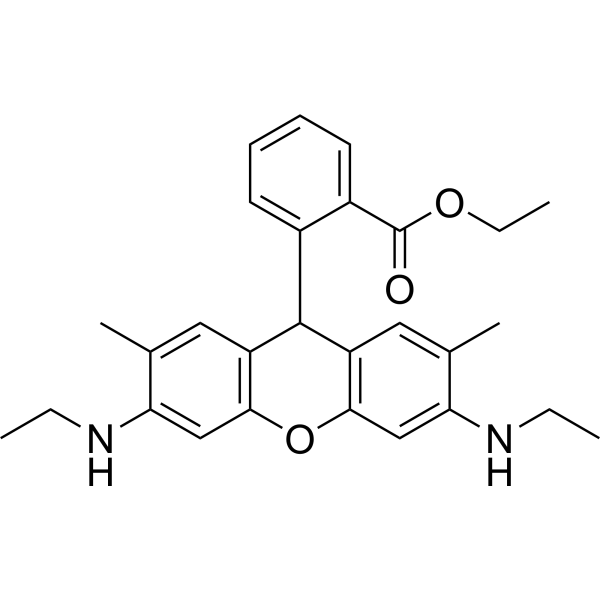
- HY-D3284
-
|
|
Fluorescent Dye
|
Others
|
|
CSF1 is a silicon-rhodamine-based, fluorescence-activatable probe with selectivity for Cu +. CSF1 colocalizes with the endoplasmic reticulum in live cells .
|
-

- HY-D1350
-
|
|
Fluorescent Dye
|
|
|
5-ROX-alkyne is a rhodamine dye that labels DNA fragments. It enables visualization of the results of capillary electrophoresis genotyping experiments and gel shift experiments.
|
-
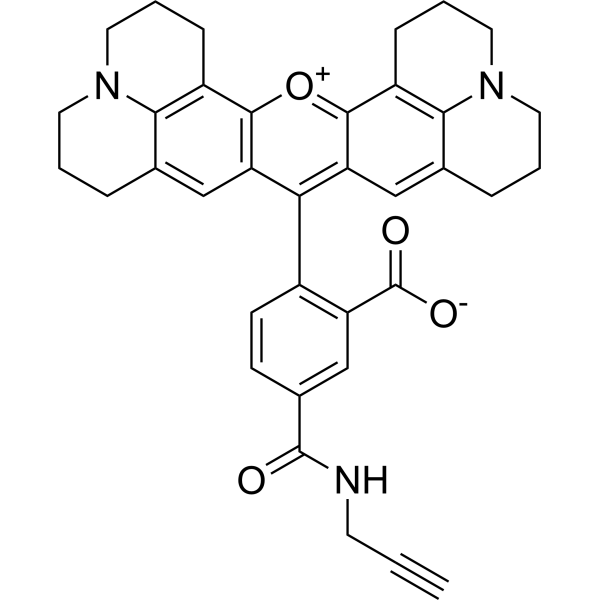
- HY-D2243
-
|
|
Fluorescent Dye
|
Others
|
|
Cy3.5 tetrazineis a Tetrazine modified Cy3.5 fluorescent dye. SiR-tetrazine is a click chemistry reagent, it contains a Tetrazine group that can undergo an inverse electron demand Diels-Alder reaction (iEDDA) with molecules containing TCO groups .
|
-
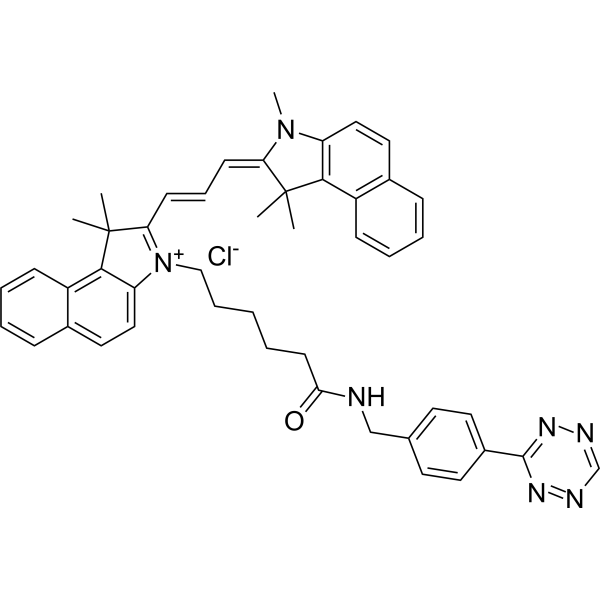
- HY-W800832
-
|
|
Fluorescent Dye
|
Others
|
|
MB 660R DBCO is a bright and photostable far-red dye that emits fluorescence at about 685 nm in the borderline spectral region between far-red and near-IR. Although the absorption maximum is at around 665 nm, this dye can be sufficiently excited by the 633 or 635 nm laser. MB 660R DBCO is water soluble and pH-insensitive from pH 4 to pH 10. MB 660R DBCO is a rhodamine-based dye, and like rhodamine dyes in general, it is very bright and exceptionally photostable.
|
-

- HY-D3151
-
|
|
Fluorescent Dye
|
Cancer
|
|
RHBCu is a rhodamine-based azophenol derivative and a fluorescent indicator for Cu 2+. RHBCu exhibits high selectivity for Cu 2+ ions and enables fluorescent imaging of Cu 2+ in cancer cells .
|
-

- HY-D1311
-
|
|
Fluorescent Dye
|
|
|
R110 azide, 6-isomer is an isomer of rhodamine dye with an azide group that labels DNA fragments. It enables visualization of the results of capillary electrophoresis genotyping experiments and gel shift experiments.
|
-
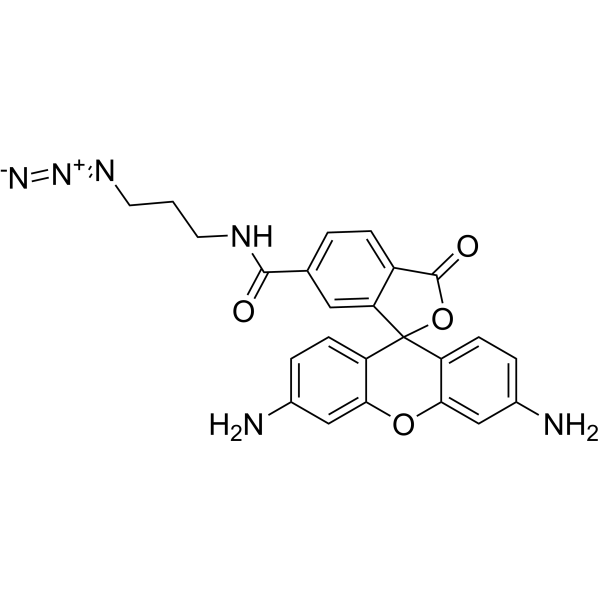
- HY-W998707
-
|
|
Fluorescent Dye
|
Others
|
|
TAMRA amine, 5-isomer hydrochloride is a rhodamine dye with excitation/emission maximum 553/575 nm. The amine group is reactive with carboxylic acids, activated NHS esters, carbonyls (ketone, aldehyde) etc.
|
-

- HY-163204
-
|
|
P-glycoprotein
|
Cancer
|
|
RhQ-DMB is a potent inhibitor of P-gp. RhQ-DMB exhibits high affinity and inhibitory activity in yeast strains expressing CmABCB1 .
|
-
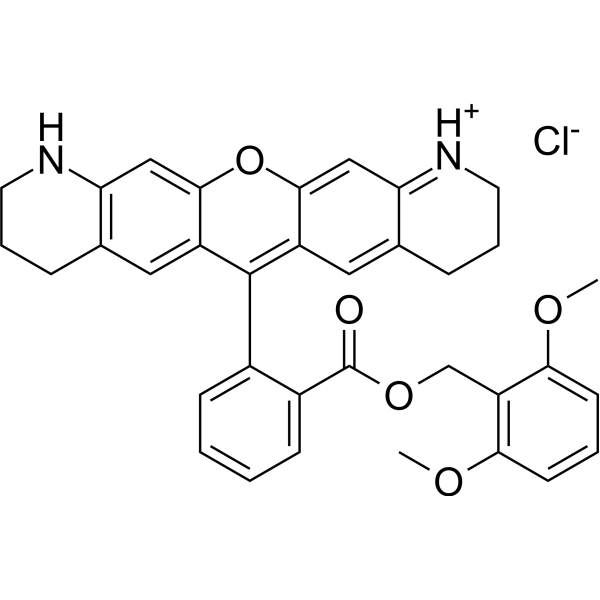
- HY-W719862
-
|
|
Liposome
|
Others
|
|
16:0 PDP PE belongs to a class of head group modified functionalized lipids. 16:0 PDP PE has been used in preparation of rhodamine high-density lipoprotein nanoparticle (Rh-HDL NP) synthesis.
|
-

- HY-P3432
-
|
|
Biochemical Assay Reagents
|
Others
|
|
DfTat is a dimer of the prototypical cell-penetrating peptide TAT. DfTat can deliver small molecules, peptides and proteins into live cells with a particularly high efficiency. DfTat labeled with the rhodamine can be used as a tracer for easy detection .
|
-
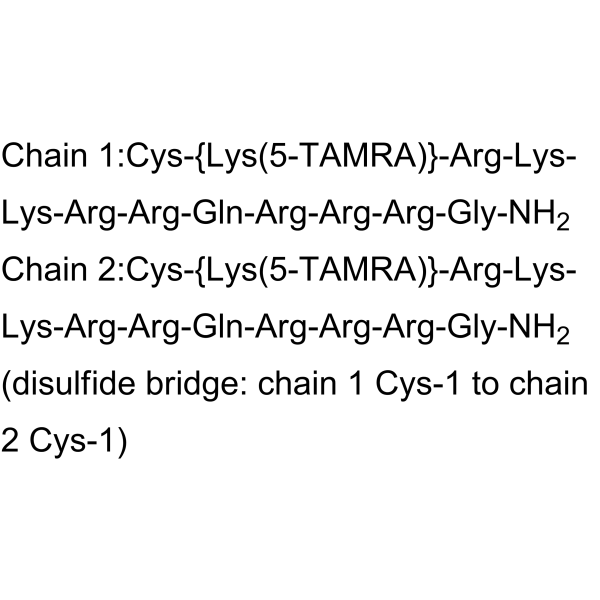
- HY-161159
-
DMHBO+
1 Publications Verification
|
Fluorescent Dye
|
Others
|
|
DMHBO+ is a cationic chromophore that binds to the Chili aptamer with a Kd of 12 nM. The Chili-DMHBO+ complex is an ideal fluorescence donor for FRET to the rhodamine dye Atto 590, suitable for imaging RNA in cells. Ex/Em=456/592 nm .
|
-
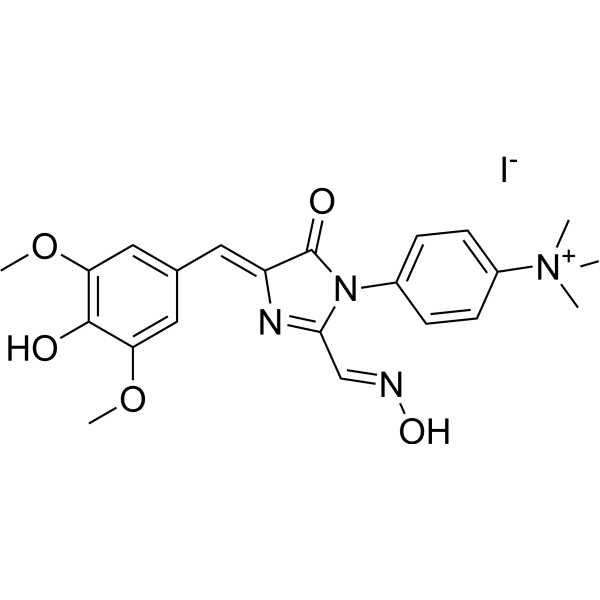
- HY-W800808
-
|
|
Fluorescent Dye
|
Others
|
|
ROX azide, 5-isomer is a red-emitting rhodamine dye possessing high brightness and fluorescence quantum yield. The azide group can react with alkyne, BCN, DBCO via Click Chemistry to yield a stable triazole linkage.
|
-

- HY-157483
-
|
|
P-glycoprotein
|
Cancer
|
|
P-gp inhibitor 18 (compound 6G) is a potent inhibitor of P-gp. P-gp inhibitor 18 inhibits rhodamine 123 efflux in the P-gp overexpressed leukemia cells, K562/Dox .
|
-
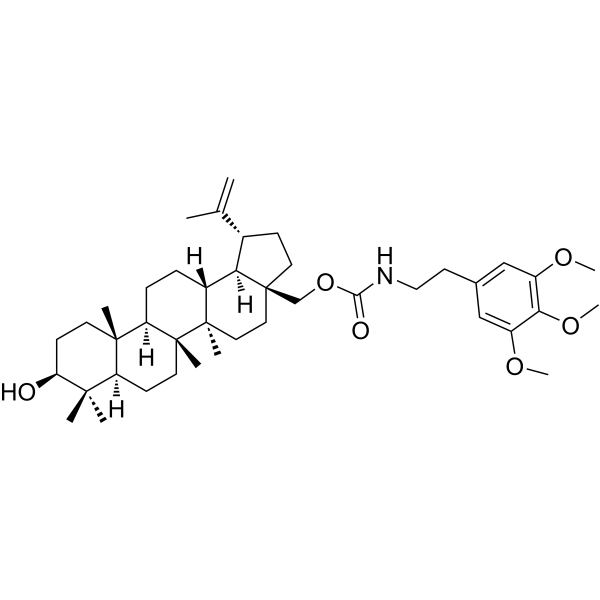
- HY-D0791
-
TRITC
1 Publications Verification
5(6)-TetramethylRhodamine isothiocyanate
|
Fluorescent Dye
|
Others
|
|
TRITC (5(6)-Tetramethylrhodamine isothiocyanate) is a commonly used fluorescent dye, belonging to the Rhodamine derivative family. It exhibits red fluorescence properties (Ex/Em ≈ 550/580 nm). TRITC can be used for cell labeling and imaging .
|
-
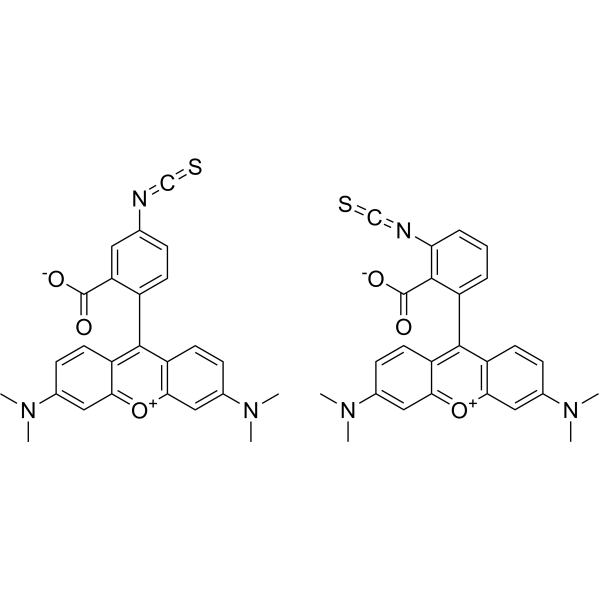
- HY-138147
-
|
|
Fluorescent Dye
|
Others
|
|
DCP-Rho1 is a rhodamine-labeled probe. DCP-Rho1 can be used for the detection of sulfenic acid-containing proteins. DCP-Rho1 shows λex of 560 nM, λem, 581 nm .
|
-
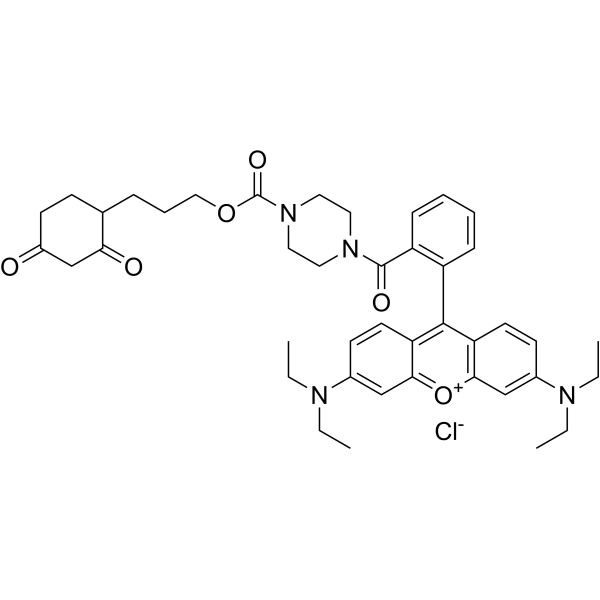
- HY-D2000
-
|
|
Fluorescent Dye
|
Others
|
|
ATTO 488 is a hydrophilic rhodamine-based fluorescent dye with strong absorption and high fluorescence quantum yield. ATTO 488 is suitable for flow cytometry (FACS), fluorescence in situ hybridization (FISH) and most other labeling uses (Ex/Em: 500/520 nm) .
|
-

- HY-101894
-
|
DHR 123
|
Fluorescent Dye
|
Others
|
|
Dihydrorhodamine 123 (DHR 123) is a non-fluorescent reactive oxygen species (ROS) indicator. Dihydrorhodamine 123 is oxidized to fluorescent Rhodamine 123 (HY-D0816) within cells in the presence of reactive oxygen species and it localizes in mitochondria (Ex/Em = 515/536 nm).
|
-
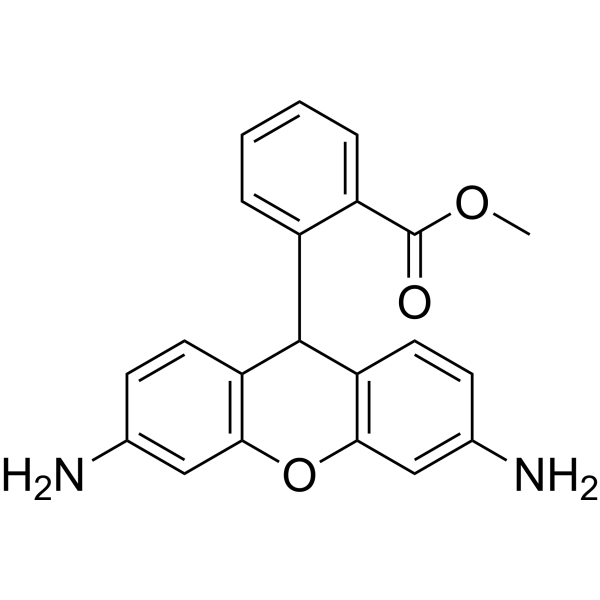
- HY-D2155
-
|
|
Fluorescent Dye
|
Others
|
|
Texas red-X 4-succinimidyl ester is a derivative of Texas Red (HY-101878), an amphoteric rhodamine red fluorescent dye. Texas Red is widely used to study neuronal morphology and as a cell type-selective fluorescent marker for astrocytes, both in vivo and in slice preparations.
|
-
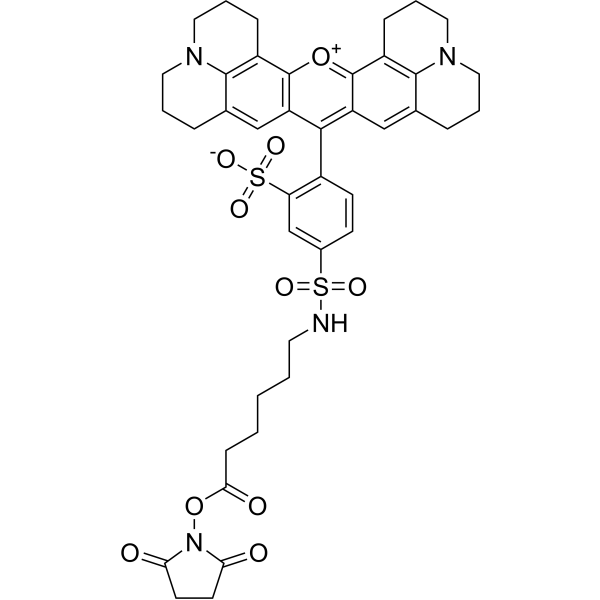
- HY-D1756
-
|
|
Fluorescent Dye
|
Others
|
|
ROX NHS ester, 6-isomer is a highly fluorescent, and photostable rhodamine dye for various applications. ROX labeled oligonucleotide probes are often used in qPCR, and qPCR instruments have ROX channel. This is reactive dye for the labeling of amino-groups in peptides, proteins, and amino-oligonucleotides. Pure single isomer.
|
-
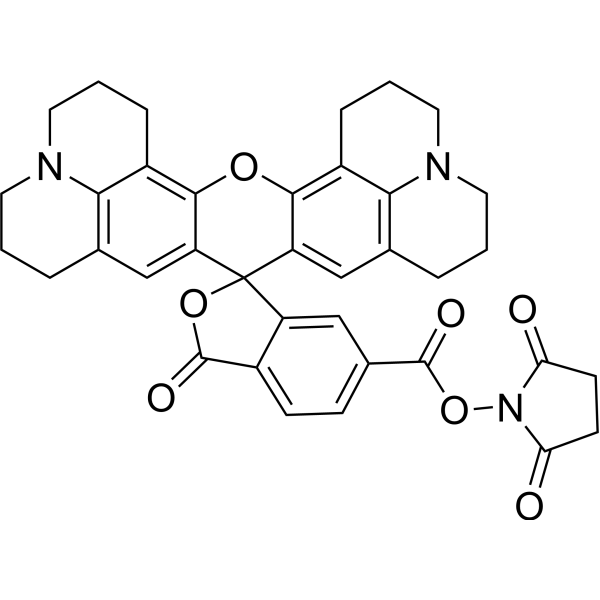
- HY-D2379A
-
|
|
Fluorescent Dye
|
|
|
closed-HMRG is HMRG with closed spirocyclic structure. Ac-HMRG, an acetylated derivative of Hydroxymethyl rhodamine green, exists as a closed spirocyclic structure in aqueous solution at physiological pH, whereas HMRG itself takes an open nonspirocyclic structure. Ac-HMRG is colorless and nonfluorescent and HMRG is strongly fluorescent .
|
-

- HY-DY1037
-
|
|
Fluorescent Dye
|
Others
|
Dihydrorhodamine 123 (DHR 123) (solution) is a non-fluorescent reactive oxygen species (ROS) indicator. Dihydrorhodamine 123 is oxidized to fluorescent Rhodamine 123 (HY-D0816) within cells in the presence of reactive oxygen species and it localizes in mitochondria (Ex/Em = 515/536 nm).
Solvent and concentration: DMSO: 10 mM
|
-

- HY-D2222
-
|
|
Fluorescent Dye
|
Others
|
|
5-HMSiR-Hoechst is a DNA probe. 5-HMSiR-Hoechst comprises Hoechst 33258 and spontaneously blinking far-red hydroxymethyl silicon-rhodamine (HMSiR). 5-HMSiR-Hoechst can stain living cells. Ex/Em=640 nm/675 nm .
|
-
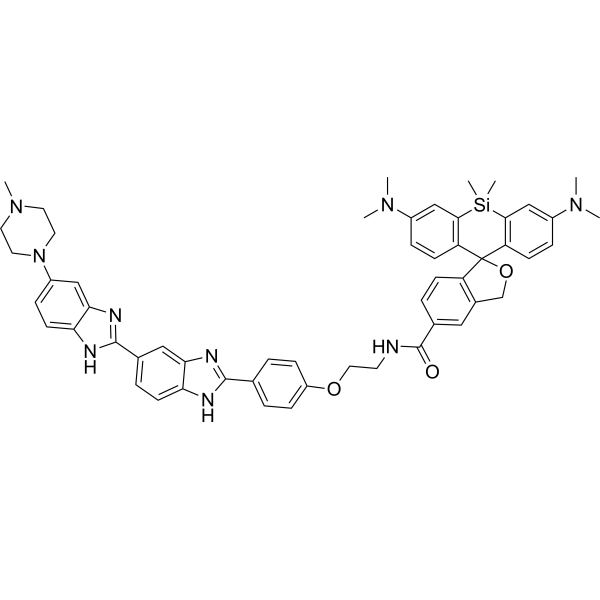
- HY-157484
-
|
|
P-glycoprotein
|
Cancer
|
|
P-gp inhibitor 19 (Compound 6i) is a P-gp inhibitor. P-gp inhibitor 19 can inhibit the efflux of rhodamine 123 (HY-D0816) in P-gp-overexpressing leukemia cells K562/Dox and also restore the sensitivity of DOX-resistant cells .
|
-
- HY-D2754
-
|
|
Fluorescent Dye
|
Others
|
|
BP Light 550 acid is a vibrant orange-to-red fluorochrome with better performance t han other rhodamine derivatives, including BP Fluor 555, TRITC, and Cy3 dye for fluorescent applications. The high water solubility of BP Light Fluors means that a high dye-to-protein ratio can be attained without causing precipitation of the conjugates.
|
-

- HY-D2766
-
|
|
Fluorescent Dye
|
Others
|
|
BP Light 550 NHS ester is a vibrant orange-to-red fluorochrome with better performance than other rhodamine derivatives, including BP Fluor 555, TRITC, and Cy3 dye for fluorescent applications. The high water solubility of BP Light 550 means that a high dye-to-protein ratio can be attained without causing precipitation of the conjugates.
|
-

- HY-N7539
-
|
|
Others
|
Metabolic Disease
|
|
Cognac oil, mainly found in wine lees, has unique fatty acid profiles, including Palmitic acid (59.26%), Linoleic acid (11.92%), Myristic acid (8.97%), Oleic acid (8.3%) and other fatty acids. Cognac oil leads to a general increase in the permeation of R6G (Rhodamine 6G) across all the membranes .
|
-

- HY-D2379
-
|
|
Fluorescent Dye
|
Endocrinology
Cancer
|
HMRG is a type of hydroxymethyl rhodamine green fluorescent scaffold, featuring an open non-cyclic structure. HMRG can produce significant dynamic fluorescence changes through a one-step enzymatic reaction at physiological pH, which is useful for developing various probes. Fluorescent probes based on HMRG can be used for fluorescence detection of diseases such as tumors and diabetic nephropathy .
|
-

- HY-D3264
-
|
|
Fluorescent Dye
|
Others
|
|
SiR-PEG4-DBCO is a novel fluorescent labeling molecule that combines the superior fluorescent properties of silicon-rhodamine dyes with the functionalities of polyethylene glycol (PEG) and Click Chemistry. SiR dyes exhibit excellent photostability under identical excitation conditions, making them suitable for long-term cellular imaging (Ex = 640 nm, Em = 670–680 nm).
|
-

- HY-163324A
-
|
|
Cytochrome P450
|
Others
|
|
2-Me PeER is a rhodamine dye-based fluorescent probe that detects CYP3A4 activity. In fluorescence-activated cell sorting (FACS) based on CYP3A4 activity, homogeneous and functional human induced pluripotent stem cell (hiPSC)-derived hepatocytes and intestinal epithelial cells can be obtained with the aid of 2-Me PeER .
|
-
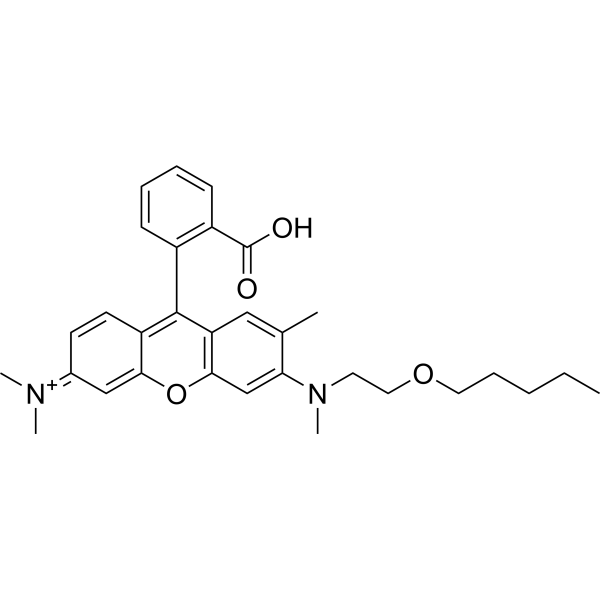
- HY-D1671
-
|
|
Fluorescent Dye
|
Others
|
|
TRITC-DHPE is a rhodamine-labeled glycerophosphate ethanolamine lipid, with head groups marked with bright red fluorescent TRITC dye (λEx/λEm=514/580 nm). TRITC-DHPE can be used for membrane fusion assay to trace lipid processing in intracellular phagocytosis. TRITC-DHPE can serves as an energy transfer receptor for NBD, BODIPY and fluorescein lipid probes .
|
-
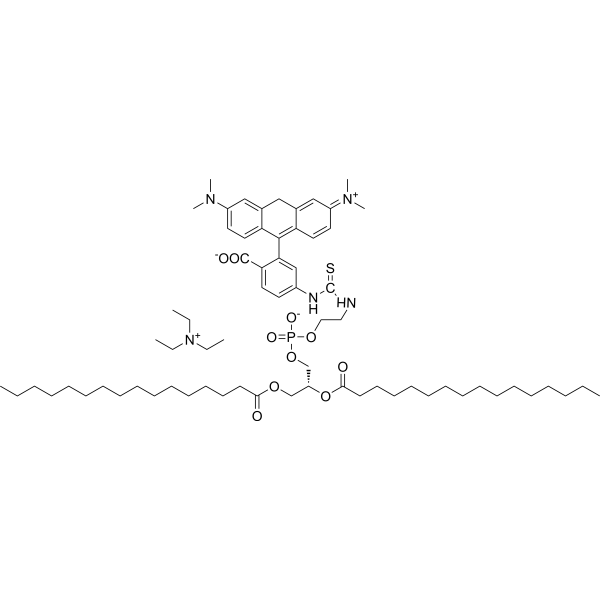
- HY-155032
-
|
|
P-glycoprotein
|
Cancer
|
|
P-gp inhibitor 15 (compound 7a) is a nonsubstrate inhibitor of P-glycoprotein (Pgp). P-gp inhibitor 15 inhibits Pgp-ATPase activity,and interfers Pgp-mediated Rhodamine123 efflux. P-gp inhibitor 15 also enhances the inhibitory efficacy of Paclitaxel (HY-B0015),inhibits tumor progress in nude mice KBV xenograft tumors model .
|
-
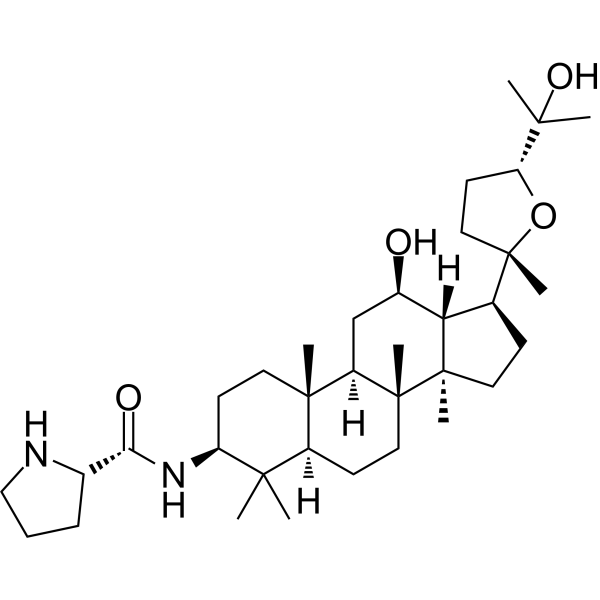
- HY-101894R
-
|
DHR 123 (Standard)
|
Fluorescent Dye
Reference Standards
|
Others
|
|
Dihydrorhodamine 123 (Standard) is the analytical standard of Dihydrorhodamine 123 (HY-101894). This product is intended for research and analytical applications. Dihydrorhodamine 123 (DHR 123) is a non-fluorescent reactive oxygen species (ROS) indicator. Dihydrorhodamine 123 is oxidized to fluorescent Rhodamine 123 (HY-D0816) within cells in the presence of reactive oxygen species and it localizes in mitochondria (Ex/Em = 515/536 nm).
|
-

- HY-D3360
-
|
|
Fluorescent Dye
|
Others
|
|
JF630-HTL is a fluorogenic Janelia Fluor (JF) Si-rhodamine HaloTag ligand. JF630-HTL covalently labels HaloTag fusion proteins in living cells. JF630-HTL displays low fluorescence in the unbound state, but exhibits a marked fluorescence enhancement upon binding to HaloTag. JF630-HTL can be used for live-cell imaging applications .
|
-

- HY-W800680
-
|
|
Fluorescent Dye
|
Others
|
|
BP Fluor 488 DBCO is a popular labeling dye used in copper-free Click Chemistry reactions. It will react with the azide group in antibody, proteins, peptides, amino-modified oligos, and other target molecules. The dye has an excitation peak at 499 nm and an emission peak at 520 nm. The conjugates are widely used in microscopy, flow cytometry, and other applications. BP Fluor 488 is a pure 5-sulfonated rhodamine molecule and it eliminates the lot-to-lot variation caused by two isomers ratio differences.
|
-

- HY-W781921
-
|
|
Fluorescent Dye
|
Others
|
|
BP Fluor 488 Alkyne is a popular labeling dye used in Click Chemistry reactions. It will react with the azide group in antibody, proteins, peptides, amino-modified oligos, and other target molecules. The dye has an excitation peak at 499 nm and an emission peak at 520 nm. The conjugates are widely used in microscopy, flow cytometry, and other applications. BP Fluor 488 is a pure 5-sulfonated rhodamine molecule and it eliminates the lot-to-lot variation caused by two isomers ratio differences.
|
-

- HY-116215
-
|
|
Fluorescent Dye
|
Others
|
|
2-NBDG is a fluorescently-labeled deoxyglucose analog that is used primarily to directly monitor glucose uptake by living cells and tissues. It is also used as a topical contrast reagent for the detection of neoplasia. 2-NBDG can be used in real-time confocal, high-resolution, or wide-field fluorescence microscopy as well as in flow cytometry. The probe can be excited by the Argon laser at 488 nm to give the environment-sensitive fluorescence. It has lower photostability than the rhodamine-based fluorescent probes.
|
-
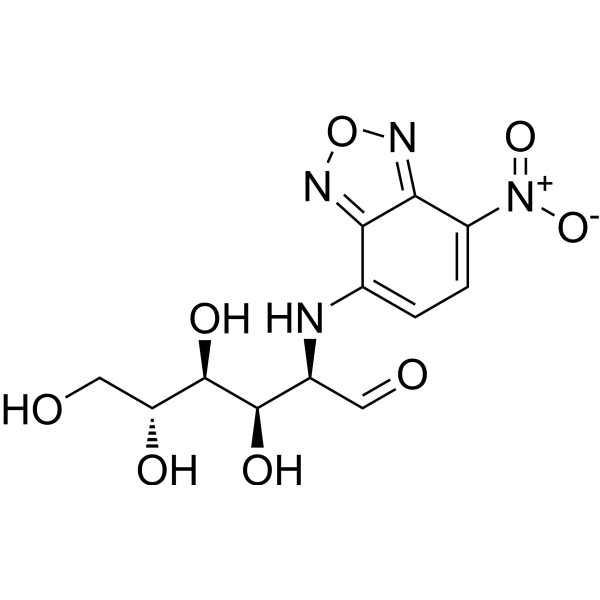
- HY-P6023B
-
|
|
Factor Xa
|
Cardiovascular Disease
|
|
D-Leu-Pro-Arg-Rh110-D-Pro acetate is a substrate for Factor Xa I (FXIa) with binding affinity. D-Leu-Pro-Arg-Rh110-D-Pro acetate consists of Rhodamine 110 (HY-D0817) linked to a peptide chain through a cleavable bond. Cleavable bond cleavage enhances fluorophore intensity. D-Leu-Pro-Arg-Rh110-D-Pro acetate can be used to detect FXIa activity .
|
-
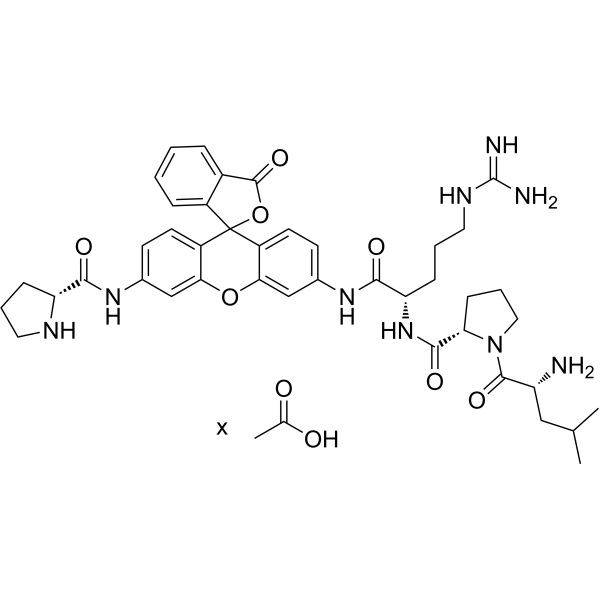
- HY-P6023
-
|
|
Factor Xa
|
Cardiovascular Disease
|
|
D-Leu-Pro-Arg-Rh110-D-Pro is a substrate for Factor Xa I (FXIa) with binding affinity. D-Leu-Pro-Arg-Rh110-D-Pro consists of Rhodamine 110 (HY-D0817) linked to a peptide chain through a cleavable bond. Cleavable bond cleavage enhances fluorophore intensity. D-Leu-Pro-Arg-Rh110-D-Pro can be used to detect FXIa activity .
|
-
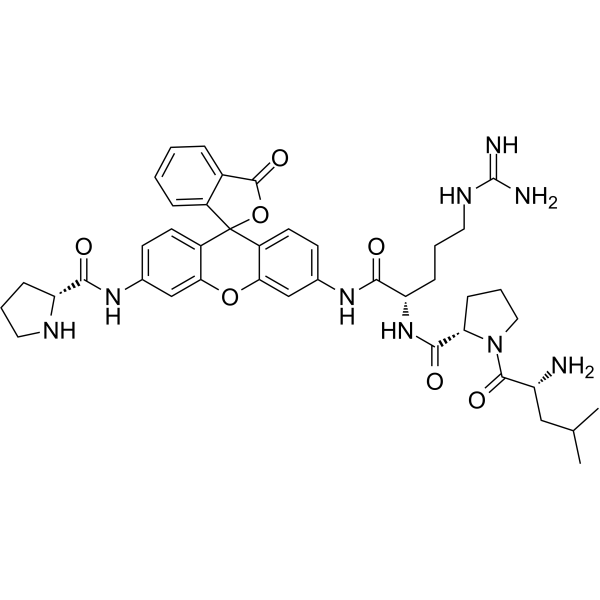
- HY-136894
-
|
|
Fluorescent Dye
|
Others
|
|
Rhod-5N is a cell-impermeant calcium-binding fluorescent dye composed of a BAPTA chelating group and a rhodamine fluorophore. Rhod-5N is often added to MOPS buffer to complex and indicate cation content. The selectivity of Rhod-5N for Cd 2+ is higher than other interfering cations ((Na+, K+, Mg 2+, Ca 2+, Zn 2+) except Pb 2+), and the detection limit is 3.1 μg/L .
|
-
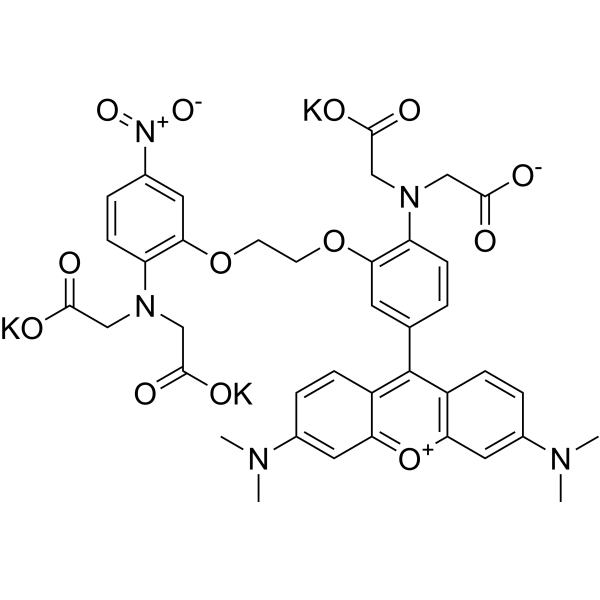
- HY-D2998
-
|
|
Fluorescent Dye
|
Others
|
|
ONOO-LysopH is a new Rhodamine-based near-infrared fluorescent probe. ONOO-LysopH is acid-sensitive, exhibiting rapid near-infrared fluorescence enhancement around 686 nm under acidic pH conditions. ONOO-LysopH also displays a rapid NIR turn-on fluorescence around 678 nm for ONOO− at physiological pH. ONOO-LysopH can target lysosomes to track lysosomal pH changes and image endogenous/exogenous ONOO− in live cells. ONOO-LysopH is applicable for cell imaging ONOO− and tracking lysosomal pH changes .
|
-

- HY-P6023A
-
|
|
Factor Xa
|
Cardiovascular Disease
|
|
D-Leu-Pro-Arg-Rh110-D-Pro TFA is a substrate for Factor Xa I (FXIa) with binding affinity. D-Leu-Pro-Arg-Rh110-D-Pro TFA consists of Rhodamine 110 (HY-D0817) linked to a peptide chain through a cleavable bond. Cleavable bond cleavage enhances fluorophore intensity. D-Leu-Pro-Arg-Rh110-D-Pro TFA can be used to detect FXIa activity .
|
-
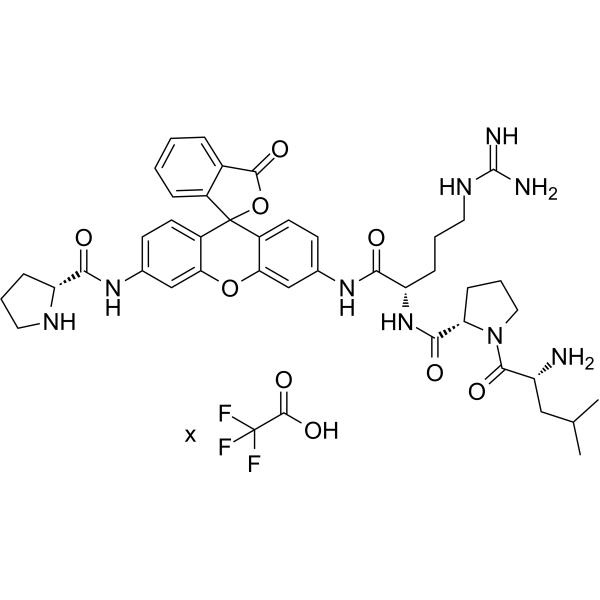
- HY-DY1019
-
|
|
Fluorescent Dye
|
Others
|
2-NBDG (solution) is a fluorescently-labeled deoxyglucose analog that is used primarily to directly monitor glucose uptake by living cells and tissues. It is also used as a topical contrast reagent for the detection of neoplasia. 2-NBDG can be used in real-time confocal, high-resolution, or wide-field fluorescence microscopy as well as in flow cytometry. The probe can be excited by the Argon laser at 488 nm to give the environment-sensitive fluorescence. It has lower photostability than the rhodamine-based fluorescent probes.
Solvent and Concentration: Sterile PBS: 5 mM
|
-

- HY-D2966
-
|
|
Fluorescent Dye
|
Others
|
|
TMR-NO-BG is a hybrid probe (Ex/Em: 557 nm/571 nm). TMR-NO-BG covalently connects the tetramethylrhodamine (TMR) lactone NO sensing unit with the SNAP-tag reactive benzyl guanine (BG) for achieving subcellular-specific nitric oxide (NO) detection .
|
-

- HY-162714
-
|
|
P-glycoprotein
|
Cancer
|
|
C3N-Dbn-Trp2 is an inhibitor for ATP-binding cassette transporter ABCB1. C3N-Dbn-Trp2 inhibits the ABCB1-mediated Rhodamine 123 (HY-D0816) efflux in cells HEK293T and HCT-15 with IC50 of 5.9 µM and 2.2 µM. C3N-Dbn-Trp2 inhibits the Doxorubicin (HY-15142A) efflux, enhances the cytotoxicity of Doxorubicin in ABCB1-expressing cells .
|
-

- HY-172166B
-
|
|
Fluorescent Dye
|
Neurological Disease
|
|
TRITC-lysine-dextran (MW 70kDa) is a fluorescent label prepared by the conjugation of TRITC (HY-D0791), lysine and dextran. TRITC-lysine-dextran (MW 70kDa) serves multiple functions as an axonal tracer, non-viral nanocarrier and fixable fluorescent clonal marker. TRITC-lysine-dextran (MW 70kDa) undergoes anterograde and retrograde transport within axons of sensory neurons, and acts as a non-viral delivery system to precisely deliver biomolecules to neurons. TRITC-lysine-dextran (MW 70kDa) remains stably retained during histological preparation, thereby supporting continuous observation in live or fixed samples .
|
-

- HY-D0996
-
|
|
DNA Stain
|
Others
|
|
Lds-751 is a nucleic acid stain that mainly detects DNA. Lds-751 is a nucleic acid stain that mainly detects DNA. Lds-751 has a high affinity for DNA and fluorescence is enhanced after binding, but the maximum emission wavelength is 670nm. Lds-751 and Thiazole orange can be used for the differentiation of red blood cells, platelets, reticulocytes, and nucleated cells and can be stimulated at 488nm. Studies have shown that LDS-751 binds almost exclusively to mitochondria when incubated with nucleated living cells. After nucleated Acridine Orange (HY-101879) staining and LDS-751 treatment of cells, confocal microscopy revealed almost no co-location of the cells. Staining with Rhodamine 123 (HY-D0816), a dye known to bind polarized mitochondria, was almost identical to the pattern observed with LDS-751 .
|
-
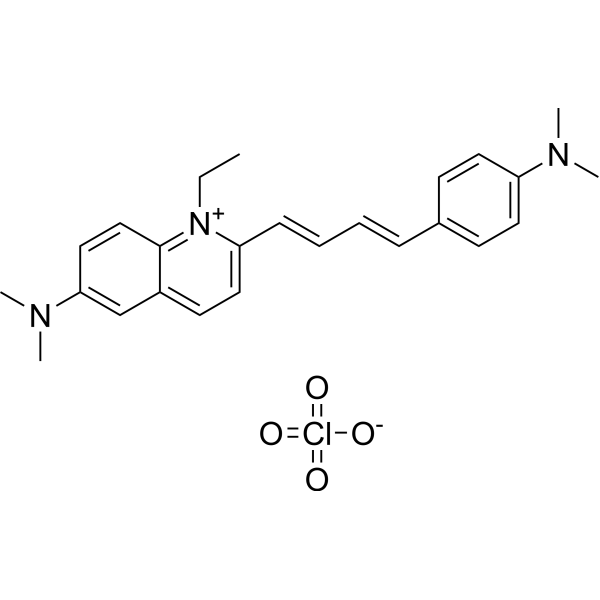
- HY-W784030
-
|
|
Amino Acid Derivatives
Biochemical Assay Reagents
Fluorescent Dye
|
Others
|
|
N-TCO-L-lysine is a non-canonical amino acid. N-TCO-L-lysine contains a trans-cyclooctene (TCO) bioorthogonal reactive linker. N-TCO-L-lysine undergoes a bioorthogonal click reaction with SiR-Tz to enable fluorescent labeling of endogenously expressed proteins with site-specific incorporation. When used in combination with SiR-Tz, N-TCO-L-lysine allows super-resolution and live-cell imaging of endogenous proteins .
|
-

- HY-138074
-
|
5-Ketomilbemycin A4 oxime; 5-Oxomilbemycin A4 5-oxime
|
Parasite
|
Infection
|
|
Milbemycin A4 oxime (5-Ketomilbemycin A4 oxime; 5-Oxomilbemycin A4 5-oxime) is a derivative of Milbemycin A4 (HY-126906) and a component of Milbemycin oxime (HY-B0778), both of which have insecticidal and nematicidal activities. Milbemycin A4 oxime (0.05 mg/kg) reduces the number of microfilariae in naturally infected dogs with D. immitis and inhibits the growth of clinical isolates of Candida glabrata (MIC80=16-32 μg/mL). Milbemycin A4 oxime (2.5 μg/mL) blocks the efflux of Fluconazole (HY-B0101) from clinical isolates of Candida glabrata. Milbemycin A4 oxime enhances doxorubicin-induced cell growth inhibition and increases the intracellular accumulation of doxorubicin and P-glycoprotein substrate Rhodamine 123 (HY-D0816) in doxorubicin-resistant but not sensitive MCF-7 breast cancer cells in a concentration-dependent manner.
|
-

| Cat. No. |
Product Name |
Type |
-
- HY-D0816
-
|
RH-123; R-22420
|
Fluorescent Dyes
|
|
Rhodamine dyes are membrane-permeable cationic fluorescent probes that specifically recognize mitochondrial membrane potentials, thereby attaching to mitochondria and producing bright fluorescence, and at certain concentrations, rhodamine dyes have low toxicity to cells, so they are commonly used to detect mitochondria in animal cells, plant cells, and microorganisms .
|
-
- HY-Y0016
-
|
Basic Violet 10; Brilliant Pink B; Rhodamine O; TetraethylRhodamine
|
Fluorescent Dyes
|
|
Rhodamine B is a staining fluorescent dye, commonly used for dyeing textiles, paper, soap, leather, and agents.
|
-
- HY-D0309
-
|
Basic Red 1
|
Fluorescent Dyes
|
|
Rhodamine dyes are membrane-permeable cationic fluorescent probes that specifically recognize mitochondrial membrane potentials, thereby attaching to mitochondria and producing bright fluorescence, and at certain concentrations, rhodamine dyes have low toxicity to cells, so they are commonly used to detect mitochondria in animal cells, plant cells, and microorganisms .
|
-
- HY-D0817
-
|
Rhodamine 110 chloride; RH110
|
Fluorescent Dyes
|
|
Rhodamine 110 is a sensitive and selective substrate for assaying proteinases in solution or inside living cells. The excitation wavelength is 498 nm and the emission wavelength is 521 nm .
|
-
- HY-123645
-
|
|
Fluorescent Dyes
|
Rhodamine B hydrazide is a fluorescent derivative based on rhodamine B, containing the spirocyclic structure of Rhodamine B (HY-Y0016), which can be used to detect copper ions (Cu 2+), mercury ions, peroxynitrite, hydroxyl radicals and nitric oxide (NO) .
Excitation/emission wavelength:
Conventional detection: 510/578 nm.
Sulfite detection: 554 nm absorption, 574 nm emission (due to the formation of Rhodamine B fluorescent product).
|
-
- HY-D1269
-
|
|
Fluorescent Dyes
|
|
Rhodamine-N3 chloride is an azide-rhodamine fluorescent dye that can be used to label biomolecules containing alkyne groups . Rhodamine-N3 chloride is a click chemistry reagent, it contains an Azide group and can undergo copper-catalyzed azide-alkyne cycloaddition reaction (CuAAc) with molecules containing Alkyne groups. It can also undergo strain-promoted alkyne-azide cycloaddition (SPAAC) reactions with molecules containing DBCO or BCN groups (Ex/Em = 544/576 nm).
|
-
- HY-D2367
-
|
N-Hydroxysuccinimidyl Rhodamine B ester
|
Fluorescent Dyes
|
|
Rhodamine B NHS ester (N-Hydroxysuccinimidyl rhodamine B ester) is an amine-reactive fluorescent probe (λex/λem: 564/589 nm, respectively). Rhodamine B NHS ester could react with Glycine (HY-Y0966) .
|
-
- HY-D0304
-
|
Solvent red 49
|
Fluorescent Dyes
|
|
Rhodamine B base (Solvent red 49) is a fluorescent dye (Ex=543 nM; Em=565 nM) .
|
-
- HY-D1044
-
|
Rhodamine 640 chloride
|
Fluorescent Dyes
|
|
Rhodamine 101 chloride (Rhodamine 640 chloride) is a fluorescent dye with excitation and emission maxima at 565 nM and 595 nM, respectively. Rhodamine 101 chloride binds to intracellular proteins and emits specific fluorescence. Rhodamine 101 chloride can be used in colon cancer research .
|
-
- HY-101876
-
|
|
Fluorescent Dyes
|
|
Rhodamine dyes are membrane-permeable cationic fluorescent probes that specifically recognize mitochondrial membrane potentials, thereby attaching to mitochondria and producing bright fluorescence, and at certain concentrations, rhodamine dyes have low toxicity to cells, so they are commonly used to detect mitochondria in animal cells, plant cells, and microorganisms .
|
-
- HY-D1747
-
-
- HY-D1599
-
|
R6GH
|
Fluorescent Dyes
|
|
Rhodamine 6G hydrazide (R6GH) is a fluorescent dye. Rhodamine 6G hydrazide can be used in selective colorimetric and fluorescent sensing .
|
-
- HY-DY1077
-
|
|
Fluorescent Dyes
|
Rhodamine B (solution) is a staining fluorescent dye, commonly used for dyeing textiles, paper, soap, leather, and agents.
Solvent and concentration: DMSO: 10 mM
|
-
- HY-D1174
-
|
|
Fluorescent Dyes
|
|
Rhodamine 700, a Lambdachrome laser dye, is one of the few rhodamine dyes with near infrared fluorescence. Rhodamine 700 can be used for mitochondrial staining .
|
-
- HY-D2893K
-
|
Rhodamine B-PEG8000-Rhodamine B
|
Fluorescent Dyes
|
|
RB-PEG8000-RB (Rhodamine B-PEG8000-Rhodamine B) a fluorescent dye composed of two Rhodamine B (HY-Y0016) and PEG. RB-PEG8000-RB can be used for fluorescent labeling and imaging (Ex/Em=546/610 nm) .
|
-
- HY-DY1054
-
|
|
Fluorescent Dyes
|
Rhodamine dyes are membrane-permeable cationic fluorescent probes that specifically recognize mitochondrial membrane potentials, thereby attaching to mitochondria and producing bright fluorescence, and at certain concentrations, rhodamine dyes have low toxicity to cells, so they are commonly used to detect mitochondria in animal cells, plant cells, and microorganisms .
Solvent and concentration: DMSO: 5 mM
|
-
- HY-158739
-
|
|
Fluorescent Dyes
|
|
Rhodamine dithenoyl hydrazide (probe 1) possesses excellent recognition and selectivity for Fe 3+ ion. Rhodamine dithenoyl hydrazide exhibits Excitation/Emission maxima of 543/550-700 nm, respectively .
|
-
- HY-Y0016R
-
|
Basic Violet 10 (Standard); Brilliant Pink B (Standard); Rhodamine O (Standard); TetraethylRhodamine (Standard)
|
Fluorescent Dyes
|
|
Rhodamine B (Standard) is the analytical standard of Rhodamine B. This product is intended for research and analytical applications. Rhodamine B is a staining fluorescent dye, commonly used for dyeing textiles, paper, soap, leather, and agents.
|
-
- HY-D2892J
-
|
|
Fluorescent Dyes
|
|
Rhodamine-PEG20000 a fluorescent PEG derivative composed of Rhodamine B (HY-Y0016) and PEG. Rhodamine-PEG20000 can be used for fluorescent labeling and imaging (Ex/Em=546/610 nm) .
|
-
- HY-D1240
-
|
|
Fluorescent Dyes
|
|
Rhodamine 101 inner salt is a bright fluorescent dye with excitation and emission maxima at 565 and 595 nm, respectively. It can be used in various biological applications such as fluorescence microscopy, flow cytometry, fluorescence correlation spectroscopy, and ELISA.
|
-
- HY-D0309R
-
|
Basic Red 1 (Standard)
|
Fluorescent Dyes
|
|
Rhodamine 6G (Standard) is the analytical standard of Rhodamine 6G. This product is intended for research and analytical applications. Rhodamine dyes are membrane-permeable cationic fluorescent probes that specifically recognize mitochondrial membrane potentials, thereby attaching to mitochondria and producing bright fluorescence, and at certain concentrations, rhodamine dyes have low toxicity to cells, so they are commonly used to detect mitochondria in animal cells, plant cells, and microorganisms .
|
-
- HY-D2893M
-
|
Rhodamine B-PEG20000-Rhodamine B
|
Fluorescent Dyes
|
|
RB-PEG20000-RB (Rhodamine B-PEG20000-Rhodamine B) a fluorescent dye composed of two Rhodamine B (HY-Y0016) and PEG. RB-PEG20000-RB can be used for fluorescent labeling and imaging (Ex/Em=546/610 nm) .
|
-
- HY-D2882
-
|
Rhodamine B-PEG400-OH
|
Fluorescent Dyes
|
|
RB-PEG400-OH (Rhodamine B-PEG400-OH) is a fluorescent dye composed of Rhodamine B (HY-Y0016), PEG and a Hydroxyl group. RB-PEG400-OH can be used for fluorescent labeling and imaging (Ex/Em=546/610 nm) .
|
-
- HY-D1440
-
|
|
Fluorescent Dyes
|
|
Rhodamine B, tetramethyl-, isothiocyanate (Tetramethylrhodamine B isothiocyante) is a fluorescent dye. Rhodamine B, tetramethyl-, isothiocyanate has a strong two-photon absorption at about 830 nm .
|
-
- HY-D1044A
-
|
Rhodamine 640 hydrochloride
|
Fluorescent Dyes
|
|
Rhodamine 101 chloride (Rhodamine 640 chloride) hydrochloride is a bright fluorescent dye with excitation and emission maxima of 565 and 595 nm, respectively .
|
-
- HY-D2893A
-
|
Rhodamine B-PEG400-Rhodamine B
|
Fluorescent Dyes
|
|
RB-PEG400-RB (Rhodamine B-PEG400-Rhodamine B) a fluorescent dye composed of two Rhodamine B (HY-Y0016) and PEG. RB-PEG400-RB can be used for fluorescent labeling and imaging (Ex/Em=546/610 nm) .
|
-
- HY-D2893J
-
|
Rhodamine B-PEG6000-Rhodamine B
|
Fluorescent Dyes
|
|
RB-PEG6000-RB (Rhodamine B-PEG6000-Rhodamine B) a fluorescent dye composed of two Rhodamine B (HY-Y0016) and PEG. RB-PEG6000-RB can be used for fluorescent labeling and imaging (Ex/Em=546/610 nm) .
|
-
- HY-D2893H
-
|
Rhodamine B-PEG5000-Rhodamine B
|
Fluorescent Dyes
|
|
RB-PEG5000-RB (Rhodamine B-PEG5000-Rhodamine B) a fluorescent dye composed of two Rhodamine B (HY-Y0016) and PEG. RB-PEG5000-RB can be used for fluorescent labeling and imaging (Ex/Em=546/610 nm) .
|
-
- HY-D2893L
-
|
Rhodamine B-PEG10000-Rhodamine B
|
Fluorescent Dyes
|
|
RB-PEG10000-RB (Rhodamine B-PEG10000-Rhodamine B) a fluorescent dye composed of two Rhodamine B (HY-Y0016) and PEG. RB-PEG10000-RB can be used for fluorescent labeling and imaging (Ex/Em=546/610 nm) .
|
-
- HY-D2892D
-
|
|
Fluorescent Dyes
|
|
Rhodamine-PEG2000 a fluorescent PEG derivative composed of Rhodamine B (HY-Y0016) and PEG. Rhodamine-PEG2000 can be used for fluorescent labeling and imaging (Ex/Em=546/610 nm) .
|
-
- HY-D2892E
-
|
|
Fluorescent Dyes
|
|
Rhodamine-PEG5000 a fluorescent PEG derivative composed of Rhodamine B (HY-Y0016) and PEG. Rhodamine-PEG5000 can be used for fluorescent labeling and imaging (Ex/Em=546/610 nm) .
|
-
- HY-D2892B
-
|
|
Fluorescent Dyes
|
|
Rhodamine-PEG750 a fluorescent PEG derivative composed of Rhodamine B (HY-Y0016) and PEG. Rhodamine-PEG750 can be used for fluorescent labeling and imaging (Ex/Em=546/610 nm) .
|
-
- HY-D2892C
-
|
|
Fluorescent Dyes
|
|
Rhodamine-PEG1000 a fluorescent PEG derivative composed of Rhodamine B (HY-Y0016) and PEG. Rhodamine-PEG1000 can be used for fluorescent labeling and imaging (Ex/Em=546/610 nm) .
|
-
- HY-W247103
-
|
|
Fluorescent Dyes
|
|
Rhodamine 19 perchlorate is a metal free organic dye for dye sensitized solar cells.
|
-
- HY-D1750
-
|
|
Fluorescent Dyes
|
|
Rhodamine B thiolactone is a high-sensitive Hg 2+ indicator used for measuring Hg 2+ concentration.
|
-
- HY-D1748
-
|
|
Fluorescent Dyes
|
|
Rhodamine B hexyl ester perchlorate is a cell-permeant, orange-fluorescent dye for mitochondria.
|
-
- HY-D2881H
-
|
Rhodamine B-PEG10000-COOH
|
Fluorescent Dyes
|
|
RB-PEG10000-COOH (Rhodamine B-PEG10000-COOH) is a fluorescent dye composed of Rhodamine B (HY-Y0016), PEG and a COOH. RRB-PEG10000-COOH can be used for fluorescent labeling and imaging (Ex/Em=546/610 nm) .
|
-
- HY-D2881A
-
|
Rhodamine B-PEG600-COOH
|
Fluorescent Dyes
|
|
RB-PEG600-COOH (Rhodamine B-PEG600-COOH) is a fluorescent dye composed of Rhodamine B (HY-Y0016), PEG and a COOH. RRB-PEG600-COOH can be used for fluorescent labeling and imaging (Ex/Em=546/610 nm) .
|
-
- HY-D2887H
-
|
Rhodamine B-PEG10000-DSPE
|
Fluorescent Dyes
|
|
RB-PEG10000-DSPE (Rhodamine B-PEG10000-DSPE) is a PEG phospholipid labeled Rhodamine B (HY-Y0016). RB-PEG10000-DSPE can be used to prepare liposomes or nanoparticles for nutrients delivery such as mRNA or DNA vaccine (Ex/Em=546/610 nm) .
|
-
- HY-D2887C
-
|
Rhodamine B-PEG2000-DSPE
|
Fluorescent Dyes
|
|
RB-PEG2000-DSPE (Rhodamine B-PEG2000-DSPE) is a PEG phospholipid labeled Rhodamine B (HY-Y0016). RB-PEG2000-DSPE can be used to prepare liposomes or nanoparticles for nutrients delivery such as mRNA or DNA vaccine (Ex/Em=546/610 nm) .
|
-
- HY-D2887D
-
|
Rhodamine B-PEG3400-DSPE
|
Fluorescent Dyes
|
|
RB-PEG3400-DSPE (Rhodamine B-PEG3400-DSPE) is a PEG phospholipid labeled Rhodamine B (HY-Y0016). RB-PEG3400-DSPE can be used to prepare liposomes or nanoparticles for nutrients delivery such as mRNA or DNA vaccine (Ex/Em=546/610 nm) .
|
-
- HY-D2887A
-
|
Rhodamine B-PEG600-DSPE
|
Fluorescent Dyes
|
|
RB-PEG600-DSPE (Rhodamine B-PEG600-DSPE) is a PEG phospholipid labeled Rhodamine B (HY-Y0016). RB-PEG600-DSPE can be used to prepare liposomes or nanoparticles for nutrients delivery such as mRNA or DNA vaccine (Ex/Em=546/610 nm) .
|
-
- HY-D2883E
-
|
Rhodamine B-PEG5000-SH
|
Fluorescent Dyes
|
|
RB-PEG5000-SH (Rhodamine B-PEG5000-SH) is a fluorescent dye composed of Rhodamine B (HY-Y0016), PEG and sulfhydryl (SH). SH is highly reactive and can react with a variety of functional groups (such as maleimide) to form stable thioether bonds (Ex/Em=546/610 nm) .
|
-
- HY-D2883D
-
|
Rhodamine B-PEG3400-SH
|
Fluorescent Dyes
|
|
RB-PEG3400-SH (Rhodamine B-PEG3400-SH) is a fluorescent dye composed of Rhodamine B (HY-Y0016), PEG and sulfhydryl (SH). SH is highly reactive and can react with a variety of functional groups (such as maleimide) to form stable thioether bonds (Ex/Em=546/610 nm) .
|
-
- HY-D2883
-
|
Rhodamine B-PEG400-SH
|
Fluorescent Dyes
|
|
RB-PEG400-SH (Rhodamine B-PEG400-SH) is a fluorescent dye composed of Rhodamine B (HY-Y0016), PEG and sulfhydryl (SH). SH is highly reactive and can react with a variety of functional groups (such as maleimide) to form stable thioether bonds (Ex/Em=546/610 nm) .
|
-
- HY-D2885H
-
|
Rhodamine B-PEG10000-Mal
|
Fluorescent Dyes
|
|
RB-PEG10000-Mal (Rhodamine B-PEG10000-Mal) is a fluorescent dye composed of Rhodamine B (HY-Y0016), PEG and Maleimide (HY-W007324) (Mal). RB-PEG10000-Mal can be used for fluorescent labeling and imaging (Ex/Em=546/610 nm) .
|
-
- HY-D2885E
-
|
Rhodamine B-PEG5000-Mal
|
Fluorescent Dyes
|
|
RB-PEG5000-Mal (Rhodamine B-PEG5000-Mal) is a fluorescent dye composed of Rhodamine B (HY-Y0016), PEG and Maleimide (HY-W007324) (Mal). RB-PEG5000-Mal can be used for fluorescent labeling and imaging (Ex/Em=546/610 nm) .
|
-
- HY-D2885C
-
|
Rhodamine B-PEG2000-Mal
|
Fluorescent Dyes
|
|
RB-PEG2000-Mal (Rhodamine B-PEG2000-Mal) is a fluorescent dye composed of Rhodamine B (HY-Y0016), PEG and Maleimide (HY-W007324) (Mal). RB-PEG2000-Mal can be used for fluorescent labeling and imaging (Ex/Em=546/610 nm) .
|
-
- HY-D2885D
-
|
Rhodamine B-PEG3400-Mal
|
Fluorescent Dyes
|
|
RB-PEG3400-Mal (Rhodamine B-PEG3400-Mal) is a fluorescent dye composed of Rhodamine B (HY-Y0016), PEG and Maleimide (HY-W007324) (Mal). RB-PEG3400-Mal can be used for fluorescent labeling and imaging (Ex/Em=546/610 nm) .
|
-
- HY-D3035
-
|
|
Fluorescent Dyes
|
|
Rhodamine-Alginate is a Rhodamine B (HY-Y0016)-labeled alginate. Rhodamine-Alginate combines the polysaccharide properties of alginate with the fluorescence properties of Rhodamine B, playing an important role in fields such as fluorescent labeling, cell imaging, and drug delivery research (Ex/Em = 546/610 nm) .
|
- HY-D2893D
-
|
Rhodamine B-PEG2000-Rhodamine B
|
Fluorescent Dyes
|
|
RB-PEG2000-RB (Rhodamine B-PEG2000-Rhodamine B) a fluorescent dye composed of two Rhodamine B (HY-Y0016) and PEG. RB-PEG2000-RB can be used for fluorescent labeling and imaging (Ex/Em=546/610 nm) .
|
- HY-D2893E
-
|
Rhodamine B-PEG4000-Rhodamine B
|
Fluorescent Dyes
|
|
RB-PEG4000-RB (Rhodamine B-PEG4000-Rhodamine B) a fluorescent dye composed of two Rhodamine B (HY-Y0016) and PEG. RB-PEG4000-RB can be used for fluorescent labeling and imaging (Ex/Em=546/610 nm) .
|
- HY-D2893
-
|
Rhodamine B-PEG600-Rhodamine B
|
Fluorescent Dyes
|
|
RB-PEG600-RB (Rhodamine B-PEG600-Rhodamine B) a fluorescent dye composed of two Rhodamine B (HY-Y0016) and PEG. RB-PEG600-RB can be used for fluorescent labeling and imaging (Ex/Em=546/610 nm) .
|
- HY-D2893B
-
|
Rhodamine B-PEG1000-Rhodamine B
|
Fluorescent Dyes
|
|
RB-PEG1000-RB (Rhodamine B-PEG1000-Rhodamine B) a fluorescent dye composed of two Rhodamine B (HY-Y0016) and PEG. RB-PEG1000-RB can be used for fluorescent labeling and imaging (Ex/Em=546/610 nm) .
|
- HY-D2893C
-
|
Rhodamine B-PEG3400-Rhodamine B
|
Fluorescent Dyes
|
|
RB-PEG3400-RB (Rhodamine B-PEG3400-Rhodamine B) a fluorescent dye composed of two Rhodamine B (HY-Y0016) and PEG. RB-PEG3400-RB can be used for fluorescent labeling and imaging (Ex/Em=546/610 nm) .
|
- HY-203233
-
|
|
Fluorescent Dyes
|
|
Rhodamine-DHPE is a fluorescently labeled phosphatidylethanolamine lipid that labels phospholipid bilayers. Rhodamine-DHPE serves as a fluorescence quenching substrate and membrane stain. The fluorescence lifetime of Rhodamine-DHPE decreases significantly in the presence of Cu 2+-PS complexes. Rhodamine-DHPE effectively stains the membranes of human red blood cells and mouse fibroblasts, and supports lifetime-resolved imaging via pump-probe fluorescence microscopy .
|
- HY-D3038
-
|
|
Fluorescent Dyes
|
|
Rhodamine B-Heparin is a Rhodamine B (HY-Y0016)-labeled heparin. Rhodamine B-Heparin is widely used in fluorescent labeling, molecular tracking, and visualization studies (Ex/Em = 546/610 nm) .
|
- HY-D2892H
-
|
|
Fluorescent Dyes
|
|
Rhodamine-PEG10000 a fluorescent PEG derivative composed of Rhodamine B (HY-Y0016) and PEG. Rhodamine-PEG10000 can be used for fluorescent labeling and imaging (Ex/Em=546/610 nm) .
|
- HY-D2892A
-
|
|
Fluorescent Dyes
|
|
Rhodamine-PEG550 a fluorescent PEG derivative composed of Rhodamine B (HY-Y0016) and PEG. Rhodamine-PEG550 can be used for fluorescent labeling and imaging (Ex/Em=546/610 nm) .
|
- HY-D2892
-
|
|
Fluorescent Dyes
|
|
Rhodamine-PEG350 a fluorescent PEG derivative composed of Rhodamine B (HY-Y0016) and PEG. Rhodamine-PEG350 can be used for fluorescent labeling and imaging (Ex/Em=546/610 nm) .
|
- HY-D3315
-
|
|
Fluorescent Dyes
|
|
Rhodamine B carbohydrazide is a fluorescent derivative based on Rhodamine B (HY-Y0016) that contains the spirocyclic structure of Rhodamine B; it can be used for the detection of copper ions (Cu 2+), mercury ions, peroxynitrite, hydroxyl radicals, and nitric oxide (NO).
|
- HY-D3048
-
|
|
Fluorescent Dyes
|
|
Rhodamine B-Chitosan (MW 3000) is a Rhodamine B (HY-Y0016)-labeled chitosan with a molecular weight of 3000. Rhodamine B-Chitosan (MW 3000) combines the polysaccharide properties of chitosan with the fluorescence properties of Rhodamine B, playing an important role in fields such as fluorescent labeling, cell imaging, and drug delivery research (Ex/Em = 546/610 nm) .
|
- HY-D3048D
-
|
|
Fluorescent Dyes
|
|
Rhodamine B-Chitosan (MW 40000) is a Rhodamine B (HY-Y0016)-labeled chitosan with a molecular weight of 40,000. Rhodamine B-Chitosan (MW 40000) combines the polysaccharide properties of chitosan with the fluorescence properties of Rhodamine B, playing an important role in fields such as fluorescent labeling, cell imaging, and drug delivery research (Ex/Em = 546/610 nm) .
|
- HY-D3048A
-
|
|
Fluorescent Dyes
|
|
Rhodamine B-Chitosan (MW 5000) is a Rhodamine B (HY-Y0016)-labeled chitosan with a molecular weight of 5,000. Rhodamine B-Chitosan (MW 5000) combines the polysaccharide properties of chitosan with the fluorescence properties of Rhodamine B, playing an important role in fields such as fluorescent labeling, cell imaging, and drug delivery research (Ex/Em = 546/610 nm) .
|
- HY-D3048E
-
|
|
Fluorescent Dyes
|
|
Rhodamine B-Chitosan (MW 100000) is a Rhodamine B (HY-Y0016)-labeled chitosan with a molecular weight of 100,000. Rhodamine B-Chitosan (MW 100000) combines the polysaccharide properties of chitosan with the fluorescence properties of Rhodamine B, playing an important role in fields such as fluorescent labeling, cell imaging, and drug delivery research (Ex/Em = 546/610 nm) .
|
- HY-D3048B
-
|
|
Fluorescent Dyes
|
|
Rhodamine B-Chitosan (MW 10000) is a Rhodamine B (HY-Y0016)-labeled chitosan with a molecular weight of 10,000. Rhodamine B-Chitosan (MW 10000) combines the polysaccharide properties of chitosan with the fluorescence properties of Rhodamine B, playing an important role in fields such as fluorescent labeling, cell imaging, and drug delivery research (Ex/Em = 546/610 nm) .
|
- HY-D3048I
-
|
|
Fluorescent Dyes
|
|
Rhodamine B-Chitosan (MW 10000) is a Rhodamine B (HY-Y0016)-labeled chitosan with a molecular weight of 10,000. Rhodamine B-Chitosan (MW 10000) combines the polysaccharide properties of chitosan with the fluorescence properties of Rhodamine B, playing an important role in fields such as fluorescent labeling, cell imaging, and drug delivery research (Ex/Em = 546/610 nm) .
|
- HY-D3048H
-
|
|
Fluorescent Dyes
|
|
Rhodamine B-Chitosan (MW 200000) is a Rhodamine B (HY-Y0016)-labeled chitosan with a molecular weight of 200,000. Rhodamine B-Chitosan (MW 200000) combines the polysaccharide properties of chitosan with the fluorescence properties of Rhodamine B, playing an important role in fields such as fluorescent labeling, cell imaging, and drug delivery research (Ex/Em = 546/610 nm) .
|
- HY-D3048C
-
|
|
Fluorescent Dyes
|
|
Rhodamine B-Chitosan (MW 20000) is a Rhodamine B (HY-Y0016)-labeled chitosan with a molecular weight of 20,000. Rhodamine B-Chitosan (MW 20000) combines the polysaccharide properties of chitosan with the fluorescence properties of Rhodamine B, playing an important role in fields such as fluorescent labeling, cell imaging, and drug delivery research (Ex/Em = 546/610 nm) .
|
- HY-D3047A
-
|
|
Fluorescent Dyes
|
|
Rhodamine B-Dextran (MW 5000) is a Rhodamine B (HY-Y0016)-labeled dextran with a molecular weight of 5000. Rhodamine B-Chitosan (MW 5000) plays an important role in fluorescent labeling, cell imaging, vascular imaging, and drug delivery research (Ex/Em = 546/610 nm) .
|
- HY-D3047
-
|
|
Fluorescent Dyes
|
|
Rhodamine B-Dextran (MW 3000) is a Rhodamine B (HY-Y0016)-labeled dextran with a molecular weight of 3000. Rhodamine B-Chitosan (MW 3000) plays an important role in fluorescent labeling, cell imaging, vascular imaging, and drug delivery research (Ex/Em = 546/610 nm) .
|
- HY-D3047I
-
|
|
Fluorescent Dyes
|
|
Rhodamine B-Dextran (MW 500000) is a Rhodamine B (HY-Y0016)-labeled dextran with a molecular weight of 500,000. Rhodamine B-Chitosan (MW 500000) plays an important role in fluorescent labeling, cell imaging, vascular imaging, and drug delivery research (Ex/Em = 546/610 nm) .
|
- HY-D3047H
-
|
|
Fluorescent Dyes
|
|
Rhodamine B-Dextran (MW 200000) is a Rhodamine B (HY-Y0016)-labeled dextran with a molecular weight of 200,000. Rhodamine B-Chitosan (MW 200000) plays an important role in fluorescent labeling, cell imaging, vascular imaging, and drug delivery research (Ex/Em = 546/610 nm) .
|
- HY-D3047C
-
|
|
Fluorescent Dyes
|
|
Rhodamine B-Dextran (MW 20000) is a Rhodamine B (HY-Y0016)-labeled dextran with a molecular weight of 20,000. Rhodamine B-Chitosan (MW 20000) plays an important role in fluorescent labeling, cell imaging, vascular imaging, and drug delivery research (Ex/Em = 546/610 nm) .
|
- HY-D3047D
-
|
|
Fluorescent Dyes
|
|
Rhodamine B-Dextran (MW 40000) is a Rhodamine B (HY-Y0016)-labeled dextran with a molecular weight of 40,000. Rhodamine B-Chitosan (MW 40000) plays an important role in fluorescent labeling, cell imaging, vascular imaging, and drug delivery research (Ex/Em = 546/610 nm) .
|
- HY-D3047E
-
|
|
Fluorescent Dyes
|
|
Rhodamine B-Dextran (MW 100000) is a Rhodamine B (HY-Y0016)-labeled dextran with a molecular weight of 100,000. Rhodamine B-Chitosan (MW 100000) plays an important role in fluorescent labeling, cell imaging, vascular imaging, and drug delivery research (Ex/Em = 546/610 nm) .
|
- HY-D3047B
-
|
|
Fluorescent Dyes
|
|
Rhodamine B-Dextran (MW 10000) is a Rhodamine B (HY-Y0016)-labeled dextran with a molecular weight of 10,000. Rhodamine B-Chitosan (MW 10000) plays an important role in fluorescent labeling, cell imaging, vascular imaging, and drug delivery research (Ex/Em = 546/610 nm) .
|
- HY-D2881
-
|
Rhodamine B-PEG400-COOH
|
Fluorescent Dyes
|
|
RB-PEG400-COOH (Rhodamine B-PEG400-COOH) is a fluorescent dye composed of Rhodamine B (HY-Y0016), PEG and a COOH. RRB-PEG400-COOH can be used for fluorescent labeling and imaging (Ex/Em=546/610 nm) .
|
- HY-D2881C
-
|
Rhodamine B-PEG2000-COOH
|
Fluorescent Dyes
|
|
RB-PEG2000-COOH (Rhodamine B-PEG2000-COOH) is a fluorescent dye composed of Rhodamine B (HY-Y0016), PEG and a COOH. RRB-PEG2000-COOH can be used for fluorescent labeling and imaging (Ex/Em=546/610 nm) .
|
- HY-D2881D
-
|
Rhodamine B-PEG3400-COOH
|
Fluorescent Dyes
|
|
RB-PEG3400-COOH (Rhodamine B-PEG3400-COOH) is a fluorescent dye composed of Rhodamine B (HY-Y0016), PEG and a COOH. RRB-PEG3400-COOH can be used for fluorescent labeling and imaging (Ex/Em=546/610 nm) .
|
- HY-D2881E
-
|
Rhodamine B-PEG5000-COOH
|
Fluorescent Dyes
|
|
RB-PEG5000-COOH (Rhodamine B-PEG5000-COOH) is a fluorescent dye composed of Rhodamine B (HY-Y0016), PEG and a COOH. RRB-PEG5000-COOH can be used for fluorescent labeling and imaging (Ex/Em=546/610 nm) .
|
- HY-D2882B
-
|
Rhodamine B-PEG1000-OH
|
Fluorescent Dyes
|
|
RB-PEG1000-OH (Rhodamine B-PEG1000-OH) is a fluorescent dye composed of Rhodamine B (HY-Y0016), PEG and a Hydroxyl group. RB-PEG1000-OH can be used for fluorescent labeling and imaging (Ex/Em=546/610 nm) .
|
- HY-D2882E
-
|
Rhodamine B-PEG5000-OH
|
Fluorescent Dyes
|
|
RB-PEG5000-OH (Rhodamine B-PEG5000-OH) is a fluorescent dye composed of Rhodamine B (HY-Y0016), PEG and a Hydroxyl group. RB-PEG5000-OH can be used for fluorescent labeling and imaging (Ex/Em=546/610 nm) .
|
- HY-D2882D
-
|
Rhodamine B-PEG3400-OH
|
Fluorescent Dyes
|
|
RB-PEG3400-OH (Rhodamine B-PEG3400-OH) is a fluorescent dye composed of Rhodamine B (HY-Y0016), PEG and a Hydroxyl group. RB-PEG3400-OH can be used for fluorescent labeling and imaging (Ex/Em=546/610 nm) .
|
- HY-D2882H
-
|
Rhodamine B-PEG10000-OH
|
Fluorescent Dyes
|
|
RB-PEG10000-OH (Rhodamine B-PEG10000-OH) is a fluorescent dye composed of Rhodamine B (HY-Y0016), PEG and a Hydroxyl group. RB-PEG10000-OH can be used for fluorescent labeling and imaging (Ex/Em=546/610 nm) .
|
- HY-D2882C
-
|
Rhodamine B-PEG2000-OH
|
Fluorescent Dyes
|
|
RB-PEG2000-OH (Rhodamine B-PEG2000-OH) is a fluorescent dye composed of Rhodamine B (HY-Y0016), PEG and a Hydroxyl group. RB-PEG2000-OH can be used for fluorescent labeling and imaging (Ex/Em=546/610 nm) .
|
- HY-D2882A
-
|
Rhodamine B-PEG600-OH
|
Fluorescent Dyes
|
|
RB-PEG600-OH (Rhodamine B-PEG600-OH) is a fluorescent dye composed of Rhodamine B (HY-Y0016), PEG and a Hydroxyl group. RB-PEG600-OH can be used for fluorescent labeling and imaging (Ex/Em=546/610 nm) .
|
- HY-D2887
-
|
Rhodamine B-PEG400-DSPE
|
Fluorescent Dyes
|
|
RB-PEG400-DSPE (Rhodamine B-PEG400-DSPE) is a PEG phospholipid labeled Rhodamine B (HY-Y0016). RB-PEG400-DSPE can be used to prepare liposomes or nanoparticles for nutrients delivery such as mRNA or DNA vaccine (Ex/Em=546/610 nm) .
|
- HY-D2883A
-
|
Rhodamine B-PEG600-SH
|
Fluorescent Dyes
|
|
RB-PEG600-SH (Rhodamine B-PEG600-SH) is a fluorescent dye composed of Rhodamine B (HY-Y0016), PEG and sulfhydryl (SH). SH is highly reactive and can react with a variety of functional groups (such as maleimide) to form stable thioether bonds (Ex/Em=546/610 nm) .
|
- HY-D2887E
-
|
Rhodamine B-PEG5000-DSPE
|
Fluorescent Dyes
|
|
RB-PEG5000-DSPE (Rhodamine B-PEG5000-DSPE) is a PEG phospholipid labeled Rhodamine B (HY-Y0016). RB-PEG5000-DSPE can be used to prepare liposomes or nanoparticles for nutrients delivery such as mRNA or DNA vaccine (Ex/Em=546/610 nm) .
|
- HY-D2883B
-
|
Rhodamine B-PEG1000-SH
|
Fluorescent Dyes
|
|
RB-PEG1000-SH (Rhodamine B-PEG1000-SH) is a fluorescent dye composed of Rhodamine B (HY-Y0016), PEG and sulfhydryl (SH). SH is highly reactive and can react with a variety of functional groups (such as maleimide) to form stable thioether bonds (Ex/Em=546/610 nm) .
|
- HY-D2883C
-
|
Rhodamine B-PEG2000-SH
|
Fluorescent Dyes
|
|
RB-PEG2000-SH (Rhodamine B-PEG2000-SH) is a fluorescent dye composed of Rhodamine B (HY-Y0016), PEG and sulfhydryl (SH). SH is highly reactive and can react with a variety of functional groups (such as maleimide) to form stable thioether bonds (Ex/Em=546/610 nm) .
|
- HY-D2883H
-
|
Rhodamine B-PEG10000-SH
|
Fluorescent Dyes
|
|
RB-PEG10000-SH (Rhodamine B-PEG10000-SH) is a fluorescent dye composed of Rhodamine B (HY-Y0016), PEG and sulfhydryl (SH). SH is highly reactive and can react with a variety of functional groups (such as maleimide) to form stable thioether bonds (Ex/Em=546/610 nm) .
|
- HY-D2881B
-
|
Rhodamine B-PEG-COOH (MW 1000)
|
Fluorescent Dyes
|
|
RB-PEG-COOH (MW 1000) (Rhodamine B-PEG-COOH (MW 1000)) is a fluorescent dye composed of Rhodamine B (HY-Y0016), PEG and a COOH. RRB-PEG-COOH (MW 1000) can be used for fluorescent labeling and imaging (Ex/Em = 546/610 nm) .
|
- HY-D2885
-
|
Rhodamine B-PEG400-Mal
|
Fluorescent Dyes
|
|
RB-PEG400-Mal (Rhodamine B-PEG400-Mal) is a fluorescent dye composed of Rhodamine B (HY-Y0016), PEG and Maleimide (HY-W007324) (Mal). RB-PEG400-Mal can be used for fluorescent labeling and imaging (Ex/Em=546/610 nm) .
|
- HY-D2885A
-
|
Rhodamine B-PEG600-Mal
|
Fluorescent Dyes
|
|
RB-PEG600-Mal (Rhodamine B-PEG600-Mal) is a fluorescent dye composed of Rhodamine B (HY-Y0016), PEG and Maleimide (HY-W007324) (Mal). RB-PEG600-Mal can be used for fluorescent labeling and imaging (Ex/Em=546/610 nm) .
|
- HY-D2885B
-
|
Rhodamine B-PEG1000-Mal
|
Fluorescent Dyes
|
|
RB-PEG1000-Mal (Rhodamine B-PEG1000-Mal) is a fluorescent dye composed of Rhodamine B (HY-Y0016), PEG and Maleimide (HY-W007324) (Mal). RB-PEG1000-Mal can be used for fluorescent labeling and imaging (Ex/Em=546/610 nm) .
|
- HY-D2884D
-
|
Rhodamine B-PEG3400-NHS
|
Fluorescent Dyes
|
|
RB-PEG3400-NHS (Rhodamine B-PEG3400-NHS) is a fluorescent dye composed of Rhodamine B (HY-Y0016), PEG and a hydroxysuccinimide (NHS) group. The NHS group can react with amine-containing groups. RB-PEG3400-NHS can be used for fluorescent labeling and imaging (Ex/Em=546/610 nm) .
|
- HY-D2888C
-
|
Rhodamine B-PEG2000-FA
|
Fluorescent Dyes
|
|
RB-PEG2000-FA (Rhodamine B-PEG2000-FA) is a fluorescent dye composed of Rhodamine B (HY-Y0016), PEG and Folic acid (FA) (HY-16637). RB-PEG2000-FA can be used for cell imaging, folate receptor targeting and detection (Ex/Em=546/610 nm) .
|
- HY-D2888E
-
|
Rhodamine B-PEG5000-FA
|
Fluorescent Dyes
|
|
RB-PEG5000-FA (Rhodamine B-PEG5000-FA) is a fluorescent dye composed of Rhodamine B (HY-Y0016), PEG and Folic acid (FA) (HY-16637). RB-PEG5000-FA can be used for cell imaging, folate receptor targeting and detection (Ex/Em=546/610 nm) .
|
- HY-D2884A
-
|
Rhodamine B-PEG600-NHS
|
Fluorescent Dyes
|
|
RB-PEG600-NHS (Rhodamine B-PEG600-NHS) is a fluorescent dye composed of Rhodamine B (HY-Y0016), PEG and a hydroxysuccinimide (NHS) group. The NHS group can react with amine-containing groups. RB-PEG600-NHS can be used for fluorescent labeling and imaging (Ex/Em=546/610 nm) .
|
- HY-D2888A
-
|
Rhodamine B-PEG600-FA
|
Fluorescent Dyes
|
|
RB-PEG600-FA (Rhodamine B-PEG600-FA) is a fluorescent dye composed of Rhodamine B (HY-Y0016), PEG and Folic acid (FA) (HY-16637). RB-PEG600-FA can be used for cell imaging, folate receptor targeting and detection (Ex/Em=546/610 nm) .
|
- HY-D2888B
-
|
Rhodamine B-PEG1000-FA
|
Fluorescent Dyes
|
|
RB-PEG1000-FA (Rhodamine B-PEG1000-FA) is a fluorescent dye composed of Rhodamine B (HY-Y0016), PEG and Folic acid (FA) (HY-16637). RB-PEG1000-FA can be used for cell imaging, folate receptor targeting and detection (Ex/Em=546/610 nm) .
|
- HY-D2888
-
|
Rhodamine B-PEG400-FA
|
Fluorescent Dyes
|
|
RB-PEG400-FA (Rhodamine B-PEG400-FA) is a fluorescent dye composed of Rhodamine B (HY-Y0016), PEG and Folic acid (FA) (HY-16637). RB-PEG400-FA can be used for cell imaging, folate receptor targeting and detection (Ex/Em=546/610 nm) .
|
- HY-D2884B
-
|
Rhodamine B-PEG1000-NHS
|
Fluorescent Dyes
|
|
RB-PEG1000-NHS (Rhodamine B-PEG1000-NHS) is a fluorescent dye composed of Rhodamine B (HY-Y0016), PEG and a hydroxysuccinimide (NHS) group. The NHS group can react with amine-containing groups. RB-PEG1000-NHS can be used for fluorescent labeling and imaging (Ex/Em=546/610 nm) .
|
- HY-D2884E
-
|
Rhodamine B-PEG5000-NHS
|
Fluorescent Dyes
|
|
RB-PEG5000-NHS (Rhodamine B-PEG5000-NHS) is a fluorescent dye composed of Rhodamine B (HY-Y0016), PEG and a hydroxysuccinimide (NHS) group. The NHS group can react with amine-containing groups. RB-PEG5000-NHS can be used for fluorescent labeling and imaging (Ex/Em=546/610 nm) .
|
- HY-D2884H
-
|
Rhodamine B-PEG10000-NHS
|
Fluorescent Dyes
|
|
RB-PEG10000-NHS (Rhodamine B-PEG10000-NHS) is a fluorescent dye composed of Rhodamine B (HY-Y0016), PEG and a hydroxysuccinimide (NHS) group. The NHS group can react with amine-containing groups. RB-PEG10000-NHS can be used for fluorescent labeling and imaging (Ex/Em=546/610 nm) .
|
- HY-D2888H
-
|
Rhodamine B-PEG10000-FA
|
Fluorescent Dyes
|
|
RB-PEG10000-FA (Rhodamine B-PEG10000-FA) is a fluorescent dye composed of Rhodamine B (HY-Y0016), PEG and Folic acid (FA) (HY-16637). RB-PEG10000-FA can be used for cell imaging, folate receptor targeting and detection (Ex/Em=546/610 nm) .
|
- HY-D2888D
-
|
Rhodamine B-PEG3400-FA
|
Fluorescent Dyes
|
|
RB-PEG3400-FA (Rhodamine B-PEG3400-FA) is a fluorescent dye composed of Rhodamine B (HY-Y0016), PEG and Folic acid (FA) (HY-16637). RB-PEG3400-FA can be used for cell imaging, folate receptor targeting and detection (Ex/Em=546/610 nm) .
|
- HY-D2884C
-
|
Rhodamine B-PEG2000-NHS
|
Fluorescent Dyes
|
|
RB-PEG2000-NHS (Rhodamine B-PEG2000-NHS) is a fluorescent dye composed of Rhodamine B (HY-Y0016), PEG and a hydroxysuccinimide (NHS) group. The NHS group can react with amine-containing groups. RB-PEG2000-NHS can be used for fluorescent labeling and imaging (Ex/Em=546/610 nm) .
|
- HY-D2884
-
|
Rhodamine B-PEG400-NHS
|
Fluorescent Dyes
|
|
RB-PEG400-NHS (Rhodamine B-PEG400-NHS) is a fluorescent dye composed of Rhodamine B (HY-Y0016), PEG and a hydroxysuccinimide (NHS) group. The NHS group can react with amine-containing groups. RB-PEG400-NHS can be used for fluorescent labeling and imaging (Ex/Em=546/610 nm) .
|
- HY-D2887B
-
|
Rhodamine B-PEG-DSPE (MW 1000)
|
Fluorescent Dyes
|
|
RB-PEG-DSPE (MW 1000) (Rhodamine B-PEG-DSPE (MW 1000)) is a PEG phospholipid labeled Rhodamine B (HY-Y0016). RB-PEG-DSPE (MW 1000) can be used to prepare liposomes or nanoparticles for nutrients delivery such as mRNA or DNA vaccine (Ex/Em = 546/610 nm) .
|
- HY-D2889D
-
|
Rhodamine B-PEG3400-Biotin
|
Fluorescent Dyes
|
|
RB-PEG3400-Biotin (Rhodamine B-PEG3400-Biotin) is a fluorescent dye composed of Rhodamine B (HY-Y0016), PEG and a Biotin. Biotin can bind with high affinity to streptavidin or avidin. RB-PEG3400-Biotin plays an important role in the specific capture and detection of biomolecules (Ex/Em=546/610 nm) .
|
- HY-D2889B
-
|
Rhodamine B-PEG1000-Biotin
|
Fluorescent Dyes
|
|
RB-PEG1000-Biotin (Rhodamine B-PEG1000-Biotin) is a fluorescent dye composed of Rhodamine B (HY-Y0016), PEG and a Biotin. Biotin can bind with high affinity to streptavidin or avidin. RB-PEG1000-Biotin plays an important role in the specific capture and detection of biomolecules (Ex/Em=546/610 nm) .
|
- HY-D2889A
-
|
Rhodamine B-PEG600-Biotin
|
Fluorescent Dyes
|
|
RB-PEG600-Biotin (Rhodamine B-PEG600-Biotin) is a fluorescent dye composed of Rhodamine B (HY-Y0016), PEG and a Biotin. Biotin can bind with high affinity to streptavidin or avidin. RB-PEG600-Biotin plays an important role in the specific capture and detection of biomolecules (Ex/Em=546/610 nm) .
|
- HY-D2889H
-
|
Rhodamine B-PEG10000-Biotin
|
Fluorescent Dyes
|
|
RB-PEG10000-Biotin (Rhodamine B-PEG10000-Biotin) is a fluorescent dye composed of Rhodamine B (HY-Y0016), PEG and a Biotin. Biotin can bind with high affinity to streptavidin or avidin. RB-PEG10000-Biotin plays an important role in the specific capture and detection of biomolecules (Ex/Em=546/610 nm) .
|
- HY-D2889C
-
|
Rhodamine B-PEG2000-Biotin
|
Fluorescent Dyes
|
|
RB-PEG2000-Biotin (Rhodamine B-PEG2000-Biotin) is a fluorescent dye composed of Rhodamine B (HY-Y0016), PEG and a Biotin. Biotin can bind with high affinity to streptavidin or avidin. RB-PEG2000-Biotin plays an important role in the specific capture and detection of biomolecules (Ex/Em=546/610 nm) .
|
- HY-D2889E
-
|
Rhodamine B-PEG5000-Biotin
|
Fluorescent Dyes
|
|
RB-PEG5000-Biotin (Rhodamine B-PEG5000-Biotin) is a fluorescent dye composed of Rhodamine B (HY-Y0016), PEG and a Biotin. Biotin can bind with high affinity to streptavidin or avidin. RB-PEG5000-Biotin plays an important role in the specific capture and detection of biomolecules (Ex/Em=546/610 nm) .
|
- HY-D2889
-
|
Rhodamine B-PEG400-Biotin
|
Fluorescent Dyes
|
|
RB-PEG400-Biotin (Rhodamine B-PEG400-Biotin) is a fluorescent dye composed of Rhodamine B (HY-Y0016), PEG and a Biotin. Biotin can bind with high affinity to streptavidin or avidin. RB-PEG400-Biotin plays an important role in the specific capture and detection of biomolecules (Ex/Em=546/610 nm) .
|
- HY-D2895E
-
|
Rhodamine B-PEG5000-NH2
|
Fluorescent Dyes
|
|
RB-PEG5000-NH2 (Rhodamine B-PEG5000-NH2) is a fluorescent dye composed of Rhodamine B (HY-Y0016), PEG and an amino group. The reactive primary amine or NH2 groups can react rapidly with activated carboxylic acids such as NHS esters to form stable amide bonds (Ex/Em=546/610 nm) .
|
- HY-D2895A
-
|
Rhodamine B-PEG600-NH2
|
Fluorescent Dyes
|
|
RB-PEG600-NH2 (Rhodamine B-PEG600-NH2) is a fluorescent dye composed of Rhodamine B (HY-Y0016), PEG and an amino group. The reactive primary amine or NH2 groups can react rapidly with activated carboxylic acids such as NHS esters to form stable amide bonds (Ex/Em=546/610 nm) .
|
- HY-D2895C
-
|
Rhodamine B-PEG2000-NH2
|
Fluorescent Dyes
|
|
RB-PEG2000-NH2 (Rhodamine B-PEG2000-NH2) is a fluorescent dye composed of Rhodamine B (HY-Y0016), PEG and an amino group. The reactive primary amine or NH2 groups can react rapidly with activated carboxylic acids such as NHS esters to form stable amide bonds (Ex/Em=546/610 nm) .
|
- HY-D2895H
-
|
Rhodamine B-PEG10000-NH2
|
Fluorescent Dyes
|
|
RB-PEG10000-NH2 (Rhodamine B-PEG10000-NH2) is a fluorescent dye composed of Rhodamine B (HY-Y0016), PEG and an amino group. The reactive primary amine or NH2 groups can react rapidly with activated carboxylic acids such as NHS esters to form stable amide bonds (Ex/Em=546/610 nm) .
|
- HY-D2895D
-
|
Rhodamine B-PEG3400-NH2
|
Fluorescent Dyes
|
|
RB-PEG3400-NH2 (Rhodamine B-PEG3400-NH2) is a fluorescent dye composed of Rhodamine B (HY-Y0016), PEG and an amino group. The reactive primary amine or NH2 groups can react rapidly with activated carboxylic acids such as NHS esters to form stable amide bonds (Ex/Em=546/610 nm) .
|
- HY-D2895B
-
|
Rhodamine B-PEG1000-NH2
|
Fluorescent Dyes
|
|
RB-PEG1000-NH2 (Rhodamine B-PEG1000-NH2) is a fluorescent dye composed of Rhodamine B (HY-Y0016), PEG and an amino group. The reactive primary amine or NH2 groups can react rapidly with activated carboxylic acids such as NHS esters to form stable amide bonds (Ex/Em=546/610 nm) .
|
- HY-D2895
-
|
Rhodamine B-PEG400-NH2
|
Fluorescent Dyes
|
|
RB-PEG400-NH2 (Rhodamine B-PEG400-NH2) is a fluorescent dye composed of Rhodamine B (HY-Y0016), PEG and an amino group. The reactive primary amine or NH2 groups can react rapidly with activated carboxylic acids such as NHS esters to form stable amide bonds (Ex/Em=546/610 nm) .
|
- HY-112697
-
|
|
Fluorescent Dyes
|
|
Rhodamine B isothiocyanate (RBITC) is a fluorescent dye commonly used in biological imaging and labeling applications. It has an isothiocyanate functional group that can be covalently attached to amino groups on proteins and other biomolecules, making it useful for fluorescent labeling of cells and tissues. RBITC fluoresces bright orange-red under green light excitation, which makes it easy to detect and track labeled molecules in complex samples. Due to its stability and sensitivity, RBITC has been widely used in various research fields, including cell biology, immunology, and neurobiology.
|
- HY-D2886A
-
|
Rhodamine B-PEG600-N3
|
Fluorescent Dyes
|
|
RB-PEG600-N3 (Rhodamine B-PEG600-N3) is a fluorescent dye composed of Rhodamine B (HY-Y0016), PEG and azide group (N3). RB-PEG600-N3 is a click chemistry reagent, it contains an Azide group and can undergo copper-catalyzed azide-alkyne cycloaddition reaction (CuAAc) with molecules containing Alkyne groups. It can also undergo strain-promoted alkyne-azide cycloaddition (SPAAC) reactions with molecules containing DBCO or BCN groups (Ex/Em=546/610 nm) .
|
- HY-D2886B
-
|
Rhodamine B-PEG1000-N3
|
Fluorescent Dyes
|
|
RB-PEG1000-N3 (Rhodamine B-PEG1000-N3) is a fluorescent dye composed of Rhodamine B (HY-Y0016), PEG and azide group (N3). RB-PEG1000-N3 is a click chemistry reagent, it contains an Azide group and can undergo copper-catalyzed azide-alkyne cycloaddition reaction (CuAAc) with molecules containing Alkyne groups. It can also undergo strain-promoted alkyne-azide cycloaddition (SPAAC) reactions with molecules containing DBCO or BCN groups (Ex/Em=546/610 nm) .
|
- HY-D2886C
-
|
Rhodamine B-PEG2000-N3
|
Fluorescent Dyes
|
|
RB-PEG2000-N3 (Rhodamine B-PEG2000-N3) is a fluorescent dye composed of Rhodamine B (HY-Y0016), PEG and azide group (N3). RB-PEG2000-N3 is a click chemistry reagent, it contains an Azide group and can undergo copper-catalyzed azide-alkyne cycloaddition reaction (CuAAc) with molecules containing Alkyne groups. It can also undergo strain-promoted alkyne-azide cycloaddition (SPAAC) reactions with molecules containing DBCO or BCN groups (Ex/Em=546/610 nm) .
|
- HY-D2886E
-
|
Rhodamine B-PEG5000-N3
|
Fluorescent Dyes
|
|
RB-PEG5000-N3 (Rhodamine B-PEG5000-N3) is a fluorescent dye composed of Rhodamine B (HY-Y0016), PEG and azide group (N3). RB-PEG5000-N3 is a click chemistry reagent, it contains an Azide group and can undergo copper-catalyzed azide-alkyne cycloaddition reaction (CuAAc) with molecules containing Alkyne groups. It can also undergo strain-promoted alkyne-azide cycloaddition (SPAAC) reactions with molecules containing DBCO or BCN groups (Ex/Em=546/610 nm) .
|
- HY-D2886
-
|
Rhodamine B-PEG400-N3
|
Fluorescent Dyes
|
|
RB-PEG400-N3 (Rhodamine B-PEG400-N3) is a fluorescent dye composed of Rhodamine B (HY-Y0016), PEG and azide group (N3). RB-PEG400-N3 is a click chemistry reagent, it contains an Azide group and can undergo copper-catalyzed azide-alkyne cycloaddition reaction (CuAAc) with molecules containing Alkyne groups. It can also undergo strain-promoted alkyne-azide cycloaddition (SPAAC) reactions with molecules containing DBCO or BCN groups (Ex/Em=546/610 nm) .
|
- HY-D2886H
-
|
Rhodamine B-PEG10000-N3
|
Fluorescent Dyes
|
|
RB-PEG10000-N3 (Rhodamine B-PEG10000-N3) is a fluorescent dye composed of Rhodamine B (HY-Y0016), PEG and azide group (N3). RB-PEG10000-N3 is a click chemistry reagent, it contains an Azide group and can undergo copper-catalyzed azide-alkyne cycloaddition reaction (CuAAc) with molecules containing Alkyne groups. It can also undergo strain-promoted alkyne-azide cycloaddition (SPAAC) reactions with molecules containing DBCO or BCN groups (Ex/Em=546/610 nm) .
|
- HY-D2886D
-
|
Rhodamine B-PEG3400-N3
|
Fluorescent Dyes
|
|
RB-PEG3400-N3 (Rhodamine B-PEG3400-N3) is a fluorescent dye composed of Rhodamine B (HY-Y0016), PEG and azide group (N3). RB-PEG3400-N3 is a click chemistry reagent, it contains an Azide group and can undergo copper-catalyzed azide-alkyne cycloaddition reaction (CuAAc) with molecules containing Alkyne groups. It can also undergo strain-promoted alkyne-azide cycloaddition (SPAAC) reactions with molecules containing DBCO or BCN groups (Ex/Em=546/610 nm) .
|
- HY-D3348
-
- HY-D3027
-
|
HSA-Rhodamine
|
Fluorescent Dyes
|
|
Human Serum Albumin-Rhodamine (HSA-Rhodamine) is a Rhodamine B (HY-Y0016) labeled serum albumin. Human Serum Albumin-Rhodamine plays an important role in fluorescent labeling, drug delivery research, and other fields (Ex/Em = 546/610 nm) .
|
- HY-D3059
-
- HY-D3052
-
|
|
Fluorescent Dyes
|
|
5(6)-carbonylated rhodamine 110 maleimide is a maleimide-based fluorescent reagent based on 5(6)-carbonylated rhodamine 110. Maleimide can be labeled by forming a stable thioester structure through an affinity addition reaction with a thiol group (-SH) (Ex/Em = 502/527 nm).
|
- HY-D3049
-
|
|
Fluorescent Dyes
|
|
5(6)-carbonylated rhodamine 110 NHS ester is a reactive ester fluorescent reagent based on 5(6)-carbonylated rhodamine 110. NHS ester is a highly reactive ester capable of covalently coupling with primary amine groups in molecules such as proteins, peptides, amino sugars, and nucleic acids to form stable amide bonds (Ex/Em = 502/527 nm).
|
- HY-D3051
-
|
|
Fluorescent Dyes
|
|
5(6)-carbonylated rhodamine 110 amine is a primary amine fluorescent reagent based on 5(6)-carbonylated rhodamine 110. Primary amines can be covalently linked with various functional groups such as carboxylic acids, active esters (e.g., NHS esters), and isothiocyanates to achieve labeling (Ex/Em = 502/527 nm).
|
- HY-D3050
-
|
|
Fluorescent Dyes
|
|
5(6)-carbonylated rhodamine 110 X NHS ester is a reactive ester fluorescent reagent based on 5(6)-carbonylated rhodamine 110 X. NHS ester is a highly reactive ester capable of covalently coupling with primary amine groups in molecules such as proteins, peptides, amino sugars, and nucleic acids to form stable amide bonds (Ex/Em = 496/522 nm).
|
- HY-W127703
-
|
|
Fluorescent Dyes
|
|
Octadecyl Rhodamine B chloride is an amphiphilic fluorescent probe with both membrane-binding ability and fluorescent properties, which easily forms aggregates in aqueous phase leading to self-quenching. Octadecyl Rhodamine B chloride can be used for cell membrane staining and further applied in membrane biology research. The maximum absorption/emission wavelengths of Octadecyl Rhodamine B chloride monomer in Triton X-100 are 565 nm/585 nm; the absorption peaks of aggregates in water are blue-shifted to 524 nm and 574 nm, with significantly quenched fluorescence .
|
- HY-D3056
-
|
|
Fluorescent Dyes
|
|
5(6)-Rhodamine 6G maleimide is a maleimide-based fluorescent reagent based on Rhodamine 6G (HY-D0309). Maleimide can be labeled by forming a stable thioester structure through an affinity addition reaction with a thiol group (-SH) (Ex/Em = 526/547 nm).
|
- HY-D1377
-
|
|
Fluorescent Dyes
|
|
Citrulline-specific probe-rhodamine hydrate is a specific probe for citrulline (Citrulline) combined with a rhodamine fluorescent group. Citrulline is the hydrolysis product of arginine catalyzed by protein arginine deiminase (PAD). PAD is abnormally activated in many diseases, leading to increased citrulline levels. Citrulline-specific probe-rhodamine hydrate is a biological probe that can identify diseases showing abnormal increases in PAD activity and may be effectively used in animal models of ulcerative colitis .
|
- HY-D1769
-
|
|
Fluorescent Dyes
|
|
N-hydroxy Rhodamine B amide is a ClO - indicator, which is hydrolyzed to prduce fluorescence in the presence of ClO -. The fluorescence intensity of N-hydroxy Rhodamine B amide is proportional to the product, thus can be used to quantify ClO -.
|
- HY-D3054
-
|
|
Fluorescent Dyes
|
|
5(6)-Rhodamine 6G amine is a primary amine fluorescent reagent based on Rhodamine 6G (HY-D0309). Primary amines can be covalently linked with various functional groups such as carboxylic acids, active esters (e.g., NHS esters), and isothiocyanates to achieve labeling (Ex/Em = 526/547 nm).
|
- HY-D3053
-
|
|
Fluorescent Dyes
|
|
5(6)-Rhodamine 6G NHS ester is a reactive ester fluorescent reagent based on Rhodamine 6G (HY-D0309). NHS ester is a highly reactive ester capable of covalently coupling with primary amine groups in molecules such as proteins, peptides, amino sugars, and nucleic acids to form stable amide bonds (Ex/Em = 526/547 nm).
|
- HY-D0784
-
5-ROX
1 Publications Verification
5-Carboxy-X-Rhodamine
|
Fluorescent Dyes
|
|
5-ROX (5-Carboxy-X-rhodamine), a rhodamine dye, exhibits strong fluorescence property in aqueous buffer with the λexit of 580 nm (ε=3.6×10 4 M -1 cm -1), and λemit of 604 nm (=0.94) .
|
- HY-175046
-
|
|
Fluorescent Dyes
|
|
C12 Lissamine-rhodamine galactosylceramide (d18:1/12:0) (Lissamine-rhodamine B-dodecanoyl Galactosylceramide) is a fluorescently labeled version of C12 galactosylceramide.
|
- HY-D2894B
-
|
4Arm-PEG10000-Rhodamine B
|
Fluorescent Dyes
|
|
4Arm-PEG10000-RB (4Arm-PEG10000-Rhodamine B) is a fluorescent dye composed of Rhodamine B (HY-Y0016) and PEG with a four-arm structure. 4Arm-PEG10000-RB can be used for drug delivery and fluorescence imaging (Ex/Em=546/610 nm) .
|
- HY-D2894A
-
|
4Arm-PEG5000-Rhodamine B
|
Fluorescent Dyes
|
|
4Arm-PEG5000-RB (4Arm-PEG5000-Rhodamine B) is a fluorescent dye composed of Rhodamine B (HY-Y0016) and PEG with a four-arm structure. 4Arm-PEG5000-RB can be used for drug delivery and fluorescence imaging (Ex/Em=546/610 nm) .
|
- HY-D2894
-
|
4Arm-PEG2000-Rhodamine B
|
Fluorescent Dyes
|
|
4Arm-PEG2000-RB (4Arm-PEG2000-Rhodamine B) is a fluorescent dye composed of Rhodamine B (HY-Y0016) and PEG with a four-arm structure. 4Arm-PEG2000-RB can be used for drug delivery and fluorescence imaging (Ex/Em=546/610 nm) .
|
- HY-D2894C
-
|
4Arm-PEG20000-Rhodamine B
|
Fluorescent Dyes
|
|
4Arm-PEG20000-RB (4Arm-PEG20000-Rhodamine B) is a fluorescent dye composed of Rhodamine B (HY-Y0016) and PEG with a four-arm structure. 4Arm-PEG20000-RB can be used for drug delivery and fluorescence imaging (Ex/Em=546/610 nm) .
|
- HY-136884
-
|
|
Fluorescent Dyes
|
|
DAR-4M is a fluorescent indicator for nitric oxide (NO) based on the rhodamine chromophore (Ex/Em= 550/572 nm) .
|
- HY-D1086
-
|
6-ROX, SE
|
Fluorescent Dyes
|
|
6-Carboxy-X-rhodamine, succinimidyl ester (6-ROX, SE) is a fluorescent dye for oligonucleotide labeling and automated DNA sequencing .
|
- HY-D1522
-
|
|
Fluorescent Dyes
|
|
N,N'-Bis[2-(acetamido)ethyl]-N,N'-dimethyl rhodamine is a fluorescent reagent .
|
- HY-D0043
-
|
5(6)-Carboxy-X-Rhodamine
|
Fluorescent Dyes
|
|
5(6)-ROX (5(6)-Carboxy-X-rhodamine) is a nucleic acid fluorescent label which can be used as a reference dye for real-time polymerase chain reaction (Em/Ex = 605/585 nm) .
|
- HY-D0139
-
|
|
Fluorescent Dyes
|
|
Octadecyl Rhodamine B (perchlorate) is a multifunctional dye. Dyes are important tools in biological experiments. They can help researchers observe and analyze cell structures, track biomolecules, evaluate cell functions, distinguish cell types, detect biomolecules, study tissue pathology and monitor microorganisms. Their applications range from basic scientific research to clinical A wide range of diagnostics. Dyes are also widely used in traditional fields such as textile dyeing, as well as in emerging fields such as functional textile processing, food pigments and dye-sensitized solar cells.
|
- HY-D1266
-
|
NO-red
|
Fluorescent Dyes
|
|
RB-OPD (NO-red) is a o-phenylenediamine (OPD)-locked rhodamine nitric oxide (NO) fluorescent probe with great sensitivity and selectivity (λex=550 nm, λem=590 nm) .
|
- HY-101878
-
|
SulfoRhodamine 101; SR101
|
Fluorescent Dyes
|
|
Texas Red (Sulforhodamine 101) is an amphoteric rhodamine red fluorescent dye (excitation/emission: 586/605 nm). Texas Red is used extensively for investigating neuronal morphology and acts as acell type-selective fluorescent marker of astrocytes bothin vivoand in slice preparations .
|
- HY-101878R
-
|
SulfoRhodamine 101 (Standard); SR101 (Standard)
|
Fluorescent Dyes
|
|
Texas Red (Standard) is the analytical standard of Texas Red (HY-101878). This product is intended for research and analytical applications. Texas Red (Sulforhodamine 101) is an amphoteric rhodamine red fluorescent dye (excitation/emission: 586/605 nm). Texas Red is used extensively for investigating neuronal morphology and acts as acell type-selective fluorescent marker of astrocytes bothin vivoand in slice preparations .
|
- HY-DY1056
-
|
|
Fluorescent Dyes
|
Texas Red (Sulforhodamine 101) (solution) is an amphoteric rhodamine red fluorescent dye (excitation/emission: 586/605 nm). Texas Red is used extensively for investigating neuronal morphology and acts as acell type-selective fluorescent marker of astrocytes bothin vivoand in slice preparations .
Solvent and concentration: DMSO: 10 mM
The 1 mL volume is defined as the base specification. All larger sizes correspond to incremental volumes of this base.
|
- HY-D3244
-
|
|
Fluorescent Dyes
|
|
RDDB is a rhodamine-based turn-on fluorescent and colorimetric chemosensor selective for Mn 2+, with a limit of detection of 5×10 -8 M (excitation wavelength: 480-550 nm; fluorescence signal collection range: >590 nm). In the presence of Mn 2+, RDDB undergoes a spirolactam ring-opening reaction of its rhodamine hydrazide moiety, resulting in turn-on fluorescence and a color change. RDDB can be used for intracellular Mn 2+ imaging .
|
- HY-158082C
-
|
Tetramethyl Rhodamine isothiocyanate glucan, MW 70000
|
Fluorescent Dyes
|
|
TRITC-dextran MW 70000 (Tetramethyl rhodamine isothiocyanate glucan, MW 70000) is a fluorescent dye with a molecular weight of 70 kD. The excitation wavelength of TRITC-dextran MW 70000 is 555 nm, and its emission wavelength is 570 nm. TRITC-dextran MW 70000 is used for drug delivery because TRITC maintains stability over a wide pH range (i.e., pH 2-11) and exhibits photobleaching resistance .
|
- HY-158082A
-
|
Tetramethyl Rhodamine isothiocyanate glucan, MW 20000
|
Fluorescent Dyes
|
|
TRITC-dextran, MW 20000 (Tetramethyl rhodamine isothiocyanate glucan, MW 20000) is a fluorescent dye, with the molecular weight of 20 kD. TRITC-dextran MW 20000 exhibits an excitation wavelength of 555 nm. TRITC-dextran MW 20000 is vessel penetrate, which could label blood plasma to visualize the vasculature. TRITC-dextran MW 20000 is utilized in drug delivery for the stability of TRITC over a wide pH range (i.e. pH 2–11) and resistance to photo-bleaching .
|
- HY-D1915
-
|
|
Fluorescent Dyes
|
|
ATTO 390 is a new fluorescent marker based on the Rhodamine structure. It has strong absorption, high fluorescence quantum yield, high thermal stability and photochemical stability, and is suitable for single molecule detection and high-resolution microscopy.
|
- HY-D2038
-
|
|
Fluorescent Dyes
|
|
ATTO 550 alkyne is a new fluorescent marker based on the Rhodamine structure. It has strong absorption, high fluorescence quantum yield, high thermal stability and photochemical stability, and is suitable for single molecule detection and high-resolution microscopy. ATTO 550 alkyne is an alkyne derivative of ATTO 550 and can be used to label proteins or antibodies.
|
- HY-D1305
-
|
|
Fluorescent Dyes
|
|
ATTO 488 carboxylic acid is a new fluorescent label based on the Rhodamine structure. It has strong absorption, high fluorescence quantum yield, high thermal stability and photochemical stability, and is suitable for single molecule detection and high-resolution microscopy. ATTO 488 carboxylic acid is a carboxylic acid derivative of ATTO 488, which can be used to label proteins or antibodies.
|
- HY-D1957
-
|
|
Fluorescent Dyes
|
|
ATTO 633 NHS ester is a new fluorescent marker based on the Rhodamine structure. It has strong absorption, high fluorescence quantum yield, high thermal stability and photochemical stability, and is suitable for single molecule detection and high-resolution microscopy. ATTO 633 NHS ester is an NHS ester derivative of ATTO 633 that can be used to label proteins or antibodies.
|
- HY-D2019
-
|
|
Fluorescent Dyes
|
|
ATTO 550 NHS ester is a new fluorescent marker based on the Rhodamine structure. It has strong absorption, high fluorescence quantum yield, high thermal stability and photochemical stability, and is suitable for single molecule detection and high-resolution microscopy. ATTO 550 NHS ester is an NHS ester derivative of ATTO 550 that can be used to label proteins or antibodies.
|
- HY-153524
-
|
|
Fluorescent Dyes
|
|
ATTO 425 NHS ester is a new fluorescent marker based on the Rhodamine structure. It has strong absorption, high fluorescence quantum yield, high thermal stability and photochemical stability, and is suitable for single molecule detection and high-resolution microscopy. ATTO 425 NHS ester is an NHS ester derivative of ATTO 425 that can be used to label proteins or antibodies.
|
- HY-D1929
-
|
|
Fluorescent Dyes
|
|
ATTO 594 NHS ester is a new fluorescent marker based on the Rhodamine structure. It has strong absorption, high fluorescence quantum yield, high thermal stability and photochemical stability, and is suitable for single molecule detection and high-resolution microscopy. ATTO 594 NHS ester is an NHS ester derivative of ATTO 594 that can be used to label proteins or antibodies.
|
- HY-D2014
-
|
|
Fluorescent Dyes
|
|
ATTO 565 alkyne is a new fluorescent marker based on the Rhodamine structure. It has strong absorption, high fluorescence quantum yield, high thermal stability and photochemical stability, and is suitable for single molecule detection and high-resolution microscopy. ATTO 565 alkyne is an alkyne derivative of ATTO 565 and can be used to label proteins or antibodies.
|
- HY-D2035
-
|
|
Fluorescent Dyes
|
|
ATTO 514 alkyne is a new fluorescent marker based on the Rhodamine structure. It has strong absorption, high fluorescence quantum yield, high thermal stability and photochemical stability, and is suitable for single molecule detection and high-resolution microscopy. ATTO 514 alkyne is an alkyne derivative of ATTO 514 and can be used to label proteins or antibodies.
|
- HY-D2002
-
|
|
Fluorescent Dyes
|
|
ATTO 488 maleimide is a new fluorescent marker based on the Rhodamine structure. It has strong absorption, high fluorescence quantum yield, high thermal stability and photochemical stability, and is suitable for single molecule detection and high-resolution microscopy. ATTO 488 maleimide is a maleimide derivative of ATTO 488, which can be used to label proteins or antibodies.
|
- HY-D2047
-
|
|
Fluorescent Dyes
|
|
ATTO 532 maleimide is a new fluorescent marker based on the Rhodamine structure. It has strong absorption, high fluorescence quantum yield, high thermal stability and photochemical stability, and is suitable for single molecule detection and high-resolution microscopy. ATTO 532 maleimide is a maleimide derivative of ATTO 532, which can be used to label proteins or antibodies.
|
- HY-D2016
-
|
|
Fluorescent Dyes
|
|
ATTO 565 cadaverine is a new fluorescent marker based on the Rhodamine structure. It has strong absorption, high fluorescence quantum yield, high thermal stability and photochemical stability, and is suitable for single molecule detection and high-resolution microscopy. ATTO 565 cadaverine is a cadaverine derivative of ATTO 565, which can be used to label proteins or antibodies.
|
- HY-D1959
-
|
|
Fluorescent Dyes
|
|
ATTO 565 NHS ester is a new fluorescent marker based on the Rhodamine structure. It has strong absorption, high fluorescence quantum yield, high thermal stability and photochemical stability, and is suitable for single molecule detection and high-resolution microscopy. ATTO 565 NHS ester is an NHS ester derivative of ATTO 565 that can be used to label proteins or antibodies.
|
- HY-D1939
-
|
|
Fluorescent Dyes
|
|
ATTO 465 amine is a new fluorescent marker based on the Rhodamine structure. It has strong absorption, high fluorescence quantum yield, high thermal stability and photochemical stability, and is suitable for single molecule detection and high-resolution microscopy. ATTO 465 amine is an amine derivative of ATTO 465 and can be used to label proteins or antibodies.
|
- HY-D2063
-
|
|
Fluorescent Dyes
|
|
ATTO 740 maleimide is a new fluorescent marker based on the Rhodamine structure. It has strong absorption, high fluorescence quantum yield, high thermal stability and photochemical stability, and is suitable for single molecule detection and high-resolution microscopy. ATTO 740 maleimide is a maleimide derivative of ATTO 740, which can be used to label proteins or antibodies.
|
- HY-D2015
-
|
|
Fluorescent Dyes
|
|
ATTO 488 alkyne is a new fluorescent marker based on the Rhodamine structure. It has strong absorption, high fluorescence quantum yield, high thermal stability and photochemical stability, and is suitable for single molecule detection and high-resolution microscopy. ATTO 488 alkyne is an alkyne derivative of ATTO 488 and can be used to label proteins or antibodies.
|
- HY-D1933
-
|
|
Fluorescent Dyes
|
|
ATTO 590 maleimide is a new fluorescent marker based on the Rhodamine structure. It has strong absorption, high fluorescence quantum yield, high thermal stability and photochemical stability, and is suitable for single molecule detection and high-resolution microscopy. ATTO 590 maleimide is a maleimide derivative of ATTO 590, which can be used to label proteins or antibodies.
|
- HY-D2059
-
|
|
Fluorescent Dyes
|
|
ATTO 700 maleimide is a new fluorescent marker based on the Rhodamine structure. It has strong absorption, high fluorescence quantum yield, high thermal stability and photochemical stability, and is suitable for single molecule detection and high-resolution microscopy. ATTO 700 maleimide is a maleimide derivative of ATTO 700, which can be used to label proteins or antibodies.
|
- HY-D2058
-
|
|
Fluorescent Dyes
|
|
ATTO 700 NHS ester is a new fluorescent marker based on the Rhodamine structure. It has strong absorption, high fluorescence quantum yield, high thermal stability and photochemical stability, and is suitable for single molecule detection and high-resolution microscopy. ATTO 700 NHS ester is an NHS ester derivative of ATTO 700 that can be used to label proteins or antibodies.
|
- HY-D2026
-
|
|
Fluorescent Dyes
|
|
ATTO 514 NHS ester is a new fluorescent marker based on the Rhodamine structure. It has strong absorption, high fluorescence quantum yield, high thermal stability and photochemical stability, and is suitable for single molecule detection and high-resolution microscopy. ATTO 514 NHS ester is an NHS ester derivative of ATTO 514 that can be used to label proteins or antibodies.
|
- HY-D1999
-
|
|
Fluorescent Dyes
|
|
ATTO 665 NHS ester is a new fluorescent marker based on the Rhodamine structure. It has strong absorption, high fluorescence quantum yield, high thermal stability and photochemical stability, and is suitable for single molecule detection and high-resolution microscopy. ATTO 665 NHS ester is an NHS ester derivative of ATTO 665 that can be used to label proteins or antibodies.
|
- HY-D1932
-
|
|
Fluorescent Dyes
|
|
ATTO 590 NHS ester is a new fluorescent marker based on the Rhodamine structure. It has strong absorption, high fluorescence quantum yield, high thermal stability and photochemical stability, and is suitable for single molecule detection and high-resolution microscopy. ATTO 590 NHS ester is an NHS ester derivative of ATTO 590 that can be used to label proteins or antibodies.
|
- HY-D2073
-
|
|
Fluorescent Dyes
|
|
ATTO 680 NHS ester is a new fluorescent marker based on the Rhodamine structure. It has strong absorption, high fluorescence quantum yield, high thermal stability and photochemical stability, and is suitable for single molecule detection and high-resolution microscopy. ATTO 680 NHS ester is an NHS ester derivative of ATTO 680 that can be used to label proteins or antibodies.
|
- HY-D2074
-
|
|
Fluorescent Dyes
|
|
ATTO 680 maleimide is a new fluorescent marker based on the Rhodamine structure. It has strong absorption, high fluorescence quantum yield, high thermal stability and photochemical stability, and is suitable for single molecule detection and high-resolution microscopy. ATTO 680 maleimide is a maleimide derivative of ATTO 680, which can be used to label proteins or antibodies.
|
- HY-D2021
-
|
|
Fluorescent Dyes
|
|
ATTO 550 maleimide is a new fluorescent marker based on the Rhodamine structure. It has strong absorption, high fluorescence quantum yield, high thermal stability and photochemical stability, and is suitable for single molecule detection and high-resolution microscopy. ATTO 550 maleimide is a maleimide derivative of ATTO 550, which can be used to label proteins or antibodies.
|
- HY-D1917
-
|
|
Fluorescent Dyes
|
|
ATTO 390 NHS ester is a new fluorescent marker based on the Rhodamine structure. It has strong absorption, high fluorescence quantum yield, high thermal stability and photochemical stability, and is suitable for single molecule detection and high-resolution microscopy. ATTO 390 NHS ester is an NHS ester derivative of ATTO 390 that can be used to label proteins or antibodies.
|
- HY-D1961
-
|
|
Fluorescent Dyes
|
|
ATTO 565 maleimide is a new fluorescent marker based on the Rhodamine structure. It has strong absorption, high fluorescence quantum yield, high thermal stability and photochemical stability, and is suitable for single molecule detection and high-resolution microscopy. ATTO 565 maleimide is a maleimide derivative of ATTO 565, which can be used to label proteins or antibodies.
|
- HY-D2046
-
|
|
Fluorescent Dyes
|
|
ATTO 532 NHS ester is a new fluorescent marker based on the Rhodamine structure. It has strong absorption, high fluorescence quantum yield, high thermal stability and photochemical stability, and is suitable for single molecule detection and high-resolution microscopy. ATTO 532 NHS ester is an NHS ester derivative of ATTO 532 that can be used to label proteins or antibodies.
|
- HY-D2052
-
|
|
Fluorescent Dyes
|
|
ATTO 532 iodacetamid is a new fluorescent marker based on the Rhodamine structure. It has strong absorption, high fluorescence quantum yield, high thermal stability and photochemical stability, and is suitable for single molecule detection and high-resolution microscopy. ATTO 532 iodacetamid is an iodoacetamide derivative of ATTO 532, which can be used to label proteins or antibodies.
|
- HY-D2001
-
|
|
Fluorescent Dyes
|
|
ATTO 488 NHS ester is a new fluorescent marker based on the Rhodamine structure. It has strong absorption, high fluorescence quantum yield, high thermal stability and photochemical stability, and is suitable for single molecule detection and high-resolution microscopy. ATTO 488 NHS ester is an NHS ester derivative of ATTO 488 that can be used to label proteins or antibodies.
|
- HY-D1935
-
|
|
Fluorescent Dyes
|
|
ATTO 465 NHS ester is a new fluorescent marker based on the Rhodamine structure. It has strong absorption, high fluorescence quantum yield, high thermal stability and photochemical stability, and is suitable for single molecule detection and high-resolution microscopy. ATTO 465 NHS ester is an NHS ester derivative of ATTO 465 that can be used to label proteins or antibodies.
|
- HY-D1946
-
|
|
Fluorescent Dyes
|
|
ATTO 590 alkyne is a new fluorescent marker based on the Rhodamine structure. It has strong absorption, high fluorescence quantum yield, high thermal stability and photochemical stability, and is suitable for single molecule detection and high-resolution microscopy. ATTO 590 alkyne is an alkyne derivative of ATTO 590 and can be used to label proteins or antibodies.
|
- HY-D2001A
-
|
|
Fluorescent Dyes
|
|
TTO 488 NHS ester TEA is a new fluorescent marker based on the Rhodamine structure. It has strong absorption, high fluorescence quantum yield, high thermal stability and photochemical stability, and is suitable for single molecule detection and high-resolution microscopy. TTO 488 NHS ester TEA is an NHS ester derivative of ATTO 488 that can be used to label proteins or antibodies.
|
- HY-D3349
-
- HY-D0053
-
|
6-Carboxy-X-Rhodamine
|
Fluorescent Dyes
|
|
6-ROX is a selective fluorescent probe and potential inhibitor of COX-2. 6-ROX binds to the active site of COX-2 and inhibits its conversion of arachidonic acid into prostaglandins. 6-ROX is often used in the field of optical imaging related to tumors and inflammation, and helps detect diseased tissues with high expression of COX-2 .
|
- HY-D0984
-
|
|
Fluorescent Dyes
|
|
Rhodamine dyes are membrane-permeable cationic fluorescent probes that specifically recognize mitochondrial membrane potentials, thereby attaching to mitochondria and producing bright fluorescence, and at certain concentrations, rhodamine dyes have low toxicity to cells, so they are commonly used to detect mitochondria in animal cells, plant cells, and microorganisms .
|
- HY-D0985A
-
TMRE
Maximum Cited Publications
75 Publications Verification
TetramethylRhodamine ethyl ester perchlorate
|
Fluorescent Dyes
|
|
Rhodamine dyes are membrane-permeable cationic fluorescent probes that specifically recognize mitochondrial membrane potentials, thereby attaching to mitochondria and producing bright fluorescence, and at certain concentrations, rhodamine dyes have low toxicity to cells, so they are commonly used to detect mitochondria in animal cells, plant cells, and microorganisms .
|
- HY-D0984A
-
|
T668
|
Fluorescent Dyes
|
|
Rhodamine dyes are membrane-permeable cationic fluorescent probes that specifically recognize mitochondrial membrane potentials, thereby attaching to mitochondria and producing bright fluorescence, and at certain concentrations, rhodamine dyes have low toxicity to cells, so they are commonly used to detect mitochondria in animal cells, plant cells, and microorganisms .
|
- HY-D2743
-
|
|
Fluorescent Dyes
|
|
ROX alkyne, 6-isomer is an alkyne derivative of the bright red-emitting dye ROX (Rhodamine X, Rhodamine 101). Due to its quantum yield approaching unity, ROX is a popular dye for qPCR and microscopy applications. It is used for fluorescent labeling of azide-containing biomolecules via copper-catalyzed click reaction.
|
- HY-D2040
-
|
|
Fluorescent Dyes
|
|
ROX tetrazine is a derivative of ROX (Rhodamine X, Rhodamine 101) dye, a red-emitting fluorophore possessing high brightness and fluorescence quantum yield. This compound contains tetrazine moiety that reacts with trans-cycloalkenes and other strained olefins in inverse electron demand Diels-Alder reaction (IEDDA). The reaction is very quick and specific.
|
- HY-DY1023
-
|
|
Fluorescent Dyes
|
Rhodamine dyes are membrane-permeable cationic fluorescent probes that specifically recognize mitochondrial membrane potentials, thereby attaching to mitochondria and producing bright fluorescence, and at certain concentrations, rhodamine dyes have low toxicity to cells, so they are commonly used to detect mitochondria in animal cells, plant cells, and microorganisms .
Solvent and concentration: DMSO: 10 mM
|
- HY-DY1042
-
|
|
Fluorescent Dyes
|
Rhodamine dyes are membrane-permeable cationic fluorescent probes that specifically recognize mitochondrial membrane potentials, thereby attaching to mitochondria and producing bright fluorescence, and at certain concentrations, rhodamine dyes have low toxicity to cells, so they are commonly used to detect mitochondria in animal cells, plant cells, and microorganisms .
Solvent and concentration: DMSO: 10 mM
|
- HY-D2740
-
|
|
Fluorescent Dyes
|
|
ROX azide, 6-isomer is an alkyne-reactive derivative of ROX (Rhodamine X, Rhodamine 101) dye. ROX is a red-emitting fluorophore possessing high brightness and fluorescence quantum yield. This reagent is a pure 6-isomer. It is used for labeling alkyne and cycloalkyne-containing biomolecules via copper-catalyzed and copper-free click chemistry reactions.
|
- HY-D1774
-
|
|
Fluorescent Dyes
|
|
5-ROX-SE is the amine-reactive form of 5-carboxy-X-rhodamine single isomer.
|
- HY-D0828
-
|
|
Fluorescent Dyes
|
|
3,6-Dichlorotrimellitic acid is the key precursor that is used for preparing a variety of dichlorinated fluoresceins and rhodamines such as TET and HEX.
|
- HY-D0829
-
|
|
Fluorescent Dyes
|
|
3,6-Dichlorotrimellitic anhydride is the key precursor that is used for preparing a variety of dichlorinated fluoresceins and rhodamines such as TET and HEX.
|
- HY-172268
-
|
|
Fluorescent Dyes
|
|
R6G phosphoramidite for oligonucleotide synthesis, pure 6-isomer. R6G (rhodamine 6G) is a xanthene dye of the rhodamine family with high fluorescence quantum yield and high molar extinction coefficient. Relative to those of fluorescein, the absorption (518 nm) and emission (542 nm) maxima of 6-R6G are shifted into the long-wave region.
|
- HY-D3284
-
|
|
Fluorescent Dyes
|
|
CSF1 is a silicon-rhodamine-based, fluorescence-activatable probe with selectivity for Cu +. CSF1 colocalizes with the endoplasmic reticulum in live cells .
|
- HY-D1350
-
|
|
Fluorescent Dyes
|
|
5-ROX-alkyne is a rhodamine dye that labels DNA fragments. It enables visualization of the results of capillary electrophoresis genotyping experiments and gel shift experiments.
|
- HY-D2243
-
|
|
Fluorescent Dyes
|
|
Cy3.5 tetrazineis a Tetrazine modified Cy3.5 fluorescent dye. SiR-tetrazine is a click chemistry reagent, it contains a Tetrazine group that can undergo an inverse electron demand Diels-Alder reaction (iEDDA) with molecules containing TCO groups .
|
- HY-D3151
-
|
|
Fluorescent Dyes
|
|
RHBCu is a rhodamine-based azophenol derivative and a fluorescent indicator for Cu 2+. RHBCu exhibits high selectivity for Cu 2+ ions and enables fluorescent imaging of Cu 2+ in cancer cells .
|
- HY-D1311
-
|
|
Fluorescent Dyes
|
|
R110 azide, 6-isomer is an isomer of rhodamine dye with an azide group that labels DNA fragments. It enables visualization of the results of capillary electrophoresis genotyping experiments and gel shift experiments.
|
- HY-W998707
-
|
|
Fluorescent Dyes
|
|
TAMRA amine, 5-isomer hydrochloride is a rhodamine dye with excitation/emission maximum 553/575 nm. The amine group is reactive with carboxylic acids, activated NHS esters, carbonyls (ketone, aldehyde) etc.
|
- HY-W800808
-
|
|
Fluorescent Dyes
|
|
ROX azide, 5-isomer is a red-emitting rhodamine dye possessing high brightness and fluorescence quantum yield. The azide group can react with alkyne, BCN, DBCO via Click Chemistry to yield a stable triazole linkage.
|
- HY-D0791
-
TRITC
1 Publications Verification
5(6)-TetramethylRhodamine isothiocyanate
|
Fluorescent Dyes
|
|
TRITC (5(6)-Tetramethylrhodamine isothiocyanate) is a commonly used fluorescent dye, belonging to the Rhodamine derivative family. It exhibits red fluorescence properties (Ex/Em ≈ 550/580 nm). TRITC can be used for cell labeling and imaging .
|
- HY-138147
-
|
|
Fluorescent Dyes
|
|
DCP-Rho1 is a rhodamine-labeled probe. DCP-Rho1 can be used for the detection of sulfenic acid-containing proteins. DCP-Rho1 shows λex of 560 nM, λem, 581 nm .
|
- HY-D2000
-
|
|
Fluorescent Dyes
|
|
ATTO 488 is a hydrophilic rhodamine-based fluorescent dye with strong absorption and high fluorescence quantum yield. ATTO 488 is suitable for flow cytometry (FACS), fluorescence in situ hybridization (FISH) and most other labeling uses (Ex/Em: 500/520 nm) .
|
- HY-101894
-
|
DHR 123
|
Fluorescent Dyes
|
|
Dihydrorhodamine 123 (DHR 123) is a non-fluorescent reactive oxygen species (ROS) indicator. Dihydrorhodamine 123 is oxidized to fluorescent Rhodamine 123 (HY-D0816) within cells in the presence of reactive oxygen species and it localizes in mitochondria (Ex/Em = 515/536 nm).
|
- HY-D2155
-
|
|
Fluorescent Dyes
|
|
Texas red-X 4-succinimidyl ester is a derivative of Texas Red (HY-101878), an amphoteric rhodamine red fluorescent dye. Texas Red is widely used to study neuronal morphology and as a cell type-selective fluorescent marker for astrocytes, both in vivo and in slice preparations.
|
- HY-D1756
-
|
|
Fluorescent Dyes
|
|
ROX NHS ester, 6-isomer is a highly fluorescent, and photostable rhodamine dye for various applications. ROX labeled oligonucleotide probes are often used in qPCR, and qPCR instruments have ROX channel. This is reactive dye for the labeling of amino-groups in peptides, proteins, and amino-oligonucleotides. Pure single isomer.
|
- HY-D2379A
-
|
|
Fluorescent Dyes
|
|
closed-HMRG is HMRG with closed spirocyclic structure. Ac-HMRG, an acetylated derivative of Hydroxymethyl rhodamine green, exists as a closed spirocyclic structure in aqueous solution at physiological pH, whereas HMRG itself takes an open nonspirocyclic structure. Ac-HMRG is colorless and nonfluorescent and HMRG is strongly fluorescent .
|
- HY-DY1037
-
|
|
Fluorescent Dyes
|
Dihydrorhodamine 123 (DHR 123) (solution) is a non-fluorescent reactive oxygen species (ROS) indicator. Dihydrorhodamine 123 is oxidized to fluorescent Rhodamine 123 (HY-D0816) within cells in the presence of reactive oxygen species and it localizes in mitochondria (Ex/Em = 515/536 nm).
Solvent and concentration: DMSO: 10 mM
|
- HY-D2222
-
|
|
Fluorescent Dyes
|
|
5-HMSiR-Hoechst is a DNA probe. 5-HMSiR-Hoechst comprises Hoechst 33258 and spontaneously blinking far-red hydroxymethyl silicon-rhodamine (HMSiR). 5-HMSiR-Hoechst can stain living cells. Ex/Em=640 nm/675 nm .
|
- HY-D2754
-
|
|
Fluorescent Dyes
|
|
BP Light 550 acid is a vibrant orange-to-red fluorochrome with better performance t han other rhodamine derivatives, including BP Fluor 555, TRITC, and Cy3 dye for fluorescent applications. The high water solubility of BP Light Fluors means that a high dye-to-protein ratio can be attained without causing precipitation of the conjugates.
|
- HY-D2766
-
|
|
Fluorescent Dyes
|
|
BP Light 550 NHS ester is a vibrant orange-to-red fluorochrome with better performance than other rhodamine derivatives, including BP Fluor 555, TRITC, and Cy3 dye for fluorescent applications. The high water solubility of BP Light 550 means that a high dye-to-protein ratio can be attained without causing precipitation of the conjugates.
|
- HY-D2379
-
|
|
Fluorescent Dyes
|
HMRG is a type of hydroxymethyl rhodamine green fluorescent scaffold, featuring an open non-cyclic structure. HMRG can produce significant dynamic fluorescence changes through a one-step enzymatic reaction at physiological pH, which is useful for developing various probes. Fluorescent probes based on HMRG can be used for fluorescence detection of diseases such as tumors and diabetic nephropathy .
|
- HY-D3264
-
|
|
Fluorescent Dyes
|
|
SiR-PEG4-DBCO is a novel fluorescent labeling molecule that combines the superior fluorescent properties of silicon-rhodamine dyes with the functionalities of polyethylene glycol (PEG) and Click Chemistry. SiR dyes exhibit excellent photostability under identical excitation conditions, making them suitable for long-term cellular imaging (Ex = 640 nm, Em = 670–680 nm).
|
- HY-D1671
-
|
|
Fluorescent Dyes
|
|
TRITC-DHPE is a rhodamine-labeled glycerophosphate ethanolamine lipid, with head groups marked with bright red fluorescent TRITC dye (λEx/λEm=514/580 nm). TRITC-DHPE can be used for membrane fusion assay to trace lipid processing in intracellular phagocytosis. TRITC-DHPE can serves as an energy transfer receptor for NBD, BODIPY and fluorescein lipid probes .
|
- HY-101894R
-
|
DHR 123 (Standard)
|
Fluorescent Dyes
|
|
Dihydrorhodamine 123 (Standard) is the analytical standard of Dihydrorhodamine 123 (HY-101894). This product is intended for research and analytical applications. Dihydrorhodamine 123 (DHR 123) is a non-fluorescent reactive oxygen species (ROS) indicator. Dihydrorhodamine 123 is oxidized to fluorescent Rhodamine 123 (HY-D0816) within cells in the presence of reactive oxygen species and it localizes in mitochondria (Ex/Em = 515/536 nm).
|
- HY-D3360
-
|
|
Fluorescent Dyes
|
|
JF630-HTL is a fluorogenic Janelia Fluor (JF) Si-rhodamine HaloTag ligand. JF630-HTL covalently labels HaloTag fusion proteins in living cells. JF630-HTL displays low fluorescence in the unbound state, but exhibits a marked fluorescence enhancement upon binding to HaloTag. JF630-HTL can be used for live-cell imaging applications .
|
- HY-W800680
-
|
|
Fluorescent Dyes
|
|
BP Fluor 488 DBCO is a popular labeling dye used in copper-free Click Chemistry reactions. It will react with the azide group in antibody, proteins, peptides, amino-modified oligos, and other target molecules. The dye has an excitation peak at 499 nm and an emission peak at 520 nm. The conjugates are widely used in microscopy, flow cytometry, and other applications. BP Fluor 488 is a pure 5-sulfonated rhodamine molecule and it eliminates the lot-to-lot variation caused by two isomers ratio differences.
|
- HY-116215
-
|
|
Fluorescent Dyes
|
|
2-NBDG is a fluorescently-labeled deoxyglucose analog that is used primarily to directly monitor glucose uptake by living cells and tissues. It is also used as a topical contrast reagent for the detection of neoplasia. 2-NBDG can be used in real-time confocal, high-resolution, or wide-field fluorescence microscopy as well as in flow cytometry. The probe can be excited by the Argon laser at 488 nm to give the environment-sensitive fluorescence. It has lower photostability than the rhodamine-based fluorescent probes.
|
- HY-136894
-
|
|
Fluorescent Dyes
|
|
Rhod-5N is a cell-impermeant calcium-binding fluorescent dye composed of a BAPTA chelating group and a rhodamine fluorophore. Rhod-5N is often added to MOPS buffer to complex and indicate cation content. The selectivity of Rhod-5N for Cd 2+ is higher than other interfering cations ((Na+, K+, Mg 2+, Ca 2+, Zn 2+) except Pb 2+), and the detection limit is 3.1 μg/L .
|
- HY-D2998
-
|
|
Fluorescent Dyes
|
|
ONOO-LysopH is a new Rhodamine-based near-infrared fluorescent probe. ONOO-LysopH is acid-sensitive, exhibiting rapid near-infrared fluorescence enhancement around 686 nm under acidic pH conditions. ONOO-LysopH also displays a rapid NIR turn-on fluorescence around 678 nm for ONOO− at physiological pH. ONOO-LysopH can target lysosomes to track lysosomal pH changes and image endogenous/exogenous ONOO− in live cells. ONOO-LysopH is applicable for cell imaging ONOO− and tracking lysosomal pH changes .
|
- HY-DY1019
-
|
|
Fluorescent Dyes
|
2-NBDG (solution) is a fluorescently-labeled deoxyglucose analog that is used primarily to directly monitor glucose uptake by living cells and tissues. It is also used as a topical contrast reagent for the detection of neoplasia. 2-NBDG can be used in real-time confocal, high-resolution, or wide-field fluorescence microscopy as well as in flow cytometry. The probe can be excited by the Argon laser at 488 nm to give the environment-sensitive fluorescence. It has lower photostability than the rhodamine-based fluorescent probes.
Solvent and Concentration: Sterile PBS: 5 mM
|
- HY-D2966
-
|
|
Fluorescent Dyes
|
|
TMR-NO-BG is a hybrid probe (Ex/Em: 557 nm/571 nm). TMR-NO-BG covalently connects the tetramethylrhodamine (TMR) lactone NO sensing unit with the SNAP-tag reactive benzyl guanine (BG) for achieving subcellular-specific nitric oxide (NO) detection .
|
- HY-D0996
-
|
|
Fluorescent Dyes
|
|
Lds-751 is a nucleic acid stain that mainly detects DNA. Lds-751 is a nucleic acid stain that mainly detects DNA. Lds-751 has a high affinity for DNA and fluorescence is enhanced after binding, but the maximum emission wavelength is 670nm. Lds-751 and Thiazole orange can be used for the differentiation of red blood cells, platelets, reticulocytes, and nucleated cells and can be stimulated at 488nm. Studies have shown that LDS-751 binds almost exclusively to mitochondria when incubated with nucleated living cells. After nucleated Acridine Orange (HY-101879) staining and LDS-751 treatment of cells, confocal microscopy revealed almost no co-location of the cells. Staining with Rhodamine 123 (HY-D0816), a dye known to bind polarized mitochondria, was almost identical to the pattern observed with LDS-751 .
|
| Cat. No. |
Product Name |
Type |
-
- HY-158082C
-
|
Tetramethyl Rhodamine isothiocyanate glucan, MW 70000
|
Biochemical Assay Reagents
|
|
TRITC-dextran MW 70000 (Tetramethyl rhodamine isothiocyanate glucan, MW 70000) is a fluorescent dye with a molecular weight of 70 kD. The excitation wavelength of TRITC-dextran MW 70000 is 555 nm, and its emission wavelength is 570 nm. TRITC-dextran MW 70000 is used for drug delivery because TRITC maintains stability over a wide pH range (i.e., pH 2-11) and exhibits photobleaching resistance .
|
-
- HY-D0304
-
-
- HY-158082
-
|
Tetramethyl Rhodamine isothiocyanate glucan, MW 4000
|
Biochemical Assay Reagents
|
|
TRITC-dextran MW 4000 (Tetramethyl rhodamine isothiocyanate glucan, MW 4000) is a fluorescent dye, with the molecular weight of 4 kD. TRITC-dextran MW 4000 exhibits an excitation wavelength of 555 nm. TRITC-dextran MW 4000 is vessel penetrate, which could label blood plasma to visualize the vasculature. TRITC-dextran MW 4000 is utilized in drug delivery for the stability of TRITC over a wide pH range (i.e. pH 2–11) and resistance to photo-bleaching .
|
-
- HY-158082A
-
|
Tetramethyl Rhodamine isothiocyanate glucan, MW 20000
|
Biochemical Assay Reagents
|
|
TRITC-dextran, MW 20000 (Tetramethyl rhodamine isothiocyanate glucan, MW 20000) is a fluorescent dye, with the molecular weight of 20 kD. TRITC-dextran MW 20000 exhibits an excitation wavelength of 555 nm. TRITC-dextran MW 20000 is vessel penetrate, which could label blood plasma to visualize the vasculature. TRITC-dextran MW 20000 is utilized in drug delivery for the stability of TRITC over a wide pH range (i.e. pH 2–11) and resistance to photo-bleaching .
|
-
- HY-158082B
-
|
Tetramethyl Rhodamine isothiocyanate glucan, MW 40000
|
Biochemical Assay Reagents
|
|
TRITC-dextran (Tetramethyl rhodamine isothiocyanate glucan), MW 40000 is a TRITC (HY-D0791)-labeled neutral 40 kDa fluorescent polysaccharide probe. TRITC-dextran, MW 40000 forms a membrane layer on the surface of protocells composed of protamine/folate condensates, and is used to assess membrane fluidity via fluorescence recovery after photobleaching. TRITC-dextran, MW 40000 can also be used to evaluate the anti-bacterial invasion ability and colloidal stability of coated condensates, as well as analyze the permeability of vascular and lymphatic endothelial cell layers .
|
-
- HY-158082D
-
|
Tetramethyl Rhodamine isothiocyanate glucan, MW 150000
|
Biochemical Assay Reagents
|
|
TRITC-dextran, MW 150000 (Tetramethyl rhodamine isothiocyanate glucan, MW 150000) is a fluorescent dye, with the molecular weight of 150 kD. TRITC-dextran, MW 150000 exhibits an excitation wavelength of 555 nm. TRITC-dextran, MW 150000 is follicular and vessel penetrate, which is dependent on the molecular weight. TRITC-dextran, MW 150000 is utilized in drug delivery for the stability of TRITC over a wide pH range (i.e. pH 2–11) and resistance to photo-bleaching .
|
-
- HY-NP0159
-
|
WGA (Rhodamine)
|
Biochemical Assay Reagents
|
|
Wheat Germ Agglutinin (WGA) Rhodamine is a plant lectin that can be used as a probe to specifically bind biomolecules (such as polysaccharides, peptides, etc.).Wheat Germ Agglutinin (WGA) Rhodamine is a biological material or organic compound that can be used in life science research .
|
-
- HY-166883
-
-
- HY-158082E
-
|
Tetramethyl Rhodamine isothiocyanate glucan, MW 500000
|
Biochemical Assay Reagents
|
|
TRITC-dextran, MW 500000 (Tetramethyl rhodamine isothiocyanate glucan, MW 500000) is a fluorescent dye, with the molecular weight of 500 kD. TRITC-dextran, MW 500000 exhibits an excitation wavelength of 555 nm. TRITC-dextran, MW 500000 is follicular and vessel penetrate, which is dependent on the molecular weight. TRITC-dextran, MW 500000 is utilized in drug delivery for the stability of TRITC over a wide pH range (i.e. pH 2–11) and resistance to photo-bleaching .
|
-
- HY-158082H
-
|
Tetramethyl Rhodamine isothiocyanate glucan, MW 2000000
|
Biochemical Assay Reagents
|
|
TRITC-dextran, MW 2000000 (Tetramethyl rhodamine isothiocyanate glucan, MW 2000000) is a fluorescent dye, with the molecular weight of 2000 kD. TRITC-dextran, MW 2000000 exhibits an excitation wavelength of 555 nm. TRITC-dextran, MW 2000000 is follicular and vessel penetrate, which is dependent on the molecular weight. TRITC-dextran, MW 2000000 is utilized in drug delivery for the stability of TRITC over a wide pH range (i.e. pH 2–11) and resistance to photo-bleaching .
|
-
- HY-NP0158
-
|
UEA I (Rhodamine)
|
Biochemical Assay Reagents
|
|
Ulex Europaeus Agglutinin I Rhodamine (UEA I Rhodamine) is a fluorescently labeled lectin. Ulex Europaeus Agglutinin I Rhodamine exhibits specificity for cell surface glycoconjugates containing α-L-fucosyl groups. Ulex Europaeus Agglutinin I Rhodamine can be used in combination with other lectins for double staining .
|
-
- HY-NP0156
-
|
PNA (Rhodamine)
|
Biochemical Assay Reagents
|
|
Peanut Agglutinin (PNA) Rhodamine is a plant lectin that can be used as a probe to specifically bind biomolecules (such as polysaccharides, peptides, etc.).Peanut Agglutinin (PNA) Rhodamine is a biological material or organic compound that can be used in life science research .
|
-
- HY-W127780
-
|
Basic Red 1 perchlorate
|
Biochemical Assay Reagents
|
|
Rhodamine 6G perchlorate is a biochemical reagent that can be used as a biological material or organic compound for life science related research.
|
-
- HY-NP0155
-
|
GSL I (Rhodamine)
|
Biochemical Assay Reagents
|
|
Griffonia (Bandeiraea) Simplicifolia Lectin I (GSL I) Rhodamine is a plant lectin that can be used as a probe to specifically bind biomolecules (such as polysaccharides, peptides, etc.).Griffonia (Bandeiraea) Simplicifolia Lectin I (GSL I) Rhodamine is a biological material or organic compound that can be used in life science research .
|
-
- HY-NP0153
-
|
Con A (Rhodamine)
|
Biochemical Assay Reagents
|
|
Concanavalin A (Con A) Rhodamine is a plant lectin that can be used as a probe to specifically bind biomolecules (such as polysaccharides, peptides, etc.).Concanavalin A (Con A) Rhodamine is a biological material or organic compound that can be used in life science research .
|
-
- HY-NP0154
-
|
DBA (Rhodamine)
|
Biochemical Assay Reagents
|
|
Dolichos Biflorus Agglutinin (DBA) Rhodamine is a plant lectin that can be used as a probe to specifically bind biomolecules (such as polysaccharides, peptides, etc.).Dolichos Biflorus Agglutinin (DBA) Rhodamine is a biological material or organic compound that can be used in life science research .
|
-
- HY-W440934
-
|
|
Biochemical Assay Reagents
|
|
Stearic acid-PEG2000-Rhodamine is an amphiphilic PEG polymer which can form micelles in water. The rhodamine can be used for staining sample and easily traced by fluorescence microscopy. Rhodamine has maximum absorption at 570 nm and emission around 595 nm.
|
-
- HY-166833
-
|
|
Biochemical Assay Reagents
|
|
DOPE-PEG5000-Rhodamine B is a phospholipid. Phospholipids have good biocompatibility and significant amphiphilic characteristics, making them the main and suitable dosage form or excipient in drug formulations, thereby achieving better therapeutic effects. DOPE-PEG5000-Rhodamine Bcan be used in drug delivery research .
|
-
- HY-W440936
-
|
|
Biochemical Assay Reagents
|
|
Stearic acid-PEG5000-Rhodamine is a fatty acid containing PEG polymer which can self assemble in an aqueous solution to form micelles. The polymer can be used to prepare nanoparticles for drug encapsulation. The red dye rhodamine can be easily traced by fluorescence microscopy. Rhodamine has maximum absorption at 570 nm and emission around 595 nm.
|
-
- HY-W440935
-
|
|
Biochemical Assay Reagents
|
|
Stearic acid-PEG3400-Rhodamine is a fatty acid containing PEG polymer which can self assemble in an aqueous solution to form micelles. The polymer can be used to prepare nanoparticles for drug encapsulation. The red dye rhodamine can be easily traced by fluorescence microscopy. Rhodamine has maximum absorption at 570 nm and emission around 595 nm.
|
-
- HY-W440921
-
|
|
Biochemical Assay Reagents
|
|
DSPE-PEG5000-Rhodamine is a phospholipid polyPEG with red fluorescent. The polymer can form lipid bilayer and be used to prepare nanoparticles or liposomes for targeted drug delivery. Rhodamine has maximum absorption at 570 nm and emission around 595 nm and can be easily traced using an imaging technique.
|
-
- HY-W440920
-
|
|
Biochemical Assay Reagents
|
|
DSPE-PEG3400-Rhodamine is a phospholipid polyPEG with red fluorescent. The polymer can form lipid bilayer and be used to prepare nanoparticles or liposomes for targeted drug delivery. Rhodamine has maximum absorption at 570 nm and emission around 595 nm and can be easily traced using an imaging technique.
|
-
- HY-NP0157
-
|
RCA I (Rhodamine)
|
Biochemical Assay Reagents
|
|
Ricinus Communis Agglutinin I (RCA I) Rhodamine is a plant lectin that can be used as a probe to specifically bind biomolecules (such as polysaccharides, peptides, etc.).Ricinus Communis Agglutinin I (RCA I) Rhodamine is a biological material or organic compound that can be used in life science research .
|
-
- HY-W440919
-
|
|
Biochemical Assay Reagents
|
|
DSPE-PEG2000-Rhodamine is a dye functionalized phospholipid. The amphiphilic polymer can form lipid bilayer in water and be used to encapsulate therapeutic agents, such as liposomal anticancer drug or mRNA vaccine. Rhodamine has maximum absorption at 570 nm and emission around 595 nm and can be easily traced using an imaging technique.
|
-
- HY-NP147
-
|
|
Biochemical Assay Reagents
|
|
Phaseolus Vulgaris Leucoagglutinin Rhodamine is a plant lectin that can be used as a probe to specifically bind biomolecules (such as polysaccharides, peptides, etc.). Phaseolus Vulgaris Leucoagglutinin Rhodamine is a biological material or organic compound that can be used in life science research .
|
-
- HY-172166B
-
|
|
Biochemical Assay Reagents
|
|
TRITC-lysine-dextran (MW 70kDa) is a fluorescent label prepared by the conjugation of TRITC (HY-D0791), lysine and dextran. TRITC-lysine-dextran (MW 70kDa) serves multiple functions as an axonal tracer, non-viral nanocarrier and fixable fluorescent clonal marker. TRITC-lysine-dextran (MW 70kDa) undergoes anterograde and retrograde transport within axons of sensory neurons, and acts as a non-viral delivery system to precisely deliver biomolecules to neurons. TRITC-lysine-dextran (MW 70kDa) remains stably retained during histological preparation, thereby supporting continuous observation in live or fixed samples .
|
-
- HY-166654
-
|
|
Biochemical Assay Reagents
|
|
DSPE-Amide-PEG2000-Rhodamine is a phospholipid. Phospholipids have good biocompatibility and significant amphiphilic characteristics, making them the main and suitable dosage form or excipient in drug formulations, thereby achieving better therapeutic effects. DSPE-Amide-PEG2000-Rhodaminecan be used in drug delivery research .
|
-
- HY-167482
-
|
|
Biochemical Assay Reagents
|
|
PLLA2000-PEG3000-RhB is a terminal rhodamine-labeled polylactic acid derivative. PLLA2000-PEG3000-RhB can be used to label nanomicelles for real-time monitoring of drug release in vivo .
|
-
- HY-167480
-
|
|
Biochemical Assay Reagents
|
|
PLLA3000-PEG1000-RhB is a terminal rhodamine-labeled polylactic acid derivative. PLLA3000-PEG1000-RhB can be used to label nanomicelles for real-time monitoring of drug release in vivo .
|
-
- HY-167491
-
|
|
Biochemical Assay Reagents
|
|
PLLA10000-PEG2000-RhB is a terminal rhodamine-labeled polylactic acid derivative. PLLA10000-PEG2000-RhB can be used to label nanomicelles for real-time monitoring of drug release in vivo .
|
-
- HY-167488
-
|
|
Biochemical Assay Reagents
|
|
PLLA1000-PEG1000-RhB is a terminal rhodamine-labeled polylactic acid derivative. PLLA1000-PEG1000-RhB can be used to label nanomicelles for real-time monitoring of drug release in vivo .
|
-
- HY-167486
-
|
|
Biochemical Assay Reagents
|
|
PLLA1000-PEG3000-RhB is a terminal rhodamine-labeled polylactic acid derivative. PLLA1000-PEG3000-RhB can be used to label nanomicelles for real-time monitoring of drug release in vivo .
|
-
- HY-167490
-
|
|
Biochemical Assay Reagents
|
|
PLLA10000-PEG3000-RhB is a terminal rhodamine-labeled polylactic acid derivative. PLLA10000-PEG3000-RhB can be used to label nanomicelles for real-time monitoring of drug release in vivo .
|
-
- HY-167484
-
|
|
Biochemical Assay Reagents
|
|
PLLA2000-PEG1000-RhB is a terminal rhodamine-labeled polylactic acid derivative. PLLA2000-PEG1000-RhB can be used to label nanomicelles for real-time monitoring of drug release in vivo .
|
-
- HY-167487
-
|
|
Biochemical Assay Reagents
|
|
PLLA1000-PEG2000-RhB is a terminal rhodamine-labeled polylactic acid derivative. PLLA1000-PEG2000-RhB can be used to label nanomicelles for real-time monitoring of drug release in vivo .
|
-
- HY-167483
-
|
|
Biochemical Assay Reagents
|
|
PLLA2000-PEG2000-RhB is a terminal rhodamine-labeled polylactic acid derivative. PLLA2000-PEG2000-RhB can be used to label nanomicelles for real-time monitoring of drug release in vivo .
|
-
- HY-167485
-
|
|
Biochemical Assay Reagents
|
|
PLLA1000-PEG5000-RhB is a terminal rhodamine-labeled polylactic acid derivative. PLLA1000-PEG5000-RhB can be used to label nanomicelles for real-time monitoring of drug release in vivo .
|
-
- HY-167492
-
|
|
Biochemical Assay Reagents
|
|
PLLA10000-PEG1000-RhB is a terminal rhodamine-labeled polylactic acid derivative. PLLA10000-PEG1000-RhB can be used to label nanomicelles for real-time monitoring of drug release in vivo .
|
-
- HY-167489
-
|
|
Biochemical Assay Reagents
|
|
PLLA10000-PEG5000-RhB is a terminal rhodamine-labeled polylactic acid derivative. PLLA10000-PEG5000-RhB can be used to label nanomicelles for real-time monitoring of drug release in vivo .
|
-
- HY-167481
-
|
|
Biochemical Assay Reagents
|
|
PLLA2000-PEG5000-RhB is a terminal rhodamine-labeled polylactic acid derivative. PLLA2000-PEG5000-RhB can be used to label nanomicelles for real-time monitoring of drug release in vivo .
|
| Cat. No. |
Product Name |
Target |
Research Area |
-
- HY-P3432
-
|
|
Biochemical Assay Reagents
|
Others
|
|
DfTat is a dimer of the prototypical cell-penetrating peptide TAT. DfTat can deliver small molecules, peptides and proteins into live cells with a particularly high efficiency. DfTat labeled with the rhodamine can be used as a tracer for easy detection .
|
-
- HY-P6023
-
|
|
Factor Xa
|
Cardiovascular Disease
|
|
D-Leu-Pro-Arg-Rh110-D-Pro is a substrate for Factor Xa I (FXIa) with binding affinity. D-Leu-Pro-Arg-Rh110-D-Pro consists of Rhodamine 110 (HY-D0817) linked to a peptide chain through a cleavable bond. Cleavable bond cleavage enhances fluorophore intensity. D-Leu-Pro-Arg-Rh110-D-Pro can be used to detect FXIa activity .
|
-
- HY-P3106
-
|
(Z-Ala-Ala-Ala-Ala)2Rhodamine110; bis-CBZ-L-alanyl-L-arginine amide Rhodamine 110
|
Fluorescent Dye
|
Others
|
|
(Z-Ala-Ala-Ala-Ala)2Rh110 is a sensitive fluorogenic elastase substrate. The colorless and nonfluorescent (Z-Ala-Ala-Ala-Ala)2Rh110 is selectively cleaved by elastase to yield the highly fluorescent compound rhodamine 110, which can be analyzed with an excitation wavelength of 485 nm and emission wavelength of 525 nm.
|
-
- HY-P4403
-
|
(Z-Asp-Glu-Val-Asp)₂-Rhodamine 110
|
Fluorescent Dye
Apoptosis
Caspase
|
Others
|
|
Z-DEVD-R110 ((Z-Asp-Glu-Val-Asp)2-Rhodamine 110) is a fluorogenic caspase-3/7 substrate. Z-DEVD-R110 can be used to detect apoptosis. Z-DEVD-R110 is a rhodamine derivative with two four–amino acid (DEVD) peptides linked to the fuorophore .
|
-
- HY-P6023A
-
|
|
Factor Xa
|
Cardiovascular Disease
|
|
D-Leu-Pro-Arg-Rh110-D-Pro TFA is a substrate for Factor Xa I (FXIa) with binding affinity. D-Leu-Pro-Arg-Rh110-D-Pro TFA consists of Rhodamine 110 (HY-D0817) linked to a peptide chain through a cleavable bond. Cleavable bond cleavage enhances fluorophore intensity. D-Leu-Pro-Arg-Rh110-D-Pro TFA can be used to detect FXIa activity .
|
-
- HY-P10322
-
|
|
Fluorescent Dye
|
Cancer
|
|
Z-IETD-R110 is a fluorescent substrate of caspases. Z-IETD-R110 acts as a substrate for caspase-8. When caspase-8 is activated, it can recognize and cut Z-IETD-R110, releasing fluorophore, which can be detected by fluorescence microscopy. Z-IETD-R110 can be used to study oxidative stress-induced apoptosis, particularly in pancreatic acinar cells .
|
-
- HY-P10450
-
|
D2R; (D)2-Rhodamine 110
|
Caspase
|
Others
|
|
(Asp)2-Rhodamine 110 (D2R) is a fluorescent caspase substrate .
|
-
- HY-P11476
-
-
- HY-P6023B
-
|
|
Factor Xa
|
Cardiovascular Disease
|
|
D-Leu-Pro-Arg-Rh110-D-Pro acetate is a substrate for Factor Xa I (FXIa) with binding affinity. D-Leu-Pro-Arg-Rh110-D-Pro acetate consists of Rhodamine 110 (HY-D0817) linked to a peptide chain through a cleavable bond. Cleavable bond cleavage enhances fluorophore intensity. D-Leu-Pro-Arg-Rh110-D-Pro acetate can be used to detect FXIa activity .
|
-
- HY-K0903
-
|
|
|
MCE Rhodamine Phalloidin is Phalloidin conjugated to the fluorescent dye Tetramethylrhodamine. Phalloidin binds F-actins with high selectivity while Rhodamine provides stable and bright orange fluorescence.
|
| Cat. No. |
Product Name |
Category |
Target |
Chemical Structure |
| Cat. No. |
Product Name |
|
Classification |
-
- HY-D1269
-
|
|
|
Labeling and Fluorescence Imaging
Azide
|
|
Rhodamine-N3 chloride is an azide-rhodamine fluorescent dye that can be used to label biomolecules containing alkyne groups . Rhodamine-N3 chloride is a click chemistry reagent, it contains an Azide group and can undergo copper-catalyzed azide-alkyne cycloaddition reaction (CuAAc) with molecules containing Alkyne groups. It can also undergo strain-promoted alkyne-azide cycloaddition (SPAAC) reactions with molecules containing DBCO or BCN groups (Ex/Em = 544/576 nm).
|
-
- HY-D2243
-
|
|
|
Tetrazine
|
|
Cy3.5 tetrazineis a Tetrazine modified Cy3.5 fluorescent dye. SiR-tetrazine is a click chemistry reagent, it contains a Tetrazine group that can undergo an inverse electron demand Diels-Alder reaction (iEDDA) with molecules containing TCO groups .
|
-
- HY-D2886A
-
|
Rhodamine B-PEG600-N3
|
|
Azide
|
|
RB-PEG600-N3 (Rhodamine B-PEG600-N3) is a fluorescent dye composed of Rhodamine B (HY-Y0016), PEG and azide group (N3). RB-PEG600-N3 is a click chemistry reagent, it contains an Azide group and can undergo copper-catalyzed azide-alkyne cycloaddition reaction (CuAAc) with molecules containing Alkyne groups. It can also undergo strain-promoted alkyne-azide cycloaddition (SPAAC) reactions with molecules containing DBCO or BCN groups (Ex/Em=546/610 nm) .
|
-
- HY-D2886B
-
|
Rhodamine B-PEG1000-N3
|
|
Azide
|
|
RB-PEG1000-N3 (Rhodamine B-PEG1000-N3) is a fluorescent dye composed of Rhodamine B (HY-Y0016), PEG and azide group (N3). RB-PEG1000-N3 is a click chemistry reagent, it contains an Azide group and can undergo copper-catalyzed azide-alkyne cycloaddition reaction (CuAAc) with molecules containing Alkyne groups. It can also undergo strain-promoted alkyne-azide cycloaddition (SPAAC) reactions with molecules containing DBCO or BCN groups (Ex/Em=546/610 nm) .
|
-
- HY-D2886E
-
|
Rhodamine B-PEG5000-N3
|
|
Azide
|
|
RB-PEG5000-N3 (Rhodamine B-PEG5000-N3) is a fluorescent dye composed of Rhodamine B (HY-Y0016), PEG and azide group (N3). RB-PEG5000-N3 is a click chemistry reagent, it contains an Azide group and can undergo copper-catalyzed azide-alkyne cycloaddition reaction (CuAAc) with molecules containing Alkyne groups. It can also undergo strain-promoted alkyne-azide cycloaddition (SPAAC) reactions with molecules containing DBCO or BCN groups (Ex/Em=546/610 nm) .
|
-
- HY-D2886D
-
|
Rhodamine B-PEG3400-N3
|
|
Azide
|
|
RB-PEG3400-N3 (Rhodamine B-PEG3400-N3) is a fluorescent dye composed of Rhodamine B (HY-Y0016), PEG and azide group (N3). RB-PEG3400-N3 is a click chemistry reagent, it contains an Azide group and can undergo copper-catalyzed azide-alkyne cycloaddition reaction (CuAAc) with molecules containing Alkyne groups. It can also undergo strain-promoted alkyne-azide cycloaddition (SPAAC) reactions with molecules containing DBCO or BCN groups (Ex/Em=546/610 nm) .
|
-
- HY-D2743
-
|
|
|
Alkynes
|
|
ROX alkyne, 6-isomer is an alkyne derivative of the bright red-emitting dye ROX (Rhodamine X, Rhodamine 101). Due to its quantum yield approaching unity, ROX is a popular dye for qPCR and microscopy applications. It is used for fluorescent labeling of azide-containing biomolecules via copper-catalyzed click reaction.
|
-
- HY-D2040
-
|
|
|
Tetrazine
|
|
ROX tetrazine is a derivative of ROX (Rhodamine X, Rhodamine 101) dye, a red-emitting fluorophore possessing high brightness and fluorescence quantum yield. This compound contains tetrazine moiety that reacts with trans-cycloalkenes and other strained olefins in inverse electron demand Diels-Alder reaction (IEDDA). The reaction is very quick and specific.
|
-
- HY-D2740
-
|
|
|
Azide
|
|
ROX azide, 6-isomer is an alkyne-reactive derivative of ROX (Rhodamine X, Rhodamine 101) dye. ROX is a red-emitting fluorophore possessing high brightness and fluorescence quantum yield. This reagent is a pure 6-isomer. It is used for labeling alkyne and cycloalkyne-containing biomolecules via copper-catalyzed and copper-free click chemistry reactions.
|
-
- HY-D1350
-
|
|
|
Alkynes
|
|
5-ROX-alkyne is a rhodamine dye that labels DNA fragments. It enables visualization of the results of capillary electrophoresis genotyping experiments and gel shift experiments.
|
-
- HY-D1311
-
|
|
|
Azide
|
|
R110 azide, 6-isomer is an isomer of rhodamine dye with an azide group that labels DNA fragments. It enables visualization of the results of capillary electrophoresis genotyping experiments and gel shift experiments.
|
-
- HY-D2886C
-
|
Rhodamine B-PEG2000-N3
|
|
Azide
|
|
RB-PEG2000-N3 (Rhodamine B-PEG2000-N3) is a fluorescent dye composed of Rhodamine B (HY-Y0016), PEG and azide group (N3). RB-PEG2000-N3 is a click chemistry reagent, it contains an Azide group and can undergo copper-catalyzed azide-alkyne cycloaddition reaction (CuAAc) with molecules containing Alkyne groups. It can also undergo strain-promoted alkyne-azide cycloaddition (SPAAC) reactions with molecules containing DBCO or BCN groups (Ex/Em=546/610 nm) .
|
-
- HY-D2886
-
|
Rhodamine B-PEG400-N3
|
|
Azide
|
|
RB-PEG400-N3 (Rhodamine B-PEG400-N3) is a fluorescent dye composed of Rhodamine B (HY-Y0016), PEG and azide group (N3). RB-PEG400-N3 is a click chemistry reagent, it contains an Azide group and can undergo copper-catalyzed azide-alkyne cycloaddition reaction (CuAAc) with molecules containing Alkyne groups. It can also undergo strain-promoted alkyne-azide cycloaddition (SPAAC) reactions with molecules containing DBCO or BCN groups (Ex/Em=546/610 nm) .
|
-
- HY-D2886H
-
|
Rhodamine B-PEG10000-N3
|
|
Azide
|
|
RB-PEG10000-N3 (Rhodamine B-PEG10000-N3) is a fluorescent dye composed of Rhodamine B (HY-Y0016), PEG and azide group (N3). RB-PEG10000-N3 is a click chemistry reagent, it contains an Azide group and can undergo copper-catalyzed azide-alkyne cycloaddition reaction (CuAAc) with molecules containing Alkyne groups. It can also undergo strain-promoted alkyne-azide cycloaddition (SPAAC) reactions with molecules containing DBCO or BCN groups (Ex/Em=546/610 nm) .
|
-
- HY-D3348
-
-
- HY-D3349
-
-
- HY-D3264
-
|
|
|
DBCO
|
|
SiR-PEG4-DBCO is a novel fluorescent labeling molecule that combines the superior fluorescent properties of silicon-rhodamine dyes with the functionalities of polyethylene glycol (PEG) and Click Chemistry. SiR dyes exhibit excellent photostability under identical excitation conditions, making them suitable for long-term cellular imaging (Ex = 640 nm, Em = 670–680 nm).
|
| Cat. No. |
Product Name |
|
Classification |
-
- HY-162543
-
|
18:1 Lissamine Rhodamine PE
|
|
Phospholipids
|
|
18:1 Liss Rhod (18:1 Lissamine rhodamine) PE is a fluorescent phospholipid and fluorescent probe.18:1 Liss Rhod PE admixes into phospholipid inks for large-scale monitoring of dip-pen nanolithography-generated lithographic structures via fluorescence microscopy.18:1 Liss Rhod PE undergoes phase separation or self-quenching under certain conditions in thin lipid membrane stacks .
|
-
- HY-166883
-
-
- HY-W440934
-
|
|
|
Pegylated Lipids
Fluorescent Lipids
|
|
Stearic acid-PEG2000-Rhodamine is an amphiphilic PEG polymer which can form micelles in water. The rhodamine can be used for staining sample and easily traced by fluorescence microscopy. Rhodamine has maximum absorption at 570 nm and emission around 595 nm.
|
-
- HY-166833
-
|
|
|
Pegylated Lipids
|
|
DOPE-PEG5000-Rhodamine B is a phospholipid. Phospholipids have good biocompatibility and significant amphiphilic characteristics, making them the main and suitable dosage form or excipient in drug formulations, thereby achieving better therapeutic effects. DOPE-PEG5000-Rhodamine Bcan be used in drug delivery research .
|
-
- HY-W440936
-
|
|
|
Pegylated Lipids
Fluorescent Lipids
|
|
Stearic acid-PEG5000-Rhodamine is a fatty acid containing PEG polymer which can self assemble in an aqueous solution to form micelles. The polymer can be used to prepare nanoparticles for drug encapsulation. The red dye rhodamine can be easily traced by fluorescence microscopy. Rhodamine has maximum absorption at 570 nm and emission around 595 nm.
|
-
- HY-W440935
-
|
|
|
Pegylated Lipids
Fluorescent Lipids
|
|
Stearic acid-PEG3400-Rhodamine is a fatty acid containing PEG polymer which can self assemble in an aqueous solution to form micelles. The polymer can be used to prepare nanoparticles for drug encapsulation. The red dye rhodamine can be easily traced by fluorescence microscopy. Rhodamine has maximum absorption at 570 nm and emission around 595 nm.
|
-
- HY-W440921
-
|
|
|
Pegylated Lipids
Fluorescent Lipids
|
|
DSPE-PEG5000-Rhodamine is a phospholipid polyPEG with red fluorescent. The polymer can form lipid bilayer and be used to prepare nanoparticles or liposomes for targeted drug delivery. Rhodamine has maximum absorption at 570 nm and emission around 595 nm and can be easily traced using an imaging technique.
|
-
- HY-W440920
-
|
|
|
Pegylated Lipids
Fluorescent Lipids
|
|
DSPE-PEG3400-Rhodamine is a phospholipid polyPEG with red fluorescent. The polymer can form lipid bilayer and be used to prepare nanoparticles or liposomes for targeted drug delivery. Rhodamine has maximum absorption at 570 nm and emission around 595 nm and can be easily traced using an imaging technique.
|
-
- HY-W440919
-
|
|
|
Pegylated Lipids
Fluorescent Lipids
|
|
DSPE-PEG2000-Rhodamine is a dye functionalized phospholipid. The amphiphilic polymer can form lipid bilayer in water and be used to encapsulate therapeutic agents, such as liposomal anticancer drug or mRNA vaccine. Rhodamine has maximum absorption at 570 nm and emission around 595 nm and can be easily traced using an imaging technique.
|
-
- HY-W719862
-
|
|
|
Cationic Lipids
|
|
16:0 PDP PE belongs to a class of head group modified functionalized lipids. 16:0 PDP PE has been used in preparation of rhodamine high-density lipoprotein nanoparticle (Rh-HDL NP) synthesis.
|
Your information is safe with us. * Required Fields.
Inquiry Information
- Product Name:
- Cat. No.:
- Quantity:
- MCE Japan Authorized Agent:





![N,N'-Bis[2-(acetamido)ethyl]-N,N'-dimethyl rhodamine](http://file.medchemexpress.com/product_pic/hy-d1522.gif)





