



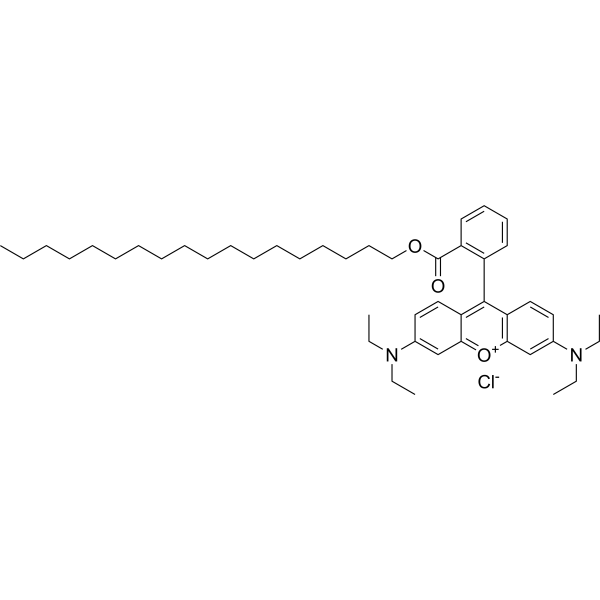
Octadecyl Rhodamine B chloride
Based on 1 publication(s) in Google Scholar
Octadecyl Rhodamine B chloride is an amphiphilic fluorescent probe with both membrane-binding ability and fluorescent properties, which easily forms aggregates in aqueous phase leading to self-quenching. Octadecyl Rhodamine B chloride can be used for cell membrane staining and further applied in membrane biology research. The maximum absorption/emission wavelengths of Octadecyl Rhodamine B chloride monomer in Triton X-100 are 565 nm/585 nm; the absorption peaks of aggregates in water are blue-shifted to 524 nm and 574 nm, with significantly quenched fluorescence.
For research use only. We do not sell to patients.
- Purity : 98.67%
- CAS No.: 65603-19-2
- Formula: C46H67ClN2O3
- Molecular Weight:731.49
-
Storage:
4°C, sealed storage, away from moisture and light
* In solvent : -80°C, 6 months; -20°C, 1 month (sealed storage, away from moisture and light)

To place orders, for customer services and technical support, please contact: MedChemExpress USA
Tel: 609-228-6898 E-mail: [email protected] [email protected]


-
 Biological Activity
-
Chemical Information
-
Solvent & Solubility
- Purity & Documentation
- References
-
 Help & FAQs




Publications Citing Use of MedChemExpress (MCE) Octadecyl Rhodamine B chloride
More

Biological Activity
Description
In Vitro
Guide (The following is our recommended protocol. This protocol is only a guide and should be modified according to your specific needs).
The reference procedures for using Octadecyl Rhodamine B chloride as a fluorescent probe are as follows[1]:
1. Reagent and Model Membrane Preparation: Prepare a stock solution of Octadecyl Rhodamine B chloride (e.g., 1 mM in DMSO), and dilute it to a working concentration (0.44-4.4 μM) with a buffer containing 0.1% human serum albumin (HSA) (e.g., Tris) to avoid aggregation (critical aggregation concentration (CAC): 14 nM). Fabricate lipid bilayers of liquid-disordered phase (DOPC) and liquid-ordered phase (DSC, DOPC:SM:cholesterol=1:1:1), and conjugate them to glass beads to form model membranes.
2. Membrane Binding and Real-Time Detection: Incubate the beads with Octadecyl Rhodamine B chloride (37°C, with stirring), and monitor fluorescence signals in real time by flow cytometry. Quantify the number of membrane-bound Octadecyl Rhodamine B chloride molecules using quantum dot-calibrated beads.
3. Fluorescence Analysis and Kinetic Modeling: Determine the self-quenching curve of Octadecyl Rhodamine B chloride (e.g., by adding Triton X-100 for dequenching), and analyze energy transfer efficiency using FRET technology. Fit the binding kinetics through mass action models to evaluate the effects of membrane structure on Octadecyl Rhodamine B chloride partitioning (e.g., differences in binding capacity and quenching degree).
Note: Maintain Octadecyl Rhodamine B chloride concentration below CAC to ensure monomeric state, optimize membrane binding kinetics using HSA as a carrier, and achieve quantitative analysis by integrating flow cytometry and spectroscopic techniques.
MedChemExpress (MCE) has not independently confirmed the accuracy of these methods. They are for reference only. .
Emission (Em)
578
Excitation (Ex)
556


Chemical Information
-
CAS No. 65603-19-2
-
Appearance Solid-Liquid Mixture
-
Molecular Weight 731.49
-
Formula C46H67ClN2O3
-
Color Pale purple to purple
-
SMILES
[Cl-].O=C(OCCCCCCCCCCCCCCCCCC)C=1C=CC=CC1C=2C=3C=CC(=CC3[O+]=C4C=C(C=CC42)N(CC)CC)N(CC)CC
-
Shipping
Room temperature in continental US; may vary elsewhere.
-
Storage
4°C, sealed storage, away from moisture and light
* In solvent : -80°C, 6 months; -20°C, 1 month (sealed storage, away from moisture and light)


Publications (1)
-
Journal Impact Factor
-
Most Recent
-
Nat Commun
2025 Feb 12;16(1):1585. PMID: 39939595


Solvent & Solubility
In Vitro:
DMSO : 100 mg/mL (136.71 mM; ultrasonic and warming and heat to 60°C; Hygroscopic DMSO has a significant impact on the solubility of product, please use newly opened DMSO)
Please refer to the solubility information to select the appropriate solvent. Once prepared, please aliquot and store the solution to prevent product inactivation from repeated freeze-thaw cycles.
Storage method and period of stock solution: -80°C, 6 months; -20°C, 1 month (sealed storage, away from moisture and light). When stored at -80°C, please use it within 6 months. When stored at -20°C, please use it within 1 month.
Please refer to the solubility information to select the appropriate solvent. Once prepared, please aliquot and store the solution to prevent product inactivation from repeated freeze-thaw cycles.
Storage method and period of stock solution: -80°C, 6 months; -20°C, 1 month (sealed storage, away from moisture and light). When stored at -80°C, please use it within 6 months. When stored at -20°C, please use it within 1 month.
Concentration (start) × Volume (start) = Concentration (final) × Volume (final)


Purity & Documentation
-
Data Sheet (270 KB)
-
SDS (393 KB)
- English - EN (393 KB)
- Français - FR (393 KB)
- Deutsch - DE (393 KB)
- Norwegian - NO (393 KB)
- Español - ES (393 KB)
- Swedish - SV (393 KB)
- Italian - IT (393 KB)
- Korean - KR (393 KB)
- Portuguese - PT (393 KB)
-
Handling Instructions (2659 KB)
References


Complete Stock Solution Preparation Table
Please refer to the solubility information to select the appropriate solvent. Once prepared, please aliquot and store the solution to prevent product inactivation from repeated freeze-thaw cycles.
Storage method and period of stock solution: -80°C, 6 months; -20°C, 1 month (sealed storage, away from moisture and light). When stored at -80°C, please use it within 6 months. When stored at -20°C, please use it within 1 month.
| Optional Solvent | Concentration Solvent Mass | 1 mg | 5 mg | 10 mg | 25 mg |
|---|---|---|---|---|---|
| DMSO | 1 mM | 1.3671 mL | 6.8354 mL | 13.6707 mL | 34.1768 mL |
| 5 mM | 0.2734 mL | 1.3671 mL | 2.7341 mL | 6.8354 mL | |
| 10 mM | 0.1367 mL | 0.6835 mL | 1.3671 mL | 3.4177 mL | |
| 15 mM | 0.0911 mL | 0.4557 mL | 0.9114 mL | 2.2785 mL | |
| 20 mM | 0.0684 mL | 0.3418 mL | 0.6835 mL | 1.7088 mL | |
| 25 mM | 0.0547 mL | 0.2734 mL | 0.5468 mL | 1.3671 mL | |
| 30 mM | 0.0456 mL | 0.2278 mL | 0.4557 mL | 1.1392 mL | |
| 40 mM | 0.0342 mL | 0.1709 mL | 0.3418 mL | 0.8544 mL | |
| 50 mM | 0.0273 mL | 0.1367 mL | 0.2734 mL | 0.6835 mL | |
| 60 mM | 0.0228 mL | 0.1139 mL | 0.2278 mL | 0.5696 mL | |
| 80 mM | 0.0171 mL | 0.0854 mL | 0.1709 mL | 0.4272 mL | |
| 100 mM | 0.0137 mL | 0.0684 mL | 0.1367 mL | 0.3418 mL |


Octadecyl Rhodamine B chloride Related Classifications
HY-W127703 Related Classifications
 Powered by Bioz