



Rhodamine-N3 chloride
Based on 1 publication(s) in Google Scholar
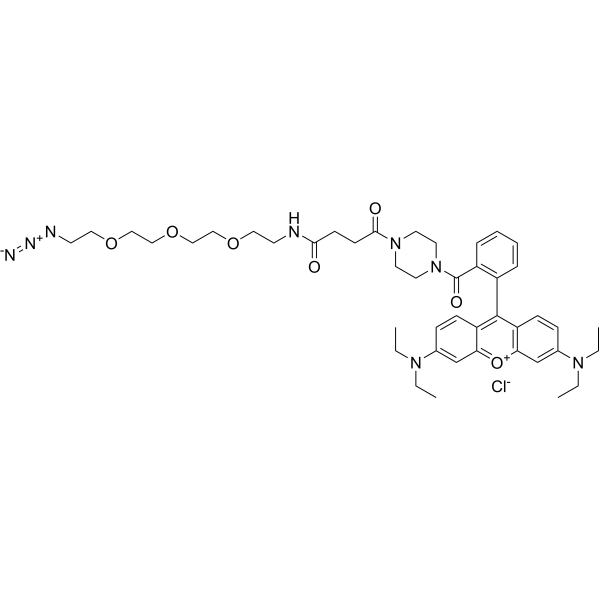
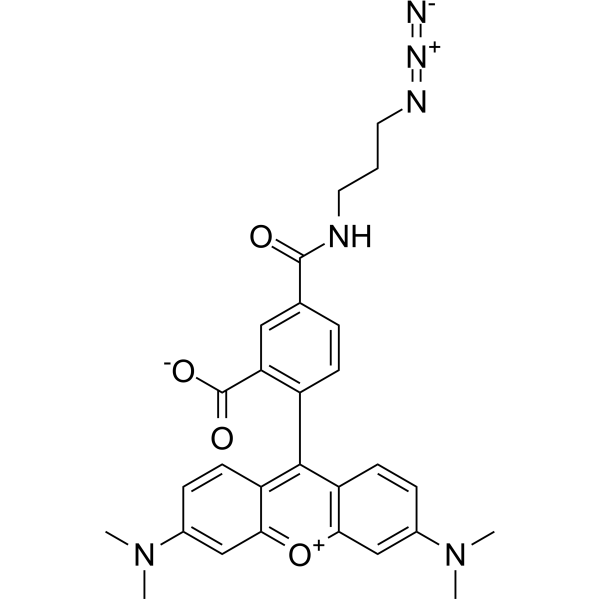
Rhodamine-N3 chloride is an azide-rhodamine fluorescent dye that can be used to label biomolecules containing alkyne groups. Rhodamine-N3 chloride is a click chemistry reagent, it contains an Azide group and can undergo copper-catalyzed azide-alkyne cycloaddition reaction (CuAAc) with molecules containing Alkyne groups. It can also undergo strain-promoted alkyne-azide cycloaddition (SPAAC) reactions with molecules containing DBCO or BCN groups (Ex/Em = 544/576 nm).
商品は「研究用試薬」です。人や動物の医療用・臨床診断用・食品用の製品ではありません。
研究用途以外に使用した場合、当社は一切の責任を負いかねます。
- 純度 : 99.85%
- CAS 番号: 2363751-90-8
- 分子式: C44H59ClN8O7
- 分子量:847.44
-
保管条件:
4°C, sealed storage, away from moisture and light
* In solvent : -80°C, 6 months; -20°C, 1 month (sealed storage, away from moisture and light)

To place orders, for customer services and technical support, please contact: MedChemExpress USA
Tel: 609-228-6898 E-mail: [email protected] [email protected]


-
 生物活性
生物活性
-
化学情報
-
溶剤 & 溶解度
- プロトコル
- 純度とドキュメンテーション
- 参考文献
-
 Help & FAQs



MedChemExpress(MCE)の使用を引用している文献 Rhodamine-N3 chloride
More

生物活性
製品説明
体外実験
Guide (The following is the experimental plan we recommend. This plan serves only as a reference guide. The specific operations should be adjusted according to your actual needs.)
In-situ labeled sample processing, based on gel-based active protein analysis [2].
Let the cells be placed on ice to thaw, and add 200 μL of cold DPBS along with the protein inhibitor mixture to each sample.
2. Disrupt the cells and centrifuge at 100,000 × g for 45 minutes.
3. Take the supernatant (the soluble protein fraction), resuspend it in 200 μL of cold DPBS (with protease inhibitors).
4. Standardize the protein concentration of each sample to 1 mg/mL, with a volume of 43 μL.
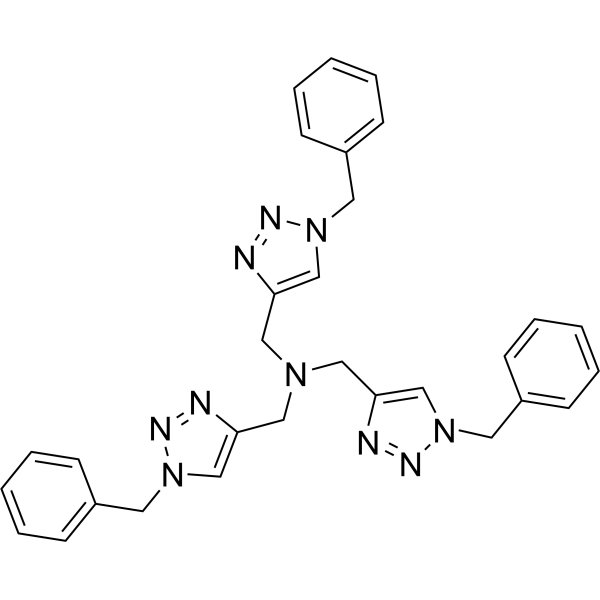
5. Perform click chemical reactions on each sample using a solution with a final concentration of 25 μM Rhodamine-N3 chloride, 1 mM TCEP, 100 μM TBTA, and 1 mM CuSO4, with a final volume of 50 μL.
6. Incubate at room temperature for 1 hour, then add 20 μL of 4X SDS loading buffer.
7. Add the sample (30 μL) and perform electrophoresis on a 10% SDS-PAGE gel. Then, image it using a fluorescence scanner.
MedChemExpress (MCE) has not independently confirmed the accuracy of these methods. They are for reference only. Further protocols information, click here.
Emission (Em)
576
Excitation (Ex)
544


化学情報
-
CAS 番号 2363751-90-8
-
性状 Solid
-
分子量 847.44
-
分子式 C44H59ClN8O7
-
Color Brown to black
-
SMILES
[N-]=[N+]=NCCOCCOCCOCCNC(CCC(N1CCN(CC1)C(C2=C(C3=C4C=CC(N(CC)CC)=CC4=[O+]C5=C3C=CC(N(CC)CC)=C5)C=CC=C2)=O)=O)=O.[Cl-]
-
輸送条件
Room temperature in continental US; may vary elsewhere.
-
保管条件
4°C, sealed storage, away from moisture and light
* In solvent : -80°C, 6 months; -20°C, 1 month (sealed storage, away from moisture and light)


Publications (1)
-
Journal Impact Factor
-
Most Recent
-
Sci Adv
Imaging of Escherichia coli K5 and glycosaminoglycan precursors via targeted metabolic labeling of capsular polysaccharides in bacteria. [Abstract]2023 Feb 17;9(7):eade4770. PMID: 36800421


溶剤 & 溶解度
体外:
DMSO : 25 mg/mL (29.50 mM; Need ultrasonic; Hygroscopic DMSO has a significant impact on the solubility of product, please use newly opened DMSO)
Please refer to the solubility information to select the appropriate solvent. Once prepared, please aliquot and store the solution to prevent product inactivation from repeated freeze-thaw cycles.
Storage method and period of stock solution: -80°C, 6 months; -20°C, 1 month (sealed storage, away from moisture and light). When stored at -80°C, please use it within 6 months. When stored at -20°C, please use it within 1 month.
Please refer to the solubility information to select the appropriate solvent. Once prepared, please aliquot and store the solution to prevent product inactivation from repeated freeze-thaw cycles.
Storage method and period of stock solution: -80°C, 6 months; -20°C, 1 month (sealed storage, away from moisture and light). When stored at -80°C, please use it within 6 months. When stored at -20°C, please use it within 1 month.
濃度 (開始) × 体積 (開始) = 濃度 (終了) × 体積 (終了)

プロトコル
-
EdU Incorporation Assay (Click Chemistry-Based DNA Synthesis Measurement)
The EdU incorporation assay measures DNA synthesis by adding the thymidine analog 5-ethynyl-2′-deoxyuridine to cells or tissues, where it is incorporated into newly synthesized DNA during S phase. Incorporated EdU is detected by copper-catalyzed azide-alkyne cycloaddition, in which a fluorescent azide covalently reacts with the ethynyl group on EdU, allowing S-phase cells to be detected by fluorescence microscopy, flow cytometry, or high-content imaging. EdU detection does not require DNA denaturation or anti-BrdU antibody access, which preserves sample structure and improves compatibility with immunostaining and multiparameter cytometry compared with BrdU-based detection. EdU can be cytotoxic in a cell-type- and exposure-dependent manner, so pulse duration, concentration, and continuous-labeling designs should be validated for each cell type.


純度とドキュメンテーション
-
データシート (271 KB)
-
SDS (252 KB)
- English - EN (252 KB)
- Français - FR (252 KB)
- Deutsch - DE (252 KB)
- Norwegian - NO (252 KB)
- Español - ES (252 KB)
- Swedish - SV (252 KB)
- Italian - IT (252 KB)
- Korean - KR (252 KB)
- Portuguese - PT (252 KB)
-
取扱説明書 (2659 KB)
参考文献
[1]. Shijiao Cai, et al. Glycyrrhizic Acid-Induced Differentiation Repressed Stemness in Hepatocellular Carcinoma by Targeting c-Jun N-Terminal Kinase 1. Front Oncol. 2020 Jan 9;9:1431. [Content Brief]
[2]. Bryan R Lanning, et al. A road map to evaluate the proteome-wide selectivity of covalent kinase inhibitors. Nat Chem Biol. 2014 Sep;10(9):760-767. [Content Brief]


Complete Stock Solution Preparation Table
Please refer to the solubility information to select the appropriate solvent. Once prepared, please aliquot and store the solution to prevent product inactivation from repeated freeze-thaw cycles.
Storage method and period of stock solution: -80°C, 6 months; -20°C, 1 month (sealed storage, away from moisture and light). When stored at -80°C, please use it within 6 months. When stored at -20°C, please use it within 1 month.
| Optional Solvent | Concentration Solvent Mass | 1 mg | 5 mg | 10 mg | 25 mg |
|---|---|---|---|---|---|
| DMSO | 1 mM | 1.1800 mL | 5.9001 mL | 11.8002 mL | 29.5006 mL |
| 5 mM | 0.2360 mL | 1.1800 mL | 2.3600 mL | 5.9001 mL | |
| 10 mM | 0.1180 mL | 0.5900 mL | 1.1800 mL | 2.9501 mL | |
| 15 mM | 0.0787 mL | 0.3933 mL | 0.7867 mL | 1.9667 mL | |
| 20 mM | 0.0590 mL | 0.2950 mL | 0.5900 mL | 1.4750 mL | |
| 25 mM | 0.0472 mL | 0.2360 mL | 0.4720 mL | 1.1800 mL |


Rhodamine-N3 chloride 関連分類
HY-D1269 関連分類
 Powered by Bioz