


Search Result
Results for "
targeted nanoparticles
" in MedChemExpress (MCE) Product Catalog:
202
Biochemical Assay Reagents
1
Isotope-Labeled Compounds
| Cat. No. |
Product Name |
Target |
Research Areas |
Chemical Structure |
-
- HY-170333
-
|
CICL1
|
Liposome
|
Inflammation/Immunology
|
|
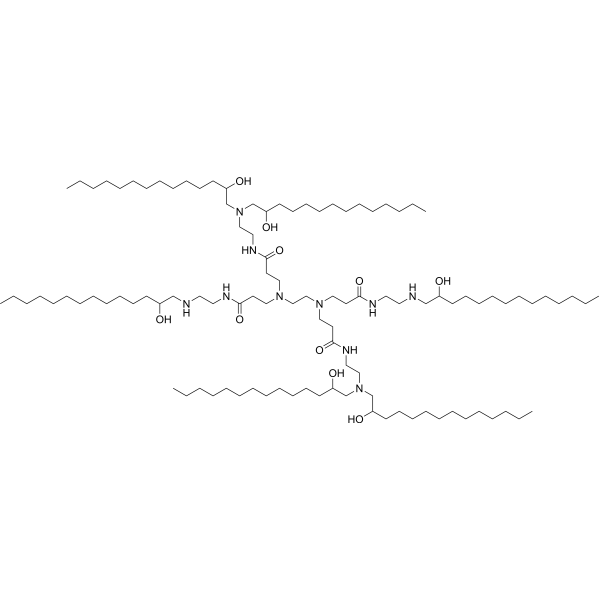
Lipid A-11 (Compound A-11) (CICL1) is an ionizable cationic lipid. Lipid A-11 can be used to prepare lipid nanoparticles. Lipid A-11 can be used in research involving T cell-targeted transfection .
|
-
-
- HY-W011696
-
|
cis-1-Amino-9-octadecene, 80-90%
|
Environmental Pollutants
Biochemical Assay Reagents
|
Cancer
|
|
Oleylamine, 80-90% (cis-1-Amino-9-octadecene, 80-90%) is a multifunctional reagent used for metal ion coordination and nanoparticle surface modification, and acts as a solvent, surfactant and reducing agent in the synthesis of metal oxide nanoparticles. Oleylamine, 80-90% regulates nanoparticle morphology, magnetization intensity and water proton relaxation rate via thiol-ene "click" reaction, and enhances the colloidal stability of nanoparticles in organic reagents. Oleylamine, 80-90% is mainly used in research and applications in fields such as nanomaterial synthesis, biomedical imaging (MRI contrast agents, fluorescent probes), cancer cell targeting and drug delivery .
|
-
-
- HY-W243303J
-
|
|
Biochemical Assay Reagents
|
Cancer
|
|
Poly(acrylic acid) (MW 250000) is a synthetic cationic electrolyte containing abundant carboxyl groups (-COOH), which exhibits excellent water absorption and retention properties and is often cross-linked to form hydrogels. Poly(acrylic acid) (with a molecular weight of 250,000). Poly(acrylic acid) (MW 250000) can be used as a non-collagenous analog in the biomimetic mineralization research of type I collagen. Poly(acrylic acid) (MW 250000) has pH responsiveness and biocompatibility and is often used as a drug carrier, surface modifier and functional material .
|
-
-
- HY-174264
-
|
|
Biochemical Assay Reagents
|
Others
|
|
DMG-PEG2000-NHS is a polyethylene glycol lipid with a molecular weight of 2000, which can be used to construct novel drug delivery systems that confer mucoadhesive and cell-targeting capabilities to lipid nanoparticles .
|
-
-
- HY-139305
-
CL4H6
1 Publications Verification
|
Liposome
|
Cancer
|
|
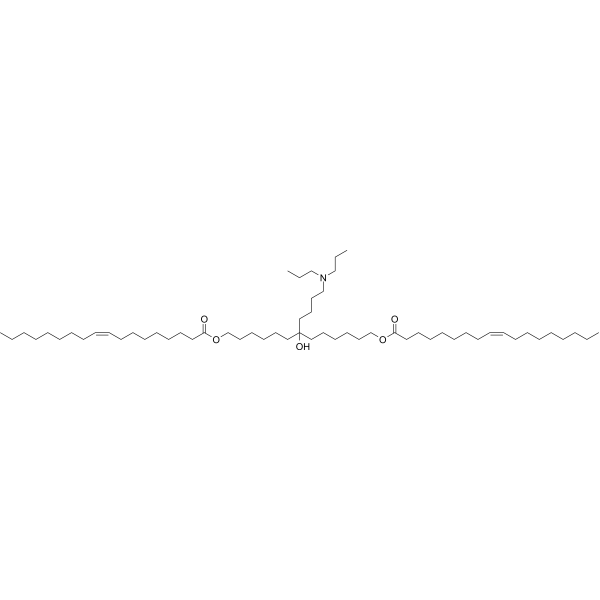
CL4H6 is a pH-sensitive cationic lipid. CL4H6 is the main component of lipid nanoparticles (LNPs), which can be used to target and deliver siRNA, and induces a potent gene-silencing response .
|
-
-
- HY-P1848
-
|
|
Interleukin Related
|
Cancer
|
|
Pep-1 (uncapped) is a specific ligand of IL-13Ra2. Pep-1 (uncapped) exerts cell penetrating activity through receptor-mediated endocytosis, can cross the blood-tumor barrier (BTB) and target glioma cells. Pep-1 (uncapped) can enhance the uptake of nanoparticles by tumor cells and enhance the cell penetration ability of nanoparticles, and can be used to develop targeted drug delivery systems for glioma .
|
-
-
- HY-P3436
-
|
|
Exosomes
|
Cardiovascular Disease
|
|
WLSEAGPVVTVRALRGTGSW is a cardiomyocyte-targeting peptide that specifically recognizes tenascin X on the surface of cardiomyocytes. WLSEAGPVVTVRALRGTGSW can serve as a targeting ligand to conjugate with various therapeutic carriers (drugs, genes, exosomes, nanoparticles, etc.) for research on cardiovascular diseases (such as myocardial infarction, heart failure) .
|
-
-
- HY-W440917
-
|
|
Liposome
|
Others
|
|
DSPE-PEG5000-FITC is a fluorescein attached PEG lipid. It can be used to prepare liposomes as drug carrier in targeted drug delivery. The polymer is modified with fluorescein (green) dye which can be used for staining cells, tissues, biomarkers, or nanoparticles.
|
-
-
- HY-177069
-
|
|
Liposome
|
Others
|
|
4A3-SC7 is a polymer of 4A3 amine and is an ionizable lipid component. 4A3-SC7 can be used to prepare lipid nanoparticles (LNPs) to construct a selective organ targeting (SORT) LNP platform .
|
-
-
- HY-W441015A
-
|
|
Liposome
|
Others
|
|
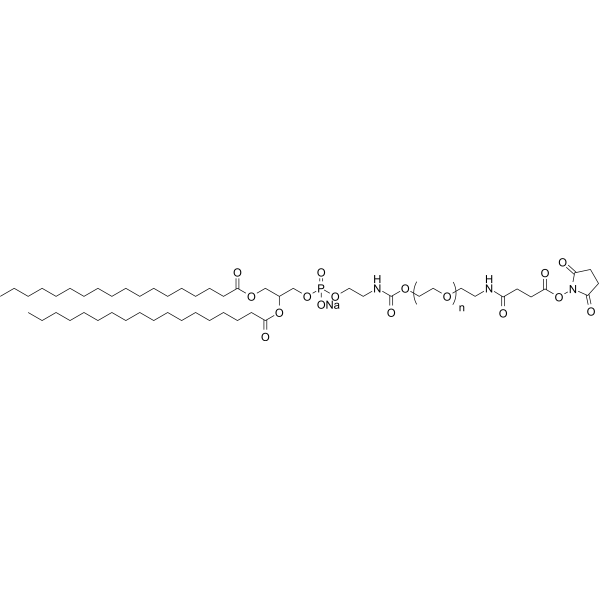
DSPE-m-PEG3400-NHS is a pegylated phospholipid derivatives which can be used to prepare liposome or lipid nanoparticles for targeted drug delivery system, such as DNA or mRNA vaccine .
|
-
-
- HY-W440916
-
|
|
Liposome
|
Others
|
|
DSPE-PEG3400-FITC is a fluorescein attached PEG lipid. It can be used to prepare liposomes as drug carrier in targeted drug delivery. The polymer is modified with fluorescein (green) dye which can be used for staining cells, tissues, biomarkers, or nanoparticles.
|
-
-
- HY-155887
-
|
DSPE-PEG-NH2, MW 3400 ammonium
|
Liposome
|
Cancer
|
|
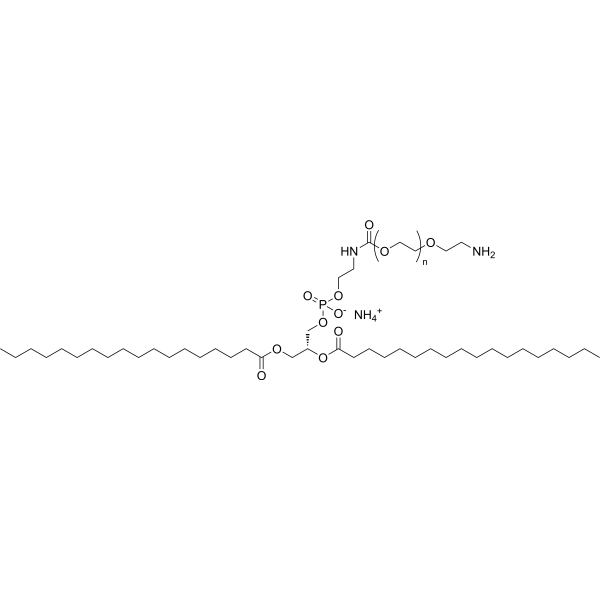
DSPE-PEG-Amine (DSPE-PEG-NH2), MW 3400 ammonium is an amino-functionalized PEGylated phospholipid. It serves not only as a key component for preparing σ receptor-targeted liposomes (such as anisamide-modified lipids) but also as a starting material for synthesizing click chemistry- and tumor-targeted lipids including DSPE-PEG-DBCO (HY-155788) and DSPE-PEG2000-TCO (HY-170704). DSPE-PEG-Amine, MW 3400 ammonium effectively modulates the ζ potential of nanoparticles, enables complexation with nucleic acids or proteins to protect DNA from nuclease degradation, and supports ligand conjugation on the nanoparticle surface. It is used in studies related to DU-145 tumors, breast cancer, and other relevant research .
|
-
-
- HY-W1048555A
-
|
|
Biochemical Assay Reagents
|
Others
|
|
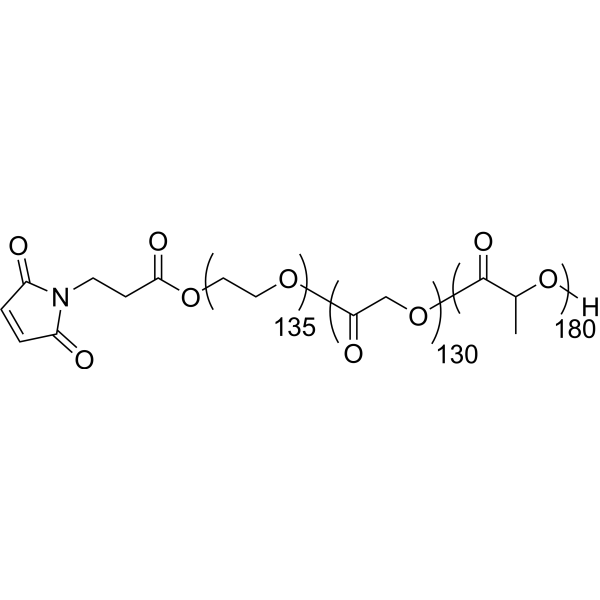
Mal-PEG2000-SCM is a heterobifunctional PEG crosslinker bearing maleimide and succinimidyl carboxymethyl ester functional groups. MMal-PEG2000-SCM conjugates the F3 peptide to nanoparticles: the SCM group reacts with amino groups on the nanoparticle surface to form amide groups, while the MAL group reacts with thiol groups of the F3 peptide to form carbon-sulfur bonds. Mal-PEG-SCM enables unidirectional addition of linkers, ensuring that appropriate functional groups are available for RGD incorporation. Mal-PEG2000-SCM can be used in the development of nanoparticles targeting specific tumor cells .
|
-
-
- HY-D2004
-
|
|
Fluorescent Dye
|
Inflammation/Immunology
|
|
ATTO 488 streptavidin is a fluorescent reagent that specifically targets and binds to biotin (biotin), formed by the conjugation of ATTO 488 with streptavidin (HY-P3152). ATTO 488 streptavidin enables visualization of the activity of streptavidin immobilized on the surface of polymeric nanoparticles, or acts as a fluorescent probe to detect the selective binding and internalization process of anti-HB-EGF/NA with cells expressing HB-EGF (with no such effect on cells that do not express this receptor). ATTO 488 streptavidin effectively verifies the function of streptavidin conjugated to the surface of nanoparticles and is suitable for research related to atherosclerotic cardiovascular diseases .
|
-
-
- HY-P10679
-
|
|
MMP
|
Cancer
|
|
GPLGLAGGWGERDGS is a peptide with MMP enzyme responsiveness and tumor targeting function, which can be used to monitor enzyme-guided nanoparticle assembly in tumors .
|
-
-
- HY-159858
-
|
|
Liposome
|
Cancer
|
|
Lipid 16 is an ionizable lipid that can be used to synthesize lipid nanoparticles (LNP) for delivering mRNA and other payloads. Lipid 16 as a potent cell type-specific ionizable lipid for the CD11bhi macrophage population without an additional targeting moiety .
|
-
-
- HY-144013B
-
|
DSPE-mPEG550 ammonium; 1,2-Distearoyl-sn-glycero-3-phosphoethanolamine-N-[methoxy(polyethylene glycol)-550] ammonium
|
Biochemical Assay Reagents
Liposome
|
Others
|
|
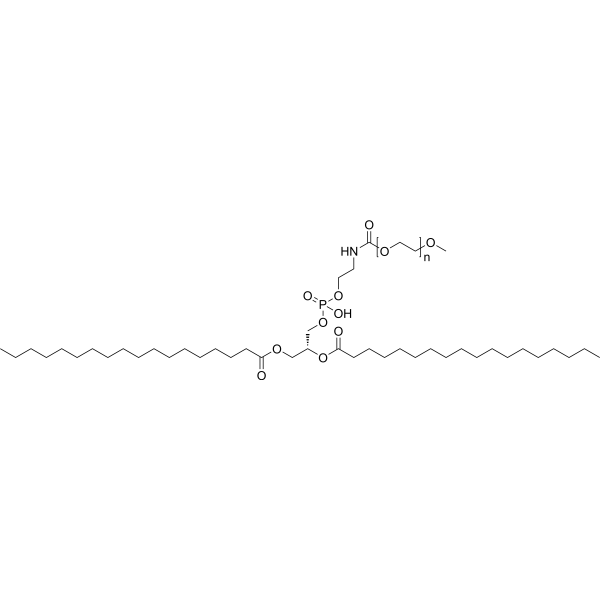
18:0 mPEG550 PE (ammonium) is a PEG lipid functional end group used in the synthesis of liposomes (LPs) for the design of conjugated polymeric nanoparticles. Through biotin modification and carboxyl terminus, lipid nanoparticles (LNPs) further coupling with other biomolecules can be achieved. Functionalized nanoparticles can be used for targeted labeling of specific cellular proteins. With streptavidin as a linker, biotinylated PEG lipid-conjugated polymer nanoparticles are able to bind to biotinylated antibodies on cell surface receptors, yielding the utility of fluorescence-based imaging and sensing.
|
-
-
- HY-144013A
-
|
DSPE-mPEG350 ammonium; 1,2-Distearoyl-sn-glycero-3-phosphoethanolamine-N-[methoxy(polyethylene glycol)-350] ammonium
|
Liposome
|
Others
|
|
18:0 mPEG350 PE (ammonium) is a PEG lipid functional end group used in the synthesis of liposomes (LPs) for the design of conjugated polymer nanoparticles. Through biotin modification and carboxyl terminus, lipid nanoparticles (LNPs) further coupling with other biomolecules can be achieved. Functionalized nanoparticles can be used for targeted labeling of specific cellular proteins. With streptavidin as a linker, biotinylated PEG lipid-conjugated polymer nanoparticles are able to bind to biotinylated antibodies on cell surface receptors, yielding the utility of fluorescence-based imaging and sensing.
|
-
-
- HY-144013D
-
|
DSPE-mPEG1000 ammonium; 1,2-Distearoyl-sn-glycero-3-phosphoethanolamine-N-[methoxy(polyethylene glycol)-1000] ammonium
|
Liposome
|
Others
|
|
18:0 mPEG1000 PE (ammonium) is a PEG lipid functional end group used in the synthesis of liposomes (LPs) for the design of conjugated polymeric nanoparticles. Through biotin modification and carboxyl terminus, lipid nanoparticles (LNPs) further coupling with other biomolecules can be achieved. Functionalized nanoparticles can be used for targeted labeling of specific cellular proteins. With streptavidin as a linker, biotinylated PEG lipid-conjugated polymer nanoparticles are able to bind to biotinylated antibodies on cell surface receptors, yielding the utility of fluorescence-based imaging and sensing.
|
-
-
- HY-144013E
-
|
DSPE-mPEG3000 ammonium; 1,2-Distearoyl-sn-glycero-3-phosphoethanolamine-N-[methoxy(polyethylene glycol)-3000] ammonium
|
Liposome
|
Others
|
|
18:0 mPEG3000 PE (ammonium) is a PEG lipid functional end group used in the synthesis of liposomes (LPs) for the design of conjugated polymeric nanoparticles. Through biotin modification and carboxyl terminus, lipid nanoparticles (LNPs) further coupling with other biomolecules can be achieved. Functionalized nanoparticles can be used for targeted labeling of specific cellular proteins. With streptavidin as a linker, biotinylated PEG lipid-conjugated polymer nanoparticles are able to bind to biotinylated antibodies on cell surface receptors, yielding the utility of fluorescence-based imaging and sensing.
|
-
-
- HY-144013C
-
|
DSPE-mPEG750 ammonium; 1,2-Distearoyl-sn-glycero-3-phosphoethanolamine-N-[methoxy(polyethylene glycol)-750] ammonium
|
Biochemical Assay Reagents
Liposome
|
Others
|
|
18:0 mPEG750 PE (ammonium) is a PEG lipid functional end group used in the synthesis of liposomes (LPs) for the design of conjugated polymeric nanoparticles. Through biotin modification and carboxyl terminus, lipid nanoparticles (LNPs) further coupling with other biomolecules can be achieved. Functionalized nanoparticles can be used for targeted labeling of specific cellular proteins. With streptavidin as a linker, biotinylated PEG lipid-conjugated polymer nanoparticles are able to bind to biotinylated antibodies on cell surface receptors, yielding the utility of fluorescence-based imaging and sensing.
|
-
-
- HY-155934
-
|
DOPE-PEG5000 ammonium; 1,2-Dioleoyl-sn-glycero-3-phosphoethanolamine-N-[methoxy(polyethylene glycol)-5000] ammonium
|
Liposome
|
Others
|
|
18:1 PEG5000 PE ammonium (DOPE-PEG5000 ammonium) is a PEG lipid functional end group used in the synthesis of liposomes (LPs) for the design of conjugated polymer nanoparticles. Through biotin modification and carboxyl terminus, lipid nanoparticles (LNPs) further coupling with other biomolecules can be achieved. Functionalized nanoparticles can be used for targeted labeling of specific cellular proteins. With streptavidin as a linker, biotinylated PEG lipid-conjugated polymer nanoparticles are able to bind to biotinylated antibodies on cell surface receptors, yielding the utility of fluorescence-based imaging and sensing.
|
-
-
- HY-155926
-
|
14:0 PEG750 PE ammonium; 1,2-Dimyristoyl-sn-glycero-3-phosphoethanolamine-N-[methoxy(polyethylene glycol)-750] ammonium
|
Liposome
|
Others
|
|
DMPE-PEG750 ammonium (14:0 PEG750 PE ammonium) is a PEG lipid functional end group used in the synthesis of liposomes (LPs) for the design of conjugated polymeric nanoparticles. Through biotin modification and carboxyl terminus, lipid nanoparticles (LNPs) further coupling with other biomolecules can be achieved. Functionalized nanoparticles can be used for targeted labeling of specific cellular proteins. With streptavidin as a linker, biotinylated PEG lipid-conjugated polymer nanoparticles are able to bind to biotinylated antibodies on cell surface receptors, yielding the utility of fluorescence-based imaging and sensing.
|
-
-
- HY-155924
-
|
14:0 PEG350 PE ammonium; 1,2-Dimyristoyl-sn-glycero-3-phosphoethanolamine-N-[methoxy(polyethylene glycol)-350] ammonium
|
Liposome
|
Others
|
|
DMPE-PEG350 ammonium (14:0 PEG350 PE ammonium) is a PEG lipid functional end group used in the synthesis of liposomes (LPs) for the design of conjugated polymer nanoparticles. Through biotin modification and carboxyl terminus, lipid nanoparticles (LNPs) further coupling with other biomolecules can be achieved. Functionalized nanoparticles can be used for targeted labeling of specific cellular proteins. With streptavidin as a linker, biotinylated PEG lipid-conjugated polymer nanoparticles are able to bind to biotinylated antibodies on cell surface receptors, yielding the utility of fluorescence-based imaging and sensing.
|
-
-
- HY-155927
-
|
14:0 PEG1000 PE ammonium; 1,2-Dimyristoyl-sn-glycero-3-phosphoethanolamine-N-[methoxy(polyethylene glycol)-1000] ammonium
|
Liposome
|
Others
|
|
DMPE-PEG1000 ammonium (14:0 PEG1000 PE ammonium) is a PEG lipid functional end group used in the synthesis of liposomes (LPs) for the design of conjugated polymer nanoparticles. Through biotin modification and carboxyl terminus, lipid nanoparticles (LNPs) further coupling with other biomolecules can be achieved. Functionalized nanoparticles can be used for targeted labeling of specific cellular proteins. With streptavidin as a linker, biotinylated PEG lipid-conjugated polymer nanoparticles are able to bind to biotinylated antibodies on cell surface receptors, yielding the utility of fluorescence-based imaging and sensing.
|
-
-
- HY-155925
-
|
14:0 PEG550 PE ammonium; 1,2-Dimyristoyl-sn-glycero-3-phosphoethanolamine-N-[methoxy(polyethylene glycol)-550] ammonium
|
Liposome
|
Others
|
|
DMPE-PEG550 ammonium (14:0 PEG550 PE ammonium) is a PEG lipid functional end group used in the synthesis of liposomes (LPs) for the design of conjugated polymeric nanoparticles. Through biotin modification and carboxyl terminus, lipid nanoparticles (LNPs) further coupling with other biomolecules can be achieved. Functionalized nanoparticles can be used for targeted labeling of specific cellular proteins. With streptavidin as a linker, biotinylated PEG lipid-conjugated polymer nanoparticles are able to bind to biotinylated antibodies on cell surface receptors, yielding the utility of fluorescence-based imaging and sensing.
|
-
-
- HY-155929
-
|
14:0 PEG5000 PE ammonium; 1,2-Dimyristoyl-sn-glycero-3-phosphoethanolamine-N-[methoxy(polyethylene glycol)-5000] ammonium
|
Liposome
|
Others
|
|
DMPE-PEG5000 ammonium (14:0 PEG5000 PE ammonium) is a PEG lipid functional end group used in the synthesis of liposomes (LPs) for the design of conjugated polymer nanoparticles. Through biotin modification and carboxyl terminus, lipid nanoparticles (LNPs) further coupling with other biomolecules can be achieved. Functionalized nanoparticles can be used for targeted labeling of specific cellular proteins. With streptavidin as a linker, biotinylated PEG lipid-conjugated polymer nanoparticles are able to bind to biotinylated antibodies on cell surface receptors, yielding the utility of fluorescence-based imaging and sensing.
|
-
-
- HY-155928
-
|
14:0 PEG3000 PE ammonium; 1,2-Dimyristoyl-sn-glycero-3-phosphoethanolamine-N-[methoxy(polyethylene glycol)-3000] ammonium
|
Liposome
|
Others
|
|
DMPE-PEG3000 ammonium (14:0 PEG3000 PE ammonium) is a PEG lipid functional end group used in the synthesis of liposomes (LPs) for the design of conjugated polymer nanoparticles. Through biotin modification and carboxyl terminus, lipid nanoparticles (LNPs) further coupling with other biomolecules can be achieved. Functionalized nanoparticles can be used for targeted labeling of specific cellular proteins. With streptavidin as a linker, biotinylated PEG lipid-conjugated polymer nanoparticles are able to bind to biotinylated antibodies on cell surface receptors, yielding the utility of fluorescence-based imaging and sensing.
|
-
-
- HY-P4115
-
|
|
FABP
|
Cancer
|
|
CooP is a linear glioblastoma-targeting nonapeptide. CooP binds to the mammary-derived growth inhibitor/fatty acid binding protein 3 (FABP3) in the glioblastoma cells and its associated vasculature. CooP is used for the targeted delivery of chemotherapy and different nanoparticles .
|
-
-
- HY-177921
-
|
|
Liposome
|
Others
|
|
PL53 is a kind of cycloalkylamine lipid nanoparticles. PL53 exhibits outstanding transfection efficiency both in vitro and in vivo, especially showing strong protein expression ability and potential tissue targeting after intramuscular injection. PL53 can be used for the study of nucleic acid delivery .
|
-
-
- HY-160045
-
|
|
Cholecystokinin Receptor
|
Cancer
|
|
AP1153 aptamer sodium is a DNA aptamer that specifically binds to the cholecystokinin receptor CCKBR (Kd: ~15 pM), but does not activate CCKBR-related signaling pathways. AP1153 aptamer sodium is internalized by pancreatic ductal adenocarcinoma (PDAC) cells in a receptor-mediated manner. AP1153 aptamer sodium can bioconjugate to the surface of fluorescent nanoparticles to facilitate nanoparticle delivery to PDAC tumors in vivo .
|
-
-
- HY-144012B
-
|
16:0 PEG550 PE; 1,2-Dipalmitoyl-sn-glycero-3-phosphoethanolamine-N-[methoxy(polyethylene glycol)-550] ammonium
|
Biochemical Assay Reagents
Liposome
|
Others
|
|
DPPE-PEG550 is a PEG lipid functional end group used in the synthesis of liposomes (LPs) for the design of conjugated polymer nanoparticles. Through biotin modification and carboxyl terminus, lipid nanoparticles (LNPs) further coupling with other biomolecules can be achieved. Functionalized nanoparticles can be used for targeted labeling of specific cellular proteins. With streptavidin as a linker, biotinylated PEG lipid-conjugated polymer nanoparticles are able to bind to biotinylated antibodies on cell surface receptors, yielding the utility of fluorescence-based imaging and sensing.
|
-
-
- HY-144012C
-
|
16:0 PEG750 PE; 1,2-Dipalmitoyl-sn-glycero-3-phosphoethanolamine-N-[methoxy(polyethylene glycol)-750] ammonium
|
Biochemical Assay Reagents
Liposome
|
Others
|
|
DPPE-PEG750 is a PEG lipid functional end group used in the synthesis of liposomes (LPs) for the design of conjugated polymer nanoparticles. Through biotin modification and carboxyl terminus, lipid nanoparticles (LNPs) further coupling with other biomolecules can be achieved. Functionalized nanoparticles can be used for targeted labeling of specific cellular proteins. With streptavidin as a linker, biotinylated PEG lipid-conjugated polymer nanoparticles are able to bind to biotinylated antibodies on cell surface receptors, yielding the utility of fluorescence-based imaging and sensing.
|
-
-
- HY-144012E
-
|
16:0 PEG3000 PE; 1,2-Dipalmitoyl-sn-glycero-3-phosphoethanolamine-N-[methoxy(polyethylene glycol)-3000] ammonium
|
Liposome
|
Others
|
|
DPPE-PEG3000 is a PEG lipid functional end group used in the synthesis of liposomes (LPs) for the design of conjugated polymer nanoparticles. Through biotin modification and carboxyl terminus, lipid nanoparticles (LNPs) further coupling with other biomolecules can be achieved. Functionalized nanoparticles can be used for targeted labeling of specific cellular proteins. With streptavidin as a linker, biotinylated PEG lipid-conjugated polymer nanoparticles are able to bind to biotinylated antibodies on cell surface receptors, yielding the utility of fluorescence-based imaging and sensing.
|
-
-
- HY-144012D
-
|
16:0 PEG1000 PE; 1,2-Dipalmitoyl-sn-glycero-3-phosphoethanolamine-N-[methoxy(polyethylene glycol)-1000] ammonium
|
Liposome
|
Others
|
|
DPPE-PEG1000 is a PEG lipid functional end group used in the synthesis of liposomes (LPs) for the design of conjugated polymer nanoparticles. Through biotin modification and carboxyl terminus, lipid nanoparticles (LNPs) further coupling with other biomolecules can be achieved. Functionalized nanoparticles can be used for targeted labeling of specific cellular proteins. With streptavidin as a linker, biotinylated PEG lipid-conjugated polymer nanoparticles are able to bind to biotinylated antibodies on cell surface receptors, yielding the utility of fluorescence-based imaging and sensing.
|
-
-
- HY-155931
-
|
DOPE-PEG550 ammonium; 1,2-Dioleoyl-sn-glycero-3-phosphoethanolamine-N-[methoxy(polyethylene glycol)-550] ammonium
|
Liposome
|
Others
|
|
18:1 PEG550 PE ammonium (DOPE-PEG550 ammonium) is a PEG lipid functional end group used in the synthesis of liposomes (LPs) for the design of conjugated polymer nanoparticles. Through biotin modification and carboxyl terminus, lipid nanoparticles (LNPs) further coupling with other biomolecules can be achieved. Functionalized nanoparticles can be used for targeted labeling of specific cellular proteins. With streptavidin as a linker, biotinylated PEG lipid-conjugated polymer nanoparticles are able to bind to biotinylated antibodies on cell surface receptors, yielding the utility of fluorescence-based imaging and sensing.
|
-
-
- HY-155933
-
|
DOPE-PEG3000 ammonium; 1,2-Dioleoyl-sn-glycero-3-phosphoethanolamine-N-[methoxy(polyethylene glycol)-3000] ammonium
|
Liposome
|
Others
|
|
18:1 PEG3000 PE ammonium (DOPE-PEG3000 ammonium) is a PEG lipid functional end group used in the synthesis of liposomes (LPs) for the design of conjugated polymer nanoparticles. Through biotin modification and carboxyl terminus, lipid nanoparticles (LNPs) further coupling with other biomolecules can be achieved. Functionalized nanoparticles can be used for targeted labeling of specific cellular proteins. With streptavidin as a linker, biotinylated PEG lipid-conjugated polymer nanoparticles are able to bind to biotinylated antibodies on cell surface receptors, yielding the utility of fluorescence-based imaging and sensing.
|
-
-
- HY-155932
-
|
DOPE-PEG1000 ammonium; 1,2-Dioleoyl-sn-glycero-3-phosphoethanolamine-N-[methoxy(polyethylene glycol)-1000] ammonium
|
Liposome
|
Others
|
|
18:1 PEG1000 PE ammonium (DOPE-PEG1000 ammonium) is a PEG lipid functional end group used in the synthesis of liposomes (LPs) for the design of conjugated polymer nanoparticles. Through biotin modification and carboxyl terminus, lipid nanoparticles (LNPs) further coupling with other biomolecules can be achieved. Functionalized nanoparticles can be used for targeted labeling of specific cellular proteins. With streptavidin as a linker, biotinylated PEG lipid-conjugated polymer nanoparticles are able to bind to biotinylated antibodies on cell surface receptors, yielding the utility of fluorescence-based imaging and sensing.
|
-
-
- HY-155930
-
|
DOPE-PEG350 ammonium; 1,2-Dioleoyl-sn-glycero-3-phosphoethanolamine-N-[methoxy(polyethylene glycol)-350] ammonium
|
Liposome
|
Others
|
|
18:1 PEG350 PE ammonium (DOPE-PEG350 ammonium) is a PEG lipid functional end group used in the synthesis of liposomes (LPs) for the design of conjugated polymer nanoparticles. Through biotin modification and carboxyl terminus, lipid nanoparticles (LNPs) further coupling with other biomolecules can be achieved. Functionalized nanoparticles can be used for targeted labeling of specific cellular proteins. With streptavidin as a linker, biotinylated PEG lipid-conjugated polymer nanoparticles are able to bind to biotinylated antibodies on cell surface receptors, yielding the utility of fluorescence-based imaging and sensing.
|
-
-
- HY-177614
-
|
AD3133 sodium
|
VEGFR
|
Cancer
|
|
ALN-3133 sodium is a siRNA that targets VEGF, and it is one of the siRNAs in ALN-VSP.ALN-VSP is a lipid nanoparticle formulation containing two siRNAs for kinesin spindle protein (KSP) and VEGF with potential antitumor activity.
|
-
-
- HY-177613A
-
|
AD12115 sodium
|
Kinesin
|
Cancer
|
|
ALN-12115 sodium is a siRNA that targets kinesin spindle protein (KSP), and it is one of the siRNAs in ALN-VSP.ALN-VSP is a lipid nanoparticle formulation containing two siRNAs for KSP and VEGF with potential antitumor activity.
|
-
-
- HY-177613
-
|
AD12115
|
Kinesin
|
Cancer
|
|
ALN-12115 is a siRNA that targets kinesin spindle protein (KSP), and it is one of the siRNAs in ALN-VSP.ALN-VSP is a lipid nanoparticle formulation containing two siRNAs for KSP and VEGF with potential antitumor activity.
|
-
-
- HY-174972A
-
|
|
Biochemical Assay Reagents
|
Others
|
|
mPEG-DPPE (MW 5000) is an amphiphilic phospholipid-modified polymer that can be used to prepare lipid nanoparticles or liposomes for targeted drug delivery applications .
|
-
-
- HY-174947
-
|
|
Biochemical Assay Reagents
|
Others
|
|
DPPE-PEG2-mal is an amphiphilic phospholipid-modified polymer that can be used to prepare lipid nanoparticles or liposomes for targeted drug delivery applications .
|
-
-
- HY-P3436A
-
|
|
Exosomes
|
Cardiovascular Disease
|
|
WLSEAGPVVTVRALRGTGSW TFA is a cardiomyocyte-targeting peptide that specifically recognizes tenascin X on the surface of cardiomyocytes. WLSEAGPVVTVRALRGTGSW TFA can serve as a targeting ligand to conjugate with various therapeutic carriers (drugs, genes, exosomes, nanoparticles, etc.) for research on cardiovascular diseases (such as myocardial infarction, heart failure) .
|
-
-
- HY-160577
-
|
|
Liposome
|
Others
|
|
DOG-IM4 can be used to synthesize nanoparticles to deliver antigen-encoding nucleic acids. It could be used to try to target autoimmune diseases, rare blood or metabolic diseases, allergies, cancer or infectious diseases .
|
-
-
- HY-122787
-
|
|
Others
|
Others
|
|
Tylocrebrine is a compound with anticancer activity. Its clinical research was interrupted due to toxicity issues. By making it into targeted nanoparticles, its inhibitory index can be improved, the killing effect on tumor cells can be enhanced and brain penetration can be reduced.
|
-
-
- HY-159675
-
|
|
Liposome
|
Inflammation/Immunology
|
|
1-A-N is a lipid nanoparticle (LNP) used for in vivo delivery of siRNA. 1-A-N can regulate immune response by delivering siCD45 (siRNA targeting CD45) to T cells and silencing the CD45 gene .
|
-
-
- HY-173549
-
|
CPPA-Triphenylphosphonium
|
Drug Intermediate
|
Cancer
|
|
CPPA-TPP (CPPA-Triphenylphosphonium) is a compound conjugated to the mitochondria-targeting moiety triphenylphosphonium (TPP). CPPA-TPP can be used in the synthesis of nanoparticles that release Camptothecin (HY-16560) in a reactive oxygen species dependent manner, leading to cancer cell death .
|
-
-
- HY-W440921
-
|
|
Liposome
|
Others
|
|
DSPE-PEG5000-Rhodamine is a phospholipid polyPEG with red fluorescent. The polymer can form lipid bilayer and be used to prepare nanoparticles or liposomes for targeted drug delivery. Rhodamine has maximum absorption at 570 nm and emission around 595 nm and can be easily traced using an imaging technique.
|
-
- HY-P10052
-
|
|
VEGFR
|
Cancer
|
|
CBO-P11 specifically binds to receptor of VEGFR-2 and is used as targeting ligand for tumor angiogenesis. CBO-P11 is modified with a nearinfrared cyanine dye bearing an alkyne function, allowing both “click” coupling on azido-modified nanoparticles and fluorescence labelling .
|
-
- HY-W440920
-
|
|
Liposome
|
Others
|
|
DSPE-PEG3400-Rhodamine is a phospholipid polyPEG with red fluorescent. The polymer can form lipid bilayer and be used to prepare nanoparticles or liposomes for targeted drug delivery. Rhodamine has maximum absorption at 570 nm and emission around 595 nm and can be easily traced using an imaging technique.
|
-
- HY-141489
-
|
|
Biochemical Assay Reagents
Liposome
|
Neurological Disease
|
|
DSPE-PEG2000-Carboxy NHS sodium is a linker. DSPE-PEG2000-Carboxy NHS sodium enables conjugation of targeting peptides to lipid nanoparticles after their preparation. DSPE-PEG2000-Carboxy NHS (sodium) is applicable to the research of hereditary retinal degeneration .
|
-
- HY-W1130412
-
|
|
Liposome
|
Others
|
|
DLPE-mPEG2000 is an amphiphilic phospholipid-modified polymer that can be used to prepare lipid nanoparticles or liposomes for targeted drug delivery applications .
|
-
- HY-174972
-
|
|
Biochemical Assay Reagents
|
Others
|
|
mPEG-DPPE (MW 1000) is an amphiphilic phospholipid-modified polymer that can be used to prepare lipid nanoparticles or liposomes for targeted drug delivery applications .
|
-
- HY-P11799
-
|
|
Transmembrane Glycoprotein
|
Inflammation/Immunology
|
|
cLABL is a cyclic peptide that specifically binds to ICAM‑1. cLABL mediates targeted enrichment and rapid endocytosis of nanoparticles. cLABL is applicable to researches such as precise drug delivery at inflammatory sites .
|
-
- HY-182981A
-
|
|
Biochemical Assay Reagents
|
Others
|
|
Mannose-PEG2000-Biotin is a conjugate composed of mannose, PEG chains, and biotin. Mannose-PEG-Biotin combines the targeting recognition ability of mannose with the high affinity of biotin to bind avidin/link avidin, and is used for applications such as constructing targeted drug delivery systems and nanoparticle modification.
|
-
- HY-182981
-
|
|
Biochemical Assay Reagents
|
Others
|
|
Mannose-PEG1000-Biotin is a conjugate composed of mannose, PEG chains, and biotin. Mannose-PEG-Biotin combines the targeting recognition ability of mannose with the high affinity of biotin to bind avidin/link avidin, and is used for applications such as constructing targeted drug delivery systems and nanoparticle modification.
|
-
- HY-182981B
-
|
|
Biochemical Assay Reagents
|
Others
|
|
Mannose-PEG3400-Biotin is a conjugate composed of mannose, PEG chains, and biotin. Mannose-PEG-Biotin combines the targeting recognition ability of mannose with the high affinity of biotin to bind avidin/link avidin, and is used for applications such as constructing targeted drug delivery systems and nanoparticle modification.
|
-
- HY-182981C
-
|
|
Biochemical Assay Reagents
|
Others
|
|
Mannose-PEG5000-Biotin is a conjugate composed of mannose, PEG chains, and biotin. Mannose-PEG-Biotin combines the targeting recognition ability of mannose with the high affinity of biotin to bind avidin/link avidin, and is used for applications such as constructing targeted drug delivery systems and nanoparticle modification.
|
-
- HY-182981D
-
|
|
Biochemical Assay Reagents
|
Others
|
|
Mannose-PEG10000-Biotin is a conjugate composed of mannose, PEG chains, and biotin. Mannose-PEG-Biotin combines the targeting recognition ability of mannose with the high affinity of biotin to bind avidin/link avidin, and is used for applications such as constructing targeted drug delivery systems and nanoparticle modification.
|
-
- HY-P11760
-
|
|
EGFR
|
Cancer
|
|
HER2-targeted peptide H10 is a HER2-targeting peptide with a Kd value of 30.4 nM. HER2-targeted peptide H10 specifically accumulates in HER2-positive tumor tissues of xenograft mice, when conjugated with nanoparticles. HER2-targeted peptide H10 can be used for studies related to HER2-positive breast cancer .
|
-
- HY-183164D
-
|
|
Biochemical Assay Reagents
|
Others
|
|
Glucose-PEG10000-OH is a conjugate composed of glucose, PEG chains, and hydroxyl groups (-OH). Glucose-PEG10000-OH combines the targeted recognition capability of glucose with the modification flexibility of hydroxyl groups, enabling applications such as targeted drug delivery systems and nanoparticle modification.
|
-
- HY-183164
-
|
|
Biochemical Assay Reagents
|
Others
|
|
Glucose-PEG1000-OH is a conjugate composed of glucose, PEG chains, and hydroxyl groups (-OH). Glucose-PEG1000-OH combines the targeted recognition capability of glucose with the modification flexibility of hydroxyl groups, enabling applications such as targeted drug delivery systems and nanoparticle modification.
|
-
- HY-183164B
-
|
|
Biochemical Assay Reagents
|
Others
|
|
Glucose-PEG3400-OH is a conjugate composed of glucose, PEG chains, and hydroxyl groups (-OH). Glucose-PEG3400-OH combines the targeted recognition capability of glucose with the modification flexibility of hydroxyl groups, enabling applications such as targeted drug delivery systems and nanoparticle modification.
|
-
- HY-183164A
-
|
|
Biochemical Assay Reagents
|
Others
|
|
Glucose-PEG2000-OH is a conjugate composed of glucose, PEG chains, and hydroxyl groups (-OH). Glucose-PEG2000-OH combines the targeted recognition capability of glucose with the modification flexibility of hydroxyl groups, enabling applications such as targeted drug delivery systems and nanoparticle modification.
|
-
- HY-183164C
-
|
|
Biochemical Assay Reagents
|
Others
|
|
Glucose-PEG5000-OH is a conjugate composed of glucose, PEG chains, and hydroxyl groups (-OH). Glucose-PEG5000-OH combines the targeted recognition capability of glucose with the modification flexibility of hydroxyl groups, enabling applications such as targeted drug delivery systems and nanoparticle modification.
|
-
- HY-183160
-
|
|
Biochemical Assay Reagents
|
Others
|
|
Glucose-PEG1000-Biotin is a conjugate composed of glucose, PEG chains, and biotin. Glucose-PEG1000-Biotin combines the targeted recognition capabilities of glucose with the high-affinity binding ability of biotin to avidin/streptavidin, enabling applications such as targeted drug delivery systems and nanoparticle modification.
|
-
- HY-183160B
-
|
|
Biochemical Assay Reagents
|
Others
|
|
Glucose-PEG3400-Biotin is a conjugate composed of glucose, PEG chains, and biotin. Glucose-PEG3400-Biotin combines the targeted recognition capabilities of glucose with the high-affinity binding ability of biotin to avidin/streptavidin, enabling applications such as targeted drug delivery systems and nanoparticle modification.
|
-
- HY-183160A
-
|
|
Biochemical Assay Reagents
|
Others
|
|
Glucose-PEG2000-Biotin is a conjugate composed of glucose, PEG chains, and biotin. Glucose-PEG2000-Biotin combines the targeted recognition capabilities of glucose with the high-affinity binding ability of biotin to avidin/streptavidin, enabling applications such as targeted drug delivery systems and nanoparticle modification.
|
-
- HY-183160D
-
|
|
Biochemical Assay Reagents
|
Others
|
|
Glucose-PEG10000-Biotin is a conjugate composed of glucose, PEG chains, and biotin. Glucose-PEG10000-Biotin combines the targeted recognition capabilities of glucose with the high-affinity binding ability of biotin to avidin/streptavidin, enabling applications such as targeted drug delivery systems and nanoparticle modification.
|
-
- HY-183160C
-
|
|
Biochemical Assay Reagents
|
Others
|
|
Glucose-PEG5000-Biotin is a conjugate composed of glucose, PEG chains, and biotin. Glucose-PEG5000-Biotin combines the targeted recognition capabilities of glucose with the high-affinity binding ability of biotin to avidin/streptavidin, enabling applications such as targeted drug delivery systems and nanoparticle modification.
|
-
- HY-181133
-
|
Budesonide 21-oleate
|
Drug Intermediate
|
Inflammation/Immunology
|
|
Budesonide oleate (C18:1) (Budesonide 21-oleate) is a prodrug of Budesonide (HY-13580), and can be used as the active ingredient of anti-inflammatory lipid nanoparticles for targeted delivery of anti-inflammatory agents .
|
-
- HY-183003C
-
|
|
Biochemical Assay Reagents
|
Others
|
|
Mannose-PEG5000-COOH is a conjugate composed of mannose, PEG chains, and carboxyl groups (COOH). Mannose-PEG-COOH combines the targeting recognition ability of mannose with the carboxyl group, which can undergo condensation or esterification reactions with amino and hydroxyl groups, for applications such as targeted drug delivery systems and nanoparticle modification.
|
-
- HY-183015C
-
|
|
Biochemical Assay Reagents
|
Others
|
|
Mannose-PEG5000-NH2 is composed of mannose, PEG chains, and terminal amino groups (–NH2). Mannose-PEG-NH2 combines the targeting recognition ability of mannose with the chemical modifiability of amino groups, making it suitable for applications such as targeted drug delivery systems and nanoparticle modification.
|
-
- HY-183015
-
|
|
Biochemical Assay Reagents
|
Others
|
|
Mannose-PEG1000-NH2 is composed of mannose, PEG chains, and terminal amino groups (–NH2). Mannose-PEG-NH2 combines the targeting recognition ability of mannose with the chemical modifiability of amino groups, making it suitable for applications such as targeted drug delivery systems and nanoparticle modification.
|
-
- HY-183003D
-
|
|
Biochemical Assay Reagents
|
Others
|
|
Mannose-PEG10000-COOH is a conjugate composed of mannose, PEG chains, and carboxyl groups (COOH). Mannose-PEG-COOH combines the targeting recognition ability of mannose with the carboxyl group, which can undergo condensation or esterification reactions with amino and hydroxyl groups, for applications such as targeted drug delivery systems and nanoparticle modification.
|
-
- HY-183015A
-
|
|
Biochemical Assay Reagents
|
Others
|
|
Mannose-PEG2000-NH2 is composed of mannose, PEG chains, and terminal amino groups (–NH2). Mannose-PEG-NH2 combines the targeting recognition ability of mannose with the chemical modifiability of amino groups, making it suitable for applications such as targeted drug delivery systems and nanoparticle modification.
|
-
- HY-183003A
-
|
|
Biochemical Assay Reagents
|
Others
|
|
Mannose-PEG2000-COOH is a conjugate composed of mannose, PEG chains, and carboxyl groups (COOH). Mannose-PEG-COOH combines the targeting recognition ability of mannose with the carboxyl group, which can undergo condensation or esterification reactions with amino and hydroxyl groups, for applications such as targeted drug delivery systems and nanoparticle modification.
|
-
- HY-183015D
-
|
|
Biochemical Assay Reagents
|
Others
|
|
Mannose-PEG10000-NH2 is composed of mannose, PEG chains, and terminal amino groups (–NH2). Mannose-PEG-NH2 combines the targeting recognition ability of mannose with the chemical modifiability of amino groups, making it suitable for applications such as targeted drug delivery systems and nanoparticle modification.
|
-
- HY-183003
-
|
|
Biochemical Assay Reagents
|
Others
|
|
Mannose-PEG1000-COOH is a conjugate composed of mannose, PEG chains, and carboxyl groups (COOH). Mannose-PEG-COOH combines the targeting recognition ability of mannose with the carboxyl group, which can undergo condensation or esterification reactions with amino and hydroxyl groups, for applications such as targeted drug delivery systems and nanoparticle modification.
|
-
- HY-183003B
-
|
|
Biochemical Assay Reagents
|
Others
|
|
Mannose-PEG3400-COOH is a conjugate composed of mannose, PEG chains, and carboxyl groups (COOH). Mannose-PEG-COOH combines the targeting recognition ability of mannose with the carboxyl group, which can undergo condensation or esterification reactions with amino and hydroxyl groups, for applications such as targeted drug delivery systems and nanoparticle modification.
|
-
- HY-183015B
-
|
|
Biochemical Assay Reagents
|
Others
|
|
Mannose-PEG3400-NH2 is composed of mannose, PEG chains, and terminal amino groups (–NH2). Mannose-PEG-NH2 combines the targeting recognition ability of mannose with the chemical modifiability of amino groups, making it suitable for applications such as targeted drug delivery systems and nanoparticle modification.
|
-
- HY-W1130442
-
|
|
Liposome
|
Inflammation/Immunology
Cancer
|
|
DMA4-H228 is a highly spleen-targeted, ionizable cationic liposome. DMA4-H228 is used to prepare lipid nanoparticles (LNPs) loaded with mRNA for the delivery of mRNA in vivo .
|
-
- HY-183163D
-
|
|
Biochemical Assay Reagents
|
Others
|
|
Glucose-PEG10000-COOH is a conjugate composed of glucose, PEG chains, and carboxyl groups (COOH). Glucose-PEG10000-COOH combines the targeting recognition ability of glucose with the carboxyl groups capable of condensation or esterification reactions with amino and hydroxyl groups, making it suitable for applications such as targeted drug delivery systems and nanoparticle modification.
|
-
- HY-183163B
-
|
|
Biochemical Assay Reagents
|
Others
|
|
Glucose-PEG3400-COOH is a conjugate composed of glucose, PEG chains, and carboxyl groups (COOH). Glucose-PEG3400-COOH combines the targeting recognition ability of glucose with the carboxyl groups capable of condensation or esterification reactions with amino and hydroxyl groups, making it suitable for applications such as targeted drug delivery systems and nanoparticle modification.
|
-
- HY-183163
-
|
|
Biochemical Assay Reagents
|
Others
|
|
Glucose-PEG1000-COOH is a conjugate composed of glucose, PEG chains, and carboxyl groups (COOH). Glucose-PEG1000-COOH combines the targeting recognition ability of glucose with the carboxyl groups capable of condensation or esterification reactions with amino and hydroxyl groups, making it suitable for applications such as targeted drug delivery systems and nanoparticle modification.
|
-
- HY-183163C
-
|
|
Biochemical Assay Reagents
|
Others
|
|
Glucose-PEG5000-COOH is a conjugate composed of glucose, PEG chains, and carboxyl groups (COOH). Glucose-PEG5000-COOH combines the targeting recognition ability of glucose with the carboxyl groups capable of condensation or esterification reactions with amino and hydroxyl groups, making it suitable for applications such as targeted drug delivery systems and nanoparticle modification.
|
-
- HY-183163A
-
|
|
Biochemical Assay Reagents
|
Others
|
|
Glucose-PEG2000-COOH is a conjugate composed of glucose, PEG chains, and carboxyl groups (COOH). Glucose-PEG2000-COOH combines the targeting recognition ability of glucose with the carboxyl groups capable of condensation or esterification reactions with amino and hydroxyl groups, making it suitable for applications such as targeted drug delivery systems and nanoparticle modification.
|
-
- HY-183175A
-
|
|
Biochemical Assay Reagents
|
Others
|
|
DSG-PEG2000-N3 is a conjugate composed of DSG, PEG chains, and terminal azido groups (-N3). DSG-PEG2000-Azide is a click chemistry reagent used for the targeted modification of liposomes/nanoparticles.
|
-
- HY-183175
-
|
|
Biochemical Assay Reagents
|
Others
|
|
DSG-PEG1000-N3 is a conjugate composed of DSG, PEG chains, and terminal azido groups (-N3). DSG-PEG1000-Azide is a click chemistry reagent used for the targeted modification of liposomes/nanoparticles.
|
-
- HY-183175C
-
|
|
Biochemical Assay Reagents
|
Others
|
|
DSG-PEG5000-N3 is a conjugate composed of DSG, PEG chains, and terminal azido groups (-N3). DSG-PEG5000-Azide is a click chemistry reagent used for the targeted modification of liposomes/nanoparticles.
|
-
- HY-183175B
-
|
|
Biochemical Assay Reagents
|
Others
|
|
DSG-PEG3400-N3 is a conjugate composed of DSG, PEG chains, and terminal azido groups (-N3). DSG-PEG3400-Azide is a click chemistry reagent used for the targeted modification of liposomes/nanoparticles.
|
-
- HY-183175D
-
|
|
Biochemical Assay Reagents
|
Others
|
|
DSG-PEG10000-N3 is a conjugate composed of DSG, PEG chains, and terminal azido groups (-N3). DSG-PEG10000-Azide is a click chemistry reagent used for the targeted modification of liposomes/nanoparticles.
|
-
- HY-183170A
-
|
|
Biochemical Assay Reagents
|
Others
|
|
DSG-PEG2000-Biotin is a conjugate composed of DSG, PEG chains, and biotin. DSG-PEG2000-Biotin combines the membrane compatibility of phospholipids with the high affinity of biotin for avidin/streptavidin, enabling applications such as targeted drug delivery systems and nanoparticle modification.
|
-
- HY-183170C
-
|
|
Biochemical Assay Reagents
|
Others
|
|
DSG-PEG5000-Biotin is a conjugate composed of DSG, PEG chains, and biotin. DSG-PEG5000-Biotin combines the membrane compatibility of phospholipids with the high affinity of biotin for avidin/streptavidin, enabling applications such as targeted drug delivery systems and nanoparticle modification.
|
-
- HY-183170
-
|
|
Biochemical Assay Reagents
|
Others
|
|
DSG-PEG1000-Biotin is a conjugate composed of DSG, PEG chains, and biotin. DSG-PEG1000-Biotin combines the membrane compatibility of phospholipids with the high affinity of biotin for avidin/streptavidin, enabling applications such as targeted drug delivery systems and nanoparticle modification.
|
-
- HY-183170B
-
|
|
Biochemical Assay Reagents
|
Others
|
|
DSG-PEG3400-Biotin is a conjugate composed of DSG, PEG chains, and biotin. DSG-PEG3400-Biotin combines the membrane compatibility of phospholipids with the high affinity of biotin for avidin/streptavidin, enabling applications such as targeted drug delivery systems and nanoparticle modification.
|
-
- HY-172499
-
|
|
Liposome
|
Cancer
|
|
DSPE-PEG1000-Mal-CLPLIPTHIISFS is a PEG compound composed of DSPE and the liver cancer targeting peptide SP94 (HY-P11050A) (sequence SFSIIHTPILPL). SP94 exhibits specific binding to hepatocellular carcinoma (HCC) cells. DSPE-PEG1000-Mal-CLPLIPTHIISFS can be used to prepare lipid nanoparticles to form liver cancer-targeting nanocarriers.
|
-
- HY-172501
-
|
|
Liposome
|
Cancer
|
|
DSPE-PEG5000-Mal-CLPLIPTHIISFS is a PEG compound composed of DSPE and the liver cancer targeting peptide SP94 (HY-P11050A) (sequence SFSIIHTPILPL). SP94 exhibits specific binding to hepatocellular carcinoma (HCC) cells. DSPE-PEG5000-Mal-CLPLIPTHIISFS can be used to prepare lipid nanoparticles to form liver cancer-targeting nanocarriers.
|
-
- HY-172500A
-
|
|
Liposome
|
Cancer
|
|
DSPE-PEG3400-Mal-CLPLIPTHIISFS is a PEG compound composed of DSPE and the liver cancer targeting peptide SP94 (HY-P11050A) (sequence SFSIIHTPILPL). SP94 exhibits specific binding to hepatocellular carcinoma (HCC) cells. DSPE-PEG3400-Mal-CLPLIPTHIISFS can be used to prepare lipid nanoparticles to form liver cancer-targeting nanocarriers.
|
-
- HY-172500
-
|
|
Liposome
|
Cancer
|
|
DSPE-PEG2000-Mal-CLPLIPTHIISFS is a PEG compound composed of DSPE and the liver cancer targeting peptide SP94 (HY-P11050A) (sequence SFSIIHTPILPL). SP94 exhibits specific binding to hepatocellular carcinoma (HCC) cells. DSPE-PEG2000-Mal-CLPLIPTHIISFS can be used to prepare lipid nanoparticles to form liver cancer-targeting nanocarriers.
|
-
- HY-172699
-
|
|
Liposome
LDLR
|
Cancer
|
|
DSPE-PEG2000-ANG is a conjugate of DSPE-PEG2000-MAL and Angiopep-2. Angiopep-2 is a peptide ligand that targets LRP-1. DSPE-PEG2000-ANG is used to synthesize gadolinium-boron bifunctionalized lipid nanoparticles BPA-F&DOTA-Gd@LIPO-ANG with blood-brain barrier and glioma targeting properties .
|
-
- HY-200288B
-
|
|
Biochemical Assay Reagents
|
Others
|
|
DMG-PEG3400-COOH is a conjugate composed of DMG, a PEG chain, and a terminal carboxyl group (-COOH). The carboxyl group in DMG-PEG3400-COOH can form an amide bond with a primary amine via EDC/NHS activation, enabling targeted modification of liposomes/nanoparticles.
|
-
- HY-W1052117A
-
|
|
Biochemical Assay Reagents
|
Others
|
|
DMPE-PEG3400-COOH is a conjugate composed of DMPE, a PEG chain, and a terminal carboxyl group (-COOH). The carboxyl group in DMPE-PEG3400-COOH can form an amide bond with a primary amine via EDC/NHS activation, enabling targeted modification of liposomes/nanoparticles.
|
-
- HY-W1052873C
-
|
|
Biochemical Assay Reagents
|
Others
|
|
DPPE-PEG1000-COOH is a conjugate composed of DPPE, a PEG chain, and a terminal carboxyl group (-COOH). The carboxyl group in DPPE-PEG1000-COOH can form an amide bond with a primary amine via EDC/NHS activation, enabling targeted modification of liposomes/nanoparticles.
|
-
- HY-W1052117
-
|
|
Biochemical Assay Reagents
|
Others
|
|
DMPE-PEG2000-COOH is a conjugate composed of DMPE, a PEG chain, and a terminal carboxyl group (-COOH). The carboxyl group in DMPE-PEG2000-COOH can form an amide bond with a primary amine via EDC/NHS activation, enabling targeted modification of liposomes/nanoparticles.
|
-
- HY-183173D
-
|
|
Biochemical Assay Reagents
|
Others
|
|
DSG-PEG10000-COOH is a conjugate composed of DSG, a PEG chain, and a terminal carboxyl group (-COOH). The carboxyl group in DSG-PEG10000-COOH can form an amide bond with a primary amine via EDC/NHS activation, enabling targeted modification of liposomes/nanoparticles.
|
-
- HY-200288D
-
|
|
Biochemical Assay Reagents
|
Others
|
|
DMG-PEG10000-COOH is a conjugate composed of DMG, a PEG chain, and a terminal carboxyl group (-COOH). The carboxyl group in DMG-PEG10000-COOH can form an amide bond with a primary amine via EDC/NHS activation, enabling targeted modification of liposomes/nanoparticles.
|
-
- HY-W1052873B
-
|
|
Biochemical Assay Reagents
|
Others
|
|
DPPE-PEG5000-COOH is a conjugate composed of DPPE, a PEG chain, and a terminal carboxyl group (-COOH). The carboxyl group in DPPE-PEG5000-COOH can form an amide bond with a primary amine via EDC/NHS activation, enabling targeted modification of liposomes/nanoparticles.
|
-
- HY-W1052873A
-
|
|
Biochemical Assay Reagents
|
Others
|
|
DPPE-PEG3400-COOH is a conjugate composed of DPPE, a PEG chain, and a terminal carboxyl group (-COOH). The carboxyl group in DPPE-PEG3400-COOH can form an amide bond with a primary amine via EDC/NHS activation, enabling targeted modification of liposomes/nanoparticles.
|
-
- HY-W1052117C
-
|
|
Biochemical Assay Reagents
|
Others
|
|
DMPE-PEG1000-COOH is a conjugate composed of DMPE, a PEG chain, and a terminal carboxyl group (-COOH). The carboxyl group in DMPE-PEG1000-COOH can form an amide bond with a primary amine via EDC/NHS activation, enabling targeted modification of liposomes/nanoparticles.
|
-
- HY-W1052051D
-
|
DPPE-PEG1000-Azide
|
Biochemical Assay Reagents
|
Others
|
|
DPPE-PEG1000-N3 (DPPE-PEG1000-Azide) is a conjugate composed of DPPE, PEG chains, and terminal azido groups (-N3). DPPE-PEG1000-Azide is a click chemistry reagent used for the targeted modification of liposomes/nanoparticles.
|
-
- HY-183173C
-
|
|
Biochemical Assay Reagents
|
Others
|
|
DSG-PEG5000-COOH is a conjugate composed of DSG, a PEG chain, and a terminal carboxyl group (-COOH). The carboxyl group in DSG-PEG5000-COOH can form an amide bond with a primary amine via EDC/NHS activation, enabling targeted modification of liposomes/nanoparticles.
|
-
- HY-182836C
-
|
DMPE-PEG5000-Azide
|
Biochemical Assay Reagents
|
Others
|
|
DMPE-PEG5000-N3 (DMPE-PEG5000-Azide) is a conjugate composed of DMPE, PEG chains, and terminal azido groups (-N3). DMPE-PEG5000-Azide is a click chemistry reagent used for the targeted modification of liposomes/nanoparticles.
|
-
- HY-183173B
-
|
|
Biochemical Assay Reagents
|
Others
|
|
DSG-PEG3400-COOH is a conjugate composed of DSG, a PEG chain, and a terminal carboxyl group (-COOH). The carboxyl group in DSG-PEG3400-COOH can form an amide bond with a primary amine via EDC/NHS activation, enabling targeted modification of liposomes/nanoparticles.
|
-
- HY-152229
-
G0-C14
2 Publications Verification
|
Liposome
|
Cancer
|
|
G0-C14 is a cationic lipid-like compound alkyl-modified polyamidoamine (PAMAM) dendrimer. G0-C14 involves in the preparation of a series of macrophage-targeted nanoparticles (NPs). NPs can be used for agent and vaccine delivery .
|
-
- HY-W1052051A
-
|
DPPE-PEG3400-Azide
|
Biochemical Assay Reagents
|
Others
|
|
DPPE-PEG3400-N3 (DPPE-PEG3400-Azide) is a conjugate composed of DPPE, PEG chains, and terminal azido groups (-N3). DPPE-PEG3400-Azide is a click chemistry reagent used for the targeted modification of liposomes/nanoparticles.
|
-
- HY-W1052051
-
|
DPPE-PEG2000-Azide
|
Biochemical Assay Reagents
|
Others
|
|
DPPE-PEG2000-N3 (DPPE-PEG2000-Azide) is a conjugate composed of DPPE, PEG chains, and terminal azido groups (-N3). DPPE-PEG2000-Azide is a click chemistry reagent used for the targeted modification of liposomes/nanoparticles.
|
-
- HY-183173
-
|
|
Biochemical Assay Reagents
|
Others
|
|
DSG-PEG1000-COOH is a conjugate composed of DSG, a PEG chain, and a terminal carboxyl group (-COOH). The carboxyl group in DSG-PEG1000-COOH can form an amide bond with a primary amine via EDC/NHS activation, enabling targeted modification of liposomes/nanoparticles.
|
-
- HY-182836A
-
|
DMPE-PEG2000-Azide
|
Biochemical Assay Reagents
|
Others
|
|
DMPE-PEG2000-N3 (DMPE-PEG2000-Azide) is a conjugate composed of DMPE, PEG chains, and terminal azido groups (-N3). DMPE-PEG2000-Azide is a click chemistry reagent used for the targeted modification of liposomes/nanoparticles.
|
-
- HY-W1052873D
-
|
|
Biochemical Assay Reagents
|
Others
|
|
DPPE-PEG10000-COOH is a conjugate composed of DPPE, a PEG chain, and a terminal carboxyl group (-COOH). The carboxyl group in DPPE-PEG10000-COOH can form an amide bond with a primary amine via EDC/NHS activation, enabling targeted modification of liposomes/nanoparticles.
|
-
- HY-200288
-
|
|
Biochemical Assay Reagents
|
Others
|
|
DMG-PEG2000-COOH is a conjugate composed of DMG, a PEG chain, and a terminal carboxyl group (-COOH). The carboxyl group in DMG-PEG2000-COOH can form an amide bond with a primary amine via EDC/NHS activation, enabling targeted modification of liposomes/nanoparticles.
|
-
- HY-183173A
-
|
|
Biochemical Assay Reagents
|
Others
|
|
DSG-PEG2000-COOH is a conjugate composed of DSG, a PEG chain, and a terminal carboxyl group (-COOH). The carboxyl group in DSG-PEG2000-COOH can form an amide bond with a primary amine via EDC/NHS activation, enabling targeted modification of liposomes/nanoparticles.
|
-
- HY-182836
-
|
DMPE-PEG1000-Azide
|
Biochemical Assay Reagents
|
Others
|
|
DMPE-PEG1000-N3 (DMPE-PEG1000-Azide) is a conjugate composed of DMPE, PEG chains, and terminal azido groups (-N3). DMPE-PEG1000-Azide is a click chemistry reagent used for the targeted modification of liposomes/nanoparticles.
|
-
- HY-182836B
-
|
DMPE-PEG3400-Azide
|
Biochemical Assay Reagents
|
Others
|
|
DMPE-PEG3400-N3 (DMPE-PEG3400-Azide) is a conjugate composed of DMPE, PEG chains, and terminal azido groups (-N3). DMPE-PEG3400-Azide is a click chemistry reagent used for the targeted modification of liposomes/nanoparticles.
|
-
- HY-200288A
-
|
|
Biochemical Assay Reagents
|
Others
|
|
DMG-PEG1000-COOH is a conjugate composed of DMG, a PEG chain, and a terminal carboxyl group (-COOH). The carboxyl group in DMG-PEG1000-COOH can form an amide bond with a primary amine via EDC/NHS activation, enabling targeted modification of liposomes/nanoparticles.
|
-
- HY-W1052873
-
|
|
Biochemical Assay Reagents
|
Others
|
|
DPPE-PEG2000-COOH is a conjugate composed of DPPE, a PEG chain, and a terminal carboxyl group (-COOH). The carboxyl group in DPPE-PEG2000-COOH can form an amide bond with a primary amine via EDC/NHS activation, enabling targeted modification of liposomes/nanoparticles.
|
-
- HY-W1052051B
-
|
DPPE-PEG5000-Azide
|
Biochemical Assay Reagents
|
Others
|
|
DPPE-PEG5000-N3 (DPPE-PEG5000-Azide) is a conjugate composed of DPPE, PEG chains, and terminal azido groups (-N3). DPPE-PEG5000-Azide is a click chemistry reagent used for the targeted modification of liposomes/nanoparticles.
|
-
- HY-W1052117D
-
|
|
Biochemical Assay Reagents
|
Others
|
|
DMPE-PEG1000-COOH is a conjugate composed of DMPE, a PEG chain, and a terminal carboxyl group (-COOH). The carboxyl group in DMPE-PEG1000-COOH can form an amide bond with a primary amine via EDC/NHS activation, enabling targeted modification of liposomes/nanoparticles.
|
-
- HY-W1052051C
-
|
DPPE-PEG10000-Azide
|
Biochemical Assay Reagents
|
Others
|
|
DPPE-PEG10000-N3 (DPPE-PEG10000-Azide) is a conjugate composed of DPPE, PEG chains, and terminal azido groups (-N3). DPPE-PEG10000-Azide is a click chemistry reagent used for the targeted modification of liposomes/nanoparticles.
|
-
- HY-200288C
-
|
|
Biochemical Assay Reagents
|
Others
|
|
DMG-PEG5000-COOH is a conjugate composed of DMG, a PEG chain, and a terminal carboxyl group (-COOH). The carboxyl group in DMG-PEG5000-COOH can form an amide bond with a primary amine via EDC/NHS activation, enabling targeted modification of liposomes/nanoparticles.
|
-
- HY-182836D
-
|
DMPE-PEG10000-Azide
|
Biochemical Assay Reagents
|
Others
|
|
DMPE-PEG10000-N3 (DMPE-PEG10000-Azide) is a conjugate composed of DMPE, PEG chains, and terminal azido groups (-N3). DMPE-PEG10000-Azide is a click chemistry reagent used for the targeted modification of liposomes/nanoparticles.
|
-
- HY-W1052117B
-
|
|
Biochemical Assay Reagents
|
Others
|
|
DMPE-PEG5000-COOH is a conjugate composed of DMPE, a PEG chain, and a terminal carboxyl group (-COOH). The carboxyl group in DMPE-PEG5000-COOH can form an amide bond with a primary amine via EDC/NHS activation, enabling targeted modification of liposomes/nanoparticles.
|
-
- HY-176027
-
|
|
Liposome
|
Others
|
|
CP-LC-1422 is a homocysteine-derived ionizable amino lipid with high RNA delivery capability and can mediate high-level protein expression in vivo. CP-LC-1422 exhibits significant spleen targeting via intravenous injection in a lipid nanoparticle (LNP) formulation with no significant toxicity observed .
|
-
- HY-W583869
-
|
1-Stearoyl-2-Oleoyl-sn-glycero-3-PE; 18:0-18:1 PE; PE(18:0/18:1)
|
Liposome
|
Metabolic Disease
|
|
1-Stearoyl-2-oleoyl-sn-glycerol-3-phosphoethanolamine is a phospholipids that contains stearic acid and oleic acid at the sn-1 and sn-2 positions, respectively. It has been used in the generation of lipid nanoparticles (LNPs) for in vitro delivery of mRNA or nuclear-targeted plasmid DNA.
|
-
- HY-W1052492D
-
|
|
Biochemical Assay Reagents
|
Others
|
|
DPPE-PEG10000-Mal is a conjugate composed of DPPE, PEG chains, and maleimide (Mal). The maleimide group in DPPE-PEG10000-Mal can undergo a specific Michael addition reaction with thiol-containing (-SH) biomolecules (such as peptides, antibodies, and aptamers), enabling targeted modification of liposomes/nanoparticles.
|
-
- HY-153377
-
|
|
Liposome
SARS-CoV
Bacterial
|
Infection
Inflammation/Immunology
|
|
Lipid 14 is an ionizable amino lipid. Lipid 14 delivers mRNA into target cells, significantly enhancing the in vivo expression efficiency and immunogenicity of mRNA. Lipid 14 can be used to synthesize lipid nanoparticles (LNPs). Lipid 14 can be used for studies of SARS-CoV-2 and Yersinia pestis .
|
-
- HY-W1052492
-
|
|
Biochemical Assay Reagents
|
Others
|
|
DPPE-PEG2000-Mal is a conjugate composed of DPPE, PEG chains, and maleimide (Mal). The maleimide group in DPPE-PEG2000-Mal can undergo a specific Michael addition reaction with thiol-containing (-SH) biomolecules (such as peptides, antibodies, and aptamers), enabling targeted modification of liposomes/nanoparticles.
|
-
- HY-W1052227A
-
|
|
Biochemical Assay Reagents
|
Others
|
|
DMPE-PEG3400-Mal is a conjugate composed of DMPE, PEG chains, and maleimide (Mal). The maleimide group in DMPE-PEG3400-Mal can undergo a specific Michael addition reaction with thiol-containing (-SH) biomolecules (such as peptides, antibodies, and aptamers), enabling targeted modification of liposomes/nanoparticles.
|
-
- HY-183126A
-
|
|
Biochemical Assay Reagents
|
Others
|
|
DSG-PEG2000-Mal is a conjugate composed of DSG, PEG chains, and maleimide (Mal). The maleimide group in DSG-PEG2000-Mal can undergo a specific Michael addition reaction with thiol-containing (-SH) biomolecules (such as peptides, antibodies, and aptamers), enabling targeted modification of liposomes/nanoparticles.
|
-
- HY-183126B
-
|
|
Biochemical Assay Reagents
|
Others
|
|
DSG-PEG3400-Mal is a conjugate composed of DSG, PEG chains, and maleimide (Mal). The maleimide group in DSG-PEG3400-Mal can undergo a specific Michael addition reaction with thiol-containing (-SH) biomolecules (such as peptides, antibodies, and aptamers), enabling targeted modification of liposomes/nanoparticles.
|
-
- HY-183126D
-
|
|
Biochemical Assay Reagents
|
Others
|
|
DSG-PEG10000-Mal is a conjugate composed of DSG, PEG chains, and maleimide (Mal). The maleimide group in DSG-PEG10000-Mal can undergo a specific Michael addition reaction with thiol-containing (-SH) biomolecules (such as peptides, antibodies, and aptamers), enabling targeted modification of liposomes/nanoparticles.
|
-
- HY-W1052227C
-
|
|
Biochemical Assay Reagents
|
Others
|
|
DMPE-PEG1000-Mal is a conjugate composed of DMPE, PEG chains, and maleimide (Mal). The maleimide group in DMPE-PEG1000-Mal can undergo a specific Michael addition reaction with thiol-containing (-SH) biomolecules (such as peptides, antibodies, and aptamers), enabling targeted modification of liposomes/nanoparticles.
|
-
- HY-W1052227B
-
|
|
Biochemical Assay Reagents
|
Others
|
|
DMPE-PEG5000-Mal is a conjugate composed of DMPE, PEG chains, and maleimide (Mal). The maleimide group in DMPE-PEG5000-Mal can undergo a specific Michael addition reaction with thiol-containing (-SH) biomolecules (such as peptides, antibodies, and aptamers), enabling targeted modification of liposomes/nanoparticles.
|
-
- HY-W1052492C
-
|
|
Biochemical Assay Reagents
|
Others
|
|
DPPE-PEG1000-Mal is a conjugate composed of DPPE, PEG chains, and maleimide (Mal). The maleimide group in DPPE-PEG1000-Mal can undergo a specific Michael addition reaction with thiol-containing (-SH) biomolecules (such as peptides, antibodies, and aptamers), enabling targeted modification of liposomes/nanoparticles.
|
-
- HY-W1052492B
-
|
|
Biochemical Assay Reagents
|
Others
|
|
DPPE-PEG5000-Mal is a conjugate composed of DPPE, PEG chains, and maleimide (Mal). The maleimide group in DPPE-PEG5000-Mal can undergo a specific Michael addition reaction with thiol-containing (-SH) biomolecules (such as peptides, antibodies, and aptamers), enabling targeted modification of liposomes/nanoparticles.
|
-
- HY-W1052227D
-
|
|
Biochemical Assay Reagents
|
Others
|
|
DMPE-PEG10000-Mal is a conjugate composed of DMPE, PEG chains, and maleimide (Mal). The maleimide group in DMPE-PEG10000-Mal can undergo a specific Michael addition reaction with thiol-containing (-SH) biomolecules (such as peptides, antibodies, and aptamers), enabling targeted modification of liposomes/nanoparticles.
|
-
- HY-W1052492A
-
|
|
Biochemical Assay Reagents
|
Others
|
|
DPPE-PEG3400-Mal is a conjugate composed of DPPE, PEG chains, and maleimide (Mal). The maleimide group in DPPE-PEG3400-Mal can undergo a specific Michael addition reaction with thiol-containing (-SH) biomolecules (such as peptides, antibodies, and aptamers), enabling targeted modification of liposomes/nanoparticles.
|
-
- HY-183126C
-
|
|
Biochemical Assay Reagents
|
Others
|
|
DSG-PEG5000-Mal is a conjugate composed of DSG, PEG chains, and maleimide (Mal). The maleimide group in DSG-PEG5000-Mal can undergo a specific Michael addition reaction with thiol-containing (-SH) biomolecules (such as peptides, antibodies, and aptamers), enabling targeted modification of liposomes/nanoparticles.
|
-
- HY-W1052227
-
|
|
Biochemical Assay Reagents
|
Others
|
|
DMPE-PEG2000-Mal is a conjugate composed of DMPE, PEG chains, and maleimide (Mal). The maleimide group in DMPE-PEG2000-Mal can undergo a specific Michael addition reaction with thiol-containing (-SH) biomolecules (such as peptides, antibodies, and aptamers), enabling targeted modification of liposomes/nanoparticles.
|
-
- HY-183126
-
|
|
Biochemical Assay Reagents
|
Others
|
|
DSG-PEG1000-Mal is a conjugate composed of DSG, PEG chains, and maleimide (Mal). The maleimide group in DSG-PEG1000-Mal can undergo a specific Michael addition reaction with thiol-containing (-SH) biomolecules (such as peptides, antibodies, and aptamers), enabling targeted modification of liposomes/nanoparticles.
|
-
- HY-183162A
-
|
|
Biochemical Assay Reagents
|
Others
|
|
Glucose-PEG2000-NHS is a conjugate composed of glucose, PEG chains, and an active ester (NHS). Glucose-PEG2000-NHS combines the targeted recognition capabilities of glucose with the ability to rapidly covalently react with molecules containing primary amines (such as proteins, peptides, and amino-modified small molecules) to form stable amide bonds in an NHS ester. This allows for applications such as constructing targeted drug delivery systems and modifying nanoparticles.
|
-
- HY-183162D
-
|
|
Biochemical Assay Reagents
|
Others
|
|
Glucose-PEG10000-NHS is a conjugate composed of glucose, PEG chains, and an active ester (NHS). Glucose-PEG10000-NHS combines the targeted recognition capabilities of glucose with the ability to rapidly covalently react with molecules containing primary amines (such as proteins, peptides, and amino-modified small molecules) to form stable amide bonds in an NHS ester. This allows for applications such as constructing targeted drug delivery systems and modifying nanoparticles.
|
-
- HY-183161
-
|
Glucose-PEG1000-Azide
|
Biochemical Assay Reagents
|
Others
|
|
Glucose-PEG1000-N3 (Glucose-PEG1000-Azide) is a conjugate composed of glucose, PEG chains, and an azide group (-N3). Glucose-PEG1000-N3 combines the targeted recognition ability of glucose with the azide group that can undergo click chemistry, making it suitable for applications such as constructing targeted drug delivery systems and nanoparticle modification.
|
-
- HY-183162C
-
|
|
Biochemical Assay Reagents
|
Others
|
|
Glucose-PEG5000-NHS is a conjugate composed of glucose, PEG chains, and an active ester (NHS). Glucose-PEG5000-NHS combines the targeted recognition capabilities of glucose with the ability to rapidly covalently react with molecules containing primary amines (such as proteins, peptides, and amino-modified small molecules) to form stable amide bonds in an NHS ester. This allows for applications such as constructing targeted drug delivery systems and modifying nanoparticles.
|
-
- HY-183161C
-
|
Glucose-PEG5000-Azide
|
Biochemical Assay Reagents
|
Others
|
|
Glucose-PEG5000-N3 (Glucose-PEG5000-Azide) is a conjugate composed of glucose, PEG chains, and an azide group (-N3). Glucose-PEG5000-N3 combines the targeted recognition ability of glucose with the azide group that can undergo click chemistry, making it suitable for applications such as constructing targeted drug delivery systems and nanoparticle modification.
|
-
- HY-183162B
-
|
|
Biochemical Assay Reagents
|
Others
|
|
Glucose-PEG3400-NHS is a conjugate composed of glucose, PEG chains, and an active ester (NHS). Glucose-PEG3400-NHS combines the targeted recognition capabilities of glucose with the ability to rapidly covalently react with molecules containing primary amines (such as proteins, peptides, and amino-modified small molecules) to form stable amide bonds in an NHS ester. This allows for applications such as constructing targeted drug delivery systems and modifying nanoparticles.
|
-
- HY-183161D
-
|
Glucose-PEG10000-Azide
|
Biochemical Assay Reagents
|
Others
|
|
Glucose-PEG10000-N3 (Glucose-PEG10000-Azide) is a conjugate composed of glucose, PEG chains, and an azide group (-N3). Glucose-PEG10000-N3 combines the targeted recognition ability of glucose with the azide group that can undergo click chemistry, making it suitable for applications such as constructing targeted drug delivery systems and nanoparticle modification.
|
-
- HY-183162
-
|
|
Biochemical Assay Reagents
|
Others
|
|
Glucose-PEG1000-NHS is a conjugate composed of glucose, PEG chains, and an active ester (NHS). Glucose-PEG1000-NHS combines the targeted recognition capabilities of glucose with the ability to rapidly covalently react with molecules containing primary amines (such as proteins, peptides, and amino-modified small molecules) to form stable amide bonds in an NHS ester. This allows for applications such as constructing targeted drug delivery systems and modifying nanoparticles.
|
-
- HY-183161A
-
|
Glucose-PEG2000-Azide
|
Biochemical Assay Reagents
|
Others
|
|
Glucose-PEG2000-N3 (Glucose-PEG2000-Azide) is a conjugate composed of glucose, PEG chains, and an azide group (-N3). Glucose-PEG2000-N3 combines the targeted recognition ability of glucose with the azide group that can undergo click chemistry, making it suitable for applications such as constructing targeted drug delivery systems and nanoparticle modification.
|
-
- HY-183161B
-
|
Glucose-PEG3400-Azide
|
Biochemical Assay Reagents
|
Others
|
|
Glucose-PEG3400-N3 (Glucose-PEG3400-Azide) is a conjugate composed of glucose, PEG chains, and an azide group (-N3). Glucose-PEG3400-N3 combines the targeted recognition ability of glucose with the azide group that can undergo click chemistry, making it suitable for applications such as constructing targeted drug delivery systems and nanoparticle modification.
|
-
- HY-W010713
-
|
Fimaporfin free base
|
Photosensitizer
|
Cancer
|
|
Meso-tetraphenylchlorin (TPCS2a) is a photosensitizer with poor water solubility, which limits its use in the blood circulation. However, TPCS2a@NPs nanoparticles can be prepared based on polylactic-co-polyethylene glycol acid (PLGA) polymer core loaded with TPCS2. Such nanoparticles can be coated with mesenchymal stem cell-derived plasma membranes (mMSCs) to form mMSC-TPCS2a@NPs, which prolongs blood circulation time and improves tumor targeting ability. Compared with uncoated TPCS2a@NPs, mMSC-TPCS2a@NPs can reduce macrophage uptake by 54% to 70% under different conditions. Both nanoparticle forms are effectively accumulated in MCF7 and MDA-MB-231 breast cancer cells, while uptake in normal breast epithelial cells MCF10A is significantly lower .
|
-
- HY-W440991
-
|
DOPE-PEG2000-NH2
|
Liposome
|
Cancer
|
|
DOPE-PEG-Amine (MW 2000) is a polydisperse PEG covalently attached to a phospholipid. The polymer is an amphiphilic molecule with hydrophobic fatty acid chains and hydrophilic PEG head which enables lipid bilayer or micelle formation in water. The phospholipid PEG can be used to prepare liposome or nanoparticles for targeted drug delivery and is reactive with alkyne to form a triazole ring.
|
-
- HY-171954
-
|
|
Liposome
|
Cancer
|
|
9C-SCC-10 is a crown-like biodegradable ionizable lipid. 9C-SCC-10 an be used to prepare lipid nanoparticles for delivering mRNA and targeting lung tissue. 9C-SCC-10 can be used for early detection and diagnosis of lung cancer .
|
-
- HY-W440884
-
|
|
Biochemical Assay Reagents
|
Others
|
|
DSPE-PEG3400-Ald is a self-assemble polyPEG which spontaneously forms lipid bilayer in water. The polymer can be used to prepare nanoparticles or liposomse as a targeted drug carrier, such as mRNA vaccine. The aldehyde is reactive with aminooxy to form a stable oxime linkage or with amine at pH < 7 to form a reversible imine bond.
|
-
- HY-171784
-
|
|
Liposome
|
Cancer
|
|
Lipid PPz-2R1 is a lung-targeted lipid. Lipid PPz-2R1 is formulated into lipid nanoparticles (LNPs) for mRNA delivery. Lipid PPz-2R1 can be used for in situ lung cancer research .
|
-
- HY-182841D
-
|
DMPE-PEG10000-Thiol
|
Biochemical Assay Reagents
|
Others
|
|
DMPE-PEG10000-SH (DMPE-PEG10000-Thiol) is a conjugate composed of DMPE, a PEG chain, and a terminal thiol group (-SH). The thiol group in DMPE-PEG10000-SH exhibits strong chemical reactivity and can participate in various bioconjugation reactions for targeted modification of liposomes/nanoparticles.
|
-
- HY-182882D
-
|
DPPE-PEG10000-Thiol
|
Biochemical Assay Reagents
|
Others
|
|
DPPE-PEG10000-SH (DPPE-PEG10000-Thiol) is a conjugate composed of DPPE, a PEG chain, and a terminal thiol group (-SH). The thiol group in DPPE-PEG10000-SH exhibits strong chemical reactivity and can participate in various bioconjugation reactions for targeted modification of liposomes/nanoparticles.
|
-
- HY-183055D
-
|
DSG-PEG10000-Thiol
|
Biochemical Assay Reagents
|
Others
|
|
DSE-PEG10000-SH (DSE-PEG10000-Thiol) is a conjugate composed of DSE, a PEG chain, and a terminal thiol group (-SH). The thiol group in DSE-PEG10000-SH exhibits strong chemical reactivity and can participate in various bioconjugation reactions for targeted modification of liposomes/nanoparticles.
|
-
- HY-182841C
-
|
DMPE-PEG5000-Thiol
|
Biochemical Assay Reagents
|
Others
|
|
DMPE-PEG5000-SH (DMPE-PEG5000-Thiol) is a conjugate composed of DMPE, a PEG chain, and a terminal thiol group (-SH). The thiol group in DMPE-PEG5000-SH exhibits strong chemical reactivity and can participate in various bioconjugation reactions for targeted modification of liposomes/nanoparticles.
|
-
- HY-183055A
-
|
DSG-PEG2000-Thiol
|
Biochemical Assay Reagents
|
Others
|
|
DSE-PEG2000-SH (DSE-PEG2000-Thiol) is a conjugate composed of DSE, a PEG chain, and a terminal thiol group (-SH). The thiol group in DSE-PEG2000-SH exhibits strong chemical reactivity and can participate in various bioconjugation reactions for targeted modification of liposomes/nanoparticles.
|
-
- HY-182882A
-
|
DPPE-PEG2000-Thiol
|
Biochemical Assay Reagents
|
Others
|
|
DPPE-PEG2000-SH (DPPE-PEG2000-Thiol) is a conjugate composed of DPPE, a PEG chain, and a terminal thiol group (-SH). The thiol group in DPPE-PEG2000-SH exhibits strong chemical reactivity and can participate in various bioconjugation reactions for targeted modification of liposomes/nanoparticles.
|
-
- HY-183055B
-
|
DSG-PEG3400-Thiol
|
Biochemical Assay Reagents
|
Others
|
|
DSE-PEG3400-SH (DSE-PEG3400-Thiol) is a conjugate composed of DSE, a PEG chain, and a terminal thiol group (-SH). The thiol group in DSE-PEG3400-SH exhibits strong chemical reactivity and can participate in various bioconjugation reactions for targeted modification of liposomes/nanoparticles.
|
-
- HY-182882C
-
|
DPPE-PEG5000-Thiol
|
Biochemical Assay Reagents
|
Others
|
|
DPPE-PEG5000-SH (DPPE-PEG5000-Thiol) is a conjugate composed of DPPE, a PEG chain, and a terminal thiol group (-SH). The thiol group in DPPE-PEG5000-SH exhibits strong chemical reactivity and can participate in various bioconjugation reactions for targeted modification of liposomes/nanoparticles.
|
-
- HY-182882
-
|
DPPE-PEG1000-Thiol
|
Biochemical Assay Reagents
|
Others
|
|
DPPE-PEG1000-SH (DPPE-PEG1000-Thiol) is a conjugate composed of DPPE, a PEG chain, and a terminal thiol group (-SH). The thiol group in DPPE-PEG1000-SH exhibits strong chemical reactivity and can participate in various bioconjugation reactions for targeted modification of liposomes/nanoparticles.
|
-
- HY-183055
-
|
DSG-PEG1000-Thiol
|
Biochemical Assay Reagents
|
Others
|
|
DSE-PEG1000-SH (DSE-PEG1000-Thiol) is a conjugate composed of DSE, a PEG chain, and a terminal thiol group (-SH). The thiol group in DSE-PEG1000-SH exhibits strong chemical reactivity and can participate in various bioconjugation reactions for targeted modification of liposomes/nanoparticles.
|
-
- HY-182841
-
|
DMPE-PEG1000-Thiol
|
Biochemical Assay Reagents
|
Others
|
|
DMPE-PEG1000-SH (DMPE-PEG1000-Thiol) is a conjugate composed of DMPE, a PEG chain, and a terminal thiol group (-SH). The thiol group in DMPE-PEG1000-SH exhibits strong chemical reactivity and can participate in various bioconjugation reactions for targeted modification of liposomes/nanoparticles.
|
-
- HY-W440833
-
|
|
Liposome
|
Others
|
|
DSPE-PEG3400-azide is a polydisperse PEG covalently attached to a phospholipid. The polymer is an amphiphilic molecule with hydrophobic fatty acid chains and hydrophilic PEG head which enables lipid bilayer or micelles formation in water. The phospholipid PEG can be used to prepare liposome or nanoparticles for targeted drug delivery and is reactive with alkyne to form triazole bond.
|
-
- HY-N16025
-
|
|
Liposome
Biochemical Assay Reagents
|
Others
|
|
DOPE-PEG(2000) Amine ammonium is a polydisperse PEG covalently attached to a phospholipid. The polymer is an amphiphilic molecule with hydrophobic fatty acid chains and hydrophilic PEG head which enables lipid bilayer or micelle formation in water. The phospholipid PEG can be used to prepare liposome or nanoparticles for targeted agent delivery and is reactive with alkyne to form a triazole ring .
|
-
- HY-182882B
-
|
DPPE-PEG3400-Thiol
|
Biochemical Assay Reagents
|
Others
|
|
DPPE-PEG3400-SH (DPPE-PEG3400-Thiol) is a conjugate composed of DPPE, a PEG chain, and a terminal thiol group (-SH). The thiol group in DPPE-PEG3400-SH exhibits strong chemical reactivity and can participate in various bioconjugation reactions for targeted modification of liposomes/nanoparticles.
|
-
- HY-182841A
-
|
DMPE-PEG2000-Thiol
|
Biochemical Assay Reagents
|
Others
|
|
DMPE-PEG2000-SH (DMPE-PEG2000-Thiol) is a conjugate composed of DMPE, a PEG chain, and a terminal thiol group (-SH). The thiol group in DMPE-PEG2000-SH exhibits strong chemical reactivity and can participate in various bioconjugation reactions for targeted modification of liposomes/nanoparticles.
|
-
- HY-W1052523C
-
|
|
Biochemical Assay Reagents
|
Others
|
|
DPPE-PEG1000-NH2 is a conjugate composed of DPPE, a PEG chain, and a terminal primary amino group (-NH2). The primary amino group in DPPE-PEG1000-NH2 can be covalently linked to functional groups such as carboxylic acids, NHS esters, and isocyanates for targeted modification of liposomes/nanoparticles.
|
-
- HY-W1052523B
-
|
|
Biochemical Assay Reagents
|
Others
|
|
DPPE-PEG5000-NH2 is a conjugate composed of DPPE, a PEG chain, and a terminal primary amino group (-NH2). The primary amino group in DPPE-PEG5000-NH2 can be covalently linked to functional groups such as carboxylic acids, NHS esters, and isocyanates for targeted modification of liposomes/nanoparticles.
|
-
- HY-W1052523
-
|
|
Biochemical Assay Reagents
|
Others
|
|
DPPE-PEG2000-NH2 is a conjugate composed of DPPE, a PEG chain, and a terminal primary amino group (-NH2). The primary amino group in DPPE-PEG2000-NH2 can be covalently linked to functional groups such as carboxylic acids, NHS esters, and isocyanates for targeted modification of liposomes/nanoparticles.
|
-
- HY-D1005A23
-
|
PEG-PPG-PEG, 4400 (Average)
|
Environmental Pollutants
Biochemical Assay Reagents
P-glycoprotein
|
Inflammation/Immunology
|
|
Poloxamer 401 L121 is a block copolymer of polyethylene oxide and polypropylene oxide with an average molecular weight of 4400. Poloxamer has the ability to inhibit P-gp. Poloxamer 401 inhibits multiagent resistance and adjuvant activity. Poloxamer 401 can be used as a cosmetic ingredient. Poloxamer 401 can be used in nanoparticle engineering (lymphatic targeting particles) research .
|
-
- HY-W1052523D
-
|
|
Biochemical Assay Reagents
|
Others
|
|
DPPE-PEG10000-NH2 is a conjugate composed of DPPE, a PEG chain, and a terminal primary amino group (-NH2). The primary amino group in DPPE-PEG10000-NH2 can be covalently linked to functional groups such as carboxylic acids, NHS esters, and isocyanates for targeted modification of liposomes/nanoparticles.
|
-
- HY-185284
-
|
|
Liposome
|
Others
|
|
MeDZ lipid is a zwitterion-type ionizable endosomal membrane destabilizer and anti-inflammatory agent that promotes endosomal escape. When incorporated into LNP formulations, MeDZ lipid enhances mRNA expression in lymph node antigen-presenting cells and promotes cytotoxic T cell activation. MeDZ lipid is compatible with existing targeted nanoparticle formulations to improve mRNA delivery efficiency .
|
-
- HY-W1052523A
-
|
|
Biochemical Assay Reagents
|
Others
|
|
DPPE-PEG3400-NH2 is a conjugate composed of DPPE, a PEG chain, and a terminal primary amino group (-NH2). The primary amino group in DPPE-PEG3400-NH2 can be covalently linked to functional groups such as carboxylic acids, NHS esters, and isocyanates for targeted modification of liposomes/nanoparticles.
|
-
- HY-P10739C
-
|
|
Collagen
Apoptosis
|
Inflammation/Immunology
|
|
WYRGRLC is a type II collagen-targeting peptide. WYRGRLC specifically binds to type II collagen α1 in articular cartilage in a sequence-dependent manner. WYRGRLC inhibits the binding of WYRGRL-displaying phage (C1-3) to articular cartilage in a sequence-specific manner. WYRGRLC can act as a retention enhancer to improve the cartilage-targeting ability of polymeric nanoparticles and liposomal nanoplatforms, facilitating the delivery of Rapamycin (HY-10219) to chondrocytes. WYRGRLC can be used in studies related to osteoarthritis .
|
-
- HY-182833A
-
|
|
Biochemical Assay Reagents
|
Others
|
|
DPPE-PEG2000-NHS is a conjugate composed of DPPE, PEG chains, and terminal active esters (NHS). The NHS ester in DMPE-PEG2000-NHS can rapidly covalently react with molecules containing primary amines (such as proteins, peptides, and small molecules modified with amino groups) to form stable amide bonds, enabling targeted modification of liposomes/nanoparticles.
|
-
- HY-182833D
-
|
|
Biochemical Assay Reagents
|
Others
|
|
DPPE-PEG10000-NHS is a conjugate composed of DPPE, PEG chains, and terminal active esters (NHS). The NHS ester in DMPE-PEG10000-NHS can rapidly covalently react with molecules containing primary amines (such as proteins, peptides, and small molecules modified with amino groups) to form stable amide bonds, enabling targeted modification of liposomes/nanoparticles.
|
-
- HY-P11101
-
|
|
Biochemical Assay Reagents
|
Others
|
|
plCSA-BP is a Placental CSA-binding peptide. plCSA-BP binds specifically to trophoblasts and not to other cell types in the placenta or to CSA-expressing cells in other tissues. plCSA-BP can guide nanoparticles for the targeted delivery of payloads (such as Indocyanine green (ICG) (HY-D0711) and Methotrexate (MTX) (HY-14519)) to the placenta, promising for placenta-specific drug delivery .
|
-
- HY-182833B
-
|
|
Biochemical Assay Reagents
|
Others
|
|
DPPE-PEG3400-NHS is a conjugate composed of DPPE, PEG chains, and terminal active esters (NHS). The NHS ester in DMPE-PEG3400-NHS can rapidly covalently react with molecules containing primary amines (such as proteins, peptides, and small molecules modified with amino groups) to form stable amide bonds, enabling targeted modification of liposomes/nanoparticles.
|
-
- HY-183104D
-
|
|
Biochemical Assay Reagents
|
Others
|
|
DSG-PEG10000-NHS is a conjugate composed of DSG, PEG chains, and terminal active esters (NHS). The NHS ester in DSG-PEG10000-NHS can rapidly covalently react with molecules containing primary amines (such as proteins, peptides, and small molecules modified with amino groups) to form stable amide bonds, enabling targeted modification of liposomes/nanoparticles.
|
-
- HY-W440903
-
|
|
Biochemical Assay Reagents
|
Others
|
|
DSPE-PEG5000-IA is a cyclooctyne containing phospholipid PEG polymer. The polymer can self-assemble spontaneously in water to form micelles/lipid bilayer. It can be used to prepare nanoparticles or liposomes as drug carrier in targeted drug delivery system. The DBCO can react with azide molecule via copper free click chemistry to form a stable triazole bond.
|
-
- HY-183104
-
|
|
Biochemical Assay Reagents
|
Others
|
|
DSG-PEG1000-NHS is a conjugate composed of DSG, PEG chains, and terminal active esters (NHS). The NHS ester in DSG-PEG1000-NHS can rapidly covalently react with molecules containing primary amines (such as proteins, peptides, and small molecules modified with amino groups) to form stable amide bonds, enabling targeted modification of liposomes/nanoparticles.
|
-
- HY-W591332
-
|
|
Liposome
|
Cancer
|
|
mPEG2000-DMPE is a PEGylated 1,2-Dimyristoyl-sn-glycero-3-phosphoethanolamine (14:0 PE) compound with a methyl group at the other end of the PEG chain. The PEG polymer exhibits amphiphatic behavior and helps to form stable micelles in an aqueous solution. It can be used to prepare nanoparticles or liposomes for targeted drug delivery applications.
|
-
- HY-183016
-
|
|
Biochemical Assay Reagents
|
Others
|
|
DMPE-PEG1000-NHS is a conjugate composed of DMPE, PEG chains, and terminal active esters (NHS). The NHS ester in DMPE-PEG1000-NHS can rapidly covalently react with molecules containing primary amines (such as proteins, peptides, and small molecules modified with amino groups) to form stable amide bonds, enabling targeted modification of liposomes/nanoparticles.
|
-
- HY-183104B
-
|
|
Biochemical Assay Reagents
|
Others
|
|
DSG-PEG3400-NHS is a conjugate composed of DSG, PEG chains, and terminal active esters (NHS). The NHS ester in DSG-PEG3400-NHS can rapidly covalently react with molecules containing primary amines (such as proteins, peptides, and small molecules modified with amino groups) to form stable amide bonds, enabling targeted modification of liposomes/nanoparticles.
|
-
- HY-183104A
-
|
|
Biochemical Assay Reagents
|
Others
|
|
DSG-PEG2000-NHS is a conjugate composed of DSG, PEG chains, and terminal active esters (NHS). The NHS ester in DSG-PEG2000-NHS can rapidly covalently react with molecules containing primary amines (such as proteins, peptides, and small molecules modified with amino groups) to form stable amide bonds, enabling targeted modification of liposomes/nanoparticles.
|
-
- HY-183016C
-
|
|
Biochemical Assay Reagents
|
Others
|
|
DMPE-PEG5000-NHS is a conjugate composed of DMPE, PEG chains, and terminal active esters (NHS). The NHS ester in DMPE-PEG5000-NHS can rapidly covalently react with molecules containing primary amines (such as proteins, peptides, and small molecules modified with amino groups) to form stable amide bonds, enabling targeted modification of liposomes/nanoparticles.
|
-
- HY-183016B
-
|
|
Biochemical Assay Reagents
|
Others
|
|
DMPE-PEG3400-NHS is a conjugate composed of DMPE, PEG chains, and terminal active esters (NHS). The NHS ester in DMPE-PEG3400-NHS can rapidly covalently react with molecules containing primary amines (such as proteins, peptides, and small molecules modified with amino groups) to form stable amide bonds, enabling targeted modification of liposomes/nanoparticles.
|
-
- HY-182833
-
|
|
Biochemical Assay Reagents
|
Others
|
|
DPPE-PEG1000-NHS is a conjugate composed of DPPE, PEG chains, and terminal active esters (NHS). The NHS ester in DMPE-PEG1000-NHS can rapidly covalently react with molecules containing primary amines (such as proteins, peptides, and small molecules modified with amino groups) to form stable amide bonds, enabling targeted modification of liposomes/nanoparticles.
|
-
- HY-183104C
-
|
|
Biochemical Assay Reagents
|
Others
|
|
DSG-PEG5000-NHS is a conjugate composed of DSG, PEG chains, and terminal active esters (NHS). The NHS ester in DSG-PEG5000-NHS can rapidly covalently react with molecules containing primary amines (such as proteins, peptides, and small molecules modified with amino groups) to form stable amide bonds, enabling targeted modification of liposomes/nanoparticles.
|
-
- HY-182833C
-
|
|
Biochemical Assay Reagents
|
Others
|
|
DPPE-PEG5000-NHS is a conjugate composed of DPPE, PEG chains, and terminal active esters (NHS). The NHS ester in DMPE-PEG5000-NHS can rapidly covalently react with molecules containing primary amines (such as proteins, peptides, and small molecules modified with amino groups) to form stable amide bonds, enabling targeted modification of liposomes/nanoparticles.
|
-
- HY-183016A
-
|
|
Biochemical Assay Reagents
|
Others
|
|
DMPE-PEG2000-NHS is a conjugate composed of DMPE, PEG chains, and terminal active esters (NHS). The NHS ester in DMPE-PEG2000-NHS can rapidly covalently react with molecules containing primary amines (such as proteins, peptides, and small molecules modified with amino groups) to form stable amide bonds, enabling targeted modification of liposomes/nanoparticles.
|
-
- HY-W440926
-
|
|
Liposome
|
Others
|
|
Stearic acid-PEG1000-NHS is a cyclooctyne containing phospholipid PEG polymer. The polymer can self-assemble spontaneously in water to form micelles/lipid bilayer. It can be used to prepare nanoparticles or liposomes as drug carrier in targeted drug delivery system. The DBCO can react with azide molecule via copper free click chemistry to form a stable triazole bond.
|
-
- HY-183016D
-
|
|
Biochemical Assay Reagents
|
Others
|
|
DMPE-PEG10000-NHS is a conjugate composed of DMPE, PEG chains, and terminal active esters (NHS). The NHS ester in DMPE-PEG10000-NHS can rapidly covalently react with molecules containing primary amines (such as proteins, peptides, and small molecules modified with amino groups) to form stable amide bonds, enabling targeted modification of liposomes/nanoparticles.
|
-
- HY-P5021
-
|
c(RGDfE)
|
Integrin
|
Cancer
|
|
Cyclo(Arg-Gly-Asp-(D-Phe)-Glu) c(RGDfE) is a cyclic RGD peptide targeting integrin αvβ3. Cyclo(Arg-Gly-Asp-(D-Phe)-Glu) is commonly used for modifying drug loaded nanoparticles. Cyclo(Arg-Gly-Asp-(D-Phe)-Glu) is often used in cancer research, such as pancreatic cancer .
|
-
- HY-W1053112B
-
|
DOPE-PEG10000-NH2
|
Biochemical Assay Reagents
|
Others
|
|
DOPE-PEG10000-Amine (DOPE-PEG1000-NH2) is a conjugate composed of dioleoylphosphatidylethanolamine (DOPE), a PEG chain, and a terminal amino group (-NH2). The amino group in DOPE-PEG10000-Amine can chemically react with carboxyl groups, activated esters, etc., participating in various bioconjugation reactions for targeted modification of liposomes/nanoparticles.
|
-
- HY-W440990
-
|
DOPE-PEG1000-NH2
|
Biochemical Assay Reagents
|
Others
|
|
DOPE-PEG1000-Amine (DOPE-PEG1000-NH2) is a conjugate composed of dioleoylphosphatidylethanolamine (DOPE), a PEG chain, and a terminal amino group (-NH2). The amino group in DOPE-PEG1000-Amine can chemically react with carboxyl groups, activated esters, etc., participating in various bioconjugation reactions for targeted modification of liposomes/nanoparticles.
|
-
- HY-178078
-
|
|
Drug Intermediate
|
Cancer
|
|
PTX-SS-COOH is the proform that can be grafted to the sulfhydryl modified gelatin to form the redox sensitive amphiphilic polymer. The nanoparticle (BSA/Gel-SS-PTX/PTX-SS-COOH NPs) demonstrates an excellent anticancer efficiency. PTX-SS-COOH can be applied in the research of targeted delivery for solid tumors (such as breast cancer and melanoma) by utilizing the unique characteristics of the tumor microenvironment (high GSH level) .
|
-
- HY-W591332A
-
|
|
Biochemical Assay Reagents
|
Others
|
|
mPEG1000-DMPE is a PEGylated 1,2-Dimyristoyl-sn-glycero-3-phosphoethanolamine (14:0 PE) compound with a methyl group at the?other?end of the PEG chain. The PEG polymer exhibits amphiphatic behavior and helps to form stable micelles in an aqueous solution. It can be used to prepare nanoparticles or liposomes for targeted drug delivery applications .
|
-
- HY-B1620L
-
|
PVP, average Mw~40000; Polyvidone, average Mw~40000; Povidone, average Mw~40000
|
Environmental Pollutants
Biochemical Assay Reagents
|
Others
|
|
Polyvinylpyrrolidone, average Mw~40000 is a multifunctional synthetic polymer with an average molecular weight of 40,000 Da. Polyvinylpyrrolidone, average Mw~40000 is widely used to synthesize nanoparticles. Polyvinylpyrrolidone, average Mw~40000 is a versatile excipient for both conventional formulations and novel controlled or targeted delivery systems, serving as a binder, coating agent, suspending agent, pore-former, solubilizer, stabilizer, etc .
|
-
- HY-W1052298
-
|
DMPE-PEG2000-Amine
|
Biochemical Assay Reagents
|
Others
|
|
DMPE-PEG2000-NH2 (DMPE-PEG2000-Amine) is a conjugate composed of DMPE, a PEG chain, and a terminal primary amino group (-NH2). The primary amino group in DMPE-PEG2000-NH2 can be covalently linked to functional groups such as carboxylic acids, NHS esters, and isocyanates for targeted modification of liposomes/nanoparticles.
|
-
- HY-167819
-
|
|
Biochemical Assay Reagents
|
|
|
D-Erythro-sphingosyl phosphoinositol is a lipid nanoparticle covalently linked to an antibody with potential activity in targeted compound delivery. D-Erythro-sphingosyl phosphoinositol can enhance the accumulation of compounds in specific cell types. D-Erythro-sphingosyl phosphoinositol may be used as a ligand to enhance the effect of antibodies in immunosuppression. D-Erythro-sphingosyl phosphoinositol can also be used to study the mechanisms related to cell signaling and lipid metabolism.
|
-
- HY-W1052298B
-
|
DMPE-PEG5000-Amine
|
Biochemical Assay Reagents
|
Others
|
|
DMPE-PEG5000-NH2 (DMPE-PEG5000-Amine) is a conjugate composed of DMPE, a PEG chain, and a terminal primary amino group (-NH2). The primary amino group in DMPE-PEG5000-NH2 can be covalently linked to functional groups such as carboxylic acids, NHS esters, and isocyanates for targeted modification of liposomes/nanoparticles.
|
-
- HY-172330
-
|
|
Liposome
|
Inflammation/Immunology
|
|
Q1-SM-102 iodide is a quaternary ammonium lipid derivative of SM-102 (HY-13454). Q1-SM-102 iodide can be used to prepare lipid nanoparticles (LNPs) for the delivery of mRNA in vivo. Q1-SM-102 iodide is a carriers for targeting delivery of mRNA to immune organs .
|
-
- HY-W1052298D
-
|
DMPE-PEG10000-Amine
|
Biochemical Assay Reagents
|
|
|
DMPE-PEG2000-NH2 (DMPE-PEG2000-Amine) is a conjugate composed of DMPE, a PEG chain, and a terminal primary amino group (-NH2). The primary amino group in DMPE-PEG2000-NH2 can be covalently linked to functional groups such as carboxylic acids, NHS esters, and isocyanates for targeted modification of liposomes/nanoparticles.
|
-
- HY-W1052298A
-
|
DMPE-PEG3400-Amine
|
Biochemical Assay Reagents
|
Others
|
|
DMPE-PEG3400-NH2 (DMPE-PEG3400-Amine) is a conjugate composed of DMPE, a PEG chain, and a terminal primary amino group (-NH2). The primary amino group in DMPE-PEG3400-NH2 can be covalently linked to functional groups such as carboxylic acids, NHS esters, and isocyanates for targeted modification of liposomes/nanoparticles.
|
-
- HY-W1052298C
-
|
DMPE-PEG1000-Amine
|
Biochemical Assay Reagents
|
Others
|
|
DMPE-PEG1000-NH2 (DMPE-PEG1000-Amine) is a conjugate composed of DMPE, a PEG chain, and a terminal primary amino group (-NH2). The primary amino group in DMPE-PEG1000-NH2 can be covalently linked to functional groups such as carboxylic acids, NHS esters, and isocyanates for targeted modification of liposomes/nanoparticles.
|
-
- HY-112624C
-
|
|
Biochemical Assay Reagents
Endogenous Metabolite
|
Others
|
|
Dextran (MW 40000) is a complex carbohydrate polymer consisting of glucose molecules linked by glycosidic bonds. Dextran has excellent solubility in water, making it useful as a viscosity modifier or stabilizer in foods, paints and adhesives. In the biomedical field, dextran is often used as a plasma expander because of its ability to increase blood volume when administered intravenously. It can also be modified to create dextran-based drug delivery systems, such as targeted nanoparticles.
|
-
- HY-185260
-
|
|
Liposome
|
Cancer
|
|
AA76-lipid (Compound aa76) is a compound with a C-terminal arginine and histidine. AA76-lipid can be used to prepare pancreas-targeted lipid nanoparticles AH-LNP. After assembling with proteins, the increased size of AH-LNP promotes Capsule-filter-mediated selective accumulation in the pancreas and receptor-mediated endocytosis, thereby enhancing pancreas-targeting ability. AA76-lipid enables highly pancreas-selective delivery of mRNA. AA76-lipid can be used in the research of pancreatic cancer .
|
-
- HY-148033
-
|
N,N,N-Trimethylchitosan
|
Drug Derivative
|
Others
|
|
Trimethyl chitosan (N,N,N-Trimethylchitosan) is a multifunctional polymer and a derivative of Chitosan (HY-B2144A). Trimethyl chitosan targets the absorption enhancing proteins of tight junctions of intestinal and mucosal epithelial cells, induces tight junction protein rearrangement, and increases intercellular permeability. Trimethyl chitosan can stimulate the activity of promoting transmembrane transport of hydrophilic drugs (such as peptides and proteins) and can be used for drug delivery and synthesis of nanoparticles .
|
-
- HY-153235
-
|
|
mRNA
SARS-CoV
Liposome
|
Infection
|
|
COVID-19 Spike Protein mRNA-LNP is a lipid nanoparticle (LNP) containing mRNA encoding COVID-19 Spike Protein. COVID-19 Spike Protein undertakes the functions of virus binding with host cell receptors, thereby mediating the entry of COVID-19 virus into cells. COVID-19 Spike Protein is an important site of action for host neutralizing antibodies and a key target for vaccine design. COVID-19 Spike Protein mRNA-LNP can be used for RNA delivery, vaccine formulation and design targeting SARS-CoV-2 .
|
-
- HY-171900
-
|
|
Liposome
|
Inflammation/Immunology
|
|
Lipid 114 is an ionizable cationic lipid with a pKa of approximately 6.8. Lipid 114 can be used to generate lipid nanoparticles (LNP) to deliver siRNA in vitro as well as in vivo. Lipid 114 LNPs encapsulating siRNA that targets IL-1β can reduce IL-1β expression in macrophages. Lipid 114 LNPs encapsulating siRNA that targets IL-1β also reduces hepatic and renal expression of IL-1β, as well as decreasing hepatic inflammation in mouse model with LPS-induced acute liver failure .
|
-
- HY-W017831
-
|
|
Biochemical Assay Reagents
Drug Intermediate
|
Others
|
|
2-Maleimido acetic acid is a maleimide-containing carboxylic acid ligand used to prepare Pt(IV) complexes capable of undergoing Diels-Alder reaction with furan derivatives for drug targeting and delivery applications .
|
-
- HY-155882
-
|
mPEG750-NH2
|
Biochemical Assay Reagents
|
Cancer
|
|
mPEG750-amine (mPEG750-NH2) is a chemical modification reagent for nanoparticles, capable of covalently binding to Ad-PVA to form Ad-PVA-PEG polymers. mPEG750-amine stabilizes gene delivery complexes by providing steric hindrance, reducing particle aggregation, while enhancing the water solubility and serum stability of the complex, reducing carrier cytotoxicity, and assisting in the efficient condensation of pDNA by cationic components to form nanoparticles that can be endocytosed by cells. mPEG750-amine can also be used to synthesize folate-conjugated polymer micelles for encapsulating the anticancer agent Camptothecin (HY-16560). Folate-conjugated polymer micelles are effective carriers for poorly soluble anticancer drugs, capable of avoiding macrophages and acting through folate receptor (FR)-mediated endocytosis to target tumor cells. mPEG750-amine can be applied to research in the field of non-viral gene delivery, as a component of gene delivery vectors, facilitating the safe and efficient delivery of nucleic acid drugs to target cells .
|
-
- HY-W020780
-
|
mPEG5000-Maleimide
|
Biochemical Assay Reagents
|
Cancer
|
|
mPEG5000-Mal (mPEG5000-Maleimide) is a PEG-derived selective covalent binding agent for sulfhydryl groups (RSGs), which can form irreversible thioether bonds with sulfhydryl groups under near-neutral conditions via the maleimide group. The mechanism of action of mPEG5000-Mal can be divided into two categories: firstly, as an enzyme modifier, it binds to target proteins through hydrophobic interactions, hydrogen bonds, and van der Waals forces, altering the protein's secondary structure; secondly, as a nanoparticle surface modifier, it covalently binds to sulfhydryl groups on the surface of red blood cells, changing the surface properties and morphology of the red blood cells, leading to their phagocytosis by macrophages of the reticuloendothelial system. mPEG5000-Mal can react with free cysteine in proteins, increasing the apparent molecular weight of the modified protein by 10-15 kDa for detection purposes. mPEG5000-Mal can enhance the thermal stability and catalytic activity of enzymes, and improve the macrophage targeting of nanoparticles, enabling targeted drug delivery. mPEG5000-Mal can be applied in enzyme engineering research in the food industry and in oncology, assisting radiotherapy by inhibiting tumor-associated macrophage infiltration and enhancing anti-tumor immune responses .
|
-
- HY-W1130459
-
|
|
Liposome
|
Cancer
|
|
(R)-C12-200 is the (R)-isomer of C12-200 (HY-145405), an ionizable cationic lipid and helper lipid. (R)-C12-200 enables functional mRNA delivery to head and neck squamous cell carcinoma xenograft tumor cells in NU/J immunocompromised mice, with minimal off-target delivery to liver or spleen. (R)-C12-200 can be utilized in the formation of lipid nanoparticles and mRNA delivery .
|
-
- HY-P10934
-
|
LXY2
|
Integrin
|
Cancer
|
|
LXY3 (LXY2) is a VLA-3-blocking peptide that inhibits the interaction between integrin α3β1 (VLA-3) on neutrophil surfaces and laminin in the basement membrane, thereby preventing neutrophil migration across the tumor vascular basement membrane barrier. LXY3 is used to block neutrophil-mediated nanoparticle release from perivascular pools into the tumor interstitium. LXY3 is commonly employed for targeted imaging of breast cancer .
|
-
- HY-170704
-
|
|
Liposome
|
Metabolic Disease
Cancer
|
|
DSPE-PEG2000-TCO is a click chemistry coupling partner. DSPE-PEG2000-TCO undergoes a reverse electron-demand Diels-Alder click reaction to form a covalent linkage with tetrazine-modified Cetuximab (HY-P9905). DSPE-PEG2000-TCO maintains the stability of lipid nanoparticles (LNPs) and has high mRNA encapsulation efficiency, which supports cellular uptake and mRNA transfection. DSPE-PEG2000-TCO is used to prepare EGFR-targeted and APN-targeted mRNA-loaded LNPs, mediating receptor-dependent endocytosis, mRNA delivery, and intestinal epithelial transcytosis .
|
-
- HY-165604
-
|
|
Liposome
|
Others
|
C14-490, an ionizable cationic lipid (pKa = 5.94), is used for the synthesis of lipid nanoparticles (LNPs). C14-490 LNPs is used as the basis for subsequent study of in utero gene editing in HSCs. C14-490 LNPs are used to encapsulate SpCas9 mRNA and TTR sgRNA using optimized B5 formulation parameters and surface conjugation to CD45 antibody F(ab’)2 fragments-Systematically optimized Targeted Editing Machinery LNPs (STEM LNPs) .
|
-
- HY-145795
-
|
|
Liposome
|
Others
|
|
OF-02 is an ionizable lipid for mRNA delivery and a key component of lipid nanoparticles (LNPs). OF-02 is protonated in the acidic endosomal environment to promote endosomal escape of mRNA and efficiently induce protein expression in target cells. OF-02 relies on the pH-responsive membrane fusion properties to form a complex with mRNA and destroy the endosomal membrane structure to achieve mRNA release in the cytoplasm. OF-02 is mainly used in the development of mRNA vaccines, gene editing, and protein replacement therapy[1][2][3].
|
-
- HY-159753
-
|
|
Toll-like Receptor (TLR)
|
Inflammation/Immunology
|
|
HS105 is a vaccine adjuvant and a key component in vaccines. Adjuvants can be divided into immunostimulants and delivery systems. Adjuvants can not only enhance the intensity and durability of immune responses, but also affect the type of immune responses. On the one hand, immunostimulants promote the production of antigen signals and co-stimulatory signals by targeting Toll-like receptors (TLRs) and other pattern recognition receptors (PRRs), leading to the maturation and activation of antigen presenting cells (APCs), thereby enhancing adaptive immune responses; on the other hand, delivery systems are carrier materials that promote antigen delivery by prolonging the bioavailability of loaded antigens and targeting antigens to lymph nodes or APCs. Several common adjuvants include: saponins, TLRs agonists, polysaccharides, nanoparticles, cytokines, and mucosal adjuvants .
|
-
- HY-159751
-
|
|
Toll-like Receptor (TLR)
|
Inflammation/Immunology
|
|
HS101 is a vaccine adjuvant and a key component in vaccines. Adjuvants can be divided into immunostimulants and delivery systems. Adjuvants can not only enhance the intensity and durability of immune responses, but also affect the type of immune responses. On the one hand, immunostimulants promote the production of antigen signals and co-stimulatory signals by targeting Toll-like receptors (TLRs) and other pattern recognition receptors (PRRs), leading to the maturation and activation of antigen presenting cells (APCs), thereby enhancing adaptive immune responses; on the other hand, delivery systems are carrier materials that promote antigen delivery by prolonging the bioavailability of loaded antigens and targeting antigens to lymph nodes or APCs. Several common adjuvants include: saponins, TLRs agonists, polysaccharides, nanoparticles, cytokines, and mucosal adjuvants .
|
-
- HY-140739
-
|
|
Liposome
|
Neurological Disease
Cancer
|
|
DSPE-PEG2000-Maleimide sodium (purity>95%) is a phospholipid-PEG conjugate. DSPE-PEG2000-Maleimide utilizes the amphiphilicity of DSPE to insert into the lipid bilayer of liposomes or nanoparticles. DSPE-PEG2000-Maleimide covalently couples to the sulfhydryl (-SH) of ligands (such as antibodies, peptides, or proteins) via thiol-maleimide click chemistry, giving the particles targeting capabilities. DSPE-PEG2000-Maleimide sodium (purity>95%) can be used in the researches of breast cancer, lymphoma, and inherited retinal degeneration .
|
-
- HY-140739A
-
|
|
Liposome
|
Neurological Disease
Cancer
|
|
DSPE-PEG2000-Maleimide free acid is a phospholipid-PEG conjugate. DSPE-PEG2000-Maleimide free acid utilizes the amphiphilicity of DSPE to insert into the lipid bilayer of liposomes or nanoparticles. DSPE-PEG2000-Maleimide free acid covalently couples to the sulfhydryl (-SH) of ligands (such as antibodies, peptides, or proteins) via thiol-maleimide click chemistry, giving the particles targeting capabilities. DSPE-PEG2000-Maleimide free acid can be used in the researches of breast cancer, lymphoma, and inherited retinal degeneration .
|
-
- HY-W250308
-
|
Epsilon-polylysine (MW 3800-4200); ε-Polylysine (MW 3800-4200); ε-PL (MW 3800-4200)
|
Bacterial
|
Others
|
|
Epsilon-polylysine is an antimicrobial peptide that can be produced by bacteria such as Streptomyces. Epsilon-polylysine inhibits the growth of microorganisms such as bacteria, yeasts and molds and is therefore often used as a green food additive and preservative in various food and beverage products. Epsilon-polylysine has a variety of properties, including thermal stability, resistance to acidic conditions, and broad-spectrum antimicrobial activity. Epsilon-polylysine can be loaded on other materials to form nanoparticles or form nanofiber membranes for targeted delivery to exert sustained antibacterial efficacy. Epsilon-polylysine is also used as a liposome stabilizer .
|
-
- HY-150229
-
|
|
Liposome
|
Cancer
|
|
306-N16B is a selective lung-targeted lipid nanoparticle that reversibly targets lung endothelial cells and specific immune cells through selective adsorption of a protein corona mediated by differences in tail structure (such as fibrinogen β/γ chain). 306-N16B binds to specific plasma proteins in the blood to form a protein corona, which guides the particles to be enriched in the lungs, releases mRNA and promotes target cell gene expression, exerts efficient lung cell transfection activity, and can precisely regulate gene delivery of different cell types in the lungs (such as endothelial cells and macrophages). 306-N16B can be used in gene therapy technologies for hereditary lung diseases including pulmonary lymphangioleiomyomatosis (LAM), restoring tumor suppressor function by delivering Tsc2 mRNA, and can also be used for lung-specific mRNA vaccines and gene editing therapies .
|
-
- HY-144013H
-
|
DSPE-mPEG5000 ammonium; 1,2-Distearoyl-sn-glycero-3-phosphoethanolamine-N-[methoxy(polyethylene glycol)-5000] ammonium
|
Liposome
|
Cancer
|
|
18:0 mPEG5000 PE (DSPE-mPEG5000) ammonium is a kind of amphiphilic polymer material. 18:0 mPEG5000 PE ammonium combines hydrophobic lipids (18:0 stearic acid chain) with hydrophilic polyethylene glycol (5 kDa) chains to form amphiphilic molecules, which are used to construct stable liposomes/nanoparticles, thereby enhancing drug delivery, prolonging circulation time, and achieving targeted effects through its functional terminal groups (usually biotin or carboxyl groups). 18:0 mPEG5000 PE ammonium can be used for the research of nanoprobes and drug delivery .
|
-
- HY-142978
-
|
DSPE-mPEG2000; 1,2-Distearoyl-sn-glycero-3-phosphoethanolamine-N-[methoxy(polyethylene glycol)-2000]
|
Liposome
|
Others
|
|
18:0 mPEG2000 PE (DSPE-mPEG2000) ammonium is a kind of amphiphilic polymer material. 18:0 mPEG2000 PE ammonium combines hydrophobic lipids (18:0 stearic acid chain) with hydrophilic polyethylene glycol (2 kDa) chains to form amphiphilic molecules, which are used to construct stable liposomes/nanoparticles, thereby enhancing drug delivery, prolonging circulation time, and achieving targeted effects through its functional terminal groups (usually biotin or carboxyl groups). 18:0 mPEG2000 PE ammonium can be used for the research of nanoprobes and drug delivery .
|
-
- HY-112624K
-
|
Dextran 5; Dextran D5; Dextran T5(MW 4500-5500)
|
Apoptosis
Autophagy
|
Others
|
|
Dextran T5 (MW 5,000) is a sulfated polysaccharide anti-apoptotic and autophagic agent. Dextran T5 (MW 5,000) has sulfated groups and interacts with cell membranes by mimicking endogenous glycosaminoglycans, inhibiting the mitochondrial apoptotic pathway and delaying DNA fragmentation to exert anti-apoptotic activity. Dextran T5 (MW 5,000) also promotes the conversion of LC3-I to LC3-II and the formation of autophagosomes to activate the autophagic pathway. Dextran T5 (MW 5,000) can prolong the survival cycle of CHO cells and increase the production of recombinant erythropoietin (EPO). The Dextran series of compounds are also natural polysaccharide drug carriers that can be connected to drugs through covalent bonding methods such as ester bonds, amide bonds or click chemistry, or self-assembled to form carriers such as nanoparticles and hydrogels. Dextran is biodegradable and biocompatible, and can achieve targeted delivery and controlled release of drugs. Dextran derivatives can prolong drug half-life, increase local concentration and reduce immune clearance activity. The Dextran series of compounds are also natural polysaccharide drug carriers that can be connected to drugs through covalent bonding methods such as ester bonds, amide bonds or click chemistry, or self-assembled to form carriers such as nanoparticles and hydrogels. Dextran is biodegradable and biocompatible, and can achieve targeted delivery and controlled release of drugs. Dextran derivatives can prolong the half-life of drugs, increase local concentrations, and reduce the activity of immune clearance .
|
-
- HY-147332
-
|
|
Liposome
|
Neurological Disease
|
|
TCL053 is an ionizable lipid carrier and used to introduce active components, in particular nucleic acids, into cells with excellent efriciency. TCL053, together with DPPC (Dipalmitoylphosphatidylcholine), PEG-DMG (Polyethylene glycoldimyristoyl glycerol), and cholesterol, forms lipid nanoparticle (LNP) which is able to deliver Cas9 mRNA and sgRNA into skeletal muscle .
|
-
- HY-147081
-
AS 1411
2 Publications Verification
AGRO-100
|
Histone Methyltransferase
Bcl-2 Family
|
Cancer
|
|
AS 1411 (AGRO-100) is an oligonucleotide aptamer targeting nucleoproteins. AS 1411 inhibits tumor cell proliferation by affecting the activity of nucleoprotein-containing complexes and can be used as a carrier to precisely deliver nanoparticles, oligonucleotides and small molecules to cancer cells. AS 1411 reduces PRMT5 expression to inhibit tumor growth in DU145 prostate cancer cells. AS 1411 works by blocking the binding of nucleoproteins to bcl-2 mRNA in MCF-7 breast cancer cells. AS 1411-coupled Jin nanospheres can inhibit breast cancer cell proliferation in vitro and in mouse models, has the ability to cross the blood-brain barrier with low tissue toxicity .
|
-
- HY-147081A
-
|
AGRO-100 sodium
|
Histone Methyltransferase
Bcl-2 Family
|
Cancer
|
|
AS 1411 (AGRO-100) sodium is an oligonucleotide aptamer targeting nucleoproteins. AS 1411 sodium inhibits tumor cell proliferation by affecting the activity of nucleoprotein-containing complexes and can be used as a carrier to precisely deliver nanoparticles, oligonucleotides and small molecules to cancer cells. AS 1411 sodium reduces PRMT5 expression to inhibit tumor growth in DU145 prostate cancer cells. S 1411 sodium works by blocking the binding of nucleoproteins to bcl-2 mRNA in MCF-7 breast cancer cells. S 1411 sodium-coupled Jin nanospheres can inhibit breast cancer cell proliferation in vitro and in mouse models, has the ability to cross the blood-brain barrier with low tissue toxicity
|
-
- HY-154974
-
|
|
Liposome
|
Cancer
|
|
LNP Lipid-8 (11-A-M) is an ionizable single-tail multi-head lipid that can be used as a lipid nanoparticle (LNP) to deliver siRNA to T cells without targeting ligands. LNP Lipid-8 is more selective for T cells than other cell types such as hepatocytes. LNP Lipid-8 selectively delivers siRNA/sgRNA to T cells (especially CD8+ T cells) through endogenous lipid transport pathways, and can enter cells and release RNA through endocytosis to achieve gene silencing. LNP Lipid-8 loaded with GFP siRNA (siGFP) significantly led to GFP gene silencing in mouse models. LNP Lipid-8 showed good efficacy and safety in both cells and animals, without obvious liver targeting and toxicity. LNP Lipid-8 can be used for RNA delivery research in the fields of tumor immunotherapy and T cell-mediated autoimmune diseases .
|
-
- HY-112624B
-
|
Dextran 70; Dextran D70; Dextran T70(MW 64000-76000)
|
Bacterial
|
Others
|
|
Dextran 70,000 is a high molecular weight polysaccharide formed by glucose linked by α-(1→6) glycosidic bonds. Dextran 70,000 can expand blood volume through colloidal osmotic pressure effect and inhibit cell adhesion and platelet aggregation through steric hindrance. At the same time, Dextran 70,000 can be used as a drug carrier to achieve targeted delivery through endocytosis. Dextran 70,000 is biologically inert and has low immunogenicity. It can be used for clinical blood volume expansion, anti-thrombotic research, and evaluation of vascular permeability in in vitro experiments. It can also be combined with fluorescent dyes for cell tracking and drug delivery research. The Dextran series of compounds are also natural polysaccharide drug carriers that can be connected to drugs through covalent bonding methods such as ester bonds, amide bonds or click chemistry, or self-assembled to form carriers such as nanoparticles and hydrogels. Dextran is biodegradable and biocompatible, and can achieve targeted delivery and controlled release of drugs. Dextran derivatives can prolong the half-life of drugs, increase local concentrations, and reduce the activity of immune clearance.
|
-
- HY-W583868
-
|
1,2-POPE; 16:0-18:1 PE
|
Liposome
|
Others
|
|
1-Palmitoyl-2-oleoyl-sn-glycero-3-PE (1,2-POPE; 16:0-18:1 PE) is a phosphatidylethanolamine (PE) lipid. 1-Palmitoyl-2-oleoyl-sn-glycero-3-PE can induce lipid bilayer to form a hexagonal phase (HII) structure in an acidic environment and promote membrane fusion. 1-Palmitoyl-2-oleoyl-sn-glycero-3-PE can enhance the endosomal escape ability of lipid nanoparticles (LNPs) and improve the cellular delivery efficiency of nucleic acid drugs such as mRNA. 1-Palmitoyl-2-oleoyl-sn-glycero-3-PE can be used for LNP carrier targeting of gene therapy and mRNA vaccines .
|
-
- HY-B1325
-
|
|
Bacterial
Antibiotic
|
Infection
Inflammation/Immunology
|
|
Cefuroxime axetil is an orally effective broad-spectrum β-lactam antibiotic that targets bacterial penicillin-binding proteins (PBPs, such as PBP3 and PBP1). Cefuroxime axetil inhibits cell wall synthesis, leading to bacterial lysis and death, with a minimum inhibitory concentration (MIC) of 0.12-4 mg/L for non-typeable Haemophilus influenzae (NTHi). Cefuroxime axetil is hydrolyzed by esterase to the active ingredient Cefuroxime (HY-B1256A) after oral absorption. Topical administration of Cefuroxime via bioadhesive nanoparticles (BNPs) can prolong the drug's retention time in the middle ear (≥7 days). Cefuroxime axetil can be used in the study of otitis media (especially NTHi infection). Cefuroxime axetil can achieve precise antibacterial effects through oral or topical nano-delivery systems, reducing systemic exposure and the risk of antibiotic resistance .
|
-
- HY-P10427
-
|
|
CXCR
Dengue Virus
|
Neurological Disease
Inflammation/Immunology
Cancer
|
|
DV1 is a CXCR4 inhibitor with anti-proteolytic properties that specifically blocks the binding of SDF-1α to its receptor. DV1 inhibits the migration of breast cancer cells and enables the targeted delivery of avidin-PLGA nanoparticles to CXCR4-expressing cancer cells. DV1 not only effectively suppresses the progression of metastatic breast cancer in mouse models, but also preferentially accumulates in brain tumor tissues rather than normal brain tissues, showing potential for inhibiting intracranial tumor metastasis. As a humoral immune stimulant, DV1 induces the production of specific IgG, neutralizing antibodies and cellular immune responses, thereby providing the host with protection against lethal challenges. DV1 has been applied to studies on CXCR4-expressing cancers, glioblastoma, dengue fever and other related diseases .
|
-
- HY-112624E
-
|
Dextran 0.8; Dextran D0.8; Dextran T0.8(MW 640-960)
|
Biochemical Assay Reagents
|
Others
|
|
Dextran T0.8 (Dextran 0.8; Dextran T0.8(MW 640-960)) is a food additive with a porous network structure that exhibits strong hydration capacity and low browning activity. Dextran T0.8 (MW 800) can improve the coagulation of dairy products and is used as a prebiotic in baked goods. Dextran T0.8 (MW 800) is non-toxic to HeLa cells at a concentration of ~500 μg/mL and has a low relative browning rate in the Maillard reaction. The Dextran series of compounds are also natural polysaccharide drug carriers that can be connected to drugs through covalent bonding methods such as ester bonds, amide bonds or click chemistry, or self-assembled to form carriers such as nanoparticles and hydrogels. Dextran is biodegradable and biocompatible, and can achieve targeted delivery and controlled release of drugs. Dextran derivatives can prolong the half-life of drugs, increase local concentrations, and reduce the activity of immune clearance .
|
-
- HY-P10427A
-
|
|
CXCR
Dengue Virus
|
Infection
|
|
DV1 TFA is a CXCR4 inhibitor with anti-proteolytic properties that specifically blocks the binding of SDF-1α to its receptor. DV1 TFA inhibits the migration of breast cancer cells and enables the targeted delivery of avidin-PLGA nanoparticles to CXCR4-expressing cancer cells. DV1 TFA not only effectively suppresses the progression of metastatic breast cancer in mouse models, but also preferentially accumulates in brain tumor tissues rather than normal brain tissues, showing potential for inhibiting intracranial tumor metastasis. As a humoral immune stimulant, DV1 TFA induces the production of specific IgG, neutralizing antibodies and cellular immune responses, thereby providing the host with protection against lethal challenges. DV1 TFA has been applied to studies on CXCR4-expressing cancers, glioblastoma, dengue fever and other related diseases .
|
-
- HY-112624J
-
|
Dextran 4; Dextran D4; Dextran T4(MW 3200-4800)
|
Bacterial
|
Others
|
|
Dextran 4,000 is a mucus rheology modifier. The dextran molecules in Dextran 4,000 can reduce the cross-link density of mucus through osmotic effects and hydrogen bond substitution, and reduce viscoelasticity and improve the mucociliary/cough clearance index by destroying the DNA-mucin network structure in mucus. Dextran 4,000 has the ability to improve the rheological properties and clearance ability of cystic fibrosis (CF) sputum, and can be used in the study of inhalation therapy or aerosol delivery of mucostatic respiratory diseases. The Dextran series of compounds are also natural polysaccharide drug carriers that can be connected to drugs through covalent bonding methods such as ester bonds, amide bonds or click chemistry, or self-assembled to form carriers such as nanoparticles and hydrogels. Dextran is biodegradable and biocompatible, and can achieve targeted delivery and controlled release of drugs. Dextran derivatives can prolong the half-life of drugs, increase local concentrations, and reduce the activity of immune clearance .
|
-
- HY-112624I
-
|
Dextran 3; Dextran D3; Dextran T3(MW 2400-3600)
|
Bacterial
|
Others
|
|
Dextran T3 (Dextran 3; Dextran T3(MW 2400-3600)) is a neural tracer and intestinal permeability probe that can move anterogradely and retrogradely in neuronal axons by passive diffusion. Dextran T3 (MW 3,000) is able to permeate across the intestinal epithelial cell membrane in the presence of cholera toxin-induced cytoskeletal disturbance. Dextran T3 (MW 3,000) is used as a fluorescent marker to rapidly label developing neurons (such as Xenopus retinal ganglion cells) and to assess intestinal barrier function. It can be used to study axonal transport in neuroanatomy and permeability changes in intestinal pathophysiology. The Dextran series of compounds are also natural polysaccharide drug carriers that can be connected to drugs through covalent bonding methods such as ester bonds, amide bonds or click chemistry, or self-assembled to form carriers such as nanoparticles and hydrogels. Dextran is biodegradable and biocompatible, and can achieve targeted delivery and controlled release of drugs. Dextran derivatives can prolong the half-life of drugs, increase local concentrations, and reduce the activity of immune clearance .
|
-
- HY-112624H
-
|
Dextran 2; Dextran D2; Dextran T2(MW 1600-2400)
|
Biochemical Assay Reagents
|
Others
|
|
Dextran T2 (Dextran 2; Dextran T2(MW 1600-2400)) is a natural high molecular weight polysaccharide, the glycosidic bonds in its structure can be recognized by endo-dextranase and exo-dextranase. Dextran T2 (MW 2,000) breaks the glycosidic bonds in the enzymatic hydrolysis mechanism, releasing products such as D-glucose, Isomaltose (IM2), and Isomaltotriose (IM3). Dextran T2 (MW 2,000) can be used as a model substrate to characterize the catalytic properties of dextranase (such as optimal pH, temperature and product specificity), and to study enzymatic mechanism research and polysaccharide degradation pathways in glycobiology. The Dextran series of compounds are also a natural polysaccharide drug carrier, which can be connected to drugs through covalent bonding methods such as ester bonds, amide bonds or click chemistry, or self-assembled to form carriers such as nanoparticles and hydrogels. Dextran is biodegradable and biocompatible, and can achieve targeted delivery and controlled release of drugs. Dextran derivatives can prolong drug half-life, increase local concentration and reduce immune clearance activity .
|
-
- HY-W583868S
-
|
1,2-POPE-d62; 16:0-18:1 PE-d62
|
Isotope-Labeled Compounds
|
Others
|
|
1-Palmitoyl-2-oleoyl-sn-glycero-3-PE-d62 (1,2-POPE-d62) is the deuterium labeled 1-Palmitoyl-2-oleoyl-sn-glycero-3-PE. 1-Palmitoyl-2-oleoyl-sn-glycero-3-PE (1,2-POPE; 16:0-18:1 PE) is a phosphatidylethanolamine (PE) lipid. 1-Palmitoyl-2-oleoyl-sn-glycero-3-PE can induce lipid bilayer to form a hexagonal phase (HII) structure in an acidic environment and promote membrane fusion. 1-Palmitoyl-2-oleoyl-sn-glycero-3-PE can enhance the endosomal escape ability of lipid nanoparticles (LNPs) and improve the cellular delivery efficiency of nucleic acid drugs such as mRNA. 1-Palmitoyl-2-oleoyl-sn-glycero-3-PE can be used for LNP carrier targeting of gene therapy and mRNA vaccines .
|
-
| Cat. No. |
Product Name |
Type |
-
- HY-W440916
-
|
|
Fluorescent Dye
|
|
DSPE-PEG3400-FITC is a fluorescein attached PEG lipid. It can be used to prepare liposomes as drug carrier in targeted drug delivery. The polymer is modified with fluorescein (green) dye which can be used for staining cells, tissues, biomarkers, or nanoparticles.
|
-
- HY-D2004
-
|
|
Fluorescent Dye
|
|
ATTO 488 streptavidin is a fluorescent reagent that specifically targets and binds to biotin (biotin), formed by the conjugation of ATTO 488 with streptavidin (HY-P3152). ATTO 488 streptavidin enables visualization of the activity of streptavidin immobilized on the surface of polymeric nanoparticles, or acts as a fluorescent probe to detect the selective binding and internalization process of anti-HB-EGF/NA with cells expressing HB-EGF (with no such effect on cells that do not express this receptor). ATTO 488 streptavidin effectively verifies the function of streptavidin conjugated to the surface of nanoparticles and is suitable for research related to atherosclerotic cardiovascular diseases .
|
| Cat. No. |
Product Name |
Type |
-
- HY-152229
-
G0-C14
2 Publications Verification
|
Biochemical Assay Reagents
|
|
G0-C14 is a cationic lipid-like compound alkyl-modified polyamidoamine (PAMAM) dendrimer. G0-C14 involves in the preparation of a series of macrophage-targeted nanoparticles (NPs). NPs can be used for agent and vaccine delivery .
|
-
- HY-W011696
-
|
cis-1-Amino-9-octadecene, 80-90%
|
Biochemical Assay Reagents
|
|
Oleylamine, 80-90% (cis-1-Amino-9-octadecene, 80-90%) is a multifunctional reagent used for metal ion coordination and nanoparticle surface modification, and acts as a solvent, surfactant and reducing agent in the synthesis of metal oxide nanoparticles. Oleylamine, 80-90% regulates nanoparticle morphology, magnetization intensity and water proton relaxation rate via thiol-ene "click" reaction, and enhances the colloidal stability of nanoparticles in organic reagents. Oleylamine, 80-90% is mainly used in research and applications in fields such as nanomaterial synthesis, biomedical imaging (MRI contrast agents, fluorescent probes), cancer cell targeting and drug delivery .
|
-
- HY-W243303J
-
|
|
Biochemical Assay Reagents
|
|
Poly(acrylic acid) (MW 250000) is a synthetic cationic electrolyte containing abundant carboxyl groups (-COOH), which exhibits excellent water absorption and retention properties and is often cross-linked to form hydrogels. Poly(acrylic acid) (with a molecular weight of 250,000). Poly(acrylic acid) (MW 250000) can be used as a non-collagenous analog in the biomimetic mineralization research of type I collagen. Poly(acrylic acid) (MW 250000) has pH responsiveness and biocompatibility and is often used as a drug carrier, surface modifier and functional material .
|
-
- HY-174264
-
|
|
Biochemical Assay Reagents
|
|
DMG-PEG2000-NHS is a polyethylene glycol lipid with a molecular weight of 2000, which can be used to construct novel drug delivery systems that confer mucoadhesive and cell-targeting capabilities to lipid nanoparticles .
|
-
- HY-W440917
-
|
|
Biochemical Assay Reagents
|
|
DSPE-PEG5000-FITC is a fluorescein attached PEG lipid. It can be used to prepare liposomes as drug carrier in targeted drug delivery. The polymer is modified with fluorescein (green) dye which can be used for staining cells, tissues, biomarkers, or nanoparticles.
|
-
- HY-W441015A
-
|
|
Biochemical Assay Reagents
|
|
DSPE-m-PEG3400-NHS is a pegylated phospholipid derivatives which can be used to prepare liposome or lipid nanoparticles for targeted drug delivery system, such as DNA or mRNA vaccine .
|
-
- HY-W440916
-
|
|
Biochemical Assay Reagents
|
|
DSPE-PEG3400-FITC is a fluorescein attached PEG lipid. It can be used to prepare liposomes as drug carrier in targeted drug delivery. The polymer is modified with fluorescein (green) dye which can be used for staining cells, tissues, biomarkers, or nanoparticles.
|
-
- HY-155887
-
|
DSPE-PEG-NH2, MW 3400 ammonium
|
Biochemical Assay Reagents
|
|
DSPE-PEG-Amine (DSPE-PEG-NH2), MW 3400 ammonium is an amino-functionalized PEGylated phospholipid. It serves not only as a key component for preparing σ receptor-targeted liposomes (such as anisamide-modified lipids) but also as a starting material for synthesizing click chemistry- and tumor-targeted lipids including DSPE-PEG-DBCO (HY-155788) and DSPE-PEG2000-TCO (HY-170704). DSPE-PEG-Amine, MW 3400 ammonium effectively modulates the ζ potential of nanoparticles, enables complexation with nucleic acids or proteins to protect DNA from nuclease degradation, and supports ligand conjugation on the nanoparticle surface. It is used in studies related to DU-145 tumors, breast cancer, and other relevant research .
|
-
- HY-W1048555A
-
|
|
Biochemical Assay Reagents
|
|
Mal-PEG2000-SCM is a heterobifunctional PEG crosslinker bearing maleimide and succinimidyl carboxymethyl ester functional groups. MMal-PEG2000-SCM conjugates the F3 peptide to nanoparticles: the SCM group reacts with amino groups on the nanoparticle surface to form amide groups, while the MAL group reacts with thiol groups of the F3 peptide to form carbon-sulfur bonds. Mal-PEG-SCM enables unidirectional addition of linkers, ensuring that appropriate functional groups are available for RGD incorporation. Mal-PEG2000-SCM can be used in the development of nanoparticles targeting specific tumor cells .
|
-
- HY-172699
-
|
|
Biochemical Assay Reagents
|
|
DSPE-PEG2000-ANG is a conjugate of DSPE-PEG2000-MAL and Angiopep-2. Angiopep-2 is a peptide ligand that targets LRP-1. DSPE-PEG2000-ANG is used to synthesize gadolinium-boron bifunctionalized lipid nanoparticles BPA-F&DOTA-Gd@LIPO-ANG with blood-brain barrier and glioma targeting properties .
|
-
- HY-144013B
-
|
DSPE-mPEG550 ammonium; 1,2-Distearoyl-sn-glycero-3-phosphoethanolamine-N-[methoxy(polyethylene glycol)-550] ammonium
|
Biochemical Assay Reagents
|
|
18:0 mPEG550 PE (ammonium) is a PEG lipid functional end group used in the synthesis of liposomes (LPs) for the design of conjugated polymeric nanoparticles. Through biotin modification and carboxyl terminus, lipid nanoparticles (LNPs) further coupling with other biomolecules can be achieved. Functionalized nanoparticles can be used for targeted labeling of specific cellular proteins. With streptavidin as a linker, biotinylated PEG lipid-conjugated polymer nanoparticles are able to bind to biotinylated antibodies on cell surface receptors, yielding the utility of fluorescence-based imaging and sensing.
|
-
- HY-144013A
-
|
DSPE-mPEG350 ammonium; 1,2-Distearoyl-sn-glycero-3-phosphoethanolamine-N-[methoxy(polyethylene glycol)-350] ammonium
|
Biochemical Assay Reagents
|
|
18:0 mPEG350 PE (ammonium) is a PEG lipid functional end group used in the synthesis of liposomes (LPs) for the design of conjugated polymer nanoparticles. Through biotin modification and carboxyl terminus, lipid nanoparticles (LNPs) further coupling with other biomolecules can be achieved. Functionalized nanoparticles can be used for targeted labeling of specific cellular proteins. With streptavidin as a linker, biotinylated PEG lipid-conjugated polymer nanoparticles are able to bind to biotinylated antibodies on cell surface receptors, yielding the utility of fluorescence-based imaging and sensing.
|
-
- HY-144013D
-
|
DSPE-mPEG1000 ammonium; 1,2-Distearoyl-sn-glycero-3-phosphoethanolamine-N-[methoxy(polyethylene glycol)-1000] ammonium
|
Biochemical Assay Reagents
|
|
18:0 mPEG1000 PE (ammonium) is a PEG lipid functional end group used in the synthesis of liposomes (LPs) for the design of conjugated polymeric nanoparticles. Through biotin modification and carboxyl terminus, lipid nanoparticles (LNPs) further coupling with other biomolecules can be achieved. Functionalized nanoparticles can be used for targeted labeling of specific cellular proteins. With streptavidin as a linker, biotinylated PEG lipid-conjugated polymer nanoparticles are able to bind to biotinylated antibodies on cell surface receptors, yielding the utility of fluorescence-based imaging and sensing.
|
-
- HY-144013E
-
|
DSPE-mPEG3000 ammonium; 1,2-Distearoyl-sn-glycero-3-phosphoethanolamine-N-[methoxy(polyethylene glycol)-3000] ammonium
|
Biochemical Assay Reagents
|
|
18:0 mPEG3000 PE (ammonium) is a PEG lipid functional end group used in the synthesis of liposomes (LPs) for the design of conjugated polymeric nanoparticles. Through biotin modification and carboxyl terminus, lipid nanoparticles (LNPs) further coupling with other biomolecules can be achieved. Functionalized nanoparticles can be used for targeted labeling of specific cellular proteins. With streptavidin as a linker, biotinylated PEG lipid-conjugated polymer nanoparticles are able to bind to biotinylated antibodies on cell surface receptors, yielding the utility of fluorescence-based imaging and sensing.
|
-
- HY-144013C
-
|
DSPE-mPEG750 ammonium; 1,2-Distearoyl-sn-glycero-3-phosphoethanolamine-N-[methoxy(polyethylene glycol)-750] ammonium
|
Biochemical Assay Reagents
|
|
18:0 mPEG750 PE (ammonium) is a PEG lipid functional end group used in the synthesis of liposomes (LPs) for the design of conjugated polymeric nanoparticles. Through biotin modification and carboxyl terminus, lipid nanoparticles (LNPs) further coupling with other biomolecules can be achieved. Functionalized nanoparticles can be used for targeted labeling of specific cellular proteins. With streptavidin as a linker, biotinylated PEG lipid-conjugated polymer nanoparticles are able to bind to biotinylated antibodies on cell surface receptors, yielding the utility of fluorescence-based imaging and sensing.
|
-
- HY-155934
-
|
DOPE-PEG5000 ammonium; 1,2-Dioleoyl-sn-glycero-3-phosphoethanolamine-N-[methoxy(polyethylene glycol)-5000] ammonium
|
Biochemical Assay Reagents
|
|
18:1 PEG5000 PE ammonium (DOPE-PEG5000 ammonium) is a PEG lipid functional end group used in the synthesis of liposomes (LPs) for the design of conjugated polymer nanoparticles. Through biotin modification and carboxyl terminus, lipid nanoparticles (LNPs) further coupling with other biomolecules can be achieved. Functionalized nanoparticles can be used for targeted labeling of specific cellular proteins. With streptavidin as a linker, biotinylated PEG lipid-conjugated polymer nanoparticles are able to bind to biotinylated antibodies on cell surface receptors, yielding the utility of fluorescence-based imaging and sensing.
|
-
- HY-155926
-
|
14:0 PEG750 PE ammonium; 1,2-Dimyristoyl-sn-glycero-3-phosphoethanolamine-N-[methoxy(polyethylene glycol)-750] ammonium
|
Biochemical Assay Reagents
|
|
DMPE-PEG750 ammonium (14:0 PEG750 PE ammonium) is a PEG lipid functional end group used in the synthesis of liposomes (LPs) for the design of conjugated polymeric nanoparticles. Through biotin modification and carboxyl terminus, lipid nanoparticles (LNPs) further coupling with other biomolecules can be achieved. Functionalized nanoparticles can be used for targeted labeling of specific cellular proteins. With streptavidin as a linker, biotinylated PEG lipid-conjugated polymer nanoparticles are able to bind to biotinylated antibodies on cell surface receptors, yielding the utility of fluorescence-based imaging and sensing.
|
-
- HY-155924
-
|
14:0 PEG350 PE ammonium; 1,2-Dimyristoyl-sn-glycero-3-phosphoethanolamine-N-[methoxy(polyethylene glycol)-350] ammonium
|
Biochemical Assay Reagents
|
|
DMPE-PEG350 ammonium (14:0 PEG350 PE ammonium) is a PEG lipid functional end group used in the synthesis of liposomes (LPs) for the design of conjugated polymer nanoparticles. Through biotin modification and carboxyl terminus, lipid nanoparticles (LNPs) further coupling with other biomolecules can be achieved. Functionalized nanoparticles can be used for targeted labeling of specific cellular proteins. With streptavidin as a linker, biotinylated PEG lipid-conjugated polymer nanoparticles are able to bind to biotinylated antibodies on cell surface receptors, yielding the utility of fluorescence-based imaging and sensing.
|
-
- HY-155927
-
|
14:0 PEG1000 PE ammonium; 1,2-Dimyristoyl-sn-glycero-3-phosphoethanolamine-N-[methoxy(polyethylene glycol)-1000] ammonium
|
Biochemical Assay Reagents
|
|
DMPE-PEG1000 ammonium (14:0 PEG1000 PE ammonium) is a PEG lipid functional end group used in the synthesis of liposomes (LPs) for the design of conjugated polymer nanoparticles. Through biotin modification and carboxyl terminus, lipid nanoparticles (LNPs) further coupling with other biomolecules can be achieved. Functionalized nanoparticles can be used for targeted labeling of specific cellular proteins. With streptavidin as a linker, biotinylated PEG lipid-conjugated polymer nanoparticles are able to bind to biotinylated antibodies on cell surface receptors, yielding the utility of fluorescence-based imaging and sensing.
|
-
- HY-155925
-
|
14:0 PEG550 PE ammonium; 1,2-Dimyristoyl-sn-glycero-3-phosphoethanolamine-N-[methoxy(polyethylene glycol)-550] ammonium
|
Biochemical Assay Reagents
|
|
DMPE-PEG550 ammonium (14:0 PEG550 PE ammonium) is a PEG lipid functional end group used in the synthesis of liposomes (LPs) for the design of conjugated polymeric nanoparticles. Through biotin modification and carboxyl terminus, lipid nanoparticles (LNPs) further coupling with other biomolecules can be achieved. Functionalized nanoparticles can be used for targeted labeling of specific cellular proteins. With streptavidin as a linker, biotinylated PEG lipid-conjugated polymer nanoparticles are able to bind to biotinylated antibodies on cell surface receptors, yielding the utility of fluorescence-based imaging and sensing.
|
-
- HY-155929
-
|
14:0 PEG5000 PE ammonium; 1,2-Dimyristoyl-sn-glycero-3-phosphoethanolamine-N-[methoxy(polyethylene glycol)-5000] ammonium
|
Biochemical Assay Reagents
|
|
DMPE-PEG5000 ammonium (14:0 PEG5000 PE ammonium) is a PEG lipid functional end group used in the synthesis of liposomes (LPs) for the design of conjugated polymer nanoparticles. Through biotin modification and carboxyl terminus, lipid nanoparticles (LNPs) further coupling with other biomolecules can be achieved. Functionalized nanoparticles can be used for targeted labeling of specific cellular proteins. With streptavidin as a linker, biotinylated PEG lipid-conjugated polymer nanoparticles are able to bind to biotinylated antibodies on cell surface receptors, yielding the utility of fluorescence-based imaging and sensing.
|
-
- HY-155928
-
|
14:0 PEG3000 PE ammonium; 1,2-Dimyristoyl-sn-glycero-3-phosphoethanolamine-N-[methoxy(polyethylene glycol)-3000] ammonium
|
Biochemical Assay Reagents
|
|
DMPE-PEG3000 ammonium (14:0 PEG3000 PE ammonium) is a PEG lipid functional end group used in the synthesis of liposomes (LPs) for the design of conjugated polymer nanoparticles. Through biotin modification and carboxyl terminus, lipid nanoparticles (LNPs) further coupling with other biomolecules can be achieved. Functionalized nanoparticles can be used for targeted labeling of specific cellular proteins. With streptavidin as a linker, biotinylated PEG lipid-conjugated polymer nanoparticles are able to bind to biotinylated antibodies on cell surface receptors, yielding the utility of fluorescence-based imaging and sensing.
|
-
- HY-172500
-
|
|
Biochemical Assay Reagents
|
|
DSPE-PEG2000-Mal-CLPLIPTHIISFS is a PEG compound composed of DSPE and the liver cancer targeting peptide SP94 (HY-P11050A) (sequence SFSIIHTPILPL). SP94 exhibits specific binding to hepatocellular carcinoma (HCC) cells. DSPE-PEG2000-Mal-CLPLIPTHIISFS can be used to prepare lipid nanoparticles to form liver cancer-targeting nanocarriers.
|
-
- HY-144012B
-
|
16:0 PEG550 PE; 1,2-Dipalmitoyl-sn-glycero-3-phosphoethanolamine-N-[methoxy(polyethylene glycol)-550] ammonium
|
Biochemical Assay Reagents
|
|
DPPE-PEG550 is a PEG lipid functional end group used in the synthesis of liposomes (LPs) for the design of conjugated polymer nanoparticles. Through biotin modification and carboxyl terminus, lipid nanoparticles (LNPs) further coupling with other biomolecules can be achieved. Functionalized nanoparticles can be used for targeted labeling of specific cellular proteins. With streptavidin as a linker, biotinylated PEG lipid-conjugated polymer nanoparticles are able to bind to biotinylated antibodies on cell surface receptors, yielding the utility of fluorescence-based imaging and sensing.
|
-
- HY-144012C
-
|
16:0 PEG750 PE; 1,2-Dipalmitoyl-sn-glycero-3-phosphoethanolamine-N-[methoxy(polyethylene glycol)-750] ammonium
|
Biochemical Assay Reagents
|
|
DPPE-PEG750 is a PEG lipid functional end group used in the synthesis of liposomes (LPs) for the design of conjugated polymer nanoparticles. Through biotin modification and carboxyl terminus, lipid nanoparticles (LNPs) further coupling with other biomolecules can be achieved. Functionalized nanoparticles can be used for targeted labeling of specific cellular proteins. With streptavidin as a linker, biotinylated PEG lipid-conjugated polymer nanoparticles are able to bind to biotinylated antibodies on cell surface receptors, yielding the utility of fluorescence-based imaging and sensing.
|
-
- HY-144012E
-
|
16:0 PEG3000 PE; 1,2-Dipalmitoyl-sn-glycero-3-phosphoethanolamine-N-[methoxy(polyethylene glycol)-3000] ammonium
|
Biochemical Assay Reagents
|
|
DPPE-PEG3000 is a PEG lipid functional end group used in the synthesis of liposomes (LPs) for the design of conjugated polymer nanoparticles. Through biotin modification and carboxyl terminus, lipid nanoparticles (LNPs) further coupling with other biomolecules can be achieved. Functionalized nanoparticles can be used for targeted labeling of specific cellular proteins. With streptavidin as a linker, biotinylated PEG lipid-conjugated polymer nanoparticles are able to bind to biotinylated antibodies on cell surface receptors, yielding the utility of fluorescence-based imaging and sensing.
|
-
- HY-144012D
-
|
16:0 PEG1000 PE; 1,2-Dipalmitoyl-sn-glycero-3-phosphoethanolamine-N-[methoxy(polyethylene glycol)-1000] ammonium
|
Biochemical Assay Reagents
|
|
DPPE-PEG1000 is a PEG lipid functional end group used in the synthesis of liposomes (LPs) for the design of conjugated polymer nanoparticles. Through biotin modification and carboxyl terminus, lipid nanoparticles (LNPs) further coupling with other biomolecules can be achieved. Functionalized nanoparticles can be used for targeted labeling of specific cellular proteins. With streptavidin as a linker, biotinylated PEG lipid-conjugated polymer nanoparticles are able to bind to biotinylated antibodies on cell surface receptors, yielding the utility of fluorescence-based imaging and sensing.
|
-
- HY-155931
-
|
DOPE-PEG550 ammonium; 1,2-Dioleoyl-sn-glycero-3-phosphoethanolamine-N-[methoxy(polyethylene glycol)-550] ammonium
|
Biochemical Assay Reagents
|
|
18:1 PEG550 PE ammonium (DOPE-PEG550 ammonium) is a PEG lipid functional end group used in the synthesis of liposomes (LPs) for the design of conjugated polymer nanoparticles. Through biotin modification and carboxyl terminus, lipid nanoparticles (LNPs) further coupling with other biomolecules can be achieved. Functionalized nanoparticles can be used for targeted labeling of specific cellular proteins. With streptavidin as a linker, biotinylated PEG lipid-conjugated polymer nanoparticles are able to bind to biotinylated antibodies on cell surface receptors, yielding the utility of fluorescence-based imaging and sensing.
|
-
- HY-155933
-
|
DOPE-PEG3000 ammonium; 1,2-Dioleoyl-sn-glycero-3-phosphoethanolamine-N-[methoxy(polyethylene glycol)-3000] ammonium
|
Biochemical Assay Reagents
|
|
18:1 PEG3000 PE ammonium (DOPE-PEG3000 ammonium) is a PEG lipid functional end group used in the synthesis of liposomes (LPs) for the design of conjugated polymer nanoparticles. Through biotin modification and carboxyl terminus, lipid nanoparticles (LNPs) further coupling with other biomolecules can be achieved. Functionalized nanoparticles can be used for targeted labeling of specific cellular proteins. With streptavidin as a linker, biotinylated PEG lipid-conjugated polymer nanoparticles are able to bind to biotinylated antibodies on cell surface receptors, yielding the utility of fluorescence-based imaging and sensing.
|
-
- HY-155932
-
|
DOPE-PEG1000 ammonium; 1,2-Dioleoyl-sn-glycero-3-phosphoethanolamine-N-[methoxy(polyethylene glycol)-1000] ammonium
|
Biochemical Assay Reagents
|
|
18:1 PEG1000 PE ammonium (DOPE-PEG1000 ammonium) is a PEG lipid functional end group used in the synthesis of liposomes (LPs) for the design of conjugated polymer nanoparticles. Through biotin modification and carboxyl terminus, lipid nanoparticles (LNPs) further coupling with other biomolecules can be achieved. Functionalized nanoparticles can be used for targeted labeling of specific cellular proteins. With streptavidin as a linker, biotinylated PEG lipid-conjugated polymer nanoparticles are able to bind to biotinylated antibodies on cell surface receptors, yielding the utility of fluorescence-based imaging and sensing.
|
-
- HY-155930
-
|
DOPE-PEG350 ammonium; 1,2-Dioleoyl-sn-glycero-3-phosphoethanolamine-N-[methoxy(polyethylene glycol)-350] ammonium
|
Biochemical Assay Reagents
|
|
18:1 PEG350 PE ammonium (DOPE-PEG350 ammonium) is a PEG lipid functional end group used in the synthesis of liposomes (LPs) for the design of conjugated polymer nanoparticles. Through biotin modification and carboxyl terminus, lipid nanoparticles (LNPs) further coupling with other biomolecules can be achieved. Functionalized nanoparticles can be used for targeted labeling of specific cellular proteins. With streptavidin as a linker, biotinylated PEG lipid-conjugated polymer nanoparticles are able to bind to biotinylated antibodies on cell surface receptors, yielding the utility of fluorescence-based imaging and sensing.
|
-
- HY-174972A
-
|
|
Biochemical Assay Reagents
|
|
mPEG-DPPE (MW 5000) is an amphiphilic phospholipid-modified polymer that can be used to prepare lipid nanoparticles or liposomes for targeted drug delivery applications .
|
-
- HY-174947
-
|
|
Biochemical Assay Reagents
|
|
DPPE-PEG2-mal is an amphiphilic phospholipid-modified polymer that can be used to prepare lipid nanoparticles or liposomes for targeted drug delivery applications .
|
-
- HY-W440921
-
|
|
Biochemical Assay Reagents
|
|
DSPE-PEG5000-Rhodamine is a phospholipid polyPEG with red fluorescent. The polymer can form lipid bilayer and be used to prepare nanoparticles or liposomes for targeted drug delivery. Rhodamine has maximum absorption at 570 nm and emission around 595 nm and can be easily traced using an imaging technique.
|
-
- HY-W440920
-
|
|
Biochemical Assay Reagents
|
|
DSPE-PEG3400-Rhodamine is a phospholipid polyPEG with red fluorescent. The polymer can form lipid bilayer and be used to prepare nanoparticles or liposomes for targeted drug delivery. Rhodamine has maximum absorption at 570 nm and emission around 595 nm and can be easily traced using an imaging technique.
|
-
- HY-172500A
-
|
|
Biochemical Assay Reagents
|
|
DSPE-PEG3400-Mal-CLPLIPTHIISFS is a PEG compound composed of DSPE and the liver cancer targeting peptide SP94 (HY-P11050A) (sequence SFSIIHTPILPL). SP94 exhibits specific binding to hepatocellular carcinoma (HCC) cells. DSPE-PEG3400-Mal-CLPLIPTHIISFS can be used to prepare lipid nanoparticles to form liver cancer-targeting nanocarriers.
|
-
- HY-W1130412
-
|
|
Biochemical Assay Reagents
|
|
DLPE-mPEG2000 is an amphiphilic phospholipid-modified polymer that can be used to prepare lipid nanoparticles or liposomes for targeted drug delivery applications .
|
-
- HY-174972
-
|
|
Biochemical Assay Reagents
|
|
mPEG-DPPE (MW 1000) is an amphiphilic phospholipid-modified polymer that can be used to prepare lipid nanoparticles or liposomes for targeted drug delivery applications .
|
-
- HY-182981A
-
|
|
Biochemical Assay Reagents
|
|
Mannose-PEG2000-Biotin is a conjugate composed of mannose, PEG chains, and biotin. Mannose-PEG-Biotin combines the targeting recognition ability of mannose with the high affinity of biotin to bind avidin/link avidin, and is used for applications such as constructing targeted drug delivery systems and nanoparticle modification.
|
-
- HY-182981
-
|
|
Biochemical Assay Reagents
|
|
Mannose-PEG1000-Biotin is a conjugate composed of mannose, PEG chains, and biotin. Mannose-PEG-Biotin combines the targeting recognition ability of mannose with the high affinity of biotin to bind avidin/link avidin, and is used for applications such as constructing targeted drug delivery systems and nanoparticle modification.
|
-
- HY-182981B
-
|
|
Biochemical Assay Reagents
|
|
Mannose-PEG3400-Biotin is a conjugate composed of mannose, PEG chains, and biotin. Mannose-PEG-Biotin combines the targeting recognition ability of mannose with the high affinity of biotin to bind avidin/link avidin, and is used for applications such as constructing targeted drug delivery systems and nanoparticle modification.
|
-
- HY-182981C
-
|
|
Biochemical Assay Reagents
|
|
Mannose-PEG5000-Biotin is a conjugate composed of mannose, PEG chains, and biotin. Mannose-PEG-Biotin combines the targeting recognition ability of mannose with the high affinity of biotin to bind avidin/link avidin, and is used for applications such as constructing targeted drug delivery systems and nanoparticle modification.
|
-
- HY-182981D
-
|
|
Biochemical Assay Reagents
|
|
Mannose-PEG10000-Biotin is a conjugate composed of mannose, PEG chains, and biotin. Mannose-PEG-Biotin combines the targeting recognition ability of mannose with the high affinity of biotin to bind avidin/link avidin, and is used for applications such as constructing targeted drug delivery systems and nanoparticle modification.
|
-
- HY-183164D
-
|
|
Biochemical Assay Reagents
|
|
Glucose-PEG10000-OH is a conjugate composed of glucose, PEG chains, and hydroxyl groups (-OH). Glucose-PEG10000-OH combines the targeted recognition capability of glucose with the modification flexibility of hydroxyl groups, enabling applications such as targeted drug delivery systems and nanoparticle modification.
|
-
- HY-183164
-
|
|
Biochemical Assay Reagents
|
|
Glucose-PEG1000-OH is a conjugate composed of glucose, PEG chains, and hydroxyl groups (-OH). Glucose-PEG1000-OH combines the targeted recognition capability of glucose with the modification flexibility of hydroxyl groups, enabling applications such as targeted drug delivery systems and nanoparticle modification.
|
-
- HY-183164B
-
|
|
Biochemical Assay Reagents
|
|
Glucose-PEG3400-OH is a conjugate composed of glucose, PEG chains, and hydroxyl groups (-OH). Glucose-PEG3400-OH combines the targeted recognition capability of glucose with the modification flexibility of hydroxyl groups, enabling applications such as targeted drug delivery systems and nanoparticle modification.
|
-
- HY-183164A
-
|
|
Biochemical Assay Reagents
|
|
Glucose-PEG2000-OH is a conjugate composed of glucose, PEG chains, and hydroxyl groups (-OH). Glucose-PEG2000-OH combines the targeted recognition capability of glucose with the modification flexibility of hydroxyl groups, enabling applications such as targeted drug delivery systems and nanoparticle modification.
|
-
- HY-183164C
-
|
|
Biochemical Assay Reagents
|
|
Glucose-PEG5000-OH is a conjugate composed of glucose, PEG chains, and hydroxyl groups (-OH). Glucose-PEG5000-OH combines the targeted recognition capability of glucose with the modification flexibility of hydroxyl groups, enabling applications such as targeted drug delivery systems and nanoparticle modification.
|
-
- HY-183160
-
|
|
Biochemical Assay Reagents
|
|
Glucose-PEG1000-Biotin is a conjugate composed of glucose, PEG chains, and biotin. Glucose-PEG1000-Biotin combines the targeted recognition capabilities of glucose with the high-affinity binding ability of biotin to avidin/streptavidin, enabling applications such as targeted drug delivery systems and nanoparticle modification.
|
-
- HY-183160B
-
|
|
Biochemical Assay Reagents
|
|
Glucose-PEG3400-Biotin is a conjugate composed of glucose, PEG chains, and biotin. Glucose-PEG3400-Biotin combines the targeted recognition capabilities of glucose with the high-affinity binding ability of biotin to avidin/streptavidin, enabling applications such as targeted drug delivery systems and nanoparticle modification.
|
- HY-183160A
-
|
|
Biochemical Assay Reagents
|
|
Glucose-PEG2000-Biotin is a conjugate composed of glucose, PEG chains, and biotin. Glucose-PEG2000-Biotin combines the targeted recognition capabilities of glucose with the high-affinity binding ability of biotin to avidin/streptavidin, enabling applications such as targeted drug delivery systems and nanoparticle modification.
|
- HY-183160D
-
|
|
Biochemical Assay Reagents
|
|
Glucose-PEG10000-Biotin is a conjugate composed of glucose, PEG chains, and biotin. Glucose-PEG10000-Biotin combines the targeted recognition capabilities of glucose with the high-affinity binding ability of biotin to avidin/streptavidin, enabling applications such as targeted drug delivery systems and nanoparticle modification.
|
- HY-183160C
-
|
|
Biochemical Assay Reagents
|
|
Glucose-PEG5000-Biotin is a conjugate composed of glucose, PEG chains, and biotin. Glucose-PEG5000-Biotin combines the targeted recognition capabilities of glucose with the high-affinity binding ability of biotin to avidin/streptavidin, enabling applications such as targeted drug delivery systems and nanoparticle modification.
|
- HY-183003C
-
|
|
Biochemical Assay Reagents
|
|
Mannose-PEG5000-COOH is a conjugate composed of mannose, PEG chains, and carboxyl groups (COOH). Mannose-PEG-COOH combines the targeting recognition ability of mannose with the carboxyl group, which can undergo condensation or esterification reactions with amino and hydroxyl groups, for applications such as targeted drug delivery systems and nanoparticle modification.
|
- HY-183015C
-
|
|
Biochemical Assay Reagents
|
|
Mannose-PEG5000-NH2 is composed of mannose, PEG chains, and terminal amino groups (–NH2). Mannose-PEG-NH2 combines the targeting recognition ability of mannose with the chemical modifiability of amino groups, making it suitable for applications such as targeted drug delivery systems and nanoparticle modification.
|
- HY-183015
-
|
|
Biochemical Assay Reagents
|
|
Mannose-PEG1000-NH2 is composed of mannose, PEG chains, and terminal amino groups (–NH2). Mannose-PEG-NH2 combines the targeting recognition ability of mannose with the chemical modifiability of amino groups, making it suitable for applications such as targeted drug delivery systems and nanoparticle modification.
|
- HY-183003D
-
|
|
Biochemical Assay Reagents
|
|
Mannose-PEG10000-COOH is a conjugate composed of mannose, PEG chains, and carboxyl groups (COOH). Mannose-PEG-COOH combines the targeting recognition ability of mannose with the carboxyl group, which can undergo condensation or esterification reactions with amino and hydroxyl groups, for applications such as targeted drug delivery systems and nanoparticle modification.
|
- HY-183015A
-
|
|
Biochemical Assay Reagents
|
|
Mannose-PEG2000-NH2 is composed of mannose, PEG chains, and terminal amino groups (–NH2). Mannose-PEG-NH2 combines the targeting recognition ability of mannose with the chemical modifiability of amino groups, making it suitable for applications such as targeted drug delivery systems and nanoparticle modification.
|
- HY-183003A
-
|
|
Biochemical Assay Reagents
|
|
Mannose-PEG2000-COOH is a conjugate composed of mannose, PEG chains, and carboxyl groups (COOH). Mannose-PEG-COOH combines the targeting recognition ability of mannose with the carboxyl group, which can undergo condensation or esterification reactions with amino and hydroxyl groups, for applications such as targeted drug delivery systems and nanoparticle modification.
|
- HY-183015D
-
|
|
Biochemical Assay Reagents
|
|
Mannose-PEG10000-NH2 is composed of mannose, PEG chains, and terminal amino groups (–NH2). Mannose-PEG-NH2 combines the targeting recognition ability of mannose with the chemical modifiability of amino groups, making it suitable for applications such as targeted drug delivery systems and nanoparticle modification.
|
- HY-183003
-
|
|
Biochemical Assay Reagents
|
|
Mannose-PEG1000-COOH is a conjugate composed of mannose, PEG chains, and carboxyl groups (COOH). Mannose-PEG-COOH combines the targeting recognition ability of mannose with the carboxyl group, which can undergo condensation or esterification reactions with amino and hydroxyl groups, for applications such as targeted drug delivery systems and nanoparticle modification.
|
- HY-183003B
-
|
|
Biochemical Assay Reagents
|
|
Mannose-PEG3400-COOH is a conjugate composed of mannose, PEG chains, and carboxyl groups (COOH). Mannose-PEG-COOH combines the targeting recognition ability of mannose with the carboxyl group, which can undergo condensation or esterification reactions with amino and hydroxyl groups, for applications such as targeted drug delivery systems and nanoparticle modification.
|
- HY-183015B
-
|
|
Biochemical Assay Reagents
|
|
Mannose-PEG3400-NH2 is composed of mannose, PEG chains, and terminal amino groups (–NH2). Mannose-PEG-NH2 combines the targeting recognition ability of mannose with the chemical modifiability of amino groups, making it suitable for applications such as targeted drug delivery systems and nanoparticle modification.
|
- HY-183163D
-
|
|
Biochemical Assay Reagents
|
|
Glucose-PEG10000-COOH is a conjugate composed of glucose, PEG chains, and carboxyl groups (COOH). Glucose-PEG10000-COOH combines the targeting recognition ability of glucose with the carboxyl groups capable of condensation or esterification reactions with amino and hydroxyl groups, making it suitable for applications such as targeted drug delivery systems and nanoparticle modification.
|
- HY-183163B
-
|
|
Biochemical Assay Reagents
|
|
Glucose-PEG3400-COOH is a conjugate composed of glucose, PEG chains, and carboxyl groups (COOH). Glucose-PEG3400-COOH combines the targeting recognition ability of glucose with the carboxyl groups capable of condensation or esterification reactions with amino and hydroxyl groups, making it suitable for applications such as targeted drug delivery systems and nanoparticle modification.
|
- HY-183163
-
|
|
Biochemical Assay Reagents
|
|
Glucose-PEG1000-COOH is a conjugate composed of glucose, PEG chains, and carboxyl groups (COOH). Glucose-PEG1000-COOH combines the targeting recognition ability of glucose with the carboxyl groups capable of condensation or esterification reactions with amino and hydroxyl groups, making it suitable for applications such as targeted drug delivery systems and nanoparticle modification.
|
- HY-183163C
-
|
|
Biochemical Assay Reagents
|
|
Glucose-PEG5000-COOH is a conjugate composed of glucose, PEG chains, and carboxyl groups (COOH). Glucose-PEG5000-COOH combines the targeting recognition ability of glucose with the carboxyl groups capable of condensation or esterification reactions with amino and hydroxyl groups, making it suitable for applications such as targeted drug delivery systems and nanoparticle modification.
|
- HY-183163A
-
|
|
Biochemical Assay Reagents
|
|
Glucose-PEG2000-COOH is a conjugate composed of glucose, PEG chains, and carboxyl groups (COOH). Glucose-PEG2000-COOH combines the targeting recognition ability of glucose with the carboxyl groups capable of condensation or esterification reactions with amino and hydroxyl groups, making it suitable for applications such as targeted drug delivery systems and nanoparticle modification.
|
- HY-183175A
-
|
|
Biochemical Assay Reagents
|
|
DSG-PEG2000-N3 is a conjugate composed of DSG, PEG chains, and terminal azido groups (-N3). DSG-PEG2000-Azide is a click chemistry reagent used for the targeted modification of liposomes/nanoparticles.
|
- HY-183175
-
|
|
Biochemical Assay Reagents
|
|
DSG-PEG1000-N3 is a conjugate composed of DSG, PEG chains, and terminal azido groups (-N3). DSG-PEG1000-Azide is a click chemistry reagent used for the targeted modification of liposomes/nanoparticles.
|
- HY-183175C
-
|
|
Biochemical Assay Reagents
|
|
DSG-PEG5000-N3 is a conjugate composed of DSG, PEG chains, and terminal azido groups (-N3). DSG-PEG5000-Azide is a click chemistry reagent used for the targeted modification of liposomes/nanoparticles.
|
- HY-183175B
-
|
|
Biochemical Assay Reagents
|
|
DSG-PEG3400-N3 is a conjugate composed of DSG, PEG chains, and terminal azido groups (-N3). DSG-PEG3400-Azide is a click chemistry reagent used for the targeted modification of liposomes/nanoparticles.
|
- HY-183175D
-
|
|
Biochemical Assay Reagents
|
|
DSG-PEG10000-N3 is a conjugate composed of DSG, PEG chains, and terminal azido groups (-N3). DSG-PEG10000-Azide is a click chemistry reagent used for the targeted modification of liposomes/nanoparticles.
|
- HY-183170A
-
|
|
Biochemical Assay Reagents
|
|
DSG-PEG2000-Biotin is a conjugate composed of DSG, PEG chains, and biotin. DSG-PEG2000-Biotin combines the membrane compatibility of phospholipids with the high affinity of biotin for avidin/streptavidin, enabling applications such as targeted drug delivery systems and nanoparticle modification.
|
- HY-183170C
-
|
|
Biochemical Assay Reagents
|
|
DSG-PEG5000-Biotin is a conjugate composed of DSG, PEG chains, and biotin. DSG-PEG5000-Biotin combines the membrane compatibility of phospholipids with the high affinity of biotin for avidin/streptavidin, enabling applications such as targeted drug delivery systems and nanoparticle modification.
|
- HY-183170
-
|
|
Biochemical Assay Reagents
|
|
DSG-PEG1000-Biotin is a conjugate composed of DSG, PEG chains, and biotin. DSG-PEG1000-Biotin combines the membrane compatibility of phospholipids with the high affinity of biotin for avidin/streptavidin, enabling applications such as targeted drug delivery systems and nanoparticle modification.
|
- HY-183170B
-
|
|
Biochemical Assay Reagents
|
|
DSG-PEG3400-Biotin is a conjugate composed of DSG, PEG chains, and biotin. DSG-PEG3400-Biotin combines the membrane compatibility of phospholipids with the high affinity of biotin for avidin/streptavidin, enabling applications such as targeted drug delivery systems and nanoparticle modification.
|
- HY-172499
-
|
|
Biochemical Assay Reagents
|
|
DSPE-PEG1000-Mal-CLPLIPTHIISFS is a PEG compound composed of DSPE and the liver cancer targeting peptide SP94 (HY-P11050A) (sequence SFSIIHTPILPL). SP94 exhibits specific binding to hepatocellular carcinoma (HCC) cells. DSPE-PEG1000-Mal-CLPLIPTHIISFS can be used to prepare lipid nanoparticles to form liver cancer-targeting nanocarriers.
|
- HY-172501
-
|
|
Biochemical Assay Reagents
|
|
DSPE-PEG5000-Mal-CLPLIPTHIISFS is a PEG compound composed of DSPE and the liver cancer targeting peptide SP94 (HY-P11050A) (sequence SFSIIHTPILPL). SP94 exhibits specific binding to hepatocellular carcinoma (HCC) cells. DSPE-PEG5000-Mal-CLPLIPTHIISFS can be used to prepare lipid nanoparticles to form liver cancer-targeting nanocarriers.
|
- HY-200288B
-
|
|
Biochemical Assay Reagents
|
|
DMG-PEG3400-COOH is a conjugate composed of DMG, a PEG chain, and a terminal carboxyl group (-COOH). The carboxyl group in DMG-PEG3400-COOH can form an amide bond with a primary amine via EDC/NHS activation, enabling targeted modification of liposomes/nanoparticles.
|
- HY-W1052117A
-
|
|
Biochemical Assay Reagents
|
|
DMPE-PEG3400-COOH is a conjugate composed of DMPE, a PEG chain, and a terminal carboxyl group (-COOH). The carboxyl group in DMPE-PEG3400-COOH can form an amide bond with a primary amine via EDC/NHS activation, enabling targeted modification of liposomes/nanoparticles.
|
- HY-W1052873C
-
|
|
Biochemical Assay Reagents
|
|
DPPE-PEG1000-COOH is a conjugate composed of DPPE, a PEG chain, and a terminal carboxyl group (-COOH). The carboxyl group in DPPE-PEG1000-COOH can form an amide bond with a primary amine via EDC/NHS activation, enabling targeted modification of liposomes/nanoparticles.
|
- HY-W1052117
-
|
|
Biochemical Assay Reagents
|
|
DMPE-PEG2000-COOH is a conjugate composed of DMPE, a PEG chain, and a terminal carboxyl group (-COOH). The carboxyl group in DMPE-PEG2000-COOH can form an amide bond with a primary amine via EDC/NHS activation, enabling targeted modification of liposomes/nanoparticles.
|
- HY-183173D
-
|
|
Biochemical Assay Reagents
|
|
DSG-PEG10000-COOH is a conjugate composed of DSG, a PEG chain, and a terminal carboxyl group (-COOH). The carboxyl group in DSG-PEG10000-COOH can form an amide bond with a primary amine via EDC/NHS activation, enabling targeted modification of liposomes/nanoparticles.
|
- HY-200288D
-
|
|
Biochemical Assay Reagents
|
|
DMG-PEG10000-COOH is a conjugate composed of DMG, a PEG chain, and a terminal carboxyl group (-COOH). The carboxyl group in DMG-PEG10000-COOH can form an amide bond with a primary amine via EDC/NHS activation, enabling targeted modification of liposomes/nanoparticles.
|
- HY-W1052873B
-
|
|
Biochemical Assay Reagents
|
|
DPPE-PEG5000-COOH is a conjugate composed of DPPE, a PEG chain, and a terminal carboxyl group (-COOH). The carboxyl group in DPPE-PEG5000-COOH can form an amide bond with a primary amine via EDC/NHS activation, enabling targeted modification of liposomes/nanoparticles.
|
- HY-W1052873A
-
|
|
Biochemical Assay Reagents
|
|
DPPE-PEG3400-COOH is a conjugate composed of DPPE, a PEG chain, and a terminal carboxyl group (-COOH). The carboxyl group in DPPE-PEG3400-COOH can form an amide bond with a primary amine via EDC/NHS activation, enabling targeted modification of liposomes/nanoparticles.
|
- HY-W1052117C
-
|
|
Biochemical Assay Reagents
|
|
DMPE-PEG1000-COOH is a conjugate composed of DMPE, a PEG chain, and a terminal carboxyl group (-COOH). The carboxyl group in DMPE-PEG1000-COOH can form an amide bond with a primary amine via EDC/NHS activation, enabling targeted modification of liposomes/nanoparticles.
|
- HY-W1052051D
-
|
DPPE-PEG1000-Azide
|
Biochemical Assay Reagents
|
|
DPPE-PEG1000-N3 (DPPE-PEG1000-Azide) is a conjugate composed of DPPE, PEG chains, and terminal azido groups (-N3). DPPE-PEG1000-Azide is a click chemistry reagent used for the targeted modification of liposomes/nanoparticles.
|
- HY-183173C
-
|
|
Biochemical Assay Reagents
|
|
DSG-PEG5000-COOH is a conjugate composed of DSG, a PEG chain, and a terminal carboxyl group (-COOH). The carboxyl group in DSG-PEG5000-COOH can form an amide bond with a primary amine via EDC/NHS activation, enabling targeted modification of liposomes/nanoparticles.
|
- HY-182836C
-
|
DMPE-PEG5000-Azide
|
Biochemical Assay Reagents
|
|
DMPE-PEG5000-N3 (DMPE-PEG5000-Azide) is a conjugate composed of DMPE, PEG chains, and terminal azido groups (-N3). DMPE-PEG5000-Azide is a click chemistry reagent used for the targeted modification of liposomes/nanoparticles.
|
- HY-183173B
-
|
|
Biochemical Assay Reagents
|
|
DSG-PEG3400-COOH is a conjugate composed of DSG, a PEG chain, and a terminal carboxyl group (-COOH). The carboxyl group in DSG-PEG3400-COOH can form an amide bond with a primary amine via EDC/NHS activation, enabling targeted modification of liposomes/nanoparticles.
|
- HY-W1052051A
-
|
DPPE-PEG3400-Azide
|
Biochemical Assay Reagents
|
|
DPPE-PEG3400-N3 (DPPE-PEG3400-Azide) is a conjugate composed of DPPE, PEG chains, and terminal azido groups (-N3). DPPE-PEG3400-Azide is a click chemistry reagent used for the targeted modification of liposomes/nanoparticles.
|
- HY-W1052051
-
|
DPPE-PEG2000-Azide
|
Biochemical Assay Reagents
|
|
DPPE-PEG2000-N3 (DPPE-PEG2000-Azide) is a conjugate composed of DPPE, PEG chains, and terminal azido groups (-N3). DPPE-PEG2000-Azide is a click chemistry reagent used for the targeted modification of liposomes/nanoparticles.
|
- HY-183173
-
|
|
Biochemical Assay Reagents
|
|
DSG-PEG1000-COOH is a conjugate composed of DSG, a PEG chain, and a terminal carboxyl group (-COOH). The carboxyl group in DSG-PEG1000-COOH can form an amide bond with a primary amine via EDC/NHS activation, enabling targeted modification of liposomes/nanoparticles.
|
- HY-182836A
-
|
DMPE-PEG2000-Azide
|
Biochemical Assay Reagents
|
|
DMPE-PEG2000-N3 (DMPE-PEG2000-Azide) is a conjugate composed of DMPE, PEG chains, and terminal azido groups (-N3). DMPE-PEG2000-Azide is a click chemistry reagent used for the targeted modification of liposomes/nanoparticles.
|
- HY-W1052873D
-
|
|
Biochemical Assay Reagents
|
|
DPPE-PEG10000-COOH is a conjugate composed of DPPE, a PEG chain, and a terminal carboxyl group (-COOH). The carboxyl group in DPPE-PEG10000-COOH can form an amide bond with a primary amine via EDC/NHS activation, enabling targeted modification of liposomes/nanoparticles.
|
- HY-200288
-
|
|
Biochemical Assay Reagents
|
|
DMG-PEG2000-COOH is a conjugate composed of DMG, a PEG chain, and a terminal carboxyl group (-COOH). The carboxyl group in DMG-PEG2000-COOH can form an amide bond with a primary amine via EDC/NHS activation, enabling targeted modification of liposomes/nanoparticles.
|
- HY-183173A
-
|
|
Biochemical Assay Reagents
|
|
DSG-PEG2000-COOH is a conjugate composed of DSG, a PEG chain, and a terminal carboxyl group (-COOH). The carboxyl group in DSG-PEG2000-COOH can form an amide bond with a primary amine via EDC/NHS activation, enabling targeted modification of liposomes/nanoparticles.
|
- HY-182836
-
|
DMPE-PEG1000-Azide
|
Biochemical Assay Reagents
|
|
DMPE-PEG1000-N3 (DMPE-PEG1000-Azide) is a conjugate composed of DMPE, PEG chains, and terminal azido groups (-N3). DMPE-PEG1000-Azide is a click chemistry reagent used for the targeted modification of liposomes/nanoparticles.
|
- HY-182836B
-
|
DMPE-PEG3400-Azide
|
Biochemical Assay Reagents
|
|
DMPE-PEG3400-N3 (DMPE-PEG3400-Azide) is a conjugate composed of DMPE, PEG chains, and terminal azido groups (-N3). DMPE-PEG3400-Azide is a click chemistry reagent used for the targeted modification of liposomes/nanoparticles.
|
- HY-200288A
-
|
|
Biochemical Assay Reagents
|
|
DMG-PEG1000-COOH is a conjugate composed of DMG, a PEG chain, and a terminal carboxyl group (-COOH). The carboxyl group in DMG-PEG1000-COOH can form an amide bond with a primary amine via EDC/NHS activation, enabling targeted modification of liposomes/nanoparticles.
|
- HY-W1052873
-
|
|
Biochemical Assay Reagents
|
|
DPPE-PEG2000-COOH is a conjugate composed of DPPE, a PEG chain, and a terminal carboxyl group (-COOH). The carboxyl group in DPPE-PEG2000-COOH can form an amide bond with a primary amine via EDC/NHS activation, enabling targeted modification of liposomes/nanoparticles.
|
- HY-W1052051B
-
|
DPPE-PEG5000-Azide
|
Biochemical Assay Reagents
|
|
DPPE-PEG5000-N3 (DPPE-PEG5000-Azide) is a conjugate composed of DPPE, PEG chains, and terminal azido groups (-N3). DPPE-PEG5000-Azide is a click chemistry reagent used for the targeted modification of liposomes/nanoparticles.
|
- HY-W1052117D
-
|
|
Biochemical Assay Reagents
|
|
DMPE-PEG1000-COOH is a conjugate composed of DMPE, a PEG chain, and a terminal carboxyl group (-COOH). The carboxyl group in DMPE-PEG1000-COOH can form an amide bond with a primary amine via EDC/NHS activation, enabling targeted modification of liposomes/nanoparticles.
|
- HY-W1052051C
-
|
DPPE-PEG10000-Azide
|
Biochemical Assay Reagents
|
|
DPPE-PEG10000-N3 (DPPE-PEG10000-Azide) is a conjugate composed of DPPE, PEG chains, and terminal azido groups (-N3). DPPE-PEG10000-Azide is a click chemistry reagent used for the targeted modification of liposomes/nanoparticles.
|
- HY-200288C
-
|
|
Biochemical Assay Reagents
|
|
DMG-PEG5000-COOH is a conjugate composed of DMG, a PEG chain, and a terminal carboxyl group (-COOH). The carboxyl group in DMG-PEG5000-COOH can form an amide bond with a primary amine via EDC/NHS activation, enabling targeted modification of liposomes/nanoparticles.
|
- HY-182836D
-
|
DMPE-PEG10000-Azide
|
Biochemical Assay Reagents
|
|
DMPE-PEG10000-N3 (DMPE-PEG10000-Azide) is a conjugate composed of DMPE, PEG chains, and terminal azido groups (-N3). DMPE-PEG10000-Azide is a click chemistry reagent used for the targeted modification of liposomes/nanoparticles.
|
- HY-W1052117B
-
|
|
Biochemical Assay Reagents
|
|
DMPE-PEG5000-COOH is a conjugate composed of DMPE, a PEG chain, and a terminal carboxyl group (-COOH). The carboxyl group in DMPE-PEG5000-COOH can form an amide bond with a primary amine via EDC/NHS activation, enabling targeted modification of liposomes/nanoparticles.
|
- HY-W1052492D
-
|
|
Biochemical Assay Reagents
|
|
DPPE-PEG10000-Mal is a conjugate composed of DPPE, PEG chains, and maleimide (Mal). The maleimide group in DPPE-PEG10000-Mal can undergo a specific Michael addition reaction with thiol-containing (-SH) biomolecules (such as peptides, antibodies, and aptamers), enabling targeted modification of liposomes/nanoparticles.
|
- HY-153377
-
|
|
Biochemical Assay Reagents
|
|
Lipid 14 is an ionizable amino lipid. Lipid 14 delivers mRNA into target cells, significantly enhancing the in vivo expression efficiency and immunogenicity of mRNA. Lipid 14 can be used to synthesize lipid nanoparticles (LNPs). Lipid 14 can be used for studies of SARS-CoV-2 and Yersinia pestis .
|
- HY-W1052492
-
|
|
Biochemical Assay Reagents
|
|
DPPE-PEG2000-Mal is a conjugate composed of DPPE, PEG chains, and maleimide (Mal). The maleimide group in DPPE-PEG2000-Mal can undergo a specific Michael addition reaction with thiol-containing (-SH) biomolecules (such as peptides, antibodies, and aptamers), enabling targeted modification of liposomes/nanoparticles.
|
- HY-W1052227A
-
|
|
Biochemical Assay Reagents
|
|
DMPE-PEG3400-Mal is a conjugate composed of DMPE, PEG chains, and maleimide (Mal). The maleimide group in DMPE-PEG3400-Mal can undergo a specific Michael addition reaction with thiol-containing (-SH) biomolecules (such as peptides, antibodies, and aptamers), enabling targeted modification of liposomes/nanoparticles.
|
- HY-183126A
-
|
|
Biochemical Assay Reagents
|
|
DSG-PEG2000-Mal is a conjugate composed of DSG, PEG chains, and maleimide (Mal). The maleimide group in DSG-PEG2000-Mal can undergo a specific Michael addition reaction with thiol-containing (-SH) biomolecules (such as peptides, antibodies, and aptamers), enabling targeted modification of liposomes/nanoparticles.
|
- HY-183126B
-
|
|
Biochemical Assay Reagents
|
|
DSG-PEG3400-Mal is a conjugate composed of DSG, PEG chains, and maleimide (Mal). The maleimide group in DSG-PEG3400-Mal can undergo a specific Michael addition reaction with thiol-containing (-SH) biomolecules (such as peptides, antibodies, and aptamers), enabling targeted modification of liposomes/nanoparticles.
|
- HY-183126D
-
|
|
Biochemical Assay Reagents
|
|
DSG-PEG10000-Mal is a conjugate composed of DSG, PEG chains, and maleimide (Mal). The maleimide group in DSG-PEG10000-Mal can undergo a specific Michael addition reaction with thiol-containing (-SH) biomolecules (such as peptides, antibodies, and aptamers), enabling targeted modification of liposomes/nanoparticles.
|
- HY-W1052227C
-
|
|
Biochemical Assay Reagents
|
|
DMPE-PEG1000-Mal is a conjugate composed of DMPE, PEG chains, and maleimide (Mal). The maleimide group in DMPE-PEG1000-Mal can undergo a specific Michael addition reaction with thiol-containing (-SH) biomolecules (such as peptides, antibodies, and aptamers), enabling targeted modification of liposomes/nanoparticles.
|
- HY-W1052227B
-
|
|
Biochemical Assay Reagents
|
|
DMPE-PEG5000-Mal is a conjugate composed of DMPE, PEG chains, and maleimide (Mal). The maleimide group in DMPE-PEG5000-Mal can undergo a specific Michael addition reaction with thiol-containing (-SH) biomolecules (such as peptides, antibodies, and aptamers), enabling targeted modification of liposomes/nanoparticles.
|
- HY-W1052492C
-
|
|
Biochemical Assay Reagents
|
|
DPPE-PEG1000-Mal is a conjugate composed of DPPE, PEG chains, and maleimide (Mal). The maleimide group in DPPE-PEG1000-Mal can undergo a specific Michael addition reaction with thiol-containing (-SH) biomolecules (such as peptides, antibodies, and aptamers), enabling targeted modification of liposomes/nanoparticles.
|
- HY-W1052492B
-
|
|
Biochemical Assay Reagents
|
|
DPPE-PEG5000-Mal is a conjugate composed of DPPE, PEG chains, and maleimide (Mal). The maleimide group in DPPE-PEG5000-Mal can undergo a specific Michael addition reaction with thiol-containing (-SH) biomolecules (such as peptides, antibodies, and aptamers), enabling targeted modification of liposomes/nanoparticles.
|
- HY-W1052227D
-
|
|
Biochemical Assay Reagents
|
|
DMPE-PEG10000-Mal is a conjugate composed of DMPE, PEG chains, and maleimide (Mal). The maleimide group in DMPE-PEG10000-Mal can undergo a specific Michael addition reaction with thiol-containing (-SH) biomolecules (such as peptides, antibodies, and aptamers), enabling targeted modification of liposomes/nanoparticles.
|
- HY-W1052492A
-
|
|
Biochemical Assay Reagents
|
|
DPPE-PEG3400-Mal is a conjugate composed of DPPE, PEG chains, and maleimide (Mal). The maleimide group in DPPE-PEG3400-Mal can undergo a specific Michael addition reaction with thiol-containing (-SH) biomolecules (such as peptides, antibodies, and aptamers), enabling targeted modification of liposomes/nanoparticles.
|
- HY-183126C
-
|
|
Biochemical Assay Reagents
|
|
DSG-PEG5000-Mal is a conjugate composed of DSG, PEG chains, and maleimide (Mal). The maleimide group in DSG-PEG5000-Mal can undergo a specific Michael addition reaction with thiol-containing (-SH) biomolecules (such as peptides, antibodies, and aptamers), enabling targeted modification of liposomes/nanoparticles.
|
- HY-W1052227
-
|
|
Biochemical Assay Reagents
|
|
DMPE-PEG2000-Mal is a conjugate composed of DMPE, PEG chains, and maleimide (Mal). The maleimide group in DMPE-PEG2000-Mal can undergo a specific Michael addition reaction with thiol-containing (-SH) biomolecules (such as peptides, antibodies, and aptamers), enabling targeted modification of liposomes/nanoparticles.
|
- HY-183126
-
|
|
Biochemical Assay Reagents
|
|
DSG-PEG1000-Mal is a conjugate composed of DSG, PEG chains, and maleimide (Mal). The maleimide group in DSG-PEG1000-Mal can undergo a specific Michael addition reaction with thiol-containing (-SH) biomolecules (such as peptides, antibodies, and aptamers), enabling targeted modification of liposomes/nanoparticles.
|
- HY-183162A
-
|
|
Biochemical Assay Reagents
|
|
Glucose-PEG2000-NHS is a conjugate composed of glucose, PEG chains, and an active ester (NHS). Glucose-PEG2000-NHS combines the targeted recognition capabilities of glucose with the ability to rapidly covalently react with molecules containing primary amines (such as proteins, peptides, and amino-modified small molecules) to form stable amide bonds in an NHS ester. This allows for applications such as constructing targeted drug delivery systems and modifying nanoparticles.
|
- HY-183162D
-
|
|
Biochemical Assay Reagents
|
|
Glucose-PEG10000-NHS is a conjugate composed of glucose, PEG chains, and an active ester (NHS). Glucose-PEG10000-NHS combines the targeted recognition capabilities of glucose with the ability to rapidly covalently react with molecules containing primary amines (such as proteins, peptides, and amino-modified small molecules) to form stable amide bonds in an NHS ester. This allows for applications such as constructing targeted drug delivery systems and modifying nanoparticles.
|
- HY-183161
-
|
Glucose-PEG1000-Azide
|
Biochemical Assay Reagents
|
|
Glucose-PEG1000-N3 (Glucose-PEG1000-Azide) is a conjugate composed of glucose, PEG chains, and an azide group (-N3). Glucose-PEG1000-N3 combines the targeted recognition ability of glucose with the azide group that can undergo click chemistry, making it suitable for applications such as constructing targeted drug delivery systems and nanoparticle modification.
|
- HY-183162C
-
|
|
Biochemical Assay Reagents
|
|
Glucose-PEG5000-NHS is a conjugate composed of glucose, PEG chains, and an active ester (NHS). Glucose-PEG5000-NHS combines the targeted recognition capabilities of glucose with the ability to rapidly covalently react with molecules containing primary amines (such as proteins, peptides, and amino-modified small molecules) to form stable amide bonds in an NHS ester. This allows for applications such as constructing targeted drug delivery systems and modifying nanoparticles.
|
- HY-183161C
-
|
Glucose-PEG5000-Azide
|
Biochemical Assay Reagents
|
|
Glucose-PEG5000-N3 (Glucose-PEG5000-Azide) is a conjugate composed of glucose, PEG chains, and an azide group (-N3). Glucose-PEG5000-N3 combines the targeted recognition ability of glucose with the azide group that can undergo click chemistry, making it suitable for applications such as constructing targeted drug delivery systems and nanoparticle modification.
|
- HY-183162B
-
|
|
Biochemical Assay Reagents
|
|
Glucose-PEG3400-NHS is a conjugate composed of glucose, PEG chains, and an active ester (NHS). Glucose-PEG3400-NHS combines the targeted recognition capabilities of glucose with the ability to rapidly covalently react with molecules containing primary amines (such as proteins, peptides, and amino-modified small molecules) to form stable amide bonds in an NHS ester. This allows for applications such as constructing targeted drug delivery systems and modifying nanoparticles.
|
- HY-183161D
-
|
Glucose-PEG10000-Azide
|
Biochemical Assay Reagents
|
|
Glucose-PEG10000-N3 (Glucose-PEG10000-Azide) is a conjugate composed of glucose, PEG chains, and an azide group (-N3). Glucose-PEG10000-N3 combines the targeted recognition ability of glucose with the azide group that can undergo click chemistry, making it suitable for applications such as constructing targeted drug delivery systems and nanoparticle modification.
|
- HY-183162
-
|
|
Biochemical Assay Reagents
|
|
Glucose-PEG1000-NHS is a conjugate composed of glucose, PEG chains, and an active ester (NHS). Glucose-PEG1000-NHS combines the targeted recognition capabilities of glucose with the ability to rapidly covalently react with molecules containing primary amines (such as proteins, peptides, and amino-modified small molecules) to form stable amide bonds in an NHS ester. This allows for applications such as constructing targeted drug delivery systems and modifying nanoparticles.
|
- HY-183161A
-
|
Glucose-PEG2000-Azide
|
Biochemical Assay Reagents
|
|
Glucose-PEG2000-N3 (Glucose-PEG2000-Azide) is a conjugate composed of glucose, PEG chains, and an azide group (-N3). Glucose-PEG2000-N3 combines the targeted recognition ability of glucose with the azide group that can undergo click chemistry, making it suitable for applications such as constructing targeted drug delivery systems and nanoparticle modification.
|
- HY-183161B
-
|
Glucose-PEG3400-Azide
|
Biochemical Assay Reagents
|
|
Glucose-PEG3400-N3 (Glucose-PEG3400-Azide) is a conjugate composed of glucose, PEG chains, and an azide group (-N3). Glucose-PEG3400-N3 combines the targeted recognition ability of glucose with the azide group that can undergo click chemistry, making it suitable for applications such as constructing targeted drug delivery systems and nanoparticle modification.
|
- HY-W440884
-
|
|
Biochemical Assay Reagents
|
|
DSPE-PEG3400-Ald is a self-assemble polyPEG which spontaneously forms lipid bilayer in water. The polymer can be used to prepare nanoparticles or liposomse as a targeted drug carrier, such as mRNA vaccine. The aldehyde is reactive with aminooxy to form a stable oxime linkage or with amine at pH < 7 to form a reversible imine bond.
|
- HY-182841D
-
|
DMPE-PEG10000-Thiol
|
Biochemical Assay Reagents
|
|
DMPE-PEG10000-SH (DMPE-PEG10000-Thiol) is a conjugate composed of DMPE, a PEG chain, and a terminal thiol group (-SH). The thiol group in DMPE-PEG10000-SH exhibits strong chemical reactivity and can participate in various bioconjugation reactions for targeted modification of liposomes/nanoparticles.
|
- HY-182882D
-
|
DPPE-PEG10000-Thiol
|
Biochemical Assay Reagents
|
|
DPPE-PEG10000-SH (DPPE-PEG10000-Thiol) is a conjugate composed of DPPE, a PEG chain, and a terminal thiol group (-SH). The thiol group in DPPE-PEG10000-SH exhibits strong chemical reactivity and can participate in various bioconjugation reactions for targeted modification of liposomes/nanoparticles.
|
- HY-183055D
-
|
DSG-PEG10000-Thiol
|
Biochemical Assay Reagents
|
|
DSE-PEG10000-SH (DSE-PEG10000-Thiol) is a conjugate composed of DSE, a PEG chain, and a terminal thiol group (-SH). The thiol group in DSE-PEG10000-SH exhibits strong chemical reactivity and can participate in various bioconjugation reactions for targeted modification of liposomes/nanoparticles.
|
- HY-182841C
-
|
DMPE-PEG5000-Thiol
|
Biochemical Assay Reagents
|
|
DMPE-PEG5000-SH (DMPE-PEG5000-Thiol) is a conjugate composed of DMPE, a PEG chain, and a terminal thiol group (-SH). The thiol group in DMPE-PEG5000-SH exhibits strong chemical reactivity and can participate in various bioconjugation reactions for targeted modification of liposomes/nanoparticles.
|
- HY-183055A
-
|
DSG-PEG2000-Thiol
|
Biochemical Assay Reagents
|
|
DSE-PEG2000-SH (DSE-PEG2000-Thiol) is a conjugate composed of DSE, a PEG chain, and a terminal thiol group (-SH). The thiol group in DSE-PEG2000-SH exhibits strong chemical reactivity and can participate in various bioconjugation reactions for targeted modification of liposomes/nanoparticles.
|
- HY-182882A
-
|
DPPE-PEG2000-Thiol
|
Biochemical Assay Reagents
|
|
DPPE-PEG2000-SH (DPPE-PEG2000-Thiol) is a conjugate composed of DPPE, a PEG chain, and a terminal thiol group (-SH). The thiol group in DPPE-PEG2000-SH exhibits strong chemical reactivity and can participate in various bioconjugation reactions for targeted modification of liposomes/nanoparticles.
|
- HY-183055B
-
|
DSG-PEG3400-Thiol
|
Biochemical Assay Reagents
|
|
DSE-PEG3400-SH (DSE-PEG3400-Thiol) is a conjugate composed of DSE, a PEG chain, and a terminal thiol group (-SH). The thiol group in DSE-PEG3400-SH exhibits strong chemical reactivity and can participate in various bioconjugation reactions for targeted modification of liposomes/nanoparticles.
|
- HY-182882C
-
|
DPPE-PEG5000-Thiol
|
Biochemical Assay Reagents
|
|
DPPE-PEG5000-SH (DPPE-PEG5000-Thiol) is a conjugate composed of DPPE, a PEG chain, and a terminal thiol group (-SH). The thiol group in DPPE-PEG5000-SH exhibits strong chemical reactivity and can participate in various bioconjugation reactions for targeted modification of liposomes/nanoparticles.
|
- HY-182882
-
|
DPPE-PEG1000-Thiol
|
Biochemical Assay Reagents
|
|
DPPE-PEG1000-SH (DPPE-PEG1000-Thiol) is a conjugate composed of DPPE, a PEG chain, and a terminal thiol group (-SH). The thiol group in DPPE-PEG1000-SH exhibits strong chemical reactivity and can participate in various bioconjugation reactions for targeted modification of liposomes/nanoparticles.
|
- HY-183055
-
|
DSG-PEG1000-Thiol
|
Biochemical Assay Reagents
|
|
DSE-PEG1000-SH (DSE-PEG1000-Thiol) is a conjugate composed of DSE, a PEG chain, and a terminal thiol group (-SH). The thiol group in DSE-PEG1000-SH exhibits strong chemical reactivity and can participate in various bioconjugation reactions for targeted modification of liposomes/nanoparticles.
|
- HY-182841
-
|
DMPE-PEG1000-Thiol
|
Biochemical Assay Reagents
|
|
DMPE-PEG1000-SH (DMPE-PEG1000-Thiol) is a conjugate composed of DMPE, a PEG chain, and a terminal thiol group (-SH). The thiol group in DMPE-PEG1000-SH exhibits strong chemical reactivity and can participate in various bioconjugation reactions for targeted modification of liposomes/nanoparticles.
|
- HY-W440833
-
|
|
Biochemical Assay Reagents
|
|
DSPE-PEG3400-azide is a polydisperse PEG covalently attached to a phospholipid. The polymer is an amphiphilic molecule with hydrophobic fatty acid chains and hydrophilic PEG head which enables lipid bilayer or micelles formation in water. The phospholipid PEG can be used to prepare liposome or nanoparticles for targeted drug delivery and is reactive with alkyne to form triazole bond.
|
- HY-182882B
-
|
DPPE-PEG3400-Thiol
|
Biochemical Assay Reagents
|
|
DPPE-PEG3400-SH (DPPE-PEG3400-Thiol) is a conjugate composed of DPPE, a PEG chain, and a terminal thiol group (-SH). The thiol group in DPPE-PEG3400-SH exhibits strong chemical reactivity and can participate in various bioconjugation reactions for targeted modification of liposomes/nanoparticles.
|
- HY-182841A
-
|
DMPE-PEG2000-Thiol
|
Biochemical Assay Reagents
|
|
DMPE-PEG2000-SH (DMPE-PEG2000-Thiol) is a conjugate composed of DMPE, a PEG chain, and a terminal thiol group (-SH). The thiol group in DMPE-PEG2000-SH exhibits strong chemical reactivity and can participate in various bioconjugation reactions for targeted modification of liposomes/nanoparticles.
|
- HY-W1052523C
-
|
|
Biochemical Assay Reagents
|
|
DPPE-PEG1000-NH2 is a conjugate composed of DPPE, a PEG chain, and a terminal primary amino group (-NH2). The primary amino group in DPPE-PEG1000-NH2 can be covalently linked to functional groups such as carboxylic acids, NHS esters, and isocyanates for targeted modification of liposomes/nanoparticles.
|
- HY-W1052523B
-
|
|
Biochemical Assay Reagents
|
|
DPPE-PEG5000-NH2 is a conjugate composed of DPPE, a PEG chain, and a terminal primary amino group (-NH2). The primary amino group in DPPE-PEG5000-NH2 can be covalently linked to functional groups such as carboxylic acids, NHS esters, and isocyanates for targeted modification of liposomes/nanoparticles.
|
- HY-W1052523
-
|
|
Biochemical Assay Reagents
|
|
DPPE-PEG2000-NH2 is a conjugate composed of DPPE, a PEG chain, and a terminal primary amino group (-NH2). The primary amino group in DPPE-PEG2000-NH2 can be covalently linked to functional groups such as carboxylic acids, NHS esters, and isocyanates for targeted modification of liposomes/nanoparticles.
|
- HY-D1005A23
-
|
PEG-PPG-PEG, 4400 (Average)
|
Biochemical Assay Reagents
|
|
Poloxamer 401 L121 is a block copolymer of polyethylene oxide and polypropylene oxide with an average molecular weight of 4400. Poloxamer has the ability to inhibit P-gp. Poloxamer 401 inhibits multiagent resistance and adjuvant activity. Poloxamer 401 can be used as a cosmetic ingredient. Poloxamer 401 can be used in nanoparticle engineering (lymphatic targeting particles) research .
|
- HY-W1052523D
-
|
|
Biochemical Assay Reagents
|
|
DPPE-PEG10000-NH2 is a conjugate composed of DPPE, a PEG chain, and a terminal primary amino group (-NH2). The primary amino group in DPPE-PEG10000-NH2 can be covalently linked to functional groups such as carboxylic acids, NHS esters, and isocyanates for targeted modification of liposomes/nanoparticles.
|
- HY-W1052523A
-
|
|
Biochemical Assay Reagents
|
|
DPPE-PEG3400-NH2 is a conjugate composed of DPPE, a PEG chain, and a terminal primary amino group (-NH2). The primary amino group in DPPE-PEG3400-NH2 can be covalently linked to functional groups such as carboxylic acids, NHS esters, and isocyanates for targeted modification of liposomes/nanoparticles.
|
- HY-182833A
-
|
|
Biochemical Assay Reagents
|
|
DPPE-PEG2000-NHS is a conjugate composed of DPPE, PEG chains, and terminal active esters (NHS). The NHS ester in DMPE-PEG2000-NHS can rapidly covalently react with molecules containing primary amines (such as proteins, peptides, and small molecules modified with amino groups) to form stable amide bonds, enabling targeted modification of liposomes/nanoparticles.
|
- HY-182833D
-
|
|
Biochemical Assay Reagents
|
|
DPPE-PEG10000-NHS is a conjugate composed of DPPE, PEG chains, and terminal active esters (NHS). The NHS ester in DMPE-PEG10000-NHS can rapidly covalently react with molecules containing primary amines (such as proteins, peptides, and small molecules modified with amino groups) to form stable amide bonds, enabling targeted modification of liposomes/nanoparticles.
|
- HY-182833B
-
|
|
Biochemical Assay Reagents
|
|
DPPE-PEG3400-NHS is a conjugate composed of DPPE, PEG chains, and terminal active esters (NHS). The NHS ester in DMPE-PEG3400-NHS can rapidly covalently react with molecules containing primary amines (such as proteins, peptides, and small molecules modified with amino groups) to form stable amide bonds, enabling targeted modification of liposomes/nanoparticles.
|
- HY-183104D
-
|
|
Biochemical Assay Reagents
|
|
DSG-PEG10000-NHS is a conjugate composed of DSG, PEG chains, and terminal active esters (NHS). The NHS ester in DSG-PEG10000-NHS can rapidly covalently react with molecules containing primary amines (such as proteins, peptides, and small molecules modified with amino groups) to form stable amide bonds, enabling targeted modification of liposomes/nanoparticles.
|
- HY-W440903
-
|
|
Biochemical Assay Reagents
|
|
DSPE-PEG5000-IA is a cyclooctyne containing phospholipid PEG polymer. The polymer can self-assemble spontaneously in water to form micelles/lipid bilayer. It can be used to prepare nanoparticles or liposomes as drug carrier in targeted drug delivery system. The DBCO can react with azide molecule via copper free click chemistry to form a stable triazole bond.
|
- HY-183104
-
|
|
Biochemical Assay Reagents
|
|
DSG-PEG1000-NHS is a conjugate composed of DSG, PEG chains, and terminal active esters (NHS). The NHS ester in DSG-PEG1000-NHS can rapidly covalently react with molecules containing primary amines (such as proteins, peptides, and small molecules modified with amino groups) to form stable amide bonds, enabling targeted modification of liposomes/nanoparticles.
|
- HY-183016
-
|
|
Biochemical Assay Reagents
|
|
DMPE-PEG1000-NHS is a conjugate composed of DMPE, PEG chains, and terminal active esters (NHS). The NHS ester in DMPE-PEG1000-NHS can rapidly covalently react with molecules containing primary amines (such as proteins, peptides, and small molecules modified with amino groups) to form stable amide bonds, enabling targeted modification of liposomes/nanoparticles.
|
- HY-183104B
-
|
|
Biochemical Assay Reagents
|
|
DSG-PEG3400-NHS is a conjugate composed of DSG, PEG chains, and terminal active esters (NHS). The NHS ester in DSG-PEG3400-NHS can rapidly covalently react with molecules containing primary amines (such as proteins, peptides, and small molecules modified with amino groups) to form stable amide bonds, enabling targeted modification of liposomes/nanoparticles.
|
- HY-183104A
-
|
|
Biochemical Assay Reagents
|
|
DSG-PEG2000-NHS is a conjugate composed of DSG, PEG chains, and terminal active esters (NHS). The NHS ester in DSG-PEG2000-NHS can rapidly covalently react with molecules containing primary amines (such as proteins, peptides, and small molecules modified with amino groups) to form stable amide bonds, enabling targeted modification of liposomes/nanoparticles.
|
- HY-183016C
-
|
|
Biochemical Assay Reagents
|
|
DMPE-PEG5000-NHS is a conjugate composed of DMPE, PEG chains, and terminal active esters (NHS). The NHS ester in DMPE-PEG5000-NHS can rapidly covalently react with molecules containing primary amines (such as proteins, peptides, and small molecules modified with amino groups) to form stable amide bonds, enabling targeted modification of liposomes/nanoparticles.
|
- HY-183016B
-
|
|
Biochemical Assay Reagents
|
|
DMPE-PEG3400-NHS is a conjugate composed of DMPE, PEG chains, and terminal active esters (NHS). The NHS ester in DMPE-PEG3400-NHS can rapidly covalently react with molecules containing primary amines (such as proteins, peptides, and small molecules modified with amino groups) to form stable amide bonds, enabling targeted modification of liposomes/nanoparticles.
|
- HY-182833
-
|
|
Biochemical Assay Reagents
|
|
DPPE-PEG1000-NHS is a conjugate composed of DPPE, PEG chains, and terminal active esters (NHS). The NHS ester in DMPE-PEG1000-NHS can rapidly covalently react with molecules containing primary amines (such as proteins, peptides, and small molecules modified with amino groups) to form stable amide bonds, enabling targeted modification of liposomes/nanoparticles.
|
- HY-183104C
-
|
|
Biochemical Assay Reagents
|
|
DSG-PEG5000-NHS is a conjugate composed of DSG, PEG chains, and terminal active esters (NHS). The NHS ester in DSG-PEG5000-NHS can rapidly covalently react with molecules containing primary amines (such as proteins, peptides, and small molecules modified with amino groups) to form stable amide bonds, enabling targeted modification of liposomes/nanoparticles.
|
- HY-182833C
-
|
|
Biochemical Assay Reagents
|
|
DPPE-PEG5000-NHS is a conjugate composed of DPPE, PEG chains, and terminal active esters (NHS). The NHS ester in DMPE-PEG5000-NHS can rapidly covalently react with molecules containing primary amines (such as proteins, peptides, and small molecules modified with amino groups) to form stable amide bonds, enabling targeted modification of liposomes/nanoparticles.
|
- HY-183016A
-
|
|
Biochemical Assay Reagents
|
|
DMPE-PEG2000-NHS is a conjugate composed of DMPE, PEG chains, and terminal active esters (NHS). The NHS ester in DMPE-PEG2000-NHS can rapidly covalently react with molecules containing primary amines (such as proteins, peptides, and small molecules modified with amino groups) to form stable amide bonds, enabling targeted modification of liposomes/nanoparticles.
|
- HY-W440926
-
|
|
Biochemical Assay Reagents
|
|
Stearic acid-PEG1000-NHS is a cyclooctyne containing phospholipid PEG polymer. The polymer can self-assemble spontaneously in water to form micelles/lipid bilayer. It can be used to prepare nanoparticles or liposomes as drug carrier in targeted drug delivery system. The DBCO can react with azide molecule via copper free click chemistry to form a stable triazole bond.
|
- HY-183016D
-
|
|
Biochemical Assay Reagents
|
|
DMPE-PEG10000-NHS is a conjugate composed of DMPE, PEG chains, and terminal active esters (NHS). The NHS ester in DMPE-PEG10000-NHS can rapidly covalently react with molecules containing primary amines (such as proteins, peptides, and small molecules modified with amino groups) to form stable amide bonds, enabling targeted modification of liposomes/nanoparticles.
|
- HY-W1053112B
-
|
DOPE-PEG10000-NH2
|
Biochemical Assay Reagents
|
|
DOPE-PEG10000-Amine (DOPE-PEG1000-NH2) is a conjugate composed of dioleoylphosphatidylethanolamine (DOPE), a PEG chain, and a terminal amino group (-NH2). The amino group in DOPE-PEG10000-Amine can chemically react with carboxyl groups, activated esters, etc., participating in various bioconjugation reactions for targeted modification of liposomes/nanoparticles.
|
- HY-W440990
-
|
DOPE-PEG1000-NH2
|
Biochemical Assay Reagents
|
|
DOPE-PEG1000-Amine (DOPE-PEG1000-NH2) is a conjugate composed of dioleoylphosphatidylethanolamine (DOPE), a PEG chain, and a terminal amino group (-NH2). The amino group in DOPE-PEG1000-Amine can chemically react with carboxyl groups, activated esters, etc., participating in various bioconjugation reactions for targeted modification of liposomes/nanoparticles.
|
- HY-W591332A
-
|
|
Biochemical Assay Reagents
|
|
mPEG1000-DMPE is a PEGylated 1,2-Dimyristoyl-sn-glycero-3-phosphoethanolamine (14:0 PE) compound with a methyl group at the?other?end of the PEG chain. The PEG polymer exhibits amphiphatic behavior and helps to form stable micelles in an aqueous solution. It can be used to prepare nanoparticles or liposomes for targeted drug delivery applications .
|
- HY-B1620L
-
|
PVP, average Mw~40000; Polyvidone, average Mw~40000; Povidone, average Mw~40000
|
Biochemical Assay Reagents
|
|
Polyvinylpyrrolidone, average Mw~40000 is a multifunctional synthetic polymer with an average molecular weight of 40,000 Da. Polyvinylpyrrolidone, average Mw~40000 is widely used to synthesize nanoparticles. Polyvinylpyrrolidone, average Mw~40000 is a versatile excipient for both conventional formulations and novel controlled or targeted delivery systems, serving as a binder, coating agent, suspending agent, pore-former, solubilizer, stabilizer, etc .
|
- HY-W1052298
-
|
DMPE-PEG2000-Amine
|
Biochemical Assay Reagents
|
|
DMPE-PEG2000-NH2 (DMPE-PEG2000-Amine) is a conjugate composed of DMPE, a PEG chain, and a terminal primary amino group (-NH2). The primary amino group in DMPE-PEG2000-NH2 can be covalently linked to functional groups such as carboxylic acids, NHS esters, and isocyanates for targeted modification of liposomes/nanoparticles.
|
- HY-167819
-
|
|
Biochemical Assay Reagents
|
|
D-Erythro-sphingosyl phosphoinositol is a lipid nanoparticle covalently linked to an antibody with potential activity in targeted compound delivery. D-Erythro-sphingosyl phosphoinositol can enhance the accumulation of compounds in specific cell types. D-Erythro-sphingosyl phosphoinositol may be used as a ligand to enhance the effect of antibodies in immunosuppression. D-Erythro-sphingosyl phosphoinositol can also be used to study the mechanisms related to cell signaling and lipid metabolism.
|
- HY-W1052298B
-
|
DMPE-PEG5000-Amine
|
Biochemical Assay Reagents
|
|
DMPE-PEG5000-NH2 (DMPE-PEG5000-Amine) is a conjugate composed of DMPE, a PEG chain, and a terminal primary amino group (-NH2). The primary amino group in DMPE-PEG5000-NH2 can be covalently linked to functional groups such as carboxylic acids, NHS esters, and isocyanates for targeted modification of liposomes/nanoparticles.
|
- HY-W1052298D
-
|
DMPE-PEG10000-Amine
|
Biochemical Assay Reagents
|
|
DMPE-PEG2000-NH2 (DMPE-PEG2000-Amine) is a conjugate composed of DMPE, a PEG chain, and a terminal primary amino group (-NH2). The primary amino group in DMPE-PEG2000-NH2 can be covalently linked to functional groups such as carboxylic acids, NHS esters, and isocyanates for targeted modification of liposomes/nanoparticles.
|
- HY-W1052298A
-
|
DMPE-PEG3400-Amine
|
Biochemical Assay Reagents
|
|
DMPE-PEG3400-NH2 (DMPE-PEG3400-Amine) is a conjugate composed of DMPE, a PEG chain, and a terminal primary amino group (-NH2). The primary amino group in DMPE-PEG3400-NH2 can be covalently linked to functional groups such as carboxylic acids, NHS esters, and isocyanates for targeted modification of liposomes/nanoparticles.
|
- HY-W1052298C
-
|
DMPE-PEG1000-Amine
|
Biochemical Assay Reagents
|
|
DMPE-PEG1000-NH2 (DMPE-PEG1000-Amine) is a conjugate composed of DMPE, a PEG chain, and a terminal primary amino group (-NH2). The primary amino group in DMPE-PEG1000-NH2 can be covalently linked to functional groups such as carboxylic acids, NHS esters, and isocyanates for targeted modification of liposomes/nanoparticles.
|
- HY-112624C
-
|
|
Biochemical Assay Reagents
|
|
Dextran (MW 40000) is a complex carbohydrate polymer consisting of glucose molecules linked by glycosidic bonds. Dextran has excellent solubility in water, making it useful as a viscosity modifier or stabilizer in foods, paints and adhesives. In the biomedical field, dextran is often used as a plasma expander because of its ability to increase blood volume when administered intravenously. It can also be modified to create dextran-based drug delivery systems, such as targeted nanoparticles.
|
- HY-148033
-
|
N,N,N-Trimethylchitosan
|
Biochemical Assay Reagents
|
|
Trimethyl chitosan (N,N,N-Trimethylchitosan) is a multifunctional polymer and a derivative of Chitosan (HY-B2144A). Trimethyl chitosan targets the absorption enhancing proteins of tight junctions of intestinal and mucosal epithelial cells, induces tight junction protein rearrangement, and increases intercellular permeability. Trimethyl chitosan can stimulate the activity of promoting transmembrane transport of hydrophilic drugs (such as peptides and proteins) and can be used for drug delivery and synthesis of nanoparticles .
|
- HY-153235
-
|
|
Biochemical Assay Reagents
|
|
COVID-19 Spike Protein mRNA-LNP is a lipid nanoparticle (LNP) containing mRNA encoding COVID-19 Spike Protein. COVID-19 Spike Protein undertakes the functions of virus binding with host cell receptors, thereby mediating the entry of COVID-19 virus into cells. COVID-19 Spike Protein is an important site of action for host neutralizing antibodies and a key target for vaccine design. COVID-19 Spike Protein mRNA-LNP can be used for RNA delivery, vaccine formulation and design targeting SARS-CoV-2 .
|
- HY-155882
-
|
mPEG750-NH2
|
Biochemical Assay Reagents
|
|
mPEG750-amine (mPEG750-NH2) is a chemical modification reagent for nanoparticles, capable of covalently binding to Ad-PVA to form Ad-PVA-PEG polymers. mPEG750-amine stabilizes gene delivery complexes by providing steric hindrance, reducing particle aggregation, while enhancing the water solubility and serum stability of the complex, reducing carrier cytotoxicity, and assisting in the efficient condensation of pDNA by cationic components to form nanoparticles that can be endocytosed by cells. mPEG750-amine can also be used to synthesize folate-conjugated polymer micelles for encapsulating the anticancer agent Camptothecin (HY-16560). Folate-conjugated polymer micelles are effective carriers for poorly soluble anticancer drugs, capable of avoiding macrophages and acting through folate receptor (FR)-mediated endocytosis to target tumor cells. mPEG750-amine can be applied to research in the field of non-viral gene delivery, as a component of gene delivery vectors, facilitating the safe and efficient delivery of nucleic acid drugs to target cells .
|
- HY-W020780
-
|
mPEG5000-Maleimide
|
Biochemical Assay Reagents
|
|
mPEG5000-Mal (mPEG5000-Maleimide) is a PEG-derived selective covalent binding agent for sulfhydryl groups (RSGs), which can form irreversible thioether bonds with sulfhydryl groups under near-neutral conditions via the maleimide group. The mechanism of action of mPEG5000-Mal can be divided into two categories: firstly, as an enzyme modifier, it binds to target proteins through hydrophobic interactions, hydrogen bonds, and van der Waals forces, altering the protein's secondary structure; secondly, as a nanoparticle surface modifier, it covalently binds to sulfhydryl groups on the surface of red blood cells, changing the surface properties and morphology of the red blood cells, leading to their phagocytosis by macrophages of the reticuloendothelial system. mPEG5000-Mal can react with free cysteine in proteins, increasing the apparent molecular weight of the modified protein by 10-15 kDa for detection purposes. mPEG5000-Mal can enhance the thermal stability and catalytic activity of enzymes, and improve the macrophage targeting of nanoparticles, enabling targeted drug delivery. mPEG5000-Mal can be applied in enzyme engineering research in the food industry and in oncology, assisting radiotherapy by inhibiting tumor-associated macrophage infiltration and enhancing anti-tumor immune responses .
|
- HY-145795
-
|
|
Biochemical Assay Reagents
|
|
OF-02 is an ionizable lipid for mRNA delivery and a key component of lipid nanoparticles (LNPs). OF-02 is protonated in the acidic endosomal environment to promote endosomal escape of mRNA and efficiently induce protein expression in target cells. OF-02 relies on the pH-responsive membrane fusion properties to form a complex with mRNA and destroy the endosomal membrane structure to achieve mRNA release in the cytoplasm. OF-02 is mainly used in the development of mRNA vaccines, gene editing, and protein replacement therapy[1][2][3].
|
- HY-140739
-
|
|
Biochemical Assay Reagents
|
|
DSPE-PEG2000-Maleimide sodium (purity>95%) is a phospholipid-PEG conjugate. DSPE-PEG2000-Maleimide utilizes the amphiphilicity of DSPE to insert into the lipid bilayer of liposomes or nanoparticles. DSPE-PEG2000-Maleimide covalently couples to the sulfhydryl (-SH) of ligands (such as antibodies, peptides, or proteins) via thiol-maleimide click chemistry, giving the particles targeting capabilities. DSPE-PEG2000-Maleimide sodium (purity>95%) can be used in the researches of breast cancer, lymphoma, and inherited retinal degeneration .
|
- HY-W250308
-
|
Epsilon-polylysine (MW 3800-4200); ε-Polylysine (MW 3800-4200); ε-PL (MW 3800-4200)
|
Biochemical Assay Reagents
|
|
Epsilon-polylysine is an antimicrobial peptide that can be produced by bacteria such as Streptomyces. Epsilon-polylysine inhibits the growth of microorganisms such as bacteria, yeasts and molds and is therefore often used as a green food additive and preservative in various food and beverage products. Epsilon-polylysine has a variety of properties, including thermal stability, resistance to acidic conditions, and broad-spectrum antimicrobial activity. Epsilon-polylysine can be loaded on other materials to form nanoparticles or form nanofiber membranes for targeted delivery to exert sustained antibacterial efficacy. Epsilon-polylysine is also used as a liposome stabilizer .
|
- HY-150229
-
|
|
Biochemical Assay Reagents
|
|
306-N16B is a selective lung-targeted lipid nanoparticle that reversibly targets lung endothelial cells and specific immune cells through selective adsorption of a protein corona mediated by differences in tail structure (such as fibrinogen β/γ chain). 306-N16B binds to specific plasma proteins in the blood to form a protein corona, which guides the particles to be enriched in the lungs, releases mRNA and promotes target cell gene expression, exerts efficient lung cell transfection activity, and can precisely regulate gene delivery of different cell types in the lungs (such as endothelial cells and macrophages). 306-N16B can be used in gene therapy technologies for hereditary lung diseases including pulmonary lymphangioleiomyomatosis (LAM), restoring tumor suppressor function by delivering Tsc2 mRNA, and can also be used for lung-specific mRNA vaccines and gene editing therapies .
|
- HY-144013H
-
|
DSPE-mPEG5000 ammonium; 1,2-Distearoyl-sn-glycero-3-phosphoethanolamine-N-[methoxy(polyethylene glycol)-5000] ammonium
|
Biochemical Assay Reagents
|
|
18:0 mPEG5000 PE (DSPE-mPEG5000) ammonium is a kind of amphiphilic polymer material. 18:0 mPEG5000 PE ammonium combines hydrophobic lipids (18:0 stearic acid chain) with hydrophilic polyethylene glycol (5 kDa) chains to form amphiphilic molecules, which are used to construct stable liposomes/nanoparticles, thereby enhancing drug delivery, prolonging circulation time, and achieving targeted effects through its functional terminal groups (usually biotin or carboxyl groups). 18:0 mPEG5000 PE ammonium can be used for the research of nanoprobes and drug delivery .
|
- HY-142978
-
|
DSPE-mPEG2000; 1,2-Distearoyl-sn-glycero-3-phosphoethanolamine-N-[methoxy(polyethylene glycol)-2000]
|
Biochemical Assay Reagents
|
|
18:0 mPEG2000 PE (DSPE-mPEG2000) ammonium is a kind of amphiphilic polymer material. 18:0 mPEG2000 PE ammonium combines hydrophobic lipids (18:0 stearic acid chain) with hydrophilic polyethylene glycol (2 kDa) chains to form amphiphilic molecules, which are used to construct stable liposomes/nanoparticles, thereby enhancing drug delivery, prolonging circulation time, and achieving targeted effects through its functional terminal groups (usually biotin or carboxyl groups). 18:0 mPEG2000 PE ammonium can be used for the research of nanoprobes and drug delivery .
|
- HY-112624K
-
|
Dextran 5; Dextran D5; Dextran T5(MW 4500-5500)
|
Biochemical Assay Reagents
|
|
Dextran T5 (MW 5,000) is a sulfated polysaccharide anti-apoptotic and autophagic agent. Dextran T5 (MW 5,000) has sulfated groups and interacts with cell membranes by mimicking endogenous glycosaminoglycans, inhibiting the mitochondrial apoptotic pathway and delaying DNA fragmentation to exert anti-apoptotic activity. Dextran T5 (MW 5,000) also promotes the conversion of LC3-I to LC3-II and the formation of autophagosomes to activate the autophagic pathway. Dextran T5 (MW 5,000) can prolong the survival cycle of CHO cells and increase the production of recombinant erythropoietin (EPO). The Dextran series of compounds are also natural polysaccharide drug carriers that can be connected to drugs through covalent bonding methods such as ester bonds, amide bonds or click chemistry, or self-assembled to form carriers such as nanoparticles and hydrogels. Dextran is biodegradable and biocompatible, and can achieve targeted delivery and controlled release of drugs. Dextran derivatives can prolong drug half-life, increase local concentration and reduce immune clearance activity. The Dextran series of compounds are also natural polysaccharide drug carriers that can be connected to drugs through covalent bonding methods such as ester bonds, amide bonds or click chemistry, or self-assembled to form carriers such as nanoparticles and hydrogels. Dextran is biodegradable and biocompatible, and can achieve targeted delivery and controlled release of drugs. Dextran derivatives can prolong the half-life of drugs, increase local concentrations, and reduce the activity of immune clearance .
|
- HY-147332
-
|
|
Biochemical Assay Reagents
|
|
TCL053 is an ionizable lipid carrier and used to introduce active components, in particular nucleic acids, into cells with excellent efriciency. TCL053, together with DPPC (Dipalmitoylphosphatidylcholine), PEG-DMG (Polyethylene glycoldimyristoyl glycerol), and cholesterol, forms lipid nanoparticle (LNP) which is able to deliver Cas9 mRNA and sgRNA into skeletal muscle .
|
- HY-112624B
-
|
Dextran 70; Dextran D70; Dextran T70(MW 64000-76000)
|
Biochemical Assay Reagents
|
|
Dextran 70,000 is a high molecular weight polysaccharide formed by glucose linked by α-(1→6) glycosidic bonds. Dextran 70,000 can expand blood volume through colloidal osmotic pressure effect and inhibit cell adhesion and platelet aggregation through steric hindrance. At the same time, Dextran 70,000 can be used as a drug carrier to achieve targeted delivery through endocytosis. Dextran 70,000 is biologically inert and has low immunogenicity. It can be used for clinical blood volume expansion, anti-thrombotic research, and evaluation of vascular permeability in in vitro experiments. It can also be combined with fluorescent dyes for cell tracking and drug delivery research. The Dextran series of compounds are also natural polysaccharide drug carriers that can be connected to drugs through covalent bonding methods such as ester bonds, amide bonds or click chemistry, or self-assembled to form carriers such as nanoparticles and hydrogels. Dextran is biodegradable and biocompatible, and can achieve targeted delivery and controlled release of drugs. Dextran derivatives can prolong the half-life of drugs, increase local concentrations, and reduce the activity of immune clearance.
|
- HY-W583868
-
|
1,2-POPE; 16:0-18:1 PE
|
Biochemical Assay Reagents
|
|
1-Palmitoyl-2-oleoyl-sn-glycero-3-PE (1,2-POPE; 16:0-18:1 PE) is a phosphatidylethanolamine (PE) lipid. 1-Palmitoyl-2-oleoyl-sn-glycero-3-PE can induce lipid bilayer to form a hexagonal phase (HII) structure in an acidic environment and promote membrane fusion. 1-Palmitoyl-2-oleoyl-sn-glycero-3-PE can enhance the endosomal escape ability of lipid nanoparticles (LNPs) and improve the cellular delivery efficiency of nucleic acid drugs such as mRNA. 1-Palmitoyl-2-oleoyl-sn-glycero-3-PE can be used for LNP carrier targeting of gene therapy and mRNA vaccines .
|
- HY-112624E
-
|
Dextran 0.8; Dextran D0.8; Dextran T0.8(MW 640-960)
|
Biochemical Assay Reagents
|
|
Dextran T0.8 (Dextran 0.8; Dextran T0.8(MW 640-960)) is a food additive with a porous network structure that exhibits strong hydration capacity and low browning activity. Dextran T0.8 (MW 800) can improve the coagulation of dairy products and is used as a prebiotic in baked goods. Dextran T0.8 (MW 800) is non-toxic to HeLa cells at a concentration of ~500 μg/mL and has a low relative browning rate in the Maillard reaction. The Dextran series of compounds are also natural polysaccharide drug carriers that can be connected to drugs through covalent bonding methods such as ester bonds, amide bonds or click chemistry, or self-assembled to form carriers such as nanoparticles and hydrogels. Dextran is biodegradable and biocompatible, and can achieve targeted delivery and controlled release of drugs. Dextran derivatives can prolong the half-life of drugs, increase local concentrations, and reduce the activity of immune clearance .
|
- HY-112624J
-
|
Dextran 4; Dextran D4; Dextran T4(MW 3200-4800)
|
Biochemical Assay Reagents
|
|
Dextran 4,000 is a mucus rheology modifier. The dextran molecules in Dextran 4,000 can reduce the cross-link density of mucus through osmotic effects and hydrogen bond substitution, and reduce viscoelasticity and improve the mucociliary/cough clearance index by destroying the DNA-mucin network structure in mucus. Dextran 4,000 has the ability to improve the rheological properties and clearance ability of cystic fibrosis (CF) sputum, and can be used in the study of inhalation therapy or aerosol delivery of mucostatic respiratory diseases. The Dextran series of compounds are also natural polysaccharide drug carriers that can be connected to drugs through covalent bonding methods such as ester bonds, amide bonds or click chemistry, or self-assembled to form carriers such as nanoparticles and hydrogels. Dextran is biodegradable and biocompatible, and can achieve targeted delivery and controlled release of drugs. Dextran derivatives can prolong the half-life of drugs, increase local concentrations, and reduce the activity of immune clearance .
|
- HY-112624I
-
|
Dextran 3; Dextran D3; Dextran T3(MW 2400-3600)
|
Biochemical Assay Reagents
|
|
Dextran T3 (Dextran 3; Dextran T3(MW 2400-3600)) is a neural tracer and intestinal permeability probe that can move anterogradely and retrogradely in neuronal axons by passive diffusion. Dextran T3 (MW 3,000) is able to permeate across the intestinal epithelial cell membrane in the presence of cholera toxin-induced cytoskeletal disturbance. Dextran T3 (MW 3,000) is used as a fluorescent marker to rapidly label developing neurons (such as Xenopus retinal ganglion cells) and to assess intestinal barrier function. It can be used to study axonal transport in neuroanatomy and permeability changes in intestinal pathophysiology. The Dextran series of compounds are also natural polysaccharide drug carriers that can be connected to drugs through covalent bonding methods such as ester bonds, amide bonds or click chemistry, or self-assembled to form carriers such as nanoparticles and hydrogels. Dextran is biodegradable and biocompatible, and can achieve targeted delivery and controlled release of drugs. Dextran derivatives can prolong the half-life of drugs, increase local concentrations, and reduce the activity of immune clearance .
|
- HY-112624H
-
|
Dextran 2; Dextran D2; Dextran T2(MW 1600-2400)
|
Biochemical Assay Reagents
|
|
Dextran T2 (Dextran 2; Dextran T2(MW 1600-2400)) is a natural high molecular weight polysaccharide, the glycosidic bonds in its structure can be recognized by endo-dextranase and exo-dextranase. Dextran T2 (MW 2,000) breaks the glycosidic bonds in the enzymatic hydrolysis mechanism, releasing products such as D-glucose, Isomaltose (IM2), and Isomaltotriose (IM3). Dextran T2 (MW 2,000) can be used as a model substrate to characterize the catalytic properties of dextranase (such as optimal pH, temperature and product specificity), and to study enzymatic mechanism research and polysaccharide degradation pathways in glycobiology. The Dextran series of compounds are also a natural polysaccharide drug carrier, which can be connected to drugs through covalent bonding methods such as ester bonds, amide bonds or click chemistry, or self-assembled to form carriers such as nanoparticles and hydrogels. Dextran is biodegradable and biocompatible, and can achieve targeted delivery and controlled release of drugs. Dextran derivatives can prolong drug half-life, increase local concentration and reduce immune clearance activity .
|
| Cat. No. |
Product Name |
Target |
Research Area |
-
- HY-P5284
-
|
|
Peptides
|
Others
|
|
RALA peptide is a cationic amphiphilic delivery agent targeting cell membranes, which forms nanoparticles through electrostatic interactions with anionic drugs. RALA peptide has pH-responsive binding properties, which can enhance the α-helical conformation in an acidic environment and destroy the endosomal membrane, promote the release of drugs into the cytoplasm, and exert efficient intracellular delivery activity. RALA peptide can be used in cancer research (enhancing the activity of bisphosphonates against prostate cancer and breast cancer cells) and bone tissue engineering (promoting osteoblast collagen deposition and extracellular matrix mineralization) .
|
-
- HY-P1848
-
|
|
Interleukin Related
|
Cancer
|
|
Pep-1 (uncapped) is a specific ligand of IL-13Ra2. Pep-1 (uncapped) exerts cell penetrating activity through receptor-mediated endocytosis, can cross the blood-tumor barrier (BTB) and target glioma cells. Pep-1 (uncapped) can enhance the uptake of nanoparticles by tumor cells and enhance the cell penetration ability of nanoparticles, and can be used to develop targeted drug delivery systems for glioma .
|
-
- HY-P3436
-
|
|
Exosomes
|
Cardiovascular Disease
|
|
WLSEAGPVVTVRALRGTGSW is a cardiomyocyte-targeting peptide that specifically recognizes tenascin X on the surface of cardiomyocytes. WLSEAGPVVTVRALRGTGSW can serve as a targeting ligand to conjugate with various therapeutic carriers (drugs, genes, exosomes, nanoparticles, etc.) for research on cardiovascular diseases (such as myocardial infarction, heart failure) .
|
-
- HY-P5021
-
|
c(RGDfE)
|
Integrin
|
Cancer
|
|
Cyclo(Arg-Gly-Asp-(D-Phe)-Glu) c(RGDfE) is a cyclic RGD peptide targeting integrin αvβ3. Cyclo(Arg-Gly-Asp-(D-Phe)-Glu) is commonly used for modifying drug loaded nanoparticles. Cyclo(Arg-Gly-Asp-(D-Phe)-Glu) is often used in cancer research, such as pancreatic cancer .
|
-
- HY-P10934
-
|
LXY2
|
Integrin
|
Cancer
|
|
LXY3 (LXY2) is a VLA-3-blocking peptide that inhibits the interaction between integrin α3β1 (VLA-3) on neutrophil surfaces and laminin in the basement membrane, thereby preventing neutrophil migration across the tumor vascular basement membrane barrier. LXY3 is used to block neutrophil-mediated nanoparticle release from perivascular pools into the tumor interstitium. LXY3 is commonly employed for targeted imaging of breast cancer .
|
-
- HY-P10427
-
|
|
CXCR
Dengue Virus
|
Neurological Disease
Inflammation/Immunology
Cancer
|
|
DV1 is a CXCR4 inhibitor with anti-proteolytic properties that specifically blocks the binding of SDF-1α to its receptor. DV1 inhibits the migration of breast cancer cells and enables the targeted delivery of avidin-PLGA nanoparticles to CXCR4-expressing cancer cells. DV1 not only effectively suppresses the progression of metastatic breast cancer in mouse models, but also preferentially accumulates in brain tumor tissues rather than normal brain tissues, showing potential for inhibiting intracranial tumor metastasis. As a humoral immune stimulant, DV1 induces the production of specific IgG, neutralizing antibodies and cellular immune responses, thereby providing the host with protection against lethal challenges. DV1 has been applied to studies on CXCR4-expressing cancers, glioblastoma, dengue fever and other related diseases .
|
-
- HY-P10679
-
|
|
MMP
|
Cancer
|
|
GPLGLAGGWGERDGS is a peptide with MMP enzyme responsiveness and tumor targeting function, which can be used to monitor enzyme-guided nanoparticle assembly in tumors .
|
-
- HY-P11101
-
|
|
Biochemical Assay Reagents
|
Others
|
|
plCSA-BP is a Placental CSA-binding peptide. plCSA-BP binds specifically to trophoblasts and not to other cell types in the placenta or to CSA-expressing cells in other tissues. plCSA-BP can guide nanoparticles for the targeted delivery of payloads (such as Indocyanine green (ICG) (HY-D0711) and Methotrexate (MTX) (HY-14519)) to the placenta, promising for placenta-specific drug delivery .
|
-
- HY-P10427A
-
|
|
CXCR
Dengue Virus
|
Infection
|
|
DV1 TFA is a CXCR4 inhibitor with anti-proteolytic properties that specifically blocks the binding of SDF-1α to its receptor. DV1 TFA inhibits the migration of breast cancer cells and enables the targeted delivery of avidin-PLGA nanoparticles to CXCR4-expressing cancer cells. DV1 TFA not only effectively suppresses the progression of metastatic breast cancer in mouse models, but also preferentially accumulates in brain tumor tissues rather than normal brain tissues, showing potential for inhibiting intracranial tumor metastasis. As a humoral immune stimulant, DV1 TFA induces the production of specific IgG, neutralizing antibodies and cellular immune responses, thereby providing the host with protection against lethal challenges. DV1 TFA has been applied to studies on CXCR4-expressing cancers, glioblastoma, dengue fever and other related diseases .
|
-
- HY-P4115
-
|
|
FABP
|
Cancer
|
|
CooP is a linear glioblastoma-targeting nonapeptide. CooP binds to the mammary-derived growth inhibitor/fatty acid binding protein 3 (FABP3) in the glioblastoma cells and its associated vasculature. CooP is used for the targeted delivery of chemotherapy and different nanoparticles .
|
-
- HY-P11422
-
|
|
Peptides
|
Infection
|
|
CKS9 is an M cell-targeting peptide. CKS9 exhibits high affinity towards M cells. CKS9 facilitates the transport of chitosan nanoparticles across the M cell to enter the follicle-associated epithelium (FAE) in Peyer’s patch (PP) of the gut. CKS9 can be used for swine dysentery research .
|
-
- HY-P3436A
-
|
|
Exosomes
|
Cardiovascular Disease
|
|
WLSEAGPVVTVRALRGTGSW TFA is a cardiomyocyte-targeting peptide that specifically recognizes tenascin X on the surface of cardiomyocytes. WLSEAGPVVTVRALRGTGSW TFA can serve as a targeting ligand to conjugate with various therapeutic carriers (drugs, genes, exosomes, nanoparticles, etc.) for research on cardiovascular diseases (such as myocardial infarction, heart failure) .
|
-
- HY-P11221
-
|
|
Peptides
|
Cardiovascular Disease
|
|
CLIKKPF is a specific peptide segment. CLIKKPF can bind with phosphatidylserine (PS) in the inner layer of the cell membrane with high affinity. CLIKKPF can enhance the targeting ability of nanoparticles. CLIKKPF can be used for research on cardiovascular conditions .
|
-
- HY-P10052
-
|
|
VEGFR
|
Cancer
|
|
CBO-P11 specifically binds to receptor of VEGFR-2 and is used as targeting ligand for tumor angiogenesis. CBO-P11 is modified with a nearinfrared cyanine dye bearing an alkyne function, allowing both “click” coupling on azido-modified nanoparticles and fluorescence labelling .
|
-
- HY-P11054
-
|
|
Peptides
|
Cancer
|
|
CREKA-YpFFK(Nph) is a gold nanoparticle surface ligand composed of CREKA and YPFFK (Nph), responsible for tumor targeting and alkaline phosphatase-responsive bond cleavage, respectively. CREKA-YpFFK(Nph) can be used for tumor targeting research .
|
-
- HY-P11799
-
|
|
Transmembrane Glycoprotein
|
Inflammation/Immunology
|
|
cLABL is a cyclic peptide that specifically binds to ICAM‑1. cLABL mediates targeted enrichment and rapid endocytosis of nanoparticles. cLABL is applicable to researches such as precise drug delivery at inflammatory sites .
|
-
- HY-P11662
-
|
|
Peptides
|
Cancer
|
|
NLS peptide is a nuclear localization signal peptide, a short amino acid sequence that can be recognized by nuclear transport machinery (such as the Importin protein complex). NLS peptide can directionally transport the molecules or nanoparticles linked to it into the nucleus, and the N-terminal Cys terminus can be used for subsequent coupling. NLS peptide can be used to construct nucleus-specific imaging probes and nucleus-targeted nanoparticles
|
-
- HY-P11760
-
|
|
EGFR
|
Cancer
|
|
HER2-targeted peptide H10 is a HER2-targeting peptide with a Kd value of 30.4 nM. HER2-targeted peptide H10 specifically accumulates in HER2-positive tumor tissues of xenograft mice, when conjugated with nanoparticles. HER2-targeted peptide H10 can be used for studies related to HER2-positive breast cancer .
|
-
- HY-P11221A
-
|
|
Peptides
|
Cardiovascular Disease
|
|
CLIKKPF acetate is a specific peptide segment. CLIKKPF acetate can bind strongly to phosphatidylserine (PS) on the inner layer of the cell membrane. CLIKKPF acetate can enhance the targeting ability of nanoparticles. CLIKKPF acetate can be used in the research of cardiovascular diseases .
|
-
- HY-P11218
-
|
|
Peptides
|
Cancer
|
|
Lipo-PtIV-R8K is a nuclear targeting peptide containing R8K. Lipo-PtIV-R8K is a lipid PtIV prodrug amphiphilic molecule that can self assemble to form nanoparticles. Lipo-PtIV-R8K can be used in the research of cancer such as breast cancer .
|
-
- HY-P10739C
-
|
|
Collagen
Apoptosis
|
Inflammation/Immunology
|
|
WYRGRLC is a type II collagen-targeting peptide. WYRGRLC specifically binds to type II collagen α1 in articular cartilage in a sequence-dependent manner. WYRGRLC inhibits the binding of WYRGRL-displaying phage (C1-3) to articular cartilage in a sequence-specific manner. WYRGRLC can act as a retention enhancer to improve the cartilage-targeting ability of polymeric nanoparticles and liposomal nanoplatforms, facilitating the delivery of Rapamycin (HY-10219) to chondrocytes. WYRGRLC can be used in studies related to osteoarthritis .
|
| Cat. No. |
Product Name |
Category |
Target |
Chemical Structure |
-
- HY-N16025
-
|
|
Structural Classification
Lipid
|
Liposome
Biochemical Assay Reagents
|
|
DOPE-PEG(2000) Amine ammonium is a polydisperse PEG covalently attached to a phospholipid. The polymer is an amphiphilic molecule with hydrophobic fatty acid chains and hydrophilic PEG head which enables lipid bilayer or micelle formation in water. The phospholipid PEG can be used to prepare liposome or nanoparticles for targeted agent delivery and is reactive with alkyne to form a triazole ring .
|
-
| Cat. No. |
Product Name |
Chemical Structure |
-
- HY-W583868S
-
|
|
|
1-Palmitoyl-2-oleoyl-sn-glycero-3-PE-d62 (1,2-POPE-d62) is the deuterium labeled 1-Palmitoyl-2-oleoyl-sn-glycero-3-PE. 1-Palmitoyl-2-oleoyl-sn-glycero-3-PE (1,2-POPE; 16:0-18:1 PE) is a phosphatidylethanolamine (PE) lipid. 1-Palmitoyl-2-oleoyl-sn-glycero-3-PE can induce lipid bilayer to form a hexagonal phase (HII) structure in an acidic environment and promote membrane fusion. 1-Palmitoyl-2-oleoyl-sn-glycero-3-PE can enhance the endosomal escape ability of lipid nanoparticles (LNPs) and improve the cellular delivery efficiency of nucleic acid drugs such as mRNA. 1-Palmitoyl-2-oleoyl-sn-glycero-3-PE can be used for LNP carrier targeting of gene therapy and mRNA vaccines .
|
-
| Cat. No. |
Product Name |
|
Classification |
-
- HY-W440833
-
|
|
|
Azide
|
|
DSPE-PEG3400-azide is a polydisperse PEG covalently attached to a phospholipid. The polymer is an amphiphilic molecule with hydrophobic fatty acid chains and hydrophilic PEG head which enables lipid bilayer or micelles formation in water. The phospholipid PEG can be used to prepare liposome or nanoparticles for targeted drug delivery and is reactive with alkyne to form triazole bond.
|
-
- HY-183175A
-
|
|
|
Azide
|
|
DSG-PEG2000-N3 is a conjugate composed of DSG, PEG chains, and terminal azido groups (-N3). DSG-PEG2000-Azide is a click chemistry reagent used for the targeted modification of liposomes/nanoparticles.
|
-
- HY-183175
-
|
|
|
Azide
|
|
DSG-PEG1000-N3 is a conjugate composed of DSG, PEG chains, and terminal azido groups (-N3). DSG-PEG1000-Azide is a click chemistry reagent used for the targeted modification of liposomes/nanoparticles.
|
-
- HY-183175C
-
|
|
|
Azide
|
|
DSG-PEG5000-N3 is a conjugate composed of DSG, PEG chains, and terminal azido groups (-N3). DSG-PEG5000-Azide is a click chemistry reagent used for the targeted modification of liposomes/nanoparticles.
|
-
- HY-183175B
-
|
|
|
Azide
|
|
DSG-PEG3400-N3 is a conjugate composed of DSG, PEG chains, and terminal azido groups (-N3). DSG-PEG3400-Azide is a click chemistry reagent used for the targeted modification of liposomes/nanoparticles.
|
-
- HY-183175D
-
|
|
|
Azide
|
|
DSG-PEG10000-N3 is a conjugate composed of DSG, PEG chains, and terminal azido groups (-N3). DSG-PEG10000-Azide is a click chemistry reagent used for the targeted modification of liposomes/nanoparticles.
|
-
- HY-W1052051D
-
|
DPPE-PEG1000-Azide
|
|
Azide
|
|
DPPE-PEG1000-N3 (DPPE-PEG1000-Azide) is a conjugate composed of DPPE, PEG chains, and terminal azido groups (-N3). DPPE-PEG1000-Azide is a click chemistry reagent used for the targeted modification of liposomes/nanoparticles.
|
-
- HY-182836C
-
|
DMPE-PEG5000-Azide
|
|
Azide
|
|
DMPE-PEG5000-N3 (DMPE-PEG5000-Azide) is a conjugate composed of DMPE, PEG chains, and terminal azido groups (-N3). DMPE-PEG5000-Azide is a click chemistry reagent used for the targeted modification of liposomes/nanoparticles.
|
-
- HY-W1052051A
-
|
DPPE-PEG3400-Azide
|
|
Azide
|
|
DPPE-PEG3400-N3 (DPPE-PEG3400-Azide) is a conjugate composed of DPPE, PEG chains, and terminal azido groups (-N3). DPPE-PEG3400-Azide is a click chemistry reagent used for the targeted modification of liposomes/nanoparticles.
|
-
- HY-W1052051
-
|
DPPE-PEG2000-Azide
|
|
Azide
|
|
DPPE-PEG2000-N3 (DPPE-PEG2000-Azide) is a conjugate composed of DPPE, PEG chains, and terminal azido groups (-N3). DPPE-PEG2000-Azide is a click chemistry reagent used for the targeted modification of liposomes/nanoparticles.
|
-
- HY-182836A
-
|
DMPE-PEG2000-Azide
|
|
Azide
|
|
DMPE-PEG2000-N3 (DMPE-PEG2000-Azide) is a conjugate composed of DMPE, PEG chains, and terminal azido groups (-N3). DMPE-PEG2000-Azide is a click chemistry reagent used for the targeted modification of liposomes/nanoparticles.
|
-
- HY-182836
-
|
DMPE-PEG1000-Azide
|
|
Azide
|
|
DMPE-PEG1000-N3 (DMPE-PEG1000-Azide) is a conjugate composed of DMPE, PEG chains, and terminal azido groups (-N3). DMPE-PEG1000-Azide is a click chemistry reagent used for the targeted modification of liposomes/nanoparticles.
|
-
- HY-182836B
-
|
DMPE-PEG3400-Azide
|
|
Azide
|
|
DMPE-PEG3400-N3 (DMPE-PEG3400-Azide) is a conjugate composed of DMPE, PEG chains, and terminal azido groups (-N3). DMPE-PEG3400-Azide is a click chemistry reagent used for the targeted modification of liposomes/nanoparticles.
|
-
- HY-W1052051B
-
|
DPPE-PEG5000-Azide
|
|
Azide
|
|
DPPE-PEG5000-N3 (DPPE-PEG5000-Azide) is a conjugate composed of DPPE, PEG chains, and terminal azido groups (-N3). DPPE-PEG5000-Azide is a click chemistry reagent used for the targeted modification of liposomes/nanoparticles.
|
-
- HY-W1052051C
-
|
DPPE-PEG10000-Azide
|
|
Azide
|
|
DPPE-PEG10000-N3 (DPPE-PEG10000-Azide) is a conjugate composed of DPPE, PEG chains, and terminal azido groups (-N3). DPPE-PEG10000-Azide is a click chemistry reagent used for the targeted modification of liposomes/nanoparticles.
|
-
- HY-182836D
-
|
DMPE-PEG10000-Azide
|
|
Azide
|
|
DMPE-PEG10000-N3 (DMPE-PEG10000-Azide) is a conjugate composed of DMPE, PEG chains, and terminal azido groups (-N3). DMPE-PEG10000-Azide is a click chemistry reagent used for the targeted modification of liposomes/nanoparticles.
|
-
- HY-183161
-
|
Glucose-PEG1000-Azide
|
|
Azide
|
|
Glucose-PEG1000-N3 (Glucose-PEG1000-Azide) is a conjugate composed of glucose, PEG chains, and an azide group (-N3). Glucose-PEG1000-N3 combines the targeted recognition ability of glucose with the azide group that can undergo click chemistry, making it suitable for applications such as constructing targeted drug delivery systems and nanoparticle modification.
|
-
- HY-183161C
-
|
Glucose-PEG5000-Azide
|
|
Azide
|
|
Glucose-PEG5000-N3 (Glucose-PEG5000-Azide) is a conjugate composed of glucose, PEG chains, and an azide group (-N3). Glucose-PEG5000-N3 combines the targeted recognition ability of glucose with the azide group that can undergo click chemistry, making it suitable for applications such as constructing targeted drug delivery systems and nanoparticle modification.
|
-
- HY-183161D
-
|
Glucose-PEG10000-Azide
|
|
Azide
|
|
Glucose-PEG10000-N3 (Glucose-PEG10000-Azide) is a conjugate composed of glucose, PEG chains, and an azide group (-N3). Glucose-PEG10000-N3 combines the targeted recognition ability of glucose with the azide group that can undergo click chemistry, making it suitable for applications such as constructing targeted drug delivery systems and nanoparticle modification.
|
-
- HY-183161A
-
|
Glucose-PEG2000-Azide
|
|
Azide
|
|
Glucose-PEG2000-N3 (Glucose-PEG2000-Azide) is a conjugate composed of glucose, PEG chains, and an azide group (-N3). Glucose-PEG2000-N3 combines the targeted recognition ability of glucose with the azide group that can undergo click chemistry, making it suitable for applications such as constructing targeted drug delivery systems and nanoparticle modification.
|
-
- HY-183161B
-
|
Glucose-PEG3400-Azide
|
|
Azide
|
|
Glucose-PEG3400-N3 (Glucose-PEG3400-Azide) is a conjugate composed of glucose, PEG chains, and an azide group (-N3). Glucose-PEG3400-N3 combines the targeted recognition ability of glucose with the azide group that can undergo click chemistry, making it suitable for applications such as constructing targeted drug delivery systems and nanoparticle modification.
|
| Cat. No. |
Product Name |
|
Classification |
-
- HY-140739
-
|
|
|
Pegylated Lipids
|
|
DSPE-PEG2000-Maleimide sodium (purity>95%) is a phospholipid-PEG conjugate. DSPE-PEG2000-Maleimide utilizes the amphiphilicity of DSPE to insert into the lipid bilayer of liposomes or nanoparticles. DSPE-PEG2000-Maleimide covalently couples to the sulfhydryl (-SH) of ligands (such as antibodies, peptides, or proteins) via thiol-maleimide click chemistry, giving the particles targeting capabilities. DSPE-PEG2000-Maleimide sodium (purity>95%) can be used in the researches of breast cancer, lymphoma, and inherited retinal degeneration .
|
-
- HY-112624B
-
|
Dextran 70; Dextran D70; Dextran T70(MW 64000-76000)
|
|
Polymers
|
|
Dextran 70,000 is a high molecular weight polysaccharide formed by glucose linked by α-(1→6) glycosidic bonds. Dextran 70,000 can expand blood volume through colloidal osmotic pressure effect and inhibit cell adhesion and platelet aggregation through steric hindrance. At the same time, Dextran 70,000 can be used as a drug carrier to achieve targeted delivery through endocytosis. Dextran 70,000 is biologically inert and has low immunogenicity. It can be used for clinical blood volume expansion, anti-thrombotic research, and evaluation of vascular permeability in in vitro experiments. It can also be combined with fluorescent dyes for cell tracking and drug delivery research. The Dextran series of compounds are also natural polysaccharide drug carriers that can be connected to drugs through covalent bonding methods such as ester bonds, amide bonds or click chemistry, or self-assembled to form carriers such as nanoparticles and hydrogels. Dextran is biodegradable and biocompatible, and can achieve targeted delivery and controlled release of drugs. Dextran derivatives can prolong the half-life of drugs, increase local concentrations, and reduce the activity of immune clearance.
|
-
- HY-148033
-
|
N,N,N-Trimethylchitosan
|
|
Polymers
|
|
Trimethyl chitosan (N,N,N-Trimethylchitosan) is a multifunctional polymer and a derivative of Chitosan (HY-B2144A). Trimethyl chitosan targets the absorption enhancing proteins of tight junctions of intestinal and mucosal epithelial cells, induces tight junction protein rearrangement, and increases intercellular permeability. Trimethyl chitosan can stimulate the activity of promoting transmembrane transport of hydrophilic drugs (such as peptides and proteins) and can be used for drug delivery and synthesis of nanoparticles .
|
-
- HY-170333
-
|
CICL1
|
|
Cationic Lipids
|
|
Lipid A-11 (Compound A-11) (CICL1) is an ionizable cationic lipid. Lipid A-11 can be used to prepare lipid nanoparticles. Lipid A-11 can be used in research involving T cell-targeted transfection .
|
-
- HY-152229
-
G0-C14
2 Publications Verification
|
|
Cationic Lipids
|
|
G0-C14 is a cationic lipid-like compound alkyl-modified polyamidoamine (PAMAM) dendrimer. G0-C14 involves in the preparation of a series of macrophage-targeted nanoparticles (NPs). NPs can be used for agent and vaccine delivery .
|
-
- HY-147081
-
AS 1411
2 Publications Verification
AGRO-100
|
|
Aptamers
|
|
AS 1411 (AGRO-100) is an oligonucleotide aptamer targeting nucleoproteins. AS 1411 inhibits tumor cell proliferation by affecting the activity of nucleoprotein-containing complexes and can be used as a carrier to precisely deliver nanoparticles, oligonucleotides and small molecules to cancer cells. AS 1411 reduces PRMT5 expression to inhibit tumor growth in DU145 prostate cancer cells. AS 1411 works by blocking the binding of nucleoproteins to bcl-2 mRNA in MCF-7 breast cancer cells. AS 1411-coupled Jin nanospheres can inhibit breast cancer cell proliferation in vitro and in mouse models, has the ability to cross the blood-brain barrier with low tissue toxicity .
|
-
- HY-W583868
-
|
1,2-POPE; 16:0-18:1 PE
|
|
Phospholipids
|
|
1-Palmitoyl-2-oleoyl-sn-glycero-3-PE (1,2-POPE; 16:0-18:1 PE) is a phosphatidylethanolamine (PE) lipid. 1-Palmitoyl-2-oleoyl-sn-glycero-3-PE can induce lipid bilayer to form a hexagonal phase (HII) structure in an acidic environment and promote membrane fusion. 1-Palmitoyl-2-oleoyl-sn-glycero-3-PE can enhance the endosomal escape ability of lipid nanoparticles (LNPs) and improve the cellular delivery efficiency of nucleic acid drugs such as mRNA. 1-Palmitoyl-2-oleoyl-sn-glycero-3-PE can be used for LNP carrier targeting of gene therapy and mRNA vaccines .
|
-
- HY-142978
-
|
DSPE-mPEG2000; 1,2-Distearoyl-sn-glycero-3-phosphoethanolamine-N-[methoxy(polyethylene glycol)-2000]
|
|
Pegylated Lipids
|
|
18:0 mPEG2000 PE (DSPE-mPEG2000) ammonium is a kind of amphiphilic polymer material. 18:0 mPEG2000 PE ammonium combines hydrophobic lipids (18:0 stearic acid chain) with hydrophilic polyethylene glycol (2 kDa) chains to form amphiphilic molecules, which are used to construct stable liposomes/nanoparticles, thereby enhancing drug delivery, prolonging circulation time, and achieving targeted effects through its functional terminal groups (usually biotin or carboxyl groups). 18:0 mPEG2000 PE ammonium can be used for the research of nanoprobes and drug delivery .
|
-
- HY-155882
-
|
mPEG750-NH2
|
|
Polymers
|
|
mPEG750-amine (mPEG750-NH2) is a chemical modification reagent for nanoparticles, capable of covalently binding to Ad-PVA to form Ad-PVA-PEG polymers. mPEG750-amine stabilizes gene delivery complexes by providing steric hindrance, reducing particle aggregation, while enhancing the water solubility and serum stability of the complex, reducing carrier cytotoxicity, and assisting in the efficient condensation of pDNA by cationic components to form nanoparticles that can be endocytosed by cells. mPEG750-amine can also be used to synthesize folate-conjugated polymer micelles for encapsulating the anticancer agent Camptothecin (HY-16560). Folate-conjugated polymer micelles are effective carriers for poorly soluble anticancer drugs, capable of avoiding macrophages and acting through folate receptor (FR)-mediated endocytosis to target tumor cells. mPEG750-amine can be applied to research in the field of non-viral gene delivery, as a component of gene delivery vectors, facilitating the safe and efficient delivery of nucleic acid drugs to target cells .
|
-
- HY-145795
-
|
|
|
Cationic Lipids
|
|
OF-02 is an ionizable lipid for mRNA delivery and a key component of lipid nanoparticles (LNPs). OF-02 is protonated in the acidic endosomal environment to promote endosomal escape of mRNA and efficiently induce protein expression in target cells. OF-02 relies on the pH-responsive membrane fusion properties to form a complex with mRNA and destroy the endosomal membrane structure to achieve mRNA release in the cytoplasm. OF-02 is mainly used in the development of mRNA vaccines, gene editing, and protein replacement therapy[1][2][3].
|
-
- HY-147332
-
|
|
|
Cationic Lipids
|
|
TCL053 is an ionizable lipid carrier and used to introduce active components, in particular nucleic acids, into cells with excellent efriciency. TCL053, together with DPPC (Dipalmitoylphosphatidylcholine), PEG-DMG (Polyethylene glycoldimyristoyl glycerol), and cholesterol, forms lipid nanoparticle (LNP) which is able to deliver Cas9 mRNA and sgRNA into skeletal muscle .
|
-
- HY-174264
-
|
|
|
Pegylated Lipids
|
|
DMG-PEG2000-NHS is a polyethylene glycol lipid with a molecular weight of 2000, which can be used to construct novel drug delivery systems that confer mucoadhesive and cell-targeting capabilities to lipid nanoparticles .
|
-
- HY-139305
-
CL4H6
1 Publications Verification
|
|
Cationic Lipids
|
|
CL4H6 is a pH-sensitive cationic lipid. CL4H6 is the main component of lipid nanoparticles (LNPs), which can be used to target and deliver siRNA, and induces a potent gene-silencing response .
|
-
- HY-150229
-
|
|
|
Cationic Lipids
|
|
306-N16B is a selective lung-targeted lipid nanoparticle that reversibly targets lung endothelial cells and specific immune cells through selective adsorption of a protein corona mediated by differences in tail structure (such as fibrinogen β/γ chain). 306-N16B binds to specific plasma proteins in the blood to form a protein corona, which guides the particles to be enriched in the lungs, releases mRNA and promotes target cell gene expression, exerts efficient lung cell transfection activity, and can precisely regulate gene delivery of different cell types in the lungs (such as endothelial cells and macrophages). 306-N16B can be used in gene therapy technologies for hereditary lung diseases including pulmonary lymphangioleiomyomatosis (LAM), restoring tumor suppressor function by delivering Tsc2 mRNA, and can also be used for lung-specific mRNA vaccines and gene editing therapies .
|
-
- HY-W440917
-
|
|
|
Pegylated Lipids
Fluorescent Lipids
|
|
DSPE-PEG5000-FITC is a fluorescein attached PEG lipid. It can be used to prepare liposomes as drug carrier in targeted drug delivery. The polymer is modified with fluorescein (green) dye which can be used for staining cells, tissues, biomarkers, or nanoparticles.
|
-
- HY-153235
-
|
|
|
mRNA
Liposome
Antigens
|
|
COVID-19 Spike Protein mRNA-LNP is a lipid nanoparticle (LNP) containing mRNA encoding COVID-19 Spike Protein. COVID-19 Spike Protein undertakes the functions of virus binding with host cell receptors, thereby mediating the entry of COVID-19 virus into cells. COVID-19 Spike Protein is an important site of action for host neutralizing antibodies and a key target for vaccine design. COVID-19 Spike Protein mRNA-LNP can be used for RNA delivery, vaccine formulation and design targeting SARS-CoV-2 .
|
-
- HY-144013H
-
|
DSPE-mPEG5000 ammonium; 1,2-Distearoyl-sn-glycero-3-phosphoethanolamine-N-[methoxy(polyethylene glycol)-5000] ammonium
|
|
Pegylated Lipids
|
|
18:0 mPEG5000 PE (DSPE-mPEG5000) ammonium is a kind of amphiphilic polymer material. 18:0 mPEG5000 PE ammonium combines hydrophobic lipids (18:0 stearic acid chain) with hydrophilic polyethylene glycol (5 kDa) chains to form amphiphilic molecules, which are used to construct stable liposomes/nanoparticles, thereby enhancing drug delivery, prolonging circulation time, and achieving targeted effects through its functional terminal groups (usually biotin or carboxyl groups). 18:0 mPEG5000 PE ammonium can be used for the research of nanoprobes and drug delivery .
|
-
- HY-154974
-
|
|
|
Cationic Lipids
|
|
LNP Lipid-8 (11-A-M) is an ionizable single-tail multi-head lipid that can be used as a lipid nanoparticle (LNP) to deliver siRNA to T cells without targeting ligands. LNP Lipid-8 is more selective for T cells than other cell types such as hepatocytes. LNP Lipid-8 selectively delivers siRNA/sgRNA to T cells (especially CD8+ T cells) through endogenous lipid transport pathways, and can enter cells and release RNA through endocytosis to achieve gene silencing. LNP Lipid-8 loaded with GFP siRNA (siGFP) significantly led to GFP gene silencing in mouse models. LNP Lipid-8 showed good efficacy and safety in both cells and animals, without obvious liver targeting and toxicity. LNP Lipid-8 can be used for RNA delivery research in the fields of tumor immunotherapy and T cell-mediated autoimmune diseases .
|
-
- HY-W441015A
-
|
|
|
Pegylated Lipids
|
|
DSPE-m-PEG3400-NHS is a pegylated phospholipid derivatives which can be used to prepare liposome or lipid nanoparticles for targeted drug delivery system, such as DNA or mRNA vaccine .
|
-
- HY-W440916
-
|
|
|
Pegylated Lipids
Fluorescent Lipids
|
|
DSPE-PEG3400-FITC is a fluorescein attached PEG lipid. It can be used to prepare liposomes as drug carrier in targeted drug delivery. The polymer is modified with fluorescein (green) dye which can be used for staining cells, tissues, biomarkers, or nanoparticles.
|
-
- HY-153377
-
|
|
|
Cationic Lipids
|
|
Lipid 14 is an ionizable amino lipid. Lipid 14 delivers mRNA into target cells, significantly enhancing the in vivo expression efficiency and immunogenicity of mRNA. Lipid 14 can be used to synthesize lipid nanoparticles (LNPs). Lipid 14 can be used for studies of SARS-CoV-2 and Yersinia pestis .
|
-
- HY-147081A
-
|
AGRO-100 sodium
|
|
Aptamers
|
|
AS 1411 (AGRO-100) sodium is an oligonucleotide aptamer targeting nucleoproteins. AS 1411 sodium inhibits tumor cell proliferation by affecting the activity of nucleoprotein-containing complexes and can be used as a carrier to precisely deliver nanoparticles, oligonucleotides and small molecules to cancer cells. AS 1411 sodium reduces PRMT5 expression to inhibit tumor growth in DU145 prostate cancer cells. S 1411 sodium works by blocking the binding of nucleoproteins to bcl-2 mRNA in MCF-7 breast cancer cells. S 1411 sodium-coupled Jin nanospheres can inhibit breast cancer cell proliferation in vitro and in mouse models, has the ability to cross the blood-brain barrier with low tissue toxicity
|
-
- HY-155887
-
|
DSPE-PEG-NH2, MW 3400 ammonium
|
|
Pegylated Lipids
|
|
DSPE-PEG-Amine (DSPE-PEG-NH2), MW 3400 ammonium is an amino-functionalized PEGylated phospholipid. It serves not only as a key component for preparing σ receptor-targeted liposomes (such as anisamide-modified lipids) but also as a starting material for synthesizing click chemistry- and tumor-targeted lipids including DSPE-PEG-DBCO (HY-155788) and DSPE-PEG2000-TCO (HY-170704). DSPE-PEG-Amine, MW 3400 ammonium effectively modulates the ζ potential of nanoparticles, enables complexation with nucleic acids or proteins to protect DNA from nuclease degradation, and supports ligand conjugation on the nanoparticle surface. It is used in studies related to DU-145 tumors, breast cancer, and other relevant research .
|
-
- HY-172699
-
|
|
|
Pegylated Lipids
|
|
DSPE-PEG2000-ANG is a conjugate of DSPE-PEG2000-MAL and Angiopep-2. Angiopep-2 is a peptide ligand that targets LRP-1. DSPE-PEG2000-ANG is used to synthesize gadolinium-boron bifunctionalized lipid nanoparticles BPA-F&DOTA-Gd@LIPO-ANG with blood-brain barrier and glioma targeting properties .
|
-
- HY-W583869
-
|
1-Stearoyl-2-Oleoyl-sn-glycero-3-PE; 18:0-18:1 PE; PE(18:0/18:1)
|
|
Phospholipids
|
|
1-Stearoyl-2-oleoyl-sn-glycerol-3-phosphoethanolamine is a phospholipids that contains stearic acid and oleic acid at the sn-1 and sn-2 positions, respectively. It has been used in the generation of lipid nanoparticles (LNPs) for in vitro delivery of mRNA or nuclear-targeted plasmid DNA.
|
-
- HY-W440833
-
|
|
|
Pegylated Lipids
|
|
DSPE-PEG3400-azide is a polydisperse PEG covalently attached to a phospholipid. The polymer is an amphiphilic molecule with hydrophobic fatty acid chains and hydrophilic PEG head which enables lipid bilayer or micelles formation in water. The phospholipid PEG can be used to prepare liposome or nanoparticles for targeted drug delivery and is reactive with alkyne to form triazole bond.
|
-
- HY-159858
-
|
|
|
Cationic Lipids
|
|
Lipid 16 is an ionizable lipid that can be used to synthesize lipid nanoparticles (LNP) for delivering mRNA and other payloads. Lipid 16 as a potent cell type-specific ionizable lipid for the CD11bhi macrophage population without an additional targeting moiety .
|
-
- HY-144013B
-
|
DSPE-mPEG550 ammonium; 1,2-Distearoyl-sn-glycero-3-phosphoethanolamine-N-[methoxy(polyethylene glycol)-550] ammonium
|
|
Pegylated Lipids
|
|
18:0 mPEG550 PE (ammonium) is a PEG lipid functional end group used in the synthesis of liposomes (LPs) for the design of conjugated polymeric nanoparticles. Through biotin modification and carboxyl terminus, lipid nanoparticles (LNPs) further coupling with other biomolecules can be achieved. Functionalized nanoparticles can be used for targeted labeling of specific cellular proteins. With streptavidin as a linker, biotinylated PEG lipid-conjugated polymer nanoparticles are able to bind to biotinylated antibodies on cell surface receptors, yielding the utility of fluorescence-based imaging and sensing.
|
-
- HY-144013A
-
|
DSPE-mPEG350 ammonium; 1,2-Distearoyl-sn-glycero-3-phosphoethanolamine-N-[methoxy(polyethylene glycol)-350] ammonium
|
|
Pegylated Lipids
|
|
18:0 mPEG350 PE (ammonium) is a PEG lipid functional end group used in the synthesis of liposomes (LPs) for the design of conjugated polymer nanoparticles. Through biotin modification and carboxyl terminus, lipid nanoparticles (LNPs) further coupling with other biomolecules can be achieved. Functionalized nanoparticles can be used for targeted labeling of specific cellular proteins. With streptavidin as a linker, biotinylated PEG lipid-conjugated polymer nanoparticles are able to bind to biotinylated antibodies on cell surface receptors, yielding the utility of fluorescence-based imaging and sensing.
|
-
- HY-144013D
-
|
DSPE-mPEG1000 ammonium; 1,2-Distearoyl-sn-glycero-3-phosphoethanolamine-N-[methoxy(polyethylene glycol)-1000] ammonium
|
|
Pegylated Lipids
|
|
18:0 mPEG1000 PE (ammonium) is a PEG lipid functional end group used in the synthesis of liposomes (LPs) for the design of conjugated polymeric nanoparticles. Through biotin modification and carboxyl terminus, lipid nanoparticles (LNPs) further coupling with other biomolecules can be achieved. Functionalized nanoparticles can be used for targeted labeling of specific cellular proteins. With streptavidin as a linker, biotinylated PEG lipid-conjugated polymer nanoparticles are able to bind to biotinylated antibodies on cell surface receptors, yielding the utility of fluorescence-based imaging and sensing.
|
-
- HY-144013E
-
|
DSPE-mPEG3000 ammonium; 1,2-Distearoyl-sn-glycero-3-phosphoethanolamine-N-[methoxy(polyethylene glycol)-3000] ammonium
|
|
Pegylated Lipids
|
|
18:0 mPEG3000 PE (ammonium) is a PEG lipid functional end group used in the synthesis of liposomes (LPs) for the design of conjugated polymeric nanoparticles. Through biotin modification and carboxyl terminus, lipid nanoparticles (LNPs) further coupling with other biomolecules can be achieved. Functionalized nanoparticles can be used for targeted labeling of specific cellular proteins. With streptavidin as a linker, biotinylated PEG lipid-conjugated polymer nanoparticles are able to bind to biotinylated antibodies on cell surface receptors, yielding the utility of fluorescence-based imaging and sensing.
|
-
- HY-144013C
-
|
DSPE-mPEG750 ammonium; 1,2-Distearoyl-sn-glycero-3-phosphoethanolamine-N-[methoxy(polyethylene glycol)-750] ammonium
|
|
Pegylated Lipids
|
|
18:0 mPEG750 PE (ammonium) is a PEG lipid functional end group used in the synthesis of liposomes (LPs) for the design of conjugated polymeric nanoparticles. Through biotin modification and carboxyl terminus, lipid nanoparticles (LNPs) further coupling with other biomolecules can be achieved. Functionalized nanoparticles can be used for targeted labeling of specific cellular proteins. With streptavidin as a linker, biotinylated PEG lipid-conjugated polymer nanoparticles are able to bind to biotinylated antibodies on cell surface receptors, yielding the utility of fluorescence-based imaging and sensing.
|
-
- HY-155934
-
|
DOPE-PEG5000 ammonium; 1,2-Dioleoyl-sn-glycero-3-phosphoethanolamine-N-[methoxy(polyethylene glycol)-5000] ammonium
|
|
Pegylated Lipids
|
|
18:1 PEG5000 PE ammonium (DOPE-PEG5000 ammonium) is a PEG lipid functional end group used in the synthesis of liposomes (LPs) for the design of conjugated polymer nanoparticles. Through biotin modification and carboxyl terminus, lipid nanoparticles (LNPs) further coupling with other biomolecules can be achieved. Functionalized nanoparticles can be used for targeted labeling of specific cellular proteins. With streptavidin as a linker, biotinylated PEG lipid-conjugated polymer nanoparticles are able to bind to biotinylated antibodies on cell surface receptors, yielding the utility of fluorescence-based imaging and sensing.
|
-
- HY-155926
-
|
14:0 PEG750 PE ammonium; 1,2-Dimyristoyl-sn-glycero-3-phosphoethanolamine-N-[methoxy(polyethylene glycol)-750] ammonium
|
|
Pegylated Lipids
|
|
DMPE-PEG750 ammonium (14:0 PEG750 PE ammonium) is a PEG lipid functional end group used in the synthesis of liposomes (LPs) for the design of conjugated polymeric nanoparticles. Through biotin modification and carboxyl terminus, lipid nanoparticles (LNPs) further coupling with other biomolecules can be achieved. Functionalized nanoparticles can be used for targeted labeling of specific cellular proteins. With streptavidin as a linker, biotinylated PEG lipid-conjugated polymer nanoparticles are able to bind to biotinylated antibodies on cell surface receptors, yielding the utility of fluorescence-based imaging and sensing.
|
-
- HY-155924
-
|
14:0 PEG350 PE ammonium; 1,2-Dimyristoyl-sn-glycero-3-phosphoethanolamine-N-[methoxy(polyethylene glycol)-350] ammonium
|
|
Pegylated Lipids
|
|
DMPE-PEG350 ammonium (14:0 PEG350 PE ammonium) is a PEG lipid functional end group used in the synthesis of liposomes (LPs) for the design of conjugated polymer nanoparticles. Through biotin modification and carboxyl terminus, lipid nanoparticles (LNPs) further coupling with other biomolecules can be achieved. Functionalized nanoparticles can be used for targeted labeling of specific cellular proteins. With streptavidin as a linker, biotinylated PEG lipid-conjugated polymer nanoparticles are able to bind to biotinylated antibodies on cell surface receptors, yielding the utility of fluorescence-based imaging and sensing.
|
-
- HY-155927
-
|
14:0 PEG1000 PE ammonium; 1,2-Dimyristoyl-sn-glycero-3-phosphoethanolamine-N-[methoxy(polyethylene glycol)-1000] ammonium
|
|
Pegylated Lipids
|
|
DMPE-PEG1000 ammonium (14:0 PEG1000 PE ammonium) is a PEG lipid functional end group used in the synthesis of liposomes (LPs) for the design of conjugated polymer nanoparticles. Through biotin modification and carboxyl terminus, lipid nanoparticles (LNPs) further coupling with other biomolecules can be achieved. Functionalized nanoparticles can be used for targeted labeling of specific cellular proteins. With streptavidin as a linker, biotinylated PEG lipid-conjugated polymer nanoparticles are able to bind to biotinylated antibodies on cell surface receptors, yielding the utility of fluorescence-based imaging and sensing.
|
-
- HY-155925
-
|
14:0 PEG550 PE ammonium; 1,2-Dimyristoyl-sn-glycero-3-phosphoethanolamine-N-[methoxy(polyethylene glycol)-550] ammonium
|
|
Pegylated Lipids
|
|
DMPE-PEG550 ammonium (14:0 PEG550 PE ammonium) is a PEG lipid functional end group used in the synthesis of liposomes (LPs) for the design of conjugated polymeric nanoparticles. Through biotin modification and carboxyl terminus, lipid nanoparticles (LNPs) further coupling with other biomolecules can be achieved. Functionalized nanoparticles can be used for targeted labeling of specific cellular proteins. With streptavidin as a linker, biotinylated PEG lipid-conjugated polymer nanoparticles are able to bind to biotinylated antibodies on cell surface receptors, yielding the utility of fluorescence-based imaging and sensing.
|
-
- HY-155929
-
|
14:0 PEG5000 PE ammonium; 1,2-Dimyristoyl-sn-glycero-3-phosphoethanolamine-N-[methoxy(polyethylene glycol)-5000] ammonium
|
|
Pegylated Lipids
|
|
DMPE-PEG5000 ammonium (14:0 PEG5000 PE ammonium) is a PEG lipid functional end group used in the synthesis of liposomes (LPs) for the design of conjugated polymer nanoparticles. Through biotin modification and carboxyl terminus, lipid nanoparticles (LNPs) further coupling with other biomolecules can be achieved. Functionalized nanoparticles can be used for targeted labeling of specific cellular proteins. With streptavidin as a linker, biotinylated PEG lipid-conjugated polymer nanoparticles are able to bind to biotinylated antibodies on cell surface receptors, yielding the utility of fluorescence-based imaging and sensing.
|
-
- HY-155928
-
|
14:0 PEG3000 PE ammonium; 1,2-Dimyristoyl-sn-glycero-3-phosphoethanolamine-N-[methoxy(polyethylene glycol)-3000] ammonium
|
|
Pegylated Lipids
|
|
DMPE-PEG3000 ammonium (14:0 PEG3000 PE ammonium) is a PEG lipid functional end group used in the synthesis of liposomes (LPs) for the design of conjugated polymer nanoparticles. Through biotin modification and carboxyl terminus, lipid nanoparticles (LNPs) further coupling with other biomolecules can be achieved. Functionalized nanoparticles can be used for targeted labeling of specific cellular proteins. With streptavidin as a linker, biotinylated PEG lipid-conjugated polymer nanoparticles are able to bind to biotinylated antibodies on cell surface receptors, yielding the utility of fluorescence-based imaging and sensing.
|
-
- HY-172500
-
|
|
|
Pegylated Lipids
|
|
DSPE-PEG2000-Mal-CLPLIPTHIISFS is a PEG compound composed of DSPE and the liver cancer targeting peptide SP94 (HY-P11050A) (sequence SFSIIHTPILPL). SP94 exhibits specific binding to hepatocellular carcinoma (HCC) cells. DSPE-PEG2000-Mal-CLPLIPTHIISFS can be used to prepare lipid nanoparticles to form liver cancer-targeting nanocarriers.
|
-
- HY-177921
-
|
|
|
Phospholipids
|
|
PL53 is a kind of cycloalkylamine lipid nanoparticles. PL53 exhibits outstanding transfection efficiency both in vitro and in vivo, especially showing strong protein expression ability and potential tissue targeting after intramuscular injection. PL53 can be used for the study of nucleic acid delivery .
|
-
- HY-160045
-
|
|
|
Aptamers
|
|
AP1153 aptamer sodium is a DNA aptamer that specifically binds to the cholecystokinin receptor CCKBR (Kd: ~15 pM), but does not activate CCKBR-related signaling pathways. AP1153 aptamer sodium is internalized by pancreatic ductal adenocarcinoma (PDAC) cells in a receptor-mediated manner. AP1153 aptamer sodium can bioconjugate to the surface of fluorescent nanoparticles to facilitate nanoparticle delivery to PDAC tumors in vivo .
|
-
- HY-144012B
-
|
16:0 PEG550 PE; 1,2-Dipalmitoyl-sn-glycero-3-phosphoethanolamine-N-[methoxy(polyethylene glycol)-550] ammonium
|
|
Pegylated Lipids
|
|
DPPE-PEG550 is a PEG lipid functional end group used in the synthesis of liposomes (LPs) for the design of conjugated polymer nanoparticles. Through biotin modification and carboxyl terminus, lipid nanoparticles (LNPs) further coupling with other biomolecules can be achieved. Functionalized nanoparticles can be used for targeted labeling of specific cellular proteins. With streptavidin as a linker, biotinylated PEG lipid-conjugated polymer nanoparticles are able to bind to biotinylated antibodies on cell surface receptors, yielding the utility of fluorescence-based imaging and sensing.
|
-
- HY-144012C
-
|
16:0 PEG750 PE; 1,2-Dipalmitoyl-sn-glycero-3-phosphoethanolamine-N-[methoxy(polyethylene glycol)-750] ammonium
|
|
Pegylated Lipids
|
|
DPPE-PEG750 is a PEG lipid functional end group used in the synthesis of liposomes (LPs) for the design of conjugated polymer nanoparticles. Through biotin modification and carboxyl terminus, lipid nanoparticles (LNPs) further coupling with other biomolecules can be achieved. Functionalized nanoparticles can be used for targeted labeling of specific cellular proteins. With streptavidin as a linker, biotinylated PEG lipid-conjugated polymer nanoparticles are able to bind to biotinylated antibodies on cell surface receptors, yielding the utility of fluorescence-based imaging and sensing.
|
-
- HY-144012E
-
|
16:0 PEG3000 PE; 1,2-Dipalmitoyl-sn-glycero-3-phosphoethanolamine-N-[methoxy(polyethylene glycol)-3000] ammonium
|
|
Pegylated Lipids
|
|
DPPE-PEG3000 is a PEG lipid functional end group used in the synthesis of liposomes (LPs) for the design of conjugated polymer nanoparticles. Through biotin modification and carboxyl terminus, lipid nanoparticles (LNPs) further coupling with other biomolecules can be achieved. Functionalized nanoparticles can be used for targeted labeling of specific cellular proteins. With streptavidin as a linker, biotinylated PEG lipid-conjugated polymer nanoparticles are able to bind to biotinylated antibodies on cell surface receptors, yielding the utility of fluorescence-based imaging and sensing.
|
-
- HY-144012D
-
|
16:0 PEG1000 PE; 1,2-Dipalmitoyl-sn-glycero-3-phosphoethanolamine-N-[methoxy(polyethylene glycol)-1000] ammonium
|
|
Pegylated Lipids
|
|
DPPE-PEG1000 is a PEG lipid functional end group used in the synthesis of liposomes (LPs) for the design of conjugated polymer nanoparticles. Through biotin modification and carboxyl terminus, lipid nanoparticles (LNPs) further coupling with other biomolecules can be achieved. Functionalized nanoparticles can be used for targeted labeling of specific cellular proteins. With streptavidin as a linker, biotinylated PEG lipid-conjugated polymer nanoparticles are able to bind to biotinylated antibodies on cell surface receptors, yielding the utility of fluorescence-based imaging and sensing.
|
-
- HY-155931
-
|
DOPE-PEG550 ammonium; 1,2-Dioleoyl-sn-glycero-3-phosphoethanolamine-N-[methoxy(polyethylene glycol)-550] ammonium
|
|
Pegylated Lipids
|
|
18:1 PEG550 PE ammonium (DOPE-PEG550 ammonium) is a PEG lipid functional end group used in the synthesis of liposomes (LPs) for the design of conjugated polymer nanoparticles. Through biotin modification and carboxyl terminus, lipid nanoparticles (LNPs) further coupling with other biomolecules can be achieved. Functionalized nanoparticles can be used for targeted labeling of specific cellular proteins. With streptavidin as a linker, biotinylated PEG lipid-conjugated polymer nanoparticles are able to bind to biotinylated antibodies on cell surface receptors, yielding the utility of fluorescence-based imaging and sensing.
|
-
- HY-155933
-
|
DOPE-PEG3000 ammonium; 1,2-Dioleoyl-sn-glycero-3-phosphoethanolamine-N-[methoxy(polyethylene glycol)-3000] ammonium
|
|
Pegylated Lipids
|
|
18:1 PEG3000 PE ammonium (DOPE-PEG3000 ammonium) is a PEG lipid functional end group used in the synthesis of liposomes (LPs) for the design of conjugated polymer nanoparticles. Through biotin modification and carboxyl terminus, lipid nanoparticles (LNPs) further coupling with other biomolecules can be achieved. Functionalized nanoparticles can be used for targeted labeling of specific cellular proteins. With streptavidin as a linker, biotinylated PEG lipid-conjugated polymer nanoparticles are able to bind to biotinylated antibodies on cell surface receptors, yielding the utility of fluorescence-based imaging and sensing.
|
-
- HY-155932
-
|
DOPE-PEG1000 ammonium; 1,2-Dioleoyl-sn-glycero-3-phosphoethanolamine-N-[methoxy(polyethylene glycol)-1000] ammonium
|
|
Pegylated Lipids
|
|
18:1 PEG1000 PE ammonium (DOPE-PEG1000 ammonium) is a PEG lipid functional end group used in the synthesis of liposomes (LPs) for the design of conjugated polymer nanoparticles. Through biotin modification and carboxyl terminus, lipid nanoparticles (LNPs) further coupling with other biomolecules can be achieved. Functionalized nanoparticles can be used for targeted labeling of specific cellular proteins. With streptavidin as a linker, biotinylated PEG lipid-conjugated polymer nanoparticles are able to bind to biotinylated antibodies on cell surface receptors, yielding the utility of fluorescence-based imaging and sensing.
|
-
- HY-155930
-
|
DOPE-PEG350 ammonium; 1,2-Dioleoyl-sn-glycero-3-phosphoethanolamine-N-[methoxy(polyethylene glycol)-350] ammonium
|
|
Pegylated Lipids
|
|
18:1 PEG350 PE ammonium (DOPE-PEG350 ammonium) is a PEG lipid functional end group used in the synthesis of liposomes (LPs) for the design of conjugated polymer nanoparticles. Through biotin modification and carboxyl terminus, lipid nanoparticles (LNPs) further coupling with other biomolecules can be achieved. Functionalized nanoparticles can be used for targeted labeling of specific cellular proteins. With streptavidin as a linker, biotinylated PEG lipid-conjugated polymer nanoparticles are able to bind to biotinylated antibodies on cell surface receptors, yielding the utility of fluorescence-based imaging and sensing.
|
- HY-177614
-
|
AD3133 sodium
|
|
siRNAs
siRNA drugs
|
|
ALN-3133 sodium is a siRNA that targets VEGF, and it is one of the siRNAs in ALN-VSP.ALN-VSP is a lipid nanoparticle formulation containing two siRNAs for kinesin spindle protein (KSP) and VEGF with potential antitumor activity.
|
- HY-177613A
-
|
AD12115 sodium
|
|
siRNAs
siRNA drugs
|
|
ALN-12115 sodium is a siRNA that targets kinesin spindle protein (KSP), and it is one of the siRNAs in ALN-VSP.ALN-VSP is a lipid nanoparticle formulation containing two siRNAs for KSP and VEGF with potential antitumor activity.
|
- HY-177613
-
|
AD12115
|
|
siRNAs
siRNA drugs
|
|
ALN-12115 is a siRNA that targets kinesin spindle protein (KSP), and it is one of the siRNAs in ALN-VSP.ALN-VSP is a lipid nanoparticle formulation containing two siRNAs for KSP and VEGF with potential antitumor activity.
|
- HY-171954
-
|
|
|
Cationic Lipids
|
|
9C-SCC-10 is a crown-like biodegradable ionizable lipid. 9C-SCC-10 an be used to prepare lipid nanoparticles for delivering mRNA and targeting lung tissue. 9C-SCC-10 can be used for early detection and diagnosis of lung cancer .
|
- HY-W591332
-
|
|
|
Pegylated Lipids
|
|
mPEG2000-DMPE is a PEGylated 1,2-Dimyristoyl-sn-glycero-3-phosphoethanolamine (14:0 PE) compound with a methyl group at the other end of the PEG chain. The PEG polymer exhibits amphiphatic behavior and helps to form stable micelles in an aqueous solution. It can be used to prepare nanoparticles or liposomes for targeted drug delivery applications.
|
- HY-W440926
-
|
|
|
Pegylated Lipids
|
|
Stearic acid-PEG1000-NHS is a cyclooctyne containing phospholipid PEG polymer. The polymer can self-assemble spontaneously in water to form micelles/lipid bilayer. It can be used to prepare nanoparticles or liposomes as drug carrier in targeted drug delivery system. The DBCO can react with azide molecule via copper free click chemistry to form a stable triazole bond.
|
- HY-140739A
-
|
|
|
Pegylated Lipids
|
|
DSPE-PEG2000-Maleimide free acid is a phospholipid-PEG conjugate. DSPE-PEG2000-Maleimide free acid utilizes the amphiphilicity of DSPE to insert into the lipid bilayer of liposomes or nanoparticles. DSPE-PEG2000-Maleimide free acid covalently couples to the sulfhydryl (-SH) of ligands (such as antibodies, peptides, or proteins) via thiol-maleimide click chemistry, giving the particles targeting capabilities. DSPE-PEG2000-Maleimide free acid can be used in the researches of breast cancer, lymphoma, and inherited retinal degeneration .
|
- HY-160577
-
|
|
|
Cationic Lipids
|
|
DOG-IM4 can be used to synthesize nanoparticles to deliver antigen-encoding nucleic acids. It could be used to try to target autoimmune diseases, rare blood or metabolic diseases, allergies, cancer or infectious diseases .
|
- HY-159675
-
|
|
|
Cationic Lipids
|
|
1-A-N is a lipid nanoparticle (LNP) used for in vivo delivery of siRNA. 1-A-N can regulate immune response by delivering siCD45 (siRNA targeting CD45) to T cells and silencing the CD45 gene .
|
- HY-W440921
-
|
|
|
Pegylated Lipids
Fluorescent Lipids
|
|
DSPE-PEG5000-Rhodamine is a phospholipid polyPEG with red fluorescent. The polymer can form lipid bilayer and be used to prepare nanoparticles or liposomes for targeted drug delivery. Rhodamine has maximum absorption at 570 nm and emission around 595 nm and can be easily traced using an imaging technique.
|
- HY-W440920
-
|
|
|
Pegylated Lipids
Fluorescent Lipids
|
|
DSPE-PEG3400-Rhodamine is a phospholipid polyPEG with red fluorescent. The polymer can form lipid bilayer and be used to prepare nanoparticles or liposomes for targeted drug delivery. Rhodamine has maximum absorption at 570 nm and emission around 595 nm and can be easily traced using an imaging technique.
|
- HY-W440991
-
|
DOPE-PEG2000-NH2
|
|
Pegylated Lipids
|
|
DOPE-PEG-Amine (MW 2000) is a polydisperse PEG covalently attached to a phospholipid. The polymer is an amphiphilic molecule with hydrophobic fatty acid chains and hydrophilic PEG head which enables lipid bilayer or micelle formation in water. The phospholipid PEG can be used to prepare liposome or nanoparticles for targeted drug delivery and is reactive with alkyne to form a triazole ring.
|
- HY-W440903
-
|
|
|
Pegylated Lipids
|
|
DSPE-PEG5000-IA is a cyclooctyne containing phospholipid PEG polymer. The polymer can self-assemble spontaneously in water to form micelles/lipid bilayer. It can be used to prepare nanoparticles or liposomes as drug carrier in targeted drug delivery system. The DBCO can react with azide molecule via copper free click chemistry to form a stable triazole bond.
|
- HY-171900
-
|
|
|
Cationic Lipids
|
|
Lipid 114 is an ionizable cationic lipid with a pKa of approximately 6.8. Lipid 114 can be used to generate lipid nanoparticles (LNP) to deliver siRNA in vitro as well as in vivo. Lipid 114 LNPs encapsulating siRNA that targets IL-1β can reduce IL-1β expression in macrophages. Lipid 114 LNPs encapsulating siRNA that targets IL-1β also reduces hepatic and renal expression of IL-1β, as well as decreasing hepatic inflammation in mouse model with LPS-induced acute liver failure .
|
- HY-159753
-
|
|
|
Adjuvant
|
|
HS105 is a vaccine adjuvant and a key component in vaccines. Adjuvants can be divided into immunostimulants and delivery systems. Adjuvants can not only enhance the intensity and durability of immune responses, but also affect the type of immune responses. On the one hand, immunostimulants promote the production of antigen signals and co-stimulatory signals by targeting Toll-like receptors (TLRs) and other pattern recognition receptors (PRRs), leading to the maturation and activation of antigen presenting cells (APCs), thereby enhancing adaptive immune responses; on the other hand, delivery systems are carrier materials that promote antigen delivery by prolonging the bioavailability of loaded antigens and targeting antigens to lymph nodes or APCs. Several common adjuvants include: saponins, TLRs agonists, polysaccharides, nanoparticles, cytokines, and mucosal adjuvants .
|
- HY-W1130412
-
|
|
|
Pegylated Lipids
|
|
DLPE-mPEG2000 is an amphiphilic phospholipid-modified polymer that can be used to prepare lipid nanoparticles or liposomes for targeted drug delivery applications .
|
- HY-172499
-
|
|
|
Pegylated Lipids
|
|
DSPE-PEG1000-Mal-CLPLIPTHIISFS is a PEG compound composed of DSPE and the liver cancer targeting peptide SP94 (HY-P11050A) (sequence SFSIIHTPILPL). SP94 exhibits specific binding to hepatocellular carcinoma (HCC) cells. DSPE-PEG1000-Mal-CLPLIPTHIISFS can be used to prepare lipid nanoparticles to form liver cancer-targeting nanocarriers.
|
- HY-172501
-
|
|
|
Pegylated Lipids
|
|
DSPE-PEG5000-Mal-CLPLIPTHIISFS is a PEG compound composed of DSPE and the liver cancer targeting peptide SP94 (HY-P11050A) (sequence SFSIIHTPILPL). SP94 exhibits specific binding to hepatocellular carcinoma (HCC) cells. DSPE-PEG5000-Mal-CLPLIPTHIISFS can be used to prepare lipid nanoparticles to form liver cancer-targeting nanocarriers.
|
- HY-176027
-
|
|
|
Cationic Lipids
|
|
CP-LC-1422 is a homocysteine-derived ionizable amino lipid with high RNA delivery capability and can mediate high-level protein expression in vivo. CP-LC-1422 exhibits significant spleen targeting via intravenous injection in a lipid nanoparticle (LNP) formulation with no significant toxicity observed .
|
- HY-185284
-
|
|
|
Cationic Lipids
|
|
MeDZ lipid is a zwitterion-type ionizable endosomal membrane destabilizer and anti-inflammatory agent that promotes endosomal escape. When incorporated into LNP formulations, MeDZ lipid enhances mRNA expression in lymph node antigen-presenting cells and promotes cytotoxic T cell activation. MeDZ lipid is compatible with existing targeted nanoparticle formulations to improve mRNA delivery efficiency .
|
- HY-159752
-
|
|
|
Adjuvant
|
|
HS103 is a vaccine adjuvant and a key component in vaccines. Adjuvants can be divided into immunostimulants and delivery systems. Adjuvants can not only enhance the intensity and durability of immune responses, but also affect the type of immune responses. On the one hand, immunostimulants promote the production of antigen signals and co-stimulatory signals by targeting Toll-like receptors (TLRs) and other pattern recognition receptors (PRRs), leading to the maturation and activation of antigen presenting cells (APCs), thereby enhancing adaptive immune responses; on the other hand, delivery systems are carrier materials that promote antigen delivery by prolonging the bioavailability of loaded antigens and targeting antigens to lymph nodes or APCs. Several common adjuvants include: saponins, TLRs agonists, polysaccharides, nanoparticles, cytokines, and mucosal adjuvants .
|
- HY-159751
-
|
|
|
Adjuvant
|
|
HS101 is a vaccine adjuvant and a key component in vaccines. Adjuvants can be divided into immunostimulants and delivery systems. Adjuvants can not only enhance the intensity and durability of immune responses, but also affect the type of immune responses. On the one hand, immunostimulants promote the production of antigen signals and co-stimulatory signals by targeting Toll-like receptors (TLRs) and other pattern recognition receptors (PRRs), leading to the maturation and activation of antigen presenting cells (APCs), thereby enhancing adaptive immune responses; on the other hand, delivery systems are carrier materials that promote antigen delivery by prolonging the bioavailability of loaded antigens and targeting antigens to lymph nodes or APCs. Several common adjuvants include: saponins, TLRs agonists, polysaccharides, nanoparticles, cytokines, and mucosal adjuvants .
|
Your information is safe with us. * Required Fields.
Inquiry Information
- Product Name:
- Cat. No.:
- Quantity:
- MCE Japan Authorized Agent:

