



Poly(acrylic acid) (MW 250000)
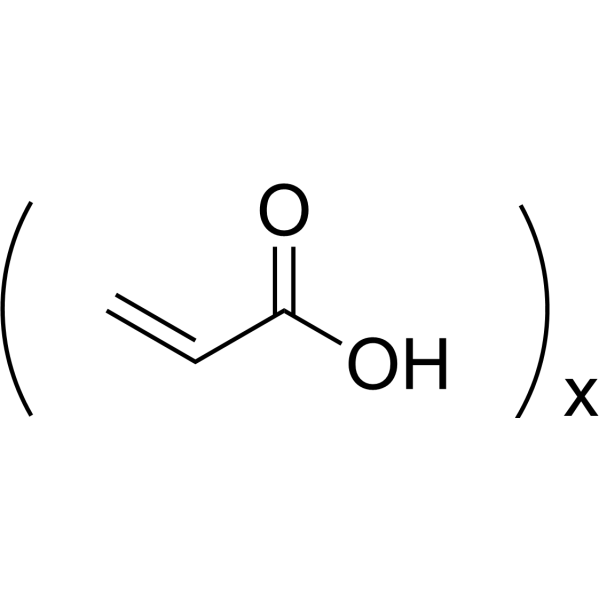
Poly(acrylic acid) (MW 250000) is a synthetic cationic electrolyte containing abundant carboxyl groups (-COOH), which exhibits excellent water absorption and retention properties and is often cross-linked to form hydrogels. Poly(acrylic acid) (with a molecular weight of 250,000). Poly(acrylic acid) (MW 250000) can be used as a non-collagenous analog in the biomimetic mineralization research of type I collagen. Poly(acrylic acid) (MW 250000) has pH responsiveness and biocompatibility and is often used as a drug carrier, surface modifier and functional material.
For research use only. We do not sell to patients.
- CAS No.: 9003-01-4
- Formula: (C3H4O2)x
- Molecular Weight:250000 (Average)
-
Storage:
Please store the product under the recommended conditions in the Certificate of Analysis.


To place orders, for customer services and technical support, please contact: MedChemExpress USA
Tel: 609-228-6898 E-mail: [email protected] [email protected]


-
 Biological Activity
-
Chemical Information
- Purity & Documentation
- References
-
 Help & FAQs


-
HY-W243303A
Poly(acrylic acid) (MW 2000) -

HY-W243303M
Poly(acrylic acid) (MW 100000) (35% in water) -
HY-W243303E
Poly(acrylic acid) (MW 450000) -

HY-W250110E
Polyethylenimine (branched) (MW 25000) -

HY-W243303D
Poly(acrylic acid) (MW 1250000) -

HY-W243303B
Poly(acrylic acid) (MW 3000000) -

HY-W243303C
Poly(acrylic acid) (MW 4000000) -
HY-W250110
Polyethylenimine (branched) (30% in water) -

HY-W250110I
Polyethylenimine (branched) (MW 10000) -

HY-401383
Poly(acrylic acid) (MW 10000~60000) -

HY-W243303O
Poly(acrylic acid) (MW 1250000) (viscous liquid) -
HY-Y0850E
Polyvinyl alcohol (Mw 30000-70000, 87-90% hydrolyzed)


Biological Activity
Description
In Vitro
Poly(acrylic acid) guides Hydroxyapatite (HY-D0835A) to deposit orderly within the collagen fibrils, thereby achieving intramolecular mineralization similar to that of natural bones and dentin. Low molecular weight (such as 2 kDa) chains are shorter and more easily penetrate into the interior of the collagen fibrils, thus enabling intramolecular mineralization (IM); high molecular weight (such as 450 kDa) chains are longer and mainly exist outside the fibrils, more easily guiding minerals to deposit on the surface of the fibrils, resulting in extramolecular mineralization (EM)[1].
Poly(acrylic acid) (MW 150000) is used to construct a new type of carrier (PAA-MoS₂ NPs) for transdermal drug delivery, which has higher stability and stronger drug-loading capacity[2].
Poly(acrylic acid) serves as the main chain of the copolymer and is used to graft the targeting molecule mannose, forming the man-g-PAA copolymer with mannose grafting. This man-g-PAA is used as a surface coating for mesoporous silica nanoparticles (MSNs) to enhance their biocompatibility and achieve pH-responsive drug release[3].
MedChemExpress (MCE) has not independently confirmed the accuracy of these methods. They are for reference only.


Chemical Information
-
CAS No. 9003-01-4
-
Molecular Weight 250000 (Average)
-
Formula (C3H4O2)x
-
SMILES
O=C(C=C)O.[x]
-
Shipping
Room temperature in continental US; may vary elsewhere.
-
Storage
Please store the product under the recommended conditions in the Certificate of Analysis.


Purity & Documentation
References
[1]. Chen L, et al. Poly(acrylic acid)-Assisted Intrafibrillar Mineralization of Type I Collagen: A Review. Macromol Rapid Commun. 2023 May;44(9):e2200827. [Content Brief]
[2]. Zhang K, et al. Poly(Acrylic Acid)-Modified MoS2 Nanoparticle-Based Transdermal Delivery of Atenolol. Int J Nanomedicine. 2020 Aug 4;15:5517-5526. [Content Brief]
[3]. Lee H, et al. Mannosylated poly(acrylic acid)-coated mesoporous silica nanoparticles for anticancer therapy. J Control Release. 2022 Sep;349:241-253. [Content Brief]

Calculators
Concentration (start) × Volume (start) = Concentration (final) × Volume (final)


Poly(acrylic acid) (MW 250000) Related Classifications
HY-W243303J Related Classifications
 Powered by Bioz