Delivery of temperature sensitive items including proteins and kits will be paused on 6/19 for the Juneteenth holiday. For urgent orders please contact customer service.
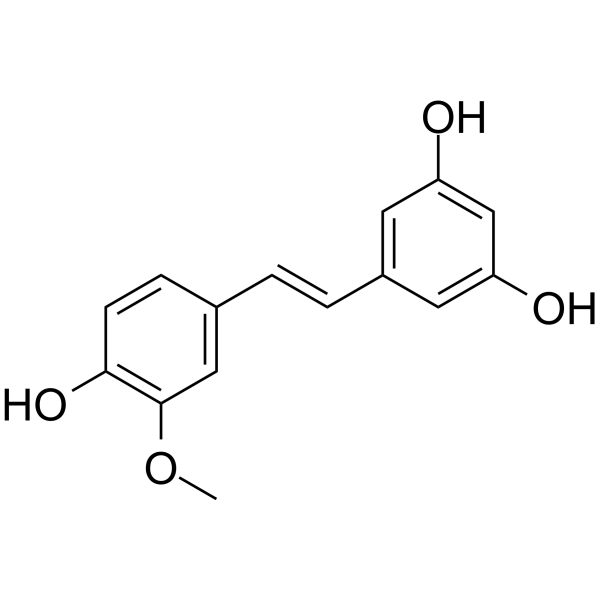
Isorhapontigenin is an orally active dietary polyphenol. Isorhapontigenin acts as a potent antioxidant that reduces the production of reactive oxygen species (ROS). Isorhapontigenin promotes the binding of JUN to the AP-1 site on the SESN2 promoter, induces SESN2 transcription, triggers MAPK8-dependent JUN activation, and upregulates the expression of PPAR-α, PGC-1α and CPT-1A to facilitate fatty acid oxidation. Isorhapontigenin induces autophagy, apoptosis and preadipocyte differentiation; it inhibits tumor growth, cell invasion, NF-κB transcriptional activity, the PI3K/Akt signaling pathway, STAT1 phosphorylation and MMP-2 expression. Isorhapontigenin alleviates oxidative stress, inflammatory cytokine release and triglyceride accumulation; it increases intracellular ATP levels and promotes Nrf2 nuclear translocation. Isorhapontigenin improves insulin sensitivity in adipose tissue and glucose tolerance, and reduces postprandial blood glucose, insulin and free fatty acid levels. Isorhapontigenin is applicable to research on bladder cancer, liver injury, chronic obstructive pulmonary disease, acute lung injury and type 2 diabetes.
Isorhapontigenin is an orally active dietary polyphenol. Isorhapontigenin acts as a potent antioxidant that reduces the production of reactive oxygen species (ROS). Isorhapontigenin promotes the binding of JUN to the AP-1 site on the SESN2 promoter, induces SESN2 transcription, triggers MAPK8-dependent JUN activation, and upregulates the expression of PPAR-α, PGC-1α and CPT-1A to facilitate fatty acid oxidation. Isorhapontigenin induces autophagy, apoptosis and preadipocyte differentiation; it inhibits tumor growth, cell invasion, NF-κB transcriptional activity, the PI3K/Akt signaling pathway, STAT1 phosphorylation and MMP-2 expression. Isorhapontigenin alleviates oxidative stress, inflammatory cytokine release and triglyceride accumulation; it increases intracellular ATP levels and promotes Nrf2 nuclear translocation. Isorhapontigenin improves insulin sensitivity in adipose tissue and glucose tolerance, and reduces postprandial blood glucose, insulin and free fatty acid levels. Isorhapontigenin is applicable to research on bladder cancer, liver injury, chronic obstructive pulmonary disease, acute lung injury and type 2 diabetes[1][2][3][4][5][6].
IC50 & Target
CPT-1A
MMP-2
PPARα
PPARγ
FOXO1
IL-6
Cellular Effect
Cell Line
Type
Value
Description
References
Platelet
IC50
1.85 3
Compound: Isorhapontigenin
Antiplatelet activity in human platelet rich plasma assessed as inhibition of ADP-induced platelet aggregation preincubated for 5 mins followed by ADP addition and measured after 5 mins
Antiplatelet activity in human platelet rich plasma assessed as inhibition of ADP-induced platelet aggregation preincubated for 5 mins followed by ADP addition and measured after 5 mins
Antiplatelet activity in human platelet rich plasma assessed as inhibition of ADP-induced platelet aggregation preincubated for 5 mins followed by ADP addition and measured after 5 mins
Antiplatelet activity in human platelet rich plasma assessed as inhibition of ADP-induced platelet aggregation preincubated for 5 mins followed by ADP addition and measured after 5 mins
Antiplatelet activity in human platelet rich plasma assessed as inhibition of ADP-induced platelet aggregation preincubated for 5 mins followed by ADP addition and measured after 5 mins
Antiplatelet activity in human platelet rich plasma assessed as inhibition of ADP-induced platelet aggregation preincubated for 5 mins followed by ADP addition and measured after 5 mins
Isorhapontigenin (1.25-40 μM; 24 h) induces autophagy in a dose-dependent manner in UMUC3, T24T, and HeLa cells, and this autophagy contributes to its inhibition of anchorage-independent growth of UMUC3 cells[1]. Isorhapontigenin (2.5-10 μM; 12-24 h) increases SESN2 transcription via a JUN-dependent mechanism, which is required for autophagy induction and inhibition of anchorage-independent growth in UMUC3 cells[1]. Isorhapontigenin (10 μM; 12 h pre-APAP treatment, 24 h post-APAP treatment) attenuates APAP-induced FAO dysregulation in AML12 cells by upregulating PPAR-α/PGC-1α/CPT-1A signaling[2]. Isorhapontigenin (1-100 μM; 1 h pre-incubation + 24 h stimulation, 1 h pre-incubation + 10-60 min stimulation) inhibits IL-6 and CXCL8 release from primary human airway epithelial cells and A549 cells, with IC50 values for IL-6 of 17.3-19.7 μM, and suppresses NF-κB, AP-1, and PI3K/Akt/FoxO3A signaling pathways[3]. Isorhapontigenin (1-100 μM; 1 h pre-incubation + 30 min stimulation) concentration-dependently reduces intracellular ROS levels in IL-1β-stimulated A549 cells[3]. Isorhapontigenin (5-15 μM; 12 h pretreatment + 12 h LPS stimulation) exerts anti-inflammatory and antioxidant effects on LPS-challenged RAW264.7 cells by reducing pro-inflammatory mediator and ROS production[4]. Isorhapontigenin (15 μM; 0-24 h direct treatment, 12 h pretreatment + 12 h LPS stimulation) activates the Nrf2 pathway in RAW264.7 cells, and its anti-inflammatory/antioxidant effects depend on Nrf2 activation[4]. Isorhapontigenin (25 μM; 6 days) promotes adipocyte differentiation, enhances insulin sensitivity, and reduces lipolysis in 3T3-L1 preadipocytes by increasing PPARγ activity and expression[5]. Isorhapontigenin (25 μM; 0-12 h) increases PPARγ activity and stability in 3T3-L1 cells by reducing inhibitory phosphorylation and decelerating proteasomal degradation[5]. Isorhapontigenin (10-20 μM; 24 h) specifically inhibits invasion of UMUC3 and T24T human invasive bladder cancer cells, respectively, without affecting migration[6]. Isorhapontigenin (2.5-20 μM; 6-18 h) induces dose- and time-dependent upregulation of FOXO1 protein expression in UMUC3 and T24T human invasive bladder cancer cells[6]. Isorhapontigenin (2.5-20 μM; 3-9 h) upregulates foxo1mRNA expression at the transcriptional level in UMUC3 and T24T human invasive bladder cancer cells[6]. Isorhapontigenin (10 μM; 6-18 h) enhances FOXO1 promoter activity in a time-dependent manner in UMUC3 human invasive bladder cancer cells[6]. Isorhapontigenin (2.5-10 μM; 12 h) inhibits STAT1 phosphorylation at Tyr701 in a dose-dependent manner in UMUC3 human invasive bladder cancer cells[6]. Isorhapontigenin (2.5-20 μM; 18 h) inhibits dose-dependent MMP-2 protein expression in UMUC3 and T24T human invasive bladder cancer cells[6].
MedChemExpress (MCE) has not independently confirmed the accuracy of these methods. They are for reference only.
Caused a dose-dependent increase in LC3-I to LC3-II conversion in UMUC3, T24T, and HeLa cells. Increased the percentage of GFP-LC3 puncta-positive cells and the number of puncta per cell in a dose-dependent manner in GFP-LC3-transfected UMUC3 cells.
Increased SESN2 and BECN1 expression at 2.5-10 μM in UMUC3 cells. Saw its induced LC3-II formation unaffected by BECN1 knockdown in UMUC3 cells. Had its LC3-II formation significantly attenuated in SESN2 knockdown UMUC3 cells. Saw its inhibitory effect on anchorage-independent growth of UMUC3 cells abolished when SESN2 was knocked down.
Increased MAPK8 phosphorylation in a dose-dependent manner. Had its induced JUN phosphorylation, SESN2 induction, LC3-II formation, SESN2 mRNA expression, and SESN2 promoter activity blocked when MAPK8 was knocked down. Saw its inhibitory effect on anchorage-independent growth of UMUC3 cells abolished when MAPK8 was knocked down.
Promoted lipid accumulation (quantified by Oil Red O staining optical density at 490 nm). Significantly increased mRNA and protein expression of PPARγ target genes (CEBPα, FAS, FABP4, GLUT4) and PPARγ itself. Enhanced insulin-stimulated glucose uptake (1.5-fold over basal). Reduced mRNA and protein levels of hormone-sensitive lipase (HSL).
Reduced relative invasion rate of UMUC3 cells by 63.1% and T24T cells by 61.2% compared to vehicle control; did not affect cell migration under the same conditions.
6 h (UMUC3, T24T cells, dose-response); 3-9 h (UMUC3 cells, time-course)
Result:
Upregulated endogenous foxo1 mRNA expression in a dose-dependent manner in UMUC3 and T24T cells, and in a time-dependent manner in UMUC3 cells; did not affect exogenous flag-foxo1 mRNA expression.
i.g. (once, 1 hour after acetaminophen); i.g. (once daily for 3 consecutive days, acetaminophen on day 3); i.g. (once, 1 hour before acetaminophen); i.g. (once, 3 hours after acetaminophen)
Result:
Significantly reduced serum ALT, AST, and LDH levels, centrilobular necrosis area, TUNEL-positive cells, C-PARP expression, serum TNF-α and IL-6 levels, liver MDA levels, and increased liver CAT levels at 25 and 50 mg/kg (post-treatment) compared to acetaminophen alone; reduced lipid accumulation (Oil Red O and BODIPY staining), serum and liver TG levels, increased liver ATP content and FAO activity, and upregulated PPAR-α, PGC-1α, and CPT-1A protein expression at 50 mg/kg (pre-treatment).
Reduced LPS-induced lung injury score, myeloperoxidase (MPO) activity in lung tissues, lung wet/dry weight ratio, and protein concentration in bronchoalveolar lavage fluid (BALF); suppressed LPS-induced increases in BALF concentrations of IL-1β, IL-6, and TNF-α; inhibited p-NF-κB p65 expression and IκB degradation in lung tissues; reduced malondialdehyde (MDA) formation in lung tissues; restored superoxide dismutase (SOD) and glutathione (GSH) activities in lung tissues.
Animal Model:
db/db mice (male, 8 weeks old at treatment start, genetically diabetic model)[5]
Dosage:
25 mg/kg
Administration:
i.p.; daily; 5 weeks
Result:
Reduced postprandial fasting glucose levels by 17.2% after 2 weeks and 40.0% after 5 weeks; reduced insulin levels by 23.2% after 5 weeks; reduced plasma FFA levels by 34.7% after 5 weeks compared to vehicle controls; improved glucose disposal during GTT; enhanced exogenous-insulin-stimulated glucose uptake during ITT; significantly reduced water intake; reduced white adipose tissue adipocyte diameters; significantly increased mRNA expression of PPARγ and its target genes (Fabp4, Glut4, Fas); significantly reduced mRNA and protein levels of HSL; significantly increased insulin-stimulated Akt phosphorylation in white adipose tissue.
Animal Model:
C57BL/6J (male, 5-6 weeks old) injected with N-Butyl-N-(4-hydroxybutyl)nitrosamine[6]
Dosage:
150 mg/kg/day
Administration:
oral via drinking water; daily; 20 weeks
Result:
Reduced the incidence of BBN-induced high-grade muscle-invasive bladder cancer from 100% (12/12 mice) to 16.7% (2/12 mice); caused 7 cases of papillomas and 3 cases of low-grade non-muscle-invasive bladder cancer in treated mice; up-regulated FOXO1 protein expression and down-regulated MMP-2 protein expression in mouse bladder tissues.
Room temperature in continental US; may vary elsewhere.
保管条件
4°C, sealed storage, away from moisture and light
*In solvent : -80°C, 6 months; -20°C, 1 month (sealed storage, away from moisture and light)
溶剤 & 溶解度
体外:
DMSO : 50 mg/mL (193.60 mM; Need ultrasonic; Hygroscopic DMSO has a significant impact on the solubility of product, please use newly opened DMSO)
Preparing Stock Solutions
ConcentrationSolventMass
1 mg
5 mg
10 mg
1 mM
3.8719 mL
19.3596 mL
38.7192 mL
5 mM
0.7744 mL
3.8719 mL
7.7438 mL
10 mM
0.3872 mL
1.9360 mL
3.8719 mL
View the Complete Stock Solution Preparation Table
*Please refer to the solubility information to select the appropriate solvent. Once prepared, please aliquot and store the solution to prevent product inactivation from repeated freeze-thaw cycles. Storage method and period of stock solution: -80°C, 6 months; -20°C, 1 month (sealed storage, away from moisture and light). When stored at -80°C, please use it within 6 months. When stored at -20°C, please use it within 1 month.
For the following dissolution methods, please ensure to first prepare a clear stock solution using an In Vitro approach and then sequentially add co-solvents:
To ensure reliable experimental results, the clarified stock solution can be appropriately stored based on storage conditions. As for the working solution for in vivo experiments, it is recommended to prepare freshly and use it on the same day. The percentages shown for the solvents indicate their volumetric ratio in the final prepared solution. If precipitation or phase separation occurs during preparation, heat and/or sonication can be used to aid dissolution.
This protocol yields a clear solution of ≥ 2.5 mg/mL (saturation unknown).
Taking 1 mL working solution as an example, add 100 μLDMSO stock solution (25.0 mg/mL) to 400 μL PEG300, and mix evenly; then add 50 μL Tween-80 and mix evenly; then add 450 μL Saline to adjust the volume to 1 mL.
Preparation of Saline: Dissolve 0.9 g sodium chloride in ddH₂O and dilute to 100 mL to obtain a clear Saline solution.
Protocol 2
Add each solvent one by one: 10% DMSO 90% (20% SBE-β-CD in Saline)
Solubility: 2.5 mg/mL (9.68 mM); Suspended solution; Need ultrasonic
This protocol yields a suspended solution of 2.5 mg/mL. Suspended solution can be used for oral and intraperitoneal injection.
Taking 1 mL working solution as an example, add 100 μLDMSO stock solution (25.0 mg/mL) to 900 μL 20% SBE-β-CD in Saline, and mix evenly.
Preparation of 20% SBE-β-CD in Saline (4°C, storage for one week): 2 g SBE-β-CD powder is dissolved in 10 mL Saline, completely dissolve until clear.
Protocol 3
Add each solvent one by one: 10% DMSO 90% Corn Oil
Solubility: ≥ 2.5 mg/mL (9.68 mM); Clear solution
This protocol yields a clear solution of ≥ 2.5 mg/mL (saturation unknown). If the continuous dosing period exceeds half a month, please choose this protocol carefully.
Taking 1 mL working solution as an example, add 100 μLDMSO stock solution (25.0 mg/mL) to 900 μLCorn oil, and mix evenly.
In Vivo Dissolution Calculator
Please enter the basic information of animal experiments:
Dosage
mg/kg
Animal weight (per animal)
g
Dosing volume (per animal)
μL
Number of animals
Recommended: Prepare an additional quantity of animals to account for potential losses during experiments.
Please enter your animal formula composition:
%
DMSO+
%
+
%
Tween-80
+
%
Saline
Recommended: Keep the proportion of DMSO in working solution below 2% if your animal is weak.
The co-solvents required include: DMSO,
. All of co-solvents are available by MedChemExpress (MCE).
, Tween 80. All of co-solvents are available by MedChemExpress (MCE).
Calculation results:
Working solution concentration:
mg/mL
Method for preparing stock solution:
mg
drug dissolved in
μL
DMSO (Stock solution concentration: mg/mL).
*In solvent : -80°C, 6 months; -20°C, 1 month (sealed storage, away from moisture and light)
The concentration of the stock solution you require exceeds the measured solubility. The following solution is for reference only. If necessary, please contact MedChemExpress (MCE).
Method for preparing in vivo working solution for animal experiments: Take
μL DMSO stock solution, add
μL .
μL , mix evenly, next add
μL Tween 80, mix evenly, then add
μL Saline.
Dissolve 0.9 g sodium chloride in ddH₂O and dilute to 100 mL to obtain a clear Saline solution
If the continuous dosing period exceeds half a month, please choose this protocol carefully.
Please ensure that the stock solution in the first step is dissolved to a clear state, and add co-solvents in sequence. You can use ultrasonic heating (ultrasonic cleaner, recommended frequency 20-40 kHz), vortexing, etc. to assist dissolution.
*Please refer to the solubility information to select the appropriate solvent. Once prepared, please aliquot and store the solution to prevent product inactivation from repeated freeze-thaw cycles. Storage method and period of stock solution: -80°C, 6 months; -20°C, 1 month (sealed storage, away from moisture and light). When stored at -80°C, please use it within 6 months. When stored at -20°C, please use it within 1 month.
Species cross-reactivity must be investigated individually for each product. Many human cytokines will produce a nice response in mouse cell lines, and many mouse proteins will show activity on human cells. Other proteins may have a lower specific activity when used in the opposite species.
MedChemExpress values your privacy and your trust is important to us. We use cookies to enhance your website experience. Some cookies are necessary to run the website.
Privacy and Cookie Policy







 Powered by Bioz

