Search Result
Results for "
Guanosine-d
" in MedChemExpress (MCE) Product Catalog:
10
Biochemical Assay Reagents
53
Isotope-Labeled Compounds
| Cat. No. |
Product Name |
Target |
Research Areas |
Chemical Structure |
-
- HY-N0097
-
Guanosine
Maximum Cited Publications
11 Publications Verification
DL-Guanosine; Vernine
|
HSV
Endogenous Metabolite
|
Infection
|
|
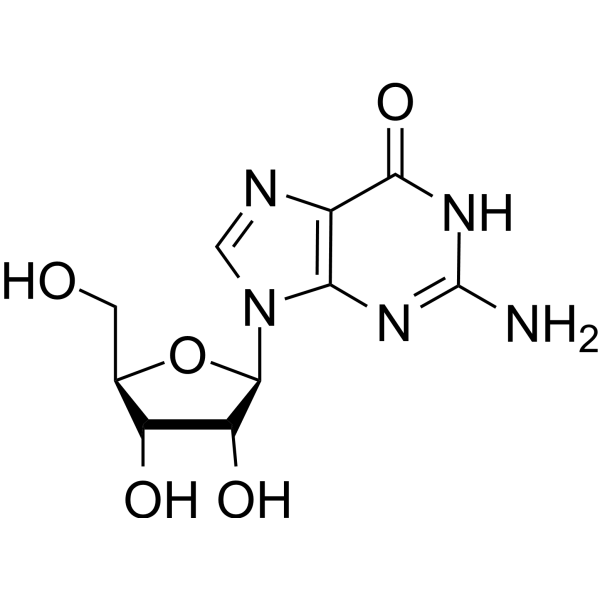
Guanosine (DL-Guanosine) is a purine nucleoside comprising guanine attached to a ribose (ribofuranose) ring via a β-N9-glycosidic bond. Guanosine possesses anti-HSV activity.
|
-
-
- HY-W010737
-
|
5'-GTP disodium salt
|
Exosomes
Endogenous Metabolite
MicroRNA
|
Metabolic Disease
|
|
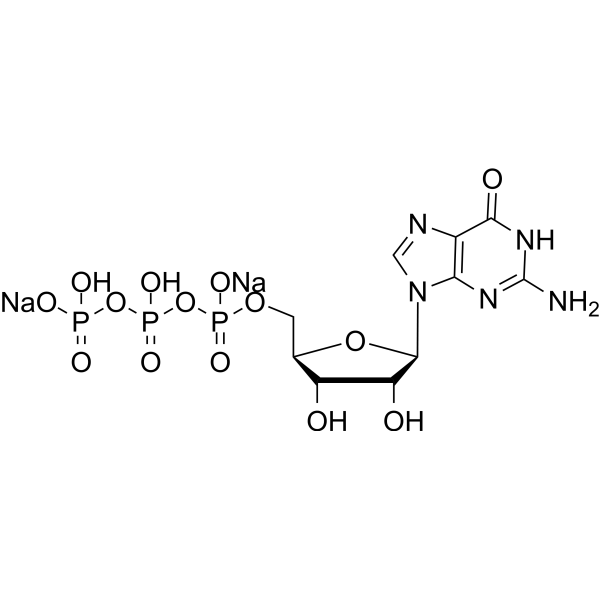
Guanosine 5'-triphosphate (5'-GTP) trisodium salt is a G protein (G proteins) signaling activator and a high-energy precursor in the biosynthesis of nucleotide units in DNA and RNA. Guanosine 5'-triphosphate trisodium salt can promote myogenic cell differentiation by upregulating miRNA (miR133a, miR133b) and myogenic regulatory factor expression, and by inducing human myogenic precursor cells to release exosomes containing guanosine molecules. Guanosine-5'-triphosphate disodium salt holds promise for research in biosynthesis and skeletal muscle regeneration .
|
-
-
- HY-113066A
-
|
GDP disodium salt
|
Hepcidin
Potassium Channel
Endogenous Metabolite
|
Neurological Disease
Inflammation/Immunology
Cancer
|
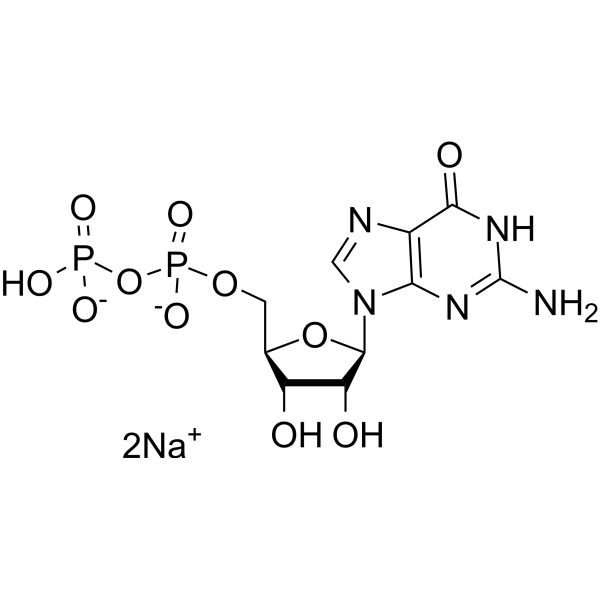
Guanosine 5'-diphosphate (GDP) disodium salt, a purine nucleoside diphosphate, is interconverted to guanosine by the action of exonucleotidase and phosphorylation of nucleoside to guanine. Guanosine 5'-diphosphate disodium salt activates adenosine 5'-triphosphate-sensitive K + channel and is used to study the kinetics and characteristics of GTPases such as those associated with G-protein coupled receptors (GPCR). Guanosine 5'-diphosphate disodium salt is a potential iron mobilizer, which prevents the Hepcidin (HY-P70400)-ferroportin interaction and modulates the interleukin-6 (IL-6)/stat-3 pathway. Elevated levels of guanosine 5’-diphosphate are associated with the pathogenesis of neurological diseases. Guanosine 5'-diphosphate disodium salt is promising for the research of inflammation, such as anemia of inflammation (AI) .
|
-
-
- HY-12695
-
|
5'-GTP trisodium
|
Exosomes
Endogenous Metabolite
DNA/RNA Synthesis
|
Metabolic Disease
|
|
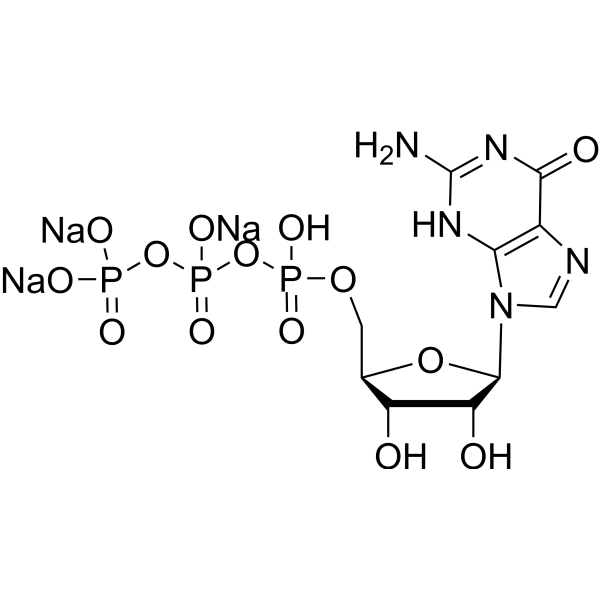
Guanosine 5'-triphosphate (5'-GTP) trisodium salt is a G protein (G proteins) signaling activator and a high-energy precursor in the biosynthesis of nucleotide units in DNA and RNA. Guanosine 5'-triphosphate trisodium salt can promote myogenic cell differentiation by upregulating miRNA (miR133a, miR133b) and myogenic regulatory factor expression, and by inducing human myogenic precursor cells to release exosomes containing guanosine molecules. Guanosine-5'-triphosphate trisodium salt holds promise for research in biosynthesis and skeletal muscle regeneration .
|
-
-
- HY-113066C
-
|
GDP sodium, Type I, 96% (HPLC)
|
Hepcidin
Potassium Channel
Endogenous Metabolite
Interleukin Related
STAT
|
Inflammation/Immunology
Cancer
|
|
Guanosine 5'-diphosphate (GDP) sodium, 96% (HPLC) is a nucleoside diphosphate that activates adenosine 5'-triphosphate-sensitive K + channel. Guanosine 5'-diphosphate sodium, 96% (HPLC) is an iron mobilizer, which forms a complex with hepcidin to inhibit the hepcidin-ferroportin (FPN) interaction and modulates the IL-6/stat-3 pathway. Guanosine 5'-diphosphate sodium, 96% (HPLC) ameliorates the Turpentine-induced anemia of inflammation (AI) in mice when combined with FeSO4. Guanosine 5'-diphosphate sodium, 96% (HPLC) can be used in the research of AI .
|
-
-
- HY-W013260
-
-
-
- HY-12695B
-
|
5'-GTP trisodium salt hydrate
|
Exosomes
Endogenous Metabolite
DNA/RNA Synthesis
|
Metabolic Disease
|
|
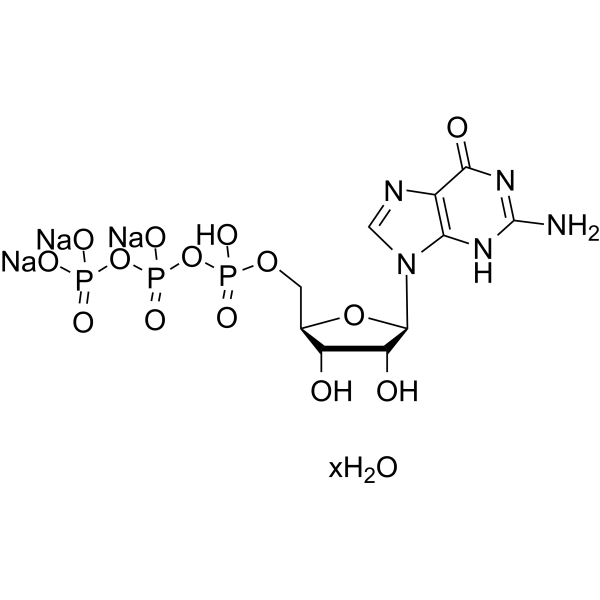
Guanosine 5'-triphosphate (5'-GTP) trisodium salt hydrate is a G protein (G proteins) signaling activator and a high-energy precursor in the biosynthesis of nucleotide units in DNA and RNA. Guanosine 5'-triphosphate trisodium salt hydrate can promote myogenic cell differentiation by upregulating miRNA (miR133a, miR133b) and myogenic regulatory factor expression, and by inducing human myogenic precursor cells to release exosomes containing guanosine molecules. Guanosine-5'-triphosphate disodium salt hydrate holds promise for research in biosynthesis and skeletal muscle regeneration .
|
-
-
- HY-113066
-
|
GDP
|
Hepcidin
Potassium Channel
Endogenous Metabolite
Interleukin Related
STAT
|
Inflammation/Immunology
Cancer
|
|
Guanosine 5'-diphosphate (GDP) is a nucleoside diphosphate that activates adenosine 5'-triphosphate-sensitive K + channel. Guanosine 5'-diphosphate is an iron mobilizer, which forms a complex with hepcidin to inhibit the hepcidin-ferroportin (FPN) interaction and modulates the IL-6/stat-3 pathway. Guanosine 5'-diphosphate ameliorates the Turpentine-induced anemia of inflammation (AI) in mice when combined with FeSO4. Guanosine 5'-diphosphate can be used in the research of AI .
|
-
-
- HY-137662
-
|
pGpG
|
STING
|
Metabolic Disease
|
|
5'-Phosphoguanylyl-(3',5')-guanosine (pGpG) is an intermediate molecule produced by the pathway for enzymatic cyclic diguanylate (c-di-GMP) degradation. 5'-Phosphoguanylyl-(3',5')-guanosine can be used to detect the metabolism of nucleic acids .
|
-
-
- HY-111648
-
|
|
Nucleoside Antimetabolite/Analog
|
Others
|
|
6-O-Methyl Guanosine is a Ribonucleoside. Replacement of the conserved G5, G8 or G12 residues in hammerhead ribozymes with 6-O-Methyl Guanosine reduces kcat without altering Km. 6-O-Methyl Guanosine exerts position-dependent regulatory effects on ribosomal velocity and fidelity. When 6-O-Methyl Guanosine is located at the first or third position of a codon, it decreases the accuracy of tRNA selection. When 6-O-Methyl Guanosine is located at the second position of a codon, it slows down the peptide bond formation rate of cognate aminoacyl-tRNA but does not change the reaction rate of near-cognate aminoacyl-tRNA .
|
-
-
- HY-113225
-
|
GTP
|
Endogenous Metabolite
DNA/RNA Synthesis
Apoptosis
Mitosis
|
Cancer
|
|
Guanosine triphosphate (GTP) is a critical nucleotide and regulator of cellular metabolism. Guanosine triphosphate promotes ribosomal DNA localization, pre-rRNA transcription and ribosome biogenesis by binding to RNA polymerase I and GPN proteins (GPN1/3). Guanosine triphosphate links MYC-dependent ribosome biogenesis to nucleotide sufficiency, acts as a metabolic gatekeeper supporting protein synthesis, DNA/RNA synthesis and cellular signal transduction, while also participating in the physiological activities of pancreatic β-cells and serving as an oxidative substrate for reactive oxygen species. In small cell lung cancer with high MYC expression, Guanosine triphosphate accumulates through the IMPDH-driven synthetic pathway, thereby affecting apoptosis and mitotic processes. Guanosine triphosphate is used in the research of small cell lung cancer, hepatoblastoma and cellular metabolism .
|
-
-
- HY-137683A
-
|
GDPβS trisodium
|
Adenylate Cyclase
|
Cardiovascular Disease
|
|
Guanosine 5'-O-(2-thiodiphosphate) trisodium (GDPβS trisodium) is a non-hydrolyzable derivative of GDP. Guanosine 5'-O-(2-thiodiphosphate) trisodium acts as an inhibitor of adenylyl cyclase (AC) with a Ki value of 600 nM. In the absence of glutamic-pyruvic transaminase (GPT) in cerebral cortex membranes of rodent models, Guanosine 5'-O-(2-thiodiphosphate) trisodium partially activates AC with an EC50 of 400 nM. Guanosine 5'-O-(2-thiodiphosphate) trisodium prevents norepinephrine-induced nitric oxide release in ventricular myocytes .
|
-
-
- HY-N0097S5
-
|
DL-Guanosine-d13; Vernine-d13
|
Isotope-Labeled Compounds
|
Infection
|
|
Guanosine-d13 (DL-Guanosine-d13) is a deuterium of Guanosine (HY-N0097). Guanosine (DL-Guanosine) is a purine nucleoside comprising guanine attached to a ribose (ribofuranose) ring via a β-N9-glycosidic bond. Guanosine possesses anti-HSV activity .
|
-
-
- HY-N0097R
-
|
DL-Guanosine (Standard); Vernine (Standard)
|
Reference Standards
HSV
Endogenous Metabolite
|
Infection
|
|
Guanosine (Standard) is the analytical standard of Guanosine. This product is intended for research and analytical applications. Guanosine (DL-Guanosine) is a purine nucleoside comprising guanine attached to a ribose (ribofuranose) ring via a β-N9-glycosidic bond. Guanosine possesses anti-HSV activity.
In Vitro: Guanosine can be phosphorylated to become guanosine monophosphate (GMP), cyclic guanosine monophosphate (cGMP), guanosine diphosphate (GDP), and guanosine triphosphate (GTP). These forms play important roles in various biochemical processes such as synthesis of nucleic acids and proteins, photosynthesis, muscle contraction, and intracellular signal transduction (cGMP).
|
-
-
- HY-21586B
-
|
m7GTP sodium
|
Nucleoside Antimetabolite/Analog
|
Others
|
|
7-Methyl-guanosine-5'-triphosphate (m7GTP) sodium is a guanosine 5'-phosphate. 7-Methyl-guanosine-5'-triphosphate sodium phosphorothioate analog is a potent cap-dependent translation inhibitor .
|
-
-
- HY-W013330
-
|
Guanosine, 3'-deoxy-
|
Nucleoside Antimetabolite/Analog
Drug Derivative
|
Metabolic Disease
|
|
3′-Deoxyguanosine (Guanosine, 3'-deoxy-) is a derivative of Guanosine (HY-N0097). 3′-Deoxyguanosine interacts with human purine nucleoside phosphorylase via hydrogen bonding with residues such as Glu201 and Asn243. 3′-Deoxyguanosine exhibits moderate displacement activity for [ 3H]-guanosine in rat meninges. 3′-Deoxyguanosine is useful for studying the mechanism of guanosine receptors and purine metabolism .
|
-
-
- HY-134315
-
|
|
Nucleoside Antimetabolite/Analog
|
Others
|
|
8-Nitroguanosine is a guanosine analogue. Some guanosine analogs have immunostimulatory activity. In some animal models, they also induce type I interferons, producing antiviral effects. Studies have shown that the functional activity of guanosine analogs is dependent on the activation of Toll-like receptor 7 (TLR7) .
|
-
-
- HY-154484
-
|
|
Nucleoside Antimetabolite/Analog
Phosphoramidites
|
Cancer
|
|
3’-O-Me-G(iBu)-2’-phosphoramidite is a guanosine analog. Some guanosine analogs have immunostimulatory activity. In some animal models, they also induce type I interferons, producing antiviral effects. Studies have shown that the functional activity of guanosine analogs is dependent on the activation of Toll-like receptor 7 (TLR7) .
|
-
-
- HY-138130
-
|
|
Nucleoside Antimetabolite/Analog
|
Infection
|
|
L-Guanosine is the L-configuration of Guanosine (HY-N0097). L-Guanosine is a purine nucleoside with anti-herpesvirus activity. L-Guanosine can be used to prepare supramolecular hydrogel .
|
-
-
- HY-N0097S3
-
|
DL-Guanosine-15N5; Vernine-15N5
|
HSV
Endogenous Metabolite
|
Infection
|
|
Guanosine- 15N5 is the 15N labeled Guanosine . Guanosine (DL-Guanosine) is a purine nucleoside comprising guanine attached to a ribose (ribofuranose) ring via a β-N9-glycosidic bond. Guanosine possesses anti-HSV activity .
|
-
-
- HY-N0097S6
-
|
DL-Guanosine-13C10,15N5; Vernine-13C10,15N5
|
HSV
Isotope-Labeled Compounds
|
Infection
|
|
Guanosine- 13C10, 15N5 is the 13C and 15N labeled Guanosine (HY-N0097). Guanosine (DL-Guanosine) is a purine nucleoside comprising guanine attached to a ribose (ribofuranose) ring via a β-N9-glycosidic bond. Guanosine possesses anti-HSV activity .
|
-
-
- HY-N0097S4
-
|
DL-Guanosine-13C10; Vernine-13C10
|
Isotope-Labeled Compounds
Endogenous Metabolite
HSV
|
Infection
|
|
Guanosine- 13C10 is the 13C labeled Guanosine (HY-N0097). Guanosine is a purine nucleoside comprising guanine attached to a ribose (ribofuranose) ring via a β-N9-glycosidic bond. Guanosine possesses anti-HSV activity .
|
-
-
- HY-113066S1
-
|
GDP-13C10 dilithium
|
Isotope-Labeled Compounds
Endogenous Metabolite
Potassium Channel
|
Inflammation/Immunology
|
|
Guanosine 5'-diphosphate- 13C10 (GDP- 13C10) dilithium is 13C-labeled Guanosine 5'-diphosphate (HY-113066). Guanosine 5'-diphosphate (GDP) is a nucleoside diphosphate that activates adenosine 5'-triphosphate-sensitive K + channel. Guanosine 5'-diphosphate is a potential iron mobilizer, which prevents the hepcidin-ferroportin interaction and modulates the interleukin-6 (IL-6)/stat-3 pathway. Guanosine 5'-diphosphate can be used in the research of inflammation, such as anemia of inflammation (AI).
|
-
-
- HY-113225S2
-
|
GTP-13C dilithium
|
Isotope-Labeled Compounds
Endogenous Metabolite
Mitosis
Apoptosis
DNA/RNA Synthesis
|
Infection
Cancer
|
|
Guanosine triphosphate- 13C (GTP- 13C) dilithium is 13C-labeled Guanosine triphosphate (HY-113225). Guanosine triphosphate (GTP) is a critical nucleotide and regulator of cellular metabolism. Guanosine triphosphate promotes ribosomal DNA localization, pre-rRNA transcription and ribosome biogenesis by binding to RNA polymerase I and GPN proteins (GPN1/3). Guanosine triphosphate links MYC-dependent ribosome biogenesis to nucleotide sufficiency, acts as a metabolic gatekeeper supporting protein synthesis, DNA/RNA synthesis and cellular signal transduction, while also participating in the physiological activities of pancreatic β-cells and serving as an oxidative substrate for reactive oxygen species. In small cell lung cancer with high MYC expression, Guanosine triphosphate accumulates through the IMPDH-driven synthetic pathway, thereby affecting apoptosis and mitotic processes. Guanosine triphosphate is used in the research of small cell lung cancer, hepatoblastoma and cellular metabolism .
|
-
-
- HY-113225S5
-
|
GTP-13C10 dilithium
|
Isotope-Labeled Compounds
Endogenous Metabolite
Mitosis
Apoptosis
DNA/RNA Synthesis
|
Infection
Cancer
|
|
Guanosine triphosphate- 13C10 (GTP- 13C10) dilithium is 13C-labeled Guanosine triphosphate (HY-113225). Guanosine triphosphate dilithium (GTP) is a critical nucleotide and regulator of cellular metabolism. Guanosine triphosphate dilithium promotes ribosomal DNA localization, pre-rRNA transcription and ribosome biogenesis by binding to RNA polymerase I and GPN proteins (GPN1/3). Guanosine triphosphate dilithium links MYC-dependent ribosome biogenesis to nucleotide sufficiency, acts as a metabolic gatekeeper supporting protein synthesis, DNA/RNA synthesis and cellular signal transduction, while also participating in the physiological activities of pancreatic β-cells and serving as an oxidative substrate for reactive oxygen species. In small cell lung cancer with high MYC expression, Guanosine triphosphate dilithium accumulates through the IMPDH-driven synthetic pathway, thereby affecting apoptosis and mitotic processes. Guanosine triphosphate dilithium is used in the research of small cell lung cancer, hepatoblastoma and cellular metabolism .
|
-
-
- HY-113225S3
-
|
GTP-15N5 dilithium
|
Isotope-Labeled Compounds
Endogenous Metabolite
Mitosis
Apoptosis
DNA/RNA Synthesis
|
Infection
Cancer
|
|
Guanosine triphosphate- 15N5 (GTP- 15N5) dilithium is 15N labeled Guanosine triphosphate (HY-113225). Guanosine triphosphate dilithium (GTP) is a critical nucleotide and regulator of cellular metabolism. Guanosine triphosphate dilithium promotes ribosomal DNA localization, pre-rRNA transcription and ribosome biogenesis by binding to RNA polymerase I and GPN proteins (GPN1/3). Guanosine triphosphate dilithium links MYC-dependent ribosome biogenesis to nucleotide sufficiency, acts as a metabolic gatekeeper supporting protein synthesis, DNA/RNA synthesis and cellular signal transduction, while also participating in the physiological activities of pancreatic β-cells and serving as an oxidative substrate for reactive oxygen species. In small cell lung cancer with high MYC expression, Guanosine triphosphate dilithium accumulates through the IMPDH-driven synthetic pathway, thereby affecting apoptosis and mitotic processes. Guanosine triphosphate dilithium is used in the research of small cell lung cancer, hepatoblastoma and cellular metabolism .
|
-
-
- HY-148169
-
|
|
Nucleoside Antimetabolite/Analog
|
Infection
|
|
2'-Deoxy-L-guanosine selectively inhibits D-Thymidine phosphorylation catalyzed by HSV 1 thymidine kinase. 2'-Deoxy-L-guanosine is the L-configuration of 2'-Deoxyguanosine (HY-17563) .
|
-
-
- HY-139101A
-
|
GpppA triammonium
|
DNA/RNA Synthesis
Endogenous Metabolite
|
Others
|
|
Guanosine 5'-triphosphate-5'-adenosine (GpppA) triammonium, a 5′ cap analog, can be used for RNA synthesis in vitro. Guanosine 5'-triphosphate-5'-adenosine triammonium is a fluorescent substrate analog .
|
-
-
- HY-138885
-
|
TpGc
|
Tyrosinase
DNA/RNA Synthesis
|
Neurological Disease
|
|
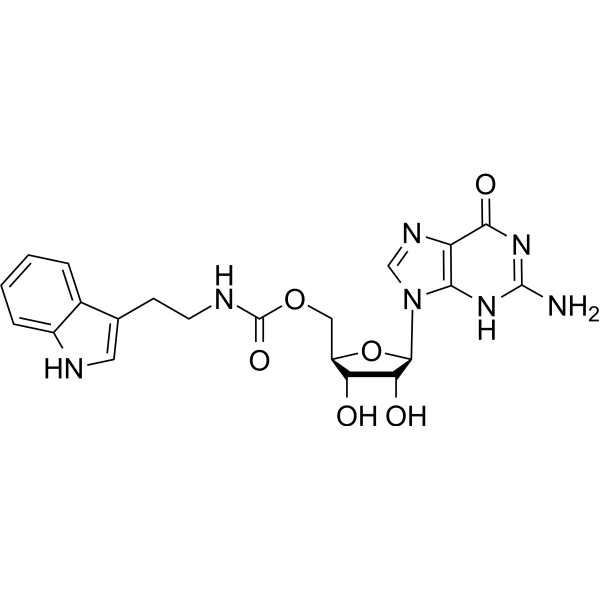
Tryptamine guanosine carbamate (TpGc) is a selective HINT1 (histidine triad nucleotide-binding protein 1) inhibitor (Ki=34 μM, Kd=3.65 μM). Tryptamine guanosine carbamate significantly enhances morphine antinociception while preventing the development of tolerance .
|
-
-
- HY-152493
-
|
|
Nucleoside Antimetabolite/Analog
|
Others
|
|
3’-O-(2-Methoxyethyl)guanosine is a guanosine analogue. Some guanosine analogs have immunostimulatory activity. In some animal models, they also induce type I interferons, producing antiviral effects. Studies have shown that the functional activity of guanosine analogs is dependent on the activation of Toll-like receptor 7 (TLR7) .
|
-
-
- HY-113066AR
-
|
GDP disodium salt (Standard)
|
Hepcidin
Endogenous Metabolite
Potassium Channel
Reference Standards
|
Neurological Disease
Inflammation/Immunology
Cancer
|
Guanosine 5'-diphosphate (disodium salt) (Standard) is the analytical standard of Guanosine 5'-diphosphate (disodium salt). This product is intended for research and analytical applications. Guanosine 5'-diphosphate (GDP) disodium salt, a purine nucleoside diphosphate, is interconverted to guanosine by the action of exonucleotidase and phosphorylation of nucleoside to guanine. Guanosine 5'-diphosphate disodium salt activates adenosine 5'-triphosphate-sensitive K+ channel and is used to study the kinetics and characteristics of GTPases such as those associated with G-protein coupled receptors (GPCR). Guanosine 5'-diphosphate disodium salt is a potential iron mobilizer, which prevents the Hepcidin (HY-P70400)-ferroportin interaction and modulates the interleukin-6 (IL-6)/stat-3 pathway. Elevated levels of guanosine 5’-diphosphate are associated with the pathogenesis of neurological diseases. Guanosine 5'-diphosphate disodium salt is promising for the research of inflammation, such as anemia of inflammation (AI) .
|
-
-
- HY-113066S
-
|
GDP-15N5 dilithium
|
Isotope-Labeled Compounds
Endogenous Metabolite
Potassium Channel
|
Inflammation/Immunology
|
|
Guanosine 5'-diphosphate- 15N5 (GDP- 15N5) dilithium is 15N labeled Guanosine 5'-diphosphate (HY-113066). Guanosine 5'-diphosphate (GDP) is a nucleoside diphosphate that activates adenosine 5'-triphosphate-sensitive K + channel. Guanosine 5'-diphosphate is a potential iron mobilizer, which prevents the hepcidin-ferroportin interaction and modulates the interleukin-6 (IL-6)/stat-3 pathway. Guanosine 5'-diphosphate can be used in the research of inflammation, such as anemia of inflammation (AI) .
|
-
-
- HY-137406
-
|
|
Nucleoside Antimetabolite/Analog
|
Others
|
|
1,2'-O-Dimethylguanosine is a guanosine analogue. Some guanosine analogs have immunostimulatory activity. In some animal models, they also induce type I interferons, producing antiviral effects. Studies have shown that the functional activity of guanosine analogs is dependent on the activation of Toll-like receptor 7 (TLR7) .
|
-
-
- HY-157504
-
-
-
- HY-W586082
-
-
-
- HY-154332
-
|
|
Nucleoside Antimetabolite/Analog
|
Cancer
|
|
8-(Phenylmethoxy)guanosine is a guanosine analog. Some guanosine analogs have immunostimulatory activity. In some animal models, they also induce type I interferons, producing antiviral effects. Studies have shown that the functional activity of guanosine analogs is dependent on the activation of Toll-like receptor 7 (TLR7) .
|
-
-
- HY-152430
-
|
|
Nucleoside Antimetabolite/Analog
|
Cancer
|
|
8-Hydroxymethyl guanosine is a guanosine analog. Some guanosine analogs have immunostimulatory activity. In some animal models, they also induce type I interferons, producing antiviral effects. Studies have shown that the functional activity of guanosine analogs is dependent on the activation of Toll-like receptor 7 (TLR7) .
|
-
-
- HY-150773S1
-
-
-
- HY-150773S
-
-
-
- HY-150768S
-
|
|
Isotope-Labeled Compounds
|
Others
|
|
Guanosine 5'-triphosphate (GTP), ammonium salt-d27 is the deuterium labeled Guanosine 5'-triphosphate (GTP), ammonium salt .
|
-
-
- HY-164248
-
-
-
- HY-139101
-
|
GpppA
|
DNA/RNA Synthesis
Endogenous Metabolite
|
Others
|
|
Guanosine 5'-triphosphate-5'-adenosine (GpppA), a 5′ cap analog, can be used for RNA synthesis in vitro. Guanosine 5'-triphosphate-5'-adenosine is a fluorescent substrate analog .
|
-
-
- HY-152547
-
|
|
Nucleoside Antimetabolite/Analog
|
Cancer
|
|
N2-[(N,N-Dimethyl amino]methylene-N1-methyl-2’-O-methylguanosine is a guanosine analog. Some guanosine analogs have immunostimulatory activity. In some animal models, they also induce type I interferons, producing antiviral effects. Studies have shown that the functional activity of guanosine analogs is dependent on the activation of Toll-like receptor 7 (TLR7) .
|
-
-
- HY-154464
-
|
|
Nucleoside Antimetabolite/Analog
Phosphoramidites
|
Cancer
|
|
N2-iso-Butyroyl-5'-O-DMT-3'-deoxy-3'-fluoroguanosine is a guanosine analog. Some guanosine analogs have immunostimulatory activity. In some animal models, they also induce type I interferons, producing antiviral effects. Studies have shown that the functional activity of guanosine analogs is dependent on the activation of Toll-like receptor 7 (TLR7) .
|
-
-
- HY-152478
-
|
|
Nucleoside Antimetabolite/Analog
|
Cancer
|
|
3’-β-C-Ethynylguanosine is a guanosine analog. Some guanosine analogs have immunostimulatory activity. In some animal models, they also induce type I interferons, producing antiviral effects. Studies have shown that the functional activity of guanosine analogs is dependent on the activation of Toll-like receptor 7 (TLR7) . 3’-β-C-Ethynylguanosine is a click chemistry reagent, it contains an Alkyne group and can undergo copper-catalyzed azide-alkyne cycloaddition (CuAAc) with molecules containing Azide groups.
|
-
-
- HY-W073825
-
|
|
Nucleoside Antimetabolite/Analog
|
Cancer
|
|
N2-iso-Butyryl-2'-O-(2-methoxyethyl)guanosine is a 2’-0-(2-methoxyethyl) guanosine derivative. 2’-0-methoxyethyl nucleoside derivatives can enhance the affinity with RNA and increase the resistance of oligonucleotides to nucleases.
|
-
-
- HY-N0090S2
-
-
-
- HY-N0090S
-
-
-
- HY-152993
-
|
|
Nucleoside Antimetabolite/Analog
|
Others
|
|
2′-Deoxy-N-(2-furanylmethyl)guanosine is a guanosine analog. Some guanosine analogs have immunostimulatory activity. In some animal models, they also induce type I interferons, producing antiviral effects. Studies have shown that the functional activity of guanosine analogs is dependent on the activation of Toll-like receptor 7 (TLR7) .
|
-
-
- HY-N0090S3
-
-
- HY-150796S
-
-
- HY-113225S1
-
|
GTP-13C10,15N5 tetraammonium
|
Endogenous Metabolite
Mitosis
Apoptosis
DNA/RNA Synthesis
|
Cancer
|
|
Guanosine triphosphate- 13C10, 15N5 tetraammonium is the 13C and 15N labeled Guanosine triphosphate tetraammonium. Guanosine triphosphate tetraammonium (GTP) is a critical nucleotide and regulator of cellular metabolism. Guanosine triphosphate tetraammonium promotes ribosomal DNA localization, pre-rRNA transcription and ribosome biogenesis by binding to RNA polymerase I and GPN proteins (GPN1/3). Guanosine triphosphate tetraammonium links MYC-dependent ribosome biogenesis to nucleotide sufficiency, acts as a metabolic gatekeeper supporting protein synthesis, DNA/RNA synthesis and cellular signal transduction, while also participating in the physiological activities of pancreatic β-cells and serving as an oxidative substrate for reactive oxygen species. In small cell lung cancer with high MYC expression, Guanosine triphosphate tetraammonium accumulates through the IMPDH-driven synthetic pathway, thereby affecting apoptosis and mitotic processes. Guanosine triphosphate tetraammonium is used in the research of small cell lung cancer, hepatoblastoma and cellular metabolism .
|
-
- HY-154549
-
|
|
Nucleoside Antimetabolite/Analog
Phosphoramidites
|
Cancer
|
|
3’-O-MOE-G(iBu)-2’-phosphoramidite is a guanosine analog. Some guanosine analogs have immunostimulatory activity. In some animal models, they also induce type I interferons, producing antiviral effects. Studies have shown that the functional activity of guanosine analogs is dependent on the activation of Toll-like receptor 7 (TLR7) .
|
-
- HY-113225S4
-
|
GTP-15N5,d14 dilithium
|
Isotope-Labeled Compounds
Endogenous Metabolite
Mitosis
Apoptosis
DNA/RNA Synthesis
|
Infection
Cancer
|
|
Guanosine triphosphate- 15N5,d14 (GTP- 15N5,d14) dilithium is deuterium and 15N labeled Guanosine triphosphate (HY-113225). Guanosine triphosphate dilithium (GTP) is a critical nucleotide and regulator of cellular metabolism. Guanosine triphosphate dilithium promotes ribosomal DNA localization, pre-rRNA transcription and ribosome biogenesis by binding to RNA polymerase I and GPN proteins (GPN1/3). Guanosine triphosphate dilithium links MYC-dependent ribosome biogenesis to nucleotide sufficiency, acts as a metabolic gatekeeper supporting protein synthesis, DNA/RNA synthesis and cellular signal transduction, while also participating in the physiological activities of pancreatic β-cells and serving as an oxidative substrate for reactive oxygen species. In small cell lung cancer with high MYC expression, Guanosine triphosphate dilithium accumulates through the IMPDH-driven synthetic pathway, thereby affecting apoptosis and mitotic processes. Guanosine triphosphate dilithium is used in the research of small cell lung cancer, hepatoblastoma and cellular metabolism .
|
-
- HY-154351
-
|
|
Nucleoside Antimetabolite/Analog
Phosphoramidites
|
Cancer
|
|
N2-iBu-5’-O-DMTr-2’-O-propargylguanosine-3’-CED-phosphoramidite is a guanosine analog. Some guanosine analogs have immunostimulatory activity. In some animal models, they also induce type I interferons, producing antiviral effects. Studies have shown that the functional activity of guanosine analogs is dependent on the activation of Toll-like receptor 7 (TLR7) .
|
-
- HY-N0090S1
-
-
- HY-N0097S1
-
-
- HY-W755003
-
-
- HY-W778058
-
|
DL-Guanosine-13C,15N2 hydrate; Vernine-13C,15N2 hydrate
|
Isotope-Labeled Compounds
|
Others
|
|
Guanosine- 13C, 15N2 (DL-Guanosine- 13C, 15N2) is 13C and 15N labeled Guanosine .
|
-
- HY-47351
-
-
- HY-152517
-
|
|
Nucleoside Antimetabolite/Analog
|
Others
|
|
8-(Methylthio)guanosine is a guanosine analogue. Some guanosine analogs have immunostimulatory activity. In some animal models, they also induce type I interferons, producing antiviral effects. Studies have shown that the functional activity of guanosine analogs is dependent on the activation of Toll-like receptor 7 (TLR7) .
|
-
- HY-154111
-
|
|
Nucleoside Antimetabolite/Analog
|
Cancer
|
|
8-(N-Boc-aminomethyl)guanosine is a guanosine analog. Some guanosine analogs have immunostimulatory activity. In some animal models, they also induce type I interferons, producing antiviral effects. Studies have shown that the functional activity of guanosine analogs is dependent on the activation of Toll-like receptor 7 (TLR7) .
|
-
- HY-152742
-
|
|
Nucleoside Antimetabolite/Analog
|
Others
|
|
8-(N,N-Dimethylaminomethyl)guanosine is a guanosine analogue. Some guanosine analogs have immunostimulatory activity. In some animal models, they also induce type I interferons, producing antiviral effects. Studies have shown that the functional activity of guanosine analogs is dependent on the activation of Toll-like receptor 7 (TLR7) .
|
-
- HY-154336
-
|
|
Nucleoside Antimetabolite/Analog
|
Cancer
|
|
N-[2-[4-(1-Methylethyl)phenoxy]acetyl]guanosine is a guanosine analog. Some guanosine analogs have immunostimulatory activity. In some animal models, they also induce type I interferons, producing antiviral effects. Studies have shown that the functional activity of guanosine analogs is dependent on the activation of Toll-like receptor 7 (TLR7) .
|
-
- HY-152991
-
|
|
Nucleoside Antimetabolite/Analog
|
Others
|
|
2′-Deoxy-N-(2-furanylmethyl)guanosine is a guanosine analog. Some guanosine analogs have immunostimulatory activity. In some animal models, they also induce type I interferons, producing antiviral effects. Studies have shown that the functional activity of guanosine analogs is dependent on the activation of Toll-like receptor 7 (TLR7) .
|
-
- HY-137683B
-
|
GDPβS trilithium
|
Others
|
Others
|
|
Guanosine 5'-O-(2-thiodiphosphate) (trilithium) is a guanosine nucleotide that is a stable free radical .
|
-
- HY-W756758
-
-
- HY-152992
-
|
|
Nucleoside Antimetabolite/Analog
|
Others
|
|
7-Cyano-7-deaza-2'-deoxy guanosine is a guanosine analog. Some guanosine analogs have immunostimulatory activity. In some animal models, they also induce type I interferons, producing antiviral effects. Studies have shown that the functional activity of guanosine analogs is dependent on the activation of Toll-like receptor 7 (TLR7) .
|
-
- HY-154547
-
|
|
Nucleoside Antimetabolite/Analog
|
Cancer
|
|
N2-iso-Butyroyl-3’-O-(methoxyethyl)guanosine is a guanosine analog. Some guanosine analogs have immunostimulatory activity. In some animal models, they also induce type I interferons, producing antiviral effects. Studies have shown that the functional activity of guanosine analogs is dependent on the activation of Toll-like receptor 7 (TLR7) .
|
-
- HY-154448
-
|
|
Nucleoside Antimetabolite/Analog
|
Cancer
|
|
3,5-Bis-O-(2,4-dichlorobenzyl)guanosine is a guanosine analog. Some guanosine analogs have immunostimulatory activity. In some animal models, they also induce type I interferons, producing antiviral effects. Studies have shown that the functional activity of guanosine analogs is dependent on the activation of Toll-like receptor 7 (TLR7) .
|
-
- HY-150711S
-
-
- HY-21586
-
|
m7GTP disodium
|
Nucleoside Antimetabolite/Analog
|
Metabolic Disease
|
|
7-Methyl-guanosine-5'-triphosphate (m7GTP) disodium is a guanosine 5'-phosphate. 7-Methyl-guanosine-5'-triphosphate disodium phosphorothioate analog is a potent cap-dependent translation inhibitor .
|
-
- HY-W768283
-
|
GUANINE RIBOSIDE HYDRATE-13C5
|
Isotope-Labeled Compounds
|
Others
|
|
Guanosine Hydrate- 13C5 (GUANINE RIBOSIDE HYDRATE- 13C5) is the 13C-labeled Guanosine Hydrate (HY-N0090).
|
-
- HY-113066S2
-
|
GDP-d13 dilithium
|
Isotope-Labeled Compounds
Endogenous Metabolite
Potassium Channel
|
Inflammation/Immunology
|
|
Guanosine 5'-diphosphate-d13 (GDP-d13) dilithium is deuterium labeled Guanosine 5'-diphosphate (HY-113066). Guanosine 5'-diphosphate (GDP) is a nucleoside diphosphate that activates adenosine 5'-triphosphate-sensitive K + channel. Guanosine 5'-diphosphate is a potential iron mobilizer, which prevents the hepcidin-ferroportin interaction and modulates the interleukin-6 (IL-6)/stat-3 pathway. Guanosine 5'-diphosphate can be used in the research of inflammation, such as anemia of inflammation (AI).
|
-
- HY-154548
-
|
|
Nucleoside Antimetabolite/Analog
Phosphoramidites
|
Others
|
|
N2-iso-Butyroyl-5’-O-DMT-3’-O-(methoxyethyl)guanosine is a guanosine analog. Some guanosine analogs have immunostimulatory activity. In some animal models, they also induce type I interferons, producing antiviral effects. Studies have shown that the functional activity of guanosine analogs is dependent on the activation of Toll-like receptor 7 (TLR7) .
|
-
- HY-154507
-
|
|
Nucleoside Antimetabolite/Analog
|
Cancer
|
|
N2-Phenoxyacetyl-3′,5′-O-(tetraisopropyldisiloxane-1,3-diyl)guanosine is a guanosine analog. Some guanosine analogs have immunostimulatory activity. In some animal models, they also induce type I interferons, producing antiviral effects. Studies have shown that the functional activity of guanosine analogs is dependent on the activation of Toll-like receptor 7 (TLR7) .
|
-
- HY-152610
-
|
|
Nucleoside Antimetabolite/Analog
|
Others
|
|
3′-C-Methylguanosine is a guanosine analogue. Some guanosine analogs have immunostimulatory activity. In some animal models, they also induce type I interferons, producing antiviral effects. Studies have shown that the functional activity of guanosine analogs is dependent on the activation of Toll-like receptor 7 (TLR7) .
|
-
- HY-152673
-
|
|
Nucleoside Antimetabolite/Analog
|
Cancer
|
|
9-(β-D-Xylofuranosyl)guanine is a guanosine analog. Some guanosine analogs have immunostimulatory activity. In some animal models, they also induce type I interferons, producing antiviral effects. Studies have shown that the functional activity of guanosine analogs is dependent on the activation of Toll-like receptor 7 (TLR7) .
|
-
- HY-154506
-
|
|
Nucleoside Antimetabolite/Analog
|
Cancer
|
|
N2-Phenoxyacetylguanosine is a guanosine analog. Some guanosine analogs have immunostimulatory activity. In some animal models, they also induce type I interferons, producing antiviral effects. Studies have shown that the functional activity of guanosine analogs is dependent on the activation of Toll-like receptor 7 (TLR7) .
|
-
- HY-152652
-
|
|
Nucleoside Antimetabolite/Analog
|
Cancer
|
|
5’(R)-C-Methylguanosine is a guanosine analog. Some guanosine analogs have immunostimulatory activity. In some animal models, they also induce type I interferons, producing antiviral effects. Studies have shown that the functional activity of guanosine analogs is dependent on the activation of Toll-like receptor 7 (TLR7) .
|
-
- HY-113066S3
-
|
GDP-13C10,15N5 dilithium
|
Isotope-Labeled Compounds
Endogenous Metabolite
Potassium Channel
|
Inflammation/Immunology
|
|
Guanosine 5'-diphosphate- 13C10, 15N5 (GDP- 13C10, 15N5) dilithium is 13C and 15N-labeled Guanosine 5'-diphosphate (HY-113066). Guanosine 5'-diphosphate (GDP) is a nucleoside diphosphate that activates adenosine 5'-triphosphate-sensitive K + channel. Guanosine 5'-diphosphate is a potential iron mobilizer, which prevents the hepcidin-ferroportin interaction and modulates the interleukin-6 (IL-6)/stat-3 pathway. Guanosine 5'-diphosphate can be used in the research of inflammation, such as anemia of inflammation (AI).
|
-
- HY-128139
-
|
2'-C-beta-MethylGuanosine
|
Nucleoside Antimetabolite/Analog
|
Others
|
|
2'-C-Methylguanosine (2'-C-beta-Methylguanosine) is a guanosine analogue. Some guanosine analogs have immunostimulatory activity. In some animal models, they also induce type I interferons, producing antiviral effects. Studies have shown that the functional activity of guanosine analogs is dependent on the activation of Toll-like receptor 7 (TLR7) .
|
-
- HY-154482
-
|
|
Nucleoside Antimetabolite/Analog
|
Cancer
|
|
N2-iso-Butyroyl-3’-O-methylguanosine is a guanosine analog. Some guanosine analogs have immunostimulatory activity. In some animal models, they also induce type I interferons, producing antiviral effects. Studies have shown that the functional activity of guanosine analogs is dependent on the activation of Toll-like receptor 7 (TLR7) .
|
-
- HY-152988
-
|
|
Nucleoside Antimetabolite/Analog
Phosphoramidites
|
Others
|
|
N2-iso-Butyroyl-7'-O-DMT-morpholinoguanine is a guanosine analog. Some guanosine analogs have immunostimulatory activity. In some animal models, they also induce type I interferons, producing antiviral effects. Studies have shown that the functional activity of guanosine analogs is dependent on the activation of Toll-like receptor 7 (TLR7) .
|
-
- HY-152797
-
|
|
Nucleoside Antimetabolite/Analog
|
Others
|
|
N4-Desmethyl-N5-Methyl wyosine is a guanosine analogue. Some guanosine analogs have immunostimulatory activity. In some animal models, they also induce type I interferons, producing antiviral effects. Studies have shown that the functional activity of guanosine analogs is dependent on the activation of Toll-like receptor 7 (TLR7) .
|
-
- HY-134242
-
|
6-ThioGuanosine monophosphate disodium; 6-Thio-GMP disodium
|
Drug Metabolite
|
Inflammation/Immunology
|
|
6-T-5'-GMP disodium is an analogue of guanosine-5'-O-monophosphate (5'-GMP) and a metabolite of an immunosuppressive drug, azathioprine (HY-B0256) .
|
-
- HY-152545
-
|
|
Nucleoside Antimetabolite/Analog
|
Cancer
|
|
N1,N2-Dimethyl-2’-O-methylguanosine is a guanosine analog. Some guanosine analogs have immunostimulatory activity. In some animal models, they also induce type I interferons, producing antiviral effects. Studies have shown that the functional activity of guanosine analogs is dependent on the activation of Toll-like receptor 7 (TLR7) .
|
-
- HY-154350
-
|
|
Nucleoside Antimetabolite/Analog
Phosphoramidites
|
Cancer
|
|
5'-O-DMT-N2-isobutyryl-2'-O-propargylguanosine is a guanosine analog. Some guanosine analogs have immunostimulatory activity. In some animal models, they also induce type I interferons, producing antiviral effects. Studies have shown that the functional activity of guanosine analogs is dependent on the activation of Toll-like receptor 7 (TLR7) .
|
-
- HY-154606
-
|
|
Nucleoside Antimetabolite/Analog
Phosphoramidites
|
Cancer
|
|
2'-F-2'-ara-N2-ibu-dG Phosphoramidite is a guanosine analog. Some guanosine analogs have immunostimulatory activity. In some animal models, they also induce type I interferons, producing antiviral effects. Studies have shown that the functional activity of guanosine analogs is dependent on the activation of Toll-like receptor 7 (TLR7) .
|
-
- HY-134242A
-
|
6-ThioGuanosine monophosphate; 6-Thio-GMP
|
Drug Metabolite
|
Inflammation/Immunology
|
|
6-T-5'-GMP (6-Thioguanosine monophosphate) is an analogue of guanosine-5'-O-monophosphate (5'-GMP) and a metabolite of an immunosuppressive drug, Azathioprine (HY-B0256) .
|
-
- HY-113066B
-
|
GDP ditromethamine
|
Hepcidin
Potassium Channel
Endogenous Metabolite
|
Inflammation/Immunology
|
|
Guanosine 5'-diphosphate ditromethamine is a nucleoside diphosphate that activates adenosine 5'-triphosphate-sensitive K + channel. Guanosine 5'-diphosphate ditromethamine is a potential iron mobilizer, which prevents the hepcidin-ferroportin interaction and modulates the interleukin-6 (IL-6)/stat-3 pathway. Guanosine 5'-diphosphate ditromethamine can be used in the research of inflammation, such as anemia of inflammation (AI) .
|
-
- HY-154483
-
|
|
Nucleoside Antimetabolite/Analog
|
Cancer
|
|
N2-iso-Butyroyl-5’-O-(4,4’-dimethoxytrityl)-3’-O-methylguanosine is a guanosine analog. Some guanosine analogs have immunostimulatory activity. In some animal models, they also induce type I interferons, producing antiviral effects. Studies have shown that the functional activity of guanosine analogs is dependent on the activation of Toll-like receptor 7 (TLR7) .
|
-
- HY-155291
-
|
|
Others
|
Others
|
|
3'-Mant-GDP is a nucleoside compound and a derivative of guanosine diphosphate .
|
-
- HY-164253
-
|
|
DNA/RNA Synthesis
|
Others
|
|
TBS-rG(Ac)Is with TBSProtecting Group (Protect OHHydroxyl), acetylated guanosine ribonucleotide.
|
-
- HY-154361
-
|
|
Nucleoside Antimetabolite/Analog
|
Cancer
|
|
TLR7 agonist 13 is a guanosine analog. Some guanosine analogs have immunostimulatory activity. In some animal models, they also induce type I interferons, producing antiviral effects. Studies have shown that the functional activity of guanosine analogs is dependent on the activation of Toll-like receptor 7 (TLR7) . TLR7 agonist 13 is a click chemistry reagent, it contains an Alkyne group and can undergo copper-catalyzed azide-alkyne cycloaddition (CuAAc) with molecules containing Azide groups.
|
-
- HY-E70441
-
-
- HY-137662A
-
|
pGpG trisodium
|
STING
|
Metabolic Disease
|
|
5'-Phosphoguanylyl-(3',5')-guanosine trisodium (pGpG trisodium) is an intermediate molecule produced by the pathway for enzymatic cyclic diguanylate (c-di-GMP) degradation. 5'-Phosphoguanylyl-(3',5')-guanosine trisodium can be used to detect the metabolism of nucleic acids .
|
-
- HY-21586A
-
|
7-Methyl-Guanosine-5'-triphosphate
|
Nucleoside Antimetabolite/Analog
|
Metabolic Disease
|
|
7-Methyl-guanosine-5'-triphosphate (m7GTP) is a guanosine 5'-phosphate. 7-Methyl-guanosine-5'-triphosphate phosphorothioate analog is a potent cap-dependent translation inhibitor .
|
-
- HY-172578
-
|
|
Drug Derivative
|
Others
|
|
8-AHT-GTP tetrasodium is a aminohexylthiol-substituted derivative of Guanosine triphosphate (GTP) (HY-113225). Guanosine triphosphate is a native nucleotide .
|
-
- HY-180473
-
-
- HY-106233B
-
|
AM188 hydrochloride
|
HBV
|
Infection
|
|
Tiviciclovir (AM188) hydrochloride is an antiviral guanosine analog and a hepatitis B virus inhibitor .
|
-
- HY-106233
-
|
AM188
|
HBV
|
Infection
|
|
Tiviciclovir (AM188) is an antiviral guanosine analog and a hepatitis B virus inhibitor .
|
-
- HY-180479
-
-
- HY-147320
-
-
- HY-155752
-
|
3′-O-Benzoyladenosine 5′-triphosphate
|
Drug Derivative
|
Others
|
|
3′-O-Benzoyl-ATP is O-Benzoyl modified guanosine triphosphate (ATP) .
|
-
- HY-164249
-
-
- HY-W778086
-
-
- HY-W767035
-
-
- HY-W013260S1
-
-
- HY-176933
-
-
- HY-154349
-
|
|
Nucleoside Antimetabolite/Analog
|
Cancer
|
|
N2-iso-Butyroyl-2’-O-propargylguanosine is a guanosine analog. Some guanosine analogs have immunostimulatory activity. In some animal models, they also induce type I interferons, producing antiviral effects. Studies have shown that the functional activity of guanosine analogs is dependent on the activation of Toll-like receptor 7 (TLR7) . N2-iso-Butyroyl-2’-O-propargylguanosine is a click chemistry reagent, it contains an Alkyne group and can undergo copper-catalyzed azide-alkyne cycloaddition (CuAAc) with molecules containing Azide groups.
|
-
- HY-152684
-
|
|
Nucleoside Antimetabolite/Analog
|
Others
|
|
2′-O-2-Propyn-1-ylguanosine is a guanosine analogue. Some guanosine analogs have immunostimulatory activity. In some animal models, they also induce type I interferons, producing antiviral effects. Studies have shown that the functional activity of guanosine analogs is dependent on the activation of Toll-like receptor 7 (TLR7) . 2′-O-2-Propyn-1-ylguanosine is a click chemistry reagent, it contains an Alkyne group and can undergo copper-catalyzed azide-alkyne cycloaddition (CuAAc) with molecules containing Azide groups.
|
-
- HY-W013260R
-
-
- HY-137181
-
|
|
HSV
|
Infection
|
|
9-Carboxymethoxymethylguanine is the main metabolite of Aciclovir. Acyclovir (Aciclovir) is a guanosine analogue and an orally active antiviral agent .
|
-
- HY-23789
-
|
2'-O-MOE-rG
|
Nucleoside Antimetabolite/Analog
DNA/RNA Synthesis
|
Others
|
|
2′-O-(2-Methoxyethyl)guanosine (2'-O-MOE-rG) is a 2'-O-methoxyethyl-modified nucleoside analogue and an important intermediate in the synthesis of nucleic acid drugs. 2′-O-(2-Methoxyethyl)guanosine neither effectively phosphorylated by cytosolic nucleoside kinases, nor are they incorporated into cellular DNA or RNA .
|
-
- HY-W783407
-
-
- HY-160537
-
|
|
Phosphoramidites
|
|
|
2'-O-TOM-guanosine-(N-Ac)-3'-CEP is a phosphoramidite that can be used in the synthesis of oligonucleotides.
|
-
- HY-17391
-
|
|
Adenosine Receptor
|
Endocrinology
|
|
Pamabrom is a diuretic that acts on the opioid receptor-nitric oxide (NO) -cyclic guanosine monophosphate (cGMP) -K + channel pathway. Pamabrom exerts peripheral antinociceptive activity by activating this pathway. The mechanism involves activating opioid receptors, promoting the release of nitric oxide, and then influencing cyclic guanosine monophosphate and K channels to produce an analgesic effect. Pamabrom is orally active and is mainly used in the research and treatment of premenstrual syndrome and primary dysmenorrhea[1].
|
-
- HY-181453
-
|
2’-O-Benzyl-3’-MANT-GTP sodium
|
Drug Derivative
Fluorescent Dye
|
Others
|
|
2'-O-Benzyl-3'-O-(N'-methylanthraniloyl) guanosine-5'-O-triphosphate sodium (Mant-GTP R=CH3, B=Gua) (2'-O-Benzyl-3'-MANT-GTP sodium) is a methylanthraniloyl derivative of GTP (HY-113225). Methylanthraniloyl-GTP exhibits fluorescent properties (λmax: 442 nm in water; 432 nm in ethanol) .
|
-
- HY-W091754
-
|
|
Nucleoside Antimetabolite/Analog
Phosphoramidites
|
Others
|
|
5'-O-Dmt-n2-isobutyryl-2'-o-methyl-d-guanosine is a nucleoside that is made using an oxime opening of the 5' position and a methylation at the 2' position. 5'-O-Dmt-n2-isobutyryl-2'-o-methyl-d-guanosine has been shown to have an affinity for tissues in a chemotactic assay.
|
-
- HY-50723
-
|
|
Endogenous Metabolite
|
Others
|
|
3-Methylxanthine, a xanthine derivative, is a cyclic guanosine monophosphate (GMP) inhibitor, with an IC50 of 920 μM on guinea-pig isolated trachealis muscle.
|
-
- HY-D0868
-
-
- HY-43059
-
-
- HY-117186
-
|
|
PROTAC Linkers
|
Metabolic Disease
|
|
Bis-propargyl-PEG6 is a PEG-based PROTAC linker used in the synthesis of PROTACs. Bis-propargyl-PEG6 can be used to synthesize the polymer linked multimers of guanosine-3', 5'-cyclic monophosphates . Bis-propargyl-PEG6 is a click chemistry reagent, it contains an Alkyne group and can undergo copper-catalyzed azide-alkyne cycloaddition (CuAAc) with molecules containing Azide groups.
|
-
- HY-133190
-
|
|
PROTAC Linkers
|
Metabolic Disease
|
|
Bis-propargyl-PEG7 is a PEG-based PROTAC linker used in the synthesis of PROTACs. Bis-propargyl-PEG7 can be used to synthesize the polymer linked multimers of guanosine-3', 5'-cyclic monophosphates . Bis-propargyl-PEG7 is a click chemistry reagent, it contains an Alkyne group and can undergo copper-catalyzed azide-alkyne cycloaddition (CuAAc) with molecules containing Azide groups.
|
-
- HY-N5134S1
-
|
5'-GMP-13C10 dilithium; 5'-Guanosine monophosphate-13C10 dilithium
|
Isotope-Labeled Compounds
Endogenous Metabolite
|
Metabolic Disease
|
|
5'-Guanylic acid- 13C10 (5'-GMP- 13C10 dilithium; 5'-guanosine monophosphate- 13C10) dilithium is 13C-labeled 5'-Guanylic acid (HY-N5134). 5'-Guanylic acid (5'-GMP) is involved in several metabolic disorders, including the AICA-ribosiduria pathway, adenosine deaminase deficiency, adenine phosphoribosyltransferase deficiency (aprt), and the 2-hydroxyglutric aciduria pathway.
|
-
- HY-P0229A
-
|
Rnase T1 (animal free)
|
DNA/RNA Synthesis
|
Others
|
|
Ribonuclease T1 (animal free) (Rnase T1 (animal free)) (EC 4.6.1.24) is an endonuclease that specifically degrades single-stranded RNA. Ribonuclease T1 forms a nucleoside 2′, 3′-cyclic phosphate intermediate to cleave the phosphodiester bond between the 3′-guanosine residue and the 5′-OH group of the adjacent nucleoside to produce a 3′-GMP-terminated oligonucleotide. This product does not contain ingredients of animal origin .
|
-
- HY-N5134S2
-
|
5'-GMP-15N5 dilithium; 5'-Guanosine monophosphate-15N5 dilithium
|
Isotope-Labeled Compounds
Endogenous Metabolite
|
Metabolic Disease
|
|
5'-Guanylic acid- 15N5 (5'-GMP- 15N5 dilithium; 5'-guanosine monophosphate- 15N5) dilithium is 15N labeled 5'-Guanylic acid (HY-N5134). 5'-Guanylic acid (5'-GMP) is involved in several metabolic disorders, including the AICA-ribosiduria pathway, adenosine deaminase deficiency, adenine phosphoribosyltransferase deficiency (aprt), and the 2-hydroxyglutric aciduria pathway.
|
-
- HY-N5134S3
-
|
5'-GMP-d12 dilithium; 5'-Guanosine monophosphate-d12 dilithium
|
Isotope-Labeled Compounds
Endogenous Metabolite
|
Metabolic Disease
|
|
5'-Guanylic acid-d12 (5'-GMP-d12 dilithium; 5'-guanosine monophosphate-d12) dilithium is deuterium labeled 5'-Guanylic acid (HY-N5134). 5'-Guanylic acid (5'-GMP) is involved in several metabolic disorders, including the AICA-ribosiduria pathway, adenosine deaminase deficiency, adenine phosphoribosyltransferase deficiency (aprt), and the 2-hydroxyglutric aciduria pathway.
|
-
- HY-W048479
-
-
- HY-W019033
-
|
|
Nucleoside Antimetabolite/Analog
|
Others
|
|
8-Bromoguanosine is a purine nucleoside, a brominated derivative of guanosine. 8-Bromoguanosine can reduce the conformational heterogeneity of RNA to enhance its function .
|
-
- HY-114265
-
|
ppGpp
|
Nucleoside Antimetabolite/Analog
|
Others
|
|
Guanosine 3',5'-bisdiphosphate (ppGpp) plays a pivotal role in the regulation of GTP biosynthesis in chloroplasts through specific inhibition of plastid/mitochondrial guanylate kinase activity .
|
-
- HY-14841
-
|
UK-369003
|
Phosphodiesterase (PDE)
|
Neurological Disease
|
|
Gisadenafil (UK-369003) is a specific, orally active phosphodiesterase 5 (PDE5) inhibitor with an IC50 of 3.6 nM and prevents degradation of cyclic guanosine monophosphate (cGMP) .
|
-
- HY-137614C
-
|
|
Nucleoside Antimetabolite/Analog
|
Others
|
|
Rp-GTPαS tetrasodium is a phosphorothioate analogue of Guanosine triphosphate (GTP) (HY-113225) that can activate calcium release and secretion in single rat peritoneal mast cells .
|
-
- HY-W098689
-
|
2'-Deoxy-N2-dimethylaminomethylene-Guanosine
|
Nucleoside Antimetabolite/Analog
|
Others
|
|
Dmf-dg (2'-Deoxy-N2-dimethylaminomethylene-guanosine) is a deoxyguanosine (dG) nucleoside protected by the dimethylaminomethylamidine (DMF) base and can be used for oligonucleotide synthesis .
|
-
- HY-138079
-
|
Guanosine 2',3'-cyclic phosphate triethylamine
|
Drug Derivative
|
Others
|
|
2′,3′-cGMP triethylamine (Guanosine 2',3'-cyclic phosphate triethylamine) is an active compound. 2′,3′-cGMP triethylamine can be used for various studies .
|
-
- HY-153538
-
-
- HY-114643
-
|
(Rac)-IMR-687
|
Phosphodiesterase (PDE)
|
Cardiovascular Disease
|
|
(Rac)-Tovinontrine ((Rac)-IMR-687) is a phosphodiesterase 9 (PDE9) inhibitor that increases cyclic guanosine monophosphate (cGMP) levels. (Rac)-Tovinontrine is promising for research of thalassemia .
|
-
- HY-108619
-
|
UK 369003-26
|
Phosphodiesterase (PDE)
|
Neurological Disease
|
|
Gisadenafil besylate (UK 369003-26) is a specific, orally active phosphodiesterase 5 (PDE5) inhibitor with an IC50 of 3.6 nM and prevents degradation of cyclic guanosine monophosphate (cGMP) .
|
-
- HY-W040055R
-
|
D-(+)-Neopterin (Standard); D-erythro-Neopterin (Standard)
|
Reference Standards
Endogenous Metabolite
|
Inflammation/Immunology
|
|
Neopterin (Standard) is the analytical standard of Neopterin. This product is intended for research and analytical applications. Neopterin (D-(+)-Neopterin), a catabolic product of guanosine triphosphate (GTM), serves as a marker of cellular immune system activation.
|
-
- HY-137665
-
|
|
PKG
|
Cardiovascular Disease
|
|
PET-cGMP is a cyclic guanosine monophosphate analog and an effective selective agonist of PKG I, the EC50 of PET-cGMP for PKG Iβ is 3.8 nM, while for PKG II, it's 193 nM .
|
-
- HY-138616S1
-
|
2'-DeoxyGuanosine-5'-triphosphate-d14 dilithium
|
Isotope-Labeled Compounds
DNA/RNA Synthesis
Nucleoside Antimetabolite/Analog
|
Infection
Cancer
|
|
dGTP-d14 (2'-Deoxyguanosine-5'-triphosphate-d14) dilithium is deuterium labeled dGTP (HY-138616). dGTP (2'-Deoxyguanosine-5'-triphosphate), a guanosine nucleotide, can be used in deoxyribonucleic acid synthesis. Guanosine nucleotides (GDP, GTP, dGDP, and dGTP) are highly susceptible to oxidative damage to 8-oxo-GDP (8-O-GDP), 8-O-dGTP, 8-O-GTP, and 8-O-dGTP.
|
-
- HY-138616S3
-
|
2'-DeoxyGuanosine-5'-triphosphate-13C10 dilithium
|
Isotope-Labeled Compounds
DNA/RNA Synthesis
Nucleoside Antimetabolite/Analog
|
Infection
Cancer
|
|
dGTP- 13C10 (2'-Deoxyguanosine-5'-triphosphate- 13C10) dilithium is 13C-labeled dGTP (HY-138616). dGTP (2'-Deoxyguanosine-5'-triphosphate), a guanosine nucleotide, can be used in deoxyribonucleic acid synthesis. Guanosine nucleotides (GDP, GTP, dGDP, and dGTP) are highly susceptible to oxidative damage to 8-oxo-GDP (8-O-GDP), 8-O-dGTP, 8-O-GTP, and 8-O-dGTP.
|
-
- HY-138616S
-
|
2'-DeoxyGuanosine-5'-triphosphate-15N5 dilithium
|
Isotope-Labeled Compounds
DNA/RNA Synthesis
Nucleoside Antimetabolite/Analog
|
Infection
Cancer
|
|
dGTP- 15N5 (2'-Deoxyguanosine-5'-triphosphate- 15N5) dilithium is 15N labeled dGTP (HY-138616). dGTP (2'-Deoxyguanosine-5'-triphosphate), a guanosine nucleotide, can be used in deoxyribonucleic acid synthesis. Guanosine nucleotides (GDP, GTP, dGDP, and dGTP) are highly susceptible to oxidative damage to 8-oxo-GDP (8-O-GDP), 8-O-dGTP, 8-O-GTP, and 8-O-dGTP.
|
-
- HY-175128
-
|
8-AET-GTP sodium
|
Drug Derivative
|
Metabolic Disease
|
|
8-(2-Aminoethylthio)guanosine-5'-O-triphosphate (8-AET-GTP) is a GTP (HY-113225) derivative. GTP is the energy substrate for protein synthesis and gluconeogenesis.
|
-
- HY-177198
-
-
- HY-113225B
-
|
GTP tritris
|
Endogenous Metabolite
Exosomes
|
Cancer
|
|
Guanosine triphosphate tritris (GTP tritris) serves as a vital enhancer of myogenic cell differentiation and plays a critical role in modulating miRNA-myogenic regulator factors. It also facilitates the release of exosomes enriched with guanosine and guanosine-derived molecules, and is regarded as an activated precursor for RNA synthesis. In mitochondrial function, GTP participates in the import of proteins into the matrix, which is essential for various regulated pathways, and is involved in initiating peptide synthesis through the binding of formylmethionyl-tRNA to the ribosome, as well as polypeptide chain elongation. Additionally, GTP acts as a phosphate and pyrophosphate carrier that channels chemical energy into specific biosynthetic pathways. It activates signal transducing G proteins that regulate cellular processes such as proliferation and differentiation, and its hydrolysis by small GTPases, including Ras and Rho, is integral to both proliferation and apoptosis. Furthermore, the small GTPase Rab is instrumental in vesicle docking, fusion, and formation. Beyond signal transduction, GTP is an energy-rich precursor in the enzymatic biosynthesis of DNA and RNA.
|
-
- HY-W012642A
-
|
|
DNA Stain
|
Others
|
|
2-Aminopurine dihydrochloride is a fluorescent analog of guanosine. 2-Aminopurine dihydrochloride can be used as a fluorescence probe for nucleic acid structure and dynamics. Incorporating 2-Aminopurine dihydrochloride into DNA quenches its fluorescence .
|
-
- HY-W009234
-
|
6-ChloroGuanosine
|
Nucleoside Antimetabolite/Analog
|
Others
|
|
6-Chloroguanineriboside (6-Chloroguanosine) is a purine nucleoside analog. 6-Chloroguanineriboside has extremely low affinity for guanosine binding sites in rat brain (Ki: 253.1 μM) .
|
-
- HY-139100
-
|
m7GpppA
|
DNA/RNA Synthesis
|
Infection
|
|
N7-Methyl-guanosine-5'-triphosphate-5'-adenosine (m7GpppA) is a dinucleotide cap analog that can be used for in vitro RNA transcription .
|
-
- HY-17422S1
-
|
Aciclovir-d4; AcycloGuanosine-d4
|
Isotope-Labeled Compounds
HSV
Bacterial
Apoptosis
Antibiotic
|
Infection
Cancer
|
|
Acyclovir-d4 is the deuterium labeled Acyclovir. Acyclovir (Aciclovir) is a guanosine analogue and an orally active antiviral agent. Acyclovir inhibits HSV-1 (IC50 of 0.85 μM), HSV-2 (IC50 of 0.86 μM) and varicella-zoster virus. Acyclovir can be phosphorylated by viral thymidine kinase (TK), and Acyclovir triphosphate interferes with viral DNA polymerization through competitive inhibition with guanosine triphosphate and obligatory chain termination . Acyclovir prevents bacterial infections during induction therapy for acute leukaemia .
|
-
- HY-152352
-
|
|
Nucleoside Antimetabolite/Analog
|
Cancer
|
|
7,8-Dihydro-8-oxo-7-propargyl guanosine is a purine nucleoside analog. Purine nucleoside analogs have broad antitumor activity targeting indolent lymphoid malignancies. Anticancer mechanisms in this process rely on inhibition of DNA synthesis, induction of apoptosis, etc . 7,8-Dihydro-8-oxo-7-propargyl guanosine is a click chemistry reagent, it contains an Alkyne group and can undergo copper-catalyzed azide-alkyne cycloaddition (CuAAc) with molecules containing Azide groups.
|
-
- HY-N5134S5
-
|
5'-GMP-13C10,15N5 dilithium; 5'-Guanosine monophosphate-13C10,15N5 dilithium
|
Isotope-Labeled Compounds
Endogenous Metabolite
|
Metabolic Disease
|
|
5'-Guanylic acid- 13C10, 15N5 (5'-GMP- 13C10, 15N5 dilithium; 5'-guanosine monophosphate- 13C10, 15N5) dilithium is 13C and 15N-labeled 5'-Guanylic acid (HY-N5134). 5'-Guanylic acid (5'-GMP) is involved in several metabolic disorders, including the AICA-ribosiduria pathway, adenosine deaminase deficiency, adenine phosphoribosyltransferase deficiency (aprt), and the 2-hydroxyglutric aciduria pathway.
|
-
- HY-106155
-
|
DAPD
|
HIV
Reverse Transcriptase
|
Infection
|
|
Amdoxovir (DAPD) is an orally active nucleoside reverse transcriptase inhibitor. Amdoxovir is active against wild-type and NRTl-resistant viruses. Amdoxovir is the prodrug of dioxolane guanosine. Amdoxovir can be used for research of HIV/AIDS .
|
-
- HY-108472
-
|
7-Allyl-8-oxoGuanosine; RWJ 21757
|
Toll-like Receptor (TLR)
Influenza Virus
|
Infection
Cancer
|
|
Loxoribine (7-Allyl-8-oxoguanosine) is a guanosine analog with anti-viral and anti-tumor activities. Loxoribine is an orally bioavailable and selective Toll-like receptor (TLR) 7 agonist .
|
-
- HY-W013111
-
|
dGDP trisodium; 2'-DeoxyGuanosine-5'-diphosphate trisodium
|
Nucleoside Antimetabolite/Analog
Parasite
|
Infection
|
|
2′-Deoxy-GDP (dGDP) trisodium, a guanosine monophosphate (GMP) analogue, is a hypoxanthine phosphoribosyltransferase (HGPRT) inhibitor with an IC50 of 12.5 μM. HGPRT is a central enzyme in the purine recycling pathway of all protozoan parasites .
|
-
- HY-154536
-
|
|
Nucleoside Antimetabolite/Analog
|
Cancer
|
|
Alpha-Guanosine is a purine nucleoside analog. Purine nucleoside analogs have broad antitumor activity targeting indolent lymphoid malignancies. Anticancer mechanisms in this process rely on inhibition of DNA synthesis, induction of apoptosis, etc .
|
-
- HY-138616S4
-
|
2'-DeoxyGuanosine-5'-triphosphate-13C10,15N5 dilithium
|
Isotope-Labeled Compounds
DNA/RNA Synthesis
Nucleoside Antimetabolite/Analog
|
Infection
Cancer
|
|
dGTP- 13C10, 15N5 (2'-Deoxyguanosine-5'-triphosphate- 13C10, 15N5) dilithium is 13C and 15N-labeled dGTP (HY-138616). dGTP (2'-Deoxyguanosine-5'-triphosphate), a guanosine nucleotide, can be used in deoxyribonucleic acid synthesis. Guanosine nucleotides (GDP, GTP, dGDP, and dGTP) are highly susceptible to oxidative damage to 8-oxo-GDP (8-O-GDP), 8-O-dGTP, 8-O-GTP, and 8-O-dGTP.
|
-
- HY-113225H
-
|
Guanosine triphosphate trisodium salt, 100 mM Solution, PCR Grade
|
Biochemical Assay Reagents
|
Cancer
|
|
GTP trisodium salt, 100 mM Solution, PCR Grade (Guanosine triphosphate trisodium salt, 100 mM Solution, PCR Grade) is a solution prepared from GTP at a concentration of 100 mM, free of DNase, RNase and phosphatase contamination, and suitable for molecular biology research .
|
-
- HY-W747970
-
-
- HY-154626
-
|
|
Nucleoside Antimetabolite/Analog
|
Cancer
|
|
2’-O-Hexadecanyl guanosine is a purine nucleoside analog. Purine nucleoside analogs have broad antitumor activity targeting indolent lymphoid malignancies. Anticancer mechanisms in this process rely on inhibition of DNA synthesis, induction of apoptosis, etc .
|
-
- HY-N5134S4
-
|
5'-GMP-15N5,d12 dilithium; 5'-Guanosine monophosphate-15N5,d12 dilithium
|
Isotope-Labeled Compounds
Endogenous Metabolite
|
Metabolic Disease
|
|
5'-Guanylic acid- 15N5,d12 (5'-GMP- 15N5,d12 dilithium; 5'-guanosine monophosphate- 15N5,d12) dilithium is deuterium and 15N labeled 5'-Guanylic acid (HY-N5134). 5'-Guanylic acid (5'-GMP) is involved in several metabolic disorders, including the AICA-ribosiduria pathway, adenosine deaminase deficiency, adenine phosphoribosyltransferase deficiency (aprt), and the 2-hydroxyglutric aciduria pathway.
|
-
- HY-154284
-
|
|
Nucleoside Antimetabolite/Analog
|
Cancer
|
|
7,8-Dihydro-8-oxo-7-propargyl-3’-deoxy guanosine is a purine nucleoside analog. Purine nucleoside analogs have broad antitumor activity targeting indolent lymphoid malignancies. Anticancer mechanisms in this process rely on inhibition of DNA synthesis, induction of apoptosis, etc . 7,8-Dihydro-8-oxo-7-propargyl-3’-deoxy guanosine is a click chemistry reagent, it contains an Alkyne group and can undergo copper-catalyzed azide-alkyne cycloaddition (CuAAc) with molecules containing Azide groups.
|
-
- HY-138616S2
-
|
2'-DeoxyGuanosine-5'-triphosphate-15N5,d14 dilithium
|
Isotope-Labeled Compounds
DNA/RNA Synthesis
Nucleoside Antimetabolite/Analog
|
Infection
Cancer
|
|
dGTP- 15N5,d14 (2'-Deoxyguanosine-5'-triphosphate- 15N5,d14) dilithium is deuterium and 15N labeled dGTP (HY-138616). dGTP (2'-Deoxyguanosine-5'-triphosphate), a guanosine nucleotide, can be used in deoxyribonucleic acid synthesis. Guanosine nucleotides (GDP, GTP, dGDP, and dGTP) are highly susceptible to oxidative damage to 8-oxo-GDP (8-O-GDP), 8-O-dGTP, 8-O-GTP, and 8-O-dGTP.
|
-
- HY-43058
-
-
- HY-125153A
-
|
|
Others
|
Endocrinology
|
|
Bursin triacetate is a peptide that can be isolated from the bursa of Fabricius in chickens. It promotes the phenotypic differentiation of B precursor cells in both mammals and birds. Bursin triacetate increases cyclic guanosine monophosphate levels in the human B-cell line Daudi .
|
-
- HY-152598
-
|
|
Nucleoside Antimetabolite/Analog
|
Cancer
|
|
N1-Methylxylo-guanosine is a purine nucleoside analog. Purine nucleoside analogs have broad antitumor activity targeting indolent lymphoid malignancies. Anticancer mechanisms in this process rely on inhibition of DNA synthesis, induction of apoptosis, etc .
|
-
- HY-131736
-
-
- HY-137682A
-
|
GpCp trisodium
|
CD73
|
Cancer
|
|
GMPCP (GpCp) trisodium (Compound 7 trisodium) is a guanosine derivative is a CD73 inhibitor, with Kis of 1110 nM (rat soluble CD73) and 410 nM (human soluble CD73) respectively. GMPCP (GpCp) trisodium can be used for research of cancer .
|
-
- HY-131736A
-
|
3'-O-Benzyl-5'-O-Guanosine triphosphate sodium
|
Nucleoside Antimetabolite/Analog
|
Metabolic Disease
|
|
3'-O-Bn-GTP (3'-O-Benzyl-5'-O-guanosine triphosphate) sodium (CAP-164) is an analog of GTP. 3'-O-Bn-GTP sodium has a higher stability against esterases .
|
-
- HY-50723R
-
|
|
Endogenous Metabolite
Reference Standards
|
Others
|
|
3-Methylxanthine (Standard) is the analytical standard of 3-Methylxanthine. This product is intended for research and analytical applications. 3-Methylxanthine, a xanthine derivative, is a cyclic guanosine monophosphate (GMP) inhibitor, with an IC50 of 920 μM on guinea-pig isolated trachealis muscle.
|
-
- HY-10250A
-
|
TCN-P sodium
|
ATP Synthase
|
Metabolic Disease
Cancer
|
|
Triciribine phosphate sodium inhibits amidophosphoribosyltransferase by an allosteric mechanism which affects the first committed step of de novo purine biosynthesis. Triciribine phosphate sodium also inhibits IMP dehydrogenase which is the first committed step of guanosine nucleotide synthesis. Tricilibine phosphate does not affect ligase activity .
|
-
- HY-50723S1
-
|
|
Endogenous Metabolite
Isotope-Labeled Compounds
|
Others
|
|
3-Methylxanthine-d3 is deuterated labeled 3-Methylxanthine (HY-50723). 3-Methylxanthine, a xanthine derivative, is a cyclic guanosine monophosphate (GMP) inhibitor, with an IC50 of 920 μM on guinea-pig isolated trachealis muscle.
|
-
- HY-153540
-
|
|
PKG
|
Others
|
|
AP-C4 is an inhibitor of guanosine 3′,5′-cyclic monophosphate (cGMP)-dependent protein kinase II (cGKII) with a pIC50 of 5.2. AP-C3 does not inhibit cGKII-dependent anion secretion .
|
-
- HY-100767
-
|
Guanosine 5'-[β,γ-imido]triphosphate trisodium
|
Adenylate Cyclase
|
Endocrinology
|
|
Guanylyl Imidodiphosphate (Guanosine 5'-[β,γ-imido]triphosphate) trisodium is a non-hydrolysable GTP analogue, an activator of ADP-ribosylation factor (ARF) and a potent stimulator of adenylate cyclase. Imidodiphosphate trisodium can be used in protein synthesis studies .
|
-
- HY-154333
-
|
|
Nucleoside Antimetabolite/Analog
|
Cancer
|
|
2′-Deoxy-8-(phenylmethoxy)guanosine is a purine nucleoside analog. Purine nucleoside analogs have broad antitumor activity targeting indolent lymphoid malignancies. Anticancer mechanisms in this process rely on inhibition of DNA synthesis, induction of apoptosis, etc .
|
-
- HY-153541
-
|
|
PKG
|
Others
|
|
AP-C7 is an inhibitor of guanosine 3′,5′-cyclic monophosphate (cGMP)-dependent protein kinase II (cGKII) with a pIC50 of 5.0. AP-C7 only weakly inhibits cGKII-dependent anion secretion .
|
-
- HY-153092
-
|
BI-685509
|
Guanylate Cyclase
|
Cardiovascular Disease
Metabolic Disease
|
|
Avenciguat (BI-685509) is a potent and orally active sGC activator. Avenciguat restores cyclic guanosine monophosphate (cGMP) and improves functionality of nitric oxide (NO) pathways. Avenciguat can be used in research of chronic kidney disease (CKD) and diabetic kidney disease (DKD) .
|
-
- HY-176049
-
|
|
Drug Derivative
|
Neurological Disease
|
|
Dasatinib derivative 1 (2e) effectively releases NO and increases the concentration of 3′,5′-cyclic guanosine monophosphate, as well as maintains senolytic activity. Dasatinib derivative 1 (2e) can be used in the research for chronic ocular hypertension (COHT) glaucoma .
|
-
- HY-W347492
-
|
O6-Methyl-2′-deoxyGuanosine
|
Nucleoside Antimetabolite/Analog
|
Cancer
|
|
O6-Methyldeoxy guanosine; DNA adduct is a purine nucleoside analog. Purine nucleoside analogs have broad antitumor activity targeting indolent lymphoid malignancies. Anticancer mechanisms in this process rely on inhibition of DNA synthesis, induction of apoptosis, etc .
|
-
- HY-153539
-
|
|
PKG
|
Others
|
|
AP-C3 is a potent inhibitor of guanosine 3′,5′-cyclic monophosphate (cGMP)-dependent protein kinase II (cGKII) with a pIC50 of 6.3. AP-C3 only weakly inhibits cGKII-dependent anion secretion .
|
-
- HY-154430
-
|
|
Nucleoside Antimetabolite/Analog
|
Cancer
|
|
2’-Deoxy-N2-cyclopentyl guanosine is a purine nucleoside analog. Purine nucleoside analogs have broad antitumor activity targeting indolent lymphoid malignancies. Anticancer mechanisms in this process rely on inhibition of DNA synthesis, induction of apoptosis, etc .
|
-
- HY-W854192
-
|
|
DNA/RNA Synthesis
Phosphoramidites
|
Others
|
|
Guanosine, 5'-O-[bis(4-methoxyphenyl)phenylmethyl]-3'-deoxy-N-[(dimethylamino)methylene]-, 2'-[2-cyanoethyl N,N-bis(1-methylethyl)phosphoramidite] is a phosphoramidite that can be used in the synthesis of oligonucleotides.
|
-
- HY-10250
-
|
TCN-P
|
ATP Synthase
|
Metabolic Disease
Cancer
|
|
Triciribine phosphate (TCN-P) inhibits amidophosphoribosyltransferase by an allosteric mechanism which affects the first committed step of de novo purine biosynthesis. Triciribine phosphate also inhibits IMP dehydrogenase which is the first committed step of guanosine nucleotide synthesis. Tricilibine phosphate does not affect ligase activity .
|
-
- HY-154428
-
|
|
Nucleoside Antimetabolite/Analog
|
Cancer
|
|
2’-Deoxy-N2-isopropyl guanosine is a purine nucleoside analog. Purine nucleoside analogs have broad antitumor activity targeting indolent lymphoid malignancies. Anticancer mechanisms in this process rely on inhibition of DNA synthesis, induction of apoptosis, etc .
|
-
- HY-153537
-
|
|
PKG
|
Others
|
|
AP-C1 is a potent inhibitor of guanosine 3′,5′-cyclic monophosphate (cGMP)-dependent protein kinase II (cGKII) with a pIC50 of 6.5. AP-C1 only weakly inhibits cGKII-dependent anion secretion .
|
-
- HY-152373
-
|
|
Nucleoside Antimetabolite/Analog
|
Cancer
|
|
7,8-Dihydro-8-oxo-7-propargyl-3’-deoxy-3’-fluoro-xylo-guanosine is a purine nucleoside analog. Purine nucleoside analogs have broad antitumor activity targeting indolent lymphoid malignancies. Anticancer mechanisms in this process rely on inhibition of DNA synthesis, induction of apoptosis, etc . 7,8-Dihydro-8-oxo-7-propargyl-3’-deoxy-3’-fluoro-xylo-guanosine is a click chemistry reagent, it contains an Alkyne group and can undergo copper-catalyzed azide-alkyne cycloaddition (CuAAc) with molecules containing Azide groups.
|
-
- HY-152364
-
|
|
Nucleoside Antimetabolite/Analog
|
Cancer
|
|
7,8-Dihydro-8-oxo-7-propargyl-3’-deoxy-3’-fluoro guanosine is a purine nucleoside analog. Purine nucleoside analogs have broad antitumor activity targeting indolent lymphoid malignancies. Anticancer mechanisms in this process rely on inhibition of DNA synthesis, induction of apoptosis, etc . 7,8-Dihydro-8-oxo-7-propargyl-3’-deoxy-3’-fluoro guanosine is a click chemistry reagent, it contains an Alkyne group and can undergo copper-catalyzed azide-alkyne cycloaddition (CuAAc) with molecules containing Azide groups.
|
-
- HY-W800446
-
|
Lna-g amidite
|
Biochemical Assay Reagents
Phosphoramidites
|
Others
|
|
LNA-Guanosine 3'-CE phosphoramidite (Lna-g amidite) is an essential building block to Locked Nucleic Acid (LNA) oligonucleotide synthesis, which includes a ribonucleoside linked by a methylene unit between the 2’-oxygen and 4’-carbon atoms, paralleling DNA polymer assembly.
|
-
- HY-N0097A
-
|
AraG
|
Drug Derivative
|
Cancer
|
|
9-β-D-Arabinofuranosylguanine is a Guanosine (HY-N0097) analog and shows high affinity for deoxyguanosine kinase (dGK) with a Km of 8.0 μM. 9-β-D-Arabinofuranosylguanine can be used for the research of T-cell lymphoblastic disease .
|
-
- HY-136520A
-
|
|
Phosphodiesterase (PDE)
|
Metabolic Disease
|
|
(R)-Xanthoanthrafil is a phosphodiesterase-5 (PDE5) inhibitor. (R)-Xanthoanthrafil selectively inhibits PDE5, increasing cyclic guanosine monophosphate (cGMP) levels, leading to smooth muscle relaxation and promoting penile erection. (R)-Xanthoanthrafil can be used to study erectile dysfunction .
|
-
- HY-W770677
-
|
|
Isotope-Labeled Compounds
HSV
Drug Metabolite
|
Infection
|
|
9-Carboxymethoxymethylguanine- 13C2, 15N is the 13C- and 15N-labeled 9-Carboxymethoxymethylguanine (HY-137181). 9-Carboxymethoxymethylguanine is the main metabolite of Aciclovir. Acyclovir (Aciclovir) is a guanosine analogue and an orally active antiviral agent .
|
-
- HY-154573
-
|
|
Nucleoside Antimetabolite/Analog
|
Cancer
|
|
2’-Deoxy-O6-[2-(4-nitrophenylethyl)]guanosine is a purine nucleoside analog. Purine nucleoside analogs have broad antitumor activity targeting indolent lymphoid malignancies. Anticancer mechanisms in this process rely on inhibition of DNA synthesis, induction of apoptosis, etc .
|
-
- HY-154121
-
|
|
Nucleoside Antimetabolite/Analog
|
Cancer
|
|
2’-O-(2-Methoxyethyl)guanosine 5’-triphosphate (ammonium) is a purine nucleoside analog. Purine nucleoside analogs have broad antitumor activity targeting indolent lymphoid malignancies. Anticancer mechanisms in this process rely on inhibition of DNA synthesis, induction of apoptosis, etc .
|
-
- HY-152566
-
|
|
Nucleoside Antimetabolite/Analog
|
Cancer
|
|
N7-Methyl-2’-beta-C-methyl guanosine is a purine nucleoside analog. Purine nucleoside analogs have broad antitumor activity targeting indolent lymphoid malignancies. Anticancer mechanisms in this process rely on inhibition of DNA synthesis, induction of apoptosis, etc .
|
-
- HY-152563
-
|
|
Nucleoside Antimetabolite/Analog
|
Cancer
|
|
N1-Methyl-2’-beta-C-methyl guanosine is a purine nucleoside analog. Purine nucleoside analogs have broad antitumor activity targeting indolent lymphoid malignancies. Anticancer mechanisms in this process rely on inhibition of DNA synthesis, induction of apoptosis, etc .
|
-
- HY-182962
-
|
7-Me-3'-OMe-GDP imidazole
|
Amino Acid Derivatives
Drug Intermediate
|
Others
|
|
7-Methylguanosine 5-disphosphoimidazolide disodium (7-Me-3'-OMe-GDP imidazole) is a guanosine diphosphate imidazolide and starting material for synthesis of alkyne-containing C-phosphonate and phosphoester clickable mononucleotide building blocks for triazole-modified mRNA cap analogues .
|
-
- HY-154235
-
|
|
Nucleoside Antimetabolite/Analog
|
Cancer
|
|
N2-iBu-2’,3’-bis-O-TBDMS guanosine is a purine nucleoside analog. Purine nucleoside analogs have broad antitumor activity targeting indolent lymphoid malignancies. Anticancer mechanisms in this process rely on inhibition of DNA synthesis, induction of apoptosis, etc .
|
-
- HY-154429
-
|
|
Nucleoside Antimetabolite/Analog
|
Cancer
|
|
2’-Deoxy-N2,N2-diethyl guanosine is a purine nucleoside analog. Purine nucleoside analogs have broad antitumor activity targeting indolent lymphoid malignancies. Anticancer mechanisms in this process rely on inhibition of DNA synthesis, induction of apoptosis, etc .
|
-
- HY-108472R
-
|
7-Allyl-8-oxoGuanosine (Standard); RWJ 21757 (Standard)
|
Toll-like Receptor (TLR)
Influenza Virus
Reference Standards
|
Infection
Cancer
|
|
Loxoribine (Standard) is the analytical standard of Loxoribine. This product is intended for research and analytical applications. Loxoribine (7-Allyl-8-oxoguanosine) is a guanosine analog with anti-viral and anti-tumor activities. Loxoribine is an orally bioavailable and selective Toll-like receptor (TLR) 7 agonist .
|
-
- HY-W040055S
-
|
D-(+)-Neopterin-13C5; D-erythro-Neopterin-13C5
|
Isotope-Labeled Compounds
Endogenous Metabolite
|
Others
|
|
Neopterin- 13C5 (D-(+)-Neopterin- 13C5; D-erythro-Neopterin- 13C5) is the deuterium labeled Neopterin (HY-W040055) . Neopterin (D-(+)-Neopterin), a catabolic product of guanosine triphosphate (GTM), serves as a marker of cellular immune system activation .
|
-
- HY-152706
-
|
|
Nucleoside Antimetabolite/Analog
|
Others
|
|
2’-O-Methyl-N2,N2-dimethyl-guanosine is a purine nucleoside analogue. Purine nucleoside analogs have broad antitumor activity targeting indolent lymphoid malignancies. Anticancer mechanisms in this process rely on inhibition of DNA synthesis, induction of apoptosis, etc .
|
-
- HY-152567
-
|
|
Nucleoside Antimetabolite/Analog
|
Cancer
|
|
N1-Methyl-2’-O-(2-methoxyethyl) guanosine is a purine nucleoside analog. Purine nucleoside analogs have broad antitumor activity targeting indolent lymphoid malignancies. Anticancer mechanisms in this process rely on inhibition of DNA synthesis, induction of apoptosis, etc .
|
-
- HY-152568
-
|
|
Nucleoside Antimetabolite/Analog
|
Cancer
|
|
N7-Methyl-2’-O-(2-methoxyethyl) guanosine is a purine nucleoside analog. Purine nucleoside analogs have broad antitumor activity targeting indolent lymphoid malignancies. Anticancer mechanisms in this process rely on inhibition of DNA synthesis, induction of apoptosis, etc .
|
-
- HY-154360
-
|
|
Nucleoside Antimetabolite/Analog
|
Cancer
|
|
2’,3’-Di-O-acetyl-8-benzyloxy-3’-deoxy guanosine is a purine nucleoside analog. Purine nucleoside analogs have broad antitumor activity targeting indolent lymphoid malignancies. Anticancer mechanisms in this process rely on inhibition of DNA synthesis, induction of apoptosis, etc .
|
-
- HY-W654004
-
-
- HY-134311
-
|
|
Fluorescent Dye
|
Others
|
|
8-NBD-cGMP is a fluorescent analog of cyclic guanosine monophosphate and a potent, membrane-permeable, fluorescent activator of cGMP-dependent protein kinase isozymes I α and I β. 8-NBD-cGMP is barely fluorescent in aqueous solution but fluoresces strongly in hydrophobic environments such as hydrophobic protein binding sites
|
-
- HY-W012642
-
|
|
DNA Stain
|
Others
|
|
2-Aminopurine, a fluorescent analog of guanosine and adenosine, is a widely used fluorescence-decay-based probe of DNA structure. When 2-Aminopurine is inserted in anoligonucleotide, its fluorescence is highly quenched by stacking with the natural bases. 2-Aminopurine has been used to probe nucleic acid structure and dynamics .
|
-
- HY-117390
-
|
|
Phosphodiesterase (PDE)
|
Cardiovascular Disease
Metabolic Disease
|
|
FR-181074 is a selective and orally active PDE V inhibitor. FR-181074 can specifically block PDE V to inhibit the degradation of cyclic guanosine monophosphate (cGMP) in order to relax smooth muscle. FR-181074 can be used for the researches of cardiovascular disease and endocrinology, such as hypertension and erectile dysfunction .
|
-
- HY-154478
-
|
|
Nucleoside Antimetabolite/Analog
|
Cancer
|
|
3’-O-Acetyl-N2-iso-Butyroyl-2’-deoxy-guanosine is a purine nucleoside analog. Purine nucleoside analogs have broad antitumor activity targeting indolent lymphoid malignancies. Anticancer mechanisms in this process rely on inhibition of DNA synthesis, induction of apoptosis, etc .
|
-
- HY-154627
-
|
|
Nucleoside Antimetabolite/Analog
|
Cancer
|
|
N2-iBu-5’-O-DMTr-2’-O-hexadecanyl guanosine is a purine nucleoside analog. Purine nucleoside analogs have broad antitumor activity targeting indolent lymphoid malignancies. Anticancer mechanisms in this process rely on inhibition of DNA synthesis, induction of apoptosis, etc .
|
-
- HY-154463
-
|
|
Nucleoside Antimetabolite/Analog
|
Cancer
|
|
N2-iso-Butyroyl-3’-deoxy-3’-fluoro guanosine is a purine nucleoside analog. Purine nucleoside analogs have broad antitumor activity targeting indolent lymphoid malignancies. Anticancer mechanisms in this process rely on inhibition of DNA synthesis, induction of apoptosis, etc .
|
-
- HY-W747965
-
|
|
Isotope-Labeled Compounds
Nucleoside Antimetabolite/Analog
|
Others
|
|
8-Bromoguanosine- 13C2, 15N is the 13C- and 15N-labeled 8-Bromoguanosine (HY-W019033). 8-Bromoguanosine is a purine nucleoside, a brominated derivative of guanosine. 8-Bromoguanosine can reduce the conformational heterogeneity of RNA to enhance its function .
|
-
- HY-104014
-
|
|
Phosphoramidites
DNA/RNA Synthesis
Nucleoside Antimetabolite/Analog
|
Others
|
|
DMT-2'O-MOE-rG(ib) Phosphoramidite belongs to cyanoethyl-protected nucleoside phosphoramidites. DMT-2'O-MOE-rG(ib) Phosphoramidite is a derivative of nucleotide and guanosine. DMT-2'O-MOE-rG(ib) Phosphoramidite can be used for the stereochemical synthesis of phosphorothioate oligonucleotides .
|
-
- HY-154229
-
|
|
Nucleoside Antimetabolite/Analog
Phosphoramidites
|
Cancer
|
|
3’-O-DMT-N2-isobutyryl-2’-O-(2-methoxyethyl)guanosine is a purine nucleoside analog. Purine nucleoside analogs have broad antitumor activity targeting indolent lymphoid malignancies. Anticancer mechanisms in this process rely on inhibition of DNA synthesis, induction of apoptosis, etc .
|
-
- HY-154571
-
|
|
Nucleoside Antimetabolite/Analog
|
Cancer
|
|
2’,3’,5’-Tri-O-acetyl-6-S-methyl-6-thio-guanosine is a purine nucleoside analog. Purine nucleoside analogs have broad antitumor activity targeting indolent lymphoid malignancies. Anticancer mechanisms in this process rely on inhibition of DNA synthesis, induction of apoptosis, etc .
|
-
- HY-153542
-
|
|
PKG
|
Others
|
|
AP-C6 is a potent inhibitor of guanosine 3′,5′-cyclic monophosphate (cGMP)-dependent protein kinase II (cGKII) with a pIC50 of 6.5. AP-C6 concentration-dependently inhibits human cGKII activity in vitro. AP-C6 potentiate cAMP signaling by PDE inhibition .
|
-
- HY-173535
-
|
TNP-β-L-Guanosine 5'-triphosphate tetrasodium
|
Arf Family GTPase
|
Others
|
|
TNP-β-L-GTP (TNP-β-L-Guanosine 5'-triphosphate) tetrasodium is a fluorescent GTP mimetic that can be used to study the binding kinetics and affinity of GTP-binding proteins (such as G proteins and GTPases). TNP-β-L-GTP tetrasodium carries a TNP fluorophore, which changes fluorescence intensity upon protein binding, allowing for quantitative analysis .
|
-
- HY-W767371
-
|
|
Isotope-Labeled Compounds
Nucleoside Antimetabolite/Analog
|
Others
|
|
8-Bromoguanosine- 13C, 15N2 is the 13C- and 15N-labeled 8-Bromoguanosine (HY-W019033). 8-Bromoguanosine is a purine nucleoside, a brominated derivative of guanosine. 8-Bromoguanosine can reduce the conformational heterogeneity of RNA to enhance its function .
|
-
- HY-152532
-
|
|
Nucleoside Antimetabolite/Analog
|
Cancer
|
|
2’-Deoxy-2’-fluoro-6-S-Methyl-6-thio-ara-guanosine is a purine nucleoside analog. Purine nucleoside analogs have broad antitumor activity targeting indolent lymphoid malignancies. Anticancer mechanisms in this process rely on inhibition of DNA synthesis, induction of apoptosis, etc .
|
-
- HY-159857
-
|
Gp(2′-5′)Ap(3′) sodium; 2'5'-GpAp sodium; Guanylyl-(2′→5′)-3′-adenylic acid sodium
|
Nucleoside Antimetabolite/Analog
|
|
|
Gp(2′-5′)Ap sodium is a linear dinucleotide analog after hydrolysis of cyclic guanosine monophosphate- adenosine monophosphate (2’3’-cGAMP) by phosphodiesterases. Due to its linear conformation, 2’5’GpAp is intended to serve as a negative control for 2’3’-cGAMP in type I IFN induction assays.
|
-
- HY-106421
-
|
PD 141955
|
Nucleoside Antimetabolite/Analog
|
Inflammation/Immunology
|
|
BCX-5 (PD 141955) is an orally active inhibitor of purine nucleoside phosphorylase (PNP) with a Ki of 0.08 μM. BCX-5 can inhibit cell proliferation and mixed lymphocyte reaction. BCX-5 can increase plasma inosine and guanosine levels. BCX-5 can be used for the research of immunology .
|
-
- HY-137674A
-
|
IsoGuanosine-5'-O-triphosphate sodium
|
Drug Isomer
|
Cancer
|
|
isoGTP (Isoguanosine-5'-O-triphosphate) sodium is an isomer of guanosine 5'-triphosphate and a phosphorylated form of Crotonoside (HY-N0071). isoGTP sodium inhibits transcription and induces T to C mutations in a reverse transcriptase assay. isoGTP sodium is promising for research of substrate specificity of phosphofructokinase and mutT homolog 1 (MTH1) .
|
-
- HY-W011549
-
|
|
Bacterial
|
Infection
|
|
2'-Amino-2'-deoxyguanosine is a nucleoside antibiotic. 2'-Amino-2'-deoxyguanosine exhibits lethal activity against certain strains of Escherichia coli, with its antibacterial effect reversible by guanosine and other purine nucleosides. 2'-Amino-2'-deoxyguanosine can be used for the study of bacterial infection .
|
-
- HY-154628
-
|
|
Nucleoside Antimetabolite/Analog
Phosphoramidites
|
Cancer
|
|
N2-iBu-5’-O-DMTr-2’-O-hexadecanyl guanosine 3’-CED phosphoramidite is a purine nucleoside analog. Purine nucleoside analogs have broad antitumor activity targeting indolent lymphoid malignancies. Anticancer mechanisms in this process rely on inhibition of DNA synthesis, induction of apoptosis, etc .
|
-
- HY-134263
-
|
|
PKA
Ras
|
Cardiovascular Disease
|
|
8-Br-cAMP-AM is a cyclic adenosine monophosphate (cAMP) analog that activates two major signal transduction pathways in the heart by mimicking the effects of cAMP: protein kinase A (PKA) and guanosine nucleotide exchange factor (Epac), which is directly activated by cAMP. 8-Br-cAMP-AM can be used to study cardiac ischemia and reperfusion injury .
|
-
- HY-125153
-
|
|
Influenza Virus
|
Others
|
|
Bursin is a peptide that can be isolated from the bursa of Fabricius of chicken. Bursin induces the phenotypic differentiation of mammalian and avian B precursor cells. Bursin also increases cyclic guanosine monophosphate in cells of the human B-cell line Daudi, its derivatives are able to protect against infection by amplifying the immune response induced by H9N2 .
|
-
- HY-129210
-
|
|
Phosphodiesterase (PDE)
Potassium Channel
|
Cardiovascular Disease
|
|
KMUP-4, as a xanthine derivative with cGMP-enhancing activity, induces aortic relaxation through endothelium-dependent and independent mechanisms. KMUP-4 increases cytoplasmic cyclic guanosine monophosphate (cGMP) and cyclic adenosine monophosphate (cAMP) levels by inhibiting phosphodiesterases (PDEs) and activating K + channels. KMUP-4 can be used in the study of cardiovascular diseases .
|
-
- HY-173530
-
|
8-Bromo TNP-Guanosine 5'-triphosphate tetrasodium
|
Fluorescent Dye
|
Others
|
|
8-Bromo TNP-GTP (8-Bromo TNP-Guanosine 5'-triphosphate) tetrasodium is a fluorescent TNP-GTP analogue with a TNP fluorophore and a bromo group at the 8-position. 8-Bromo TNP-GTP tetrasodium can be used to analyze the binding activity of GTP-binding proteins (such as Ras and Gα subunits) .
|
-
- HY-147114
-
|
|
Fluorescent Dye
|
Others
|
|
3-Methyl-8-(2'-deoxy-β-D-ribofuranosyl)isoxanthopterin is a DNA uptake tracer, a pteridine-based fluorescent guanosine analogue. 3-Methyl-8-(2'-deoxy-β-D-ribofuranosyl)isoxanthopterin is widely used in studies of DNA binding and dynamics, with an absorbance maximum at 350 nm and an emission maximum at 430 nm .
|
-
- HY-107022
-
|
|
Phosphodiesterase (PDE)
|
Neurological Disease
|
|
BMS-341400 is an orally active selective phosphodiesterase 5 (PDE5) inhibitor with an IC50 value of 0.3 nM. BMS-341400 reduces the degradation of cyclic guanosine monophosphate (cGMP), thereby enhancing nitric oxide (NO)-mediated relaxation of the smooth muscle of the corpus cavernosum and promoting erection. BMS-341400 can be used to study erectile dysfunction.
|
-
- HY-113586
-
|
LB-80380
|
HBV
DNA/RNA Synthesis
Drug Derivative
|
Infection
|
|
Besifovir Dipivoxil (LB-80380), an analog of guanosine monophosphate, is an acyclic nucleotide phosphonate with antiviral effect. Besifovir Dipivoxil is rapidly converted by the liver and intestine to the intermediate metabolite LB80331 via the esterification process, subsequently phosphorylated into the di- and triphosphate forms, which act as antiviral DNA synthesis inhibitors. Besifovir Dipivoxil is promising for research of chronic hepatitis B .
|
-
- HY-107022A
-
|
|
Phosphodiesterase (PDE)
|
Neurological Disease
|
|
BMS-341400 mesylate is a selective phosphodiesterase 5 (PDE5) inhibitor with an IC50 value of 0.3 nM. BMS-341400 mesylate reduces the degradation of cyclic guanosine monophosphate (cGMP), thereby enhancing nitric oxide (NO)-mediated relaxation of the smooth muscle of the corpus cavernosum and promoting erection. BMS-341400 mesylate can be used to study erectile dysfunction .
|
-
- HY-W192446
-
|
|
Drug Intermediate
|
Others
|
|
Nicotinoyl azide is capable of forming high energy intermediates known to form C-8 adducts with adenosine and guanosine . It contains an azide group and can undergo copper-catalyzed azide-alkyne cycloaddition (CuAAc) with molecules containing alkyne groups. It can also undergo ring strain-promoted alkyne-azide cycloaddition (SPAAC) with molecules containing DBCO or BCN groups.
|
-
- HY-W854193
-
|
|
DNA/RNA Synthesis
Phosphoramidites
|
Others
|
|
Guanosine, 5'-O-[bis(4-methoxyphenyl)phenylmethyl]-2'-deoxy-7,8-dihydro-N-(2-methyl-1-oxopropyl)-8-oxo-, 3'-[2-cyanoethyl bis(1-methylethyl)phosphoramidite] is a phosphoramidite that can be used in the synthesis of oligonucleotides.
|
-
- HY-13337
-
|
INX-08189
|
HCV
|
Infection
|
|
BMS-986094 (INX-08189) is a potent inhibitor of hepatitis C virus (HCV) replication, with an EC50 of 35 nM at 24 h in Huh-7 cells. BMS-986094 is a phosphoramidate proagent of 6-O-methyl-2’-C-methyl guanosine. BMS-986094 can be used for the research of chronic HCV infection .
|
-
- HY-172002
-
|
3'-O-Methyl GTP sodium
|
Drug Derivative
|
Metabolic Disease
|
|
3'-O-Methylguanosine-5'-O-triphosphate (3'-O-Methyl GTP) sodium is a methylated derivative of Guanosine 5'-triphosphate (HY-W010737). 3'-O-Methylguanosine-5'-O-triphosphate has been used as a chain termination reagent in the preparation of early RNA polymerase II elongation intermediates.
|
-
- HY-P2867
-
|
3′-Exonuclease
|
Phosphodiesterase (PDE)
|
Neurological Disease
|
|
Phosphodiesterase II (EC 3.1.16.1), namely phosphodiesterase 2, is mainly involved in the hydrolysis of the important second messengers cyclic adenosine monophosphate (cAMP) and cyclic guanosine monophosphate (cGMP), and is often used in biochemical research. Phosphodiesterase II is expressed in a variety of tissues, such as the adrenal medulla, brain, heart, platelets, macrophages and endothelial cells, and is involved in the regulation of many different intracellular processes .
|
-
- HY-131454
-
SR-717
Maximum Cited Publications
30 Publications Verification
|
STING
|
Inflammation/Immunology
Cancer
|
|
SR-717 is a non-nucleotide STING agonist with EC50s of 2.1 μM and 2.2 μM in ISG-THP1 (WT) and ISG-THP1 cGAS KO (cGAS KO) cell lines, respectively. SR-717 is a stable cyclic guanosine monophosphate-adenosine monophosphate (cGAMP) mimetic. Antitumor activity .
|
-
- HY-171041
-
|
|
Bacterial
|
Others
|
|
PreQ1-biotin is a biotin conjugated preQ1 substrate. PreQ1-biotin is used for RNA-TAG (transglycosylation at guanosine) and DNA-TAG. PreQ1-biotin can be used for affinity tagging and pull-down of specific RNAs that have been modified selectively by E. coli tRNA guanine transglycosylase (TGT) .
|
-
- HY-131454A
-
|
|
STING
|
Inflammation/Immunology
Cancer
|
|
SR-717 free acid is a non-nucleotide STING agonist with EC50s of 2.1 μM and 2.2 μM in ISG-THP1 (WT) and ISG-THP1 cGAS KO (cGAS KO) cell lines, respectively. SR-717 free acid is a stable cyclic guanosine monophosphate-adenosine monophosphate (cGAMP) mimetic. Antitumor activity .
|
-
- HY-137958
-
|
AT-527
|
HCV
SARS-CoV
|
Infection
|
|
Bemnifosbuvir hemisulfate (AT-527), a hemisulfate salt of AT-511, a guanosine nucleotide proagent, is a potent and orally active HCV viral replication inhibitor. Bemnifosbuvir hemisulfate is highly effective in the control of SARS-CoV-2 (COVID-19) infection in vitro (EC90=0.47 μM). Bemnifosbuvir hemisulfate has pangenotypic antiviral activity .
|
-
- HY-174521
-
|
|
mRNA
|
Inflammation/Immunology
|
|
Human TLR7 mRNA encodes the human toll like receptor 7 (TLR7) protein, a member of the Toll-like receptor (TLR) family which plays a fundamental role in pathogen recognition and activation of innate immunity. TLR7 senses single-stranded RNA oligonucleotides containing guanosine- and uridine-rich sequences from RNA viruses, a recognition occuring in the endosomes of plasmacytoid dendritic cells and B cells.
|
-
- HY-P0229
-
|
Rnase T1
|
DNA/RNA Synthesis
|
Others
|
|
Ribonulease T1, Aspergillus oryzae (Rnase T1), is commonly used in biochemical research. Ribonuclease T1 is an endonuclease that can specifically degrade single stranded RNA. Ribonuclease T1 can form nucleoside 2 ', 3 '-cyclic phosphoric acid intermediates to cut the phosphodiester bond between 3' -guanosine residues and adjacent nucleoside 5 '-OH groups to produce 3' -GMP terminal oligonucleotides .
|
-
- HY-137108
-
|
|
PKA
PKG
|
Neurological Disease
|
|
Sp-8-pCPT-cGMPS is a potent cyclic guanosine monophosphate-gated channel agonist and a lipophilic activator of protein kinase G (types I α, I β, and II) and protein kinase A type II with excellent cell membrane permeability and phosphodiesterase stability. Sp-8-pCPT-cGMPS can be used to study the role of cGMP in neural plasticity and synaptic transmission .
|
-
- HY-137677
-
|
Guanosine 5'-[γ-thio]triphosphate
|
GLUT
|
Metabolic Disease
|
|
GTPγS (Guanosine 5'-[γ-thio]triphosphate) is a G-protein activator that protects proteins from proteolytic degradation, stimulates GLUT4 translocation in a tyrosine kinase-dependent manner, stimulate phospholipases and induce actin polymerization. GTPγS to couple with G- protein α, to study its effect on kinase activity. GTPγS acts as a component of lysis buffer .
|
-
- HY-130530
-
|
|
Biochemical Assay Reagents
|
Metabolic Disease
|
|
AP-C5 displays selective inhibition of guanosine 3′,5′-cyclic monophosphate (cGMP)-dependent protein kinase II (cGKII) with a pIC50 of 7.2, which can be used for the research of diarrheal disease . AP-C5 is a click chemistry reagent, it contains an Alkyne group and can undergo copper-catalyzed azide-alkyne cycloaddition (CuAAc) with molecules containing Azide groups.
|
-
- HY-137677B
-
|
Guanosine 5'-[γ-thio]triphosphate tetralithium
|
GLUT
|
Metabolic Disease
|
|
GTPγS (Guanosine 5'-[γ-thio]triphosphate) tetralithium is a G-protein activator that protects proteins from proteolytic degradation, stimulates GLUT4 translocation in a tyrosine kinase-dependent manner, stimulate phospholipases and induce actin polymerization. GTPγS tetralithium to couple with G- protein α, to study its effect on kinase activity. GTPγS tetralithium acts as a component of lysis buffer .
|
-
- HY-10250S1
-
|
TCN-P-d3
|
Isotope-Labeled Compounds
ATP Synthase
|
Metabolic Disease
|
|
Triciribine phosphate-d3 (TCN-P-d3) is a deuterated compound of Triciribine phosphate (TCN-P). TCN-P inhibits adenosine monophosphate (AMP)-activated protein kinase through an allosteric mechanism, affecting the first key step in de novo purine biosynthesis. Triciribine phosphate also inhibits inosine monophosphate dehydrogenase, which is the first key step in guanosine nucleotide synthesis. Triciribine phosphate does not affect ligase activity .
|
-
- HY-E70064
-
|
|
Endogenous Metabolite
|
Others
|
|
alpha-1,3-Fucosyltransferase (α1,3FucT) catalyzes the transfer of L-fucose moiety from guanosine diphosphate-beta-L-fucose (GDP-Fuc) to acceptor sugars. alpha-1,3-Fucosyltransferase (α1,3FucT) is often used in biochemical studies, and it can be used to form fucoglycoconjugates .
|
-
- HY-B0442A
-
|
|
Phosphodiesterase (PDE)
Endogenous Metabolite
|
Metabolic Disease
Inflammation/Immunology
Endocrinology
Cancer
|
|
Vardenafil hydrochloride is a selective and orally active inhibitor of phosphodiesterase-5 (PDE5), with an IC50 of 0.7 nM. Vardenafil hydrochloride shows inhibitory towards PDE1, PDE6 with IC50s of 180 nM, and 11 nM, while IC50s are >1000 nM for PDE3 and PDE4 . Vardenafil hydrochloride competitively inhibits cyclic guanosine monophosphate (cGMP) hydrolysis and thus increases cGMP levels . Vardenafil hydrochloride can be used for the research of erectile dysfunction, hepatitis, diabetes [1]-[6].
|
-
- HY-B0442S
-
|
|
Isotope-Labeled Compounds
Phosphodiesterase (PDE)
Endogenous Metabolite
|
Endocrinology
|
|
Vardenafil-d5 is deuterium labeled Vardenafil. Vardenafil is a selective, orally active, potent inhibitor of phosphodiesterase-5 (PDE5), with an IC50 of 0.7 nM. Vardenafil shows selectivity over PDE1 (180 nM), PDE6 (11 nM), PDE2, PDE3, and PDE4 (>1000 nM). Vardenafil competitively inhibits cyclic guanosine monophosphate (cGMP) hydrolysis and thus increases cGMP levels. Vardenafil can be used for the research of erectile dysfunction .
|
-
- HY-B0442C
-
|
|
Endogenous Metabolite
Phosphodiesterase (PDE)
|
Metabolic Disease
Inflammation/Immunology
Endocrinology
Cancer
|
|
Vardenafil dihydrochloride is a selective and orally active inhibitor of phosphodiesterase-5 (PDE5), with an IC50 of 0.7 nM. Vardenafil dihydrochloride shows inhibitory towards PDE1, PDE6 with IC50s of 180 nM, and 11 nM respectively, while IC50s are >1000 nM for PDE3 and PDE4. Vardenafil dihydrochloride competitively inhibits cyclic guanosine monophosphate (cGMP) hydrolysis and thus increases cGMP levels. Vardenafil dihydrochloride can be used for the research of erectile dysfunction, hepatitis, diabetes - .
|
-
- HY-B0442
-
|
|
Phosphodiesterase (PDE)
Endogenous Metabolite
|
Metabolic Disease
Inflammation/Immunology
Endocrinology
Cancer
|
|
Vardenafil is a selective and orally active inhibitor of phosphodiesterase-5 (PDE5), with an IC50 of 0.7 nM. Vardenafil shows inhibitory towards PDE1, PDE6 with IC50s of 180 nM, and 11 nM, while IC50s are >1000 nM for PDE3 and PDE4 . Vardenafil competitively inhibits cyclic guanosine monophosphate (cGMP) hydrolysis and thus increases cGMP levels . Vardenafil can be used for the research of erectile dysfunction, hepatitis, diabetes [1]-[6].
|
-
- HY-119708
-
|
RPL-554
|
Phosphodiesterase (PDE)
|
Infection
Neurological Disease
Inflammation/Immunology
Cancer
|
|
Ensifentrine (RPL-554) is an inhaled dual inhibitor of PDE3 and PDE4 with IC50s of 0.4 nM and 1479 nM, respectively. Ensifentrine blocks PDE3 and PDE4 enzymes, thereby increasing the levels of cyclic adenosine monophosphate (cAMP) and cyclic guanosine monophosphate (cGMP) in lung cells, dilating the bronchi, and inhibiting the activation and migration of inflammatory cells. Ensifentrine can be used in the research of chronic obstructive pulmonary disease (COPD) .
|
-
- HY-119708A
-
|
RPL-554 tosylate
|
Phosphodiesterase (PDE)
|
Inflammation/Immunology
|
|
Ensifentrine (RPL-554) tosylate is an inhaled dual inhibitor of PDE3 and PDE4 with IC50s of 0.4 nM and 1479 nM, respectively. Ensifentrine tosylate blocks PDE3 and PDE4 enzymes, thereby increasing the levels of cyclic adenosine monophosphate (cAMP) and cyclic guanosine monophosphate (cGMP) in lung cells, dilating the bronchi, and inhibiting the activation and migration of inflammatory cells. Ensifentrine tosylate can be used in the research of chronic obstructive pulmonary disease (COPD) .
|
-
- HY-117803
-
|
OSI-461 free base
|
Apoptosis
|
Cancer
|
|
CP 461 free base (OSI-461 free base) is a novel pro-apoptotic compound with the activity of inhibiting cyclic guanosine monophosphate phosphodiesterase. CP 461 free base exhibits growth inhibitory activity against a variety of human tumor cell lines in vitro. CP 461 free base selectively induces apoptosis in cancer cell lines but has no effect on normal cells. CP 461 free base can be used in the study of renal cell carcinoma, prostate cancer and Crohn's disease .
|
-
- HY-B0442B
-
|
|
Endogenous Metabolite
Phosphodiesterase (PDE)
|
Metabolic Disease
Inflammation/Immunology
Endocrinology
|
|
Vardenafil hydrochloride trihydrate is a selective and orally active inhibitor of phosphodiesterase-5 (PDE5), with an IC50 of 0.7 nM. Vardenafil hydrochloride trihydrate shows inhibitory towards PDE1, PDE6 with IC50s of 180 nM, and 11 nM, while IC50s are >1000 nM for PDE3 and PDE4 . Vardenafil hydrochloride trihydrate competitively inhibits cyclic guanosine monophosphate (cGMP) hydrolysis and thus increases cGMP levels . Vardenafil hydrochloride trihydrate can be used for the research of erectile dysfunction, hepatitis, diabetes [1]-[6].
|
-
- HY-174162A
-
|
2'-Methyl GTP sodium
|
Nucleoside Antimetabolite/Analog
DNA/RNA Synthesis
|
Infection
|
|
2'-O-Methylguanosine-5'-O-triphosphate sodium (2'-Methyl GTP sodium), a methylated derivative of Guanosine 5'-triphosphate (HY-W010737), is a HCV NS5B RNA-dependent RNA polymerase inhibitor. 2'-O-Methylguanosine-5'-O-triphosphate sodium is a nucleotide competitor of GTP and acts as a chain terminator to inhibit RNA synthesis. 2'-O-Methylguanosine-5'-O-triphosphate sodium can be used for HCV infections research .
|
-
- HY-W013159
-
|
5′-dGMP disodium
|
Endogenous Metabolite
Nucleoside Antimetabolite/Analog
|
Metabolic Disease
|
|
2'-Deoxyguanosine 5'-monophosphate (5′-dGMP) disodium is a mononucleotide having guanine as the nucleobase. 2'-Deoxyguanosine 5'-monophosphate disodium is a reactant involved in analysis of self-assembling in solution and nucleation/growth of G-qudruplexes, nucleophilic trapping and reductive alkylation. 2'-Deoxyguanosine 5'-monophosphate disodium can be used as an oxidizable target. 2'-Deoxyguanosine 5'-monophosphate disodium is a nucleic acid guanosine triphosphate (GTP) derivative and is a nucleotide precursor used in DNA synthesis .
|
-
- HY-P2881
-
|
Nucleoside 5′-diphosphate kinase
|
Biochemical Assay Reagents
|
Cancer
|
|
Nucleoside diphosphate kinase (Nucleoside 5′-diphosphate kinase) belongs to the family of structurally and functionally conserved NDPK (Nucleotide diphosphate kinase) enzymes. Nucleoside diphosphate kinase catalyzes the reversible transfer of γ-phosphates between nucleoside di-(NDP) and triphosphates (NTP) through ping-pong bi-bi reaction kinetics. Nucleoside diphosphate kinase is the essential housekeeping proteins that produces CTP (cytidine triphosphate) for lipid syntheses, UTP (Uridine triphosphate) for polysaccharide syntheses, and GTP (guanosine triphosphate) for protein syntheses, signal transduction, and microtubules polymerization .
|
-
- HY-105349
-
|
|
Phosphodiesterase (PDE)
|
Neurological Disease
|
|
T-0156 is a potent and selective phosphodiesterase type 5 (PDE5) inhibitor. T-0156 specifically inhibits the hydrolysis of cyclic guanosine monophosphate (cGMP) by PDE5 in a competitive manner (IC50=0.23 nM). T-0156 inhibits PDE6 (IC50=56 nM) and has low potencies against PDE1, PDE2, PDE3, and PDE4 (IC50>10 μM). T-0156 enhances the nitric oxide (NO)/cGMP pathway .
|
-
- HY-B0442CR
-
|
|
Reference Standards
Endogenous Metabolite
Phosphodiesterase (PDE)
|
Metabolic Disease
Inflammation/Immunology
Endocrinology
Cancer
|
|
Vardenafil (dihydrochloride) (Standard) is the analytical standard of Vardenafil (dihydrochloride). This product is intended for research and analytical applications. Vardenafil dihydrochloride is a selective and orally active inhibitor of phosphodiesterase-5 (PDE5), with an IC50 of 0.7 nM. Vardenafil dihydrochloride shows inhibitory towards PDE1, PDE6 with IC50s of 180 nM, and 11 nM respectively, while IC50s are >1000 nM for PDE3 and PDE4. Vardenafil dihydrochloride competitively inhibits cyclic guanosine monophosphate (cGMP) hydrolysis and thus increases cGMP levels. Vardenafil dihydrochloride can be used for the research of erectile dysfunction, hepatitis, diabetes - .
|
-
- HY-B0442AR
-
|
|
Phosphodiesterase (PDE)
Endogenous Metabolite
Reference Standards
|
Metabolic Disease
Inflammation/Immunology
Endocrinology
Cancer
|
|
Vardenafil (hydrochloride) (Standard) is the analytical standard of Vardenafil (hydrochloride). This product is intended for research and analytical applications. Vardenafil hydrochloride is a selective and orally active inhibitor of phosphodiesterase-5 (PDE5), with an IC50 of 0.7 nM. Vardenafil hydrochloride shows inhibitory towards PDE1, PDE6 with IC50s of 180 nM, and 11 nM, while IC50s are >1000 nM for PDE3 and PDE4 . Vardenafil hydrochloride competitively inhibits cyclic guanosine monophosphate (cGMP) hydrolysis and thus increases cGMP levels . Vardenafil hydrochloride can be used for the research of erectile dysfunction, hepatitis, diabetes - .
|
-
- HY-N1393
-
|
NSC 3778; O-Methylsalicylic acid; Salicylic acid methyl ether
|
Carbonic Anhydrase
Phospholipase
|
Cardiovascular Disease
|
|
2-Methoxybenzoic acid (NSC 3778; O-Methylsalicylic acid; Salicylic acid methyl ether) is a natural compound with potential salicylate-like effect. 2-Methoxybenzoic acid inhibits carbonic anhydrase activity, elevates intraplatelet cyclic guanosine monophosphate level, and suppresses cytosolic phospholipase A2 phosphorylation. 2-Methoxybenzoic acid suppresses platelet reactivity, including decreased spreading, retraction, and aggregation in platelets. 2-Methoxybenzoic acid ameliorates arterial thrombosis in a dose-dependent manner without affecting normal hemostasis in mice. 2-Methoxybenzoic acid can be used for the research of arterial thrombosis .
|
-
- HY-104014R
-
|
|
Reference Standards
DNA/RNA Synthesis
Nucleoside Antimetabolite/Analog
|
Others
|
|
DMT-2'O-MOE-rG(ib) Phosphoramidite (Standard) is the analytical standard of DMT-2'O-MOE-rG(ib) Phosphoramidite (HY-104014). This product is intended for research and analytical applications. DMT-2'O-MOE-rG(ib) Phosphoramidite belongs to cyanoethyl-protected nucleoside phosphoramidites. DMT-2'O-MOE-rG(ib) Phosphoramidite is a derivative of nucleotide and guanosine. DMT-2'O-MOE-rG(ib) Phosphoramidite can be used for the stereochemical synthesis of phosphorothioate oligonucleotides .
|
-
- HY-147129
-
|
|
Guanylate Cyclase
Adenylate Cyclase
CXCR
NF-κB
|
Inflammation/Immunology
|
|
cGAS-IN-9 is a cyclic guanosine monophosphate-adenosine monophosphate synthase (cGAS) inhibitor, with IC50 values of 27.5 nM and 5.15 μM against human and murine cGAS, respectively. cGAS-IN-9 shows weak inhibitory activity against human soluble adenylate cyclase, with an IC50 of 26.4 μM. cGAS-IN-9 inhibits dsDNA-induced expression of IFNB1 and CXCL10, as well as activation of the NF-κB pathway, in human immune cells. cGAS-IN-9 can be used in research related to cGAS-dependent inflammatory diseases .
|
-
- HY-B0442R
-
|
|
Reference Standards
Phosphodiesterase (PDE)
Endogenous Metabolite
|
Metabolic Disease
Inflammation/Immunology
Endocrinology
|
|
Vardenafil (Standard) is the analytical standard of Vardenafil. This product is intended for research and analytical applications. Vardenafil is a selective and orally active inhibitor of phosphodiesterase-5 (PDE5), with an IC50 of 0.7 nM. Vardenafil shows inhibitory towards PDE1, PDE6 with IC50s of 180 nM, and 11 nM, while IC50s are >1000 nM for PDE3 and PDE4 . Vardenafil competitively inhibits cyclic guanosine monophosphate (cGMP) hydrolysis and thus increases cGMP levels . Vardenafil can be used for the research of erectile dysfunction, hepatitis, diabetes [1]-[6].
|
-
- HY-W049735R
-
|
|
Drug Metabolite
Reference Standards
Endogenous Metabolite
|
Metabolic Disease
|
|
Vardenafil (dihydrochloride) (Standard) is the analytical standard of Vardenafil (dihydrochloride). This product is intended for research and analytical applications. Vardenafil dihydrochloride is a selective and orally active inhibitor of phosphodiesterase-5 (PDE5), with an IC50 of 0.7 nM. Vardenafil dihydrochloride shows inhibitory towards PDE1, PDE6 with IC50s of 180 nM, and 11 nM respectively, while IC50s are >1000 nM for PDE3 and PDE4. Vardenafil dihydrochloride competitively inhibits cyclic guanosine monophosphate (cGMP) hydrolysis and thus increases cGMP levels. Vardenafil dihydrochloride can be used for the research of erectile dysfunction, hepatitis, diabetes - .
|
-
- HY-B0442AS
-
|
|
Endogenous Metabolite
Phosphodiesterase (PDE)
Isotope-Labeled Compounds
|
Metabolic Disease
Inflammation/Immunology
Endocrinology
|
|
Vardenafil-d5 hydrochloride is deuterated labeled Vardenafil hydrochloride (HY-B0442A). Vardenafil hydrochloride is a selective and orally active inhibitor of phosphodiesterase-5 (PDE5), with an IC50 of 0.7 nM. Vardenafil hydrochloride shows inhibitory towards PDE1, PDE6 with IC50s of 180 nM, and 11 nM, while IC50s are >1000 nM for PDE3 and PDE4 . Vardenafil hydrochloride competitively inhibits cyclic guanosine monophosphate (cGMP) hydrolysis and thus increases cGMP levels . Vardenafil hydrochloride can be used for the research of erectile dysfunction, hepatitis, diabetes [1]-[6].
|
-
- HY-Y0488A
-
|
Ammonium formate
|
Environmental Pollutants
Calcium Channel
NO Synthase
Bacterial
ATP Synthase
|
Metabolic Disease
|
|
Formic acid ammonium is the ammonium salt form of formic acid, which is an endogenous metabolite. Formic acid ammonium activates the nitric oxide/cyclic guanosine monophosphate (NO/cGMP) signaling pathway in endothelial cells and inhibits calcium ion influx in vascular smooth muscle cells, resulting in vasomotor relaxation. Formic acid ammonium inhibits cytochrome C oxidase (CcO) and disrupts the electron transport chain, leading to ATP depletion. Formic acid ammonium can be used as a feed additive, which can lower the feed pH value, inhibit the growth of microorganisms (such as Escherichia coli, Salmonella), and extend the shelf life of the feed .
|
-
- HY-109136
-
|
BAY 1101042
|
Guanylate Cyclase
|
Cardiovascular Disease
Metabolic Disease
|
|
Runcaciguat (BAY 1101042) is a selective, orally active, allosteric activator of soluble guanylate cyclase (sGC) that specifically targets its oxidized and heme-free form. Runcaciguat binds to sGC in a histidine-dependent manner and restores cyclic guanosine monophosphate (cGMP) production under oxidative stress, independent of nitric oxide (NO) or heme. Runcaciguat exhibits renoprotective and cardioprotective activities, such as reduced proteinuria and improved renal function. Runcaciguat is primarily being studied in chronic kidney disease (CKD) associated with hypertension, diabetes, and metabolic disorders, as well as potential cardiovascular indications such as heart failure with preserved ejection fraction (HFpEF) .
|
-
- HY-164685
-
|
|
Phosphodiesterase (PDE)
|
Neurological Disease
|
|
T-0156 free base is a potent and selective phosphodiesterase type 5 (PDE5) inhibitor. T-0156 free base specifically inhibits the hydrolysis of cyclic guanosine monophosphate (cGMP) by PDE5 in a competitive manner (IC50=0.23 nM). T-0156 free base inhibits PDE6 (IC50=56 nM) and has low potencies against PDE1, PDE2, PDE3, and PDE4 (IC50>10 μM). T-0156 free base enhances the nitric oxide (NO)/cGMP pathway .
|
-
- HY-B0442BR
-
|
|
Reference Standards
Endogenous Metabolite
Phosphodiesterase (PDE)
|
Metabolic Disease
Inflammation/Immunology
Endocrinology
|
|
Vardenafil (hydrochloride trihydrate) (Standard) is the analytical standard of Vardenafil (hydrochloride trihydrate). This product is intended for research and analytical applications. Vardenafil hydrochloride trihydrate is a selective and orally active inhibitor of phosphodiesterase-5 (PDE5), with an IC50 of 0.7 nM. Vardenafil hydrochloride trihydrate shows inhibitory towards PDE1, PDE6 with IC50s of 180 nM, and 11 nM, while IC50s are >1000 nM for PDE3 and PDE4 . Vardenafil hydrochloride trihydrate competitively inhibits cyclic guanosine monophosphate (cGMP) hydrolysis and thus increases cGMP levels . Vardenafil hydrochloride trihydrate can be used for the research of erectile dysfunction, hepatitis, diabetes - .
|
-
- HY-N1393R
-
|
NSC 3778 (Standard); O-Methylsalicylic acid (Standard); Salicylic acid methyl ether (Standard)
|
Reference Standards
Carbonic Anhydrase
Phospholipase
|
Cardiovascular Disease
|
|
2-Methoxybenzoic acid (NSC 3778; O-Methylsalicylic acid; Salicylic acid methyl ether) (Standard) is the analytical standard of 2-Methoxybenzoic acid (HY-N1393). 2-Methoxybenzoic acid is a natural compound with potential salicylate-like effect. 2-Methoxybenzoic acid inhibits carbonic anhydrase activity, elevates intraplatelet cyclic guanosine monophosphate level, and suppresses cytosolic phospholipase A2 phosphorylation. 2-Methoxybenzoic acid suppresses platelet reactivity, including decreased spreading, retraction, and aggregation in platelets. 2-Methoxybenzoic acid ameliorates arterial thrombosis in a dose-dependent manner without affecting normal hemostasis in mice. 2-Methoxybenzoic acid can be used for the research of arterial thrombosis .
|
-
- HY-177306
-
|
|
Dynamin
|
Cancer
|
|
Opitor-0 is a potent and selective inhibitor of mitochondrial dynamin-related protein Optic Atrophy 1 (OPA1) guanosine triphosphatase (GTPase) with an IC50 of 3 μM. Opitor-0 can induce fragmentation of mitochondria and remodeling of cristae, disrupt the stability of OPA1 oligomers, and significantly enhance the release of cytochrome c and induce apoptosis. Opitor-0 has a synergistic antitumor effect with Bcl-2 inhibitors, such as ABT-737 (HY-50907) and Venetoclax (HY-15531). Opitor-0 can be used for the research of malignant tumors that are resistant to Bcl-2 inhibitors, such as triple-negative breast cancer (TNBC) .
|
-
- HY-Y0488AR
-
|
Ammonium formate (Standard)
|
Reference Standards
NO Synthase
Calcium Channel
Bacterial
ATP Synthase
|
Metabolic Disease
|
|
Formic acid ammonium (Standard) is the analytical standard of Formic acid ammonium. This product is intended for research and analytical applications. Formic acid ammonium is the ammonium salt form of formic acid, which is an endogenous metabolite. Formic acid ammonium activates the nitric oxide/cyclic guanosine monophosphate (NO/cGMP) signaling pathway in endothelial cells and inhibits calcium ion influx in vascular smooth muscle cells, resulting in vasomotor relaxation. Formic acid ammonium inhibits cytochrome C oxidase (CcO) and disrupts the electron transport chain, leading to ATP depletion. Formic acid ammonium can be used as a feed additive, which can lower the feed pH value, inhibit the growth of microorganisms (such as Escherichia coli, Salmonella), and extend the shelf life of the feed.
|
-
- HY-114367
-
|
Delphinidin 3-O-rutinoside chloride
|
Endothelin Receptor
NO Synthase
Myosin
GLP Receptor
|
Neurological Disease
Metabolic Disease
|
|
Delphinidin 3-rutinoside chloride is an anthocyanin component. Delphinidin 3-rutinoside chloride is isolable from the fruits of blackcurrant Ribes nigrum L. Delphinidin 3-rutinoside chloride activates the ETB receptor and stimulates the NO/cGMP pathway. Delphinidin 3-rutinoside chloride increases cyclic guanosine monophosphate production and reduces the phosphorylation level of Myosin regulatory light chain. Delphinidin 3-rutinoside chloride stimulates GLP-1 secretion. It significantly induces relaxation of bovine ciliary muscle strips contracted by ET-1 and inhibits ET-1-induced contraction of bovine ciliary muscle strips. Delphinidin 3-rutinoside chloride is applicable to research related to type 2 diabetes .
|
-
- HY-N1393S
-
|
NSC 3778-13C6; O-Methylsalicylic acid-13C6; Salicylic acid methyl ether-13C6
|
Isotope-Labeled Compounds
Carbonic Anhydrase
Phospholipase
|
Cardiovascular Disease
|
|
2-Methoxybenzoic acid (NSC 3778; O-Methylsalicylic acid; Salicylic acid methyl ether)- 13C6 is the 13C-labeled 2-Methoxybenzoic acid (HY-N1393). 2-Methoxybenzoic acid is a natural compound with potential salicylate-like effect. 2-Methoxybenzoic acid inhibits carbonic anhydrase activity, elevates intraplatelet cyclic guanosine monophosphate level, and suppresses cytosolic phospholipase A2 phosphorylation. 2-Methoxybenzoic acid suppresses platelet reactivity, including decreased spreading, retraction, and aggregation in platelets. 2-Methoxybenzoic acid ameliorates arterial thrombosis in a dose-dependent manner without affecting normal hemostasis in mice. 2-Methoxybenzoic acid can be used for the research of arterial thrombosis .
|
-
- HY-18252
-
|
TA1790
|
Phosphodiesterase (PDE)
NO Synthase
Endogenous Metabolite
|
Cardiovascular Disease
Endocrinology
|
|
Avanafil (TA-1790) is a potent and selective phosphodiesterase-5 (PDE-5) inhibitor with IC50 values of 5.2 nM, 630 nM, 5700 nM, 6200 nM, 12000 nM, 27000 nM, 51000 nM and 53000 nM for PDE-5, PDE-6, PDE-4, PDE-10, PDE-8, PDE-7, PDE-2 and PDE-1, respectively. Avanafil activates NO/cGMP/PKG signaling-pathway to decrease loss in BMD, bone atrophy, and oxidative stress. Avanafil inhibits cyclic guanosine monophosphate (cGMP) hydrolysis and thus increases cGMP levels. Avanafil can be used for the research of erectile dysfunction and osteoporosis .
|
-
- HY-N1393S1
-
|
NSC 3778-d3; O-Methylsalicylic acid-d3; Salicylic acid methyl ether-d3
|
Isotope-Labeled Compounds
Carbonic Anhydrase
Phospholipase
|
Cardiovascular Disease
|
|
2-Methoxybenzoic acid (NSC 3778; O-Methylsalicylic acid; Salicylic acid methyl ether)-d3 is deuterium-labeled 2-Methoxybenzoic acid (HY-N1393). 2-Methoxybenzoic acid is a natural compound with potential salicylate-like effect. 2-Methoxybenzoic acid inhibits carbonic anhydrase activity, elevates intraplatelet cyclic guanosine monophosphate level, and suppresses cytosolic phospholipase A2 phosphorylation. 2-Methoxybenzoic acid suppresses platelet reactivity, including decreased spreading, retraction, and aggregation in platelets. 2-Methoxybenzoic acid ameliorates arterial thrombosis in a dose-dependent manner without affecting normal hemostasis in mice. 2-Methoxybenzoic acid can be used for the research of arterial thrombosis .
|
-
- HY-147946
-
|
|
Phosphodiesterase (PDE)
Calcium Channel
|
Inflammation/Immunology
|
|
PDE1-IN-4 (compound 2g) is a potent and selective PDE1 (phosphodiesterase-1) inhibitor, with IC50 values of 10, 145, and 354 nM for PDE1C, PDE1A, and PDE1B, respectively. PDE1-IN-4 inhibits myofibroblast differentiation of human lung fibroblasts induced by TGF-β1. PDE1-IN-4 shows anti-fibrosis effects through the regulation of cAMP (3′,5′-cyclic adenosine monophosphate) and cGMP (3′,5′-cyclic guanosine monophosphate). PDE1-IN-4 can be used for idiopathic pulmonary fibrosis (IPF) research .
|
-
- HY-177787A
-
|
|
Nucleoside Antimetabolite/Analog
|
Others
|
2'-Deoxy-N-methyl-AMP ammonium is an N6-substituted adenine nucleotide derivative and a glycosyl donor. On one hand, 2'-Deoxy-N-methyl-AMP ammonium acts as a specific substrate for N6-methyl-AMP aminohydrolase, and it is catalytically converted to dIMP to participate in the nucleotide metabolic cycle. On the other hand, 2'-Deoxy-N-methyl-AMP ammonium also serves as a guanosine diphosphate (GDP)-linked fucose derivative donor, driving site-specific glycoconjugation of proteins under the mediation of α-1,3-fucosyltransferase. 2'-Deoxy-N-methyl-AMP ammonium is an important molecular tool for investigating the mechanisms of nucleotide modification and protein glycosylation .
|
-
- HY-18252R
-
|
TA1790 (Standard)
|
Reference Standards
Phosphodiesterase (PDE)
NO Synthase
Endogenous Metabolite
|
Cardiovascular Disease
Endocrinology
|
|
Avanafil (Standard) is the analytical standard of Avanafil. This product is intended for research and analytical applications. Avanafil (TA-1790) is a potent and selective phosphodiesterase-5 (PDE-5) inhibitor with IC50 values of 5.2 nM, 630 nM, 5700 nM, 6200 nM, 12000 nM, 27000 nM, 51000 nM and 53000 nM for PDE-5, PDE-6, PDE-4, PDE-10, PDE-8, PDE-7, PDE-2 and PDE-1, respectively. Avanafil activates NO/cGMP/PKG signaling-pathway to decrease loss in BMD, bone atrophy, and oxidative stress. Avanafil inhibits cyclic guanosine monophosphate (cGMP) hydrolysis and thus increases cGMP levels. Avanafil can be used for the research of erectile dysfunction and osteoporosis .
|
-
- HY-18252A
-
|
TA1790 dibenzenesulfonate
|
Phosphodiesterase (PDE)
NO Synthase
Endogenous Metabolite
|
Cardiovascular Disease
Endocrinology
|
|
Avanafil (TA-1790) dibenzenesulfonate is a potent and selective phosphodiesterase-5 (PDE-5) inhibitor with IC50 values of 5.2 nM, 630 nM, 5700 nM, 6200 nM, 12000 nM, 27000 nM, 51000 nM and 53000 nM for PDE-5, PDE-6, PDE-4, PDE-10, PDE-8, PDE-7, PDE-2 and PDE-1, respectively. Avanafil dibenzenesulfonate activates NO/cGMP/PKG signaling-pathway to decrease loss in BMD, bone atrophy, and oxidative stress. Avanafil dibenzenesulfonate inhibits cyclic guanosine monophosphate (cGMP) hydrolysis and thus increases cGMP levels. Avanafil dibenzenesulfonate can be used for the research of erectile dysfunction and osteoporosis .
|
-
- HY-113972R
-
|
|
Reference Standards
Others
|
Inflammation/Immunology
|
|
Avanafil (Standard) is the analytical standard of Avanafil. This product is intended for research and analytical applications. Avanafil (TA-1790) is a potent and selective phosphodiesterase-5 (PDE-5) inhibitor with IC50 values of 5.2 nM, 630 nM, 5700 nM, 6200 nM, 12000 nM, 27000 nM, 51000 nM and 53000 nM for PDE-5, PDE-6, PDE-4, PDE-10, PDE-8, PDE-7, PDE-2 and PDE-1, respectively. Avanafil activates NO/cGMP/PKG signaling-pathway to decrease loss in BMD, bone atrophy, and oxidative stress. Avanafil inhibits cyclic guanosine monophosphate (cGMP) hydrolysis and thus increases cGMP levels. Avanafil can be used for the research of erectile dysfunction and osteoporosis .
|
-
- HY-W013159R
-
|
5′-dGMP disodium (Standard)
|
Endogenous Metabolite
Reference Standards
Nucleoside Antimetabolite/Analog
|
Metabolic Disease
|
|
2'-Deoxyguanosine 5'-monophosphate (disodium) (Standard) is the analytical standard of 2'-Deoxyguanosine 5'-monophosphate (disodium) (HY-W013159). This product is intended for research and analytical applications. 2'-Deoxyguanosine 5'-monophosphate (5′-dGMP) disodium is a mononucleotide having guanine as the nucleobase. 2'-Deoxyguanosine 5'-monophosphate disodium is a reactant involved in analysis of self-assembling in solution and nucleation/growth of G-qudruplexes, nucleophilic trapping and reductive alkylation. 2'-Deoxyguanosine 5'-monophosphate disodium can be used as an oxidizable target. 2'-Deoxyguanosine 5'-monophosphate disodium is a nucleic acid guanosine triphosphate (GTP) derivative and is a nucleotide precursor used in DNA synthesis .
|
-
- HY-18252S3
-
|
TA1790-13C5
|
Isotope-Labeled Compounds
Endogenous Metabolite
Phosphodiesterase (PDE)
NO Synthase
|
Cardiovascular Disease
Endocrinology
|
|
Avanafil- 13C5 (TA1790- 13C5) is 13C labeled Avanafil. Avanafil (TA-1790) is a potent and selective phosphodiesterase-5 (PDE-5) inhibitor with IC50 values of 5.2 nM, 630 nM, 5700 nM, 6200 nM, 12000 nM, 27000 nM, 51000 nM and 53000 nM for PDE-5, PDE-6, PDE-4, PDE-10, PDE-8, PDE-7, PDE-2 and PDE-1, respectively. Avanafil activates NO/cGMP/PKG signaling-pathway to decrease loss in BMD, bone atrophy, and oxidative stress. Avanafil inhibits cyclic guanosine monophosphate (cGMP) hydrolysis and thus increases cGMP levels. Avanafil can be used for the research of erectile dysfunction and osteoporosis .
|
-
- HY-18252S1
-
|
|
Endogenous Metabolite
NO Synthase
Phosphodiesterase (PDE)
Isotope-Labeled Compounds
|
Cardiovascular Disease
Endocrinology
|
|
Avanafil- 13C5, 15N,d2 is 15N and deuterated labeled Avanafil (HY-18252). Avanafil (TA-1790) is a potent and selective phosphodiesterase-5 (PDE-5) inhibitor with IC50 values of 5.2 nM, 630 nM, 5700 nM, 6200 nM, 12000 nM, 27000 nM, 51000 nM and 53000 nM for PDE-5, PDE-6, PDE-4, PDE-10, PDE-8, PDE-7, PDE-2 and PDE-1, respectively. Avanafil activates NO/cGMP/PKG signaling-pathway to decrease loss in BMD, bone atrophy, and oxidative stress. Avanafil inhibits cyclic guanosine monophosphate (cGMP) hydrolysis and thus increases cGMP levels. Avanafil can be used for the research of erectile dysfunction and osteoporosis .
|
-
- HY-W013159S
-
|
5′-dGMP-13C10,15N5 disodium
|
Isotope-Labeled Compounds
Endogenous Metabolite
Nucleoside Antimetabolite/Analog
|
Metabolic Disease
|
|
2'-Deoxyguanosine 5'-monophosphate- 13C10, 15N5 (dGMP- 13C10, 15N5) disodium is the 13C and 15N labeled 2'-Deoxyguanosine 5'-monophosphate disodium (HY-W013159). 2'-Deoxyguanosine 5'-monophosphate (5′-dGMP) disodium is a mononucleotide having guanine as the nucleobase. 2'-Deoxyguanosine 5'-monophosphate disodium is a reactant involved in analysis of self-assembling in solution and nucleation/growth of G-qudruplexes, nucleophilic trapping and reductive alkylation. 2'-Deoxyguanosine 5'-monophosphate disodium can be used as an oxidizable target. 2'-Deoxyguanosine 5'-monophosphate disodium is a nucleic acid guanosine triphosphate (GTP) derivative and is a nucleotide precursor used in DNA synthesis .
|
-
- HY-164581
-
|
|
Phosphoramidites
DNA/RNA Synthesis
|
Others
|
|
DMTr-2'-O-C22-rG (ibu)-3'-CE-Phosphoramidite is an RNA phosphoramidite monomer for oligonucleotide synthesis. DMTr-2'-O-C22-rG (ibu)-3'-CE-Phosphoramidite enables site-specific introduction of 2'-O-C22 lipophilic modification at guanosine positions to construct double-stranded RNA (dsRNA) molecules with extrahepatic delivery capability. DMTr-2'-O-C22-rG (ibu)-3'-CE-Phosphoramidite supports target gene silencing in skeletal muscle, cardiac muscle and adipose tissue by enhancing the lipid solubility and tissue uptake efficiency of dsRNA. DMTr-2'-O-C22-rG (ibu)-3'-CE-Phosphoramidite can be used for the construction and mechanism research of nucleic acid silencing molecules .
|
-
| Cat. No. |
Product Name |
Type |
-
- HY-W012642
-
|
|
Fluorescent Dyes
|
|
2-Aminopurine, a fluorescent analog of guanosine and adenosine, is a widely used fluorescence-decay-based probe of DNA structure. When 2-Aminopurine is inserted in anoligonucleotide, its fluorescence is highly quenched by stacking with the natural bases. 2-Aminopurine has been used to probe nucleic acid structure and dynamics .
|
-
- HY-W012642A
-
|
|
Fluorescent Dyes
|
|
2-Aminopurine dihydrochloride is a fluorescent analog of guanosine. 2-Aminopurine dihydrochloride can be used as a fluorescence probe for nucleic acid structure and dynamics. Incorporating 2-Aminopurine dihydrochloride into DNA quenches its fluorescence .
|
-
- HY-147114
-
|
|
Fluorescent Dyes
|
|
3-Methyl-8-(2'-deoxy-β-D-ribofuranosyl)isoxanthopterin is a DNA uptake tracer, a pteridine-based fluorescent guanosine analogue. 3-Methyl-8-(2'-deoxy-β-D-ribofuranosyl)isoxanthopterin is widely used in studies of DNA binding and dynamics, with an absorbance maximum at 350 nm and an emission maximum at 430 nm .
|
| Cat. No. |
Product Name |
Type |
-
- HY-113066C
-
|
GDP sodium, Type I, 96% (HPLC)
|
Biochemical Assay Reagents
|
|
Guanosine 5'-diphosphate (GDP) sodium, 96% (HPLC) is a nucleoside diphosphate that activates adenosine 5'-triphosphate-sensitive K + channel. Guanosine 5'-diphosphate sodium, 96% (HPLC) is an iron mobilizer, which forms a complex with hepcidin to inhibit the hepcidin-ferroportin (FPN) interaction and modulates the IL-6/stat-3 pathway. Guanosine 5'-diphosphate sodium, 96% (HPLC) ameliorates the Turpentine-induced anemia of inflammation (AI) in mice when combined with FeSO4. Guanosine 5'-diphosphate sodium, 96% (HPLC) can be used in the research of AI .
|
-
- HY-113225H
-
|
Guanosine triphosphate trisodium salt, 100 mM Solution, PCR Grade
|
Biochemical Assay Reagents
|
|
GTP trisodium salt, 100 mM Solution, PCR Grade (Guanosine triphosphate trisodium salt, 100 mM Solution, PCR Grade) is a solution prepared from GTP at a concentration of 100 mM, free of DNase, RNase and phosphatase contamination, and suitable for molecular biology research .
|
-
- HY-100767
-
|
Guanosine 5'-[β,γ-imido]triphosphate trisodium
|
Biochemical Assay Reagents
|
|
Guanylyl Imidodiphosphate (Guanosine 5'-[β,γ-imido]triphosphate) trisodium is a non-hydrolysable GTP analogue, an activator of ADP-ribosylation factor (ARF) and a potent stimulator of adenylate cyclase. Imidodiphosphate trisodium can be used in protein synthesis studies .
|
-
- HY-23789
-
|
2'-O-MOE-rG
|
Biochemical Assay Reagents
|
|
2′-O-(2-Methoxyethyl)guanosine (2'-O-MOE-rG) is a 2'-O-methoxyethyl-modified nucleoside analogue and an important intermediate in the synthesis of nucleic acid drugs. 2′-O-(2-Methoxyethyl)guanosine neither effectively phosphorylated by cytosolic nucleoside kinases, nor are they incorporated into cellular DNA or RNA .
|
-
- HY-21586B
-
|
m7GTP sodium
|
Biochemical Assay Reagents
|
|
7-Methyl-guanosine-5'-triphosphate (m7GTP) sodium is a guanosine 5'-phosphate. 7-Methyl-guanosine-5'-triphosphate sodium phosphorothioate analog is a potent cap-dependent translation inhibitor .
|
-
- HY-W011549
-
|
|
Biochemical Assay Reagents
|
|
2'-Amino-2'-deoxyguanosine is a nucleoside antibiotic. 2'-Amino-2'-deoxyguanosine exhibits lethal activity against certain strains of Escherichia coli, with its antibacterial effect reversible by guanosine and other purine nucleosides. 2'-Amino-2'-deoxyguanosine can be used for the study of bacterial infection .
|
-
- HY-139101
-
|
GpppA
|
Biochemical Assay Reagents
|
|
Guanosine 5'-triphosphate-5'-adenosine (GpppA), a 5′ cap analog, can be used for RNA synthesis in vitro. Guanosine 5'-triphosphate-5'-adenosine is a fluorescent substrate analog .
|
-
- HY-139100
-
|
m7GpppA
|
Biochemical Assay Reagents
|
|
N7-Methyl-guanosine-5'-triphosphate-5'-adenosine (m7GpppA) is a dinucleotide cap analog that can be used for in vitro RNA transcription .
|
-
- HY-W048479
-
|
|
Biochemical Assay Reagents
|
|
7-Iodo-2',3'-dideoxy-7-deaza-guanosine is a dideoxynucleoside that can be used in DNA synthesis and sequencing reactions .
|
-
- HY-W778086
-
| Cat. No. |
Product Name |
Target |
Research Area |
-
- HY-125153
-
|
|
Influenza Virus
|
Others
|
|
Bursin is a peptide that can be isolated from the bursa of Fabricius of chicken. Bursin induces the phenotypic differentiation of mammalian and avian B precursor cells. Bursin also increases cyclic guanosine monophosphate in cells of the human B-cell line Daudi, its derivatives are able to protect against infection by amplifying the immune response induced by H9N2 .
|
| Cat. No. |
Product Name |
Category |
Target |
Chemical Structure |
-
- HY-N0097
-
-
-
- HY-W010737
-
-
-
- HY-113066A
-
|
GDP disodium salt
|
Structural Classification
Natural Products
Classification of Application Fields
Endogenous metabolite
Inflammation/Immunology
Disease Research Fields
Source Classification
|
Hepcidin
Potassium Channel
Endogenous Metabolite
|
Guanosine 5'-diphosphate (GDP) disodium salt, a purine nucleoside diphosphate, is interconverted to guanosine by the action of exonucleotidase and phosphorylation of nucleoside to guanine. Guanosine 5'-diphosphate disodium salt activates adenosine 5'-triphosphate-sensitive K + channel and is used to study the kinetics and characteristics of GTPases such as those associated with G-protein coupled receptors (GPCR). Guanosine 5'-diphosphate disodium salt is a potential iron mobilizer, which prevents the Hepcidin (HY-P70400)-ferroportin interaction and modulates the interleukin-6 (IL-6)/stat-3 pathway. Elevated levels of guanosine 5’-diphosphate are associated with the pathogenesis of neurological diseases. Guanosine 5'-diphosphate disodium salt is promising for the research of inflammation, such as anemia of inflammation (AI) .
|
-
-
- HY-12695
-
-
-
- HY-113066C
-
-
-
- HY-B0442
-
-
-
- HY-18252
-
|
TA1790
|
Cardiovascular Disease
Natural Products
Classification of Application Fields
Endogenous metabolite
Disease Research Fields
Endocrinology
Source Classification
|
Phosphodiesterase (PDE)
NO Synthase
Endogenous Metabolite
|
|
Avanafil (TA-1790) is a potent and selective phosphodiesterase-5 (PDE-5) inhibitor with IC50 values of 5.2 nM, 630 nM, 5700 nM, 6200 nM, 12000 nM, 27000 nM, 51000 nM and 53000 nM for PDE-5, PDE-6, PDE-4, PDE-10, PDE-8, PDE-7, PDE-2 and PDE-1, respectively. Avanafil activates NO/cGMP/PKG signaling-pathway to decrease loss in BMD, bone atrophy, and oxidative stress. Avanafil inhibits cyclic guanosine monophosphate (cGMP) hydrolysis and thus increases cGMP levels. Avanafil can be used for the research of erectile dysfunction and osteoporosis .
|
-
-
- HY-B0442A
-
-
-
- HY-Y0488A
-
-
-
- HY-12695B
-
-
-
- HY-113066
-
-
-
- HY-B0442B
-
-
-
- HY-W013159
-
-
-
- HY-113225
-
-
-
- HY-N1393
-
-
-
- HY-114367
-
-
-
- HY-N0097R
-
-
-
- HY-50723
-
-
-
- HY-113066AR
-
|
GDP disodium salt (Standard)
|
Structural Classification
Natural Products
Endogenous metabolite
Source Classification
|
Hepcidin
Endogenous Metabolite
Potassium Channel
Reference Standards
|
Guanosine 5'-diphosphate (disodium salt) (Standard) is the analytical standard of Guanosine 5'-diphosphate (disodium salt). This product is intended for research and analytical applications. Guanosine 5'-diphosphate (GDP) disodium salt, a purine nucleoside diphosphate, is interconverted to guanosine by the action of exonucleotidase and phosphorylation of nucleoside to guanine. Guanosine 5'-diphosphate disodium salt activates adenosine 5'-triphosphate-sensitive K+ channel and is used to study the kinetics and characteristics of GTPases such as those associated with G-protein coupled receptors (GPCR). Guanosine 5'-diphosphate disodium salt is a potential iron mobilizer, which prevents the Hepcidin (HY-P70400)-ferroportin interaction and modulates the interleukin-6 (IL-6)/stat-3 pathway. Elevated levels of guanosine 5’-diphosphate are associated with the pathogenesis of neurological diseases. Guanosine 5'-diphosphate disodium salt is promising for the research of inflammation, such as anemia of inflammation (AI) .
|
-
-
- HY-W040055R
-
-
-
- HY-50723R
-
-
-
- HY-18252A
-
|
TA1790 dibenzenesulfonate
|
Cardiovascular Disease
Natural Products
Classification of Application Fields
Endogenous metabolite
Disease Research Fields
Endocrinology
Source Classification
|
Phosphodiesterase (PDE)
NO Synthase
Endogenous Metabolite
|
|
Avanafil (TA-1790) dibenzenesulfonate is a potent and selective phosphodiesterase-5 (PDE-5) inhibitor with IC50 values of 5.2 nM, 630 nM, 5700 nM, 6200 nM, 12000 nM, 27000 nM, 51000 nM and 53000 nM for PDE-5, PDE-6, PDE-4, PDE-10, PDE-8, PDE-7, PDE-2 and PDE-1, respectively. Avanafil dibenzenesulfonate activates NO/cGMP/PKG signaling-pathway to decrease loss in BMD, bone atrophy, and oxidative stress. Avanafil dibenzenesulfonate inhibits cyclic guanosine monophosphate (cGMP) hydrolysis and thus increases cGMP levels. Avanafil dibenzenesulfonate can be used for the research of erectile dysfunction and osteoporosis .
|
-
-
- HY-B0442C
-
-
-
- HY-B0442CR
-
|
|
Structural Classification
Natural Products
Endogenous metabolite
Source Classification
|
Reference Standards
Endogenous Metabolite
Phosphodiesterase (PDE)
|
|
Vardenafil (dihydrochloride) (Standard) is the analytical standard of Vardenafil (dihydrochloride). This product is intended for research and analytical applications. Vardenafil dihydrochloride is a selective and orally active inhibitor of phosphodiesterase-5 (PDE5), with an IC50 of 0.7 nM. Vardenafil dihydrochloride shows inhibitory towards PDE1, PDE6 with IC50s of 180 nM, and 11 nM respectively, while IC50s are >1000 nM for PDE3 and PDE4. Vardenafil dihydrochloride competitively inhibits cyclic guanosine monophosphate (cGMP) hydrolysis and thus increases cGMP levels. Vardenafil dihydrochloride can be used for the research of erectile dysfunction, hepatitis, diabetes - .
|
-
-
- HY-B0442AR
-
|
|
Structural Classification
Natural Products
Endogenous metabolite
Source Classification
|
Phosphodiesterase (PDE)
Endogenous Metabolite
Reference Standards
|
|
Vardenafil (hydrochloride) (Standard) is the analytical standard of Vardenafil (hydrochloride). This product is intended for research and analytical applications. Vardenafil hydrochloride is a selective and orally active inhibitor of phosphodiesterase-5 (PDE5), with an IC50 of 0.7 nM. Vardenafil hydrochloride shows inhibitory towards PDE1, PDE6 with IC50s of 180 nM, and 11 nM, while IC50s are >1000 nM for PDE3 and PDE4 . Vardenafil hydrochloride competitively inhibits cyclic guanosine monophosphate (cGMP) hydrolysis and thus increases cGMP levels . Vardenafil hydrochloride can be used for the research of erectile dysfunction, hepatitis, diabetes - .
|
-
-
- HY-B0442R
-
-
-
- HY-W049735R
-
|
|
Monophenols
Phenols
Endogenous metabolite
Source Classification
|
Drug Metabolite
Reference Standards
Endogenous Metabolite
|
|
Vardenafil (dihydrochloride) (Standard) is the analytical standard of Vardenafil (dihydrochloride). This product is intended for research and analytical applications. Vardenafil dihydrochloride is a selective and orally active inhibitor of phosphodiesterase-5 (PDE5), with an IC50 of 0.7 nM. Vardenafil dihydrochloride shows inhibitory towards PDE1, PDE6 with IC50s of 180 nM, and 11 nM respectively, while IC50s are >1000 nM for PDE3 and PDE4. Vardenafil dihydrochloride competitively inhibits cyclic guanosine monophosphate (cGMP) hydrolysis and thus increases cGMP levels. Vardenafil dihydrochloride can be used for the research of erectile dysfunction, hepatitis, diabetes - .
|
-
-
- HY-B0442BR
-
|
|
Structural Classification
Natural Products
Endogenous metabolite
Source Classification
|
Reference Standards
Endogenous Metabolite
Phosphodiesterase (PDE)
|
|
Vardenafil (hydrochloride trihydrate) (Standard) is the analytical standard of Vardenafil (hydrochloride trihydrate). This product is intended for research and analytical applications. Vardenafil hydrochloride trihydrate is a selective and orally active inhibitor of phosphodiesterase-5 (PDE5), with an IC50 of 0.7 nM. Vardenafil hydrochloride trihydrate shows inhibitory towards PDE1, PDE6 with IC50s of 180 nM, and 11 nM, while IC50s are >1000 nM for PDE3 and PDE4 . Vardenafil hydrochloride trihydrate competitively inhibits cyclic guanosine monophosphate (cGMP) hydrolysis and thus increases cGMP levels . Vardenafil hydrochloride trihydrate can be used for the research of erectile dysfunction, hepatitis, diabetes - .
|
-
-
- HY-N1393R
-
|
NSC 3778 (Standard); O-Methylsalicylic acid (Standard); Salicylic acid methyl ether (Standard)
|
Structural Classification
Microorganisms
Ketones, Aldehydes, Acids
Endogenous metabolite
Source Classification
|
Reference Standards
Carbonic Anhydrase
Phospholipase
|
|
2-Methoxybenzoic acid (NSC 3778; O-Methylsalicylic acid; Salicylic acid methyl ether) (Standard) is the analytical standard of 2-Methoxybenzoic acid (HY-N1393). 2-Methoxybenzoic acid is a natural compound with potential salicylate-like effect. 2-Methoxybenzoic acid inhibits carbonic anhydrase activity, elevates intraplatelet cyclic guanosine monophosphate level, and suppresses cytosolic phospholipase A2 phosphorylation. 2-Methoxybenzoic acid suppresses platelet reactivity, including decreased spreading, retraction, and aggregation in platelets. 2-Methoxybenzoic acid ameliorates arterial thrombosis in a dose-dependent manner without affecting normal hemostasis in mice. 2-Methoxybenzoic acid can be used for the research of arterial thrombosis .
|
-
-
- HY-Y0488AR
-
|
Ammonium formate (Standard)
|
Structural Classification
Ketones, Aldehydes, Acids
Endogenous metabolite
Source Classification
|
Reference Standards
NO Synthase
Calcium Channel
Bacterial
ATP Synthase
|
|
Formic acid ammonium (Standard) is the analytical standard of Formic acid ammonium. This product is intended for research and analytical applications. Formic acid ammonium is the ammonium salt form of formic acid, which is an endogenous metabolite. Formic acid ammonium activates the nitric oxide/cyclic guanosine monophosphate (NO/cGMP) signaling pathway in endothelial cells and inhibits calcium ion influx in vascular smooth muscle cells, resulting in vasomotor relaxation. Formic acid ammonium inhibits cytochrome C oxidase (CcO) and disrupts the electron transport chain, leading to ATP depletion. Formic acid ammonium can be used as a feed additive, which can lower the feed pH value, inhibit the growth of microorganisms (such as Escherichia coli, Salmonella), and extend the shelf life of the feed.
|
-
-
- HY-18252R
-
|
TA1790 (Standard)
|
Structural Classification
Natural Products
Endogenous metabolite
Source Classification
|
Reference Standards
Phosphodiesterase (PDE)
NO Synthase
Endogenous Metabolite
|
|
Avanafil (Standard) is the analytical standard of Avanafil. This product is intended for research and analytical applications. Avanafil (TA-1790) is a potent and selective phosphodiesterase-5 (PDE-5) inhibitor with IC50 values of 5.2 nM, 630 nM, 5700 nM, 6200 nM, 12000 nM, 27000 nM, 51000 nM and 53000 nM for PDE-5, PDE-6, PDE-4, PDE-10, PDE-8, PDE-7, PDE-2 and PDE-1, respectively. Avanafil activates NO/cGMP/PKG signaling-pathway to decrease loss in BMD, bone atrophy, and oxidative stress. Avanafil inhibits cyclic guanosine monophosphate (cGMP) hydrolysis and thus increases cGMP levels. Avanafil can be used for the research of erectile dysfunction and osteoporosis .
|
-
-
- HY-114265
-
-
-
- HY-113972R
-
|
|
Structural Classification
Monophenols
Microorganisms
Marine natural products
Phenols
Marine microorganism
|
Reference Standards
Others
|
|
Avanafil (Standard) is the analytical standard of Avanafil. This product is intended for research and analytical applications. Avanafil (TA-1790) is a potent and selective phosphodiesterase-5 (PDE-5) inhibitor with IC50 values of 5.2 nM, 630 nM, 5700 nM, 6200 nM, 12000 nM, 27000 nM, 51000 nM and 53000 nM for PDE-5, PDE-6, PDE-4, PDE-10, PDE-8, PDE-7, PDE-2 and PDE-1, respectively. Avanafil activates NO/cGMP/PKG signaling-pathway to decrease loss in BMD, bone atrophy, and oxidative stress. Avanafil inhibits cyclic guanosine monophosphate (cGMP) hydrolysis and thus increases cGMP levels. Avanafil can be used for the research of erectile dysfunction and osteoporosis .
|
-
-
- HY-W013159R
-
|
5′-dGMP disodium (Standard)
|
Structural Classification
Natural Products
Endogenous metabolite
Source Classification
|
Endogenous Metabolite
Reference Standards
Nucleoside Antimetabolite/Analog
|
|
2'-Deoxyguanosine 5'-monophosphate (disodium) (Standard) is the analytical standard of 2'-Deoxyguanosine 5'-monophosphate (disodium) (HY-W013159). This product is intended for research and analytical applications. 2'-Deoxyguanosine 5'-monophosphate (5′-dGMP) disodium is a mononucleotide having guanine as the nucleobase. 2'-Deoxyguanosine 5'-monophosphate disodium is a reactant involved in analysis of self-assembling in solution and nucleation/growth of G-qudruplexes, nucleophilic trapping and reductive alkylation. 2'-Deoxyguanosine 5'-monophosphate disodium can be used as an oxidizable target. 2'-Deoxyguanosine 5'-monophosphate disodium is a nucleic acid guanosine triphosphate (GTP) derivative and is a nucleotide precursor used in DNA synthesis .
|
-
| Cat. No. |
Product Name |
Chemical Structure |
-
- HY-17422S1
-
|
|
|
Acyclovir-d4 is the deuterium labeled Acyclovir. Acyclovir (Aciclovir) is a guanosine analogue and an orally active antiviral agent. Acyclovir inhibits HSV-1 (IC50 of 0.85 μM), HSV-2 (IC50 of 0.86 μM) and varicella-zoster virus. Acyclovir can be phosphorylated by viral thymidine kinase (TK), and Acyclovir triphosphate interferes with viral DNA polymerization through competitive inhibition with guanosine triphosphate and obligatory chain termination . Acyclovir prevents bacterial infections during induction therapy for acute leukaemia .
|
-
-
- HY-W040055S
-
|
|
|
Neopterin- 13C5 (D-(+)-Neopterin- 13C5; D-erythro-Neopterin- 13C5) is the deuterium labeled Neopterin (HY-W040055) . Neopterin (D-(+)-Neopterin), a catabolic product of guanosine triphosphate (GTM), serves as a marker of cellular immune system activation .
|
-
-
- HY-N0097S5
-
|
|
|
Guanosine-d13 (DL-Guanosine-d13) is a deuterium of Guanosine (HY-N0097). Guanosine (DL-Guanosine) is a purine nucleoside comprising guanine attached to a ribose (ribofuranose) ring via a β-N9-glycosidic bond. Guanosine possesses anti-HSV activity .
|
-
-
- HY-N0097S3
-
|
|
|
Guanosine- 15N5 is the 15N labeled Guanosine . Guanosine (DL-Guanosine) is a purine nucleoside comprising guanine attached to a ribose (ribofuranose) ring via a β-N9-glycosidic bond. Guanosine possesses anti-HSV activity .
|
-
-
- HY-N0097S6
-
|
|
|
Guanosine- 13C10, 15N5 is the 13C and 15N labeled Guanosine (HY-N0097). Guanosine (DL-Guanosine) is a purine nucleoside comprising guanine attached to a ribose (ribofuranose) ring via a β-N9-glycosidic bond. Guanosine possesses anti-HSV activity .
|
-
-
- HY-N0097S4
-
|
|
|
Guanosine- 13C10 is the 13C labeled Guanosine (HY-N0097). Guanosine is a purine nucleoside comprising guanine attached to a ribose (ribofuranose) ring via a β-N9-glycosidic bond. Guanosine possesses anti-HSV activity .
|
-
-
- HY-113066S1
-
|
|
|
Guanosine 5'-diphosphate- 13C10 (GDP- 13C10) dilithium is 13C-labeled Guanosine 5'-diphosphate (HY-113066). Guanosine 5'-diphosphate (GDP) is a nucleoside diphosphate that activates adenosine 5'-triphosphate-sensitive K + channel. Guanosine 5'-diphosphate is a potential iron mobilizer, which prevents the hepcidin-ferroportin interaction and modulates the interleukin-6 (IL-6)/stat-3 pathway. Guanosine 5'-diphosphate can be used in the research of inflammation, such as anemia of inflammation (AI).
|
-
-
- HY-113225S2
-
|
|
|
Guanosine triphosphate- 13C (GTP- 13C) dilithium is 13C-labeled Guanosine triphosphate (HY-113225). Guanosine triphosphate (GTP) is a critical nucleotide and regulator of cellular metabolism. Guanosine triphosphate promotes ribosomal DNA localization, pre-rRNA transcription and ribosome biogenesis by binding to RNA polymerase I and GPN proteins (GPN1/3). Guanosine triphosphate links MYC-dependent ribosome biogenesis to nucleotide sufficiency, acts as a metabolic gatekeeper supporting protein synthesis, DNA/RNA synthesis and cellular signal transduction, while also participating in the physiological activities of pancreatic β-cells and serving as an oxidative substrate for reactive oxygen species. In small cell lung cancer with high MYC expression, Guanosine triphosphate accumulates through the IMPDH-driven synthetic pathway, thereby affecting apoptosis and mitotic processes. Guanosine triphosphate is used in the research of small cell lung cancer, hepatoblastoma and cellular metabolism .
|
-
-
- HY-113225S5
-
|
|
|
Guanosine triphosphate- 13C10 (GTP- 13C10) dilithium is 13C-labeled Guanosine triphosphate (HY-113225). Guanosine triphosphate dilithium (GTP) is a critical nucleotide and regulator of cellular metabolism. Guanosine triphosphate dilithium promotes ribosomal DNA localization, pre-rRNA transcription and ribosome biogenesis by binding to RNA polymerase I and GPN proteins (GPN1/3). Guanosine triphosphate dilithium links MYC-dependent ribosome biogenesis to nucleotide sufficiency, acts as a metabolic gatekeeper supporting protein synthesis, DNA/RNA synthesis and cellular signal transduction, while also participating in the physiological activities of pancreatic β-cells and serving as an oxidative substrate for reactive oxygen species. In small cell lung cancer with high MYC expression, Guanosine triphosphate dilithium accumulates through the IMPDH-driven synthetic pathway, thereby affecting apoptosis and mitotic processes. Guanosine triphosphate dilithium is used in the research of small cell lung cancer, hepatoblastoma and cellular metabolism .
|
-
-
- HY-113225S3
-
|
|
|
Guanosine triphosphate- 15N5 (GTP- 15N5) dilithium is 15N labeled Guanosine triphosphate (HY-113225). Guanosine triphosphate dilithium (GTP) is a critical nucleotide and regulator of cellular metabolism. Guanosine triphosphate dilithium promotes ribosomal DNA localization, pre-rRNA transcription and ribosome biogenesis by binding to RNA polymerase I and GPN proteins (GPN1/3). Guanosine triphosphate dilithium links MYC-dependent ribosome biogenesis to nucleotide sufficiency, acts as a metabolic gatekeeper supporting protein synthesis, DNA/RNA synthesis and cellular signal transduction, while also participating in the physiological activities of pancreatic β-cells and serving as an oxidative substrate for reactive oxygen species. In small cell lung cancer with high MYC expression, Guanosine triphosphate dilithium accumulates through the IMPDH-driven synthetic pathway, thereby affecting apoptosis and mitotic processes. Guanosine triphosphate dilithium is used in the research of small cell lung cancer, hepatoblastoma and cellular metabolism .
|
-
-
- HY-138616S3
-
|
|
|
dGTP- 13C10 (2'-Deoxyguanosine-5'-triphosphate- 13C10) dilithium is 13C-labeled dGTP (HY-138616). dGTP (2'-Deoxyguanosine-5'-triphosphate), a guanosine nucleotide, can be used in deoxyribonucleic acid synthesis. Guanosine nucleotides (GDP, GTP, dGDP, and dGTP) are highly susceptible to oxidative damage to 8-oxo-GDP (8-O-GDP), 8-O-dGTP, 8-O-GTP, and 8-O-dGTP.
|
-
-
- HY-113066S
-
|
|
|
Guanosine 5'-diphosphate- 15N5 (GDP- 15N5) dilithium is 15N labeled Guanosine 5'-diphosphate (HY-113066). Guanosine 5'-diphosphate (GDP) is a nucleoside diphosphate that activates adenosine 5'-triphosphate-sensitive K + channel. Guanosine 5'-diphosphate is a potential iron mobilizer, which prevents the hepcidin-ferroportin interaction and modulates the interleukin-6 (IL-6)/stat-3 pathway. Guanosine 5'-diphosphate can be used in the research of inflammation, such as anemia of inflammation (AI) .
|
-
-
- HY-138616S4
-
|
|
|
dGTP- 13C10, 15N5 (2'-Deoxyguanosine-5'-triphosphate- 13C10, 15N5) dilithium is 13C and 15N-labeled dGTP (HY-138616). dGTP (2'-Deoxyguanosine-5'-triphosphate), a guanosine nucleotide, can be used in deoxyribonucleic acid synthesis. Guanosine nucleotides (GDP, GTP, dGDP, and dGTP) are highly susceptible to oxidative damage to 8-oxo-GDP (8-O-GDP), 8-O-dGTP, 8-O-GTP, and 8-O-dGTP.
|
-
-
- HY-150773S1
-
|
|
|
Guanosine triphosphate-d14 (GTP-d14) dilithium is a deuterium labeled Guanosine triphosphate (HY-113225). Guanosine triphosphate is a native nucleotide. The derivatives of GTP may be used as specific inhibitors against COVID-19 .
|
-
-
- HY-150773S
-
|
|
|
Guanosine 5'-triphosphate(GTP)-d4 (ammonium salt) is the deuterium labeled Guanosine 5'-triphosphate(GTP) ammonium salt .
|
-
-
- HY-150768S
-
|
|
|
Guanosine 5'-triphosphate (GTP), ammonium salt-d27 is the deuterium labeled Guanosine 5'-triphosphate (GTP), ammonium salt .
|
-
-
- HY-N5134S5
-
|
|
|
5'-Guanylic acid- 13C10, 15N5 (5'-GMP- 13C10, 15N5 dilithium; 5'-guanosine monophosphate- 13C10, 15N5) dilithium is 13C and 15N-labeled 5'-Guanylic acid (HY-N5134). 5'-Guanylic acid (5'-GMP) is involved in several metabolic disorders, including the AICA-ribosiduria pathway, adenosine deaminase deficiency, adenine phosphoribosyltransferase deficiency (aprt), and the 2-hydroxyglutric aciduria pathway.
|
-
-
- HY-B0442AS
-
|
|
|
Vardenafil-d5 hydrochloride is deuterated labeled Vardenafil hydrochloride (HY-B0442A). Vardenafil hydrochloride is a selective and orally active inhibitor of phosphodiesterase-5 (PDE5), with an IC50 of 0.7 nM. Vardenafil hydrochloride shows inhibitory towards PDE1, PDE6 with IC50s of 180 nM, and 11 nM, while IC50s are >1000 nM for PDE3 and PDE4 . Vardenafil hydrochloride competitively inhibits cyclic guanosine monophosphate (cGMP) hydrolysis and thus increases cGMP levels . Vardenafil hydrochloride can be used for the research of erectile dysfunction, hepatitis, diabetes [1]-[6].
|
-
-
- HY-W013159S
-
|
|
|
2'-Deoxyguanosine 5'-monophosphate- 13C10, 15N5 (dGMP- 13C10, 15N5) disodium is the 13C and 15N labeled 2'-Deoxyguanosine 5'-monophosphate disodium (HY-W013159). 2'-Deoxyguanosine 5'-monophosphate (5′-dGMP) disodium is a mononucleotide having guanine as the nucleobase. 2'-Deoxyguanosine 5'-monophosphate disodium is a reactant involved in analysis of self-assembling in solution and nucleation/growth of G-qudruplexes, nucleophilic trapping and reductive alkylation. 2'-Deoxyguanosine 5'-monophosphate disodium can be used as an oxidizable target. 2'-Deoxyguanosine 5'-monophosphate disodium is a nucleic acid guanosine triphosphate (GTP) derivative and is a nucleotide precursor used in DNA synthesis .
|
-
-
- HY-N0090S2
-
|
|
|
Guanosine-d (hydrate) is the deuterium labeled Guanosine Hydrate .
|
-
-
- HY-N0090S
-
|
|
|
Guanosine-1'- 13C Monohydrate is the 13C-labeled Guanosine-1' Monohydrate .
|
-
-
- HY-N0090S3
-
|
|
|
Guanosine- 13C10, 15N5 (hydrate) is the 13C and 15N labeled Guanosine Hydrate[1].
|
-
-
- HY-150796S
-
|
|
|
Guanosine 5'-triphosphate, ammonium salt- 15N5 is the 15N labeled Guanosine 5'-triphosphate, ammonium salt .
|
-
-
- HY-113225S1
-
|
|
|
Guanosine triphosphate- 13C10, 15N5 tetraammonium is the 13C and 15N labeled Guanosine triphosphate tetraammonium. Guanosine triphosphate tetraammonium (GTP) is a critical nucleotide and regulator of cellular metabolism. Guanosine triphosphate tetraammonium promotes ribosomal DNA localization, pre-rRNA transcription and ribosome biogenesis by binding to RNA polymerase I and GPN proteins (GPN1/3). Guanosine triphosphate tetraammonium links MYC-dependent ribosome biogenesis to nucleotide sufficiency, acts as a metabolic gatekeeper supporting protein synthesis, DNA/RNA synthesis and cellular signal transduction, while also participating in the physiological activities of pancreatic β-cells and serving as an oxidative substrate for reactive oxygen species. In small cell lung cancer with high MYC expression, Guanosine triphosphate tetraammonium accumulates through the IMPDH-driven synthetic pathway, thereby affecting apoptosis and mitotic processes. Guanosine triphosphate tetraammonium is used in the research of small cell lung cancer, hepatoblastoma and cellular metabolism .
|
-
-
- HY-113225S4
-
|
|
|
Guanosine triphosphate- 15N5,d14 (GTP- 15N5,d14) dilithium is deuterium and 15N labeled Guanosine triphosphate (HY-113225). Guanosine triphosphate dilithium (GTP) is a critical nucleotide and regulator of cellular metabolism. Guanosine triphosphate dilithium promotes ribosomal DNA localization, pre-rRNA transcription and ribosome biogenesis by binding to RNA polymerase I and GPN proteins (GPN1/3). Guanosine triphosphate dilithium links MYC-dependent ribosome biogenesis to nucleotide sufficiency, acts as a metabolic gatekeeper supporting protein synthesis, DNA/RNA synthesis and cellular signal transduction, while also participating in the physiological activities of pancreatic β-cells and serving as an oxidative substrate for reactive oxygen species. In small cell lung cancer with high MYC expression, Guanosine triphosphate dilithium accumulates through the IMPDH-driven synthetic pathway, thereby affecting apoptosis and mitotic processes. Guanosine triphosphate dilithium is used in the research of small cell lung cancer, hepatoblastoma and cellular metabolism .
|
-
-
- HY-50723S1
-
|
|
|
3-Methylxanthine-d3 is deuterated labeled 3-Methylxanthine (HY-50723). 3-Methylxanthine, a xanthine derivative, is a cyclic guanosine monophosphate (GMP) inhibitor, with an IC50 of 920 μM on guinea-pig isolated trachealis muscle.
|
-
-
- HY-N0090S1
-
|
|
|
Guanosine-d2 (hydrate) is the deuterium labeled Guanosine Hydrate .
|
-
-
- HY-N0097S1
-
|
|
|
Guanosine-8-d-1 is the deuterium labeled Guanosine. Guanosine (DL-Guanosine) is a purine nucleoside comprising guanine attached to a ribose (ribofuranose) ring via a β-N9-glycosidic bond. Guanosine possesses anti-HSV activ .
|
-
-
- HY-W778058
-
|
|
|
Guanosine- 13C, 15N2 (DL-Guanosine- 13C, 15N2) is 13C and 15N labeled Guanosine .
|
-
-
- HY-W756758
-
|
|
|
Guanosine- 13C5 5'-Monophosphate is the 13C-labeled Guanosine 5'-Monophosphate.
|
-
-
- HY-150711S
-
|
|
|
Guanosine- 13C10, 15N5 (ammonium) is the 13C and 15N labeled Guanosine ammonium .
|
-
-
- HY-W768283
-
|
|
|
Guanosine Hydrate- 13C5 (GUANINE RIBOSIDE HYDRATE- 13C5) is the 13C-labeled Guanosine Hydrate (HY-N0090).
|
-
-
- HY-113066S2
-
|
|
|
Guanosine 5'-diphosphate-d13 (GDP-d13) dilithium is deuterium labeled Guanosine 5'-diphosphate (HY-113066). Guanosine 5'-diphosphate (GDP) is a nucleoside diphosphate that activates adenosine 5'-triphosphate-sensitive K + channel. Guanosine 5'-diphosphate is a potential iron mobilizer, which prevents the hepcidin-ferroportin interaction and modulates the interleukin-6 (IL-6)/stat-3 pathway. Guanosine 5'-diphosphate can be used in the research of inflammation, such as anemia of inflammation (AI).
|
-
-
- HY-113066S3
-
|
|
|
Guanosine 5'-diphosphate- 13C10, 15N5 (GDP- 13C10, 15N5) dilithium is 13C and 15N-labeled Guanosine 5'-diphosphate (HY-113066). Guanosine 5'-diphosphate (GDP) is a nucleoside diphosphate that activates adenosine 5'-triphosphate-sensitive K + channel. Guanosine 5'-diphosphate is a potential iron mobilizer, which prevents the hepcidin-ferroportin interaction and modulates the interleukin-6 (IL-6)/stat-3 pathway. Guanosine 5'-diphosphate can be used in the research of inflammation, such as anemia of inflammation (AI).
|
-
-
- HY-N5134S2
-
|
|
|
5'-Guanylic acid- 15N5 (5'-GMP- 15N5 dilithium; 5'-guanosine monophosphate- 15N5) dilithium is 15N labeled 5'-Guanylic acid (HY-N5134). 5'-Guanylic acid (5'-GMP) is involved in several metabolic disorders, including the AICA-ribosiduria pathway, adenosine deaminase deficiency, adenine phosphoribosyltransferase deficiency (aprt), and the 2-hydroxyglutric aciduria pathway.
|
-
-
- HY-N5134S1
-
|
|
|
5'-Guanylic acid- 13C10 (5'-GMP- 13C10 dilithium; 5'-guanosine monophosphate- 13C10) dilithium is 13C-labeled 5'-Guanylic acid (HY-N5134). 5'-Guanylic acid (5'-GMP) is involved in several metabolic disorders, including the AICA-ribosiduria pathway, adenosine deaminase deficiency, adenine phosphoribosyltransferase deficiency (aprt), and the 2-hydroxyglutric aciduria pathway.
|
-
-
- HY-N5134S3
-
|
|
|
5'-Guanylic acid-d12 (5'-GMP-d12 dilithium; 5'-guanosine monophosphate-d12) dilithium is deuterium labeled 5'-Guanylic acid (HY-N5134). 5'-Guanylic acid (5'-GMP) is involved in several metabolic disorders, including the AICA-ribosiduria pathway, adenosine deaminase deficiency, adenine phosphoribosyltransferase deficiency (aprt), and the 2-hydroxyglutric aciduria pathway.
|
-
-
- HY-138616S1
-
|
|
|
dGTP-d14 (2'-Deoxyguanosine-5'-triphosphate-d14) dilithium is deuterium labeled dGTP (HY-138616). dGTP (2'-Deoxyguanosine-5'-triphosphate), a guanosine nucleotide, can be used in deoxyribonucleic acid synthesis. Guanosine nucleotides (GDP, GTP, dGDP, and dGTP) are highly susceptible to oxidative damage to 8-oxo-GDP (8-O-GDP), 8-O-dGTP, 8-O-GTP, and 8-O-dGTP.
|
-
-
- HY-138616S
-
|
|
|
dGTP- 15N5 (2'-Deoxyguanosine-5'-triphosphate- 15N5) dilithium is 15N labeled dGTP (HY-138616). dGTP (2'-Deoxyguanosine-5'-triphosphate), a guanosine nucleotide, can be used in deoxyribonucleic acid synthesis. Guanosine nucleotides (GDP, GTP, dGDP, and dGTP) are highly susceptible to oxidative damage to 8-oxo-GDP (8-O-GDP), 8-O-dGTP, 8-O-GTP, and 8-O-dGTP.
|
-
-
- HY-N5134S4
-
|
|
|
5'-Guanylic acid- 15N5,d12 (5'-GMP- 15N5,d12 dilithium; 5'-guanosine monophosphate- 15N5,d12) dilithium is deuterium and 15N labeled 5'-Guanylic acid (HY-N5134). 5'-Guanylic acid (5'-GMP) is involved in several metabolic disorders, including the AICA-ribosiduria pathway, adenosine deaminase deficiency, adenine phosphoribosyltransferase deficiency (aprt), and the 2-hydroxyglutric aciduria pathway.
|
-
-
- HY-138616S2
-
|
|
|
dGTP- 15N5,d14 (2'-Deoxyguanosine-5'-triphosphate- 15N5,d14) dilithium is deuterium and 15N labeled dGTP (HY-138616). dGTP (2'-Deoxyguanosine-5'-triphosphate), a guanosine nucleotide, can be used in deoxyribonucleic acid synthesis. Guanosine nucleotides (GDP, GTP, dGDP, and dGTP) are highly susceptible to oxidative damage to 8-oxo-GDP (8-O-GDP), 8-O-dGTP, 8-O-GTP, and 8-O-dGTP.
|
-
-
- HY-W770677
-
|
|
|
9-Carboxymethoxymethylguanine- 13C2, 15N is the 13C- and 15N-labeled 9-Carboxymethoxymethylguanine (HY-137181). 9-Carboxymethoxymethylguanine is the main metabolite of Aciclovir. Acyclovir (Aciclovir) is a guanosine analogue and an orally active antiviral agent .
|
-
-
- HY-W654004
-
|
|
|
8-Hydroxy guanosine- 13C, 15N2 is 13C and 15N labeled 8-Hydroxyguanosine. 8-Hydroxyguanosine, an oxidized nucleoside, is a marker of RNA oxidative damage and oxidative stress. 8-Hydroxyguanosine stimulates proliferation and differentiation of B cells .
|
-
-
- HY-W747965
-
|
|
|
8-Bromoguanosine- 13C2, 15N is the 13C- and 15N-labeled 8-Bromoguanosine (HY-W019033). 8-Bromoguanosine is a purine nucleoside, a brominated derivative of guanosine. 8-Bromoguanosine can reduce the conformational heterogeneity of RNA to enhance its function .
|
-
-
- HY-W767371
-
|
|
|
8-Bromoguanosine- 13C, 15N2 is the 13C- and 15N-labeled 8-Bromoguanosine (HY-W019033). 8-Bromoguanosine is a purine nucleoside, a brominated derivative of guanosine. 8-Bromoguanosine can reduce the conformational heterogeneity of RNA to enhance its function .
|
-
-
- HY-10250S1
-
|
|
|
Triciribine phosphate-d3 (TCN-P-d3) is a deuterated compound of Triciribine phosphate (TCN-P). TCN-P inhibits adenosine monophosphate (AMP)-activated protein kinase through an allosteric mechanism, affecting the first key step in de novo purine biosynthesis. Triciribine phosphate also inhibits inosine monophosphate dehydrogenase, which is the first key step in guanosine nucleotide synthesis. Triciribine phosphate does not affect ligase activity .
|
-
-
- HY-B0442S
-
|
|
|
Vardenafil-d5 is deuterium labeled Vardenafil. Vardenafil is a selective, orally active, potent inhibitor of phosphodiesterase-5 (PDE5), with an IC50 of 0.7 nM. Vardenafil shows selectivity over PDE1 (180 nM), PDE6 (11 nM), PDE2, PDE3, and PDE4 (>1000 nM). Vardenafil competitively inhibits cyclic guanosine monophosphate (cGMP) hydrolysis and thus increases cGMP levels. Vardenafil can be used for the research of erectile dysfunction .
|
-
-
- HY-N1393S
-
|
|
|
2-Methoxybenzoic acid (NSC 3778; O-Methylsalicylic acid; Salicylic acid methyl ether)- 13C6 is the 13C-labeled 2-Methoxybenzoic acid (HY-N1393). 2-Methoxybenzoic acid is a natural compound with potential salicylate-like effect. 2-Methoxybenzoic acid inhibits carbonic anhydrase activity, elevates intraplatelet cyclic guanosine monophosphate level, and suppresses cytosolic phospholipase A2 phosphorylation. 2-Methoxybenzoic acid suppresses platelet reactivity, including decreased spreading, retraction, and aggregation in platelets. 2-Methoxybenzoic acid ameliorates arterial thrombosis in a dose-dependent manner without affecting normal hemostasis in mice. 2-Methoxybenzoic acid can be used for the research of arterial thrombosis .
|
-
-
- HY-18252S3
-
|
|
|
Avanafil- 13C5 (TA1790- 13C5) is 13C labeled Avanafil. Avanafil (TA-1790) is a potent and selective phosphodiesterase-5 (PDE-5) inhibitor with IC50 values of 5.2 nM, 630 nM, 5700 nM, 6200 nM, 12000 nM, 27000 nM, 51000 nM and 53000 nM for PDE-5, PDE-6, PDE-4, PDE-10, PDE-8, PDE-7, PDE-2 and PDE-1, respectively. Avanafil activates NO/cGMP/PKG signaling-pathway to decrease loss in BMD, bone atrophy, and oxidative stress. Avanafil inhibits cyclic guanosine monophosphate (cGMP) hydrolysis and thus increases cGMP levels. Avanafil can be used for the research of erectile dysfunction and osteoporosis .
|
-
-
- HY-18252S1
-
|
|
|
Avanafil- 13C5, 15N,d2 is 15N and deuterated labeled Avanafil (HY-18252). Avanafil (TA-1790) is a potent and selective phosphodiesterase-5 (PDE-5) inhibitor with IC50 values of 5.2 nM, 630 nM, 5700 nM, 6200 nM, 12000 nM, 27000 nM, 51000 nM and 53000 nM for PDE-5, PDE-6, PDE-4, PDE-10, PDE-8, PDE-7, PDE-2 and PDE-1, respectively. Avanafil activates NO/cGMP/PKG signaling-pathway to decrease loss in BMD, bone atrophy, and oxidative stress. Avanafil inhibits cyclic guanosine monophosphate (cGMP) hydrolysis and thus increases cGMP levels. Avanafil can be used for the research of erectile dysfunction and osteoporosis .
|
-
- HY-W767035
-
|
|
|
O6-Benzyl-N2,3-etheno Guanosine- 13C2,d1 is the deuterium labeled and 13C-labeled O6-Benzyl-N2,3-etheno Guanosine.
|
-
- HY-W747970
-
|
|
|
2’,3’,5’-Tri-O-acetyl guanosine- 13C2, 15N is the 13C- and 15N-labeled 2',3',5'-Tri-O-acetylguanosine (HY-W010967).
|
-
- HY-N1393S1
-
|
|
|
2-Methoxybenzoic acid (NSC 3778; O-Methylsalicylic acid; Salicylic acid methyl ether)-d3 is deuterium-labeled 2-Methoxybenzoic acid (HY-N1393). 2-Methoxybenzoic acid is a natural compound with potential salicylate-like effect. 2-Methoxybenzoic acid inhibits carbonic anhydrase activity, elevates intraplatelet cyclic guanosine monophosphate level, and suppresses cytosolic phospholipase A2 phosphorylation. 2-Methoxybenzoic acid suppresses platelet reactivity, including decreased spreading, retraction, and aggregation in platelets. 2-Methoxybenzoic acid ameliorates arterial thrombosis in a dose-dependent manner without affecting normal hemostasis in mice. 2-Methoxybenzoic acid can be used for the research of arterial thrombosis .
|
-
| Cat. No. |
Product Name |
|
Classification |
-
- HY-152684
-
|
|
|
Alkynes
|
|
2′-O-2-Propyn-1-ylguanosine is a guanosine analogue. Some guanosine analogs have immunostimulatory activity. In some animal models, they also induce type I interferons, producing antiviral effects. Studies have shown that the functional activity of guanosine analogs is dependent on the activation of Toll-like receptor 7 (TLR7) . 2′-O-2-Propyn-1-ylguanosine is a click chemistry reagent, it contains an Alkyne group and can undergo copper-catalyzed azide-alkyne cycloaddition (CuAAc) with molecules containing Azide groups.
|
-
- HY-152478
-
|
|
|
Alkynes
|
|
3’-β-C-Ethynylguanosine is a guanosine analog. Some guanosine analogs have immunostimulatory activity. In some animal models, they also induce type I interferons, producing antiviral effects. Studies have shown that the functional activity of guanosine analogs is dependent on the activation of Toll-like receptor 7 (TLR7) . 3’-β-C-Ethynylguanosine is a click chemistry reagent, it contains an Alkyne group and can undergo copper-catalyzed azide-alkyne cycloaddition (CuAAc) with molecules containing Azide groups.
|
-
- HY-133190
-
|
|
|
PROTAC Synthesis
Alkynes
|
|
Bis-propargyl-PEG7 is a PEG-based PROTAC linker used in the synthesis of PROTACs. Bis-propargyl-PEG7 can be used to synthesize the polymer linked multimers of guanosine-3', 5'-cyclic monophosphates . Bis-propargyl-PEG7 is a click chemistry reagent, it contains an Alkyne group and can undergo copper-catalyzed azide-alkyne cycloaddition (CuAAc) with molecules containing Azide groups.
|
-
- HY-117186
-
|
|
|
PROTAC Synthesis
Alkynes
|
|
Bis-propargyl-PEG6 is a PEG-based PROTAC linker used in the synthesis of PROTACs. Bis-propargyl-PEG6 can be used to synthesize the polymer linked multimers of guanosine-3', 5'-cyclic monophosphates . Bis-propargyl-PEG6 is a click chemistry reagent, it contains an Alkyne group and can undergo copper-catalyzed azide-alkyne cycloaddition (CuAAc) with molecules containing Azide groups.
|
-
- HY-130530
-
|
|
|
Alkynes
|
|
AP-C5 displays selective inhibition of guanosine 3′,5′-cyclic monophosphate (cGMP)-dependent protein kinase II (cGKII) with a pIC50 of 7.2, which can be used for the research of diarrheal disease . AP-C5 is a click chemistry reagent, it contains an Alkyne group and can undergo copper-catalyzed azide-alkyne cycloaddition (CuAAc) with molecules containing Azide groups.
|
-
- HY-154361
-
|
|
|
Alkynes
|
|
TLR7 agonist 13 is a guanosine analog. Some guanosine analogs have immunostimulatory activity. In some animal models, they also induce type I interferons, producing antiviral effects. Studies have shown that the functional activity of guanosine analogs is dependent on the activation of Toll-like receptor 7 (TLR7) . TLR7 agonist 13 is a click chemistry reagent, it contains an Alkyne group and can undergo copper-catalyzed azide-alkyne cycloaddition (CuAAc) with molecules containing Azide groups.
|
-
- HY-154349
-
|
|
|
Alkynes
|
|
N2-iso-Butyroyl-2’-O-propargylguanosine is a guanosine analog. Some guanosine analogs have immunostimulatory activity. In some animal models, they also induce type I interferons, producing antiviral effects. Studies have shown that the functional activity of guanosine analogs is dependent on the activation of Toll-like receptor 7 (TLR7) . N2-iso-Butyroyl-2’-O-propargylguanosine is a click chemistry reagent, it contains an Alkyne group and can undergo copper-catalyzed azide-alkyne cycloaddition (CuAAc) with molecules containing Azide groups.
|
-
- HY-152352
-
|
|
|
Alkynes
|
|
7,8-Dihydro-8-oxo-7-propargyl guanosine is a purine nucleoside analog. Purine nucleoside analogs have broad antitumor activity targeting indolent lymphoid malignancies. Anticancer mechanisms in this process rely on inhibition of DNA synthesis, induction of apoptosis, etc . 7,8-Dihydro-8-oxo-7-propargyl guanosine is a click chemistry reagent, it contains an Alkyne group and can undergo copper-catalyzed azide-alkyne cycloaddition (CuAAc) with molecules containing Azide groups.
|
-
- HY-154284
-
|
|
|
Alkynes
|
|
7,8-Dihydro-8-oxo-7-propargyl-3’-deoxy guanosine is a purine nucleoside analog. Purine nucleoside analogs have broad antitumor activity targeting indolent lymphoid malignancies. Anticancer mechanisms in this process rely on inhibition of DNA synthesis, induction of apoptosis, etc . 7,8-Dihydro-8-oxo-7-propargyl-3’-deoxy guanosine is a click chemistry reagent, it contains an Alkyne group and can undergo copper-catalyzed azide-alkyne cycloaddition (CuAAc) with molecules containing Azide groups.
|
-
- HY-152373
-
|
|
|
Alkynes
|
|
7,8-Dihydro-8-oxo-7-propargyl-3’-deoxy-3’-fluoro-xylo-guanosine is a purine nucleoside analog. Purine nucleoside analogs have broad antitumor activity targeting indolent lymphoid malignancies. Anticancer mechanisms in this process rely on inhibition of DNA synthesis, induction of apoptosis, etc . 7,8-Dihydro-8-oxo-7-propargyl-3’-deoxy-3’-fluoro-xylo-guanosine is a click chemistry reagent, it contains an Alkyne group and can undergo copper-catalyzed azide-alkyne cycloaddition (CuAAc) with molecules containing Azide groups.
|
-
- HY-152364
-
|
|
|
Alkynes
|
|
7,8-Dihydro-8-oxo-7-propargyl-3’-deoxy-3’-fluoro guanosine is a purine nucleoside analog. Purine nucleoside analogs have broad antitumor activity targeting indolent lymphoid malignancies. Anticancer mechanisms in this process rely on inhibition of DNA synthesis, induction of apoptosis, etc . 7,8-Dihydro-8-oxo-7-propargyl-3’-deoxy-3’-fluoro guanosine is a click chemistry reagent, it contains an Alkyne group and can undergo copper-catalyzed azide-alkyne cycloaddition (CuAAc) with molecules containing Azide groups.
|
-
- HY-W192446
-
|
|
|
Azide
|
|
Nicotinoyl azide is capable of forming high energy intermediates known to form C-8 adducts with adenosine and guanosine . It contains an azide group and can undergo copper-catalyzed azide-alkyne cycloaddition (CuAAc) with molecules containing alkyne groups. It can also undergo ring strain-promoted alkyne-azide cycloaddition (SPAAC) with molecules containing DBCO or BCN groups.
|
| Cat. No. |
Product Name |
|
Classification |
-
- HY-N0097
-
Guanosine
Maximum Cited Publications
11 Publications Verification
DL-Guanosine; Vernine
|
|
Nucleoside Analogs
Guanosine
|
|
Guanosine (DL-Guanosine) is a purine nucleoside comprising guanine attached to a ribose (ribofuranose) ring via a β-N9-glycosidic bond. Guanosine possesses anti-HSV activity.
|
-
- HY-W010737
-
|
5'-GTP disodium salt
|
|
Nucleotide Analogs
|
|
Guanosine 5'-triphosphate (5'-GTP) trisodium salt is a G protein (G proteins) signaling activator and a high-energy precursor in the biosynthesis of nucleotide units in DNA and RNA. Guanosine 5'-triphosphate trisodium salt can promote myogenic cell differentiation by upregulating miRNA (miR133a, miR133b) and myogenic regulatory factor expression, and by inducing human myogenic precursor cells to release exosomes containing guanosine molecules. Guanosine-5'-triphosphate disodium salt holds promise for research in biosynthesis and skeletal muscle regeneration .
|
-
- HY-113066A
-
|
GDP disodium salt
|
|
Nucleotide Analogs
|
Guanosine 5'-diphosphate (GDP) disodium salt, a purine nucleoside diphosphate, is interconverted to guanosine by the action of exonucleotidase and phosphorylation of nucleoside to guanine. Guanosine 5'-diphosphate disodium salt activates adenosine 5'-triphosphate-sensitive K + channel and is used to study the kinetics and characteristics of GTPases such as those associated with G-protein coupled receptors (GPCR). Guanosine 5'-diphosphate disodium salt is a potential iron mobilizer, which prevents the Hepcidin (HY-P70400)-ferroportin interaction and modulates the interleukin-6 (IL-6)/stat-3 pathway. Elevated levels of guanosine 5’-diphosphate are associated with the pathogenesis of neurological diseases. Guanosine 5'-diphosphate disodium salt is promising for the research of inflammation, such as anemia of inflammation (AI) .
|
-
- HY-12695
-
|
5'-GTP trisodium
|
|
Nucleotide Analogs
|
|
Guanosine 5'-triphosphate (5'-GTP) trisodium salt is a G protein (G proteins) signaling activator and a high-energy precursor in the biosynthesis of nucleotide units in DNA and RNA. Guanosine 5'-triphosphate trisodium salt can promote myogenic cell differentiation by upregulating miRNA (miR133a, miR133b) and myogenic regulatory factor expression, and by inducing human myogenic precursor cells to release exosomes containing guanosine molecules. Guanosine-5'-triphosphate trisodium salt holds promise for research in biosynthesis and skeletal muscle regeneration .
|
-
- HY-W013260
-
|
|
|
Nucleoside Analogs
Guanosine
|
|
2'-O-Methylguanosine is a modified nucleoside produced in tRNAs by the action of tRNA guanosine-2’-O-methyltransferase. 2'-O-Methylguanosine results in apoptotic changes of cells .
|
-
- HY-12695B
-
|
5'-GTP trisodium salt hydrate
|
|
Nucleotide Analogs
|
|
Guanosine 5'-triphosphate (5'-GTP) trisodium salt hydrate is a G protein (G proteins) signaling activator and a high-energy precursor in the biosynthesis of nucleotide units in DNA and RNA. Guanosine 5'-triphosphate trisodium salt hydrate can promote myogenic cell differentiation by upregulating miRNA (miR133a, miR133b) and myogenic regulatory factor expression, and by inducing human myogenic precursor cells to release exosomes containing guanosine molecules. Guanosine-5'-triphosphate disodium salt hydrate holds promise for research in biosynthesis and skeletal muscle regeneration .
|
-
- HY-113066
-
|
GDP
|
|
Nucleotide Analogs
|
|
Guanosine 5'-diphosphate (GDP) is a nucleoside diphosphate that activates adenosine 5'-triphosphate-sensitive K + channel. Guanosine 5'-diphosphate is an iron mobilizer, which forms a complex with hepcidin to inhibit the hepcidin-ferroportin (FPN) interaction and modulates the IL-6/stat-3 pathway. Guanosine 5'-diphosphate ameliorates the Turpentine-induced anemia of inflammation (AI) in mice when combined with FeSO4. Guanosine 5'-diphosphate can be used in the research of AI .
|
-
- HY-W019033
-
|
|
|
Nucleoside Analogs
Guanosine
|
|
8-Bromoguanosine is a purine nucleoside, a brominated derivative of guanosine. 8-Bromoguanosine can reduce the conformational heterogeneity of RNA to enhance its function .
|
-
- HY-104014
-
|
|
|
Phosphoramidites
Guanine
|
|
DMT-2'O-MOE-rG(ib) Phosphoramidite belongs to cyanoethyl-protected nucleoside phosphoramidites. DMT-2'O-MOE-rG(ib) Phosphoramidite is a derivative of nucleotide and guanosine. DMT-2'O-MOE-rG(ib) Phosphoramidite can be used for the stereochemical synthesis of phosphorothioate oligonucleotides .
|
-
- HY-111648
-
|
|
|
Nucleoside Analogs
Guanosine
|
|
6-O-Methyl Guanosine is a Ribonucleoside. Replacement of the conserved G5, G8 or G12 residues in hammerhead ribozymes with 6-O-Methyl Guanosine reduces kcat without altering Km. 6-O-Methyl Guanosine exerts position-dependent regulatory effects on ribosomal velocity and fidelity. When 6-O-Methyl Guanosine is located at the first or third position of a codon, it decreases the accuracy of tRNA selection. When 6-O-Methyl Guanosine is located at the second position of a codon, it slows down the peptide bond formation rate of cognate aminoacyl-tRNA but does not change the reaction rate of near-cognate aminoacyl-tRNA .
|
-
- HY-113225
-
|
GTP
|
|
Nucleotide Analogs
|
|
Guanosine triphosphate (GTP) is a critical nucleotide and regulator of cellular metabolism. Guanosine triphosphate promotes ribosomal DNA localization, pre-rRNA transcription and ribosome biogenesis by binding to RNA polymerase I and GPN proteins (GPN1/3). Guanosine triphosphate links MYC-dependent ribosome biogenesis to nucleotide sufficiency, acts as a metabolic gatekeeper supporting protein synthesis, DNA/RNA synthesis and cellular signal transduction, while also participating in the physiological activities of pancreatic β-cells and serving as an oxidative substrate for reactive oxygen species. In small cell lung cancer with high MYC expression, Guanosine triphosphate accumulates through the IMPDH-driven synthetic pathway, thereby affecting apoptosis and mitotic processes. Guanosine triphosphate is used in the research of small cell lung cancer, hepatoblastoma and cellular metabolism .
|
-
- HY-21586B
-
|
m7GTP sodium
|
|
Nucleotide Analogs
Guanine Nucleotide
|
|
7-Methyl-guanosine-5'-triphosphate (m7GTP) sodium is a guanosine 5'-phosphate. 7-Methyl-guanosine-5'-triphosphate sodium phosphorothioate analog is a potent cap-dependent translation inhibitor .
|
-
- HY-W013330
-
|
Guanosine, 3'-deoxy-
|
|
Nucleoside Analogs
Guanosine
|
|
3′-Deoxyguanosine (Guanosine, 3'-deoxy-) is a derivative of Guanosine (HY-N0097). 3′-Deoxyguanosine interacts with human purine nucleoside phosphorylase via hydrogen bonding with residues such as Glu201 and Asn243. 3′-Deoxyguanosine exhibits moderate displacement activity for [ 3H]-guanosine in rat meninges. 3′-Deoxyguanosine is useful for studying the mechanism of guanosine receptors and purine metabolism .
|
-
- HY-154484
-
|
|
|
Phosphoramidites
Guanine
|
|
3’-O-Me-G(iBu)-2’-phosphoramidite is a guanosine analog. Some guanosine analogs have immunostimulatory activity. In some animal models, they also induce type I interferons, producing antiviral effects. Studies have shown that the functional activity of guanosine analogs is dependent on the activation of Toll-like receptor 7 (TLR7) .
|
-
- HY-152684
-
|
|
|
Nucleoside Analogs
Guanosine
|
|
2′-O-2-Propyn-1-ylguanosine is a guanosine analogue. Some guanosine analogs have immunostimulatory activity. In some animal models, they also induce type I interferons, producing antiviral effects. Studies have shown that the functional activity of guanosine analogs is dependent on the activation of Toll-like receptor 7 (TLR7) . 2′-O-2-Propyn-1-ylguanosine is a click chemistry reagent, it contains an Alkyne group and can undergo copper-catalyzed azide-alkyne cycloaddition (CuAAc) with molecules containing Azide groups.
|
-
- HY-145998
-
|
m8Gm
|
|
Nucleoside Analogs
Guanosine
|
|
2′-O-Methyl-8-methyl guanosine (m8Gm) is a Z-form RNA stabilizer. 2′-O-Methyl-8-methyl guanosine can markedly stabilize the Z-RNA at low salt conditions . m8Gm-contained oligonucleotides stabilize
the Z-DNA under low salt conditions .
|
-
- HY-138130
-
|
|
|
Nucleoside Analogs
Guanosine
|
|
L-Guanosine is the L-configuration of Guanosine (HY-N0097). L-Guanosine is a purine nucleoside with anti-herpesvirus activity. L-Guanosine can be used to prepare supramolecular hydrogel .
|
-
- HY-148169
-
|
|
|
Nucleoside Analogs
Guanosine
|
|
2'-Deoxy-L-guanosine selectively inhibits D-Thymidine phosphorylation catalyzed by HSV 1 thymidine kinase. 2'-Deoxy-L-guanosine is the L-configuration of 2'-Deoxyguanosine (HY-17563) .
|
-
- HY-139101A
-
|
GpppA triammonium
|
|
Nucleotide Analogs
Adenine Nucleotide
|
|
Guanosine 5'-triphosphate-5'-adenosine (GpppA) triammonium, a 5′ cap analog, can be used for RNA synthesis in vitro. Guanosine 5'-triphosphate-5'-adenosine triammonium is a fluorescent substrate analog .
|
-
- HY-138885
-
|
TpGc
|
|
Nucleoside Analogs
Guanosine
|
|
Tryptamine guanosine carbamate (TpGc) is a selective HINT1 (histidine triad nucleotide-binding protein 1) inhibitor (Ki=34 μM, Kd=3.65 μM). Tryptamine guanosine carbamate significantly enhances morphine antinociception while preventing the development of tolerance .
|
-
- HY-W009234
-
|
6-ChloroGuanosine
|
|
Nucleoside Analogs
Guanosine
|
|
6-Chloroguanineriboside (6-Chloroguanosine) is a purine nucleoside analog. 6-Chloroguanineriboside has extremely low affinity for guanosine binding sites in rat brain (Ki: 253.1 μM) .
|
-
- HY-W347492
-
|
O6-Methyl-2′-deoxyGuanosine
|
|
Nucleoside Analogs
Guanosine
|
|
O6-Methyldeoxy guanosine; DNA adduct is a purine nucleoside analog. Purine nucleoside analogs have broad antitumor activity targeting indolent lymphoid malignancies. Anticancer mechanisms in this process rely on inhibition of DNA synthesis, induction of apoptosis, etc .
|
-
- HY-152493
-
|
|
|
Nucleoside Analogs
Guanosine
|
|
3’-O-(2-Methoxyethyl)guanosine is a guanosine analogue. Some guanosine analogs have immunostimulatory activity. In some animal models, they also induce type I interferons, producing antiviral effects. Studies have shown that the functional activity of guanosine analogs is dependent on the activation of Toll-like receptor 7 (TLR7) .
|
-
- HY-43059
-
|
5'-O-DMT-2'-O-TBDMS-ibu-rG
|
|
Phosphoramidites
Guanine
|
|
5'-O-DMT-2'-O-iBu-N-Bz-Guanosine could be used for silyl protection of ribonucleosides .
|
-
- HY-W586082
-
-
- HY-154332
-
|
|
|
Nucleoside Analogs
Guanosine
|
|
8-(Phenylmethoxy)guanosine is a guanosine analog. Some guanosine analogs have immunostimulatory activity. In some animal models, they also induce type I interferons, producing antiviral effects. Studies have shown that the functional activity of guanosine analogs is dependent on the activation of Toll-like receptor 7 (TLR7) .
|
-
- HY-152430
-
|
|
|
Nucleoside Analogs
Guanosine
|
|
8-Hydroxymethyl guanosine is a guanosine analog. Some guanosine analogs have immunostimulatory activity. In some animal models, they also induce type I interferons, producing antiviral effects. Studies have shown that the functional activity of guanosine analogs is dependent on the activation of Toll-like receptor 7 (TLR7) .
|
-
- HY-164248
-
|
N-AcetylGuanosine
|
|
Nucleoside Analogs
|
|
Ac-rG (N-Acetylguanosine is an acetylated guanosine ribonucleotide.
|
-
- HY-139101
-
|
GpppA
|
|
Nucleotide Analogs
Adenine Nucleotide
|
|
Guanosine 5'-triphosphate-5'-adenosine (GpppA), a 5′ cap analog, can be used for RNA synthesis in vitro. Guanosine 5'-triphosphate-5'-adenosine is a fluorescent substrate analog .
|
-
- HY-152547
-
|
|
|
Nucleoside Analogs
Guanosine
|
|
N2-[(N,N-Dimethyl amino]methylene-N1-methyl-2’-O-methylguanosine is a guanosine analog. Some guanosine analogs have immunostimulatory activity. In some animal models, they also induce type I interferons, producing antiviral effects. Studies have shown that the functional activity of guanosine analogs is dependent on the activation of Toll-like receptor 7 (TLR7) .
|
-
- HY-154464
-
|
|
|
Phosphoramidites
Guanine
|
|
N2-iso-Butyroyl-5'-O-DMT-3'-deoxy-3'-fluoroguanosine is a guanosine analog. Some guanosine analogs have immunostimulatory activity. In some animal models, they also induce type I interferons, producing antiviral effects. Studies have shown that the functional activity of guanosine analogs is dependent on the activation of Toll-like receptor 7 (TLR7) .
|
-
- HY-152478
-
|
|
|
Nucleoside Analogs
Guanosine
|
|
3’-β-C-Ethynylguanosine is a guanosine analog. Some guanosine analogs have immunostimulatory activity. In some animal models, they also induce type I interferons, producing antiviral effects. Studies have shown that the functional activity of guanosine analogs is dependent on the activation of Toll-like receptor 7 (TLR7) . 3’-β-C-Ethynylguanosine is a click chemistry reagent, it contains an Alkyne group and can undergo copper-catalyzed azide-alkyne cycloaddition (CuAAc) with molecules containing Azide groups.
|
-
- HY-W073825
-
|
|
|
Nucleoside Analogs
Guanosine
|
|
N2-iso-Butyryl-2'-O-(2-methoxyethyl)guanosine is a 2’-0-(2-methoxyethyl) guanosine derivative. 2’-0-methoxyethyl nucleoside derivatives can enhance the affinity with RNA and increase the resistance of oligonucleotides to nucleases.
|
-
- HY-139100
-
|
m7GpppA
|
|
Cap Analogs
|
|
N7-Methyl-guanosine-5'-triphosphate-5'-adenosine (m7GpppA) is a dinucleotide cap analog that can be used for in vitro RNA transcription .
|
-
- HY-43058
-
|
5'-O-DMT-N2-isobutyrylGuanosine
|
|
Phosphoramidites
Guanine
|
|
5'-O-DMT-ibu-rG (5'-O-DMT-N2-isobutyrylguanosine) is a chemically modified guanosine derivative that can be used as a novel DNA-binding molecule for the development of effective and selective anti-cancer agents.
|
-
- HY-154333
-
|
|
|
Nucleoside Analogs
Guanosine
|
|
2′-Deoxy-8-(phenylmethoxy)guanosine is a purine nucleoside analog. Purine nucleoside analogs have broad antitumor activity targeting indolent lymphoid malignancies. Anticancer mechanisms in this process rely on inhibition of DNA synthesis, induction of apoptosis, etc .
|
-
- HY-154429
-
|
|
|
Nucleoside Analogs
Guanosine
|
|
2’-Deoxy-N2,N2-diethyl guanosine is a purine nucleoside analog. Purine nucleoside analogs have broad antitumor activity targeting indolent lymphoid malignancies. Anticancer mechanisms in this process rely on inhibition of DNA synthesis, induction of apoptosis, etc .
|
-
- HY-152706
-
|
|
|
Nucleoside Analogs
Guanosine
|
|
2’-O-Methyl-N2,N2-dimethyl-guanosine is a purine nucleoside analogue. Purine nucleoside analogs have broad antitumor activity targeting indolent lymphoid malignancies. Anticancer mechanisms in this process rely on inhibition of DNA synthesis, induction of apoptosis, etc .
|
-
- HY-154627
-
|
|
|
Nucleoside Analogs
Guanosine
|
|
N2-iBu-5’-O-DMTr-2’-O-hexadecanyl guanosine is a purine nucleoside analog. Purine nucleoside analogs have broad antitumor activity targeting indolent lymphoid malignancies. Anticancer mechanisms in this process rely on inhibition of DNA synthesis, induction of apoptosis, etc .
|
-
- HY-152993
-
|
|
|
Nucleoside Analogs
Guanosine
|
|
2′-Deoxy-N-(2-furanylmethyl)guanosine is a guanosine analog. Some guanosine analogs have immunostimulatory activity. In some animal models, they also induce type I interferons, producing antiviral effects. Studies have shown that the functional activity of guanosine analogs is dependent on the activation of Toll-like receptor 7 (TLR7) .
|
-
- HY-154549
-
|
|
|
Phosphoramidites
Guanine
|
|
3’-O-MOE-G(iBu)-2’-phosphoramidite is a guanosine analog. Some guanosine analogs have immunostimulatory activity. In some animal models, they also induce type I interferons, producing antiviral effects. Studies have shown that the functional activity of guanosine analogs is dependent on the activation of Toll-like receptor 7 (TLR7) .
|
-
- HY-154351
-
|
|
|
Phosphoramidites
Guanine
|
|
N2-iBu-5’-O-DMTr-2’-O-propargylguanosine-3’-CED-phosphoramidite is a guanosine analog. Some guanosine analogs have immunostimulatory activity. In some animal models, they also induce type I interferons, producing antiviral effects. Studies have shown that the functional activity of guanosine analogs is dependent on the activation of Toll-like receptor 7 (TLR7) .
|
-
- HY-147320
-
-
- HY-W091754
-
|
|
|
Phosphoramidites
Guanine
|
|
5'-O-Dmt-n2-isobutyryl-2'-o-methyl-d-guanosine is a nucleoside that is made using an oxime opening of the 5' position and a methylation at the 2' position. 5'-O-Dmt-n2-isobutyryl-2'-o-methyl-d-guanosine has been shown to have an affinity for tissues in a chemotactic assay.
|
-
- HY-W048479
-
|
|
|
Nucleoside Analogs
Guanosine
|
|
7-Iodo-2',3'-dideoxy-7-deaza-guanosine is a dideoxynucleoside that can be used in DNA synthesis and sequencing reactions .
|
-
- HY-47351
-
-
- HY-152517
-
|
|
|
Nucleoside Analogs
Guanosine
|
|
8-(Methylthio)guanosine is a guanosine analogue. Some guanosine analogs have immunostimulatory activity. In some animal models, they also induce type I interferons, producing antiviral effects. Studies have shown that the functional activity of guanosine analogs is dependent on the activation of Toll-like receptor 7 (TLR7) .
|
-
- HY-154111
-
|
|
|
Nucleoside Analogs
Guanosine
|
|
8-(N-Boc-aminomethyl)guanosine is a guanosine analog. Some guanosine analogs have immunostimulatory activity. In some animal models, they also induce type I interferons, producing antiviral effects. Studies have shown that the functional activity of guanosine analogs is dependent on the activation of Toll-like receptor 7 (TLR7) .
|
-
- HY-152742
-
|
|
|
Nucleoside Analogs
Guanosine
|
|
8-(N,N-Dimethylaminomethyl)guanosine is a guanosine analogue. Some guanosine analogs have immunostimulatory activity. In some animal models, they also induce type I interferons, producing antiviral effects. Studies have shown that the functional activity of guanosine analogs is dependent on the activation of Toll-like receptor 7 (TLR7) .
|
-
- HY-154336
-
|
|
|
Nucleoside Analogs
Guanosine
|
|
N-[2-[4-(1-Methylethyl)phenoxy]acetyl]guanosine is a guanosine analog. Some guanosine analogs have immunostimulatory activity. In some animal models, they also induce type I interferons, producing antiviral effects. Studies have shown that the functional activity of guanosine analogs is dependent on the activation of Toll-like receptor 7 (TLR7) .
|
- HY-152991
-
|
|
|
Nucleoside Analogs
Guanosine
|
|
2′-Deoxy-N-(2-furanylmethyl)guanosine is a guanosine analog. Some guanosine analogs have immunostimulatory activity. In some animal models, they also induce type I interferons, producing antiviral effects. Studies have shown that the functional activity of guanosine analogs is dependent on the activation of Toll-like receptor 7 (TLR7) .
|
- HY-152992
-
|
|
|
Nucleoside Analogs
Guanosine
|
|
7-Cyano-7-deaza-2'-deoxy guanosine is a guanosine analog. Some guanosine analogs have immunostimulatory activity. In some animal models, they also induce type I interferons, producing antiviral effects. Studies have shown that the functional activity of guanosine analogs is dependent on the activation of Toll-like receptor 7 (TLR7) .
|
- HY-154547
-
|
|
|
Nucleoside Analogs
Guanosine
|
|
N2-iso-Butyroyl-3’-O-(methoxyethyl)guanosine is a guanosine analog. Some guanosine analogs have immunostimulatory activity. In some animal models, they also induce type I interferons, producing antiviral effects. Studies have shown that the functional activity of guanosine analogs is dependent on the activation of Toll-like receptor 7 (TLR7) .
|
- HY-154448
-
|
|
|
Nucleoside Analogs
Guanosine
|
|
3,5-Bis-O-(2,4-dichlorobenzyl)guanosine is a guanosine analog. Some guanosine analogs have immunostimulatory activity. In some animal models, they also induce type I interferons, producing antiviral effects. Studies have shown that the functional activity of guanosine analogs is dependent on the activation of Toll-like receptor 7 (TLR7) .
|
- HY-21586
-
|
m7GTP disodium
|
|
Nucleotide Analogs
Guanine Nucleotide
|
|
7-Methyl-guanosine-5'-triphosphate (m7GTP) disodium is a guanosine 5'-phosphate. 7-Methyl-guanosine-5'-triphosphate disodium phosphorothioate analog is a potent cap-dependent translation inhibitor .
|
- HY-154548
-
|
|
|
Phosphoramidites
Guanine
|
|
N2-iso-Butyroyl-5’-O-DMT-3’-O-(methoxyethyl)guanosine is a guanosine analog. Some guanosine analogs have immunostimulatory activity. In some animal models, they also induce type I interferons, producing antiviral effects. Studies have shown that the functional activity of guanosine analogs is dependent on the activation of Toll-like receptor 7 (TLR7) .
|
- HY-154507
-
|
|
|
Nucleoside Analogs
Guanosine
|
|
N2-Phenoxyacetyl-3′,5′-O-(tetraisopropyldisiloxane-1,3-diyl)guanosine is a guanosine analog. Some guanosine analogs have immunostimulatory activity. In some animal models, they also induce type I interferons, producing antiviral effects. Studies have shown that the functional activity of guanosine analogs is dependent on the activation of Toll-like receptor 7 (TLR7) .
|
- HY-152610
-
|
|
|
Nucleoside Analogs
Guanosine
|
|
3′-C-Methylguanosine is a guanosine analogue. Some guanosine analogs have immunostimulatory activity. In some animal models, they also induce type I interferons, producing antiviral effects. Studies have shown that the functional activity of guanosine analogs is dependent on the activation of Toll-like receptor 7 (TLR7) .
|
- HY-152673
-
|
|
|
Nucleoside Analogs
Guanosine
|
|
9-(β-D-Xylofuranosyl)guanine is a guanosine analog. Some guanosine analogs have immunostimulatory activity. In some animal models, they also induce type I interferons, producing antiviral effects. Studies have shown that the functional activity of guanosine analogs is dependent on the activation of Toll-like receptor 7 (TLR7) .
|
- HY-154506
-
|
|
|
Nucleoside Analogs
Guanosine
|
|
N2-Phenoxyacetylguanosine is a guanosine analog. Some guanosine analogs have immunostimulatory activity. In some animal models, they also induce type I interferons, producing antiviral effects. Studies have shown that the functional activity of guanosine analogs is dependent on the activation of Toll-like receptor 7 (TLR7) .
|
- HY-152652
-
|
|
|
Nucleoside Analogs
Guanosine
|
|
5’(R)-C-Methylguanosine is a guanosine analog. Some guanosine analogs have immunostimulatory activity. In some animal models, they also induce type I interferons, producing antiviral effects. Studies have shown that the functional activity of guanosine analogs is dependent on the activation of Toll-like receptor 7 (TLR7) .
|
- HY-154482
-
|
|
|
Nucleoside Analogs
Guanosine
|
|
N2-iso-Butyroyl-3’-O-methylguanosine is a guanosine analog. Some guanosine analogs have immunostimulatory activity. In some animal models, they also induce type I interferons, producing antiviral effects. Studies have shown that the functional activity of guanosine analogs is dependent on the activation of Toll-like receptor 7 (TLR7) .
|
- HY-152988
-
|
|
|
Phosphoramidites
Guanine
|
|
N2-iso-Butyroyl-7'-O-DMT-morpholinoguanine is a guanosine analog. Some guanosine analogs have immunostimulatory activity. In some animal models, they also induce type I interferons, producing antiviral effects. Studies have shown that the functional activity of guanosine analogs is dependent on the activation of Toll-like receptor 7 (TLR7) .
|
- HY-152797
-
|
|
|
Nucleoside Analogs
|
|
N4-Desmethyl-N5-Methyl wyosine is a guanosine analogue. Some guanosine analogs have immunostimulatory activity. In some animal models, they also induce type I interferons, producing antiviral effects. Studies have shown that the functional activity of guanosine analogs is dependent on the activation of Toll-like receptor 7 (TLR7) .
|
- HY-152545
-
|
|
|
Nucleoside Analogs
Guanosine
|
|
N1,N2-Dimethyl-2’-O-methylguanosine is a guanosine analog. Some guanosine analogs have immunostimulatory activity. In some animal models, they also induce type I interferons, producing antiviral effects. Studies have shown that the functional activity of guanosine analogs is dependent on the activation of Toll-like receptor 7 (TLR7) .
|
- HY-154350
-
|
|
|
Phosphoramidites
Guanine
|
|
5'-O-DMT-N2-isobutyryl-2'-O-propargylguanosine is a guanosine analog. Some guanosine analogs have immunostimulatory activity. In some animal models, they also induce type I interferons, producing antiviral effects. Studies have shown that the functional activity of guanosine analogs is dependent on the activation of Toll-like receptor 7 (TLR7) .
|
- HY-154606
-
|
|
|
Phosphoramidites
Guanine
|
|
2'-F-2'-ara-N2-ibu-dG Phosphoramidite is a guanosine analog. Some guanosine analogs have immunostimulatory activity. In some animal models, they also induce type I interferons, producing antiviral effects. Studies have shown that the functional activity of guanosine analogs is dependent on the activation of Toll-like receptor 7 (TLR7) .
|
- HY-154483
-
|
|
|
Nucleoside Analogs
Guanosine
|
|
N2-iso-Butyroyl-5’-O-(4,4’-dimethoxytrityl)-3’-O-methylguanosine is a guanosine analog. Some guanosine analogs have immunostimulatory activity. In some animal models, they also induce type I interferons, producing antiviral effects. Studies have shown that the functional activity of guanosine analogs is dependent on the activation of Toll-like receptor 7 (TLR7) .
|
- HY-164253
-
- HY-164249
-
|
|
|
Phosphoramidites
Guanine
|
|
DMT-rG(Ac)Is with DMTProtecting Group (Protect 5'end), acetylated guanosine ribonucleotide.
|
- HY-154349
-
|
|
|
Nucleoside Analogs
Guanosine
|
|
N2-iso-Butyroyl-2’-O-propargylguanosine is a guanosine analog. Some guanosine analogs have immunostimulatory activity. In some animal models, they also induce type I interferons, producing antiviral effects. Studies have shown that the functional activity of guanosine analogs is dependent on the activation of Toll-like receptor 7 (TLR7) . N2-iso-Butyroyl-2’-O-propargylguanosine is a click chemistry reagent, it contains an Alkyne group and can undergo copper-catalyzed azide-alkyne cycloaddition (CuAAc) with molecules containing Azide groups.
|
- HY-W783407
-
|
5'-DMT-2'-TBDMS-rG(N-Ac) Phosphoramidite
|
|
Phosphoramidites
Guanine
|
|
Ac-rG (5'-DMT-2'-TBDMS-rG(N-Ac)) Phosporamidite is an acetylated guanosine ribonucleotide.
|
- HY-W098689
-
|
2'-Deoxy-N2-dimethylaminomethylene-Guanosine
|
|
Nucleoside Analogs
Guanosine
|
|
Dmf-dg (2'-Deoxy-N2-dimethylaminomethylene-guanosine) is a deoxyguanosine (dG) nucleoside protected by the dimethylaminomethylamidine (DMF) base and can be used for oligonucleotide synthesis .
|
- HY-152352
-
|
|
|
Nucleoside Analogs
Guanosine
|
|
7,8-Dihydro-8-oxo-7-propargyl guanosine is a purine nucleoside analog. Purine nucleoside analogs have broad antitumor activity targeting indolent lymphoid malignancies. Anticancer mechanisms in this process rely on inhibition of DNA synthesis, induction of apoptosis, etc . 7,8-Dihydro-8-oxo-7-propargyl guanosine is a click chemistry reagent, it contains an Alkyne group and can undergo copper-catalyzed azide-alkyne cycloaddition (CuAAc) with molecules containing Azide groups.
|
- HY-154536
-
|
|
|
Nucleoside Analogs
Guanosine
|
|
Alpha-Guanosine is a purine nucleoside analog. Purine nucleoside analogs have broad antitumor activity targeting indolent lymphoid malignancies. Anticancer mechanisms in this process rely on inhibition of DNA synthesis, induction of apoptosis, etc .
|
- HY-154626
-
|
|
|
Nucleoside Analogs
Guanosine
|
|
2’-O-Hexadecanyl guanosine is a purine nucleoside analog. Purine nucleoside analogs have broad antitumor activity targeting indolent lymphoid malignancies. Anticancer mechanisms in this process rely on inhibition of DNA synthesis, induction of apoptosis, etc .
|
- HY-154284
-
|
|
|
Nucleoside Analogs
Guanosine
|
|
7,8-Dihydro-8-oxo-7-propargyl-3’-deoxy guanosine is a purine nucleoside analog. Purine nucleoside analogs have broad antitumor activity targeting indolent lymphoid malignancies. Anticancer mechanisms in this process rely on inhibition of DNA synthesis, induction of apoptosis, etc . 7,8-Dihydro-8-oxo-7-propargyl-3’-deoxy guanosine is a click chemistry reagent, it contains an Alkyne group and can undergo copper-catalyzed azide-alkyne cycloaddition (CuAAc) with molecules containing Azide groups.
|
- HY-152598
-
|
|
|
Nucleoside Analogs
Guanosine
|
|
N1-Methylxylo-guanosine is a purine nucleoside analog. Purine nucleoside analogs have broad antitumor activity targeting indolent lymphoid malignancies. Anticancer mechanisms in this process rely on inhibition of DNA synthesis, induction of apoptosis, etc .
|
- HY-154430
-
|
|
|
Nucleoside Analogs
Guanosine
|
|
2’-Deoxy-N2-cyclopentyl guanosine is a purine nucleoside analog. Purine nucleoside analogs have broad antitumor activity targeting indolent lymphoid malignancies. Anticancer mechanisms in this process rely on inhibition of DNA synthesis, induction of apoptosis, etc .
|
- HY-154428
-
|
|
|
Nucleoside Analogs
Guanosine
|
|
2’-Deoxy-N2-isopropyl guanosine is a purine nucleoside analog. Purine nucleoside analogs have broad antitumor activity targeting indolent lymphoid malignancies. Anticancer mechanisms in this process rely on inhibition of DNA synthesis, induction of apoptosis, etc .
|
- HY-152373
-
|
|
|
Nucleoside Analogs
Guanosine
|
|
7,8-Dihydro-8-oxo-7-propargyl-3’-deoxy-3’-fluoro-xylo-guanosine is a purine nucleoside analog. Purine nucleoside analogs have broad antitumor activity targeting indolent lymphoid malignancies. Anticancer mechanisms in this process rely on inhibition of DNA synthesis, induction of apoptosis, etc . 7,8-Dihydro-8-oxo-7-propargyl-3’-deoxy-3’-fluoro-xylo-guanosine is a click chemistry reagent, it contains an Alkyne group and can undergo copper-catalyzed azide-alkyne cycloaddition (CuAAc) with molecules containing Azide groups.
|
- HY-152364
-
|
|
|
Nucleoside Analogs
Guanosine
|
|
7,8-Dihydro-8-oxo-7-propargyl-3’-deoxy-3’-fluoro guanosine is a purine nucleoside analog. Purine nucleoside analogs have broad antitumor activity targeting indolent lymphoid malignancies. Anticancer mechanisms in this process rely on inhibition of DNA synthesis, induction of apoptosis, etc . 7,8-Dihydro-8-oxo-7-propargyl-3’-deoxy-3’-fluoro guanosine is a click chemistry reagent, it contains an Alkyne group and can undergo copper-catalyzed azide-alkyne cycloaddition (CuAAc) with molecules containing Azide groups.
|
- HY-W800446
-
|
Lna-g amidite
|
|
Phosphoramidites
Guanine
|
|
LNA-Guanosine 3'-CE phosphoramidite (Lna-g amidite) is an essential building block to Locked Nucleic Acid (LNA) oligonucleotide synthesis, which includes a ribonucleoside linked by a methylene unit between the 2’-oxygen and 4’-carbon atoms, paralleling DNA polymer assembly.
|
- HY-154573
-
|
|
|
Nucleoside Analogs
Guanosine
|
|
2’-Deoxy-O6-[2-(4-nitrophenylethyl)]guanosine is a purine nucleoside analog. Purine nucleoside analogs have broad antitumor activity targeting indolent lymphoid malignancies. Anticancer mechanisms in this process rely on inhibition of DNA synthesis, induction of apoptosis, etc .
|
- HY-154121
-
|
|
|
Nucleoside Analogs
Guanosine
|
|
2’-O-(2-Methoxyethyl)guanosine 5’-triphosphate (ammonium) is a purine nucleoside analog. Purine nucleoside analogs have broad antitumor activity targeting indolent lymphoid malignancies. Anticancer mechanisms in this process rely on inhibition of DNA synthesis, induction of apoptosis, etc .
|
- HY-152566
-
|
|
|
Nucleoside Analogs
Guanosine
|
|
N7-Methyl-2’-beta-C-methyl guanosine is a purine nucleoside analog. Purine nucleoside analogs have broad antitumor activity targeting indolent lymphoid malignancies. Anticancer mechanisms in this process rely on inhibition of DNA synthesis, induction of apoptosis, etc .
|
- HY-152563
-
|
|
|
Nucleoside Analogs
Guanosine
|
|
N1-Methyl-2’-beta-C-methyl guanosine is a purine nucleoside analog. Purine nucleoside analogs have broad antitumor activity targeting indolent lymphoid malignancies. Anticancer mechanisms in this process rely on inhibition of DNA synthesis, induction of apoptosis, etc .
|
- HY-154235
-
|
|
|
Nucleoside Analogs
Guanosine
|
|
N2-iBu-2’,3’-bis-O-TBDMS guanosine is a purine nucleoside analog. Purine nucleoside analogs have broad antitumor activity targeting indolent lymphoid malignancies. Anticancer mechanisms in this process rely on inhibition of DNA synthesis, induction of apoptosis, etc .
|
- HY-152567
-
|
|
|
Nucleoside Analogs
Guanosine
|
|
N1-Methyl-2’-O-(2-methoxyethyl) guanosine is a purine nucleoside analog. Purine nucleoside analogs have broad antitumor activity targeting indolent lymphoid malignancies. Anticancer mechanisms in this process rely on inhibition of DNA synthesis, induction of apoptosis, etc .
|
- HY-152568
-
|
|
|
Nucleoside Analogs
Guanosine
|
|
N7-Methyl-2’-O-(2-methoxyethyl) guanosine is a purine nucleoside analog. Purine nucleoside analogs have broad antitumor activity targeting indolent lymphoid malignancies. Anticancer mechanisms in this process rely on inhibition of DNA synthesis, induction of apoptosis, etc .
|
- HY-154360
-
|
|
|
Nucleoside Analogs
Guanosine
|
|
2’,3’-Di-O-acetyl-8-benzyloxy-3’-deoxy guanosine is a purine nucleoside analog. Purine nucleoside analogs have broad antitumor activity targeting indolent lymphoid malignancies. Anticancer mechanisms in this process rely on inhibition of DNA synthesis, induction of apoptosis, etc .
|
- HY-154478
-
|
|
|
Nucleoside Analogs
Guanosine
|
|
3’-O-Acetyl-N2-iso-Butyroyl-2’-deoxy-guanosine is a purine nucleoside analog. Purine nucleoside analogs have broad antitumor activity targeting indolent lymphoid malignancies. Anticancer mechanisms in this process rely on inhibition of DNA synthesis, induction of apoptosis, etc .
|
- HY-154463
-
|
|
|
Nucleoside Analogs
Guanosine
|
|
N2-iso-Butyroyl-3’-deoxy-3’-fluoro guanosine is a purine nucleoside analog. Purine nucleoside analogs have broad antitumor activity targeting indolent lymphoid malignancies. Anticancer mechanisms in this process rely on inhibition of DNA synthesis, induction of apoptosis, etc .
|
- HY-E70441
-
- HY-21586A
-
|
7-Methyl-Guanosine-5'-triphosphate
|
|
Nucleoside Analogs
Nucleotide Analogs
|
|
7-Methyl-guanosine-5'-triphosphate (m7GTP) is a guanosine 5'-phosphate. 7-Methyl-guanosine-5'-triphosphate phosphorothioate analog is a potent cap-dependent translation inhibitor .
|
- HY-W778086
-
- HY-176933
-
|
|
|
Phosphoramidites
Guanine
|
|
2'-Fluoro guanosine (n-acetyl) P-methyl phosphoramidite is a phosphoramidite that can be used in the synthesis of oligonucleotides.
|
- HY-160537
-
|
|
|
Phosphoramidites
Guanine
|
|
2'-O-TOM-guanosine-(N-Ac)-3'-CEP is a phosphoramidite that can be used in the synthesis of oligonucleotides.
|
- HY-177814
-
|
|
|
Aptamers
|
|
LJM-3064 sodium is a guanosine-rich 40-mer DNA aptamer that targets myelin. LJM-3064 mediates remyelination in the Theiler's murine encephalomyelitis virus mouse model of multiple sclerosis.
|
- HY-W854192
-
|
|
|
Phosphoramidites
Guanine
|
|
Guanosine, 5'-O-[bis(4-methoxyphenyl)phenylmethyl]-3'-deoxy-N-[(dimethylamino)methylene]-, 2'-[2-cyanoethyl N,N-bis(1-methylethyl)phosphoramidite] is a phosphoramidite that can be used in the synthesis of oligonucleotides.
|
- HY-154229
-
|
|
|
Phosphoramidites
Guanine
|
|
3’-O-DMT-N2-isobutyryl-2’-O-(2-methoxyethyl)guanosine is a purine nucleoside analog. Purine nucleoside analogs have broad antitumor activity targeting indolent lymphoid malignancies. Anticancer mechanisms in this process rely on inhibition of DNA synthesis, induction of apoptosis, etc .
|
- HY-154571
-
|
|
|
Nucleoside Analogs
Guanosine
|
|
2’,3’,5’-Tri-O-acetyl-6-S-methyl-6-thio-guanosine is a purine nucleoside analog. Purine nucleoside analogs have broad antitumor activity targeting indolent lymphoid malignancies. Anticancer mechanisms in this process rely on inhibition of DNA synthesis, induction of apoptosis, etc .
|
- HY-152532
-
|
|
|
Nucleoside Analogs
Guanosine
|
|
2’-Deoxy-2’-fluoro-6-S-Methyl-6-thio-ara-guanosine is a purine nucleoside analog. Purine nucleoside analogs have broad antitumor activity targeting indolent lymphoid malignancies. Anticancer mechanisms in this process rely on inhibition of DNA synthesis, induction of apoptosis, etc .
|
- HY-159857
-
|
Gp(2′-5′)Ap(3′) sodium; 2'5'-GpAp sodium; Guanylyl-(2′→5′)-3′-adenylic acid sodium
|
|
Nucleotide Analogs
|
|
Gp(2′-5′)Ap sodium is a linear dinucleotide analog after hydrolysis of cyclic guanosine monophosphate- adenosine monophosphate (2’3’-cGAMP) by phosphodiesterases. Due to its linear conformation, 2’5’GpAp is intended to serve as a negative control for 2’3’-cGAMP in type I IFN induction assays.
|
- HY-154628
-
|
|
|
Phosphoramidites
Guanine
|
|
N2-iBu-5’-O-DMTr-2’-O-hexadecanyl guanosine 3’-CED phosphoramidite is a purine nucleoside analog. Purine nucleoside analogs have broad antitumor activity targeting indolent lymphoid malignancies. Anticancer mechanisms in this process rely on inhibition of DNA synthesis, induction of apoptosis, etc .
|
- HY-W854193
-
|
|
|
Phosphoramidites
Guanine
|
|
Guanosine, 5'-O-[bis(4-methoxyphenyl)phenylmethyl]-2'-deoxy-7,8-dihydro-N-(2-methyl-1-oxopropyl)-8-oxo-, 3'-[2-cyanoethyl bis(1-methylethyl)phosphoramidite] is a phosphoramidite that can be used in the synthesis of oligonucleotides.
|
- HY-172002
-
|
3'-O-Methyl GTP sodium
|
|
Nucleotide Analogs
Guanine Nucleotide
|
|
3'-O-Methylguanosine-5'-O-triphosphate (3'-O-Methyl GTP) sodium is a methylated derivative of Guanosine 5'-triphosphate (HY-W010737). 3'-O-Methylguanosine-5'-O-triphosphate has been used as a chain termination reagent in the preparation of early RNA polymerase II elongation intermediates.
|
- HY-174521
-
|
|
|
mRNA
|
|
Human TLR7 mRNA encodes the human toll like receptor 7 (TLR7) protein, a member of the Toll-like receptor (TLR) family which plays a fundamental role in pathogen recognition and activation of innate immunity. TLR7 senses single-stranded RNA oligonucleotides containing guanosine- and uridine-rich sequences from RNA viruses, a recognition occuring in the endosomes of plasmacytoid dendritic cells and B cells.
|
- HY-W013159
-
|
5′-dGMP disodium
|
|
Nucleotide Analogs
|
|
2'-Deoxyguanosine 5'-monophosphate (5′-dGMP) disodium is a mononucleotide having guanine as the nucleobase. 2'-Deoxyguanosine 5'-monophosphate disodium is a reactant involved in analysis of self-assembling in solution and nucleation/growth of G-qudruplexes, nucleophilic trapping and reductive alkylation. 2'-Deoxyguanosine 5'-monophosphate disodium can be used as an oxidizable target. 2'-Deoxyguanosine 5'-monophosphate disodium is a nucleic acid guanosine triphosphate (GTP) derivative and is a nucleotide precursor used in DNA synthesis .
|
- HY-177787A
-
|
|
|
Nucleotide Analogs
|
2'-Deoxy-N-methyl-AMP ammonium is an N6-substituted adenine nucleotide derivative and a glycosyl donor. On one hand, 2'-Deoxy-N-methyl-AMP ammonium acts as a specific substrate for N6-methyl-AMP aminohydrolase, and it is catalytically converted to dIMP to participate in the nucleotide metabolic cycle. On the other hand, 2'-Deoxy-N-methyl-AMP ammonium also serves as a guanosine diphosphate (GDP)-linked fucose derivative donor, driving site-specific glycoconjugation of proteins under the mediation of α-1,3-fucosyltransferase. 2'-Deoxy-N-methyl-AMP ammonium is an important molecular tool for investigating the mechanisms of nucleotide modification and protein glycosylation .
|
- HY-164581
-
|
|
|
Phosphoramidites
Guanine
|
|
DMTr-2'-O-C22-rG (ibu)-3'-CE-Phosphoramidite is an RNA phosphoramidite monomer for oligonucleotide synthesis. DMTr-2'-O-C22-rG (ibu)-3'-CE-Phosphoramidite enables site-specific introduction of 2'-O-C22 lipophilic modification at guanosine positions to construct double-stranded RNA (dsRNA) molecules with extrahepatic delivery capability. DMTr-2'-O-C22-rG (ibu)-3'-CE-Phosphoramidite supports target gene silencing in skeletal muscle, cardiac muscle and adipose tissue by enhancing the lipid solubility and tissue uptake efficiency of dsRNA. DMTr-2'-O-C22-rG (ibu)-3'-CE-Phosphoramidite can be used for the construction and mechanism research of nucleic acid silencing molecules .
|
Your information is safe with us. * Required Fields.
Inquiry Information
- Product Name:
- Cat. No.:
- Quantity:
- MCE Japan Authorized Agent:

