



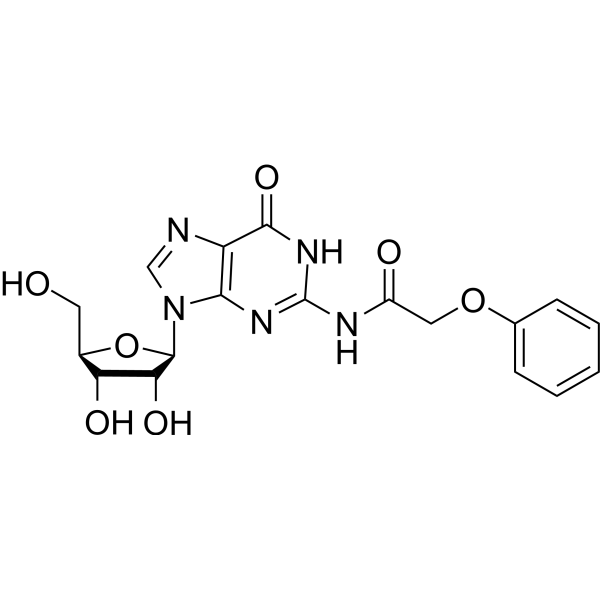
N2-Phenoxyacetylguanosine

Based on 1 Customer Validation
N2-Phenoxyacetylguanosine is a guanosine analog. Some guanosine analogs have immunostimulatory activity. In some animal models, they also induce type I interferons, producing antiviral effects. Studies have shown that the functional activity of guanosine analogs is dependent on the activation of Toll-like receptor 7 (TLR7).
For research use only. We do not sell to patients.
- Purity : 97.0%
- CAS No.: 119824-66-7
- Formula: C18H19N5O7
- Molecular Weight:417.37
-
Storage:Powder -20°C, 3 years , 4°C, 2 years ; In solvent -80°C, 6 months , -20°C, 1 month

To place orders, for customer services and technical support, please contact: MedChemExpress USA
Tel: 609-228-6898 E-mail: [email protected] [email protected]


-
 Biological Activity
-
Chemical Information
-
Solvent & Solubility
- Protocols
- Purity & Documentation
- References
-
 Help & FAQs




Biological Activity
Description


Chemical Information
-
CAS No. 119824-66-7
-
Appearance Solid
-
Molecular Weight 417.37
-
Formula C18H19N5O7
-
Color Light yellow to light brown
-
SMILES
O[C@H]1[C@@H](O)[C@H](N2C(N=C(NC(COC3=CC=CC=C3)=O)NC4=O)=C4N=C2)O[C@@H]1CO
-
Shipping
Room temperature in continental US; may vary elsewhere.
-
Storage
Powder -20°C 3 years 4°C 2 years In solvent -80°C 6 months -20°C 1 month


Solvent & Solubility
In Vitro:
DMSO : 100 mg/mL (239.60 mM; Need ultrasonic; Hygroscopic DMSO has a significant impact on the solubility of product, please use newly opened DMSO)
Please refer to the solubility information to select the appropriate solvent. Once prepared, please aliquot and store the solution to prevent product inactivation from repeated freeze-thaw cycles.
Storage method and period of stock solution: -80°C, 6 months; -20°C, 1 month. When stored at -80°C, please use it within 6 months. When stored at -20°C, please use it within 1 month.
Please refer to the solubility information to select the appropriate solvent. Once prepared, please aliquot and store the solution to prevent product inactivation from repeated freeze-thaw cycles.
Storage method and period of stock solution: -80°C, 6 months; -20°C, 1 month. When stored at -80°C, please use it within 6 months. When stored at -20°C, please use it within 1 month.
Concentration (start) × Volume (start) = Concentration (final) × Volume (final)

Protocols
-
Research Protocol for Infectious Diseases
Infectious-disease experiments test how pathogens interact with host barriers, innate immune receptors, inflammatory signaling, pathogen replication, and tissue injury; pattern-recognition receptors such as TLRs, RIG-I-like receptors, NOD-like receptors, and inflammasomes detect microbial molecules and activate NF-κB, interferon, and cytokine responses. The central hypothesis is that infection severity reflects the balance between pathogen burden and host response: protective inflammation restricts pathogen growth, whereas excessive or mislocalized inflammation contributes to tissue damage and disease phenotype. Unresolved questions include which host pathways are protective versus pathogenic, why some infection models fail to translate to human disease, and which combined readouts best predict clinically relevant infection outcomes.


Purity & Documentation
-
Data Sheet (271 KB)
-
SDS (394 KB)
- English - EN (394 KB)
- Français - FR (394 KB)
- Deutsch - DE (394 KB)
- Norwegian - NO (394 KB)
- Español - ES (394 KB)
- Swedish - SV (394 KB)
- Italian - IT (394 KB)
- Korean - KR (394 KB)
- Portuguese - PT (394 KB)
-
Handling Instructions (2659 KB)
References


Complete Stock Solution Preparation Table
Please refer to the solubility information to select the appropriate solvent. Once prepared, please aliquot and store the solution to prevent product inactivation from repeated freeze-thaw cycles.
Storage method and period of stock solution: -80°C, 6 months; -20°C, 1 month. When stored at -80°C, please use it within 6 months. When stored at -20°C, please use it within 1 month.
| Optional Solvent | Concentration Solvent Mass | 1 mg | 5 mg | 10 mg | 25 mg |
|---|---|---|---|---|---|
| DMSO | 1 mM | 2.3960 mL | 11.9798 mL | 23.9596 mL | 59.8989 mL |
| 5 mM | 0.4792 mL | 2.3960 mL | 4.7919 mL | 11.9798 mL | |
| 10 mM | 0.2396 mL | 1.1980 mL | 2.3960 mL | 5.9899 mL | |
| 15 mM | 0.1597 mL | 0.7987 mL | 1.5973 mL | 3.9933 mL | |
| 20 mM | 0.1198 mL | 0.5990 mL | 1.1980 mL | 2.9949 mL | |
| 25 mM | 0.0958 mL | 0.4792 mL | 0.9584 mL | 2.3960 mL | |
| 30 mM | 0.0799 mL | 0.3993 mL | 0.7987 mL | 1.9966 mL | |
| 40 mM | 0.0599 mL | 0.2995 mL | 0.5990 mL | 1.4975 mL | |
| 50 mM | 0.0479 mL | 0.2396 mL | 0.4792 mL | 1.1980 mL | |
| 60 mM | 0.0399 mL | 0.1997 mL | 0.3993 mL | 0.9983 mL | |
| 80 mM | 0.0299 mL | 0.1497 mL | 0.2995 mL | 0.7487 mL | |
| 100 mM | 0.0240 mL | 0.1198 mL | 0.2396 mL | 0.5990 mL |


N2-Phenoxyacetylguanosine Related Classifications
HY-154506 Related Classifications
 Powered by Bioz