



Formic acid ammonium
Based on 1 publication(s) in Google Scholar
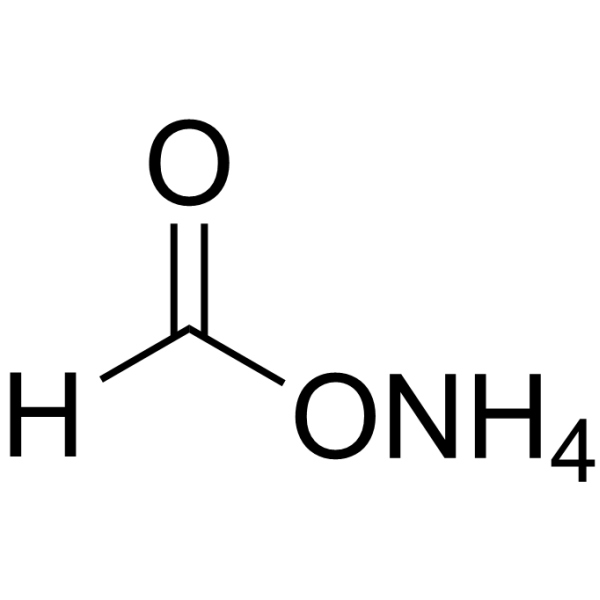
Formic acid ammonium is the ammonium salt form of formic acid, which is an endogenous metabolite. Formic acid ammonium activates the nitric oxide/cyclic guanosine monophosphate (NO/cGMP) signaling pathway in endothelial cells and inhibits calcium ion influx in vascular smooth muscle cells, resulting in vasomotor relaxation. Formic acid ammonium inhibits cytochrome C oxidase (CcO) and disrupts the electron transport chain, leading to ATP depletion. Formic acid ammonium can be used as a feed additive, which can lower the feed pH value, inhibit the growth of microorganisms (such as Escherichia coli, Salmonella), and extend the shelf life of the feed.
For research use only. We do not sell to patients.
- Assay : 98.47%
- CAS No.: 540-69-2
- Formula: HCO2NH4
- Molecular Weight:63.06
-
Storage:
Store at room temperature, keep dry and cool.
In solvent -80°C, 1 year , -20°C, 6 months

To place orders, for customer services and technical support, please contact: MedChemExpress USA
Tel: 609-228-6898 E-mail: [email protected] [email protected]


-
 Biological Activity
-
Chemical Information
-
Solvent & Solubility
- Purity & Documentation
- References
-
 Help & FAQs


-

HY-Y0849C
Ammonium acetate, for molecular biology, 98% -
HY-13757A
Tamoxifen -

HY-Y0488AR
Formic acid ammonium (Standard) -
HY-Y1269
Ammonium chloride, AR, 99.5% -
HY-Y1269C
Ammonium chloride, for cell culture -

HY-Y0344D
Sodium chloride, for cell culture -
HY-W251598C
Sodium bicarbonate, for cell culture -
HY-Y0320
Dimethyl sulfoxide, meets analytical specification of Ch.P. -
HY-Y0320C
Dimethyl sulfoxide
Publications Citing Use of MedChemExpress (MCE) Formic acid ammonium
MoreAll Calcium Channel Isoforms
More

Biological Activity
Description
In Vitro
Formic acid ammonium (0.1-10 mM) induces vasodilation in large isolated thoracic aortic rings in a concentration-dependent manner with EC₅₀ values in endothelium-intact and endothelium-deprived vascular rings of 2.315 mM and 2.132 mM, respectively[2].
Formic acid ammonium (0.5-5 mM,2 h) upregulates the expression of eNOS in rat aortic tissue, enhances the activity of NOS, and increases the production of NO and cGMP[2].
MedChemExpress (MCE) has not independently confirmed the accuracy of these methods. They are for reference only.
-
Cell Line:Ex vivo thoracic aortic ring
-
Concentration:0.5, 1 and 5 mM
-
Incubation Time:2h
-
Result:Significantly increased eNOS mRNA, and the mRNA levels of nNOS and iNOS remained unchanged.
-
Cell Line:Ex vivo thoracic aortic ring
-
Concentration:0.5, 1 and 5 mM
-
Incubation Time:2h
-
Result:Significantly increased eNOS protein, and the protein levels of nNOS and iNOS remained unchanged.
-
Cell Line:Ex vivo thoracic aortic ring
-
Concentration:0.5, 1 and 5 mM
-
Incubation Time:2h
-
Result:Significantly increased NO and cGMP, and the level of cAMP remained unchanged.
In Vivo
Formic acid ammonium induces reversible retinal toxicity in a methanol-induced visual toxicity rat model following short-term exposure[3].
MedChemExpress (MCE) has not independently confirmed the accuracy of these methods. They are for reference only.


Chemical Information
-
CAS No. 540-69-2
-
Appearance Solid
-
Molecular Weight 63.06
-
Formula HCO2NH4
-
Color Colorless to off-white
-
SMILES
[H]C(O[NH4])=O
-
Synonyms
Ammonium formate
-
Structure Classification
-
Initial Source
-
Shipping
Room temperature in continental US; may vary elsewhere.
-
Storage
Store at room temperature, keep dry and cool
In solvent -80°C 1 year -20°C 6 months


Publications (1)
-
Journal Impact Factor
-
Most Recent
-
Phytomedicine
2025 May:140:156619. PMID: 40088745


Solvent & Solubility
In Vitro:
DMSO : 100 mg/mL (1585.79 mM; Need ultrasonic; Hygroscopic DMSO has a significant impact on the solubility of product, please use newly opened DMSO)
Please refer to the solubility information to select the appropriate solvent. Once prepared, please aliquot and store the solution to prevent product inactivation from repeated freeze-thaw cycles.
Storage method and period of stock solution: -80°C, 1 year; -20°C, 6 months. When stored at -80°C, please use it within 1 year. When stored at -20°C, please use it within 6 months.
Please refer to the solubility information to select the appropriate solvent. Once prepared, please aliquot and store the solution to prevent product inactivation from repeated freeze-thaw cycles.
Storage method and period of stock solution: -80°C, 1 year; -20°C, 6 months. When stored at -80°C, please use it within 1 year. When stored at -20°C, please use it within 6 months.
Concentration (start) × Volume (start) = Concentration (final) × Volume (final)
In Vivo:
Select the appropriate dissolution method based on your experimental animal and administration route.
- For the following dissolution methods, please ensure to first prepare a clear stock solution using an In Vitro approach and then sequentially add co-solvents:
- To ensure reliable experimental results, the clarified stock solution can be appropriately stored based on storage conditions. As for the working solution for In Vivo experiments, it is recommended to prepare freshly and use it on the same day.
- The percentages shown for the solvents indicate their volumetric ratio in the final prepared solution. If precipitation or phase separation occurs during preparation, heat and/or sonication can be used to aid dissolution.
Add each solvent one by one: 10% DMSO 40% PEG300 5% Tween-80 45% Saline
Solubility: ≥ 5 mg/mL (79.29 mM); Clear solution
This protocol yields a clear solution of ≥ 5 mg/mL (saturation unknown).
Taking 1 mL working solution as an example, add 100 μL DMSO stock solution (50.0 mg/mL) to 400 μL PEG300, and mix evenly; then add 50 μL Tween-80 and mix evenly; then add 450 μL Saline to adjust the volume to 1 mL.
Preparation of Saline: Dissolve 0.9 g sodium chloride in ddH₂O and dilute to 100 mL to obtain a clear Saline solution.
Add each solvent one by one: 10% DMSO 90% (20% SBE-β-CD in Saline)
Solubility: ≥ 5 mg/mL (79.29 mM); Clear solution
This protocol yields a clear solution of ≥ 5 mg/mL (saturation unknown).
Taking 1 mL working solution as an example, add 100 μL DMSO stock solution (50.0 mg/mL) to 900 μL 20% SBE-β-CD in Saline, and mix evenly.
Preparation of 20% SBE-β-CD in Saline (4°C, storage for one week): 2 g SBE-β-CD powder is dissolved in 10 mL Saline, completely dissolve until clear.
In Vivo Dissolution Calculator
Please enter the basic information of animal experiments:
-
-
-
-
Recommended: Prepare an additional quantity of animals to account for potential losses during experiments.
Please enter your animal formula composition:
-
%DMSO +
Recommended: Keep the proportion of DMSO in working solution below 2% if your animal is weak.
-
%+
-
+%Tween-80 + +
-
%Saline +
The co-solvents required include: DMSO, . All of co-solvents are available by MedChemExpress (MCE). , Tween 80. All of co-solvents are available by MedChemExpress (MCE).
Working solution concentration: 0.22 mg/mL
Method for preparing stock solution: mg drug dissolved in μL DMSO. Stock solution concentration: mg/mL.
1. Take μL DMSO stock solution;
2. Add μL .
μL , mix evenly;
3. Then add μL Tween 80, mix evenly;
4. Then add μL
Please ensure that the stock solution in the first step is dissolved to a clear state, and add co-solvents in sequence. You can use ultrasonic heating (ultrasonic cleaner, recommended frequency 20-40 kHz), vortexing, etc. to assist dissolution.


Purity & Documentation
-
Data Sheet (275 KB)
-
SDS (393 KB)
- English - EN (393 KB)
- Français - FR (393 KB)
- Deutsch - DE (393 KB)
- Norwegian - NO (393 KB)
- Español - ES (393 KB)
- Swedish - SV (393 KB)
- Italian - IT (393 KB)
- Korean - KR (393 KB)
- Portuguese - PT (393 KB)
-
Handling Instructions (2659 KB)
References
[1]. Eisemann JH, van Heugten E. Response of pigs to dietary inclusion of formic acid and ammonium formate. J Anim Sci. 2007 Jun;85(6):1530-9. [Content Brief]
[2]. Zhang Q, et al. Formic acid up-regulates vascular tension through nitric oxide-cGMP signaling pathway. Chem Biol Interact. 2019 Aug 25;309:108710. [Content Brief]
[3]. Kapur BM, Baber M. FASD: folic acid and formic acid - an unholy alliance in the alcohol abusing mother. Biochem Cell Biol. 2018 Apr;96(2):189-197. [Content Brief]


Complete Stock Solution Preparation Table
Please refer to the solubility information to select the appropriate solvent. Once prepared, please aliquot and store the solution to prevent product inactivation from repeated freeze-thaw cycles.
Storage method and period of stock solution: -80°C, 1 year; -20°C, 6 months. When stored at -80°C, please use it within 1 year. When stored at -20°C, please use it within 6 months.
| Optional Solvent | Concentration Solvent Mass | 1 mg | 5 mg | 10 mg | 25 mg |
|---|---|---|---|---|---|
| DMSO | 1 mM | 15.8579 mL | 79.2896 mL | 158.5791 mL | 396.4478 mL |
| 5 mM | 3.1716 mL | 15.8579 mL | 31.7158 mL | 79.2896 mL | |
| 10 mM | 1.5858 mL | 7.9290 mL | 15.8579 mL | 39.6448 mL | |
| 15 mM | 1.0572 mL | 5.2860 mL | 10.5719 mL | 26.4299 mL | |
| 20 mM | 0.7929 mL | 3.9645 mL | 7.9290 mL | 19.8224 mL | |
| 25 mM | 0.6343 mL | 3.1716 mL | 6.3432 mL | 15.8579 mL | |
| 30 mM | 0.5286 mL | 2.6430 mL | 5.2860 mL | 13.2149 mL | |
| 40 mM | 0.3964 mL | 1.9822 mL | 3.9645 mL | 9.9112 mL | |
| 50 mM | 0.3172 mL | 1.5858 mL | 3.1716 mL | 7.9290 mL | |
| 60 mM | 0.2643 mL | 1.3215 mL | 2.6430 mL | 6.6075 mL | |
| 80 mM | 0.1982 mL | 0.9911 mL | 1.9822 mL | 4.9556 mL | |
| 100 mM | 0.1586 mL | 0.7929 mL | 1.5858 mL | 3.9645 mL |


Formic acid ammonium Related Classifications
HY-Y0488A Related Classifications
 Powered by Bioz