



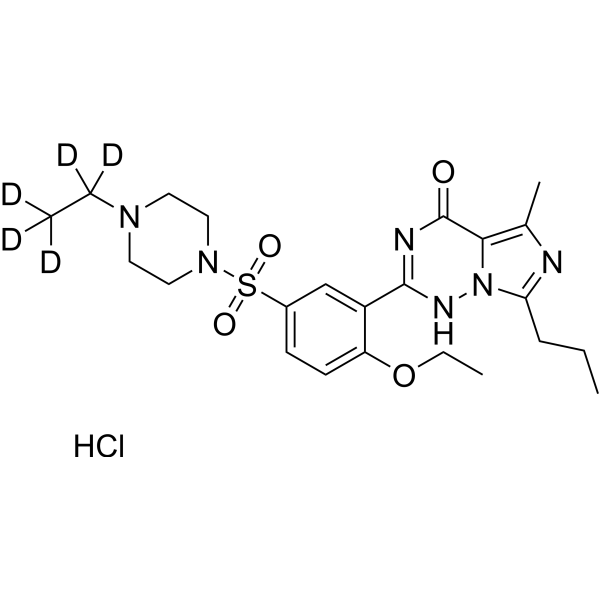
Vardenafil-d5 hydrochloride

Based on 1 Customer Validation
Vardenafil-d5 hydrochloride is deuterated labeled Vardenafil hydrochloride (HY-B0442A). Vardenafil hydrochloride is a selective and orally active inhibitor of phosphodiesterase-5 (PDE5), with an IC50 of 0.7 nM. Vardenafil hydrochloride shows inhibitory towards PDE1, PDE6 with IC50s of 180 nM, and 11 nM, while IC50s are >1000 nM for PDE3 and PDE4. Vardenafil hydrochloride competitively inhibits cyclic guanosine monophosphate (cGMP) hydrolysis and thus increases cGMP levels. Vardenafil hydrochloride can be used for the research of erectile dysfunction, hepatitis, diabetes[1]-[6].
For research use only. We do not sell to patients.
- Purity : 98.65%
- Formula: C23H28D5ClN6O4S
- Molecular Weight:530.09
-
Storage:Powder -20°C, 3 years , 4°C, 2 years ; In solvent -80°C, 6 months , -20°C, 1 month

To place orders, for customer services and technical support, please contact: MedChemExpress USA
Tel: 609-228-6898 E-mail: [email protected] [email protected]


-
 Biological Activity
-
Chemical Information
-
Solvent & Solubility
- Protocols
- Purity & Documentation
- References
-
 Help & FAQs


All Endogenous Metabolite Isoforms
More

Biological Activity
Description
In Vitro
Stable heavy isotopes of hydrogen, carbon, and other elements have been incorporated into drug molecules, largely as tracers for quantitation during the drug development process. Deuteration has gained attention because of its potential to affect the pharmacokinetic and metabolic profiles of drugs[1].
Vardenafil hydrochloride specifically inhibits the hydrolysis of cGMP by PDE5 with an IC50 of 0.7 nM[2].
Vardenafil hydrochloride increases intracellular cGMP levels in the cavernosum tissue of the penis, thus results increasing the dilation of the body's sinuses and blood flow[4].
MedChemExpress (MCE) has not independently confirmed the accuracy of these methods. They are for reference only. Further protocols information, click here.
In Vivo
Vardenafil hydrochloride (I.V.; 0.17 mg/kg once daily; 7 days) protects liver against Con A–induced hepatitis, and decreases the expression of NF-[6].
Vardenafil hydrochloride (P.O.; 10 mg/kg once daily; 25 weeks) prevents the reduction of tissue cGMP levels and the increase in 3-NT generation in ZDF hearts[7].
MedChemExpress (MCE) has not independently confirmed the accuracy of these methods. They are for reference only.
Application
1. This compound can be used as a tracer
2. This compound can be used as an internal standard for quantitative analysis by NMR, GC-MS, or LC-MS.


Chemical Information
-
Unlabeled CAS 224785-91-5
-
Appearance Solid
-
Molecular Weight 530.09
-
Formula C23H28D5ClN6O4S
-
Color White to off-white
-
SMILES
CC1=C2N(NC(C3=CC(S(=O)(N4CCN(CC4)C([2H])(C([2H])([2H])[2H])[2H])=O)=CC=C3OCC)=NC2=O)C(CCC)=N1.Cl
-
Shipping
Room temperature in continental US; may vary elsewhere.
-
Storage
Powder -20°C 3 years 4°C 2 years In solvent -80°C 6 months -20°C 1 month


Solvent & Solubility
In Vitro:
DMSO : ≥ 100 mg/mL (188.65 mM; Hygroscopic DMSO has a significant impact on the solubility of product, please use newly opened DMSO)
* "≥" means soluble, but saturation unknown.
Please refer to the solubility information to select the appropriate solvent. Once prepared, please aliquot and store the solution to prevent product inactivation from repeated freeze-thaw cycles.
Storage method and period of stock solution: -80°C, 6 months; -20°C, 1 month. When stored at -80°C, please use it within 6 months. When stored at -20°C, please use it within 1 month.
Please refer to the solubility information to select the appropriate solvent. Once prepared, please aliquot and store the solution to prevent product inactivation from repeated freeze-thaw cycles.
Storage method and period of stock solution: -80°C, 6 months; -20°C, 1 month. When stored at -80°C, please use it within 6 months. When stored at -20°C, please use it within 1 month.
Concentration (start) × Volume (start) = Concentration (final) × Volume (final)

Protocols
-
Cell Cytotoxicity Assay
Cytotoxicity assays are usually based on the assessment of cell membrane damage, which can also be indirectly detected by measuring cell viability. Detection methods include MTT assay, CKK-8 assay, LDH assay and ATP assay, etc.
-
Research Protocol for Metabolic Diseases
AMP-activated protein kinase, AMPK, is a conserved cellular energy sensor that responds to reduced cellular energy status and coordinates metabolism by increasing ATP-generating catabolic pathways while suppressing ATP-consuming anabolic processes. In metabolic disease research, the AMPK pathway is experimentally relevant because it regulates hepatic lipid synthesis, fatty acid oxidation, glucose production, skeletal-muscle glucose disposal, mTORC1-linked biosynthesis, autophagy, mitochondrial homeostasis, and whole-body energy balance. The central pathway logic is that energy stress, metformin, exercise-like stimulation, or direct AMPK activators increase AMPKα Thr172 phosphorylation and downstream substrate phosphorylation, including ACC and RAPTOR. Phosphorylation of ACC suppresses lipogenesis and supports fatty acid oxidation, whereas phosphorylation of RAPTOR suppresses mTORC1 signaling and links cellular energy status to growth and protein synthesis control. The pathway is linked


Purity & Documentation
-
Data Sheet (277 KB)
-
SDS (584 KB)
- English - EN (584 KB)
- Français - FR (584 KB)
- Deutsch - DE (584 KB)
- Norwegian - NO (584 KB)
- Español - ES (584 KB)
- Swedish - SV (584 KB)
- Italian - IT (584 KB)
- Korean - KR (584 KB)
- Portuguese - PT (584 KB)
-
Handling Instructions (2659 KB)
References
[1]. Russak EM, et al. Impact of Deuterium Substitution on the Pharmacokinetics of Pharmaceuticals. Ann Pharmacother. 2019 Feb;53(2):211-216. [Content Brief]
[2]. Gresser U, et al. Erectile dysfunction: comparison of efficacy and side effects of the PDE-5 inhibitors sildenafil, vardenafil and tadalafil--review of the literature. Eur J Med Res. 2002 Oct 29. 7(10):435-46. [Content Brief]
[3]. Ashour AE, et al. Vardenafil dihydrochloride. Profiles Drug Subst Excip Relat Methodol. 2014;39:515-544. [Content Brief]
[4]. Bódi B, et al. Long-Term PDE-5A Inhibition Improves Myofilament Function in Left and Right Ventricular Cardiomyocytes through Partially Different Mechanisms in Diabetic Rat Hearts. Antioxidants (Basel). 2021 Nov 6. 10(11):1776. [Content Brief]
[5]. Saenz de Tejada I, et al. The phosphodiesterase inhibitory selectivity and the in vitro and in vivo potency of the new PDE5 inhibitor vardenafil. Int J Impot Res. 2001;13(5):282-290. [Content Brief]
[6]. Oudot A, et al. Combination of BAY 60-4552 and vardenafil exerts proerectile facilitator effects in rats with cavernous nerve injury: a proof of concept study for the treatment of phosphodiesterase type 5 inhibitor failure. Eur Urol. 2011 Nov. 60(5):1020-6. [Content Brief]
[7]. Ahmed N, et al. Hepatoprotective role of vardenafil against experimentally induced hepatitis in mice. J Biochem Mol Toxicol. 2017 Mar. 31(3). [Content Brief]


Complete Stock Solution Preparation Table
Please refer to the solubility information to select the appropriate solvent. Once prepared, please aliquot and store the solution to prevent product inactivation from repeated freeze-thaw cycles.
Storage method and period of stock solution: -80°C, 6 months; -20°C, 1 month. When stored at -80°C, please use it within 6 months. When stored at -20°C, please use it within 1 month.
| Optional Solvent | Concentration Solvent Mass | 1 mg | 5 mg | 10 mg | 25 mg |
|---|---|---|---|---|---|
| DMSO | 1 mM | 1.8865 mL | 9.4324 mL | 18.8647 mL | 47.1618 mL |
| 5 mM | 0.3773 mL | 1.8865 mL | 3.7729 mL | 9.4324 mL | |
| 10 mM | 0.1886 mL | 0.9432 mL | 1.8865 mL | 4.7162 mL | |
| 15 mM | 0.1258 mL | 0.6288 mL | 1.2576 mL | 3.1441 mL | |
| 20 mM | 0.0943 mL | 0.4716 mL | 0.9432 mL | 2.3581 mL | |
| 25 mM | 0.0755 mL | 0.3773 mL | 0.7546 mL | 1.8865 mL | |
| 30 mM | 0.0629 mL | 0.3144 mL | 0.6288 mL | 1.5721 mL | |
| 40 mM | 0.0472 mL | 0.2358 mL | 0.4716 mL | 1.1790 mL | |
| 50 mM | 0.0377 mL | 0.1886 mL | 0.3773 mL | 0.9432 mL | |
| 60 mM | 0.0314 mL | 0.1572 mL | 0.3144 mL | 0.7860 mL | |
| 80 mM | 0.0236 mL | 0.1179 mL | 0.2358 mL | 0.5895 mL | |
| 100 mM | 0.0189 mL | 0.0943 mL | 0.1886 mL | 0.4716 mL |


Vardenafil-d5 hydrochloride Related Classifications
HY-B0442AS Related Classifications
 Powered by Bioz