1. Search Result
Search Result
Results for "

proto-oncogene

" in MedChemExpress (MCE) Product Catalog:

20

Inhibitors & Agonists

1

Peptides

2

Natural
Products

91

Recombinant Proteins

1

Isotope-Labeled Compounds

150

Antibodies

3

Oligonucleotides

Cat. No. Product Name Target Research Areas Chemical Structure
  • HY-N6732
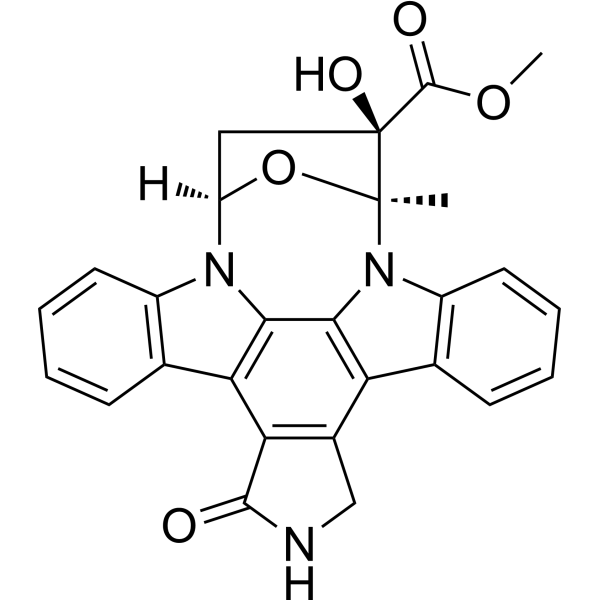
    K-252a
    25+ Cited Publications

    SF2370; Antibiotic K 252a; Antibiotic SF 2370

    Autophagy PKA PKC Trk Receptor CaMK Infection Inflammation/Immunology
    K-252a, a staurosporine analog, inhibits protein kinase, with IC50 values of 470 nM, 140 nM, 270 nM, and 1.7 nM for PKC, PKA, Ca 2+/calmodulin-dependent kinase type II, and phosphorylase kinase, respectively . K-252a is a potent inhibitor (IC50 of 3 nM) of the tyrosine protein kinase (TRK) activity of the NGF receptor gp140trk, the product of the trk protooncogene .
    K-252a
  • HY-15176A
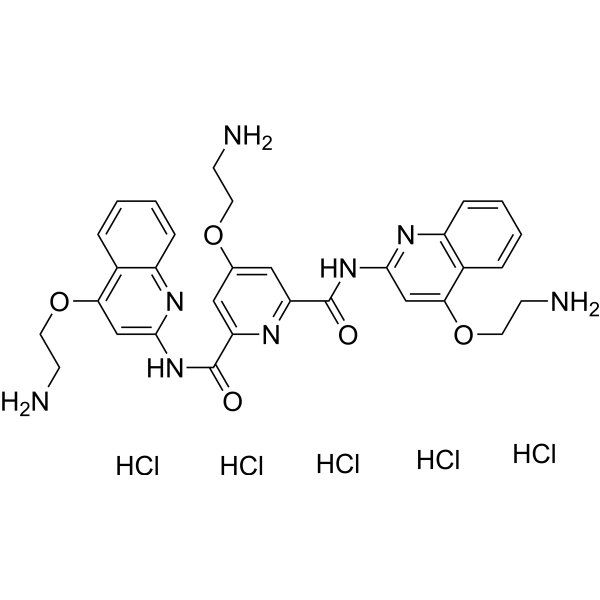
    Pyridostatin hydrochloride
    30+ Cited Publications

    RR82 hydrochloride

    DNA/RNA Synthesis G-quadruplex Flavivirus Src Virus Protease Cancer
    Pyridostatin (RR82) hydrochloride is a G-quadruplex DNA stabilizing agent (Kd=490 nM) and can target DNA and RNA G4s in cells. Pyridostatin hydrochloride promotes growth arrest in human cancer cells by inducing replication- and transcription-dependent DNA damage. Pyridostatin hydrochloride targets the proto-oncogene Src. Pyridostatin hydrochloride reduced SRC protein levels and SRC-dependent cellular motility in human breast cancer cells .
    Pyridostatin hydrochloride
  • HY-15176

    RR82

    G-quadruplex Cancer
    Pyridostatin (RR82) is a G-quadruplex DNA stabilizing agent (Kd=490 nM) and can target DNA and RNA G4s in cells. Pyridostatin promotes growth arrest in human cancer cells by inducing replication- and transcription-dependent DNA damage. Pyridostatin targets the proto-oncogene Src. Pyridostatin reduced SRC protein levels and SRC-dependent cellular motility in human breast cancer cells .
    Pyridostatin
  • HY-50878A
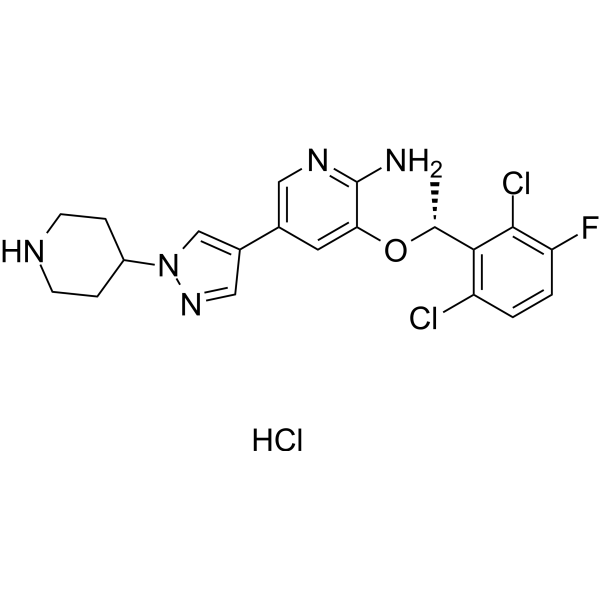
    Crizotinib hydrochloride
    Maximum Cited Publications
    86 Publications Verification

    PF-02341066 hydrochloride

    Anaplastic lymphoma kinase (ALK) c-Met/HGFR ROS Kinase Autophagy Cancer
    Crizotinib hydrochloride (PF-02341066 hydrochloride) is an orally bioavailable, selective, and ATP-competitive dual ALK and c-Met inhibitor with IC50s of 20 and 8 nM, respectively. Crizotinib hydrochloride (PF-02341066 hydrochloride) inhibits tyrosine phosphorylation of NPM-ALK and tyrosine phosphorylation of c-Met with IC50s of 24 and 11 nM in cell-based assays, respectively. It is also a ROS proto-oncogene 1 (ROS1) inhibitor. Crizotinib hydrochloride (PF-02341066 hydrochloride) has effective tumor growth inhibition .
    Crizotinib hydrochloride
  • HY-16059

    (+)-Arglabin

    NOD-like Receptor (NLR) Farnesyl Transferase Autophagy Inflammation/Immunology Cancer
    Arglabin ((+)-Arglabin), a natural product isolated from Artemisia glabella, is a NLRP3 inflammasome inhibitor. Arglabin shows anti-inflammatory and antitumor activities . The antitumor activity of Arglabin proceeds through its inhibition of farnesyl transferase which leads to the activation of RAS proto-oncogene .
    Arglabin
  • HY-W002199

    6:2 FTOH; 1H,1H,2H,2H-Perfluoro-1-octanol; 2-(Perfluorohexyl)ethanol

    Bacterial Apoptosis ERK TNF Receptor Infection Neurological Disease
    6:2 Fluorotelomer alcohol (6:2 FTOH) is an orally active, blood-brain barrier-permeable modulator of cyclin D1 and ETS1. 6:2 Fluorotelomer alcohol downregulates cyclin D1 expression, upregulates ETS1 via the TNF-α/ERK 1/2 pathway, impairs mitochondrial membrane potential and respiratory function, increases reactive oxygen species levels, disrupts calcium homeostasis and activates endoplasmic reticulum stress markers, and induces cell proliferation inhibition and endothelial-mesenchymal transition. Furthermore, 6:2 Fluorotelomer alcohol induces morphological abnormalities in zebrafish embryos and liver developmental damage, while disrupting the brain immune microenvironment in mice, causing systemic toxicity and delayed pup maturation in CD-1 mice. 6:2 Fluorotelomer alcohol also induces cortical neuron apoptosis, glial cell activation, synaptic abnormalities, colonic barrier damage, intestinal dysbiosis and autism spectrum disorder-like symptoms in mice. 6:2 Fluorotelomer alcohol shows no mutagenic, clastogenic, primary skin/eye irritation or skin sensitizing effects, exhibits no selective reproductive toxicity in CD-1 mice, and is classified as GHS Category 4 for acute oral toxicity. 6:2 Fluorotelomer alcohol can be used in studies of neurodevelopmental disorders and autism spectrum disorders .
    6:2 Fluorotelomer alcohol
  • HY-156228

    Ras Cancer
    RGB-1 selectively binds to and stabilizes RNA G-quadruplex structures, and reduces the expression of the NRAS proto-oncogene in breast cancer cells. RGB-1 can serve as a tool for investigating the cellular functions of RNA G-quadruplex structures and identifying novel mRNA G-quadruplex-forming sequences. RGB-1 is applicable for breast cancer research .
    RGB-1
  • HY-155477

    E1/E2/E3 Enzyme Cancer
    Cbl-b-IN-15 (compound 25) is an inhibitor of the RING finger E3 ligase Cbl (IC50: 15 nM). Cbl-b refers to Casitas B-lineage lymphoma proto-oncogene-b, which inhibits T-cell, natural killer (NK) cell, and B-cell activation. Cbl-b-IN-15 activates T cell function with EC50=0.41 μM .
    Cbl-b-IN-15
  • HY-141431

    E1/E2/E3 Enzyme Inflammation/Immunology Cancer
    Cbl-b-IN-2 (Example 8) is an orally bioavailable compound, can inhibit the E3 enzyme Casitas B-lineage lymphoma proto-oncogene-b (Cbl-b) in the ubiquitin proteasome pathway. Cbl-b-IN-2 can be used to modulate the immune system and diseases amenable to immune system modulation. Cbl-b-IN-2 (Example 8) also may be administered to an individual with cancer, either alone or as part of a combination, with one or more of an immune checkpoint inhibitor, an anti-neoplastic agent, and radiation agent .
    Cbl-b-IN-2
  • HY-164387

    EGFR PDGFR VEGFR Cancer
    Sutetinib is an orally active inhibitor for tyrosine kinase, that is associated with tumor growth and angiogenesis, such as VEGFR (Ki= 0.009 µM for VEGFR-1/2/3), PDGFR (Ki= 0.008 µM for PDGFR-α/β) and proto-oncogene cKIT. Sutetinib inhibits the proliferation, migration, and tubular structure formation of endothelial cells and fibroblasts, and exhibits board-spectrum antitumor efficacy in vitro and in vivo .
    Sutetinib
  • HY-164387A

    EGFR VEGFR PDGFR Cancer
    Sutetinib maleate is the maleate form of Sutetinib (HY-164387). Sutetinib maleate is an orally active inhibitor for tyrosine kinase, that is associated with tumor growth and angiogenesis, such as VEGFR (Ki= 0.009 µM for VEGFR-1/2/3), PDGFR (Ki= 0.008 µM for PDGFR-α/β) and proto-oncogene cKIT. Sutetinib maleate inhibits the proliferation, migration, and tubular structure formation of endothelial cells and fibroblasts, and exhibits board-spectrum antitumor efficacy in vitro and in vivo .
    Sutetinib maleate
  • HY-50878AS

    PF-02341066-d9 hydrochloride

    c-Met/HGFR Autophagy Anaplastic lymphoma kinase (ALK) ROS Kinase Isotope-Labeled Compounds Cancer
    Crizotinib-d9 hydrochloride is deuterated labeled Crizotinib hydrochloride (HY-50878A). Crizotinib hydrochloride (PF-02341066 hydrochloride) is an orally bioavailable, selective, and ATP-competitive dual ALK and c-Met inhibitor with IC50s of 20 and 8 nM, respectively. Crizotinib hydrochloride (PF-02341066 hydrochloride) inhibits tyrosine phosphorylation of NPM-ALK and tyrosine phosphorylation of c-Met with IC50s of 24 and 11 nM in cell-based assays, respectively. It is also a ROS proto-oncogene 1 (ROS1) inhibitor. Crizotinib hydrochloride (PF-02341066 hydrochloride) has effective tumor growth inhibition .
    Crizotinib-d9 hydrochloride
  • HY-174682

    mRNA Cancer
    Human FOS mRNA encodes the human Fos proto-oncogene, AP-1 transcription factor subunit (FOS) protein which has been implicated as regulators of cell proliferation, differentiation, and transformation.
    Human FOS mRNA
  • HY-158172

    E1/E2/E3 Enzyme Others
    Cbl-b-IN-18 (compound 51) is an inhibitor of the E3 ligase Casitas B-lineage lymphoma proto-oncogene B (CPL-B). Cbl-b-IN-18 inhibits the phosphorylation of CPL-B (IC50< 100 nM) .
    Cbl-b-IN-18
  • HY-129488

    R-(-)-BPAP hydrochloride

    Bcl-2 Family Neurological Disease
    FPFS-1169 (hydrochloride) is a proto-oncogene protein c-bcl-2 stimulant. FPFS-1169 (hydrochloride) can increase the impulse-evoked release of monoamine neurotransmitters. FPFS-1169 (hydrochloride) can be studied in research on Parkinson’s disease .
    FPFS-1169 hydrochloride
  • HY-158174

    E1/E2/E3 Enzyme Cancer
    Cbl-b-IN-20 (Example 50) is a casitas proto-oncogene-B ( CPL-B ) inhibitor with IC50 <100 nM .
    Cbl-b-IN-20
  • HY-169005

    E1/E2/E3 Enzyme Inflammation/Immunology
    Cbl-b-IN-27 is a casitas B-lymphoma proto-oncogene-b (Cbl-b) inhibitor with an IC50 value of 7 nM. Cbl-b-IN-27 is promising for research of effector T cell function, T cell, natural killer (NK) cell and B cell activation regulation .
    Cbl-b-IN-27
  • HY-174577

    mRNA Cancer
    Human MYC mRNA encodes the human MYC proto-oncogene, bHLH transcription factor (MYC) protein, a nuclear phosphoprotein that plays a role in cell cycle progression, apoptosis and cellular transformation.
    Human MYC mRNA
  • HY-174581

    mRNA Cancer
    Human MET mRNA encodes the human MET proto-oncogene, receptor tyrosine kinase (MET) protein, a member of the receptor tyrosine kinase family. MET regulates many physiological processes including proliferation, scattering, morphogenesis and survival.
    Human MET mRNA
  • HY-181061

    COX EGFR Lipoxygenase FAK Raf Apoptosis Caspase Bcl-2 Family Cancer
    COX/5-LO-IN-2 is a COX2, EGFR, COX1, 5-LOX, BRAF and FAK inhibitor with IC50 of 1.22 μM, 2.5 μM, 2.95 μM, 4.65 μM, 7.4 μM, 12.2 μM, respectively. COX/5-LO-IN-2 induces cell growth arrest at G2/M phase. COX/5-LO-IN-2 triggers apoptotic activity by up-regulating proapoptotic proteins p53, Bax, and caspase-7 and down-regulating anti-apoptotic protein Bcl-2. COX/5-LO-IN-2 can be used for the research of breast cancer .
    COX/5-LO-IN-2

Inquiry Online

Your information is safe with us. * Required Fields.

Salutation


Country or Region *

Applicant Name *


Organization Name *

Department *


Email Address *


Product Name *

Cat. No.


Requested quantity *

Phone Number *


Remarks

Inquiry Online

Inquiry Information

Product Name:
Cat. No.:
Quantity:
MCE Japan Authorized Agent:

