



KRAS Antibody (YA6628)
(Synonyms: c Ki ras2 antibody; c Kirsten ras protein antibody; c-K-ras antibody; c-Ki-ras antibody; Cellular c Ki ras2 proto oncogene antibody; Cellular transforming proto oncogene antibody; CFC2 antibody; cK Ras antibody; GTPase KRas antibody; K RAS p21 protein antibody; c Ki ras2 antibody; c Kirsten ras protein antibody; c-K-ras antibody; c-Ki-ras antibody; Cellular c Ki ras2 proto oncogene antibody; Cellular transforming proto oncogene antibody; CFC2 antibody; cK Ras antibody; GTPase KRas antibody; K RAS p21 protein antibody; K RAS2A antibody; K RAS2B antibody; K RAS4A antibody; K RAS4B antibody; K-Ras 2 antibody; KI RAS antibody; Ki-Ras antibody; KIRSTEN MURINE SARCOMA VIRUS 2 antibody; Kirsten rat sarcoma 2 viral (v Ki ras2) oncogene homolog antibody; Kirsten rat sarcoma viral oncogene homolog antibody; KRAS antibody; KRAS proto oncogene, GTPase antibody; KRAS1 antibody; KRAS2 antibody; N-terminally processed antibody; NS antibody; NS3 antibody; Oncogene KRAS2 antibody; p21ras antibody; PR310 c K ras oncogene antibody; PR310 cK ras oncogene antibody; RALD antibody; RASK_HUMAN antibody; RASK2 antibody; Transforming protein p21 antibody; v Ki ras2 Kirsten rat sarcoma 2 viral oncogene homolog antibody; v Ki ras2 Kirsten rat sarcoma viral oncogene homolog antibody; )Based on 1 Customer Validation
KRAS Antibody (YA6628) is a Mouse-derived and non-conjugated IgG1 monoclonal antibody, targeting to KRAS.
-
Host:
Mouse
-
Isotype:
IgG
-
Application:
WB, IHC-P
-
Reactivity :
Human, Mouse, Rat
-
Formulation:
Supplied in PBS (pH7.4), 0.1% BSA, 40% Glycerol. Preservative: 0.05% Sodium Azide.
-
Conjugation:
Non-conjugated


To place orders, for customer services and technical support, please contact: MedChemExpress USA
Tel: 609-228-6898 E-mail: [email protected] [email protected]





Applications
| Application |
WB

WB: Western Blot
|
IHC-P
IHC-P: Immunohistochemistry-Paraffin
|
|---|---|---|
| Dilution Ratio | 1:500-1:2000 | 1:1000 |


Product Details
KRAS Antibody (YA6628) is a Mouse-derived and non-conjugated IgG1 monoclonal antibody, targeting to KRAS.
-
Host Mouse

-
Clonality Recombinant,Monoclonal

-
Species ReactivityHuman, Mouse, Rat
-
Observed Molecular WeightObserved band size: 22 kDa
Note: Due to possible protein modifications or aggregation, the molecular weight should be confirmed by actual measurement, and the predicted value is for reference only.

-
Calculated Molecular Weight Predicted band size: 22 kDa

Recombinant protein within human KRAS aa 2-186 (P01116-1).
affinity purified.
Non-conjugated
Unmodified
IgG


Product Properties
-
Appearance
Solution
-
Formulation
Supplied in PBS (pH7.4), 0.1% BSA, 40% Glycerol. Preservative: 0.05% Sodium Azide.
-
Concentration
Batch-dependent, Please check the COA for the concentration of each lot. Check Lot Concentration
-
Storage & Stability
Stored at -20°C for 1 year. Avoid repeated freeze / thaw cycles.
-
Shipping
Shipping with blue ice.


Verification Images
-
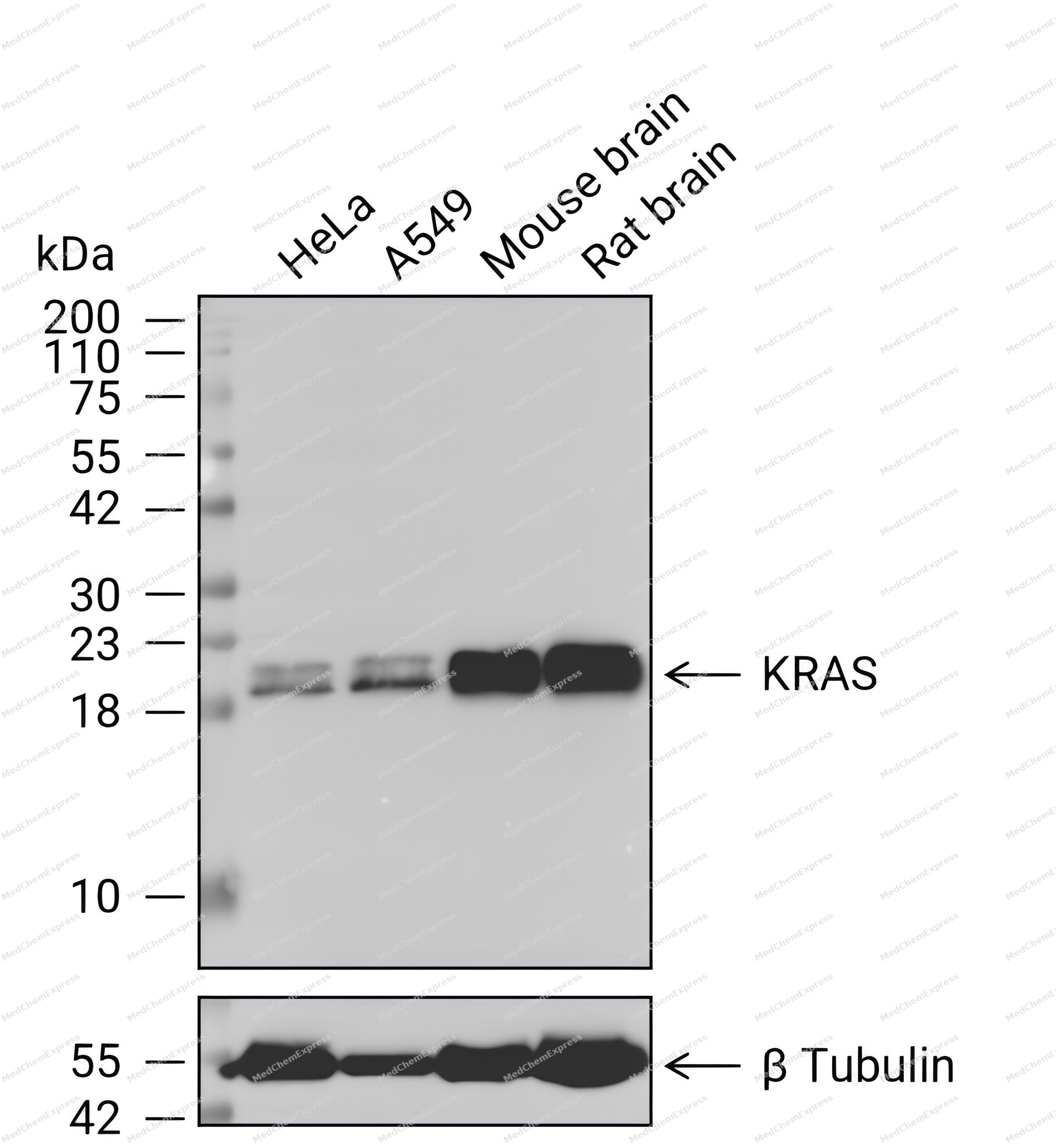 Western blot analysis of extracts from HeLa (lane 1(20μg)) 、A549 (lane 2(20μg)) 、Mouse brain (lane 3(20μg)) and Rat brain (lane 4(20μg)) using KRAS Antibody (HY-P86935) . Proteins were transferred to a PVDF membrane and blocked with 5% nonfat dry milk in TBST for 1.5 hour at room temperature. The primary antibody (1/1000) and Loading control antibody (β Tubulin, 1/10000) was used in 5% nonfat dry milk in TBST at 4℃ overnight. Goat Anti-Mouse IgG-HRP Secondary Antibody (1/10,000) was used for 1 hour at room temperature.


Background
-
Function
K-Ras (KRAS) is a small GTPase that functions as a molecular switch within the RAS/MAPK signaling network, cycling between inactive GDP-bound and active GTP-bound states to regulate cell proliferation, differentiation, and survival[1][2]. Mechanistically, activated KRAS transduces signals from cell-surface receptors to downstream effectors, including the MAPK/ERK and PI3K/AKT pathways, thereby coordinating cellular growth and stress-response programs[1][3]. Oncogenic mutations impair GTP hydrolysis and maintain persistent KRAS signaling, resulting in sustained activation of proliferative pathways that contribute to tumor initiation, progression, and therapeutic resistance across multiple cancer types, particularly pancreatic ductal adenocarcinoma, colorectal cancer, and non-small cell lung cancer[2][3][4]. In disease models, mutant KRAS also reshapes the tumor microenvironment through inflammatory and immune-regulatory signaling, further supporting tumor development and immune evasion[3][2]. Compared with the related RAS isoforms HRAS and NRAS, KRAS is the most frequently altered RAS family member in human cancer and accounts for the majority of oncogenic RAS mutations, highlighting its distinct biological and clinical importance[2][5]. For experimental applications, the development of mutation-selective inhibitors, especially KRAS^G12C^ inhibitors, has established a tractable platform for studying KRAS-dependent signaling and therapeutic resistance mechanisms, although resistance remains a major challenge for long-term clinical efficacy[2][5].
-
Subcellular Localization
Cell membrane,Endomembrane system,Cytoplasm, cytosol,Cell membrane
-
Isoforms & Post-Translational Modification
P01116 has two isomers: P01116-1: 21656 Da (predicted); P01116-2: 21425 Da (predicted).
Acetylation at Lys-104 prevents interaction with guanine nucleotide exchange factors (GEFs)丨Palmitoylated at Lys-182, Lys-184 and Lys-185 (PubMed:29239724)丨Ubiquitinated by the BCR(LZTR1) E3 ubiquitin ligase complex at Lys-170 in a non-degradative manner, leading to inhibit Ras signaling by decreasing Ras association with membranes丨(Microbial infection) Glucosylated at Thr-35 by P -
Subunit
Interacts with PHLPP (By similarity)
-
SwissProt ID
-
Synonyms
c Ki ras2 antibody; c Kirsten ras protein antibody; c-K-ras antibody; c-Ki-ras antibody; Cellular c Ki ras2 proto oncogene antibody; Cellular transforming proto oncogene antibody; CFC2 antibody; cK Ras antibody; GTPase KRas antibody; K RAS p21 protein antibody; c Ki ras2 antibody; c Kirsten ras protein antibody; c-K-ras antibody; c-Ki-ras antibody; Cellular c Ki ras2 proto oncogene antibody; Cellular transforming proto oncogene antibody; CFC2 antibody; cK Ras antibody; GTPase KRas antibody; K RAS p21 protein antibody; K RAS2A antibody; K RAS2B antibody; K RAS4A antibody; K RAS4B antibody; K-Ras 2 antibody; KI RAS antibody; Ki-Ras antibody; KIRSTEN MURINE SARCOMA VIRUS 2 antibody; Kirsten rat sarcoma 2 viral (v Ki ras2) oncogene homolog antibody; Kirsten rat sarcoma viral oncogene homolog antibody; KRAS antibody; KRAS proto oncogene, GTPase antibody; KRAS1 antibody; KRAS2 antibody; N-terminally processed antibody; NS antibody; NS3 antibody; Oncogene KRAS2 antibody; p21ras antibody; PR310 c K ras oncogene antibody; PR310 cK ras oncogene antibody; RALD antibody; RASK_HUMAN antibody; RASK2 antibody; Transforming protein p21 antibody; v Ki ras2 Kirsten rat sarcoma 2 viral oncogene homolog antibody; v Ki ras2 Kirsten rat sarcoma viral oncogene homolog antibody;


Documentation
-
Data Sheet (259 KB)
-
SDS (254 KB)
- English - EN (254 KB)
- Français - FR (254 KB)
- Deutsch - DE (254 KB)
- Norwegian - NO (254 KB)
- Español - ES (254 KB)
- Swedish - SV (254 KB)
- Italian - IT (254 KB)
- Korean - KR (254 KB)
- Portuguese - PT (254 KB)
-
User Guide for Antibodies (1077 KB)
References
[2]. Huang L, et al. KRAS mutation: from undruggable to druggable in cancer. Signal Transduct Target Ther. 2021 Nov 15;6(1):386. [Content Brief]
[3]. Uniyal P, et al. KRAS Mutations in Cancer: Understanding Signaling Pathways to Immune Regulation and the Potential of Immunotherapy. Cancers (Basel). 2025 Feb 25;17(5):785. [Content Brief]
[4]. Suda K, et al. Biological and clinical significance of KRAS mutations in lung cancer: an oncogenic driver that contrasts with EGFR mutation. Cancer Metastasis Rev. 2010 Mar;29(1):49-60. [Content Brief]
[5]. Riedl JM, et al. Emerging landscape of KRAS inhibitors in cancer treatment. Cancer Cell. 2026 Mar 9;44(3):471-497. [Content Brief]

 Powered by Bioz
