



Raf-1 Antibody (YA107)
(Synonyms: RAF1; RAF; RAF proto-oncogene serine/threonine-protein kinase; Proto-oncogene c-RAF; cRaf; Raf-1)Based on 1 publication(s) in Google Scholar
Raf-1 Antibody (YA107) is a Rabbit-derived and non-conjugated IgG monoclonal antibody, targeting to Raf-1.
-
Host:
Rabbit
-
Isotype:
IgG
-
Application:
WB, ICC/IF
-
Reactivity :
Human, Mouse, Rat
-
Formulation:
Supplied in 50 mM Tris-Glycine (pH 7.4), 0.15 M NaCl, 40% Glycerol and 0.05% BSA. Preservative: 0.01% Sodium azide
-
Conjugation:
Non-conjugated


To place orders, for customer services and technical support, please contact: MedChemExpress USA
Tel: 609-228-6898 E-mail: [email protected] [email protected]



Publications Citing Use of MedChemExpress (MCE) Raf-1 Antibody (YA107)
More

Applications
| Application |
WB

WB: Western Blot
|
ICC/IF
ICC/IF: Immunocytochemistry/
Immunofluorescence |
|---|---|---|
| Dilution Ratio | 1:500-1:1000 | 1:50-1:200 |


Product Details
Raf-1 Antibody (YA107) is a Rabbit-derived and non-conjugated IgG monoclonal antibody, targeting to Raf-1.
-
Host Rabbit

-
Clonality Recombinant,Monoclonal

-
Species ReactivityHuman, Mouse, Rat
-
Observed Molecular WeightObserved band size: 73 kDa
Note: Due to possible protein modifications or aggregation, the molecular weight should be confirmed by actual measurement, and the predicted value is for reference only.

-
Calculated Molecular Weight Predicted band size: 73 kDa

Entrez Gene: 5894 Human ; 110157 Mouse ; 24703 Rat
SwissProt: P04049 Human ; Q99N57 Mouse ; P11345 Rat
OMIM: 611553 Human
Synthetic peptide corresponding to Human Raf1 aa4-20.
Endogenous
affinity purified
Non-conjugated
Unmodified
IgG


Product Properties
-
Appearance
Solution
-
Formulation
Supplied in 50 mM Tris-Glycine (pH 7.4), 0.15 M NaCl, 40% Glycerol and 0.05% BSA. Preservative: 0.01% Sodium azide
-
Concentration
Batch-dependent, Please check the COA for the concentration of each lot. Check Lot Concentration
-
Storage & Stability
Stored at -20°C for 1 year. Avoid repeated freeze / thaw cycles.
-
Shipping
Shipping with blue ice.


Publications (1)
-
Journal Impact Factor
-
Most Recent
-
Int J Antimicrob Agents
Regorafenib, a multitargeted kinase inhibitor, inhibits enterovirus 71 infection by suppressing the MAPK pathway. [Abstract]2026 Feb;67(2):107711. PMID: 41490665


Verification Images
-
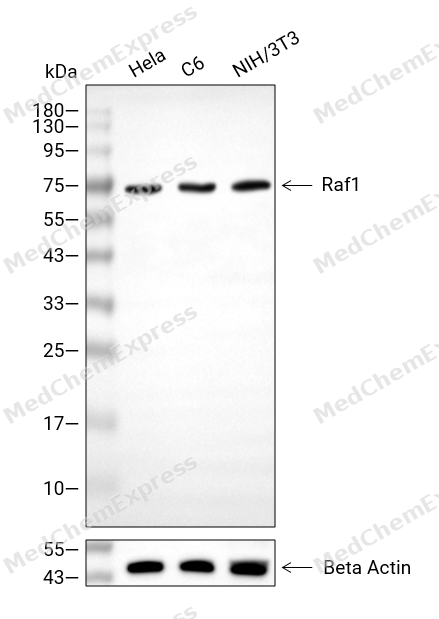 Western blot analysis of extracts from Hela (lane 2(20μg), C6 (lane 3(20μg), NIH/3T3 (lane 4(20μg), using Raf1 Antibody. Proteins were transferred to a PVDF membrane and blocked with 5% BSA in TBST for 2 hour at room temperature. The primary antibody and Loading control antibody (Beta Actin, HY-P80438, 1/3000) was used in 5% BSA in TBST at 4°C overnight. Goat Anti-Mouse/Rabbit IgG-HRP Secondary Antibody (HY-P8004/HY-P8001, 1/10,000) was used for 1 hour at room temperature.
 -
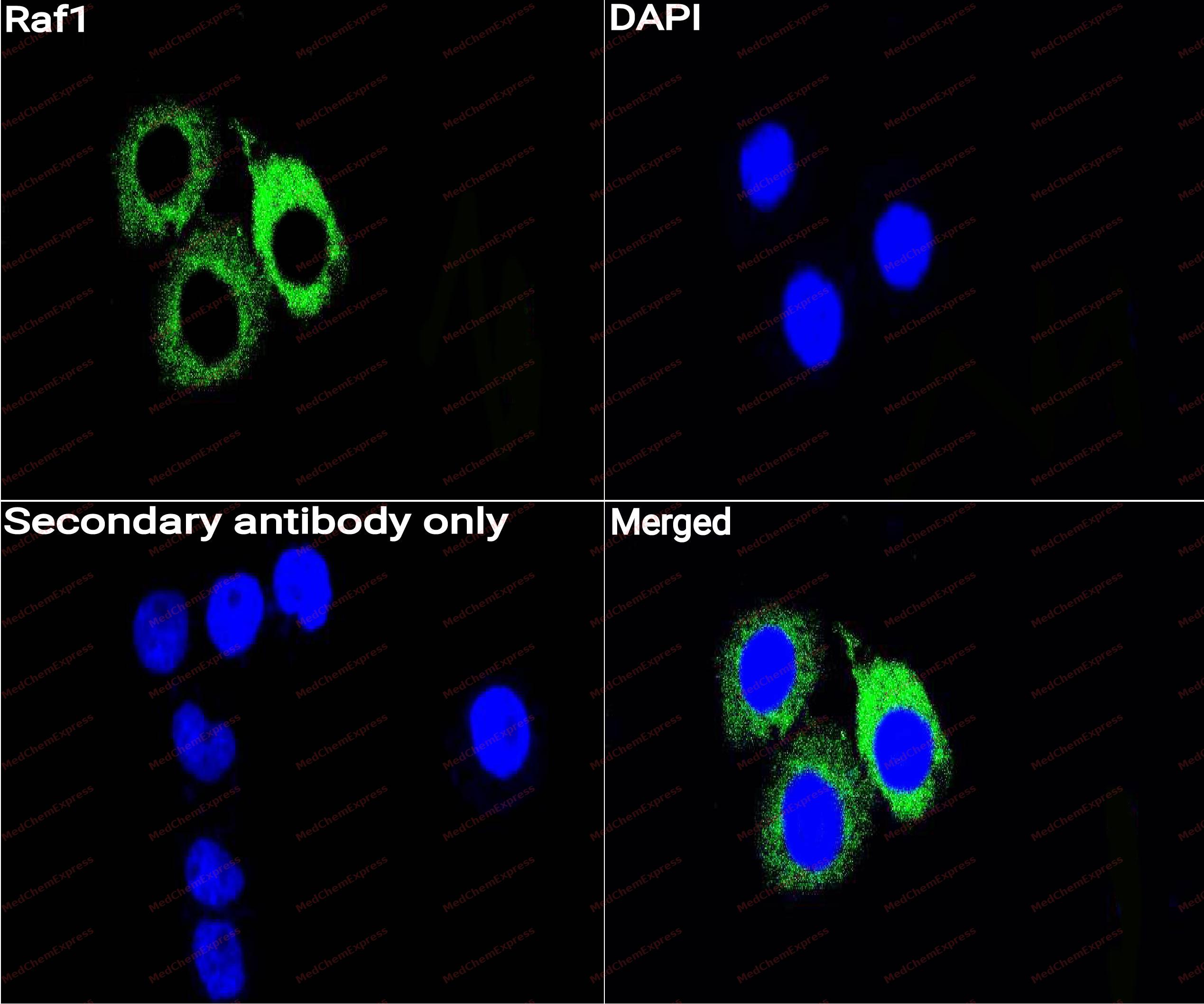 Immunocytochemistry analysis of Hela cells labeling Raf1 with Raf1 Antibody (HY-P80880) at 1/50 dilution. Cells were fixed in 4% paraformaldehyde for 15 minutes at room temperature, permeabilized with 0.1% Triton X-100 for 10 minutes at room temperature, then blocked with QuickBlock™ Blocking Buffer for Immunol Staining for 10 min at room temperature. Cells were then incubated with Raf1 Antibody (HY-P80880) at 1/50 dilution in QuickBlock™ Blocking Buffer for Immunol Staining at 4 ℃. Alexa Fluor® 488-conjugated AffiniPure Goat Anti-Rabbit IgG H&L(HY-P8002, Green) was used as the secondary antibody at 1/1,000 dilution. PBS instead of the primary antibody was used as the secondary antibody only control. The Nuclear counterstain was DAPI (Blue).
 -
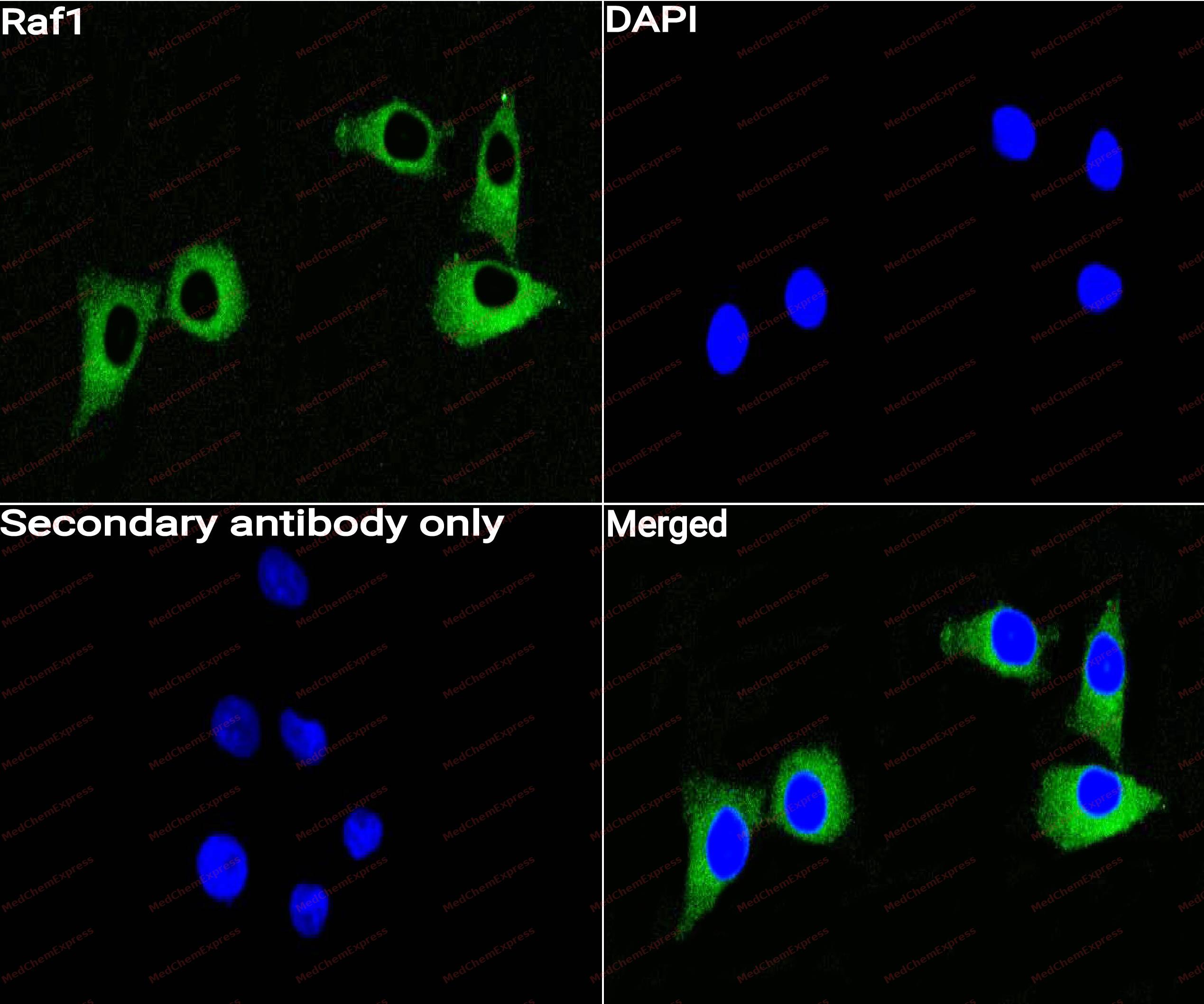 Immunocytochemistry analysis of A549 cells labeling Raf1 with Raf1 Antibody (HY-P80880) at 1/50 dilution. Cells were fixed in 4% paraformaldehyde for 15 minutes at room temperature, permeabilized with 0.1% Triton X-100 for 10 minutes at room temperature, then blocked with QuickBlock™ Blocking Buffer for Immunol Staining for 10 min at room temperature. Cells were then incubated with Raf1 Antibody (HY-P80880)at 1/50 dilution in QuickBlock™ Blocking Buffer for Immunol Staining at 4 ℃. Alexa Fluor® 488-conjugated AffiniPure Goat Anti-Rabbit IgG H&L(HY-P8002,Green) was used as the secondary antibody at 1/1,000 dilution. PBS instead of the primary antibody was used as the secondary antibody only control. The Nuclear counterstain was DAPI (Blue).


Background
-
Function
Raf-1 is a Serine/threonine-protein kinase that acts as a regulatory link between the membrane-associated Ras GTPases and the MAPK/ERK cascade, and this critical regulatory link functions as a switch determining cell fate decisions including proliferation, differentiation, apoptosis, survival and oncogenic transformation. RAF1 activation initiates a mitogen-activated protein kinase (MAPK) cascade that comprises a sequential phosphorylation of the dual-specific MAPK kinases (MAP2K1/MEK1 and MAP2K2/MEK2) and the extracellular signal-regulated kinases (MAPK3/ERK1 and MAPK1/ERK2). The phosphorylated form of RAF1 (on residues Ser-338 and Ser-339, by PAK1) phosphorylates BAD/Bcl2-antagonist of cell death at 'Ser-75'. Phosphorylates adenylyl cyclases: ADCY2, ADCY5 and ADCY6, resulting in their activation. Phosphorylates PPP1R12A resulting in inhibition of the phosphatase activity. Phosphorylates TNNT2/cardiac muscle troponin T. Can promote NF-kB activation and inhibit signal transducers involved in motility (ROCK2), apoptosis (MAP3K5/ASK1 and STK3/MST2), proliferation and angiogenesis (RB1). Can protect cells from apoptosis also by translocating to the mitochondria where it binds BCL2 and displaces BAD/Bcl2-antagonist of cell death. Regulates Rho signaling and migration, and is required for normal wound healing. Plays a role in the oncogenic transformation of epithelial cells via repression of the TJ protein, occludin (OCLN) by inducing the up-regulation of a transcriptional repressor SNAI2/SLUG, which induces down-regulation of OCLN. Restricts caspase activation in response to selected stimuli, notably Fas stimulation, pathogen-mediated macrophage apoptosis, and erythroid differentiation
-
Subcellular Localization
Cytoplasm; Cell membrane; Mitochondrion; Nucleus
-
Expression
Tissue_specificity:In skeletal muscle, isoform 1 is more abundant than isoform 2. -
Isoforms & Post-Translational Modification
P04049 has 2 isomers: P04049-1: 73052 Da (predicted); P04049-2: 75395 Da (predicted).
Phosphorylation at Thr-269, Ser-338, Tyr-341, Thr-491 and Ser-494 results in its activation. Phosphorylation at Ser-29, Ser-43, Ser-289, Ser-296, Ser-301 and Ser-642 by MAPK1/ERK2 results in its inactivation. Phosphorylation at Ser-259 induces the interaction with YWHAZ and inactivates kinase activity. Dephosphorylation of Ser-259 by the SHOC2-MRAS-PP1c (SMP) complex consisting of SHOC2, GTP-bound M-Ras/MRAS and the catalytic subunit of protein phosphatase 1 (PPP1CA, PPP1CB or PPP1CC); this relieves inactivation and stimulates kinase activity (PubMed:35768504, PubMed:35831509, PubMed:35830882). Phosphorylation at Ser-338 by PAK1 and PAK5 and Ser-339 by PAK1 is required for its mitochondrial localization. Phosphorylation at Ser-621 in response to growth factor treatment stabilizes the protein, possibly by preventing proteasomal degradation. Phosphorylation at Ser-289, Ser-296, Ser-301, Ser-338 and Ser-621 are somehow linked to the methylation potential of cells. Treatment of cells with HGF in the presence of the methylation inhibitor 5'-methylthioadenosine (MTA) results in increased phosphorylation at Ser-338 and Ser-621 and decreased phosphorylation at Ser-296, Ser-301 and Ser-338. Dephosphorylation at Ser-338 by PPP5C results in an activity decrease;Methylated at Arg-563 in response to EGF treatment. This modification leads to destabilization of the protein, possibly through proteasomal degradation -
Subunit
Monomer. Homodimer. Heterodimerizes with BRAF and this heterodimer possesses a highly increased kinase activity compared to the respective homodimers or monomers (PubMed:16508002). Heterodimerization is mitogen-regulated and enhanced by 14-3-3 proteins (PubMed:16508002). MAPK1/ERK2 activation can induce a negative feedback that promotes the dissociation of the heterodimer (PubMed:16508002). Forms a multiprotein complex with Ras (M-Ras/MRAS), SHOC2 and protein phosphatase 1 (PPP1CA, PPP1CB and PPP1CC) (PubMed:16630891). Interacts with LZTR1 (PubMed:30368668). Interacts with Ras proteins; the interaction is antagonized by RIN1 (PubMed:11784866). Weakly interacts with RIT1. Interacts (via N-terminus) with RGS14 (via RBD domains); the interaction mediates the formation of a ternary complex with BRAF, a ternary complex inhibited by GNAI1 (By similarity). Probably forms a complex composed of chaperones HSP90 and HSP70, co-chaperones CDC37, PPP5C, TSC1 and client protein TSC2, CDK4, AKT, RAF1 and NR3C1; this complex does not contain co-chaperones STIP1/HOP and PTGES3/p23 (PubMed:29127155). Interacts with STK3/MST2; the interaction inhibits its pro-apoptotic activity (PubMed:15618521). Interacts (when phosphorylated at Ser-259) with YWHAZ (unphosphorylated at 'Thr-232') (PubMed:31024343, PubMed:9360956). Interacts with MAP2K1/MEK1 and MAP2K2/MEK2 (By similarity). Interacts with MAP3K5/ASF1 (via N-terminus) and this interaction inhibits the proapoptotic function of MAP3K5/ASK1 (PubMed:11427728). Interacts with PAK1 (via kinase domain) (PubMed:11733498). The phosphorylated form interacts with PIN1 (By similarity). The Ser-338 and Ser-339 phosphorylated form (by PAK1) interacts with BCL2 (PubMed:15849194). Interacts with PEBP1/RKIP and this interaction is enhanced if RAF1 is phosphorylated on residues Ser-338, Ser-339, Tyr-340 and Tyr-341 (PubMed:18294816). Interacts with ADCY2, ADCY5, ADCY6, DGKH, RCAN1/DSCR1, PPP1R12A, PKB/AKT1, PPP2CA, PPP2R1B, SPRY2, SPRY4, CNKSR1/CNK1, KSR2 and PHB/prohibitin (PubMed:10576742, PubMed:10801873, PubMed:11719507, PubMed:12717443, PubMed:15385642, PubMed:15935327, PubMed:19710016). Interacts with ROCK2 (By similarity). In its active form, interacts with PRMT5 (PubMed:21917714). Interacts with FAM83B; displaces 14-3-3 proteins from RAF1 and activates RAF1 (PubMed:22886302). Interacts with PDE8A; the interaction promotes RAF1 activity (PubMed:23509299). Interacts with MFHAS1 (PubMed:23327923). Interacts with GLS (PubMed:22538822). Interacts with NEK10 and MAP2K1; the interaction is direct with NEK10 and required for ERK1/2-signaling pathway activation in response to UV irradiation (PubMed:20956560)
-
SwissProt ID
-
Synonyms
RAF1; RAF; RAF proto-oncogene serine/threonine-protein kinase; Proto-oncogene c-RAF; cRaf; Raf-1
-
Research Field
Signal Transduction
Documentation
-
Data Sheet (235 KB)
-
SDS (252 KB)
- English - EN (252 KB)
- Français - FR (252 KB)
- Deutsch - DE (252 KB)
- Norwegian - NO (252 KB)
- Español - ES (252 KB)
- Swedish - SV (252 KB)
- Italian - IT (252 KB)
- Korean - KR (252 KB)
- Portuguese - PT (252 KB)
-
User Guide for Antibodies (1077 KB)

 Powered by Bioz
