



Wnt3 Antibody (YA1081)
(Synonyms: Proto-oncogene Wnt-3; INT4; TETAMS)
Based on 1 Customer Validation
Wnt3 Antibody (YA1081) is a Mouse-derived and non-conjugated IgG1 monoclonal antibody, targeting to Wnt3.
-
Host:
Mouse
-
Isotype:
IgG
-
Application:
WB
-
Reactivity :
Human, Mouse, Rat
-
Formulation:
Supplied in PBS containing 50% glycerol, 0.5% BSA and 0.02% sodium azide, pH 7.3.
-
Conjugation:
Non-conjugated


To place orders, for customer services and technical support, please contact: MedChemExpress USA
Tel: 609-228-6898 E-mail: [email protected] [email protected]





Applications
| Application |
WB

WB: Western Blot
|
|---|---|
| Dilution Ratio | 1:500-1:1000 |


Product Details
Wnt3 Antibody (YA1081) is a Mouse-derived and non-conjugated IgG1 monoclonal antibody, targeting to Wnt3.
-
Host Mouse

-
Clonality Monoclonal

-
Species ReactivityHuman, Mouse, Rat
-
Observed Molecular WeightObserved band size: 40 kDa
Note: Due to possible protein modifications or aggregation, the molecular weight should be confirmed by actual measurement, and the predicted value is for reference only.

-
Calculated Molecular Weight Predicted band size: 40 kDa

Entrez Gene: 7473 Human ; 22415 Mouse ; 24882 Rat
SwissProt: P56703 Human ; P17553 Mouse ;
OMIM: 273395 Human
Purified recombinant human Wnt3 protein fragments expressed in E.coli.
Transfected
Affinity Purified
Non-conjugated
Unmodified
IgG


Product Properties
-
Appearance
Solution
-
Formulation
Supplied in PBS containing 50% glycerol, 0.5% BSA and 0.02% sodium azide, pH 7.3.
-
Concentration
Batch-dependent, Please check the COA for the concentration of each lot. Check Lot Concentration
-
Storage & Stability
Stored at -20°C for 1 year. Avoid repeated freeze / thaw cycles.
-
Shipping
Shipping with blue ice.


Verification Images
-
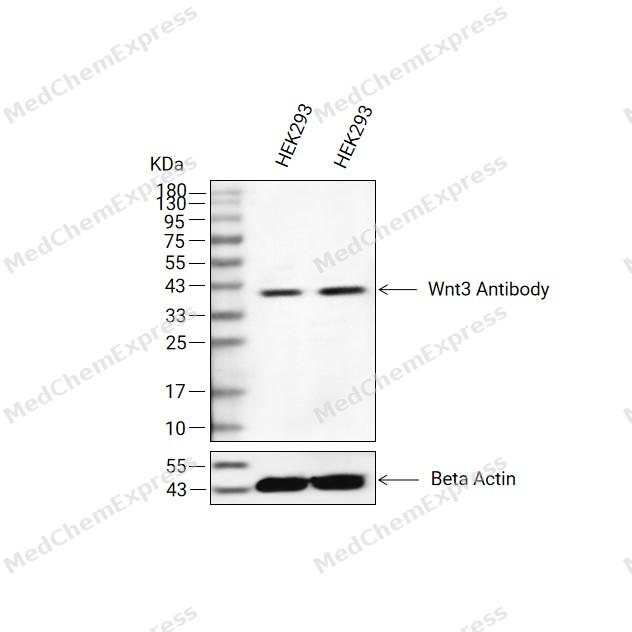 Western blot analysis of extracts from HEK293(lane 2(20ug) and HEK293(lane 3(40ug) using Wnt3 Antibody (HY-P81336) Rabbit mAb. Proteins were transferred to a PVDF membrane and blocked with 5% non-fat milk in TBST for 2 hour at room temperature. The primary antibody (1/1000) and Loading control antibody (Beta Actin, HY-P83730, 1/10000) was used in 5% non-fat milk in TBST at 4°C overnight. Goat Anti-Mouse IgG-HRP Secondary Antibody (1/10000) was used for 1 hour at room temperature.


Background
-
Function
Wnt3 is a secreted Wnt ligand linked to canonical Wnt/β-catenin signaling, a pathway that controls embryonic development and adult homeostasis[1]. Mechanistically, Wnt3 activity supports TCF/LEF-dependent transcription and connects ligand-receptor signaling to cell fate regulation[1]. In mouse embryos, Wnt3 expression precedes gastrulation and becomes restricted to the posterior epiblast, visceral endoderm, primitive streak, and mesoderm[2]. Wnt3- embryos fail to form a primitive streak, mesoderm, or node, establishing Wnt3 as a core regulator of vertebrate axis formation[2]. In limb development, ectodermal Wnt3/β-catenin signaling establishes and maintains the apical ectodermal ridge, linking Wnt3 to limb morphogenesis[3]. Human evidence further connects homozygous WNT3 mutation with tetra-amelia, supporting its early requirement in limb, craniofacial, and urogenital development[4]. Compared with Wnt3a, Wnt3 shows distinct activity in spinal cord neural precursors: Wnt3 transiently increases proliferation and enhances neurogenesis, whereas Wnt3a sustains proliferation[5]. For experimental applications, Wnt3/Wnt3a pathway studies can use canonical Wnt agonists, antagonists, or GSK-3β inhibitors to interrogate β-catenin-dependent proliferation, neurogenesis, and neurite outgrowth[1][5].
-
Subcellular Localization
Secreted, extracellular space, extracellular matrix; Secreted
-
Subunit
Forms a soluble 1:1 complex with AFM; this prevents oligomerization and is required for prolonged biological activity (PubMed:26902720). The complex with AFM may represent the physiological form in body fluids (PubMed:26902720). Interacts with PORCN. Interacts with WLS (By similarity)
-
SwissProt ID
-
Synonyms
Proto-oncogene Wnt-3; INT4; TETAMS
-
Research Field
Neuroscience


Documentation
-
Data Sheet (261 KB)
-
SDS (251 KB)
- English - EN (251 KB)
- Français - FR (251 KB)
- Deutsch - DE (251 KB)
- Norwegian - NO (251 KB)
- Español - ES (251 KB)
- Swedish - SV (251 KB)
- Italian - IT (251 KB)
- Korean - KR (251 KB)
- Portuguese - PT (251 KB)
-
User Guide for Antibodies (1077 KB)
References
[1]. MacDonald BT, et al. Wnt/beta-catenin signaling: components, mechanisms, and diseases. Dev Cell. 2009 Jul;17(1):9-26. [Content Brief]
[2]. Liu P, et al. Requirement for Wnt3 in vertebrate axis formation. Nat Genet. 1999 Aug;22(4):361-5. [Content Brief]
[3]. Barrow JR, et al. Ectodermal Wnt3/beta-catenin signaling is required for the establishment and maintenance of the apical ectodermal ridge. Genes Dev. 2003 Feb 1;17(3):394-409. [Content Brief]
[4]. Niemann S, et al. Homozygous WNT3 mutation causes tetra-amelia in a large consanguineous family. Am J Hum Genet. 2004 Mar;74(3):558-63. [Content Brief]
[5]. David MD, et al. Wnt-3a and Wnt-3 differently stimulate proliferation and neurogenesis of spinal neural precursors and promote neurite outgrowth by canonical signaling. J Neurosci Res. 2010 Nov 1;88(14):3011-23. [Content Brief]

 Powered by Bioz
