



ABL1 Protein, Human (Active, sf9, GST)

Based on 1 Customer Validation
ABL1 is a non-receptor tyrosine protein kinase that coordinates key cellular processes for growth and survival. It affects cytoskeletal remodeling, cell motility, and receptor endocytosis. ABL1 Protein, Human (sf9, GST) is the recombinant human-derived ABL1 protein, expressed by Sf9 insect cells , with N-GST labeled tag.
- Species: Human
- Source: Sf9 insect cells
-
Storage:Stored at -80°C for 1 year from date of receipt. It is stable at -20°C for 3 months after opening. It is recommended to freeze aliquots at -80°C for extended storage. Avoid repeated freeze-thaw cycles.


To place orders, for customer services and technical support, please contact: MedChemExpress USA
Tel: 609-228-6898 E-mail: [email protected] [email protected]


-
 Biological Activity
-
Technical Parameters
-
Product Properties
- Documentation
- Help & FAQs




Biological Activity
Description
ABL1 is a non-receptor tyrosine protein kinase that coordinates key cellular processes for growth and survival. It affects cytoskeletal remodeling, cell motility, and receptor endocytosis. ABL1 Protein, Human (sf9, GST) is the recombinant human-derived ABL1 protein, expressed by Sf9 insect cells , with N-GST labeled tag.
Background
ABL1, a non-receptor tyrosine-protein kinase, orchestrates diverse cellular processes crucial for growth and survival. Its multifaceted roles include coordinating cytoskeleton remodeling in response to extracellular cues, regulating cell motility, and influencing receptor endocytosis. ABL1's impact extends to autophagy, DNA damage response, and apoptosis, where it phosphorylates key substrates involved in these pathways. Notably, it modulates actin dynamics by phosphorylating proteins like WASF3 and ANXA1, influencing processes such as lamellipodia formation and cell migration. A critical player in cell adhesion and motility, ABL1 phosphorylates regulators like BCAR1 and CRK. Furthermore, it engages in the regulation of receptor tyrosine kinases, including the facilitation of EGFR endocytosis. ABL1's reach extends to mitochondrial function during oxidative stress, where it mediates dysfunction and cell death. Additionally, it translocates to the nucleus, contributing to DNA damage response, apoptosis, and the regulation of T-cell differentiation. ABL1's extensive substrate repertoire encompasses proteins involved in DNA repair and apoptosis, showcasing its central role in cellular homeostasis and response to external stimuli.
Verified Bioactivity
The specific activity was determined to be >15 nmol/min/mg using synthetic Abl peptide (EAIYAAPFAKKK) as substrate.
MCE Validation Data
-
Purity - SDS-PAGE
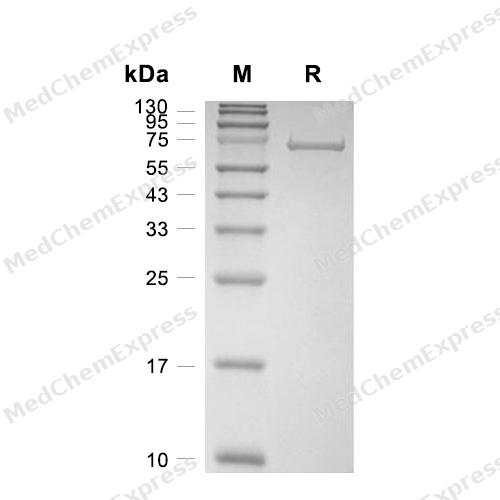
Purity - SDS-PAGE


Technical Parameters
-
Species Human
-
Source Sf9 insect cells
-
Tag N-GST
-
Accession
P00519-2 (P137-S554)
-
Molecular Construction
-
N-term
-
GST
-
ABL1 (P137-S554)
Accession # P00519-2 -
C-term
-
-
Protein Length
Partial
-
Synonyms
ABL1; BCR/ABL1 E1a2 Fusion Protein; Prev. ABL; Bcr/C-Abl Oncogene Protein; JTK7; Chimeric BCR::ABL1 Protein; P150; BCR::ABL1 Fusion Protein; C-ABL; BCR/ABL E8a2 Fusion; V-Abl Abelson Murine Leukemia Viral Oncogene Homolog 1; BCR/ABL1 Fusion; C-Abl Oncogen
-
AA Sequence
PVNSLEKHSWYHGPVSRNAAEYLLSSGINGSFLVRESESSPGQRSISLRYEGRVYHYRINTASDGKLYVSSESRFNTLAELVHHHSTVADGLITTLHYPAPKRNKPTVYGVSPNYDKWEMERTDITMKHKLGGGQYGEVYEGVWKKYSLTVAVKTLKEDTMEVEEFLKEAAVMKEIKHPNLVQLLGVCTREPPFYIITEFMTYGNLLDYLRECNRQEVNAVVLLYMATQISSAMEYLEKKNFIHRDLAARNCLVGENHLVKVADFGLSRLMTGDTYTAHAGAKFPIKWTAPESLAYNKFSIKSDVWAFGVLLWEIATYGMSPYPGIDLSQVYELLEKDYRMERPEGCPEKVYELMRACWQWNPSDRPSFAEIHQAFETMFQESSISDEVEKELGKQGVRGAVSTLLQAPELPTKTRTS
-
Predicted Molecular Mass
74 kDa
-
Molecular Weight
Approximately 65 kDa, based on SDS-PAGE under reducing conditions.
-
Purity
≥ 90%, as determined by reducing SDS-PAGE.


Product Properties
Solution
1.Supplied as a 0.22 μm filtered solution of 50 mM Tris, 100 mM NaCl, 0.5 mM PMSF, 0.5 mM EDTA, 0.5 mM Reduced Glutathione, pH 8.0.
2.Supplied as a 0.22 μm filtered solution of 20 mM Tris, 300 mM NaCl, 25% glycerol, 0.1 mM PMSF, 0.1 mM EDTA, 0.5 mM GSH, pH 7.5.
Note: For SPR assay, please replace the buffer. Primary amine components (e.g., Tris, imidazole) can affect protein-coupled chips.
Please refer to the lot-specific COA for specific buffer information.
<1 EU/μg, determined by LAL method.
Please use rapid thawing with running water to thaw the protein.
Stored at -80°C for 1 year from date of receipt. It is stable at -20°C for 3 months after opening. It is recommended to freeze aliquots at -80°C for extended storage. Avoid repeated freeze-thaw cycles.
Shipping with dry ice.


Documentation
-
Data Sheet (238 KB)
-
SDS (252 KB)
- English - EN (252 KB)
- Français - FR (252 KB)
- Deutsch - DE (252 KB)
- Norwegian - NO (252 KB)
- Español - ES (252 KB)
- Swedish - SV (252 KB)
- Italian - IT (252 KB)
- Korean - KR (252 KB)
- Portuguese - PT (252 KB)
-
Handling Instructions (2659 KB)

Calculators
Concentration (start) × Volume (start) = Concentration (final) × Volume (final)


 Powered by Bioz

