



AnxA1
Annexin A1 (AnxA1) is a glucocorticoid-regulated member of the annexin family that functions as a calcium-dependent phospholipid-binding protein and an endogenous mediator of inflammation resolution[1][2]. Mechanistically, AnxA1 limits leukocyte recruitment, promotes neutrophil apoptosis, enhances macrophage-mediated clearance of apoptotic cells, and supports macrophage reprogramming toward a pro-resolving phenotype, thereby restoring tissue homeostasis after inflammatory responses[1]. Through signaling mediated by formyl peptide receptors (FPRs), particularly FPR2/ALX, AnxA1 and its N-terminal peptide derivatives regulate inflammatory cell behavior and coordinate resolution-associated pathways[1][3]. In disease models, AnxA1 contributes to mucosal repair by activating epithelial FPR-dependent signaling and NOX1-mediated redox pathways that promote epithelial migration and wound closure[3]. Dysregulated AnxA1 expression has also been associated with cancer progression, inflammatory disorders, and viral infections, highlighting its context-dependent roles in disease pathophysiology[2][4][5]. Compared with other annexin family members, AnxA1 is distinguished by its well-characterized pro-resolving and immunoregulatory functions, whereas related isoforms often display broader roles in membrane dynamics, stress responses, or regulated cell death pathways[2][6]. For experimental applications, the AnxA1-derived peptide Ac2-26 reproduces key biological activities of the full-length protein through FPR signaling and is widely used as a pharmacological tool to investigate resolution biology, tissue repair, and anti-inflammatory mechanisms[3][5].
References:
- [1]. Sugimoto MA, et al. Annexin A1 and the Resolution of Inflammation: Modulation of Neutrophil Recruitment, Apoptosis, and Clearance. J Immunol Res. 2016;2016:8239258. [Content Brief]
- [2]. Gerke V, et al. Annexins-a family of proteins with distinctive tastes for cell signaling and membrane dynamics. Nat Commun. 2024 Feb 21;15(1):1574. [Content Brief]
- [3]. Gómez Hernández MT, et al. The «Weekday Effect» Does Not Have an Impact on the Development of Complications or Mortality After Pulmonary Resection: Retrospective Cohort Study. Cir Esp (Engl Ed). 2021 Apr;99(4):296-301. English, Spanish. [Content Brief]
- [4]. Gastardelo TS, et al. Inflammation and cancer: role of annexin A1 and FPR2/ALX in proliferation and metastasis in human laryngeal squamous cell carcinoma. PLoS One. 2014 Dec 9;9(12):e111317. [Content Brief]
- [5]. Resende F, et al. The Multifaceted Role of Annexin A1 in Viral Infections. Cells. 2023 Apr 11;12(8):1131. [Content Brief]
- [6]. Shao G, et al. Advancements of Annexin A1 in inflammation and tumorigenesis. Onco Targets Ther. 2019 Apr 30;12:3245-3254. [Content Brief]
All Product Categories
-
AnxA1 Related Products (5)
Related Products (5)

-
PF-04217903
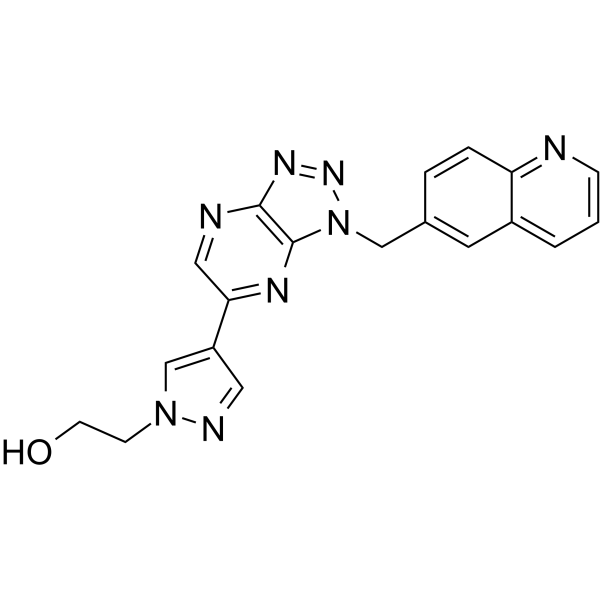 0 ImagesPF-04217903 is an orally active, highly selective ATP-competitive c-Met kinase inhibitor with a Ki value of 4.8 nM and a Kd value of 4.5 nM. PF-04217903 blocks c-Met and HGF signaling pathways, inhibits MET phosphorylation, and blocks downstream MAPK, PI3K/AKT and PLCγ1 pathways. PF-04217903 suppresses tumor proliferation, survival, migration, invasion, angiogenesis and metastasis, induces apoptosis, and enhances efferocytosis, Annexin A1 expression and resolution of inflammation. PF-04217903 retains activity against several c-Met mutants (M1131T, V1220I, H1094R). PF-04217903 increases the incidence of subarachnoid hemorrhage and reduces survival rate without altering aneurysm formation, and also prevents lymph node metastasis induced by VEGF inhibition. PF-04217903 is applicable to research related to tumors (pancreas, stomach, lung, brain, colon, breast, kidney, melanoma, etc.), intracranial aneurysms and inflammatory diseases (gouty arthritis, neutrophilic pleuritis).
-
A11
 0 ImagesSynonyms: ANXA1-derived 11 amino acid-long peptideA11 (ANXA1-derived 11 amino acid-long peptide) is a ANXA1-EphA2 interaction-blocking peptide. A11 reduces ANXA1 bound to EphA2 and increases Cbl (the E3 ubiquitin ligase of EphA2) bound to EphA2. A11 inhibits the proliferation, migration and invasion of nasopharyngeal carcinoma cells. A11 inhibits angiogenesis. A11 can be used in studies related to nasopharyngeal carcinoma.
-
PF-04217903 mesylate
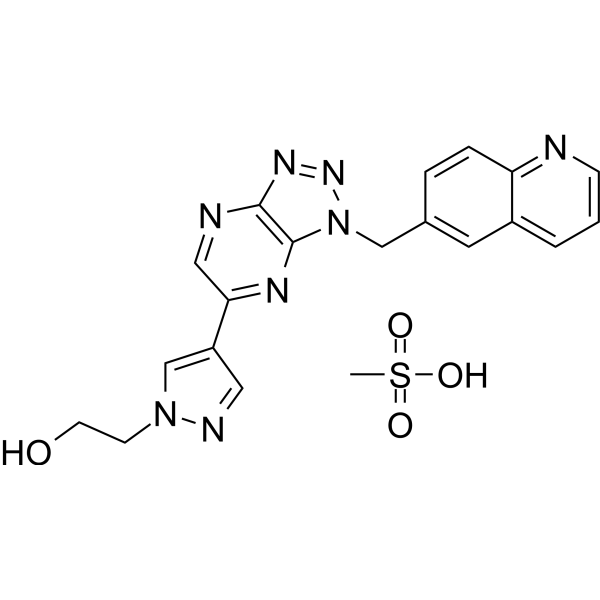 0 ImagesPF-04217903 mesylate is an orally active, highly selective ATP-competitive c-Met kinase inhibitor with a Ki value of 4.8 nM and a Kd value of 4.5 nM. PF-04217903 mesylate blocks c-Met and HGF signaling pathways, inhibits MET phosphorylation, and blocks downstream MAPK, PI3K/AKT and PLCγ1 pathways. PF-04217903 mesylate suppresses tumor proliferation, survival, migration, invasion, angiogenesis and metastasis, induces apoptosis, and enhances efferocytosis, Annexin A1 expression and resolution of inflammation. PF-04217903 mesylate retains activity against several c-Met mutants (M1131T, V1220I, H1094R). PF-04217903 mesylate increases the incidence of subarachnoid hemorrhage and reduces survival rate without altering aneurysm formation, and also prevents lymph node metastasis induced by VEGF inhibition. PF-04217903 mesylate is applicable to research related to tumors (pancreas, stomach, lung, brain, colon, breast, kidney, melanoma, etc.), intracranial aneurysms and inflammatory diseases (gouty arthritis, neutrophilic pleuritis).
-
PF-04217903 phenolsulfonate
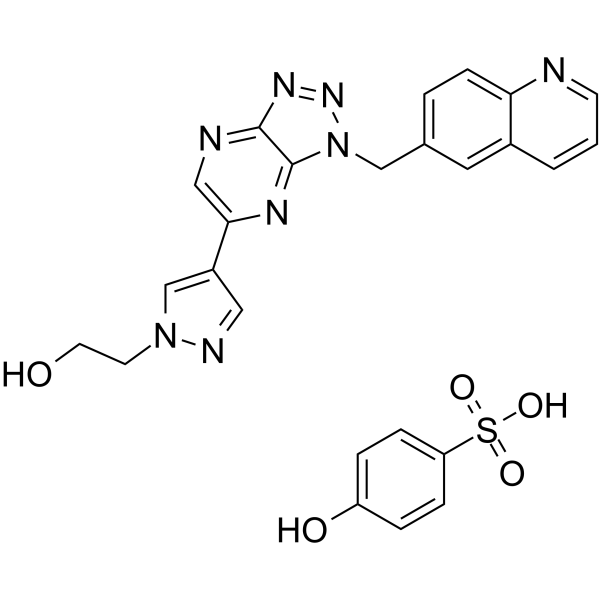 0 ImagesCat. No.: HY-12017BCAS No.: 1159490-85-3PF-04217903 phenolsulfonate is an orally active, highly selective ATP-competitive c-Met kinase inhibitor with a Ki value of 4.8 nM and a Kd value of 4.5 nM. PF-04217903 phenolsulfonate blocks c-Met and HGF signaling pathways, inhibits MET phosphorylation, and blocks downstream MAPK, PI3K/AKT and PLCγ1 pathways. PF-04217903 phenolsulfonate suppresses tumor proliferation, survival, migration, invasion, angiogenesis and metastasis, induces apoptosis, and enhances efferocytosis, Annexin A1 expression and resolution of inflammation. PF-04217903 phenolsulfonate retains activity against several c-Met mutants (M1131T, V1220I, H1094R). PF-04217903 phenolsulfonate increases the incidence of subarachnoid hemorrhage and reduces survival rate without altering aneurysm formation, and also prevents lymph node metastasis induced by VEGF inhibition. PF-04217903 phenolsulfonate is applicable to research related to tumors (pancreas, stomach, lung, brain, colon, breast, kidney, melanoma, etc.), intracranial aneurysms and inflammatory diseases (gouty arthritis, neutrophilic pleuritis).
-
PF-04217903 phosphate
 0 ImagesCat. No.: HY-12017CCAS No.: 1159490-83-1PF-04217903 phosphate is an orally active, highly selective ATP-competitive c-Met kinase inhibitor with a Ki value of 4.8 nM and a Kd value of 4.5 nM. PF-04217903 phosphate blocks c-Met and HGF signaling pathways, inhibits MET phosphorylation, and blocks downstream MAPK, PI3K/AKT and PLCγ1 pathways. PF-04217903 phosphate suppresses tumor proliferation, survival, migration, invasion, angiogenesis and metastasis, induces apoptosis, and enhances efferocytosis, Annexin A1 expression and resolution of inflammation. PF-04217903 phosphate retains activity against several c-Met mutants (M1131T, V1220I, H1094R). PF-04217903 phosphate increases the incidence of subarachnoid hemorrhage and reduces survival rate without altering aneurysm formation, and also prevents lymph node metastasis induced by VEGF inhibition. PF-04217903 phosphate is applicable to research related to tumors (pancreas, stomach, lung, brain, colon, breast, kidney, melanoma, etc.), intracranial aneurysms and inflammatory diseases (gouty arthritis, neutrophilic pleuritis).



