



Phospho-BRAF (Thr401) Antibody (YA222)
(Synonyms: BRAF; BRAF1; RAFB1; Serine/threonine-protein kinase B-raf; Proto-oncogene B-Raf; p94; v-Raf murine sarcoma viral oncogene homolog B1)Based on 1 Customer Validation
Phospho-BRAF (Thr401) Antibody (YA222) is a Rabbit-derived and non-conjugated IgG monoclonal antibody, targeting to Phospho-BRAF (Thr401).
-
Host:
Rabbit
-
Isotype:
IgG
-
Application:
WB, IP
-
Reactivity :
Human, Mouse, Rat
-
Formulation:
Supplied in 50 mM Tris-Glycine (pH 7.4), 0.15 M NaCl, 40% Glycerol and 0.05% BSA. Preservative: 0.01% Sodium azide
-
Conjugation:
Non-conjugated


To place orders, for customer services and technical support, please contact: MedChemExpress USA
Tel: 609-228-6898 E-mail: [email protected] [email protected]





Applications
| Application |
WB

WB: Western Blot
|
IP
IP: Immunoprecipitation
|
|---|---|---|
| Dilution Ratio | 1:500-1:1000 | 1:20 |


Product Details
Phospho-BRAF (Thr401) Antibody (YA222) is a Rabbit-derived and non-conjugated IgG monoclonal antibody, targeting to Phospho-BRAF (Thr401).
-
Host Rabbit

-
Clonality Recombinant,Monoclonal

-
Species ReactivityHuman, Mouse, Rat
-
Observed Molecular WeightObserved band size: 84 kDa
Note: Due to possible protein modifications or aggregation, the molecular weight should be confirmed by actual measurement, and the predicted value is for reference only.

-
Calculated Molecular Weight Predicted band size: 84 kDa

Entrez Gene: 673 Human ; 109880 Mouse ; 114486 Rat
SwissProt: P15056 Human ; P28028 Mouse ;
OMIM: 114500 Human
Synthetic phosphopeptide corresponding to residues surrounding Thr401 of Human B Raf.The exact sequence is proprietary to MCE.
Endogenous
affinity purified
Non-conjugated
Phosphorylated
IgG


Product Properties
-
Appearance
Solution
-
Formulation
Supplied in 50 mM Tris-Glycine (pH 7.4), 0.15 M NaCl, 40% Glycerol and 0.05% BSA. Preservative: 0.01% Sodium azide
-
Concentration
Batch-dependent, Please check the COA for the concentration of each lot. Check Lot Concentration
-
Storage & Stability
Stored at -20°C for 1 year. Avoid repeated freeze / thaw cycles.
-
Shipping
Shipping with blue ice.


Verification Images
-
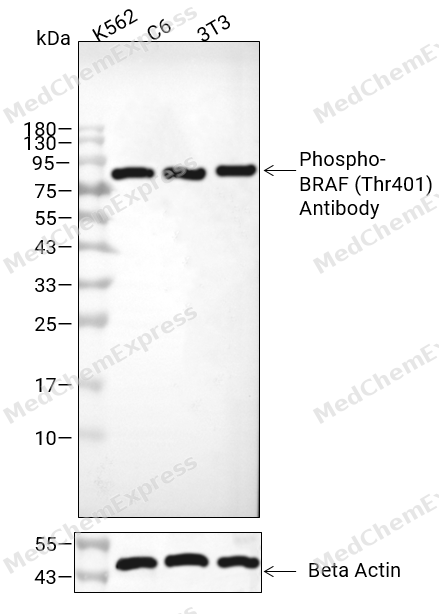 Western blot analysis of extracts from K562 (lane 2(40μg), C6 (lane 3(40μg), 3T3 (lane 4(40μg) using Phospho-BRAF (Thr401) Antibody. Proteins were transferred to a PVDF membrane and blocked with 5% BSA in TBST for 2 hour at room temperature. The primary antibody and Loading control antibody (Beta Actin, HY-P80438, 1/3000) was used in 5% BSA in TBST at 4°C overnight. Goat Anti-Mouse/Rabbit IgG-HRP Secondary Antibody (HY-P8004/HY-P8001, 1/10,000) was used for 1 hour at room temperature.


Background
-
Function
B-Raf is a serine/threonine protein kinase encoded by BRAF and functions as a central signal transducer in the RAS-RAF-MEK-ERK signaling cascade that regulates cell proliferation, differentiation, and survival[1][2]. Mechanistically, activated B-Raf phosphorylates MEK, leading to ERK activation and propagation of mitogenic signaling, making B-Raf a critical regulator of MAPK pathway output[2]. Dysregulation of this pathway is strongly linked to oncogenesis, and somatic BRAF mutations are among the most common kinase alterations identified in human cancer, particularly melanoma, colorectal cancer, thyroid cancer, and non-small-cell lung cancer[1][3]. In disease models, the canonical BRAF V600E mutation constitutively activates kinase signaling and promotes tumor cell growth independent of normal upstream regulatory inputs[2][3]. Compared with the related RAF isoforms A-Raf and C-Raf (RAF1), B-Raf displays stronger basal kinase activity and is the most potent activator of MEK-ERK signaling, making it a dominant MAPK pathway driver in many BRAF-mutant tumors[2]. For experimental applications, selective B-Raf inhibitors have been widely used to suppress oncogenic MAPK signaling and to investigate pathway dependence in cancer models[4]. The development of mutation-selective inhibitors, including compounds targeting BRAF V600E, established B-Raf as a validated therapeutic and mechanistic target and continues to support research on signaling regulation, drug resistance, and combination treatment strategies[4][5].
-
Subcellular Localization
Nucleus; Cytoplasm; Cell membrane
-
Expression
Tissue_specificity:brain and testicles -
Subunit
Monomer (PubMed:19710016). Homodimer (PubMed:19710016, PubMed:36402789). Heterodimerizes with RAF1, and the heterodimer possesses a highly increased kinase activity compared to the respective homodimers or monomers (PubMed:19710016).
-
SwissProt ID
-
Synonyms
BRAF; BRAF1; RAFB1; Serine/threonine-protein kinase B-raf; Proto-oncogene B-Raf; p94; v-Raf murine sarcoma viral oncogene homolog B1
-
Research Field
Cell Biology


Documentation
-
Data Sheet (261 KB)
-
SDS (252 KB)
- English - EN (252 KB)
- Français - FR (252 KB)
- Deutsch - DE (252 KB)
- Norwegian - NO (252 KB)
- Español - ES (252 KB)
- Swedish - SV (252 KB)
- Italian - IT (252 KB)
- Korean - KR (252 KB)
- Portuguese - PT (252 KB)
-
User Guide for Antibodies (1077 KB)
References
[1]. Davies H, et al. Mutations of the BRAF gene in human cancer. Nature. 2002 Jun 27;417(6892):949-54. [Content Brief]
[2]. Wan PT, et al. Mechanism of activation of the RAF-ERK signaling pathway by oncogenic mutations of B-RAF. Cell. 2004 Mar 19;116(6):855-67. [Content Brief]
[3]. B-Raf gene information from NCBI.
[4]. Tsai J, et al. Discovery of a selective inhibitor of oncogenic B-Raf kinase with potent antimelanoma activity. Proc Natl Acad Sci U S A. 2008 Feb 26;105(8):3041-6. [Content Brief]
[5]. Bollag G, et al. Vemurafenib: the first drug approved for BRAF-mutant cancer. Nat Rev Drug Discov. 2012 Nov;11(11):873-86. [Content Brief]

 Powered by Bioz
