



Src Protein, Human (Active, His)
Based on 1 publication(s) in Google Scholar
Src is a non-receptor protein tyrosine kinase that centralizes multiple cellular processes triggered by various receptors. It controls gene transcription, immune response, adhesion, cell cycle, apoptosis, migration and transformation. SRC Protein, Human (His) is the recombinant human-derived SRC protein, expressed by E. coli , with N-10*His labeled tag.
- Species: Human
- Source: E. coli
-
Storage:Stored at -80°C for 1 year from date of receipt. It is stable at -20°C for 3 months after opening. It is recommended to freeze aliquots at -80°C for extended storage. Avoid repeated freeze-thaw cycles.


To place orders, for customer services and technical support, please contact: MedChemExpress USA
Tel: 609-228-6898 E-mail: [email protected] [email protected]


-
 Biological Activity
-
Technical Parameters
-
Product Properties
- Documentation
- Help & FAQs





Biological Activity
Description
Src is a non-receptor protein tyrosine kinase that centralizes multiple cellular processes triggered by various receptors. It controls gene transcription, immune response, adhesion, cell cycle, apoptosis, migration and transformation. SRC Protein, Human (His) is the recombinant human-derived SRC protein, expressed by E. coli , with N-10*His labeled tag.
Background
Src, a non-receptor protein tyrosine kinase, emerges as a central player in an array of cellular processes triggered by the engagement of diverse receptors, including immune response receptors, integrins, receptor protein tyrosine kinases, G protein-coupled receptors, and cytokine receptors. It orchestrates signaling pathways governing gene transcription, immune responses, cell adhesion, cell cycle progression, apoptosis, migration, and cellular transformation. While functional redundancy within the SRC kinase family complicates the identification of specific roles, SRC appears to be a primary kinase activated upon receptor engagement, influencing the activation of other protein tyrosine kinase (PTK) families. SRC is implicated in the regulation of cytoskeletal organization by phosphorylating substrates like AFAP1 and cortactin (CTTN). Its involvement extends to cell-cell and cell-matrix junctions, where it phosphorylates components such as beta-catenin (CTNNB1), delta-catenin (CTNND1), plakoglobin (JUP), and connexin-43 (GJA1). Additionally, SRC participates in PDGF-mediated tyrosine phosphorylation of STAT1 and STAT3, the RAS pathway, EGF-mediated calcium-activated chloride channel activation, and beta-arrestin desensitization. It also plays a crucial role in EGFR internalization, CDK20/MAPK3 mitogen-activated protein kinase cascade stimulation, and osteoclastic bone resorption. SRC's multifaceted activities highlight its intricate role in cellular regulation and signal transduction.
Verified Bioactivity
The specific activity was determined to be ≥80 nmol/min/mg that incubate at room temperature for 40min and using 0.2 mg/mL SRC synthetic peptide substrate.
MCE Validation Data
-
Purity - SDS-PAGE
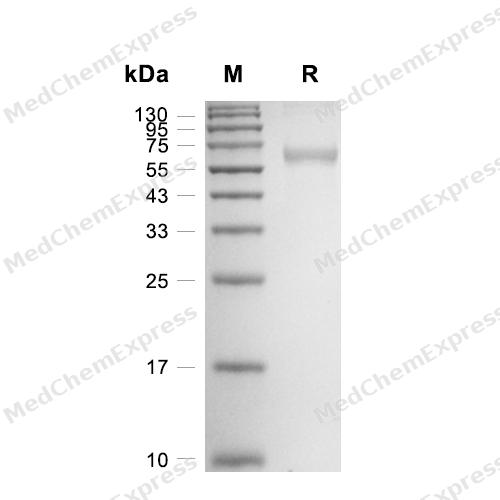
Purity - SDS-PAGE


Publications (1)
-
Journal Impact Factor
-
Most Recent
-
Carbohydr Res
A structurally defined galactoglucan from Arisaema erubescens with a multi-target tumor-associated protein binding domain. [Abstract]2025 Nov 29:560:109781. PMID: 41344200


Technical Parameters
-
Species Human
-
Source E. coli
-
Tag N-10*His
-
Accession
P12931-1 (G2-L536)
-
Gene ID6714
-
Molecular Construction
-
N-term
-
10*His
-
SRC (G2-L536)
Accession # P12931-1 -
C-term
-
-
Protein Length
Full Length of Isoform-1
-
Synonyms
SRC; Tyrosine Kinase Pp60c-Src; Prev. SRC1; P60-Src; C-Src; Protooncogene SRC, Rous Sarcoma; ASV; Tyrosine-Protein Kinase SRC-1; V-Src Avian Sarcoma (Schmidt-Ruppin A-2) Viral Oncogene Homolog; Pp60c-Src; Proto-Oncogene Tyrosine-Protein Kinase Src; THC6; SRC Proto-Oncogene, Non-Receptor Tyrosine Kinase; Proto-Oncogene C-Src
-
AA Sequence
GSNKSKPKDASQRRRSLEPAENVHGAGGGAFPASQTPSKPASADGHRGPSAAFAPAAAEPKLFGGFNSSDTVTSPQRAGPLAGGVTTFVALYDYESRTETDLSFKKGERLQIVNNTEGDWWLAHSLSTGQTGYIPSNYVAPSDSIQAEEWYFGKITRRESERLLLNAENPRGTFLVRESETTKGAYCLSVSDFDNAKGLNVKHYKIRKLDSGGFYITSRTQFNSLQQLVAYYSKHADGLCHRLTTVCPTSKPQTQGLAKDAWEIPRESLRLEVKLGQGCFGEVWMGTWNGTTRVAIKTLKPGTMSPEAFLQEAQVMKKLRHEKLVQLYAVVSEEPIYIVTEYMSKGSLLDFLKGETGKYLRLPQLVDMAAQIASGMAYVERMNYVHRDLRAANILVGENLVCKVADFGLARLIEDNEYTARQGAKFPIKWTAPEAALYGRFTIKSDVWSFGILLTELTTKGRVPYPGMVNREVLDQVERGYRMPCPPECPESLHDLMCQCWRKEPEERPTFEYLQAFLEDYFTSTEPQYQPGENL
-
Predicted Molecular Mass
64.2 kDa
-
Molecular Weight
Approximately 64 kDa, based on SDS-PAGE under reducing conditions.
-
Purity
≥ 90%, as determined by reducing SDS-PAGE.


Product Properties
Solution
Supplied as a 0.22 μm filtered solution of 50 mM Tris-HCl, 200 mM NaCl, pH 8.0, 0.5 mM EDTA, 1 mM DTT, 50% glycerol.
Note: For SPR assay, please replace the buffer. Primary amine components (e.g., Tris, imidazole) can affect protein-coupled chips.
<1 EU/μg, determined by LAL method.
Please use rapid thawing with running water to thaw the protein.
Stored at -80°C for 1 year from date of receipt. It is stable at -20°C for 3 months after opening. It is recommended to freeze aliquots at -80°C for extended storage. Avoid repeated freeze-thaw cycles.
Shipping with dry ice.


Documentation
-
Data Sheet (239 KB)
-
SDS (252 KB)
- English - EN (252 KB)
- Français - FR (252 KB)
- Deutsch - DE (252 KB)
- Norwegian - NO (252 KB)
- Español - ES (252 KB)
- Swedish - SV (252 KB)
- Italian - IT (252 KB)
- Korean - KR (252 KB)
- Portuguese - PT (252 KB)
-
Handling Instructions (2659 KB)

Calculators
Concentration (start) × Volume (start) = Concentration (final) × Volume (final)


 Powered by Bioz

