



Phospho-c-Jun (Ser63) Antibody (YA215)
(Synonyms: Transcription factor AP-1; Activator protein 1; AP1; Proto-oncogene c-Jun; V-jun avian sarcoma virus 17 oncogene homolog; p39)
Based on 1 Customer Validation
Phospho-c-Jun (Ser63) Antibody (YA215) is a Rabbit-derived and non-conjugated IgG monoclonal antibody, targeting to Phospho-c-Jun (Ser63).
-
Host:
Rabbit
-
Isotype:
IgG
-
Application:
WB, IHC-P
-
Reactivity :
Human, Mouse, Rat
-
Formulation:
Supplied in 50 mM Tris-Glycine (pH 7.4), 0.15 M NaCl, 40% Glycerol and 0.05% BSA. Preservative: 0.01% Sodium azide
-
Conjugation:
Non-conjugated


To place orders, for customer services and technical support, please contact: MedChemExpress USA
Tel: 609-228-6898 E-mail: [email protected] [email protected]





Applications
| Application |
WB

WB: Western Blot
|
IHC-P
IHC-P: Immunohistochemistry-Paraffin
|
|---|---|---|
| Dilution Ratio | 1:500-1:1000 | 1:50-1:100 |


Product Details
Phospho-c-Jun (Ser63) Antibody (YA215) is a Rabbit-derived and non-conjugated IgG monoclonal antibody, targeting to Phospho-c-Jun (Ser63).
-
Host Rabbit

-
Clonality Recombinant,Monoclonal

-
Species ReactivityHuman, Mouse, Rat
-
Observed Molecular WeightObserved band size: 43 kDa
Note: Due to possible protein modifications or aggregation, the molecular weight should be confirmed by actual measurement, and the predicted value is for reference only.

-
Calculated Molecular Weight Predicted band size: 36 kDa

Entrez Gene: 3725 Human ; 16476 Mouse ; 24516 Rat
SwissProt: P05412 Human ; P05627 Mouse ; P17325 Rat
OMIM: 165160 Human
Synthetic phosphopeptide corresponding to residues surrounding Ser63 of Human c-Jun.The exact sequence is proprietary to MCE.
Endogenous
affinity purified
Non-conjugated
Phosphorylated
IgG


Product Properties
-
Appearance
Solution
-
Formulation
Supplied in 50 mM Tris-Glycine (pH 7.4), 0.15 M NaCl, 40% Glycerol and 0.05% BSA. Preservative: 0.01% Sodium azide
-
Concentration
Batch-dependent, Please check the COA for the concentration of each lot. Check Lot Concentration
-
Storage & Stability
Stored at -20°C for 1 year. Avoid repeated freeze / thaw cycles.
-
Shipping
Shipping with blue ice.


Verification Images
-
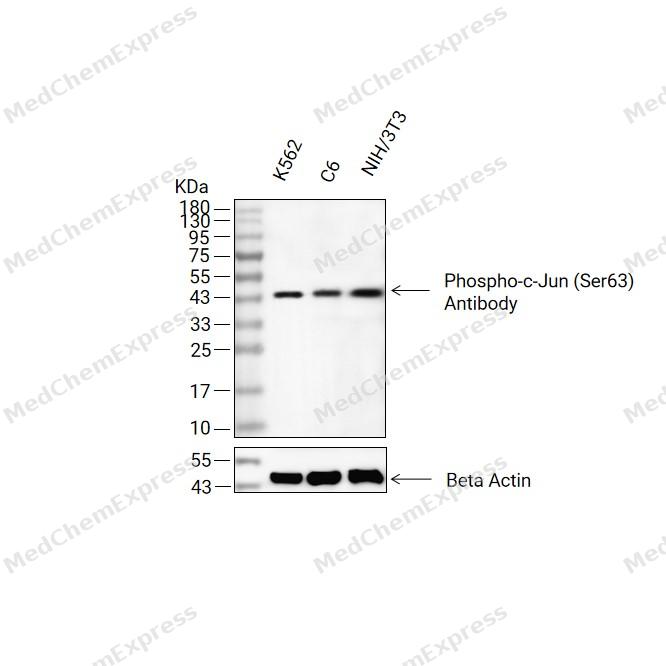 Western blot analysis of extracts from K562(lane 2(20ug) , C6(lane 3(20ug) and NIH/3T3(lane 4(20ug) using Phospho-c-Jun Antibody (HY-P80801) Rabbit mAb. Proteins were transferred to a PVDF membrane and blocked with 5% non-fat milk in TBST for 2 hour at room temperature. The primary antibody (1/1000) and Loading control antibody (Beta Actin, HY-P80438, 1/10000) was used in 5% non-fat milk in TBST at 4°C overnight. Goat Anti-Mouse/Rabbit IgG-HRP Secondary Antibody (1/10000) was used for 1 hour at room temperature.
 -
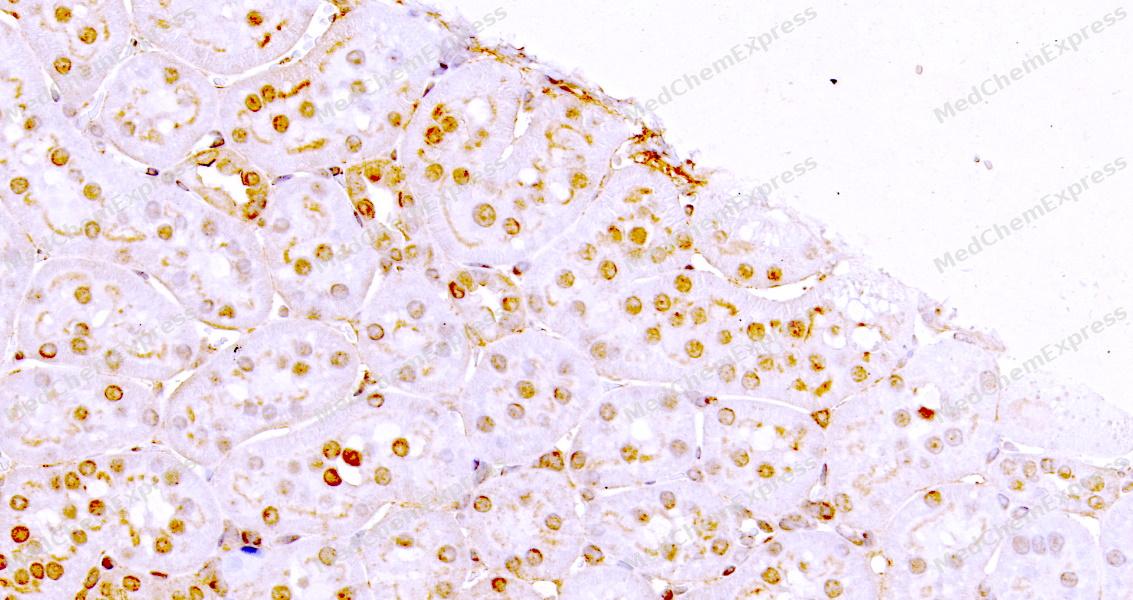 Immunohistochemical analysis of paraffin-embedded rat kidney tissue using Phospho-c-Jun (Ser63) Antibody. The section was pre-treated using heat mediated antigen retrieval with sodium citrate buffer (pH 6.0) for 8 minutes. The tissues were blocked in QuickBlock for 20 minutes at room temperature, washed with ddH2O and PBS, and then probed with the primary antibody at 1/100 dilution in 4℃ overnight. The detection was performed using an HRP conjugated compact polymer system. DAB was used as the chromogen. Tissues were counterstained with hematoxylin and mounted with DPX.
 -
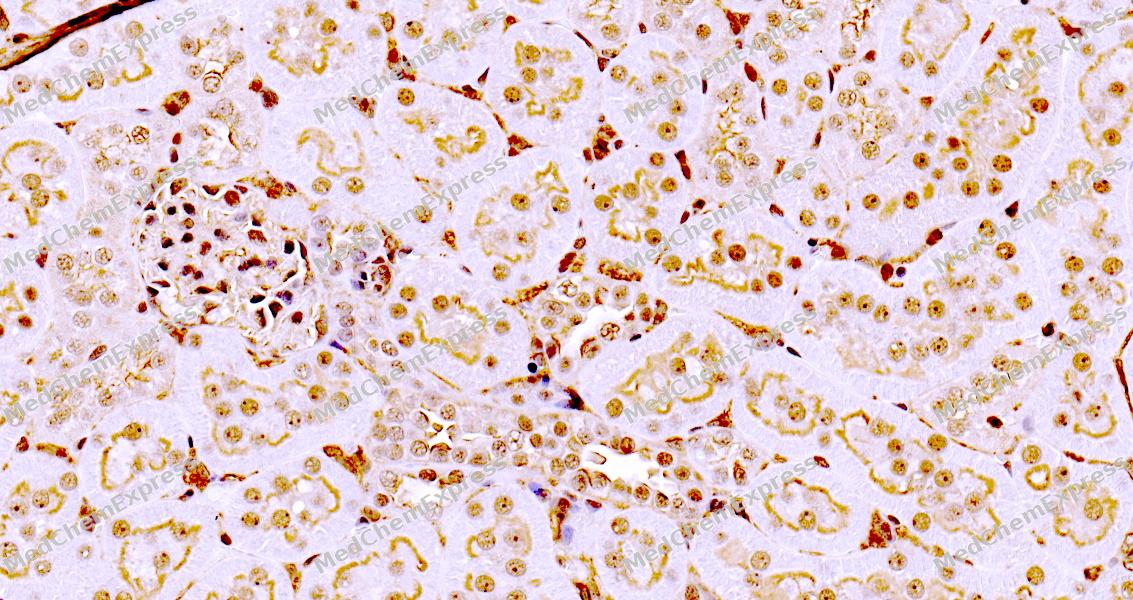 Immunohistochemical analysis of paraffin-embedded rat kidney tissue using Phospho-c-Jun (Ser63) Antibody. The section was pre-treated using heat mediated antigen retrieval with sodium citrate buffer (pH 6.0) for 8 minutes. The tissues were blocked in QuickBlock for 20 minutes at room temperature, washed with ddH2O and PBS, and then probed with the primary antibody at 1/100 dilution in 4℃ overnight. The detection was performed using an HRP conjugated compact polymer system. DAB was used as the chromogen. Tissues were counterstained with hematoxylin and mounted with DPX.


Background
-
Function
c-Jun, a basic leucine zipper transcription factor, regulates gene expression in response to multiple extracellular signals[1]. It is a central component of the activator protein-1 (AP-1) complex, mediating cellular proliferation, differentiation, and stress responses[2][3]. Mechanistically, c-Jun is primarily activated by phosphorylation through the c-Jun N-terminal kinase (JNK) pathway, linking stress signals to transcriptional outputs[3][4]. Isoform-specific functions of JNK1, JNK2, and JNK3 modulate c-Jun activity in tissue- and cell-specific contexts, influencing apoptosis, inflammation, and neuroplasticity[1][5][6]. In disease models, c-Jun contributes to pathological angiogenesis, rheumatoid arthritis, and neurodegeneration, where its inhibition reduces endothelial proliferation, metalloproteinase expression, and neuronal apoptosis[7][8][9][10][11][6]. Compared with related Jun-family members, c-Jun exhibits distinct phosphorylation patterns and transcriptional targets, enabling isoform-specific experimental interventions[6][12]. Pharmacological inhibitors targeting JNK or c-Jun itself, such as SP600125 or DNAzymes, demonstrate utility in blocking pro-apoptotic signaling, reducing inflammation, and modulating angiogenic pathways, supporting their research and therapeutic application[7][8][10][6]. In cancer and viral models, c-Jun interacts with oncogenic pathways, including Bcl-2/Bcl-xL upregulation and FGF-2-mediated proliferation, highlighting its role in cell survival and transcriptional regulation[2][13]. Collectively, c-Jun integrates stress, mitogenic, and inflammatory signals, serving as a critical target for isoform-specific modulation in experimental and disease contexts[1][3][6][7].
-
Subcellular Localization
Nucleus
-
Expression
Tissue_specificity:It is expressed in developing and adult prostate cells as well as prostate cancer cells. -
Subunit
Heterodimer with either BATF3 or ATF7 (PubMed:10376527, PubMed:12087103, PubMed:15467742). Heterodimer with FOS (By similarity). Heterodimer with FOSB isoform 1 and 2 (By similarity). Component of an AP-1 transcription factor complex composed of JUN-FOS heterodimers (By similarity). As part of the AP-1 transcription factor complex, forms heterodimers with FOSB, thereby binding to the AP-1 consensus sequence and stimulating transcription (By similarity). Interacts with FOS and FOSB isoform 1 and 2 (By similarity). The ATF7/JUN heterodimer is essential for ATF7 transactivation activity (PubMed:10376527). Interacts with TSC22D3 (via N-terminus); the interaction inhibits the binding of active AP1 to its target DNA (By similarity). Interacts with HIVEP3 and MYBBP1A (By similarity). Interacts with SP1, SPIB and TCF20 (PubMed:10196196, PubMed:16478997, PubMed:8663478). Interacts with COPS5; the interaction leads indirectly to its phosphorylation (PubMed:8837781). Component of the SMAD3/SMAD4/JUN/FOS/complex which forms at the AP1 promoter site (PubMed:10995748). The SMAD3/SMAD4 heterodimer acts synergistically with the JUN/FOS heterodimer to activate transcription in response to TGF-beta (PubMed:9732876). Interacts (via its basic DNA binding and leucine zipper domains) with SMAD3 (via an N-terminal domain); the interaction is required for TGF-beta-mediated transactivation of the SMAD3/SMAD4/JUN/FOS/complex (PubMed:10995748). Interacts with methylated RNF187 (PubMed:20852630, PubMed:23624934). Binds to HIPK3. Interacts (when phosphorylated) with FBXW7 (PubMed:14739463). Found in a complex with PRR7 and FBXW7 (PubMed:27458189). Interacts with PRR7 and FBXW7; the interaction inhibits ubiquitination-mediated JUN degradation promoting its phosphorylation and transcriptional activity (PubMed:27458189). Interacts with RBM39 (By similarity). Interacts with PAGE4 (PubMed:24263171, PubMed:24559171, PubMed:26242913). Interacts with ARK2N and CSNK2B; the interaction with ARK2N is mediated by CSNK2B (PubMed:31341047)
-
SwissProt ID
-
Synonyms
Transcription factor AP-1; Activator protein 1; AP1; Proto-oncogene c-Jun; V-jun avian sarcoma virus 17 oncogene homolog; p39
-
Research Field
Epigenetics and Nuclear Signaling


Documentation
-
Data Sheet (263 KB)
-
SDS (252 KB)
- English - EN (252 KB)
- Français - FR (252 KB)
- Deutsch - DE (252 KB)
- Norwegian - NO (252 KB)
- Español - ES (252 KB)
- Swedish - SV (252 KB)
- Italian - IT (252 KB)
- Korean - KR (252 KB)
- Portuguese - PT (252 KB)
-
User Guide for Antibodies (1077 KB)
References
[1]. Bogoyevitch MA. The isoform-specific functions of the c-Jun N-terminal Kinases (JNKs): differences revealed by gene targeting. Bioessays. 2006 Sep;28(9):923-34. doi: 10.1002/bies.20458. PMID: 16937364. et al. The isoform-specific functions of the c-Jun N-terminal Kinases (JNKs): differences revealed by gene targeting. Bioessays. 2006 Sep;28(9):923-34. [Content Brief]
[2]. Hortala M, et al. Identification of c-Jun as a critical mediator for the intracrine 24 kDa FGF-2 isoform-induced cell proliferation. Int J Cancer. 2005 May 10;114(6):863-9. [Content Brief]
[3]. Shashikanth N, et al. Role of C-Jun N-Terminal Kinases on a Stressed Epithelium: Time for Testing Isoform Specificity. Biology (Basel). 2025 Jun 3;14(6):649. [Content Brief]
[4]. Yao R, et al. Specific activation of a c-Jun NH2-terminal kinase isoform and induction of neurite outgrowth in PC-12 cells by staurosporine. J Biol Chem. 1997 Jul 18;272(29):18261-6. [Content Brief]
[5]. Raivich G. c-Jun expression, et al. c-Jun expression, activation and function in neural cell death, inflammation and repair. J Neurochem. 2008 Nov;107(4):898-906. [Content Brief]
[6]. Tan J, et al. Isoform-specific functions of c-Jun N-terminal kinase 1 and 2 in lung ischemia-reperfusion injury through the c-Jun/activator protein-1 pathway. J Thorac Cardiovasc Surg. 2021 Aug;162(2):e143-e156. [Content Brief]
[7]. Folkman J. Angiogenesis and c-Jun. J Natl Cancer Inst. 2004 May 5;96(9):644. doi: 10.1093/jnci/djh148. PMID: 15126593. et al. Angiogenesis and c-Jun. J Natl Cancer Inst. 2004 May 5;96(9):644. [Content Brief]
[8]. Zhang GY, et al. Agents targeting c-Jun N-terminal kinase pathway as potential neuroprotectants. Expert Opin Investig Drugs. 2005 Nov;14(11):1373-83. [Content Brief]
[9]. Ouyang W, et al. Anthrax lethal toxin rapidly reduces c-Jun levels by inhibiting c-Jun gene transcription and promoting c-Jun protein degradation. J Biol Chem. 2017 Oct 27;292(43):17919-17927. [Content Brief]
[10]. Han Z, et al. c-Jun N-terminal kinase is required for metalloproteinase expression and joint destruction in inflammatory arthritis. J Clin Invest. 2001 Jul;108(1):73-81. [Content Brief]
[11]. Hepp Rehfeldt SC, et al. c-Jun N-Terminal Kinase Inhibitors as Potential Leads for New Therapeutics for Alzheimer's Diseases. Int J Mol Sci. 2020 Dec 18;21(24):9677. [Content Brief]
[12]. Zhang Y, et al. MAPK/c-Jun signaling pathway contributes to the upregulation of the anti-apoptotic proteins Bcl-2 and Bcl-xL induced by Epstein-Barr virus-encoded BARF1 in gastric carcinoma cells. Oncol Lett. 2018 May;15(5):7537-7544. [Content Brief]
[13]. Zoukhri D, et al. c-Jun NH2-terminal kinase mediates interleukin-1beta-induced inhibition of lacrimal gland secretion. J Neurochem. 2006 Jan;96(1):126-35. [Content Brief]

 Powered by Bioz
