



c-Myc Antibody (YA3476)
(Synonyms: MYC; BHLHE39; Myc proto-oncogene protein; Class E basic helix-loop-helix protein 39; bHLHe39; Proto-oncogene c-Myc; Transcription factor p64)
Based on 1 Customer Validation
c-Myc Antibody (YA3476) is a Rabbit-derived and non-conjugated IgG monoclonal antibody, targeting to c-Myc.
-
Host:
Rabbit
-
Isotype:
IgG
-
Application:
WB, IHC-P, IP, ChIP
-
Reactivity :
Human, Mouse, Rat
-
Formulation:
Supplied in PBS (pH7.4), 0.1% BSA, 40% Glycerol. Preservative: 0.05% Sodium Azide.
-
Conjugation:
Non-conjugated


To place orders, for customer services and technical support, please contact: MedChemExpress USA
Tel: 609-228-6898 E-mail: [email protected] [email protected]





Applications
| Application |
WB

WB: Western Blot
|
IHC-P
IHC-P: Immunohistochemistry-Paraffin
|
IP
IP: Immunoprecipitation
|
ChIP
ChIP: Chromatin Immunoprecipitation
|
|---|---|---|---|---|
| Dilution Ratio | 1:1000 | 1:200 | 1-2μg/sample | Use 0.5~2 μg for 25 μg of chromatin. |


Product Details
c-Myc Antibody (YA3476) is a Rabbit-derived and non-conjugated IgG monoclonal antibody, targeting to c-Myc.
-
Host Rabbit

-
Clonality Monoclonal,Recombinant

-
Species ReactivityHuman, Mouse, Rat
-
Observed Molecular WeightObserved band size: 55 kDa
Note: Due to possible protein modifications or aggregation, the molecular weight should be confirmed by actual measurement, and the predicted value is for reference only.

-
Calculated Molecular Weight Predicted band size: 49 kDa

Synthetic peptide.
affinity purified
Non-conjugated
Unmodified
IgG


Product Properties
-
Appearance
Solution
-
Formulation
Supplied in PBS (pH7.4), 0.1% BSA, 40% Glycerol. Preservative: 0.05% Sodium Azide.
-
Concentration
Batch-dependent, Please check the COA for the concentration of each lot. Check Lot Concentration
-
Storage & Stability
Stored at -20°C for 1 year. Avoid repeated freeze / thaw cycles.
-
Shipping
Shipping with blue ice.


Verification Images
-
 Western blot analysis of extracts from K562 (lane 2(20μg), HEK293 (lane 3(20μg) and Jurkat (lane 4(20μg) using c-Myc (HY-P80626A) Rabbit mAb. Proteins were transferred to a PVDF membrane and blocked with 5% non-fat milk in TBST for 2 hour at room temperature. The primary antibody (1/1000) and Loading control antibody (Beta Actin, HY-P80438, 1/10000) was used in 5% non-fat milk in TBST at 4°C overnight. Goat Anti-Mouse/Rabbit IgG-HRP Secondary Antibody (1/10000) was used for 1 hour at room temperature.
 -
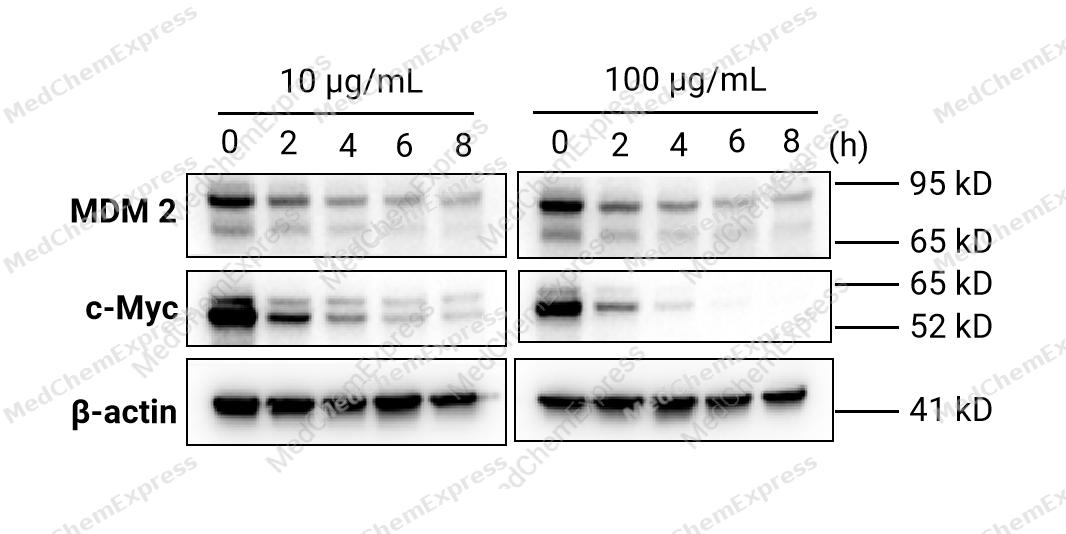
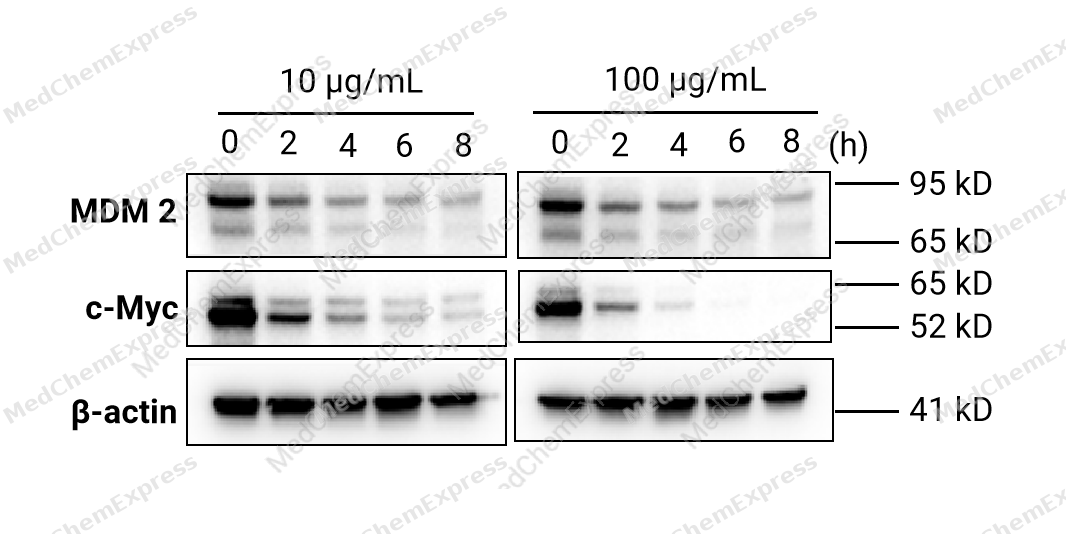 HCT 116 cells were seeded at 4*105 cells/well in a 6-well plate and were cultured overnight. Then, cells were treated with 10 and 100 μg/mL Cycloheximide (HY-12320) for 0-8 hours to assess the expression of MDM2 and c-Myc via Western blotting. The results demonstrated that Cycloheximide inhibited the expression of MDM2 and c-Myc in a time-dependent manner. Primary antibody: MDM2 antibody (HY-P83705), c-Myc antibody (HY-P80626), β-actin antibody (HY-P80438).
 -
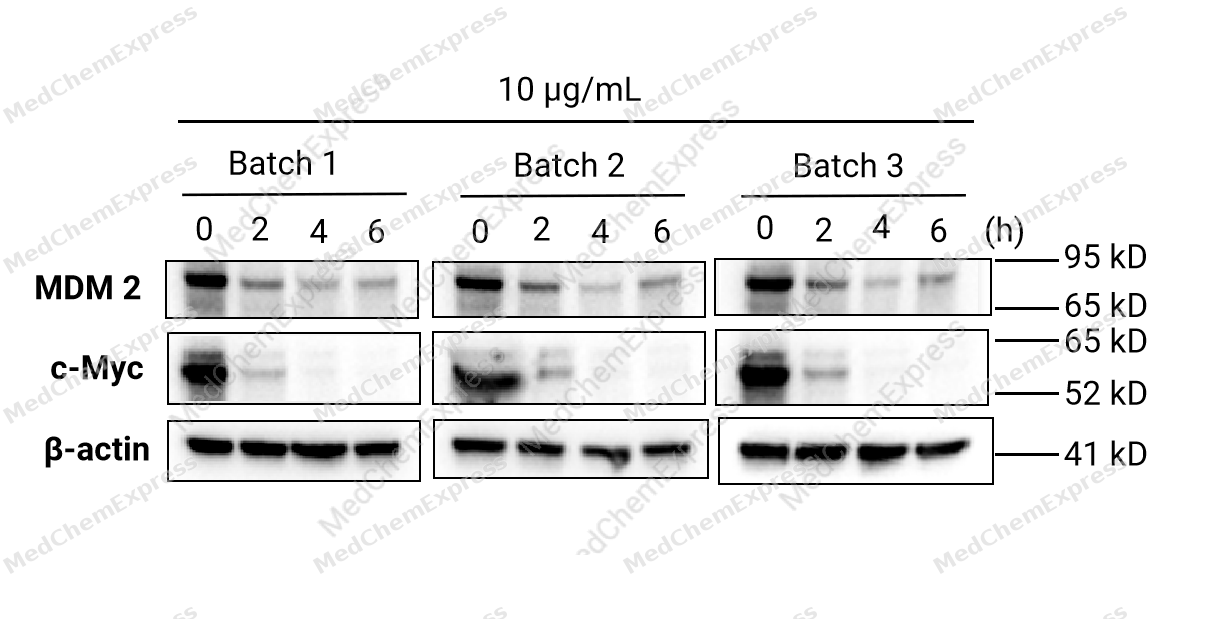 HCT 116 cells were seeded at 4*105 cells/well in a 6-well plate and were cultured overnight. Then, cells were treated with 10 μg/mL Cycloheximide (HY-12320) for 0-6 hours to assess the expression of MDM2 and c-Myc via Western blotting. The results demonstrated that Cycloheximide inhibited the expression of MDM2 and c-Myc proteins and showed lot-to-lot consistency. Primary antibody: MDM2 antibody (HY-P83705), c-Myc antibody (HY-P80626), β-actin antibody (HY-P80438).
 -
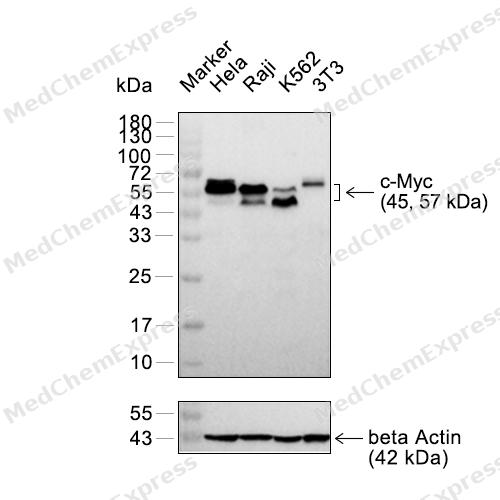 Western blot analysis of extracts from Hela (lane 2(20μg)), Raji (lane 3(20μg)), K562 (lane 4(20μg)) and 3T3 (lane 5(20μg)) using c-Myc Rabbit mAb. Proteins were transferred to a PVDF membrane and blocked with 5% non-fat milk in TBST for 2 hour at room temperature. The primary antibody (1/1000) and Loading control antibody (beta Actin, HY-P83730, 1/5000) was used in 5% non-fat milk in TBST at 4°C overnight. Goat Anti-Rabbit/Mouse IgG-HRP Secondary Antibody (1/10000) was used for 1 hour at room temperature.


Background
-
Function
The transcription factor c-Myc is a member of the basic helix-loop-helix leucinezipper (bHLHZip) protein family. The target genes of the c-MYC protein participate in different cellular functions, including cell cycle, survival, protein synthesis, cell adhesion, and micro-RNA expression. c-Myc is also one of the four factors used in reprogramming somatic cells to induce pluripotent stem (iPS) cells and is implicated in maintaining cancer stem-like cells (CSCs) . Most biological functions of c-Myc require heterodimerization with its activation partner Max.
c-Myc is also part of a dynamic network whose members interact selectively with one another and with various transcriptional coregulators and histone-modifying enzymes. Deregulated expression of c-MYC caused by gene amplification, retroviral insertion, or chromosomal translocation is associated with tumorigenesis. c-Myc has been identified as a highly promising target for cancer therapy.
-
Subcellular Localization
Nucleus, nucleoplasm; Nucleus, nucleolus; Nucleus; Cytoplasm; Chromosome
-
Isoforms & Post-Translational Modification
P01106 has 3 isomers: P01106-2: 50565 Da (predicted); P01106-1: 48804 Da (predicted); P01106-3: 50437 Da (predicted).
Phosphorylated by PRKDC (PubMed:1597196). Phosphorylation at Ser-344 by PIM2 leads to the stabilization of MYC (By similarity). Phosphorylation at Ser-77 by CDK2 prevents Ras-induced senescence (PubMed:19966300, PubMed:20713526). Phosphorylated at Ser-77 by DYRK2; this primes the protein for subsequent phosphorylation by GSK3B at Thr-73 (PubMed:22307329). Phosphorylation at Thr-73 and Ser-77 by GSK3 is required for ubiquitination and degradation by the proteasome (PubMed:15103331, PubMed:17558397, PubMed:8386367). Dephosphorylation at multiple sites by the PNUTS-PP1 complex promotes MYC stability by preventing ubiquitination by the SCF(FBXW7) complex (PubMed:30158517). Dephosphorylation at Ser-77 by protein phosphatase 2A (PPP2CA) promotes its degradation; interaction with PPP2CA is enhanced by AMBRA1 (PubMed:25438055, PubMed:25803737);Ubiquitinated by the SCF(FBXW7) complex when phosphorylated at Thr-73 and Ser-77, leading to its degradation by the proteasome (PubMed:15103331, PubMed:17558397, PubMed:25775507, PubMed:30158517). In the nucleoplasm, ubiquitination is counteracted by USP28, which interacts with isoform 1 of FBXW7 (FBW7alpha), leading to its deubiquitination and preventing degradation (PubMed:17558397, PubMed:17873522). In the nucleolus, however, ubiquitination is not counteracted by USP28 but by USP36, due to the lack of interaction between isoform 3 of FBXW7 (FBW7gamma) and USP28, explaining the selective MYC degradation in the nucleolus (PubMed:17558397, PubMed:25775507). Also polyubiquitinated by the DCX(TRPC4AP) complex (PubMed:20551172, PubMed:29779948). Ubiquitinated by UBR5 when not forming a heterodimer with another bHLH protein, leading to its degradation: UBR5 recognizes and binds a degron that is only available upon heterodimer dissociation (PubMed:33208877, PubMed:37478862). Ubiquitinated by TRIM6 in a phosphorylation-independent manner (By similarity) -
Subunit
Efficient DNA binding requires dimerization with another bHLH protein. Binds DNA as a heterodimer with MAX (PubMed:9680483). Interacts with TAF1C and SPAG9. Interacts with PARP10. Interacts with KDM5A and KDM5B. Interacts (when phosphorylated at Thr-73 and Ser-77) with FBXW7 (PubMed:17558397, PubMed:25775507). Interacts with PIM2. Interacts with RIOX1. The heterodimer MYC:MAX interacts with ABI1; the interaction may enhance MYC:MAX transcriptional activity. Interacts with TRIM6 (By similarity). Interacts with NPM1; the binary complex is recruited to the promoter of MYC target genes and enhances their transcription (PubMed:25956029). Interacts with CIP2A; leading to the stabilization of MYC (PubMed:17632056). Interacts with NUP205 (PubMed:22719065). Interacts with HEATR1; the interaction is required for localization of MYC to the nucleolus (PubMed:38225354)
-
SwissProt ID
-
Synonyms
MYC; BHLHE39; Myc proto-oncogene protein; Class E basic helix-loop-helix protein 39; bHLHe39; Proto-oncogene c-Myc; Transcription factor p64
-
Research Field
Epigenetics and Nuclear Signaling


Documentation
-
Data Sheet (235 KB)
-
SDS (252 KB)
- English - EN (252 KB)
- Français - FR (252 KB)
- Deutsch - DE (252 KB)
- Norwegian - NO (252 KB)
- Español - ES (252 KB)
- Swedish - SV (252 KB)
- Italian - IT (252 KB)
- Korean - KR (252 KB)
- Portuguese - PT (252 KB)
-
User Guide for Antibodies (1077 KB)

 Powered by Bioz
