



Beta Actin Antibody (YA823)
(Synonyms: A26C1A antibody; A26C1B antibody; ACTB antibody; ACTB_HUMAN antibody; Actin beta antibody; Actin cytoplasmic 1 antibody; Actin, cytoplasmic 1, N-terminally processed antibody; Actx antibody; b actin antibody; Beta cytoskeletal actin antibody; Beta-actin antibody; BRWS1 antibody; E430023M04Rik antibody; MGC128179 antibody; PS1TP5 binding protein 1 antibody; PS1TP5BP1 antibody; β-actin antibody )Based on 10 publication(s) in Google Scholar
Beta Actin Antibody is a non-conjugated and Mouse origined IgG1 monoclonal antibody, targeting to Beta Actin. It can be used as a loading control antibody.
-
Host:
Mouse
-
Isotype:
IgG
-
Application:
WB, IHC-P, ICC/IF
-
Reactivity :
Human, Mouse, Rat
-
Formulation:
Supplied in 1*PBS (pH7.4), 0.2% BSA and 40% Glycerol. Preservative: 0.05% Sodium Azide.OR PBS containing 50% glycerol, 0.5% BSA and 0.02% sodium azide, pH 7.3.
-
Conjugation:
Non-conjugated


To place orders, for customer services and technical support, please contact: MedChemExpress USA
Tel: 609-228-6898 E-mail: [email protected] [email protected]



-

HY-P8004
HRP-conjugated Goat Anti-Mouse IgG H&L -
HY-P80137
GAPDH Antibody (YA418) -
HY-P8001
HRP-conjugated Goat Anti-Rabbit IgG H&L -
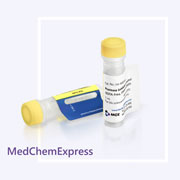
HY-K0010
Protease Inhibitor Cocktail (EDTA-Free, 100× in DMSO) -
HY-P80487
Beta Tubulin Antibody (YA585) -
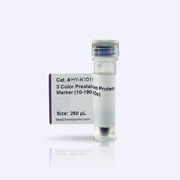
HY-K1011
3-Color Prestained Protein Marker (10-190 kDa) -
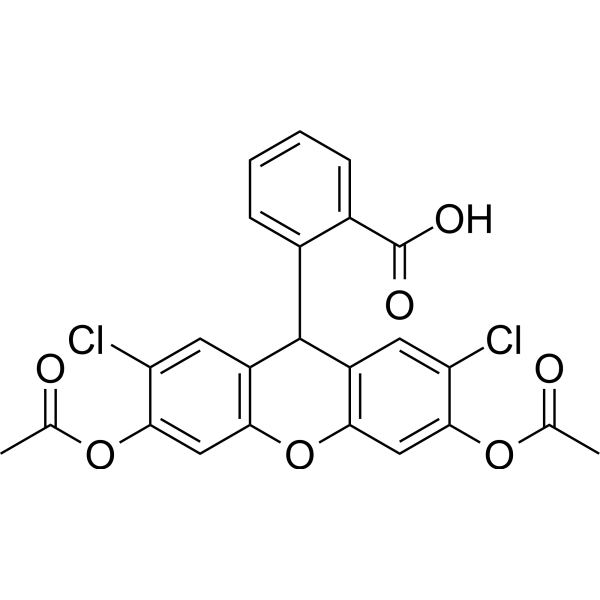
HY-D0940
H2DCFDA -

HY-K1100
SDS-PAGE Sample Loading Buffer (4×) -
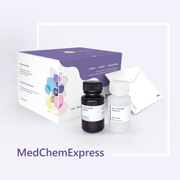
HY-K1005
Ultra High Sensitivity ECL Kit -
HY-K1014
PolyFast Transfection Reagent -

HY-K1001
RIPA Lysis Buffer (Strong) -
HY-P8002
AF488-conjugated Goat Anti-Rabbit IgG H&L
Publications Citing Use of MedChemExpress (MCE) Beta Actin Antibody (YA823)
More- Imeta. 2025 Jul 17;4(5):e70066. [Abstract]
- NPJ Sci Food. 2025 Aug 18;9(1):178. [Abstract]
- Front Immunol. 2025 Mar 6:16:1486961. [Abstract]
- Colloids Surf A Physicochem Eng Asp. 2025 Aug 20.
- Molecules. 2024 Apr 30;29(9):2080. [Abstract]
- J Inflamm Res. 2025 Apr 28:18:5727-5739. [Abstract]
- FASEB J. 2026 May 31;40(10):e71888. [Abstract]
- J Virol. 2025 Aug 19;99(8):e0075825. [Abstract]
- Bone. 2025 Jul 7:117579. [Abstract]
- Discov Oncol. 2025 Apr 9;16(1):499. [Abstract]

 10 Publications Citing Use of MCE Beta Actin Antibody (YA823) (3)
-
WB
-
WB

-
WB


Applications
| Application |
WB

WB: Western Blot
|
ICC/IF
ICC/IF: Immunocytochemistry/
Immunofluorescence |
IHC-P
IHC-P: Immunohistochemistry-Paraffin
|
|---|---|---|---|
| Dilution Ratio | 1:10000 | 1:100-1:200 | 1:50-1:200 |


Product Details
Beta Actin Antibody is a non-conjugated and Mouse origined IgG1 monoclonal antibody, targeting to Beta Actin. It can be used as a loading control antibody.
-
Host Mouse

-
Clonality Monoclonal

-
Species ReactivityHuman, Mouse, Rat
-
Observed Molecular WeightObserved band size: 42 kDa
Note: Due to possible protein modifications or aggregation, the molecular weight should be confirmed by actual measurement, and the predicted value is for reference only.

-
Calculated Molecular Weight Predicted band size: 42 kDa

Entrez Gene: 60 Human ; 11461 Mouse ; 81822 Rat
SwissProt: P60709 Human ; P60710 Mouse ; P60711 Rat
OMIM: 102630 Human
Synthetic peptide corresponding to Human Beta-actin.The exact sequence is proprietary to MCE.
Endogenous
Protein A affinity purified.
Non-conjugated
Unmodified
IgG


Product Properties
-
Appearance
Solution
-
Formulation
Supplied in 1*PBS (pH7.4), 0.2% BSA and 40% Glycerol. Preservative: 0.05% Sodium Azide.OR PBS containing 50% glycerol, 0.5% BSA and 0.02% sodium azide, pH 7.3.
-
Concentration
Batch-dependent, Please check the COA for the concentration of each lot. Check Lot Concentration
-
Storage & Stability
Stored at -20°C for 1 year. Avoid repeated freeze / thaw cycles.
-
Shipping
Shipping with blue ice.


Publications (10)
-
Journal Impact Factor
-
Most Recent
-
Imeta
Akkermansia muciniphila-derived hypoacylated rough-type lipopolysaccharides alleviate diet-induced obesity via activation of TLR4-IL-23-IL-22 immune axis. [Abstract]2025 Jul 17;4(5):e70066. PMID: 41112049
Beta Actin Antibody (YA823) purchased from MedChemExpress. Usage Cited in: Imeta. 2025 Jul 17;4(5):e70066. [Abstract]
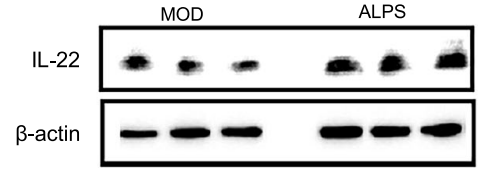
Western blot analysis of IL-22 and β-actin expression in the ileum. Primary antibody: β-actin antibody (HY-P80438), anti-IL-22.
-
NPJ Sci Food
Effects of Mytilus edulis derived plasmalogens against atherosclerosis via lipid metabolism and MAPK signaling pathway. [Abstract]2025 Aug 18;9(1):178. PMID: 40826004 -
Molecules
2024 Apr 30;29(9):2080. PMID: 38731569 -
J Inflamm Res
CCL20 Expression via AKT-ERK1/2-AP1 Pathway in Mycoplasma Pneumoniae Infection: Implications for EMT and Cell Migration. [Abstract]2025 Apr 28:18:5727-5739. PMID: 40322529 -
FASEB J
Maternal LDHB Safeguards Redox Balance and Developmental Competence During Preimplantation Embryo Cleavage. [Abstract]2026 May 31;40(10):e71888. PMID: 42117986 -
J Virol
DENV-2 3'UTR dumbbell structure is a critical factor for viral infection and dissemination in Aedes mosquito. [Abstract]2025 Aug 19;99(8):e0075825. PMID: 40693788 -
Discov Oncol
ATF6 activation promotes tumorigenesis and drug resistance in diffuse large B-cell lymphoma (DLBCL) by regulating the mTOR/S6K signaling pathway. [Abstract]2025 Apr 9;16(1):499. PMID: 40205285
Beta Actin Antibody (YA823) purchased from MedChemExpress. Usage Cited in: Discov Oncol. 2025 Apr 9;16(1):499. [Abstract]
CeapinA7 induced S6K dephosphorylation and cellular autophagy protein expression in DLBCL cell lines. Cells were subject to the specified concentrations of ceapinA7, and the expression levels of Bip, phosphorylated S6K, P62, and LC3 proteins were evaluated through Western blot analysis, with β-actin as a loading control. Primary antibody: anti-BiP/GRP78, anti-S6K, anti-pS6K, anti-P62, anti-LC3, and β-actin antibody (HY-P80438).
Beta Actin Antibody (YA823) purchased from MedChemExpress. Usage Cited in: Discov Oncol. 2025 Apr 9;16(1):499. [Abstract]
WB detection of changes in LC3-II/β-actin expression after combined application of ceapinA7 and CQ. Primary antibody: anti-LC3, and β-actin antibody (HY-P80438).


Verification Images
-
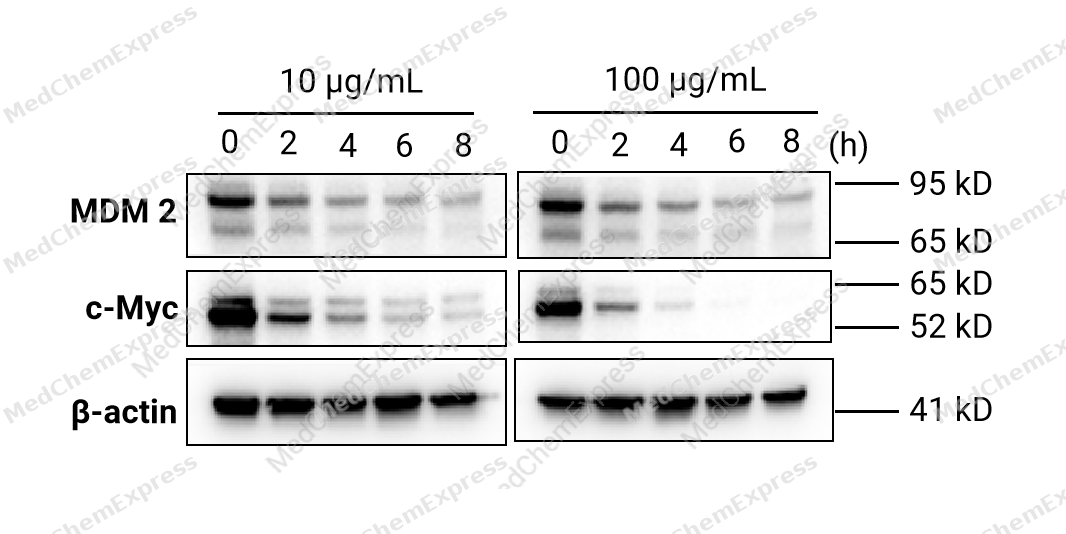 HCT 116 cells were seeded at 4*105 cells/well in a 6-well plate and were cultured overnight. Then, cells were treated with 10 and 100 μg/mL Cycloheximide (HY-12320) for 0-8 hours to assess the expression of MDM2 and c-Myc via Western blotting. The results demonstrated that Cycloheximide inhibited the expression of MDM2 and c-Myc in a time-dependent manner. Primary antibody: MDM2 antibody (HY-P83705), c-Myc antibody (HY-P80626), β-actin antibody (HY-P80438).
 -
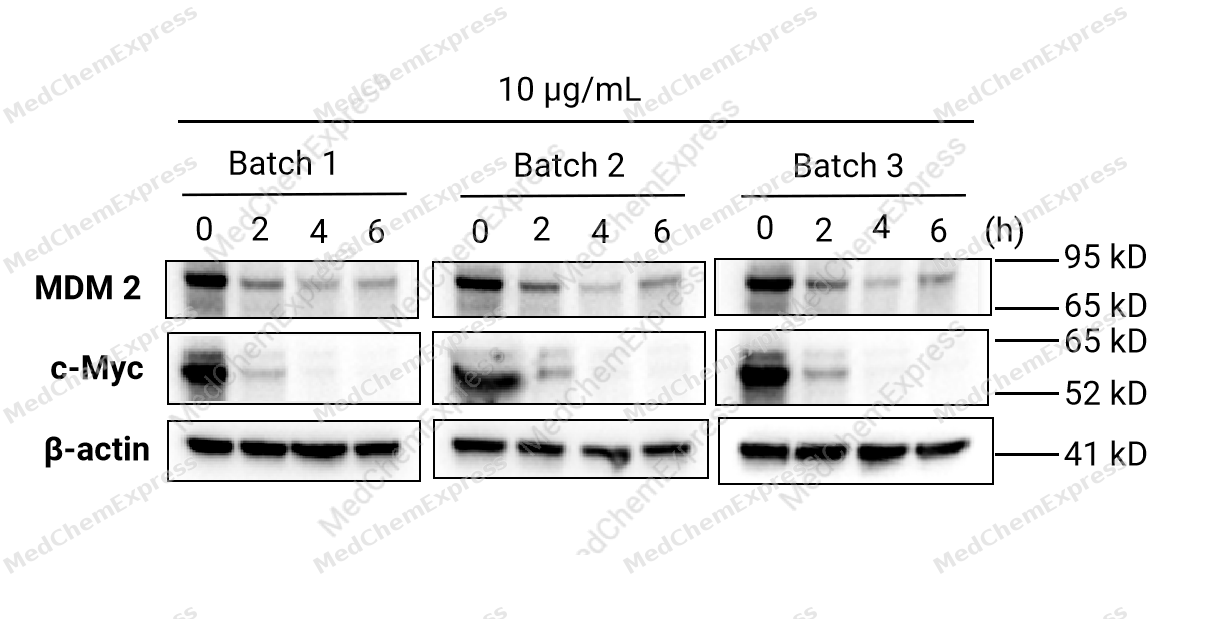 HCT 116 cells were seeded at 4*105 cells/well in a 6-well plate and were cultured overnight. Then, cells were treated with 10 μg/mL Cycloheximide (HY-12320) for 0-6 hours to assess the expression of MDM2 and c-Myc via Western blotting. The results demonstrated that Cycloheximide inhibited the expression of MDM2 and c-Myc proteins and showed lot-to-lot consistency. Primary antibody: MDM2 antibody (HY-P83705), c-Myc antibody (HY-P80626), β-actin antibody (HY-P80438).
 -
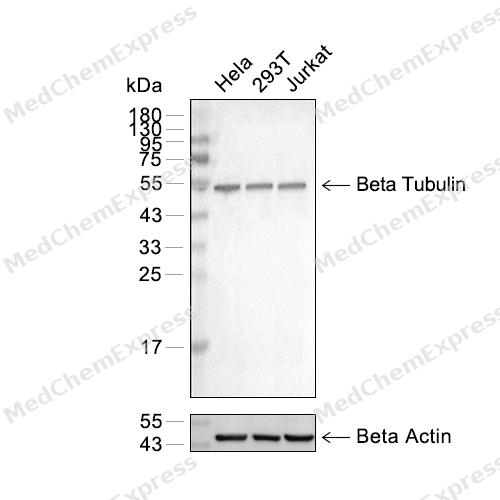 Western blot analysis of extracts from Hela (lane 2(20μg), HEK293T (lane 3(20μg), Jurkat (lane 4(20μg) using Beta Tubulin (HY-P80487) Rabbit mAb. Proteins were transferred to a PVDF membrane and blocked with 5% BSA in TBST for 2 hour at room temperature. The primary antibody (HY-P80487, 1/1000) and Loading control antibody (Beta Actin, HY-P80438, 1/3000) was used in 5% BSA in TBST at 4°C overnight. Goat Anti-Mouse/Rabbit IgG-HRP Secondary Antibody (HY-P8004/HY-P8001, 1/10,000) was used for 1 hour at room temperature.
 -
 Immunocytochemistry analysis of Hela cells labeling Beta Actin with Beta Actin Antibody (HY-P80438) at 1/100 dilution. Cells were fixed in 4% paraformaldehyde for 15 minutes at room temperature, permeabilized with 0.1% Triton X-100 in PBS for 15 minutes at room temperature, then blocked with quick block buffer for 10 minutes at room temperature. Cells were then incubated with Beta Actin Antibody (HY-P80438) at 1/100 dilution in quick block buffer overnight at 4 ℃. AF488-conjugated Goat Anti-Mouse IgG H&L(HY-P8005, Green) was used as the secondary antibody at 1/1,000 dilution. PBS instead of the primary antibody was used as the secondary antibody only control. The Nuclear counterstain was DAPI (Blue).
 -
 Immunocytochemistry analysis of Hela cells labeling Beta Actin with Beta Actin Antibody (HY-P80438) at 1/200 dilution. Cells were fixed in 4% paraformaldehyde for 15 minutes at room temperature, permeabilized with 0.1% Triton X-100 in PBS for 15 minutes at room temperature, then blocked with quick block buffer for 10 minutes at room temperature. Cells were then incubated with Beta Actin Antibody (HY-P80438) at 1/200 dilution in quick block buffer overnight at 4 ℃. AF488-conjugated Goat Anti-Mouse IgG H&L(HY-P8005, Green) was used as the secondary antibody at 1/1,000 dilution. PBS instead of the primary antibody was used as the secondary antibody only control. The Nuclear counterstain was DAPI (Blue).


Background
-
Function
Beta Actin is an Actin is a highly conserved protein that polymerizes to produce filaments that form cross-linked networks in the cytoplasm of cells. Actin exists in both monomeric (G-actin) and polymeric (F-actin) forms, both forms playing key functions, such as cell motility and contraction. In addition to their role in the cytoplasmic cytoskeleton, G- and F-actin also localize in the nucleus, and regulate gene transcription and motility and repair of damaged DNA. Plays a role in the assembly of the gamma-tubulin ring complex (gTuRC), which regulates the minus-end nucleation of alpha-beta tubulin heterodimers that grow into microtubule protafilaments. Part of the ACTR1A/ACTB filament around which the dynactin complex is built. The dynactin multiprotein complex activates the molecular motor dynein for ultra-processive transport along microtubules[1][2][3][4][5].
-
Subcellular Localization
Cytoplasm, cytoskeleton; Nucleus
-
Subunit
Polymerization of globular actin (G-actin) leads to a structural filament (F-actin) in the form of a two-stranded helix (PubMed:16685646, PubMed:28604741). Each actin can bind to 4 others (PubMed:16685646, PubMed:28604741). Identified in a IGF2BP1-dependent mRNP granule complex containing untranslated mRNAs (PubMed:17289661). Component of the BAF complex, which includes at least actin (ACTB), ARID1A, ARID1B/BAF250, SMARCA2, SMARCA4/BRG1, ACTL6A/BAF53, ACTL6B/BAF53B, SMARCE1/BAF57 SMARCC1/BAF155, SMARCC2/BAF170, SMARCB1/SNF5/INI1, and one or more of SMARCD1/BAF60A, SMARCD2/BAF60B, or SMARCD3/BAF60C (PubMed:18765789). In muscle cells, the BAF complex also contains DPF3 (PubMed:18765789). Found in a complex with XPO6, Ran, ACTB and PFN1 (PubMed:14592989). Interacts with PFN1 (PubMed:10411937, PubMed:25255767). Interacts with XPO6 and EMD (PubMed:15328537). Interacts with ERBB2 (PubMed:21555369). Interacts with GCSAM (PubMed:17823310). Interacts with TBC1D21 (By similarity). Interacts with CPNE1 (via VWFA domain) and CPNE4 (via VWFA domain) (By similarity). Interacts with DHX9 (via C-terminus); this interaction is direct and mediates the attachment to nuclear ribonucleoprotein complexes (PubMed:11687588). Interacts with FAM107A (PubMed:21969592, PubMed:28604741). Associates with the gamma-tubulin ring complex (gTuRC) consisting of TUBGCP2, TUBGCP3, TUBGCP4, TUBGCP5 and TUBGCP6 and gamma-tubulin TUBG1 or TUBG2; within the complex, interacts with TUBGCP3 and TUBGCP6 to form a luminal bridge with MZT1 that stabilizes the initial structure during complex assembly (PubMed:39321809, PubMed:38609661). Part of the ACTR1A/ACTB filament around which the dynactin complex is built (By similarity). The filament contains 8 copies of ACTR1A and 1 ACTB (By similarity). Interacts with TPRN which forms ring-like structures in the stereocilium taper region; the interaction may stabilize stereocilia in inner ear hair cells (By similarity). Interacts with AMOTL2 (via N-terminus), the interaction facilitates binding of cell junction complexes to actin fibers in endothelial cells (By similarity)
-
SwissProt ID
-
Synonyms
A26C1A antibody; A26C1B antibody; ACTB antibody; ACTB_HUMAN antibody; Actin beta antibody; Actin cytoplasmic 1 antibody; Actin, cytoplasmic 1, N-terminally processed antibody; Actx antibody; b actin antibody; Beta cytoskeletal actin antibody; Beta-actin antibody; BRWS1 antibody; E430023M04Rik antibody; MGC128179 antibody; PS1TP5 binding protein 1 antibody; PS1TP5BP1 antibody; β-actin antibody
-
Research Field
Isotype/Loading Controls
Documentation
-
Data Sheet (262 KB)
-
SDS (254 KB)
- English - EN (254 KB)
- Français - FR (254 KB)
- Deutsch - DE (254 KB)
- Norwegian - NO (254 KB)
- Español - ES (254 KB)
- Swedish - SV (254 KB)
- Italian - IT (254 KB)
- Korean - KR (254 KB)
- Portuguese - PT (254 KB)
-
User Guide for Antibodies (1077 KB)
References
[1]. Hundt N, et al. Molecular mechanisms of disease-related human β-actin mutations p.R183W and p.E364K. FEBS J. 2014 Dec;281(23):5279-91. [Content Brief]
[2]. Drazic A, et al. NAA80 is actin's N-terminal acetyltransferase and regulates cytoskeleton assembly and cell motility. Proc Natl Acad Sci U S A. 2018 Apr 24;115(17):4399-4404. [Content Brief]
[3]. Schrank BR, et al. Nuclear ARP2/3 drives DNA break clustering for homology-directed repair. Nature. 2018 Jul;559(7712):61-66. [Content Brief]
[4]. Serna M, et al. CDK5RAP2 activates microtubule nucleator γTuRC by facilitating template formation and actin release. Dev Cell. 2024 Dec 2;59(23):3175-3188.e8. [Content Brief]
[5]. Aher A, et al. Structure of the γ-tubulin ring complex-capped microtubule. Nat Struct Mol Biol. 2024 Jul;31(7):1124-1133. [Content Brief]

 Powered by Bioz
