



Fyn Antibody
(Synonyms: FYN; Tyrosine-protein kinase Fyn; Proto-oncogene Syn; Proto-oncogene c-Fyn; Src-like kinase; SLK; p59-Fyn)Based on 1 Customer Validation
Fyn Antibody is a Rabbit-derived and non-conjugated IgG polyclonal antibody, targeting to Fyn.
-
Host:
Rabbit
-
Isotype:
IgG
-
Application:
WB
-
Reactivity :
Human, Mouse, Rat
-
Formulation:
Supplied in 1*PBS (pH 7.3), 50% glycerol and 0.5% BSA. Preservative: 0.02% sodium azide.
-
Conjugation:
Non-conjugated


To place orders, for customer services and technical support, please contact: MedChemExpress USA
Tel: 609-228-6898 E-mail: [email protected] [email protected]





Applications
| Application |
WB

WB: Western Blot
|
|---|---|
| Dilution Ratio | 1:500-1:1000 |


Product Details
Fyn Antibody is a Rabbit-derived and non-conjugated IgG polyclonal antibody, targeting to Fyn.
-
Host Rabbit

-
Clonality Polyclonal

-
Species ReactivityHuman, Mouse, Rat
-
Observed Molecular WeightObserved band size: 61 kDa
Note: Due to possible protein modifications or aggregation, the molecular weight should be confirmed by actual measurement, and the predicted value is for reference only.

-
Calculated Molecular Weight Predicted band size: 61 kDa

Entrez Gene: 2534 Human ; 14360 Mouse ; 25150 Rat
SwissProt: P06241 Human ; P39688 Mouse ; Q62844 Rat
OMIM: 137025 Human
Endogenous
affinity purified
Non-conjugated
Unmodified
IgG


Product Properties
-
Appearance
Solution
-
Formulation
Supplied in 1*PBS (pH 7.3), 50% glycerol and 0.5% BSA. Preservative: 0.02% sodium azide.
-
Concentration
Batch-dependent, Please check the COA for the concentration of each lot. Check Lot Concentration
-
Storage & Stability
Stored at -20°C for 1 year. Avoid repeated freeze / thaw cycles.
-
Shipping
Shipping with blue ice.


Verification Images
-
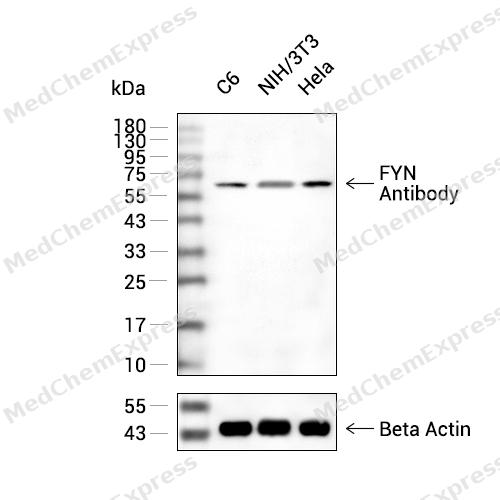 Western blot analysis of extracts from C6(lane 2(20ug) , NIH/3T3(lane 3(20ug) and Hela(lane 4(20ug) using FYN Antibody (HY-P80681) Rabbit mAb. Proteins were transferred to a PVDF membrane and blocked with 5% non-fat milk in TBST for 2 hour at room temperature. The primary antibody (1/1000) and Loading control antibody (Beta Actin, HY-P80438, 1/10000) was used in 5% non-fat milk in TBST at 4°C overnight. Goat Anti-Mouse/Rabbit IgG-HRP Secondary Antibody (1/10000) was used for 1 hour at room temperature.


Background
-
Function
Fyn is a Src family tyrosine kinase represented in brain by the neuronal isoform p59FynB, where Src and Fyn constitute the two main tyrosine kinases involved in neuronal growth and myelination[1]. Mechanistically, Fyn participates in Src-family signaling modules that regulate inflammation, apoptosis, neuroinflammation, and epileptogenesis in experimental systems[2][3]. In pulmonary endothelial inflammation models, fyn knockdown increased caspase-3 activity, reduced viable cell numbers, and intensified LPS-induced lung injury in fyn−/− mice, identifying Fyn as a negative regulator of inflammation-induced apoptosis[2]. In temporal lobe epilepsy models, the Fyn-PKCδ pathway linked status epilepticus to neuroinflammation and epileptogenesis, while saracatinib reduced seizures, gliosis, neurodegeneration, phosphorylated Fyn/Src-419, PKCδ-tyr311, nitrooxidative stress, and proinflammatory cytokines[3]. Compared with related isoforms, Fyn showed an opposite endothelial apoptosis phenotype to Yes, because yes knockdown lowered caspase-3 activity and increased viable cells under cytomix stimulation[2]. For experimental applications, saracatinib functions as a Src/Fyn tyrosine kinase inhibitor for probing epileptogenesis-associated neuroinflammatory and nitrooxidative pathways[3].
-
Subcellular Localization
Cytoplasm; Nucleus; Cell membrane; Perikaryon
-
Expression
Tissue_specificity:Isomer 1 is highly expressed in the brain. Isomer 2 is expressed in hematopoietic lineage cells, especially in T lymphocytes. -
Isoforms & Post-Translational Modification
P06241 has 3 isomers: P06241-1: 60762 Da (predicted); P06241-2: 60141 Da (predicted); P06241-3: 54513 Da (predicted).
Autophosphorylated at Tyr-420 (By similarity). Phosphorylation on the C-terminal tail at Tyr-531 by CSK maintains the enzyme in an inactive state (PubMed:1699196). PTPRC/CD45 dephosphorylates Tyr-531 leading to activation (PubMed:1533589). Ultraviolet B (UVB) strongly increase phosphorylation at Thr-12 and kinase activity, and promotes translocation from the cytoplasm to the nucleus (PubMed:15537652). Dephosphorylation at Tyr-420 by PTPN2 negatively regulates T-cell receptor signaling (PubMed:22080863). Phosphorylated at tyrosine residues, which can be enhanced by NTN1 (By similarity);Palmitoylated. Palmitoylation at Cys-3 and Cys-6, probably by ZDHHC21, regulates subcellular location -
Subunit
Interacts (via its SH3 domain) with PIK3R1 and PRMT8. Interacts with FYB1, PAG1, and SH2D1A. Interacts with CD79A (tyrosine-phosphorylated form); the interaction increases FYN activity.
-
SwissProt ID
-
Synonyms
FYN; Tyrosine-protein kinase Fyn; Proto-oncogene Syn; Proto-oncogene c-Fyn; Src-like kinase; SLK; p59-Fyn
-
Research Field
Neuroscience


Documentation
-
Data Sheet (260 KB)
-
SDS (251 KB)
- English - EN (251 KB)
- Français - FR (251 KB)
- Deutsch - DE (251 KB)
- Norwegian - NO (251 KB)
- Español - ES (251 KB)
- Swedish - SV (251 KB)
- Italian - IT (251 KB)
- Korean - KR (251 KB)
- Portuguese - PT (251 KB)
-
User Guide for Antibodies (1077 KB)
References
[1]. Rouer E. Les isoformes neuronales des tyrosines kinases Src, et al. Les isoformes neuronales des tyrosines kinases Src, Fyn et Lck : rôle particulier de la p56lckN dans la survie neuronale [Neuronal isoforms of Src, Fyn and Lck tyrosine kinases: A specific role for p56lckN in neuron protection]. C R Biol. 2010 Jan;333(1):1-10. French. [Content Brief]
[3]. Sharma S, et al. Mechanisms of disease-modifying effect of saracatinib (AZD0530), a Src/Fyn tyrosine kinase inhibitor, in the rat kainate model of temporal lobe epilepsy. Neurobiol Dis. 2021 Aug;156:105410. [Content Brief]

 Powered by Bioz
