



1. Search Result
Search Result
Results for "

Htt aggregates/oligomers

" in MedChemExpress (MCE) Product Catalog:

358

Inhibitors & Agonists

3

Screening Libraries

19

Fluorescent Dyes

58

Biochemical Assay Reagents

53

Peptides

2

MCE Kits

17

Inhibitory Antibodies

45

Natural
Products

2

Recombinant Proteins

7

Isotope-Labeled Compounds

1

Antibodies

1

Click Chemistry

23

Oligonucleotides

Targets Recommended:
Cat. No. Product Name Target Research Areas Chemical Structure
  • HY-101855

    Anle138b

    Amyloid-β Neurological Disease
    Emrusolmin (Anle138b), an oligomeric aggregation inhibitor, blocks the formation of pathological aggregates of prion protein (PrPSc) and of α-synuclein (α-syn). Emrusolmin strongly inhibits oligomer accumulation, neuronal degeneration, and disease progression in vivo. Emrusolmin has low toxicity and an excellent oral bioavailability and blood-brain-barrier penetration. Emrusolmin blocks Aβ channels and rescues disease phenotypes in a mouse model for amyloid pathology .
    Emrusolmin
  • HY-W143216

    Monomethylthionine

    Amyloid-β Tau Protein HSP Neurological Disease
    Azure C (Monomethylthionine) acts as a tau oligomer inhibitor and Aβ42 oligomerization inhibitor. Azure C regulates hsp70 ATPase activity, thereby mediating the clearance of tau protein. Azure C reduces the levels of toxic tau oligomers by promoting the formation of non-toxic tau aggregates, rescues neuroblastoma cells from tau oligomer-induced toxicity, and binds to and inhibits Aβ42 oligomerization. Azure C is generated via continuous oxidation of methylene blue or azure B through a horseradish peroxidase-mediated reaction. Azure C can be used in research related to tauopathies, including Alzheimer's disease .
    Azure C
  • HY-156650

    PTC518

    Huntingtin Neurological Disease
    Votoplam (PTC518) (Example 37) is an HTT gene regulator with an IC50 ≤ 0.1 μM. Votoplam can be used in the research of Huntington's disease .
    Votoplam
  • HY-N7697

    Others Others
    Chitotetraose tetrahydrochloride is a short-chain chitin oligomer derived from arbuscular mycorrhizal (AM) fungi. Chitotetraose tetrahydrochloride activates the AM fungus-dependent conserved symbiotic signaling pathway (CSSP) in actinorhizal plant species .
    Chitotetraose tetrahydrochloride
  • HY-113788

    Pyk2 p38 MAPK Amyloid-β Neurological Disease Inflammation/Immunology
    PF-719 is a highly selective Pyk2 inhibitor with an IC50 value of 17 nM. PF-719 promotes the activation of LKB1 and p38 MAPK. PF-719 blocks synaptic deficits induced by Amyloid-beta oligomers and reverses the inhibition of long-term potentiation induced by β-amyloid oligomers. PF-719 can be used in research related to Alzheimer's disease and autoimmune diseases .
    PF-719
  • HY-132579

    RG6042; IONIS-HttRx

    Huntingtin Neurological Disease
    Tominersen (RG6042) is a second-generation 2′-O-(2-methoxyethyl) antisense oligonucleotide that targets huntingtin protein (HTT) mRNA and potently suppresses HTT production. Tominersen improves survival and reduces brain atrophy in mice. Tominersen can be used for the research of Huntington’s disease (HD) .
    Tominersen
  • HY-Y1230

    Propargylacetic acid

    Biochemical Assay Reagents Others
    4-Pentynoic acid (Propargylacetic acid) is an intermediate to produce biologically active compounds. 4-Pentynoic acid is widely utilized as a building block for the synthesis of eight sequence-defined model oligomers . 4-Pentynoic acid is a click chemistry reagent, it contains an Alkyne group and can undergo copper-catalyzed azide-alkyne cycloaddition (CuAAc) with molecules containing Azide groups.
    4-Pentynoic acid
  • HY-P10954

    p38 MAPK Others
    Link N peptide is a proteoglycan aggregates activator in the extracellular matrix. Link N peptide can selectively activate the p38 mitogen-activated protein kinase (MAPK) pathway to promote the expression of type I and II collagens in human intervertebral disc cells. Link N peptide is promising for research of intervertebral disc degeneration-related diseases .
    Link N peptide
  • HY-121035

    7-Bromoindirubin-3-Oxime

    CDK GSK-3 Neurological Disease
    7BIO (7-Bromoindirubin-3-Oxime) is the derivate of indirubin. 7BIO (7-Bromoindirubin-3-Oxime) has inhibitory effects against cyclin-dependent kinase-5 (CDK5) and glycogen synthase kinase-3β (GSK3β). 7BIO (7-Bromoindirubin-3-Oxime) inhibits Aβ oligomer-induced neuroinflammation, synaptic impairments, tau hyper-phosphorylation, activation of astrocytes and microglia, and attenuates Aβ oligomer-induced cognitive impairments in mice [1].
    7BIO
  • HY-132579A

    RG6042 sodium; IONIS-HttRx sodium

    Huntingtin Neurological Disease
    Tominersen sodium is a second-generation 2′-O-(2-methoxyethyl) antisense oligonucleotide that targets huntingtin protein (HTT) mRNA and potently suppresses HTT production. Tominersen improves survival and reduces brain atrophy in mice. Tominersen sodium can be used for the research of Huntington’s disease (HD) .
    Tominersen sodium
  • HY-171179

    Fluorescent Dye Neurological Disease
    BD-Oligo is an oligomer-specific fluorescent chemical probe. BD-Oligo preferentially identifies Aβ oligomer assemblies over monomers or fibrils by using diversity-directed fluorescent library (DOFL) screening and computational techniques. BD-Oligo exhibits dynamic oligomer monitoring capabilities during Aβ peptide fibril formation as Aβ is induced to form oligomers and ultimately fibrils over time. BD-Oligo also exhibits blood-brain barrier permeability with the ability to stain Aβ oligomers in vivo .
    BD-Oligo
  • HY-153402

    Biochemical Assay Reagents Drug Intermediate Others
    Activated EG3 Tail can be used in the synthesis of exon jumping oligomer conjugates .
    Activated EG3 Tail
  • HY-148913

    CaMK Neurological Disease
    CS587 is a specific inhibitor of CaMK1D with neurocytotoxicity at 10 μM. CS587 modulates the sensitivity of neuronal cells to Aβ oligomer toxicity .
    CS587
  • HY-143792

    Huntingtin P-glycoprotein Neurological Disease
    HTT-D3 is an orally active, blood-brain barrier penetrant splicing modulator of huntingtin (HTT). HTT-D3 promotes the inclusion of a pseudo-exon containing a premature termination codon into HTT pre-mRNA, triggers nonsense-mediated mRNA degradation and reduces HTT protein levels. HTT-D3 induces dose-dependent, comparable reductions in mutant HTT protein in both the brain and peripheral tissues of transgenic mouse models. HTT-D3 can be used for the research of Huntington's disease .
    HTT-D3
  • HY-N7699C

    Bacterial Neurological Disease
    D-Pentamannuronic acid, an alginate oligomer, is produced by marine brown algae and by a limited range of Gram negative bacteria. D-Pentamannuronic acid can be used for the research of pain and vascular dementia .
    D-Pentamannuronic acid
  • HY-113434B

    (±)-5-HETE

    Endogenous Metabolite Inflammation/Immunology
    5-HETE ((±)-5-HETE), a fatty acid, is a oxidative derivative of Arachidonic acid. 5-HETE is a mixture of 5(S)-HETE and 5(R)-HETE. 5-HETE is a potent aggregating agent that induces the aggregation of neutrophils with an IC50 value of 200 nM .
    5-HETE
  • HY-150049

    Amyloid-β Neurological Disease
    γ-Secretase modulator 13 (compound 4) is a gamma-secretase modulator (GSMs) that inhibits the production of the aggregated amyloid β-peptide Aβ42 with an IC50 value of 163 nM. γ-Secretase modulator 13 can be used in the study of Alzheimer's disease .
    γ-Secretase modulator 13
  • HY-N7699B

    Bacterial Neurological Disease
    D-Tetramannuronic acid, an alginate oligomer, is produced by marine brown algae and by a limited range of Gram negative bacteria. D-Tetramannuronic acid can be used for the research of pain and vascular dementia .
    D-Tetramannuronic acid
  • HY-N7699F

    Bacterial Neurological Disease
    D-Octamannuronic acid, an alginate oligomer, is produced by marine brown algae and by a limited range of Gram negative bacteria. D-Octamannuronic acid can be used for the research of pain and vascular dementia .
    D-Octamannuronic acid
  • HY-163145

    α-synuclein Neurological Disease
    α-Synuclein inhibitor 11 (compound 1) is a selective α-synuclein (α-syn) oligomer formation inhibitor. α-Synuclein inhibitor 11 does not inhibits tau 4R (isoforms 0N4R, 2N4R) or p-tau (isoform 1N4R). α-Synuclein inhibitor 11 can be used for Parkinson's disease (PD) research .
    α-Synuclein inhibitor 11
  • HY-P3780

    Amyloid-β Neurological Disease
    Cys-Gly-Lys-Lys-Gly-Amyloid β-Protein (36-42) is the 36-42 fragment of Amyloid β-Protein. β-amyloid, a polypeptide made up of 36-43 amino acids, is the main component of amyloid plaques found in the brains of people with Alzheimer's disease. β-amyloid oligomers (Aβos) plays A key role in the progression of Alzheimer's disease (AD) by inducing neuronal damage and cognitive impairment .
    Cys-Gly-Lys-Lys-Gly-Amyloid β-Protein (36-42)
  • HY-156650A

    PTC518 hydrochloride

    Huntingtin Neurological Disease
    Votoplam (PTC518) hydrochloride is an HTT gene regulator with an IC50 ≤ 0.1 μM. Votoplam hydrochloride can be used in the research of Huntington's disease .
    Votoplam hydrochloride
  • HY-112636

    Amyloid-β Others
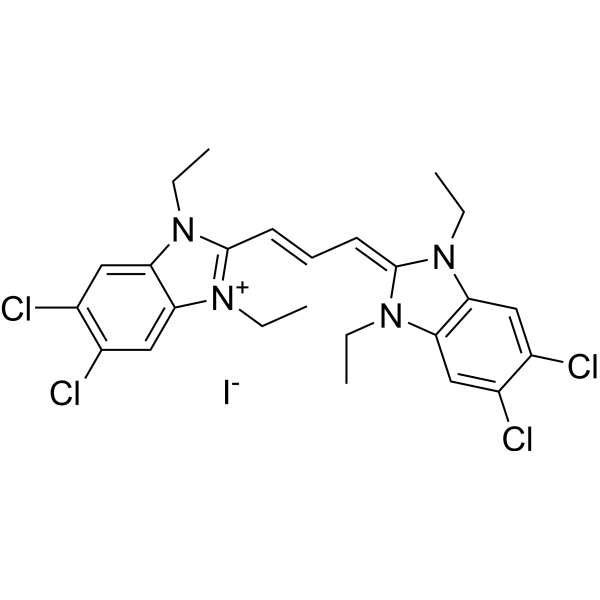
    Astrophloxine is a fluorescent imaging probe capable of targeting antiparallel dimers. Astrophloxine can be used to detect aggregated Aβ in brain tissue and cerebrospinal fluid samples of Alzheimer's disease (AD) mice .
    Astrophloxine
  • HY-167006

    PLGA10000-PEG3000-Vinylsulfone

    Biochemical Assay Reagents Others
    PLGA10000-PEG3000-VS (PLGA10000-PEG3000-Vinylsulfone) is an amphiphilic polymer. Amphiphilic polymers can be used in drug delivery studies due to their ability to self-assemble into discrete aggregates .
    PLGA10000-PEG3000-VS
  • HY-W206987

    Drug Intermediate Others
    2-(Aminomethyl)benzoic acid is an amino acid derivative and also a building block for heterogeneously synthetic folded oligomers with repeating γ/α 2-Amb-Pro motifs. 2-(Aminomethyl)benzoic acid can be used to construct synthetic oligomers .
    2-(Aminomethyl)benzoic acid
  • HY-RS24494

    Small Interfering RNA (siRNA) Others

    Htt Rat Pre-designed siRNA Set A contains three designed siRNAs for Htt gene (Rat), as well as a negative control, a positive control, and a FAM-labeled negative control.

    Htt Rat Pre-designed siRNA Set A
    Htt Rat Pre-designed siRNA Set A
  • HY-RS06490

    Small Interfering RNA (siRNA) Others

    HTT Human Pre-designed siRNA Set A contains three designed siRNAs for HTT gene (Human), as well as a negative control, a positive control, and a FAM-labeled negative control.

    HTT Human Pre-designed siRNA Set A
    HTT Human Pre-designed siRNA Set A
  • HY-P10822

    Caspase Neurological Disease
    ED11 is a potent and selective caspase-6 inhibitor with an IC50 of 12.12 nM. ED11 competes with Htt for the caspase-6 active site, and thus reduce Htt cleavage. ED11 can cross the blood-brain barrier (BBB). ED11 has the potential for the study of Huntington's disease (HD) .
    ED11
  • HY-119987

    SOG

    Fluorescent Dye Others
    Sudan orange G is an azo dye. Sudan orange G, after enzymatic oxidation, generates oligomers and even polymers through free radical coupling reactions .
    Sudan orange G
  • HY-N7699A

    TNF Receptor Neurological Disease Inflammation/Immunology
    D-Trimannuronic acid, an alginate oligomer is extracted from seaweed. D-Trimannuronic acid can induce TNF‐α secretion by mouse macrophage cell lines. D-Trimannuronic acid can be used for the research of pain and vascular dementia .
    D-Trimannuronic acid
  • HY-113950

    Transthyretin (TTR) Neurological Disease
    Dichlorophenyl-ABA is an inhibitor of transthyretin (TTR) amyloid fibril formation, inhibiting aggregate formation in more than 80% in TTR L55P-expressing cells .
    Dichlorophenyl-ABA
  • HY-N7699E

    Bacterial Neurological Disease
    D-Heptamannuronic acid, an alginate oligomer, is produced by marine brown algae and by a limited range of Gram negative bacteria. D-Heptamannuronic acid can be used for the research of pain and vascular dementia .
    D-Heptamannuronic acid
  • HY-N7699G

    Bacterial Neurological Disease
    D-Nonamannuronic acid, an alginate oligomer, is produced by marine brown algae and by a limited range of Gram negative bacteria. D-Nonamannuronic acid can be used for the research of pain and vascular dementia .
    D-Nonamannuronic acid
  • HY-N7699D

    Bacterial Neurological Disease
    D-Hexamannuronic acid, an alginate oligomer, is produced by marine brown algae and by a limited range of Gram negative bacteria. D-Hexamannuronic acid can be used for the research of pain and vascular dementia .
    D-Hexamannuronic acid
  • HY-168052

    Amyloid-β Cholinesterase (ChE) Neurological Disease
    hAChE-IN-9 (compound 7i) is a selective inhibitor of human acetylcholinesterase (hAChE) with IC50 of 0.05 μM and 2.85 μM for AChE and BChE, respectively. hAChE-IN-9 modulates toxic oligomer forms into non-toxic ones and has antioxidant and neuroprotective effects against -induced toxicity. hAChE-IN-9 can be used for the study of Alzheimer's disease .
    hAChE-IN-9
  • HY-119987R

    SOG (Standard)

    Fluorescent Dye Reference Standards Others
    Sudan orange G (Standard) is the analytical standard of Sudan orange G. This product is intended for research and analytical applications. Sudan orange G is an azo dye. Sudan orange G, after enzymatic oxidation, generates oligomers and even polymers through free radical coupling reactions .
    Sudan orange G (Standard)
  • HY-W792458

    Serotonin Transporter Neurological Disease
    MADAM exhibits high affinity and selectivity for 5-HTT with a Ki value of 1.6 nM. MADAM has the potential to serve as a PET radiotracer for visualizing the serotonin transporter .
    MADAM
  • HY-P10630

    Amyloid-β Neurological Disease
    Pep63 is a neuroprotective peptide (VFQVRARTVA). Pep63 has a neuroprotective effect on synaptic plasticity and memory. Pep63 can competitively bind with Aβ1-42 oligomers, and can block Aβ fiber formation. Pep63 can be used for Alzheimer’s disease (AD) research .
    Pep63
  • HY-167055

    PLLA4000-PEG2000-Vinylsulfone

    Biochemical Assay Reagents Others
    PLLA4000-PEG2000-VS (PLLA4000-PEG2000-Vinylsulfone) is an amphiphilic polymer. Amphiphilic polymers can be used in drug delivery studies due to their ability to self-assemble into discrete aggregates .
    PLLA4000-PEG2000-VS
  • HY-167033

    PLGA4000-PEG5000-Vinylsulfone

    Biochemical Assay Reagents Others
    PLGA4000-PEG5000-VS (PLGA4000-PEG5000-Vinylsulfone) is an amphiphilic polymer. Amphiphilic polymers can be used in drug delivery studies due to their ability to self-assemble into discrete aggregates .
    PLGA4000-PEG5000-VS
  • HY-167047

    PLLA5000-PEG1000-Vinylsulfone

    Biochemical Assay Reagents Others
    PLLA5000-PEG1000-VS (PLLA5000-PEG1000-Vinylsulfone) is an amphiphilic polymer. Amphiphilic polymers can be used in drug delivery studies due to their ability to self-assemble into discrete aggregates .
    PLLA5000-PEG1000-VS
  • HY-167035

    PLGA5000-PEG2000-Vinylsulfone

    Biochemical Assay Reagents Others
    PLGA5000-PEG2000-VS (PLGA5000-PEG2000-Vinylsulfone) is an amphiphilic polymer. Amphiphilic polymers can be used in drug delivery studies due to their ability to self-assemble into discrete aggregates .
    PLGA5000-PEG2000-VS
  • HY-14535

    Amyloid-β Neurological Disease
    SEN-1269 is a potent Aβ aggregation inhibitor. SEN-1269 blocks Aβ(1-42) aggregation and protects neuronal cell lines exposed to Aβ(1-42). SEN-1269 reduces the deficits in LTP and memory induced by Aβ oligomers. SEN-1269 can be used for the research of Alzheimer's disease .
    SEN-1269
  • HY-119682

    Bcl-2 Family Apoptosis Cancer
    Bax agonist 1 (compound SMBA2) is a Bax agonist (Ki=57.2 nM). Bax agonist 1 induces Bax conformational changes by blocking S184 phosphorylation, promoting Bax insertion into the mitochondrial membrane and forming Bax oligomers, which induce cytochrome c release and apoptosis in malignant cancer cells expressing Bax. Bax agonist 1 can be used in lung cancer research .
    Bax agonist 1
  • HY-161743A

    AUTOTACs Autophagy Neurological Disease Cancer
    PBA-1105 TFA is an autophagy-targeting chimera (AUTOTAC) that induces p62 self-oligomerization. PBA-1105 TFA selectively binds to exposed hydrophobic regions of misfolded proteins, facilitating their degradation via the autophagic pathway. PBA-1105 TFA increases the autophagic flux of Ub-conjugated aggregates .
    PBA-1105 TFA
  • HY-P3781

    Amyloid-β Neurological Disease
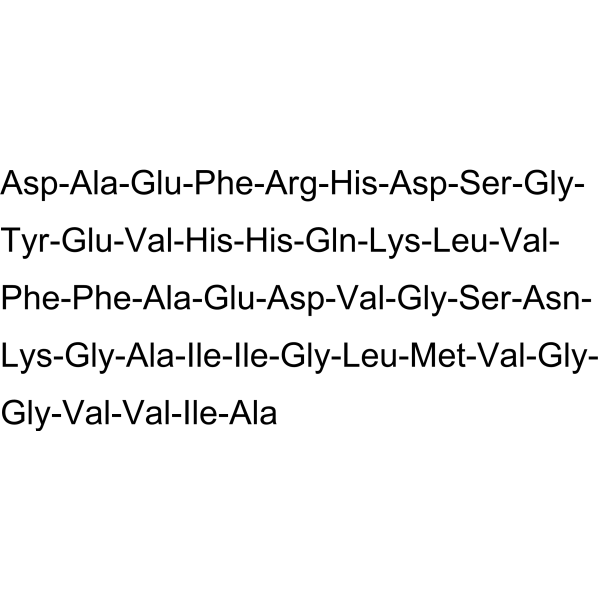
    (Met(O)35)-Amyloid β-Protein (1-42) is the oxidation form of Met35 in Aβ42. (Met(O)35)-Amyloid β-Protein (1-42) can yield an oligomer size distribution characteristic of Aβ40. (Met(O)35)-Amyloid β-Protein (1-42) can be used in the research of Alzheimer’s disease (AD) .
    (Met(O)35)-Amyloid β-Protein (1-42)
  • HY-120156

    Dopamine Receptor α-synuclein Amyloid-β Neurological Disease
    D-520 is a potent and brain-penetrant dopamine D2/D3 agonist (D2 EC50 = 4.73 nM, Ki = 41.8 nM; D3 EC50 = 2.18 nM, Ki = 0.35 nM). D-520 inhibits the formation of aggregates in vitro and promotes the disaggregation of both alpha-synuclein (α-syn) and Aβ aggregates. D-520 exhibits efficacious activity in animal models of Parkinson’s disease (PD). D-520 can be used for PD and PD with dementia (PDD) research [1][2].
    D-520
  • HY-161458

    GSK-3 Tau Protein Neurological Disease
    GSK-3β inhibitor 16 (compound 7c) is a GSK-3β inhibitor with the IC50 of 4.68 nM. GSK-3β inhibitor 16 decreases Tau hyperphosphorylated aggregate and alleviates cognitive impairments in the Scopolamin (HY-N0296)-induced model in mice .
    GSK-3β inhibitor 16
  • HY-184480

    SNIPERs Huntingtin Neurological Disease
    PROTAC HTT Degrader-1 is a cIAP1-recruiting Htt PROTAC degrader. PROTAC HTT Degrader-1 recruits cIAP1 to mHtt or wtHtt and induces their degradation via the ubiquitin-proteasome system. PROTAC HTT Degrader-1 can be used in research related to Huntington's disease .
    PROTAC HTT Degrader-1
  • HY-RS18021

    Small Interfering RNA (siRNA) Others

    Htt Mouse Pre-designed siRNA Set A contains three designed siRNAs for Htt gene (Mouse), as well as a negative control, a positive control, and a FAM-labeled negative control.

    Htt Mouse Pre-designed siRNA Set A
    Htt Mouse Pre-designed siRNA Set A

Inquiry Online

Your information is safe with us. * Required Fields.

Salutation


Country or Region *

Applicant Name *


Organization Name *

Department *


Email Address *


Product Name *

Cat. No.


Requested quantity *

Phone Number *


Remarks

Inquiry Online

Inquiry Information

Product Name:
Cat. No.:
Quantity:
MCE Japan Authorized Agent:

