



Carbenoxolone
Based on 11 publication(s) in Google Scholar
Carbenoxolone is a blood-brain barrier-permeable Pannexin1 inhibitor, gap junction (Gap junction) blocker, and β-amyloid 42 inhibitor. Carbenoxolone modulates voltage-gated currents of wild-type and mutant Panx1, and inhibits stimulus-activated Panx1 channel function. Carbenoxolone interacts with stable residues of β-amyloid 42 peptides, fibrils and oligomers, thereby inhibiting their aggregation. Carbenoxolone alleviates liver fibrosis. Carbenoxolone exerts neuroprotective and nootropic effects. Carbenoxolone can be used in studies related to Alzheimer's disease and liver fibrosis.
Nur für Forschungszwecke. Wir verkaufen nicht an Patienten.
- Reinheit : 99.9%
- CAS. Nr.: 5697-56-3
- Formel: C34H50O7
- Molecular Weight:570.76
-
Speicherung:Powder -20°C, 3 years ; In solvent -80°C, 6 months , -20°C, 1 month


To place orders, for customer services and technical support, please contact: MedChemExpress USA
Tel: 609-228-6898 E-mail: [email protected] [email protected]


-
 Biologische Aktivität
-
Chemical Information
-
Lösungsmittel & Löslichkeit
- Protokoll
- Reinheit & Dokumentation
- Verweise
-
 Help & FAQs


Publications Citing Use of MedChemExpress (MCE) Carbenoxolone
More- Nat Neurosci. 2024 Aug;27(8):1522-1533. [Abstract]
- Cell Chem Biol. 2025 Jun 19;32(6):885-898.e11. [Abstract]
- Free Radic Biol Med. 2025 Feb 1:227:64-79. [Abstract]
- Free Radic Biol Med. 2024 Nov 20:225:641-653. [Abstract]
- Transl Res. 2024 May 9:271:26-39. [Abstract]
- Glia. 2025 Apr 4. [Abstract]
- PLoS Pathog. 2026 Jan 26;22(1):e1013903. [Abstract]
- Biol Reprod. 2025 May 13;112(5):942-954. [Abstract]
- Food Chem Toxicol. 2024 May:187:114594. [Abstract]
- Utah State University . 2026.
- Res Sq. 2025 Sep 11.
 Customer Validation & Images

-
WB
-
Cell Imaging/Staining
-
Bio/Physico-chemical Assay
-
Cell Imaging/Staining
-
WB


Biologische Aktivität
Beschreibung
Cellular Effect
|
Cell Line

|
Type | Value | Description | References |
|---|---|---|---|---|
| 3T3-L1 | EC50 |
>500 μM
Compound: 4; CBX
|
Cytotoxicity against mouse 3T3L1 cells measured after 72 hrs by celltiter-glo luminescent cell viability assay
Cytotoxicity against mouse 3T3L1 cells measured after 72 hrs by celltiter-glo luminescent cell viability assay
|
[PMID: 31294974] |
| CHO | IC50 |
0.5 μM
Compound: Carbenoxolone
|
Inhibition of human 11beta-HSD1 expressed in CHO cells after 3 hrs by HTRF cortisol assay
Inhibition of human 11beta-HSD1 expressed in CHO cells after 3 hrs by HTRF cortisol assay
|
[PMID: 21093259] |
| CHO | IC50 |
250 nM
Compound: Carbenoxolone
|
Inhibition of mouse 11beta-HSD1 expressed in CHO cells after 3 hrs by HTRF cortisol assay
Inhibition of mouse 11beta-HSD1 expressed in CHO cells after 3 hrs by HTRF cortisol assay
|
[PMID: 21093259] |
| CHO-K1 | IC50 |
0.5 μM
Compound: carbenoxolone
|
Inhibition of human 11beta-HSD1 expressed in CHO-K1 cells using cortisone as substrate after 3 hrs by HTRF assay
Inhibition of human 11beta-HSD1 expressed in CHO-K1 cells using cortisone as substrate after 3 hrs by HTRF assay
|
[PMID: 24900439] |
| CHO-K1 | IC50 |
1630 nM
Compound: Carbenoxolone
|
Inhibition of human 11beta-HSD1 expressed in CHOK1 cells using XL665-labeled cortisol as substrate measured after 24 hrs by HTRF assay
Inhibition of human 11beta-HSD1 expressed in CHOK1 cells using XL665-labeled cortisol as substrate measured after 24 hrs by HTRF assay
|
[PMID: 31759849] |
| CHO-K1 | IC50 |
243 nM
Compound: Carbenoxolone
|
Inhibition of mouse 11beta-HSD1 expressed in CHOK1 cells using XL665-labeled cortisol as substrate measured after 24 hrs by HTRF assay
Inhibition of mouse 11beta-HSD1 expressed in CHOK1 cells using XL665-labeled cortisol as substrate measured after 24 hrs by HTRF assay
|
[PMID: 31759849] |
| HEK293 | EC50 |
82 nM
Compound: Carbenoxolone
|
Inhibition of mouse 11beta-HSD2 expressed in HEK293 cells assessed as [3H]cortisol production after 60 mins by SPA
Inhibition of mouse 11beta-HSD2 expressed in HEK293 cells assessed as [3H]cortisol production after 60 mins by SPA
|
[PMID: 22440625] |
| HEK293 | IC50 |
0.17 μM
Compound: 4; CBX
|
Inhibition of 11beta-HSD2 (unknown origin) expressed in HEK293 cells using cortisone as substrate measured after 2 hrs in presence of NAD+ by HTRF assay
Inhibition of 11beta-HSD2 (unknown origin) expressed in HEK293 cells using cortisone as substrate measured after 2 hrs in presence of NAD+ by HTRF assay
|
[PMID: 31294974] |
| HEK293 | IC50 |
206 nM
Compound: carbenoxolone
|
Inhibition of mouse 11beta-HSD2 expressed in HEK293 cells assessed as conversion of [3H]cortisone into [3H]cortisol by scintillation proximity assay
Inhibition of mouse 11beta-HSD2 expressed in HEK293 cells assessed as conversion of [3H]cortisone into [3H]cortisol by scintillation proximity assay
|
[PMID: 22360639] |
| HEK293 | IC50 |
82 nM
Compound: carbenoxolone
|
Inhibition of mouse microsomal 11beta-HSD2 expressed in HEK293 cells assessed as conversion of [3H]cortisone to [3H]cortisol by scintillation proximity assay
Inhibition of mouse microsomal 11beta-HSD2 expressed in HEK293 cells assessed as conversion of [3H]cortisone to [3H]cortisol by scintillation proximity assay
|
[PMID: 19564108] |
| RAW264.7 | IC50 |
11.42 μM
Compound: Carbenoxolone
|
Antiinflammatory activity against mouse RAW264.7 cells assessed as inhibition of HMGB1-induced NO production pretreated with compounds for 15 mins followed by HMGB1 stimulation measured after 24 hrs by Griess reagent based assay
Antiinflammatory activity against mouse RAW264.7 cells assessed as inhibition of HMGB1-induced NO production pretreated with compounds for 15 mins followed by HMGB1 stimulation measured after 24 hrs by Griess reagent based assay
|
[PMID: 34800877] |
| RAW264.7 | IC50 |
6.64 μM
Compound: Carbenoxolone
|
Anti-inflammatory activity in mouse RAW264.7 cells assessed as inhibition of LPS-induced NO production
Anti-inflammatory activity in mouse RAW264.7 cells assessed as inhibition of LPS-induced NO production
|
[PMID: 34973341] |
| RAW264.7 | IC50 |
7.62 μM
Compound: Carbenoxolone
|
Anti-inflammatory activity in mouse RAW264.7 cells assessed as inhibition of HMGB1-induced NO production
Anti-inflammatory activity in mouse RAW264.7 cells assessed as inhibition of HMGB1-induced NO production
|
[PMID: 34973341] |
In Vitro
Carbenoxolone (0.01-1000 μM) potently inhibits voltage-gated wild-type human Pannexin1 channel activity in HEK293 cells with an IC50 of ~2 μM, with greater inhibition (up to ~90% at 100 mV) observed in strongly rectifying cell populations[1].
Carbenoxolone (0.01-1000 μM) potentiates voltage-gated hPanx1/Panx3 loop1 chimera channel activity in HEK293 cells with an EC50 of ~120 μM, producing a nearly fourfold increase in current at a saturating concentration of 562 μM[1].
Carbenoxolone (50-100 μM; 4 days) inhibits amyloid-beta 42 peptide aggregation in a concentration-dependent manner, with 22.54% inhibition at 50 μM and 47.16% inhibition at 100 μM following 4-day incubation at 37 °C[2].
Carbenoxolone (50 μM; 24-48 h) inhibits gap junction activity in primary rat hepatocytes[3].
MedChemExpress (MCE) has not independently confirmed the accuracy of these methods. They are for reference only.
In Vivo
MedChemExpress (MCE) has not independently confirmed the accuracy of these methods. They are for reference only.
-
Animal Model:Balb/c (male, 22 g)[3]
-
Dosage:1 mg/kg body weight/day
-
Administration:Administered via an osmoti pump implanted in the peritoneal cavity; daily; 14 days
-
Result:Significantly reduced hepatic collagen deposition (p ≤ 0.05) and percentage of alpha smooth muscle actin (α-SMA)-positive cells (p ≤ 0.05).
Increased serum aspartate aminotransferase (AST) levels (p ≤ 0.05).
Significantly upregulated hepatic glutathione peroxidase (GPx) activity (p ≤ 0.05).
Significantly increased hepatic levels of eotaxin-2 (p ≤ 0.05) and Fas ligand (p ≤ 0.05).
Significantly reduced hepatic levels of interleukin 1α (p ≤ 0.01), interleukin 2 (p ≤ 0.05), interleukin 4 (p ≤ 0.05), growth-regulated alpha protein (KC) (p ≤ 0.01), lipopolysaccharide-induced CXC chemokine (LIX) (p ≤ 0.05), thymus-expressed chemokine (TECK) (p ≤ 0.01), and granulocyte-macrophage colony-stimulating factor (GM-CSF) (p ≤ 0.01).


Chemical Information
-
CAS. Nr. 5697-56-3
-
Appearance Solid
-
Molecular Weight 570.76
-
Formel C34H50O7
-
Color White to off-white
-
SMILES
CC(C)([C@]1([H])CC[C@@]([C@@]2(CC[C@]3(CC[C@](C(O)=O)(C[C@]3(C2=C4)[H])C)C)C)5C)[C@@H](OC(CCC(O)=O)=O)CC[C@]1(C)[C@@]5([H])C4=O
-
Versand
Room temperature in continental US; may vary elsewhere.
-
Speicherung
Powder -20°C 3 years In solvent -80°C 6 months -20°C 1 month


Publications (11)
-
Journal Impact Factor
-
Most Recent
-
Nat Neurosci
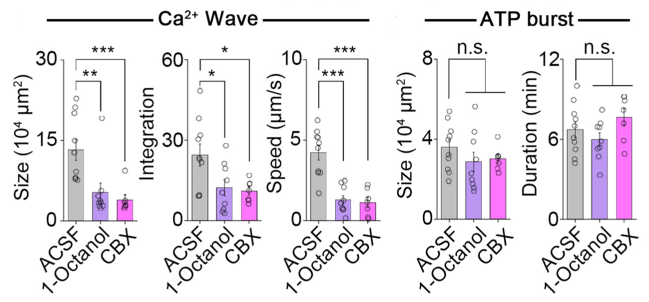
Spatiotemporally selective astrocytic ATP dynamics encode injury information sensed by microglia following brain injury in mice. [Abstract]2024 Aug;27(8):1522-1533. PMID: 38862791
Carbenoxolone purchased from MedChemExpress. Usage Cited in: Nat Neurosci. 2024 Aug;27(8):1522-1533. [Abstract]
The gap-junction dependency of FLA-evoked astrocytic Ca2+ wave and ATP bursts (n = 10/9/7 slices from 4/4/3 mice for ACSF, 1-Octanol and Carbenoxolone disodium; CBX; 100 µM; 5 min).
-
Cell Chem Biol
Electrochemical sensor toolkit for simultaneous glutamate detection at edge of cleft and peri-soma. [Abstract]2025 Jun 19;32(6):885-898.e11. PMID: 40466640 -
Free Radic Biol Med
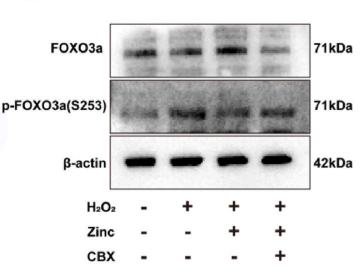
Zinc ions facilitate metabolic bioenergetic recovery post spinal cord injury by activating microglial mitophagy through the STAT3-FOXO3a-SOD2 pathway. [Abstract]2025 Feb 1:227:64-79. PMID: 39613048
Carbenoxolone purchased from MedChemExpress. Usage Cited in: Free Radic Biol Med. 2025 Feb 1:227:64-79. [Abstract]
Western blot analysis of p-FOXO3a (S253) and FOXO3a protein in BV2 cells post-Carbenoxolone disodium (CBX; 100 μM) and H₂O₂/zinc treatment.
-
Free Radic Biol Med
Connexin30-deficient mice increase susceptibility to noise via redox and lactate imbalances. [Abstract]2024 Nov 20:225:641-653. PMID: 39396580 -
Transl Res
Counteracting TGM2 by a Fibroin peptide ameliorated Adriamycin-induced nephropathy via regulation of lipid metabolism through PANX1-PPAR α/PANK1 pathway. [Abstract]2024 May 9:271:26-39. PMID: 38734063
Carbenoxolone purchased from MedChemExpress. Usage Cited in: Transl Res. 2024 May 9:271:26-39. [Abstract]
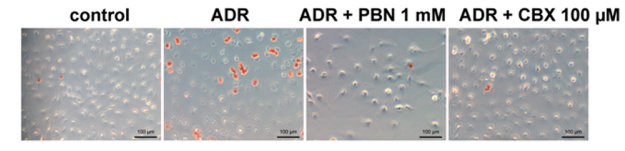
HK-2 cells were treated with PANX1 inhibitor PBN (1 mM),and Carbenoxolone disodium (CBX; 100 μM) with or without ADR. Intracellular lipid content was detected by oil red O staining.
Carbenoxolone purchased from MedChemExpress. Usage Cited in: Transl Res. 2024 May 9:271:26-39. [Abstract]
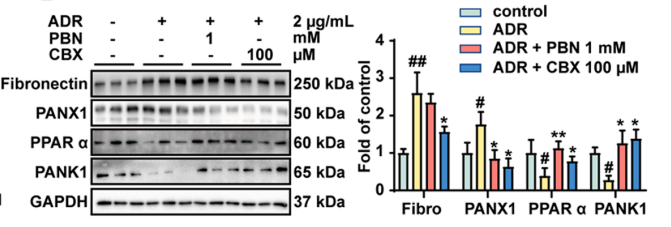
HK-2 cells were treated with PANX1 inhibitor PBN (1 mM), and Carbenoxolone disodium (CBX; 100 μM) with or without ADR. The protein expressions of Fibronectin, PANX1, PPAR α, and PANK1 were analyzed by western blotting.
-
Glia
Role of Cx43 and ACKR3 in Modulating Astrocytic Response and Neuronal Survival Post-Subarachnoid Hemorrhage. [Abstract]2025 Apr 4. PMID: 40183383
Carbenoxolone purchased from MedChemExpress. Usage Cited in: Glia. 2025 Apr 4. [Abstract]
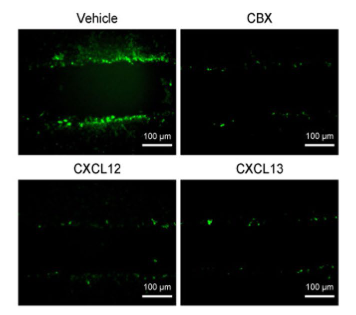
Evaluation of GJIC in different cell groups by assessing thespread of fluorescent dye LY in cultured astrocyte syncytia via scrape-loading. The results showed that LYdiffusion was significantly inhibited in cells treated with Carbenoxolone disodium (CBX; 50 μM), similar to the effects of CXCL12 and CXCL11 .
-
PLoS Pathog
Anti-orthopoxvirus drugs inhibit lumpy skin disease virus replication by targeting viral DNA polymerase. [Abstract]2026 Jan 26;22(1):e1013903. PMID: 41587213 -
Biol Reprod
Suppression of FOXO3 by BMP signaling contribute to the different primordial germ cell proliferation between layers and broilers. [Abstract]2025 May 13;112(5):942-954. PMID: 39987556 -
Food Chem Toxicol
Unveiling the mechanisms of trichloroethylene hypersensitivity syndrome: Exploring the role of connexin 43 gap junctions in severe skin damage. [Abstract]2024 May:187:114594. PMID: 38485042 -
-


Lösungsmittel & Löslichkeit
In Vitro:
DMSO : 100 mg/mL (175.20 mM; Need ultrasonic; Hygroscopic DMSO has a significant impact on the solubility of product, please use newly opened DMSO)
Please refer to the solubility information to select the appropriate solvent. Once prepared, please aliquot and store the solution to prevent product inactivation from repeated freeze-thaw cycles.
Storage method and period of stock solution: -80°C, 6 months; -20°C, 1 month. When stored at -80°C, please use it within 6 months. When stored at -20°C, please use it within 1 month.
Please refer to the solubility information to select the appropriate solvent. Once prepared, please aliquot and store the solution to prevent product inactivation from repeated freeze-thaw cycles.
Storage method and period of stock solution: -80°C, 6 months; -20°C, 1 month. When stored at -80°C, please use it within 6 months. When stored at -20°C, please use it within 1 month.
Konzentration (Stammlösung) × Volumen (Stammlösung) = Konzentration (Ziellösung) × Volumen (Ziellösung)
In Vivo:
Select the appropriate dissolution method based on your experimental animal and administration route.
- For the following dissolution methods, please ensure to first prepare a clear stock solution using an In Vitro approach and then sequentially add co-solvents:
- To ensure reliable experimental results, the clarified stock solution can be appropriately stored based on storage conditions. As for the working solution for In Vivo experiments, it is recommended to prepare freshly and use it on the same day.
- The percentages shown for the solvents indicate their volumetric ratio in the final prepared solution. If precipitation or phase separation occurs during preparation, heat and/or sonication can be used to aid dissolution.
In Vivo Dissolution Calculator
Please enter the basic information of animal experiments:
-
-
-
-
Recommended: Prepare an additional quantity of animals to account for potential losses during experiments.
Please enter your animal formula composition:
-
%DMSO +
Recommended: Keep the proportion of DMSO in working solution below 2% if your animal is weak.
-
%+
-
+%Tween-80 + +
-
%Saline +
The co-solvents required include: DMSO, . All of co-solvents are available by MedChemExpress (MCE). , Tween 80. All of co-solvents are available by MedChemExpress (MCE).
Working solution concentration: 0.22 mg/mL
Method for preparing stock solution: mg drug dissolved in μL DMSO. Stock solution concentration: mg/mL.
1. Take μL DMSO stock solution;
2. Add μL .
μL , mix evenly;
3. Then add μL Tween 80, mix evenly;
4. Then add μL
Please ensure that the stock solution in the first step is dissolved to a clear state, and add co-solvents in sequence. You can use ultrasonic heating (ultrasonic cleaner, recommended frequency 20-40 kHz), vortexing, etc. to assist dissolution.


Reinheit & Dokumentation
-
Data Sheet (277 KB)
-
SDS (396 KB)
- English - EN (396 KB)
- Français - FR (396 KB)
- Deutsch - DE (396 KB)
- Norwegian - NO (396 KB)
- Español - ES (396 KB)
- Swedish - SV (396 KB)
- Italian - IT (396 KB)
- Korean - KR (396 KB)
- Portuguese - PT (396 KB)
-
Handling Instructions (2659 KB)
Verweise
[1]. Michalski K, et al. Carbenoxolone inhibits Pannexin1 channels through interactions in the first extracellular loop. J Gen Physiol. 2016;147(2):165-174. [Content Brief]
[2]. Sharma S, et al. Inhibition of Alzheimer's amyloid-beta aggregation in-vitro by carbenoxolone: Insight into mechanism of action. Neurochem Int. 2017;108:481-493. [Content Brief]
[3]. Crespo Yanguas S, et al. TAT-Gap19 and Carbenoxolone Alleviate Liver Fibrosis in Mice. Int J Mol Sci. 2018;19(3):817. Published 2018 Mar 12. [Content Brief]
[4]. Hirata K, et al. Formulation of carbenoxolone for delivery to the skin. Int J Pharm. 2013;448(2):360-365. [Content Brief]


Complete Stock Solution Preparation Table
Please refer to the solubility information to select the appropriate solvent. Once prepared, please aliquot and store the solution to prevent product inactivation from repeated freeze-thaw cycles.
Storage method and period of stock solution: -80°C, 6 months; -20°C, 1 month. When stored at -80°C, please use it within 6 months. When stored at -20°C, please use it within 1 month.
| Optional Solvent | Concentration Solvent Mass | 1 mg | 5 mg | 10 mg | 25 mg |
|---|---|---|---|---|---|
| DMSO | 1 mM | 1.7520 mL | 8.7602 mL | 17.5205 mL | 43.8012 mL |
| 5 mM | 0.3504 mL | 1.7520 mL | 3.5041 mL | 8.7602 mL | |
| 10 mM | 0.1752 mL | 0.8760 mL | 1.7520 mL | 4.3801 mL | |
| 15 mM | 0.1168 mL | 0.5840 mL | 1.1680 mL | 2.9201 mL | |
| 20 mM | 0.0876 mL | 0.4380 mL | 0.8760 mL | 2.1901 mL | |
| 25 mM | 0.0701 mL | 0.3504 mL | 0.7008 mL | 1.7520 mL | |
| 30 mM | 0.0584 mL | 0.2920 mL | 0.5840 mL | 1.4600 mL | |
| 40 mM | 0.0438 mL | 0.2190 mL | 0.4380 mL | 1.0950 mL | |
| 50 mM | 0.0350 mL | 0.1752 mL | 0.3504 mL | 0.8760 mL | |
| 60 mM | 0.0292 mL | 0.1460 mL | 0.2920 mL | 0.7300 mL | |
| 80 mM | 0.0219 mL | 0.1095 mL | 0.2190 mL | 0.5475 mL | |
| 100 mM | 0.0175 mL | 0.0876 mL | 0.1752 mL | 0.4380 mL |


Carbenoxolone Related Classifications
HY-B1588 Related Classifications
 Powered by Bioz