



Carbenoxolone-d4

Based on 1 Customer Validation
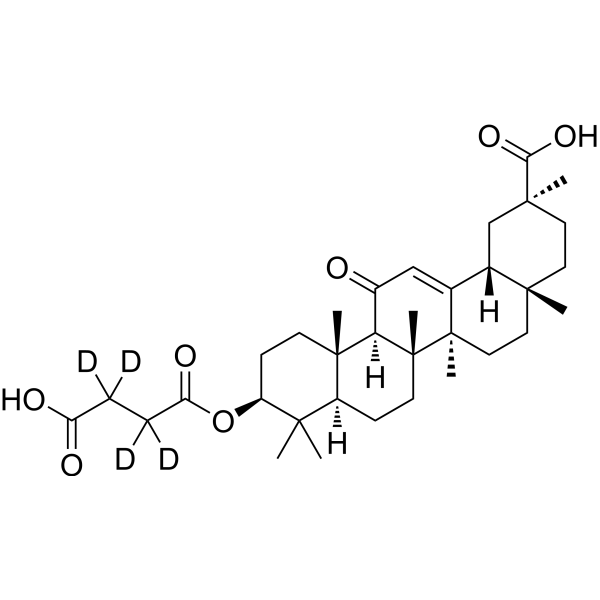
Carbenoxolone-d4 is the d4 labeled Carbenoxolone (HY-B1588). Carbenoxolone is a blood-brain barrier-permeable Pannexin1 inhibitor, gap junction (Gap junction) blocker, and β-amyloid 42 inhibitor. Carbenoxolone modulates voltage-gated currents of wild-type and mutant Panx1, and inhibits stimulus-activated Panx1 channel function. Carbenoxolone interacts with stable residues of β-amyloid 42 peptides, fibrils and oligomers, thereby inhibiting their aggregation. Carbenoxolone alleviates liver fibrosis. Carbenoxolone exerts neuroprotective and nootropic effects. Carbenoxolone can be used in studies related to Alzheimer's disease and liver fibrosis.
For research use only. We do not sell to patients.
- Purity : 99.28%
- Formula: C34H46D4O7
- Molecular Weight:574.78
-
Storage:Powder -20°C, 3 years ; In solvent -80°C, 6 months , -20°C, 1 month

To place orders, for customer services and technical support, please contact: MedChemExpress USA
Tel: 609-228-6898 E-mail: [email protected] [email protected]


-
 Biological Activity
-
Chemical Information
- Protocols
- Purity & Documentation
- References
-
 Help & FAQs




Biological Activity
Description
Application
1. This compound can be used as a tracer
2. This compound can be used as an internal standard for quantitative analysis by NMR, GC-MS, or LC-MS.


Chemical Information
-
Unlabeled CAS 5697-56-3
-
Appearance Solid
-
Molecular Weight 574.78
-
Formula C34H46D4O7
-
Color White to off-white
-
SMILES
C[C@]12[C@@](C(C=C3[C@]2(CC[C@@]4([C@@]3([H])C[C@](C)(CC4)C(O)=O)C)C)=O)([H])[C@@]5([C@@](C(C)([C@H](CC5)OC(C([2H])([2H])C([2H])([2H])C(O)=O)=O)C)([H])CC1)C
-
Shipping
Room temperature in continental US; may vary elsewhere.
-
Storage
Powder -20°C 3 years In solvent -80°C 6 months -20°C 1 month


Purity & Documentation
-
Data Sheet (270 KB)
-
SDS (394 KB)
- English - EN (394 KB)
- Français - FR (394 KB)
- Deutsch - DE (394 KB)
- Norwegian - NO (394 KB)
- Español - ES (394 KB)
- Swedish - SV (394 KB)
- Italian - IT (394 KB)
- Korean - KR (394 KB)
- Portuguese - PT (394 KB)
-
Handling Instructions (2659 KB)
References
[1]. Michalski K, et al. Carbenoxolone inhibits Pannexin1 channels through interactions in the first extracellular loop. J Gen Physiol. 2016;147(2):165-174. [Content Brief]
[2]. Sharma S, et al. Inhibition of Alzheimer's amyloid-beta aggregation in-vitro by carbenoxolone: Insight into mechanism of action. Neurochem Int. 2017;108:481-493. [Content Brief]
[3]. Crespo Yanguas S, et al. TAT-Gap19 and Carbenoxolone Alleviate Liver Fibrosis in Mice. Int J Mol Sci. 2018;19(3):817. Published 2018 Mar 12. [Content Brief]
[4]. Hirata K, et al. Formulation of carbenoxolone for delivery to the skin. Int J Pharm. 2013;448(2):360-365. [Content Brief]

Calculators
Concentration (start) × Volume (start) = Concentration (final) × Volume (final)


Carbenoxolone-d4 Related Classifications
HY-B1588S Related Classifications
 Powered by Bioz