



Dystrophin
Dystrophin is a rod-shaped cytoskeletal protein that connects the intercellular cytoskeleton to the extracellular matrix through an actin-associated glycoprotein complex. This property enables Dystrophin to play a role in sarcolemmal stability during muscle contraction and prevent contraction damage. Dystrophin also mediates cell signaling, such as mechanotransduction and cell adhesion. However, Dystrophin deficiency or mutation (producing internally truncated Dystrophin) will become a predisposing factor for Duchenne muscular dystrophy (DMD). In the muscle tissue of mild and asymptomatic patients, a large number of alternative Dystrophin splicing protein products can be detected. Currently, the methods for restoring Dystrophin mutations rely on virus-mediated restoration or exon skipping. Exon skipping uses antisense oligonucleotides to induce alternative splicing, bypassing the mutated exon to restore the protein reading frame, and converting DMD mutations to Becker muscular dystrophy (BMD) protein mutations.Dystrophin-related proteins can be divided into three groups (according to subcellular localization): (1) α-dystroglycan located outside the cell; (2) β-dystroglycan, sarcoglycans, and sarcospan located on the plasma membrane; (3) Dystrophin, dystrobrevin, syntrophins, and neuronal nitric oxide synthase located inside the cell. Dystrophin has four major functional domains: the actin-binding amino-terminal domain (ABD1), the central rod domain, the cysteine-rich domain, and the carboxyl terminus. Dystrophin interacts with tubulin and acidic actin filaments through the rod domain, so Dystrophin mutations not only lead to progressive loss of muscle tissue and function, but also cause cardiomyopathy[1][2][3].
References:
All Product Categories
-
Dystrophin Related Products (35)
Related Products (35)

- 1
- 2
-
Eteplirsen
 0 ImagesSynonyms: AVI 4658Eteplirsen (AVI 4658) is a phosphorylated diamine morpholino oligonucleotide that targets exon 51 of the human Duchenne muscular dystrophy (DMD) gene. Eteplirsen induces exon 51 skipping, causing it to be skipped during splicing, thereby restoring the translation reading frame and producing a shortened functional dystrophin. Eteplirsen can be used in research on Duchenne muscular dystrophy.
-
Viltolarsen sodium
 0 ImagesCat. No.: HY-132586ASynonyms: NS-065/NCNP-01 sodiumViltolarsen (NS-065/NCNP-01) sodium is a phosphorodiamidate morpholino antisense oligonucleotide. Viltolarsen sodium binds to exon 53 of the dystrophin mRNA precursor and restores the amino acid open-reading frame by skipping exon 53, resulting in the production of a shortened dystrophin protein that contains essential functional portions. Viltolarsen sodium has the potential for Duchenne muscular dystrophy (DMD) research.
-
Eteplirsen sodium
 0 ImagesCat. No.: HY-108753ASynonyms: AVI 4658 sodiumEteplirsen (AVI 4658) sodium is a phosphorylated diamine morpholino oligonucleotide that targets exon 51 of the human Duchenne muscular dystrophy (DMD) gene. Eteplirsen sodium induces exon 51 skipping, causing it to be skipped during splicing, thereby restoring the translation reading frame and producing a shortened functional dystrophin. Eteplirsen sodium can be used in research on Duchenne muscular dystrophy.
-
Viltolarsen
 0 ImagesCat. No.: HY-132586CAS No.: 2055732-84-6Synonyms: NS-065/NCNP-01Viltolarsen (NS-065/NCNP-01) is a phosphorodiamidate morpholino antisense oligonucleotide. Viltolarsen binds to exon 53 of the dystrophin mRNA precursor and restores the amino acid open-reading frame by skipping exon 53, resulting in the production of a shortened dystrophin protein that contains essential functional portions. Viltolarsen has the potential for Duchenne muscular dystrophy (DMD) research.
-
Golodirsen
 0 ImagesCat. No.: HY-132611CAS No.: 1422959-91-8Synonyms: SRP-4053Golodirsen (SRP-4053) is an antisense oligonucleotide of the phophorodiamidate morpholino oligomer (PMO). Golodirsen restores the reading frame of the Duchenne muscular dystrophy (DMD) gene by modifying the splicing process of the pre-mRNA, skipping exon 53. Golodirsen can restore the expression of the anti-myostatin protein. Golodirsen can be used for the research of duchenne muscular dystrophy (DMD).
-
Casimersen sodium
 0 ImagesCat. No.: HY-132584ASynonyms: SRP-4045 sodiumCasimersen (SRP-4045) sodium is an antisense oligonucleotide of the phosphorodiamidate morpholino oligomer subclass. Casimersen sodium binds to exon 45 of dystrophin pre-mRNA, restores the open-reading frame (by skipping exon 45) resulting in the production of an internally truncated but functional dystrophin protein. Casimersen sodium can be used for the research of Duchenne muscular dystrophy (DMD).
-
Zotadirsen
 0 ImagesCat. No.: HY-177972Zotadirsen is the core component of the AOC drug Delpacibart zotadirsen (AOC1044) (HY-177564), consisting of a phosphorodiamidate morpholino oligonucleotide (PMO) targeting exon 44 of the dystrophin gene and an SMCC linker (HY-42360). Upon conjugation with the anti-TfR1 antibody Delpacibart (HY-P990051), Zotadirsen exerts splicing regulatory activity and mediates exon skipping. Zotadirsen can be used in studies related to AOC synthesis.
-
Casimersen
 0 ImagesCat. No.: HY-132584CAS No.: 1422958-19-7Synonyms: SRP-4045Casimersen (SRP-4045) is an antisense oligonucleotide of the phosphorodiamidate morpholino oligomer subclass. Casimersen binds to exon 45 of dystrophin pre-mRNA, restores the open-reading frame (by skipping exon 45) resulting in the production of an internally truncated but functional dystrophin protein. Casimersen can be used for the research of Duchenne muscular dystrophy (DMD).
-
Golodirsen sodium
 0 ImagesCat. No.: HY-132611ASynonyms: SRP-4053 sodiumGolodirsen (SRP-4053) sodium is an antisense oligonucleotide of the phophorodiamidate morpholino oligomer (PMO). Golodirsen sodium restores the reading frame of the Duchenne muscular dystrophy (DMD) gene by modifying the splicing process of the pre-mRNA, skipping exon 53. Golodirsen sodium can restore the expression of the anti-myostatin protein. Golodirsen sodium can be used for the research of duchenne muscular dystrophy (DMD).
-
Drisapersen
 0 ImagesCat. No.: HY-145724CAS No.: 1251830-50-8Synonyms: Kyndrisa; GSK2402968A; PRO051Drisapersen (Kyndrisa) is a 2'-O-methyl phosphorothioate RNA antisense oligonucleotide that induces exon 51 skipping. Drisapersen induces skipping of exon 51 during Dystrophin pre-mRNA splicing, allowing the synthesis of partially functional Dystrophin. Drisapersen can be used in research related to Duchenne muscular dystrophy.
-
RTC13
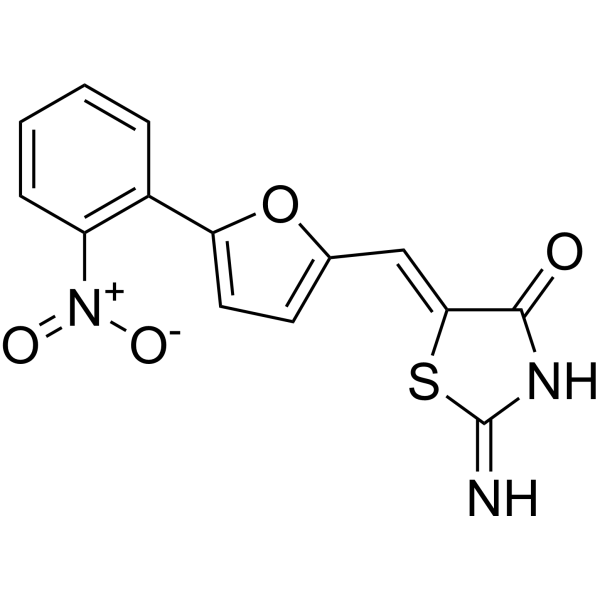 0 ImagesRTC13 restores dystrophin expression and improves muscle function in the mdx mouse model for Duchenne muscular dystrophy (DMD).
-
TG693
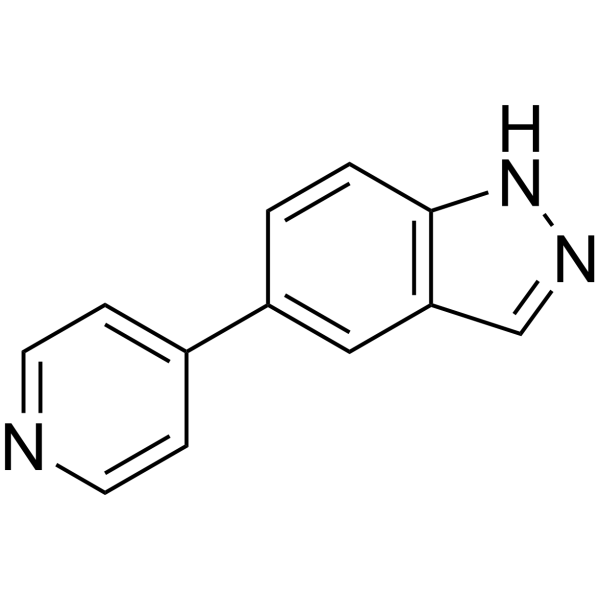 0 ImagesTG693 is an orally active inhibitor of CLK1. TG693 regulates the mutated exon 31 of the dystrophin gene in vivo. TG693 is used in Duchenne muscular dystrophy (DMD) research.
-
FITC-labeled Drisapersen sodium
 0 ImagesCat. No.: HY-150237FITC-labeled Drisapersen (sodium) is Drisapersen labeled with FITC. Drisapersen, a antisense oligonucleotide, induces exon 51 skipping during dystrophin pre-mRNA splicing and allows synthesis of partially functional dystrophin in Duchenne muscular dystrophy (DMD) patients with amenable mutations.
-
FAM labled Zotadirsen
 0 ImagesCat. No.: HY-177972BFAM labled Zotadirsenis a FAM labled Zotadirsen.
-
Cy3 labled Zotadirsen
 0 ImagesCat. No.: HY-177972CCy3 labled Zotadirsen is a Cy3 labled Zotadirsen.
-
Renadirsen
 0 ImagesCat. No.: HY-177658CAS No.: 1782108-31-9Synonyms: DS-5141bRenadirsen is an antisense oligonucleotide that induces robust Exon 45 skipping for Dystrophin in vivo.
-
FAM labled Eteplirsen sodium
 0 ImagesCat. No.: HY-108753DFAM labled Eteplirsen sodiumis a FAM labled Eteplirsen (AVI 4658) sodium (HY-108753A). Eteplirsen (AVI 4658) sodium is a phosphorylated diamine morpholino oligonucleotide that targets exon 51 of the human Duchenne muscular dystrophy (DMD) gene. Eteplirsen sodium induces exon 51 skipping, causing it to be skipped during splicing, thereby restoring the translation reading frame and producing a shortened functional dystrophin. Eteplirsen sodium can be used in research on Duchenne muscular dystrophy.
-
Nivudirsen sodium scrambled negative control
 0 ImagesCat. No.: HY-177649BNivudirsen sodium scrambled negative control is the sequence scrambled negative control of Nivudirsen sodium.
-
Rimigorsen
 0 ImagesCat. No.: HY-177659CAS No.: 1196915-71-5Rimigorsen is an antisense oligonucleotide that induces skipping of exon 44 of the pre-mRNA encoding dystrophin in a Duchenne muscular dystrophy (DMD)
-
Tacadirsen
 0 ImagesCat. No.: HY-185321CAS No.: 3037526-45-4Tacadirsen is an oligonucleotide that can promote the synthesis of functional dystrophin synthesis, and is used for the research of Duchenne muscular dystrophy.
- 1
- 2



