



AChE/BChE/BACE-1-IN-2
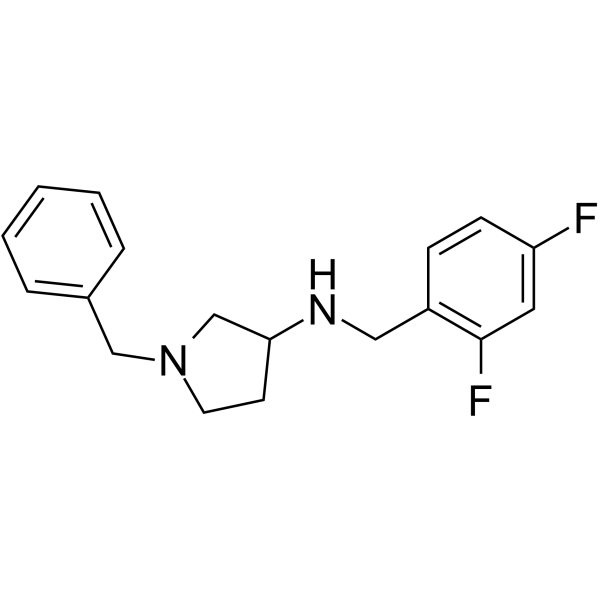
AChE/BChE/BACE-1-IN-2 (Compound 4o) is an orally active inhibitor of AChE, BChE, and BACE-1 with IC50 values of 0.069, 0.127 and 0.097 μM against hAChE, hBChE and hBACE-1, respectively. AChE/BChE/BACE-1-IN-2 shows considerable PAS-AChE binding capability, excellent brain permeation, potential disassembly of Aβ aggregates, and neuroprotective activity against Aβ-induced stress. AChE/BChE/BACE-1-IN-2 has remarkable antioxidant potential.
Nur für Forschungszwecke. Wir verkaufen nicht an Patienten.
- CAS. Nr.: 1877000-20-8
- Formel: C18H20F2N2
- Molecular Weight:302.36
-
Speicherung:
Please store the product under the recommended conditions in the Certificate of Analysis.

To place orders, for customer services and technical support, please contact: MedChemExpress USA
Tel: 609-228-6898 E-mail: [email protected] [email protected]


-
 Biologische Aktivität
-
Chemical Information
- Protokoll
- Reinheit & Dokumentation
- Verweise
-
 Help & FAQs




Biologische Aktivität
Beschreibung
IC50 & Target
IC50: 0.069 μM (hAChE), 0.097 μM (hBACE-1), 0.127 μM (hBChE)[1]
In Vivo
MedChemExpress (MCE) has not independently confirmed the accuracy of these methods. They are for reference only.


Chemical Information
-
CAS. Nr. 1877000-20-8
-
Molecular Weight 302.36
-
Formel C18H20F2N2
-
SMILES
FC1=CC(F)=C(C=C1)CNC2CCN(C2)CC3=CC=CC=C3
-
Versand
Room temperature in continental US; may vary elsewhere.
-
Speicherung
Please store the product under the recommended conditions in the Certificate of Analysis.

Protokoll
-
Cell Cytotoxicity Assay
Cytotoxicity assays are usually based on the assessment of cell membrane damage, which can also be indirectly detected by measuring cell viability. Detection methods include MTT assay, CKK-8 assay, LDH assay and ATP assay, etc.
-
Carbohydrates and Mucins: Periodic Acid-Schiff (PAS) Staining
Periodic acid-Schiff staining detects tissue carbohydrates and mucosubstances by oxidizing carbohydrate glycol groups with periodic acid to generate aldehydes, which then react with Schiff reagent to produce a magenta reaction product; classic reports established the method for mucin and polysaccharide-containing structures in fixed tissue sections. PAS staining can demonstrate neutral mucins and goblet-cell mucin, but it is not specific for mucin because glycogen and other PAS-positive tissue components can also stain; diastase/PAS-D is used when glycogen removal is needed to distinguish glycogen-dependent PAS signal from non-glycogen PAS-positive mucosubstances.
-
Alzheimer’s Disease Modeling
Alzheimer’s Disease (AD) is a neurodegenerative disorder characterized by a progressive decline in cognitive functions and loss of specific types of neurons and synapses. Alzheimer's symptoms can be simulated in mice by injecting drugs (such as Aβ) or genetically modified.


Reinheit & Dokumentation
Verweise

Calculators
Konzentration (Stammlösung) × Volumen (Stammlösung) = Konzentration (Ziellösung) × Volumen (Ziellösung)


AChE/BChE/BACE-1-IN-2 Related Classifications
HY-147659 Related Classifications
 Powered by Bioz