



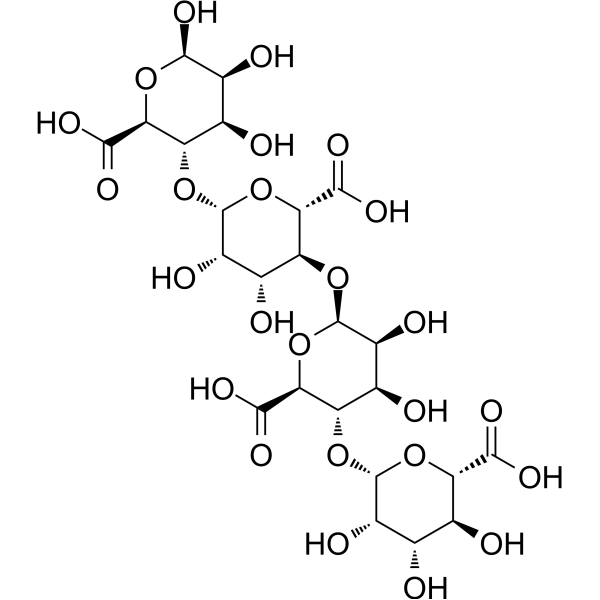
D-Tetramannuronic acid

Based on 1 Customer Validation
D-Tetramannuronic acid, an alginate oligomer, is produced by marine brown algae and by a limited range of Gram negative bacteria. D-Tetramannuronic acid can be used for the research of pain and vascular dementia.
For research use only. We do not sell to patients.
- Purity : 98.0%
- CAS No.: 149511-34-2
- Formula: C24H34O25
- Molecular Weight:722.51
-
Storage:
-20°C, sealed storage, away from moisture and light
* In solvent : -80°C, 6 months; -20°C, 1 month (sealed storage, away from moisture and light)

To place orders, for customer services and technical support, please contact: MedChemExpress USA
Tel: 609-228-6898 E-mail: [email protected] [email protected]


-
 Biological Activity
-
Chemical Information
- Purity & Documentation
- References
-
 Help & FAQs




Biological Activity
Description


Chemical Information
-
CAS No. 149511-34-2
-
Appearance Solid
-
Molecular Weight 722.51
-
Formula C24H34O25
-
Color Off-white to light yellow
-
SMILES
OC([C@@H](O[C@H]1O[C@@H]([C@@H]([C@@H]2O)O)[C@H](O[C@H]2O)C(O)=O)[C@H]([C@@H]([C@@H]1O)O)O[C@@H]([C@H]([C@H]3O)O)O[C@@H]([C@H]3O[C@@H]([C@H]([C@H]4O)O)O[C@@H]([C@H]4O)C(O)=O)C(O)=O)=O
-
Structure Classification
-
Initial Source
marine brown algae and a limited range of Gram negative bacteria
-
Shipping
Room temperature in continental US; may vary elsewhere.
-
Storage
-20°C, sealed storage, away from moisture and light
* In solvent : -80°C, 6 months; -20°C, 1 month (sealed storage, away from moisture and light)


Purity & Documentation
-
Data Sheet (274 KB)
-
SDS (252 KB)
- English - EN (252 KB)
- Français - FR (252 KB)
- Deutsch - DE (252 KB)
- Norwegian - NO (252 KB)
- Español - ES (252 KB)
- Swedish - SV (252 KB)
- Italian - IT (252 KB)
- Korean - KR (252 KB)
- Portuguese - PT (252 KB)
-
Handling Instructions (2659 KB)
References
[1]. Heyraud A, et, al. HPLC analysis of saturated or unsaturated oligoguluronates and oligomannuronates. Application to the determination of the action pattern of Haliotis tuberculata alginate lyase. Carbohydr Res. 1996 Sep 23; 291:115-26. [Content Brief]
[2]. Iwamoto M, et, al. Structure-activity relationship of alginate oligosaccharides in the induction of cytokine production from RAW264.7 cells. FEBS Lett. 2005 Aug 15; 579(20): 4423-9. [Content Brief]

Calculators
Concentration (start) × Volume (start) = Concentration (final) × Volume (final)


D-Tetramannuronic acid Related Classifications
HY-N7699B Related Classifications
 Powered by Bioz