



Biotinylated isoxazole

Based on 1 Customer Validation
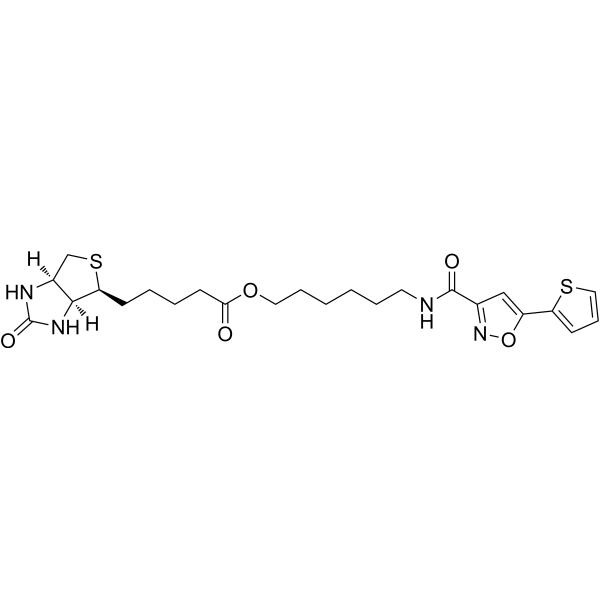
Biotinylated isoxazole is a chemical probe that selectively precipitates proteins containing prion-like low-complexity domains and Cross-β prion-like polymers through recognition of Cross-β structure. Biotinylated isoxazole induces precipitation of proteins containing intrinsically disordered regions through microcrystal formation in solution. Biotinylated isoxazole enables enrichment of Amyloid oligomers for ELISA-based detection. Biotinylated isoxazole decreases Gems and increases misfolded PFN1 aggregates.
Nur für Forschungszwecke. Wir verkaufen nicht an Patienten.
- Reinheit : 99.41%
- CAS. Nr.: 1377605-22-5
- Formel: C24H32N4O5S2
- Molecular Weight:520.66
-
Speicherung:Powder -20°C, 3 years , 4°C, 2 years ; In solvent -80°C, 6 months , -20°C, 1 month

To place orders, for customer services and technical support, please contact: MedChemExpress USA
Tel: 609-228-6898 E-mail: [email protected] [email protected]


-
 Biologische Aktivität
-
Chemical Information
-
Lösungsmittel & Löslichkeit
- Reinheit & Dokumentation
- Verweise
-
 Help & FAQs




Biologische Aktivität
Beschreibung
In Vitro
Biotinylated isoxazole (100 µM; 1 h) effectively precipitates NUP98 fusion proteins in HL-60 cell lysates, indicating its propensity to participate in biomolecular condensation[2].
Biotinylated isoxazole (11-33 µM) effectively maps cellular condensates in HL-60 cells, identifying proteins with dose-dependent precipitation and enrichment propensity for LLPS factors[2].
Biotinylated isoxazole (11-33 µM) extensively rearranges cellular condensates in HL-60 cells expressing NUP98-KDM5A or NUP98-NSD1, enriching key complexes involved in transcriptional activation and chromatin organization[2].
Biotinylated isoxazole (60 min) precipitates cross-β protein aggregates from ALS plasma (but not from healthy controls), and the precipitate size is negatively correlated with ALSFRS-R scores[3].
Biotinylated isoxazole (100 mM) selectively precipitates recombinant SMN1 protein and cellular SMN from mes23.5 cell lysates, primarily recognizing the cytoplasmic conformation[4].
Treatment with biotinylated isoxazole eliminates endogenous SUMOylated SMN protein, which is predominantly detected in the insoluble urea fraction of mes23.5 cells[4].
The biotinylated isoxazole precipitation assay is a method used to isolate prion-like proteins from 293T cell lysates[4].
Biotinylated isoxazole (100 mM) precipitates SMN from mes23.5 and 293T cell lysates, indicating that SMN possesses prion-like and phase transition potential[5].
Biotinylated isoxazole precipitates RNA-binding proteins that are components of mRNP granules[6].
MedChemExpress (MCE) has not independently confirmed the accuracy of these methods. They are for reference only.
-
Cell Line:HL-60 cells expressing NUP98 fusion proteins (NUP98-KDM5A, NUP98-NSD1, NUP98-HOXA9, NUP98-DDX10, NUP98-PSIP1) or N-NUP98
-
Concentration:100 µM
-
Incubation Time:1 h at 4 °C
-
Result:Efficiently precipitated all tested NUP98 fusion proteins from HL-60 cell lysates.
Co-precipitated the known NUP98 interactor RAE1.
Did not precipitate the highly structured protein HSC70.
Precipitation was not affected by the presence of the Strep-HA tag.


Chemical Information
-
CAS. Nr. 1377605-22-5
-
Appearance Solid
-
Molecular Weight 520.66
-
Formel C24H32N4O5S2
-
Color White to off-white
-
SMILES
O=C(C1=NOC(C2=CC=CS2)=C1)NCCCCCCOC(CCCC[C@H]3[C@]4([H])[C@](NC(N4)=O)([H])CS3)=O
-
Versand
Room temperature in continental US; may vary elsewhere.
-
Speicherung
Powder -20°C 3 years 4°C 2 years In solvent -80°C 6 months -20°C 1 month


Lösungsmittel & Löslichkeit
In Vitro:
DMSO : 41.67 mg/mL (80.03 mM; ultrasonic and warming and heat to 60°C; Hygroscopic DMSO has a significant impact on the solubility of product, please use newly opened DMSO)
Please refer to the solubility information to select the appropriate solvent. Once prepared, please aliquot and store the solution to prevent product inactivation from repeated freeze-thaw cycles.
Storage method and period of stock solution: -80°C, 6 months; -20°C, 1 month. When stored at -80°C, please use it within 6 months. When stored at -20°C, please use it within 1 month.
Please refer to the solubility information to select the appropriate solvent. Once prepared, please aliquot and store the solution to prevent product inactivation from repeated freeze-thaw cycles.
Storage method and period of stock solution: -80°C, 6 months; -20°C, 1 month. When stored at -80°C, please use it within 6 months. When stored at -20°C, please use it within 1 month.
Konzentration (Stammlösung) × Volumen (Stammlösung) = Konzentration (Ziellösung) × Volumen (Ziellösung)


Reinheit & Dokumentation
-
Data Sheet (272 KB)
-
SDS (396 KB)
- English - EN (396 KB)
- Français - FR (396 KB)
- Deutsch - DE (396 KB)
- Norwegian - NO (396 KB)
- Español - ES (396 KB)
- Swedish - SV (396 KB)
- Italian - IT (396 KB)
- Korean - KR (396 KB)
- Portuguese - PT (396 KB)
-
Handling Instructions (2659 KB)
Verweise


Complete Stock Solution Preparation Table
Please refer to the solubility information to select the appropriate solvent. Once prepared, please aliquot and store the solution to prevent product inactivation from repeated freeze-thaw cycles.
Storage method and period of stock solution: -80°C, 6 months; -20°C, 1 month. When stored at -80°C, please use it within 6 months. When stored at -20°C, please use it within 1 month.
| Optional Solvent | Concentration Solvent Mass | 1 mg | 5 mg | 10 mg | 25 mg |
|---|---|---|---|---|---|
| DMSO | 1 mM | 1.9206 mL | 9.6032 mL | 19.2064 mL | 48.0160 mL |
| 5 mM | 0.3841 mL | 1.9206 mL | 3.8413 mL | 9.6032 mL | |
| 10 mM | 0.1921 mL | 0.9603 mL | 1.9206 mL | 4.8016 mL | |
| 15 mM | 0.1280 mL | 0.6402 mL | 1.2804 mL | 3.2011 mL | |
| 20 mM | 0.0960 mL | 0.4802 mL | 0.9603 mL | 2.4008 mL | |
| 25 mM | 0.0768 mL | 0.3841 mL | 0.7683 mL | 1.9206 mL | |
| 30 mM | 0.0640 mL | 0.3201 mL | 0.6402 mL | 1.6005 mL | |
| 40 mM | 0.0480 mL | 0.2401 mL | 0.4802 mL | 1.2004 mL | |
| 50 mM | 0.0384 mL | 0.1921 mL | 0.3841 mL | 0.9603 mL | |
| 60 mM | 0.0320 mL | 0.1601 mL | 0.3201 mL | 0.8003 mL | |
| 80 mM | 0.0240 mL | 0.1200 mL | 0.2401 mL | 0.6002 mL |


Biotinylated isoxazole Related Classifications
HY-W750960 Related Classifications
 Powered by Bioz
Keywords
- Biotinylated isoxazole
- 1377605-22-5
- Prion Protein
- Biochemical Assay Reagents
- Amyloid-β
- NUP98 fusion proteins
- cross-β prion-like polymers
- amyloid oligomers
- prion-like low-complexity proteins
- intrinsically disordered region-containing proteins
- gems
- misfolded PFN1 aggregates
- prion-like low-complexity domain-containing proteins
- HL-60 cells
- SMN
- Inhibitor
- inhibitor
- inhibit