



Peucedanocoumarin III

Based on 1 Customer Validation
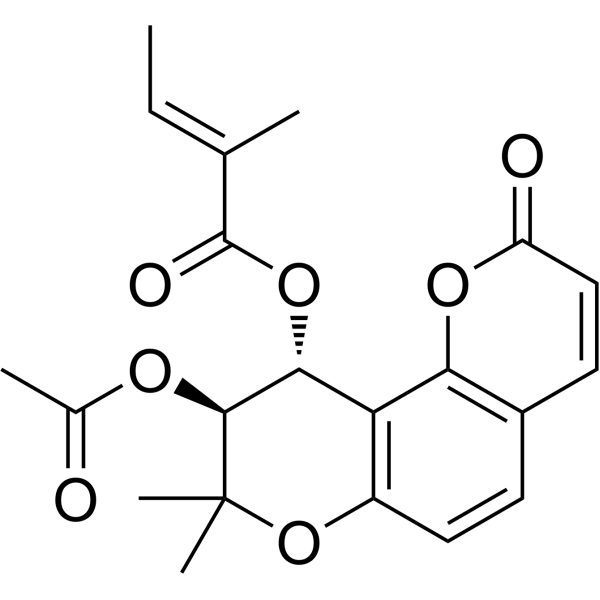
Peucedanocoumarin III is an α-synuclein fiber depolymerizer with blood-brain barrier permeability. Peucedanocoumarin III depolymerizes β-sheet aggregate structures, promotes aggregate clearance, inhibits β23-induced cytotoxicity, blocks the formation of Lewy body-like inclusions, and prevents dopaminergic neuron loss. Peucedanocoumarin III can be used in studies related to Parkinson's disease.
For research use only. We do not sell to patients.
- Purity : 95.07%
- CAS No.: 130464-57-2
- Formula: C21H22O7
- Molecular Weight:386.40
-
Storage:
-20°C, sealed storage, away from moisture
* In solvent : -80°C, 6 months; -20°C, 1 month (sealed storage, away from moisture)

To place orders, for customer services and technical support, please contact: MedChemExpress USA
Tel: 609-228-6898 E-mail: [email protected] [email protected]


-
 Biological Activity
-
Chemical Information
- Purity & Documentation
- References
-
 Help & FAQs


All α-synuclein Isoforms
More

Biological Activity
Description
IC50 & Target
|
α-synuclein Aggregation |
In Vitro
Purified and synthetic Peucedanocoumarin III (1 µM; 37-48 h) similarly clear β23 aggregates and protect SH-SY5Y cells from β23-induced toxicity[1].
Synthetic Peucedanocoumarin III partially protects protects HA-α-synuclein-transfected SH-SY5Y cells from 6-OHDA-induced cytotoxicity[1].
MedChemExpress (MCE) has not independently confirmed the accuracy of these methods. They are for reference only.
Parmacokinetics
| Species | Dose | Route | Brain Concentration |
|---|---|---|---|
| Mice[1] | 10 mg/kg | i.p. | 230 ng/g |
In Vivo
Peucedanocoumarin III (10 mg/kg/day; i.p.; daily; 7 days) is well-tolerated in healthy mice, shows no adverse effects on body weight, motor function, or tissue structure, and penetrates the blood-brain barrier to reach therapeutic target tissue[1].
MedChemExpress (MCE) has not independently confirmed the accuracy of these methods. They are for reference only.
-
Animal Model:C57BL/6N (male, 2 months old, intrastriatal stereotaxic injection of 6-OHDA)[1]
-
Dosage:1 mg/kg/day
-
Administration:i.p.; daily; 7 days
-
Result:Substantially reduced phospho-serine 129 α-synuclein (pS129-α-Syn) positive Lewy-like inclusion intensities.
Largely alleviated 6-OHDA-induced dopaminergic neuron loss in the substantia nigra pars compacta.
Substantially protected against 6-OHDA-induced loss of striatal dopaminergic nerve terminals.
Reduced 6-OHDA-induced GFAP immunofluorescence signal increase by about two-fold relative to PBS controls.
-
Animal Model:C57BL/6N (male, 2 months old)[1]
-
Dosage:10 mg/kg/day
-
Administration:i.p.; daily; 7 days
-
Result:Showed no statistically significant difference in body weight relative to DMSO controls.
Showed no statistically significant differences in total open field exploration distance, time/distance spent in arena zones, rotarod latency/speed, or pole test time to ground relative to DMSO controls.
Distributed to all tested tissues, with brain levels of 230 ng/g tissue, heart levels of 231 ng/g tissue, lung levels of 121 ng/g tissue, liver levels of 105 ng/g tissue, kidney levels of 162 ng/g tissue, and spleen levels of 109 ng/g tissue.
Showed no structural abnormalities in heart, lung, liver, kidney, or spleen via H&E staining.
Showed no statistically significant difference in GFAP immunofluorescence signal in cortex, hippocampus, striatum, or ventral midbrain relative to DMSO controls.


Chemical Information
-
CAS No. 130464-57-2
-
Appearance Solid
-
Molecular Weight 386.40
-
Formula C21H22O7
-
Color White to off-white
-
SMILES
C/C=C(C)/C(O[C@@H]1C2=C(OC(C)([C@H]1OC(C)=O)C)C=CC(C=C3)=C2OC3=O)=O
-
Structure Classification
-
Initial Source
-
Shipping
Room temperature in continental US; may vary elsewhere.
-
Storage
-20°C, sealed storage, away from moisture
* In solvent : -80°C, 6 months; -20°C, 1 month (sealed storage, away from moisture)


Purity & Documentation
-
Data Sheet (280 KB)
-
SDS (251 KB)
- English - EN (251 KB)
- Français - FR (251 KB)
- Deutsch - DE (251 KB)
- Norwegian - NO (251 KB)
- Español - ES (251 KB)
- Swedish - SV (251 KB)
- Italian - IT (251 KB)
- Korean - KR (251 KB)
- Portuguese - PT (251 KB)
-
Handling Instructions (2659 KB)
References
[1]. Ham S, et al. Therapeutic Evaluation of Synthetic Peucedanocoumarin III in an Animal Model of Parkinson's Disease. Int J Mol Sci. 2019;20(21):5481. Published 2019 Nov 4. [Content Brief]
[2]. Jiang J, et al. Growth Year and Chemotype Synergistically Regulate Coumarin Accumulation and the Associated Transcriptional Profiles in Peucedanum praeruptorum Dunn. Plants (Basel). 2026 Feb 13;15(4):598. [Content Brief]
[3]. Chen IS, et al. Coumarins and antiplatelet aggregation constituents from Formosan Peucedanum japonicum. Phytochemistry. 1996;41(2):525-530. [Content Brief]

Calculators
Concentration (start) × Volume (start) = Concentration (final) × Volume (final)


Peucedanocoumarin III Related Classifications
HY-122958 Related Classifications
 Powered by Bioz