



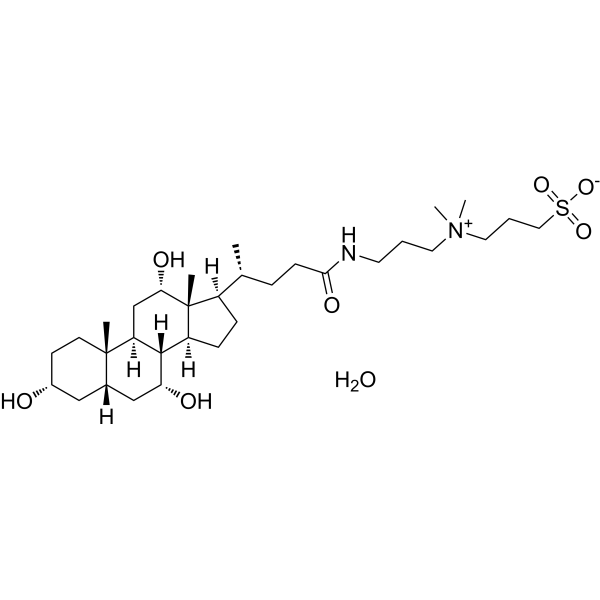
CHAPS hydrate
Based on 4 publication(s) in Google Scholar
CHAPS hydrate is a cholic acid-derived, sulfobetaine-type zwitterionic detergent and micelle-forming agent. CHAPS hydrate exhibits properties of weak cationic or nonionic surfactants in different solution systems, undergoes micellization, and forms small, loose hydrophilic aggregates that are temperature-dependent. CHAPS hydrate stabilizes mononucleosomes under different ionic strengths, reduces nucleosome sequence specificity, promotes sliding of histone cores along DNA, solubilizes Tamm‑Horsfall protein to reduce its interference with urinary exosome isolation, and maintains vesicle structure and the activity of related proteins at the same time. CHAPS hydrate is used to recover native folded fusion proteins, enhance the binding capacity of GST fusion proteins, and restore GST enzyme activity. However, CHAPS hydrate cannot refold proteins denatured by urea, guanidine hydrochloride or heat, nor can it construct the structure of intrinsically disordered proteins. CHAPS hydrate is commonly used in research on the separation and purification of membrane proteins.
For research use only. We do not sell to patients.
- Purity : 98.65%
- CAS No.: 331717-45-4
- Formula: C32H60N2O8S
- Molecular Weight:632.89
-
Storage:
4°C, sealed storage, away from moisture and light
* In solvent : -80°C, 6 months; -20°C, 1 month (sealed storage, away from moisture and light)

To place orders, for customer services and technical support, please contact: MedChemExpress USA
Tel: 609-228-6898 E-mail: [email protected] [email protected]


-
 Biological Activity
-
Chemical Information
-
Solvent & Solubility
- Purity & Documentation
- References
-
 Help & FAQs


Publications Citing Use of MedChemExpress (MCE) CHAPS hydrate
More

Biological Activity
Description
In Vitro
CHAPS hydrate forms low aggregation number (5.4-6.7) micelles with cmc values dependent on solvent and temperature (U-shaped cmc vs temperature curve with minimum at ~295 K) and ΔHm0 transitioning from endothermic to exothermic with increasing temperature in aqueous solutions, NaCl solutions, and buffer solutions[1].
CHAPS hydrate (16-4.8 mM; 1-120 h) stabilizes reconstituted mononucleosomes (assembled with human histones H2A, H2B, H3, H4 on 601 sequence DNA) at 0.4 nM concentration at 0°C without altering their structure, with 16 μM preventing dissociation for 1 hour, 1.6 mM maintaining over 50% intact nucleosomes for 120 hours, and 4.8 mM maintaining over 70% intact nucleosomes for 120 hours[2].
CHAPS hydrate (1% (w/v); overnight at 4°C) treatment of pooled urine-derived exosomal pellets (P18, P200) preserves vesicle morphology, exosomal marker distribution, and nephrilysin activity while removing interfering proteins like THP and albumin[3].
MedChemExpress (MCE) has not independently confirmed the accuracy of these methods. They are for reference only.


Chemical Information
-
CAS No. 331717-45-4
-
Appearance Solid
-
Molecular Weight 632.89
-
Formula C32H60N2O8S
-
Color White to off-white
-
SMILES
O[C@H]1[C@@]2([H])[C@@]3([H])[C@@]([C@@](CC3)([H])[C@H](C)CCC(NCCC[N+](C)(C)CCCS(=O)([O-])=O)=O)([C@H](C[C@]2([H])[C@@]4([C@](C[C@@H](CC4)O)([H])C1)C)O)C.O
-
Shipping
Room temperature in continental US; may vary elsewhere.
-
Storage
4°C, sealed storage, away from moisture and light
* In solvent : -80°C, 6 months; -20°C, 1 month (sealed storage, away from moisture and light)


Publications (4)
-
Journal Impact Factor
-
Most Recent
-
J Colloid Interface Sci
Efficient biofunctionalization of MoS2 nanosheets with peptides as intracellular fluorescent biosensor for sensitive detection of caspase-3 activity. [Abstract]2019 May 1:543:96-105. PMID: 30782521 -
Brain Behav Immun
2026 Jul:135:106516. PMID: 41747779 -
Biochem Pharmacol
2025 Jul:237:116941. PMID: 40228633 -
Biochem Pharmacol
2024 Aug:226:116392. PMID: 38942091


Solvent & Solubility
In Vitro:
DMSO : 10 mg/mL (15.80 mM; Need ultrasonic; Hygroscopic DMSO has a significant impact on the solubility of product, please use newly opened DMSO)
Please refer to the solubility information to select the appropriate solvent. Once prepared, please aliquot and store the solution to prevent product inactivation from repeated freeze-thaw cycles.
Storage method and period of stock solution: -80°C, 6 months; -20°C, 1 month (sealed storage, away from moisture and light). When stored at -80°C, please use it within 6 months. When stored at -20°C, please use it within 1 month.
Please refer to the solubility information to select the appropriate solvent. Once prepared, please aliquot and store the solution to prevent product inactivation from repeated freeze-thaw cycles.
Storage method and period of stock solution: -80°C, 6 months; -20°C, 1 month (sealed storage, away from moisture and light). When stored at -80°C, please use it within 6 months. When stored at -20°C, please use it within 1 month.
Concentration (start) × Volume (start) = Concentration (final) × Volume (final)


Purity & Documentation
-
Data Sheet (274 KB)
-
SDS (394 KB)
- English - EN (394 KB)
- Français - FR (394 KB)
- Deutsch - DE (394 KB)
- Norwegian - NO (394 KB)
- Español - ES (394 KB)
- Swedish - SV (394 KB)
- Italian - IT (394 KB)
- Korean - KR (394 KB)
- Portuguese - PT (394 KB)
-
Handling Instructions (2659 KB)
References
[1]. Kroflic A, et al. Thermodynamic characterization of 3-[(3-cholamidopropyl)-dimethylammonium]-1-propanesulfonate (CHAPS) micellization using isothermal titration calorimetry: temperature, salt, and pH dependence. Langmuir. 2012 Jul 17;28(28):10363-71. [Content Brief]
[2]. Menshikova I, et al. Nucleosomes structure and dynamics: effect of CHAPS. Int J Biochem Mol Biol. 2011;2(2):129-137. [Content Brief]
[3]. Musante L, et al. Biochemical and physical characterisation of urinary nanovesicles following CHAPS treatment. PLoS One. 2012;7(7):e37279. [Content Brief]
[4]. Tao H, et al. Purifying natively folded proteins from inclusion bodies using sarkosyl, Triton X-100, and CHAPS. Biotechniques. 2010;48(1):61-64. [Content Brief]


Complete Stock Solution Preparation Table
Please refer to the solubility information to select the appropriate solvent. Once prepared, please aliquot and store the solution to prevent product inactivation from repeated freeze-thaw cycles.
Storage method and period of stock solution: -80°C, 6 months; -20°C, 1 month (sealed storage, away from moisture and light). When stored at -80°C, please use it within 6 months. When stored at -20°C, please use it within 1 month.
| Optional Solvent | Concentration Solvent Mass | 1 mg | 5 mg | 10 mg | 25 mg |
|---|---|---|---|---|---|
| DMSO | 1 mM | 1.5801 mL | 7.9003 mL | 15.8005 mL | 39.5013 mL |
| 5 mM | 0.3160 mL | 1.5801 mL | 3.1601 mL | 7.9003 mL | |
| 10 mM | 0.1580 mL | 0.7900 mL | 1.5801 mL | 3.9501 mL | |
| 15 mM | 0.1053 mL | 0.5267 mL | 1.0534 mL | 2.6334 mL |


CHAPS hydrate Related Classifications
HY-15435A Related Classifications
 Powered by Bioz