



Serotonin Transporter Antibody (YA1638)
(Synonyms: SLC6A4; 5HTT; 5HT transporter; 5-HTT; 5-HTTLPR; OCD1; SERT; Serotonin transporter; HSERT; SERT1)Based on 1 Customer Validation
Serotonin Transporter Antibody (YA1638) is a Rabbit-derived and non-conjugated IgG monoclonal antibody, targeting to Serotonin Transporter.
-
Host:
Rabbit
-
Isotype:
IgG
-
Application:
WB
-
Reactivity :
Human, Mouse, Rat
-
Formulation:
Supplied in PBS containing 50% glycerol, 0.5% BSA and 0.02% sodium azide.
-
Conjugation:
Non-conjugated


To place orders, for customer services and technical support, please contact: MedChemExpress USA
Tel: 609-228-6898 E-mail: [email protected] [email protected]





Applications
| Application |
WB

WB: Western Blot
|
|---|---|
| Dilution Ratio | 1:500-1:1000 |


Product Details
Serotonin Transporter Antibody (YA1638) is a Rabbit-derived and non-conjugated IgG monoclonal antibody, targeting to Serotonin Transporter.
-
Host Rabbit

-
Clonality Recombinant,Monoclonal

-
Species ReactivityHuman, Mouse, Rat
-
Observed Molecular WeightObserved band size: 70 kDa
Note: Due to possible protein modifications or aggregation, the molecular weight should be confirmed by actual measurement, and the predicted value is for reference only.

-
Calculated Molecular Weight Predicted band size: 70 kDa

Entrez Gene: 6532 Human ; 15567 Mouse ; 25553 Rat
SwissProt: P31645 Human ; Q60857 Mouse ; P31652 Rat
OMIM: 103780 Human
A synthesized peptide derived from human Serotonin transporter aa50-100/630.
Endogenous
Affinity Chromatography
Non-conjugated
Unmodified
IgG


Product Properties
-
Appearance
Solution
-
Formulation
Supplied in PBS containing 50% glycerol, 0.5% BSA and 0.02% sodium azide.
-
Concentration
Batch-dependent, Please check the COA for the concentration of each lot. Check Lot Concentration
-
Storage & Stability
Stored at -20°C for 1 year. Avoid repeated freeze / thaw cycles.
-
Shipping
Shipping with blue ice.


Verification Images
-
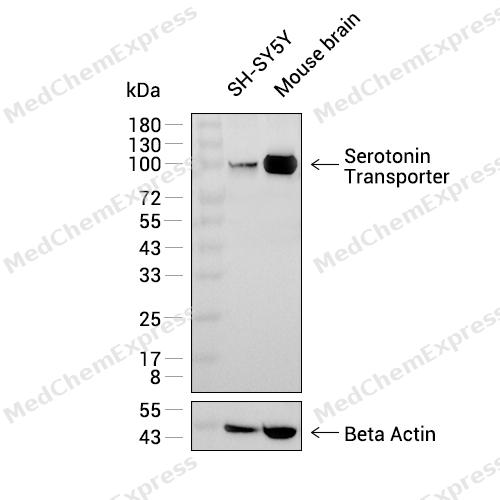
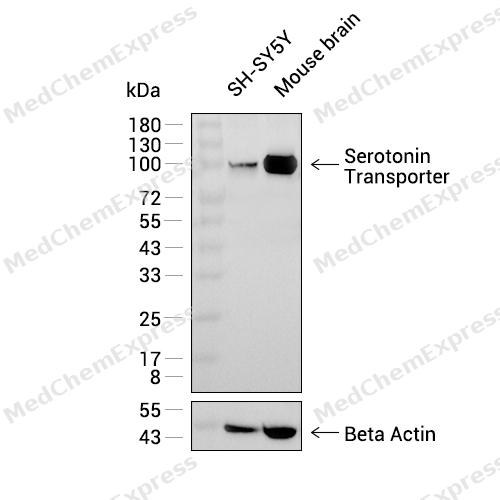 Western blot analysis was performed on extracts from SH-SY5Y (lane 1, 20 μg), and Mouse brain (lane 2, 20 μg) using Serotonin Transporter Rabbit mAb.Proteins were transferred to a PVDF membrane and blocked with 5% non - fat milk in TBST at 4°C overnight.The primary antibody (1:1000 dilution) and the loading control antibody (beta-Actin, HY-P83730, 1:5000 dilution) were incubated in 5% non-fat milk in TBST for 1 hour at 37°C.Goat Anti - Rabbit IgG - HRP Secondary Antibody (1:20000 dilution) was then applied for 40 minutes at 37°C.


Background
-
Function
Serotonin Transporters (SERTs) are integral membrane proteins that transport serotonin from synaptic spaces into presynaptic neurons. SERTs function by reuptaking serotonin in the synaptic cleft, effectively terminating the function of serotonin and halting neuronal transmission. Serotonin reuptake is a critical process to prevent overstimulation of nerves. Serotonin transporter (SERT) regulates extracellular levels of serotonin (5-hydroxytryptamine, 5HT) in the brain by transporting 5HT into neurons and glial cells. The human SERT (hSERT) is the primary target for drugs used in the treatment of emotional disorders, including depression. hSERT belongs to the solute carrier 6 family that includes a bacterial leucine transporter (LeuT), for which a high resolution crystal structure has become available.
-
Subcellular Localization
Cell membrane; Multi-pass membrane protein; Endomembrane system; Multi-pass membrane protein; Endosome membrane; Multi-pass membrane protein; Synapse; Cell junction, focal adhesion; Cell projection, neuron projection
-
Expression
Tissue_specificity:Expressed in platelets (at protein level) -
Isoforms & Post-Translational Modification
P31645 has 2 isomers: P31645-1: 70325 Da (predicted); P31645-2: 74979 Da (predicted).
Phosphorylation at Thr-276 increases 5-HT uptake and is required for cGMP-mediated SERT regulation -
Subunit
Monomer or homooligomer (By similarity). Interacts with TGFB1I1 (PubMed:16803896). Interacts with SEC23A, SEC24C and PATJ.
-
SwissProt ID
-
Synonyms
SLC6A4; 5HTT; 5HT transporter; 5-HTT; 5-HTTLPR; OCD1; SERT; Serotonin transporter; HSERT; SERT1
-
Research Field
Neuroscience


Documentation
-
Data Sheet (231 KB)
-
SDS (252 KB)
- English - EN (252 KB)
- Français - FR (252 KB)
- Deutsch - DE (252 KB)
- Norwegian - NO (252 KB)
- Español - ES (252 KB)
- Swedish - SV (252 KB)
- Italian - IT (252 KB)
- Korean - KR (252 KB)
- Portuguese - PT (252 KB)
-
User Guide for Antibodies (1077 KB)

 Powered by Bioz
