



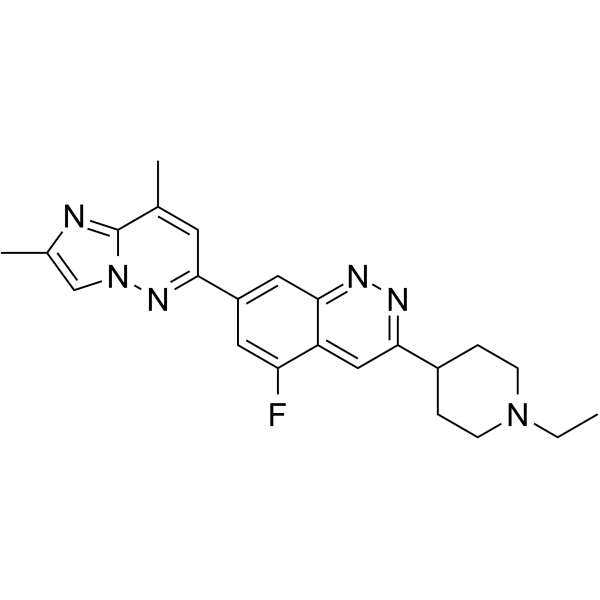
HTT-D3
HTT-D3 is an orally active, blood-brain barrier penetrant splicing modulator of huntingtin (HTT). HTT-D3 promotes the inclusion of a pseudo-exon containing a premature termination codon into HTT pre-mRNA, triggers nonsense-mediated mRNA degradation and reduces HTT protein levels. HTT-D3 induces dose-dependent, comparable reductions in mutant HTT protein in both the brain and peripheral tissues of transgenic mouse models. HTT-D3 can be used for the research of Huntington's disease.
For research use only. We do not sell to patients.
- CAS No.: 2254502-89-9
- Formula: C23H25FN6
- Molecular Weight:404.48
-
Storage:
Please store the product under the recommended conditions in the Certificate of Analysis.

To place orders, for customer services and technical support, please contact: MedChemExpress USA
Tel: 609-228-6898 E-mail: [email protected] [email protected]


-
 Biological Activity
-
Chemical Information
- Protocols
- Purity & Documentation
- References
-
 Help & FAQs




Biological Activity
Description
In Vitro
HTT-D3 (10 μM; 1 h) exhibits reduced P-gp substrate activity in MDCK-MDR1 cells[1].
MedChemExpress (MCE) has not independently confirmed the accuracy of these methods. They are for reference only.
In Vivo
MedChemExpress (MCE) has not independently confirmed the accuracy of these methods. They are for reference only.
-
Animal Model:BACHD mice (6-10 weeks old, female); Hu97/18 mice (2-4 months old, both sexes)[1]
-
Dosage:1, 3, 10 mg/kg for BACHD mice; 2, 6, 12 mg/kg for Hu97/18 mice;
-
Administration:Oral gavage, once daily, for 21 consecutive days
-
Result:Induced dose-dependent and approximately equivalent mHTT protein lowering in brain and peripheral tissues, uniform mHTT reduction was observed in striatum and cortex of Hu97/18 mice, and significant positive correlations were detected between mHTT levels in cortex, striatum, plasma and CSF in Hu97/18 mice.


Chemical Information
-
CAS No. 2254502-89-9
-
Molecular Weight 404.48
-
Formula C23H25FN6
-
SMILES
FC1=CC(C2=NN3C(C(C)=C2)=NC(C)=C3)=CC4=NN=C(C5CCN(CC)CC5)C=C14
-
Shipping
Room temperature in continental US; may vary elsewhere.
-
Storage
Please store the product under the recommended conditions in the Certificate of Analysis.


Purity & Documentation
References

Calculators
Concentration (start) × Volume (start) = Concentration (final) × Volume (final)


HTT-D3 Related Classifications
HY-143792 Related Classifications
 Powered by Bioz