Search Result
Results for "
Metabolite D
" in MedChemExpress (MCE) Product Catalog:
1039
Inhibitors & Agonists
8
Biochemical Assay Reagents
736
Isotope-Labeled Compounds
| Cat. No. |
Product Name |
Target |
Research Areas |
Chemical Structure |
-
- HY-10002
-
-
-
- HY-32343
-
|
(24R)-24,25-Dihydroxyvitamin D3
|
Endogenous Metabolite
VD/VDR
|
Metabolic Disease
Inflammation/Immunology
|
|
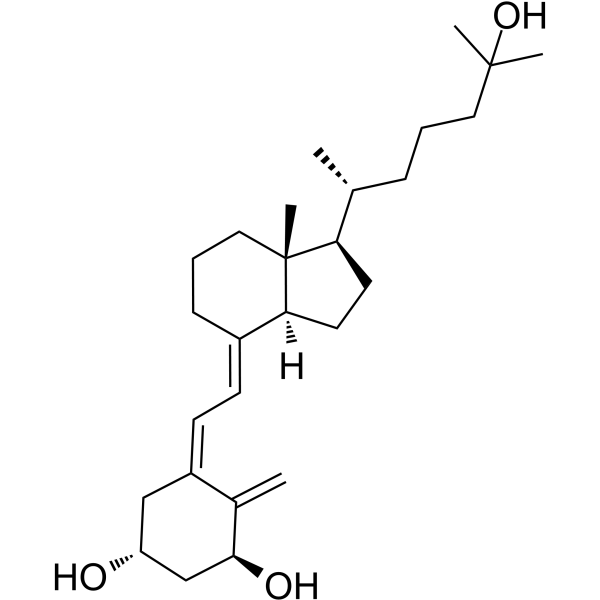
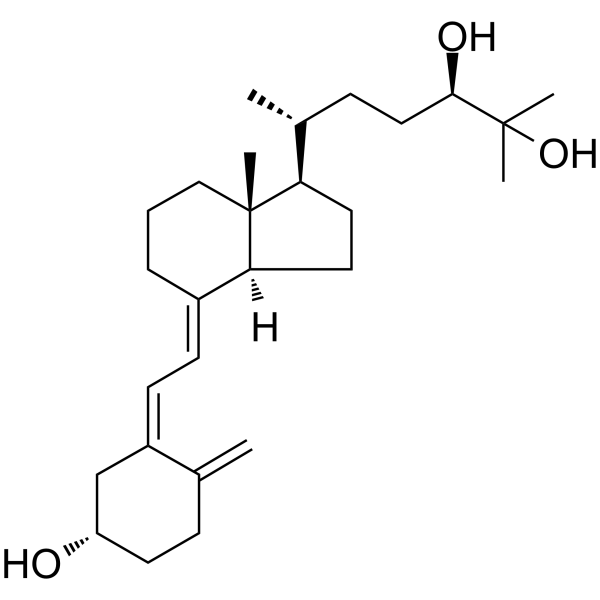
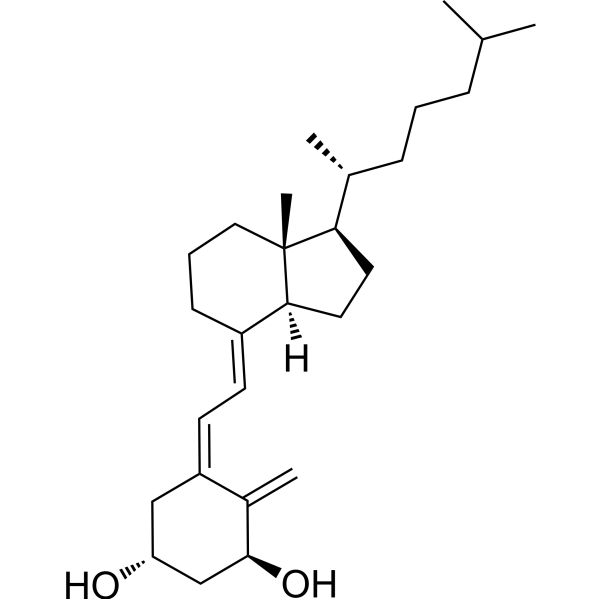
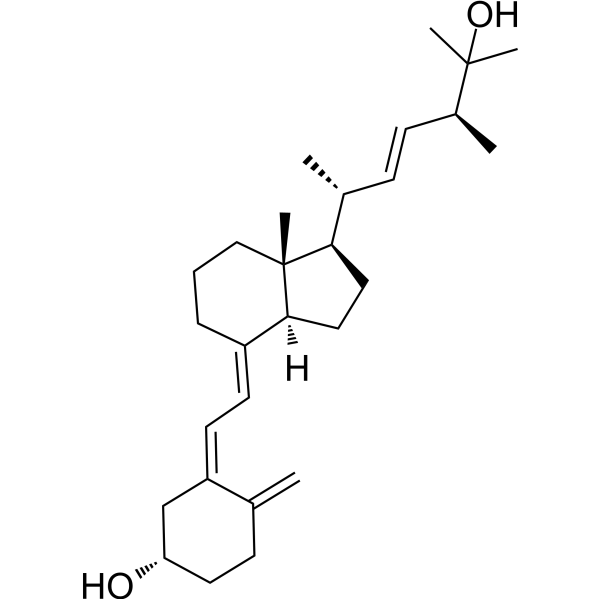
Secalciferol ((24R)-24,25-Dihydroxyvitamin D3) is the major active metabolite of Vitamin D. Secalciferol activates vitamin D receptor (VDR) with an EC50 value of 150 nM. Secalciferol is involved in a wide range of biological functions such as calcium homeostasis, cellular differentiation and proliferation processes, as well as other functions related to the immune system, which is promising for research of rickets, osteomalacia, hypercalcemia and autoimmune disorders .
|
-
-
- HY-33212
-
-
-
- HY-32349
-
-
-
- HY-112537B
-
-
-
- HY-76814
-
-
-
- HY-103005S
-
|
|
Melatonin Receptor
Drug Metabolite
|
Neurological Disease
Endocrinology
|
|
Ramelteon metabolite M-II-d3 is the deuterium labeled Ramelteon metabolite M-II. Ramelteon metabolite M-II is the major metabolite of Ramelteon, with IC50s of 208 pM, 1470 pM for human melatonin receptors (MT1 or MT2). Ramelteon is a selective melatonin agonist .
|
-
-
- HY-12767
-
|
4-Hydroxyphenyl Carvedilol; 4-Hydroxycarvedilol
|
Drug Metabolite
Cytochrome P450
|
Metabolic Disease
|
|
4-Hydroxyphenyl Carvedilol, a metabolite of Carvedilol, is an active metabolite of Carvedilol (HY-B0006) and is produced via CYP2D6-mediated oxidation .
|
-
-
- HY-W040154
-
-
-
- HY-W001132S
-
-
-
- HY-109619
-
|
Δ4-Abiraterone; CB-7627; Abiraterone D4A Metabolite
|
Androgen Receptor
Cytochrome P450
|
Cancer
|
|
D4-abiraterone is a major metabolite of abiraterone. D4-abiraterone is an inhibitor of CYP17A1, 3b-hydroxysteroid dehydrogenase (3βHSD) and steroid-5a-reductase (SRD5A) and also an antagonist of androgen receptor.
|
-
-
- HY-128745
-
-
-
- HY-118840
-
-
-
- HY-G0017S
-
|
Norimatinib-d8; Imatinib Metabolite N-Desmethyl imatinib-d8; CGP 74588-d8
|
Isotope-Labeled Compounds
Drug Metabolite
P-glycoprotein
Apoptosis
|
Neurological Disease
Cancer
|
|
N-Desmethyl imatinib-d8 is a deuterium labeled Imatinib metabolite N-Desmethyl Imatinib (HY-G0017). N‑Desmethyl imatinib (Norimatinib) is an active metabolite of Imatinib (HY-15463), a selective c‑Abl inhibitor, and a substrate of P‑glycoprotein. N-Desmethyl imatinib binds to the c-Abl catalytic domain to prevent substrate phosphorylation, inhibits c-Abl-mediated α-synuclein activation and downstream inflammatory signaling pathways. N-Desmethyl imatinib induces apoptosis in K562 human leukemia cells. N-Desmethyl imatinib exhibits significantly elevated plasma levels in gastrointestinal stromal tumor (GIST) settings following mild SARS CoV 2 infection. N-Desmethyl imatinib can be used for the research of Parkinson’s disease, gastrointestinal stromal tumor, and chronic myeloid leukemia .
|
-
-
- HY-128417S3
-
-
-
- HY-N2353S1
-
-
-
- HY-128754S1
-
-
-
- HY-129336S
-
|
LSN3106726-d8
|
CDK
|
Cancer
|
|
Abemaciclib metabolite M20-d8 is the deuterium labeled Abemaciclib metabolite M20. Abemaciclib metabolite M20 (LSN3106726), the active metabolite of Abemaciclib, is a selective CDK4/6 inhibitor .
|
-
-
- HY-128669S
-
|
LSN2839567-d6
|
CDK
|
Cancer
|
|
Abemaciclib metabolite M2-d6 is the deuterium labeled Abemaciclib metabolite M2. Abemaciclib metabolite M2 (LSN2839567) is a metabolite of Abemaciclib, acts as a potent CDK4 and CDK6 inhibitor, with IC50s in the range of 1-3 nM. Anti-cancer activity .
|
-
-
- HY-N2325R
-
-
-
- HY-N0343A
-
|
p-Formylphenyl-β-D-glucopyranoside; p-Hydroxybenzaldehyde glucoside
|
Others
|
Others
|
|
4-Formylpyrnyl-β-D-glucopyranoside (p-Formylphenyl-β-D-glucopyranoside) is a metabolite of Gastrodin (HY-N0115) in rat plasma. 4-Formylpyrnyl-β-D-glucopyranoside can be used to study the effects of multiple doses and food on the pharmacokinetic behavior of oral Gastrodin and its metabolites .
|
-
-
- HY-128417S1
-
-
-
- HY-32349S
-
-
-
- HY-128754S
-
-
-
- HY-W145584
-
-
-
- HY-N5034S
-
|
Monoaminoethyl phosphate-d4; NSC 254167-d4; O-Phosphoethanolamine-d4
|
Isotope-Labeled Compounds
Endogenous Metabolite
|
Metabolic Disease
|
|
Phosphorylethanolamine-d4 (Monoaminoethyl phosphate-d4; NSC 254167-d4) is a deuterium labeled Phosphorylethanolamine (HY-N5034). Phosphorylethanolamine is an endogenous metabolite.
|
-
-
- HY-128737
-
-
-
- HY-Y0181R
-
-
-
- HY-N6612S
-
-
-
- HY-W422362
-
|
|
Drug Metabolite
|
Others
|
|
Carbocysteine sulfoxide is a metabolite and impurity of Carbocisteine (HY-D0205A).
|
-
-
- HY-151002S
-
-
-
- HY-12769S1
-
|
Mebeverine Metabolite Mebeverine acid-d5 hydrochloride
|
Isotope-Labeled Compounds
Drug Metabolite
|
Neurological Disease
|
|
Mebeverine acid-d5 (Mebeverine metabolite Mebeverine acid-d5) hydrochloride is deuterium labeled Mebeverine acid hydrochloride. Mebeverine acid hydrochloride is a secondary metabolite of the intestinal antispasmodic agent Mebeverine (HY-A0078). Mebeverine acid hydrochloride is generated by the hydrolysis of Mebeverine in the body and is considered a key circulating metabolite. Mebeverine acid hydrochloride is an important marker for oral Mebeverine.
|
-
-
- HY-126534S
-
|
LSN3106729-d8
|
CDK
Ligands for Target Protein for PROTAC
|
Cancer
|
|
Abemaciclib metabolite M18-d8 is the deuterium labeled Abemaciclib metabolite M18. Abemaciclib metabolite M18 (LSN3106729), the metabolite of Abemaciclib (HY-16297A), is a CDK inhibitor with antitumor activity. Abemaciclib metabolite M18 and a CRBN ligand have been used to design PROTAC CDK4/6 degrader .
|
-
-
- HY-176301
-
|
Tetranor-prostaglandin D Metabolite lactone
|
Endogenous Metabolite
|
Inflammation/Immunology
Endocrinology
|
|
Tetranor-PGDM lactone (Tetranor-prostaglandin D metabolite lactone) is a urinary metabolite of PGD2 (HY-101988). Prostaglandin D2 (PGD2) is one of the most potent endogenous sleep promoting substances. PGD2 plays a protective role by suppressing inflammation .
|
-
-
- HY-W702068
-
|
Metabolite D hydrochloride
|
Biochemical Assay Reagents
|
Others
|
|
7-Hydroxy-1-methyl-N-(9-methyl-9-azabicyclo[3.3.1]nonan-3-yl)-1H-indazole-3-carboxamide (Metabolite D) hydrochloride is a biological molecule.
|
-
-
- HY-G0018S
-
|
17-Deacetyl norgestimate-d6; 17-Deacylnorgestimate-d6
|
Isotope-Labeled Compounds
Drug Metabolite
|
Others
|
|
Norgestimate metabolite norelgestromin-d6 is the deuterium labeled Norgestimate metabolite norelgestromin. Norelgestromin is a metabolite of Norgestimate, which is a progestin or synthetic progestogen. Norgestimate metabolite norelgestromin-d6 is a click chemistry reagent, it contains an Alkyne group and can undergo copper-catalyzed azide-alkyne cycloaddition (CuAAc) with molecules containing Azide groups.
|
-
-
- HY-148002
-
|
|
Drug Metabolite
|
Others
|
|
1'-Hydroxy Midazolam-β-D-glucuronide is a β-D-glucuronide that acts as a drug metabolite, human urine metabolite, and human serum metabolite .
|
-
-
- HY-W779002
-
|
|
Isotope-Labeled Compounds
|
|
|
alpha-D-glucose-13C2-1 is a 13C labeled alpha-D-glucose. alpha-D-glucose is an endogenous metabolite.
|
-
-
- HY-N2325S
-
-
-
- HY-33212S
-
-
-
- HY-W040154R
-
-
-
- HY-146963S
-
-
-
- HY-W128916S
-
-
-
- HY-144165S
-
-
-
- HY-120927S
-
-
-
- HY-157074S
-
-
-
- HY-143913S
-
-
-
- HY-G0001S
-
-
-
- HY-G0002S
-
-
-
- HY-117659
-
|
Prostaglandin D Metabolite
|
Prostaglandin Receptor
|
Inflammation/Immunology
|
|
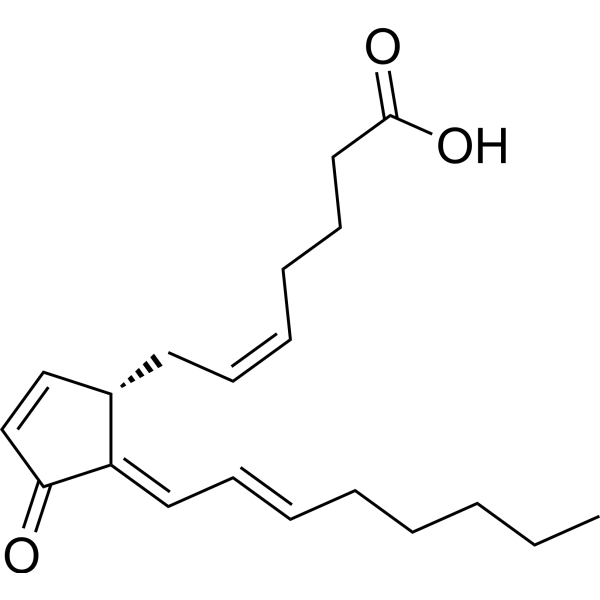
PGDM (Prostaglandin D Metabolite) is the main urinary metabolite of Prostaglandin D2 and is prone to reversible cyclization. PGDM may serve as a biomarker for the endogenous production of PGD2 or be used to evaluate the severity of acute allergic reactions .
|
-
- HY-154757S
-
-
- HY-132504S
-
-
- HY-108251S
-
-
- HY-154754S
-
-
- HY-W714366
-
-
- HY-W701814
-
|
|
Isotope-Labeled Compounds
Drug Metabolite
|
Neurological Disease
|
|
Mazindol metabolite-d4 hydrochloride is the deuterium labeled 2-(2-Aminoethyl)-3-(4-chlorophenyl)-3-hydroxyisoindol-1-one hydrochloride (HY-W700741). 2-(2-Aminoethyl)-3-(4-chlorophenyl)-3-hydroxyisoindol-1-one hydrochloride is a metabolite of the anorectic agent Mazindol.
|
-
- HY-143967S
-
-
- HY-W717406
-
-
- HY-12769S
-
|
Mebeverine Metabolite Mebeverine acid-d5
|
Isotope-Labeled Compounds
Drug Metabolite
|
Neurological Disease
|
|
Mebeverine acid-d5 (Mebeverine metabolite Mebeverine acid-d5) is the deuterium labeled Mebeverine Acid (HY-12769). Mebeverine acid is a secondary metabolite of the intestinal antispasmodic agent Mebeverine (HY-A0078). Mebeverine acid is generated by the hydrolysis of Mebeverine in the body and is considered a key circulating metabolite. Mebeverine acid is an important marker for oral Mebeverine.
|
-
- HY-12770S1
-
-
- HY-166341S
-
|
Tianeptine Metabolite MC5-d4
|
Isotope-Labeled Compounds
Drug Metabolite
|
Neurological Disease
|
|
S 8849-1-d4 (free base) (Tianeptine metabolite MC5-d4) is deuterium labeled S 8849-1 (free base). S 8849-1 (free base) (Tianeptine metabolite MC5) is a Tianeptine (HY-90003) metabolite that is found in plasma. The mean elimination half-lives of S 8849-1 (free base) is 7.53 h in rats. S 8849-1 (free base) is promising for research of antidepressants .
|
-
- HY-G0003S1
-
|
P88-d3; Hydroxy Iloperidone-d3
|
Drug Metabolite
|
Neurological Disease
|
|
Iloperidone metabolite Hydroxy Iloperidone-d3 is the deuterium labeled Iloperidone metabolite Hydroxy Iloperidone (HY-G0003). Iloperidone metabolite Hydroxy Iloperidone (P88; Hydroxy Iloperidone) is an active reduced metabolite of Iloperidone (HY-17410). Iloperidone metabolite Hydroxy Iloperidone can be used for the research of schizophrenia .
|
-
- HY-165687
-
|
2-(Allophanoylsulfamoyl)-N,N-dimethyl-pyridine-3-carboxamide-d6
|
Isotope-Labeled Compounds
|
Others
|
|
Nicosulfuron metabolite UCSN-d6 (2-(Allophanoylsulfamoyl)-N,N-dimethyl-pyridine-3-carboxamide-d6) is deuterium labeled Nicosulfuron metabolite UCSN .
|
-
- HY-12778S
-
-
- HY-12767S1
-
|
4-Hydroxyphenyl Carvedilol-d4; 4-Hydroxycarvedilol-d4
|
Isotope-Labeled Compounds
|
Cancer
|
|
Carvedilol metabolite 4-Hydroxyphenyl Carvedilol-d4 is deuterated labeled Carvedilol metabolite 4-Hydroxyphenyl Carvedilol (HY-12767). 4-Hydroxyphenyl Carvedilol is a metabolite of Carvedilol.
|
-
- HY-165684
-
|
Methyl N-(carboxyacetyl)-N-(2,6-dimethylphenyl-d9)-DL-alaninate
|
Isotope-Labeled Compounds
|
Others
|
|
Benalaxyl metabolite M1-d9 (Methyl N-(carboxyacetyl)-N-(2,6-dimethylphenyl-d9)-DL-alaninate) is deuterium labeled Benalaxyl metabolite M1 .
|
-
- HY-W746555S
-
|
Metazachlor OA-d9; Metazachlor oxalic acid-d9
|
Isotope-Labeled Compounds
|
Others
|
|
Metazachlor metabolite BH479-4-d9 (Metazachlor OA-d9) is deuterium labeled Metazachlor Oxalic Acid .
|
-
- HY-W185208S
-
|
Methyldesphenylchloridazon-d3;
5-Amino-4-chloro-2-methyl-d3-3(2H)-pyridazinone
|
Isotope-Labeled Compounds
|
Others
|
|
Chloridazon metabolite B1-d3 (Methyldesphenylchloridazon-d3) is deuterium labeled 5-Amino-4-chloro-2-methyl-2,3-dihydropyridazin-3-one .
|
-
- HY-G0017S1
-
|
Norimatinib-d4; Imatinib Metabolite N-Desmethyl imatinib-d4; CGP 74588-d4
|
Isotope-Labeled Compounds
Drug Metabolite
P-glycoprotein
Apoptosis
|
Neurological Disease
Cancer
|
|
N-Desmethyl imatinib-d4 is the deuterium-labeled N-Desmethyl imatinib (HY-G0017). N‑Desmethyl imatinib (Norimatinib) is an active metabolite of Imatinib (HY-15463), a selective c‑Abl inhibitor, and a substrate of P‑glycoprotein. N-Desmethyl imatinib binds to the c-Abl catalytic domain to prevent substrate phosphorylation, inhibits c-Abl-mediated α-synuclein activation and downstream inflammatory signaling pathways. N-Desmethyl imatinib induces apoptosis in K562 human leukemia cells. N-Desmethyl imatinib exhibits significantly elevated plasma levels in gastrointestinal stromal tumor (GIST) settings following mild SARS CoV 2 infection. N-Desmethyl imatinib can be used for the research of Parkinson’s disease, gastrointestinal stromal tumor, and chronic myeloid leukemia .
|
-
- HY-143826S
-
|
Mebeverine Metabolite O-desmethyl Mebeverine alcohol-d5 citrate
|
Isotope-Labeled Compounds
|
Others
|
|
O-Desmethyl Mebeverine alcohol-d5 (citrate) is the deuterium labeled O-Desmethyl Mebeverine alcohol citrate .
|
-
- HY-125523
-
-
- HY-12772S3
-
|
R-63373-d6
|
Isotope-Labeled Compounds
Fungal
|
Others
|
|
Hydroxy Itraconazole-d6 (R-63373-d6) is deuterium labeled Hydroxy Itraconazole. Hydroxy Itraconazole (Itraconazole metabolite Hydroxy Itraconazole; R-63373) is an active metabolite of Itraconazole (ITZ), which is a triazole antifungal agent.
|
-
- HY-W768302
-
-
- HY-128417S
-
-
- HY-141776S
-
|
Ufiprazole-d3
|
Drug Metabolite
|
Others
|
|
Omeprazole sulfide-d3 is the deuterium labeled Omeprazole sulfide. Omeprazole metabolite Omeprazole sulfide (Ufiprazole) is a metabolite of Omeprazole, which is a proton pump inhibitor.
|
-
- HY-41982R
-
|
D-Glucurono-6,3-lactone (Standard); D-Glucurono-γ-lactone (Standard); D-Glucuronolactone (Standard); Dicurone (Standard); Glucoxy (Standard); Glucurolactone (Standard); Glucurone (Standard)
|
Reference Standards
Endogenous Metabolite
|
Metabolic Disease
|
|
D-Glucuronic acid lactone (Standard) is the analytical standard of D-Glucuronic acid lactone. This product is intended for research and analytical applications. D-Glucuronic acid lactone is an endogenous metabolite.
|
-
- HY-33212R
-
-
- HY-77274
-
|
|
VD/VDR
|
Metabolic Disease
|
|
Calcitriol Impurities D is the impurity of Calcitriol, Calcitriol is the hormonally active form of vitamin D, Calcitriol is the active metabolite of vitamin D3 that activates the vitamin D receptor (VDR).
|
-
- HY-W342243
-
-
- HY-Z10347S
-
-
- HY-109594S
-
-
- HY-W020576S
-
|
NAP 226-90-d6
|
Isotope-Labeled Compounds
Drug Metabolite
|
Others
|
|
Rivastigmine metabolite-d6 (NAP 226-90-d6) is a deuterated form of Rivastigmine metabolite. Rivastigmine metabolite (NAP 226-90) is a metabolite produced by the hydrolysis of Rivastigmine (HY-17368) . Rivastigmine metabolite serves as a surrogate marker to track the bioavailability, metabolic extent, and transdermal patch delivery rate of Rivastigmine .
|
-
- HY-Z18070S
-
-
- HY-W753270S
-
-
- HY-Z18070AS
-
-
- HY-12769S2
-
|
Mebeverine Metabolite Mebeverine acid-d3
|
Isotope-Labeled Compounds
Drug Derivative
|
Neurological Disease
|
|
Mebeverine acid-d3 (Mebeverine metabolite Mebeverine acid-d3) is the deuterium labeled Mebeverine Acid (HY-12769). Mebeverine acid is a secondary metabolite of the intestinal antispasmodic agent Mebeverine (HY-A0078). Mebeverine acid is generated by the hydrolysis of Mebeverine in the body and is considered a key circulating metabolite. Mebeverine acid is an important marker for oral Mebeverine.
|
-
- HY-W714168S
-
|
|
Isotope-Labeled Compounds
|
Others
|
|
(rac)-Metolachlor metabolite CGA 351916-d3 is deuterium labeled 2-((2-Ethyl-6-methylphenyl)(1-methoxypropan-2-yl)amino)-2-oxoacetic acid .
|
-
- HY-W725077S
-
|
Methyl N-(2,6-dimethylphenyl)-N-(formyl)-DL-alaninate-d9
|
Isotope-Labeled Compounds
|
Others
|
|
Benalaxyl metabolite F4-d9 (Methyl N-(2,6-dimethylphenyl)-N-(formyl)-DL-alaninate-d9) is deuterium labeled Methyl N-(2,6-dimethylphenyl)-N-formylalaninate .
|
-
- HY-W722289S
-
|
N-(2-(Ethyl-2,2,2-d3)-6-methylphenyl)-2-aminopropanoic acid
|
Isotope-Labeled Compounds
|
Others
|
|
(rac)-Metolachlor metabolite CGA 50267-d3 (N-(2-(Ethyl-2,2,2-d3)-6-methylphenyl)-2-aminopropanoic acid) is deuterium labeled (2-Ethyl-6-methylphenyl)alanine .
|
-
- HY-W289054S
-
|
2-((2-(Ethyl-2,2,2-d3)-6-methylphenyl)amino)-2-oxoacetic acid
|
Isotope-Labeled Compounds
|
Others
|
|
(S)-Metolachlor metabolite CGA 50720-d3 (2-((2-(Ethyl-2,2,2-d3)-6-methylphenyl)amino)-2-oxoacetic acid) is deuterium labeled 2-((2-Ethyl-6-methylphenyl)amino)-2-oxoacetic acid .
|
-
- HY-W714705S
-
|
Sodium 2-((2-(ethyl-2,2,2-d3)-6-methylphenyl)amino)-2-oxoethane-1-sulfonate
|
Isotope-Labeled Compounds
|
Others
|
|
(S)-Metolachlor metabolite CGA 368208-d3 sodium salt (Sodium 2-((2-(ethyl-2,2,2-d3)-6-methylphenyl)amino)-2-oxoethane-1-sulfonate) is deuterium labeled Sodium 2-((2-ethyl-6-methylphenyl)amino)-2-oxoethane-1-sulfonate .
|
-
- HY-W097565S
-
|
5,7-Dimethoxy[1,2,4]triazolo[1,5-a]pyrimidin-2-amine-d6
|
Isotope-Labeled Compounds
|
Others
|
|
Pyroxsulam Metabolite ADTP-d6 (5,7-Dimethoxy[1,2,4]triazolo[1,5-a]pyrimidin-2-amine-d6) is deuterium labeled 5,7-Dimethoxy-[1,2,4]triazolo[1,5-a]pyrimidin-2-amine .
|
-
- HY-182093S
-
|
|
Isotope-Labeled Compounds
|
Others
|
|
N-(Cyanomethyl)-4-(2-((4-(3-oxo-4-morpholinyl)phenyl)amino)-4-pyrimidinyl)benzamide-d4 is the deuterium labeled N-(Cyanomethyl)-4-(2-((4-(3-oxo-4-morpholinyl)phenyl)amino)-4-pyrimidinyl)benzamide.
|
-
- HY-137546S
-
-
- HY-180777
-
-
- HY-N8325
-
-
- HY-173577
-
-
- HY-180648
-
-
- HY-N15476
-
|
|
Others
|
Others
|
|
Nanangenine D is a drimane sesquiterpene fungal metabolite that has been found in A. nanangensis.
|
-
- HY-N16429
-
|
|
Endogenous Metabolite
|
Others
|
|
Neosartoricin D, a polyketide, is a microbial secondary metabolite. Neosartoricin D can be isolated from the cultural of Aspergillus nidulans. Neosartoricin D is an analog of Neosartoricin B (HY-N10311). Neosartoricin B is the secondary metabolite, which can be produced by Aspergillus nidulans. Neosartoricin B may regulate immunomodulatory effects with the host during infection and colonization by pathogenic fungi .
|
-
- HY-165062
-
|
Stearoyl sphingomyelin; Sphingomyelin (d18:1/18:0); N-Octadecanoyl sphingosylphosphorylcholine
|
Others
|
Metabolic Disease
|
|
C18 Sphingomyelin (d18:1/18:0) is a form of sphingomyelin and can be used for study of sphingolipid metabolites .
|
-
- HY-75041
-
-
- HY-180759
-
-
- HY-W001132S4
-
-
- HY-125731S1
-
-
- HY-126986
-
-
- HY-12374
-
-
- HY-N2353S2
-
-
- HY-77956S4
-
-
- HY-125731S
-
-
- HY-180703
-
-
- HY-77956S3
-
-
- HY-W587775
-
|
Acyl-MPAG
|
Drug Metabolite
|
Metabolic Disease
|
|
Mycophenolic acid acyl-β-D-glucuronide (Acyl-MPAG) is a metabolite of Mycophenolic acid (MPA) , an immunosuppressant.
|
-
- HY-32349S2
-
-
- HY-164703
-
|
|
Drug Metabolite
Dopamine Receptor
5-HT Receptor
|
Neurological Disease
|
|
Lumateperone metabolite 1 (Formula T) is a metabolite of Lumateperone (HY-17637) . Lumateperone (ITI-007) is an orally active 5-HT2A receptor antagonist (Ki = 0.54 nM), a partial agonist of presynaptic D2 receptors and an antagonist of postsynaptic D2 receptors (Ki = 32 nM), and a dopamine D1 receptor modulator
|
-
- HY-13332
-
-
- HY-Y0504S
-
|
|
Endogenous Metabolite
|
Metabolic Disease
|
|
Trimethylammonium chloride- 13C3,d9 is the deuterium and 13C labeled Trimethylammonium chloride . Trimethylammonium chloride is an endogenous metabolite.
|
-
- HY-177702
-
-
- HY-10002S2
-
-
- HY-128417S4
-
-
- HY-10002S1
-
|
1,25-Dihydroxyvitamin D3-d3
|
VD/VDR
Endogenous Metabolite
|
Cancer
|
|
Calcitriol-d3 is the deuterium labeled Calcitriol . Calcitriol is the most active metabolite of vitamin D and also a vitamin D receptor (VDR) agonist .
|
-
- HY-W742417
-
-
- HY-W015450
-
|
D-Alanyl-D-alanine; H-D-Ala-D-Ala-OH
|
Endogenous Metabolite
|
Others
|
|
D-Ala-D-Ala is a bacterial endogenous metabolite. D-Ala-D-Ala constitutes the terminus of the peptide part of the peptidoglycan monomer unit and is involved in the transpeptidation reaction as the substrate. D-Ala-D-Ala is catalyzed by D-Alanine-D-Alanine ligase .
|
-
- HY-W704772
-
-
- HY-W072459
-
-
- HY-W018035
-
|
Glyceric Acid (20% in Water,ca.2 mol/L)
|
Endogenous Metabolite
|
Metabolic Disease
|
|
DL-Glyceric Acid (20% in water) is a metabolite of plants and mammals and exists in two configurations, D and L .
|
-
- HY-Y0504S1
-
|
Hegzadesil-d10; Trimethylamine hydrochloric acid-d10; Trimethylamine monohydrochloride-d10
|
Endogenous Metabolite
|
Metabolic Disease
|
|
Trimethylammonium chloride-d10 is the deuterium labeled Trimethylammonium chloride . Trimethylammonium chloride is an endogenous metabolite.
|
-
- HY-Y0504S4
-
|
Hegzadesil-d6; Trimethylamine hydrochloric acid-d6; Trimethylamine monohydrochloride-d6
|
Endogenous Metabolite
|
Metabolic Disease
|
|
Trimethylammonium chloride-d6 is the deuterium labeled Trimethylammonium chloride . Trimethylammonium chloride is an endogenous metabolite.
|
-
- HY-W072459A
-
|
|
Drug Metabolite
|
Infection
|
|
6'-Hydroxydihydrocinchonidine acetate is a metabolite of Quinine (HY-D0143) (antimalarial agent) .
|
-
- HY-12770S
-
-
- HY-12781S
-
-
- HY-Y0267S
-
-
- HY-125411
-
|
|
Endogenous Metabolite
|
Others
|
|
Berninamycin D is a cyclic peptide fungal metabolite isolated from ermentation of Streptomyces bernensis .
|
-
- HY-N14940
-
-
- HY-Y0504S3
-
-
- HY-137339
-
|
|
Drug Metabolite
|
Others
|
|
Amitriptyline N-β-D-glucuronide is an ammonium glucuronide and an urinary excretion metabolite of amitriptyline .
|
-
- HY-G0012S
-
-
- HY-13292
-
|
1β,25-Dihydroxyvitamin-D3; 1-Epicalcitriol
|
VD/VDR
|
Cancer
|
|
Impurity B of Calcitriol, Calcitriol(1,25-Dihydroxyvitamin D3; Rocaltrol ) is the hormonally active form of vitamin D, Calcitriol is the active metabolite of vitamin D3 that activates the vitamin D receptor (VDR).
|
-
- HY-W145584S
-
-
- HY-139232
-
-
- HY-128417S5
-
-
- HY-13293
-
|
|
VD/VDR
|
Cancer
|
|
Impurity C of Calcitriol is the impurity of Calcitriol (HY-10002). Calcitriol is the hormonally active form of vitamin D. Calcitriol is the active metabolite of vitamin D3 that activates the vitamin D receptor (VDR).
|
-
- HY-114557S
-
-
- HY-W050026S
-
|
NSC 203800-d5; Phenylacetyl-L-glutamine-d5
|
Endogenous Metabolite
Isotope-Labeled Compounds
|
Others
|
|
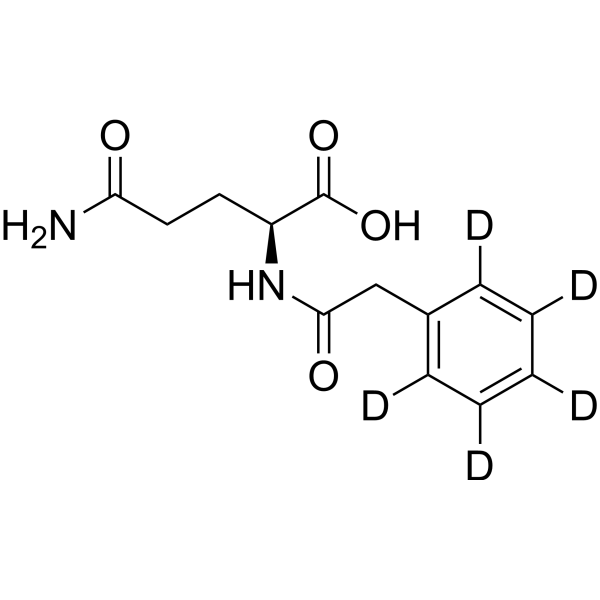
Phenylacetylglutamine-d5 (NSC 203800-d5) is the deuterium labeled Phenylacetylglutamine (HY-W050026). Phenylacetylglutamine is a colonic microbial metabolite from amino acid fermentation .
|
-
- HY-W777236
-
|
|
Drug Metabolite
|
Others
|
|
N-Acetyl serotonin β-D-glucuronide is a glucuronidated metabolite of N-acetylserotonin (HY-107854) and a probe metabolite for UGT1A6 activity assays.N-Acetyl serotonin β-D-glucuronide forms from N-acetyl serotonin via glucuronidation catalyzed by a UGT enzyme .
|
-
- HY-Y1314S
-
-
- HY-180701
-
-
- HY-W012480S1
-
-
- HY-126358S
-
-
- HY-W012480S
-
-
- HY-W585982
-
-
- HY-W400496
-
|
|
HDAC
|
Cancer
|
|
Valproic acid β-D-glucuronide is the major urinary metabolite of Valproic acid (HY-10585) .
|
-
- HY-W585920
-
|
|
FXR
|
Metabolic Disease
|
|
Chenodeoxycholic acid 24-acyl-β-D-glucuronide is a metabolite of Chenodeoxycholic Acid (HY-76847) .
|
-
- HY-32349R
-
|
25-Hydroxy Vitamin D2 (Standard)
|
Reference Standards
VD/VDR
Endogenous Metabolite
|
Metabolic Disease
|
|
Ercalcidiol (Standard) is the analytical standard of Ercalcidiol. This product is intended for research and analytical applications. Ercalcidiol is a metabolite of vitamin D2, is regarded as an indicator of vitamin D nutritional status.
|
-
- HY-W714890
-
-
- HY-W587841
-
|
|
Drug Intermediate
|
Metabolic Disease
|
|
D-Xylulose 5-phosphate is a sugar phosphate ester intermediate and also a core metabolite of the pentose phosphate pathway. D-Xylulose 5-phosphate can be used in the research of metabolic diseases .
|
-
- HY-N0684AS
-
|
cis-Phylloquinone-d7; cis-Phytomenadione-d7
|
Isotope-Labeled Compounds
|
Others
|
|
cis-Vitamin K1-d7 is the deuterium labeled cis-Vitamin K1, is an endogenous metabolite of Vitamin K .
|
-
- HY-32343S
-
-
- HY-10002S
-
-
- HY-125446S
-
|
LY-290411-d3; 2-OH-OLZ-d3
|
Isotope-Labeled Compounds
Drug Metabolite
|
Others
|
|
2-Hydroxymethyl olanzapine-d3 (LY-290411-d3) is a deuterium labeled 2-Hydroxymethyl olanzapine. 2-Hydroxymethyl olanzapine is a metabolite of Olanzapine. .
|
-
- HY-Z4690
-
-
- HY-119223S
-
|
Normirtazapine-d6 hydrochloride
|
Isotope-Labeled Compounds
Drug Metabolite
|
Neurological Disease
|
Desmethylmirtazapine-d6 hydrochloride (Normirtazapine-d6 hydrochloride) is the deuterium labeled Desmethylmirtazapine (HY-119223). Desmethylmirtazapine is an active metabolite of Mirtazapine that has antidepressant effects .
|
-
- HY-10002R
-
|
1,25-Dihydroxyvitamin D3 (Standard)
|
Drug Metabolite
Reference Standards
VD/VDR
Endogenous Metabolite
|
Cancer
|
|
Calcitriol (Standard) is the analytical standard of Calcitriol. This product is intended for research and analytical applications. Calcitriol is the most active metabolite of vitamin D and also a vitamin D receptor (VDR) agonist.
|
-
- HY-A0058
-
|
Retinyl β-D-glucoside
|
Drug Metabolite
|
Metabolic Disease
|
|
Retinyl-β-D-glucoside is a naturally occurring and biologically active metabolites of vitamin A, which are found in fish and mammals.
|
-
- HY-G0010S
-
-
- HY-G0011S
-
-
- HY-G0016S
-
|
MADDS-d4; Monoacetyldapsone-d4
|
Isotope-Labeled Compounds
|
Others
|
|
N-acetyl Dapsone-d4 is the deuterium labeled N-acetyl Dapsone, which is a metabolite of Dapsone.
|
-
- HY-113295S3
-
-
- HY-113239S
-
-
- HY-32350S
-
-
- HY-139070A
-
|
|
Endogenous Metabolite
|
Metabolic Disease
|
|
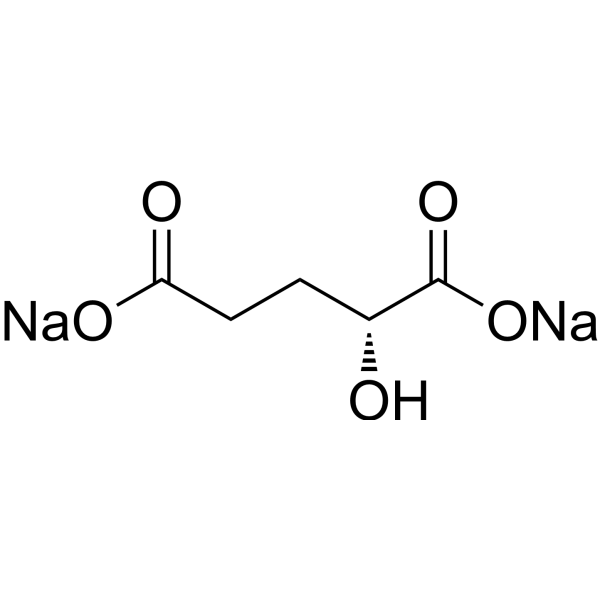
D-Glyceric acid sodium is the sodium form of D-Glyceric acid (HY-139070A). D-Glyceric acid is an endogenous metabolite present in urine that can be used for the research of primary hyperoxaluria type I and glutaric acidemia type 2 .
|
-
- HY-172565
-
|
SCH 56592 D-glucuronide
|
Drug Metabolite
UGT
|
Infection
|
|
Posaconazole D-glucuronide (SCH 56592 D-glucuronide) is a glucuronide metabolite of the antifungal agent Posaconazole (HY-17373). Posaconazole D-glucuronide can be formed in human liver microsomes catalyzed by UGT1A4 .
|
-
- HY-W777677
-
-
- HY-W756134
-
|
|
Isotope-Labeled Compounds
Drug Metabolite
FXR
|
Metabolic Disease
|
|
Chenodeoxycholic acid 24-acyl-β-D-glucuronide-d5 sodium is the deuterium labeled Chenodeoxycholic acid 24-acyl-β-D-glucuronide sodium. Chenodeoxycholic acid 24-acyl-β-D-glucuronide sodium is a metabolite of Chenodeoxycholic Acid (HY-76847) .
|
-
- HY-W769286
-
|
|
Isotope-Labeled Compounds
HDAC
|
Cancer
|
|
Valproic acid β-D-glucuronide-d15 is the deuterium labeled Valproic acid β-D-glucuronide (HY-W400496). Valproic acid β-D-glucuronide is the major urinary metabolite of Valproic acid (HY-10585) .
|
-
- HY-W012874
-
-
- HY-N8349
-
|
|
Parasite
Endogenous Metabolite
|
Infection
Cancer
|
|
19,20-Epoxycytochalasin D, a cytochalasin, is a fungal metabolite from Nemania sp. 19,20-Epoxycytochalasin D shows potent in vitro antiplasmodial activity and phytotoxicity .
|
-
- HY-153995A
-
-
- HY-N1424S
-
-
- HY-W744788
-
-
- HY-79593S1
-
-
- HY-G0016S1
-
-
- HY-131630
-
|
|
Drug Metabolite
|
Others
|
|
O-Desmethylmetoprolol is the metabolite of Metoprolol (HY-17503) produced by CYP2D6 enzyme metabolism .
|
-
- HY-D0185S1
-
-
- HY-W654234
-
-
- HY-137188
-
-
- HY-W713877
-
|
Montelukast AG
|
Drug Metabolite
|
Others
|
|
Montelukast acyl-b-D-glucuronide (Montelukast AG) is a acyl glucuronide metabolite of Montelukast (HY-13315A) .
|
-
- HY-W008794S
-
|
(±)-Normetanephrine-d3 hydrochloride; DL-Normetanephrine-d3 hydrochloride; (Rac)-Normetanephrine-d3 hydrochloride
|
Endogenous Metabolite
|
Metabolic Disease
|
|
Normetanephrine-d3 (hydrochloride) is the deuterium labeled Normetanephrine hydrochloride. Normetanephrine ((±)-Normetanephrine) hydrochloride is the O-methylated metabolite of norepinephrine (NE) .
|
-
- HY-113219S
-
-
- HY-W700378
-
|
|
Isotope-Labeled Compounds
HDAC
|
Cancer
|
|
Valproic acid β-D-glucuronide-d6-1 is the deuterium labeled Valproic acid β-D-glucuronide (HY-W400496). Valproic acid β-D-glucuronide is the major urinary metabolite of Valproic acid (HY-10585) .
|
-
- HY-Y1298S1
-
|
Acetoacetate methyl ester-d3; Methyl 3-oxobutanoate-d3; Methyl acetoacetate-d3
|
Isotope-Labeled Compounds
|
Others
|
|
Methyl acetylacetate-d3 (Acetoacetate methyl ester-d3) is a deuterium labeled Methyl acetylacetate (HY-Y1298). Methyl acetylacetate is an endogenous metabolite .
|
-
- HY-113375
-
|
D-Ribose
|
Endogenous Metabolite
|
Cardiovascular Disease
|
|
D-Ribofuranose (D-Ribose) is an endogenous metabolite present in Cerebrospinal_Fluid that can be used for the research of Ribose 5 Phosphate Isomerase Deficiency and Medium Chain Acyl Co A Dehydrogenase Deficiency .
|
-
- HY-W751198
-
|
|
VD/VDR
|
Metabolic Disease
|
|
Vitamin D-C22 acid is an analog of vitamin D, and its [125]I-labeled form can be used for the development of vitamin D detection methods. [125I]Vitamin D-C22 acid can be used as a tracer for the radioimmunoassay of vitamin D metabolites .
|
-
- HY-133879
-
|
1α,25-Dihydroxyvitamin D3-26,23-lactone
|
Endogenous Metabolite
|
Others
Inflammation/Immunology
|
|
Calcitriol lactone (1α,25-Dihydroxyvitamin D3-26,23-lactone) is a metabolite of vitamin D3. Calcitriol lactone is the active form of vitamin D and affects bone health, cell differentiation, immune function .
|
-
- HY-W004066S
-
-
- HY-Y0289S1
-
-
- HY-W004066S1
-
-
- HY-B1945S
-
|
Bis(2-ethylhexyl) phthalate-d4; Ergoplast FDO-d4; ESBO-D 82-d4
|
Endogenous Metabolite
|
Metabolic Disease
|
|
DEHP-d4 is the deuterium labeled DEHP. DEHP (Bis(2-ethylhexyl) phthalate) is an endogenous metabolite.
|
-
- HY-136344
-
|
|
Drug Metabolite
|
Others
|
|
Simvastatin Acyl-β-D-glucuronide is a metabolite of Simvastatin. Simvastatin is a competitive inhibitor of HMG-CoA reductase with a Ki of 0.2 nM .
|
-
- HY-N13295
-
|
Ethyl α-(β-D-glucopyranosyloxy)-1H-indole-3-propanoate
|
Endogenous Metabolite
|
Others
|
|
Indole-3-lactate-O-β-D-glucopyranoside is an endogenous metabolite that acts as a plant growth regulator .
|
-
- HY-137963
-
-
- HY-113353S
-
|
|
Endogenous Metabolite
|
Others
|
|
Nicotinuric acid-d4 is the deuterium labeled Nicotinuric acid. Nicotinuric acid is an acyl glycine. Nicotinuric acid is a metabolite of nicotinic acid .
|
-
- HY-138795
-
|
|
Endogenous Metabolite
|
Cancer
|
|
Curcumin-β-D-glucuronide is a major metabolite after oral intake of Curcumin in hepatic tissue and portal blood. Curcumin-β-D-glucuronide can be used for the research of colon cancer .
|
-
- HY-N11848
-
|
Glucosamine-6-phosphate; D-GlcN-6-P
|
Endogenous Metabolite
|
Metabolic Disease
|
|
D-Glucosamine 6-phosphate is an endogenous metabolite that can be synthesized by glutamine fructose-6-phosphate amidotransferase (GFAT). D-Glucosamine 6-phosphate can be used for the research of diabetes mellitus .
|
-
- HY-W653947
-
|
Ursodeoxycholylglycine-d5
|
Isotope-Labeled Compounds
Endogenous Metabolite
|
Neurological Disease
|
|
Glycoursodeoxycholic acid-d5 (Ursodeoxycholylglycine-d5) is the deuterium labeled Glycoursodeoxycholic acid (HY-N1424). Glycoursodeoxycholic acid, a acyl glycine and a bile acid-glycine conjugate, is a metabolite of ursodeoxycholic acid.
|
-
- HY-W015450R
-
|
D-Alanyl-D-alanine (Standard); H-D-Ala-D-Ala-OH (Standard)
|
Reference Standards
Endogenous Metabolite
|
Others
|
|
D-Ala-D-Ala (Standard) is the analytical standard of D-Ala-D-Ala. This product is intended for research and analytical applications. D-Ala-D-Ala is a bacterial endogenous metabolite. D-Ala-D-Ala constitutes the terminus of the peptide part of the peptidoglycan monomer unit and is involved in the transpeptidation reaction as the substrate. D-Ala-D-Ala is catalyzed by D-Alanine-D-Alanine ligase .
|
-
- HY-W710753
-
-
- HY-50683S
-
|
|
c-Met/HGFR
|
Cancer
|
|
JNJ-38877605-d1 (compound DO-2) is a highly selective MNNG HOS transforming (MET) inhibitor. JNJ-38877605-d1 is thought to diminish the formation of the Aldehyde Oxidase 1 inactive metabolite M3 .
|
-
- HY-G0002
-
|
|
Drug Metabolite
Dopamine Receptor
5-HT Receptor
|
Neurological Disease
|
|
Lurasidone metabolite 14326 is a minor active metabolite of Lurasidone (HY-B0032A) generated via metabolism by CYP3A4. Lurasidone metabolite 14326 shares similar receptor-binding properties with Lurasidone, acting as an antagonist of the dopamine D2 receptor (dopamine D2 receptor), an antagonist of the serotonin 5-HT2A and 5-HT7 receptors (5-HT2A and 5-HT7 receptor), and a partial agonist of the serotonin 5-HT1A receptor. Lurasidone metabolite 14326 can be used in the research of schizophrenia and bipolar depression .
|
-
- HY-135176
-
|
|
Endogenous Metabolite
|
Cancer
|
|
13-Dihydrocarminomycin (compound D788-12) is the major metabolite of the antitumor antibiotic Carminomycin (HY-B2171). 13-Dihydrocarminomycin has weak antitumor activity .
|
-
- HY-W749733
-
|
|
Isotope-Labeled Compounds
VEGFR
|
Cancer
|
|
BIBF 1202-d3 is the deuterium labeled BIBF 1202 (HY-15992). BIBF 1202 is the carboxylate metabolite of BIBF 1120 which inhibits VEGFR2 kinase with an IC50 of 62 nM.
|
-
- HY-Y1644S
-
|
3-Methylcrotonic acid-d6; 3-Methylbut-2-enoic acid-d6
|
Endogenous Metabolite
|
Metabolic Disease
|
|
3,3-Dimethylacrylic acid-d6 is the deuterium labeled 3,3-Dimethylacrylic acid . 3,3-Dimethylacrylic acid-d6 is an endogenous metabolite .
|
-
- HY-32350R
-
-
- HY-153995B
-
|
|
Mitochondrial Metabolism
Drug Metabolite
|
Metabolic Disease
|
|
D-Ribonic acid ammonium is a metabolite of D-Ribose (HY-113375). Ribonic acid ammonium is associated with genetic variations in ENOSF1 and NUBPL. Ribonic acid ammonium may participate in the mitochondrial energy production process .
|
-
- HY-W012874S
-
-
- HY-128733S
-
-
- HY-15236S
-
|
RO-2433-13C,d3; GS-331007-13C,d3; Sofosbuvir Metabolite GS-331007-13C,d3
|
HCV
|
Infection
|
|
PSI-6206- 13C,d3 is the deuterium labeled PSI-6206. PSI-6206 is the deaminated derivative of PSI-6130, which is a potent and selective inhibitor of HCV NS5B polymerase. PSI-6206 low potently inhibits HCV replicon with EC90 of >100 μM.
|
-
- HY-132569S
-
-
- HY-113105
-
|
Estriol 16-glucosiduronate
|
Endogenous Metabolite
|
Others
|
|
Estriol 16α-(β-D-glucuronide) is an endogenous metabolite present in Urine that can be used for the research of Pregnancy .
|
-
- HY-Y1809S
-
-
- HY-N11189
-
-
- HY-132675S
-
|
|
Isotope-Labeled Compounds
|
Others
|
|
Prochlorperazine Sulfoxide-d3 is a deuterium labeled Prochlorperazine Sulfoxide. Prochlorperazine Sulfoxide is the major metabolite of the antiemetic Prochlorperazine .
|
-
- HY-Y0289S2
-
-
- HY-132405S
-
|
|
COX
Autophagy
|
Others
|
|
Desmethyl Naproxen-d3 is deuterium labeled Desmethyl Naproxen. Desmethyl Naproxen is the metabolite of anti-inflammatory agent Naproxen .
|
-
- HY-128735S
-
-
- HY-W015924S
-
-
- HY-D0185S
-
-
- HY-113367S
-
-
- HY-113367S1
-
-
- HY-B1945S1
-
-
- HY-W040948S
-
-
- HY-Y0289S3
-
-
- HY-116029
-
-
- HY-Y1809S1
-
-
- HY-32349S3
-
-
- HY-112537
-
|
|
Endogenous Metabolite
mTOR
|
Cardiovascular Disease
Metabolic Disease
|
|
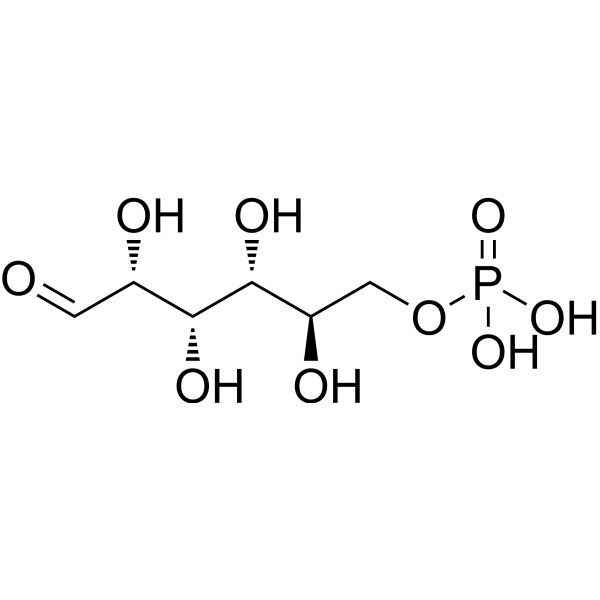
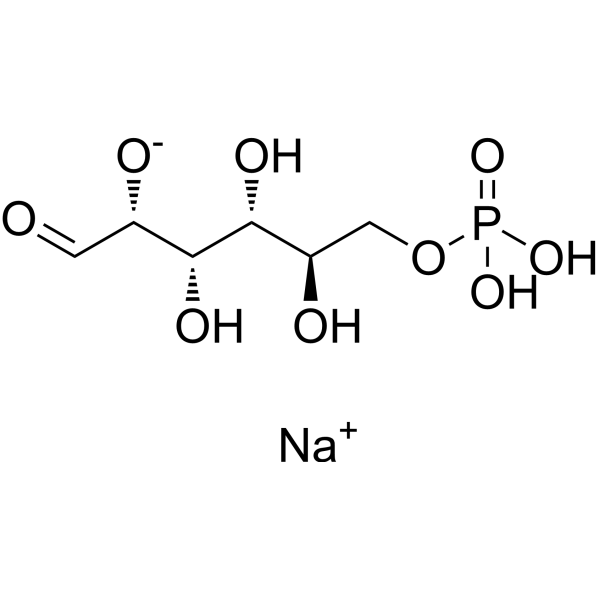
D-Glucose 6-phosphate is a key central node metabolite in glucose metabolism. It serves as the initiating metabolite for glycolysis and the pentose phosphate pathway, as well as a substrate for glycogen synthesis. D-Glucose 6-phosphate acts as a metabolic stress signal, which activates the mTOR pathway to promote protein synthesis, especially when phosphoglucose isomerase (PGI) is inhibited, thereby participating in cardiac remodeling processes. D-Glucose 6-phosphate can be used in research related to non-insulin-dependent diabetes mellitus and heart failure .
|
-
- HY-132343S
-
|
|
Isotope-Labeled Compounds
|
Neurological Disease
|
|
Zolmitriptan N-Oxide-d6 is a deuterium labeled Zolmitriptan N-Oxide. Zolmitriptan N-Oxide is the major metabolite of Zolmitriptan. Zolmitriptan is a 5-HT1B/1D receptor partial agonist .
|
-
- HY-W015883S2
-
|
|
Endogenous Metabolite
|
Metabolic Disease
|
|
Fumaric acid- 13C2,d2 is the deuterium and 13C labeled Fumaric acid . Fumaric acid, associated with fumarase deficiency, is identified as an oncometabolite or an endogenous, cancer causing metabolite .
|
-
- HY-135621
-
-
- HY-N8102
-
|
|
Transmembrane Glycoprotein
Others
|
Cardiovascular Disease
|
|
Echinocystic acid 28-O-β-D-glucoside is a metabolite of Echinocystic acid by microbial oxidation and glucosidation. Echinocystic acid 28-O-β-D-glucoside is a tissue factor pathway inhibitor, with an IC50 of 10.61 nM .
|
-
- HY-180763
-
-
- HY-123305S
-
-
- HY-W053787S
-
|
|
Endogenous Metabolite
|
Metabolic Disease
|
|
1-Methylhistamine-d3 (dihydrochloride) is the deuterium labeled 1-Methylhistamine (dihydrochloride) . 1-Methylhistamine dihydrochloride is a histamine metabolite .
|
-
- HY-113239S1
-
-
- HY-138290
-
-
- HY-113239S2
-
-
- HY-118774
-
-
- HY-U00199S
-
-
- HY-112537S2
-
|
|
Isotope-Labeled Compounds
Endogenous Metabolite
mTOR
|
Others
|
|
D-Glucose 6-phosphate- 13C is 13C labeled D-Glucose 6-phosphate (HY-112537). D-Glucose 6-phosphate is a key central node metabolite in glucose metabolism. It serves as the initiating metabolite for glycolysis and the pentose phosphate pathway, as well as a substrate for glycogen synthesis. D-Glucose 6-phosphate acts as a metabolic stress signal, which activates the mTOR pathway to promote protein synthesis, especially when phosphoglucose isomerase (PGI) is inhibited, thereby participating in cardiac remodeling processes. D-Glucose 6-phosphate can be used in research related to non-insulin-dependent diabetes mellitus and heart failure.
|
-
- HY-116083
-
|
|
Endogenous Metabolite
|
Others
|
|
13,14-Dihydro-15-keto-tetranor prostaglandin D2 (Compound VI) is a prostaglandin D2 metabolite. 13,14-Dihydro-15-keto-tetranor prostaglandin D2 as a biomarker can be used to study prostaglandin D2-related diseases .
|
-
- HY-W768333
-
|
D-Ribose-13C5
|
Isotope-Labeled Compounds
Endogenous Metabolite
|
Cardiovascular Disease
|
|
D-Ribofuranose- 13C5 (D-Ribose- 13C5) is the 13C-labeled D-Ribofuranose (HY-113375). D-Ribofuranose (D-Ribose) is an endogenous metabolite present in Cerebrospinal_Fluid that can be used for the research of Ribose 5 Phosphate Isomerase Deficiency and Medium Chain Acyl Co A Dehydrogenase Deficiency .
|
-
- HY-W777433
-
|
|
Endogenous Metabolite
|
Infection
Others
|
|
Cyclobenzaprine b-D-glucuronide is a metabolite of Cyclobenzaprine. Cyclobenzaprine b-D-glucuronide can be used to treat diseases associated with coronavirus infection. Cyclobenzaprine b-D-glucuronide can be used to study the metabolic pathways of Cyclobenzaprine in the body and as a potential candidate for studying coronavirus treatment .
|
-
- HY-W585982S
-
-
- HY-W588194
-
|
|
Drug Metabolite
|
Neurological Disease
Metabolic Disease
|
|
Cotinine N-β-D-Glucuronide is a glucuronide conjugate of the tobacco metabolite Cotinine (HY-B1178). Cotinine N-β-D-Glucuronide is promising for research of tobacco carcinogen metabolism and cognitive function .
|
-
- HY-79593S2
-
|
ACT-333679-d7
|
Prostaglandin Receptor
|
Metabolic Disease
|
|
MRE-269-d7 is deuterium labeled MRE-269 (HY-79593). MRE-269 is an active metabolite of selexipag, and acts as a selective IP receptor agonist .
|
-
- HY-76801
-
-
- HY-118427
-
|
|
Parasite
Endogenous Metabolite
|
Infection
Cancer
|
|
Asterriquinol D dimethyl ether is a fungal metabolite, which can inhibit mouse myeloma NS-1 cell lines with an IC50 of 28 μg/mL. Asterriquinol D dimethyl ether also inhibits Tritrichomonas foetus .
|
-
- HY-12388S
-
|
Desmethylclomipramine-d7; Norclomipramine-d7
|
Isotope-Labeled Compounds
|
Neurological Disease
|
|
N-Desmethyl clomipramine-d7 (Desmethylclomipramine-d7) is deuterium labeled N-Desmethyl clomipramine. Desmethylclomipramine (Norclomipramine) is a metabolite of Clomipramine (HY-B0457A) and can be used for neurological research .
|
-
- HY-12388S1
-
|
Desmethylclomipramine-d6; Norclomipramine-d6
|
Isotope-Labeled Compounds
Drug Metabolite
|
Neurological Disease
|
|
N-Desmethyl clomipramine-d6 (Desmethylclomipramine-d6) is deuterium labeled N-Desmethyl clomipramine. Desmethylclomipramine (Norclomipramine) is a metabolite of Clomipramine (HY-B0457A) and can be used for neurological research .
|
-
- HY-122277
-
|
Ro 03-7410
|
Drug Metabolite
|
Metabolic Disease
|
|
1'-Hydroxy bufuralol is the main metabolite of Bufuralol (HY-105124) by the cytochrome P450 isoenzymes 2D1 and 2D2 (CYP2D1/2). 1'-Hydroxy bufuralol can be used to determine CYP2D1/2 enzyme activity .
|
-
- HY-W014502
-
|
|
Aryl Hydrocarbon Receptor
Endogenous Metabolite
|
Cancer
|
|
D-kynurenine, a metabolite of D-tryptophan, can serve as the bioprecursor of kynurenic acid (KYNA) and 3-hydroxykynurenine. D-Kynurenine is an agonist for G protein-coupled receptor, GPR109B. D-Kynurenine is a substrate in a fluorometric assay of D-amino acid oxidase. D-kynurenine promotes epithelial-to-mesenchymal transition via activating aryl hydrocarbon receptor (AHR) .
|
-
- HY-U00050S
-
|
E-10-OH-NT-d3
|
Isotope-Labeled Compounds
Drug Metabolite
|
Neurological Disease
|
|
(E)-10-Hydroxynortriptyline-d3 is a deuterium labeled (E)-10-Hydroxy Nortriptyline. (E)-10-Hydroxy Nortriptyline is a metabolite of Nortriptyline. Nortriptyline is a tricyclic antidepressant and the main active metabolite of Amitriptyline, and is used to relieve the symptoms of depression .
|
-
- HY-118025S
-
|
(±)-SR-121683-d4
|
Isotope-Labeled Compounds
Others
|
Others
|
|
(±)-2-Oxo clopidogrel-d4 ((±)-SR-121683-d4) is the deuterium labeled (±)-2-Oxo clopidogrel (HY-118025). (±)-2-Oxo clopidogrel is a metabolite of the antiplatelet agent Clopidogrel (HY-15283) .
|
-
- HY-Y0507S
-
|
|
TMV
Isotope-Labeled Compounds
|
Infection
Cancer
|
|
DL-Serine-2,3,3-d3 is the deuterium labeled DL-Serine. DL-Serine, a fundamental metabolite, is a mixture of D-Serine and L-Serine. DL-Serine has antiviral activity against the multiplication of tobacco mosaic virus (TMV) .
|
-
- HY-171182
-
|
|
Endogenous Metabolite
|
Neurological Disease
|
|
D3017 is the main metabolite of D2624, which has oral bioactivity and anti-convulsant effects. D3017 ED50 value is 1.5 mg/kg in mice, and it can be used for research on severe generalized tonic-clonic seizures (grand mal) and complex partial epilepsy .
|
-
- HY-131144S
-
-
- HY-N1623
-
-
- HY-129295
-
|
|
Acyltransferase
|
Metabolic Disease
|
|
Amidepsine D is a fungal metabolite isolated from the culture broth of Humicola sp. FO-2942 that inhibits Diacylglycerol acyltransferases (DGAT) activity .
|
-
- HY-113220S
-
|
|
Endogenous Metabolite
|
Metabolic Disease
|
|
Monoisobutyl phthalic acid-d4 is the deuterium labeled Monoisobutyl phthalic acid . Monoisobutyl phthalic acid is a phthalate metabolite that is in human semen and in meconium .
|
-
- HY-70002BS
-
-
- HY-W584173
-
|
|
Endogenous Metabolite
|
Metabolic Disease
|
|
D-Glyceric acid calcium hydrate is an endogenous metabolite present in urine that can be used for the research of primary hyperoxaluria type I and glutaric acidemia type 2 .
|
-
- HY-137959
-
|
|
β-glucuronidase
Drug Metabolite
|
Metabolic Disease
|
|
Telmisartan acyl-β-D-glucuronide is an acyl-β-D-glucuronide and a metabolite of Telmisartan (HY-13955). Telmisartan acyl-β-D-glucuronide can be converted back to Telmisartan upon incubation with Glucuronidase. Partial acyl migration of Telmisartan acyl-β-D-glucuronide occurs under physiological conditions .
|
-
- HY-122813
-
|
|
Drug Metabolite
Thrombin
|
Cardiovascular Disease
|
|
Dabigatran acyl-β-D-glucuronide is an active metabolite of the thrombin inhibitor Dabigatran (HY-10163). Dabigatran acyl-β-D-glucuronide increases activated partial thromboplastin time (aPTT) in isolated human platelet-poor plasma.
|
-
- HY-10003S
-
|
1-hydroxycholecalciferol-d7; 1.alpha.-Hydroxyvitamin D3-d7
|
Isotope-Labeled Compounds
VD/VDR
|
Metabolic Disease
|
|
Alfacalcidol-d7 is the deuterium labeled Alfacalcidol. Alfacalcidol (1-hydroxycholecalciferol) is a vitamin D active metabolites, acts as a non-selective VDR activator medication, and widely be used in the management of osteoporosis .
|
-
- HY-113116S
-
-
- HY-141530
-
-
- HY-10003A
-
-
- HY-112537A
-
|
|
Endogenous Metabolite
mTOR
|
Cardiovascular Disease
Metabolic Disease
|
|
D-Glucose 6-phosphate dipotassium is a key central node metabolite in glucose metabolism. It serves as the initiating metabolite for glycolysis and the pentose phosphate pathway, as well as a substrate for glycogen synthesis. D-Glucose 6-phosphate dipotassium acts as a metabolic stress signal, which activates the mTOR pathway to promote protein synthesis, especially when phosphoglucose isomerase (PGI) is inhibited, thereby participating in cardiac remodeling processes. D-Glucose 6-phosphate dipotassium can be used in research related to non-insulin-dependent diabetes mellitus and heart failure .
|
-
- HY-113456S
-
|
|
Drug Metabolite
Endogenous Metabolite
|
Cardiovascular Disease
Inflammation/Immunology
|
|
Leukotriene D4-d5 is the deuterium labeled Leukotriene D4. Leukotriene D4 is one of the constituents of slow-reacting substance of anaphylaxis (SRS-A) produced by the metabolism of LTC4 by γ-glutamyl transpeptidase. Leukotriene D4 is the first cysteinyl-leukotriene metabolite of LTC4. Leukotriene D4-induced bronchoconstriction and enhanced vascular permeability contribute to the pathogenesis of asthma and acute hypersensitivity.
|
-
- HY-185057
-
|
S-Lactylglutathione; (R)-S-Lactoylglutathione
|
Drug Metabolite
Glyoxalase (GLO)
|
Inflammation/Immunology
Cancer
|
|
S-D-Lactoylglutathione is a crucial intermediate metabolite of the glyoxalase (Glo) system. S-D-Lactoylglutathione acts as a "bridge molecule" for the conversion of methylglyoxal (MGO) into non-toxic D-lactic acid by continuous catalysis from Glo1 to Glo2, preventing cell damage caused by the accumulation of MGO .
|
-
- HY-W699926
-
|
(R)-Naproxen-β-D-glucuronide
|
Biochemical Assay Reagents
|
|
|
(R)-Naproxen acyl-β-D-glucuronide ((R)-Naproxen-β-D-glucuronide) is a compound metabolite with anti-inflammatory activity. (R)-Naproxen acyl-β-D-glucuronide can serve as a sensitive fluorescent substrate for proglutamyl peptidase 1, which produces a blue reaction after cleavage.
|
-
- HY-113161S
-
|
|
Isotope-Labeled Compounds
|
Others
|
|
L-Octanoylcarnitine-d3 is the deuterium-labeled L-Octanoylcarnitine (HY-113161). L-Octanoylcarnitine-d3 is a plasma metabolite and a physiologically active form of octanoylcarnitine. L-Octanoylcarnitine-d3 can be used for the research of breast cancer .
|
-
- HY-118774R
-
|
|
Reference Standards
Endogenous Metabolite
|
Inflammation/Immunology
|
|
Propofol β-D-glucuronide (Standard) is the analytical standard of Propofol β-D-glucuronide. This product is intended for research and analytical applications. Propofol β-D-glucuronide is a metabolite of Propofol sulfate and can be used for diagnosis to distinguish colorectal cancer from healthy individuals .
|
-
- HY-W759719
-
|
21-desDFZ-d4
|
Isotope-Labeled Compounds
Drug Metabolite
|
Inflammation/Immunology
|
|
21-Desacetyldeflazacort-d4 (21-desDFZ-d4) is the deuterium labeled 21-Desacetyldeflazacort (HY-100085). 21-Desacetyldeflazacort (21-desDFZ) is the active metabolite of Deflazacort (HY-13609). Deflazacort is an anti-inflammatory and immunosuppressant. Deflazacort is an inactive pro-drug which can be rapidly converted by esterases to the active metabolite 21-desacetyldeflazacort after oral administration .
|
-
- HY-148225
-
|
|
Drug Metabolite
|
Cancer
|
|
Fulvestrant 3-β-D-Glucuronide, a metabolite, is glucuronide and sulfate conjugates of Fulvestrant (HY-13636), a pure anti-estrogenic steroid. Fulvestrant 3-β-D-Glucuronide can be used for the research of breast cancer .
|
-
- HY-N8523
-
|
|
Others
|
Metabolic Disease
|
|
Vibralactone D (Compound 1) is a metabolite isolated and cultured from natural basidiomycetes Boreostereum vibrans. Vibralactone D shows weak inhibitory activity against isoenzymes of 11b-hydroxysteroid dehydrogenase (HSD) (IC50 85.7 μM).
|
-
- HY-113527S
-
|
1-Methylnicotinamide-d3chloride
|
Endogenous Metabolite
|
Metabolic Disease
|
|
TRIA-662-d3 is the deuterium labeled TRIA-662 . TRIA-662 (1-Methylnicotinamide chloride) is an endogenous metabolite. TRIA-662 shows antithrombotic and anti-inflammatory activities .
|
-
- HY-W701262
-
|
Modafinil acid-d10
|
Isotope-Labeled Compounds
Drug Metabolite
|
Others
|
|
2-(Benzhydrylsulfinyl)acetic acid-d10 (Modafinil acid-d10) is the deuterium labeled 2-(Benzhydrylsulfinyl)acetic acid (HY-W103882). 2-Benzhydrylsulfinylacetic acid (Modafinil acid) is the metabolite of modafinil .
|
-
- HY-128532A
-
|
|
Endogenous Metabolite
|
Others
|
|
Formononetin 7-O-β-D-glucuronide sodium is a metabolite of Formononetin (HY-N0183) and can be absorbed and metabolized through the intestine .
|
-
- HY-N9446
-
|
|
Endogenous Metabolite
|
Others
|
|
H-Asn(glcnac-beta-D)-OH is an endogenous metabolite present in Urine that can be used for the research of NGLY1-CDDG .
|
-
- HY-100635S
-
-
- HY-W015883S4
-
|
|
Endogenous Metabolite
|
Metabolic Disease
|
|
Fumaric acid-d4 is the deuterium labeled Fumaric acid . Fumaric acid, associated with fumarase deficiency, is identified as an oncometabolite or an endogenous, cancer causing metabolite .
|
-
- HY-W015780S
-
-
- HY-113116
-
|
D-erythro-Dihydrosphingosine 1-phosphate
|
Endogenous Metabolite
|
Inflammation/Immunology
Cancer
|
|
Sphinganine 1-phosphate (D-erythro-Dihydrosphingosine 1-phosphate) is a polar sphingolipid metabolite that regulates cell migration, differentiation, survival and complex physiological processes .
|
-
- HY-W015883S3
-
|
|
Endogenous Metabolite
|
Metabolic Disease
|
|
Fumaric acid-d2 is the deuterium labeled Fumaric acid . Fumaric acid, associated with fumarase deficiency, is identified as an oncometabolite or an endogenous, cancer causing metabolite .
|
-
- HY-B1417S
-
|
Desmethylamitriptyline-d3 hydrochloride; Desitriptilina-d3 hydrochloride
|
Isotope-Labeled Compounds
Autophagy
Apoptosis
Drug Metabolite
|
Neurological Disease
Cancer
|
|
Nortriptyline-d3 (hydrochloride) is the deuterium labeled Nortriptyline hydrochloride. Nortriptyline hydrochloride (Desmethylamitriptyline hydrochloride) is a tricyclic antidepressant and the main active metabolite of Amitriptyline, and used to relieve the symptoms of depression .
|
-
- HY-135588
-
|
|
Drug Metabolite
|
Metabolic Disease
|
|
Raloxifene 6,4'-Bis-β-D-glucuronide (compound IV) is a metabolite of Raloxifene. Raloxifene is a selective estrogen receptor antagonist for the prevention of osteoporosis .
|
-
- HY-W707358
-
-
- HY-139070
-
|
|
Endogenous Metabolite
|
Metabolic Disease
|
|
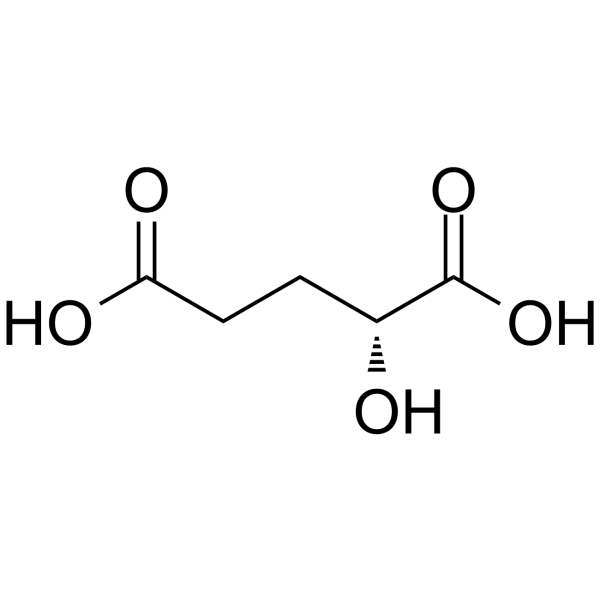
D-Glyceric acid is an endogenous metabolite present in urine that can be used for the research of primary hyperoxaluria type I and glutaric acidemia type 2 .
|
-
- HY-Y1667S
-
-
- HY-133113S
-
|
|
5-HT Receptor
|
Neurological Disease
|
|
7-Desmethyl-agomelatine-d3 is a deuterium labeled 7-Desmethyl-agomelatine. 7-Desmethyl-agomelatine is a metabolite of Agomelatine .
|
-
- HY-75954S
-
-
- HY-W010489S2
-
-
- HY-128532
-
-
- HY-121636S
-
|
RvD2-d5
|
TRP Channel
|
Infection
Neurological Disease
Inflammation/Immunology
|
|
Resolvin D2-d5 is the deuterium labeled Resolvin D2. Resolvin D2 is a metabolite of docosahexaenoic acid (DHA), with anti-inflammatory, anti-infective activities. Resolvin D2 is a potent regulator of leukocytes and controls microbial sepsis. Resolvin D2 is a remarkably potent inhibitor of TRPV1 (IC50 = 0.1 nM) and TRPA1 (IC50 = 2 nM) in primary sensory neurons .
|
-
- HY-18646
-
|
24-Oxo-23,25-dihydroxyvitamin D3
|
Endogenous Metabolite
|
Metabolic Disease
|
|
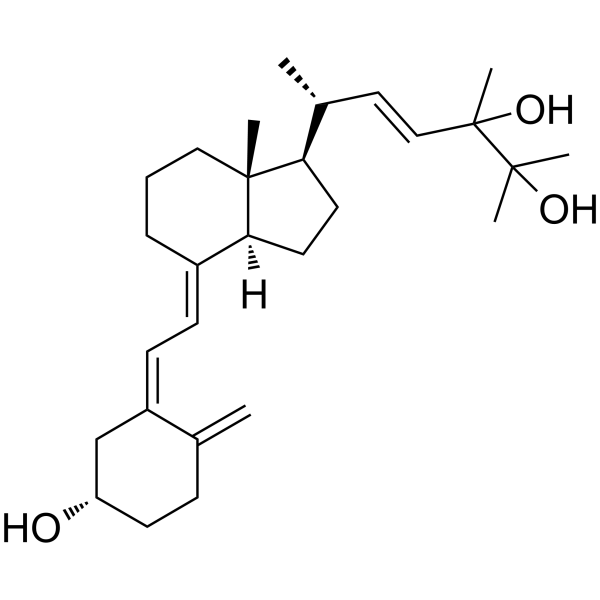
23,25-Dihydroxy-24-oxovitamin D3 is a major metabolite of 24(R),25-Dihydroxyvitamin D3. 23,25-Dihydroxy-24-oxovitamin D3 can be used for the research of metabolic diseases .
|
-
- HY-150159S
-
|
|
Isotope-Labeled Compounds
Drug Metabolite
|
Neurological Disease
Metabolic Disease
|
|
Cotinine-d3 N-β-D-Glucuronide is the deuterium labeled Cotinine N-β-D-Glucuronide (HY-W588194). Cotinine N-β-D-Glucuronide is a glucuronide conjugate of the tobacco metabolite Cotinine (HY-B1178). Cotinine N-β-D-Glucuronide is promising for research of tobacco carcinogen metabolism and cognitive function .
|
-
- HY-150162
-
|
T4-Glc
|
Drug Metabolite
|
Others
|
|
Thyroxine 4'-O-β-D-glucuronide (T4-Glc) is a conjugate of Thyroxine (T4) and Glucuronic acid. Thyroxine 4'-O-β-D-glucuronide is a major metabolite of Thyroxine (HY-18341) .
|
-
- HY-W699430
-
|
(±)-Norverapamil-d6 hydrochloride; D591-d6 hydrochloride
|
Isotope-Labeled Compounds
P-glycoprotein
Calcium Channel
|
Cardiovascular Disease
|
|
Norverapamil-d6 ((±)-Norverapamil-d6) hydrochloride is deuterium labeled Norverapamil (hydrochloride). Norverapamil hydrochloride ((±)-Norverapamil hydrochloride), an N-demethylated metabolite of Verapamil, is a L-type calcium channel blocker and a P-glycoprotein (P-gp) function inhibitor .
|
-
- HY-156180
-
|
|
Drug Metabolite
|
Neurological Disease
|
|
DDC 3′-O-β-D glucuronide (compound 5) is a drug metabolite that can prevent the fibrillization and oligomerization of Aβ42. DDC 3′-O-β-D glucuronide has potential for the research of Alzheimer's disease .
|
-
- HY-112537S1
-
|
|
Isotope-Labeled Compounds
Endogenous Metabolite
mTOR
|
Cardiovascular Disease
Metabolic Disease
|
|
D-Glucose 6-Phosphate- 13C6 disodium xhydrate is a 13C-labeled D-Glucose 6-phosphate disodium xhydrate. D-Glucose 6-phosphate disodium xhydrate is a key central node metabolite in sugar metabolism, serving as the initial metabolite of glycolysis and pentose phosphate pathway, and also a substrate for glycogen synthesis. D-Glucose 6-phosphate disodium xhydrate can act as a metabolic stress signal, especially when phosphoglucomutase (PGI) is inhibited, activating the mTOR pathway, promoting protein synthesis, and thereby participating in the remodeling process of the heart. D-Glucose 6-phosphate disodium xhydrate can be used in research related to non-insulin-dependent diabetes and heart failure.
|
-
- HY-W329175
-
|
SKF-104557
|
Dopamine Receptor
|
Neurological Disease
|
|
N-Despropyl Ropinirole (SKF-104557) is an active metabolite of the dopamine D2 receptor agonist Ropinirole (HY-B0623). N-Despropyl Ropinirole is a full agonist at human D2 and D3 receptors. N-Despropyl Ropinirole is a partial agonistof the hD4 receptor .
|
-
- HY-W014502R
-
|
|
Reference Standards
Aryl Hydrocarbon Receptor
Endogenous Metabolite
|
Cancer
|
|
D-Kynurenine (Standard) is the analytical standard of D-Kynurenine. This product is intended for research and analytical applications. D-kynurenine, a metabolite of D-tryptophan, can serve as the bioprecursor of kynurenic acid (KYNA) and 3-hydroxykynurenine. D-Kynurenine is an agonist for G protein-coupled receptor, GPR109B. D-Kynurenine is a substrate in a fluorometric assay of D-amino acid oxidase. D-kynurenine promotes epithelial-to-mesenchymal transition via activating aryl hydrocarbon receptor (AHR) .
|
-
- HY-128753S6
-
|
|
Isotope-Labeled Compounds
Endogenous Metabolite
Drug Intermediate
|
Metabolic Disease
|
|
D-Lyxose-d is the deuterium labeled D-Lyxose. D-Lyxose is an endogenous metabolite. D-Lyxose is a rare pentose sugar with significant potential for drug synthesis. D-Lyxose can be used as a starting material for anti-tumor drugs such as alpha galactose ceramide immunostimulants. D-Lyxose can be used as a precursor for L-nucleoside analogs for the development of antiviral drugs. D-Lyxose can be used as a synthetic intermediate for other rare sugars such as L-ribose .
|
-
- HY-128753S7
-
|
|
Isotope-Labeled Compounds
Endogenous Metabolite
Drug Intermediate
|
Metabolic Disease
|
|
D-Lyxose-d-1 is the deuterium labeled D-Lyxose. D-Lyxose is an endogenous metabolite. D-Lyxose is a rare pentose sugar with significant potential for drug synthesis. D-Lyxose can be used as a starting material for anti-tumor drugs such as alpha galactose ceramide immunostimulants. D-Lyxose can be used as a precursor for L-nucleoside analogs for the development of antiviral drugs. D-Lyxose can be used as a synthetic intermediate for other rare sugars such as L-ribose .
|
-
- HY-126107
-
-
- HY-136445S
-
|
Desethylterbuthylazine-d9
|
Isotope-Labeled Compounds
|
Others
|
|
Terbuthylazine-desethyl-d9 is the deuterium labeled Terbuthylazine-desethyl . Terbuthylazine-desethyl (Desethylterbuthylazine) is a chloro dealkylated metabolite of Terbuthylazine (a triazine herbicide) .
|
-
- HY-Y0507
-
|
|
TMV
|
Infection
Cancer
|
|
DL-Serine, a fundamental metabolite, is a mixture of D-Serine and L-Serine. DL-Serine has antiviral activity against the multiplication of tobacco mosaic virus (TMV) .
|
-
- HY-113232S
-
-
- HY-136428S
-
|
|
Isotope-Labeled Compounds
|
Cancer
|
|
Desoxycarbadox-d3 is the deuterium labeled Desoxycarbadox. Desoxycarbadox is a metabolite of Carbadox (HY-B1340). Carbadox is a quinoxaline-di-N-oxide antibiotic compound.
|
-
- HY-B0016S
-
-
- HY-Y0781S5
-
|
Acetylformic acid-13C,d4
|
Endogenous Metabolite
|
Others
|
|
Pyruvic acid- 13C,d4 is the deuterium and 13C labeled Pyruvic acid . Pyruvic acid is an intermediate metabolite in the metabolism of carbohydrates, proteins, and fats .
|
-
- HY-W019773S1
-
-
- HY-131936S
-
-
- HY-126061S
-
-
- HY-W016498S
-
-
- HY-133771AS
-
|
Desmethyldoxepin-d3 hydrochloride
|
Drug Metabolite
|
Neurological Disease
|
|
Nordoxepin-d3 (hydrochloride) is the deuterium labeled Nordoxepin hydrochloride. Nordoxepin hydrochloride is an active metabolite of Doxepin hydrochloride (HY-B0725), which is an orally active tricyclic antidepressant .
|
-
- HY-141626S
-
-
- HY-128753
-
|
|
Endogenous Metabolite
Drug Intermediate
|
Metabolic Disease
|
|
D-Lyxose is an endogenous metabolite. D-Lyxose is a rare pentose with significant potential for pharmaceutical synthesis. D-Lyxose serves as a starting material for antitumor agents (such as α-galactosylceramide-based immunostimulants). D-Lyxose acts as a precursor for L-nucleoside analogs used in the development of antiviral drugs. D-Lyxose can be used as a synthetic intermediate for other rare sugars (such as L-ribose) .
|
-
- HY-135035S1
-
|
(-)-Decanoylcarnitine-d19
|
Isotope-Labeled Compounds
Endogenous Metabolite
|
Metabolic Disease
Cancer
|
|
Decanoyl-L-carnitine-d19 ((-)-Decanoylcarnitine-d19> is the deuterium labeled Decanoyl-L-carnitine (HY-135035). Decanoyl-L-carnitine ((-)-Decanoylcarnitine) is an endogenous metabolite. Decanoyl-L-carnitine can be used as a serum metabolic biomarkers as indicators in the progression of intravenous leiomyomatosis.
|
-
- HY-W700240
-
|
|
5-HT Receptor
|
Neurological Disease
|
|
Triazolomethylindole-3-acetic acid is a metabolite of the serotonin (5-HT) receptor subtype 5-HT1B and 5-HT1D agonist Rizatriptan HY-B0206).
|
-
- HY-N11678
-
|
DON-3-β-D-glucoside; Deoxynivalenol 3-glucoside
|
Drug Metabolite
|
Metabolic Disease
|
|
Deoxynivalenol-3-β-D-glucoside (DON-3-β-D-glucoside) is a plant metabolite of the Fusarium mycotoxin Deoxynivalenol (HY-N6684). Deoxynivalenol-3-β-D-glucoside exhibits lower toxicity than Deoxynivalenol in vitro and in vivo .
|
-
- HY-113093S
-
-
- HY-100646AS
-
|
|
Drug Metabolite
|
Neurological Disease
|
|
(Z)-10-Hydroxynortriptyline-d3 is the deuterium labeled (Z)-10-Hydroxynortriptyline (HY-100646A). (Z)-10-Hydroxynortriptyline is a metabolite of Nortriptyline (HY-118620). Nortriptyline is a tricyclic antidepressant and the main active metabolite of Amitriptyline, and is used to relieve the symptoms of depression .
|
-
- HY-70002AS
-
|
N-Desmethyl MDV 3100-d6
|
Androgen Receptor
|
Cancer
|
|
N-desmethyl Enzalutamide-d6 is a deuterium labeled N-desmethyl Enzalutamide. N-desmethyl Enzalutamide is an active metabolite of Enzalutamide. N-desmethyl Enzalutamide is the active metabolite of Enzalutamide. N-desmethyl Enzalutamide demonstrates primary and secondary pharmacodynamics of similar potency to Enzalutamide and circulates at approximately the same plasma concentrations as enzalutamide .
|
-
- HY-142140S
-
|
|
Isotope-Labeled Compounds
|
Others
|
|
3-epi-25-Hydroxy Vitamin D3-d6 is the deuterium labeled 3-epi-25-Hydroxy Vitamin D3 (HY-142140) . 3-epi-25-Hydroxy Vitamin D3 is the vitamin D metabolite, while vitamin D metabolism highly dependent on macrophage polarization. The C3-epimerase pathway for vitamin D is active in macrophages .
|
-
- HY-12772S4
-
|
(2S)-R-63373-d8
|
Fungal
|
Infection
|
|
(2S)-Hydroxy Itraconazole-d8 ((2S)-R-63373-d8) is the enantiomer of Hydroxy Itraconazole-d8 (R-63373-d8) (HY-12772S). Hydroxy Itraconazole-d8 is the deuterium labeled Hydroxy Itraconazole (HY-12772). Hydroxy Itraconazole is an active metabolite of Itraconazole (ITZ), which is a triazole antifungal agent.
|
-
- HY-34439S1
-
-
- HY-W654397
-
|
|
Isotope-Labeled Compounds
|
Others
|
|
Deflazacort-d3 is a isotope of Deflazacort. Deflazacort is an inactive proagent and is converted rapidly to the active metabolite 21-desacetyldeflazacort. Deflazacort is used as an anti-inflammatory and immunosuppressant .
|
-
- HY-178430S
-
-
- HY-W041019S
-
|
|
Endogenous Metabolite
|
Others
|
|
5-Hydroxytryptophol-d4 is the deuterium labeled 5-Hydroxytryptophol. 5-Hydroxytryptophol is a mammalian serotonin metabolite, acting as a marker of acute alcohol consumption.
|
-
- HY-113270AS
-
|
γ-Butyrobetaine-d9 hydrochloride; Deoxycarnitine-d9 hydrochloride
|
Endogenous Metabolite
|
Cardiovascular Disease
Metabolic Disease
|
|
Actinine-d9 chloride is the deuterium labeled Actinine chloride. Actinine chloride is angiopathic substance produced as an intermediary metabolite by gut microbiota that feed on carnitine in dietary red meat .
|
-
- HY-W653885
-
-
- HY-W010973S
-
|
|
Endogenous Metabolite
|
Metabolic Disease
|
|
5-Hydroxytryptamine-d4 creatinine sulfate monohydrate is the deuterium labeled 5-Hydroxytryptamine creatinine sulfate monohydrate. 5-Hydroxytryptamine creatinine sulfate monohydrate is an endogenous metabolite.
|
-
- HY-10003
-
|
1-hydroxycholecalciferol; 1.alpha.-Hydroxyvitamin D3
|
Environmental Pollutants
VD/VDR
|
Metabolic Disease
|
|
Alfacalcidol (1-hydroxycholecalciferol) is a vitamin D active metabolites, acts as a non-selective VDR activator medication, and widely be used in the management of osteoporosis .
|
-
- HY-135400S
-
|
|
FXR
|
Inflammation/Immunology
|
|
Glyco-obeticholic acid-d5 is the deuterium labeled Glyco-Obeticholic acid. Glyco-obeticholic acid is an active metabolite of Obeticholic acid. Obeticholic acid is a farnesoid X receptor (FXR) agonist .
|
-
- HY-W001080S
-
|
|
Endogenous Metabolite
|
Others
|
|
3,4-Dihydroxybenzeneacetic acid-d5 is the deuterium labeled 3,4-Dihydroxybenzeneacetic acid. 3,4-Dihydroxybenzeneacetic acid is the main neuronal metabolite of dopamine.
|
-
- HY-N8515B
-
|
UDP-3-O-(3-hydroxytetradecanoyl)-N-acetylglucosamine diammonium
|
Endogenous Metabolite
|
Others
|
|
UDP-3-O-acyl-GlcNAc diammonium is an E. coli metabolite that is involved in 3-deoxy-D-manno-octulosonate (KDO) biosynthesis pathway .
|
-
- HY-12772S
-
|
R-63373-d8
|
Fungal
|
Infection
|
|
Hydroxy Itraconazole-d8 is the deuterium labeled Hydroxy Itraconazole (HY-12772). Hydroxy Itraconazole is an active metabolite of Itraconazole (ITZ), which is a triazole antifungal agent.
|
-
- HY-124414S
-
-
- HY-104026S1
-
-
- HY-12388AS
-
|
Desmethylclomipramine-d3 hydrochloride; Norclomipramine-d3 hydrochloride
|
Drug Metabolite
|
Neurological Disease
|
|
N-Desmethyl Clomipramine-d3 (hydrochloride) is the deuterium labeled N-Desmethyl Clomipramine. N-Desmethyl Clomipramine hydrochloride (Desmethylclomipramine hydrochloride) is a primary plasma N-desmethyl metabolite of Clomipramine
|
-
- HY-133116S
-
|
|
Adrenergic Receptor
|
Neurological Disease
|
|
4-Hydroxyatomoxetine-d3 is a deuterium labeled 4-Hydroxyatomoxetine. 4-Hydroxyatomoxetine is an active metabolite of Atomoxetine (Tomoxetine). 4-Hydroxyatomoxetine is metabolized by the enzyme cytochrome P450 2D6 (CYP2D6). Atomoxetine is a potent and selective noradrenal in re-uptake inhibitor .
|
-
- HY-121636
-
|
RvD2
|
TRP Channel
|
Infection
Neurological Disease
Inflammation/Immunology
|
|
Resolvin D2 is a metabolite of docosahexaenoic acid (DHA), with anti-inflammatory, anti-infective activities. Resolvin D2 is a potent regulator of leukocytes and controls microbial sepsis. Resolvin D2 is a remarkably potent inhibitor of TRPV1 (IC50 = 0.1 nM) and TRPA1 (IC50 = 2 nM) in primary sensory neurons .
|
-
- HY-10002B
-
|
(1R,5Z)-1,25-Dihydroxyvitamin D3
|
VD/VDR
|
Cancer
|
|
(1R,5Z)-Calcitriol ((1R,5Z)-1,25-Dihydroxyvitamin D3) is a Calcitriol (HY-10002) isomer. Calcitriol is the most active metabolite of vitamin D and also a vitamin D receptor (VDR) agonist .
|
-
- HY-113335S1
-
|
Coprocholic acid-d5
|
Isotope-Labeled Compounds
Endogenous Metabolite
|
Inflammation/Immunology
|
|
Trihydroxycholestanoic acid-d5 (Coprocholic acid-d5) is deuterium labeled Trihydroxycholestanoic acid. Trihydroxycholestanoic acid is an endogenous metabolite present in Blood that can be used for the research of Zellweger Syndrome, Refsum Disease, D Bifunctional Protein Deficiency and Infantile Refsum Disease .
|
-
- HY-W015346S
-
|
3-(4-Hydroxyphenyl)propionic acidd-d8
|
Isotope-Labeled Compounds
Influenza Virus
Endogenous Metabolite
|
Infection
|
|
Desaminotyrosine-d8 (3-(4-Hydroxyphenyl)propionic acid-d8) is the deuterium labeled Desaminotyrosine (HY-W015346). Desaminotyrosine is a microbially associated metabolite protecting from influenza through augmentation of type I interferon signaling.
|
-
- HY-W739949
-
-
- HY-W904855
-
|
|
Endogenous Metabolite
Bacterial
|
Infection
|
|
Apicidin D2 (Compound 4), a fungal metabolite, is a Accessory gene regulator A (AgrA) quorum-sensing inhibitor. Apicidin D2 has anti-virulence activity. Apicidin D2 suppresses MRSA agr activation and shows potent inhibitory activities against all agr types in a nonbiocidal manner. Apicidin D2 can be used for MRSA infections research .
|
-
- HY-N11576
-
|
|
Apoptosis
GSK-3
c-Myc
β-catenin
|
Cancer
|
|
Secalonic acid D is a toxic compound against tumor cells. Secalonic acid D can be isolated from the metabolites of Aspergillus aculeatus. Secalonic acid D activates GSK3-β, and degrades β-catenin. Thus, Secalonic acid D down-regulates c-Myc expression, arrests cell cycle at G1 phase, induces cell apoptosis .
|
-
- HY-W712327
-
|
|
Biochemical Assay Reagents
|
Others
|
|
D-Xylulose 5-phosphate sodium is a pentose phosphate ester and an essential intermediate metabolite in the pentose phosphate pathway (PPP) and the non-oxidative phase of the pentose phosphate pathway. D-xylulose-5-phosphate sodium can be efficiently synthesized through the phosphorylation of D-xylulose catalyzed by D-xylulokinase (XKS1 from Saccharomyces cerevisiae), with ATP regeneration facilitated by the phosphoenolpyruvate (PEP)/pyruvate kinase (PK) system .
|
-
- HY-Y0669S
-
|
|
Isotope-Labeled Compounds
Endogenous Metabolite
Ferroptosis
YAP
Glutathione Peroxidase
|
Infection
|
|
Pipecolic acid-d9 is the deuterium labeled Pipecolic acid. Pipecolic acid is a metabolite of lysine and an important precursor for many useful microbial secondary metabolites. Pipecolic acid slows ferroptosis in diabetic retinopathy by inhibiting the YAP-GPX4 signaling pathway. In addition, Pipecolic acid can be used as a diagnostic marker for pyridoxine-dependent epilepsy .
|
-
- HY-N10508
-
|
|
Drug Metabolite
VD/VDR
|
Metabolic Disease
Cancer
|
|
Calcitroic acid is a vitamin D receptor (VDR) agonist that can activate VDR-mediated transcription. Calcitroic acid is the main metabolite of 1,25-dihydroxyvitamin D3, with the highest concentrations found in the liver and mucosa of mice, and it has metabolic stability and very low toxicity .
|
-
- HY-15157
-
|
1α, 24, 25-Trihydroxy VD3
|
VD/VDR
Drug Metabolite
|
Infection
|
|
Calcitetrol (1α, 24, 25-Trihydroxy VD3), a Vitamin D3 (HY-15398) metabolite, is the hormonally active form of vitamin D. Calcitetrol participates in regulation of Treg cells. Calcitetrol can be used for the research of Toxoplasma gondii infection .
|
-
- HY-113018A
-
|
(S)-Ibuprofen glucuronide
|
Drug Metabolite
|
Inflammation/Immunology
|
|
(S)-Ibuprofen acyl-β-D-glucuronide ((S)-Ibuprofen glucuronide) is a compound used to study the metabolism and pharmacokinetics of S-ibuprofen, a non-steroidal anti-inflammatory drug. (S)-Ibuprofen acyl-β-D-glucuronide is an acylglucuronic acid metabolite produced by S-ibuprofen in the liver .
|
-
- HY-141749AS
-
|
CLPM-d4; SR 26334-d4
|
Isotope-Labeled Compounds
|
Cardiovascular Disease
|
|
Clopidogrel carboxylic acid-d4 is a deuterated derivative of Clopidogrel carboxylic acid, which is an inactive metabolite of the antiplatelet agent Clopidogrel (HY-15283) in plasma. Clopidogrel carboxylic acid-d4 can be used to further explore the metabolic characteristics of Clopidogrel .
|
-
- HY-W008216S
-
|
Hydroxy Dimetridazole-d3
|
Drug Metabolite
Isotope-Labeled Compounds
Parasite
|
Infection
|
|
HMMNI-d3 (Hydroxy Dimetridazole-d3) is deuterium labeled HMMNI (HY-W008216). HMMNI (Hydroxy dimetridazole) is a hydroxy metabolite of Dimetridazol (HY-B1244). Dimetridazole is a nitroimidazole class agent that combats protozoan infections .
|
-
- HY-W766140
-
|
4-Hydroxy duloxetine glucuronide sodium; LY550408 sodium
|
Drug Metabolite
|
Metabolic Disease
|
|
4-Hydroxy duloxetine β-D-glucuronide (4-Hydroxy duloxetine glucuronide) sodium is a major metabolite of Duloxetine (HY-B0161). 4-Hydroxy duloxetine β-D-glucuronide sodium is promising for research of hepatic or renal impairment .
|
-
- HY-113114S
-
|
|
Isotope-Labeled Compounds
Endogenous Metabolite
|
Others
|
|
Tetrahydrocortisone-d5 is the deuterium labeled Tetrahydrocortisone. Tetrahydrocortisone is a stress-induced hormone. Tetrahydrocortisone is also a urinary metabolite of Cortisone derived from the reduction of Cortisone by 5-reductase .
|
-
- HY-Y1362S
-
-
- HY-113335
-
|
Coprocholic acid
|
Endogenous Metabolite
|
Inflammation/Immunology
|
|
Trihydroxycholestanoic acid is an endogenous metabolite present in Blood that can be used for the research of Zellweger Syndrome, Refsum Disease, D Bifunctional Protein Deficiency and Infantile Refsum Disease .
|
-
- HY-113114S1
-
|
|
Isotope-Labeled Compounds
Endogenous Metabolite
|
Others
|
|
Tetrahydrocortisone-d6 is the deuterium labeled Tetrahydrocortisone. Tetrahydrocortisone is a stress-induced hormone. Tetrahydrocortisone is also a urinary metabolite of Cortisone derived from the reduction of Cortisone by 5-reductase .
|
-
- HY-129889
-
|
Febuxostat acyl-β-D-glucuronide
|
Drug Metabolite
Xanthine Oxidase
|
Metabolic Disease
|
|
Febuxostat acyl glucuronide (Febuxostat acyl-β-D-glucuronide) is a metabolite of Febuxostat (HY-14268). Febuxostat is a potent, selective and non-purine xanthine oxidase (XO) inhibitor .
|
-
- HY-B0806AS
-
|
|
Isotope-Labeled Compounds
Parasite
Antifolate
|
Infection
|
|
Proguanil-d4 (hydrochloride) is the deuterium labeled Proguanil hydrochloride. Proguanil hydrochloride, an antimalarial proagent, is metabolized to the active metabolite Cycloguanil (HY-12784). Proguanil hydrochloride is a dihydrofolate reductase (DHFR) inhibitor .
|
-
- HY-W010476S
-
-
- HY-W019773S
-
-
- HY-124245S2
-
|
|
Isotope-Labeled Compounds
|
Others
|
|
3-Hydroxy desloratadine-d6 is deuterated labeled 3-Hydroxy desloratadine (HY-124245). 3-Hydroxy desloratidine is a metabolite of Desloratidine .
|
-
- HY-113252S2
-
-
- HY-W704657
-
-
- HY-115127S
-
|
m-Methoxytoluene-d3; m-Methylanisole-d3
|
Isotope-Labeled Compounds
Endogenous Metabolite
Bacterial
|
Infection
|
|
3-Methylanisole-d3 (m-Methoxytoluene-d3; m-MetHYlanisole-d3) is the deuterium labeled 3-Methylanisole (HY-115127) . Methylanisole is a volatile metabolite produced by Penicillium strains growing on barley. 3-Methylanisole serves as a precursor for the biotechnological production of vanillin .
|
-
- HY-180632
-
|
D-Erythro-imidazole-glycerol 3-phosphate
|
Nucleoside Antimetabolite/Analog
|
Neurological Disease
|
|
D-Erythro-1-(imidazol-4-yl)glycerol 3-phosphate (D-Erythro-imidazole-glycerol 3-phosphate) is a metabolite in the histidine metabolism pathway. D-Erythro-1-(imidazol-4-yl)glycerol 3-phospha can serve as a biomarker for epilepsy .
|
-
- HY-W019721R
-
|
|
Reference Standards
Nuclear Factor of activated T Cells (NFAT)
|
Inflammation/Immunology
|
|
Cyclosporin D (Standard) is the analytical standard of Cyclosporin D. This product is intended for research and analytical applications. Cyclosporin D, a metabolite of Cyclosporin A, is a weak immunosuppressant. Cyclosporin D is used as internal standard for quantification of Cyclosporin A . Cyclosporin A is a potent immunosuppressant agent, suppress T cell activation by inhibiting calcineurin and the calcineurin-dependent transcription factors nuclear factor of activated T cells (NFAc) .
|
-
- HY-W017511
-
|
|
Endogenous Metabolite
Drug Intermediate
|
Others
|
|
5,6-Dimethyl-1H-benzo[d]imidazole is an endogenous metabolite. 5,6-Dimethyl-1H-benzo[d]imidazole is also a benzimidazole derivative and can be used in the synthesis of other active compounds .
|
-
- HY-W707099
-
|
|
Isotope-Labeled Compounds
Bacterial
|
Infection
|
|
Ro 20-0657/000-d3 is the deuterium labeled Ro 20-0657/000 (HY-100622). Ro 20-0657/000 is a metabolite of Trimethoprim. Trimethoprim is a dihydrofolate reductase inhibitor, used as an antibacterial agent in human and veterinary medicine .
|
-
- HY-W587691S
-
-
- HY-128753S5
-
|
|
Isotope-Labeled Compounds
Endogenous Metabolite
Drug Intermediate
|
Others
|
|
D-Lyxose- 13C-4 is the 13C labeled D-Lyxose. D-Lyxose is an endogenous metabolite. D-Lyxose is a rare pentose sugar with significant potential for drug synthesis. D-Lyxose can be used as a starting material for anti-tumor drugs such as alpha galactose ceramide immunostimulants. D-Lyxose can be used as a precursor for L-nucleoside analogs for the development of antiviral drugs. D-Lyxose can be used as a synthetic intermediate for other rare sugars such as L-ribose .
|
-
- HY-122277S
-
|
Ro 03-7410-d9
|
Isotope-Labeled Compounds
Drug Metabolite
|
Metabolic Disease
|
|
1'-Hydroxy bufuralol-d9 is a deuterium labeled 1'-Hydroxy bufuralol (HY-122277). 1'-Hydroxy bufuralol is the main metabolite of Bufuralol (HY-105124) by the cytochrome P450 isoenzymes 2D1 and 2D2 (CYP2D1/2). 1'-Hydroxy bufuralol can be used to determine CYP2D1/2 enzyme activity .
|
-
- HY-128753R
-
|
|
Reference Standards
Endogenous Metabolite
Drug Intermediate
|
Metabolic Disease
|
|
D-Lyxose (Standard) is the analytical standard of D-Lyxose. This product is intended for research and analytical applications. D-Lyxose is an endogenous metabolite. D-Lyxose is a rare pentose sugar with significant potential for drug synthesis. D-Lyxose can be used as a starting material for anti-tumor drugs such as alpha galactose ceramide immunostimulants. D-Lyxose can be used as a precursor for L-nucleoside analogs for the development of antiviral drugs. D-Lyxose can be used as a synthetic intermediate for other rare sugars such as L-ribose .
|
-
- HY-128753S3
-
|
|
Isotope-Labeled Compounds
Endogenous Metabolite
Drug Intermediate
|
Others
|
|
D-Lyxose- 13C-2 is the 13C labeled D-Lyxose. D-Lyxose is an endogenous metabolite. D-Lyxose is a rare pentose sugar with significant potential for drug synthesis. D-Lyxose can be used as a starting material for anti-tumor drugs such as alpha galactose ceramide immunostimulants. D-Lyxose can be used as a precursor for L-nucleoside analogs for the development of antiviral drugs. D-Lyxose can be used as a synthetic intermediate for other rare sugars such as L-ribose .
|
-
- HY-128753S4
-
|
|
Isotope-Labeled Compounds
Endogenous Metabolite
Drug Intermediate
|
Others
|
|
D-Lyxose- 13C-3 is the 13C labeled D-Lyxose. D-Lyxose is an endogenous metabolite. D-Lyxose is a rare pentose sugar with significant potential for drug synthesis. D-Lyxose can be used as a starting material for anti-tumor drugs such as alpha galactose ceramide immunostimulants. D-Lyxose can be used as a precursor for L-nucleoside analogs for the development of antiviral drugs. D-Lyxose can be used as a synthetic intermediate for other rare sugars such as L-ribose .
|
-
- HY-B0806S1
-
|
|
Antifolate
Parasite
|
Infection
|
|
Proguanil-d4 is the deuterium labeled Proguanil . Proguanil, an antimalarial proagent, is metabolized to the active metabolite Cycloguanil (HY-12784). Proguanil is a dihydrofolate reductase (DHFR) inhibitor .
|
-
- HY-13609S1
-
-
- HY-132417S
-
-
- HY-118634
-
|
R-4G
|
FATP
|
Metabolic Disease
|
|
Trans-Resveratrol-4'-O-D-Glucuronide (R-4G) is a metabolite of resveratrol with anti-fat accumulation property, and can be used for metabolic research .
|
-
- HY-137532S1
-
|
|
Isotope-Labeled Compounds
|
Neurological Disease
|
|
7-Hydroxyquetiapine-d4 (hemifumarate) is deuterium labeled 7-Hydroxyquetiapine. 7-Hydroxyquetiapine (ICI 214227) is the major active metabolite of antipsychotic medicine Quetiapine .
|
-
- HY-104026S
-
-
- HY-W015060S1
-
|
|
Endogenous Metabolite
|
Others
|
|
2-(2-Methylbenzamido)acetic acid-d2 is the deuterium labeled 2-(2-Methylbenzamido)acetic acid. 2-(2-Methylbenzamido)acetic acid is a metabolite detected in urine.
|
-
- HY-W015780S1
-
-
- HY-N8549A
-
|
|
Endogenous Metabolite
|
Metabolic Disease
|
|
5-Dihydrocortisone is a 5-Dihydrocortisone with mixture of isomers. 5β-Dihydrocortisone is a sterol metabolite of cortisone by 5β-reductase (AKR1D1) in liver
|
-
- HY-107850S
-
-
- HY-113426S
-
-
- HY-113005S
-
|
|
Isotope-Labeled Compounds
Endogenous Metabolite
|
Metabolic Disease
|
|
Glutarylcarnitine-d9 (chloride) is the deuterium labeled Glutarylcarnitine chloride. Glutarylcarnitine is the diagnostic metabolite for malonic aciduria and glutaric aciduria type I monitored in most tandem mass spectrometry newborn screening programmes.
|
-
- HY-137532S
-
-
- HY-113405S1
-
-
- HY-W015060S
-
|
|
Endogenous Metabolite
|
Others
|
|
2-(2-Methylbenzamido)acetic acid-d7 is the deuterium labeled 2-(2-Methylbenzamido)acetic acid. 2-(2-Methylbenzamido)acetic acid is a metabolite detected in urine.
|
-
- HY-W741628
-
-
- HY-100662S
-
|
Bisdesethylchloroquine-d4
|
Isotope-Labeled Compounds
Drug Metabolite
|
Cardiovascular Disease
|
|
Didesethyl chloroquine-d4 is the deuterium labeled Didesethyl chloroquine. Didesethyl chloroquine (Bisdesethylchloroquine) is a major metabolite of the antimalarial agent Chloroquine. Didesethyl chloroquine is a potent myocardial depressant .
|
-
- HY-W011848S
-
|
2-((Benzyloxy)carbonyl)benzoic acid-d4
|
Isotope-Labeled Compounds
Endogenous Metabolite
|
Metabolic Disease
|
|
Monobenzyl phthalate-d4 is the deuterium labeled Monobenzyl phthalate. Monobenzyl phthalate (2-((Benzyloxy)carbonyl)benzoic acid) is the urinary metabolite exposuring to phthalates, such as, diethylhexyl phthalate (DEHP) .
|
-
- HY-13609S
-
-
- HY-B0815S
-
|
|
Cholinesterase (ChE)
|
Neurological Disease
|
|
Chlorpyrifos-d10 is the deuterium labeled Chlorpyrifos. Chlorpyrifos is an organophosphate insecticide that is classified as a phosphorothionate. The oxon metabolite of Chlorpyrifos is an inhibitor of acetylcholinesterase (AChE), affecting neurological function in insects, humans, and other animals. The Chlorpyrifos oxon (CPO) metabolite is hydrolyzed by the plasma enzyme paraoxonase 1 (PON1), and susceptibility to neurotoxicity associated with CPO exposure is mitigated by PON1 overexpression.
|
-
- HY-113371S
-
|
Methylcitric acid-d3
|
Endogenous Metabolite
|
Metabolic Disease
|
|
2-Methylcitric acid-d3 is the deuterium labeled 2-Methylcitric acid. 2-Methylcitric acid (Methylcitric acid) is an endogenous metabolite in the 2-methylcitric acid cycle. 2-Methylcitric acid accumulates in methylmalonic and propionic acidemias and acts as a marker metabolite. 2-Methylcitric acid markedly inhibits ADP-stimulated and uncoupled respiration in mitochondria supported by glutamate .
|
-
- HY-113739
-
|
DCIT hydrochloride
|
Cytochrome P450
|
Neurological Disease
|
|
Desmethylcitalopram (DCIT) hydrochloride is the active metabolite of Citalopram (HY-121203). Desmethylcitalopram has antidepressant effects. Desmethylcitalopram also inhibits cytochrome P450-2D6, -2C19 with IC50s of 39.5 and 53.5 μM .
|
-
- HY-W741748
-
|
Deacetylcephapirin-d6 sodium
|
Isotope-Labeled Compounds
Bacterial
|
Infection
|
|
Desacetylcephapirin-d6 sodium (Deacetylcephapirin-d6 sodium) is the deuterium labeled Desacetylcephapirin sodium (HY-131989). Desacetylcephapirin (Deacetylcephapirin) sodium is an active metabolite of Cephapirin (HY-A0153A). Desacetylcephapirin sodium has antimicrobial against S. aureus and coagulase-negative staphylococci mastitis pathogen .
|
-
- HY-W019721
-
|
|
Nuclear Factor of activated T Cells (NFAT)
|
Inflammation/Immunology
|
|
Cyclosporin D, a metabolite of Cyclosporin A, is a weak immunosuppressant. Cyclosporin D is used as internal standard for quantification of Cyclosporin A . Cyclosporin A is a potent immunosuppressant agent, suppress T cell activation by inhibiting calcineurin and the calcineurin-dependent transcription factors nuclear factor of activated T cells (NFAc) .
|
-
- HY-17530S
-
-
- HY-N0384S
-
-
- HY-N0384S1
-
-
- HY-N0384S2
-
-
- HY-141987S
-
|
Atorvastatin impurity K-d5
|
Isotope-Labeled Compounds
Drug Metabolite
|
Metabolic Disease
|
|
2-Hydroxy atorvastatin-d5 (Atorvastatin impurity K-d5) is the deuterium labeled 2-Hydroxy atorvastatin. 2-Hydroxy atorvastatin calcium salt is a hydroxy metabolite of Atorvastatin calcium salt. Atorvastatin is a potent HMG-CoA reductase inhibitor with an IC50 value of 8 nM.
|
-
- HY-B0256S
-
|
BW 57-322-d3
|
Isotope-Labeled Compounds
|
Others
|
|
Azathioprine-d3 (BW 57-322-d3) is the deuterium labeled Azathioprine (HY-B0256). Azathioprine (BW 57-322) is an orally active immunosuppressive agent. Azathioprine can be converted in vivo to the active metabolite 6-mercaptopurine (6-MP). Azathioprine has myelosuppressive effects and induces apoptosis .
|
-
- HY-N4237
-
|
|
Prostaglandin Receptor
Potassium Channel
|
Inflammation/Immunology
|
|
Saikogenin D is isolated from?Bupleurum chinense, has anti-inflammatory effects. Saikogenin D activates epoxygenases that converts arachidonic acid to epoxyeicosanoids and dihydroxyeicosatrienoic acids, and the metabolites secondarily inhibit prostaglandin E2 (PGE2) production. Saikogenin D results in an elevation of [Ca 2+]i due to Ca 2+ release from intracellular stores .
|
-
- HY-137912
-
|
|
Drug Metabolite
|
Endocrinology
Cancer
|
|
trans-Resveratrol-3-O-β-D-Glucuronide is an active metabolite of trans-resveratrol. trans-Resveratrol-3-O-β-D-Glucuronide reduces the proliferation of several intestinal cancer cell line. trans-Resveratrol-3-O-β-D-Glucuronide increases pyruvate production in livers .
|
-
- HY-W121887
-
|
Zomepirac glucuronide
|
Dipeptidyl Peptidase
Transmembrane Glycoprotein
|
Inflammation/Immunology
|
|
Zomepirac acyl-O-β-D-glucuronide (Zomepirac glucuronide) is a dipeptidyl peptidase IV Inhibitor. Zomepirac acyl-O-β-D-glucuronide is an unstable and chemically reactive metabolite of Zomepirac (HY-B0890A). Zomepirac acyl-O-β-D-glucuronide forms covalent adducts with cell membrane glycoproteins. Zomepirac acyl-O-β-D-glucuronide can be used for research on immunotoxicity .
|
-
- HY-W012926S1
-
-
- HY-135400S2
-
|
|
Isotope-Labeled Compounds
|
Inflammation/Immunology
|
|
Glyco-obeticholic acid-d4 is the deuterium labeled Glyco-obeticholic acid (HY-135400). Glyco-obeticholic acid is an active metabolite of Obeticholic acid. Obeticholic acid is a farnesoid X receptor (FXR) agonist .
|
-
- HY-W009713S
-
|
|
Drug Metabolite
|
Neurological Disease
|
|
3,4,5-Trimethoxyphenylacetic acid-d2 is the deuterium labeled 3,4,5-Trimethoxyphenylacetic acid . 3,4,5-Trimethoxyphenylacetic acid is a metabolite of Mescaline .
|
-
- HY-113369S
-
-
- HY-126665
-
|
|
ADC Payload
|
Cancer
|
|
DMEA-PNU-159682 (molecule D12) is a ADC cytotoxin molecule including metabolites of nemorubicin (MMDX) from liver microsomes and a potent ADCs cytotoxin PNU-159682 .
|
-
- HY-W699907
-
-
- HY-12785S1
-
|
Ricobendazole-d7; Albendazole oxide-d7
|
Isotope-Labeled Compounds
Parasite
|
Infection
|
|
Albendazole sulfoxide-d7 is the deuterium labeled Albendazole sulfoxide. Albendazole sulfoxide (Ricobendazole), the main active metabolite of Albendazole, exhibits anti-parasite effect against Echinococcus multilocularis Metacestodes .
|
-
- HY-N7143S
-
|
|
Isotope-Labeled Compounds
|
Endocrinology
|
|
Monobutyl phthalate-d4 is the deuterium labeled Monobutyl phthalate . Monobutyl phthalate, a major metabolite of dibutyl phthalate (DBP), possesses antiandrogenic effects. Monobutyl phthalate is an embryotoxicant .
|
-
- HY-Z9101
-
|
|
Histamine Receptor
|
Neurological Disease
|
|
Promethazine sulfoxide is a metabolite of the histamine H1 receptor antagonist Promethazine (HY-B1296). It is formed from promethazine by the cytochrome P450 (CYP) isoform CYP2D6.
|
-
- HY-137909
-
-
- HY-135335S
-
|
|
Drug Metabolite
|
Metabolic Disease
|
|
3'-Hydroxy Repaglinide-d5 is the deuterium labeled 3'-Hydroxy Repaglinide. 3'-Hydroxy Repaglinide is a main CYP2C8 metabolite of Repaglinide .
|
-
- HY-113038
-
|
(R)-2-Hydroxyglutarate; (R)-2-Hydroxyglutaric acid; (R)-2-Hydroxypentanedioic acid
|
Reactive Oxygen Species (ROS)
ATP Synthase
mTOR
Endogenous Metabolite
|
Neurological Disease
Inflammation/Immunology
Cancer
|
|
D-α-Hydroxyglutaric acid ((R)-2-Hydroxyglutarate) is the principal metabolite accumulating in neurometabolic disease D-2-hydroxyglutaric aciduria. D-α-Hydroxyglutaric acid is a weak competitive antagonist of α-ketoglutarate (α-KG) and inhibits multiple α-KG-dependent dioxygenases with a Ki of 10.87 mM. D-α-Hydroxyglutaric acid increases reactive oxygen species (ROS) production. D-α-Hydroxyglutaric acid binds and inhibits ATP synthase and inhibits mTOR signaling .
|
-
- HY-100665S
-
|
OPC-14857-d8; DM-14857-d8
|
Isotope-Labeled Compounds
5-HT Receptor
|
Neurological Disease
|
|
Dehydroaripiprazole-d8 is deuterium labeled Dehydroaripiprazole. Dehydroaripiprazole (OPC-14857) is an active metabolite of Aripiprazole. Aripiprazole is an antipsychotic agent and is metabolized by CYP3A4 and CYP2D6 forming mainly Dehydroaripiprazole. Dehydroaripiprazole has with antipsychotic activity equivalent to Aripiprazole .
|
-
- HY-143664S
-
-
- HY-Y1097S
-
|
2-(Methoxycarbonyl)benzoic acid-d4
|
Isotope-Labeled Compounds
|
Cancer
|
|
Monomethyl phthalate-d4 (2-(Methoxycarbonyl)benzoic acid-d4) is the deuterium labeled Monomethyl phthalate. Monomethyl phthalate is a phthalate metabolite. Monomethyl phthalate acts as a urinary biomarker of phthalates exposure and can be used as a standard for the determination of thyroid cancer and benign nodule .
|
-
- HY-W019151S
-
|
|
Isotope-Labeled Compounds
Endogenous Metabolite
|
Metabolic Disease
|
|
Meconin-d3 is the deuterium labeled Meconine (HY-W019151). Meconine is an endogenous metabolite of Noscapine (HY-13716). Meconine is the major metabolite in all three species, accounting for about 3, 8 and 2% of the dose in the first 24 h urines of rats, rabbits and humans, respectively. Meconine can be used as a marker to detect illicit opiate use.
|
-
- HY-W708469
-
|
|
Endogenous Metabolite
TRP Channel
|
Inflammation/Immunology
|
|
Resolvin D2 methyl ester is an ester derivative of the DHA (HY-B2167) metabolite Resolvin D2 (HY-121636) with anti-inflammatory and anti-infective activities. Resolvin D2 is a leukocyte modulator and a potent inhibitor of neuronal TRPV1 (IC50=0.1 nM) and TRPA1 (IC50=2 nM). Resolvin D2 can be used in sepsis research .
|
-
- HY-159201
-
|
|
Calcium Channel
|
Metabolic Disease
|
|
24-Oxo-25-hydroxyvitamin D3 is a vitamin D3 metabolite and an intermediate in the renal mitochondrial side-chain oxidation pathway. 24-Oxo-25-hydroxyvitamin D3 enhances intestinal calcium transport in rats . 24-Oxo-25-hydroxyvitamin D3 can be used in studies related to X-linked hypophosphatemic rickets .
|
-
- HY-135594
-
|
|
Estrogen Receptor/ERR
|
Metabolic Disease
|
|
4'-Raloxifene-β-D-glucopyranoside, a metabolite of Raloxifene, is a benzothiophene glucuronidated at the 4' postion. 4'-Raloxifene-β-D-glucopyranoside is a selective and orally active estrogen receptor antagonist. 4'-Raloxifene-β-D-glucopyranoside can be used for inhibiting bone loss and resorption, and lowering lipid levels. 4'-Raloxifene-β-D-glucopyranoside, example 5, is extracted from patent US5567820A .
|
-
- HY-N13015
-
|
|
Endogenous Metabolite
|
Endocrinology
|
|
Quercetin 5-O-β-D-glucopyranoside is a glycosylated flavonoid metabolite and flavonoid compound. Quercetin 5-O-β-D-glucopyranoside can be produced by microbial transformation of Quercetin (HY-18085) via Mucor hiemalis. Quercetin 5-O-β-D-glucopyranoside can be used in studies related to benign prostatic hyperplasia .
|
-
- HY-W739944
-
|
NA-872-d5
|
Isotope-Labeled Compounds
Autophagy
Glycosidase
|
Neurological Disease
Metabolic Disease
|
|
Ambroxol-d5 (NA-872-d5) is deuterium labeled Ambroxol. Ambroxol (NA-872), an active metabolite of the proagent Bromhexine, has potent expectorant effects. Ambroxol is a glucocerebrosidase (GCase) chaperone and increases glucocerebrosidase activity. Ambroxol induces lung autophagy and has the potential for Parkinson disease and neuronopathic Gaucher disease research .
|
-
- HY-135392S
-
|
AC-279-d9 hydrochloride
|
Isotope-Labeled Compounds
|
Neurological Disease
|
|
N-Desmethyl Pimavanserin-d9 hydrochloride (AC-279-d9 hydrochloride) is the deuterium labeled N-Desmethyl Pimavanserin (HY-135392). N-Desmethyl Pimavanserin is the active metabolite of Pimavanserin. Pimavanserin is a selective inverse agonist of the 5-HT2A receptor with pIC50 and pKd of 8.73 and 9.3, respectively .
|
-
- HY-113739S1
-
|
DCIT-d4 hydrochloride
|
Cytochrome P450
Isotope-Labeled Compounds
|
Neurological Disease
|
|
Desmethylcitalopram-d4 hydrochloride is deuterated labeled Desmethylcitalopram hydrochloride (HY-113739). Desmethylcitalopram (DCIT) hydrochloride is the active metabolite of Citalopram (HY-121203). Desmethylcitalopram has antidepressant effects. Desmethylcitalopram also inhibits cytochrome P450-2D6, -2C19 with IC50s of 39.5 and 53.5 μM .
|
-
- HY-N6709S2
-
|
α-Zearalanol-d5-1
|
Isotope-Labeled Compounds
Estrogen Receptor/ERR
|
Endocrinology
|
|
Zeranol-d5-1 (α-Zearalanol-d5-1) is the deuterium labeled Zeranol (HY-N6709). Zeranol, a metabolite of the mycoestrogen zearalenone, is an estrogen receptor agonist. Zeranol is used as a growth promoter of livestock due to its strong estrogenic activity .
|
-
- HY-W704807
-
|
3-O-methyl Dopamine-d3 hydrochloride
|
Isotope-Labeled Compounds
Drug Metabolite
|
Neurological Disease
|
|
3-Methoxytyramine-d3 hydrochloride (3-O-methyl Dopamine-d3 hydrochloride) is the deuterium labeled 3-Methoxytyramine hydrochloride (HY-103638). 3-Methoxytyramine hydrochloride is an inactive metabolite of dopamine which can activate trace amine associated receptor 1 (TAAR1).
|
-
- HY-150012S2
-
|
Lac-Phe-d5
|
Isotope-Labeled Compounds
Endogenous Metabolite
|
Metabolic Disease
|
|
N-Lactoyl-phenylalanine-d5 (Lac-Phe-d5) is the deuterium labeled N-Lactoyl-phenylalanine (HY-150012). N-Lactoyl-phenylalanine is a blood-derived signaling metabolite that can be induced by exercise. N-Lactoyl-phenylalanine can reduce obesity and improve glucose tolerance.
|
-
- HY-W045132S
-
|
Desbutylbupivacaine-d6
|
Isotope-Labeled Compounds
Drug Metabolite
|
Neurological Disease
|
|
N-Desbutyl bupivacaine-d6 (Desbutylbupivacaine-d6) is the deuterium labeled N-Desbutyl Bupivacaine (HY-W045132). N-Desbutyl Bupivacaine (compound 100) is a metabolite of Bupivacaine (HY-B0405), an NMDA receptor inhibitor and SCN5A antagonist .
|
-
- HY-N0384S4
-
-
- HY-135391S
-
|
Ezetimibe glucuronide-d4; Ezetimibe β-D-glucuronide-d4
|
Drug Metabolite
|
Metabolic Disease
|
|
Ezetimibe phenoxy glucuronide-d4 is the deuterium labeled Ezetimibe phenoxy glucuronide. Ezetimibe phenoxy glucuronide is the active metabolite of Ezetimibe. Antihyperlipoproteinemic activity . Ezetimibe is a potent cholesterol absorption inhibitor .
|
-
- HY-137215S2
-
|
|
Isotope-Labeled Compounds
|
Others
|
|
4'-trans-Hydroxy Cilostazol-d4 is deuterated labeled 4'-trans-Hydroxy Cilostazol (HY-137215). 4'-trans-Hydroxy Cilostazol is a metabolite of Cilostazol .
|
-
- HY-75087S
-
-
- HY-135328AS
-
|
(±)-Norverapamil-d7 hydrochloride; D591-d7 hydrochloride
|
Isotope-Labeled Compounds
Calcium Channel
|
Cardiovascular Disease
|
|
Norverapamil-d7 (hydrochloride) is a deuterium labeled Norverapamil. Norverapamil ((±)-Norverapamil), an N-demethylated metabolite of Verapamil, is a L-type calcium channel blocker and a P-glycoprotein (P-gp) function inhibitor .
|
-
- HY-W724350
-
-
- HY-144463S
-
|
|
Isotope-Labeled Compounds
COX
|
Others
|
|
4'-Aarboxylic acid imrecoxib-d7 is the deuterium labeled 4'-Aarboxylic acid imrecoxib (HY-154846). 4'-Aarboxylic acid imrecoxib is a metabolite of Imrecoxib, a selective COX-II inhibitor.
|
-
- HY-W701397
-
-
- HY-135407S
-
|
|
Isotope-Labeled Compounds
Drug Metabolite
|
Neurological Disease
|
|
N-Desethyl Oxybutynin-d5 (hydrochloride) is deuterium labeled N-Desethyl Oxybutynin hydrochloride. N-Desethyl Oxybutynin is the the active metabolite Oxybutynin. Oxybutynin is an anticholinergic agent that inhibits voltage-dependent K+ channels .
|
-
- HY-W010476S1
-
-
- HY-W016562S
-
|
2-Benzamidoacetic acid-d5
|
Endogenous Metabolite
|
Metabolic Disease
|
|
Hippuric acid-d5 is the deuterium labeled Hippuric acid. Hippuric Acid (2-Benzamidoacetic acid), an acyl glycine produced by the conjugation of benzoic acid and glycine, is a normal component in urine as a metabolite of aromatic compounds from food.
|
-
- HY-126665A
-
|
|
ADC Payload
|
Cancer
|
|
DMEA-PNU-159682 (molecule D12) dichloroacetate is an ADC cytotoxin molecule including metabolites of nemorubicin (MMDX) from liver microsomes and a potent ADCs cytotoxin PNU-159682 .
|
-
- HY-135328S
-
-
- HY-W010736S
-
-
- HY-W016562S1
-
|
2-Benzamidoacetic acid-d2
|
Isotope-Labeled Compounds
Endogenous Metabolite
|
Metabolic Disease
|
|
Hippuric acid-d2 is the deuterium labeled Hippuric acid. Hippuric Acid (2-Benzamidoacetic acid), an acyl glycine produced by the conjugation of benzoic acid and glycine, is a normal component in urine as a metabolite of aromatic compounds from food.
|
-
- HY-W715112
-
|
|
Isotope-Labeled Compounds
Endogenous Metabolite
|
Others
|
|
3-Hydroxypropionic acid-d4 sodium is the deuterium labeled 3-Hydroxypropionic acid sodium (HY-W095705A). 3-Hydroxypropionic acid sodium, an endogenous metabolite, is a building block in the chemical synthesis .
|
-
- HY-128554S
-
|
|
Isotope-Labeled Compounds
Parasite
|
Infection
|
|
N-Desethyl amodiaquine-d5 is the deuterium labeled N-Desethyl amodiaquine. N-Desethyl amodiaquine is the major biologically active metabolite of Amodiaquine. N-Desethyl amodiaquine is an antiparasitic agent. IC50 values for strains V1/S and 3D7 are 97 nM and 25 nM, respectively .
|
-
- HY-128554S1
-
|
|
Isotope-Labeled Compounds
Parasite
|
Infection
|
|
N-Desethyl amodiaquine-d5 dihydrochloride is the deuterium labeled N-Desethyl amodiaquine dihydrochloride. N-Desethyl amodiaquine dihydrochloride is the major biologically active metabolite of Amodiaquine. N-Desethyl amodiaquine dihydrochloride is an antiparasitic agent. IC50 values for strains V1/S and 3D7 are 97 nM and 25 nM, respectively .
|
-
- HY-100807S
-
-
- HY-101108S1
-
|
AGN 190299-13C2,d2
|
Drug Metabolite
Isotope-Labeled Compounds
|
Others
|
|
Tazarotenic acid-13C2,d2 (AGN 190299-13C2,d2) is the 13C and deuterium labeled isotope of Tazarotenic acid (HY-101108). Tazarotenic acid is the metabolite of Tazarotene. Tazarotenic acid binding to retinoic acid receptors (RARs) is the probable molecular target of retinoid action. Tazarotenic acid has the potential for the research of warty dyskeratoma .
|
-
- HY-A0132
-
|
N-Acetyl-2-amino-2-deoxy-D-glucose
|
Endogenous Metabolite
Drug Derivative
Drug Isomer
Interleukin Related
|
Metabolic Disease
Inflammation/Immunology
Cancer
|
|
N-Acetyl-D-Glucosamine (N-Acetyl-2-amino-2-deoxy-D-glucose), the D isomer of N-acetylglucosamine, is an orally active monosaccharide derivative of glucose with anti-tumor and anti-inflammation properties. N-Acetyl-D-Glucosamine is also a bacterial metabolite, which is found in Escherichia coli. N-Acetyl-D-Glucosamine can induce yeast-mycelial conversion in Candida albicans. N-Acetyl-D-Glucosamine also enhances healing of cartilaginous injuries in rabbits .
|
-
- HY-15830
-
|
25,26-Dihydroxycholecalciferol
|
VD/VDR
Drug Metabolite
Drug Derivative
Calcium Channel
|
Metabolic Disease
|
|
25,26-Dihydroxyvitamin D3 (25,26-Dihydroxycholecalciferol) is a dihydroxylated derivative and metabolite of Vitamin D3 (HY-15398). 25,26-Dihydroxyvitamin D3 moderately increases serum calcium levels when the initial serum calcium level is low. 25,26-Dihydroxyvitamin D3 promotes intestinal calcium absorption in vitamin D-deficient rats fed a low-calcium diet. 25,26-Dihydroxyvitamin D3 is applicable to research related to osteomalacia .
|
-
- HY-100542
-
|
Disodium (R)-2-hydroxyglutarate
|
Reactive Oxygen Species (ROS)
ATP Synthase
mTOR
Endogenous Metabolite
|
Neurological Disease
Inflammation/Immunology
Cancer
|
|
D-α-Hydroxyglutaric acid disodium (Disodium (R)-2-hydroxyglutarate) is the principal metabolite accumulating in neurometabolic disease D-2-hydroxyglutaric aciduria. D-α-Hydroxyglutaric acid disodium is a weak competitive antagonist of α-ketoglutarate (α-KG) and inhibits multiple α-KG-dependent dioxygenases with a Ki of 10.87 mM. D-α-Hydroxyglutaric acid disodium increases reactive oxygen species (ROS) production. D-α-Hydroxyglutaric acid disodium binds and inhibits ATP synthase and inhibits mTOR signaling .
|
-
- HY-144950S
-
|
3-OHBaP-d11
|
Isotope-Labeled Compounds
|
Others
|
|
3-Hydroxy benzopyrene-d11 is the deuterium labeled 3-Hydroxy benzopyrene (HY-144950) . 3-Hydroxy benzopyrene is a metabolite of Benzopyrene (HY-107377) .
|
-
- HY-W709055
-
-
- HY-113252S
-
-
- HY-133115AS
-
|
|
Isotope-Labeled Compounds
β-catenin
|
Neurological Disease
|
|
N-Desmethylnefopam-d5 (hydrochloride) is a deuterium labeled N-Desmethylnefopam hydrochloride. N-Desmethylnefopam hydrochloride is the main metabolite of Nefopam. N-Desmethylnefopam hydrochloride is a centrally-acting but non-opioid analgesic agent, for the relief of moderate to severe pain .
|
-
- HY-126635
-
|
|
Dopamine Receptor
Adrenergic Receptor
|
Others
|
|
Mafoprazine is a phenylpiperazine derivative with variable affinities for neuronal receptors. It may exert its antipsychotic effects primarily through D2 receptor blockade and α-adrenergic activity, and may increase the activity of dopamine metabolites.
|
-
- HY-W740630
-
|
|
5-HT Receptor
|
Neurological Disease
|
|
8-Hydroxy mirtazapine is a metabolite of the antidepressant Mirtazapine (HY-B0352). 8-Hydroxy mirtazapine is formed from mMirtazapine by the cytochrome P450 (CYP) isoform CYP2D6.
|
-
- HY-152014S
-
|
|
Isotope-Labeled Compounds
Endogenous Metabolite
|
Neurological Disease
|
|
Stearoylcarnitine-d3-1 (hydrochloride) is deuterium labeled Stearoylcarnitine. Stearoylcarnitine, a fatty ester lipid molecule, is a human endogenous metabolite. Stearoylcarnitine acts as a metabolomics biomarker for early-onset-preeclampsia and late-onset-preeclampsia .
|
-
- HY-104026S2
-
|
|
Isotope-Labeled Compounds
|
Cancer
|
|
L-Kynurenine-d4-1 hydrochloride is the deuterium labeled L-Kynurenine (HY-104026). L-Kynurenine is a metabolite of the amino acid L-tryptophan. L-Kynurenine is an aryl hydrocarbon receptor agonist .
|
-
- HY-113247S
-
|
|
Endogenous Metabolite
|
Metabolic Disease
|
|
trans-trans-Muconic acid-d4 is the deuterium labeled trans-trans-Muconic acid . trans-trans-Muconic acid is a urinary metabolite of benzene and has been used as a biomarker of exposure to benzene in human .
|
-
- HY-W014125S
-
-
- HY-W740139
-
-
- HY-113224S
-
|
|
Isotope-Labeled Compounds
Endogenous Metabolite
|
Metabolic Disease
|
|
Desmosterol-d6 is the deuterium labeled Desmosterol. Desmosterol is a molecule similar to cholesterol. Desmosterol is the immediate precursor of cholesterol in the Bloch pathway of cholesterol biosynthesis. Desmosterol, as an endogenous metabolite, used to study cholesterol metabolism .
|
-
- HY-113261S
-
-
- HY-135399S2
-
|
|
Isotope-Labeled Compounds
FXR
|
Inflammation/Immunology
|
|
Tauro-obeticholic acid-d4 is the deuterium labeled Tauro-obeticholic acid (HY-135399). Tauro-obeticholic acid is an active metabolite of Obeticholic acid. Obeticholic acid is an orally bioavailable farnesoid-X receptor (FXR) agonist .
|
-
- HY-113114S2
-
|
|
Isotope-Labeled Compounds
Endogenous Metabolite
|
Others
|
|
Tetrahydrocortisone-d5-1 is the deuterium labeled Tetrahydrocortisone (HY-113114). Tetrahydrocortisone is a stress-induced hormone. Tetrahydrocortisone is also a urinary metabolite of Cortisone derived from the reduction of Cortisone by 5-reductase .
|
-
- HY-109592S
-
-
- HY-W037282
-
|
Cupreidine
|
Drug Metabolite
|
Neurological Disease
|
|
O-Desmethyl quinidine (Cupreidine) is an orally active metabolite of Quinine (HY-D0143). O-Desmethyl quinidine reduces frequency of cramps in rats with spinal cord injury and shows low blood toxicity .
|
-
- HY-W725496
-
|
|
Endogenous Metabolite
|
Neurological Disease
Metabolic Disease
|
|
D-Fructose 6-phosphate dipotassium is an endogenous metabolite in saliva that affects cell growth and autophagy; it can be hydrolyzed by Fructose-1,6-bisphosphatase (FBPase). D-Fructose 6-phosphate dipotassium can be converted into D-glucose 6-phosphate (HY-112537) by the action of phosphoglucose isomerase. D-Fructose 6-phosphate dipotassium is a sugar intermediate in the glycolysis pathway and the pentose phosphate pathway. D-Fructose 6-phosphate dipotassium can be used to study Lewy body dementia .
|
-
- HY-113407
-
|
|
Endogenous Metabolite
FBPase
|
Neurological Disease
Metabolic Disease
|
|
D-Fructose 6-phosphate is an endogenous metabolite. D-Fructose 6-phosphate can be obtained by hydrolysis of Fructose-1,6-bisphosphatase (FBPase). D-Fructose-6-phosphate is a sugar intermediate in the glycolysis pathway and the pentose phosphate pathway. D-Fructose-6-phosphate can be used to detect glucosamine-6-phosphate synthase and TAL activities. D-Fructose 6-phosphate can be used to study Lewy body dementia .
|
-
- HY-10002A
-
|
1α,25-Dihydroxy-3-epi-vitamin-D3
|
VD/VDR
|
Others
|
|
(1S)-Calcitriol (1α,25-Dihydroxy-3-epi-vitamin-D3) is a natural metabolite of 1α,25-dihydroxyvitamin D3 (1α,25(OH)2D3). (1S)-Calcitriol exhibits potent vitamin D receptor (VDR)-mediated actions such as inhibition of keratinocyte growth or suppression of parathyroid hormone secretion .
|
-
- HY-W744217
-
|
7-HCS-d5 potassium
|
Isotope-Labeled Compounds
Endogenous Metabolite
|
Metabolic Disease
|
|
7-Hydroxy coumarin sulfate-d5 potassium (7-HCS-d5 potassium) is the deuterium labeled 7-Hydroxy coumarin sulfate potassium (HY-129977). 7-Hydroxy coumarin sulfate (7-HCS) potassium is a metabolite of 7-Ethoxycoumarin (HY-133091) .
|
-
- HY-112023
-
|
9β,10α-Cholesta-5,7-dien-3β-ol; Cholecalciferol EP Impurity C
|
Endogenous Metabolite
|
Metabolic Disease
|
|
Lumisterol 3 (>90%) (9β,10α-Cholesta-5,7-dien-3β-ol) is a normal human secosterooid metabolite from the class of vitamin D3 photoisomer derivatives. Lumisterol 3 (>90%) is used in the preparation of vitamin D .
|
-
- HY-W707562
-
-
- HY-W010255AS
-
|
Benzoylformic acid-d5sodium; Sodium phenylglyoxylate-d5
|
Isotope-Labeled Compounds
Endogenous Metabolite
Drug Intermediate
|
Metabolic Disease
Inflammation/Immunology
|
|
Phenylglyoxylic acid-d5 (Benzoylformic acid-d5) sodium is the deuterium labeled Phenylglyoxylic acid sodium (HY-W010255A). Phenylglyoxylic acid (Benzoylformic acid) is a metabolite of ethylbenzene and styrene (EB/S) and can be used as a biomarker of exposure to EB/S in human. Phenylglyoxylic acid can be used as drug intermediate for synthesis of antineoplastic compounds .
|
-
- HY-W010255S
-
-
- HY-100064S1
-
|
|
Isotope-Labeled Compounds
EGFR
|
Cancer
|
|
O-Desmethyl gefitinib-d6 is the deuterium labeled O-Desmethyl gefitinib. O-Desmethyl gefitinib is an active metabolite of Gefitinib in human plasma. The formation of O-desmethyl gefitinib is dependent on CYP2D6 activity. O-desmethyl gefitinib inhibits EGFR with an IC50 of 36 nM in subcellular assays .
|
-
- HY-100064S
-
|
|
EGFR
|
Cancer
|
|
O-Desmethyl gefitinib-d8 is a deuterium labeled O-Desmethyl gefitinib. O-Desmethyl gefitinib is an active metabolite of Gefitinib in human plasma. The formation of O-desmethyl gefitinib is dependent on CYP2D6 activity. O-desmethyl gefitinib inhibits EGFR with an IC50 of 36 nM in subcellular assays .
|
-
- HY-W724397
-
-
- HY-W013266S
-
|
Acetylsulfamethoxazole-d4
|
Isotope-Labeled Compounds
Drug Metabolite
|
Infection
Metabolic Disease
|
|
N4-Acetylsulfamethoxazole-d4 (Acetylsulfamethoxazole-d4) is the deuterium labeled N4-Acetylsulfamethoxazole (HY-W013266). N4-Acetylsulfamethoxazole (Acetylsulfamethoxazole) is the N4-acetylated metabolite of Sulfamethoxazole (HY-B0322) .
|
-
- HY-W009216S2
-
|
5'-dCMP-15N3,d12 dilithium; Deoxy-CMP-15N3,d12 dilithium; 2'-Deoxycytidine-5'-monophosphoric acid-15N3,d12 dilithium
|
Isotope-Labeled Compounds
Endogenous Metabolite
|
Metabolic Disease
|
|
2'-Deoxycytidine-5'-monophosphoric acid- 15N3,d12 dilithium is deuterium and 15N labeled 2'-Deoxycytidine-5'-monophosphoric acid (HY-W009216). 2'-Deoxycytidine-5'-monophosphoric acid is an endogenous metabolite.
|
-
- HY-137522AS1
-
|
3'-Azido-3'-deoxythymidine β-D-glucuronide-13C6
|
Isotope-Labeled Compounds
Drug Metabolite
|
Others
|
|
Zidovudine Glucuronide- 13C6 (3'-Azido-3'-deoxythymidine β-D-glucuronide- 13C6) is 13C labeled Zidovudine O-β-D-glucuronide. Zidovudine O-β-D-glucuronide (3'-Azido-3'-deoxythymidine β-D-glucuronide) sodium is the major metabolite of Zidovudine. Zidovudine is a nucleoside reverse transcriptase inhibitor (NRTI), widely used to treat HIV infection .
|
-
- HY-113113S
-
|
13,14-Dihydroprostaglandin E1-d4; PGE0-d4
|
Isotope-Labeled Compounds
Endogenous Metabolite
|
Metabolic Disease
|
|
13,14-Dihydro PGE1-d4 (13,14-Dihydroprostaglandin E1-d4) is deuterium labeled 13,14-Dihydro PGE1. 13,14-Dihydro PGE1 is a metabolite of PGE1 (Prostaglandin E1) which inhibits the ADP-induced platelet aggregation (ID50 = 10.8 ng/mL platelet rich plasma) .
|
-
- HY-113215S
-
|
|
Isotope-Labeled Compounds
Endogenous Metabolite
|
Others
|
|
Allotetrahydrocortisol-d5 is the deuterium labeled Allotetrahydrocortisol. Allotetrahydrocortisol (5a-Tetrahydrocortisol) is a metabolite of Cortisol. Cortisol is the main glucocorticoid in human. It is produced in adrenal cortex and plays a crucial role in many physiological processes .
|
-
- HY-W740212
-
-
- HY-135389S
-
|
|
Isotope-Labeled Compounds
Drug Metabolite
Antibiotic
|
Infection
|
|
Desmethyl Levofloxacin-d8 hydrochloride is the deuterium labeled Desmethyl Levofloxacin. Desmethyl Levofloxacin is a metabolite of Levofloxacin. Levofloxacin, a synthetic fluoroquinolone, is an antibacterial agent that inhibits the supercoiling activity of bacterial DNA gyrase, halting DNA replication .
|
-
- HY-Z2493
-
|
|
Dopamine Receptor
|
Neurological Disease
|
|
Aripiprazole N-oxide is a metabolite of the atypical antipsychotic Aripiprazole (HY-14546). Aripiprazole N-oxide is formed from aripiprazole by the cytochrome P450 (CYP) isoforms CYP2D6 and CYP3A4.
|
-
- HY-B0806AS1
-
|
|
Isotope-Labeled Compounds
Parasite
Antifolate
|
Infection
|
|
Proguanil-d6 hydrochloride is the deuterium labeled Proguanil hydrochloride (HY-B0806A). Proguanil hydrochloride, an antimalarial proagent, is metabolized to the active metabolite Cycloguanil (HY-12784). Proguanil hydrochloride is a dihydrofolate reductase (DHFR) inhibitor .
|
-
- HY-W744340
-
|
|
Isotope-Labeled Compounds
|
Others
|
|
2-Oxo Clopidogrel-d3 is the deuterium labeled (±)-2-Oxo clopidogrel (HY-118025). (±)-2-Oxo clopidogrel is a metabolite of the antiplatelet agent Clopidogrel (HY-15283) .
|
-
- HY-W010248S
-
-
- HY-41494S
-
|
2-Methylbenzoic acid-d7
|
Isotope-Labeled Compounds
Endogenous Metabolite
|
Others
|
|
O-Toluic acid-d7 is the deuterium labeled o-Toluic acid . o-Toluic acid (2-Methylbenzoic acid) is a benzoic acid substituted by a methyl group at position 2. O-Toluic acid plays a role as a xenobiotic metabolite.
|
-
- HY-136307S
-
|
|
Isotope-Labeled Compounds
Parasite
|
Infection
|
|
Tizoxanide-d4 glucuronide is the deuterium labeled Tizoxanide glucuronide. Tizoxanide glucuronide is the metabolite of Nitazoxanide (HY-B0217) and is cell-permeable to inhibit asexual and sexual stages development of parasite C. parvum .
|
-
- HY-W012814S1
-
|
|
Endogenous Metabolite
|
Others
|
|
4-Methylcatechol-d8 is the deuterium labeled 4-Methylcatechol . 4-Methylcatechol, a metabolite of p-toluate, is a substrate as well as a suicide inhibitor of Catechol 2,3-Dioxygenase .
|
-
- HY-133794S
-
|
|
Isotope-Labeled Compounds
Drug Metabolite
|
Cancer
|
|
Dasatinib N-oxide-d8 is the deuterium labeled Dasatinib N-oxide. Dasatinib N-oxide is a minor metabolite of Dasatinib. Dasatinib is a potent and orally active dual Src/Bcr-Abl inhibitor .
|
-
- HY-W653871
-
|
|
Isotope-Labeled Compounds
|
Infection
|
|
Florfenicol amine-d3 is deuterated labeled Florfenicol amine. Florfenicol amine is a metabolite of Florfenicol (HY-B1374). Florfenicol, a veterinary antibiotic, can be used in aquaculture to control susceptible bacterial diseases .
|
-
- HY-152010S
-
|
|
Isotope-Labeled Compounds
|
Cancer
|
|
L-Octanoylcarnitine-d3 (hydrochloride) is deuterium labeled L-Octanoylcarnitine. L-Octanoylcarnitine is a plasma metabolite and a physiologically active form of octanoylcarnitine. L-Octanoylcarnitine can be used for the research of breast cancer .
|
-
- HY-W010381S
-
|
|
Endogenous Metabolite
|
Metabolic Disease
|
|
2-Methylsuccinic acid-d6 is the deuterium labeled 2-Methylsuccinic acid . 2-Methylsuccinic acid is a normal metabolite in human fluids and the main biochemical measurable features in ethylmalonic encephalopathy .
|
-
- HY-135389S1
-
|
|
Isotope-Labeled Compounds
Drug Metabolite
Antibiotic
|
Infection
|
|
Desmethyl Levofloxacin-d8 is deuterium labeled Desmethyl Levofloxacin. Desmethyl Levofloxacin is a metabolite of Levofloxacin. Levofloxacin, a synthetic fluoroquinolone, is an antibacterial agent that inhibits the supercoiling activity of bacterial DNA gyrase, halting DNA replication .
|
-
- HY-12365S2
-
-
- HY-13609S3
-
-
- HY-W012814S
-
|
|
Endogenous Metabolite
|
Others
|
|
4-Methylcatechol-d3 is the deuterium labeled 4-Methylcatechol . 4-Methylcatechol, a metabolite of p-toluate, is a substrate as well as a suicide inhibitor of Catechol 2,3-Dioxygenase .
|
-
- HY-30004S
-
-
- HY-135399S
-
-
- HY-135212S
-
|
|
Isotope-Labeled Compounds
Endogenous Metabolite
|
Metabolic Disease
|
|
Hydroxy ipronidazole-d3 is the deuterium labeled Hydroxy ipronidazole. Hydroxy ipronidazole (Ipronidazole-OH) is a metabolite of nitroimidazole antibiotics, such as ipronidazole (IPZ). Hydroxy ipronidazole may has similar mutagenic potential as the parent compound .
|
-
- HY-137522A
-
|
3'-Azido-3'-deoxythymidine β-D-glucuronide
|
Drug Metabolite
|
Others
|
|
Zidovudine O-β-D-glucuronide (3'-Azido-3'-deoxythymidine β-D-glucuronide) is the glucuronide conjugate and metabolite of Zidovudine (HY-17413), which can be used to detect UGT2B7 activity. As a substrate, Zidovudine O-β-D-glucuronide undergoes deconjugation via hydrolysis by immobilized β-glucuronidase to produce Zidovudine .
|
-
- HY-137522
-
|
3'-Azido-3'-deoxythymidine β-D-glucuronide sodium
|
Drug Metabolite
|
Others
|
|
Zidovudine O-β-D-glucuronide (3'-Azido-3'-deoxythymidine β-D-glucuronide) sodium is the glucuronide conjugate and metabolite of Zidovudine (HY-17413), which can be used to detect UGT2B7 activity. As a substrate, Zidovudine O-β-D-glucuronide sodium undergoes deconjugation via hydrolysis by immobilized β-glucuronidase to produce Zidovudine .
|
-
- HY-N11678S
-
|
DON-3-β-D-glucoside-13C15; Deoxynivalenol 3-glucoside-13C15
|
Isotope-Labeled Compounds
|
Metabolic Disease
|
|
Deoxynivalenol-3-β-D-glucoside- 13C15 (DON-3-β-D-glucoside- 13C15) is the 13C-labeled Deoxynivalenol-3-β-D-glucoside. Deoxynivalenol-3-β-D-glucoside (DON-3-β-D-glucoside) is a plant metabolite of the Fusarium mycotoxin Deoxynivalenol (HY-N6684). Deoxynivalenol-3-β-D-glucoside exhibits lower toxicity than Deoxynivalenol in vitro and in vivo .
|
-
- HY-W779800
-
|
|
Isotope-Labeled Compounds
Endogenous Metabolite
Reactive Oxygen Species (ROS)
mTOR
ATP Synthase
|
Neurological Disease
|
|
D-α-Hydroxyglutaric acid- 13C5 disodium is the 13C-labeled D-α-Hydroxyglutaric acid (HY-113038). D-α-Hydroxyglutaric acid ((R)-2-Hydroxyglutarate) is the principal metabolite accumulating in neurometabolic disease D-2-hydroxyglutaric aciduria. D-α-Hydroxyglutaric acid is a weak competitive antagonist of α-ketoglutarate (α-KG) and inhibits multiple α-KG-dependent dioxygenases with a Ki of 10.87 mM. D-α-Hydroxyglutaric acid increases reactive oxygen species (ROS) production. D-α-Hydroxyglutaric acid binds and inhibits ATP synthase and inhibits mTOR signaling .
|
-
- HY-W750488
-
|
Lithocholylglycine-d5
|
Isotope-Labeled Compounds
Endogenous Metabolite
|
Inflammation/Immunology
|
|
Glycolithocholic acid-d5 (Lithocholylglycine-d5) is the deuterium labeled Glycolithocholic acid (HY-116374). Glycolithocholic acid (Lithocholylglycine), an endogenous metabolite, is a glycine-conjugated secondary bile acid. Glycolithocholic acid can be used to diagnose ulcerative colitis (UC), non-alcoholic steatohepatitis (NASH) and primary sclerosing cholangitis (PSC) .
|
-
- HY-W053507S
-
|
3-Methylbenzeneacetic acid-d3
|
Isotope-Labeled Compounds
Drug Metabolite
Drug Intermediate
|
Others
|
|
m-Tolylacetic acid-d3 (3-Methylbenzeneacetic acid-d3) is the deuterium labeled m-Tolylacetic acid (HY-W053507). m-Tolylacetic acid is a hydroaromatic dicarboxylic acids excreted in the urine as metabolite of tolueneacetic acid. m-Tolylacetic acid can be used for drug intermediate for synthesising more complex molecules .
|
-
- HY-137321
-
|
Estriol 3-β-D-Glucuronide sodium salt
|
Endogenous Metabolite
|
Metabolic Disease
|
|
Estriol 3-glucuronide (Estriol 3-β-D-Glucuronide) sodium salt is a metabolite of Estriol. Estriol 3-glucuronide sodium salt competitively inhibits the hydrolysis of 4-methylumbelliferyl-β-D-glucuronide (4Mu-GlcU). Estriol 3-glucuronide sodium salt is a substrate for hydrolysis by Klotho-human IgG1 Fc protein (KLFc) .
|
-
- HY-W699735
-
|
|
Isotope-Labeled Compounds
Endogenous Metabolite
|
Others
|
|
(E)-2-Methylbut-2-enoic-4,4,4-d3 acid is the deuterium labeled Tiglic acid (HY-W012999). Tiglic acid is a monocarboxylic unsaturated organic acid found in croton oil and in several other natural products. Tiglic aci has a role as a plant metabolite .
|
-
- HY-N0384S5
-
-
- HY-B0794S
-
|
|
EGFR
IGF-1R
Drug Metabolite
|
Others
|
|
AZ7550-d5 is the deuterium labeled AZ7550?(HY-B0794). AZ7550, an active metabolite of Osimtinib (AZD9291; HY-15772), inhibits the activity of?IGF1R?with an?IC50?of 1.6 μM .
|
-
- HY-N7176
-
|
Kaempferol-3-glucuronide; Kaempferol-3-O-glucuronide
|
Interleukin Related
|
Metabolic Disease
Inflammation/Immunology
Cancer
|
|
Kaempferol 3-O-β-D-glucuronide (Kaempferol-3-glucuronide) is a metabolite of kaempferol that can be taken orally and has anti-inflammatory properties. Kaempferol 3-O-β-D-glucuronide can activate AKT/GSK3β phosphorylation and improve glucose metabolism .
|
-
- HY-133116
-
|
|
Adrenergic Receptor
|
Neurological Disease
|
|
4-Hydroxyatomoxetine is an active metabolite of Atomoxetine. 4-Hydroxyatomoxetine is metabolized by the enzyme cytochrome P450 2D6 (CYP2D6). Atomoxetine hydrochloride is a potent and selective noradrenalin re-uptake inhibitor (Ki values are 5 nM, 77 nM and 1451 nM for inhibition of radioligand binding to human NET, SERT and DAT respectively) .
|
-
- HY-113344S2
-
-
- HY-101411S
-
-
- HY-W706930
-
|
|
Isotope-Labeled Compounds
Drug Metabolite
|
Others
|
|
DCBA-d10 is the deuterium labeled DCBA (HY-136612). DCBA is a metabolite of insect repellent N-N-diethyl-meta-toluamide (DEET). The concentration of DCBA in urine can assess exposure to DEET .
|
-
- HY-133695S
-
|
|
Isotope-Labeled Compounds
Antibiotic
|
Infection
|
|
Florfenicol amine-d3-1 is the deuterium labeled Florfenicol amine. Florfenicol amine is a metabolite of Florfenicol (HY-B1374). Florfenicol, a veterinary antibiotic, can be used in aquaculture to control susceptible bacterial diseases .
|
-
- HY-W753452
-
-
- HY-77641S
-
|
|
Isotope-Labeled Compounds
Endogenous Metabolite
|
Metabolic Disease
|
|
Cinnamoylglycine-d2 is the deuterium labeled Cinnamoylglycine. Cinnamoylglycine is a glycine conjugate of cinnamic acid and a urinary metabolite in human. Cinnamoylglycine is used as a potential urinary biomarker indicating intact or disrupted colonization resistance during and after antibiotic treatment .
|
-
- HY-113247S1
-
-
- HY-101417S1
-
|
Diethyl phosphoric acid-d10
|
Endogenous Metabolite
|
Others
|
|
Diethyl phosphate-d10-1 is the deuterium labeled Diethyl phosphate. Diethylphosphate (Diethyl phosphoric acid) is an orally active organophosphorus pesticides metabolite. Diethylphosphate can interfere with thyroid hormone-related mechanisms and affect intestinal microbes in rats .
|
-
- HY-135035S
-
|
(-)-Decanoylcarnitine-d3
|
Isotope-Labeled Compounds
Endogenous Metabolite
|
Metabolic Disease
Cancer
|
|
Decanoyl-L-carnitine ((-)-Decanoylcarnitine)-d3 is deuterium labeled Decanoyl-L-carnitine (HY-135035). Decanoyl-L-carnitine is an endogenous metabolite. Decanoyl-L-carnitine can be used as a serum metabolic biomarkers as indicators in the progression of intravenous leiomyomatosis .
|
-
- HY-12753S
-
|
SR35021-d7
|
Isotope-Labeled Compounds
Drug Metabolite
|
Cardiovascular Disease
|
|
Debutyldronedarone-d7 is deuterium labeled Debutyldronedarone. Debutyldronedarone is a major circulating active metabolite of dronedarone (HY-A0016) in humans.Debutyldronedarone exhibits a potency that is 1/10 to 1/3 of that of the parent agent .
|
-
- HY-W653920
-
|
|
Isotope-Labeled Compounds
FXR
|
Inflammation/Immunology
|
|
Tauro 6-ethlchenodeoxycholic acid-d5 sodium is deuterium labeled Tauro-obeticholic acid (HY-135399). Tauro-obeticholic acid is an active metabolite of Obeticholic acid. Obeticholic acid is an orally bioavailable farnesoid-X receptor (FXR) agonist .
|
-
- HY-108279S
-
|
|
Isotope-Labeled Compounds
Antibiotic
Bacterial
|
Infection
|
|
Ulifloxacin-d8 is the deuterium labeled Ulifloxacin (HY-108279) . Ulifloxacin is a broad-spectrum quinolone antibiotic. Ulifloxacin is the active metabolite of Prulifloxacin (HY-B0024). Ulifloxacin has anti-bacterial activity.
|
-
- HY-100064
-
|
|
EGFR
|
Cancer
|
|
O-Desmethyl gefitinib is an active metabolite of Gefitinib in human plasma. The formation of O-desmethyl gefitinib is dependent on CYP2D6 activity. O-desmethyl gefitinib inhibits EGFR with an IC50 of 36 nM in subcellular assays .
|
-
- HY-103638S
-
|
3-O-methyl Dopamine-d4 hydrochloride
|
Drug Metabolite
Endogenous Metabolite
|
Neurological Disease
|
|
3-Methoxytyramine-d4 (hydrochloride) is the deuterium labeled 3-Methoxytyramine hydrochloride. 3-Methoxytyramine hydrochloride is an inactive metabolite of dopamine which can activate trace amine associated receptor 1 (TAAR1) .
|
-
- HY-12753S1
-
|
SR35021 D6 hydrochloride
|
Isotope-Labeled Compounds
Drug Metabolite
|
Cardiovascular Disease
|
|
Debutyldronedarone-d6 (hydrochloride) is deuterium labeled Debutyldronedarone. Debutyldronedarone is a major circulating active metabolite of dronedarone (HY-A0016) in humans. Debutyldronedarone exhibits a potency that is 1/10 to 1/3 of that of the parent agent .
|
-
- HY-126635A
-
-
- HY-W738587
-
|
|
Isotope-Labeled Compounds
Drug Metabolite
|
Neurological Disease
|
|
rac-threo-Dihydro Bupropion Hydrochloride-d9 is the deuterium labeled Threo-dihydrobupropion hydrochloride (HY-131479). Threo-dihydrobupropion hydrochloride is a primary metabolite of Bupropion. Threo-dihydrobupropion hydrochloride can be used for the research of the depression, behavioral, and biochemistry .
|
-
- HY-107494S3
-
|
4-Keto 13-cis-retinoic acid-d6; 4-Oxoisotretinoin-d6; Ro 22-6595-d6
|
Isotope-Labeled Compounds
Endogenous Metabolite
|
Others
|
|
13-cis-4-Oxoretinoic acid-d6 (4-Keto 13-cis-retinoic acid-d6; 4-Oxoisotretinoin-d6; Ro 22-6595-d6) is the deuterium labeled 13-cis-4-Oxoretinoic acid (HY-107494). 13-cis-4-Oxoretinoic acid (4-Keto 13-cis-retinoic acid) is a metabolite of vitamin A in human plasma .
|
-
- HY-113407A
-
|
|
Endogenous Metabolite
FBPase
|
Neurological Disease
Metabolic Disease
|
|
D-Fructose 6-phosphate disodium is an endogenous metabolite. D-Fructose 6-phosphate disodium can be obtained by hydrolysis of Fructose-1,6-bisphosphatase (FBPase). D-Fructose-6-phosphate disodium is a sugar intermediate in the glycolysis pathway and the pentose phosphate pathway. D-Fructose-6-phosphate disodium can be used to detect glucosamine-6-phosphate synthase and TAL activities. D-Fructose 6-phosphate disodium can be used to study Lewy body dementia .
|
-
- HY-113407B
-
|
|
Endogenous Metabolite
FBPase
|
Neurological Disease
Metabolic Disease
|
|
D-Fructose 6-phosphate disodium hydrate is an endogenous metabolite. D-Fructose 6-phosphate disodium hydrate can be obtained by hydrolysis of Fructose-1,6-bisphosphatase (FBPase). D-Fructose-6-phosphate disodium hydrate is a sugar intermediate in the glycolysis pathway and the pentose phosphate pathway. D-Fructose-6-phosphate disodium hydrate can be used to detect glucosamine-6-phosphate synthase and TAL activities. D-Fructose 6-phosphate disodium hydrate can be used to study Lewy body dementia .
|
-
- HY-186081
-
|
|
Drug Metabolite
|
Metabolic Disease
|
|
Ramiprilat acyl-β-D-glucuronide is an acyl glucuronide metabolite of Ramiprilat (HY-B0279). Ramiprilat acyl-β-D-glucuronide undergoes methylation on its glucuronic acid moiety during solid phase extraction with strong cation exchanger cartridges, forming a methylated derivative. Ramiprilat acyl-β-D-glucuronide undergoes in-source conversion to Ramiprilat in mass spectrometry, with conversion extent proportional to declustering potential voltage .
|
-
- HY-171459S
-
|
N-Desmethyl Ribociclib-d3
|
Isotope-Labeled Compounds
Cytochrome P450
Drug Metabolite
|
Cancer
|
|
LEQ803-d3 (N-Desmethyl Ribociclib-d3) is the deuterium labeled LEQ803 (HY-171459). LEQ803 (N-Desmethyl Ribociclib) is a drug metabolite of the CDK4/6 inhibitor Ribociclib (HY-15777), which is produced through metabolism by CYP3A4. LEQ803 has potential application value in the field of oncology .
|
-
- HY-A0132S14
-
|
N-Acetyl-2-amino-2-deoxy-D-glucose-d3
|
Isotope-Labeled Compounds
Endogenous Metabolite
Drug Derivative
Interleukin Related
Drug Isomer
|
Metabolic Disease
Inflammation/Immunology
Cancer
|
|
N-Acetyl-D-glucosamine-d3 (N-Acetyl-2-amino-2-deoxy-D-glucose-d3) is deuterium labeled N-Acetyl-D-glucosamine. N-Acetyl-D-Glucosamine (N-Acetyl-2-amino-2-deoxy-D-glucose), the D isomer of N-acetylglucosamine, is an orally active monosaccharide derivative of glucose with anti-tumor and anti-inflammation properties. N-Acetyl-D-Glucosamine is also a bacterial metabolite, which is found in Escherichia coli. N-Acetyl-D-Glucosamine can induce yeast-mycelial conversion in Candida albicans. N-Acetyl-D-Glucosamine also enhances healing of cartilaginous injuries in rabbits .
|
-
- HY-100665
-
|
OPC-14857; DM-14857
|
5-HT Receptor
Dopamine Receptor
|
Neurological Disease
|
|
Dehydroaripiprazole (OPC-14857) is an active metabolite of Aripiprazole (HY-14546) and dopamine D2/D3 receptor partial agonist. Dehydroaripiprazole also has certain affinity for serotonin 5-HT1A, 5-HT2A and 5-HT2B receptors. Dehydroaripiprazole has antipsychotic activity equivalent to Aripiprazole .
|
-
- HY-10003AR
-
|
|
Thyroid Hormone Receptor
Reference Standards
|
Metabolic Disease
|
|
1α-Hydroxy-3-epi-vitamin D3 (Standard) is the analytical standard of 1α-Hydroxy-3-epi-vitamin D3 (HY-10003A). This product is intended for research and analytical applications. 1α-Hydroxy-3-epi-vitamin D3, a natural metabolite of 1alpha,25-dihydroxyvitamin D3, is a potent suppressor of parathyroid hormone (PTH) secretion .
|
-
- HY-W012499S
-
|
N-Acetylmethionine-d3
|
Isotope-Labeled Compounds
Endogenous Metabolite
|
Metabolic Disease
|
|
N-Acetyl-L-methionine-d3 is the deuterium labeled N-Acetyl-L-methionine. N-Acetyl-L-methionine, a human metabolite, is nutritionally and metabolically equivalent to L-methionine. L-methionine is an indispensable amino acid required for normal growth and development .
|
-
- HY-W766163
-
|
|
Isotope-Labeled Compounds
Drug Metabolite
|
Others
|
|
7-Hydroxy coumarin glucuronide-d5 sodium is the deuterium labeled 7-Hydroxy coumarin glucuronide sodium (HY-120201). 7-Hydroxy coumarin glucuronide sodium is a benzopyrone and a metabolite of 7-hydroxy coumarin .
|
-
- HY-W727757
-
-
- HY-136440S
-
|
Metronidazole-OH-d4
|
Isotope-Labeled Compounds
Bacterial
Parasite
|
Infection
|
|
Hydroxymetronidazole-d4 is the deuterium labeled Hydroxymetronidazole. Hydroxymetronidazole (Metronidazole-OH) is a metabolite of Metronidazole belonging to the class of nitroimidazoles. Hydroxymetronidazole can be used for the research of certain bacterial and protozoal diseases in poultry, swine dysentery and genital trichomoniasis in cattle .
|
-
- HY-135811S
-
-
- HY-18719ES
-
|
|
Cytochrome P450
Estrogen Receptor/ERR
Drug Metabolite
Parasite
|
Cancer
|
|
Endoxifen-d5 is the deuterium labeled Endoxifen. Endoxifen is a key active metabolite of tamoxifen (TAM) with higher affinity and specificity to estrogen receptor that also inhibits aromatase activity. Endoxifen has the potential for breast cancer study .
|
-
- HY-178409S
-
|
|
Isotope-Labeled Compounds
Endogenous Metabolite
|
Metabolic Disease
|
|
Ethyl nonanoate-d17 is the deuterium labeled Ethyl nonanoate (HY-129623). Ethyl nonanoate is a rich ester in spirits and its presence is commonly related to the pleasant fruity bouquet of alcoholic beverages. Ethyl nonanoate is an endogenous metabolite .
|
-
- HY-133588S
-
|
|
Isotope-Labeled Compounds
Endogenous Metabolite
|
Metabolic Disease
|
|
4-Formylaminoantipyrine-d3 is the deuterium labeled 4-Formylaminoantipyrine (HY-133588). 4-Formylaminoantipyrine is an excreted metabolite of Aminophenazone. Aminophenazone is a pyrazolone with analgesic, anti-inflammatory, and antipyretic effects in vivo .
|
-
- HY-W015061S
-
-
- HY-W007346S
-
-
- HY-101108S
-
|
AGN 190299-d6
|
Isotope-Labeled Compounds
Drug Metabolite
|
Others
|
|
Tazarotenic acid-d6 is deuterium labeled Tazarotenic acid. Tazarotenic acid is the metabolite of Tazarotene. Tazarotenic acid binding to retinoic acid receptors (RARs) is the probable molecular target of retinoid action. Tazarotenic acid has the potential for the research of warty dyskeratoma .
|
-
- HY-126818S
-
|
|
Isotope-Labeled Compounds
Bacterial
Drug Metabolite
|
Infection
|
|
Desfuroylceftiofur-d3 sodium is the deuterium labeled Desfuroylceftiofur sodium (HY-126818). Desfuroylceftiofur is a metabolite of Ceftiofur (HY-N7102) and an Antibacterial agent. Desfuroylceftiofur exhibits comparable activity against Gram-negative bacteria to that of Ceftiofur .
|
-
- HY-135811S1
-
-
- HY-113024S
-
-
- HY-129694
-
|
Ro 21-6150; Antibiotic A-130-A
|
β-catenin
CDK
Reactive Oxygen Species (ROS)
|
Cancer
|
|
Lenoremycin (Ro 21-6150) is a microbial metabolite. Lenoremycin decreases β-catenin and cyclin D1 proteins levels. Lenoremycin decreases cancer stem cells (CSCs) populations via inducing reactive oxygen species production .
|
-
- HY-W121901
-
|
(S)-Naproxen-β-D-glucuronide
|
COX
|
Inflammation/Immunology
|
|
Naproxen glucuronide ((S)-Naproxen-β-D-glucuronide) is a non-selective COX inhibitor. Naproxen glucuronide, a metabolite of naproxen, is a nonsteroidal anti-inflammatory drug (NSAID) of the propionic acid class (the same as ibuprofen) that relieves pain, fever, swelling, and stiffness .
|
-
- HY-144953S
-
|
|
Isotope-Labeled Compounds
Drug Metabolite
|
Others
|
|
Abiraterone sulfate-d4 sodium is the deuterium labeled Abiraterone sulfate sodium (HY-131936). Abiraterone sulfate is a metabolite of Abiraterone (HY-148377). Abiraterone is a potent and irreversible?CYP17A1 inhibitor?with antiandrogen activity.
|
-
- HY-168779
-
-
- HY-100542R
-
|
Disodium (R)-2-hydroxyglutarate (Standard)
|
Reference Standards
Reactive Oxygen Species (ROS)
ATP Synthase
mTOR
Endogenous Metabolite
|
Neurological Disease
Inflammation/Immunology
Cancer
|
|
D-α-Hydroxyglutaric acid (disodium) (Standard) is the analytical standard of D-α-Hydroxyglutaric acid (disodium). This product is intended for research and analytical applications. D-α-Hydroxyglutaric acid disodium (Disodium (R)-2-hydroxyglutarate) is the principal metabolite accumulating in neurometabolic disease D-2-hydroxyglutaric aciduria. D-α-Hydroxyglutaric acid disodium is a weak competitive antagonist of α-ketoglutarate (α-KG) and inhibits multiple α-KG-dependent dioxygenases with a Ki of 10.87 mM. D-α-Hydroxyglutaric acid disodium increases reactive oxygen species (ROS) production. D-α-Hydroxyglutaric acid disodium binds and inhibits ATP synthase and inhibits mTOR signaling .
|
-
- HY-137522S
-
|
3'-Azido-3'-deoxythymidine β-D-glucuronide-d3 sodium
|
Isotope-Labeled Compounds
Drug Metabolite
|
Others
|
|
Zidovudine O-β-D-glucuronide-d3 sodium (3'-Azido-3'-deoxythymidine β-D-glucuronide-d3 sodium) is a deuterium labeled Zidovudine O-β-D-glucuronide sodium (HY-137522). Zidovudine O-β-D-glucuronide (3'-Azido-3'-deoxythymidine β-D-glucuronide) sodium is the glucuronide conjugate and metabolite of Zidovudine (HY-17413), which can be used to detect UGT2B7 activity. As a substrate, Zidovudine O-β-D-glucuronide sodium undergoes deconjugation via hydrolysis by immobilized β-glucuronidase to produce Zidovudine .
|
-
- HY-113266S
-
|
C5:0 L-carnitine-d9
|
Isotope-Labeled Compounds
Endogenous Metabolite
|
Metabolic Disease
|
|
Valerylcarnitine-d9 (C5:0 L-carnitine-d9) is the deuterium labeled Valerylcarnitine (HY-113266). Valerylcarnitine is an endogenous metabolite, belonging to the short-chain acylcarnitines. Valerylcarnitine acts as a metabolomic biomarker for ionizing radiation exposure in nonhuman primates. Valerylcarnitine can be used for the research of type 1 diabetes .
|
-
- HY-W008614S
-
|
AG-1813-d4
|
Isotope-Labeled Compounds
Proton Pump
Drug Metabolite
|
Inflammation/Immunology
|
|
Lansoprazole sulfone (AG-1813)-d4 is the deuterium labeled Lansoprazole sulfone (HY-W008614). Lansoprazole sulfone, Lansoprazole (HY-13662) metabolite, is a H +, K +-ATPase inhibitor. Lansoprazole sulfone has potential applications in duodenal ulcer, gastric ulcer, gastroesophageal reflux disease and Zolinger Ellison disease .
|
-
- HY-113739A
-
|
(S)-DCIT
|
Cytochrome P450
|
Neurological Disease
|
|
(S)-Desmethylcitalopram is the isomer of Desmethylcitalopram hydrochloride (HY-113739). Desmethylcitalopram (DCIT) hydrochloride is the active metabolite of Citalopram (HY-121203). Desmethylcitalopram has antidepressant effects. Desmethylcitalopram also inhibits cytochrome P450-2D6,-2C19 with IC50s of 39.5 and 53.5 μM .
|
-
- HY-132428S
-
|
|
Isotope-Labeled Compounds
Opioid Receptor
|
Neurological Disease
|
|
O-Desmethyl Tramadol-d6 is the deuterium labeled O-Desmethyl Tramadol. O-Desmethyl Tramadol is a primary active metabolite of Tramadol. O-Desmethyl Tramadol is mainly responsible for its μ-opioid receptor-related analgesic effect. Tramadol is metabolized to O-Demethyltramadol mainly by the cytochrome P450 (CYP) 2D6 enzyme .
|
-
- HY-112253
-
|
|
Endogenous Metabolite
|
Metabolic Disease
|
|
D-Fructose 1-phosphate is a key intermediate metabolite in the fructose metabolic pathway. As a key signaling molecule linking fructose metabolism and glucose metabolic regulation, D-Fructose 1-phosphate acts as an allosteric modulator to counteract the inhibitory effect of the glucokinase-regulatory protein complex, thereby finely regulating the direction of hepatic glucose metabolism at the substrate level .
|
-
- HY-13704S
-
|
NK012-d3
|
Topoisomerase
ADC Payload
Autophagy
|
Cancer
|
|
SN-38-d3 is the deuterium labeled SN-38. SN-38 (NK012) is an active metabolite of the Topoisomerase I inhibitor Irinotecan. SN-38 (NK012) inhibits DNA and RNA synthesis with IC50s of 0.077 and 1.3 μM, respectively .
|
-
- HY-W012481S
-
|
Ethylphenylhydantoin-d5; Phenylethyihydantoin-d5; Desmethylmephenytoin-d5
|
Isotope-Labeled Compounds
Drug Metabolite
|
Neurological Disease
|
|
Nirvanol-d5 (Ethylphenylhydantoin-d5) is deuterium labeled Nirvanol (HY-W012481) . Nirvanol (Ethylphenylhydantoin) is a metabolite of Mephenytoin (HY-B1184) that exerts anticonvulsant effects in the maximal electroshock (M.E.S.) seizure model in mice. Nirvanol shows potential for research in epilepsy-related neurological disorders .
|
-
- HY-B0539S2
-
-
- HY-30216
-
|
D-α-Hydroxyisocaproic acid
|
Amino Acid Derivatives
Endogenous Metabolite
|
Metabolic Disease
|
|
(R)-Leucic acid (D-α-Hydroxyisocaproic acid) is an orally active D-isomer of the α-hydroxy analogue of Leucine (HY-N0486). (R)-Leucic acid is a metabolite of Lactobacillus and can promote intestinal fatty acid absorption by upregulating CD36 expression. (R)-Leucic acid can be used to study microbe-host interactions and the regulation of lipid metabolism by probiotics .
|
-
- HY-113263S
-
|
17-OHP5-d3
|
Isotope-Labeled Compounds
Endogenous Metabolite
|
Metabolic Disease
|
|
17a-Hydroxypregnenolone-d3 (17-OHP5-d3) is the deuterium labeled 17a-Hydroxypregnenolone (HY-113263). 17a-Hydroxypregnenolone is a metabolite of Pregnenolone (HY-B0151) and a precursor in the biosynthesis of Dehydroepiandrosterone (HY-14650). 17a-Hydroxypregnenolone is a substrate for the enzyme 3β-hydroxysteroid dehydrogenase (3β-HSD) .
|
-
- HY-W654003
-
|
Disodium (R)-2-hydroxyglutarate-d5
|
Reactive Oxygen Species (ROS)
|
Neurological Disease
Inflammation/Immunology
Cancer
|
|
D-α-Hydroxyglutaric acid-d5 disodium (Disodium (R)-2-hydroxyglutarate-d5) is the deuterium labeled D-α-Hydroxyglutaric acid disodium (HY-100542). D-α-Hydroxyglutaric acid disodium (Disodium (R)-2-hydroxyglutarate) is the principal metabolite accumulating in neurometabolic disease D-2-hydroxyglutaric aciduria. D-α-Hydroxyglutaric acid disodium is a weak competitive antagonist of α-ketoglutarate (α-KG) and inhibits multiple α-KG-dependent dioxygenases with a Ki of 10.87 mM. D-α-Hydroxyglutaric acid disodium increases reactive oxygen species (ROS) production. D-α-Hydroxyglutaric acid disodium binds and inhibits ATP synthase and inhibits mTOR signaling .
|
-
- HY-133178
-
|
3,4,8,9-Tetrahydroxy urolithin
|
Ephrin Receptor
PPAR
AMPK
|
Metabolic Disease
Inflammation/Immunology
Cancer
|
|
Urolithin D (3,4,8,9-Tetrahydroxy urolithin) is a colonic metabolite of Ellagitannins and a competitive, reversible, and selective antagonist of the EphA receptor. Urolithin D inhibits EphA2-ephrin-A1 binding with an IC50 of 0.9 μM. Urolithin D is also a potent antioxidant that scavenges free radicals and repairs oxidized DNA damage. Additionally, Urolithin D suppresses triglyceride accumulation and promotes fatty acid oxidation by activating the AMPK signaling pathway. Urolithin D can be used for research on tumors, metabolic, and inflammatory diseases .
|
-
- HY-138176
-
|
7-RispOH
|
Drug Metabolite
|
Neurological Disease
|
|
7-Hydroxyrisperidone (7-RispOH) is a metabolite of Risperidone (HY-11018). Risperidone is a serotonin 5-HT2 receptor blocker, P-Glycoprotein inhibitor and potent dopamine D2 receptor antagonist .
|
-
- HY-113575
-
|
OPC-14857 hydrochloride; DM-14857 hydrochloride
|
5-HT Receptor
|
Neurological Disease
|
|
Dehydroaripiprazole (OPC-14857) hydrochloride is an active metabolite of Aripiprazole. Aripiprazole is an antipsychotic agent and is metabolized by CYP3A4 and CYP2D6 forming mainly Dehydroaripiprazole hydrochloride. Dehydroaripiprazole hydrochloride has with antipsychotic activity equivalent to Aripiprazole .
|
-
- HY-12687S
-
|
|
Isotope-Labeled Compounds
Bacterial
HIV
Autophagy
|
Infection
|
|
Tizoxanide-d4 is the deuterium labeled Tizoxanide. Tizoxanide is the active metabolite of Nitazoxanide, which is a thiazolide anti-infective compound against anaerobic bacteria, protozoa, and a range of viruses. Tizoxanide has anti-HIV-1 activities .
|
-
- HY-I0736S
-
-
- HY-117605S
-
-
- HY-133695S2
-
|
|
Isotope-Labeled Compounds
Drug Metabolite
|
Infection
|
|
Florfenicol amine-d5 is the deuterium labeled Florfenicol amine (HY-133695). Florfenicol amine is a metabolite of Florfenicol (HY-B1374). Florfenicol, a veterinary antibiotic, can be used in aquaculture to control susceptible bacterial diseases .
|
-
- HY-W765261
-
-
- HY-N1902S
-
-
- HY-113161S1
-
|
|
Isotope-Labeled Compounds
Endogenous Metabolite
|
Cancer
|
|
L-Octanoylcarnitine-d9 is deuterium labeled L-Octanoylcarnitine. L-Octanoylcarnitine is a plasma metabolite and a physiologically active form of octanoylcarnitine. L-Octanoylcarnitine can be used for the research of breast cancer . .
|
-
- HY-N10508S
-
|
|
Isotope-Labeled Compounds
VD/VDR
Drug Metabolite
|
Metabolic Disease
Cancer
|
|
Calcitroic acid- 13C is the 13C-labeled Calcitroic acid (HY-N10508). Calcitroic acid is a vitamin D receptor (VDR) agonist that can activate VDR-mediated transcription. Calcitroic acid is the main metabolite of 1,25-dihydroxyvitamin D3, with the highest concentrations found in the liver and mucosa of mice, and it has metabolic stability and very low toxicity .
|
-
- HY-112253A
-
|
|
Endogenous Metabolite
|
Metabolic Disease
|
|
D-Fructose 1-phosphate disodium is a key intermediate metabolite in the fructose metabolic pathway. As a key signaling molecule linking fructose metabolism and glucose metabolic regulation, D-Fructose 1-phosphate disodium acts as an allosteric modulator to counteract the inhibitory effect of the glucokinase-regulatory protein complex, thereby finely regulating the direction of hepatic glucose metabolism at the substrate level .
|
-
- HY-113134S
-
|
25-OHC-d6
|
Isotope-Labeled Compounds
Endogenous Metabolite
|
Inflammation/Immunology
|
|
25-Hydroxycholesterol-d6 (25-OHC-d6) is the deuterium labeled 25-Hydroxycholesterol. 25-Hydroxycholesterol is a metabolite of cholesterol that is produced and secreted by macrophages in response to Toll-like receptor (TLR) activation. 25-hydroxycholesterol is a potent (EC50≈65 nM) and selective suppressor of IgA production by B cells .
|
-
- HY-W709612
-
|
N-Desmethyl regorafenib N-oxide-d3-1
|
Isotope-Labeled Compounds
VEGFR
Raf
c-Kit
Drug Metabolite
|
Cancer
|
|
Regorafenib N-oxide and N-desmethyl (M5)-d3-1 (N-Desmethyl regorafenib N-oxide-d3-1) is the deuterium labeled Regorafenib N-oxide and N-desmethyl (M5) (HY-108226). Regorafenib N-oxide and N-desmethyl (M5) (N-Desmethyl regorafenib N-oxide) is an active metabolite of Sorafenib (HY-10201) and can be metabolized by CYP3A4 .
|
-
- HY-N7916
-
|
L-Menthone
|
Environmental Pollutants
|
Others
|
|
(-)-Menthone is a monoterpene component of the essential oil of maturing peppermint. (+)-Neomenthyl-β-d-glucoside is a metabolite of (-)-Menthone .Mortality of two biological forms of Anopheles stephensi(larvae) exposed to about 45 ppm (-)-Menthone is 27.67% and 94.92%.
|
-
- HY-N15185
-
|
(-)-Pyrenophorin
|
Herbicide
|
Cancer
|
|
Pyrenophorin ((-)-Pyrenophorin) is a fungal metabolite that has been found in D. avenae and has phytotoxic activity. Pyrenophorin shows strong cytotoxicity against several cancer cell lines with IC50 values ranging from 0.07 to 7.8 μM .
|
-
- HY-143623S
-
|
|
Isotope-Labeled Compounds
|
Others
|
|
Neo Spiramycin I-d3 is the deuterium labeled Neo Spiramycin I (HY-143623) . Neo Spiramycin I (NSPI) is the active metabolite of Spiramycin (SPI) with antimicrobial activity. Neo Spiramycin is widely used in veterinary medicine .
|
-
- HY-151239
-
|
AR 00440993
|
Cytochrome P450
|
Cancer
|
|
ONT-993 is an aliphatic hydroxylated metabolite. ONT-993 inhibits CYP2D6 (IC50=7.9 µM) and causes metabolism-dependent inactivation of CYP3A (KI=1.6 µM) .
|
-
- HY-N8515
-
|
UDP-3-O-(3-hydroxytetradecanoyl)-N-acetylglucosamine
|
Endogenous Metabolite
|
Infection
|
|
UDP-3-O-acyl-GlcNAc (UDP-3-O-(3-hydroxytetradecanoyl)-N-acetylglucosamine) is an E. coli metabolite that is involved in 3-deoxy-D-manno-octulosonate (KDO) biosynthesis pathway .
|
-
- HY-N1902S1
-
|
|
Keap1-Nrf2
Endogenous Metabolite
|
Metabolic Disease
|
|
4-Hydroxyphenylacetic acid-d4 is the deuterium labeled 4-Hydroxyphenylacetic acid . 4-hydroxyphenylacetic acid, a major microbiota-derived metabolite of polyphenols, is involved in the antioxidative action. 4-hydroxyphenylacetic acid induces expression of Nrf2 .
|
-
- HY-15992S
-
|
|
Isotope-Labeled Compounds
VEGFR
|
Cancer
|
|
BIBF 1202- 13C,d3 is the 13C- and deuterium labeled BIBF 1202 (HY-15992). BIBF 1202 is the carboxylate metabolite of Nintedanib (HY-50904) which inhibits VEGFR2 kinase with an IC50 of 62 nM.
|
-
- HY-141987S1
-
|
|
Isotope-Labeled Compounds
Drug Metabolite
|
Others
|
|
2-Hydroxy atorvastatin sodium salt-d5 is deuterium labeled 2-Hydroxy atorvastatin sodium salt . 2-Hydroxy atorvastatin calcium salt is a hydroxy metabolite of Atorvastatin calcium salt. Atorvastatin is a potent HMG-CoA reductase inhibitor with an IC50 value of 8 nM.
|
-
- HY-10003R
-
|
1-hydroxycholecalciferol (Standard); 1.alpha.-Hydroxyvitamin D3 (Standard)
|
Reference Standards
VD/VDR
|
Metabolic Disease
|
|
Alfacalcidol (Standard) is the analytical standard of Alfacalcidol. This product is intended for research and analytical applications. Alfacalcidol (1-hydroxycholecalciferol) is a vitamin D active metabolites, acts as a non-selective VDR activator medication, and widely be used in the management of osteoporosis .
|
-
- HY-W803860
-
|
|
Drug Metabolite
Sodium Channel
|
Cardiovascular Disease
|
|
N-Depropylpropafenone is an active metabolite of Propafenone (HY-B0432), generated through the CYP450 enzyme system (mainly CYP2D6). It functions by blocking sodium ion channels, slowing myocardial conduction and exhibiting certain antiarrhythmic effects .
|
-
- HY-W702646
-
|
|
Drug Metabolite
|
Neurological Disease
|
|
Hydroxymethyl tolperisone hydrochloride is a metabolite of Tolperisone (HY-B1139A). Hydroxymethyl tolperisone hydrochloride is formed from tolperisone primarily by the cytochrome P450 (CYP) isoform CYP2D6 and to a lesser extent by CYP2C19 and CYP1A2.
|
-
- HY-136456S
-
|
|
Isotope-Labeled Compounds
|
Others
|
|
2-NP-AMOZ-d5 is deuterium labeled 2-NP-AMOZ. 2-NP-AMOZ is a 2-nitrophenyl derivative of AMOZ (a metabolite of antibiotic Furaltadone), can be used to detect protein bound AMOZ .
|
-
- HY-W777284
-
|
|
Isotope-Labeled Compounds
Estrogen Receptor/ERR
|
Endocrinology
|
|
Zeranol-d5 (mixture of diastereomers) is the deuterium labeled Zeranol (HY-N6709). Zeranol, a metabolite of the mycoestrogen zearalenone, is an estrogen receptor agonist. Zeranol is used as a growth promoter of livestock due to its strong estrogenic activity .
|
-
- HY-W041895S1
-
|
|
Endogenous Metabolite
|
Others
|
|
DL-Glutamic acid-d3 is the deuterium labeled DL-Glutamic acid. DL-Glutamic acid is the conjugate acid of Glutamic acid, which acts as a fundamental metabolite. Comparing with the second phase of polymorphs α and β L-Glutamic acid, DL-Glutamic acid presents better stability .
|
-
- HY-W041895S
-
|
|
Isotope-Labeled Compounds
Endogenous Metabolite
|
Others
|
|
DL-Glutamic acid-d5 is the deuterium labeled DL-Glutamic acid. DL-Glutamic acid is the conjugate acid of Glutamic acid, which acts as a fundamental metabolite. Comparing with the second phase of polymorphs α and β L-Glutamic acid, DL-Glutamic acid presents better stability .
|
-
- HY-135103S
-
|
|
Isotope-Labeled Compounds
FXR
|
Cancer
|
|
Tauro-β-muricholic acid-d4 (sodium) is the deuterium labeled Tauro-β-muricholic acid sodium. Tauro-β-muricholic Acid sodium (T-βMCA sodium), a endogenous metabolite, is a competitive and reversible farnesoid X receptor (FXR) antagonist, with an IC50 of 40 μM .
|
-
- HY-113378S
-
|
β-Hydroxybutyric acid-d4 sodium
|
Endogenous Metabolite
|
Metabolic Disease
|
|
3-Hydroxybutyric acid-d4 (sodium) is the deuterium labeled 3-Hydroxybutyric acid. 3-Hydroxybutyric acid (β-Hydroxybutyric acid) is a metabolite that is elevated in type I diabetes. 3-Hydroxybutyric acid can modulate the properties of membrane lipids .
|
-
- HY-W006492S
-
-
- HY-W017511R
-
|
|
Reference Standards
Endogenous Metabolite
Drug Intermediate
|
Others
|
|
5,6-Dimethyl-1H-benzo[d]imidazole (Standard) is the analytical standard of 5,6-Dimethyl-1H-benzo[d]imidazole (HY-W017511). This product is intended for research and analytical applications. 5,6-Dimethyl-1H-benzo[d]imidazole is an endogenous metabolite. 5,6-Dimethyl-1H-benzo[d]imidazole is also a benzimidazole derivative and can be used in the synthesis of other active compounds.
|
-
- HY-W403046A
-
|
|
Drug Metabolite
Calcium Channel
|
Neurological Disease
|
|
D-myo-Inositol-4-phosphate monoammonium is a metabolite of D-myo-Inositol 1,4,5-trisphosphate. D-myo-Inositol 1,4,5-trisphosphate, a second messenger, elicits Ca 2+ mobilization. D-myo-Inositol 1,4,5-trisphosphate inhibits the binding of phosphoinositide-specific phospholipase C-delta 1 (PLC-delta 1) to bilayer membranes composed of phosphatidylcholine (PC) and phosphatidylinositol 4,5-bisphosphate (PIP2) .
|
-
- HY-A0181S5
-
|
AMP-15N5,d12 dilithium
|
Isotope-Labeled Compounds
Endogenous Metabolite
Adenosine Receptor
HSV
|
Infection
Metabolic Disease
|
|
Adenosine monophosphate- 15N5,d12 (AMP- 15N5,d12) dilithium is deuterium and 15N labeled Adenosine monophosphate (HY-A0181). Adenosine monophosphate is an adenosine A1 receptor agonist. Adenosine monophosphate has significant antiviral activity against HSV-1 and HSV-2. Adenosine monophosphate is a key cellular metabolite regulating energy homeostasis and signal transduction .
|
-
- HY-W010452S
-
|
β-Hydroxybutyric acid-d2 sodium
|
Endogenous Metabolite
|
Metabolic Disease
|
|
3-Hydroxybutyric acid-d2 (sodium) is the deuterium labeled 3-Hydroxybutyric acid sodium . 3-Hydroxybutyric acid sodium (β-Hydroxybutyric acid sodium) is a metabolite that is elevated in type I diabetes. 3-Hydroxybutyric acid sodium can modulate the properties of membrane lipids .
|
-
- HY-W654040
-
-
- HY-143840S
-
|
|
Isotope-Labeled Compounds
Drug Metabolite
|
Others
|
|
2-Hydroxy Atorvastatin-d5 disodium is the deuterium labeled 2-Hydroxy Atorvastatin disodium . 2-Hydroxy atorvastatin calcium salt is a hydroxy metabolite of Atorvastatin calcium salt. Atorvastatin is a potent HMG-CoA reductase inhibitor with an IC50 value of 8 nM.
|
-
- HY-136440S1
-
|
Metronidazole-OH-d2
|
Isotope-Labeled Compounds
|
Infection
|
|
Hydroxymetronidazole-d2 is the deuterium labeled Hydroxymetronidazole(HY-136440).Hydroxymetronidazole (Metronidazole-OH) is a metabolite of Metronidazole belonging to the class of nitroimidazoles. Hydroxymetronidazole can be used for the research of certain bacterial and protozoal diseases in poultry, swine dysentery and genital trichomoniasis in cattle .
|
-
- HY-113320S
-
|
5β-Androsterone-d5
|
Isotope-Labeled Compounds
GABA Receptor
Endogenous Metabolite
|
Neurological Disease
|
|
Etiocholanolone-d5 is the deuterium labeled Etiocholanolone. Etiocholanolone (5β-Androsterone) is the excreted metabolite of testosterone and has anticonvulsant activity . Etiocholanolone is a less potent?neurosteroid positive allosteric modulator?(PAM) of the GABAA?receptor than its?enantiomer form .
|
-
- HY-75342S
-
-
- HY-B0602S
-
|
|
Isotope-Labeled Compounds
Drug Metabolite
|
Neurological Disease
|
|
(R)-(-)-O-Desmethyl Venlafaxine-d6 is the deuterium labeled (R)-(-)-O-Desmethyl Venlafaxine. O-Desmethyl Venlafaxine is an active metabolite of Venlafaxine . Venlafaxine (HY-B0196) is an antidepressant of the serotonin-norepinephrine reuptake inhibitor (SNRI) class .
|
-
- HY-B2150S
-
|
4-Hydroxyphenazone-d3; NSC 174055-d3
|
Drug Metabolite
Isotope-Labeled Compounds
|
Others
|
|
4-Hydroxyantipyrine-d3 is the deuterium labeled 4-Hydroxyantipyrine. 4-Hydroxyantipyrine is the major metabolite of Antipyrine, can be as a biodistribution promoter. 4-Hydroxyantipyrine can increase distribution of concentration ratio of Antipyrine in the brain .
|
-
- HY-116374S
-
-
- HY-N8812
-
|
|
NO Synthase
|
Inflammation/Immunology
|
|
19-[(β-D-Glucopyranosyl)oxy]-19-oxo-ent-labda-8(17),13-dien-16,15-olide, the metabolite of Neoandrographolide, inhibits nitric oxide (NO) production in lipopolysaccharide-activated macrophages .
|
-
- HY-17399S
-
|
Acetorphan-d5
|
Isotope-Labeled Compounds
Neprilysin
|
Metabolic Disease
|
|
Racecadotril-d5 is the deuterium labeled Racecadotril. Racecadotril (Acetorphan) is a neutral endopeptidase (NEP) inhibitor. Racecadotril and its active metabolite Thiorphan inhibits purified NEP activity from mouse brain with Kis of 4500 and 6.1 nM, , respectively. Antidiarrheal agent .
|
-
- HY-113352S
-
|
|
Endogenous Metabolite
|
Others
|
|
7-Methylguanine-d3 is the deuterium labeled 7-Methylguanine . 7-Methylguanine is a metabolite of DNA methylation. It can be generated by methylating agents, and used as a probe of protein–DNA interactions and a key component of DNA sequencing method .
|
-
- HY-W585865
-
|
UDP-3-O-(3-hydroxytetradecanoyl)-N-acetylglucosamine Tris
|
Endogenous Metabolite
|
Infection
|
|
UDP-3-O-acyl-GlcNAc (UDP-3-O-(3-hydroxytetradecanoyl)-N-acetylglucosamine) Tris is an E. coli metabolite that is involved in 3-deoxy-D-manno-octulosonate (KDO) biosynthesis pathway .
|
-
- HY-B0602S1
-
|
|
Drug Metabolite
|
Neurological Disease
|
|
(S)-(+)-O-Desmethyl Venlafaxine-d6 is the deuterium labeled (S)-(+)-O-Desmethyl Venlafaxine. O-Desmethyl Venlafaxine is an active metabolite of Venlafaxine . Venlafaxine (HY-B0196) is an antidepressant of the serotonin-norepinephrine reuptake inhibitor (SNRI) class .
|
-
- HY-N6662S
-
|
|
Isotope-Labeled Compounds
Endogenous Metabolite
|
Others
|
|
(+)-Longifolene- 13C,d2 is the 13C- and deuterium labeled (+)-Longifolene (HY-N6662). (+)-Longifolene is a sesquiterpenoid and a metabolite in rabbits. (+)-Longifolen is converted to primary, secondary or tertiary alcohols in rabbits, among which the primary alcohol is predominant .
|
-
- HY-100659S
-
|
PCI-45227-d5
|
Btk
Isotope-Labeled Compounds
|
Cancer
|
|
Dihydrodiol-Ibrutinib-d5 is the deuterium labeled Dihydrodiol-Ibrutinib (HY-100659). Dihydrodiol-Ibrutinib is a dihydrodiol active metabolite of Ibrutinib (HY-10997), has inhibitory activity towards BTK approximately 15 times lower than that of ibrutinib .
|
-
- HY-G0014S
-
|
|
Isotope-Labeled Compounds
Drug Metabolite
|
Neurological Disease
|
|
Quetiapine Sulfoxide-d8 is the deuterium labeled Quetiapine sulfoxide. Quetiapine sulfoxide (Quetiapine S-oxide) is a main metabolite of Quetiapinem. Quetiapine is a second-generation antipsychotic . Quetiapine is a 5-HT receptors agonist and a dopamine receptor antagonist .
|
-
- HY-144957S
-
|
|
Isotope-Labeled Compounds
Drug Metabolite
|
Cancer
|
|
Abiraterone N-oxide-d4 is the deuterium labeled Abiraterone N-oxide (HY-148376). Abiraterone N-oxide is a metabolite of Abiraterone (HY-148377). Abiraterone is a potent and irreversible?CYP17A1 inhibitor?with antiandrogen activity.
|
-
- HY-N8515C
-
|
UDP-3-O-(3-hydroxytetradecanoyl)-N-acetylglucosamine disodium
|
Endogenous Metabolite
|
Infection
Others
|
|
UDP-3-O-acyl-GlcNAc (UDP-3-O-(3-hydroxytetradecanoyl)-N-acetylglucosamine) disodium is an E. coli metabolite that is involved in 3-deoxy-D-manno-octulosonate (KDO) biosynthesis pathway .
|
-
- HY-B0760S2
-
|
FNF acid-d4
|
Isotope-Labeled Compounds
|
Metabolic Disease
|
|
Fenofibric acid-d4 (FNF acid-d4) is deuterium labeled Fenofibric acid. Fenofibric acid, an active metabolite of fenofibrate, is a PPAR activitor, with EC50s of 22.4 μM, 1.47 μM, and 1.06 μM for PPARα, PPARγ and PPARδ, respectively; Fenofibric acid also inhibits COX-2 enzyme activity, with an IC50 of 48 nM.
|
-
- HY-W711177
-
|
MCNP-d4
|
Isotope-Labeled Compounds
Drug Metabolite
|
Others
|
|
Mono(7-carboxy-2-methyloctyl) phthalate-d4 (MCNP-d4) is the deuterium labeled Mono(7-carboxy-2-methyloctyl) phthalate (HY-133679). Mono(7-carboxy-2-methyloctyl) phthalate (MCNP) is a metabolite of Di-decyl phthalate (DDP) .
|
-
- HY-N7715
-
|
Ferulic acid glucoside; Feruloyl glucose ester
|
Drug Metabolite
|
Others
|
|
Ferulic acid acyl-β-D-glucoside (Ferulic acid glucoside) is a metabolite of Ferulic Acid (HY-N0060). Ferulic acid acyl-β-D-glucoside can be isolated from flaxseed extract. Ferulic acid is a novel fibroblast growth factor receptor 1 (FGFR1) inhibitor with IC50 values of 3.78 and 12.5 μM for FGFR1 and FGFR2, respectively .
|
-
- HY-134529
-
|
Ribose 1-phosphate
|
Endogenous Metabolite
|
Others
|
|
D-Ribofuranose 1-dihydrogenphosphate (Ribose 1-phosphate) dicyclohexanamine is a pentose phosphate and serves as a key intermediate metabolite in the salvage synthesis pathway of purine and pyrimidine nucleotides. In nucleotide salvage synthesis, D-Ribofuranose 1-dihydrogenphosphate dicyclohexanamine directly "transfers" the ribosyl group from purine nucleosides to pyrimidine bases, acting as a hub molecule linking nucleoside/base metabolism with pentose phosphate metabolism .
|
-
- HY-W050031S
-
|
(S)-β-Hydroxybutanoic acid-d; L-(+)-3-Hydroxybutyric acid-d; L-β-Hydroxybutyric acid-d
|
Isotope-Labeled Compounds
Endogenous Metabolite
|
Metabolic Disease
|
|
(S)-3-Hydroxybutanoic acid-d ((S)-β-Hydroxybutanoic acid-d) is the deuterium labeled (S)-3-Hydroxybutanoic acid (HY-W050031). (S)-3-Hydroxybutanoic acid is a metabolite and a disease marker of depression. 3-Hydroxybutyric acid is synthesized in the liver from acetyl-CoA, and can be used as an energy source by the brain when blood glucose is low.
|
-
- HY-B0760S
-
|
|
PPAR
COX
|
Metabolic Disease
|
|
Fenofibric acid-d6 (FNF acid-d6) is the deuterium labeled Fenofibric acid. Fenofibric acid, an active metabolite of fenofibrate, is a PPAR activitor, with EC50s of 22.4 µM, 1.47 µM, and 1.06 µM for PPARα, PPARγ and PPARδ, respectively; Fenofibric acid also inhibits COX-2 enzyme activity, with an IC50 of 48 nM.
|
-
- HY-100641S1
-
|
Hydroxytolbutamide-d9-1
|
Isotope-Labeled Compounds
Autophagy
Potassium Channel
|
Metabolic Disease
|
|
4-Hydroxytolbutamide-d9-1 (Hydroxytolbutamide-d9-1) is the deuterium labeled 4-Hydroxytolbutamide (HY-100641). 4-Hydroxytolbutamide (Hydroxytolbutamide) is a metabolite of Tolbutamide. 4-Hydroxytolbutamide is metabolized by CYP2C8 and CYP2C9. Tolbutamide is a first generation potassium channel blocker and a sulfonylurea oral antidiabetic .
|
-
- HY-132561S
-
|
APC-d3
|
Isotope-Labeled Compounds
Topoisomerase
Cholinesterase (ChE)
|
Cancer
|
|
RPR121056-d3 is the deuterium labeled RPR121056. RPR121056 is a metabolite of Irinotecan (HY-16562), which is generated by CYP3A4. Irinotecan (CPT-11) is an antineoplastic agent that inhibits topoisomerase type I, causing cell death, and is widely used in the study of colorectal cancer. Irinotecan also directly inhibits AChE .
|
-
- HY-118830S
-
|
DK-PGD2-d4; 15-Oxo-13,14-dihydro-PGD2-d4; 13,14-Dihydro-15-keto-PGD2-d4
|
Isotope-Labeled Compounds
|
Endocrinology
|
|
13,14-Dihydro-15-keto prostaglandin D2-d4 (DK-PGD2-d4) is deuterium labeled 13,14-Dihydro-15-keto prostaglandin D2. 13, 14-Dihydro-15-keto prostaglandin D2 (DK-PGD2) is a PGD2 metabolite formed by the 15-hydroxyl PGDH pathway. 13, 14-Dihydro-15-keto prostaglandin D2 is a selective agonist for the DP2 receptor. 13, 14-Dihydro-15-keto prostaglandin D2 can inhibit ion flux in canine colonic mucosa preparation .
|
-
- HY-10002AS2
-
|
1α,25-Dihydroxy-3-epi-vitamin D3-d6
|
Isotope-Labeled Compounds
VD/VDR
|
Others
|
|
(1S)-Calcitriol-d6 (1α,25-Dihydroxy-3-epi-vitamin D3-d6) is the deuterium labeled (1S)-Calcitriol (HY-10002A). (1S)-Calcitriol (1α,25-Dihydroxy-3-epi-vitamin-D3) is a natural metabolite of 1α,25-dihydroxyvitamin D3 (1α,25(OH)2D3). (1S)-Calcitriol exhibits potent vitamin D receptor (VDR)-mediated actions such as inhibition of keratinocyte growth or suppression of parathyroid hormone secretion .
|
-
- HY-10002AS
-
|
1α,25-Dihydroxy-3-epi-vitamin D3-d3
|
Isotope-Labeled Compounds
VD/VDR
|
Others
|
|
(1S)-Calcitriol-d3 (1α,25-Dihydroxy-3-epi-vitamin D3-d3) is the deuterium labeled (1S)-Calcitriol (HY-10002A). (1S)-Calcitriol (1α,25-Dihydroxy-3-epi-vitamin-D3) is a natural metabolite of 1α,25-dihydroxyvitamin D3 (1α,25(OH)2D3). (1S)-Calcitriol exhibits potent vitamin D receptor (VDR)-mediated actions such as inhibition of keratinocyte growth or suppression of parathyroid hormone secretion .
|
-
- HY-118830S1
-
|
DK-PGD2-d9; 15-Oxo-13,14-dihydro-PGD2-d9; 13,14-Dihydro-15-keto-PGD2-d9
|
Isotope-Labeled Compounds
Prostaglandin Receptor
|
Endocrinology
|
|
13,14-Dihydro-15-keto prostaglandin D2-d9 (DK-PGD2-d9) is deuterium labeled 13,14-Dihydro-15-keto prostaglandin D2. 13, 14-Dihydro-15-keto prostaglandin D2 (DK-PGD2) is a PGD2 metabolite formed by the 15-hydroxyl PGDH pathway. 13, 14-Dihydro-15-keto prostaglandin D2 is a selective agonist for the DP2 receptor. 13, 14-Dihydro-15-keto prostaglandin D2 can inhibit ion flux in canine colonic mucosa preparation .
|
-
- HY-129578
-
-
- HY-Y0507R
-
|
|
Reference Standards
TMV
|
Infection
Cancer
|
|
DL-Serine (Standard) is the analytical standard of DL-Serine. This product is intended for research and analytical applications. DL-Serine, a fundamental metabolite, is a mixture of D-Serine and L-Serine. DL-Serine has antiviral activity against the multiplication of tobacco mosaic virus (TMV)[1].
|
-
- HY-130353S
-
|
|
Isotope-Labeled Compounds
Potassium Channel
Autophagy
|
Cardiovascular Disease
|
|
Desethyl Amiodarone-d4 (hydrochloride) is the deuterium labeled Desethylamiodarone hydrochloride. Desethylamiodarone hydrochloride (N-desethylamiodarone hydrochloride) is a major active metabolite of Amiodarone. Desethylamiodarone hydrochloride is formed by CYP3A isoenzymes. Amiodarone is an antiarrhythmic agent for inhibition of ATP-sensitive potassium channel with an IC50 of 19.1 μM .
|
-
- HY-123742
-
|
|
P-glycoprotein
|
Metabolic Disease
|
|
Estradiol 3-sulfate 17-glucuronide potassium is metabolite of estradiol. Estradiol 3-sulfate 17-glucuronide potassium inhibits multidrug resistance protein (MRP) mediated 17β -Estradiol 17-(β -D-Glucuronide) transport with a Ki of 22 μM .
|
-
- HY-113067S1
-
|
|
Isotope-Labeled Compounds
|
Metabolic Disease
|
|
Phytanic acid-d39 is the deuterium labeled Phytanic acid. Phytanic acid is an endogenous metabolite present in Blood that can be used for the research of Zellweger Syndrome, Alpha Methylacyl CoA Racemase Deficiency, Rhizomelic Chondrodysplasia Punctata and Infantile Refsum Disease .
|
-
- HY-113261S1
-
-
- HY-113320S1
-
|
5β-Androsterone-d2
|
Isotope-Labeled Compounds
GABA Receptor
Endogenous Metabolite
|
Neurological Disease
|
|
Etiocholanolone-d2 is the deuterium labeled Etiocholanolone. Etiocholanolone (5β-Androsterone) is the excreted metabolite of testosterone and has anticonvulsant activity . Etiocholanolone is a less potent?neurosteroid positive allosteric modulator?(PAM) of the GABAA?receptor than its?enantiomer form .
|
-
- HY-127025S1
-
-
- HY-W009216S3
-
|
5'-dCMP-d12 dilithium; Deoxy-CMP-d12 dilithium; 2'-Deoxycytidine-5'-monophosphoric acid-d12 dilithium
|
Isotope-Labeled Compounds
Endogenous Metabolite
|
Metabolic Disease
|
|
2'-Deoxycytidine-5'-monophosphoric acid-d12 dilithium is deuterium labeled 2'-Deoxycytidine-5'-monophosphoric acid (HY-W009216). 2'-Deoxycytidine-5'-monophosphoric acid is an endogenous metabolite.
|
-
- HY-N3246
-
|
|
NO Synthase
|
Inflammation/Immunology
|
|
Morachalcone A is a naturally-occurring aromatase inhibitor (IC50=4.6 mM). Morachalcone A is also a plants metabolite with potential anti-inflammatory and anticancer activity. Morachalcone A inhibits Lipopolysaccharide (HY-D1056)-induced nitric oxide production .
|
-
- HY-W718796
-
|
|
Isotope-Labeled Compounds
TMV
|
Cancer
|
|
DL-Serine- 15N is 15N-labeled DL-Serine (HY-Y0507) DL-Serine, a fundamental metabolite, is a mixture of D-Serine and L-Serine. DL-Serine has antiviral activity against the multiplication of tobacco mosaic virus (TMV).
|
-
- HY-P5189A
-
|
|
Endogenous Metabolite
Cholinesterase (ChE)
|
Others
|
|
His-D-beta-Nal-Ala-Trp-D-Phe-Lys-NH2 TFA, is a growth hormone releasing peptide, as well as a metabolite of GHRP-1. GHRP-1, or Ala-His-D-beta Nal-Ala-Trp-D-Phe-Lys-NH2, has the effect of promoting the release of growth hormone (GH). GHRP-1 increases GH release and increases [Ca2+]i levels in static monolayer cells of rat pituitary gland, but does not affect cAMP levels .
|
-
- HY-100665R
-
|
OPC-14857 (Standard); DM-14857 (Standard)
|
Reference Standards
5-HT Receptor
|
Neurological Disease
|
|
Dehydroaripiprazole (Standard) is the analytical standard of Dehydroaripiprazole. This product is intended for research and analytical applications. Dehydroaripiprazole (OPC-14857) is an active metabolite of Aripiprazole (HY-14546) and dopamine D2/D3 receptor partial agonist. Dehydroaripiprazole also has certain affinity for serotonin 5-HT1A, 5-HT2A and 5-HT2B receptors. Dehydroaripiprazole has antipsychotic activity equivalent to Aripiprazole .
|
-
- HY-137967
-
|
Genistein 7-O-glucuronide
|
Drug Metabolite
|
Metabolic Disease
|
|
Genistein 7-β-D-Glucuronide (Genistein 7-O-glucuronide) is the primary phase II metabolite of Genistein (HY-14596) in human and rat hepatocytes. Genistein 7-β-D-Glucuronide undergoes distinct deconjugation in different functional assays. Genistein 7-β-D-Glucuronide is produced via hepatic microsomal glucuronidation and shows a mild age-related increase in intrinsic clearance in male F344 rats. Genistein 7-β-D-Glucuronide can be used for research on metabolism .
|
-
- HY-13318S1
-
|
GS 4071-13C,d3; Ro 64-0802-13C,d3; Oseltamivir carboxylate-13C,d3
|
Isotope-Labeled Compounds
Drug Metabolite
Influenza Virus
|
Infection
|
|
Oseltamivir acid-13C,d3 (GS 4071-13C,d3; Ro 64-0802-13C,d3) is a 13C- and deuterium-labeled Oseltamivir acid (HY-13318). Oseltamivir acid is the active metabolite of Oseltamivir phosphate and inhibits influenza virus neuraminidase (IC50=2 nM). Oseltamivir acid is orally active and can be used to study influenza A/B infections .
|
-
- HY-118830
-
|
DK-PGD2; 15-Oxo-13,14-dihydro-PGD2; 13,14-Dihydro-15-keto-PGD2
|
Prostaglandin Receptor
|
Endocrinology
|
|
13, 14-Dihydro-15-keto prostaglandin D2 (DK-PGD2) is a PGD2 metabolite formed by the 15-hydroxyl PGDH pathway. 13, 14-Dihydro-15-keto prostaglandin D2 is a selective agonist for the DP2 receptor. 13, 14-Dihydro-15-keto prostaglandin D2 can inhibit ion flux in canine colonic mucosa preparation .
|
-
- HY-100656R
-
|
|
Drug Metabolite
Dopamine Receptor
Reference Standards
5-HT Receptor
|
Neurological Disease
|
|
Desmethyl cariprazine (Standard) is the analytical standard of Desmethyl cariprazine (HY-100656). This product is intended for research and analytical applications. Desmethyl cariprazine is an active metabolite of Cariprazine . Cariprazine, an antipsychotic agent candidate, exhibits high affinity for the D3 (Ki=0.085 nM) and D2 (0.49 nM) receptors, and moderate affinity for the 5-HT1A receptor (2.6 nM) .
|
-
- HY-W014423S8
-
-
- HY-13256AS
-
|
|
Isotope-Labeled Compounds
Drug Metabolite
|
Cancer
|
|
Desmethyl Erlotinib-d4 is the deuterium labeled Desmethyl Erlotinib. Desmethyl Erlotinib (OSI-420 free base) is an active metabolite of Erlotinib. Erlotinib is a potent EGFR tyrosin kinase inhibitor . Desmethyl Erlotinib-d4 is a click chemistry reagent, it contains an Alkyne group and can undergo copper-catalyzed azide-alkyne cycloaddition (CuAAc) with molecules containing Azide groups.
|
-
- HY-113457S
-
|
11-Ketoetiocholanolone-d5
|
Isotope-Labeled Compounds
Endogenous Metabolite
Biochemical Assay Reagents
|
Metabolic Disease
|
|
11-Oxo etiocholanolone-d5 (11-Ketoetiocholanolone-d5) is the deuterium labeled 11-Oxo etiocholanolone (HY-113457). 11-Oxo etiocholanolone (11-Ketoetiocholanolone) is a steroid. 11-Oxo etiocholanolone is a key indicator for detecting cortisol metabolites in feces and urine. 11-Oxo etiocholanolone has the potential to be a pheromone .
|
-
- HY-W015882S
-
|
Isocaproic acid-d12
|
Isotope-Labeled Compounds
Drug Metabolite
|
Neurological Disease
Metabolic Disease
|
4-Methylpentanoic acid-d12 (Isocaproic Acid-d12) is the deuterium labeled 4-Methylpentanoic acid. 4-Methylpentanoic acid is a short-chain fatty acid and a metabolite of 20 α-hydroxycholesterol (HY-12316) that can be detected in feces. The concentration of 4-Methylpentanoic acid is closely associated with several diseases, such as depression. 4-Methylpentanoic acid is also applicable to studies on cholesterol metabolism.
|
-
- HY-A0181S2
-
|
AMP-d12 dilithium
|
Isotope-Labeled Compounds
Endogenous Metabolite
Adenosine Receptor
HSV
|
Infection
Metabolic Disease
|
|
Adenosine monophosphate-d12 (AMP-d12) dilithium is deuterium labeled Adenosine monophosphate (HY-A0181). Adenosine monophosphate is an adenosine A1 receptor agonist. Adenosine monophosphate has significant antiviral activity against HSV-1 and HSV-2. Adenosine monophosphate is a key cellular metabolite regulating energy homeostasis and signal transduction .
|
-
- HY-133673S
-
|
MCPP-d4
|
Isotope-Labeled Compounds
Drug Metabolite
|
Others
|
|
Mono(3-carboxypropyl) phthalate-d4 (MCPP-d4) is a deuterium labeled Mono(3-carboxypropyl) phthalate (HY-133673). Mono(3-carboxypropyl) phthalate (MCPP) is a metabolite of Di-n-octyl phthalate. Di-n-octyl phthalate (DnOP) is a plasticizer used in polyvinyl chloride plastics, cellulose esters, and polystyrene resins .
|
-
- HY-W040971S
-
-
- HY-17461S4
-
-
- HY-W015882S1
-
|
|
Isotope-Labeled Compounds
Drug Metabolite
|
Neurological Disease
Metabolic Disease
|
4-Methylpentanoic acid-d11 (Isocaproic Acid-d11) is the deuterium labeled 4-Methylpentanoic acid. 4-Methylpentanoic acid is a short-chain fatty acid and a metabolite of 20 α-hydroxycholesterol (HY-12316) that can be detected in feces. The concentration of 4-Methylpentanoic acid is closely associated with several diseases, such as depression. 4-Methylpentanoic acid is also applicable to studies on cholesterol metabolism.
|
-
- HY-W011819S
-
|
|
Endogenous Metabolite
|
Metabolic Disease
|
|
Tetradecanedioic acid-d24 is the deuterium labeled Tetradecanedioic acid . Tetradecanedioic acid is an endogenous metabolite and belongs to the class of organic compounds known as long-chain fatty acids. Tetradecanedioic acid can act as a candidate biomarker for organic anion-transporting polypeptide mediated agent-agent interactions .
|
-
- HY-B1986S
-
|
4,4'-DDE-d8; p,p'-Dichlorodiphenyldichloroethylene-d8
|
Androgen Receptor
Drug Metabolite
|
Endocrinology
|
|
p,p'-DDE-d8 is the deuterium labeled p,p'-DDE . p,p'-DDE (4,4'-DDE), a major metabolite of persistent dichlorodiphenyltrichloroethane (DDT), is a potent androgen receptor antagonist, with an IC50 of 5 μM and a Ki of 3.5 μM .
|
-
- HY-124265S2
-
|
|
Endogenous Metabolite
|
Metabolic Disease
|
|
4β-Hydroxycholesterol-d4 is the deuterium labeled 4β-Hydroxycholesterol (HY-124265) . 4β-Hydroxycholesterol is a major Cholesterol (HY-N0322) metabolite and a precursor in the synthesis of bile acids that is found in human circulation .
|
-
- HY-124489S1
-
|
|
Isotope-Labeled Compounds
Endogenous Metabolite
|
Infection
|
|
2-Hydroxyestradiol-d5 is the deuterium labeled 2-Hydroxyestradiol. 2-Hydroxyestradiol, a metabolite of 17β-estradiol with minimal estrogenic activity, possesses antioxidant effects and reacts with DNA to form stable adducts and exerts genotoxicity[ .
|
-
- HY-145480
-
|
Silodosin β-D-glucuronide sodium
|
Drug Metabolite
|
Others
|
|
Silodosin Glucuronide sodium (Silodosin β-D-glucuronide sodium) is the metabolite of Silodosin (HY-10122). Silodosin is a selective and orally active antagonist for α1A-adrenergic receptor (α1A-AR) with Ki of 0.036 nM .
|
-
- HY-124265S
-
|
|
Endogenous Metabolite
|
Metabolic Disease
|
|
4β-Hydroxycholesterol-d7 is the deuterium labeled 4β-Hydroxycholesterol (HY-124265). 4β-Hydroxycholesterol is a major Cholesterol (HY-N0322) metabolite and a precursor in the synthesis of bile acids that is found in human circulation .
|
-
- HY-A0116S1
-
|
|
Angiotensin-converting Enzyme (ACE)
Endogenous Metabolite
|
Cardiovascular Disease
|
|
Trandolaprilate-d6 is the deuterium labeled Trandolaprilate . Trandolaprilate is a potent angiotensin-converting enzyme (ACE) inhibitor. Trandolaprilate partially inhibits angiotensin-I-mediated c-fos induction. Trandolaprilate is main bioactive metabolite of Trandolapril. Trandolaprilate shows high lipophilicity .
|
-
- HY-129491S
-
|
CGP62221-d5; O-Desmethyl PKC412-d5
|
Isotope-Labeled Compounds
Drug Metabolite
|
Cancer
|
|
O-Desmethyl Midostaurin-d5 is a deuterium labeled O-Desmethyl PKC412. O-Desmethyl Midostaurin (CGP62221; O-Desmethyl PKC412) is the active metabolite of Midostaurin (HY-10230) via cytochrome P450 liver enzyme metabolism .
|
-
- HY-124265S1
-
-
- HY-W168309A
-
|
|
Endogenous Metabolite
|
Inflammation/Immunology
|
|
Trans-Caffeic aldehyde is a type of phenylpropanoid compound, which was discovered in the secondary metabolites of the actinomycete Acrocarpospora punica. Trans-Caffeic aldehyde does not exhibit inhibitory activity against NO production in the mouse macrophage (RAW 264.7) model induced by LPS (HY-D1056) .
|
-
- HY-121385S
-
|
Ro 48-5033-d6
|
Isotope-Labeled Compounds
Endogenous Metabolite
|
Cardiovascular Disease
|
|
Hydroxy Bosentan-d6 is deuterium labeled Hydroxy bosentan. Hydroxy bosentan (Ro 48-5033) is a primary metabolite of Bosentan (BOS) metabolized by the cytochrome P450 system in the liver. Ro 48-5033 assists BOS pharmacologically, retaining 10%-20% activities .
|
-
- HY-136346S
-
|
|
Drug Metabolite
|
Cardiovascular Disease
|
|
Ortho-hydroxy atorvastatin lactone-d5 is deuterium labeled 2-Hydroxy atorvastatin lactone. 2-Hydroxy atorvastatin lactone is a metabolite of Atorvastatin. Atorvastatin is an orally active HMG-CoA reductase inhibitor, has the ability to effectively decrease blood lipids .
|
-
- HY-135867
-
-
- HY-122009
-
|
Indoxyl-β-D-glucoside
|
P-glycoprotein
OAT
Fluorescent Dye
|
Others
|
|
Indican (Indoxyl-β-D-glucoside), a glycoside of indoxyl, is a precursor of the dyesindigo and indirubin. Indican has a major metabolite, indoxyl sulfate (IS). IS, an uremic toxin, is a substrate/inhibitor of organic anion transporter (OAT) 1, OAT 3 and multidrug resistance-associated protein (MRP) 4 .
|
-
- HY-A0115S1
-
-
- HY-W015913S1
-
|
Sodium 2-oxopropanoate-d3; Acetylformic acid-d3 sodium
|
Endogenous Metabolite
Reactive Oxygen Species (ROS)
|
Metabolic Disease
|
|
Sodium 2-oxopropanoate-d3 is the deuterium labeled Sodium 2-oxopropanoate . Sodium 2-oxopropanoate (Sodium pyruvate), a three-carbon metabolite of Glucose, is a compound produced in the glycolytic pathway. Sodium 2-oxopropanoate is a free radical scavenger that can scavenge ROS .
|
-
- HY-N16500
-
|
|
NF-κB
|
Neurological Disease
|
|
Hericenone C is a metabolite derived from Hericium erinaceus. Hericenone C inhibits LPS (HY-D1056)-induced NRE::Luc luciferase activity, reduces phosphorylation of p65 and inhibits NF-κB signaling. Hericenone C exhibits neuroprotective effect .
|
-
- HY-W740777
-
|
|
Isotope-Labeled Compounds
Drug Metabolite
|
Others
|
|
4-Hydroxyphenylbutazone-d9 is the deuterium labeled 4-Hydroxyphenylbutazone (HY-139199). 4-Hydroxyphenylbutazone is a metabolite of Phenylbutazone. Phenylbutazone, a nonsteroidal anti-inflammatory agent (NSAID), is an efficient reducing cofactor for the peroxidase activity of prostaglandin H synthase (PHS) .
|
-
- HY-N1902S2
-
-
- HY-121385S1
-
|
Ro 48-5033-d4
|
Isotope-Labeled Compounds
Endogenous Metabolite
|
Cardiovascular Disease
|
|
Hydroxy Bosentan-d4 is deuterium labeled Hydroxy bosentan. Hydroxy bosentan (Ro 48-5033) is a primary metabolite of Bosentan (BOS) metabolized by the cytochrome P450 system in the liver. Ro 48-5033 assists BOS pharmacologically, retaining 10%-20% activities .
|
-
- HY-113067S
-
|
|
Endogenous Metabolite
|
Metabolic Disease
|
|
Phytanic acid-d3 is the deuterium labeled Phytanic acid . Phytanic acid is an endogenous metabolite present in Blood that can be used for the research of Zellweger Syndrome, Alpha Methylacyl CoA Racemase Deficiency, Rhizomelic Chondrodysplasia Punctata and Infantile Refsum Disease .
|
-
- HY-133178R
-
|
3,4,8,9-Tetrahydroxy urolithin (Standard)
|
Reference Standards
Ephrin Receptor
PPAR
AMPK
|
Metabolic Disease
Inflammation/Immunology
Cancer
|
|
Urolithin D (Standard) (3,4,8,9-Tetrahydroxy urolithin (Standard)) is the analytical standard of Urolithin D (HY-133178). This product is intended for research and analytical applications. Urolithin D (3,4,8,9-Tetrahydroxy urolithin) is a colonic metabolite of Ellagitannins and a competitive, reversible, and selective antagonist of the EphA receptor. Urolithin D inhibits EphA2-ephrin-A1 binding with an IC50 of 0.9 μM. Urolithin D is also a potent antioxidant that scavenges free radicals and repairs oxidized DNA damage. Additionally, Urolithin D suppresses triglyceride accumulation and promotes fatty acid oxidation by activating the AMPK signaling pathway. Urolithin D can be used for research on tumors, metabolic, and inflammatory diseases .
|
-
- HY-41982
-
|
D-Glucurono-6,3-lactone; D-Glucurono-γ-lactone; D-Glucuronolactone; Dicurone; Glucoxy; Glucurolactone; Glucurone
|
Environmental Pollutants
Endogenous Metabolite
Drug Derivative
|
Cardiovascular Disease
Metabolic Disease
|
|
D-Glucuronic acid lactone (D-Glucurono-6,3-lactone; D-Glucurono-γ-lactone; D-Glucuronolactone; Dicurone; Glucoxy; Glucurolactone; Glucurone) is an endogenous metabolite and a glucuronic acid derivative. D-Glucuronic acid lactone serves as a starting reagent for the synthesis of 2,3,4-tris (tert-butyldimethylsilyl) glucuronic acid trichloroethyl ester, which is used to prepare 1-O-acyl glucuronic acids for the anti-inflammatory agent mL-3000 (HY-B1452), synthesize optically active glucuronic acids, and produce long-chain alkyl glucuronides. D-Glucuronic acid lactone shows potential for use in studies of reversible cerebral vasoconstriction syndrome (RCVS) .
|
-
- HY-100806S
-
-
- HY-103252S2
-
-
- HY-W767767
-
-
- HY-113459S
-
-
- HY-12766S
-
|
|
Isotope-Labeled Compounds
nAChR
Dopamine Transporter
|
Neurological Disease
|
|
Bupropion morpholinol-d6 is the deuterated form of Bupropion morpholinol. Bupropion morpholinol is a major metabolite of Bupropion. Bupropion morpholinol inhibits Dopamine, Norepinephrine transporters and the α4β2 nicotinic receptor in vitro. Bupropion morpholinol contributes to antidepressant and smoking cessation activities .
|
-
- HY-Y1009S
-
|
|
Isotope-Labeled Compounds
Endogenous Metabolite
|
Metabolic Disease
|
|
Methoxyacetic acid-d3 is the deuterium labeled Methoxyacetic acid (HY-Y1009). Methoxyacetic acid is a metabolite of ethylene glycol monomethyl ether. When the concentration of methoxyacetic acid reaches a certain level, it can inhibit the respiratory function of hepatic mitochondria and testicular mitochondria. Methoxyacetic acid is somewhat toxic .
|
-
- HY-103252S
-
-
- HY-136610S
-
|
|
Isotope-Labeled Compounds
Cholinesterase (ChE)
|
Neurological Disease
|
|
Chlorpyrifos-oxon-d10 is the deuterium labeled Chlorpyrifos-oxon. Chlorpyrifos-oxon, an active metabolite of Chlorpyrifos, is a potent phosphorylating agent that potently inhibits AChE. Chlorpyrifos-oxon can induce cross-linking between subunits of tubulin and disrupt microtubule function .
|
-
- HY-109054AS
-
|
|
Isotope-Labeled Compounds
Drug Metabolite
Opioid Receptor
|
Neurological Disease
|
|
O-Desmethyltramadol-d6 hydrochloride is a deuterated labeled O-Desmethyltramadol hydrochloride. O-Desmethyltramadol hydrochloride is the main active metabolite of tramadol (Tramadol) and can cross the blood-brain barrier. O-Desmethyltramadol hydrochloride mainly exerts its analgesic effect by activating the µ-opioid receptor (µ-OR) .
|
-
- HY-132545S
-
|
NPC-d3
|
Isotope-Labeled Compounds
Topoisomerase
|
Cancer
|
|
RPR132595A-d3 is the deuterium labeled RPR132595A. RPR132595A is an active metabolite of Irinotecan (CPT-11), which is generated by cytochrome P-450 3A4 (CYP3A4) and finally excreted through urine .
|
-
- HY-W016221S
-
|
|
Isotope-Labeled Compounds
Drug Metabolite
|
Neurological Disease
|
|
6-Hydroxy Chlorzoxazone-d2 is deuterium labeled 6-Hydroxy Chlorzoxazone. 6-Hydroxy Chlorzoxazone is a metabolite of Chlorzoxazone (HY-B1462). Chlorzoxazone is a centrally acting muscle relaxant used to treat muscle spasm and the resulting pain or discomfort .
|
-
- HY-A0181S4
-
|
AMP-13C10,15N5,d12 dilithium
|
Isotope-Labeled Compounds
Endogenous Metabolite
Adenosine Receptor
HSV
|
Infection
Metabolic Disease
|
|
Adenosine monophosphate- 13C10, 15N5,d12 (AMP- 13C10, 15N5,d12) dilithium is 13C and 15N-labeled Adenosine monophosphate (HY-A0181). Adenosine monophosphate is an adenosine A1 receptor agonist. Adenosine monophosphate has significant antiviral activity against HSV-1 and HSV-2. Adenosine monophosphate is a key cellular metabolite regulating energy homeostasis and signal transduction .
|
-
- HY-W001083S1
-
-
- HY-W051723S2
-
|
(R)-(-)-3-Hydroxybutanoic acid-d; (R)-3-Hydroxybutyric acid-d
|
Isotope-Labeled Compounds
Endogenous Metabolite
|
Metabolic Disease
|
|
(R)-3-Hydroxybutanoic acid-d ((R)-(-)-3-Hydroxybutanoic acid-d) is the deuterium labeled (R)-3-Hydroxybutanoic acid (HY-W051723). (R)-3-Hydroxybutanoic acid is a metabolite, and converted from acetoacetic acid catalyzed by 3-hydroxybutyrate dehydrogenase. (R)-3-Hydroxybutanoic acid has applications as a nutrition source and as a precursor for vitamins, antibiotics and pheromones.
|
-
- HY-135810S
-
|
Desethylhydroxychloroquine-d4
|
Isotope-Labeled Compounds
CHIKV
Influenza Virus
Parasite
|
Infection
Inflammation/Immunology
|
|
Cletoquine-d4 is deuterium labeled Cletoquine. Cletoquine (Desethylhydroxychloroquine) is a major active metabolite of Hydroxychloroquine. Cletoquine is produced in the liver by CYP2D6, CYP3A4, CYP3A5, and CYP2C8 isoenzymes. Cletoquine is also a Chloroquine derivative and has the ability to against the chikungunya virus (CHIKV). Cletoquine has antimalarial effects and has the potential for autoimmune diseases treatment .
|
-
- HY-D0300S
-
|
|
Isotope-Labeled Compounds
Biochemical Assay Reagents
|
Others
|
|
Leucomalachite green-d5 is the deuterated derivative of Leucomalachite green (HY-D0300). Leucomalachite green is the major reduced metabolite of malachite green (MG) and has lower cytotoxicity (such as HEp-2 and Caco-2) than malachite green. Leucomalachite green may be involved in interfering with cell metabolism or redox balance and can be used to evaluate its potential harm to human cells as a food contaminant .
|
-
- HY-135810S1
-
|
Desethylhydroxychloroquine-d4-1
|
Isotope-Labeled Compounds
CHIKV
Influenza Virus
Parasite
|
Infection
Inflammation/Immunology
|
|
Cletoquine-d4-1 is the deuterium labeled Cletoquine. Cletoquine (Desethylhydroxychloroquine) is a major active metabolite of Hydroxychloroquine. Cletoquine is produced in the liver by CYP2D6, CYP3A4, CYP3A5, and CYP2C8 isoenzymes. Cletoquine is also a Chloroquine derivative and has the ability to against the chikungunya virus (CHIKV). Cletoquine has antimalarial effects and has the potential for autoimmune diseases treatment .
|
-
- HY-126373S
-
|
SN-38G-d5
|
Isotope-Labeled Compounds
Drug Metabolite
|
Cancer
|
|
SN-38 glucuronide-d5 (SN-38G-d5) is the deuterium labeled SN-38 glucuronide (HY-126373). SN-38 glucuronide is an inactive metabolite of the anticancer active molecule Irinotecan (HY-16562) and has toxic effects on the gastrointestinal tract. Irinotecan is a topoisomerase I inhibitor which can be used for researching colon and rectal cancer.
|
-
- HY-A0019S
-
|
|
Dopamine Receptor
5-HT Receptor
Adrenergic Receptor
|
Neurological Disease
|
|
Paliperidone-d4 is the deuterium labeled Paliperidone. Paliperidone (9-Hydroxyrisperidone), the major active metabolite of Risperidone, is a dopamine D2 antagonist and 5-HT2A antagonist. Paliperidone is also active as an antagonist at α1 and α2 adrenergic receptors and H1-histaminergic receptors. Paliperidone, a antipsychotic agent, shows efficacy against schizophrenia .
|
-
- HY-D0300S1
-
|
|
Isotope-Labeled Compounds
Biochemical Assay Reagents
|
Others
|
|
Leucomalachite green-d6 is the deuterated derivative of Leucomalachite green (HY-D0300). Leucomalachite green is the major reduced metabolite of malachite green (MG) and has lower cytotoxicity (such as HEp-2 and Caco-2) than malachite green. Leucomalachite green may be involved in interfering with cell metabolism or redox balance and can be used to evaluate its potential harm to human cells as a food contaminant .
|
-
- HY-113263S1
-
|
17-OHP5-13C2,d2
|
Endogenous Metabolite
Isotope-Labeled Compounds
|
Metabolic Disease
|
|
17α-Hydroxypregnenolone- 13C2,d2 is the deuterium and 13C labeled 17α-Hydroxypregnenolone . 17a-Hydroxypregnenolone is a metabolite of Pregnenolone (HY-B0151) and a precursor in the biosynthesis of Dehydroepiandrosterone (HY-14650). 17a-Hydroxypregnenolone is a substrate for the enzyme 3β-hydroxysteroid dehydrogenase (3β-HSD) .
|
-
- HY-10002AR
-
|
1α,25-Dihydroxy-3-epi-vitamin-D3 (Standard)
|
Reference Standards
VD/VDR
|
Others
|
|
(1S)-Calcitriol (Standard) is the analytical standard of (1S)-Calcitriol (HY-10002A). This product is intended for research and analytical applications. (1S)-Calcitriol (1α,25-Dihydroxy-3-epi-vitamin-D3) is a natural metabolite of 1α,25-dihydroxyvitamin D3 (1α,25(OH)2D3). (1S)-Calcitriol exhibits potent vitamin D receptor (VDR)-mediated actions such as inhibition of keratinocyte growth or suppression of parathyroid hormone secretion .
|
-
- HY-158721
-
|
Marinamide
|
Endogenous Metabolite
Parasite
|
Infection
Cancer
|
|
Penicinoline (Marinamide) (Compound 1), a pyrrolyl 4-quinolinone alkaloid, is a microbial secondary metabolite. Penicinoline can be isolated from endophytic fungus Penicillium sp. Penicinoline has antimalarial activity against Chloroquine (HY-17589A) sensitive strain (pf3d7) and against Chloroquine resistant strain (pfDd2) of plasmodium falciparum. Penicinoline also has strong insecticidal activity against Aphis gossypii and selective anticancer effect with significant cytotoxicity for 95-D and HepG2 cells .
|
-
- HY-76569S
-
|
PNU-200577-d5; 5-Hydroxymethyl Tolterodine-d5
|
Isotope-Labeled Compounds
mAChR
|
Neurological Disease
Cancer
|
|
Desfesoterodine-d5 (PNU-200577-d5) is the deuterium labeled Desfesoterodine (HY-76569). Desfesoterodine (PNU-200577) is a potent and selective muscarinic receptor (mAChR) antagonist with a KB and a pA2 of 0.84 nM and 9.14, respectively . Desfesoterodine is a major pharmacologically active metabolite of Tolterodine (PNU-200583; HY-A0024) and Fesoterodine (HY-70053) . Desfesoterodine improves cerebral infarction induced detrusor overactivity in rats .
|
-
- HY-135867F
-
|
|
CHIKV
Endogenous Metabolite
Enterovirus
HCV
Topoisomerase
SARS-CoV
|
Infection
|
|
NHC-diphosphate triammonium is an active phosphorylated intracellular metabolite of β-d-N4-Hydroxycytidine (NHC) (HY-125033) as a diphosphate form . NHC-diphosphate triammonium is a weak alternative substrate for the viral polymerase and can be incorporated into HCV replicon RNA .
|
-
- HY-126635R
-
|
|
Adrenergic Receptor
Dopamine Receptor
Reference Standards
|
Others
|
|
Mafoprazine (Standard) is the analytical standard of Mafoprazine. This product is intended for research and analytical applications. Mafoprazine is a phenylpiperazine derivative with variable affinities for neuronal receptors. It may exert its antipsychotic effects primarily through D2 receptor blockade and α-adrenergic activity, and may increase the activity of dopamine metabolites.
|
-
- HY-W015224S
-
|
|
Endogenous Metabolite
|
Metabolic Disease
|
|
Methyl 2-(1H-indol-3-yl)acetate-d5 is the deuterium labeled Methyl 2-(1H-indol-3-yl)acetate. Methyl 2-(1H-indol-3-yl)acetate is an endogenous metabolite.
|
-
- HY-130321S1
-
-
- HY-136444S
-
|
|
Isotope-Labeled Compounds
|
Others
|
|
2-NP-AOZ-d4 is a deuterium labeled 2-NP-AOZ. 2-NP-AOZ is a 2-nitrophenyl derivative of AOZ (a tissue-bound metabolite of the Furazolidone). 2-NP-AOZ can be used to determination of the AOZ residues .
|
-
- HY-B0539S1
-
-
- HY-135867E
-
|
|
CHIKV
Endogenous Metabolite
Enterovirus
HCV
Topoisomerase
SARS-CoV
|
Infection
|
|
NHC-triphosphate tetraammonium is an active phosphorylated intracellular metabolite of β-d-N4-Hydroxycytidine (NHC) (HY-125033) as a triphosphate form . NHC-triphosphate tetraammonium is a weak alternative substrate for the viral polymerase and can be incorporated into HCV replicon RNA .
|
-
- HY-130569S1
-
|
|
Isotope-Labeled Compounds
Drug Metabolite
|
Metabolic Disease
|
|
7-Hydroxymethotrexate-d3 is the deuterium labeled 7-Hydroxymethotrexate. 7-Hydroxymethotrexate is a major metabolite of Methotrexate (HY-14519). Methotrexate, an antimetabolite and antifolate agent, inhibits the enzyme dihydrofolate reductase, thereby preventing the conversion of folic acid into tetrahydrofolate, and inhibiting DNA synthesis .
|
-
- HY-W008253S1
-
|
|
Endogenous Metabolite
|
Neurological Disease
Cancer
|
|
5-Hydroxyindole-3-acetic acid-d6 is the deuterium labeled 5-Hydroxyindole-3-acetic acid. 5-Hydroxyindole-3-acetic acid is the main metabolite of serotonin or metanephrines, which can be used as a biomarker of neuroendocrine tumors.
|
-
- HY-103252S1
-
-
- HY-W013186S
-
|
AG-1777-d4
|
Proton Pump
Bacterial
|
Inflammation/Immunology
|
|
Lansoprazole sulfide-d4 is a deuterium labeled Lansoprazole Sulfide. Lansoprazole Sulfide is an active metabolite of the proton pump inhibitor Lansoprazole. Lansoprazole Sulfide is an orally active anti-TB (Mycobacterium tuberculosis) agent with IC50 values of 0.59 μM intracellularly and 0.46 μM in broth .
|
-
- HY-Z0548S1
-
|
|
Isotope-Labeled Compounds
Keap1-Nrf2
Apoptosis
|
Inflammation/Immunology
Cancer
|
|
Methyl 3,4-dihydroxybenzoate-d3-1 is the deuterium labeled Methyl 3,4-dihydroxybenzoate. Methyl 3,4-dihydroxybenzoate (Protocatechuic acid methyl ester; Methyl protocatechuate) is a major metabolite of antioxidant polyphenols found in green tea. Antioxidant and anti-inflammatory effect .
|
-
- HY-W013378S
-
|
|
Endogenous Metabolite
Isotope-Labeled Compounds
|
Others
|
|
Carbamazepine 10,11 epoxide-d2 is the deuterium labeled Carbamazepine 10,11 epoxide . Carbamazepine 10,11-epoxide is an orally active metabolite of Carbamazepine (HY-B0246). Carbamazepine has anticonvulsant effect. Carbamazepine can be used for the research of seizures .
|
-
- HY-B0539S3
-
-
- HY-130321S
-
-
- HY-129240S
-
|
Isoacitretin d3; Ro 13-7652 d3
|
Isotope-Labeled Compounds
Drug Metabolite
|
Inflammation/Immunology
|
|
13-cis Acitretin-d3 is a deuterium labeled 13-cis Acitretin. 13-cis Acitretin is the metabolite of Acitretin after chronic administration. Acitretin(Ro 10-1670) is a second-generation, systemic retinoid that has been used in the treatment of psoriasis .
|
-
- HY-W008253S
-
|
|
Endogenous Metabolite
|
Neurological Disease
Cancer
|
|
5-Hydroxyindole-3-acetic acid-d2 is the deuterium labeled 5-Hydroxyindole-3-acetic acid. 5-Hydroxyindole-3-acetic acid is the main metabolite of serotonin or metanephrines, which can be used as a biomarker of neuroendocrine tumors.
|
-
- HY-130569S
-
|
|
Isotope-Labeled Compounds
Drug Metabolite
|
Inflammation/Immunology
Cancer
|
|
7-Hydroxymethotrexate-d3 (sodium) is deuterium labeled 7-Hydroxymethotrexate. 7-Hydroxymethotrexate is a major metabolite of Methotrexate (HY-14519). Methotrexate, an antimetabolite and antifolate agent, inhibits the enzyme dihydrofolate reductase, thereby preventing the conversion of folic acid into tetrahydrofolate, and inhibiting DNA synthesis .
|
-
- HY-135867A
-
|
|
CHIKV
Endogenous Metabolite
Enterovirus
HCV
Topoisomerase
|
Infection
|
|
NHC-triphosphate tetrasodium is an active phosphorylated intracellular metabolite of β-d-N4-Hydroxycytidine (NHC) (HY-125033) as a triphosphate form . NHC-triphosphate tetrasodium is a weak alternative substrate for the viral polymerase and can be incorporated into HCV replicon RNA .
|
-
- HY-113218S
-
|
O-Acetyl-L-carnitine-d9; ALCAR-d9
|
Isotope-Labeled Compounds
|
Others
|
|
Acetyl-L-carnitine-d9 (O-Acetyl-L-carnitine-d9) is deuterium labeled Acetyl-L-carnitine. Acetyl-L-carnitine (O-Acetyl-L-carnitine) is a compound involved in human metabolic research. It has relevant applications in predicting metabolite biomarker changes using the Recon 2 metabolic reconstruction model and integrating and analyzing multiple data types, but its specific activity mechanism is not described in detail based on the existing information .
|
-
- HY-108229S
-
|
6β-Hydroxynaltrexone-d3
|
Isotope-Labeled Compounds
Opioid Receptor
Drug Metabolite
|
Neurological Disease
|
|
6β-Naltrexol-d3 (6β-Hydroxynaltrexone-d3) is deuterium labeled 6β-Naltrexol. 6β-Naltrexol (6β-Hydroxynaltrexone), the primary metabolite of Naltrexone, is a peripherally selective opioid antagonist. 6β-Naltrexol selectively inhibits gastrointestinal opioid effects in human subjects and inhibits Morphine-induced slowing of gastrointestinal transit .
|
-
- HY-W015169S
-
|
O-Methylserotonin-d4
|
Isotope-Labeled Compounds
5-HT Receptor
Drug Metabolite
|
Neurological Disease
Cancer
|
|
5-Methoxytryptamine-d4 (O-Methylserotonin-d4) is the deuterium labeled 5-Methoxytryptamine (HY-W015169). 5-Methoxytryptamine, a metabolite of Melatonin, is a nonselective 5-HT receptor agonist. 5-Methoxytryptamine has no affinity for the 5-HT3 receptor. 5-Methoxytryptamine is also a potent antioxidant and has radioprotective action .
|
-
- HY-W751669
-
|
9-Hydroxyfluorene-d9
|
Isotope-Labeled Compounds
Dopamine Receptor
Drug Metabolite
|
Neurological Disease
|
|
9-Fluorenol-d9 (9-Hydroxyfluorene-d9) is the deuterium labeled 9-Fluorenol (HY-W016388). 9-Fluorenol (9-Hydroxyfluorene; compound 3) is a dopamine (DAT) inhibitor with IC50 value of 9 μM. 9-Fluorenol is a major metabolite of compound developed as a wake promoting agent. 9-Fluorenol shows wake promotion activity in vivo .
|
-
- HY-G0021S
-
|
Norclozapine-d8; Desmethylclozapine-d8; Normethylclozapine-d8
|
mAChR
Opioid Receptor
Drug Metabolite
Virus Protease
|
Infection
|
|
N-Desmethylclozapine-d8 is the deuterium labeled N-Desmethylclozapine. N-Desmethylclozapine is a major active metabolite of the atypical antipsychotic agent Clozapine. N-Desmethylclozapine is a potent, allosteric and partial M1 receptors agonist (EC50=115 nM) and is able to potentiate hippocampal N-methyl-d-aspartate (NMDA) receptor currents through M1 receptor activation. N-Desmethylclozapine is also a δ-opioid agonist .
|
-
- HY-113139S
-
|
N1-Methylinosine-d3
|
Isotope-Labeled Compounds
Endogenous Metabolite
Nucleoside Antimetabolite/Analog
|
Cancer
|
|
1-Methylinosine-d3 (N1-MetHYlinosine-d3) is the deuterium labeled 1-Methylinosine. 1-Methylinosine is a modified nucleotide located at position 37 of eukaryotic tRNA, 3' to the tRNA anticodon. 1-Methylinosine is a minor metabolite of 1-methyladenosine (HY-113081). The level of 1-Methylinosine is significantly elevated in urine samples from breast cancer models.
|
-
- HY-17461S1
-
-
- HY-113221AS
-
|
|
Endogenous Metabolite
Proteasome
Isotope-Labeled Compounds
Apoptosis
|
Metabolic Disease
Cancer
|
|
Isovalerylcarnitine-d3 chloride is the deuterium labeled Isovalerylcarnitine chloride (HY-145542). Isovalerylcarnitine chloride is a metabolite of leucine. Isovalerylcarnitine chloride can specifically activate calpain in human neutrophils. Isovalerylcarnitine chloride inhibits tumor cell proliferation and induces apoptosis. Elevated circulating levels of Isovalerylcarnitine chloride are negatively correlated with reduced lung cancer risk .
|
-
- HY-W019726S1
-
|
BAY-b 4759-13C,d3
|
Isotope-Labeled Compounds
Drug Metabolite
|
Cancer
|
|
Dehydro Nifedipine-13C,d3 is a deuterated labeled Dehydro Nifedipine . Dehydro nifedipine (BAY-b 4759) is a metabolite of Nifedipine (HY-B0284). Nifedipine (BAY-a-1040) is a potent calcium channel blocker and an agent of choice for cardiac insufficiencies .
|
-
- HY-W745860
-
|
|
Reactive Oxygen Species (ROS)
|
Cancer
|
|
Hexahydrocurcumin-d6 is the deuterium labeled Hexahydrocurcumin (HY-N0929). Hexahydrocurcumin is one of the major metabolites of curcumin and a selective, orally active COX-2 inhibitor. Hexahydrocurcumin is inactive against COX-1. Hexahydrocurcumin has antioxidant, anticancer and anti-inflammatory activities .
|
-
- HY-W704878
-
|
|
Isotope-Labeled Compounds
COMT
|
Metabolic Disease
|
|
(Z)-Entacapone-d10-1 is the deuterium labeled (Z)-Entacapone (HY-139089). (Z)-Entacapone is a metabolite of the catechol-O-methyltransferase (COMT) inhibitor Entacapone (HY-14280). It is also a potential impurity found in commercial preparations of Entacapone and a degradant of Entacapone formed by UV light exposure.
|
-
- HY-119696S
-
|
|
Isotope-Labeled Compounds
Drug Metabolite
|
Neurological Disease
Cancer
|
|
MTIC-d3 is deuterium labeled MTIC. MTIC is the active metabolite of Temozolomide (TMZ). MITC has lower bioavailability in the brain compared with TMZ, because the agent’s permeability through biological barriers and tumor cell membranes affects bioavailability. MITC exhibits low affinity to biological membrane .
|
-
- HY-W742805
-
|
|
Isotope-Labeled Compounds
mTOR
Drug Metabolite
|
Cancer
|
|
Sulindac Sulfone-d6 is the deuterium labeled Sulindac sulfone (HY-B1787). Sulindac sulfone is an mTORC1 pathway inhibitor and a metabolite of Sulindac. Sulindac sulfone inhibits colon cancer cell growth and induces cell cycle arrest. Sulindac sulfone is used in cancer research .
|
-
- HY-121356S
-
|
|
Isotope-Labeled Compounds
Histamine Receptor
|
Endocrinology
Cancer
|
|
Carebastine-d5 is the deuterium labeled Carebastine. Carebastine is the active metabolite of Ebastine. Carebastine is a histamine H1 receptor antagonist. Carebastine inhibits VEGF-induced HUVEC and HPAEC proliferation, migration and angiogenesis in a dose-dependent manner . Carebastine suppresses the expression of macrophage migration inhibitory factor .
|
-
- HY-W003467S1
-
-
- HY-B0539S
-
-
- HY-40161S
-
-
- HY-17042AS
-
|
|
Isotope-Labeled Compounds
Histamine Receptor
|
Inflammation/Immunology
|
|
Cetirizine-d4 (dihydrochloride) is a deuterium labeled Cetirizine. Cetirizine, a second-generation antihistamine and the carboxylated metabolite of hydroxyzine, is a specific, orally active and long-acting histamine H1-receptor antagonist. Cetirizine marks antiallergic properties and inhibits eosinophil chemotaxis during the allergic response .
|
-
- HY-W766709
-
|
|
Isotope-Labeled Compounds
Drug Metabolite
|
Metabolic Disease
|
|
Desdiacetyl bisacodyl-d13 is the deuterium labeled Desacetyl bisacodyl (HY-131637). Desacetyl bisacodyl is the active metabolite of the laxative bisacodyl. Desacetyl bisacodyl induces epithelial Cl(-) secretion in rat colon and rectum. Desacetyl bisacodyl evokes several effects at the colon or rectum, including increased mucus and chloride secretion .
|
-
- HY-A0115S2
-
-
- HY-100641S
-
|
Hydroxytolbutamide-d9
|
Potassium Channel
Autophagy
|
Metabolic Disease
Cancer
|
|
4-Hydroxytolbutamide-d9 is the deuterium labeled 4-Hydroxytolbutamide. 4-Hydroxytolbutamide (Hydroxytolbutamide) is a metabolite of Tolbutamide. 4-Hydroxytolbutamide is metabolized by CYP2C8 and CYP2C9. Tolbutamide is a first generation potassium channel blocker and a sulfonylurea oral antidiabetic .
|
-
- HY-152007S
-
|
|
Isotope-Labeled Compounds
Endogenous Metabolite
|
Cardiovascular Disease
Metabolic Disease
Cancer
|
|
Butyrylcarnitine-d3 hydrochloride is deuterium labeled Butyrylcarnitine (HY-113168). Butyrylcarnitine is an endogenous metabolite found in plasma. Elevated levels of Butyrylcarnitine are closely associated with abnormalities in lipid and energy metabolism. Butyrylcarnitine can serve as a diagnostic and prognostic indicator for certain diseases, such as heart failure and head and neck cancer .
|
-
- HY-121356S1
-
|
|
Isotope-Labeled Compounds
Histamine Receptor
|
Endocrinology
Cancer
|
|
Carebastine-d5 Methyl Ester is the deuterium labeled Carebastine. Carebastine is the active metabolite of Ebastine. Carebastine is a histamine H1 receptor antagonist. Carebastine inhibits VEGF-induced HUVEC and HPAEC proliferation, migration and angiogenesis in a dose-dependent manner . Carebastine suppresses the expression of macrophage migration inhibitory factor .
|
-
- HY-136487
-
|
Bu N-oxide
|
Drug Metabolite
|
Neurological Disease
|
|
Buspirone N-oxide (Bu N-oxide) is a metabolite of Buspirone (HY-B1115A). Buspirone is an orally active 5-HT1A receptor agonist, and a dopamine D2 autoreceptorsant antagonist. Buspirone is an anxiolytic agent, and can be used for the generalized anxiety disorder research .
|
-
- HY-13936S
-
|
1-Methylimidazole-4-acetic acid-d3
|
Isotope-Labeled Compounds
Endogenous Metabolite
|
Others
|
|
1-Methylimidazoleacetic acid (1-Methylimidazole-4-acetic acid)-d3 is deuterium labeled 1-Methylimidazoleacetic acid (HY-13936). 1-Methylimidazoleacetic acid is a Histamine (HY-B1204) metabolite. 1-Methylimidazoleacetic acid serves as a biomarker for the detection of mastocytosis .
|
-
- HY-17042S1
-
|
|
Histamine Receptor
|
Inflammation/Immunology
|
|
Cetirizine-d8 is a deuterium labeled Cetirizine. Cetirizine, a second-generation antihistamine and the carboxylated metabolite of hydroxyzine, is a specific, orally active and long-acting histamine H1-receptor antagonist. Cetirizine marks antiallergic properties and inhibits eosinophil chemotaxis during the allergic response .
|
-
- HY-100807
-
-
- HY-135335S1
-
|
|
Isotope-Labeled Compounds
Drug Metabolite
|
Metabolic Disease
|
|
3'-Hydroxy Repaglinide-d7 is the deuterium labeled 3'-Hydroxy Repaglinide (HY-135335). 3'-Hydroxy Repaglinide is the major CYP2C8 metabolite of Repaglinide (HY-15209). Repaglinide is a carbamoylmethylbenzoic acid (CMBA) derivative that acts on type 2 diabetes .
|
-
- HY-17042AS1
-
|
|
Isotope-Labeled Compounds
Histamine Receptor
|
Inflammation/Immunology
|
|
Cetirizine-d8 (dihydrochloride) is a deuterium labeled Cetirizine. Cetirizine, a second-generation antihistamine and the carboxylated metabolite of hydroxyzine, is a specific, orally active and long-acting histamine H1-receptor antagonist. Cetirizine marks antiallergic properties and inhibits eosinophil chemotaxis during the allergic response .
|
-
- HY-B1355AS
-
|
|
Isotope-Labeled Compounds
COX
Bacterial
|
Infection
Inflammation/Immunology
Cancer
|
|
Oxyphenbutazone-d9 is the deuterium labeled Oxyphenbutazone (HY-B1355A). Oxyphenbutazone is a phenylbutazone derivative, with anti-inflammatory effect. Oxyphenbutazone is a non-selective COX inhibitor. Oxyphenbutazone is the metabolite of Phenylbutazone (HY-B0230). Oxyphenbutazone selectively kills non-replicating Mycobaterium tuberculosis .
|
-
- HY-17461S3
-
|
17-Hydroxy-11-dehydrocorticosterone-d2; Kendall's compound E-d2
|
Isotope-Labeled Compounds
Glucocorticoid Receptor
Endogenous Metabolite
|
Endocrinology
|
|
Cortisone-d2 is the deuterium labeled Cortisone. Cortisone (17-Hydroxy-11-dehydrocorticosterone), an oxidized metabolite of Cortisol (a Glucocorticoid). Cortisone acts as an immunosuppressant and anti-inflammatory agent. Cortisone can partially intervene in binding of Glucocorticoid to Glucocorticoid-receptor at high concentrations .
|
-
- HY-15895S
-
|
ACT-132577-d4
|
Isotope-Labeled Compounds
Endothelin Receptor
|
Cardiovascular Disease
Endocrinology
|
|
Aprocitentan-d4 is a deuterium labeled Aprocitentan. Aprocitentan is a major and pharmacologically active metabolite of Macitentan. Aprocitentan is an orally active dual ETA/ETB antagonist with IC50s of 3.4 nM and 987 nM, and pA2 valus of 6.7 and 5.5, respectively. Aprocitentan is an antihypertensive agent .
|
-
- HY-145542S
-
|
|
Isotope-Labeled Compounds
Endogenous Metabolite
Proteasome
Apoptosis
|
Metabolic Disease
Cancer
|
|
Isovalerylcarnitine-d9 chloride is the deuterium labeled Isovalerylcarnitine chloride (HY-145542). Isovalerylcarnitine chloride is a metabolite of leucine. Isovalerylcarnitine chloride can specifically activate calpain in human neutrophils. Isovalerylcarnitine chloride inhibits tumor cell proliferation and induces apoptosis. Elevated circulating levels of Isovalerylcarnitine chloride are negatively correlated with reduced lung cancer risk .
|
-
- HY-130569S2
-
|
|
Isotope-Labeled Compounds
Drug Metabolite
|
Metabolic Disease
|
|
7-Hydroxymethotrexate-d3 (ammonium) is the deuterium labeled 7-Hydroxymethotrexate ammonium. 7-Hydroxymethotrexate is a major metabolite of Methotrexate (HY-14519). Methotrexate, an antimetabolite and antifolate agent, inhibits the enzyme dihydrofolate reductase, thereby preventing the conversion of folic acid into tetrahydrofolate, and inhibiting DNA synthesis .
|
-
- HY-N10192
-
|
|
Endogenous Metabolite
Bacterial
|
Infection
|
|
Aculene D, a fungal metabolite, shows quorum sensing (QS) inhibitory activity against Chromobacterium violaceum CV026, and could significantly reduce violacein production in N-hexanoyl-l-homoserine lactone (C6-HSL) induced C. violaceum CV026 cultures at sub-inhibitory concentrations .
|
-
- HY-30216R
-
|
D-α-Hydroxyisocaproic acid (Standard)
|
Reference Standards
Amino Acid Derivatives
Endogenous Metabolite
|
Metabolic Disease
|
|
(R)-Leucic acid (Standard) is the analytical standard of (R)-Leucic acid (HY-30216). This product is intended for research and analytical applications. (R)-Leucic acid (D-α-Hydroxyisocaproic acid) is the D-isomer of the α-hydroxy analogue of Leucine (HY-N0486). (R)-Leucic acid is a metabolite of Lactobacillus and can promote intestinal fatty acid absorption by upregulating CD36 expression. (R)-Leucic acid can be used to study microbe-host interactions and the regulation of lipid metabolism by probiotics.
|
-
- HY-W014423S1
-
|
H-His-OH-13C6,15N3,d5 hydrochloride hydrate
|
Isotope-Labeled Compounds
Endogenous Metabolite
|
Inflammation/Immunology
Cancer
|
|
L-Histidine- 13C6, 15N3,d5 hydrochloride hydrate is the deuterium, 13C-, and 15-labeled L-Histidine hydrochloride hydrate (HY-W014423). L-Histidine hydrochloride hydrate is an endogenous metabolite. L-Histidine hydrochloride hydrate scavenges hydroxyl radicals and singlet oxygen, regulate the absorption of zinc, copper and iron, exhibits anti-inflammatory and antioxidant activities. L-Histidine hydrochloride hydrate is blood brain barrier penetrable .
|
-
- HY-G0021S1
-
|
Norclozapine-d8 hydrochloride; Desmethylclozapine-d8 hydrochloride; Normethylclozapine-d8 hydrochloride
|
mAChR
Opioid Receptor
Drug Metabolite
Virus Protease
|
Infection
|
|
N-Desmethylclozapine-d8 (hydrochloride) is the deuterium labeled N-Desmethylclozapine hydrochloride. N-Desmethylclozapine hydrochloride is a major active metabolite of the atypical antipsychotic agent Clozapine. N-Desmethylclozapine hydrochloride is a potent, allosteric and partial M1 receptors agonist (EC50=115 nM) and is able to potentiate hippocampal N-methyl-d-aspartate (NMDA) receptor currents through M1 receptor activation. N-Desmethylclozapine hydrochloride is also a δ-opioid agonist .
|
-
- HY-W724345
-
|
4-Methylpyrazole-d2
|
Isotope-Labeled Compounds
Cytochrome P450
|
Metabolic Disease
|
|
Fomepizole-d2 (4-Methylpyrazole-d2) is the deuterium labeled Fomepizole (HY-B0876). Fomepizole (4-Methylpyrazole) is a potent cytochrome P450 (CYP2E1) inhibitor. Fomepizole is a competitive inhibitor of the enzyme alcohol dehydrogenase. Fomepizole blocks further conversion of methanol and ethylene glycol to toxic metabolites. Fomepizole has the potential for an antidote for ethylene glycol or methanol poisoning .
|
-
- HY-W747507
-
|
|
Bacterial
|
Infection
|
|
Reveromycin D is a bacterial metabolite originally isolated from Streptomyces. It inhibits EGF-induced mitogenic activity in Balb/MK cells and has pH-dependent antifungal activity against C. albicans (MICs=2 and >500 μg/mL at pH 3 and 7.4, respectively).2 Reveromycin D also inhibits proliferation of KB and K562 cells (IC50s=1.6 and 1.3 μg/mL, respectively).
|
-
- HY-135334S
-
|
|
Isotope-Labeled Compounds
Drug Metabolite
Btk
Cytochrome P450
|
Cancer
|
|
ACP-5862-d4 is deuterium labeled ACP-5862. ACP-5862 is a major active, circulating, pyrrolidine ring-opened metabolite of Acalabrutinib with an IC50 of 5.0 nM for Bruton tyrosine kinase (BTK). ACP‐5862 is a weak time‐dependent inactivator of CYP3A4 and CYP2C8. Acalabrutinib is an orally active, irreversible, and highly selective BTK inhibitor, with an IC50 of 3 nM and EC50 of 8 nM .
|
-
- HY-125801S
-
|
Dehydrolithocholic acid-d4; 3-oxoLCA-d4
|
Isotope-Labeled Compounds
ROR
|
Inflammation/Immunology
|
|
3-Oxo-5β-cholanoic acid-d4 (Dehydrolithocholic acid-d4) is the deuterium labeled 3-Oxo-5β-cholanoic acid (HY-125801). 3-Oxo-5β-cholanoic acid (Dehydrolithocholic acid), a bile acid metabolite, inhibits the diferentiation of TH17 cells by directly binding to the key transcription factor RORγt (Kd=1.13 μM) .
|
-
- HY-W744265
-
|
N-Acetyl-4-benzoquinone Imine-d3
|
Isotope-Labeled Compounds
Drug Metabolite
Endogenous Metabolite
|
Metabolic Disease
|
|
NAPQI-d3 (N-Acetyl-4-benzoquinone Imine-d3) is the deuterium labeled NAPQI (HY-W017464). NAPQI is the toxic metabolite of Acetaminophen (HY-66005). NAPQI is also an inhibitor of enzymes in the vitamin K cycle. NAPQI is rapidly detoxified by glutathione (GSH), but in situations of GSH deficiency, excess NAPQI reacts with cysteine residues in proteins, causing cell death and toxicity in the liver .
|
-
- HY-N2040
-
|
|
Bacterial
Interleukin Related
|
Infection
Inflammation/Immunology
Cancer
|
|
(20R)-Protopanaxadiol is a metabolite of ginsenosides. (20R)-Protopanaxadiol has anti-inflammatory and antibacterial activities, but shows no significant cytotoxicity against tumor cell lines. In addition, (20R)-Protopanaxadiol can inhibit the uptake of 2-deoxy-D-glucose (2-DG) .
|
-
- HY-128554A
-
|
|
Parasite
|
Infection
|
|
N-Desethyl amodiaquine dihydrochloride is the biologically active metabolite of Amodiaquine (HY-B1322A). N-Desethyl amodiaquine dihydrochloride is an antiparasitic agent, has inhibitory for strains V1/S and 3D7 with IC50 values of 97 nM and 25 nM, respectively. N-Desethyl amodiaquine dihydrochloride can be used for the research of malaria .
|
-
- HY-100807R
-
-
- HY-126121S
-
|
(±)-2-Hydroxy Ibuprofen-d6
|
Isotope-Labeled Compounds
COX
|
Inflammation/Immunology
Cancer
|
|
2-Hydroxy Ibuprofen-d6 is the deuterium labeled 2-Hydroxy Ibuprofen. 2-Hydroxy Ibuprofen is a metabolite of Ibuprofen. Ibuprofen is an anti-inflammatory inhibitor targeting COX-1 and COX-2 with IC50s of 13 μM and 370 μM, respectively .
|
-
- HY-124104S
-
|
|
Isotope-Labeled Compounds
|
Metabolic Disease
|
|
Aldicarb sulfoxide-d3 is the deuterium labled Aldicarb sulfoxide (HY-124104). Aldicarb sulfoxide is a metabolite of Aldicarb. Aldicarb sulfoxide affects the glutathione-linked enzymes in CHO-K1 cells. Aldicarb sulfoxide inhibits cholinesterase (ChE) and carboxylesterase (CaE) with IC50 of 10 μM for both in zebrafish .
|
-
- HY-B1039AS
-
|
NA-872-d5 hydrochloride
|
Isotope-Labeled Compounds
Glycosidase
Autophagy
|
Neurological Disease
Metabolic Disease
|
|
Ambroxol-d5 (hydrochloride) is the deuterium labeled Ambroxol hydrochloride. Ambroxol hydrochloride (NA-872 hydrochloride), an active metabolite of the proagent Bromhexine, has potent expectorant effects. Ambroxol hydrochloride is a glucocerebrosidase (GCase) chaperone and increases glucocerebrosidase activity. Ambroxol hydrochloride induces lung autophagy and has the potential for Parkinson disease and neuronopathic Gaucher disease research .
|
-
- HY-128554
-
|
|
Parasite
|
Infection
|
|
N-Desethyl amodiaquine is the biologically active metabolite of Amodiaquine (HY-B1322A). N-Desethyl amodiaquine is an antiparasitic agent, has inhibitory for strains V1/S and 3D7 with IC50 values of 97 nM and 25 nM, respectively. N-Desethyl amodiaquine can be used for the research of malaria .
|
-
- HY-121252S
-
|
|
Isotope-Labeled Compounds
α-synuclein
Apoptosis
Drug Metabolite
|
Neurological Disease
|
|
Dopal-d5 is the deuterium labeled Dopal (HY-121252). Dopal is a metabolite and aldehyde neurotoxin of Dopamine (HY-B0451). Dopal exhibits cytotoxicity, induces α-synuclein oligomerization and aggregation, and is closely associated with the pathogenesis of Parkinson's disease. Dopal can be used in research related to Parkinson's disease .
|
-
- HY-Y0110S
-
|
|
Endogenous Metabolite
|
Others
|
|
2-Naphthol-d8 is the deuterium labeled 2-Naphthol . 2-Naphthol is a metabolite of naphthalene, catalyzed by cytochrome P450 (CYP) isozymes (CYP 1A1, CYP 1A2, CYP 2A1, CYP 2E1 and CYP 2F2) .
|
-
- HY-Y0110S1
-
|
|
Endogenous Metabolite
|
Others
|
|
2-Naphthol-d7 is the deuterium labeled 2-Naphthol . 2-Naphthol is a metabolite of naphthalene, catalyzed by cytochrome P450 (CYP) isozymes (CYP 1A1, CYP 1A2, CYP 2A1, CYP 2E1 and CYP 2F2) .
|
-
- HY-W008449S2
-
|
|
Drug Metabolite
Endogenous Metabolite
Isotope-Labeled Compounds
|
Cancer
|
|
1-Methylxanthine-d3 is deuterated labeled 1-Methylxanthine (HY-W008449). 1-Methylxanthine, a caffeine derivative, is an essential human urinary metabolite of caffeine and theophylline (1,3-dimethylxanthine, TP) . 1-Methylxanthine enhances the radiosensitivity of tumor cells .
|
-
- HY-W654227
-
|
|
Isotope-Labeled Compounds
Drug Metabolite
|
Inflammation/Immunology
|
|
7-Hydroxy methotrexate-d3 (ammonium salt) is deuterium labeled 7-Hydroxymethotrexate. 7-Hydroxymethotrexate is a major metabolite of Methotrexate (MTX; HY-14519). Methotrexate, an antimetabolite and antifolate agent, inhibits the enzyme dihydrofolate reductase, thereby preventing the conversion of folic acid into tetrahydrofolate, and inhibiting DNA synthesis .
|
-
- HY-W006371S
-
-
- HY-127026S
-
|
|
Angiotensin-converting Enzyme (ACE)
|
Cardiovascular Disease
|
|
Quinaprilat-d5 is a deuterium-labeled Quinaprilat (HY-127026). Quinaprilat is a nonsulfhydryl ACE inhibitor, the active diacid metabolite of Quinapril. Quinaprilat specifically blocks the conversion of angiotensin I to the vasoconstrictor angiotensin II and inhibits bradykinin degradation. Quinaprilat primarily acts as a vasodilator, decreasing total peripheral and renal vascular resistance .
|
-
- HY-W008449S
-
|
|
Isotope-Labeled Compounds
Endogenous Metabolite
|
Cancer
|
|
1-Methylxanthine- 13C,d3 is the 13C- and deuterium labeled 1-Methylxanthine. 1-Methylxanthine, a caffeine derivative, is an essential human urinary metabolite of caffeine and theophylline (1,3-dimethylxanthine, TP) . 1-Methylxanthine enhances the radiosensitivity of tumor cells .
|
-
- HY-B0652S1
-
-
- HY-108692S
-
|
|
Isotope-Labeled Compounds
Apoptosis
Endogenous Metabolite
|
Cancer
|
|
Enterolactone-d6 is the deuterium labeled Enterolactone. Enterolactone is a bioactive phenolic metabolite known as a mammalian lignan derived from dietary lignans. Enterolactone has estrogenic properties and anti-breast cancer activity . Enterolactone is a radiosensitizer for human breast cancer cell lines through impaired DNA repair and increased apoptosis .
|
-
- HY-135766
-
|
(+)-Colletodiol
|
Influenza Virus
|
Infection
|
|
Colletodiol is a fungal metabolite that has been found in D. grovesii and has immunosuppressant and antiviral activities. It inhibits concanavalin A- or LPS-induced proliferation of isolated mouse splenocytes (IC50s=12 and 5 μg/mL, respectively).1 Colletodiol inhibits influenza A viral replication in HeLa-IAV-Luc cells.
|
-
- HY-17042S
-
|
|
Histamine Receptor
|
Inflammation/Immunology
|
|
Cetirizine-d4 is a deuterium labeled Cetirizine. Cetirizine, a second-generation antihistamine and the carboxylated metabolite of hydroxyzine, is a specific, orally active and long-acting histamine H1-receptor antagonist. Cetirizine marks antiallergic properties and inhibits eosinophil chemotaxis during the allergic response[1][2][3].
|
-
- HY-165550
-
|
C22-D-erythro-Sphingosine
|
Apoptosis
Caspase
Mitochondrial Metabolism
Bcl-2 Family
|
Metabolic Disease
|
|
Sphingosine (C22-D-erythro-Sphingosine) is a metabolite of sphingolipid and a pro-Apoptotic signaling messenger. Sphingosine induces apoptosis via Caspase-dependent, mitochondria-dependent and lysosomal affinity detergent pathways, downregulates Bcl-2 and Bcl-xL, and truncates Bid and Bax. Sphingosine is used for cancer research .
|
-
- HY-113437AS
-
-
- HY-N9923
-
|
|
Bacterial
|
Infection
|
|
2-C-Methyl-D-erythritol 4-phosphate is a metabolite intermediate exclusive to the non-mevalonate MEP pathway, predominantly found in prokaryotes, serving as a precursor for the synthesis of isoprenoids and non-isoprenoids, including vitamins; its absence in humans makes it a promising target for the development of bacterium-specific drugs aimed at treating infectious diseases.
|
-
- HY-G0003A
-
|
(S)-Hydroxy Iloperidone; VHX-896
|
Drug Metabolite
Dopamine Receptor
5-HT Receptor
|
Neurological Disease
|
|
Milsaperidone ((S)-Hydroxy Iloperidone) is an active metabolite of the antipsychotic agent Iloperidone (HY-17410). Milsaperidone is a dopamine D2 and 5-HT2A receptor antagonist. Milsaperidone rapidly converts to Iloperidone when taken orally. Milsaperidone can be used in the research of mental illnesses such as depression .
|
-
- HY-100656AS
-
|
|
Isotope-Labeled Compounds
Dopamine Receptor
5-HT Receptor
|
Neurological Disease
|
|
Desmethyl cariprazine-d8 is the deuterium labeled Desmethyl cariprazine (HY-100656). Desmethyl cariprazine is a major active metabolite of cariprazine, with activities at human dopamine receptors and serotonin receptors, showing a pEC50 of 8.90 at human D2 receptors, a pEC50 of 8.09 at D3 receptors, and a pEC50 of 6.28 at 5-HT1A receptors. Desmethyl cariprazine inhibits forskolin-induced cAMP production at D2, D3 and 5-HT1A receptors, and suppresses serotonin-induced Ca 2+ release at 5-HT2B receptors. Desmethyl cariprazine is applicable to research related to schizophrenia, bipolar disorder type I and bipolar disorder.
|
-
- HY-100658S
-
|
|
Isotope-Labeled Compounds
5-HT Receptor
Dopamine Receptor
|
Neurological Disease
|
|
Didesmethyl cariprazine-d8 is the deuterium labeled Didesmethyl cariprazine (HY-100658). Didesmethyl cariprazine is an orally active, BBB-permeable metabolite of Cariprazine (HY-14763). Didesmethyl cariprazine is a partial agonist at the D2 and D3 receptors, full agonist at the 5-HT1A receptor, and antagonist at the human 5-HT2B receptor (Ki: 1.41 nM (human D2L), 0.056 nM (human D3), 1.7 nM (human 5-HT1A), 0.52 nM (human 5-HT2B)). Didesmethyl cariprazine dose-dependently inhibits the spontaneous activity of rat midbrain dopaminergic neurons.
|
-
- HY-100658
-
|
|
5-HT Receptor
Dopamine Receptor
|
Neurological Disease
|
|
Didesmethyl cariprazine is an orally active, BBB-permeable metabolite of Cariprazine (HY-14763). Didesmethyl cariprazine is a partial agonist at the D2 and D3 receptors, full agonist at the 5-HT1A receptor, and antagonist at the human 5-HT2B receptor (Ki: 1.41 nM (human D2L), 0.056 nM (human D3), 1.7 nM (human 5-HT1A), 0.52 nM (human 5-HT2B)). Didesmethyl cariprazine dose-dependently inhibits the spontaneous activity of rat midbrain dopaminergic neurons .
|
-
- HY-W353102
-
|
|
Endogenous Metabolite
P-glycoprotein
|
Metabolic Disease
|
|
Estradiol 17-(β-D-Glucuronide) is a D-ring glucuronide metabolite of natural estrogen formed in the liver. Estradiol 17-(β-D-Glucuronide) is a substrate of the organic anion-transporting polypeptide family (Oatp) and multidrug resistance-associated protein 2 (Mrp2). Estradiol 17-(β-D-Glucuronide) regulates MRP8-mediated transport processes and inhibits MRP8-mediated transport of dehydroepiandrosterone 3-sulfate and taurocholic acid. Estradiol 17-(β-D-Glucuronide) induces immediate, reversible reduction of bile flow and acute intrahepatic cholestasis in female rats without altering the bile acid composition in bile. Estradiol 17-(β-D-Glucuronide) can be used in studies related to intrahepatic cholestasis .
|
-
- HY-129987
-
|
|
Endogenous Metabolite
P-glycoprotein
|
Metabolic Disease
|
|
Estradiol 17-(β-D-Glucuronide) sodium is a D-ring glucuronide metabolite of natural estrogen formed in the liver. Estradiol 17-(β-D-Glucuronide) sodium is a substrate of the organic anion-transporting polypeptide family (Oatp) and multidrug resistance-associated protein 2 (Mrp2). Estradiol 17-(β-D-Glucuronide) sodium regulates MRP8-mediated transport processes and inhibits MRP8-mediated transport of dehydroepiandrosterone 3-sulfate and taurocholic acid. Estradiol 17-(β-D-Glucuronide) sodium induces immediate, reversible reduction of bile flow and acute intrahepatic cholestasis in female rats without altering the bile acid composition in bile. Estradiol 17-(β-D-Glucuronide) sodium can be used in studies related to intrahepatic cholestasis .
|
-
- HY-W654353
-
|
T-α-MCA-d4-1 sodium
|
Isotope-Labeled Compounds
FXR
Endogenous Metabolite
|
Others
|
|
Tauro-α-muricholic acid-d4-1 (sodium) is deuterium labeled Tauro-α-muricholic acid (sodium). Tauro-α-muricholic acid (T-α-MCA) sodium is a FXR (Farnesoid X receptor) antagonist (IC50=28μM). Tauro-α-muricholic acid sodium is also a endogenous metabolite that can be found in cecal .
|
-
- HY-N7916R
-
|
L-Menthone (Standard)
|
Reference Standards
Others
|
Others
|
|
(-)-Menthone (Standard) is the analytical standard of (-)-Menthone. This product is intended for research and analytical applications. (-)-Menthone is a monoterpene component of the essential oil of maturing peppermint. (+)-Neomenthyl-β-d-glucoside is a metabolite of (-)-Menthone .Mortality of two biological forms of Anopheles stephensi(larvae) exposed to about 45 ppm (-)-Menthone is 27.67% and 94.92%.
|
-
- HY-W008253S2
-
|
|
Isotope-Labeled Compounds
Endogenous Metabolite
|
Others
|
|
5-Hydroxyindole-3-acetic acid-d5 is the deuterium labeled 5-Hydroxyindole-3-acetic acid (HY-W008253) . 5-Hydroxyindole-3-acetic acid is the main metabolite of serotonin or metanephrines, which can be used as a biomarker of neuroendocrine tumors .
|
-
- HY-W014423S4
-
|
H-His-OH-d5 hydrochloride hydrate
|
Isotope-Labeled Compounds
Apoptosis
Reactive Oxygen Species (ROS)
Endogenous Metabolite
|
Inflammation/Immunology
Cancer
|
|
L-Histidine-d5 hydrochloride hydrate is the deuterium labeled L-Histidine hydrochloride hydrate (HY-W014423). L-Histidine hydrochloride hydrate is an endogenous metabolite. L-Histidine hydrochloride hydrate scavenges hydroxyl radicals and singlet oxygen, regulate the absorption of zinc, copper and iron, exhibits anti-inflammatory and antioxidant activities. L-Histidine hydrochloride hydrate is blood brain barrier penetrable .
|
-
- HY-W014423S7
-
|
H-His-OH-d3 hydrochloride hydrate
|
Isotope-Labeled Compounds
Apoptosis
Reactive Oxygen Species (ROS)
Endogenous Metabolite
|
Inflammation/Immunology
Cancer
|
|
L-Histidine-d3 hydrochloride hydrate is the deuterium labeled L-Histidine hydrochloride hydrate (HY-W014423). L-Histidine hydrochloride hydrate is an endogenous metabolite. L-Histidine hydrochloride hydrate scavenges hydroxyl radicals and singlet oxygen, regulate the absorption of zinc, copper and iron, exhibits anti-inflammatory and antioxidant activities. L-Histidine hydrochloride hydrate is blood brain barrier penetrable .
|
-
- HY-100064R
-
|
|
Reference Standards
EGFR
|
Cancer
|
|
O-Desmethyl gefitinib (Standard) is the analytical standard of O-Desmethyl gefitinib. This product is intended for research and analytical applications. O-Desmethyl gefitinib is an active metabolite of Gefitinib in human plasma. The formation of O-desmethyl gefitinib is dependent on CYP2D6 activity. O-desmethyl gefitinib inhibits EGFR with an IC50 of 36 nM in subcellular assays .
|
-
- HY-W700149
-
|
|
Isotope-Labeled Compounds
Drug Metabolite
|
Cancer
|
|
N,O-Didesmethylvenlafaxine-d3 is the deuterium labeled N,O-Didesmethylvenlafaxine (HY-138818). N,O-Didesmethylvenlafaxine (NODVFX) is a metabolite of Venlafaxine (VFX; HY-B0196). Venlafaxine (Wy 45030) is an orally active, potent serotonin (5-HT)/norepinephrine (NE) reuptake dual inhibitor .
|
-
- HY-10873S
-
|
|
Isotope-Labeled Compounds
Drug Metabolite
|
Cancer
|
|
N-Desethyl Sunitinib-d5 is the deuterium labeled N-Desethyl Sunitinib. N-Desethyl Sunitinib (SU-12662) is a metabolite of sunitinib. Sunitinib is a potent, ATP-competitive VEGFR, PDGFRβ and KIT inhibitor with Ki values of 2, 9, 17, 8 and 4 nM for VEGFR -1, -2, -3, PDGFRβ and KIT, respectively .
|
-
- HY-100807S1
-
-
- HY-135910S
-
|
OPC-13015-d11
|
Drug Metabolite
Isotope-Labeled Compounds
|
Cancer
|
|
3,4-Dehydro Cilostazol-d11 is deuterated labeled 3,4-Dehydro Cilostazol (HY-135910). 3,4-Dehydro Cilostazol (OPC-13015) is an active metabolite of Cilostazol (CLZ; HY-17464). 3,4-Dehydro Cilostazol is used for pharmacokinetic study .
|
-
- HY-105129AS
-
|
|
Isotope-Labeled Compounds
|
Cancer
|
|
Pimonidazole-d10 is the deuterium labeled Pimonidazole. Pimonidazole is a novel hypoxia marker for complementary study of tumor hypoxia and cell proliferation in tumor . Pimonidazole accumulates in hypoxic cells via covalent binding with macromolecules or by forming reductive metabolites after reduction of its nitro group, it can be used for qualitative and quantitative assessment of tumor hypoxia .
|
-
- HY-B0539S4
-
-
- HY-128731
-
|
DL-5-MTP
|
Endogenous Metabolite
Interleukin Related
|
Cardiovascular Disease
|
|
5-Methoxy-DL-tryptophan is a metabolite. 5-Methoxy-DL-tryptophan reduces LPS (HY-D1056)-induced release of IL-6. 5-Methoxy-DL-tryptophan has anti-inflammatory effects. 5-Methoxy-DL-tryptophan can be used in the study of atherosclerosis .
|
-
- HY-113147AS
-
|
|
Potassium Channel
Endogenous Metabolite
|
Cardiovascular Disease
Metabolic Disease
|
|
L-Palmitoylcarnitine-d3 hydrochloride is the deuterium labeled L-Palmitoylcarnitine hydrochloride. L-Palmitoylcarnitine hydrochloride, a long-chain acylcarnitine and a fatty acid metabolite, accumulates in the sarcolemma and deranges the membrane lipid environment during ischaemia. L-Palmitoylcarnitine hydrochloride inhibits KATP channel activity, without affecting the single channel conductance, through interaction with Kir6.2 .
|
-
- HY-W740014
-
|
183C91; DZT
|
5-HT Receptor
|
Neurological Disease
|
|
N-Desmethyl Zolmitriptan (183C91; DZT) is the active metabolite of the serotonin (5-HT) receptor subtype 5-HT1B and 5-HT1D agonist Zolmitriptan (HY-B0229). N-Desmethyl Zolmitriptan (183C91; DZT) is an agonist of 5-HT1B receptors and induces constriction in isolated human cerebral arteries (EC50=100 nM).
|
-
- HY-W032915S
-
|
5-Phenylpentanoic acid-13
|
Isotope-Labeled Compounds
Endogenous Metabolite
|
Others
|
|
5-Phenylvaleric acid-d13 (5-Phenylpentanoic acid-d13) is the deuterium labeled 5-Phenylvaleric acid (HY-W032915). 5-Phenylvaleric acid (5-Phenylpentanoic acid) is a major metabolite produced by the gut microbiota during the metabolism of flavan-3-ols and can serve as a biomarker for flavan-3-ol intake. 5-Phenylvaleric acid can also be used as a raw material for the synthesis of polyhydroxyalkanoates .
|
-
- HY-135746S
-
-
- HY-W777442
-
|
|
Isotope-Labeled Compounds
Influenza Virus
Parasite
CHIKV
|
Infection
|
|
Cletoquine-d4 Oxalate is the deuterium labeled Cletoquine (oxalate) (HY-135810A). Cletoquine oxalate (Desethylhydroxychloroquine oxalate) is a major active metabolite of Hydroxychloroquine. Cletoquine oxalate is produced in the liver by CYP2D6, CYP3A4, CYP3A5, and CYP2C8 isoenzymes. Cletoquine oxalate is also a Chloroquine derivative and has the ability to against the chikungunya virus (CHIKV). Cletoquine oxalate has antimalarial effects and has the potential for autoimmune diseases treatment .
|
-
- HY-100656
-
|
|
Dopamine Receptor
5-HT Receptor
|
Neurological Disease
|
|
Desmethyl cariprazine is a major active metabolite of cariprazine, with activities at human dopamine receptors and serotonin receptors, showing a pEC50 of 8.90 at human D2 receptors, a pEC50 of 8.09 at D3 receptors, and a pEC50 of 6.28 at 5-HT1A receptors. Desmethyl cariprazine inhibits forskolin-induced cAMP production at D2, D3 and 5-HT1A receptors, and suppresses serotonin-induced Ca 2+ release at 5-HT2B receptors. Desmethyl cariprazine is applicable to research related to schizophrenia, bipolar disorder type I and bipolar disorder.
|
-
- HY-148377S
-
|
|
Isotope-Labeled Compounds
Drug Metabolite
|
Cancer
|
|
Abiraterone sulfate N-oxide-d4 TEA is the deuterium labeled Abiraterone sulfate N-oxide TEA (HY-148377). Abiraterone sulfate N-oxide is a carboxylic acid. Abiraterone sulfate N-oxide also is a major metabolite of Abiraterone (HY-70013). Abiraterone sulfate N-oxide can be used for the research of prostate cancer .
|
-
- HY-135810
-
|
Desethylhydroxychloroquine
|
CHIKV
Influenza Virus
Parasite
|
Infection
Inflammation/Immunology
|
|
Cletoquine (Desethylhydroxychloroquine) is a major active metabolite of Hydroxychloroquine. Cletoquine is produced in the liver by CYP2D6, CYP3A4, CYP3A5, and CYP2C8 isoenzymes. Cletoquine is also a Chloroquine derivative and has the ability to against the chikungunya virus (CHIKV). Cletoquine has antimalarial effects and has the potential for autoimmune diseases treatment .
|
-
- HY-125156
-
|
BMS-801576
|
Endogenous Metabolite
|
Metabolic Disease
|
|
Dapagliflozin-3-O-β-D-glucuronide (BMS-801576) is the metabolite of Dapagliflozin (HY-10450), and is formed in the liver and kidney by uridine diphosphate glucuronosyltransferase-1A9 (UGT1A9). Dapagliflozin is a selective inhibitor for SGLT2, that can be used to improve glycemic control and attenuate type 2 diabetes .
|
-
- HY-W013014S
-
-
- HY-113147S1
-
-
- HY-15550S
-
|
|
Drug Metabolite
|
Neurological Disease
Inflammation/Immunology
|
|
4'-Hydroxy diclofenac-d4 is the deuterium labeled 4'-Hydroxy diclofenac. 4'-Hydroxy diclofenac is an orally active metabolite of Diclofenac (HY-15036) by cytochrome P450 2C9 (CYP2C9). 4'-Hydroxy diclofenac has anti-inflammatory and analgesic properties .
|
-
- HY-W016221S1
-
|
|
Isotope-Labeled Compounds
Drug Metabolite
|
Neurological Disease
|
|
6-Hydroxy Chlorzoxazone- 15N,d2 is the 15N and deuterium labeled 6-Hydroxy Chlorzoxazone (HY-W016221). 6-Hydroxy Chlorzoxazone is a metabolite of Chlorzoxazone (HY-B1462). Chlorzoxazone is a centrally acting muscle relaxant used to treat muscle spasm and the resulting pain or discomfort .
|
-
- HY-133115S
-
|
|
Isotope-Labeled Compounds
β-catenin
|
Neurological Disease
|
|
N-Desmethylnefopam-d5 is the deuterium labeled N-Desmethylnefopam (HY-133115). N-Desmethylnefopam is the main metabolite of Nefopam. N-Desmethylnefopam is a centrally-acting but non-opioid analgesic agent, for the relief of moderate to severe pain. Nefopam targets β-catenin protein level in mesenchymal cells in-vitro and in-vivo .
|
-
- HY-129578R
-
|
|
Reference Standards
Autophagy
Cathepsin
|
Infection
Inflammation/Immunology
Cancer
|
|
Asperphenamate (Standard) is the analytical standard of Asperphenamate. This product is intended for research and analytical applications. Asperphenamate, a fungal metabolite of Aspergillus flatiipes with anti-cancer effect, exhibits IC50 values of 92.3 μM, 96.5 μM and 97.9 μM in T47D, MDA-MB-231 and HL-60 cells, respectively[1][2].
|
-
- HY-108263S
-
|
CGP52421-d5
|
Isotope-Labeled Compounds
FLT3
|
Cancer
|
|
3-Hydroxy Midostaurin-d5 is a deuterium labeled 3-Hydroxy Midostaurin. 3-Hydroxy Midostaurin is a metabolite of PKC412, which effectively inhibits FMS-like tyrosine kinase-3 (FLT3) autophosphorylation with IC50s of approximately 132 nM and 9.8 μM in culture medium and plasma, respectively .
|
-
- HY-I0508S
-
-
- HY-76569B
-
|
PNU-200577 formic
|
mAChR
|
Neurological Disease
|
|
5-Hydroxymethyl tolterodine (formate) (PNU-200577 (formic)) is an active metabolite of the muscarinic acetylcholine receptor antagonists Tolterodine (HY-A0024) and Fesoterodine (HY-70053). 5-Hydroxymethyl tolterodine (formate) is formed from tolterodine by the cytochrome P450 (CYP) isoform CYP2D6 and from fesoterodine by plasma esterases.
|
-
- HY-152013S
-
|
|
Isotope-Labeled Compounds
Endogenous Metabolite
Potassium Channel
|
Cardiovascular Disease
|
|
L-Palmitoylcarnitine-d3-1 (hydrochloride) is deuterium labeled L-Palmitoylcarnitine (chloride). L-Palmitoylcarnitine chloride, a long-chain acylcarnitine and a fatty acid metabolite, accumulates in the sarcolemma and deranges the membrane lipid environment during ischaemia. L-Palmitoylcarnitine chloride inhibits KATP channel activity, without affecting the single channel conductance, through interaction with Kir6.2 .
|
-
- HY-124124S
-
|
|
Isotope-Labeled Compounds
Endogenous Metabolite
Drug Derivative
|
Cardiovascular Disease
Metabolic Disease
Cancer
|
|
N-Methylnicotinamide-d4 is the deuterium labeled N-Methylnicotinamide (HY-124124). N-Methylnicotinamide is an endogenous metabolite with antithrombotic effect. N-Methylnicotinamide via production/release of prostacyclin inhibits arterial thrombosis development. N-Methylnicotinamide is also the N-methylation product from nicotinamide catalyzed by N-methyltransferase within nicotinate and nicotinamide metabolism pathway.
|
-
- HY-132451S
-
|
|
Isotope-Labeled Compounds
|
Cancer
|
|
(R,S)-4-Hydroxy Cyclophosphamide-d4 Preparation Kit is the deuterium labeled (R,S)-4-Hydroxy Cyclophosphamide Preparation Kit. (R,S)-4-Hydroxy Cyclophosphamide is an isomer of 4-Hydroxycyclophosphamide, the active metabolite of the cytotoxic alkylating agent Cyclophosphamide (HY-17420) .
|
-
- HY-109502S
-
|
|
Isotope-Labeled Compounds
|
Neurological Disease
|
|
10-OH-NBP-d4 is deuterium labeled 10-OH-NBP. 10-OH-NBP is a Butylphthalide (3-n-Butylphthalide; NBP; HY-B0647) hydroxylated metabolite and can penetrates the blood-brain barrier (BBB). Butylphthalide exerts neuroprotective effects and has potential for cerebral ischemia research .
|
-
- HY-10873S2
-
|
SU-12662-d5 hydrochloride
|
Isotope-Labeled Compounds
Drug Metabolite
|
Cancer
|
|
N-Desethyl Sunitinib-d5 (hydrochloride) is a deuterated labeled N-Desethyl Sunitinib . N-Desethyl Sunitinib (SU-12662) is a metabolite of sunitinib. Sunitinib is a potent, ATP-competitive VEGFR, PDGFRβ and KIT inhibitor with Ki values of 2, 9, 17, 8 and 4 nM for VEGFR -1, -2, -3, PDGFRβ and KIT, respectively .
|
-
- HY-113227S1
-
|
|
Isotope-Labeled Compounds
Endogenous Metabolite
|
Inflammation/Immunology
|
|
Oxoadipic acid-d2 is the deuterium labeled Oxoadipic acid (HY-113227). Oxoadipic acid is a key intermediate metabolite in the lysine degradation pathway. The level of Oxoadipic acid is significantly negatively correlated with the abundance of Staphylococcus. That is, the higher the abundance of Staphylococcus-a potential pathogenic bacterium that usually increases in ulcerative colitis-the lower the level of Oxoadipic acid. Oxoadipic acid can be used in the research of ulcerative colitis.
|
-
- HY-A0019
-
|
9-Hydroxyrisperidone
|
Drug Metabolite
Dopamine Receptor
5-HT Receptor
Adrenergic Receptor
|
Neurological Disease
|
|
Paliperidone (9-Hydroxyrisperidone), the major active metabolite of Risperidone, is a dopamine D2 antagonist and 5-HT2A antagonist. Paliperidone is also active as an antagonist at α1 and α2 adrenergic receptors and H1-histaminergic receptors. Paliperidone, a antipsychotic agent, shows efficacy against schizophrenia .
|
-
- HY-12765S
-
|
E-3174 d4; EXP-3174 d4
|
Angiotensin Receptor
|
Cardiovascular Disease
Endocrinology
Cancer
|
|
Losartan-d4 carboxylic acid (E-3174-d4) is the deuterium labeled Losartan Carboxylic Acid (HY-12765). Losartan Carboxylic Acid (E-3174), an active carboxylic acid metabolite of Losartan, is an angiotensin II receptor type 1 (AT1) antagonist. The Ki values are 0.97, 0.57, 0.67 nM for rat AT1B/AT1A and human AT1, respectively. Losartan Carboxylic Acid blocks the angiotensin II-induced responses in vascular smoothmuscle cells (VSMC). Losartan Carboxylic Acid elevates plasma renin activities and reduces mean arterial pressure.
|
-
- HY-113459S1
-
|
13,14-Dihydro-15-keto-PGF2α-d4
|
Isotope-Labeled Compounds
Prostaglandin Receptor
|
Endocrinology
|
|
13,14-Dihydro-15-keto Prostaglandin F2α-d4 (13,14-Dihydro-15-keto-PGF2α-d4) is a deuterated labeled 13,14-Dihydro-15-keto Prostaglandin F2α (HY-113208). 13,14-Dihydro-15-keto Prostaglandin F2α-d4 is an endogenous metabolite present in Blood that can be used for the research of Pregnancy .
|
-
- HY-W743473
-
|
Ro 15-8074-d3; Deacetoxycefotaxime-d3
|
Isotope-Labeled Compounds
Bacterial
Antibiotic
Penicillin-binding protein (PBP)
Drug Metabolite
|
Infection
|
|
Cefetamet-d3 (Ro 15-8074-d3; Deacetoxycefotaxime-d3) is the deuterium labeled Cefetamet (HY-A0111). Cefetamet (Ro 15-8074) is a cephalosporin antibiotic and the active metabolite of Cefetamet pivoxil (HY-B1894A). Cefetamet binds to bacterial penicillin-binding protein (PBP) (IC50 for PBP3 in Escherichia coli W3110 is 2.5 μg/mL). Cefetamet has significant activity against Gram-negative bacteria such as Enterobacteriaceae, Neisseria species, and Haemophilus influenzae, as well as Gram-positive bacteria such as Streptococcus. Cefetamet kills and lyses Treponema pallidum. Cefetamet can be used in the research of respiratory tract, urinary tract, ear, nose and throat infections, and syphilis .
|
-
- HY-W012982S
-
-
- HY-77278
-
|
|
VD/VDR
Aryl Hydrocarbon Receptor
LXR
PPAR
|
Others
|
|
25-Hydroxytachysterol3 is the metabolite of Vitamin D3 (HY-15398). 25-Hydroxytachysterol3 inhibits the proliferation of epidermal keratinocytes and dermal fibroblasts, stimulates the expression of differentiation- and antioxidant-related genes in keratinocytes. 25-Hydroxytachysterol3 activates vitamin D receptor (VDR) and aryl hydrocarbon receptor (AhR), liver X receptor α/β (LXR α/β) and peroxisome proliferator-activated receptor γ (PPARγ), stimulates the expression of CYP24A1 .
|
-
- HY-113323S
-
|
HMPG-d3; MHPG-d3; MOPEG-d3
|
Isotope-Labeled Compounds
Endogenous Metabolite
|
Neurological Disease
|
|
3-Methoxy-4-hydroxyphenylglycol-d3 (HMPG-d3) is the deuterium labeled 3-Methoxy-4-hydroxyphenylglycol. 3-Methoxy-4-hydroxyphenylglycol is a metabolite of norepinephrine degradation in the brain. 3-Methoxy-4-hydroxyphenylglycol (HMPG) serves as an indicator of noradrenergic activity in the central nervous system. 3-Methoxy-4-hydroxyphenylglycol (HMPG) can be used for research on diseases such as depression and chronic schizophrenia.
|
-
- HY-153875
-
|
|
β-glucuronidase
Cytochrome P450
|
Metabolic Disease
|
|
Saccharolactone is a potent orally active β-glucuronidase inhibitor. Saccharolactone markedly lowers biliary endogenous β-glucuronidase activity in the rat bile. Saccharolactone can stabilize glucuronide metabolites in vitro. Saccharolactone is also a strong inhibitor of CYP1A2, 2D6, 3A4 and 2C8 isoforms (IC50 < 4 mM) .
|
-
- HY-146579S
-
|
|
Isotope-Labeled Compounds
Drug Metabolite
Endogenous Metabolite
|
Metabolic Disease
|
|
Estrone-3-glucuronide-d4 lithium is the deuterium labeled Estrone-3-glucuronide lithium. Estrone 3-glucuronide is a dominant urinary metabolite of?Estradiol?(HY-B0141) and urinary marker for female fertile window prediction. Estrone 3-glucuronide can be used in combination with luteinizing hormone in ovulation prediction kits.
|
-
- HY-129548
-
|
|
Antibiotic
|
Infection
|
|
Prumycin is an antifungal antibiotic with activity against cucumber powdery mildew. Prumycin significantly inhibited the disease, whereas other metabolites such as bacillomycin D and surfactin did not. Prumycin did not induce the expression of plant defense genes, indicating that its effects were not through plant defense responses. Observation of cucumber cotyledons treated with prumycin showed that it could inhibit spore germination of P. fusca .
|
-
- HY-113097S1
-
-
- HY-129548A
-
|
|
Fungal
|
Infection
|
|
Prumycin dihydrochloride is an antifungal antibiotic with activity against cucumber powdery mildew. Prumycin dihydrochloride significantly inhibited the disease, whereas other metabolites such as bacillomycin D and surfactin did not. Prumycin dihydrochloride did not induce the expression of plant defense genes, indicating that its effects were not through plant defense responses. Observation of cucumber cotyledons treated with prumycin showed that it could inhibit spore germination of P. fusca .
|
-
- HY-W701464
-
|
|
Isotope-Labeled Compounds
|
Others
|
|
N-Desalkylflurazepam-d4 is a deuterated labeled N-Desalkylflurazepam (HY-106454). N-Desalkylflurazepam (Norfludiazepam) is a long-acting metabolite of benzodiazepine compounds, such as Flurazepam. N-Desalkylflurazepam inhibits L-type voltage-gated calcium channels with IC50 values of 55 μM and 37 μM for Cav1.2 and Cav1.3, respectively .
|
-
- HY-W653919
-
|
|
Isotope-Labeled Compounds
Drug Metabolite
|
Cancer
|
|
SN-38 glucuronide-d3 is deuterium labeled SN-38 glucuronide. SN-38 glucuronide is an inactive metabolite of the anticancer active molecule Irinotecan (HY-16562) and has toxic effects on the gastrointestinal tract. Irinotecan is a topoisomerase I inhibitor which can be used for researching colon and rectal cancer .
|
-
- HY-W709120
-
|
|
Isotope-Labeled Compounds
Drug Metabolite
|
Others
|
|
Mono(7-carboxyheptyl) phthalate-d4 is the deuterium labeled Mono(7-carboxyheptyl) phthalate (HY-133674). Mono(7-carboxyheptyl) phthalate is a oxidative metabolite of Di-n-octyl phthalate. Di-n-octyl phthalate (DnOP) is a plasticizer used in polyvinyl chloride plastics, cellulose esters, and polystyrene resins .
|
-
- HY-N3995S
-
|
|
Isotope-Labeled Compounds
Apoptosis
Drug Metabolite
|
Cancer
|
|
5β-Dihydrocortisol-d6 is the deuterium labeled 5β-Dihydrocortisol. 5β-Dihydrocortisol, a metabolite of Cortisol, is a potential mineralocorticoid. 5β-Dihydrocortisol can potentiate glucocorticoid activity in raising the intraocular pressure. 5β-Dihydrocortisol causes breast cancer cell apoptosis .
|
-
- HY-135867D
-
|
|
CHIKV
Endogenous Metabolite
Enterovirus
HCV
Topoisomerase
SARS-CoV
|
Infection
|
|
NHC-diphosphate is an active phosphorylated intracellular metabolite of β-d-N4-Hydroxycytidine (NHC) (HY-125033) as a diphosphate form . NHC is a pyrimidine ribonucleoside and behaves as a potent anti-virus agent. NHC effectively inhibits the replication of venezuelan equine encephalitis virus (VEEV), Chikungunya virus (CHIKV) and hepatitis C virus (HCV) .
|
-
- HY-100807S2
-
-
- HY-G0021
-
|
Norclozapine; Desmethylclozapine; Normethylclozapine
|
mAChR
Opioid Receptor
Drug Metabolite
Virus Protease
|
Infection
|
|
N-Desmethylclozapine is a major active metabolite of the atypical antipsychotic agent Clozapine. N-Desmethylclozapine is a potent, allosteric and partial M1 receptors agonist (EC50=115 nM) and is able to potentiate hippocampal N-methyl-d-aspartate (NMDA) receptor currents through M1 receptor activation. N-Desmethylclozapine is also a δ-opioid agonist .
|
-
- HY-106584
-
|
Clospipramine
|
Drug Derivative
Dopamine Receptor
5-HT Receptor
|
Neurological Disease
|
|
Mosapramine (Clospipramine) is an orally active antipsychotic agent and one of the metabolites of Clocapramine (HY-B2073) after oral absorption. Mosapramine exerts its effects by specifically binding to striatal dopamine D2 receptors and frontal lobe 5-HT2 receptors, with a D2/5-HT2 receptor occupancy ratio of 7.4. Mosapramine induces typical neuropharmacological responses in rat brain regions, including extrapyramidal symptoms, hyperprolactinemia, increased salivation, constipation, and upregulated Fos protein expression. Mosapramine also features a reduced incidence of weight loss. Mosapramine is applicable to research related to schizophrenia .
|
-
- HY-17357S
-
|
AHR-9434-d5; AL-6515-d5
|
Isotope-Labeled Compounds
COX
Prostaglandin Receptor
|
Neurological Disease
Inflammation/Immunology
Endocrinology
Cancer
|
|
Nepafenac-d5 (AHR-9434-d5; AL-6515-d5) is the deuterium labeled Nepafenac (HY-17357). Nepafenac, a nonsteroidal anti-inflammatory agent, is a topically administered COX-2 inhibitor with an IC50 of 0.12 μM. Nepafenac exhibits only weak COX-1 inhibitory activity (IC50 = 64.3 μM). Nepafenac possesses unique prodrug properties, which enable it to rapidly convert into the active metabolite Amfenac (HY-17479) in the ocular tissues, thereby achieving high concentrations in the retina and choroid. Nepafenac reduces inflammation and pain by inhibiting the activity of cyclooxygenase (COX) enzymes and thereby decreasing the production of prostaglandin PGE₂. Nepafenac can delay the metastasis of uveal melanoma (UM) in rabbit eyes. Nepafenac is mainly used for pain management and inflammation control after ophthalmic surgeries.
|
-
- HY-W719463
-
|
|
Isotope-Labeled Compounds
Proton Pump
Bacterial
|
Infection
|
|
Rabeprazole sulfide-d4 is the deuterium labeled Rabeprazole Sulfide (HY-W003467). Rabeprazole Sulfide is an active metabolite of Rabeprazole. Rabeprazole is a proton pump inhibitor that suppresses gastric acid secretion through an interaction with (H+/K+)-ATPase in gastric parietal cells. Rabeprazole markedly inhibits the motility of H. pylori. Rabeprazole has the potential for various peptic diseases treatment .
|
-
- HY-113097S
-
|
|
Isotope-Labeled Compounds
Endogenous Metabolite
|
Others
|
|
3α,7α-Dihydroxycoprostanic acid-d3 is the deuterium labeled 3α,7α-Dihydroxycoprostanic acid (HY-113097) . 3α,7α-Dihydroxycoprostanic acid is an endogenous metabolite. 3α,7α-Dihydroxycoprostanic acid, a bile acid, is the precursor to chenodeoxycholic acid .
|
-
- HY-W699990
-
|
|
Isotope-Labeled Compounds
|
Others
|
|
4-(1,2-Dihydroxyethyl)benzene-1,2-diol-d5 is the deuterium labeled 4-(1,2-Dihydroxyethyl)benzene-1,2-diol (HY-W010066). 4-(1,2-Dihydroxyethyl)benzene-1,2-diol, a normal norepinephrine metabolite, is found to be associated with Menkes syndrome.
|
-
- HY-160828
-
|
PF-05199265
|
Drug Metabolite
EGFR
|
Cancer
|
|
O-Desmethyl dacomitinib (PF-05199265) is the major circulating metabolite of dacomitinib (HY-13272) and acts as a pan-epidermal growth factor receptor (ErbB) tyrosine kinase inhibitor. O-Desmethyl dacomitinib exhibits a much lower exposure level than dacomitinib in the body. O-Desmethyl dacomitinib is highly dependent on the enzymatic activity of CYP2D6 for its formation .
|
-
- HY-B0559S
-
|
BRL14777-d3
|
Isotope-Labeled Compounds
COX
|
Inflammation/Immunology
Cancer
|
|
Nabumetone-d3 is the deuterium labeled Nabumetone (HY-B0559). Nabumetone is an orally active non-acidic anti-inflammatory agent, acts as a potent and selective COX-2 inhibitor, and is the proagent of the active metaboliteα-Demethylnaproxen (HY-W086896). Nabumetone can inhibit cancer cells proliferation and relieve gastric ulcers .
|
-
- HY-W016099S
-
|
MQCA-d4
|
Isotope-Labeled Compounds
|
Cancer
|
|
3-Methyl-2-quinoxalinecarboxylic acid-d4 is the deuterium labeled 3-Methyl-2-quinoxalinecarboxylic acid. 3-Methyl-2-quinoxalinecarboxylic acid (MQCA), an important N-oxide reductive metabolite of Quinocetone or Olaquindox, potently inhibits the growth of Chang liver cells through S phase arrest of the cell cycle .
|
-
- HY-127059S
-
|
U-25026A-13C,d3
|
Isotope-Labeled Compounds
Antibiotic
|
Metabolic Disease
|
|
Clindamycin sulfoxide- 13C,d3 (U-25026A- 13C,d3) is the deuterium and 13C-labeled Clindamycin sulfoxide (HY-127059). Clindamycin sulfoxide is an active metabolite of the antibiotic Clindamycin (HY-B1455). It is formed via S-oxidation of clindamycin primarily by the cytochrome P450 (CYP) isoform CYP3A4. Clindamycin sulfoxide inhibits the growth of P. prevotti, B. fragilis, and C. sordelli in vitro with MIC values of 2, 2, and 1 mg/L, respectively.
|
-
- HY-133152S
-
|
DM-3411 d8
|
Isotope-Labeled Compounds
5-HT Receptor
Dopamine Receptor
|
Neurological Disease
|
|
Brexpiprazole S-oxide-d8 (DM-3411 D8) is a deuterium labeled Brexpiprazole S-oxide (HY-133152). Brexpiprazole S-oxide is a main metabolite of Brexpiprazole and is metabolized by cytochrome P450 3A4 (CYP3A4). Brexpiprazole is an atypical antipsychotic agent and a partial agonist of human 5-HT1A and dopamine receptor with Kis of 0.12 nM and 0.3 nM, respectively. Brexpiprazole is also a 5-HT2A receptor antagonist with a Ki of 0.47 nM .
|
-
- HY-W012722BS
-
|
α-Ketoisocaproic acid-d7 sodium
|
Endogenous Metabolite
Isotope-Labeled Compounds
|
Neurological Disease
Metabolic Disease
|
|
4-Methyl-2-oxopentanoic acid-d7 (α-Ketoisocaproic acid-d7) sodium is the deuterium labeled 4-Methyl-2-oxopentanoic acid (HY-W012722).4-Methyl-2-oxopentanoic acid is a metabolite of L-leucine and is involved in energy metabolism. 4-Methyl-2-oxopentanoic acid increases endoplasmic reticulum stress, promotes lipid accumulation in preadipocytes and insulin resistance by impairing mTOR and autophagy signaling pathways .
|
-
- HY-117580S2
-
|
OH-PRED-d5
|
Isotope-Labeled Compounds
Drug Metabolite
|
Inflammation/Immunology
|
|
16α-Hydroxyprednisolone-d5 (OH-PRED-d5) is the deuterium labeled 16α-Hydroxyprednisolone (HY-117580). 16α-Hydroxyprednisolone (OH-PRED) is a stereoselective metabolite of the 22(R) epimer of the glucocorticoid Budesonide (HY-13580). 16α-Hydroxyprednisolone formation is catalyzed by isoenzymes within the cytochrome P450 3A (CYP3A) subfamily. 16α-Hydroxyprednisolone formation can be inhibited by antibodies targeting the CYP3A subfamily .
|
-
- HY-126619
-
|
|
Bacterial
Apoptosis
|
Infection
|
|
Aspochalasin D is a co-metabolite originally isolated from A. microcysticus with aspochalasins A, B, and C, that is initially thought to be inactive. It has antibacterial activity against Gram-positive and Gram-negative bacteria at a concentration of 1 mg/ml.2 Aspochalasin D is more cytotoxic, via apoptosis, to Ba/F3-V12 cells in an IL-3-free medium than in an IL-3-containing medium (IC50s=0.49 and 1.9 μg/mL, respectively).
|
-
- HY-N0176S6
-
|
Dihydroqinghaosu-d; β-Dihydroartemisinin-d; Artenimol-d
|
Isotope-Labeled Compounds
Parasite
NF-κB
Autophagy
Reactive Oxygen Species (ROS)
Drug Metabolite
|
Infection
Neurological Disease
Metabolic Disease
Inflammation/Immunology
Cancer
|
|
Dihydroartemisinin-d (Dihydroqinghaosu-d) is the deuterium labeled Dihydroartemisinin (HY-N0176). Dihydroartemisinin is an orally active metabolite of rtemisinin (HY-B0094) and antimalarial agent. Dihydroartemisinin induces Autophagy by inhibiting NF-κB activation. Dihydroartemisinin promotes ROS accumulation. Dihydroartemisinin exhibits anticancer activity in esophageal cancer cells. Dihydroartemisinin shows schistosomicidal activity against juvenile and adult worms of Schistosoma japonicum, reduces worm burden, and displays antiparasitic activity. Dihydroartemisinin can be used in research related to multiple myeloma, promyelocytic leukemia, esophageal cancer, and Schistosoma japonicum infection.
|
-
- HY-100658R
-
|
|
5-HT Receptor
Reference Standards
Dopamine Receptor
|
Neurological Disease
|
|
Didesmethyl cariprazine (Standard) is the analytical standard of Didesmethyl cariprazine (HY-100658). This product is intended for research and analytical applications. Didesmethyl cariprazine is an orally active, BBB-permeable metabolite of Cariprazine (HY-14763). Didesmethyl cariprazine is a partial agonist at the D2 and D3 receptors, full agonist at the 5-HT1A receptor, and antagonist at the human 5-HT2B receptor (Ki: 1.41 nM (human D2L), 0.056 nM (human D3), 1.7 nM (human 5-HT1A), 0.52 nM (human 5-HT2B)). Didesmethyl cariprazine dose-dependently inhibits the spontaneous activity of rat midbrain dopaminergic neurons .
|
-
- HY-W012790S
-
|
|
Endogenous Metabolite
|
Metabolic Disease
|
|
Sodium 2-hydroxybutanoate-d3 is the deuterium labeled Sodium 2-hydroxybutanoate . Sodium 2-hydroxybutanoate (2-Hydroxybutyric acid sodium) is converted from 2-Aminobutyric acid, with 2-oxobutyric acid as an intermediate metabolite . Sodium 2-hydroxybutanoate is a potential biomarker for type 2 diabetes and preeclampsia . Sodium 2-hydroxybutanoate prevents the acetaminophen (AP)-induced liver injury .
|
-
- HY-W004049S
-
-
- HY-18719S
-
-
- HY-136611S
-
|
|
Isotope-Labeled Compounds
Drug Metabolite
|
Infection
|
|
ω-Hydroxy-DEET-d10 is the deuterium labeled ω-Hydroxy-DEET (HY-136611). ω-Hydroxy-DEET is a major metabolite of insect repellent N-N-diethyl-meta-toluamide (DEET). ω-Hydroxy-DEET has anti-proliferative effects. DEET is a spatial repellent and an irritant that commonly used to prevent contact with mosquitoes .
|
-
- HY-12753AS
-
|
SR35021-d7 hydrochloride
|
Thyroid Hormone Receptor
Isotope-Labeled Compounds
|
Cardiovascular Disease
|
|
Debutyldronedarone-d7 hydrochloride is deuterated labeled Debutyldronedarone hydrochloride (HY-12753A). Debutyldronedarone (SR35021) hydrochloride, the main metabolite of Dronedarone, is a selective thyroid hormone receptor α1 (TRα1) inhibitor. Debutyldronedarone hydrochloride inhibits T3 binding to TRα1 and TRβ1 by 77% and 25%, respectively. Debutyldronedarone hydrochloride can be used for the research of arrhythmic .
|
-
- HY-W005288S
-
|
4-Hydroxystyrene-d4
|
Apoptosis
Endogenous Metabolite
Isotope-Labeled Compounds
|
Cancer
|
|
4-Vinylphenol-d4 is deuterated labeled 4-Vinylphenol (HY-W005288). 4-Vinylphenol is found in the medicinal herb Hedyotis diffusa Willd, wild rice and is also the metabolite of p-coumaric and ferulic acid by lactic acid bacteria in wine. 4-Vinylphenol induces apoptosis and inhibits blood vessels formation and suppresses invasive breast tumor growth in vivo .
|
-
- HY-135810A
-
|
Desethylhydroxychloroquine oxalate
|
CHIKV
Influenza Virus
Parasite
|
Infection
Inflammation/Immunology
|
|
Cletoquine oxalate (Desethylhydroxychloroquine oxalate) is a major active metabolite of Hydroxychloroquine. Cletoquine oxalate is produced in the liver by CYP2D6, CYP3A4, CYP3A5, and CYP2C8 isoenzymes. Cletoquine oxalate is also a Chloroquine derivative and has the ability to against the chikungunya virus (CHIKV). Cletoquine oxalate has antimalarial effects and has the potential for autoimmune diseases treatment .
|
-
- HY-129953S
-
-
- HY-107785R
-
|
D-Glucosamine-2-N-sulfate sodium (Standard)
|
Reference Standards
Endogenous Metabolite
|
Metabolic Disease
|
|
2-Deoxy-2-sulfoamino-D-glucose (sodium) (Standard) is the analytical standard of 2-Deoxy-2-sulfoamino-D-glucose (sodium). This product is intended for research and analytical applications. 2-Deoxy-2-sulfoamino-D-glucose sodium (D-Glucosamine-2-N-sulfate sodium) is an endogenous metabolite. The main regulatory mechanism of 2-Deoxy-2-sulfoamino-D-glucose sodium involves the interaction of sulfuric acid groups with biomolecules. Sulfate groups can influence the charge density and configuration of polysaccharides, thereby regulating their ability to bind to proteins such as antithrombin. This combination can enhance the activity of antithrombin, which in turn inhibits key enzymes in the blood clotting process to achieve anti-clotting effects. 2-Deoxy-2-sulfoamino-D-glucose sodium can be used to study the selective removal of n-sulfate groups from Heparin (HY-17567) which has important implications for understanding the biological activity of heparin and developing related drugs .
|
-
- HY-W009512S1
-
|
RS-94287-d6
|
Isotope-Labeled Compounds
|
Others
|
|
N-(2,6-Dimethylphenyl)-2-(piperazin-1-yl)acetamide-d6 (N-[(2-chlorophenyl)carbamoyl]phenylalanine-d6) is deuterium-labeled CVT-2738 (HY-W009512). CVT-2738 is an orally active metabolite of Ranolazine (HY-B0280). CVT-2738 has a protective effect against isoprenaline (HY-108353)-induced myocardial ischemia in mice. CVT-2738 can be used in myocardial ischemia research .
|
-
- HY-W709755
-
|
MECPP-d9
|
Isotope-Labeled Compounds
Drug Metabolite
|
Others
|
|
Mono(5-carboxy-2-ethylpentyl) phthalate-d9 (MECPP-d9) is the deuterium labeled Mono(5-carboxy-2-ethylpentyl) phthalate (HY-133675). Mono(5-carboxy-2-ethylpentyl) phthalate (MECPP) is a metabolite of Di-(2-ethylhexyl) phthalate (DEHP). Di(2-ethylhexyl) phthalate is the predominant plasticizer added to rigid polyvinyl chloride (PVC) to impart flexibility, temperature tolerance, optical clarity, strength and resistance to kinking .
|
-
- HY-W782193
-
-
- HY-133675S
-
|
MECPP-d4
|
Isotope-Labeled Compounds
Drug Metabolite
|
Others
|
|
Mono(5-carboxy-2-ethylpentyl) phthalate-d4 (MECPP-d4) is a deuterium labeled Mono(5-carboxy-2-ethylpentyl) phthalate (HY-133675). Mono(5-carboxy-2-ethylpentyl) phthalate (MECPP) is a metabolite of Di-(2-ethylhexyl) phthalate (DEHP). Di(2-ethylhexyl) phthalate is the predominant plasticizer added to rigid polyvinyl chloride (PVC) to impart flexibility, temperature tolerance, optical clarity, strength and resistance to kinking .
|
-
- HY-109583S
-
|
4-Oxo-4-HPR-d4
|
Isotope-Labeled Compounds
Reactive Oxygen Species (ROS)
Drug Metabolite
Apoptosis
|
Cancer
|
|
4-Oxofenretinide-d4 (4-Oxo-4-HPR-d4) is deuterium labeled 4-Oxofenretinide. 4-Oxofenretinide (4-Oxo-4-HPR) is a metabolite of Fenretinide (HY-15373). 4-Oxofenretinide induces cell growth inhibition in ovarian, breast, and neuroblastoma tumor cell lines. 4-Oxofenretinide causes a marked accumulation of cells in G2-M. 4-Oxofenretinide induces cancer cell apoptosis through caspase-9 .
|
-
- HY-W127357
-
|
|
Biochemical Assay Reagents
|
Others
|
|
Glyceryl trinonanoate is a triacylglycerol containing nonanoic acid at the sn-1, sn-2 and sn-3 positions. It has been found in Schizochytrium biomass. 1 1,2,3-Trinonanoyl-rac-glycerol increases blood levels of the ketone body D-(-)-3-hydroxybutyrate in neonatal rhesus monkeys. 2|1. Mioso, R., Toledo Marante, FJ, González, JE, et al. Schizochytrium sp. metabolite analysis. Oleaginous microbial sources of biodiesel by GC-MS. braz. J. Microbiology. 45(2), 403-409 (2014).|2. Tetrick, MA, Greer, FR and Benevenga, NJ Blood D- ( )-3-Hydroxybutyric acid concentration. Compare. medicine. 60(6), 486-490 (2010).
|
-
- HY-100057
-
|
6-Hydroxybuspirone; 6'-Hydroxybuspirone; BMS 528215
|
5-HT Receptor
Drug Metabolite
Dopamine Receptor
|
Neurological Disease
|
|
BMY 28674 (6-Hydroxybuspirone) is the active metabolite of the anxiolytic buspirone (HY-B1115A) and is metabolized by CYP3A4.4. BMY 28674 binds to the serotonin (5-HT) receptor subtype 5-HT1A in the rat hippocampus and dorsal raphe (EC50s are 4 and 1 μM, respectively) and is an antagonist of dopamine D2, D3, and D4 receptors (IC50s are 3.1, 4.9, and 0.85 μM, respectively). BMY 28674 also inhibits organic cation transporter 1 (OCT1), OCT2, and OCT3 expressing human transporters in S2 proximal tubule cells in a concentration-dependent manner.
|
-
- HY-16985S
-
|
ODM-201-d4; BAY-1841788-d4
|
Isotope-Labeled Compounds
Androgen Receptor
|
Cancer
|
|
Darolutamide-d4 (ODM-201-d4) is deuterium labeled Darolutamide (HY-16985). Darolutamide (ODM-201) is an orally active competitive androgen receptor (AR) antagonist, with a Ki of 11 nM for rat wild-type AR (wtAR) and an IC50 of 26 nM for human wild-type AR (hAR)-mediated transcriptional activation . Darolutamide inhibits testosterone-induced AR nuclear translocation and transcriptional activation . Darolutamide exerts selective effects on AR-positive cells by inhibiting AR-dependent signaling pathways, and its active metabolite retains full antagonistic activity against AR mutants . Darolutamide can be used for the research of prostate cancer, including androgen receptor-dependent prostate cancer .
|
-
- HY-118189S
-
|
|
Isotope-Labeled Compounds
Prostaglandin Receptor
|
Inflammation/Immunology
|
|
Misoprostol acid-d5 is deuterium labeled Misoprostol acid. Misoprostol acid is an active metabolite of Misoprostol. Misoprostol is a synthetic analogue of prostaglandin E1 (PGE1), extensively absorbed, and undergoes rapid de-esterification to Misoprostol acid in the gastrointestinal tract after oral administration. Misoprostol can be used for non-steroidal anti-inflammatory drug-induced (NSAID) gastric ulcers . Misoprostol is an oral agent used to induce labor .
|
-
- HY-W401531S
-
|
|
Dopamine Receptor
Endogenous Metabolite
|
Neurological Disease
|
|
(R)-3-O-Methyldopa-d3 is a deuterium labeled (R)-3-O-Methyldopa, and (R)-3-O-Methyldopa is an R-enantiomer of 3-O-Methyldopa. 3-O-Methyldopa is a metabolite of L-DOPA which is formed by catechol-O-methyltransferase (COMT). 3-O-Methyldopa competitively inhibits the pharmacodynamics of L-DOPA and dopamine .
|
-
- HY-135731AS
-
|
|
Isotope-Labeled Compounds
COX
Drug Metabolite
|
Inflammation/Immunology
|
|
4-Methylamino antipyrine-d3 (hydrochloride) is deuterium labeled 4-Methylamino antipyrine (hydrochloride). 4-Methylamino antipyrine hydrochloride is an active metabolite of Metamizole. Metamizole is a pyrazolone non-steroidal anti-inflammatory drug (NSAID) and inhibits COX. Metamizole is an nonopioid analgesic agent and can be used for pain and fever . 4-Methylamino antipyrine hydrochloride has analgesic, antipyretic, and relatively weak antiinflammatory properties .
|
-
- HY-W699866
-
-
- HY-B0602S3
-
|
|
Isotope-Labeled Compounds
Serotonin Transporter
|
Neurological Disease
|
|
Desvenlafaxine-d10 is deuterium labeled Desvenlafaxine. Desvenlafaxine, the succinate salt form of the isolated major active metabolite of Venlafaxine (HY-B0196), is an orally active and BBB penetrated 5-HT and norepinephrine reuptake inhibitor, with IC50 values of 47.3 nM and 531.3 nM for hSERT and hNET, respectively. Desvenlafaxine shows weak binding affinity (62% inhibition at 100 μM) at the human dopamine (DA) transporter .
|
-
- HY-W401531S1
-
|
|
Dopamine Receptor
Endogenous Metabolite
|
Neurological Disease
|
|
(R)-3-O-Methyldopa-d3 (hydrochloride) is a deuterium labeled (R)-3-O-Methyldopa, and (R)-3-O-Methyldopa is an R-enantiomer of 3-O-Methyldopa. 3-O-Methyldopa is a metabolite of L-DOPA which is formed by catechol-O-methyltransferase (COMT). 3-O-Methyldopa competitively inhibits the pharmacodynamics of L-DOPA and dopamine .
|
-
- HY-W713010
-
|
|
Isotope-Labeled Compounds
FXR
Endogenous Metabolite
|
Inflammation/Immunology
|
|
3-Epideoxycholic acid-d5 is the deuterium labeled 3-Epideoxycholic acid (HY-48814). 3-Epideoxycholic acid is the microbial metabolite of Deoxycholic acid (HY-N0593). 3-Epideoxycholic acid targets FXR of dendritic cells, reduces their immunostimulatory properties, promotes the generation of Treg cells, and exhibits anti-inflammatory activity. 3-Epideoxycholic acid promotes the growth of bacteria Bacteroides .
|
-
- HY-B0602S2
-
|
|
Isotope-Labeled Compounds
Serotonin Transporter
|
Neurological Disease
|
|
Desvenlafaxine-d6 is deuterium labeled Desvenlafaxine. Desvenlafaxine, the succinate salt form of the isolated major active metabolite of Venlafaxine (HY-B0196), is an orally active and BBB penetrated 5-HT and norepinephrine reuptake inhibitor, with IC50 values of 47.3 nM and 531.3 nM for hSERT and hNET, respectively. Desvenlafaxine shows weak binding affinity (62% inhibition at 100 μM) at the human dopamine (DA) transporter .
|
-
- HY-107969
-
|
|
Dopamine Receptor
COX
NO Synthase
|
Neurological Disease
Cancer
|
|
Haloperidol decanoate is a depot preparation of haloperidol, a commonly used butyrophenone derivative with antipsychotic activity. Haloperidol decanoate can increase the striatal D2 receptor in rat. Haloperidol decanoate can improve conditions of psychoses (mainly schizophrenia). Haloperidol decanoate can lead to increased accumulation of the dopamine metabolites homo-vanillic acid. Haloperidol decanoate can reduce intestinal transport, increase gastric emptying and reduce acid output in rat model .
|
-
- HY-116028S1
-
|
15-Deoxy-Δ12,14-PGD2-d4
|
Isotope-Labeled Compounds
Endogenous Metabolite
Prostaglandin Receptor
PPAR
Src
|
Inflammation/Immunology
Cancer
|
|
15-Deoxy-Δ12,14-Prostaglandin D2-d4 (15-Deoxy-Δ12,14-PGD2-d4) is the deuterium labeled 15-deoxy-Δ12,14-Prostaglandin D2. 15-deoxy-Δ12,14-Prostaglandin D2 (15-Deoxy-Δ12,14-PGD2) is a metabolite of prostaglandin D₂ (PGD₂) (HY-101988), which can undergo further dehydration metabolism to 15-deoxy-Δ12,14-PGJ₂. 15-deoxy-Δ12,14-Prostaglandin D2 is a highly selective agonist for DP2 receptor and PPARγ. 15-deoxy-Δ12,14-Prostaglandin D2 causes morphological changes in eosinophils and migration of type II innate lymphoid cells (ILC2). 15-deoxy-Δ12,14-Prostaglandin D2 has a growth inhibitory effect on prostate cancer cells expressing PPARγ, induces cell cycle arrest and promotes apoptosis. 15-deoxy-Δ12,14-Prostaglandin D2 can be used in related research on asthma and prostate cancer.
|
-
- HY-19379
-
|
|
Cytochrome P450
|
Others
|
|
E-2101 is a novel antispastic agent. E-2101 is a competitive CYP2C19 and CYP2D6 inhibitor with Ki values of 15 and 48 μM, respectively. E-2101 is metabolized by Cytochromes P450 to form monohydroxylated (M1 and M2), dihydroxylated (M3), and N-dealkylated metabolites (M4). E-2101 can be used in the research of skeletal muscle spasm .
|
-
- HY-129630S
-
|
|
Isotope-Labeled Compounds
Drug Metabolite
Glucocorticoid Receptor
|
Neurological Disease
Cancer
|
|
Tetrahydrocortisol-d5 is the deuterium labeled Tetrahydrocortisol. Tetrahydrocortisol is a metabolite of Hydrocortisone (HY-N0583) that fails to activate glucocorticoid receptor. Tetrahydrocortisol inhibits Dexamethasone (HY-14648)-induced formation of cross-linked actin networks. Tetrahydrocortisol acts as a synergist to enhance the activity of anticancer agents. Tetrahydrocortisol can be used in the research of primary open-angle glaucoma, ocular hypertension, lung cancer and breast cancer .
|
-
- HY-119695AS
-
|
Tenivastatin-d6 ammonium
|
Isotope-Labeled Compounds
Endogenous Metabolite
|
Cardiovascular Disease
|
|
Simvastatin acid-d6 (ammonium)mis the deuterium labeled Simvastatin acid ammonium. Simvastatin ammonium is an active metabolite of simvastatin lactone mediated by CYP3A4/5 in the intestinal wall and liver (pKa=5.5). Simvastatin ammonium reduces indoxyl sulfate-mediated reactive oxygen species and modulates OATP3A1 expression in cardiomyocytes and HEK293 cells transfected with the OATP3A1 gene .
|
-
- HY-128554AR
-
|
|
Reference Standards
Parasite
|
Infection
|
|
N-Desethyl amodiaquine dihydrochloride (Standard) is the analytical standard of N-Desethyl amodiaquine dihydrochloride. This product is intended for research and analytical applications. N-Desethyl amodiaquine dihydrochloride is the biologically active metabolite of Amodiaquine (HY-B1322A). N-Desethyl amodiaquine dihydrochloride is an antiparasitic agent, has inhibitory for strains V1/S and 3D7 with IC50 values of 97 nM and 25 nM, respectively. N-Desethyl amodiaquine dihydrochloride can be used for the research of malaria .
|
-
- HY-A0019R
-
|
9-Hydroxyrisperidone (Standard)
|
Drug Metabolite
Reference Standards
Dopamine Receptor
5-HT Receptor
Adrenergic Receptor
|
Neurological Disease
|
|
Paliperidone (Standard) is the analytical standard of Paliperidone. This product is intended for research and analytical applications. Paliperidone (9-Hydroxyrisperidone), the major active metabolite of Risperidone, is a dopamine D2 antagonist and 5-HT2A antagonist. Paliperidone is also active as an antagonist at α1 and α2 adrenergic receptors and H1-histaminergic receptors. Paliperidone, a antipsychotic agent, shows efficacy against schizophrenia .
|
-
- HY-W740572
-
|
|
Prostaglandin Receptor
COX
|
Inflammation/Immunology
|
|
O-Desmethyl-N-deschlorobenzoyl indomethacin is a metabolite of the non-steroidal anti-inflammatory drug (NSAID) and COX inhibitor indomethacin (HY-14397). It is formed from indomethacin in isolated rabbit hepatocytes. O-Desmethyl-N-deschlorobenzoyl indomethacin (600 μM) decreases the viability of HL-60 leukemia cells when cultured with glucose oxidase. It has also been used in the synthesis of prostaglandin D2 (HY-101988) receptor antagonists.
|
-
- HY-W011235
-
|
|
5-HT Receptor
Calcium Channel
Drug Metabolite
|
Cardiovascular Disease
Neurological Disease
|
|
Norfluoxetine hydrochloride is an active N-demethylated metabolite of Fluoxetine. Fluoxetine is a selective serotonin (5-HT) reuptake inhibitor that is metabolized to Norfluoxetine hydrochloride by cytochrome P450 (CYP) 2D6, CYP2C19, and CYP3A4. Norfluoxetine hydrochloride inhibits 5-HT uptake and inhibits CaV3.3 T current (IC50 = 5 μM). Norfluoxetine hydrochloride has anticonvulsant activity .
|
-
- HY-135111S
-
|
|
Isotope-Labeled Compounds
Drug Metabolite
|
Infection
Metabolic Disease
Cancer
|
|
4-Desmethoxy Omeprazole-d3 is the deuterium labeled 4-Desmethoxy Omeprazole. 4-Desmethoxy Omeprazole is the active metabolite of Omeprazole. Omeprazole, a proton pump inhibitor (PPI), is available for treatment of acid-related gastrointestinal disorders. Omeprazole shows competitive inhibition of CYP2C19 activity with a Kiof 2 to 6 μM . Omeprazole also inhibits growth of Gram-positive and Gram-negative bacteria .
|
-
- HY-118828AS
-
|
(9S,13R)-12-OPDA-d5
|
Isotope-Labeled Compounds
|
Others
|
|
(9S,13R)-12-OPDA-d5 ((9S,13R)-12-OPDA-d5) is an isotopic label of (9S,13R)-12-oxyphytodienoic acid. (9S,13R)-12-Oxophytodienoic acid is an isomer of 12-oxoPDA (HY-118828). (9S,13R)-12-Oxo phytodienoic Acid is a lipoxygenase metabolite in green plant leaves .
|
-
- HY-66008S
-
|
N-Acetyl-5-aminosalicylic acid-d3; N-Acetyl-ASA-d3
|
Isotope-Labeled Compounds
Drug Metabolite
|
Inflammation/Immunology
Cancer
|
|
N-Acetyl mesalazine-d3 (N-Acetyl-5-aminosalicylic acid-d3) is the deuterium labeled N-Acetyl mesalazine (HY-66008). N-Acetyl mesalazine (N-Acetyl-5-aminosalicylic acid) is the primary intestinal metabolite of 5-Aminosalicylic Acid (HY-15027) and serves as a biomarker for evaluating the efficacy of 5-Aminosalicylic Acid (HY-15027). N-Acetyl mesalazine can scavenge free radicals, reduce DNA base hydroxylation, and ameliorate mucosal inflammation. N-Acetyl mesalazine can be used in the study of diseases such as colitis and colon cancer .
|
-
- HY-126848
-
|
D-1-O-G
|
Drug Metabolite
SOD
COX
Reactive Oxygen Species (ROS)
OAT
|
Inflammation/Immunology
|
|
Diclofenac acyl glucuronide (D-1-O-G) is an orally active glucuronide metabolite of Diclofenac (HY-15036). Diclofenac acyl glucuronide exhibits SOD inhibitory activity, COX-1 inhibitory activity (IC50 = 0.620 μM), and COX-2 inhibitory activity (IC50 = 2.91 μM). Diclofenac acyl glucuronide induces reactive oxygen species (ROS) production and acts as a substrate of OATP2B1. Diclofenac acyl glucuronide induces small intestinal ulcers . Diclofenac acyl glucuronide can be used in research related to intestinal diseases and small intestinal ulcers .
|
-
- HY-66008S1
-
|
N-Acetyl-5-aminosalicylic acid-d3-1; N-Acetyl-ASA-d3-1
|
Isotope-Labeled Compounds
Drug Metabolite
|
Inflammation/Immunology
Cancer
|
|
N-Acetyl mesalazine-d3-1 (N-Acetyl-5-aminosalicylic acid-d3-1) is deuterium labeled N-Acetyl mesalazine (HY-66008). N-Acetyl mesalazine (N-Acetyl-5-aminosalicylic acid) is the primary intestinal metabolite of 5-Aminosalicylic Acid (HY-15027) and serves as a biomarker for evaluating the efficacy of 5-Aminosalicylic Acid (HY-15027). N-Acetyl mesalazine can scavenge free radicals, reduce DNA base hydroxylation, and ameliorate mucosal inflammation. N-Acetyl mesalazine can be used in the study of diseases such as colitis and colon cancer .
|
-
- HY-W750342
-
-
- HY-15130
-
|
|
Endogenous Metabolite
|
Metabolic Disease
|
|
DL-O-Phosphoserine is a normal metabolite in human biofluids and is a mixture of phosphoserine with two stereochemical structures (D-type and L-type O-phospho-serine). O-phospho-L-serine is a competitive inhibitor of serine racemase and phagocytosis. O-phospho-L-serine inhibits the enzymatic reaction by competing with the active site of serine racemase, thereby affecting the production of D-serine. O-phospho-L-serine also mimics the phosphatidylserine head group, binds to the phosphatidylserine receptor, interferes with phagocytic signal transduction, and partially blocks the phagocytosis of apoptotic cells by cells. O-phospho-L-serin can be used in the research of retinal regeneration, bone repair, and insect growth and development .
|
-
- HY-116084S
-
-
- HY-I0678S
-
|
|
PDGFR
Drug Metabolite
|
Cancer
|
|
Regorafénib N-oxyde-d3(M2) is the deuterium labeled Regorafénib N-oxyde M2 . Regorafénib N-oxyde M2 is an active metabolite of Regorafenib. Regorafenib is a multi-target inhibitor for VEGFR1/2/3, PDGFRβ, Kit, RET and Raf-1 with IC50s of 13/4.2/46, 22, 7, 1.5 and 2.5 nM, respectively .
|
-
- HY-W008719S
-
|
|
Mitochondrial Metabolism
|
Neurological Disease
|
|
MPP+-d3 (iodide) is deuterium labeled MPP+ (iodide). MPP+ iodide, a toxic metabolite of the neurotoxin MPTP, causes symptom of Parkinson's disease in animal models by selectively destroying dopaminergic neurons in substantia nigra. MPP+ iodide is taken up by the dopamine transporter into dopaminergic neurons where it exerts its neurotoxic action on mitochondria by affecting complex I of the respiratory chain. MPP+ iodide is also a high affinity substrate for the serotonin transporter (SERT) .
|
-
- HY-117580S
-
|
OH-PRED-d3
|
Isotope-Labeled Compounds
Drug Metabolite
|
Inflammation/Immunology
|
|
16α-Hydroxyprednisolone-d3 is the deuterium labeled 16α-Hydroxyprednisolone. 16α-Hydroxyprednisolone is a stereoselective metabolite of the 22(R) epimer of the glucocorticoid Budesonide (HY-13580). 16α-Hydroxyprednisolone formation is catalyzed by isoenzymes within the cytochrome P450 3A (CYP3A) subfamily. 16α-Hydroxyprednisolone formation can be inhibited by antibodies targeting the CYP3A subfamily .
|
-
- HY-W272217S
-
|
n-Octacosane-d58; NSC 5549-d58
|
Bacterial
Endogenous Metabolite
|
Cancer
|
|
Octacosane-d58 is the deuterium labeled Octacosane . Octacosane is an endogenous metabolite with antibacterial activity. Octacosane shows high cytotoxicity against murine melanoma B16F10-Nex2 cells besides inducing protection against a grafted subcutaneous melanoma. Octacosane has the larvicidal activity against mosquito Culex quinquefasciatus with the LC50 concentration of 7.2 mg/l .
|
-
- HY-W007337S
-
|
|
Isotope-Labeled Compounds
Endogenous Metabolite
|
Endocrinology
|
|
3-Bromopropan-1-ol-d6 is the deuterium labeled 3-Bromopropan-1-ol (HY-W007337). 3-Bromopropan-1-ol is an endogenous metabolite. 3-Bromopropan-1-ol is significantly upregulated during the estrus period in buffaloes. 3-Bromopropan-1-ol can be used in buffalo estrus research .
|
-
- HY-W018392S
-
|
MEHP-d4; Phthalic acid mono-2-ethylhexyl ester-d4
|
Isotope-Labeled Compounds
Endogenous Metabolite
|
Metabolic Disease
|
|
Mono-(2-ethylhexyl) phthalate-d4 is a deuterium labeled Mono-(2-ethylhexyl) phthalate (HY-W018392). Mono-(2-ethylhexyl) phthalate (MEHP) is a major bioactive metabolite of diethylhexyl phthalate (DEHP). Mono-(2-ethylhexyl) phthalate can promote fatty acid synthesis in hepatocytes by regulating the expression of relevant genes and proteins, contributing to non-alcoholic fatty liver disease (NAFLD) .
|
-
- HY-117433S
-
|
|
DNA Alkylator/Crosslinker
Apoptosis
Reactive Oxygen Species (ROS)
Drug Metabolite
|
Inflammation/Immunology
|
|
4-Hydroperoxy Cyclophosphamide-d4 is the deuterium labeled 4-Hydroperoxy cyclophosphamide. 4-Hydroperoxy cyclophosphamide is the active metabolite form of the proagent Cyclophosphamide. 4-Hydroperoxy cyclophosphamide crosslinks DNA and induces T cell apoptosis independent of death receptor activation, but activates mitochondrial death pathways through production of reactive oxygen species (ROS). 4-Hydroperoxy cyclophosphamide has the potential for lymphomas and autoimmune disorders .
|
-
- HY-W012997S
-
|
δ-valerolactone-d4
|
Isotope-Labeled Compounds
Endogenous Metabolite
|
Others
|
|
Tetrahydro-2H-pyran-2-one-d4 is the deuterium labeled Tetrahydro-2H-pyran-2-one. Tetrahydro-2H-pyran-2-one is an endogenous metabolite with antioxidant capacity. Tetrahydro-2H-pyran-2-one is the small active molecule and can be used as drug intermediate .
|
-
- HY-G0021R
-
|
Norclozapine (Standard); Desmethylclozapine (Standard); Normethylclozapine (Standard)
|
Reference Standards
mAChR
Opioid Receptor
Drug Metabolite
Virus Protease
|
Infection
|
|
N-Desmethylclozapine (Standard) is the analytical standard of N-Desmethylclozapine. This product is intended for research and analytical applications. N-Desmethylclozapine is a major active metabolite of the atypical antipsychotic agent Clozapine. N-Desmethylclozapine is a potent, allosteric and partial M1 receptors agonist (EC50=115 nM) and is able to potentiate hippocampal N-methyl-d-aspartate (NMDA) receptor currents through M1 receptor activation. N-Desmethylclozapine is also a δ-opioid agonist .
|
-
- HY-D0300R
-
|
|
Biochemical Assay Reagents
Reference Standards
|
Others
|
|
Leucomalachite green (Standard) is the analytical standard of Leucomalachite green (HY-D0300). This product is intended for research and analytical applications. Leucomalachite green is the major reduced metabolite of malachite green (MG) and has lower cytotoxicity (such as HEp-2 and Caco-2) than malachite green. Leucomalachite green may be involved in interfering with cell metabolism or redox balance and can be used to evaluate its potential harm to human cells as a food contaminant .
|
-
- HY-14649S5
-
|
Vitamin A acid-d3; all-trans-Retinoic acid-d3; ATRA-d3
|
Isotope-Labeled Compounds
RAR/RXR
PPAR
Endogenous Metabolite
Autophagy
|
Cancer
|
|
Retinoic acid-d3 is the deuterium labeled Retinoic acid (HY-14649). Retinoic acid is a metabolite of vitamin A that plays important roles in cell growth, differentiation, and organogenesis. Retinoic acid is a natural agonist of RAR nuclear receptors, with IC50s of 14 nM for RARα/β/γ. Retinoic acid bind to PPARβ/δ with Kd of 17 nM. Retinoic acid acts as an inhibitor of transcription factor Nrf2 through activation of retinoic acid receptor alpha .
|
-
- HY-180952
-
|
|
Drug Metabolite
COX
PPAR
NF-κB
p38 MAPK
|
Inflammation/Immunology
|
|
Zaltoprofen sulfoxide (Compound M2) is the main metabolite of Zaltoprofen (HY-B0619). Zaltoprofen sulfoxide is an efficient and selective COX-2 inhibitor (IC50 = 45.38 nM) and a PPAR-γ activator. Zaltoprofen sulfoxide effectively inhibits NF-κB and MAPK inflammatory signaling pathways and alleviates acute lung injury induced by LPS (HY-D1056B3). Zaltoprofen sulfoxide can be used for the study of acute lung injury .
|
-
- HY-W701503
-
|
|
Isotope-Labeled Compounds
COX
Drug Metabolite
|
Inflammation/Immunology
|
|
4-Methylamino antipyrine-d3-1 is the deuterium labeled 4-Methylamino antipyrine-1. 4-Methylamino antipyrine is an active metabolite of Metamizole. Metamizole is a pyrazolone non-steroidal anti-inflammatory drug (NSAID) and inhibits COX. Metamizole is an nonopioid analgesic agent and can be used for pain and fever . 4-Methylamino antipyrine has analgesic, antipyretic, and relatively weak antiinflammatory properties .
|
-
- HY-W704752
-
|
|
Isotope-Labeled Compounds
Dopamine Receptor
Drug Metabolite
|
Neurological Disease
|
|
Z-Doxepin-d3 hydrochloride is the deuterium labeled 7-Hydroxychlorpromazine hydrochloride (HY-W704749). 7-Hydroxychlorpromazine hydrochloride is the active metabolite of Chlorpromazine (HY-12708). 7-Hydroxychlorpromazine hydrochloride can increase prolactin levels in rats. 7-Hydroxychlorpromazine hydrochloride can increase dopamine turnover and has a sedative effect. In addition, 7-Hydroxychlorpromazine hydrochloride can effectively inhibit amphetamine-induced stereotyped behavior in rats and is used in the study of psychosis .
|
-
- HY-13318S
-
|
GS 4071-d3; Ro 64-0802-d3; Oseltamivir carboxylate-d3
|
Isotope-Labeled Compounds
Influenza Virus
Drug Metabolite
|
Infection
|
|
Oseltamivir acid-d3 is a deuterium labeled Oseltamivir acid (HY-13318). Oseltamivir acid, the active metabolite of Oseltamivir phosphate, is an orally bioavailable, potent and selective inhibitor of influenza virus neuraminidase (IC50=2 nM) with activity against both influenza A and B viruses. Oseltamivir acid has an extremely weak ability to penetrate the BBB under normal physiological conditions, but its blood-brain barrier penetration is significantly enhanced under inflammatory conditions .
|
-
- HY-14649S6
-
|
Vitamin A acid-d3-1; all-trans-Retinoic acid-d3-1; ATRA-d3-1
|
Isotope-Labeled Compounds
RAR/RXR
PPAR
Endogenous Metabolite
Autophagy
|
Metabolic Disease
Cancer
|
|
Retinoic acid-d3-1 is the deuterium labeled Retinoic acid (HY-14649). Retinoic acid is a metabolite of vitamin A that plays important roles in cell growth, differentiation, and organogenesis. Retinoic acid is a natural agonist of RAR nuclear receptors, with IC50s of 14 nM for RARα/β/γ. Retinoic acid bind to PPARβ/δ with Kd of 17 nM. Retinoic acid acts as an inhibitor of transcription factor Nrf2 through activation of retinoic acid receptor alpha .
|
-
- HY-I0678S1
-
|
|
Drug Metabolite
|
Cancer
|
|
Regorafénib N-oxyde (M2)- 13C,d3 is the 13C- and deuterium labeled Regorafénib N-oxyde (M2). Regorafénib N-oxyde M2 is an active metabolite of Regorafenib. Regorafenib is a multi-target inhibitor for VEGFR1/2/3, PDGFRβ, Kit, RET and Raf-1 with IC50s of 13/4.2/46, 22, 7, 1.5 and 2.5 nM, respectively.
|
-
- HY-131543S
-
|
RU 42698-d6
|
Isotope-Labeled Compounds
|
Others
|
|
22-Hydroxy Mifepristone-d6 is the deuterium labeled 22-Hydroxy Mifepristone (HY-131543). 22-Hydroxy Mifepristone (RU 42698) is an orally active hydroxylated alcoholic metabolite with antiprogestational and antiglucocorticoidal activities, which contains an Alkyne group and can undergo copper-catalyzed azide-alkyne cycloaddition (CuAAc) with molecules containing Azide groups. The relative binding affinity of 22-Hydroxy Mifepristone to the human glucocorticoid receptor is 48% .
|
-
- HY-76569S1
-
|
PNU-200577-d14; 5-Hydroxymethyl Tolterodine-d14
|
mAChR
Isotope-Labeled Compounds
|
Neurological Disease
|
|
(R)-Hydroxytolterodine-d14 is deuterated labeled Desfesoterodine (HY-76569). Desfesoterodine (PNU-200577) is a potent and selective muscarinic receptor (mAChR) antagonist with a KB and a pA2 of 0.84 nM and 9.14, respectively . Desfesoterodine is a major pharmacologically active metabolite of Tolterodine (PNU-200583; HY-A0024) and Fesoterodine (HY-70053) . Desfesoterodine improves cerebral infarction induced detrusor overactivity in rats .
|
-
- HY-113468AS
-
|
3-Methoxy-L-tyrosine-d3; 3-O-Methyl-L-DOPA-d3
|
Isotope-Labeled Compounds
Drug Metabolite
Interleukin Related
|
Neurological Disease
Inflammation/Immunology
|
|
3-O-Methyldopa-d3 (3-Methoxy-L-tyrosine-d3) is deuterium labeled 3-O-Methyldopa (HY-113468A). 3-O-Methyldopa (3-Methoxy-L-tyrosine) is a metabolite of L-DOPA (HY-N0304) that can cross the blood-brain barrier (BBB). 3-O-Methyldopa inhibits the astrocyte-mediated protective effect of L-DOPA (HY-N0304) on dopaminergic neurons. In addition, 3-O-Methyldopa has certain antidepressant and neuroprotective activities. 3-O-Methyldopa can be used in the research of nervous system diseases such as depression and Parkinson's disease .
|
-
- HY-100642S
-
|
Ro 40-7591 d7
|
Isotope-Labeled Compounds
Drug Metabolite
COMT
Amyloid-β
Apoptosis
Reactive Oxygen Species (ROS)
|
Neurological Disease
Cancer
|
|
3-O-Methyltolcapone-d7 (Ro 40-7591 d7) is a deuterium labeled 3-O-Methyltolcapone (HY-174062). 3-O-Methyltolcapone (Ro 40-7591) is a metabolite of Tolcapone (HY-17406). Tolcapone (Ro 40-7592) is a selective, potent and orally active COMT inhibitor with an IC50of 773 nM. Tolcapone can inhibits α-syn and Aβ42 oligomerization and fibrillogenesis. Tolcapone can cause oxidative stress and induce cancer cells apoptosis and ROS production. Tolcapone can be used for the researches of cancer and neurological disease, such as Parkinson disease and neuroblastoma .
|
-
- HY-100642S1
-
|
Ro 40-7591-d4
|
Isotope-Labeled Compounds
Drug Metabolite
COMT
Amyloid-β
Apoptosis
Reactive Oxygen Species (ROS)
|
Neurological Disease
Cancer
|
|
3-O-Methyltolcapone-d4 (Ro 40-7591 d4) is a deuterium labeled 3-O-Methyltolcapone (HY-174062). 3-O-Methyltolcapone (Ro 40-7591) is a metabolite of Tolcapone (HY-17406). Tolcapone (Ro 40-7592) is a selective, potent and orally active COMT inhibitor with an IC50of 773 nM. Tolcapone can inhibits α-syn and Aβ42 oligomerization and fibrillogenesis. Tolcapone can cause oxidative stress and induce cancer cells apoptosis and ROS production. Tolcapone can be used for the researches of cancer and neurological disease, such as Parkinson disease and neuroblastoma .
|
-
- HY-14649S2
-
|
|
Isotope-Labeled Compounds
RAR/RXR
PPAR
Endogenous Metabolite
Autophagy
|
Cancer
|
|
11-cis-Retinoic Acid-d5 is the deuterium labeled Retinoic acid. Retinoic acid is a metabolite of vitamin A that plays important roles in cell growth, differentiation, and organogenesis. Retinoic acid is a natural agonist of RAR nuclear receptors, with IC50s of 14 nM for RARα/β/γ. Retinoic acid bind to PPARβ/δ with Kd of 17 nM. Retinoic acid acts as an inhibitor of transcription factor Nrf2 through activation of retinoic acid receptor alpha[1][2].
|
-
- HY-W013378S2
-
|
|
Endogenous Metabolite
|
Others
|
|
Carbamazepine 10,11-epoxide- 13C,d2 is the deuterium labeled Carbamazepine 10,11-epoxide-C13. Carbamazepine 10,11-epoxide-C13 is a 13C-labled Carbamazepine 10,11-epoxide. Carbamazepine 10,11-epoxide is an orally active metabolite of Carbamazepine (HY-B0246). Carbamazepine has anticonvulsant effect. Carbamazepine can be used for the research of seizures .
|
-
- HY-100634S
-
|
(±)-4-Hydroxy Propranolol-d7 hydrochloride
|
Isotope-Labeled Compounds
Adrenergic Receptor
|
Neurological Disease
|
|
4-Hydroxypropranolol-d7 (hydrochloride) is a deuterium labeled 4-Hydroxypropranolol hydrochloride. 4-Hydroxypropranolol hydrochlorid is an active metabolite of Propranolol, with potency comparable to Propranolol. 4-Hydroxypropranolol hydrochlorid inhibits β1- and β2-adrenergic receptors with pA2 values of 8.24 and 8.26, respectively. 4-Hydroxypropranolol hydrochlorid has intrinsic sympathomimetic activity, membrane stabilizing activity and potent antioxidant properties .
|
-
- HY-76570S1
-
|
|
Isotope-Labeled Compounds
mAChR
|
Neurological Disease
|
|
5-Hydroxymethyl Tolterodine-d14 (formate) is deuterium labeled (Rac)-5-Hydroxymethyl Tolterodine. (Rac)-5-Hydroxymethyl Tolterodine ((Rac)-Desfesoterodine), an active metabolite of Tolterodine, is a mAChR antagonist (Ki values of 2.3 nM, 2 nM, 2.5 nM, 2.8 nM, and 2.9 nM for M1, M2, M3, M4, and M5 receptors, respectively). (Rac)-5-Hydroxymethyl Tolterodine can be used for overactive bladder research .
|
-
- HY-W014504S1
-
|
|
Isotope-Labeled Compounds
Endogenous Metabolite
|
Metabolic Disease
|
|
DL-Kynurenine-d7 is the deuterium labeled DL-Kynurenine. DL-Kynurenine is a key metabolite in the tryptophan metabolic pathway and can cross the blood-brain barrier. DL-Kynurenine has a bidirectional regulatory effect on neural excitability. DL-Kynurenine can enhance the convulsive and lethal effects caused by strychnine. DL-Kynurenine is the precursor of Kynurenic acid (HY-100806), which is an antagonist at the glycine site of NMDA receptors and can counteract excitatory toxins. DL-Kynurenine can be used for research on neurotoxicity.
|
-
- HY-122524AS
-
|
|
Isotope-Labeled Compounds
Nucleoside Antimetabolite/Analog
Endogenous Metabolite
DNA/RNA Synthesis
|
Others
|
|
7-Methylguanosine- 13C,d3 iodide is the 13C- and deuterium labeled 7-Methylguanosine iodide (HY-122524A). 7-Methylguanosine iodide is an iodide of 7-Methylguanosine (HY-122524). 7-Methylguanosine is a modified nucleoside widely present in various RNAs and a key metabolite of the 5'-cap structure of eukaryotic mRNA. 7-Methylguanosine plays important roles in stabilizing RNA structures, regulating translation, and other aspects.
|
-
- HY-14649S4
-
|
Vitamin A acid-d5; all-trans-Retinoic acid-d5; ATRA-d5
|
Isotope-Labeled Compounds
RAR/RXR
PPAR
Endogenous Metabolite
Autophagy
|
Cancer
|
|
Retinoic acid-d5 is the the deuterium labeled Retinoic acid (HY-14649). Retinoic acid is a metabolite of vitamin A that plays important roles in cell growth, differentiation, and organogenesis. Retinoic acid is a natural agonist of RAR nuclear receptors, with IC50s of 14 nM for RARα/β/γ. Retinoic acid bind to PPARβ/δ with Kd of 17 nM. Retinoic acid acts as an inhibitor of transcription factor Nrf2 through activation of retinoic acid receptor alpha .
|
-
- HY-113202S
-
|
|
Isotope-Labeled Compounds
Endogenous Metabolite
PKC
GlyT
|
Neurological Disease
Metabolic Disease
|
|
Stearoyl-L-carnitine-d3 is the deuterium labeled Stearoylcarnitine. Stearoylcarnitine, a fatty ester lipid molecule, is an endogenous metabolite. Stearoylcarnitine can be used as PKC inhibitor. Stearoylcarnitine accumulates in β cells, leading to arrest of insulin synthesis and energy deficiency in type 2 diabetes mouse. Stearoylcarnitine inhibits lecithin cholesterol acyltransferase (LCAT) in rat and rabbits plasma. Stearoylcarnitine acts as a metabolomics biomarker for Parkinson’s disease. Stearoylcarnitine is a less potent inhibitor of GlyT2 .
|
-
- HY-W741755S1
-
|
|
Isotope-Labeled Compounds
Dipeptidyl Peptidase
|
Metabolic Disease
|
|
5-Hydroxy saxagliptin- 13C,d2-2 hydrochloride is the 13C- and deuterium labeled 5-Hydroxy saxagliptin hydrochloride. 5-Hydroxy saxagliptin hydrochloride is an active metabolite of Saxagliptin (HY-10285) and a potent and selective DPP-4 inhibitor. 5-Hydroxy saxagliptin hydrochloride has Ki values of 2.6 nM and 2.9 nM for humans and cynomolgus monkeys, respectively. 5-Hydroxy saxagliptin hydrochloride can be used in the research of type 2 diabetes mellitus .
|
-
- HY-W002112S1
-
|
Nornicotine-d7
|
Isotope-Labeled Compounds
Endogenous Metabolite
Drug Metabolite
nAChR
β-catenin
|
Cardiovascular Disease
Neurological Disease
|
|
(±)-Nornicotine-d7 is the deuterium labeled (±)-Nornicotine (HY-W002112). (±)-Nornicotine is a major metabolite of Nicotine. (±)-Nornicotine is a partial nAChRs agonist, specifically activating receptor subtypes containing α7 and α6 subunits. (±)-Nornicotine disrupts β-catenin and ZO-1, and induces F-actin depolymerization. (±)-Nornicotine supports self-administration behavior. (±)-Nornicotine can be used in the research of atherosclerosis, Alzheimer's disease, and schizophrenia .
|
-
- HY-W002112S
-
|
Nornicotine-d4
|
nAChR
Isotope-Labeled Compounds
Endogenous Metabolite
Drug Metabolite
β-catenin
|
Cardiovascular Disease
Neurological Disease
|
|
(±)-Nornicotine-d4 is the deuterium labeled (±)-Nornicotine (HY-W002112). (±)-Nornicotine is a major metabolite of Nicotine. (±)-Nornicotine is a partial nAChRs agonist, specifically activating receptor subtypes containing α7 and α6 subunits. (±)-Nornicotine disrupts β-catenin and ZO-1, and induces F-actin depolymerization. (±)-Nornicotine supports self-administration behavior. (±)-Nornicotine can be used in the research of atherosclerosis, Alzheimer's disease, and schizophrenia .
|
-
- HY-138166S
-
|
|
Isotope-Labeled Compounds
Potassium Channel
Drug Metabolite
NO Synthase
|
Cardiovascular Disease
|
|
Rosuvastatin lactone-d6 is the deuterium labeled Rosuvastatin lactone. Rosuvastatin lactone is a metabolite of Rosuvastatin (HY-17504A), a statin lipid-lowering agent and HMG-CoA inhibitor. Rosuvastatin lactone exhibits endothelium-independent and HMG-CoA reductase-independent vasorelaxant activity in rat aortic rings, and its vasorelaxant effect is jointly mediated by NO produced by inducible nitric oxide synthase (iNOS) located in vascular smooth muscle and activation of potassium channels. Rosuvastatin lactone itself has no lipid-lowering effect .
|
-
- HY-108568S
-
|
15d-PGJ2-d4; 15-Deoxy-Δ12,14-PGJ2-d4
|
Isotope-Labeled Compounds
PPAR
Endogenous Metabolite
|
Neurological Disease
Inflammation/Immunology
Cancer
|
|
15-Deoxy-Δ-12,14-prostaglandin J2-d4 is the deuterium labeled 15-Deoxy-Δ-12,14-prostaglandin J2. 15-Deoxy-Δ-12,14-prostaglandin J2 (15d-PGJ2) is a cyclopentenone prostaglandin and a metabolite of PGD2. 15-Deoxy-Δ-12,14-prostaglandin J2 is a selective PPARγ (EC50 of 2 μM) and a covalent PPARδ agonist. 15-Deoxy-Δ-12,14-prostaglandin J2 promotes efficient differentiation of C3H10T1/2 fibroblasts to adipocytes with an EC50 of 7 μM .
|
-
- HY-W052508S
-
|
N-Desalkylquetiapine-d8
|
Isotope-Labeled Compounds
|
Others
Neurological Disease
Inflammation/Immunology
|
|
Norquetiapine-d8 (N-Desalkylquetiapine-d8) is the deuterium labeled Norquetiapine.Norquetiapine ( N-Desalkylauetiapine), a metabolite of Quetiapine (HY-14544), is a selective HCN1 channel inhibitor, with an IC50 of 13.9 μM. Norquetiapine selectively inhibits noradrenaline reuptake, is a partial 5-HT1A (Ki = 45 nM) receptor agonist, and acts as an antagonist at presynapticα2 (Ki = 237 nM), 5-HT2C(Ki = 107 nM), and 5-HT7 (Ki = 76 nM) receptors. Norquetiapine blocks the human cardiac sodium channel Nav1.5 in a state-dependent manner. Norquetiapine shows partial anti-inflammatory effects in LPS (HY-D1056) injected C57BL/6 mice. Norquetiapine can be used for the study of depression and inflammation .
|
-
- HY-108385
-
|
|
Isotope-Labeled Compounds
Endogenous Metabolite
DNA/RNA Synthesis
PPAR
Reactive Oxygen Species (ROS)
Apoptosis
Fungal
|
Inflammation/Immunology
Cancer
|
|
Ochratoxin A-D4 (Phe-OTA-D4) is the deuterium labeled Ochratoxin A. Ochratoxin A is an orally active food-borne mycotoxin that can cross the blood-brain barrier. Ochratoxin A is a secondary metabolite of fungi belonging to the genera Aspergillus and Penicillium, and is classified as a Group 2B carcinogen. Ochratoxin A exerts its effects through multiple pathways, including inducing oxidative stress, inhibiting mitochondrial respiration, causing oxidative DNA damage, disrupting the PPAR-γ-CD36 axis, inducing immunosuppression, generating ROS, mediating mitochondria-dependent apoptosis, inhibiting glutamate uptake, triggering demyelination and neuroinflammation, inducing DNA hypomethylation, and inhibiting cell proliferation. Ochratoxin A can induce nephrotoxicity, hepatotoxicity, immunotoxicity, and neurotoxicity, and also exhibits mutagenicity, teratogenicity, and carcinogenicity.
|
-
- HY-166478S
-
|
Desmethylcarvedilol-d5; BM-14242-d5
|
Isotope-Labeled Compounds
Calcium Channel
|
Metabolic Disease
|
|
O-Desmethyl carvedilol-d5 (Desmethylcarvedilol-d5) is deuterium labeled O-Desmethylcarvedilol. O-Desmethylcarvedilol (Desmethylcarvedilol) is an active metabolite of the non-selective β-adrenergic receptor (β-AR) antagonist Carvedilol (HY-B0006). O-Desmethylcarvedilol inhibits store-overload-induced calcium release in HEK293 cells expressing the ryanodine receptor 2 (RyR2) R4496C (RyR2 R4496C) mutation (IC50 = 7.62 μM). O-Desmethylcarvedilol reduces increases in heart rate and prevents decreases in diastolic blood pressure induced by Isoproterenol (HY-B0468) in conscious rabbits (ED50s = 32 and 5 μg/kg, respectively) .
|
-
- HY-W018161S
-
|
|
Isotope-Labeled Compounds
IRE1
Ferroptosis
Keap1-Nrf2
Glutathione Peroxidase
|
Metabolic Disease
|
|
Hexadecanedioic acid-d28 is the deuterium labeled Hexadecanedioic acid (HY-W018161). Hexadecanedioic acid (Thapsic acid) is an orally active metabolite produced by B. uniformis. Hexadecanedioic acid inhibits IRE1α-XBP1s-mediated flipogenesis and ferroptosis. Hexadecanedioic acid downregulates XBP1 and Hrd1 expression, activates the Nrf2/SLC7A11/GPX4 pathway. Hexadecanedioic acid can be used for the research of metabolic-associated fatty liver disease .
|
-
- HY-100634SA
-
|
(±)-4-Hydroxy Propranolol-d7
|
Isotope-Labeled Compounds
Adrenergic Receptor
|
Neurological Disease
|
|
4-Hydroxypropranolol-d7 is the deuterium labeled 4-Hydroxypropranolol hydrochloride. 4-Hydroxypropranolol hydrochlorid is an active metabolite of Propranolol. 4-Hydroxypropranolol hydrochlorid is of comparable potency to Propranolol. 4-Hydroxypropranolol hydrochlorid inhibits β1- and β2-adrenergic receptors with pA2 values of 8.24 and 8.26, respectively. 4-Hydroxypropranolol hydrochlorid has intrinsic sympathomimetic activity, membrane stabilizing activity and potent antioxidant properties .
|
-
- HY-17569S2
-
|
|
Isotope-Labeled Compounds
Phospholipase
|
Inflammation/Immunology
|
|
Difluprednate-d3-1 is the deuterium labeled Difluprednate (HY-17569). Difluprednate is a glucocorticoid receptor (GC receptor) agonist with a Ki of 0.78 nM. Difluprednate's active metabolite 21-deacetylated difluprednate (DFB) is a competitive agonist of GC receptors with a Ki of 0.061 nM. Difluprednate binds to GC receptors through metabolism to DFB, regulating the transcription of inflammatory mediator genes, thereby exerting anti-inflammatory activity. Difluprednate can be used for research related to ocular inflammation, such as postoperative inflammation, anterior uveitis, etc .
|
-
- HY-152678
-
|
|
Nucleoside Antimetabolite/Analog
Xanthine Oxidase
|
Cancer
|
|
6-Methoxypurine-9-β-D-5’(R)-C-methylriboside is a hypoxanthine analog. Hypoxanthine is a kind of purine base mainly present in muscle tissue. And it is a metabolite produced by purine oxidase acting on xanthine. Hypoxanthine has typical anti-inflammatory effects and is a potential endogenous poly(ADP-ribose) polymerase (PARP) inhibitor. It is cytoprotective by inhibiting PAPR activity, inhibiting peroxynitrite-induced mitochondrial depolarization and secondary superoxide production. Hypoxanthine can also be used as an indicator of hypoxia .
|
-
- HY-Y0546S1
-
|
|
Isotope-Labeled Compounds
Endogenous Metabolite
Photosensitizer
|
Cancer
|
|
Benzophenone-d5 is the deuterium labeled Benzophenone (HY-Y0546). Benzophenone is an endogenous metabolite. Benzophenone is a photosensitizer, that absorbs UV light, transfers its energy to DNA, and triggers DNA damage. Benzophenone can be used as the fragrance enhancer, ultraviolet curing agent, additive in plastics, or the flavor ingredient. Benzophenone can also be used in the manufacturing of insecticides, agricultural chemicals, hypnotics, antihistamines, and other pharmaceuticals. Benzophenone exhibits certain carcinogenicity in mouse/rat models under long term exposure. Benzophenone exhibits estrogenic activity .
|
-
- HY-76570S
-
|
(Rac)-Desfesoterodine-d14; (Rac)-PNU-200577-d14
|
Isotope-Labeled Compounds
mAChR
|
Neurological Disease
|
|
(Rac)-5-Hydroxymethyl Tolterodine-d14 is the deuterium labeled (Rac)-5-Hydroxymethyl Tolterodine. (Rac)-5-Hydroxymethyl Tolterodine ((Rac)-Desfesoterodine), an active metabolite of Tolterodine, is a mAChR antagonist (Ki values of 2.3 nM, 2 nM, 2.5 nM, 2.8 nM, and 2.9 nM for M1, M2, M3, M4, and M5 receptors, respectively). (Rac)-5-Hydroxymethyl Tolterodine can be used for overactive bladder research .
|
-
- HY-B1482AS
-
|
|
Isotope-Labeled Compounds
Potassium Channel
|
Neurological Disease
|
|
Mesoridazine-d3 is the deuterium labeled Mesoridazine (HY-B1482A). Mesoridazine (TPS-23) , a metabolite of Thioridazine (HY-B0965A), acts as an orally active phenothiazine antipsychotic agent. Mesoridazine is a potent and rapid open-channel blocker of human ether-a-go-go related gene (hERG) channels and blocks hERG currents with an IC50 of 550 nM (at 0 mV) in human embryonic kidney 293 cells .Mesoridazine can be used for the research of schizophrenia, as well as certain other psychiatric disorders .
|
-
- HY-14649S3
-
|
Vitamin A acid-d6; all-trans-Retinoic acid-d6; ATRA-d6
|
Isotope-Labeled Compounds
RAR/RXR
PPAR
Autophagy
Endogenous Metabolite
|
Cancer
|
|
Retinoic acid-d6 is the deuterium labeled Retinoic acid[1]. Retinoic acid is a metabolite of vitamin A that plays important roles in cell growth, differentiation, and organogenesis. Retinoic acid is a natural agonist of RAR nuclear receptors, with IC50s of 14 nM for RARα/β/γ. Retinoic acid bind to PPARβ/δ with Kd of 17 nM. Retinoic acid acts as an inhibitor of transcription factor Nrf2 through activation of retinoic acid receptor alpha[2][3][4][5][6][7].
|
-
- HY-107969R
-
|
|
Dopamine Receptor
Reference Standards
COX
NO Synthase
|
Neurological Disease
|
|
Haloperidol decanoate (Standard) is the analytical standard of Haloperidol decanoate. This product is intended for research and analytical applications. Haloperidol decanoate is a depot preparation of haloperidol, a commonly used butyrophenone derivative with antipsychotic activity. Haloperidol decanoate can increase the striatal D2 receptor in rat. Haloperidol decanoate can improve conditions of psychoses (mainly schizophrenia). Haloperidol decanoate can lead to increased accumulation of the dopamine metabolites homo-vanillic acid. Haloperidol decanoate can reduce intestinal transport, increase gastric emptying and reduce acid output in rat model .
|
-
- HY-W016183
-
|
o,o'-Biphenol
|
COX
AP-1
NF-κB
|
Inflammation/Immunology
|
|
2,2'-Biphenol (o,o'-Biphenol) is an anti-inflammatory agent and the major non-protein-bound phenolic metabolite activated by rat bone marrow homogenate and hydrogen peroxide. 2,2'-Biphenol inhibits lipopolysaccharide (LPS) (HY-D1056)-induced COX-2 mRNA and protein expression. 2,2'-Biphenol suppresses the binding of AP-1 and NF-κB to their respective consensus sequences. 2,2'-Biphenol is applicable to research related to inflammation .
|
-
- HY-Y0546S
-
|
|
Isotope-Labeled Compounds
Endogenous Metabolite
Photosensitizer
|
Cancer
|
|
Benzophenone-d10 is the deuterium labeled Benzophenone (HY-Y0546). Benzophenone is an endogenous metabolite. Benzophenone is a photosensitizer, that absorbs UV light, transfers its energy to DNA, and triggers DNA damage. Benzophenone can be used as the fragrance enhancer, ultraviolet curing agent, additive in plastics, or the flavor ingredient. Benzophenone can also be used in the manufacturing of insecticides, agricultural chemicals, hypnotics, antihistamines, and other pharmaceuticals. Benzophenone exhibits certain carcinogenicity in mouse/rat models under long term exposure. Benzophenone exhibits estrogenic activity .
|
-
- HY-W706737
-
|
|
Isotope-Labeled Compounds
Drug Metabolite
|
Others
|
|
N-Deschlorobenzoyl indomethacin-d3 is the deuterium labeled N-Deschlorobenzoyl indomethacin (HY-W008567). N-Deschlorobenzoyl indomethacin (Compound 18), the primary metabolite of indomethacin (HY-14397), lacks the N-p-chlorobenzoyl group in its structure. Consequently, N-Deschlorobenzoyl indomethacin loses inhibitory activity against AKR1C2 and AKR1C3 (AKR1C2 IC50 =100 μM, AKR1C3 IC50 >100 μM), exhibiting no selectivity .
|
-
- HY-W001083S2
-
-
- HY-178381S
-
|
|
Isotope-Labeled Compounds
Endogenous Metabolite
|
Others
|
|
3-Hydroxyhippuric acid-d4 is the deuterium labeled 3-Hydroxyhippuric acid (HY-113085). 3-Hydroxyhippuric acid is an acyl glycine. 3-Hydroxyhippuric acid inhibits kynureninase (Ki = 60 μM). 3-Hydroxyhippuric acid is found in higher concentrations in autistic group than in the controls. 3-Hydroxyhippuric acid is a marker of Clostridium species, and has a positive correlation with the level of Clostridia. 3-Hydroxyhippuric acid is one of the main metabolites formed from the catechin diet and wine polyphenol diets .
|
-
- HY-143712S1
-
|
3α-hydoxy-5α-Cholaoic Acid-d4, allo-LCA-d4
|
Isotope-Labeled Compounds
Drug Metabolite
G protein-coupled Bile Acid Receptor 1
ROR
|
Metabolic Disease
Inflammation/Immunology
Cancer
|
|
Allolithocholic Acid-d4 (3α-hydoxy-5α-Cholaoic Acid-d4, allo-LCA-d4) is deuterium labeled Allolithocholic acid (HY-143712). Allolithocholic acid is an orally active metabolite of Lithocholic acid (HY-B0172). Allolithocholic acid is a dual GPBAR1 agonist (EC50 = 2.7 μM) and RORγt inverse agonist (IC50 = 3.4 μM). Allolithocholic acid modulates immune and metabolic pathways, regulates immune cell polarization, prevents M1 macrophage and Th17 CD4 cell polarization. Allolithocholic acid improves insulin sensitivity, reduces liver lipid accumulation, reverses liver immunological, inflammatory and metabolic signaling dysregulation, restores bile acid homeostasis, adipose tissue histopathology/function, and intestinal microbiota composition, modulates intestinal immunity. Allolithocholic acid can be used for the researches of cancer, inflammayion, immunology and metabolic disease .
|
-
- HY-W754151
-
|
|
Isotope-Labeled Compounds
|
Others
|
|
N-Desmethyl apalutamide-d4 is the deuterium-labeled N-Desmethyl-Apalutamide (HY-135331). N-Desmethyl Apalutamide is an active metabolite of Apalutamide. N-Desmethyl Apalutamide is a less potent antagonist of the androgen receptor and is responsible for one-third of the activity of Apalutamide. The formation of N-Desmethyl Apalutamide mediated predominantly by CYP2C8 and CYP3A4. N-Desmethyl Apalutamide is moderate to strong CYP3A4 and CYP2B6 inducer and has an excellent plasma-proteins bound concentration .
|
-
- HY-125348S
-
|
|
Isotope-Labeled Compounds
|
Cancer
|
|
6α-Hydroxy Paclitaxel-d5 is the deuterium labeled 6α-Hydroxy paclitaxel. 6α-Hydroxy paclitaxel is one of the main metabolites of Paclitaxel (PTX) (HY-B0015), and it is generated by the liver cytochrome P450 enzyme CYP2C8. 6α-Hydroxy paclitaxel has bone marrow toxicity, but it can enhance the cytotoxicity of PTX against leukemia cells without causing cell toxicity. 6α-Hydroxy paclitaxel can be used in leukemia research.
|
-
- HY-W015240S1
-
|
|
Isotope-Labeled Compounds
Endogenous Metabolite
|
Metabolic Disease
Inflammation/Immunology
|
|
N-Acetyl-L-glutamic acid-d4 is the deuterium labeled N-Acetyl-L-glutamic acid (HY-W015240). N-Acetyl-L-glutamic acid is a type of glutamic acid that can serve as a component of cell culture media. When combined with media containing inorganic salts, carbohydrates, vitamins, and amino acids, N-Acetyl-L-glutamic acid plays roles in promoting cell growth, enhancing antibody production, etc. N-Acetyl-L-glutamic acid is also an endogenous metabolite that can be found in the brain. Additionally, as an IgE blocker, N-Acetyl-L-glutamic acid can be used in the research of allergic diseases .
|
-
- HY-132429S
-
|
|
Isotope-Labeled Compounds
|
Others
|
|
Potassium 1H-indol-3-yl sulfate-d5 is the deuterium labeled 3-Indoxyl Sulfate potassium. Potassium 1H-indol-3-yl sulfate is a metabolite of tryptophan, produced by intestinal microorganisms and combined with sulfate in the liver before entering the circulatory system. Potassium 1H-indol-3-yl sulfate is a potent endogenous agonist of the aryl hydrocarbon receptor (AhR) and a urinary toxin. Potassium 1H-indol-3-yl sulfate can be used for research on kidney diseases.
|
-
- HY-W516880
-
|
O-Demethylastemizole
|
Drug Metabolite
Parasite
Histamine Receptor
Potassium Channel
|
Infection
Cardiovascular Disease
|
|
Desmethylastemizole (O-Demethylastemizole) , a metabolite of Astemizole (HY-12532), is a β-hematin (βH) inhibitor. Desmethylastemizole has an antiplasmodium activity against P. falciparum with IC50 of 0.12, 0.11 and 0.06 μM for Pf3D7, PfDd2, and PfItG strains, respectively. Desmethylastemizole is also a Histamine H1 receptor antagonist. Desmethylastemizole significantly blocks hERG K + channels and also inhibits histone-lysine N-methyltransferase EZH2 activity. Desmethylastemizole can be used for long QT syndrome and malaria research .
|
-
- HY-182429
-
|
|
Beta-secretase
Cathepsin
Amyloid-β
|
Neurological Disease
|
|
NB-533 is an orally active and brain-penetrant BACE-1 inhibitor with a human IC50 of 0.002 μM. NB-533 also inhibits human cathepsin D with an IC50 of 0.001 μM. NB-533 inhibits amyloidogenic amyloid precursor protein (APP) processing and reduces Aβ40 release. NB-533 reduces brain levels of APP metabolite C99 and Aβ40 in transgenic mice. NB-533 can be used for the research of Alzheimer’s disease .
|
-
- HY-135582S1
-
|
|
Isotope-Labeled Compounds
Estrogen Receptor/ERR
|
Endocrinology
|
|
Raloxifene 4'-glucuronide-d4 (lithium) is deuterium labeled Raloxifene 4'-glucuronide. Raloxifene 4'-glucuronide is a primary metabolite of Raloxifene. Raloxifene 4'-glucuronide formation is mediated mostly by UGT1A10 and UGT1A8. Raloxifene 4'-glucuronide binds to estrogen receptor with an IC50 of 370 μM. . Raloxifene is a selective estrogen receptor modulator. Raloxifene activates TGFβ3 promoter as a full agonist at nanomolar concentrations, and inhibits the estrogen response element-containing vitellogenin promoter expression .
|
-
- HY-126194
-
|
Ro 61-1448
|
Drug Metabolite
COMT
Amyloid-β
Apoptosis
Reactive Oxygen Species (ROS)
|
Others
|
|
Tolcapone 3-β-D-glucuronide (Ro 61-1448) is an O-methyl metabolite of Tolcapone (HY-17406) and is pharmacologically inactive. Tolcapone (Ro 40-7592) is a selective, potent and orally active COMT inhibitor with an IC50of 773 nM. Tolcapone can inhibits α-syn and Aβ42 oligomerization and fibrillogenesis. Tolcapone can cause oxidative stress and induce cancer cells apoptosis and ROS production. Tolcapone can be used for the researches of cancer and neurological disease, such as Parkinson disease and neuroblastoma .
|
-
- HY-113202S1
-
|
|
Isotope-Labeled Compounds
GlyT
Endogenous Metabolite
PKC
|
Neurological Disease
Metabolic Disease
|
|
Stearoyl-L-carnitine-d9 chloride is the deuterium labeled Stearoyl-L-carnitine chloride. Stearoyl-L-carnitine chloride, a fatty ester lipid molecule, is an endogenous metabolite. Stearoyl-L-carnitine chloride can be used as PKC inhibitor. Stearoyl-L-carnitine chloride accumulates in β cells, leading to arrest of insulin synthesis and energy deficiency in type 2 diabetes mouse. Stearoyl-L-carnitine chloride inhibits lecithin cholesterol acyltransferase (LCAT) in rat and rabbits plasma. Stearoyl-L-carnitine chloride acts as a metabolomics biomarker for Parkinson’s disease. Stearoyl-L-carnitine chloride is a less potent inhibitor of GlyT2 .
|
-
- HY-135581S1
-
|
|
Isotope-Labeled Compounds
Estrogen Receptor/ERR
|
Endocrinology
|
|
Raloxifene 6-glucuronide-d4 (lithium) is deuterium labeled Raloxifene 6-glucuronide. Raloxifene 6-glucuronide is a primary metabolite of Raloxifene. Raloxifene 6-glucuronide is mediated mostly by UGT1A1 and UGT1A8. Raloxifene 6-glucuronide binds to estrogen receptor with an IC50 of 290 μM. Raloxifene is a selective and nonsteroidal estrogen receptor modulator. Raloxifene activates TGFβ3 promoter as a full agonist at nanomolar concentrations, and inhibits the estrogen response element-containing vitellogenin promoter expression .
|
-
- HY-W653929
-
|
BCIPP-d12
|
Isotope-Labeled Compounds
Endogenous Metabolite
|
Metabolic Disease
|
|
Bis(1-chloro-2-propyl) phosphate-d12 is deuterium labeled Bis(1-chloro-2-propyl) phosphate. Bis(1-chloro-2-propyl) phosphate (BCIPP) is a metabolite of organophosphate flame retardants (OPFR) that may alter energy metabolism by influencing the levels of steroid hormones, such as cortisol and cortisone. Bis(1-chloro-2-propyl) phosphate holds potential for research on metabolism-related diseases caused by environmental exposure .
|
-
- HY-135794S
-
|
11-KDHT-d3; 5α-Dihydro-11-keto testosterone-d3
|
Isotope-Labeled Compounds
Androgen Receptor
|
Endocrinology
|
|
11-Ketodihydrotestosterone-d3 is the deuterium labeled 11-Ketodihydrotestosterone. 11-Ketodihydrotestosterone (11-KDHT; 5α-Dihydro-11-keto testosterone) is an endogenous steroid and a metabolite of 11β-Hydroxyandrostenedione. 11-Ketodihydrotestosterone is an active androgen and is also a potent androgen receptor (AR) agonist with a Ki of 20.4 nM and an EC50 of 1.35 nM for human AR. 11-Ketodihydrotestosterone drives gene regulation, protein expression and cell growth in androgen-dependent prostate cancer cells .
|
-
- HY-W748582
-
|
|
Isotope-Labeled Compounds
Dopamine Receptor
mAChR
Drug Metabolite
|
Neurological Disease
|
|
Clozapine N-oxide-d8 is the deuterium labeled Clozapine N-oxide (HY-17366). Clozapine N-oxide is a major metabolite of Clozapine and a human muscarinic designer receptors (DREADDs) agonist. Clozapine N-oxide activates the DREADD receptor hM3Dq and hM4Di. Clozapine N-oxide can't cross the blood-brain barrier . Clozapine is a potent dopamine antagonist and also a potent and selective muscarinic M4 receptor (EC50=11 nM) agonist .
|
-
- HY-N2024AS
-
|
|
Isotope-Labeled Compounds
Endogenous Metabolite
Glycosidase
|
Metabolic Disease
|
|
Maltose monohydrate-d14 is the deuterium labeled Maltose monohydrate. Maltose monohydrate is a disaccharide composed of two glucose molecules linked together. Maltose monohydrate is an endogenous metabolic product in plants, yeast, or bacteria, and it participates in carbon source storage and metabolism. Maltose monohydrate is a key core metabolite and main transport form in the temporary starch degradation, carbon output, and subsequent sucrose synthesis metabolism of the night chloroplast. In X. dendrorhous, maltose can act as a sugar donor and is converted into isomaltulose by α-glucosidase. Maltose monohydrate can act as a osmotic agent, supporting continuous capillary ultrafiltration and preventing severe metabolic disorders.
|
-
- HY-W015240S
-
|
|
Isotope-Labeled Compounds
Endogenous Metabolite
|
Metabolic Disease
Inflammation/Immunology
|
|
N-Acetyl-L-glutamic acid-d5 is the deuterium labeled N-Acetyl-L-glutamic acid (HY-W015240). N-Acetyl-L-glutamic acid is a type of glutamic acid that can serve as a component of cell culture media. When combined with media containing inorganic salts, carbohydrates, vitamins, and amino acids, N-Acetyl-L-glutamic acid plays roles in promoting cell growth, enhancing antibody production, etc. N-Acetyl-L-glutamic acid is also an endogenous metabolite that can be found in the brain. Additionally, as an IgE blocker, N-Acetyl-L-glutamic acid can be used in the research of allergic diseases .
|
-
- HY-W009300S
-
|
4-OHE1-d4
|
Endogenous Metabolite
Isotope-Labeled Compounds
Estrogen Receptor/ERR
Sirtuin
MDM-2/p53
PDI
Ferroptosis
Reactive Oxygen Species (ROS)
|
Neurological Disease
Metabolic Disease
Cancer
|
|
4-Hydroxyestrone (4-OHE1)-d4 is the deuterium labeled 4-Hydroxyestrone (HY-W009300). 4-Hydroxyestrone is a brain-penetrant estrogen metabolite. 4-Hydroxyestrone shows neuroprotective effects involving increased cytoplasmic localization of p53 resulting from SIRT1-mediated p53 deacetylation. 4-Hydroxyestrone relies on PDI to mediate its protective effect against chemically induced ferroptosis in estrogen receptor-negative cancer cells. 4-Hydroxyestrone inhibits lipid peroxidation and lipid-ROS accumulation. 4-Hydroxyestrone blocks preovulatory luteinizing hormone surges in Rattus norvegicus. 4-Hydroxyestrone can be used for the researches of neurodegeneration, breast cancer and endocrine disease .
|
-
- HY-116028
-
|
15-Deoxy-Δ12,14-PGD2
|
Endogenous Metabolite
Prostaglandin Receptor
PPAR
Src
|
Cardiovascular Disease
|
|
15-deoxy-Δ12,14-Prostaglandin D2 (15-Deoxy-Δ12,14-PGD2), a metabolite of PGD2 (HY-101988), is an agonist of prostaglandin receptor 2 (DP2). 15-deoxy-Δ12,14-Prostaglandin D2 binds to DP2 (Ki=50 nM) and induces eosinophil activation (EC50=8 nM). 15-deoxy-Δ12,14-Prostaglandin D2 also stimulates the recruitment of steroid receptor coactivator-1 (SRC-1) to peroxisome proliferator-activated receptor γ (PPARγ), inducing PPARγ-mediated transcription. 15-deoxy-Δ12,14-Prostaglandin D2 (15-Deoxy-Δ12,14-PGD2) is cytotoxic to L1210 murine leukemia cells (IC50=0.3 μg/ml) and inhibits ADP-induced platelet aggregation (IC50=320 ng/mL).
|
-
- HY-12033S2
-
|
2-ME2-d5; NSC-659853-d5
|
Isotope-Labeled Compounds
Microtubule/Tubulin
Reactive Oxygen Species (ROS)
Apoptosis
Autophagy
Endogenous Metabolite
|
Cancer
|
|
2-Methoxyestradiol-d5 is the deuterium labeled 2-Methoxyestradiol. 2-Methoxyestradiol (2-ME2), an orally active endogenous metabolite of 17β-estradiol (E2), is an apoptosis inducer and an angiogenesis inhibitor with potent antineoplastic activity. 2-Methoxyestradiol also destablize microtubules. 2-Methoxyestradio, also a potent superoxide dismutase (SOD) inhibitor and a ROS-generating agent, induces autophagy in the transformed cell line HEK293 and the cancer cell lines U87 and HeLa .
|
-
- HY-135582S
-
|
|
Estrogen Receptor/ERR
Isotope-Labeled Compounds
|
Endocrinology
|
|
Raloxifene 4'-glucuronide-d4 is deuterated labeled Raloxifene 4'-glucuronide (HY-135582). Raloxifene 4'-glucuronide is a primary metabolite of Raloxifene. Raloxifene 4'-glucuronide formation is mediated mostly by UGT1A10 and UGT1A8. Raloxifene 4'-glucuronide binds to estrogen receptor with an IC50 of 370 μM. . Raloxifene is a selective estrogen receptor modulator. Raloxifene activates TGFβ3 promoter as a full agonist at nanomolar concentrations, and inhibits the estrogen response element-containing vitellogenin promoter expression .
|
-
- HY-12765S1
-
|
|
Isotope-Labeled Compounds
Angiotensin Receptor
|
Cardiovascular Disease
|
|
Losartan carboxylic acid-d4 (hydrochloride) is deuterium labeled Losartan Carboxylic Acid. Losartan Carboxylic Acid (E-3174), an active carboxylic acid metabolite of Losartan, is an angiotensin II receptor type 1 (AT1) antagonist. The Ki values are 0.97, 0.57, 0.67 nM for rat AT1B/AT1A and human AT1, respectively. Losartan Carboxylic Acid blocks the angiotensin II-induced responses in vascular smoothmuscle cells (VSMC). Losartan Carboxylic Acid elevates plasma renin activities and reduces mean arterial pressure .
|
-
- HY-135331S
-
|
|
Isotope-Labeled Compounds
Androgen Receptor
Cytochrome P450
|
Cancer
|
|
N-Desmethyl-Apalutamide-15N,d4 is the 15N and deuterium labeled isotope of N-Desmethyl-Apalutamide (HY-135331). N-Desmethyl Apalutamide is an active metabolite of Apalutamide. N-Desmethyl Apalutamide is a less potent antagonist of the androgen receptor and is responsible for one-third of the activity of Apalutamide. The formation of N-Desmethyl Apalutamide mediated predominantly by CYP2C8 and CYP3A4. N-Desmethyl Apalutamide is moderate to strong CYP3A4 and CYP2B6 inducer and has an excellent plasma-proteins bound concentration .
|
-
- HY-108568
-
|
15d-PGJ2; 15-Deoxy-Δ12,14-PGJ2
|
PPAR
Endogenous Metabolite
|
Neurological Disease
Inflammation/Immunology
Cancer
|
|
15-Deoxy-Δ-12,14-prostaglandin J2 (15d-PGJ2) is a cyclopentenone prostaglandin and a metabolite of PGD2. 15-Deoxy-Δ-12,14-prostaglandin J2 is a selective PPARγ (EC50 of 2 µM) and a covalent PPARδ agonist. 15-Deoxy-Δ-12,14-prostaglandin J2 promotes efficient differentiation of C3H10T1/2 fibroblasts to adipocytes with an EC50 of 7 μM .
|
-
- HY-W011910S
-
-
- HY-113468AS1
-
|
3-Methoxy-L-tyrosine-d3 hydrate; 3-O-Methyl-L-DOPA-d3 hydrate
|
Isotope-Labeled Compounds
Drug Metabolite
Interleukin Related
|
Neurological Disease
Inflammation/Immunology
|
|
3-O-Methyldopa-d3 (hydrate) is the deuterium labeled 3-O-Methyldopa. 3-O-Methyldopa (3-Methoxy-L-tyrosine) hydrate is a metabolite of L-DOPA (HY-N0304) that can cross the blood-brain barrier (BBB). 3-O-Methyldopa hydrate inhibits the astrocyte-mediated protective effect of L-DOPA (HY-N0304) on dopaminergic neurons. In addition, 3-O-Methyldopa hydrate has certain antidepressant and neuroprotective activities. 3-O-Methyldopa hydrate can be used in the research of nervous system diseases such as depression and Parkinson's disease .
|
-
- HY-B1787
-
|
|
mTOR
Drug Metabolite
CDK
PPAR
Apoptosis
|
Cancer
|
|
Sulindac sulfone is an orally active metabolite of Sulindac (HY-B0008). Sulindac sulfone activates PPARγ and drives transcriptional induction of SSAT by binding to the PPRE-2 element. Sulindac sulfone induces Apoptosis. Sulindac sulfone negatively regulates the function of VDAC1/2 to inhibit the mTORC1 pathway, reduces Cyclin D1 levels, and induces G1 cell cycle arrest in colon cancer cells. Sulindac sulfone exerts colon cancer preventive effects through a COX-independent mechanism. Sulindac sulfone can be used in research related to colon cancer .
|
-
- HY-163712S
-
|
|
Isotope-Labeled Compounds
Estrogen Receptor/ERR
|
Endocrinology
|
|
17-Epiestriol-d5-1 is the deuterium labeled 17-Epiestriol (HY-163712). 17-Epiestriol is an estrogen metabolite and a selective estrogen receptor (ER) β agonist. 17-epiestriol inhibits the mRNA and protein expression of the vascular cell adhesion molecule VCAM-1 induced by tumor necrosis factor α (TNFα). 17-epiestriol also inhibits TNFα-induced VCAM-1 expression and prevents NF-κB migration to the nucleus. 17-Epiestriol also induces the mRNA and protein expression of endothelial nitric oxide synthase .
|
-
- HY-12033S
-
|
|
Isotope-Labeled Compounds
Microtubule/Tubulin
Reactive Oxygen Species (ROS)
Apoptosis
Autophagy
Endogenous Metabolite
|
Cancer
|
|
2-Methoxyestradiol- 13C,d3 is the 13C- and deuterium labeled 2-Methoxyestradiol. 2-Methoxyestradiol (2-ME2), an orally active endogenous metabolite of 17β-estradiol (E2), is an apoptosis inducer and an angiogenesis inhibitor with potent antineoplastic activity. 2-Methoxyestradiol also destablize microtubules. 2-Methoxyestradio, also a potent superoxide dismutase (SOD) inhibitor and a ROS-generating agent, induces autophagy in the transformed cell line HEK293 and the cancer cell lines U87 and HeLa .
|
-
- HY-113366
-
|
PGJ2
|
Prostaglandin Receptor
Endogenous Metabolite
|
Neurological Disease
|
|
Prostaglandin J2 (PGJ2), an endogenous metabolite of Prostaglandin D2 (PGD2; HY-101988), is a potent PGD2 receptor (DP) agonist with Kis of 0.9 nM and 6.6 nM for hDP and hCRTH2, respectively. Prostaglandin J2 stimulates intracellular cyclic AMP production with an EC50 value of 1.2 nM. Prostaglandin J2 induces oxidative stress and neuronal apoptosis. Prostaglandin J2 induces the accumulation/aggregation of ubiquitinated (Ub) proteins. Prostaglandin J2 is highly neurotoxic and potentially contributes to many neurodegenerative conditions, including Alzheimer's (AD) and Parkinson's diseases (PD) .
|
-
- HY-B1984S
-
|
4,4'-DDD-d8; p,p'-Dichlorodiphenyl dichloroethane-d8
|
Drug Metabolite
Apoptosis
Necroptosis
Insecticide
|
Infection
Neurological Disease
Cancer
|
|
p,p'-DDD-d8 is the deuterium labeled p,p'-DDD[1]. p,p'-DDD (4,4’-DDD) is an organochlorine insecticide, a major metabolite of p,p'-DDT. p,p'-DDD is an agonist at estrogen receptor α(ERα) and ERβ. p,p'-DDD increases DNA damage, apoptosis and necrosis in peripheral blood. p,p'-DDD stimulates cell proliferation in SKBR3 cells. p,p'-DDD activates the AP-1 transcription factor. p,p'-DDD decreases sleep times of barbiturates and steroids in rats .
|
-
- HY-125577
-
|
RU-36384
|
Interleukin Related
|
Inflammation/Immunology
|
|
VRT-18858 (RU-36384), the active metabolite of Pralnacasan (HY-19676), is a potent interleukin-1β converting enzyme (ICE) inhibitor (Ki = 1.4 nM). VRT-18858 inhibits LPS (HY-D1056)-induced IL-1β release (IC50 = 0.42 µM) and S. aureus Cowan-induced IL-1β and IL-18 release (IC50=1.3 and 2.1 µM, respectively) in human peripheral blood mononuclear cells. VRT-18858 can be used for osteoarthritis research .
|
-
- HY-133676S
-
|
|
Isotope-Labeled Compounds
Drug Metabolite
|
Others
|
|
Mono(2-ethyl-5-oxohexyl) phthalate-d4 is a deuterium labeled Mono(2-ethyl-5-oxohexyl) phthalate (HY-133676). Mono(2-ethyl-5-oxohexyl) phthalate is an oxidative metabolite of Di(2-ethylhexyl) phthalate (DEHP). Mono(2-ethyl-5-oxohexyl) phthalate may protective sperm DNA damage. Di(2-ethylhexyl) phthalate is the predominant plasticizer added to rigid polyvinyl chloride (PVC) to impart flexibility, temperature tolerance, optical clarity, strength and resistance to kinking .
|
-
- HY-W587743
-
|
AMK hydrochloride
|
Prostaglandin Receptor
PGE synthase
COX
Reactive Oxygen Species (ROS)
|
Neurological Disease
Metabolic Disease
|
|
N1-Acetyl-5-methoxykynuramine (AMK) hydrochloride is an active metabolite of the neurohormone melatonin (HY-B0075). N1-Acetyl-5-methoxykynuramine hydrochloride (200 µM) effectively scavenges singlet oxygen (ROS).1 It also inhibits the production of prostaglandin E2 (PGE2) and prostaglandin D2 (PGD2) induced by epinephrine and arachidonic acid in a concentration- and time-dependent manner, and suppresses the increase in COX-2 levels induced by LPS (HY-D1056) in RAW 264.7 macrophages at a concentration of 500 µM. In a mouse model of Parkinson's disease induced by MPTP (HY-15608), N1-Acetyl-5-methoxykynuramine hydrochloride (20 mg/kg) reduces the increase in lipid peroxidation in the cytosol and mitochondria of the substantia nigra and striatum. N1-Acetyl-5-methoxykynuramine hydrochloride can be used in research on metabolic and neurological diseases
|
-
- HY-133668S
-
|
|
Isotope-Labeled Compounds
Drug Metabolite
Cytochrome P450
PPAR
|
Cancer
|
|
Monoethyl phthalate-d4 is the deuterium labeled Monoethyl phthalate. Monoethyl phthalate is an orally active PDX-1 activator and the major hydrolytic metabolite of Diethyl phthalate (HY-Y0284) in vivo, with reproductive toxicity. Monoethyl phthalate targets aromatase (aromatase/CYP19A1) and PPAR to induce cell proliferation. The plasma protein binding rate of Monoethyl phthalate in rats and humans is lower than that of Diethyl phthalate. It exhibits significant enterohepatic circulation in rats and mainly accumulates in liver tissues. Monoethyl phthalate shows no estrogenic activity in estrogen-dependent human breast cancer cells. Monoethyl phthalate can be used in studies of reproductive toxicity and related environmental endocrine disruption mechanisms .
|
-
- HY-W778179
-
|
LRCL 3794-13C,d3
|
Isotope-Labeled Compounds
COX
Cytochrome P450
Lipoxygenase
PGE synthase
|
Inflammation/Immunology
|
|
Benoxaprofen- 13C, d3 is the 13C-labeled Benoxaprofen (HY-13568). Benoxaprofen (LRCL 3794) is a nonsteroidal anti-inflammatory agent that blocks the biosynthesis of inflammatory mediators such as leukotrienes and prostaglandins by inhibiting 5-LOX, PGH2 synthase and cytochrome P-450. Benoxaprofen exhibits significant toxicity: it not only alters cellular redox status, uncouples oxidative phosphorylation and disrupts calcium ion homeostasis, but also causes liver injury through the formation of covalent adducts between its active metabolites and hepatic proteins. Benoxaprofen shows strong phototoxicity under ultraviolet irradiation, and induces erythrocyte lysis, mast cell degranulation and histamine release. Benoxaprofen is widely used in studies of urticaria and related phototoxic mechanisms .
|
-
- HY-W739770
-
|
|
Isotope-Labeled Compounds
Endogenous Metabolite
|
Metabolic Disease
|
|
3-Methyl-2-buten-1-ol-d6 is the deuterium labeled 3-Methyl-2-buten-1-ol (HY-W013035). 3-Methyl-2-buten-1-ol (MBO321) is an orally active endogenous metabolite found in pine trees and is used as a fragrance ingredient in cosmetics and detergents. 3-Methyl-2-buten-1-ol passes cell barrier. 3-Methyl-2-buten-1-ol reduces body weight in rats .
|
-
- HY-W052508
-
|
N-Desalkylquetiapine
|
Drug Metabolite
5-HT Receptor
HCN Channel
Serotonin Transporter
|
Neurological Disease
|
|
Norquetiapine ( N-Desalkylauetiapine), a metabolite of Quetiapine (HY-14544), is a selective HCN1 channel inhibitor, with an IC50 of 13.9 μM. Norquetiapine selectively inhibits noradrenaline reuptake, is a partial 5-HT1A (Ki = 45 nM) receptor agonist, and acts as an antagonist at presynapticα2 (Ki = 237 nM), 5-HT2C(Ki = 107 nM), and 5-HT7 (Ki = 76 nM) receptors. Norquetiapine blocks the human cardiac sodium channel Nav1.5 in a state-dependent manner. Norquetiapine shows partial anti-inflammatory effects in LPS (HY-D1056) injected C57BL/6 mice. Norquetiapine can be used for the study of depression and inflammation .
|
-
- HY-W015229R
-
|
Indole-3-propionic acid (Standard); 3-IPA (Standard)
|
Reference Standards
Endogenous Metabolite
Reactive Oxygen Species (ROS)
|
Neurological Disease
Metabolic Disease
|
|
3-Indolepropionic acid (Standard) is the analytical standard of 3-Indolepropionic acid. This product is intended for research and analytical applications. 3-Indolepropionic acid is shown to be a powerful antioxidant and has potential in the treatment for Alzheimer’s disease.
In Vitro: 3-Indolepropionic acid is shown to be a powerful antioxidant and has potential in the treatment for Alzheimer’s disease . 3-Indolepropionic acid is a more potent scavenger of hydroxyl radicals than melatonin. Similar to melatonin but unlike other antioxidants, 3-Indolepropionic acid scavenges radicals without subsequently generating reactive and pro-oxidant intermediate compounds . It is also suggested that indolepropionic acid, a gut microbiota-produced metabolite, is a potential biomarker for the development of type 2 diabetes (T2D) that may mediate its protective effect by preservation of β-cell function .
|
-
- HY-W040555
-
|
N-Desalkylquetiapine dihydrochloride
|
Drug Metabolite
5-HT Receptor
HCN Channel
Serotonin Transporter
|
Neurological Disease
|
|
Norquetiapine ( N-Desalkylauetiapine) dihydrochloride, a metabolite of Quetiapine (HY-14544), is a selective HCN1 channel inhibitor, with an IC50 of 13.9 μM. Norquetiapine dihydrochloride selectively inhibits noradrenaline reuptake, is a partial 5-HT1A (Ki = 45 nM) receptor agonist, and acts as an antagonist at presynapticα2 (Ki = 237 nM), 5-HT2C(Ki = 107 nM), and 5-HT7 (Ki = 76 nM) receptors. Norquetiapine dihydrochloride blocks the human cardiac sodium channel Nav1.5 in a state-dependent manner. Norquetiapine dihydrochloride shows partial anti-inflammatory effects in LPS (HY-D1056) injected C57BL/6 mice. Norquetiapine dihydrochloride can be used for the study of depression and inflammation .
|
-
- HY-W019817S1
-
|
|
Isotope-Labeled Compounds
Endogenous Metabolite
|
Cancer
|
|
4-(Methylnitrosamino)-1-(3-pyridyl)-1-butanol-d3 is the deuterium labeled 4-(Methylnitrosamino)-1-(3-pyridyl)-1-butanol (HY-W019817). 4-(Methylnitrosamino)-1-(3-pyridyl)-1-butanol (NNAL) is the main metabolite of 4-(methylnitrosamino)-1-(3-pyridyl)-1-butanone (NNK), a tobacco-specific lung carcinogen. The oxidative metabolic pathway in which NNAL is oxidized to NNK and other products exhibits carcinogenic activity. 4-(Methylnitrosamino)-1-(3-pyridyl)-1-butanol can be used in research on carcinogenic mechanisms related to lung cancer .
|
-
- HY-W745349
-
|
|
Isotope-Labeled Compounds
Endogenous Metabolite
TNF Receptor
Interleukin Related
|
Inflammation/Immunology
|
|
rel-(1S,2R)-Dihydro bupropion-d9 hydrochloride is the deuterium labeled rel-(1S,2R)-Dihydro bupropion hydrochloride (HY-178240). rel-(1S,2R)-Dihydro bupropion is a metabolite of bupropion. rel-(1S,2R)-Dihydro bupropion can promote endogenous IL-10 production and inhibit Th1 cytokines (IL-12 and TNF-α). rel-(1S,2R)-Dihydro bupropion can induce immune response transition from Th1 to Th2. rel-(1S,2R)-Dihydro bupropion can be used for research on inflammatory conditions .
|
-
- HY-W777138
-
|
|
Isotope-Labeled Compounds
Endogenous Metabolite
TNF Receptor
Interleukin Related
|
Inflammation/Immunology
|
|
rel-(1S,2R)-Dihydro bupropion-d9 is the deuterium labeled rel-(1S,2R)-Dihydro bupropion (HY-178240). rel-(1S,2R)-Dihydro bupropion is a metabolite of bupropion. rel-(1S,2R)-Dihydro bupropion can promote endogenous IL-10 production and inhibit Th1 cytokines (IL-12 and TNF-α). rel-(1S,2R)-Dihydro bupropion can induce immune response transition from Th1 to Th2. rel-(1S,2R)-Dihydro bupropion can be used for research on inflammatory conditions .
|
-
- HY-G0007S
-
|
Omeprazole sulfone-d3; Omeprazole sulphone-d3
|
Isotope-Labeled Compounds
Drug Metabolite
Cytochrome P450
Aryl Hydrocarbon Receptor
|
Infection
Cancer
|
|
Omeprazole sulfone-d3 is the deuterium labeled Omeprazole sulfone. Omeprazole sulfone (Omeprazole sulphone) is one of the major circulating metabolites of Omeprazole (HY-B0113) in vivo, and belongs to class 4 non-mutagenic impurities. Omeprazole sulfone does not bind to the aryl hydrocarbon receptor (AhR), nor does it induce the expression of CYP1A1 or CYP1A2. However, Omeprazole sulfone promotes the migration of gastric epithelial cells under basal conditions and reverses the inhibitory effect of Indomethacin (HY-14397) on cell migration. Omeprazole sulfone does not promote cell proliferation, nor does it upregulate COX-2 expression or activate signaling pathways such as ERK, P38 MAPK and PI3K. Omeprazole sulfone maintains basal ulcer healing under non-acid-dependent conditions and can be used in studies related to gastric ulcer repair .
|
-
- HY-B0561S4
-
|
|
Isotope-Labeled Compounds
Mineralocorticoid Receptor
Androgen Receptor
Autophagy
Calcium Channel
|
Cardiovascular Disease
Metabolic Disease
Cancer
|
|
Spironolactone-d6-1 is the deuterium labeled Spironolactone (HY-B0561). Spironolactone is an aldosterone antagonist that acts on the aldosterone mineralocorticoid receptor (IC50=24 nM) and androgen receptor (IC50=77 nM), promotes podocyte autophagy and regulates pain. Spironolactone improves hypertension-related vascular hypertrophy and remodeling by reducing angiotensin II (Ang II)-induced inflammation, reduces aldosterone-induced vascular and soft tissue calcification through PIT1-dependent signaling, and alleviates vascular dysfunction in type II diabetic mice by reducing oxidative stress and restoring NO/GC signaling; at low concentrations, it and its metabolites can interfere with aldosterone biosynthesis in the adrenal cortex and inhibit voltage-dependent Ca 2+ channels to exert antihypertensive effects .
|
-
- HY-176243
-
|
|
Drug Derivative
Endogenous Metabolite
PPAR
|
Neurological Disease
Inflammation/Immunology
Cancer
|
|
15-Deoxy-Δ12,14-Prostaglandin J2-2-glyceryl ester is a derivate of 15-Deoxy-Δ-12,14-prostaglandin J2 (HY-108568). 15-Deoxy-Δ-12,14-prostaglandin J2 (15d-PGJ2) is a cyclopentenone prostaglandin and a metabolite of PGD2. 15-Deoxy-Δ-12,14-prostaglandin J2 is a selective PPARγ (EC50 of 2 µM) and a covalent PPARδ agonist. 15-Deoxy-Δ-12,14-prostaglandin J2 promotes efficient differentiation of C3H10T1/2 fibroblasts to adipocytes with an EC50 of 7 μM .
|
-
- HY-Y0496S
-
|
|
Isotope-Labeled Compounds
Insecticide
|
Others
|
|
1,4-Dichlorobenzene-d4 is the deuterium labeled 1,4-Dichlorobenzene. 1,4-Dichlorobenzene is a non-genotoxic, orally active mitogenic/tumor-promoting carcinogen that is also widely used as a dye, resin intermediate, and deodorant, moth repellent/insecticide. 1,4-Dichlorobenzene induces liver tumors in mice and promotes the growth of spontaneous precancerous lesions, but shows no liver tumor-inducing activity in F344 rats. 1,4-Dichlorobenzene increases the levels of white blood cell count, serum alanine aminotransferase and blood urea nitrogen in occupationally exposed populations. 1,4-Dichlorobenzene is metabolized to 2,5-dichlorophenol and excreted in urine, and this metabolite can serve as a biomarker for 1,4-Dichlorobenzene exposure. Due to its specific hepatotoxic characteristics, 1,4-Dichlorobenzene is applicable to liver cancer-related research .
|
-
- HY-N8389
-
|
|
Bacterial
Fungal
PAK
Akt
STAT
PD-1/PD-L1
Apoptosis
CCR
|
Infection
Cancer
|
|
Globulol is a terpenoid metabolite and Antimicrobial agent. Globulol can be isolated from Alpinia oxyphylla Miq. Globulol binds to PAK4, reduces the expression level of PAK4 in cancer cells, decreases the phosphorylation of AKT, and downregulates the expressions of STAT3, phosphorylated STAT3, and PD-L1. Globulol promotes the secretion of CCL4 by cancer cells. Globulol reduces the viability and proliferation ability of cancer cells, induces G0/G1 cell cycle arrest and Apoptosis in cancer cells, and inhibits cancer cell migration and the integrity of 3D tumor spheres. Globulol enhances the relevant effects of anti-PD-1 agents in the cancer cell microenvironment. Globulol exhibits anticancer activity against liver cancer. Globulol inhibits the mycelial growth of phytopathogenic fungi and the growth of phytopathogenic bacteria. Globulol can be used in studies related to hepatocellular carcinoma .
|
-
- HY-G0007S1
-
|
Omeprazole sulfone-13C,d3; Omeprazole sulphone-13C,d3
|
Isotope-Labeled Compounds
Drug Metabolite
Cytochrome P450
Aryl Hydrocarbon Receptor
|
Others
|
|
Omeprazole sulfone- 13C,d3 is the deuterium and 13C labeled Omeprazole sulfone. Omeprazole sulfone (Omeprazole sulphone) is one of the major circulating metabolites of Omeprazole (HY-B0113) in vivo, and belongs to class 4 non-mutagenic impurities. Omeprazole sulfone does not bind to the aryl hydrocarbon receptor (AhR), nor does it induce the expression of CYP1A1 or CYP1A2. However, Omeprazole sulfone promotes the migration of gastric epithelial cells under basal conditions and reverses the inhibitory effect of Indomethacin (HY-14397) on cell migration. Omeprazole sulfone does not promote cell proliferation, nor does it upregulate COX-2 expression or activate signaling pathways such as ERK, P38 MAPK and PI3K. Omeprazole sulfone maintains basal ulcer healing under non-acid-dependent conditions and can be used in studies related to gastric ulcer repair .
|
-
- HY-W009538S
-
|
5-Fluoro-5'-deoxycytidine-d3
|
Nucleoside Antimetabolite/Analog
Isotope-Labeled Compounds
DNA/RNA Synthesis
Drug Metabolite
|
Cancer
|
|
5'-Deoxy-5-fluorocytidine-d3 is deuterated labeled 5'-Deoxy-5-fluorocytidine (HY-W009538). 5'-Deoxy-5-fluorocytidine (5-Fluoro-5'-deoxycytidine) is a cytidine analog and metabolite of Capecitabine (HY-B0016). 5'-Deoxy-5-fluorocytidine is converted from Capecitabine by carboxylesterase in the liver. 5'-Deoxy-5-fluorocytidine is deaminated by cytidine deaminase to generate 5'-deoxy-5-fluorouridine, which is finally converted into 5-fluorouracil (HY-90006) by thymidine phosphorylase in tumor tissues to exert anti-tumor effects. 5'-Deoxy-5-fluorocytidine is used in the researches for solid tumors such as colorectal cancer, non-small cell lung cancer and breast cancer .
|
-
- HY-138089
-
|
|
Androgen Receptor
Estrogen Receptor/ERR
LDLR
|
Metabolic Disease
Cancer
|
|
17β-Hydroxy exemestane (17-H-EXE) is the primary active metabolite of Exemestane (HY-13632). 17β-Hydroxy exemestane is an aromatase inhibitor (IC50 = 69 nM) and an androgen receptor (AR) agonist (IC50 = 39.6 nM) that is selective for AR over estrogen receptor α (ERα; IC50 = 21.2 μM). 17β-Hydroxy exemestane stimulates growth of AR- and ERα-positive MCF-7 (EC50= 2.7 μM) and T47D breast cancer cells (EC50s = 0.43 and 1500 nM for AR- and ER-mediated growth, respectively) and inhibits proliferation of testosterone-treated aromatase-overexpressing MCF-7 cells. 17β-Hydroxy exemestane inhibits increases in serum cholesterol and LDL levels and prevents decreases in bone mineral density in the lumbar vertebrae and femur, as well as femoral bending strength and compressive strength of the fifth lumbar vertebrae in ovariectomized rats .
|
-
- HY-116538
-
|
trans-10,cis-12 CLA2
|
Endogenous Metabolite
PPAR
NF-κB
Stearoyl-CoA Desaturase (SCD)
Lipase
|
Metabolic Disease
Inflammation/Immunology
Cancer
|
|
(10E,12Z)-Octadeca-10,12-dienoic acid (trans-10,cis-12 CLA2) is an orally active PPARα activator and inhibits adipocyte differentiation. (10E,12Z)-Octadeca-10,12-dienoic acid and its downstream metabolites have various antioxidant and antitumor activities. (10E,12Z)-Octadeca-10,12-dienoic acid can induce proinflammatory cytokines and chemokines, which would lead to decreased adipogenesis and insulin resistance in adipose tissue. (10E,12Z)-Octadeca-10,12-dienoic acid can affect many aspects of milk fat synthesis. (10E,12Z)-Octadeca-10,12-dienoic acid reduces expression of lipogenic enzymes and inhibits the desaturation of fatty acids. (10E,12Z)-Octadeca-10,12-dienoic acid can reduce lipoprotein lipase (LPL) activity in cultured 3T3-L1 adipocytes and enhance triacylglycerol release from these cells. (10E,12Z)-Octadeca-10,12-dienoic acid decreases the expression of hepatic stearoyl-CoA desatyrase mRNA in mice. (10E,12Z)-Octadeca-10,12-dienoic acid is associated with changes in mucosal NF-κB and Cyclin D1 protein levels in mice .
|
-
-
-
HY-L0107V
-
|
|
13,236 compounds
|
|
Natural products are small molecules produced naturally by any organism including primary and secondary metabolites. Nowadays, new drugs based on Natural products are successfully applied to treat tumors, viral and bacterial diseases, and nervous disorders.
In response to the current drug discovery demand, we created this natural product-like compound library with 13,236 in-stock synthetic compounds similar to natural ones. The library was designed by 2D fingerprint similarity filtering, chemical descriptor-based and natural-likeness scoring selection. These compounds are useful tools for high throughput screening (HTS) and high content screening (HCS) programs.
|
-
-
HY-L229
-
|
|
158 compounds
|
|
Kidneys are one of the vital organs in the human body. Due to their exposure to higher concentrations of circulating drugs or metabolites, they are highly susceptible to drug-induced renal injury (DIRI). According to statistics, drug-induced kidney injury accounts for approximately 20% of nephrotoxicity reports and can lead to acute kidney injury (AKI), chronic kidney disease (CKD), or even end-stage renal disease (ESRD). Early detection of drug nephrotoxicity is crucial for preventing irreversible kidney damage. Research into its mechanisms can help optimize clinical medication by adjusting dosages or avoiding combinations of nephrotoxic drugs. Additionally, predicting drug-induced nephrotoxicity in early drug development can reduce the risk of late-stage R&D failure.
MCE offers 158 nephrotoxicity compounds that have been clearly reported by the FDA to be associated with kidney injury. This library can be used for studying molecular mechanisms of nephrotoxicity or developing novel biomarkers.
|
| Cat. No. |
Product Name |
Type |
-
- HY-D0300R
-
|
|
Fluorescent Dyes
|
|
Leucomalachite green (Standard) is the analytical standard of Leucomalachite green (HY-D0300). This product is intended for research and analytical applications. Leucomalachite green is the major reduced metabolite of malachite green (MG) and has lower cytotoxicity (such as HEp-2 and Caco-2) than malachite green. Leucomalachite green may be involved in interfering with cell metabolism or redox balance and can be used to evaluate its potential harm to human cells as a food contaminant .
|
| Cat. No. |
Product Name |
Type |
-
- HY-137959
-
|
|
Biochemical Assay Reagents
|
|
Telmisartan acyl-β-D-glucuronide is an acyl-β-D-glucuronide and a metabolite of Telmisartan (HY-13955). Telmisartan acyl-β-D-glucuronide can be converted back to Telmisartan upon incubation with Glucuronidase. Partial acyl migration of Telmisartan acyl-β-D-glucuronide occurs under physiological conditions .
|
-
- HY-W127357
-
|
|
Biochemical Assay Reagents
|
|
Glyceryl trinonanoate is a triacylglycerol containing nonanoic acid at the sn-1, sn-2 and sn-3 positions. It has been found in Schizochytrium biomass. 1 1,2,3-Trinonanoyl-rac-glycerol increases blood levels of the ketone body D-(-)-3-hydroxybutyrate in neonatal rhesus monkeys. 2|1. Mioso, R., Toledo Marante, FJ, González, JE, et al. Schizochytrium sp. metabolite analysis. Oleaginous microbial sources of biodiesel by GC-MS. braz. J. Microbiology. 45(2), 403-409 (2014).|2. Tetrick, MA, Greer, FR and Benevenga, NJ Blood D- ( )-3-Hydroxybutyric acid concentration. Compare. medicine. 60(6), 486-490 (2010).
|
-
- HY-112537A
-
|
|
Biochemical Assay Reagents
|
|
D-Glucose 6-phosphate dipotassium is a key central node metabolite in glucose metabolism. It serves as the initiating metabolite for glycolysis and the pentose phosphate pathway, as well as a substrate for glycogen synthesis. D-Glucose 6-phosphate dipotassium acts as a metabolic stress signal, which activates the mTOR pathway to promote protein synthesis, especially when phosphoglucose isomerase (PGI) is inhibited, thereby participating in cardiac remodeling processes. D-Glucose 6-phosphate dipotassium can be used in research related to non-insulin-dependent diabetes mellitus and heart failure .
|
-
- HY-W699926
-
|
(R)-Naproxen-β-D-glucuronide
|
Biochemical Assay Reagents
|
|
(R)-Naproxen acyl-β-D-glucuronide ((R)-Naproxen-β-D-glucuronide) is a compound metabolite with anti-inflammatory activity. (R)-Naproxen acyl-β-D-glucuronide can serve as a sensitive fluorescent substrate for proglutamyl peptidase 1, which produces a blue reaction after cleavage.
|
-
- HY-W725496
-
|
|
Biochemical Assay Reagents
|
|
D-Fructose 6-phosphate dipotassium is an endogenous metabolite in saliva that affects cell growth and autophagy; it can be hydrolyzed by Fructose-1,6-bisphosphatase (FBPase). D-Fructose 6-phosphate dipotassium can be converted into D-glucose 6-phosphate (HY-112537) by the action of phosphoglucose isomerase. D-Fructose 6-phosphate dipotassium is a sugar intermediate in the glycolysis pathway and the pentose phosphate pathway. D-Fructose 6-phosphate dipotassium can be used to study Lewy body dementia .
|
-
- HY-W072459
-
-
- HY-W584173
-
|
|
Biochemical Assay Reagents
|
|
D-Glyceric acid calcium hydrate is an endogenous metabolite present in urine that can be used for the research of primary hyperoxaluria type I and glutaric acidemia type 2 .
|
-
- HY-107785R
-
|
D-Glucosamine-2-N-sulfate sodium (Standard)
|
Biochemical Assay Reagents
|
|
2-Deoxy-2-sulfoamino-D-glucose (sodium) (Standard) is the analytical standard of 2-Deoxy-2-sulfoamino-D-glucose (sodium). This product is intended for research and analytical applications. 2-Deoxy-2-sulfoamino-D-glucose sodium (D-Glucosamine-2-N-sulfate sodium) is an endogenous metabolite. The main regulatory mechanism of 2-Deoxy-2-sulfoamino-D-glucose sodium involves the interaction of sulfuric acid groups with biomolecules. Sulfate groups can influence the charge density and configuration of polysaccharides, thereby regulating their ability to bind to proteins such as antithrombin. This combination can enhance the activity of antithrombin, which in turn inhibits key enzymes in the blood clotting process to achieve anti-clotting effects. 2-Deoxy-2-sulfoamino-D-glucose sodium can be used to study the selective removal of n-sulfate groups from Heparin (HY-17567) which has important implications for understanding the biological activity of heparin and developing related drugs .
|
| Cat. No. |
Product Name |
Target |
Research Area |
-
- HY-W015450
-
|
D-Alanyl-D-alanine; H-D-Ala-D-Ala-OH
|
Endogenous Metabolite
|
Others
|
|
D-Ala-D-Ala is a bacterial endogenous metabolite. D-Ala-D-Ala constitutes the terminus of the peptide part of the peptidoglycan monomer unit and is involved in the transpeptidation reaction as the substrate. D-Ala-D-Ala is catalyzed by D-Alanine-D-Alanine ligase .
|
-
- HY-W019721
-
|
|
Nuclear Factor of activated T Cells (NFAT)
|
Inflammation/Immunology
|
|
Cyclosporin D, a metabolite of Cyclosporin A, is a weak immunosuppressant. Cyclosporin D is used as internal standard for quantification of Cyclosporin A . Cyclosporin A is a potent immunosuppressant agent, suppress T cell activation by inhibiting calcineurin and the calcineurin-dependent transcription factors nuclear factor of activated T cells (NFAc) .
|
-
- HY-P5189A
-
|
|
Endogenous Metabolite
Cholinesterase (ChE)
|
Others
|
|
His-D-beta-Nal-Ala-Trp-D-Phe-Lys-NH2 TFA, is a growth hormone releasing peptide, as well as a metabolite of GHRP-1. GHRP-1, or Ala-His-D-beta Nal-Ala-Trp-D-Phe-Lys-NH2, has the effect of promoting the release of growth hormone (GH). GHRP-1 increases GH release and increases [Ca2+]i levels in static monolayer cells of rat pituitary gland, but does not affect cAMP levels .
|
-
- HY-185057
-
|
S-Lactylglutathione; (R)-S-Lactoylglutathione
|
Drug Metabolite
Glyoxalase (GLO)
|
Inflammation/Immunology
Cancer
|
|
S-D-Lactoylglutathione is a crucial intermediate metabolite of the glyoxalase (Glo) system. S-D-Lactoylglutathione acts as a "bridge molecule" for the conversion of methylglyoxal (MGO) into non-toxic D-lactic acid by continuous catalysis from Glo1 to Glo2, preventing cell damage caused by the accumulation of MGO .
|
-
- HY-W015450R
-
|
D-Alanyl-D-alanine (Standard); H-D-Ala-D-Ala-OH (Standard)
|
Reference Standards
Endogenous Metabolite
|
Others
|
|
D-Ala-D-Ala (Standard) is the analytical standard of D-Ala-D-Ala. This product is intended for research and analytical applications. D-Ala-D-Ala is a bacterial endogenous metabolite. D-Ala-D-Ala constitutes the terminus of the peptide part of the peptidoglycan monomer unit and is involved in the transpeptidation reaction as the substrate. D-Ala-D-Ala is catalyzed by D-Alanine-D-Alanine ligase .
|
-
- HY-W019721R
-
|
|
Reference Standards
Nuclear Factor of activated T Cells (NFAT)
|
Inflammation/Immunology
|
|
Cyclosporin D (Standard) is the analytical standard of Cyclosporin D. This product is intended for research and analytical applications. Cyclosporin D, a metabolite of Cyclosporin A, is a weak immunosuppressant. Cyclosporin D is used as internal standard for quantification of Cyclosporin A . Cyclosporin A is a potent immunosuppressant agent, suppress T cell activation by inhibiting calcineurin and the calcineurin-dependent transcription factors nuclear factor of activated T cells (NFAc) .
|
| Cat. No. |
Product Name |
Category |
Target |
Chemical Structure |
-
- HY-10002
-
-
-
- HY-A0132
-
-
-
- HY-113407A
-
-
-
- HY-112537
-
-
-
- HY-W014502
-
-
-
- HY-32343
-
-
-
- HY-33212
-
-
-
- HY-W018035
-
-
-
- HY-100542
-
-
-
- HY-113038
-
-
-
- HY-32349
-
-
-
- HY-N11848
-
-
-
- HY-112023
-
-
-
- HY-112537B
-
-
-
- HY-W015450
-
-
-
- HY-Y0507
-
-
-
- HY-N11678
-
|
DON-3-β-D-glucoside; Deoxynivalenol 3-glucoside
|
Natural Products
Microorganisms
Source Classification
|
Drug Metabolite
|
|
Deoxynivalenol-3-β-D-glucoside (DON-3-β-D-glucoside) is a plant metabolite of the Fusarium mycotoxin Deoxynivalenol (HY-N6684). Deoxynivalenol-3-β-D-glucoside exhibits lower toxicity than Deoxynivalenol in vitro and in vivo .
|
-
-
- HY-N7176
-
-
-
- HY-122009
-
-
-
- HY-W040154
-
-
-
- HY-113116
-
-
-
- HY-N9446
-
-
-
- HY-113335
-
-
-
- HY-W019721
-
-
-
- HY-113407
-
-
-
- HY-30216
-
-
-
- HY-112253
-
-
-
- HY-N7715
-
-
-
- HY-W012874
-
-
-
- HY-128753
-
-
-
- HY-N11576
-
-
-
- HY-N10508
-
|
|
Ketones, Aldehydes, Acids
Endogenous metabolite
|
Drug Metabolite
VD/VDR
|
|
Calcitroic acid is a vitamin D receptor (VDR) agonist that can activate VDR-mediated transcription. Calcitroic acid is the main metabolite of 1,25-dihydroxyvitamin D3, with the highest concentrations found in the liver and mucosa of mice, and it has metabolic stability and very low toxicity .
|
-
-
- HY-133178
-
|
3,4,8,9-Tetrahydroxy urolithin
|
Microorganisms
Classification of Application Fields
Phenols
Polyphenols
Disease Research Fields
Source Classification
Cancer
|
Ephrin Receptor
PPAR
AMPK
|
|
Urolithin D (3,4,8,9-Tetrahydroxy urolithin) is a colonic metabolite of Ellagitannins and a competitive, reversible, and selective antagonist of the EphA receptor. Urolithin D inhibits EphA2-ephrin-A1 binding with an IC50 of 0.9 μM. Urolithin D is also a potent antioxidant that scavenges free radicals and repairs oxidized DNA damage. Additionally, Urolithin D suppresses triglyceride accumulation and promotes fatty acid oxidation by activating the AMPK signaling pathway. Urolithin D can be used for research on tumors, metabolic, and inflammatory diseases .
|
-
-
- HY-112253A
-
-
-
- HY-N7916
-
-
-
- HY-129578
-
-
-
- HY-128745
-
-
-
- HY-118840
-
-
-
- HY-10002R
-
-
-
- HY-N8102
-
-
-
- HY-W017511
-
-
-
- HY-N8515C
-
-
-
- HY-W585865
-
-
-
- HY-N8349
-
-
-
- HY-N11189
-
-
-
- HY-N4237
-
-
-
- HY-N13015
-
-
-
- HY-15830
-
-
-
- HY-N16500
-
-
-
- HY-N2325R
-
-
- HY-N0343A
-
|
p-Formylphenyl-β-D-glucopyranoside; p-Hydroxybenzaldehyde glucoside
|
Gastrodia elata Bl.
Orchidaceae
Plants
Saccharides
Monosaccharides
Source Classification
|
Others
|
|
4-Formylpyrnyl-β-D-glucopyranoside (p-Formylphenyl-β-D-glucopyranoside) is a metabolite of Gastrodin (HY-N0115) in rat plasma. 4-Formylpyrnyl-β-D-glucopyranoside can be used to study the effects of multiple doses and food on the pharmacokinetic behavior of oral Gastrodin and its metabolites .
|
-
- HY-W145584
-
-
- HY-32349R
-
-
- HY-118774
-
-
- HY-N8549A
-
-
- HY-135867
-
-
- HY-128737
-
-
- HY-Y0181R
-
-
- HY-139070
-
-
- HY-W040154R
-
-
- HY-113105
-
-
- HY-118427
-
-
- HY-W014502R
-
|
|
Ketones, Aldehydes, Acids
Endogenous metabolite
|
Reference Standards
Aryl Hydrocarbon Receptor
Endogenous Metabolite
|
|
D-Kynurenine (Standard) is the analytical standard of D-Kynurenine. This product is intended for research and analytical applications. D-kynurenine, a metabolite of D-tryptophan, can serve as the bioprecursor of kynurenic acid (KYNA) and 3-hydroxykynurenine. D-Kynurenine is an agonist for G protein-coupled receptor, GPR109B. D-Kynurenine is a substrate in a fluorometric assay of D-amino acid oxidase. D-kynurenine promotes epithelial-to-mesenchymal transition via activating aryl hydrocarbon receptor (AHR) .
|
-
- HY-N8515
-
-
- HY-134529
-
-
- HY-125523
-
-
- HY-41982R
-
-
- HY-33212R
-
-
- HY-125411
-
-
- HY-N14940
-
-
- HY-N13295
-
-
- HY-W015450R
-
-
- HY-32350R
-
-
- HY-135176
-
-
- HY-N1623
-
-
- HY-118774R
-
-
- HY-18646
-
-
- HY-N8515B
-
-
- HY-W019721R
-
-
- HY-128753R
-
-
- HY-129694
-
-
- HY-100542R
-
-
- HY-W017511R
-
-
- HY-Y0507R
-
-
- HY-N3246
-
-
- HY-W168309A
-
-
- HY-180777
-
-
- HY-N8325
-
-
- HY-180648
-
-
- HY-N15476
-
-
- HY-N16429
-
|
|
Natural Products
Microorganisms
Source Classification
|
Endogenous Metabolite
|
|
Neosartoricin D, a polyketide, is a microbial secondary metabolite. Neosartoricin D can be isolated from the cultural of Aspergillus nidulans. Neosartoricin D is an analog of Neosartoricin B (HY-N10311). Neosartoricin B is the secondary metabolite, which can be produced by Aspergillus nidulans. Neosartoricin B may regulate immunomodulatory effects with the host during infection and colonization by pathogenic fungi .
|
-
- HY-180759
-
-
- HY-180703
-
-
- HY-W777236
-
-
- HY-180701
-
-
- HY-180763
-
-
- HY-N8523
-
|
|
Natural Products
Microorganisms
Source Classification
|
Others
|
|
Vibralactone D (Compound 1) is a metabolite isolated and cultured from natural basidiomycetes Boreostereum vibrans. Vibralactone D shows weak inhibitory activity against isoenzymes of 11b-hydroxysteroid dehydrogenase (HSD) (IC50 85.7 μM).
|
-
- HY-180632
-
-
- HY-159201
-
-
- HY-N15185
-
-
- HY-133178R
-
|
3,4,8,9-Tetrahydroxy urolithin (Standard)
|
Microorganisms
Phenols
Polyphenols
Source Classification
|
Reference Standards
Ephrin Receptor
PPAR
AMPK
|
|
Urolithin D (Standard) (3,4,8,9-Tetrahydroxy urolithin (Standard)) is the analytical standard of Urolithin D (HY-133178). This product is intended for research and analytical applications. Urolithin D (3,4,8,9-Tetrahydroxy urolithin) is a colonic metabolite of Ellagitannins and a competitive, reversible, and selective antagonist of the EphA receptor. Urolithin D inhibits EphA2-ephrin-A1 binding with an IC50 of 0.9 μM. Urolithin D is also a potent antioxidant that scavenges free radicals and repairs oxidized DNA damage. Additionally, Urolithin D suppresses triglyceride accumulation and promotes fatty acid oxidation by activating the AMPK signaling pathway. Urolithin D can be used for research on tumors, metabolic, and inflammatory diseases .
|
-
- HY-41982
-
-
- HY-158721
-
|
Marinamide
|
Structural Classification
Alkaloids
Microorganisms
Indole Alkaloids
Source Classification
|
Endogenous Metabolite
Parasite
|
|
Penicinoline (Marinamide) (Compound 1), a pyrrolyl 4-quinolinone alkaloid, is a microbial secondary metabolite. Penicinoline can be isolated from endophytic fungus Penicillium sp. Penicinoline has antimalarial activity against Chloroquine (HY-17589A) sensitive strain (pf3d7) and against Chloroquine resistant strain (pfDd2) of plasmodium falciparum. Penicinoline also has strong insecticidal activity against Aphis gossypii and selective anticancer effect with significant cytotoxicity for 95-D and HepG2 cells .
|
-
- HY-135867F
-
-
- HY-135867A
-
-
- HY-100807
-
-
- HY-N10192
-
-
- HY-30216R
-
-
- HY-N2040
-
-
- HY-100807R
-
-
- HY-N9923
-
-
- HY-W353102
-
-
- HY-129987
-
-
- HY-N7916R
-
-
- HY-128731
-
-
- HY-129578R
-
-
- HY-A0019
-
-
- HY-135867D
-
-
- HY-A0019R
-
-
- HY-126848
-
-
- HY-15130
-
|
|
Microorganisms
Classification of Application Fields
Ketones, Aldehydes, Acids
Metabolic Disease
Endogenous metabolite
Disease Research Fields
Source Classification
|
Endogenous Metabolite
|
|
DL-O-Phosphoserine is a normal metabolite in human biofluids and is a mixture of phosphoserine with two stereochemical structures (D-type and L-type O-phospho-serine). O-phospho-L-serine is a competitive inhibitor of serine racemase and phagocytosis. O-phospho-L-serine inhibits the enzymatic reaction by competing with the active site of serine racemase, thereby affecting the production of D-serine. O-phospho-L-serine also mimics the phosphatidylserine head group, binds to the phosphatidylserine receptor, interferes with phagocytic signal transduction, and partially blocks the phagocytosis of apoptotic cells by cells. O-phospho-L-serin can be used in the research of retinal regeneration, bone repair, and insect growth and development .
|
-
- HY-W016183
-
|
o,o'-Biphenol
|
Structural Classification
Phenols
Polyphenols
Poaceae
Plants
Zizania aquatica L.
Source Classification
|
COX
AP-1
NF-κB
|
|
2,2'-Biphenol (o,o'-Biphenol) is an anti-inflammatory agent and the major non-protein-bound phenolic metabolite activated by rat bone marrow homogenate and hydrogen peroxide. 2,2'-Biphenol inhibits lipopolysaccharide (LPS) (HY-D1056)-induced COX-2 mRNA and protein expression. 2,2'-Biphenol suppresses the binding of AP-1 and NF-κB to their respective consensus sequences. 2,2'-Biphenol is applicable to research related to inflammation .
|
-
- HY-126194
-
-
- HY-108568
-
-
- HY-113366
-
-
- HY-W015229R
-
|
Indole-3-propionic acid (Standard); 3-IPA (Standard)
|
Structural Classification
Human Gut Microbiota Metabolites
Microorganisms
Ketones, Aldehydes, Acids
Endogenous metabolite
Source Classification
|
Reference Standards
Endogenous Metabolite
Reactive Oxygen Species (ROS)
|
|
3-Indolepropionic acid (Standard) is the analytical standard of 3-Indolepropionic acid. This product is intended for research and analytical applications. 3-Indolepropionic acid is shown to be a powerful antioxidant and has potential in the treatment for Alzheimer’s disease.
In Vitro: 3-Indolepropionic acid is shown to be a powerful antioxidant and has potential in the treatment for Alzheimer’s disease . 3-Indolepropionic acid is a more potent scavenger of hydroxyl radicals than melatonin. Similar to melatonin but unlike other antioxidants, 3-Indolepropionic acid scavenges radicals without subsequently generating reactive and pro-oxidant intermediate compounds . It is also suggested that indolepropionic acid, a gut microbiota-produced metabolite, is a potential biomarker for the development of type 2 diabetes (T2D) that may mediate its protective effect by preservation of β-cell function .
|
-
- HY-N8389
-
|
|
Structural Classification
Terpenoids
Sesquiterpenes
Myrtaceae
Plants
Eucalyptus globulus Labill.
Source Classification
|
Bacterial
Fungal
PAK
Akt
STAT
PD-1/PD-L1
Apoptosis
CCR
|
|
Globulol is a terpenoid metabolite and Antimicrobial agent. Globulol can be isolated from Alpinia oxyphylla Miq. Globulol binds to PAK4, reduces the expression level of PAK4 in cancer cells, decreases the phosphorylation of AKT, and downregulates the expressions of STAT3, phosphorylated STAT3, and PD-L1. Globulol promotes the secretion of CCL4 by cancer cells. Globulol reduces the viability and proliferation ability of cancer cells, induces G0/G1 cell cycle arrest and Apoptosis in cancer cells, and inhibits cancer cell migration and the integrity of 3D tumor spheres. Globulol enhances the relevant effects of anti-PD-1 agents in the cancer cell microenvironment. Globulol exhibits anticancer activity against liver cancer. Globulol inhibits the mycelial growth of phytopathogenic fungi and the growth of phytopathogenic bacteria. Globulol can be used in studies related to hepatocellular carcinoma .
|
-
| Cat. No. |
Product Name |
Chemical Structure |
-
- HY-76814
-
|
|
|
Calcitriol-d6 is the deuterium labeled Calcitriol. Calcitriol is the active metabolite of vitamin D3 and an agonist of the vitamin D receptor (VDR) .
|
-
-
- HY-W001132S4
-
|
|
|
Indole-d7 is the deuterium labeled Indole . Indole is an endogenous metabolite.
|
-
-
- HY-103005S
-
|
|
|
Ramelteon metabolite M-II-d3 is the deuterium labeled Ramelteon metabolite M-II. Ramelteon metabolite M-II is the major metabolite of Ramelteon, with IC50s of 208 pM, 1470 pM for human melatonin receptors (MT1 or MT2). Ramelteon is a selective melatonin agonist .
|
-
-
- HY-W001132S
-
|
|
|
Indole-d6 is the deuterium labeled Indole. Indole is an endogenous metabolite.
|
-
-
- HY-13332
-
|
|
|
Calcifediol-d6 is the deuterium labeled Calcifediol. Calcifediol, a major circulating metabolite of vitamin D3, is a potent VDR ligand .
|
-
-
- HY-W050026S
-
2 Publications Verification
|
|
Phenylacetylglutamine-d5 (NSC 203800-d5) is the deuterium labeled Phenylacetylglutamine (HY-W050026). Phenylacetylglutamine is a colonic microbial metabolite from amino acid fermentation .
|
-
-
- HY-Y0504S3
-
|
|
|
Trimethylammonium chloride-d9 is the deuterium labeled Trimethylammonium chloride . Trimethylammonium chloride is an endogenous metabolite.
|
-
-
- HY-125731S
-
|
|
|
Glycodeoxycholic acid-d4 is the deuterium labeled Glycodeoxycholic Acid. Glycodeoxycholic Acid is an endogenous metabolite.
|
-
-
- HY-G0017S
-
|
|
|
N-Desmethyl imatinib-d8 is a deuterium labeled Imatinib metabolite N-Desmethyl Imatinib (HY-G0017). N‑Desmethyl imatinib (Norimatinib) is an active metabolite of Imatinib (HY-15463), a selective c‑Abl inhibitor, and a substrate of P‑glycoprotein. N-Desmethyl imatinib binds to the c-Abl catalytic domain to prevent substrate phosphorylation, inhibits c-Abl-mediated α-synuclein activation and downstream inflammatory signaling pathways. N-Desmethyl imatinib induces apoptosis in K562 human leukemia cells. N-Desmethyl imatinib exhibits significantly elevated plasma levels in gastrointestinal stromal tumor (GIST) settings following mild SARS CoV 2 infection. N-Desmethyl imatinib can be used for the research of Parkinson’s disease, gastrointestinal stromal tumor, and chronic myeloid leukemia .
|
-
-
- HY-128417S3
-
|
|
|
alpha-D-glucose-d7 is the deuterium labeled alpha-D-glucose . alpha-D-glucose is an endogenous metabolite.
|
-
-
- HY-N2353S1
-
|
|
|
Arabinose-d is the deuterium labeled Arabinose. Arabinose is an endogenous metabolite .
|
-
-
- HY-128754S1
-
|
|
|
Monoolein-d7 is deuterium labeled Monoolein. Monoolein is an endogenous metabolite.
|
-
-
- HY-126358S
-
|
|
|
Acetylcarnitine-d3 is the deuterium labeled Acetylcarnitine (HY-126358). Acetylcarnitine is an endogenous metabolite.
|
-
-
- HY-10002S
-
|
|
|
Calcitriol- 13C3 is the 13C-labeled Calcitriol. Calcitriol is the most active metabolite of vitamin D and also a vitamin D receptor (VDR) agonist.
|
-
-
- HY-129336S
-
|
|
|
Abemaciclib metabolite M20-d8 is the deuterium labeled Abemaciclib metabolite M20. Abemaciclib metabolite M20 (LSN3106726), the active metabolite of Abemaciclib, is a selective CDK4/6 inhibitor .
|
-
-
- HY-128669S
-
|
|
|
Abemaciclib metabolite M2-d6 is the deuterium labeled Abemaciclib metabolite M2. Abemaciclib metabolite M2 (LSN2839567) is a metabolite of Abemaciclib, acts as a potent CDK4 and CDK6 inhibitor, with IC50s in the range of 1-3 nM. Anti-cancer activity .
|
-
-
- HY-128417S1
-
|
|
|
Alpha-D-glucose- 13C is the 13C labeled alpha-D-glucose. alpha-D-glucose is an endogenous metabolite .
|
-
-
- HY-32349S
-
|
|
|
Ercalcidiol-d3 is the deuterium labeled Ercalcidiol. Ercalcidiol is a metabolite of Vitamins D2. Ercalcidiol can be used as an indicator of vitamins D status .
|
-
-
- HY-128754S
-
|
|
|
Monoolein-d5 is the deuterium labeled Monoolein. Monoolein is an endogenous metabolite.
|
-
-
- HY-N5034S
-
|
|
|
Phosphorylethanolamine-d4 (Monoaminoethyl phosphate-d4; NSC 254167-d4) is a deuterium labeled Phosphorylethanolamine (HY-N5034). Phosphorylethanolamine is an endogenous metabolite.
|
-
-
- HY-10002S1
-
|
|
|
Calcitriol-d3 is the deuterium labeled Calcitriol . Calcitriol is the most active metabolite of vitamin D and also a vitamin D receptor (VDR) agonist .
|
-
-
- HY-W012480S
-
|
|
|
DL-Tryptophan-d3 is the deuterium labeled DL-Tryptophan. DL-Tryptophan is an endogenous metabolite.
|
-
-
- HY-N6612S
-
|
|
|
D-Glucuronic acid sodium monohydrate- 13C6 is the 13C-labeled D-Glucuronic acid sodium salt monohydrate (HY-N6612A). D-Glucuronic acid sodium salt monohydrate is an endogenous metabolite.
|
-
-
- HY-125731S1
-
|
|
|
Glycodeoxycholic acid-d6 is the deuterium labeled Glycodeoxycholic Acid. Glycodeoxycholic Acid is an endogenous metabolite.
|
-
-
- HY-Y0504S
-
|
|
|
Trimethylammonium chloride- 13C3,d9 is the deuterium and 13C labeled Trimethylammonium chloride . Trimethylammonium chloride is an endogenous metabolite.
|
-
-
- HY-Y0504S1
-
|
|
|
Trimethylammonium chloride-d10 is the deuterium labeled Trimethylammonium chloride . Trimethylammonium chloride is an endogenous metabolite.
|
-
-
- HY-151002S
-
|
|
|
M8 metabolite of Carvedilol-d5 is the deuterium labeled M8 metabolite of Carvedilol .
|
-
-
- HY-12769S1
-
|
|
|
Mebeverine acid-d5 (Mebeverine metabolite Mebeverine acid-d5) hydrochloride is deuterium labeled Mebeverine acid hydrochloride. Mebeverine acid hydrochloride is a secondary metabolite of the intestinal antispasmodic agent Mebeverine (HY-A0078). Mebeverine acid hydrochloride is generated by the hydrolysis of Mebeverine in the body and is considered a key circulating metabolite. Mebeverine acid hydrochloride is an important marker for oral Mebeverine.
|
-
-
- HY-126534S
-
|
|
|
Abemaciclib metabolite M18-d8 is the deuterium labeled Abemaciclib metabolite M18. Abemaciclib metabolite M18 (LSN3106729), the metabolite of Abemaciclib (HY-16297A), is a CDK inhibitor with antitumor activity. Abemaciclib metabolite M18 and a CRBN ligand have been used to design PROTAC CDK4/6 degrader .
|
-
-
- HY-G0018S
-
|
|
|
Norgestimate metabolite norelgestromin-d6 is the deuterium labeled Norgestimate metabolite norelgestromin. Norelgestromin is a metabolite of Norgestimate, which is a progestin or synthetic progestogen. Norgestimate metabolite norelgestromin-d6 is a click chemistry reagent, it contains an Alkyne group and can undergo copper-catalyzed azide-alkyne cycloaddition (CuAAc) with molecules containing Azide groups.
|
-
-
- HY-W779002
-
|
|
|
alpha-D-glucose-13C2-1 is a 13C labeled alpha-D-glucose. alpha-D-glucose is an endogenous metabolite.
|
-
-
- HY-N2325S
-
|
|
|
D-(+)-Cellobiose- 13C is the 13C labeled D-(+)-Cellobiose. D-(+)-Cellobiose is an endogenous metabolite .
|
-
-
- HY-33212S
-
1 Publications Verification
|
|
D-N-Acetylgalactosamine- 13C is the 13C labeled D-N-Acetylgalactosamine. D-N-Acetylgalactosamine is an endogenous metabolite .
|
-
-
- HY-Y0504S4
-
|
|
|
Trimethylammonium chloride-d6 is the deuterium labeled Trimethylammonium chloride . Trimethylammonium chloride is an endogenous metabolite.
|
-
-
- HY-W714890
-
|
|
|
DL-Tryptophan-d5 ((±)-Tryptophan-d5) is the deuterium labeled DL-Tryptophan (HY-W012480). DL-Tryptophan is an endogenous metabolite.
|
-
-
- HY-146963S
-
|
|
|
Amitraz metabolite-d3 is the deuterium labeled Amitraz metabolite.
|
-
-
- HY-W128916S
-
|
|
|
Prasugrel metabolite-d4 is the deuterium labeled Prasugrel metabolite .
|
-
-
- HY-144165S
-
|
|
|
Silodosin metabolite-d4 is the deuterium labeled Silodosin metabolite .
|
-
-
- HY-120927S
-
|
|
|
Alvimopan metabolite-d5 is the deuterium labeled Alvimopan Metabolite .
|
-
-
- HY-157074S
-
|
|
|
Tandospirone Acid Metabolite-d6 is deuterium-labeled Tandospirone Acid Metabolite .
|
-
-
- HY-143913S
-
|
|
|
Aripiprazole metabolite-d6 is the deuterium labeled Aripiprazole metabolite .
|
-
-
- HY-G0001S
-
|
|
|
Lurasidone Metabolite 14283-d8 is the deuterium labeled Lurasidone Metabolite 14283, which is a metabolite of Lurasidone.
|
-
-
- HY-G0002S
-
|
|
|
Lurasidone metabolite 14326-d8 is the deuterium labeled Lurasidone Metabolite 14326, which is a metabolite of Lurasidone.
|
-
-
- HY-154757S
-
|
|
|
Iloperidone metabolite P88-d3 is deuterated labeled Iloperidone metabolite P88.
|
-
-
- HY-132504S
-
|
|
|
Tianeptine Metabolite MC5-d4 (sodium) is the deuterium labeled Tianeptine Metabolite MC5 sodium salt .
|
-
-
- HY-108251S
-
|
|
|
Methotrexate metabolite-d3 is the deuterium labeled Methotrexate metabolite. Methotrexate metabolite (DAMPA), the active metabolite of Methotrexate. Methotrexate is a folic acid antagonist that is widely used as an immunosuppressant and chemotherapeutic agent .
|
-
-
- HY-154754S
-
|
|
|
Saxagliptin Metabolite- 15N,d2 hydrochloride is 15N and deuterated labeled Saxagliptin Metabolite.
|
-
-
- HY-W714366
-
|
|
|
AB-CHMINACA metabolite M4-d4 is deuterium labeled AB-CHMINACA metabolite M4 .
|
-
-
- HY-W701814
-
|
|
|
Mazindol metabolite-d4 hydrochloride is the deuterium labeled 2-(2-Aminoethyl)-3-(4-chlorophenyl)-3-hydroxyisoindol-1-one hydrochloride (HY-W700741). 2-(2-Aminoethyl)-3-(4-chlorophenyl)-3-hydroxyisoindol-1-one hydrochloride is a metabolite of the anorectic agent Mazindol.
|
-
-
- HY-143967S
-
|
|
|
Iloperidone metabolite P95- 13C,d3 is the 13C- and deuterium labeled Iloperidone metabolite P95 .
|
-
- HY-W717406
-
|
|
|
CH5468924-d4 (Alectinib Metabolite M-4-d4) is the deuterium labeled CH5468924.
|
-
- HY-12769S
-
|
|
|
Mebeverine acid-d5 (Mebeverine metabolite Mebeverine acid-d5) is the deuterium labeled Mebeverine Acid (HY-12769). Mebeverine acid is a secondary metabolite of the intestinal antispasmodic agent Mebeverine (HY-A0078). Mebeverine acid is generated by the hydrolysis of Mebeverine in the body and is considered a key circulating metabolite. Mebeverine acid is an important marker for oral Mebeverine.
|
-
- HY-12770S1
-
|
|
|
Mebeverine alcohol-d3 (Mebeverine metabolite Mebeverine alcohol-d3) is deuterium labeled Mebeverine alcohol.
|
-
- HY-166341S
-
|
|
|
S 8849-1-d4 (free base) (Tianeptine metabolite MC5-d4) is deuterium labeled S 8849-1 (free base). S 8849-1 (free base) (Tianeptine metabolite MC5) is a Tianeptine (HY-90003) metabolite that is found in plasma. The mean elimination half-lives of S 8849-1 (free base) is 7.53 h in rats. S 8849-1 (free base) is promising for research of antidepressants .
|
-
- HY-G0003S1
-
|
|
|
Iloperidone metabolite Hydroxy Iloperidone-d3 is the deuterium labeled Iloperidone metabolite Hydroxy Iloperidone (HY-G0003). Iloperidone metabolite Hydroxy Iloperidone (P88; Hydroxy Iloperidone) is an active reduced metabolite of Iloperidone (HY-17410). Iloperidone metabolite Hydroxy Iloperidone can be used for the research of schizophrenia .
|
-
- HY-165687
-
|
|
|
Nicosulfuron metabolite UCSN-d6 (2-(Allophanoylsulfamoyl)-N,N-dimethyl-pyridine-3-carboxamide-d6) is deuterium labeled Nicosulfuron metabolite UCSN .
|
-
- HY-12778S
-
|
|
|
N-Demethyl Ivabradine-d6 (hydrochloride) is the deuterium labeled N-Demethyl Ivabradine, which is a metabolite of Ivabradine.
|
-
- HY-12767S1
-
|
|
|
Carvedilol metabolite 4-Hydroxyphenyl Carvedilol-d4 is deuterated labeled Carvedilol metabolite 4-Hydroxyphenyl Carvedilol (HY-12767). 4-Hydroxyphenyl Carvedilol is a metabolite of Carvedilol.
|
-
- HY-165684
-
|
|
|
Benalaxyl metabolite M1-d9 (Methyl N-(carboxyacetyl)-N-(2,6-dimethylphenyl-d9)-DL-alaninate) is deuterium labeled Benalaxyl metabolite M1 .
|
-
- HY-W746555S
-
|
|
|
Metazachlor metabolite BH479-4-d9 (Metazachlor OA-d9) is deuterium labeled Metazachlor Oxalic Acid .
|
-
- HY-W185208S
-
|
|
|
Chloridazon metabolite B1-d3 (Methyldesphenylchloridazon-d3) is deuterium labeled 5-Amino-4-chloro-2-methyl-2,3-dihydropyridazin-3-one .
|
-
- HY-G0017S1
-
|
|
|
N-Desmethyl imatinib-d4 is the deuterium-labeled N-Desmethyl imatinib (HY-G0017). N‑Desmethyl imatinib (Norimatinib) is an active metabolite of Imatinib (HY-15463), a selective c‑Abl inhibitor, and a substrate of P‑glycoprotein. N-Desmethyl imatinib binds to the c-Abl catalytic domain to prevent substrate phosphorylation, inhibits c-Abl-mediated α-synuclein activation and downstream inflammatory signaling pathways. N-Desmethyl imatinib induces apoptosis in K562 human leukemia cells. N-Desmethyl imatinib exhibits significantly elevated plasma levels in gastrointestinal stromal tumor (GIST) settings following mild SARS CoV 2 infection. N-Desmethyl imatinib can be used for the research of Parkinson’s disease, gastrointestinal stromal tumor, and chronic myeloid leukemia .
|
-
- HY-143826S
-
|
|
|
O-Desmethyl Mebeverine alcohol-d5 (citrate) is the deuterium labeled O-Desmethyl Mebeverine alcohol citrate .
|
-
- HY-12772S3
-
|
|
|
Hydroxy Itraconazole-d6 (R-63373-d6) is deuterium labeled Hydroxy Itraconazole. Hydroxy Itraconazole (Itraconazole metabolite Hydroxy Itraconazole; R-63373) is an active metabolite of Itraconazole (ITZ), which is a triazole antifungal agent.
|
-
- HY-W768302
-
|
|
|
D-Lyxose- 13C5 is the 13C-labeled D-Lyxose. D-Lyxose is an?endogenous metabolite.
|
-
- HY-128417S
-
|
|
|
alpha-D-glucose-d12 is the deuterium labeled alpha-D-glucose. alpha-D-glucose is an endogenous metabolite.
|
-
- HY-141776S
-
|
|
|
Omeprazole sulfide-d3 is the deuterium labeled Omeprazole sulfide. Omeprazole metabolite Omeprazole sulfide (Ufiprazole) is a metabolite of Omeprazole, which is a proton pump inhibitor.
|
-
- HY-N2353S2
-
|
|
|
Arabinose-d-1 is the deuterium labeled Arabinose. Arabinose is an endogenous metabolite .
|
-
- HY-77956S4
-
|
|
|
Thyminose-d3 is the deuterium labeled Thyminose. Thyminose is an endogenous metabolite .
|
-
- HY-128417S4
-
|
|
|
alpha-D-glucose- 13C6 is 13C-labeled alpha-D-glucose (HY-128417). alpha-D-glucose is an endogenous metabolite.
|
-
- HY-W742417
-
|
|
|
Tazarotenic acid-d8 (AGN 190299-d8) is the deuterium labeled Tazarotenic acid (HY-101108). Tazarotenic acid is the metabolite of Tazarotene (HY-15388) .
|
-
- HY-Y0267S
-
|
|
|
Phenoxyacetic acid-d5 is the deuterium labeled Phenoxyacetic acid . Phenoxyacetic acid is an endogenous metabolite.
|
-
- HY-12770S
-
|
|
|
Mebeverine alcohol-d5 is the deuterium labeled Mebeverine alcohol, which is a metabolite of Mebeverine.
|
-
- HY-G0012S
-
|
|
|
Monohydroxy Netupitant-d6 is the deuterium labeled Monohydroxy Netupitant, which is a metabolite of Netupitant.
|
-
- HY-W145584S
-
|
|
|
D-Iditol- 13C is the 13C labeled D-Iditol. D-Iditol is a fungal metabolite, a sugar alcohol that accumulates in galactokinase deficiency. D-Iditol may have potential antitumour activity .
|
-
- HY-128417S5
-
|
|
|
alpha-D-glucose- 13C6,d7 is deuterium and 13C-labeled alpha-D-glucose (HY-128417). alpha-D-glucose is an endogenous metabolite.
|
-
- HY-W012480S1
-
|
|
|
DL-Tryptophan-d8 is the deuterium labeled DL-Tryptophan. DL-Tryptophan is an endogenous metabolite.
|
-
- HY-Y1314S
-
|
|
|
Dimethyl sulfone-d6 is the deuterium labeled Dimethyl sulfone. Dimethyl sulfone is an endogenous metabolite.
|
-
- HY-N0684AS
-
|
|
|
cis-Vitamin K1-d7 is the deuterium labeled cis-Vitamin K1, is an endogenous metabolite of Vitamin K .
|
-
- HY-32343S
-
|
|
|
Secalciferol-d6 is the deuterium labeled Secalciferol. Secalciferol is a metabolite of Vitamin D, a possibly anti-inflammatory steroid which is involved in bone ossification .
|
-
- HY-Z10347S
-
|
|
|
Lumateperone metabolite M131-d3 is the deuterium labeled Lumateperone metabolite M131.
|
-
- HY-109594S
-
|
|
|
Alectinib M4 metabolite-d4 is the deuterium labeled Alectinib M4 metabolite.
|
-
- HY-W020576S
-
|
|
|
Rivastigmine metabolite-d6 (NAP 226-90-d6) is a deuterated form of Rivastigmine metabolite. Rivastigmine metabolite (NAP 226-90) is a metabolite produced by the hydrolysis of Rivastigmine (HY-17368) . Rivastigmine metabolite serves as a surrogate marker to track the bioavailability, metabolic extent, and transdermal patch delivery rate of Rivastigmine .
|
-
- HY-Z18070S
-
|
|
|
Ruxolitinib M18 metabolite impurity-d4 is the deuterium labeled Ruxolitinib M18 metabolite impurity.
|
-
- HY-W753270S
-
|
|
|
Metazachlor metabolite BH479-12-d3 is deuterium labeled Carboxyformamido Metazachlor Benzoic Acid .
|
-
- HY-Z18070AS
-
|
|
|
(Rac)-Ruxolitinib M18 metabolite impurity-d4 is the deuterium labeled (Rac)-Ruxolitinib M18 metabolite impurity.
|
-
- HY-12769S2
-
|
|
|
Mebeverine acid-d3 (Mebeverine metabolite Mebeverine acid-d3) is the deuterium labeled Mebeverine Acid (HY-12769). Mebeverine acid is a secondary metabolite of the intestinal antispasmodic agent Mebeverine (HY-A0078). Mebeverine acid is generated by the hydrolysis of Mebeverine in the body and is considered a key circulating metabolite. Mebeverine acid is an important marker for oral Mebeverine.
|
-
- HY-W714168S
-
|
|
|
(rac)-Metolachlor metabolite CGA 351916-d3 is deuterium labeled 2-((2-Ethyl-6-methylphenyl)(1-methoxypropan-2-yl)amino)-2-oxoacetic acid .
|
-
- HY-W725077S
-
|
|
|
Benalaxyl metabolite F4-d9 (Methyl N-(2,6-dimethylphenyl)-N-(formyl)-DL-alaninate-d9) is deuterium labeled Methyl N-(2,6-dimethylphenyl)-N-formylalaninate .
|
-
- HY-W722289S
-
|
|
|
(rac)-Metolachlor metabolite CGA 50267-d3 (N-(2-(Ethyl-2,2,2-d3)-6-methylphenyl)-2-aminopropanoic acid) is deuterium labeled (2-Ethyl-6-methylphenyl)alanine .
|
-
- HY-W289054S
-
|
|
|
(S)-Metolachlor metabolite CGA 50720-d3 (2-((2-(Ethyl-2,2,2-d3)-6-methylphenyl)amino)-2-oxoacetic acid) is deuterium labeled 2-((2-Ethyl-6-methylphenyl)amino)-2-oxoacetic acid .
|
-
- HY-W714705S
-
|
|
|
(S)-Metolachlor metabolite CGA 368208-d3 sodium salt (Sodium 2-((2-(ethyl-2,2,2-d3)-6-methylphenyl)amino)-2-oxoethane-1-sulfonate) is deuterium labeled Sodium 2-((2-ethyl-6-methylphenyl)amino)-2-oxoethane-1-sulfonate .
|
-
- HY-W097565S
-
|
|
|
Pyroxsulam Metabolite ADTP-d6 (5,7-Dimethoxy[1,2,4]triazolo[1,5-a]pyrimidin-2-amine-d6) is deuterium labeled 5,7-Dimethoxy-[1,2,4]triazolo[1,5-a]pyrimidin-2-amine .
|
-
- HY-182093S
-
|
|
|
N-(Cyanomethyl)-4-(2-((4-(3-oxo-4-morpholinyl)phenyl)amino)-4-pyrimidinyl)benzamide-d4 is the deuterium labeled N-(Cyanomethyl)-4-(2-((4-(3-oxo-4-morpholinyl)phenyl)amino)-4-pyrimidinyl)benzamide.
|
-
- HY-137546S
-
|
|
|
Reduced Haloperidol-d4 is the deuterium labeled Reduced Haloperidol .
|
-
- HY-77956S3
-
|
|
|
Thyminose-d2 is the deuterium labeled Thyminose. Thyminose is an endogenous metabolite .
|
-
- HY-32349S2
-
|
|
|
Ercalcidiol-d9 (25-Hydroxy Vitamin D2-d9) is the deuterium labeled Ercalcidiol (HY-32349). Ercalcidiol is a metabolite of vitamin D2, is regarded as an indicator of vitamin D nutritional status.
|
-
- HY-10002S2
-
|
|
|
Calcitriol-d9 (1,25-Dihydroxyvitamin D3-d9) is the deuterium labeled Calcitriol (HY-10002). Calcitriol is the most active metabolite of vitamin D and also a vitamin D receptor (VDR) agonist.
|
-
- HY-12781S
-
|
|
|
Desbutyl Lumefantrine-d9 is the deuterium labeled euterium labeled, which is a metabolite of Lumefantrine.
|
-
- HY-114557S
-
|
|
|
NSC 90469-d4 (3,5-Diiodo-L-thyronine-d4) is the deuterium labeled NSC 90469 (HY-114557). NSC 90469 is an endogenous metabolite.
|
-
- HY-125446S
-
|
|
|
2-Hydroxymethyl olanzapine-d3 (LY-290411-d3) is a deuterium labeled 2-Hydroxymethyl olanzapine. 2-Hydroxymethyl olanzapine is a metabolite of Olanzapine. .
|
-
- HY-119223S
-
|
|
Desmethylmirtazapine-d6 hydrochloride (Normirtazapine-d6 hydrochloride) is the deuterium labeled Desmethylmirtazapine (HY-119223). Desmethylmirtazapine is an active metabolite of Mirtazapine that has antidepressant effects .
|
-
- HY-G0010S
-
|
|
|
N-desmethyl Netupitant-d6 is the deuterium labeled N-desmethyl Netupitant, which is a metabolite of Netupitant.
|
-
- HY-G0011S
-
|
|
|
Netupitant N-oxide-d6 is the deuterium labeled Netupitant N-oxide, which is a metabolite of Netupitant.
|
-
- HY-G0016S
-
|
|
|
N-acetyl Dapsone-d4 is the deuterium labeled N-acetyl Dapsone, which is a metabolite of Dapsone.
|
-
- HY-113295S3
-
|
|
|
Salicyluric acid-d4 is deuterated labeled Salicyluric acid (HY-113295). Salicyluric acid is an endogenous metabolite.
|
-
- HY-113239S
-
|
|
|
Hydroxycotinine-d3 is deuterium labeled Hydroxycotinine. Hydroxycotinine is the main nicotine metabolite detected in smokers urine.
|
-
- HY-32350S
-
|
|
|
Ercalcitriol- 13C,d3 is the 13C- and deuterium labeled Ercalcitriol. Ercalcitriol (1α,25-Dihydroxy Vitamin D2) is an active metabolite of vitamin D2.
|
-
- HY-W777677
-
|
|
|
Bisphenol b-D-glucuronide A-d6 is the deuterium labeled Bisphenol A-β-D-glucuronide (HY-W585982). Bisphenol A-β-D-glucuronide is an inactive metabolite of the plasticizer Bisphenol A (HY-18260) .
|
-
- HY-W756134
-
|
|
|
Chenodeoxycholic acid 24-acyl-β-D-glucuronide-d5 sodium is the deuterium labeled Chenodeoxycholic acid 24-acyl-β-D-glucuronide sodium. Chenodeoxycholic acid 24-acyl-β-D-glucuronide sodium is a metabolite of Chenodeoxycholic Acid (HY-76847) .
|
-
- HY-W769286
-
|
|
|
Valproic acid β-D-glucuronide-d15 is the deuterium labeled Valproic acid β-D-glucuronide (HY-W400496). Valproic acid β-D-glucuronide is the major urinary metabolite of Valproic acid (HY-10585) .
|
-
- HY-N1424S
-
|
|
|
Glycoursodeoxycholic acid-d4 (Ursodeoxycholylglycine-d4) is the deuterium labeled Glycoursodeoxycholic acid. Glycoursodeoxycholic acid, a acyl glycine and a bile acid-glycine conjugate, is a metabolite of ursodeoxycholic acid .
|
-
- HY-W744788
-
|
|
|
Amitriptylinoxide-d6 (Equilibrin-d6) is the deuterium labeled Amitriptylinoxide (HY-107032). Amitriptylinoxide (Equilibrin) is an analogue and metabolite of amitriptyline with similar antidepressant efficacy .
|
-
- HY-79593S1
-
|
|
|
MRE-269-d6 is deuterium labeled MRE-269. MRE-269 is an active metabolite of selexipag, and acts as a selective IP receptor agonist.
|
-
- HY-G0016S1
-
|
|
|
N-acetyl Dapsone-d4-1 is the deuterium labeled N-acetyl Dapsone, which is a metabolite of Dapsone.
|
-
- HY-D0185S1
-
|
|
|
2'-Deoxyguanosine-d (monohydrate) is the deuterium labeled 2'-Deoxyguanosine monohydrate. 2'-Deoxyguanosine monohydrate is an endogenous metabolite .
|
-
- HY-W654234
-
|
|
|
Hydroxyphenyllactic acid-d3 is the deuterium labeled Hydroxyphenyllactic acid (HY-113219). Hydroxyphenyllactic acid is an antifungal metabolite .
|
-
- HY-W008794S
-
|
|
|
Normetanephrine-d3 (hydrochloride) is the deuterium labeled Normetanephrine hydrochloride. Normetanephrine ((±)-Normetanephrine) hydrochloride is the O-methylated metabolite of norepinephrine (NE) .
|
-
- HY-113219S
-
|
|
|
Hydroxyphenyllactic acid-d4 is the deuterium labeled Hydroxyphenyllactic acid (HY-113219). Hydroxyphenyllactic acid is an antifungal metabolite .
|
-
- HY-W700378
-
|
|
|
Valproic acid β-D-glucuronide-d6-1 is the deuterium labeled Valproic acid β-D-glucuronide (HY-W400496). Valproic acid β-D-glucuronide is the major urinary metabolite of Valproic acid (HY-10585) .
|
-
- HY-Y1298S1
-
|
|
|
Methyl acetylacetate-d3 (Acetoacetate methyl ester-d3) is a deuterium labeled Methyl acetylacetate (HY-Y1298). Methyl acetylacetate is an endogenous metabolite .
|
-
- HY-W004066S
-
|
|
|
Ac-Ala-OH-d3 is the deuterium labeled Ac-Ala-OH. Ac-Ala-OH is an endogenous metabolite.
|
-
- HY-Y0289S1
-
|
|
|
1-Dodecanol-d25 is the deuterium labeled 1-Dodecanol. 1-Dodecanol is an endogenous metabolite.
|
-
- HY-W004066S1
-
|
|
|
Ac-Ala-OH-d4 is the deuterium labeled Ac-Ala-OH. Ac-Ala-OH is an endogenous metabolite.
|
-
- HY-B1945S
-
|
|
|
DEHP-d4 is the deuterium labeled DEHP. DEHP (Bis(2-ethylhexyl) phthalate) is an endogenous metabolite.
|
-
- HY-113353S
-
|
|
|
Nicotinuric acid-d4 is the deuterium labeled Nicotinuric acid. Nicotinuric acid is an acyl glycine. Nicotinuric acid is a metabolite of nicotinic acid .
|
-
- HY-W653947
-
|
|
|
Glycoursodeoxycholic acid-d5 (Ursodeoxycholylglycine-d5) is the deuterium labeled Glycoursodeoxycholic acid (HY-N1424). Glycoursodeoxycholic acid, a acyl glycine and a bile acid-glycine conjugate, is a metabolite of ursodeoxycholic acid.
|
-
- HY-W710753
-
|
|
|
D,L-Sulforaphane glutathione-d5 (DL-SFN-GSH-d5) is deuterium labeled DL-Sulforaphane glutathione. DL-Sulforaphane glutathione (DL-SFN-GSH) is a metabolite of Sulforaphane (HY-13755) in rat plasma .
|
-
- HY-50683S
-
|
|
|
JNJ-38877605-d1 (compound DO-2) is a highly selective MNNG HOS transforming (MET) inhibitor. JNJ-38877605-d1 is thought to diminish the formation of the Aldehyde Oxidase 1 inactive metabolite M3 .
|
-
- HY-W749733
-
|
|
|
BIBF 1202-d3 is the deuterium labeled BIBF 1202 (HY-15992). BIBF 1202 is the carboxylate metabolite of BIBF 1120 which inhibits VEGFR2 kinase with an IC50 of 62 nM.
|
-
- HY-Y1644S
-
|
|
|
3,3-Dimethylacrylic acid-d6 is the deuterium labeled 3,3-Dimethylacrylic acid . 3,3-Dimethylacrylic acid-d6 is an endogenous metabolite .
|
-
- HY-W012874S
-
|
|
|
D-Threonine-d2 (H-D-Thr-OH-d2) is the deuterium labeled D-Threonine (HY-W012874). D-Threonine is one of the important unnatural amino acids used as chiral building blocks in pharmaceutical drugs. D-Threonine is a metabolite of Saccharomyces cerevisiae. D-Threonine is cleaved into glycine and acetaldehyde by the catalytic action of D-threonine aldolase.
|
-
- HY-128733S
-
|
|
|
Phenyl acetate-d5 is the deuterium labeled Phenyl acetate. Phenyl acetate is an endogenous metabolite and a metabolite of 2-phenylethylamine, which can be found in urine. Phenyl acetate regulates the metabolism of glutamine. In addition, Phenyl acetate can be used as a detection index for certain diseases, such as depression .
|
-
- HY-15236S
-
|
|
|
PSI-6206- 13C,d3 is the deuterium labeled PSI-6206. PSI-6206 is the deaminated derivative of PSI-6130, which is a potent and selective inhibitor of HCV NS5B polymerase. PSI-6206 low potently inhibits HCV replicon with EC90 of >100 μM.
|
-
- HY-132569S
-
|
|
|
8-Hydroxy warfarin-d5 can be used as an internal standard for the quantification of Warfarin and its known metabolites .
|
-
- HY-Y1809S
-
|
|
|
1-Hydroxyoctadecane-d37 is the deuterium labeled 1-Hydroxyoctadecane . 1-Hydroxyoctadecane is an endogenous metabolite.
|
-
- HY-132675S
-
|
|
|
Prochlorperazine Sulfoxide-d3 is a deuterium labeled Prochlorperazine Sulfoxide. Prochlorperazine Sulfoxide is the major metabolite of the antiemetic Prochlorperazine .
|
-
- HY-Y0289S2
-
|
|
|
1-Dodecanol-d26 is the deuterium labeled 1-Dodecanol . 1-Dodecanol is an endogenous metabolite.
|
-
- HY-132405S
-
|
|
|
Desmethyl Naproxen-d3 is deuterium labeled Desmethyl Naproxen. Desmethyl Naproxen is the metabolite of anti-inflammatory agent Naproxen .
|
-
- HY-128735S
-
|
|
|
N-Formylglycine-d2 is the deuterated labeled N-Formylglycine (HY-128735). N-Formylglycine is an endogenous metabolite .
|
-
- HY-W015924S
-
|
|
|
2-Hydroxyisobutyric acid-d6 is the deuterium labeled 2-Hydroxyisobutyric acid. 2-Hydroxyisobutyric acid is an endogenous metabolite.
|
-
- HY-D0185S
-
|
|
|
2'-Deoxyguanosine-d2 (monohydrate) is the deuterium labeled 2'-Deoxyguanosine monohydrate. 2'-Deoxyguanosine monohydrate is an endogenous metabolite .
|
-
- HY-113367S
-
|
|
|
Suberylglycine-d4 is the deuterium labeled Suberylglycine. Suberylglycine is an acyl glycine, which is a normally minor metabolite of fatty acid .
|
-
- HY-113367S1
-
|
|
|
Suberylglycine-d2 is the deuterium labeled Suberylglycine. Suberylglycine is an acyl glycine, which is a normally minor metabolite of fatty acid .
|
-
- HY-B1945S1
-
|
|
|
DEHP-d38 is the deuterium labeled DEHP . DEHP (Bis(2-ethylhexyl) phthalate) is an endogenous metabolite.
|
-
- HY-W040948S
-
|
|
|
2-Ethylpyrazine-d5 is the deuterium labeled 2-Ethylpyrazine . 2-Ethylpyrazine is an endogenous metabolite.
|
-
- HY-Y0289S3
-
|
|
|
1-Dodecanol-d1 is the deuterium labeled 1-Dodecanol . 1-Dodecanol is an endogenous metabolite.
|
-
- HY-Y1809S1
-
|
|
|
1-Hydroxyoctadecane-d2 is the deuterium labeled 1-Hydroxyoctadecane . 1-Hydroxyoctadecane is an endogenous metabolite.
|
-
- HY-32349S3
-
|
|
|
Ercalcidiol- 13C3 (25-Hydroxy Vitamin D2- 13C3) is the 13C-labeled Ercalcidiol (HY-32349). Ercalcidiol is a metabolite of vitamin D2, is regarded as an indicator of vitamin D nutritional status.
|
-
- HY-132343S
-
|
|
|
Zolmitriptan N-Oxide-d6 is a deuterium labeled Zolmitriptan N-Oxide. Zolmitriptan N-Oxide is the major metabolite of Zolmitriptan. Zolmitriptan is a 5-HT1B/1D receptor partial agonist .
|
-
- HY-W015883S2
-
|
|
|
Fumaric acid- 13C2,d2 is the deuterium and 13C labeled Fumaric acid . Fumaric acid, associated with fumarase deficiency, is identified as an oncometabolite or an endogenous, cancer causing metabolite .
|
-
- HY-123305S
-
|
|
|
5-Hydroxymebendazole-d3 is a deuterium labeled 5-Hydroxymebendazole. 5-Hydroxymebendazole is the one metabolite of Benzimidazoles .
|
-
- HY-W053787S
-
|
|
|
1-Methylhistamine-d3 (dihydrochloride) is the deuterium labeled 1-Methylhistamine (dihydrochloride) . 1-Methylhistamine dihydrochloride is a histamine metabolite .
|
-
- HY-113239S1
-
|
|
|
rel-Hydroxycotinine-d3 is deuterated labeled Hydroxycotinine (HY-113239). Hydroxycotinine is the main nicotine metabolite detected in smokers urine.
|
-
- HY-113239S2
-
|
|
|
(Rac)-Hydroxycotinine-d3 is deuterated labeled Hydroxycotinine (HY-113239). Hydroxycotinine is the main nicotine metabolite detected in smokers urine.
|
-
- HY-U00199S
-
|
|
|
N-Desmethyl zopiclone-d8 is deuterium labeled Norzopiclone. Norzopiclone is the inactive metabolite of Zopiclone. Norzopiclone has some anxiolytic properties.
|
-
- HY-112537S2
-
|
|
|
D-Glucose 6-phosphate- 13C is 13C labeled D-Glucose 6-phosphate (HY-112537). D-Glucose 6-phosphate is a key central node metabolite in glucose metabolism. It serves as the initiating metabolite for glycolysis and the pentose phosphate pathway, as well as a substrate for glycogen synthesis. D-Glucose 6-phosphate acts as a metabolic stress signal, which activates the mTOR pathway to promote protein synthesis, especially when phosphoglucose isomerase (PGI) is inhibited, thereby participating in cardiac remodeling processes. D-Glucose 6-phosphate can be used in research related to non-insulin-dependent diabetes mellitus and heart failure.
|
-
- HY-W768333
-
|
|
|
D-Ribofuranose- 13C5 (D-Ribose- 13C5) is the 13C-labeled D-Ribofuranose (HY-113375). D-Ribofuranose (D-Ribose) is an endogenous metabolite present in Cerebrospinal_Fluid that can be used for the research of Ribose 5 Phosphate Isomerase Deficiency and Medium Chain Acyl Co A Dehydrogenase Deficiency .
|
-
- HY-W585982S
-
|
|
|
Bisphenol A β-D-Glucuronide- 13C12 is the 13C labeled isotope of Bisphenol A β-D-Glucuronide (HY-W585982). Bisphenol A-β-D-glucuronide is an inactive metabolite of the plasticizer Bisphenol A (HY-18260) .
|
-
- HY-79593S2
-
|
|
|
MRE-269-d7 is deuterium labeled MRE-269 (HY-79593). MRE-269 is an active metabolite of selexipag, and acts as a selective IP receptor agonist .
|
-
- HY-12388S
-
|
|
|
N-Desmethyl clomipramine-d7 (Desmethylclomipramine-d7) is deuterium labeled N-Desmethyl clomipramine. Desmethylclomipramine (Norclomipramine) is a metabolite of Clomipramine (HY-B0457A) and can be used for neurological research .
|
-
- HY-12388S1
-
|
|
|
N-Desmethyl clomipramine-d6 (Desmethylclomipramine-d6) is deuterium labeled N-Desmethyl clomipramine. Desmethylclomipramine (Norclomipramine) is a metabolite of Clomipramine (HY-B0457A) and can be used for neurological research .
|
-
- HY-U00050S
-
|
|
|
(E)-10-Hydroxynortriptyline-d3 is a deuterium labeled (E)-10-Hydroxy Nortriptyline. (E)-10-Hydroxy Nortriptyline is a metabolite of Nortriptyline. Nortriptyline is a tricyclic antidepressant and the main active metabolite of Amitriptyline, and is used to relieve the symptoms of depression .
|
-
- HY-118025S
-
|
|
|
(±)-2-Oxo clopidogrel-d4 ((±)-SR-121683-d4) is the deuterium labeled (±)-2-Oxo clopidogrel (HY-118025). (±)-2-Oxo clopidogrel is a metabolite of the antiplatelet agent Clopidogrel (HY-15283) .
|
-
- HY-Y0507S
-
|
|
|
DL-Serine-2,3,3-d3 is the deuterium labeled DL-Serine. DL-Serine, a fundamental metabolite, is a mixture of D-Serine and L-Serine. DL-Serine has antiviral activity against the multiplication of tobacco mosaic virus (TMV) .
|
-
- HY-131144S
-
|
|
|
AMOZ-d5 is a deuterium labeled AMOZ. AMOZ, a tissue bound metabolite of Furaltadone, Furaltadone is a synthetic nitrofuran antibiotic widely used .
|
-
- HY-113220S
-
|
|
|
Monoisobutyl phthalic acid-d4 is the deuterium labeled Monoisobutyl phthalic acid . Monoisobutyl phthalic acid is a phthalate metabolite that is in human semen and in meconium .
|
-
- HY-70002BS
-
|
|
|
Enzalutamide carboxylic acid-d6 is the deuterium labeled Enzalutamide carboxylic acid (MDV3100 carboxylic acid). Enzalutamide carboxylic acid is an inactive metabolite of Enzalutamide .
|
-
- HY-10003S
-
|
|
|
Alfacalcidol-d7 is the deuterium labeled Alfacalcidol. Alfacalcidol (1-hydroxycholecalciferol) is a vitamin D active metabolites, acts as a non-selective VDR activator medication, and widely be used in the management of osteoporosis .
|
-
- HY-113116S
-
|
|
|
Sphinganine 1-phosphate-d7 is deuterium labeled Sphinganine 1-phosphate. Sphinganine 1-phosphate (D-erythro-Dihydrosphingosine 1-phosphate) is a polar sphingolipid metabolite that regulates cell migration, differentiation, survival and complex physiologic
|
-
- HY-113456S
-
|
|
|
Leukotriene D4-d5 is the deuterium labeled Leukotriene D4. Leukotriene D4 is one of the constituents of slow-reacting substance of anaphylaxis (SRS-A) produced by the metabolism of LTC4 by γ-glutamyl transpeptidase. Leukotriene D4 is the first cysteinyl-leukotriene metabolite of LTC4. Leukotriene D4-induced bronchoconstriction and enhanced vascular permeability contribute to the pathogenesis of asthma and acute hypersensitivity.
|
-
- HY-113161S
-
|
|
|
L-Octanoylcarnitine-d3 is the deuterium-labeled L-Octanoylcarnitine (HY-113161). L-Octanoylcarnitine-d3 is a plasma metabolite and a physiologically active form of octanoylcarnitine. L-Octanoylcarnitine-d3 can be used for the research of breast cancer .
|
-
- HY-W759719
-
|
|
|
21-Desacetyldeflazacort-d4 (21-desDFZ-d4) is the deuterium labeled 21-Desacetyldeflazacort (HY-100085). 21-Desacetyldeflazacort (21-desDFZ) is the active metabolite of Deflazacort (HY-13609). Deflazacort is an anti-inflammatory and immunosuppressant. Deflazacort is an inactive pro-drug which can be rapidly converted by esterases to the active metabolite 21-desacetyldeflazacort after oral administration .
|
-
- HY-113527S
-
|
|
|
TRIA-662-d3 is the deuterium labeled TRIA-662 . TRIA-662 (1-Methylnicotinamide chloride) is an endogenous metabolite. TRIA-662 shows antithrombotic and anti-inflammatory activities .
|
-
- HY-W701262
-
|
|
|
2-(Benzhydrylsulfinyl)acetic acid-d10 (Modafinil acid-d10) is the deuterium labeled 2-(Benzhydrylsulfinyl)acetic acid (HY-W103882). 2-Benzhydrylsulfinylacetic acid (Modafinil acid) is the metabolite of modafinil .
|
-
- HY-100635S
-
|
|
|
Diacetolol-d7 is a deuterium labeled Diacetolol. Diacetolol is the major metabolite of Acebutolol. Diacetolol is a β-adrenoceptor blocking and anti-arrhythmic agent .
|
-
- HY-W015883S4
-
|
|
|
Fumaric acid-d4 is the deuterium labeled Fumaric acid . Fumaric acid, associated with fumarase deficiency, is identified as an oncometabolite or an endogenous, cancer causing metabolite .
|
-
- HY-W015780S
-
|
|
|
1,4-Dimethoxybenzene-d10 is the deuterium labeled 1,4-Dimethoxybenzene . 1,4-Dimethoxybenzene is an endogenous metabolite.
|
-
- HY-W015883S3
-
|
|
|
Fumaric acid-d2 is the deuterium labeled Fumaric acid . Fumaric acid, associated with fumarase deficiency, is identified as an oncometabolite or an endogenous, cancer causing metabolite .
|
-
- HY-B1417S
-
|
|
|
Nortriptyline-d3 (hydrochloride) is the deuterium labeled Nortriptyline hydrochloride. Nortriptyline hydrochloride (Desmethylamitriptyline hydrochloride) is a tricyclic antidepressant and the main active metabolite of Amitriptyline, and used to relieve the symptoms of depression .
|
-
- HY-W707358
-
|
|
|
12-Hydroxydodecanoic acid-d20 is the deuterium labeled 12-Hydroxydodecanoic acid (HY-128743). 12-Hydroxydodecanoic acid is an endogenous metabolite.
|
-
- HY-Y1667S
-
|
|
|
2,6-Dibromophenol-d3 is the deuterium labeled 2,6-Dibromophenol . 2,6-Dibromophenol is an endogenous metabolite.
|
-
- HY-133113S
-
|
|
|
7-Desmethyl-agomelatine-d3 is a deuterium labeled 7-Desmethyl-agomelatine. 7-Desmethyl-agomelatine is a metabolite of Agomelatine .
|
-
- HY-75954S
-
|
|
|
2-Hydroxyhexanoic acid-d3 is the deuterium labeled 2-Hydroxyhexanoic acid (HY-75954). 2-Hydroxyhexanoic acid is an endogenous metabolite.
|
-
- HY-W010489S2
-
|
|
|
2-Phenylacetaldehyde-d5 is deuterated labeled 2-Phenylacetaldehyde (HY-W010489). 2-Phenylacetaldehyde is an endogenous metabolite.
|
-
- HY-121636S
-
|
|
|
Resolvin D2-d5 is the deuterium labeled Resolvin D2. Resolvin D2 is a metabolite of docosahexaenoic acid (DHA), with anti-inflammatory, anti-infective activities. Resolvin D2 is a potent regulator of leukocytes and controls microbial sepsis. Resolvin D2 is a remarkably potent inhibitor of TRPV1 (IC50 = 0.1 nM) and TRPA1 (IC50 = 2 nM) in primary sensory neurons .
|
-
- HY-150159S
-
|
|
|
Cotinine-d3 N-β-D-Glucuronide is the deuterium labeled Cotinine N-β-D-Glucuronide (HY-W588194). Cotinine N-β-D-Glucuronide is a glucuronide conjugate of the tobacco metabolite Cotinine (HY-B1178). Cotinine N-β-D-Glucuronide is promising for research of tobacco carcinogen metabolism and cognitive function .
|
-
- HY-W699430
-
|
|
|
Norverapamil-d6 ((±)-Norverapamil-d6) hydrochloride is deuterium labeled Norverapamil (hydrochloride). Norverapamil hydrochloride ((±)-Norverapamil hydrochloride), an N-demethylated metabolite of Verapamil, is a L-type calcium channel blocker and a P-glycoprotein (P-gp) function inhibitor .
|
-
- HY-112537S1
-
|
|
|
D-Glucose 6-Phosphate- 13C6 disodium xhydrate is a 13C-labeled D-Glucose 6-phosphate disodium xhydrate. D-Glucose 6-phosphate disodium xhydrate is a key central node metabolite in sugar metabolism, serving as the initial metabolite of glycolysis and pentose phosphate pathway, and also a substrate for glycogen synthesis. D-Glucose 6-phosphate disodium xhydrate can act as a metabolic stress signal, especially when phosphoglucomutase (PGI) is inhibited, activating the mTOR pathway, promoting protein synthesis, and thereby participating in the remodeling process of the heart. D-Glucose 6-phosphate disodium xhydrate can be used in research related to non-insulin-dependent diabetes and heart failure.
|
-
- HY-128753S6
-
|
|
|
D-Lyxose-d is the deuterium labeled D-Lyxose. D-Lyxose is an endogenous metabolite. D-Lyxose is a rare pentose sugar with significant potential for drug synthesis. D-Lyxose can be used as a starting material for anti-tumor drugs such as alpha galactose ceramide immunostimulants. D-Lyxose can be used as a precursor for L-nucleoside analogs for the development of antiviral drugs. D-Lyxose can be used as a synthetic intermediate for other rare sugars such as L-ribose .
|
-
- HY-128753S7
-
|
|
|
D-Lyxose-d-1 is the deuterium labeled D-Lyxose. D-Lyxose is an endogenous metabolite. D-Lyxose is a rare pentose sugar with significant potential for drug synthesis. D-Lyxose can be used as a starting material for anti-tumor drugs such as alpha galactose ceramide immunostimulants. D-Lyxose can be used as a precursor for L-nucleoside analogs for the development of antiviral drugs. D-Lyxose can be used as a synthetic intermediate for other rare sugars such as L-ribose .
|
-
- HY-136445S
-
|
|
|
Terbuthylazine-desethyl-d9 is the deuterium labeled Terbuthylazine-desethyl . Terbuthylazine-desethyl (Desethylterbuthylazine) is a chloro dealkylated metabolite of Terbuthylazine (a triazine herbicide) .
|
-
- HY-113232S
-
|
|
|
3-Methylcrotonylglycine-d2 is the deuterium labeled 3-Methylcrotonylglycine. 3-Methylcrotonylglycine is an acyl glycine, a normal amino acid metabolite found in urine.
|
-
- HY-136428S
-
1 Publications Verification
|
|
Desoxycarbadox-d3 is the deuterium labeled Desoxycarbadox. Desoxycarbadox is a metabolite of Carbadox (HY-B1340). Carbadox is a quinoxaline-di-N-oxide antibiotic compound.
|
-
- HY-B0016S
-
|
|
|
Capecitabine-d11 is the deuterium labeled Capecitabine. Capecitabine is an oral proagent that is converted to its active metabolite, 5-FU, by thymidine phosphorylase .
|
-
- HY-Y0781S5
-
|
|
|
Pyruvic acid- 13C,d4 is the deuterium and 13C labeled Pyruvic acid . Pyruvic acid is an intermediate metabolite in the metabolism of carbohydrates, proteins, and fats .
|
-
- HY-W019773S1
-
|
|
|
Albendazole sulfone-d3 is the deuterium labeled Albendazole sulfone. Albendazole sulfone is a metabolite of Albendazole, and exhibits anti-parasite effect against Echinococcus multilocularis Metacestodes.
|
-
- HY-131936S
-
|
|
|
Diazoxon-d10 is the deuterium labeled Diazoxon (HY-145149). Diazoxon is a metabolite of Diazinon (HY-B1113). Diazinon is an organophosphate insecticide .
|
-
- HY-126061S
-
|
|
|
1,7-Dimethyluric acid-d3 is the deuterium labeled 1,7-Dimethyluric acid. 1,7-Dimethyluric acid is the metabolite of caffeine .
|
-
- HY-W016498S
-
|
|
|
Paraxanthine-d6 is the deuterium labeled Paraxanthine. Paraxanthine, a caffeine metabolite, provides protection against Dopaminergic cell death via stimulation of Ryanodine Receptor Channels.
|
-
- HY-133771AS
-
|
|
|
Nordoxepin-d3 (hydrochloride) is the deuterium labeled Nordoxepin hydrochloride. Nordoxepin hydrochloride is an active metabolite of Doxepin hydrochloride (HY-B0725), which is an orally active tricyclic antidepressant .
|
-
- HY-141626S
-
|
|
|
6β-Hydroxytestosterone-d7 is a deuterated labeled 6β-Hydroxytestosterone. 6β-Hydroxytestosterone is a major metabolite of Testosterone .
|
-
- HY-135035S1
-
|
|
|
Decanoyl-L-carnitine-d19 ((-)-Decanoylcarnitine-d19> is the deuterium labeled Decanoyl-L-carnitine (HY-135035). Decanoyl-L-carnitine ((-)-Decanoylcarnitine) is an endogenous metabolite. Decanoyl-L-carnitine can be used as a serum metabolic biomarkers as indicators in the progression of intravenous leiomyomatosis.
|
-
- HY-113093S
-
|
|
|
Ethyl glucuronide-d5 is the deuterium labeled Ethyl glucuronide (HY-113093) . Ethyl glucuronide is an endogenous metabolite. Ethyl glucuronide is the metabolite of ethanol. Ethyl glucuronide is a biomarker for ethanol exposure that accumulates in hair and reflects the alcohol intake over a time period. Ethyl glucuronide is the agonist for TLR4 .
|
-
- HY-100646AS
-
|
|
|
(Z)-10-Hydroxynortriptyline-d3 is the deuterium labeled (Z)-10-Hydroxynortriptyline (HY-100646A). (Z)-10-Hydroxynortriptyline is a metabolite of Nortriptyline (HY-118620). Nortriptyline is a tricyclic antidepressant and the main active metabolite of Amitriptyline, and is used to relieve the symptoms of depression .
|
-
- HY-70002AS
-
|
|
|
N-desmethyl Enzalutamide-d6 is a deuterium labeled N-desmethyl Enzalutamide. N-desmethyl Enzalutamide is an active metabolite of Enzalutamide. N-desmethyl Enzalutamide is the active metabolite of Enzalutamide. N-desmethyl Enzalutamide demonstrates primary and secondary pharmacodynamics of similar potency to Enzalutamide and circulates at approximately the same plasma concentrations as enzalutamide .
|
-
- HY-142140S
-
|
|
|
3-epi-25-Hydroxy Vitamin D3-d6 is the deuterium labeled 3-epi-25-Hydroxy Vitamin D3 (HY-142140) . 3-epi-25-Hydroxy Vitamin D3 is the vitamin D metabolite, while vitamin D metabolism highly dependent on macrophage polarization. The C3-epimerase pathway for vitamin D is active in macrophages .
|
-
- HY-12772S4
-
|
|
|
(2S)-Hydroxy Itraconazole-d8 ((2S)-R-63373-d8) is the enantiomer of Hydroxy Itraconazole-d8 (R-63373-d8) (HY-12772S). Hydroxy Itraconazole-d8 is the deuterium labeled Hydroxy Itraconazole (HY-12772). Hydroxy Itraconazole is an active metabolite of Itraconazole (ITZ), which is a triazole antifungal agent.
|
-
- HY-34439S1
-
|
|
|
2,5-Dimethylpyrazine-d3 is deuterated labeled 2,5-Dimethylpyrazine (HY-34439). 2,5-Dimethylpyrazine is an endogenous metabolite.
|
-
- HY-W654397
-
|
|
|
Deflazacort-d3 is a isotope of Deflazacort. Deflazacort is an inactive proagent and is converted rapidly to the active metabolite 21-desacetyldeflazacort. Deflazacort is used as an anti-inflammatory and immunosuppressant .
|
-
- HY-178430S
-
|
|
|
Octadecanedioic acid-d32 is the deuterium labeled Octadecanedioic acid (HY-W005178). Octadecanedioic acid is an endogenous metabolite. Octadecanedioic acid can be used in the research of Reye's syndrome .
|
-
- HY-W041019S
-
|
|
|
5-Hydroxytryptophol-d4 is the deuterium labeled 5-Hydroxytryptophol. 5-Hydroxytryptophol is a mammalian serotonin metabolite, acting as a marker of acute alcohol consumption.
|
-
- HY-113270AS
-
|
|
|
Actinine-d9 chloride is the deuterium labeled Actinine chloride. Actinine chloride is angiopathic substance produced as an intermediary metabolite by gut microbiota that feed on carnitine in dietary red meat .
|
-
- HY-W653885
-
|
|
|
rac 3,4-Dihydroxymandelic Acid-d3 is deuterium labeled 3,4-Dihydroxymandelic acid. 3,4-Dihydroxymandelic acid is a metabolite of norepinephrine .
|
-
- HY-W010973S
-
|
|
|
5-Hydroxytryptamine-d4 creatinine sulfate monohydrate is the deuterium labeled 5-Hydroxytryptamine creatinine sulfate monohydrate. 5-Hydroxytryptamine creatinine sulfate monohydrate is an endogenous metabolite.
|
-
- HY-135400S
-
|
|
|
Glyco-obeticholic acid-d5 is the deuterium labeled Glyco-Obeticholic acid. Glyco-obeticholic acid is an active metabolite of Obeticholic acid. Obeticholic acid is a farnesoid X receptor (FXR) agonist .
|
-
- HY-W001080S
-
|
|
|
3,4-Dihydroxybenzeneacetic acid-d5 is the deuterium labeled 3,4-Dihydroxybenzeneacetic acid. 3,4-Dihydroxybenzeneacetic acid is the main neuronal metabolite of dopamine.
|
-
- HY-12772S
-
|
|
|
Hydroxy Itraconazole-d8 is the deuterium labeled Hydroxy Itraconazole (HY-12772). Hydroxy Itraconazole is an active metabolite of Itraconazole (ITZ), which is a triazole antifungal agent.
|
-
- HY-124414S
-
|
|
|
4'-Hydroxytamoxifen-d6 (contains up to 10% E isomer) is deuterium labeled 4'-Hydroxy Tamoxifen. 4'-Hydroxytamoxifen is a metabolite of Tamoxifen.
|
-
- HY-104026S1
-
|
|
|
L-Kynurenine-d4-1 is deuterium labeled L-Kynurenine. L-Kynurenine is a metabolite of the amino acid L-tryptophan. L-Kynurenine is an aryl hydrocarbon receptor agonist.
|
-
- HY-12388AS
-
|
|
|
N-Desmethyl Clomipramine-d3 (hydrochloride) is the deuterium labeled N-Desmethyl Clomipramine. N-Desmethyl Clomipramine hydrochloride (Desmethylclomipramine hydrochloride) is a primary plasma N-desmethyl metabolite of Clomipramine
|
-
- HY-133116S
-
|
|
|
4-Hydroxyatomoxetine-d3 is a deuterium labeled 4-Hydroxyatomoxetine. 4-Hydroxyatomoxetine is an active metabolite of Atomoxetine (Tomoxetine). 4-Hydroxyatomoxetine is metabolized by the enzyme cytochrome P450 2D6 (CYP2D6). Atomoxetine is a potent and selective noradrenal in re-uptake inhibitor .
|
-
- HY-113335S1
-
|
|
|
Trihydroxycholestanoic acid-d5 (Coprocholic acid-d5) is deuterium labeled Trihydroxycholestanoic acid. Trihydroxycholestanoic acid is an endogenous metabolite present in Blood that can be used for the research of Zellweger Syndrome, Refsum Disease, D Bifunctional Protein Deficiency and Infantile Refsum Disease .
|
-
- HY-W015346S
-
|
|
|
Desaminotyrosine-d8 (3-(4-Hydroxyphenyl)propionic acid-d8) is the deuterium labeled Desaminotyrosine (HY-W015346). Desaminotyrosine is a microbially associated metabolite protecting from influenza through augmentation of type I interferon signaling.
|
-
- HY-W739949
-
|
|
|
Imidaprilat-d3 (6366A-d3) is deuterium labeled Imidaprilate. Imidaprilate is an active metabolite of TA-6366, acts as a potent angiotensin converting enzyme (ACE) inhibitor, with an IC50 of 2.6 nM, and is used in the research of hypertensive disease .
|
-
- HY-Y0669S
-
|
|
|
Pipecolic acid-d9 is the deuterium labeled Pipecolic acid. Pipecolic acid is a metabolite of lysine and an important precursor for many useful microbial secondary metabolites. Pipecolic acid slows ferroptosis in diabetic retinopathy by inhibiting the YAP-GPX4 signaling pathway. In addition, Pipecolic acid can be used as a diagnostic marker for pyridoxine-dependent epilepsy .
|
-
- HY-141749AS
-
|
|
|
Clopidogrel carboxylic acid-d4 is a deuterated derivative of Clopidogrel carboxylic acid, which is an inactive metabolite of the antiplatelet agent Clopidogrel (HY-15283) in plasma. Clopidogrel carboxylic acid-d4 can be used to further explore the metabolic characteristics of Clopidogrel .
|
-
- HY-W008216S
-
|
|
|
HMMNI-d3 (Hydroxy Dimetridazole-d3) is deuterium labeled HMMNI (HY-W008216). HMMNI (Hydroxy dimetridazole) is a hydroxy metabolite of Dimetridazol (HY-B1244). Dimetridazole is a nitroimidazole class agent that combats protozoan infections .
|
-
- HY-113114S
-
|
|
|
Tetrahydrocortisone-d5 is the deuterium labeled Tetrahydrocortisone. Tetrahydrocortisone is a stress-induced hormone. Tetrahydrocortisone is also a urinary metabolite of Cortisone derived from the reduction of Cortisone by 5-reductase .
|
-
- HY-Y1362S
-
|
|
|
Ethyl pyruvate-d3 is the deuterium labeled Ethyl pyruvate . Ethyl pyruvate is a simple derivative of the endogenous metabolite, pyruvic acid. Ethyl pyruvate is an anti-inflammatory agent .
|
-
- HY-113114S1
-
|
|
|
Tetrahydrocortisone-d6 is the deuterium labeled Tetrahydrocortisone. Tetrahydrocortisone is a stress-induced hormone. Tetrahydrocortisone is also a urinary metabolite of Cortisone derived from the reduction of Cortisone by 5-reductase .
|
-
- HY-B0806AS
-
|
|
|
Proguanil-d4 (hydrochloride) is the deuterium labeled Proguanil hydrochloride. Proguanil hydrochloride, an antimalarial proagent, is metabolized to the active metabolite Cycloguanil (HY-12784). Proguanil hydrochloride is a dihydrofolate reductase (DHFR) inhibitor .
|
-
- HY-W010476S
-
|
|
|
2,3,5-Trimethylpyrazine-d9 is the deuterium labeled 2,3,5-Trimethylpyrazine. 2,3,5-Trimethylpyrazine is an endogenous metabolite .
|
-
- HY-W019773S
-
|
|
|
Albendazole sulfone-d7 is the deuterium labeled Albendazole sulfone. Albendazole sulfone is a metabolite of Albendazole, and exhibits anti-parasite effect against Echinococcus multilocularis Metacestodes .
|
-
- HY-124245S2
-
|
|
|
3-Hydroxy desloratadine-d6 is deuterated labeled 3-Hydroxy desloratadine (HY-124245). 3-Hydroxy desloratidine is a metabolite of Desloratidine .
|
-
- HY-113252S2
-
|
|
|
2-Methoxyestrone-d4 is the deuterium labeled 2-Methoxyestrone. 2-Methoxyestrone is a methoxylated catechol estrogen and metabolite of estrone, with a pKa of 10.81 .
|
-
- HY-W704657
-
|
|
|
Monobutyl phosphate-d9 is the deuterium labeled Monobutyl phosphate (HY-N7143). Monobutyl phthalate, a major metabolite of dibutyl phthalate (DBP), possesses antiandrogenic effects .
|
-
- HY-115127S
-
|
|
|
3-Methylanisole-d3 (m-Methoxytoluene-d3; m-MetHYlanisole-d3) is the deuterium labeled 3-Methylanisole (HY-115127) . Methylanisole is a volatile metabolite produced by Penicillium strains growing on barley. 3-Methylanisole serves as a precursor for the biotechnological production of vanillin .
|
-
- HY-W707099
-
|
|
|
Ro 20-0657/000-d3 is the deuterium labeled Ro 20-0657/000 (HY-100622). Ro 20-0657/000 is a metabolite of Trimethoprim. Trimethoprim is a dihydrofolate reductase inhibitor, used as an antibacterial agent in human and veterinary medicine .
|
-
- HY-W587691S
-
|
|
|
16-Ketoestradiol-d5 (16-keto-17β-Estradiol-d5) is the deuterium labeled 16-Ketoestradiol (HY-W587691). 6-Ketoestradiol is an active metabolite of the endogenous estrogen estrone .
|
-
- HY-128753S5
-
|
|
|
D-Lyxose- 13C-4 is the 13C labeled D-Lyxose. D-Lyxose is an endogenous metabolite. D-Lyxose is a rare pentose sugar with significant potential for drug synthesis. D-Lyxose can be used as a starting material for anti-tumor drugs such as alpha galactose ceramide immunostimulants. D-Lyxose can be used as a precursor for L-nucleoside analogs for the development of antiviral drugs. D-Lyxose can be used as a synthetic intermediate for other rare sugars such as L-ribose .
|
-
- HY-122277S
-
|
|
|
1'-Hydroxy bufuralol-d9 is a deuterium labeled 1'-Hydroxy bufuralol (HY-122277). 1'-Hydroxy bufuralol is the main metabolite of Bufuralol (HY-105124) by the cytochrome P450 isoenzymes 2D1 and 2D2 (CYP2D1/2). 1'-Hydroxy bufuralol can be used to determine CYP2D1/2 enzyme activity .
|
-
- HY-128753S3
-
|
|
|
D-Lyxose- 13C-2 is the 13C labeled D-Lyxose. D-Lyxose is an endogenous metabolite. D-Lyxose is a rare pentose sugar with significant potential for drug synthesis. D-Lyxose can be used as a starting material for anti-tumor drugs such as alpha galactose ceramide immunostimulants. D-Lyxose can be used as a precursor for L-nucleoside analogs for the development of antiviral drugs. D-Lyxose can be used as a synthetic intermediate for other rare sugars such as L-ribose .
|
-
- HY-128753S4
-
|
|
|
D-Lyxose- 13C-3 is the 13C labeled D-Lyxose. D-Lyxose is an endogenous metabolite. D-Lyxose is a rare pentose sugar with significant potential for drug synthesis. D-Lyxose can be used as a starting material for anti-tumor drugs such as alpha galactose ceramide immunostimulants. D-Lyxose can be used as a precursor for L-nucleoside analogs for the development of antiviral drugs. D-Lyxose can be used as a synthetic intermediate for other rare sugars such as L-ribose .
|
-
- HY-B0806S1
-
|
|
|
Proguanil-d4 is the deuterium labeled Proguanil . Proguanil, an antimalarial proagent, is metabolized to the active metabolite Cycloguanil (HY-12784). Proguanil is a dihydrofolate reductase (DHFR) inhibitor .
|
-
- HY-13609S1
-
|
|
|
Deflazacort-d7 is the deuterium labeled Deflazacort. Deflazacort, a glucocorticoid, is an inactive proagent and is converted rapidly to the active metabolite 21-desacetyldeflazacort. Deflazacort is used as an anti-inflammatory and immunosuppressant .
|
-
- HY-132417S
-
|
|
|
(rac)-N,O-Didesmethyl Tramadol-d3 is a deuterium labeled (rac)-N,O-Didesmethyl Tramadol. (rac)-N,O-Didesmethyl Tramadol is the main metabolite of Tramadol .
|
-
- HY-137532S1
-
|
|
|
7-Hydroxyquetiapine-d4 (hemifumarate) is deuterium labeled 7-Hydroxyquetiapine. 7-Hydroxyquetiapine (ICI 214227) is the major active metabolite of antipsychotic medicine Quetiapine .
|
-
- HY-104026S
-
1 Publications Verification
|
|
L-Kynurenine-d4 is the deuterium labeled L-Kynurenine. L-Kynurenine is a metabolite of the amino acid L-tryptophan. L-Kynurenine is an aryl hydrocarbon receptor agonist[1][2].
|
-
- HY-W015060S1
-
|
|
|
2-(2-Methylbenzamido)acetic acid-d2 is the deuterium labeled 2-(2-Methylbenzamido)acetic acid. 2-(2-Methylbenzamido)acetic acid is a metabolite detected in urine.
|
-
- HY-W015780S1
-
|
|
|
1,4-Dimethoxybenzene-d4 is the deuterium labeled 1,4-Dimethoxybenzene (HY-W015780).1,4-Dimethoxybenzene is an endogenous metabolite .
|
-
- HY-107850S
-
|
|
|
Pregnanediol-d5 is the deuterium labeled Pregnanediol. Pregnanediol is the major metabolite of progesterone and can be excreted via urine. Pregnanediol offers an indirect way to measure progesterone levels in vivo .
|
-
- HY-113426S
-
|
|
|
Nepsilon-acetyl-L-lysine-d8 is the deuterium labeled Nepsilon-Acetyl-L-lysine. Nepsilon-Acetyl-L-lysine, an endogenous metabolite, is an R-chain N-acetylated α amino acid .
|
-
- HY-113005S
-
|
|
|
Glutarylcarnitine-d9 (chloride) is the deuterium labeled Glutarylcarnitine chloride. Glutarylcarnitine is the diagnostic metabolite for malonic aciduria and glutaric aciduria type I monitored in most tandem mass spectrometry newborn screening programmes.
|
-
- HY-137532S
-
|
|
|
7-Hydroxy Quetiapine-d8 is the deuterium labeled 7-Hydroxyquetiapine. 7-Hydroxyquetiapine (ICI 214227) is the major active metabolite of antipsychotic medicine Quetiapine .
|
-
- HY-113405S1
-
|
|
|
21-Deoxycortisol-d8 is the deuterium labeled 21-Deoxycortisol. 21-Deoxycortisol is an endogenous metabolite. 21-Deoxycortisol is a sign of congenital adrenal hyperplasia .
|
-
- HY-W015060S
-
|
|
|
2-(2-Methylbenzamido)acetic acid-d7 is the deuterium labeled 2-(2-Methylbenzamido)acetic acid. 2-(2-Methylbenzamido)acetic acid is a metabolite detected in urine.
|
-
- HY-W741628
-
|
|
|
7-Aminonimetazepam-d3 is the deuterium labeled 7-Aminonimetazepam (HY-W088846). 7-Aminonimetazepam is the metabolite of Nimetazepam, which is found in the urine .
|
-
- HY-100662S
-
|
|
|
Didesethyl chloroquine-d4 is the deuterium labeled Didesethyl chloroquine. Didesethyl chloroquine (Bisdesethylchloroquine) is a major metabolite of the antimalarial agent Chloroquine. Didesethyl chloroquine is a potent myocardial depressant .
|
-
- HY-W011848S
-
|
|
|
Monobenzyl phthalate-d4 is the deuterium labeled Monobenzyl phthalate. Monobenzyl phthalate (2-((Benzyloxy)carbonyl)benzoic acid) is the urinary metabolite exposuring to phthalates, such as, diethylhexyl phthalate (DEHP) .
|
-
- HY-13609S
-
|
|
|
Deflazacort-d5 is the deuterium labeled Deflazacort. Deflazacort, a glucocorticoid, is an inactive proagent and is converted rapidly to the active metabolite 21-desacetyldeflazacort. Deflazacort is used as an anti-inflammatory and immunosuppressant .
|
-
- HY-B0815S
-
|
|
|
Chlorpyrifos-d10 is the deuterium labeled Chlorpyrifos. Chlorpyrifos is an organophosphate insecticide that is classified as a phosphorothionate. The oxon metabolite of Chlorpyrifos is an inhibitor of acetylcholinesterase (AChE), affecting neurological function in insects, humans, and other animals. The Chlorpyrifos oxon (CPO) metabolite is hydrolyzed by the plasma enzyme paraoxonase 1 (PON1), and susceptibility to neurotoxicity associated with CPO exposure is mitigated by PON1 overexpression.
|
-
- HY-113371S
-
|
|
|
2-Methylcitric acid-d3 is the deuterium labeled 2-Methylcitric acid. 2-Methylcitric acid (Methylcitric acid) is an endogenous metabolite in the 2-methylcitric acid cycle. 2-Methylcitric acid accumulates in methylmalonic and propionic acidemias and acts as a marker metabolite. 2-Methylcitric acid markedly inhibits ADP-stimulated and uncoupled respiration in mitochondria supported by glutamate .
|
-
- HY-W741748
-
|
|
|
Desacetylcephapirin-d6 sodium (Deacetylcephapirin-d6 sodium) is the deuterium labeled Desacetylcephapirin sodium (HY-131989). Desacetylcephapirin (Deacetylcephapirin) sodium is an active metabolite of Cephapirin (HY-A0153A). Desacetylcephapirin sodium has antimicrobial against S. aureus and coagulase-negative staphylococci mastitis pathogen .
|
-
- HY-17530S
-
|
|
|
Aldicarb sulfone- 13C2,d3 is the deuterium and 13C labeled Aldicarb sulfone (HY-17530). Aldicarb sulfone is one of the metabolites of the carbamate pesticide Aldicarb and has insecticidal activity. Aldicarb sulfone is also an inhibitor of cholinesterase .
|
-
- HY-N0384S
-
|
|
|
Homovanillic acid-d3 (Vanilacetic acid-d3) is the deuterium labeled Homovanillic acid (HY-N0384). Homovanillic acid (Vanilacetic acid) is a dopamine metabolite found to be associated with aromatic L-amino acid decarboxylase deficiency, celiac disease, growth hormone deficiency, and sepiapterin reductase deficiency .
|
-
- HY-N0384S1
-
|
|
|
Homovanillic acid-d2 (Vanilacetic acid-d2) is the deuterium labeled Homovanillic acid (HY-N0384). Homovanillic acid (Vanilacetic acid) is a dopamine metabolite found to be associated with aromatic L-amino acid decarboxylase deficiency, celiac disease, growth hormone deficiency, and sepiapterin reductase deficiency .
|
-
- HY-N0384S2
-
|
|
|
Homovanillic acid-d5 (Vanilacetic acid-d5) is the deuterium labeled Homovanillic acid (HY-N0384). Homovanillic acid (Vanilacetic acid) is a dopamine metabolite found to be associated with aromatic L-amino acid decarboxylase deficiency, celiac disease, growth hormone deficiency, and sepiapterin reductase deficiency .
|
-
- HY-141987S
-
|
|
|
2-Hydroxy atorvastatin-d5 (Atorvastatin impurity K-d5) is the deuterium labeled 2-Hydroxy atorvastatin. 2-Hydroxy atorvastatin calcium salt is a hydroxy metabolite of Atorvastatin calcium salt. Atorvastatin is a potent HMG-CoA reductase inhibitor with an IC50 value of 8 nM.
|
-
- HY-B0256S
-
|
|
|
Azathioprine-d3 (BW 57-322-d3) is the deuterium labeled Azathioprine (HY-B0256). Azathioprine (BW 57-322) is an orally active immunosuppressive agent. Azathioprine can be converted in vivo to the active metabolite 6-mercaptopurine (6-MP). Azathioprine has myelosuppressive effects and induces apoptosis .
|
-
- HY-W012926S1
-
|
|
|
Dihydrouracil-d4 is the deuterium labeled Dihydrouracil . Dihydrouracil (HY-W012926), a metabolite of Uracil, can be used as a marker for identification of dihydropyrimidine dehydrogenase (DPD)-deficient .
|
-
- HY-135400S2
-
|
|
|
Glyco-obeticholic acid-d4 is the deuterium labeled Glyco-obeticholic acid (HY-135400). Glyco-obeticholic acid is an active metabolite of Obeticholic acid. Obeticholic acid is a farnesoid X receptor (FXR) agonist .
|
-
- HY-W009713S
-
|
|
|
3,4,5-Trimethoxyphenylacetic acid-d2 is the deuterium labeled 3,4,5-Trimethoxyphenylacetic acid . 3,4,5-Trimethoxyphenylacetic acid is a metabolite of Mescaline .
|
-
- HY-113369S
-
|
|
|
Cholesteryl arachidonate-d8 is deuterium labeled Cholesteryl arachidonate (HY-113369). Cholesteryl arachidonate, a lipid, is an endogenous metabolite. Cholesteryl arachidonate has antibacterial activity .
|
-
- HY-W699907
-
|
|
|
Pantoprazole sulfide-d8 is the deuterium labeled Pantoprazole sulfide (HY-W016033). Pantoprazole sulfide is a metabolite of Pantoprazole (HY-17507), which is a proton-pump inhibitor .
|
-
- HY-12785S1
-
|
|
|
Albendazole sulfoxide-d7 is the deuterium labeled Albendazole sulfoxide. Albendazole sulfoxide (Ricobendazole), the main active metabolite of Albendazole, exhibits anti-parasite effect against Echinococcus multilocularis Metacestodes .
|
-
- HY-N7143S
-
|
|
|
Monobutyl phthalate-d4 is the deuterium labeled Monobutyl phthalate . Monobutyl phthalate, a major metabolite of dibutyl phthalate (DBP), possesses antiandrogenic effects. Monobutyl phthalate is an embryotoxicant .
|
-
- HY-135335S
-
|
|
|
3'-Hydroxy Repaglinide-d5 is the deuterium labeled 3'-Hydroxy Repaglinide. 3'-Hydroxy Repaglinide is a main CYP2C8 metabolite of Repaglinide .
|
-
- HY-100665S
-
|
|
|
Dehydroaripiprazole-d8 is deuterium labeled Dehydroaripiprazole. Dehydroaripiprazole (OPC-14857) is an active metabolite of Aripiprazole. Aripiprazole is an antipsychotic agent and is metabolized by CYP3A4 and CYP2D6 forming mainly Dehydroaripiprazole. Dehydroaripiprazole has with antipsychotic activity equivalent to Aripiprazole .
|
-
- HY-143664S
-
|
|
|
(±)14,15-DiHETrE-d11 ((±)14(15)-DiHET-d11) is the deuterium labeled (±)14,15-DiHETrE (HY-143664). (±)14,15-DiHETrE is an epoxide hydrolases enzymatically hydrated metabolite of (±)14(15)-EET .
|
-
- HY-Y1097S
-
|
|
|
Monomethyl phthalate-d4 (2-(Methoxycarbonyl)benzoic acid-d4) is the deuterium labeled Monomethyl phthalate. Monomethyl phthalate is a phthalate metabolite. Monomethyl phthalate acts as a urinary biomarker of phthalates exposure and can be used as a standard for the determination of thyroid cancer and benign nodule .
|
-
- HY-W019151S
-
|
|
|
Meconin-d3 is the deuterium labeled Meconine (HY-W019151). Meconine is an endogenous metabolite of Noscapine (HY-13716). Meconine is the major metabolite in all three species, accounting for about 3, 8 and 2% of the dose in the first 24 h urines of rats, rabbits and humans, respectively. Meconine can be used as a marker to detect illicit opiate use.
|
-
- HY-W739944
-
|
|
|
Ambroxol-d5 (NA-872-d5) is deuterium labeled Ambroxol. Ambroxol (NA-872), an active metabolite of the proagent Bromhexine, has potent expectorant effects. Ambroxol is a glucocerebrosidase (GCase) chaperone and increases glucocerebrosidase activity. Ambroxol induces lung autophagy and has the potential for Parkinson disease and neuronopathic Gaucher disease research .
|
-
- HY-135392S
-
|
|
|
N-Desmethyl Pimavanserin-d9 hydrochloride (AC-279-d9 hydrochloride) is the deuterium labeled N-Desmethyl Pimavanserin (HY-135392). N-Desmethyl Pimavanserin is the active metabolite of Pimavanserin. Pimavanserin is a selective inverse agonist of the 5-HT2A receptor with pIC50 and pKd of 8.73 and 9.3, respectively .
|
-
- HY-113739S1
-
|
|
|
Desmethylcitalopram-d4 hydrochloride is deuterated labeled Desmethylcitalopram hydrochloride (HY-113739). Desmethylcitalopram (DCIT) hydrochloride is the active metabolite of Citalopram (HY-121203). Desmethylcitalopram has antidepressant effects. Desmethylcitalopram also inhibits cytochrome P450-2D6, -2C19 with IC50s of 39.5 and 53.5 μM .
|
-
- HY-N6709S2
-
|
|
|
Zeranol-d5-1 (α-Zearalanol-d5-1) is the deuterium labeled Zeranol (HY-N6709). Zeranol, a metabolite of the mycoestrogen zearalenone, is an estrogen receptor agonist. Zeranol is used as a growth promoter of livestock due to its strong estrogenic activity .
|
-
- HY-W704807
-
|
|
|
3-Methoxytyramine-d3 hydrochloride (3-O-methyl Dopamine-d3 hydrochloride) is the deuterium labeled 3-Methoxytyramine hydrochloride (HY-103638). 3-Methoxytyramine hydrochloride is an inactive metabolite of dopamine which can activate trace amine associated receptor 1 (TAAR1).
|
-
- HY-150012S2
-
|
|
|
N-Lactoyl-phenylalanine-d5 (Lac-Phe-d5) is the deuterium labeled N-Lactoyl-phenylalanine (HY-150012). N-Lactoyl-phenylalanine is a blood-derived signaling metabolite that can be induced by exercise. N-Lactoyl-phenylalanine can reduce obesity and improve glucose tolerance.
|
-
- HY-W045132S
-
|
|
|
N-Desbutyl bupivacaine-d6 (Desbutylbupivacaine-d6) is the deuterium labeled N-Desbutyl Bupivacaine (HY-W045132). N-Desbutyl Bupivacaine (compound 100) is a metabolite of Bupivacaine (HY-B0405), an NMDA receptor inhibitor and SCN5A antagonist .
|
-
- HY-N0384S4
-
|
|
|
Homovanillic acid-d3-1 (Vanilacetic acid-d3-1) is deuterated labeled Homovanillic acid (HY-N0384). Homovanillic acid (Vanilacetic acid) is a dopamine metabolite found to be associated with aromatic L-amino acid decarboxylase deficiency, celiac disease, growth hormone deficiency, and sepiapterin reductase deficiency .
|
-
- HY-135391S
-
|
|
|
Ezetimibe phenoxy glucuronide-d4 is the deuterium labeled Ezetimibe phenoxy glucuronide. Ezetimibe phenoxy glucuronide is the active metabolite of Ezetimibe. Antihyperlipoproteinemic activity . Ezetimibe is a potent cholesterol absorption inhibitor .
|
-
- HY-137215S2
-
|
|
|
4'-trans-Hydroxy Cilostazol-d4 is deuterated labeled 4'-trans-Hydroxy Cilostazol (HY-137215). 4'-trans-Hydroxy Cilostazol is a metabolite of Cilostazol .
|
-
- HY-75087S
-
|
|
|
(R)-Pyrrolidine-2-carboxylic acid-d3 is the deuterium labeled (R)-pyrrolidine-2-carboxylic acid. (R)-pyrrolidine-2-carboxylic acid is an endogenous metabolite.
|
-
- HY-135328AS
-
|
|
|
Norverapamil-d7 (hydrochloride) is a deuterium labeled Norverapamil. Norverapamil ((±)-Norverapamil), an N-demethylated metabolite of Verapamil, is a L-type calcium channel blocker and a P-glycoprotein (P-gp) function inhibitor .
|
-
- HY-W724350
-
|
|
|
2,3,5-Trimethylpyrazine-d10 is the deuterium labeled 2,3,5-Trimethylpyrazine (HY-W010476). 2,3,5-Trimethylpyrazine is an endogenous metabolite.
|
-
- HY-144463S
-
|
|
|
4'-Aarboxylic acid imrecoxib-d7 is the deuterium labeled 4'-Aarboxylic acid imrecoxib (HY-154846). 4'-Aarboxylic acid imrecoxib is a metabolite of Imrecoxib, a selective COX-II inhibitor.
|
-
- HY-W701397
-
|
|
|
Nicotinamide N-oxide-d4 is the deuterium labeled Nicotinamide N-oxide (HY-101407). Nicotinamide N-oxide, an in vivo nicotinamide metabolite, is a potent, and selective antagonist of the CXCR2 receptor.
|
-
- HY-135407S
-
|
|
|
N-Desethyl Oxybutynin-d5 (hydrochloride) is deuterium labeled N-Desethyl Oxybutynin hydrochloride. N-Desethyl Oxybutynin is the the active metabolite Oxybutynin. Oxybutynin is an anticholinergic agent that inhibits voltage-dependent K+ channels .
|
-
- HY-W010476S1
-
|
|
|
2,3,5-Trimethylpyrazine-d3 is deuterated labeled 2,3,5-Trimethylpyrazine (HY-W010476). 2,3,5-Trimethylpyrazine is an endogenous metabolite.
|
-
- HY-W016562S
-
|
|
|
Hippuric acid-d5 is the deuterium labeled Hippuric acid. Hippuric Acid (2-Benzamidoacetic acid), an acyl glycine produced by the conjugation of benzoic acid and glycine, is a normal component in urine as a metabolite of aromatic compounds from food.
|
-
- HY-135328S
-
|
|
|
Norverapamil-d7 is a deuterium labeled Norverapamil ((±)-Norverapamil). Norverapamil, an N-demethylated metabolite of Verapamil, is a L-type calcium channel blocker and a P-glycoprotein (P-gp) function inhibitor .
|
-
- HY-W010736S
-
|
|
|
1,2-Dipalmitoyl-sn-glycerol-d9 is a deuterated labeled 1,2-Dipalmitoyl-sn-glycerol . 1,2-Dipalmitoyl-sn-glycerol is an endogenous metabolite.
|
-
- HY-W016562S1
-
|
|
|
Hippuric acid-d2 is the deuterium labeled Hippuric acid. Hippuric Acid (2-Benzamidoacetic acid), an acyl glycine produced by the conjugation of benzoic acid and glycine, is a normal component in urine as a metabolite of aromatic compounds from food.
|
-
- HY-W715112
-
|
|
|
3-Hydroxypropionic acid-d4 sodium is the deuterium labeled 3-Hydroxypropionic acid sodium (HY-W095705A). 3-Hydroxypropionic acid sodium, an endogenous metabolite, is a building block in the chemical synthesis .
|
-
- HY-128554S
-
|
|
|
N-Desethyl amodiaquine-d5 is the deuterium labeled N-Desethyl amodiaquine. N-Desethyl amodiaquine is the major biologically active metabolite of Amodiaquine. N-Desethyl amodiaquine is an antiparasitic agent. IC50 values for strains V1/S and 3D7 are 97 nM and 25 nM, respectively .
|
-
- HY-128554S1
-
|
|
|
N-Desethyl amodiaquine-d5 dihydrochloride is the deuterium labeled N-Desethyl amodiaquine dihydrochloride. N-Desethyl amodiaquine dihydrochloride is the major biologically active metabolite of Amodiaquine. N-Desethyl amodiaquine dihydrochloride is an antiparasitic agent. IC50 values for strains V1/S and 3D7 are 97 nM and 25 nM, respectively .
|
-
- HY-100807S
-
2 Publications Verification
|
|
Quinolinic acid-d3 is the deuterium labeled Quinolinic acid. Quinolinic acid, an endogenous metabolite of tryptophan, is a N-methyl-D-aspartate receptor (NMDA receptor) agonist. Quinolinic acid increases glutamate efflux, induces the generation of ROS, activates nitric oxide synthase, produces excessive NO, leading to calcium ion influx and neuronal apoptosis.
|
-
- HY-101108S1
-
|
|
|
Tazarotenic acid-13C2,d2 (AGN 190299-13C2,d2) is the 13C and deuterium labeled isotope of Tazarotenic acid (HY-101108). Tazarotenic acid is the metabolite of Tazarotene. Tazarotenic acid binding to retinoic acid receptors (RARs) is the probable molecular target of retinoid action. Tazarotenic acid has the potential for the research of warty dyskeratoma .
|
-
- HY-144950S
-
|
|
|
3-Hydroxy benzopyrene-d11 is the deuterium labeled 3-Hydroxy benzopyrene (HY-144950) . 3-Hydroxy benzopyrene is a metabolite of Benzopyrene (HY-107377) .
|
-
- HY-W709055
-
|
|
|
Pantoprazole sulfone-d6 (major) is the deuterium labeled Pantoprazole sulfone (HY-117225). Pantoprazole sulfone is a metabolite of the gastric H+/K+ ATPase pump inhibitor Pantoprazole (HY-17507) .
|
-
- HY-113252S
-
|
|
|
2-Methoxyestrone- 13C,d3 is the 13C- and deuterium labeled 2-Methoxyestrone. 2-Methoxyestrone is a methoxylated catechol estrogen and metabolite of estrone, with a pKa of 10.81.
|
-
- HY-133115AS
-
|
|
|
N-Desmethylnefopam-d5 (hydrochloride) is a deuterium labeled N-Desmethylnefopam hydrochloride. N-Desmethylnefopam hydrochloride is the main metabolite of Nefopam. N-Desmethylnefopam hydrochloride is a centrally-acting but non-opioid analgesic agent, for the relief of moderate to severe pain .
|
-
- HY-152014S
-
|
|
|
Stearoylcarnitine-d3-1 (hydrochloride) is deuterium labeled Stearoylcarnitine. Stearoylcarnitine, a fatty ester lipid molecule, is a human endogenous metabolite. Stearoylcarnitine acts as a metabolomics biomarker for early-onset-preeclampsia and late-onset-preeclampsia .
|
-
- HY-104026S2
-
|
|
|
L-Kynurenine-d4-1 hydrochloride is the deuterium labeled L-Kynurenine (HY-104026). L-Kynurenine is a metabolite of the amino acid L-tryptophan. L-Kynurenine is an aryl hydrocarbon receptor agonist .
|
-
- HY-113247S
-
|
|
|
trans-trans-Muconic acid-d4 is the deuterium labeled trans-trans-Muconic acid . trans-trans-Muconic acid is a urinary metabolite of benzene and has been used as a biomarker of exposure to benzene in human .
|
-
- HY-W014125S
-
|
|
|
Undecanedioic acid-d18 is the deuterium labeled Undecanedioic acid (HY-W014125). Undecanedioic acid is an oral activie nndogenous metabolite. Undecanedioic acid is associated with intercellular matrix macromolecules and specifically with elastin .
|
-
- HY-W740139
-
|
|
|
4-Hydroxy midazolam methanoate-d5 is the deuterium labeled 4-Hydroxymidazolam (HY-100050). 4-Hydroxymidazolam is a major metabolite of Midazolam. Midazolam is a potent benzodiazepine with anxiolytic properties.
|
-
- HY-113224S
-
|
|
|
Desmosterol-d6 is the deuterium labeled Desmosterol. Desmosterol is a molecule similar to cholesterol. Desmosterol is the immediate precursor of cholesterol in the Bloch pathway of cholesterol biosynthesis. Desmosterol, as an endogenous metabolite, used to study cholesterol metabolism .
|
-
- HY-113261S
-
|
|
|
Oleoylcarnitine-d9 is deuterium labeled Oleoylcarnitine. Oleoylcarnitine, the metabolite which accumulates through suppression of fatty acid β-oxidation, can enhance hepatocarcinogenesis via STAT3 activation .
|
-
- HY-135399S2
-
|
|
|
Tauro-obeticholic acid-d4 is the deuterium labeled Tauro-obeticholic acid (HY-135399). Tauro-obeticholic acid is an active metabolite of Obeticholic acid. Obeticholic acid is an orally bioavailable farnesoid-X receptor (FXR) agonist .
|
-
- HY-113114S2
-
|
|
|
Tetrahydrocortisone-d5-1 is the deuterium labeled Tetrahydrocortisone (HY-113114). Tetrahydrocortisone is a stress-induced hormone. Tetrahydrocortisone is also a urinary metabolite of Cortisone derived from the reduction of Cortisone by 5-reductase .
|
-
- HY-109592S
-
|
|
|
Imidaprilate-d5 is deuterium labeled Imidaprilate. Imidaprilate is an active metabolite of TA-6366, acts as a potent angiotensin converting enzyme (ACE) inhibitor, with an IC50 of 2.6 nM, and is used in the research of hypertensive disease.
|
-
- HY-W744217
-
|
|
|
7-Hydroxy coumarin sulfate-d5 potassium (7-HCS-d5 potassium) is the deuterium labeled 7-Hydroxy coumarin sulfate potassium (HY-129977). 7-Hydroxy coumarin sulfate (7-HCS) potassium is a metabolite of 7-Ethoxycoumarin (HY-133091) .
|
-
- HY-W707562
-
|
|
|
FOY 251-d4 is the deuterium labeled FOY 251 (HY-19727A). FOY 251, an anti-proteolytic active metabolite Camostate (HY-13512), acts as a proteinase inhibitor . FOY 251 inhibits SARS-CoV-2 infection in cells assay .
|
-
- HY-W010255AS
-
|
|
|
Phenylglyoxylic acid-d5 (Benzoylformic acid-d5) sodium is the deuterium labeled Phenylglyoxylic acid sodium (HY-W010255A). Phenylglyoxylic acid (Benzoylformic acid) is a metabolite of ethylbenzene and styrene (EB/S) and can be used as a biomarker of exposure to EB/S in human. Phenylglyoxylic acid can be used as drug intermediate for synthesis of antineoplastic compounds .
|
-
- HY-W010255S
-
|
|
|
Phenylglyoxylic acid-d5 (Benzoylformic acid-d5) is a deuterium labeled Phenylglyoxylic acid (HY-W010255). Phenylglyoxylic acid (Benzoylformic acid) is a metabolite of ethylbenzene and styrene (EB/S) and can be used as a biomarker of exposure to EB/S in human. Phenylglyoxylic acid can be used as drug intermediate for synthesis of antineoplastic compounds .
|
-
- HY-100064S1
-
|
|
|
O-Desmethyl gefitinib-d6 is the deuterium labeled O-Desmethyl gefitinib. O-Desmethyl gefitinib is an active metabolite of Gefitinib in human plasma. The formation of O-desmethyl gefitinib is dependent on CYP2D6 activity. O-desmethyl gefitinib inhibits EGFR with an IC50 of 36 nM in subcellular assays .
|
-
- HY-100064S
-
|
|
|
O-Desmethyl gefitinib-d8 is a deuterium labeled O-Desmethyl gefitinib. O-Desmethyl gefitinib is an active metabolite of Gefitinib in human plasma. The formation of O-desmethyl gefitinib is dependent on CYP2D6 activity. O-desmethyl gefitinib inhibits EGFR with an IC50 of 36 nM in subcellular assays .
|
-
- HY-W724397
-
|
|
|
3-Phenoxybenzoic acid-d9 (3-PBA-d9) is the deuterium labeled 3-Phenoxybenzoic acid (HY-W014225). 3-Phenoxybenzoic acid is the metabolite of pyrethroid insecticides. 3-Phenoxybenzoic acid induces immunotoxicity and oxidative stress, and inhibits the phagocytic ability of macrophages .
|
-
- HY-W013266S
-
|
|
|
N4-Acetylsulfamethoxazole-d4 (Acetylsulfamethoxazole-d4) is the deuterium labeled N4-Acetylsulfamethoxazole (HY-W013266). N4-Acetylsulfamethoxazole (Acetylsulfamethoxazole) is the N4-acetylated metabolite of Sulfamethoxazole (HY-B0322) .
|
-
- HY-W009216S2
-
|
|
|
2'-Deoxycytidine-5'-monophosphoric acid- 15N3,d12 dilithium is deuterium and 15N labeled 2'-Deoxycytidine-5'-monophosphoric acid (HY-W009216). 2'-Deoxycytidine-5'-monophosphoric acid is an endogenous metabolite.
|
-
- HY-137522AS1
-
|
|
|
Zidovudine Glucuronide- 13C6 (3'-Azido-3'-deoxythymidine β-D-glucuronide- 13C6) is 13C labeled Zidovudine O-β-D-glucuronide. Zidovudine O-β-D-glucuronide (3'-Azido-3'-deoxythymidine β-D-glucuronide) sodium is the major metabolite of Zidovudine. Zidovudine is a nucleoside reverse transcriptase inhibitor (NRTI), widely used to treat HIV infection .
|
-
- HY-113113S
-
|
|
|
13,14-Dihydro PGE1-d4 (13,14-Dihydroprostaglandin E1-d4) is deuterium labeled 13,14-Dihydro PGE1. 13,14-Dihydro PGE1 is a metabolite of PGE1 (Prostaglandin E1) which inhibits the ADP-induced platelet aggregation (ID50 = 10.8 ng/mL platelet rich plasma) .
|
-
- HY-113215S
-
|
|
|
Allotetrahydrocortisol-d5 is the deuterium labeled Allotetrahydrocortisol. Allotetrahydrocortisol (5a-Tetrahydrocortisol) is a metabolite of Cortisol. Cortisol is the main glucocorticoid in human. It is produced in adrenal cortex and plays a crucial role in many physiological processes .
|
-
- HY-W740212
-
|
|
|
16-Keto 17Beta-estradiol-d5 is the deuterium labeled 16-Ketoestradiol (HY-W587691). 6-Ketoestradiol is an active metabolite of the endogenous estrogen estrone .
|
-
- HY-135389S
-
|
|
|
Desmethyl Levofloxacin-d8 hydrochloride is the deuterium labeled Desmethyl Levofloxacin. Desmethyl Levofloxacin is a metabolite of Levofloxacin. Levofloxacin, a synthetic fluoroquinolone, is an antibacterial agent that inhibits the supercoiling activity of bacterial DNA gyrase, halting DNA replication .
|
-
- HY-B0806AS1
-
|
|
|
Proguanil-d6 hydrochloride is the deuterium labeled Proguanil hydrochloride (HY-B0806A). Proguanil hydrochloride, an antimalarial proagent, is metabolized to the active metabolite Cycloguanil (HY-12784). Proguanil hydrochloride is a dihydrofolate reductase (DHFR) inhibitor .
|
-
- HY-W744340
-
|
|
|
2-Oxo Clopidogrel-d3 is the deuterium labeled (±)-2-Oxo clopidogrel (HY-118025). (±)-2-Oxo clopidogrel is a metabolite of the antiplatelet agent Clopidogrel (HY-15283) .
|
-
- HY-W010248S
-
|
|
|
2-Phenylglycine-d5 is the deuterium labeled 2-Phenylglycine. 2-Phenylglycine (DL-α-Phenylglycine) is a metabolite in breast milk during the W2 to W4 lactation period .
|
-
- HY-41494S
-
|
|
|
O-Toluic acid-d7 is the deuterium labeled o-Toluic acid . o-Toluic acid (2-Methylbenzoic acid) is a benzoic acid substituted by a methyl group at position 2. O-Toluic acid plays a role as a xenobiotic metabolite.
|
-
- HY-136307S
-
|
|
|
Tizoxanide-d4 glucuronide is the deuterium labeled Tizoxanide glucuronide. Tizoxanide glucuronide is the metabolite of Nitazoxanide (HY-B0217) and is cell-permeable to inhibit asexual and sexual stages development of parasite C. parvum .
|
-
- HY-W012814S1
-
|
|
|
4-Methylcatechol-d8 is the deuterium labeled 4-Methylcatechol . 4-Methylcatechol, a metabolite of p-toluate, is a substrate as well as a suicide inhibitor of Catechol 2,3-Dioxygenase .
|
-
- HY-133794S
-
|
|
|
Dasatinib N-oxide-d8 is the deuterium labeled Dasatinib N-oxide. Dasatinib N-oxide is a minor metabolite of Dasatinib. Dasatinib is a potent and orally active dual Src/Bcr-Abl inhibitor .
|
-
- HY-W653871
-
|
|
|
Florfenicol amine-d3 is deuterated labeled Florfenicol amine. Florfenicol amine is a metabolite of Florfenicol (HY-B1374). Florfenicol, a veterinary antibiotic, can be used in aquaculture to control susceptible bacterial diseases .
|
-
- HY-152010S
-
|
|
|
L-Octanoylcarnitine-d3 (hydrochloride) is deuterium labeled L-Octanoylcarnitine. L-Octanoylcarnitine is a plasma metabolite and a physiologically active form of octanoylcarnitine. L-Octanoylcarnitine can be used for the research of breast cancer .
|
-
- HY-W010381S
-
|
|
|
2-Methylsuccinic acid-d6 is the deuterium labeled 2-Methylsuccinic acid . 2-Methylsuccinic acid is a normal metabolite in human fluids and the main biochemical measurable features in ethylmalonic encephalopathy .
|
-
- HY-135389S1
-
|
|
|
Desmethyl Levofloxacin-d8 is deuterium labeled Desmethyl Levofloxacin. Desmethyl Levofloxacin is a metabolite of Levofloxacin. Levofloxacin, a synthetic fluoroquinolone, is an antibacterial agent that inhibits the supercoiling activity of bacterial DNA gyrase, halting DNA replication .
|
-
- HY-12365S2
-
|
|
|
Tauro-obeticholic acid-d5 is deuterium labeled Tauro-obeticholic acid (HY-135399). Tauro-obeticholic acid is an active metabolite of Obeticholic acid. Obeticholic acid is an orally bioavailable farnesoid-X receptor (FXR) agonist .
|
-
- HY-13609S3
-
|
|
|
Deflazacort-d3-1 is the deuterium labeled Deflazacort (HY-13609). Deflazacort, a glucocorticoid, is an inactive proagent and is converted rapidly to the active metabolite 21-desacetyldeflazacort. Deflazacort is used as an anti-inflammatory and immunosuppressant .
|
-
- HY-W012814S
-
|
|
|
4-Methylcatechol-d3 is the deuterium labeled 4-Methylcatechol . 4-Methylcatechol, a metabolite of p-toluate, is a substrate as well as a suicide inhibitor of Catechol 2,3-Dioxygenase .
|
-
- HY-30004S
-
|
|
|
1-Aminocyclopropane-1-carboxylic acid-d4 is the deuterium labeled 1-Aminocyclopropane-1-carboxylic acid. Aminocyclopropane-1-carboxylic acid is an endogenous metabolite .
|
-
- HY-135399S
-
|
|
|
Tauro-obeticholic acid-d5 sodium is deuterium labeled Tauro-obeticholic acid sodium (HY-135399A). Tauro-obeticholic acid is an active metabolite of Obeticholic acid. Obeticholic acid is an orally bioavailable farnesoid-X receptor (FXR) agonist .
|
-
- HY-135212S
-
|
|
|
Hydroxy ipronidazole-d3 is the deuterium labeled Hydroxy ipronidazole. Hydroxy ipronidazole (Ipronidazole-OH) is a metabolite of nitroimidazole antibiotics, such as ipronidazole (IPZ). Hydroxy ipronidazole may has similar mutagenic potential as the parent compound .
|
-
- HY-N11678S
-
|
|
|
Deoxynivalenol-3-β-D-glucoside- 13C15 (DON-3-β-D-glucoside- 13C15) is the 13C-labeled Deoxynivalenol-3-β-D-glucoside. Deoxynivalenol-3-β-D-glucoside (DON-3-β-D-glucoside) is a plant metabolite of the Fusarium mycotoxin Deoxynivalenol (HY-N6684). Deoxynivalenol-3-β-D-glucoside exhibits lower toxicity than Deoxynivalenol in vitro and in vivo .
|
-
- HY-W779800
-
|
|
|
D-α-Hydroxyglutaric acid- 13C5 disodium is the 13C-labeled D-α-Hydroxyglutaric acid (HY-113038). D-α-Hydroxyglutaric acid ((R)-2-Hydroxyglutarate) is the principal metabolite accumulating in neurometabolic disease D-2-hydroxyglutaric aciduria. D-α-Hydroxyglutaric acid is a weak competitive antagonist of α-ketoglutarate (α-KG) and inhibits multiple α-KG-dependent dioxygenases with a Ki of 10.87 mM. D-α-Hydroxyglutaric acid increases reactive oxygen species (ROS) production. D-α-Hydroxyglutaric acid binds and inhibits ATP synthase and inhibits mTOR signaling .
|
-
- HY-W750488
-
|
|
|
Glycolithocholic acid-d5 (Lithocholylglycine-d5) is the deuterium labeled Glycolithocholic acid (HY-116374). Glycolithocholic acid (Lithocholylglycine), an endogenous metabolite, is a glycine-conjugated secondary bile acid. Glycolithocholic acid can be used to diagnose ulcerative colitis (UC), non-alcoholic steatohepatitis (NASH) and primary sclerosing cholangitis (PSC) .
|
-
- HY-W053507S
-
|
|
|
m-Tolylacetic acid-d3 (3-Methylbenzeneacetic acid-d3) is the deuterium labeled m-Tolylacetic acid (HY-W053507). m-Tolylacetic acid is a hydroaromatic dicarboxylic acids excreted in the urine as metabolite of tolueneacetic acid. m-Tolylacetic acid can be used for drug intermediate for synthesising more complex molecules .
|
-
- HY-W699735
-
|
|
|
(E)-2-Methylbut-2-enoic-4,4,4-d3 acid is the deuterium labeled Tiglic acid (HY-W012999). Tiglic acid is a monocarboxylic unsaturated organic acid found in croton oil and in several other natural products. Tiglic aci has a role as a plant metabolite .
|
-
- HY-N0384S5
-
|
|
|
Homovanillic acid- 13C,d3 (Vanilacetic acid- 13C,d3) is 13C and deuterium labeled Homovanillic acid (HY-N0384). Homovanillic acid (Vanilacetic acid) is a dopamine metabolite found to be associated with aromatic L-amino acid decarboxylase deficiency, celiac disease, growth hormone deficiency, and sepiapterin reductase deficiency .
|
-
- HY-B0794S
-
|
|
|
AZ7550-d5 is the deuterium labeled AZ7550?(HY-B0794). AZ7550, an active metabolite of Osimtinib (AZD9291; HY-15772), inhibits the activity of?IGF1R?with an?IC50?of 1.6 μM .
|
-
- HY-113344S2
-
|
|
|
16α-Hydroxyestrone-d3 (16αOHE-d3) is the deuterium labeled 16α-Hydroxyestrone (HY-113344). 16α-Hydroxyestrone (16αOHE) is a major Estradiol metabolite. 16α-Hydroxyestrone (16αOHE) can be used for the research of metabolic disease .
|
-
- HY-101411S
-
|
|
|
4-Acetamidobutanoic acid-d3 is the deuterated analog of 4-Acetamidobutanoic acid (HY-101411). 4-Acetamidobutanoic acid (N-acetyl GABA), the main metabolite of GABA, exhibits antioxidant and antibacterial activities .
|
-
- HY-W706930
-
|
|
|
DCBA-d10 is the deuterium labeled DCBA (HY-136612). DCBA is a metabolite of insect repellent N-N-diethyl-meta-toluamide (DEET). The concentration of DCBA in urine can assess exposure to DEET .
|
-
- HY-133695S
-
|
|
|
Florfenicol amine-d3-1 is the deuterium labeled Florfenicol amine. Florfenicol amine is a metabolite of Florfenicol (HY-B1374). Florfenicol, a veterinary antibiotic, can be used in aquaculture to control susceptible bacterial diseases .
|
-
- HY-W753452
-
|
|
|
N,N-Dimethyltryptamine N-oxide-d6 is the deuterium labeled N,N-Dimethyltryptamine N-oxide (HY-W576312). N,N-Dimethyltryptamine N-oxide is a metabolite of N,N-Dimethyltryptamine .
|
-
- HY-77641S
-
|
|
|
Cinnamoylglycine-d2 is the deuterium labeled Cinnamoylglycine. Cinnamoylglycine is a glycine conjugate of cinnamic acid and a urinary metabolite in human. Cinnamoylglycine is used as a potential urinary biomarker indicating intact or disrupted colonization resistance during and after antibiotic treatment .
|
-
- HY-113247S1
-
|
|
|
trans-trans-Muconic acid-d4-1 is a deuterium labeled trans-trans-Muconic acid (HY-113247). trans-trans-Muconic acid is a urinary metabolite of benzene and has been used as a biomarker of exposure to benzene in human.
|
-
- HY-101417S1
-
|
|
|
Diethyl phosphate-d10-1 is the deuterium labeled Diethyl phosphate. Diethylphosphate (Diethyl phosphoric acid) is an orally active organophosphorus pesticides metabolite. Diethylphosphate can interfere with thyroid hormone-related mechanisms and affect intestinal microbes in rats .
|
-
- HY-135035S
-
|
|
|
Decanoyl-L-carnitine ((-)-Decanoylcarnitine)-d3 is deuterium labeled Decanoyl-L-carnitine (HY-135035). Decanoyl-L-carnitine is an endogenous metabolite. Decanoyl-L-carnitine can be used as a serum metabolic biomarkers as indicators in the progression of intravenous leiomyomatosis .
|
-
- HY-12753S
-
|
|
|
Debutyldronedarone-d7 is deuterium labeled Debutyldronedarone. Debutyldronedarone is a major circulating active metabolite of dronedarone (HY-A0016) in humans.Debutyldronedarone exhibits a potency that is 1/10 to 1/3 of that of the parent agent .
|
-
- HY-W653920
-
|
|
|
Tauro 6-ethlchenodeoxycholic acid-d5 sodium is deuterium labeled Tauro-obeticholic acid (HY-135399). Tauro-obeticholic acid is an active metabolite of Obeticholic acid. Obeticholic acid is an orally bioavailable farnesoid-X receptor (FXR) agonist .
|
-
- HY-108279S
-
|
|
|
Ulifloxacin-d8 is the deuterium labeled Ulifloxacin (HY-108279) . Ulifloxacin is a broad-spectrum quinolone antibiotic. Ulifloxacin is the active metabolite of Prulifloxacin (HY-B0024). Ulifloxacin has anti-bacterial activity.
|
-
- HY-103638S
-
1 Publications Verification
|
|
3-Methoxytyramine-d4 (hydrochloride) is the deuterium labeled 3-Methoxytyramine hydrochloride. 3-Methoxytyramine hydrochloride is an inactive metabolite of dopamine which can activate trace amine associated receptor 1 (TAAR1) .
|
-
- HY-12753S1
-
|
|
|
Debutyldronedarone-d6 (hydrochloride) is deuterium labeled Debutyldronedarone. Debutyldronedarone is a major circulating active metabolite of dronedarone (HY-A0016) in humans. Debutyldronedarone exhibits a potency that is 1/10 to 1/3 of that of the parent agent .
|
-
- HY-W738587
-
|
|
|
rac-threo-Dihydro Bupropion Hydrochloride-d9 is the deuterium labeled Threo-dihydrobupropion hydrochloride (HY-131479). Threo-dihydrobupropion hydrochloride is a primary metabolite of Bupropion. Threo-dihydrobupropion hydrochloride can be used for the research of the depression, behavioral, and biochemistry .
|
-
- HY-107494S3
-
|
|
|
13-cis-4-Oxoretinoic acid-d6 (4-Keto 13-cis-retinoic acid-d6; 4-Oxoisotretinoin-d6; Ro 22-6595-d6) is the deuterium labeled 13-cis-4-Oxoretinoic acid (HY-107494). 13-cis-4-Oxoretinoic acid (4-Keto 13-cis-retinoic acid) is a metabolite of vitamin A in human plasma .
|
-
- HY-171459S
-
|
|
|
LEQ803-d3 (N-Desmethyl Ribociclib-d3) is the deuterium labeled LEQ803 (HY-171459). LEQ803 (N-Desmethyl Ribociclib) is a drug metabolite of the CDK4/6 inhibitor Ribociclib (HY-15777), which is produced through metabolism by CYP3A4. LEQ803 has potential application value in the field of oncology .
|
-
- HY-A0132S14
-
|
|
|
N-Acetyl-D-glucosamine-d3 (N-Acetyl-2-amino-2-deoxy-D-glucose-d3) is deuterium labeled N-Acetyl-D-glucosamine. N-Acetyl-D-Glucosamine (N-Acetyl-2-amino-2-deoxy-D-glucose), the D isomer of N-acetylglucosamine, is an orally active monosaccharide derivative of glucose with anti-tumor and anti-inflammation properties. N-Acetyl-D-Glucosamine is also a bacterial metabolite, which is found in Escherichia coli. N-Acetyl-D-Glucosamine can induce yeast-mycelial conversion in Candida albicans. N-Acetyl-D-Glucosamine also enhances healing of cartilaginous injuries in rabbits .
|
-
- HY-W012499S
-
|
|
|
N-Acetyl-L-methionine-d3 is the deuterium labeled N-Acetyl-L-methionine. N-Acetyl-L-methionine, a human metabolite, is nutritionally and metabolically equivalent to L-methionine. L-methionine is an indispensable amino acid required for normal growth and development .
|
-
- HY-W766163
-
|
|
|
7-Hydroxy coumarin glucuronide-d5 sodium is the deuterium labeled 7-Hydroxy coumarin glucuronide sodium (HY-120201). 7-Hydroxy coumarin glucuronide sodium is a benzopyrone and a metabolite of 7-hydroxy coumarin .
|
-
- HY-W727757
-
|
|
|
Pristanic acid-d6 (>90%) is the deuterium labeled Pristanic acid (HY-113024). Pristanic acid is an endogenous metabolite present in Blood that can be used for the research of Alpha Methylacyl CoA Racemase Deficiency and Zellweger Syndrome .
|
-
- HY-136440S
-
|
|
|
Hydroxymetronidazole-d4 is the deuterium labeled Hydroxymetronidazole. Hydroxymetronidazole (Metronidazole-OH) is a metabolite of Metronidazole belonging to the class of nitroimidazoles. Hydroxymetronidazole can be used for the research of certain bacterial and protozoal diseases in poultry, swine dysentery and genital trichomoniasis in cattle .
|
-
- HY-135811S
-
|
|
|
Desethyl chloroquine-d4 is the deuterium labeled Desethyl chloroquine. Desethyl chloroquine is a major desethyl metabolite of Chloroquine. Chloroquine diphosphate is an inhibitor of autophagy and toll-like receptors (TLRs). Desethyl chloroquine possesses antiplasmodic activity .
|
-
- HY-18719ES
-
|
|
|
Endoxifen-d5 is the deuterium labeled Endoxifen. Endoxifen is a key active metabolite of tamoxifen (TAM) with higher affinity and specificity to estrogen receptor that also inhibits aromatase activity. Endoxifen has the potential for breast cancer study .
|
-
- HY-178409S
-
|
|
|
Ethyl nonanoate-d17 is the deuterium labeled Ethyl nonanoate (HY-129623). Ethyl nonanoate is a rich ester in spirits and its presence is commonly related to the pleasant fruity bouquet of alcoholic beverages. Ethyl nonanoate is an endogenous metabolite .
|
-
- HY-133588S
-
|
|
|
4-Formylaminoantipyrine-d3 is the deuterium labeled 4-Formylaminoantipyrine (HY-133588). 4-Formylaminoantipyrine is an excreted metabolite of Aminophenazone. Aminophenazone is a pyrazolone with analgesic, anti-inflammatory, and antipyretic effects in vivo .
|
-
- HY-W015061S
-
|
|
|
N-(Phenylacetyl-d5)glycine is the deuterium labeled Phenylacetylglycine. Phenylacetylglycine is a gut microbial metabolite that can activate β2AR. Phenylacetylglycine protects against cardiac injury caused by ischemia/reperfusion .
|
-
- HY-W007346S
-
|
|
|
m-Anisaldehyde-d3 is the deuterium labeled m-Anisaldehyde (HY-W007346). m-Anisaldehyde (3-Methoxybenzaldehyde) is an endogenous metabolite. 3-Methoxybenzaldehyde is associated with thyroid autoimmunity during early pregnancy .
|
-
- HY-101108S
-
|
|
|
Tazarotenic acid-d6 is deuterium labeled Tazarotenic acid. Tazarotenic acid is the metabolite of Tazarotene. Tazarotenic acid binding to retinoic acid receptors (RARs) is the probable molecular target of retinoid action. Tazarotenic acid has the potential for the research of warty dyskeratoma .
|
-
- HY-126818S
-
|
|
|
Desfuroylceftiofur-d3 sodium is the deuterium labeled Desfuroylceftiofur sodium (HY-126818). Desfuroylceftiofur is a metabolite of Ceftiofur (HY-N7102) and an Antibacterial agent. Desfuroylceftiofur exhibits comparable activity against Gram-negative bacteria to that of Ceftiofur .
|
-
- HY-135811S1
-
|
|
|
Desethyl chloroquine-d5 is deuterium labeled Desethyl chloroquine. Desethyl chloroquine is a major desethyl metabolite of Chloroquine. Chloroquine diphosphate is an inhibitor of autophagy and toll-like receptors (TLRs). Desethyl chloroquine possesses antiplasmodic activity .
|
-
- HY-113024S
-
|
|
|
Pristanic acid-d3 is deuterium labeled Pristanic acid. Pristanic acid is an endogenous metabolite present in Blood that can be used for the research of Alpha Methylacyl CoA Racemase Deficiency and Zellweger Syndrome .
|
-
- HY-144953S
-
|
|
|
Abiraterone sulfate-d4 sodium is the deuterium labeled Abiraterone sulfate sodium (HY-131936). Abiraterone sulfate is a metabolite of Abiraterone (HY-148377). Abiraterone is a potent and irreversible?CYP17A1 inhibitor?with antiandrogen activity.
|
-
- HY-137522S
-
|
|
|
Zidovudine O-β-D-glucuronide-d3 sodium (3'-Azido-3'-deoxythymidine β-D-glucuronide-d3 sodium) is a deuterium labeled Zidovudine O-β-D-glucuronide sodium (HY-137522). Zidovudine O-β-D-glucuronide (3'-Azido-3'-deoxythymidine β-D-glucuronide) sodium is the glucuronide conjugate and metabolite of Zidovudine (HY-17413), which can be used to detect UGT2B7 activity. As a substrate, Zidovudine O-β-D-glucuronide sodium undergoes deconjugation via hydrolysis by immobilized β-glucuronidase to produce Zidovudine .
|
-
- HY-113266S
-
|
|
|
Valerylcarnitine-d9 (C5:0 L-carnitine-d9) is the deuterium labeled Valerylcarnitine (HY-113266). Valerylcarnitine is an endogenous metabolite, belonging to the short-chain acylcarnitines. Valerylcarnitine acts as a metabolomic biomarker for ionizing radiation exposure in nonhuman primates. Valerylcarnitine can be used for the research of type 1 diabetes .
|
-
- HY-W008614S
-
|
|
|
Lansoprazole sulfone (AG-1813)-d4 is the deuterium labeled Lansoprazole sulfone (HY-W008614). Lansoprazole sulfone, Lansoprazole (HY-13662) metabolite, is a H +, K +-ATPase inhibitor. Lansoprazole sulfone has potential applications in duodenal ulcer, gastric ulcer, gastroesophageal reflux disease and Zolinger Ellison disease .
|
-
- HY-132428S
-
|
|
|
O-Desmethyl Tramadol-d6 is the deuterium labeled O-Desmethyl Tramadol. O-Desmethyl Tramadol is a primary active metabolite of Tramadol. O-Desmethyl Tramadol is mainly responsible for its μ-opioid receptor-related analgesic effect. Tramadol is metabolized to O-Demethyltramadol mainly by the cytochrome P450 (CYP) 2D6 enzyme .
|
-
- HY-13704S
-
|
|
|
SN-38-d3 is the deuterium labeled SN-38. SN-38 (NK012) is an active metabolite of the Topoisomerase I inhibitor Irinotecan. SN-38 (NK012) inhibits DNA and RNA synthesis with IC50s of 0.077 and 1.3 μM, respectively .
|
-
- HY-W012481S
-
|
|
|
Nirvanol-d5 (Ethylphenylhydantoin-d5) is deuterium labeled Nirvanol (HY-W012481) . Nirvanol (Ethylphenylhydantoin) is a metabolite of Mephenytoin (HY-B1184) that exerts anticonvulsant effects in the maximal electroshock (M.E.S.) seizure model in mice. Nirvanol shows potential for research in epilepsy-related neurological disorders .
|
-
- HY-B0539S2
-
|
|
|
Desloratadine-3,3,5,5-d4 is the deuterium labeled Desloratadine. Desloratadine (Sch34117) is the orally active major metabolite of the nonsedating H1-antihistamine Loratadine. Desloratadine is a selective H1-receptor antagonist that has anti-allergic and anti-inflammatory activities[1][2].
|
-
- HY-113263S
-
|
|
|
17a-Hydroxypregnenolone-d3 (17-OHP5-d3) is the deuterium labeled 17a-Hydroxypregnenolone (HY-113263). 17a-Hydroxypregnenolone is a metabolite of Pregnenolone (HY-B0151) and a precursor in the biosynthesis of Dehydroepiandrosterone (HY-14650). 17a-Hydroxypregnenolone is a substrate for the enzyme 3β-hydroxysteroid dehydrogenase (3β-HSD) .
|
-
- HY-W654003
-
|
|
|
D-α-Hydroxyglutaric acid-d5 disodium (Disodium (R)-2-hydroxyglutarate-d5) is the deuterium labeled D-α-Hydroxyglutaric acid disodium (HY-100542). D-α-Hydroxyglutaric acid disodium (Disodium (R)-2-hydroxyglutarate) is the principal metabolite accumulating in neurometabolic disease D-2-hydroxyglutaric aciduria. D-α-Hydroxyglutaric acid disodium is a weak competitive antagonist of α-ketoglutarate (α-KG) and inhibits multiple α-KG-dependent dioxygenases with a Ki of 10.87 mM. D-α-Hydroxyglutaric acid disodium increases reactive oxygen species (ROS) production. D-α-Hydroxyglutaric acid disodium binds and inhibits ATP synthase and inhibits mTOR signaling .
|
-
- HY-12687S
-
|
|
|
Tizoxanide-d4 is the deuterium labeled Tizoxanide. Tizoxanide is the active metabolite of Nitazoxanide, which is a thiazolide anti-infective compound against anaerobic bacteria, protozoa, and a range of viruses. Tizoxanide has anti-HIV-1 activities .
|
-
- HY-I0736S
-
|
|
|
Isonicotinic acid-d4 is the deuterium labeled Isonicotinic acid (HY-I0736). Isonicotinic acid is an Isoniazid (HY-B0329) metabolite. The Isonicotinic acid derivative Enisamium inhibits the replication of multiple subtypes of influenza A virus .
|
-
- HY-117605S
-
|
|
|
N-Desmethyl Sildenafil-d8 is the deuterium labeled N-Desmethyl Sildenafil (HY-117605). N-Desmethyl Sildenafil is a major metabolite of Sildenafil. Sildenafil is a potent phosphodiesterase type 5 (PDE5) inhibitor .
|
-
- HY-133695S2
-
|
|
|
Florfenicol amine-d5 is the deuterium labeled Florfenicol amine (HY-133695). Florfenicol amine is a metabolite of Florfenicol (HY-B1374). Florfenicol, a veterinary antibiotic, can be used in aquaculture to control susceptible bacterial diseases .
|
-
- HY-W765261
-
|
|
|
Eprinomectin B1a- 13C,d3 is the deuterium and 13C labeled Eprinomectin B1a (HY-N8483). Eprinomectin B1a is a Eprinomectin (HY-12643) metabolite (an antiparasitic compound) .
|
-
- HY-N1902S
-
|
|
|
4-Hydroxyphenylacetic acid-d6 is the deuterium labeled 4-Hydroxyphenylacetic acid. 4-hydroxyphenylacetic acid, a major microbiota-derived metabolite of polyphenols, is involved in the antioxidative action. 4-hydroxyphenylacetic acid induces expression of Nrf2 .
|
-
- HY-113161S1
-
|
|
|
L-Octanoylcarnitine-d9 is deuterium labeled L-Octanoylcarnitine. L-Octanoylcarnitine is a plasma metabolite and a physiologically active form of octanoylcarnitine. L-Octanoylcarnitine can be used for the research of breast cancer . .
|
-
- HY-N10508S
-
|
|
|
Calcitroic acid- 13C is the 13C-labeled Calcitroic acid (HY-N10508). Calcitroic acid is a vitamin D receptor (VDR) agonist that can activate VDR-mediated transcription. Calcitroic acid is the main metabolite of 1,25-dihydroxyvitamin D3, with the highest concentrations found in the liver and mucosa of mice, and it has metabolic stability and very low toxicity .
|
-
- HY-113134S
-
|
|
|
25-Hydroxycholesterol-d6 (25-OHC-d6) is the deuterium labeled 25-Hydroxycholesterol. 25-Hydroxycholesterol is a metabolite of cholesterol that is produced and secreted by macrophages in response to Toll-like receptor (TLR) activation. 25-hydroxycholesterol is a potent (EC50≈65 nM) and selective suppressor of IgA production by B cells .
|
-
- HY-W709612
-
|
|
|
Regorafenib N-oxide and N-desmethyl (M5)-d3-1 (N-Desmethyl regorafenib N-oxide-d3-1) is the deuterium labeled Regorafenib N-oxide and N-desmethyl (M5) (HY-108226). Regorafenib N-oxide and N-desmethyl (M5) (N-Desmethyl regorafenib N-oxide) is an active metabolite of Sorafenib (HY-10201) and can be metabolized by CYP3A4 .
|
-
- HY-143623S
-
|
|
|
Neo Spiramycin I-d3 is the deuterium labeled Neo Spiramycin I (HY-143623) . Neo Spiramycin I (NSPI) is the active metabolite of Spiramycin (SPI) with antimicrobial activity. Neo Spiramycin is widely used in veterinary medicine .
|
-
- HY-N1902S1
-
|
|
|
4-Hydroxyphenylacetic acid-d4 is the deuterium labeled 4-Hydroxyphenylacetic acid . 4-hydroxyphenylacetic acid, a major microbiota-derived metabolite of polyphenols, is involved in the antioxidative action. 4-hydroxyphenylacetic acid induces expression of Nrf2 .
|
-
- HY-15992S
-
|
|
|
BIBF 1202- 13C,d3 is the 13C- and deuterium labeled BIBF 1202 (HY-15992). BIBF 1202 is the carboxylate metabolite of Nintedanib (HY-50904) which inhibits VEGFR2 kinase with an IC50 of 62 nM.
|
-
- HY-141987S1
-
|
|
|
2-Hydroxy atorvastatin sodium salt-d5 is deuterium labeled 2-Hydroxy atorvastatin sodium salt . 2-Hydroxy atorvastatin calcium salt is a hydroxy metabolite of Atorvastatin calcium salt. Atorvastatin is a potent HMG-CoA reductase inhibitor with an IC50 value of 8 nM.
|
-
- HY-136456S
-
|
|
|
2-NP-AMOZ-d5 is deuterium labeled 2-NP-AMOZ. 2-NP-AMOZ is a 2-nitrophenyl derivative of AMOZ (a metabolite of antibiotic Furaltadone), can be used to detect protein bound AMOZ .
|
-
- HY-W777284
-
|
|
|
Zeranol-d5 (mixture of diastereomers) is the deuterium labeled Zeranol (HY-N6709). Zeranol, a metabolite of the mycoestrogen zearalenone, is an estrogen receptor agonist. Zeranol is used as a growth promoter of livestock due to its strong estrogenic activity .
|
-
- HY-W041895S1
-
|
|
|
DL-Glutamic acid-d3 is the deuterium labeled DL-Glutamic acid. DL-Glutamic acid is the conjugate acid of Glutamic acid, which acts as a fundamental metabolite. Comparing with the second phase of polymorphs α and β L-Glutamic acid, DL-Glutamic acid presents better stability .
|
-
- HY-W041895S
-
|
|
|
DL-Glutamic acid-d5 is the deuterium labeled DL-Glutamic acid. DL-Glutamic acid is the conjugate acid of Glutamic acid, which acts as a fundamental metabolite. Comparing with the second phase of polymorphs α and β L-Glutamic acid, DL-Glutamic acid presents better stability .
|
-
- HY-135103S
-
|
|
|
Tauro-β-muricholic acid-d4 (sodium) is the deuterium labeled Tauro-β-muricholic acid sodium. Tauro-β-muricholic Acid sodium (T-βMCA sodium), a endogenous metabolite, is a competitive and reversible farnesoid X receptor (FXR) antagonist, with an IC50 of 40 μM .
|
-
- HY-113378S
-
|
|
|
3-Hydroxybutyric acid-d4 (sodium) is the deuterium labeled 3-Hydroxybutyric acid. 3-Hydroxybutyric acid (β-Hydroxybutyric acid) is a metabolite that is elevated in type I diabetes. 3-Hydroxybutyric acid can modulate the properties of membrane lipids .
|
-
- HY-W006492S
-
|
|
|
5a-Pregnane-3,20-dione-d6 is the deuterium labeled 5a-Pregnane-3,20-dione. 5a-Pregnane-3,20-dione is the endogenous progesterone metabolite.
|
-
- HY-A0181S5
-
|
|
|
Adenosine monophosphate- 15N5,d12 (AMP- 15N5,d12) dilithium is deuterium and 15N labeled Adenosine monophosphate (HY-A0181). Adenosine monophosphate is an adenosine A1 receptor agonist. Adenosine monophosphate has significant antiviral activity against HSV-1 and HSV-2. Adenosine monophosphate is a key cellular metabolite regulating energy homeostasis and signal transduction .
|
-
- HY-W010452S
-
|
|
|
3-Hydroxybutyric acid-d2 (sodium) is the deuterium labeled 3-Hydroxybutyric acid sodium . 3-Hydroxybutyric acid sodium (β-Hydroxybutyric acid sodium) is a metabolite that is elevated in type I diabetes. 3-Hydroxybutyric acid sodium can modulate the properties of membrane lipids .
|
-
- HY-W654040
-
|
|
|
N1-Acetylspermine-d3 Trihydrochloride is the deuterium labeled N1-Acetylspermine (HY-113200). N1-Acetylspermine is an endogenous metabolite present in Urine that can be used for the research of Leukemia .
|
-
- HY-143840S
-
|
|
|
2-Hydroxy Atorvastatin-d5 disodium is the deuterium labeled 2-Hydroxy Atorvastatin disodium . 2-Hydroxy atorvastatin calcium salt is a hydroxy metabolite of Atorvastatin calcium salt. Atorvastatin is a potent HMG-CoA reductase inhibitor with an IC50 value of 8 nM.
|
-
- HY-136440S1
-
|
|
|
Hydroxymetronidazole-d2 is the deuterium labeled Hydroxymetronidazole(HY-136440).Hydroxymetronidazole (Metronidazole-OH) is a metabolite of Metronidazole belonging to the class of nitroimidazoles. Hydroxymetronidazole can be used for the research of certain bacterial and protozoal diseases in poultry, swine dysentery and genital trichomoniasis in cattle .
|
-
- HY-113320S
-
|
|
|
Etiocholanolone-d5 is the deuterium labeled Etiocholanolone. Etiocholanolone (5β-Androsterone) is the excreted metabolite of testosterone and has anticonvulsant activity . Etiocholanolone is a less potent?neurosteroid positive allosteric modulator?(PAM) of the GABAA?receptor than its?enantiomer form .
|
-
- HY-75342S
-
|
|
|
Methyl vanillate-d3 is deuterated labeled Methyl vanillate (HY-75342). Methyl vanillate, one of the ingredients in Oryza sativa Linn., is a Wnt/β-catenin pathway activator . A benzoate ester that is the methyl ester of vanillic acid. It has a role as an antioxidant and a plant metabolite.
|
-
- HY-B0602S
-
|
|
|
(R)-(-)-O-Desmethyl Venlafaxine-d6 is the deuterium labeled (R)-(-)-O-Desmethyl Venlafaxine. O-Desmethyl Venlafaxine is an active metabolite of Venlafaxine . Venlafaxine (HY-B0196) is an antidepressant of the serotonin-norepinephrine reuptake inhibitor (SNRI) class .
|
-
- HY-B2150S
-
|
|
|
4-Hydroxyantipyrine-d3 is the deuterium labeled 4-Hydroxyantipyrine. 4-Hydroxyantipyrine is the major metabolite of Antipyrine, can be as a biodistribution promoter. 4-Hydroxyantipyrine can increase distribution of concentration ratio of Antipyrine in the brain .
|
-
- HY-116374S
-
|
|
|
Glycolithocholic acid-d4 is the deuterium labeled Glycolithocholic acid. Glycolithocholic acid, an endogenous metabolite, is a glycine-conjugated secondary bile acid and can be used to diagnose ulcerative colitis (UC), non-alcoholic steatohepatitis (NASH) and primary sclerosing cholangitis (PSC) .
|
-
- HY-17399S
-
|
|
|
Racecadotril-d5 is the deuterium labeled Racecadotril. Racecadotril (Acetorphan) is a neutral endopeptidase (NEP) inhibitor. Racecadotril and its active metabolite Thiorphan inhibits purified NEP activity from mouse brain with Kis of 4500 and 6.1 nM, , respectively. Antidiarrheal agent .
|
-
- HY-113352S
-
|
|
|
7-Methylguanine-d3 is the deuterium labeled 7-Methylguanine . 7-Methylguanine is a metabolite of DNA methylation. It can be generated by methylating agents, and used as a probe of protein–DNA interactions and a key component of DNA sequencing method .
|
-
- HY-B0602S1
-
|
|
|
(S)-(+)-O-Desmethyl Venlafaxine-d6 is the deuterium labeled (S)-(+)-O-Desmethyl Venlafaxine. O-Desmethyl Venlafaxine is an active metabolite of Venlafaxine . Venlafaxine (HY-B0196) is an antidepressant of the serotonin-norepinephrine reuptake inhibitor (SNRI) class .
|
-
- HY-N6662S
-
|
|
|
(+)-Longifolene- 13C,d2 is the 13C- and deuterium labeled (+)-Longifolene (HY-N6662). (+)-Longifolene is a sesquiterpenoid and a metabolite in rabbits. (+)-Longifolen is converted to primary, secondary or tertiary alcohols in rabbits, among which the primary alcohol is predominant .
|
-
- HY-100659S
-
|
|
|
Dihydrodiol-Ibrutinib-d5 is the deuterium labeled Dihydrodiol-Ibrutinib (HY-100659). Dihydrodiol-Ibrutinib is a dihydrodiol active metabolite of Ibrutinib (HY-10997), has inhibitory activity towards BTK approximately 15 times lower than that of ibrutinib .
|
-
- HY-G0014S
-
|
|
|
Quetiapine Sulfoxide-d8 is the deuterium labeled Quetiapine sulfoxide. Quetiapine sulfoxide (Quetiapine S-oxide) is a main metabolite of Quetiapinem. Quetiapine is a second-generation antipsychotic . Quetiapine is a 5-HT receptors agonist and a dopamine receptor antagonist .
|
-
- HY-144957S
-
|
|
|
Abiraterone N-oxide-d4 is the deuterium labeled Abiraterone N-oxide (HY-148376). Abiraterone N-oxide is a metabolite of Abiraterone (HY-148377). Abiraterone is a potent and irreversible?CYP17A1 inhibitor?with antiandrogen activity.
|
-
- HY-B0760S2
-
|
|
|
Fenofibric acid-d4 (FNF acid-d4) is deuterium labeled Fenofibric acid. Fenofibric acid, an active metabolite of fenofibrate, is a PPAR activitor, with EC50s of 22.4 μM, 1.47 μM, and 1.06 μM for PPARα, PPARγ and PPARδ, respectively; Fenofibric acid also inhibits COX-2 enzyme activity, with an IC50 of 48 nM.
|
-
- HY-W711177
-
|
|
|
Mono(7-carboxy-2-methyloctyl) phthalate-d4 (MCNP-d4) is the deuterium labeled Mono(7-carboxy-2-methyloctyl) phthalate (HY-133679). Mono(7-carboxy-2-methyloctyl) phthalate (MCNP) is a metabolite of Di-decyl phthalate (DDP) .
|
-
- HY-W050031S
-
|
|
|
(S)-3-Hydroxybutanoic acid-d ((S)-β-Hydroxybutanoic acid-d) is the deuterium labeled (S)-3-Hydroxybutanoic acid (HY-W050031). (S)-3-Hydroxybutanoic acid is a metabolite and a disease marker of depression. 3-Hydroxybutyric acid is synthesized in the liver from acetyl-CoA, and can be used as an energy source by the brain when blood glucose is low.
|
-
- HY-B0760S
-
|
|
|
Fenofibric acid-d6 (FNF acid-d6) is the deuterium labeled Fenofibric acid. Fenofibric acid, an active metabolite of fenofibrate, is a PPAR activitor, with EC50s of 22.4 µM, 1.47 µM, and 1.06 µM for PPARα, PPARγ and PPARδ, respectively; Fenofibric acid also inhibits COX-2 enzyme activity, with an IC50 of 48 nM.
|
-
- HY-100641S1
-
|
|
|
4-Hydroxytolbutamide-d9-1 (Hydroxytolbutamide-d9-1) is the deuterium labeled 4-Hydroxytolbutamide (HY-100641). 4-Hydroxytolbutamide (Hydroxytolbutamide) is a metabolite of Tolbutamide. 4-Hydroxytolbutamide is metabolized by CYP2C8 and CYP2C9. Tolbutamide is a first generation potassium channel blocker and a sulfonylurea oral antidiabetic .
|
-
- HY-132561S
-
|
|
|
RPR121056-d3 is the deuterium labeled RPR121056. RPR121056 is a metabolite of Irinotecan (HY-16562), which is generated by CYP3A4. Irinotecan (CPT-11) is an antineoplastic agent that inhibits topoisomerase type I, causing cell death, and is widely used in the study of colorectal cancer. Irinotecan also directly inhibits AChE .
|
-
- HY-118830S
-
|
|
|
13,14-Dihydro-15-keto prostaglandin D2-d4 (DK-PGD2-d4) is deuterium labeled 13,14-Dihydro-15-keto prostaglandin D2. 13, 14-Dihydro-15-keto prostaglandin D2 (DK-PGD2) is a PGD2 metabolite formed by the 15-hydroxyl PGDH pathway. 13, 14-Dihydro-15-keto prostaglandin D2 is a selective agonist for the DP2 receptor. 13, 14-Dihydro-15-keto prostaglandin D2 can inhibit ion flux in canine colonic mucosa preparation .
|
-
- HY-10002AS2
-
|
|
|
(1S)-Calcitriol-d6 (1α,25-Dihydroxy-3-epi-vitamin D3-d6) is the deuterium labeled (1S)-Calcitriol (HY-10002A). (1S)-Calcitriol (1α,25-Dihydroxy-3-epi-vitamin-D3) is a natural metabolite of 1α,25-dihydroxyvitamin D3 (1α,25(OH)2D3). (1S)-Calcitriol exhibits potent vitamin D receptor (VDR)-mediated actions such as inhibition of keratinocyte growth or suppression of parathyroid hormone secretion .
|
-
- HY-10002AS
-
|
|
|
(1S)-Calcitriol-d3 (1α,25-Dihydroxy-3-epi-vitamin D3-d3) is the deuterium labeled (1S)-Calcitriol (HY-10002A). (1S)-Calcitriol (1α,25-Dihydroxy-3-epi-vitamin-D3) is a natural metabolite of 1α,25-dihydroxyvitamin D3 (1α,25(OH)2D3). (1S)-Calcitriol exhibits potent vitamin D receptor (VDR)-mediated actions such as inhibition of keratinocyte growth or suppression of parathyroid hormone secretion .
|
-
- HY-118830S1
-
|
|
|
13,14-Dihydro-15-keto prostaglandin D2-d9 (DK-PGD2-d9) is deuterium labeled 13,14-Dihydro-15-keto prostaglandin D2. 13, 14-Dihydro-15-keto prostaglandin D2 (DK-PGD2) is a PGD2 metabolite formed by the 15-hydroxyl PGDH pathway. 13, 14-Dihydro-15-keto prostaglandin D2 is a selective agonist for the DP2 receptor. 13, 14-Dihydro-15-keto prostaglandin D2 can inhibit ion flux in canine colonic mucosa preparation .
|
-
- HY-130353S
-
|
|
|
Desethyl Amiodarone-d4 (hydrochloride) is the deuterium labeled Desethylamiodarone hydrochloride. Desethylamiodarone hydrochloride (N-desethylamiodarone hydrochloride) is a major active metabolite of Amiodarone. Desethylamiodarone hydrochloride is formed by CYP3A isoenzymes. Amiodarone is an antiarrhythmic agent for inhibition of ATP-sensitive potassium channel with an IC50 of 19.1 μM .
|
-
- HY-113067S1
-
|
|
|
Phytanic acid-d39 is the deuterium labeled Phytanic acid. Phytanic acid is an endogenous metabolite present in Blood that can be used for the research of Zellweger Syndrome, Alpha Methylacyl CoA Racemase Deficiency, Rhizomelic Chondrodysplasia Punctata and Infantile Refsum Disease .
|
-
- HY-113261S1
-
|
|
|
Oleoylcarnitine- 13C,d3 is the deuterium and 13C-labeled Oleoylcarnitine (HY-113261). Oleoylcarnitine, the metabolite which accumulates through suppression of fatty acid β-oxidation, can enhance hepatocarcinogenesis via STAT3 activation .
|
-
- HY-113320S1
-
|
|
|
Etiocholanolone-d2 is the deuterium labeled Etiocholanolone. Etiocholanolone (5β-Androsterone) is the excreted metabolite of testosterone and has anticonvulsant activity . Etiocholanolone is a less potent?neurosteroid positive allosteric modulator?(PAM) of the GABAA?receptor than its?enantiomer form .
|
-
- HY-127025S1
-
|
|
|
8-Hydroxy loxapine-d8 is the deuterium labeled 8-Hydroxy loxapine (HY-127025). 8-Hydroxy loxapine is the relatively inactive oxidative metabolite of Loxapine (HY-17390), compared to 7-OH-loxapine .
|
-
- HY-W009216S3
-
|
|
|
2'-Deoxycytidine-5'-monophosphoric acid-d12 dilithium is deuterium labeled 2'-Deoxycytidine-5'-monophosphoric acid (HY-W009216). 2'-Deoxycytidine-5'-monophosphoric acid is an endogenous metabolite.
|
-
- HY-W718796
-
|
|
|
DL-Serine- 15N is 15N-labeled DL-Serine (HY-Y0507) DL-Serine, a fundamental metabolite, is a mixture of D-Serine and L-Serine. DL-Serine has antiviral activity against the multiplication of tobacco mosaic virus (TMV).
|
-
- HY-13318S1
-
|
|
|
Oseltamivir acid-13C,d3 (GS 4071-13C,d3; Ro 64-0802-13C,d3) is a 13C- and deuterium-labeled Oseltamivir acid (HY-13318). Oseltamivir acid is the active metabolite of Oseltamivir phosphate and inhibits influenza virus neuraminidase (IC50=2 nM). Oseltamivir acid is orally active and can be used to study influenza A/B infections .
|
-
- HY-W014423S8
-
|
|
|
L-Histidine- 15N3,d5 hydrochloride hydrate is the deuterium and 15N labeled L-Histidine hydrochloride hydrate (HY-W014423). L-Histidine hydrochloride hydrate is an endogenous metabolite. L-Histidine hydrochloride hydrate scavenges hydroxyl radicals and singlet oxygen, regulate the absorption of zinc, copper and iron, exhibits anti-inflammatory and antioxidant activities. L-Histidine hydrochloride hydrate is blood brain barrier penetrable .
|
-
- HY-13256AS
-
|
|
|
Desmethyl Erlotinib-d4 is the deuterium labeled Desmethyl Erlotinib. Desmethyl Erlotinib (OSI-420 free base) is an active metabolite of Erlotinib. Erlotinib is a potent EGFR tyrosin kinase inhibitor . Desmethyl Erlotinib-d4 is a click chemistry reagent, it contains an Alkyne group and can undergo copper-catalyzed azide-alkyne cycloaddition (CuAAc) with molecules containing Azide groups.
|
-
- HY-113457S
-
|
|
|
11-Oxo etiocholanolone-d5 (11-Ketoetiocholanolone-d5) is the deuterium labeled 11-Oxo etiocholanolone (HY-113457). 11-Oxo etiocholanolone (11-Ketoetiocholanolone) is a steroid. 11-Oxo etiocholanolone is a key indicator for detecting cortisol metabolites in feces and urine. 11-Oxo etiocholanolone has the potential to be a pheromone .
|
-
- HY-W015882S
-
|
|
4-Methylpentanoic acid-d12 (Isocaproic Acid-d12) is the deuterium labeled 4-Methylpentanoic acid. 4-Methylpentanoic acid is a short-chain fatty acid and a metabolite of 20 α-hydroxycholesterol (HY-12316) that can be detected in feces. The concentration of 4-Methylpentanoic acid is closely associated with several diseases, such as depression. 4-Methylpentanoic acid is also applicable to studies on cholesterol metabolism.
|
-
- HY-A0181S2
-
|
|
|
Adenosine monophosphate-d12 (AMP-d12) dilithium is deuterium labeled Adenosine monophosphate (HY-A0181). Adenosine monophosphate is an adenosine A1 receptor agonist. Adenosine monophosphate has significant antiviral activity against HSV-1 and HSV-2. Adenosine monophosphate is a key cellular metabolite regulating energy homeostasis and signal transduction .
|
-
- HY-133673S
-
|
|
|
Mono(3-carboxypropyl) phthalate-d4 (MCPP-d4) is a deuterium labeled Mono(3-carboxypropyl) phthalate (HY-133673). Mono(3-carboxypropyl) phthalate (MCPP) is a metabolite of Di-n-octyl phthalate. Di-n-octyl phthalate (DnOP) is a plasticizer used in polyvinyl chloride plastics, cellulose esters, and polystyrene resins .
|
-
- HY-W040971S
-
|
|
|
Creosol-d4 (2-Methoxy-4-methylphenol-d4) is the deuterium labeled Creosol (HY-W040971). Creosol (2-Methoxy-4-methylphenol) is an endogenous metabolite that acts as an important chemical intermediate and potential biofuel mainly derived from lignocellulosic biomass. Creosol is blood brain barrier penetrable .
|
-
- HY-17461S4
-
|
|
|
Cortisone-d9 (17-Hydroxy-11-dehydrocorticosterone-d9) is the deuterium labeled Cortisone (HY-17461). Cortisone (17-Hydroxy-11-dehydrocorticosterone), an oxidized metabolite of Cortisol (a Glucocorticoid). Cortisone acts as an immunosuppressant and anti-inflammatory agent. Cortisone can partially intervene in binding of Glucocorticoid to Glucocorticoid-receptor at high concentrations .
|
-
- HY-W015882S1
-
|
|
4-Methylpentanoic acid-d11 (Isocaproic Acid-d11) is the deuterium labeled 4-Methylpentanoic acid. 4-Methylpentanoic acid is a short-chain fatty acid and a metabolite of 20 α-hydroxycholesterol (HY-12316) that can be detected in feces. The concentration of 4-Methylpentanoic acid is closely associated with several diseases, such as depression. 4-Methylpentanoic acid is also applicable to studies on cholesterol metabolism.
|
-
- HY-W011819S
-
|
|
|
Tetradecanedioic acid-d24 is the deuterium labeled Tetradecanedioic acid . Tetradecanedioic acid is an endogenous metabolite and belongs to the class of organic compounds known as long-chain fatty acids. Tetradecanedioic acid can act as a candidate biomarker for organic anion-transporting polypeptide mediated agent-agent interactions .
|
-
- HY-B1986S
-
|
|
|
p,p'-DDE-d8 is the deuterium labeled p,p'-DDE . p,p'-DDE (4,4'-DDE), a major metabolite of persistent dichlorodiphenyltrichloroethane (DDT), is a potent androgen receptor antagonist, with an IC50 of 5 μM and a Ki of 3.5 μM .
|
-
- HY-124265S2
-
|
|
|
4β-Hydroxycholesterol-d4 is the deuterium labeled 4β-Hydroxycholesterol (HY-124265) . 4β-Hydroxycholesterol is a major Cholesterol (HY-N0322) metabolite and a precursor in the synthesis of bile acids that is found in human circulation .
|
-
- HY-124489S1
-
|
|
|
2-Hydroxyestradiol-d5 is the deuterium labeled 2-Hydroxyestradiol. 2-Hydroxyestradiol, a metabolite of 17β-estradiol with minimal estrogenic activity, possesses antioxidant effects and reacts with DNA to form stable adducts and exerts genotoxicity[ .
|
-
- HY-124265S
-
|
|
|
4β-Hydroxycholesterol-d7 is the deuterium labeled 4β-Hydroxycholesterol (HY-124265). 4β-Hydroxycholesterol is a major Cholesterol (HY-N0322) metabolite and a precursor in the synthesis of bile acids that is found in human circulation .
|
-
- HY-A0116S1
-
|
|
|
Trandolaprilate-d6 is the deuterium labeled Trandolaprilate . Trandolaprilate is a potent angiotensin-converting enzyme (ACE) inhibitor. Trandolaprilate partially inhibits angiotensin-I-mediated c-fos induction. Trandolaprilate is main bioactive metabolite of Trandolapril. Trandolaprilate shows high lipophilicity .
|
-
- HY-129491S
-
|
|
|
O-Desmethyl Midostaurin-d5 is a deuterium labeled O-Desmethyl PKC412. O-Desmethyl Midostaurin (CGP62221; O-Desmethyl PKC412) is the active metabolite of Midostaurin (HY-10230) via cytochrome P450 liver enzyme metabolism .
|
-
- HY-124265S1
-
|
|
|
4β-Hydroxycholesterol-d5 is the deuterium labeled 4β-Hydroxycholesterol (HY-124265). 4β-Hydroxycholesterol is a major Cholesterol (HY-N0322) metabolite and a precursor in the synthesis of bile acids that is found in human circulation .
|
-
- HY-121385S
-
|
|
|
Hydroxy Bosentan-d6 is deuterium labeled Hydroxy bosentan. Hydroxy bosentan (Ro 48-5033) is a primary metabolite of Bosentan (BOS) metabolized by the cytochrome P450 system in the liver. Ro 48-5033 assists BOS pharmacologically, retaining 10%-20% activities .
|
-
- HY-136346S
-
|
|
|
Ortho-hydroxy atorvastatin lactone-d5 is deuterium labeled 2-Hydroxy atorvastatin lactone. 2-Hydroxy atorvastatin lactone is a metabolite of Atorvastatin. Atorvastatin is an orally active HMG-CoA reductase inhibitor, has the ability to effectively decrease blood lipids .
|
-
- HY-A0115S1
-
|
|
|
Ramiprilat-d5 is deuterium labeled Ramiprilat. Ramiprilat (HOE 498 diacid), an active metabolite of Ramipril, is a potent and orally active angiotensin converting enzyme (ACE) inhibitor with a Ki value of 7 pM. Ramiprilat can be used for high blood pressure and heart failure research .
|
-
- HY-W015913S1
-
|
|
|
Sodium 2-oxopropanoate-d3 is the deuterium labeled Sodium 2-oxopropanoate . Sodium 2-oxopropanoate (Sodium pyruvate), a three-carbon metabolite of Glucose, is a compound produced in the glycolytic pathway. Sodium 2-oxopropanoate is a free radical scavenger that can scavenge ROS .
|
-
- HY-W740777
-
|
|
|
4-Hydroxyphenylbutazone-d9 is the deuterium labeled 4-Hydroxyphenylbutazone (HY-139199). 4-Hydroxyphenylbutazone is a metabolite of Phenylbutazone. Phenylbutazone, a nonsteroidal anti-inflammatory agent (NSAID), is an efficient reducing cofactor for the peroxidase activity of prostaglandin H synthase (PHS) .
|
-
- HY-N1902S2
-
|
|
|
4-Hydroxyphenylacetic acid-d2 is the deuterium labeled 4-Hydroxyphenylacetic acid (HY-N1902). 4-hydroxyphenylacetic acid, a major microbiota-derived metabolite of polyphenols, is involved in the antioxidative action. 4-hydroxyphenylacetic acid induces expression of Nrf2 .
|
-
- HY-121385S1
-
|
|
|
Hydroxy Bosentan-d4 is deuterium labeled Hydroxy bosentan. Hydroxy bosentan (Ro 48-5033) is a primary metabolite of Bosentan (BOS) metabolized by the cytochrome P450 system in the liver. Ro 48-5033 assists BOS pharmacologically, retaining 10%-20% activities .
|
-
- HY-113067S
-
|
|
|
Phytanic acid-d3 is the deuterium labeled Phytanic acid . Phytanic acid is an endogenous metabolite present in Blood that can be used for the research of Zellweger Syndrome, Alpha Methylacyl CoA Racemase Deficiency, Rhizomelic Chondrodysplasia Punctata and Infantile Refsum Disease .
|
-
- HY-100806S
-
1 Publications Verification
|
|
Kynurenic acid-d5 is the deuterium labeled Kynurenic acid. Kynurenic acid, an endogenous tryptophan metabolite, is a broad-spectrum antagonist targeting NMDA, glutamate, α7 nicotinic acetylcholine receptor. Kynurenic acid is also an agonist of GPR35/CXCR8 .
|
-
- HY-103252S2
-
|
|
|
Monomethyl fumarate-d2 is a deuterium labeled Monomethyl fumarate (HY-103252). Monomethyl fumarate, an active metabolite of Dimethyl fumarate (DMF) (HY-17363), is a potent GPR109A agonist. Monomethyl fumarate has the potential for multiple neuroprotective pathways and other models of retinal disease .
|
-
- HY-W767767
-
|
|
|
2-Oxo-3-hydroxy-LSD-d10 is the deuterium labeled 2-Oxo-3-hydroxy-LSD (HY-137386). 2-Oxo-3-hydroxy-LSD is a metabolite of Lysergic acid diethylamide .
|
-
- HY-113459S
-
|
|
|
Prostaglandin F1a-d9 is the deuterium labeled Prostaglandin F1a . Prostaglandin F1a is an endogenous metabolite and a cyclooxygenase product with platelet activity inhibitory effects. Prostaglandin F1a can be used as a marker in coagulation-related studies .
|
-
- HY-12766S
-
|
|
|
Bupropion morpholinol-d6 is the deuterated form of Bupropion morpholinol. Bupropion morpholinol is a major metabolite of Bupropion. Bupropion morpholinol inhibits Dopamine, Norepinephrine transporters and the α4β2 nicotinic receptor in vitro. Bupropion morpholinol contributes to antidepressant and smoking cessation activities .
|
-
- HY-Y1009S
-
|
|
|
Methoxyacetic acid-d3 is the deuterium labeled Methoxyacetic acid (HY-Y1009). Methoxyacetic acid is a metabolite of ethylene glycol monomethyl ether. When the concentration of methoxyacetic acid reaches a certain level, it can inhibit the respiratory function of hepatic mitochondria and testicular mitochondria. Methoxyacetic acid is somewhat toxic .
|
-
- HY-103252S
-
1 Publications Verification
|
|
Monomethyl fumarate-d3 is a deuterium labeled Monomethyl fumarate (HY-103252). Monomethyl fumarate, an active metabolite of Dimethyl fumarate (DMF) (HY-17363), is a potent GPR109A agonist. Monomethyl fumarate has the potential for multiple neuroprotective pathways and other models of retinal disease .
|
-
- HY-136610S
-
|
|
|
Chlorpyrifos-oxon-d10 is the deuterium labeled Chlorpyrifos-oxon. Chlorpyrifos-oxon, an active metabolite of Chlorpyrifos, is a potent phosphorylating agent that potently inhibits AChE. Chlorpyrifos-oxon can induce cross-linking between subunits of tubulin and disrupt microtubule function .
|
-
- HY-109054AS
-
|
|
|
O-Desmethyltramadol-d6 hydrochloride is a deuterated labeled O-Desmethyltramadol hydrochloride. O-Desmethyltramadol hydrochloride is the main active metabolite of tramadol (Tramadol) and can cross the blood-brain barrier. O-Desmethyltramadol hydrochloride mainly exerts its analgesic effect by activating the µ-opioid receptor (µ-OR) .
|
-
- HY-132545S
-
|
|
|
RPR132595A-d3 is the deuterium labeled RPR132595A. RPR132595A is an active metabolite of Irinotecan (CPT-11), which is generated by cytochrome P-450 3A4 (CYP3A4) and finally excreted through urine .
|
-
- HY-W016221S
-
|
|
|
6-Hydroxy Chlorzoxazone-d2 is deuterium labeled 6-Hydroxy Chlorzoxazone. 6-Hydroxy Chlorzoxazone is a metabolite of Chlorzoxazone (HY-B1462). Chlorzoxazone is a centrally acting muscle relaxant used to treat muscle spasm and the resulting pain or discomfort .
|
-
- HY-A0181S4
-
|
|
|
Adenosine monophosphate- 13C10, 15N5,d12 (AMP- 13C10, 15N5,d12) dilithium is 13C and 15N-labeled Adenosine monophosphate (HY-A0181). Adenosine monophosphate is an adenosine A1 receptor agonist. Adenosine monophosphate has significant antiviral activity against HSV-1 and HSV-2. Adenosine monophosphate is a key cellular metabolite regulating energy homeostasis and signal transduction .
|
-
- HY-W001083S1
-
|
|
|
2-(3-Hydroxyphenyl-2,4,6-d3)acetic-2,2-d2 acid is the deuterium labeled 3-Hydroxyphenylacetic acid (HY-W001083). 3-Hydroxyphenylacetic acid is an orally active flavonoid metabolite produced by intestinal flora, with blood pressure-lowering activity. 3-Hydroxyphenylacetic acid can also inhibit ferroptosis by upregulating the expression of GPX4, thereby improving spermatogenic dysfunction in aged mice. In addition, abnormal levels of 3-Hydroxyphenylacetic acid are closely related to certain diseases, such as autism spectrum disorders.
|
-
- HY-W051723S2
-
|
|
|
(R)-3-Hydroxybutanoic acid-d ((R)-(-)-3-Hydroxybutanoic acid-d) is the deuterium labeled (R)-3-Hydroxybutanoic acid (HY-W051723). (R)-3-Hydroxybutanoic acid is a metabolite, and converted from acetoacetic acid catalyzed by 3-hydroxybutyrate dehydrogenase. (R)-3-Hydroxybutanoic acid has applications as a nutrition source and as a precursor for vitamins, antibiotics and pheromones.
|
-
- HY-135810S
-
|
|
|
Cletoquine-d4 is deuterium labeled Cletoquine. Cletoquine (Desethylhydroxychloroquine) is a major active metabolite of Hydroxychloroquine. Cletoquine is produced in the liver by CYP2D6, CYP3A4, CYP3A5, and CYP2C8 isoenzymes. Cletoquine is also a Chloroquine derivative and has the ability to against the chikungunya virus (CHIKV). Cletoquine has antimalarial effects and has the potential for autoimmune diseases treatment .
|
-
- HY-D0300S
-
|
|
|
Leucomalachite green-d5 is the deuterated derivative of Leucomalachite green (HY-D0300). Leucomalachite green is the major reduced metabolite of malachite green (MG) and has lower cytotoxicity (such as HEp-2 and Caco-2) than malachite green. Leucomalachite green may be involved in interfering with cell metabolism or redox balance and can be used to evaluate its potential harm to human cells as a food contaminant .
|
-
- HY-135810S1
-
|
|
|
Cletoquine-d4-1 is the deuterium labeled Cletoquine. Cletoquine (Desethylhydroxychloroquine) is a major active metabolite of Hydroxychloroquine. Cletoquine is produced in the liver by CYP2D6, CYP3A4, CYP3A5, and CYP2C8 isoenzymes. Cletoquine is also a Chloroquine derivative and has the ability to against the chikungunya virus (CHIKV). Cletoquine has antimalarial effects and has the potential for autoimmune diseases treatment .
|
-
- HY-126373S
-
|
|
|
SN-38 glucuronide-d5 (SN-38G-d5) is the deuterium labeled SN-38 glucuronide (HY-126373). SN-38 glucuronide is an inactive metabolite of the anticancer active molecule Irinotecan (HY-16562) and has toxic effects on the gastrointestinal tract. Irinotecan is a topoisomerase I inhibitor which can be used for researching colon and rectal cancer.
|
-
- HY-A0019S
-
|
|
|
Paliperidone-d4 is the deuterium labeled Paliperidone. Paliperidone (9-Hydroxyrisperidone), the major active metabolite of Risperidone, is a dopamine D2 antagonist and 5-HT2A antagonist. Paliperidone is also active as an antagonist at α1 and α2 adrenergic receptors and H1-histaminergic receptors. Paliperidone, a antipsychotic agent, shows efficacy against schizophrenia .
|
-
- HY-D0300S1
-
|
|
|
Leucomalachite green-d6 is the deuterated derivative of Leucomalachite green (HY-D0300). Leucomalachite green is the major reduced metabolite of malachite green (MG) and has lower cytotoxicity (such as HEp-2 and Caco-2) than malachite green. Leucomalachite green may be involved in interfering with cell metabolism or redox balance and can be used to evaluate its potential harm to human cells as a food contaminant .
|
-
- HY-113263S1
-
|
|
|
17α-Hydroxypregnenolone- 13C2,d2 is the deuterium and 13C labeled 17α-Hydroxypregnenolone . 17a-Hydroxypregnenolone is a metabolite of Pregnenolone (HY-B0151) and a precursor in the biosynthesis of Dehydroepiandrosterone (HY-14650). 17a-Hydroxypregnenolone is a substrate for the enzyme 3β-hydroxysteroid dehydrogenase (3β-HSD) .
|
-
- HY-76569S
-
|
|
|
Desfesoterodine-d5 (PNU-200577-d5) is the deuterium labeled Desfesoterodine (HY-76569). Desfesoterodine (PNU-200577) is a potent and selective muscarinic receptor (mAChR) antagonist with a KB and a pA2 of 0.84 nM and 9.14, respectively . Desfesoterodine is a major pharmacologically active metabolite of Tolterodine (PNU-200583; HY-A0024) and Fesoterodine (HY-70053) . Desfesoterodine improves cerebral infarction induced detrusor overactivity in rats .
|
-
- HY-W015224S
-
|
|
|
Methyl 2-(1H-indol-3-yl)acetate-d5 is the deuterium labeled Methyl 2-(1H-indol-3-yl)acetate. Methyl 2-(1H-indol-3-yl)acetate is an endogenous metabolite.
|
-
- HY-130321S1
-
|
|
|
Lauroyl-L-carnitine-d9 chloride is the deuterium labeled Lauroyl-L-carnitine chloride (HY-130321). Lauroyl-L-carnitine chloride is an orally active metabolite. Lauroyl-L-carnitine chloride significantly reverses the decrease in its target gene IL-10. Lauroyl-L-carnitine chloride alleviates Crohn' s-like colitis .
|
-
- HY-136444S
-
|
|
|
2-NP-AOZ-d4 is a deuterium labeled 2-NP-AOZ. 2-NP-AOZ is a 2-nitrophenyl derivative of AOZ (a tissue-bound metabolite of the Furazolidone). 2-NP-AOZ can be used to determination of the AOZ residues .
|
-
- HY-B0539S1
-
|
|
|
Desloratadine-d9 is the deuterium labeled Desloratadine. Desloratadine (Sch34117) is the orally active major metabolite of the nonsedating H1-antihistamine Loratadine. Desloratadine is a selective H1-receptor antagonist that has anti-allergic and anti-inflammatory activities .
|
-
- HY-130569S1
-
|
|
|
7-Hydroxymethotrexate-d3 is the deuterium labeled 7-Hydroxymethotrexate. 7-Hydroxymethotrexate is a major metabolite of Methotrexate (HY-14519). Methotrexate, an antimetabolite and antifolate agent, inhibits the enzyme dihydrofolate reductase, thereby preventing the conversion of folic acid into tetrahydrofolate, and inhibiting DNA synthesis .
|
-
- HY-W008253S1
-
|
|
|
5-Hydroxyindole-3-acetic acid-d6 is the deuterium labeled 5-Hydroxyindole-3-acetic acid. 5-Hydroxyindole-3-acetic acid is the main metabolite of serotonin or metanephrines, which can be used as a biomarker of neuroendocrine tumors.
|
-
- HY-103252S1
-
|
|
|
Monomethyl fumarate-d5 is deuterium labeled Monomethyl fumarate (HY-103252) . Monomethyl fumarate, an active metabolite of Dimethyl fumarate (DMF) (HY-17363), is a potent GPR109A agonist. Monomethyl fumarate has the potential for multiple neuroprotective pathways and other models of retinal disease .
|
-
- HY-W013186S
-
|
|
|
Lansoprazole sulfide-d4 is a deuterium labeled Lansoprazole Sulfide. Lansoprazole Sulfide is an active metabolite of the proton pump inhibitor Lansoprazole. Lansoprazole Sulfide is an orally active anti-TB (Mycobacterium tuberculosis) agent with IC50 values of 0.59 μM intracellularly and 0.46 μM in broth .
|
-
- HY-Z0548S1
-
|
|
|
Methyl 3,4-dihydroxybenzoate-d3-1 is the deuterium labeled Methyl 3,4-dihydroxybenzoate. Methyl 3,4-dihydroxybenzoate (Protocatechuic acid methyl ester; Methyl protocatechuate) is a major metabolite of antioxidant polyphenols found in green tea. Antioxidant and anti-inflammatory effect .
|
-
- HY-W013378S
-
|
|
|
Carbamazepine 10,11 epoxide-d2 is the deuterium labeled Carbamazepine 10,11 epoxide . Carbamazepine 10,11-epoxide is an orally active metabolite of Carbamazepine (HY-B0246). Carbamazepine has anticonvulsant effect. Carbamazepine can be used for the research of seizures .
|
-
- HY-B0539S3
-
|
|
|
Desloratadine-d5 is deuterium labeled Desloratadine. Desloratadine (Sch34117) is the orally active major metabolite of the nonsedating H1-antihistamine Loratadine. Desloratadine is a selective H1-receptor antagonist that has anti-allergic and anti-inflammatory activities .
|
-
- HY-130321S
-
|
|
|
Lauroyl-L-carnitine-d3 (chloride) is the deuterium labeled Lauroyl-L-carnitine chloride (HY-130321). Lauroyl-L-carnitine chloride is an orally active metabolite. Lauroyl-L-carnitine chloride significantly reverses the decrease in its target gene IL-10. Lauroyl-L-carnitine chloride alleviates Crohn' s-like colitis .
|
-
- HY-129240S
-
|
|
|
13-cis Acitretin-d3 is a deuterium labeled 13-cis Acitretin. 13-cis Acitretin is the metabolite of Acitretin after chronic administration. Acitretin(Ro 10-1670) is a second-generation, systemic retinoid that has been used in the treatment of psoriasis .
|
-
- HY-W008253S
-
|
|
|
5-Hydroxyindole-3-acetic acid-d2 is the deuterium labeled 5-Hydroxyindole-3-acetic acid. 5-Hydroxyindole-3-acetic acid is the main metabolite of serotonin or metanephrines, which can be used as a biomarker of neuroendocrine tumors.
|
-
- HY-130569S
-
|
|
|
7-Hydroxymethotrexate-d3 (sodium) is deuterium labeled 7-Hydroxymethotrexate. 7-Hydroxymethotrexate is a major metabolite of Methotrexate (HY-14519). Methotrexate, an antimetabolite and antifolate agent, inhibits the enzyme dihydrofolate reductase, thereby preventing the conversion of folic acid into tetrahydrofolate, and inhibiting DNA synthesis .
|
-
- HY-113218S
-
|
|
|
Acetyl-L-carnitine-d9 (O-Acetyl-L-carnitine-d9) is deuterium labeled Acetyl-L-carnitine. Acetyl-L-carnitine (O-Acetyl-L-carnitine) is a compound involved in human metabolic research. It has relevant applications in predicting metabolite biomarker changes using the Recon 2 metabolic reconstruction model and integrating and analyzing multiple data types, but its specific activity mechanism is not described in detail based on the existing information .
|
-
- HY-108229S
-
|
|
|
6β-Naltrexol-d3 (6β-Hydroxynaltrexone-d3) is deuterium labeled 6β-Naltrexol. 6β-Naltrexol (6β-Hydroxynaltrexone), the primary metabolite of Naltrexone, is a peripherally selective opioid antagonist. 6β-Naltrexol selectively inhibits gastrointestinal opioid effects in human subjects and inhibits Morphine-induced slowing of gastrointestinal transit .
|
-
- HY-W015169S
-
|
|
|
5-Methoxytryptamine-d4 (O-Methylserotonin-d4) is the deuterium labeled 5-Methoxytryptamine (HY-W015169). 5-Methoxytryptamine, a metabolite of Melatonin, is a nonselective 5-HT receptor agonist. 5-Methoxytryptamine has no affinity for the 5-HT3 receptor. 5-Methoxytryptamine is also a potent antioxidant and has radioprotective action .
|
-
- HY-W751669
-
|
|
|
9-Fluorenol-d9 (9-Hydroxyfluorene-d9) is the deuterium labeled 9-Fluorenol (HY-W016388). 9-Fluorenol (9-Hydroxyfluorene; compound 3) is a dopamine (DAT) inhibitor with IC50 value of 9 μM. 9-Fluorenol is a major metabolite of compound developed as a wake promoting agent. 9-Fluorenol shows wake promotion activity in vivo .
|
-
- HY-G0021S
-
|
|
|
N-Desmethylclozapine-d8 is the deuterium labeled N-Desmethylclozapine. N-Desmethylclozapine is a major active metabolite of the atypical antipsychotic agent Clozapine. N-Desmethylclozapine is a potent, allosteric and partial M1 receptors agonist (EC50=115 nM) and is able to potentiate hippocampal N-methyl-d-aspartate (NMDA) receptor currents through M1 receptor activation. N-Desmethylclozapine is also a δ-opioid agonist .
|
-
- HY-113139S
-
|
|
|
1-Methylinosine-d3 (N1-MetHYlinosine-d3) is the deuterium labeled 1-Methylinosine. 1-Methylinosine is a modified nucleotide located at position 37 of eukaryotic tRNA, 3' to the tRNA anticodon. 1-Methylinosine is a minor metabolite of 1-methyladenosine (HY-113081). The level of 1-Methylinosine is significantly elevated in urine samples from breast cancer models.
|
-
- HY-17461S1
-
|
|
|
Cortisone-d8 is the deuterium labeled Cortisone. Cortisone (17-Hydroxy-11-dehydrocorticosterone), an oxidized metabolite of Cortisol (a Glucocorticoid). Cortisone acts as an immunosuppressant and anti-inflammatory agent. Cortisone can partially intervene in binding of Glucocorticoid to Glucocorticoid-receptor at high concentrations .
|
-
- HY-113221AS
-
|
|
|
Isovalerylcarnitine-d3 chloride is the deuterium labeled Isovalerylcarnitine chloride (HY-145542). Isovalerylcarnitine chloride is a metabolite of leucine. Isovalerylcarnitine chloride can specifically activate calpain in human neutrophils. Isovalerylcarnitine chloride inhibits tumor cell proliferation and induces apoptosis. Elevated circulating levels of Isovalerylcarnitine chloride are negatively correlated with reduced lung cancer risk .
|
-
- HY-W019726S1
-
|
|
|
Dehydro Nifedipine-13C,d3 is a deuterated labeled Dehydro Nifedipine . Dehydro nifedipine (BAY-b 4759) is a metabolite of Nifedipine (HY-B0284). Nifedipine (BAY-a-1040) is a potent calcium channel blocker and an agent of choice for cardiac insufficiencies .
|
-
- HY-W745860
-
|
|
|
Hexahydrocurcumin-d6 is the deuterium labeled Hexahydrocurcumin (HY-N0929). Hexahydrocurcumin is one of the major metabolites of curcumin and a selective, orally active COX-2 inhibitor. Hexahydrocurcumin is inactive against COX-1. Hexahydrocurcumin has antioxidant, anticancer and anti-inflammatory activities .
|
-
- HY-W704878
-
|
|
|
(Z)-Entacapone-d10-1 is the deuterium labeled (Z)-Entacapone (HY-139089). (Z)-Entacapone is a metabolite of the catechol-O-methyltransferase (COMT) inhibitor Entacapone (HY-14280). It is also a potential impurity found in commercial preparations of Entacapone and a degradant of Entacapone formed by UV light exposure.
|
-
- HY-119696S
-
|
|
|
MTIC-d3 is deuterium labeled MTIC. MTIC is the active metabolite of Temozolomide (TMZ). MITC has lower bioavailability in the brain compared with TMZ, because the agent’s permeability through biological barriers and tumor cell membranes affects bioavailability. MITC exhibits low affinity to biological membrane .
|
-
- HY-W742805
-
|
|
|
Sulindac Sulfone-d6 is the deuterium labeled Sulindac sulfone (HY-B1787). Sulindac sulfone is an mTORC1 pathway inhibitor and a metabolite of Sulindac. Sulindac sulfone inhibits colon cancer cell growth and induces cell cycle arrest. Sulindac sulfone is used in cancer research .
|
-
- HY-121356S
-
|
|
|
Carebastine-d5 is the deuterium labeled Carebastine. Carebastine is the active metabolite of Ebastine. Carebastine is a histamine H1 receptor antagonist. Carebastine inhibits VEGF-induced HUVEC and HPAEC proliferation, migration and angiogenesis in a dose-dependent manner . Carebastine suppresses the expression of macrophage migration inhibitory factor .
|
-
- HY-W003467S1
-
|
|
|
Rabeprazole sulfide-d3 is the deuterium labeled Rabeprazole Sulfide (HY-W003467). Rabeprazole Sulfide is a sulfide metabolite of Rabeprazole (HY-B0656). Rabeprazole Sulfide inhibits Helicobacter pylori motility. Rabeprazole Sulfide can be used for the research of Helicobacter pylori infection .
|
-
- HY-B0539S
-
|
|
|
Desloratadine-d4 is the deuterium labeled Desloratadine. Desloratadine (Sch34117) is the orally active major metabolite of the nonsedating H1-antihistamine Loratadine. Desloratadine is a selective H1-receptor antagonist that has anti-allergic and anti-inflammatory activities[1][2].
|
-
- HY-40161S
-
|
|
|
Indole-3-carboxylic acid-d4 is deuterium labeled Indole-3-carboxylic acid. Indole-3-carboxylic acid is a normal urinary indolic tryptophan metabolite and has been found elevated in patients with liver diseases .
|
-
- HY-17042AS
-
|
|
|
Cetirizine-d4 (dihydrochloride) is a deuterium labeled Cetirizine. Cetirizine, a second-generation antihistamine and the carboxylated metabolite of hydroxyzine, is a specific, orally active and long-acting histamine H1-receptor antagonist. Cetirizine marks antiallergic properties and inhibits eosinophil chemotaxis during the allergic response .
|
-
- HY-W766709
-
|
|
|
Desdiacetyl bisacodyl-d13 is the deuterium labeled Desacetyl bisacodyl (HY-131637). Desacetyl bisacodyl is the active metabolite of the laxative bisacodyl. Desacetyl bisacodyl induces epithelial Cl(-) secretion in rat colon and rectum. Desacetyl bisacodyl evokes several effects at the colon or rectum, including increased mucus and chloride secretion .
|
-
- HY-A0115S2
-
|
|
|
Ramiprilat-d4 hydrochloride is deuterated labeled Ramiprilat (HY-A0115). Ramiprilat (HOE 498 diacid), an active metabolite of Ramipril, is a potent and orally active angiotensin converting enzyme (ACE) inhibitor with a Ki value of 7 pM. Ramiprilat can be used for high blood pressure and heart failure research .
|
-
- HY-100641S
-
|
|
|
4-Hydroxytolbutamide-d9 is the deuterium labeled 4-Hydroxytolbutamide. 4-Hydroxytolbutamide (Hydroxytolbutamide) is a metabolite of Tolbutamide. 4-Hydroxytolbutamide is metabolized by CYP2C8 and CYP2C9. Tolbutamide is a first generation potassium channel blocker and a sulfonylurea oral antidiabetic .
|
-
- HY-152007S
-
|
|
|
Butyrylcarnitine-d3 hydrochloride is deuterium labeled Butyrylcarnitine (HY-113168). Butyrylcarnitine is an endogenous metabolite found in plasma. Elevated levels of Butyrylcarnitine are closely associated with abnormalities in lipid and energy metabolism. Butyrylcarnitine can serve as a diagnostic and prognostic indicator for certain diseases, such as heart failure and head and neck cancer .
|
-
- HY-121356S1
-
|
|
|
Carebastine-d5 Methyl Ester is the deuterium labeled Carebastine. Carebastine is the active metabolite of Ebastine. Carebastine is a histamine H1 receptor antagonist. Carebastine inhibits VEGF-induced HUVEC and HPAEC proliferation, migration and angiogenesis in a dose-dependent manner . Carebastine suppresses the expression of macrophage migration inhibitory factor .
|
-
- HY-13936S
-
|
|
|
1-Methylimidazoleacetic acid (1-Methylimidazole-4-acetic acid)-d3 is deuterium labeled 1-Methylimidazoleacetic acid (HY-13936). 1-Methylimidazoleacetic acid is a Histamine (HY-B1204) metabolite. 1-Methylimidazoleacetic acid serves as a biomarker for the detection of mastocytosis .
|
-
- HY-17042S1
-
|
|
|
Cetirizine-d8 is a deuterium labeled Cetirizine. Cetirizine, a second-generation antihistamine and the carboxylated metabolite of hydroxyzine, is a specific, orally active and long-acting histamine H1-receptor antagonist. Cetirizine marks antiallergic properties and inhibits eosinophil chemotaxis during the allergic response .
|
-
- HY-135335S1
-
|
|
|
3'-Hydroxy Repaglinide-d7 is the deuterium labeled 3'-Hydroxy Repaglinide (HY-135335). 3'-Hydroxy Repaglinide is the major CYP2C8 metabolite of Repaglinide (HY-15209). Repaglinide is a carbamoylmethylbenzoic acid (CMBA) derivative that acts on type 2 diabetes .
|
-
- HY-17042AS1
-
|
|
|
Cetirizine-d8 (dihydrochloride) is a deuterium labeled Cetirizine. Cetirizine, a second-generation antihistamine and the carboxylated metabolite of hydroxyzine, is a specific, orally active and long-acting histamine H1-receptor antagonist. Cetirizine marks antiallergic properties and inhibits eosinophil chemotaxis during the allergic response .
|
-
- HY-B1355AS
-
|
|
|
Oxyphenbutazone-d9 is the deuterium labeled Oxyphenbutazone (HY-B1355A). Oxyphenbutazone is a phenylbutazone derivative, with anti-inflammatory effect. Oxyphenbutazone is a non-selective COX inhibitor. Oxyphenbutazone is the metabolite of Phenylbutazone (HY-B0230). Oxyphenbutazone selectively kills non-replicating Mycobaterium tuberculosis .
|
-
- HY-17461S3
-
|
|
|
Cortisone-d2 is the deuterium labeled Cortisone. Cortisone (17-Hydroxy-11-dehydrocorticosterone), an oxidized metabolite of Cortisol (a Glucocorticoid). Cortisone acts as an immunosuppressant and anti-inflammatory agent. Cortisone can partially intervene in binding of Glucocorticoid to Glucocorticoid-receptor at high concentrations .
|
-
- HY-15895S
-
|
|
|
Aprocitentan-d4 is a deuterium labeled Aprocitentan. Aprocitentan is a major and pharmacologically active metabolite of Macitentan. Aprocitentan is an orally active dual ETA/ETB antagonist with IC50s of 3.4 nM and 987 nM, and pA2 valus of 6.7 and 5.5, respectively. Aprocitentan is an antihypertensive agent .
|
-
- HY-145542S
-
|
|
|
Isovalerylcarnitine-d9 chloride is the deuterium labeled Isovalerylcarnitine chloride (HY-145542). Isovalerylcarnitine chloride is a metabolite of leucine. Isovalerylcarnitine chloride can specifically activate calpain in human neutrophils. Isovalerylcarnitine chloride inhibits tumor cell proliferation and induces apoptosis. Elevated circulating levels of Isovalerylcarnitine chloride are negatively correlated with reduced lung cancer risk .
|
-
- HY-130569S2
-
|
|
|
7-Hydroxymethotrexate-d3 (ammonium) is the deuterium labeled 7-Hydroxymethotrexate ammonium. 7-Hydroxymethotrexate is a major metabolite of Methotrexate (HY-14519). Methotrexate, an antimetabolite and antifolate agent, inhibits the enzyme dihydrofolate reductase, thereby preventing the conversion of folic acid into tetrahydrofolate, and inhibiting DNA synthesis .
|
-
- HY-W014423S1
-
|
|
|
L-Histidine- 13C6, 15N3,d5 hydrochloride hydrate is the deuterium, 13C-, and 15-labeled L-Histidine hydrochloride hydrate (HY-W014423). L-Histidine hydrochloride hydrate is an endogenous metabolite. L-Histidine hydrochloride hydrate scavenges hydroxyl radicals and singlet oxygen, regulate the absorption of zinc, copper and iron, exhibits anti-inflammatory and antioxidant activities. L-Histidine hydrochloride hydrate is blood brain barrier penetrable .
|
-
- HY-G0021S1
-
|
|
|
N-Desmethylclozapine-d8 (hydrochloride) is the deuterium labeled N-Desmethylclozapine hydrochloride. N-Desmethylclozapine hydrochloride is a major active metabolite of the atypical antipsychotic agent Clozapine. N-Desmethylclozapine hydrochloride is a potent, allosteric and partial M1 receptors agonist (EC50=115 nM) and is able to potentiate hippocampal N-methyl-d-aspartate (NMDA) receptor currents through M1 receptor activation. N-Desmethylclozapine hydrochloride is also a δ-opioid agonist .
|
-
- HY-W724345
-
|
|
|
Fomepizole-d2 (4-Methylpyrazole-d2) is the deuterium labeled Fomepizole (HY-B0876). Fomepizole (4-Methylpyrazole) is a potent cytochrome P450 (CYP2E1) inhibitor. Fomepizole is a competitive inhibitor of the enzyme alcohol dehydrogenase. Fomepizole blocks further conversion of methanol and ethylene glycol to toxic metabolites. Fomepizole has the potential for an antidote for ethylene glycol or methanol poisoning .
|
-
- HY-135334S
-
|
|
|
ACP-5862-d4 is deuterium labeled ACP-5862. ACP-5862 is a major active, circulating, pyrrolidine ring-opened metabolite of Acalabrutinib with an IC50 of 5.0 nM for Bruton tyrosine kinase (BTK). ACP‐5862 is a weak time‐dependent inactivator of CYP3A4 and CYP2C8. Acalabrutinib is an orally active, irreversible, and highly selective BTK inhibitor, with an IC50 of 3 nM and EC50 of 8 nM .
|
-
- HY-125801S
-
|
|
|
3-Oxo-5β-cholanoic acid-d4 (Dehydrolithocholic acid-d4) is the deuterium labeled 3-Oxo-5β-cholanoic acid (HY-125801). 3-Oxo-5β-cholanoic acid (Dehydrolithocholic acid), a bile acid metabolite, inhibits the diferentiation of TH17 cells by directly binding to the key transcription factor RORγt (Kd=1.13 μM) .
|
-
- HY-W744265
-
|
|
|
NAPQI-d3 (N-Acetyl-4-benzoquinone Imine-d3) is the deuterium labeled NAPQI (HY-W017464). NAPQI is the toxic metabolite of Acetaminophen (HY-66005). NAPQI is also an inhibitor of enzymes in the vitamin K cycle. NAPQI is rapidly detoxified by glutathione (GSH), but in situations of GSH deficiency, excess NAPQI reacts with cysteine residues in proteins, causing cell death and toxicity in the liver .
|
-
- HY-126121S
-
|
|
|
2-Hydroxy Ibuprofen-d6 is the deuterium labeled 2-Hydroxy Ibuprofen. 2-Hydroxy Ibuprofen is a metabolite of Ibuprofen. Ibuprofen is an anti-inflammatory inhibitor targeting COX-1 and COX-2 with IC50s of 13 μM and 370 μM, respectively .
|
-
- HY-124104S
-
|
|
|
Aldicarb sulfoxide-d3 is the deuterium labled Aldicarb sulfoxide (HY-124104). Aldicarb sulfoxide is a metabolite of Aldicarb. Aldicarb sulfoxide affects the glutathione-linked enzymes in CHO-K1 cells. Aldicarb sulfoxide inhibits cholinesterase (ChE) and carboxylesterase (CaE) with IC50 of 10 μM for both in zebrafish .
|
-
- HY-B1039AS
-
|
|
|
Ambroxol-d5 (hydrochloride) is the deuterium labeled Ambroxol hydrochloride. Ambroxol hydrochloride (NA-872 hydrochloride), an active metabolite of the proagent Bromhexine, has potent expectorant effects. Ambroxol hydrochloride is a glucocerebrosidase (GCase) chaperone and increases glucocerebrosidase activity. Ambroxol hydrochloride induces lung autophagy and has the potential for Parkinson disease and neuronopathic Gaucher disease research .
|
-
- HY-121252S
-
|
|
|
Dopal-d5 is the deuterium labeled Dopal (HY-121252). Dopal is a metabolite and aldehyde neurotoxin of Dopamine (HY-B0451). Dopal exhibits cytotoxicity, induces α-synuclein oligomerization and aggregation, and is closely associated with the pathogenesis of Parkinson's disease. Dopal can be used in research related to Parkinson's disease .
|
-
- HY-Y0110S
-
|
|
|
2-Naphthol-d8 is the deuterium labeled 2-Naphthol . 2-Naphthol is a metabolite of naphthalene, catalyzed by cytochrome P450 (CYP) isozymes (CYP 1A1, CYP 1A2, CYP 2A1, CYP 2E1 and CYP 2F2) .
|
-
- HY-Y0110S1
-
|
|
|
2-Naphthol-d7 is the deuterium labeled 2-Naphthol . 2-Naphthol is a metabolite of naphthalene, catalyzed by cytochrome P450 (CYP) isozymes (CYP 1A1, CYP 1A2, CYP 2A1, CYP 2E1 and CYP 2F2) .
|
-
- HY-W008449S2
-
|
|
|
1-Methylxanthine-d3 is deuterated labeled 1-Methylxanthine (HY-W008449). 1-Methylxanthine, a caffeine derivative, is an essential human urinary metabolite of caffeine and theophylline (1,3-dimethylxanthine, TP) . 1-Methylxanthine enhances the radiosensitivity of tumor cells .
|
-
- HY-W654227
-
|
|
|
7-Hydroxy methotrexate-d3 (ammonium salt) is deuterium labeled 7-Hydroxymethotrexate. 7-Hydroxymethotrexate is a major metabolite of Methotrexate (MTX; HY-14519). Methotrexate, an antimetabolite and antifolate agent, inhibits the enzyme dihydrofolate reductase, thereby preventing the conversion of folic acid into tetrahydrofolate, and inhibiting DNA synthesis .
|
-
- HY-W006371S
-
|
|
|
(2-Aminoethyl)phosphonic acid-d4 is the deuterium labeled (2-Aminoethyl)phosphonic acid (HY-W006371). (2-Aminoethyl)phosphonic acid is an endogenous metabolite and amino acid analog. (2-Aminoethyl)phosphonic acid can be used for the synthesis of biological macromolecules and the preparation of hydrogels .
|
-
- HY-127026S
-
|
|
|
Quinaprilat-d5 is a deuterium-labeled Quinaprilat (HY-127026). Quinaprilat is a nonsulfhydryl ACE inhibitor, the active diacid metabolite of Quinapril. Quinaprilat specifically blocks the conversion of angiotensin I to the vasoconstrictor angiotensin II and inhibits bradykinin degradation. Quinaprilat primarily acts as a vasodilator, decreasing total peripheral and renal vascular resistance .
|
-
- HY-W008449S
-
|
|
|
1-Methylxanthine- 13C,d3 is the 13C- and deuterium labeled 1-Methylxanthine. 1-Methylxanthine, a caffeine derivative, is an essential human urinary metabolite of caffeine and theophylline (1,3-dimethylxanthine, TP) . 1-Methylxanthine enhances the radiosensitivity of tumor cells .
|
-
- HY-B0652S1
-
|
|
|
Etonogestrel-d6 is deuterium labeled Etonogestrel. Etonogestrel (3-Oxodesogestrel), a biologically active metabolite of progestin Desogestrel, binds with high affinity to progesterone receptors and estrogen receptors in the target organs . Etonogestrel induce FKBP51 mRNA and protein expression in cultured human endometrial stromal cells (HESCs) .
|
-
- HY-108692S
-
|
|
|
Enterolactone-d6 is the deuterium labeled Enterolactone. Enterolactone is a bioactive phenolic metabolite known as a mammalian lignan derived from dietary lignans. Enterolactone has estrogenic properties and anti-breast cancer activity . Enterolactone is a radiosensitizer for human breast cancer cell lines through impaired DNA repair and increased apoptosis .
|
-
- HY-17042S
-
|
|
|
Cetirizine-d4 is a deuterium labeled Cetirizine. Cetirizine, a second-generation antihistamine and the carboxylated metabolite of hydroxyzine, is a specific, orally active and long-acting histamine H1-receptor antagonist. Cetirizine marks antiallergic properties and inhibits eosinophil chemotaxis during the allergic response[1][2][3].
|
-
- HY-113437AS
-
|
|
|
1,2-Dipalmitoyl-sn-glycerol 3-phosphate-d62 (sodium) is deuterium labeled 1,2-Dipalmitoyl-sn-glycerol 3-phosphate. 1,2-Dipalmitoyl-sn-glycerol 3-phosphate sodium (compound 3-F7) is a phosphatidic acid and a human endogenous metabolite .
|
-
- HY-100656AS
-
|
|
|
Desmethyl cariprazine-d8 is the deuterium labeled Desmethyl cariprazine (HY-100656). Desmethyl cariprazine is a major active metabolite of cariprazine, with activities at human dopamine receptors and serotonin receptors, showing a pEC50 of 8.90 at human D2 receptors, a pEC50 of 8.09 at D3 receptors, and a pEC50 of 6.28 at 5-HT1A receptors. Desmethyl cariprazine inhibits forskolin-induced cAMP production at D2, D3 and 5-HT1A receptors, and suppresses serotonin-induced Ca 2+ release at 5-HT2B receptors. Desmethyl cariprazine is applicable to research related to schizophrenia, bipolar disorder type I and bipolar disorder.
|
-
- HY-100658S
-
|
|
|
Didesmethyl cariprazine-d8 is the deuterium labeled Didesmethyl cariprazine (HY-100658). Didesmethyl cariprazine is an orally active, BBB-permeable metabolite of Cariprazine (HY-14763). Didesmethyl cariprazine is a partial agonist at the D2 and D3 receptors, full agonist at the 5-HT1A receptor, and antagonist at the human 5-HT2B receptor (Ki: 1.41 nM (human D2L), 0.056 nM (human D3), 1.7 nM (human 5-HT1A), 0.52 nM (human 5-HT2B)). Didesmethyl cariprazine dose-dependently inhibits the spontaneous activity of rat midbrain dopaminergic neurons.
|
-
- HY-W654353
-
|
|
|
Tauro-α-muricholic acid-d4-1 (sodium) is deuterium labeled Tauro-α-muricholic acid (sodium). Tauro-α-muricholic acid (T-α-MCA) sodium is a FXR (Farnesoid X receptor) antagonist (IC50=28μM). Tauro-α-muricholic acid sodium is also a endogenous metabolite that can be found in cecal .
|
-
- HY-W008253S2
-
|
|
|
5-Hydroxyindole-3-acetic acid-d5 is the deuterium labeled 5-Hydroxyindole-3-acetic acid (HY-W008253) . 5-Hydroxyindole-3-acetic acid is the main metabolite of serotonin or metanephrines, which can be used as a biomarker of neuroendocrine tumors .
|
-
- HY-W014423S4
-
|
|
|
L-Histidine-d5 hydrochloride hydrate is the deuterium labeled L-Histidine hydrochloride hydrate (HY-W014423). L-Histidine hydrochloride hydrate is an endogenous metabolite. L-Histidine hydrochloride hydrate scavenges hydroxyl radicals and singlet oxygen, regulate the absorption of zinc, copper and iron, exhibits anti-inflammatory and antioxidant activities. L-Histidine hydrochloride hydrate is blood brain barrier penetrable .
|
-
- HY-W014423S7
-
|
|
|
L-Histidine-d3 hydrochloride hydrate is the deuterium labeled L-Histidine hydrochloride hydrate (HY-W014423). L-Histidine hydrochloride hydrate is an endogenous metabolite. L-Histidine hydrochloride hydrate scavenges hydroxyl radicals and singlet oxygen, regulate the absorption of zinc, copper and iron, exhibits anti-inflammatory and antioxidant activities. L-Histidine hydrochloride hydrate is blood brain barrier penetrable .
|
-
- HY-W700149
-
|
|
|
N,O-Didesmethylvenlafaxine-d3 is the deuterium labeled N,O-Didesmethylvenlafaxine (HY-138818). N,O-Didesmethylvenlafaxine (NODVFX) is a metabolite of Venlafaxine (VFX; HY-B0196). Venlafaxine (Wy 45030) is an orally active, potent serotonin (5-HT)/norepinephrine (NE) reuptake dual inhibitor .
|
-
- HY-10873S
-
|
|
|
N-Desethyl Sunitinib-d5 is the deuterium labeled N-Desethyl Sunitinib. N-Desethyl Sunitinib (SU-12662) is a metabolite of sunitinib. Sunitinib is a potent, ATP-competitive VEGFR, PDGFRβ and KIT inhibitor with Ki values of 2, 9, 17, 8 and 4 nM for VEGFR -1, -2, -3, PDGFRβ and KIT, respectively .
|
-
- HY-100807S1
-
|
|
|
Quinolinic acid- 13C7 is the 13C labeled Quinolinic acid (HY-100807). Quinolinic acid, an endogenous metabolite of tryptophan, is a N-methyl-D-aspartate receptor (NMDA receptor) agonist. Quinolinic acid increases glutamate efflux, induces the generation of ROS, activates nitric oxide synthase, produces excessive NO, leading to calcium ion influx and neuronal apoptosis.
|
-
- HY-135910S
-
|
|
|
3,4-Dehydro Cilostazol-d11 is deuterated labeled 3,4-Dehydro Cilostazol (HY-135910). 3,4-Dehydro Cilostazol (OPC-13015) is an active metabolite of Cilostazol (CLZ; HY-17464). 3,4-Dehydro Cilostazol is used for pharmacokinetic study .
|
-
- HY-105129AS
-
|
|
|
Pimonidazole-d10 is the deuterium labeled Pimonidazole. Pimonidazole is a novel hypoxia marker for complementary study of tumor hypoxia and cell proliferation in tumor . Pimonidazole accumulates in hypoxic cells via covalent binding with macromolecules or by forming reductive metabolites after reduction of its nitro group, it can be used for qualitative and quantitative assessment of tumor hypoxia .
|
-
- HY-B0539S4
-
|
|
|
Desloratadine-d4 hydrobromide is deuterated labeled Desloratadine (HY-B0539). Desloratadine (Sch34117) is the orally active major metabolite of the nonsedating H1-antihistamine Loratadine. Desloratadine is a selective H1-receptor antagonist that has anti-allergic and anti-inflammatory activities .
|
-
- HY-113147AS
-
|
|
|
L-Palmitoylcarnitine-d3 hydrochloride is the deuterium labeled L-Palmitoylcarnitine hydrochloride. L-Palmitoylcarnitine hydrochloride, a long-chain acylcarnitine and a fatty acid metabolite, accumulates in the sarcolemma and deranges the membrane lipid environment during ischaemia. L-Palmitoylcarnitine hydrochloride inhibits KATP channel activity, without affecting the single channel conductance, through interaction with Kir6.2 .
|
-
- HY-W032915S
-
|
|
|
5-Phenylvaleric acid-d13 (5-Phenylpentanoic acid-d13) is the deuterium labeled 5-Phenylvaleric acid (HY-W032915). 5-Phenylvaleric acid (5-Phenylpentanoic acid) is a major metabolite produced by the gut microbiota during the metabolism of flavan-3-ols and can serve as a biomarker for flavan-3-ol intake. 5-Phenylvaleric acid can also be used as a raw material for the synthesis of polyhydroxyalkanoates .
|
-
- HY-135746S
-
|
|
|
OR-1896-d3 is the deuterium labeled OR-1896 (HY-135746). OR-1896 is an active long-lived metabolite of Levosimendan. OR-1896 is a highly selective phosphodiesterase (PDE) III isoform inhibitor and a powerful vasodilator. OR-1896 can open ATP-sensitive K+ channels and has Ca2+-sensitizing effect. OR-1896 mitigates cardiomyocyte apoptosis, cardiac remodeling and myocardial inflammation .
|
-
- HY-W777442
-
|
|
|
Cletoquine-d4 Oxalate is the deuterium labeled Cletoquine (oxalate) (HY-135810A). Cletoquine oxalate (Desethylhydroxychloroquine oxalate) is a major active metabolite of Hydroxychloroquine. Cletoquine oxalate is produced in the liver by CYP2D6, CYP3A4, CYP3A5, and CYP2C8 isoenzymes. Cletoquine oxalate is also a Chloroquine derivative and has the ability to against the chikungunya virus (CHIKV). Cletoquine oxalate has antimalarial effects and has the potential for autoimmune diseases treatment .
|
-
- HY-148377S
-
|
|
|
Abiraterone sulfate N-oxide-d4 TEA is the deuterium labeled Abiraterone sulfate N-oxide TEA (HY-148377). Abiraterone sulfate N-oxide is a carboxylic acid. Abiraterone sulfate N-oxide also is a major metabolite of Abiraterone (HY-70013). Abiraterone sulfate N-oxide can be used for the research of prostate cancer .
|
-
- HY-W013014S
-
|
|
|
3-Methyl-2-cyclopenten-1-one-d3 is deuterated labeled 3-Methyl-2-cyclopenten-1-one (HY-W013014). 3-Methyl-2-cyclopenten-1-one is an endogenous metabolite.
|
-
- HY-113147S1
-
|
|
|
L-Palmitoylcarnitine-d9 is deuterium labeled L-Palmitoylcarnitine. L-Palmitoylcarnitine, a long-chain acylcarnitine and a fatty acid metabolite, accumulates in the sarcolemma and deranges the membrane lipid environment during ischaemia. L-Palmitoylcarnitine inhibits KATP channel activity, without affecting the single channel conductance, through interaction with Kir6.2 .
|
-
- HY-15550S
-
|
|
|
4'-Hydroxy diclofenac-d4 is the deuterium labeled 4'-Hydroxy diclofenac. 4'-Hydroxy diclofenac is an orally active metabolite of Diclofenac (HY-15036) by cytochrome P450 2C9 (CYP2C9). 4'-Hydroxy diclofenac has anti-inflammatory and analgesic properties .
|
-
- HY-W016221S1
-
|
|
|
6-Hydroxy Chlorzoxazone- 15N,d2 is the 15N and deuterium labeled 6-Hydroxy Chlorzoxazone (HY-W016221). 6-Hydroxy Chlorzoxazone is a metabolite of Chlorzoxazone (HY-B1462). Chlorzoxazone is a centrally acting muscle relaxant used to treat muscle spasm and the resulting pain or discomfort .
|
-
- HY-133115S
-
|
|
|
N-Desmethylnefopam-d5 is the deuterium labeled N-Desmethylnefopam (HY-133115). N-Desmethylnefopam is the main metabolite of Nefopam. N-Desmethylnefopam is a centrally-acting but non-opioid analgesic agent, for the relief of moderate to severe pain. Nefopam targets β-catenin protein level in mesenchymal cells in-vitro and in-vivo .
|
-
- HY-108263S
-
|
|
|
3-Hydroxy Midostaurin-d5 is a deuterium labeled 3-Hydroxy Midostaurin. 3-Hydroxy Midostaurin is a metabolite of PKC412, which effectively inhibits FMS-like tyrosine kinase-3 (FLT3) autophosphorylation with IC50s of approximately 132 nM and 9.8 μM in culture medium and plasma, respectively .
|
-
- HY-I0508S
-
|
|
|
Phthalic acid-d4 is the deuterium labeled Phthalic acid. Phthalic acid is the final common metabolite of phthalic acid esters (PAEs). Phthalic acid can be used for the synthesis of synthetic agents, such as isophthalic acid (IPA), and terephthalic acid (TPA). Phthalic acid has applications in the preparation of phthalate ester plasticizers. Phthalic acid exhibits mutagenic effect and causes genetic damage in mammalian germ cells .
|
-
- HY-152013S
-
|
|
|
L-Palmitoylcarnitine-d3-1 (hydrochloride) is deuterium labeled L-Palmitoylcarnitine (chloride). L-Palmitoylcarnitine chloride, a long-chain acylcarnitine and a fatty acid metabolite, accumulates in the sarcolemma and deranges the membrane lipid environment during ischaemia. L-Palmitoylcarnitine chloride inhibits KATP channel activity, without affecting the single channel conductance, through interaction with Kir6.2 .
|
-
- HY-124124S
-
|
|
|
N-Methylnicotinamide-d4 is the deuterium labeled N-Methylnicotinamide (HY-124124). N-Methylnicotinamide is an endogenous metabolite with antithrombotic effect. N-Methylnicotinamide via production/release of prostacyclin inhibits arterial thrombosis development. N-Methylnicotinamide is also the N-methylation product from nicotinamide catalyzed by N-methyltransferase within nicotinate and nicotinamide metabolism pathway.
|
-
- HY-132451S
-
|
|
|
(R,S)-4-Hydroxy Cyclophosphamide-d4 Preparation Kit is the deuterium labeled (R,S)-4-Hydroxy Cyclophosphamide Preparation Kit. (R,S)-4-Hydroxy Cyclophosphamide is an isomer of 4-Hydroxycyclophosphamide, the active metabolite of the cytotoxic alkylating agent Cyclophosphamide (HY-17420) .
|
-
- HY-109502S
-
|
|
|
10-OH-NBP-d4 is deuterium labeled 10-OH-NBP. 10-OH-NBP is a Butylphthalide (3-n-Butylphthalide; NBP; HY-B0647) hydroxylated metabolite and can penetrates the blood-brain barrier (BBB). Butylphthalide exerts neuroprotective effects and has potential for cerebral ischemia research .
|
-
- HY-10873S2
-
|
|
|
N-Desethyl Sunitinib-d5 (hydrochloride) is a deuterated labeled N-Desethyl Sunitinib . N-Desethyl Sunitinib (SU-12662) is a metabolite of sunitinib. Sunitinib is a potent, ATP-competitive VEGFR, PDGFRβ and KIT inhibitor with Ki values of 2, 9, 17, 8 and 4 nM for VEGFR -1, -2, -3, PDGFRβ and KIT, respectively .
|
-
- HY-113227S1
-
|
|
|
Oxoadipic acid-d2 is the deuterium labeled Oxoadipic acid (HY-113227). Oxoadipic acid is a key intermediate metabolite in the lysine degradation pathway. The level of Oxoadipic acid is significantly negatively correlated with the abundance of Staphylococcus. That is, the higher the abundance of Staphylococcus-a potential pathogenic bacterium that usually increases in ulcerative colitis-the lower the level of Oxoadipic acid. Oxoadipic acid can be used in the research of ulcerative colitis.
|
-
- HY-12765S
-
|
|
|
Losartan-d4 carboxylic acid (E-3174-d4) is the deuterium labeled Losartan Carboxylic Acid (HY-12765). Losartan Carboxylic Acid (E-3174), an active carboxylic acid metabolite of Losartan, is an angiotensin II receptor type 1 (AT1) antagonist. The Ki values are 0.97, 0.57, 0.67 nM for rat AT1B/AT1A and human AT1, respectively. Losartan Carboxylic Acid blocks the angiotensin II-induced responses in vascular smoothmuscle cells (VSMC). Losartan Carboxylic Acid elevates plasma renin activities and reduces mean arterial pressure.
|
-
- HY-113459S1
-
|
|
|
13,14-Dihydro-15-keto Prostaglandin F2α-d4 (13,14-Dihydro-15-keto-PGF2α-d4) is a deuterated labeled 13,14-Dihydro-15-keto Prostaglandin F2α (HY-113208). 13,14-Dihydro-15-keto Prostaglandin F2α-d4 is an endogenous metabolite present in Blood that can be used for the research of Pregnancy .
|
-
- HY-W743473
-
|
|
|
Cefetamet-d3 (Ro 15-8074-d3; Deacetoxycefotaxime-d3) is the deuterium labeled Cefetamet (HY-A0111). Cefetamet (Ro 15-8074) is a cephalosporin antibiotic and the active metabolite of Cefetamet pivoxil (HY-B1894A). Cefetamet binds to bacterial penicillin-binding protein (PBP) (IC50 for PBP3 in Escherichia coli W3110 is 2.5 μg/mL). Cefetamet has significant activity against Gram-negative bacteria such as Enterobacteriaceae, Neisseria species, and Haemophilus influenzae, as well as Gram-positive bacteria such as Streptococcus. Cefetamet kills and lyses Treponema pallidum. Cefetamet can be used in the research of respiratory tract, urinary tract, ear, nose and throat infections, and syphilis .
|
-
- HY-W012982S
-
|
|
|
3-Amino-2-oxazolidinone-d4 (AOZ-d4) is a deuterium labeled 3-Amino-2-oxazolidinone (HY-W012982). 3-Amino-2-oxazolidinone (AOZ) is the metabolite of Furazolidone (HY-B1336). 3-Amino-2-oxazolidinone is always be detected as a indicator of furazolidone residues in vivo. 3-Amino-2-oxazolidinone is orally active .
|
-
- HY-113323S
-
|
|
|
3-Methoxy-4-hydroxyphenylglycol-d3 (HMPG-d3) is the deuterium labeled 3-Methoxy-4-hydroxyphenylglycol. 3-Methoxy-4-hydroxyphenylglycol is a metabolite of norepinephrine degradation in the brain. 3-Methoxy-4-hydroxyphenylglycol (HMPG) serves as an indicator of noradrenergic activity in the central nervous system. 3-Methoxy-4-hydroxyphenylglycol (HMPG) can be used for research on diseases such as depression and chronic schizophrenia.
|
-
- HY-146579S
-
|
|
|
Estrone-3-glucuronide-d4 lithium is the deuterium labeled Estrone-3-glucuronide lithium. Estrone 3-glucuronide is a dominant urinary metabolite of?Estradiol?(HY-B0141) and urinary marker for female fertile window prediction. Estrone 3-glucuronide can be used in combination with luteinizing hormone in ovulation prediction kits.
|
-
- HY-113097S1
-
|
|
|
3α,7α-Dihydroxycoprostanic acid-d5 is deuterium labeled 3α,7α-Dihydroxycoprostanic acid. 3α,7α-Dihydroxycoprostanic acid is an endogenous metabolite. 3α,7α-Dihydroxycoprostanic acid, a bile acid, is the precursor to chenodeoxycholic acid .
|
-
- HY-W701464
-
|
|
|
N-Desalkylflurazepam-d4 is a deuterated labeled N-Desalkylflurazepam (HY-106454). N-Desalkylflurazepam (Norfludiazepam) is a long-acting metabolite of benzodiazepine compounds, such as Flurazepam. N-Desalkylflurazepam inhibits L-type voltage-gated calcium channels with IC50 values of 55 μM and 37 μM for Cav1.2 and Cav1.3, respectively .
|
-
- HY-W653919
-
|
|
|
SN-38 glucuronide-d3 is deuterium labeled SN-38 glucuronide. SN-38 glucuronide is an inactive metabolite of the anticancer active molecule Irinotecan (HY-16562) and has toxic effects on the gastrointestinal tract. Irinotecan is a topoisomerase I inhibitor which can be used for researching colon and rectal cancer .
|
-
- HY-W709120
-
|
|
|
Mono(7-carboxyheptyl) phthalate-d4 is the deuterium labeled Mono(7-carboxyheptyl) phthalate (HY-133674). Mono(7-carboxyheptyl) phthalate is a oxidative metabolite of Di-n-octyl phthalate. Di-n-octyl phthalate (DnOP) is a plasticizer used in polyvinyl chloride plastics, cellulose esters, and polystyrene resins .
|
-
- HY-N3995S
-
|
|
|
5β-Dihydrocortisol-d6 is the deuterium labeled 5β-Dihydrocortisol. 5β-Dihydrocortisol, a metabolite of Cortisol, is a potential mineralocorticoid. 5β-Dihydrocortisol can potentiate glucocorticoid activity in raising the intraocular pressure. 5β-Dihydrocortisol causes breast cancer cell apoptosis .
|
-
- HY-100807S2
-
|
|
|
Quinolinic acid-13C4, 15N is an isotopic labeled Quinolinic acid (HY-100807). Quinolinic acid, an endogenous metabolite of tryptophan, is a N-methyl-D-aspartate receptor (NMDA receptor) agonist. Quinolinic acid increases glutamate efflux, induces the generation of ROS, activates nitric oxide synthase, produces excessive NO, leading to calcium ion influx and neuronal apoptosis.
|
-
- HY-17357S
-
|
|
|
Nepafenac-d5 (AHR-9434-d5; AL-6515-d5) is the deuterium labeled Nepafenac (HY-17357). Nepafenac, a nonsteroidal anti-inflammatory agent, is a topically administered COX-2 inhibitor with an IC50 of 0.12 μM. Nepafenac exhibits only weak COX-1 inhibitory activity (IC50 = 64.3 μM). Nepafenac possesses unique prodrug properties, which enable it to rapidly convert into the active metabolite Amfenac (HY-17479) in the ocular tissues, thereby achieving high concentrations in the retina and choroid. Nepafenac reduces inflammation and pain by inhibiting the activity of cyclooxygenase (COX) enzymes and thereby decreasing the production of prostaglandin PGE₂. Nepafenac can delay the metastasis of uveal melanoma (UM) in rabbit eyes. Nepafenac is mainly used for pain management and inflammation control after ophthalmic surgeries.
|
-
- HY-W719463
-
|
|
|
Rabeprazole sulfide-d4 is the deuterium labeled Rabeprazole Sulfide (HY-W003467). Rabeprazole Sulfide is an active metabolite of Rabeprazole. Rabeprazole is a proton pump inhibitor that suppresses gastric acid secretion through an interaction with (H+/K+)-ATPase in gastric parietal cells. Rabeprazole markedly inhibits the motility of H. pylori. Rabeprazole has the potential for various peptic diseases treatment .
|
-
- HY-113097S
-
|
|
|
3α,7α-Dihydroxycoprostanic acid-d3 is the deuterium labeled 3α,7α-Dihydroxycoprostanic acid (HY-113097) . 3α,7α-Dihydroxycoprostanic acid is an endogenous metabolite. 3α,7α-Dihydroxycoprostanic acid, a bile acid, is the precursor to chenodeoxycholic acid .
|
-
- HY-W699990
-
|
|
|
4-(1,2-Dihydroxyethyl)benzene-1,2-diol-d5 is the deuterium labeled 4-(1,2-Dihydroxyethyl)benzene-1,2-diol (HY-W010066). 4-(1,2-Dihydroxyethyl)benzene-1,2-diol, a normal norepinephrine metabolite, is found to be associated with Menkes syndrome.
|
-
- HY-B0559S
-
|
|
|
Nabumetone-d3 is the deuterium labeled Nabumetone (HY-B0559). Nabumetone is an orally active non-acidic anti-inflammatory agent, acts as a potent and selective COX-2 inhibitor, and is the proagent of the active metaboliteα-Demethylnaproxen (HY-W086896). Nabumetone can inhibit cancer cells proliferation and relieve gastric ulcers .
|
-
- HY-W016099S
-
|
|
|
3-Methyl-2-quinoxalinecarboxylic acid-d4 is the deuterium labeled 3-Methyl-2-quinoxalinecarboxylic acid. 3-Methyl-2-quinoxalinecarboxylic acid (MQCA), an important N-oxide reductive metabolite of Quinocetone or Olaquindox, potently inhibits the growth of Chang liver cells through S phase arrest of the cell cycle .
|
-
- HY-127059S
-
|
|
|
Clindamycin sulfoxide- 13C,d3 (U-25026A- 13C,d3) is the deuterium and 13C-labeled Clindamycin sulfoxide (HY-127059). Clindamycin sulfoxide is an active metabolite of the antibiotic Clindamycin (HY-B1455). It is formed via S-oxidation of clindamycin primarily by the cytochrome P450 (CYP) isoform CYP3A4. Clindamycin sulfoxide inhibits the growth of P. prevotti, B. fragilis, and C. sordelli in vitro with MIC values of 2, 2, and 1 mg/L, respectively.
|
-
- HY-133152S
-
|
|
|
Brexpiprazole S-oxide-d8 (DM-3411 D8) is a deuterium labeled Brexpiprazole S-oxide (HY-133152). Brexpiprazole S-oxide is a main metabolite of Brexpiprazole and is metabolized by cytochrome P450 3A4 (CYP3A4). Brexpiprazole is an atypical antipsychotic agent and a partial agonist of human 5-HT1A and dopamine receptor with Kis of 0.12 nM and 0.3 nM, respectively. Brexpiprazole is also a 5-HT2A receptor antagonist with a Ki of 0.47 nM .
|
-
- HY-W012722BS
-
|
|
|
4-Methyl-2-oxopentanoic acid-d7 (α-Ketoisocaproic acid-d7) sodium is the deuterium labeled 4-Methyl-2-oxopentanoic acid (HY-W012722).4-Methyl-2-oxopentanoic acid is a metabolite of L-leucine and is involved in energy metabolism. 4-Methyl-2-oxopentanoic acid increases endoplasmic reticulum stress, promotes lipid accumulation in preadipocytes and insulin resistance by impairing mTOR and autophagy signaling pathways .
|
-
- HY-117580S2
-
|
|
|
16α-Hydroxyprednisolone-d5 (OH-PRED-d5) is the deuterium labeled 16α-Hydroxyprednisolone (HY-117580). 16α-Hydroxyprednisolone (OH-PRED) is a stereoselective metabolite of the 22(R) epimer of the glucocorticoid Budesonide (HY-13580). 16α-Hydroxyprednisolone formation is catalyzed by isoenzymes within the cytochrome P450 3A (CYP3A) subfamily. 16α-Hydroxyprednisolone formation can be inhibited by antibodies targeting the CYP3A subfamily .
|
-
- HY-N0176S6
-
|
|
|
Dihydroartemisinin-d (Dihydroqinghaosu-d) is the deuterium labeled Dihydroartemisinin (HY-N0176). Dihydroartemisinin is an orally active metabolite of rtemisinin (HY-B0094) and antimalarial agent. Dihydroartemisinin induces Autophagy by inhibiting NF-κB activation. Dihydroartemisinin promotes ROS accumulation. Dihydroartemisinin exhibits anticancer activity in esophageal cancer cells. Dihydroartemisinin shows schistosomicidal activity against juvenile and adult worms of Schistosoma japonicum, reduces worm burden, and displays antiparasitic activity. Dihydroartemisinin can be used in research related to multiple myeloma, promyelocytic leukemia, esophageal cancer, and Schistosoma japonicum infection.
|
-
- HY-W012790S
-
|
|
|
Sodium 2-hydroxybutanoate-d3 is the deuterium labeled Sodium 2-hydroxybutanoate . Sodium 2-hydroxybutanoate (2-Hydroxybutyric acid sodium) is converted from 2-Aminobutyric acid, with 2-oxobutyric acid as an intermediate metabolite . Sodium 2-hydroxybutanoate is a potential biomarker for type 2 diabetes and preeclampsia . Sodium 2-hydroxybutanoate prevents the acetaminophen (AP)-induced liver injury .
|
-
- HY-W004049S
-
|
|
|
3-Hydroxybenzoic acid-d4 is the deuterium labeled 3-Hydroxybenzoic acid (HY-W004049). 3-Hydroxybenzoic acid is an orally active endogenous metabolite. 3-Hydroxybenzoic acid is an agonist for GPR81 and GPR109A. 3-Hydroxybenzoic acid acts as stress response desensitizers. 3-Hydroxybenzoic acid can be used for anti-inflammatory and analgesic study .
|
-
- HY-18719S
-
|
|
|
Endoxifen-d5 (Z-isomer) is the deuterium labeled Endoxifen (Z-isomer) (HY-18719). Endoxifen (Z-isomer) is an oral active Tamoxifen (HY-13757A) metabolite, inducing an anti-estrogenic effect in breast cancer cells expressing ERα. Endoxifen (Z-isomer) inhibits hERG. This effect is concentration-dependent, with an IC50 value of 1.6 μM .
|
-
- HY-136611S
-
|
|
|
ω-Hydroxy-DEET-d10 is the deuterium labeled ω-Hydroxy-DEET (HY-136611). ω-Hydroxy-DEET is a major metabolite of insect repellent N-N-diethyl-meta-toluamide (DEET). ω-Hydroxy-DEET has anti-proliferative effects. DEET is a spatial repellent and an irritant that commonly used to prevent contact with mosquitoes .
|
-
- HY-12753AS
-
|
|
|
Debutyldronedarone-d7 hydrochloride is deuterated labeled Debutyldronedarone hydrochloride (HY-12753A). Debutyldronedarone (SR35021) hydrochloride, the main metabolite of Dronedarone, is a selective thyroid hormone receptor α1 (TRα1) inhibitor. Debutyldronedarone hydrochloride inhibits T3 binding to TRα1 and TRβ1 by 77% and 25%, respectively. Debutyldronedarone hydrochloride can be used for the research of arrhythmic .
|
-
- HY-W005288S
-
|
|
|
4-Vinylphenol-d4 is deuterated labeled 4-Vinylphenol (HY-W005288). 4-Vinylphenol is found in the medicinal herb Hedyotis diffusa Willd, wild rice and is also the metabolite of p-coumaric and ferulic acid by lactic acid bacteria in wine. 4-Vinylphenol induces apoptosis and inhibits blood vessels formation and suppresses invasive breast tumor growth in vivo .
|
-
- HY-129953S
-
|
|
|
9α,11β-Prostaglandin F2α-d4 is a deuterated labeled 9α,11β-Prostaglandin F2α . 9α,11β-Prostaglandin F2α is an endogenous metabolite present in Urine that can be used for the research of Asthma .
|
-
- HY-W009512S1
-
|
|
|
N-(2,6-Dimethylphenyl)-2-(piperazin-1-yl)acetamide-d6 (N-[(2-chlorophenyl)carbamoyl]phenylalanine-d6) is deuterium-labeled CVT-2738 (HY-W009512). CVT-2738 is an orally active metabolite of Ranolazine (HY-B0280). CVT-2738 has a protective effect against isoprenaline (HY-108353)-induced myocardial ischemia in mice. CVT-2738 can be used in myocardial ischemia research .
|
-
- HY-W709755
-
|
|
|
Mono(5-carboxy-2-ethylpentyl) phthalate-d9 (MECPP-d9) is the deuterium labeled Mono(5-carboxy-2-ethylpentyl) phthalate (HY-133675). Mono(5-carboxy-2-ethylpentyl) phthalate (MECPP) is a metabolite of Di-(2-ethylhexyl) phthalate (DEHP). Di(2-ethylhexyl) phthalate is the predominant plasticizer added to rigid polyvinyl chloride (PVC) to impart flexibility, temperature tolerance, optical clarity, strength and resistance to kinking .
|
-
- HY-W782193
-
|
|
|
Sulcatone-d5 (6-Methyl-5-hepten-2-one-d5) is the deuterium labeled Sulcatone (HY-W010435). Sulcatone (6-Methyl-5-hepten-2-one) is a plant-derived volatile organic compound with activities such as insecticidal, antifungal, and blood pressure-lowering effects. Sulcatone also serves as an insect pheromone and an endogenous metabolite, which can be found in feces. Changes in Sulcatone levels can be used for the auxiliary diagnosis of ulcerative colitis .
|
-
- HY-133675S
-
|
|
|
Mono(5-carboxy-2-ethylpentyl) phthalate-d4 (MECPP-d4) is a deuterium labeled Mono(5-carboxy-2-ethylpentyl) phthalate (HY-133675). Mono(5-carboxy-2-ethylpentyl) phthalate (MECPP) is a metabolite of Di-(2-ethylhexyl) phthalate (DEHP). Di(2-ethylhexyl) phthalate is the predominant plasticizer added to rigid polyvinyl chloride (PVC) to impart flexibility, temperature tolerance, optical clarity, strength and resistance to kinking .
|
-
- HY-109583S
-
|
|
|
4-Oxofenretinide-d4 (4-Oxo-4-HPR-d4) is deuterium labeled 4-Oxofenretinide. 4-Oxofenretinide (4-Oxo-4-HPR) is a metabolite of Fenretinide (HY-15373). 4-Oxofenretinide induces cell growth inhibition in ovarian, breast, and neuroblastoma tumor cell lines. 4-Oxofenretinide causes a marked accumulation of cells in G2-M. 4-Oxofenretinide induces cancer cell apoptosis through caspase-9 .
|
-
- HY-16985S
-
|
|
|
Darolutamide-d4 (ODM-201-d4) is deuterium labeled Darolutamide (HY-16985). Darolutamide (ODM-201) is an orally active competitive androgen receptor (AR) antagonist, with a Ki of 11 nM for rat wild-type AR (wtAR) and an IC50 of 26 nM for human wild-type AR (hAR)-mediated transcriptional activation . Darolutamide inhibits testosterone-induced AR nuclear translocation and transcriptional activation . Darolutamide exerts selective effects on AR-positive cells by inhibiting AR-dependent signaling pathways, and its active metabolite retains full antagonistic activity against AR mutants . Darolutamide can be used for the research of prostate cancer, including androgen receptor-dependent prostate cancer .
|
-
- HY-118189S
-
|
|
|
Misoprostol acid-d5 is deuterium labeled Misoprostol acid. Misoprostol acid is an active metabolite of Misoprostol. Misoprostol is a synthetic analogue of prostaglandin E1 (PGE1), extensively absorbed, and undergoes rapid de-esterification to Misoprostol acid in the gastrointestinal tract after oral administration. Misoprostol can be used for non-steroidal anti-inflammatory drug-induced (NSAID) gastric ulcers . Misoprostol is an oral agent used to induce labor .
|
-
- HY-W401531S
-
|
|
|
(R)-3-O-Methyldopa-d3 is a deuterium labeled (R)-3-O-Methyldopa, and (R)-3-O-Methyldopa is an R-enantiomer of 3-O-Methyldopa. 3-O-Methyldopa is a metabolite of L-DOPA which is formed by catechol-O-methyltransferase (COMT). 3-O-Methyldopa competitively inhibits the pharmacodynamics of L-DOPA and dopamine .
|
-
- HY-135731AS
-
|
|
|
4-Methylamino antipyrine-d3 (hydrochloride) is deuterium labeled 4-Methylamino antipyrine (hydrochloride). 4-Methylamino antipyrine hydrochloride is an active metabolite of Metamizole. Metamizole is a pyrazolone non-steroidal anti-inflammatory drug (NSAID) and inhibits COX. Metamizole is an nonopioid analgesic agent and can be used for pain and fever . 4-Methylamino antipyrine hydrochloride has analgesic, antipyretic, and relatively weak antiinflammatory properties .
|
-
- HY-W699866
-
|
|
|
Gemfibrozil 1-O-β-glucuronide-d6 is the deuterium labeled Gemfibrozil 1-O-β-glucuronide (HY-129993). Gemfibrozil 1-O-β-Glucuronide, a metabolite of Gemfibrozil (CI-719; HY-B0258), is a potent and competitive P450 (CYP) isoform CYP2C8 inhibitor with an IC50 of 4.07 μM .
|
-
- HY-B0602S3
-
|
|
|
Desvenlafaxine-d10 is deuterium labeled Desvenlafaxine. Desvenlafaxine, the succinate salt form of the isolated major active metabolite of Venlafaxine (HY-B0196), is an orally active and BBB penetrated 5-HT and norepinephrine reuptake inhibitor, with IC50 values of 47.3 nM and 531.3 nM for hSERT and hNET, respectively. Desvenlafaxine shows weak binding affinity (62% inhibition at 100 μM) at the human dopamine (DA) transporter .
|
-
- HY-W401531S1
-
|
|
|
(R)-3-O-Methyldopa-d3 (hydrochloride) is a deuterium labeled (R)-3-O-Methyldopa, and (R)-3-O-Methyldopa is an R-enantiomer of 3-O-Methyldopa. 3-O-Methyldopa is a metabolite of L-DOPA which is formed by catechol-O-methyltransferase (COMT). 3-O-Methyldopa competitively inhibits the pharmacodynamics of L-DOPA and dopamine .
|
-
- HY-W713010
-
|
|
|
3-Epideoxycholic acid-d5 is the deuterium labeled 3-Epideoxycholic acid (HY-48814). 3-Epideoxycholic acid is the microbial metabolite of Deoxycholic acid (HY-N0593). 3-Epideoxycholic acid targets FXR of dendritic cells, reduces their immunostimulatory properties, promotes the generation of Treg cells, and exhibits anti-inflammatory activity. 3-Epideoxycholic acid promotes the growth of bacteria Bacteroides .
|
-
- HY-B0602S2
-
|
|
|
Desvenlafaxine-d6 is deuterium labeled Desvenlafaxine. Desvenlafaxine, the succinate salt form of the isolated major active metabolite of Venlafaxine (HY-B0196), is an orally active and BBB penetrated 5-HT and norepinephrine reuptake inhibitor, with IC50 values of 47.3 nM and 531.3 nM for hSERT and hNET, respectively. Desvenlafaxine shows weak binding affinity (62% inhibition at 100 μM) at the human dopamine (DA) transporter .
|
-
- HY-116028S1
-
|
|
|
15-Deoxy-Δ12,14-Prostaglandin D2-d4 (15-Deoxy-Δ12,14-PGD2-d4) is the deuterium labeled 15-deoxy-Δ12,14-Prostaglandin D2. 15-deoxy-Δ12,14-Prostaglandin D2 (15-Deoxy-Δ12,14-PGD2) is a metabolite of prostaglandin D₂ (PGD₂) (HY-101988), which can undergo further dehydration metabolism to 15-deoxy-Δ12,14-PGJ₂. 15-deoxy-Δ12,14-Prostaglandin D2 is a highly selective agonist for DP2 receptor and PPARγ. 15-deoxy-Δ12,14-Prostaglandin D2 causes morphological changes in eosinophils and migration of type II innate lymphoid cells (ILC2). 15-deoxy-Δ12,14-Prostaglandin D2 has a growth inhibitory effect on prostate cancer cells expressing PPARγ, induces cell cycle arrest and promotes apoptosis. 15-deoxy-Δ12,14-Prostaglandin D2 can be used in related research on asthma and prostate cancer.
|
-
- HY-129630S
-
|
|
|
Tetrahydrocortisol-d5 is the deuterium labeled Tetrahydrocortisol. Tetrahydrocortisol is a metabolite of Hydrocortisone (HY-N0583) that fails to activate glucocorticoid receptor. Tetrahydrocortisol inhibits Dexamethasone (HY-14648)-induced formation of cross-linked actin networks. Tetrahydrocortisol acts as a synergist to enhance the activity of anticancer agents. Tetrahydrocortisol can be used in the research of primary open-angle glaucoma, ocular hypertension, lung cancer and breast cancer .
|
-
- HY-119695AS
-
|
|
|
Simvastatin acid-d6 (ammonium)mis the deuterium labeled Simvastatin acid ammonium. Simvastatin ammonium is an active metabolite of simvastatin lactone mediated by CYP3A4/5 in the intestinal wall and liver (pKa=5.5). Simvastatin ammonium reduces indoxyl sulfate-mediated reactive oxygen species and modulates OATP3A1 expression in cardiomyocytes and HEK293 cells transfected with the OATP3A1 gene .
|
-
- HY-135111S
-
|
|
|
4-Desmethoxy Omeprazole-d3 is the deuterium labeled 4-Desmethoxy Omeprazole. 4-Desmethoxy Omeprazole is the active metabolite of Omeprazole. Omeprazole, a proton pump inhibitor (PPI), is available for treatment of acid-related gastrointestinal disorders. Omeprazole shows competitive inhibition of CYP2C19 activity with a Kiof 2 to 6 μM . Omeprazole also inhibits growth of Gram-positive and Gram-negative bacteria .
|
-
- HY-118828AS
-
|
|
|
(9S,13R)-12-OPDA-d5 ((9S,13R)-12-OPDA-d5) is an isotopic label of (9S,13R)-12-oxyphytodienoic acid. (9S,13R)-12-Oxophytodienoic acid is an isomer of 12-oxoPDA (HY-118828). (9S,13R)-12-Oxo phytodienoic Acid is a lipoxygenase metabolite in green plant leaves .
|
-
- HY-66008S
-
|
|
|
N-Acetyl mesalazine-d3 (N-Acetyl-5-aminosalicylic acid-d3) is the deuterium labeled N-Acetyl mesalazine (HY-66008). N-Acetyl mesalazine (N-Acetyl-5-aminosalicylic acid) is the primary intestinal metabolite of 5-Aminosalicylic Acid (HY-15027) and serves as a biomarker for evaluating the efficacy of 5-Aminosalicylic Acid (HY-15027). N-Acetyl mesalazine can scavenge free radicals, reduce DNA base hydroxylation, and ameliorate mucosal inflammation. N-Acetyl mesalazine can be used in the study of diseases such as colitis and colon cancer .
|
-
- HY-66008S1
-
|
|
|
N-Acetyl mesalazine-d3-1 (N-Acetyl-5-aminosalicylic acid-d3-1) is deuterium labeled N-Acetyl mesalazine (HY-66008). N-Acetyl mesalazine (N-Acetyl-5-aminosalicylic acid) is the primary intestinal metabolite of 5-Aminosalicylic Acid (HY-15027) and serves as a biomarker for evaluating the efficacy of 5-Aminosalicylic Acid (HY-15027). N-Acetyl mesalazine can scavenge free radicals, reduce DNA base hydroxylation, and ameliorate mucosal inflammation. N-Acetyl mesalazine can be used in the study of diseases such as colitis and colon cancer .
|
-
- HY-W750342
-
|
|
|
Tryptophol-d4 (Indole-3-ethanol-d4) is the deuterium labeled Tryptophol (HY-W010155). Tryptophol is an aromatic alcohol and secondary metabolite produced by microorganisms. Tryptophol induces apoptosis and cleavage of caspase-8. Tryptophol inhibits Cunninghamella blakesleeana biofilm. Tryptophol has anti-phage infection, biofilm formation regulation, anti-inflammatory, hemolytic, sleep induction, temperature change, seizure susceptibility and immune regulation activities. Tryptophol is used in the research of African trypanosomiasis, sleep disorders, epilepsy .
|
-
- HY-116084S
-
1 Publications Verification
|
|
Trimethylamine N-oxide-d9 is the deuterium labeled Trimethylamine N-oxide. Trimethylamine N-oxide is a gut microbe-dependent metabolite of dietary choline and other trimethylamine-containing nutrients. Trimethylamine N-oxide induces inflammation by activating the ROS/NLRP3 inflammasome. Trimethylamine N-oxide also accelerates fibroblast-myofibroblast differentiation and induces cardiac fibrosis by activating the TGF-β/smad2 signaling pathway .
|
-
- HY-I0678S
-
|
|
|
Regorafénib N-oxyde-d3(M2) is the deuterium labeled Regorafénib N-oxyde M2 . Regorafénib N-oxyde M2 is an active metabolite of Regorafenib. Regorafenib is a multi-target inhibitor for VEGFR1/2/3, PDGFRβ, Kit, RET and Raf-1 with IC50s of 13/4.2/46, 22, 7, 1.5 and 2.5 nM, respectively .
|
-
- HY-W008719S
-
|
|
|
MPP+-d3 (iodide) is deuterium labeled MPP+ (iodide). MPP+ iodide, a toxic metabolite of the neurotoxin MPTP, causes symptom of Parkinson's disease in animal models by selectively destroying dopaminergic neurons in substantia nigra. MPP+ iodide is taken up by the dopamine transporter into dopaminergic neurons where it exerts its neurotoxic action on mitochondria by affecting complex I of the respiratory chain. MPP+ iodide is also a high affinity substrate for the serotonin transporter (SERT) .
|
-
- HY-117580S
-
|
|
|
16α-Hydroxyprednisolone-d3 is the deuterium labeled 16α-Hydroxyprednisolone. 16α-Hydroxyprednisolone is a stereoselective metabolite of the 22(R) epimer of the glucocorticoid Budesonide (HY-13580). 16α-Hydroxyprednisolone formation is catalyzed by isoenzymes within the cytochrome P450 3A (CYP3A) subfamily. 16α-Hydroxyprednisolone formation can be inhibited by antibodies targeting the CYP3A subfamily .
|
-
- HY-W272217S
-
|
|
|
Octacosane-d58 is the deuterium labeled Octacosane . Octacosane is an endogenous metabolite with antibacterial activity. Octacosane shows high cytotoxicity against murine melanoma B16F10-Nex2 cells besides inducing protection against a grafted subcutaneous melanoma. Octacosane has the larvicidal activity against mosquito Culex quinquefasciatus with the LC50 concentration of 7.2 mg/l .
|
-
- HY-W007337S
-
|
|
|
3-Bromopropan-1-ol-d6 is the deuterium labeled 3-Bromopropan-1-ol (HY-W007337). 3-Bromopropan-1-ol is an endogenous metabolite. 3-Bromopropan-1-ol is significantly upregulated during the estrus period in buffaloes. 3-Bromopropan-1-ol can be used in buffalo estrus research .
|
-
- HY-W018392S
-
|
|
|
Mono-(2-ethylhexyl) phthalate-d4 is a deuterium labeled Mono-(2-ethylhexyl) phthalate (HY-W018392). Mono-(2-ethylhexyl) phthalate (MEHP) is a major bioactive metabolite of diethylhexyl phthalate (DEHP). Mono-(2-ethylhexyl) phthalate can promote fatty acid synthesis in hepatocytes by regulating the expression of relevant genes and proteins, contributing to non-alcoholic fatty liver disease (NAFLD) .
|
-
- HY-117433S
-
|
|
|
4-Hydroperoxy Cyclophosphamide-d4 is the deuterium labeled 4-Hydroperoxy cyclophosphamide. 4-Hydroperoxy cyclophosphamide is the active metabolite form of the proagent Cyclophosphamide. 4-Hydroperoxy cyclophosphamide crosslinks DNA and induces T cell apoptosis independent of death receptor activation, but activates mitochondrial death pathways through production of reactive oxygen species (ROS). 4-Hydroperoxy cyclophosphamide has the potential for lymphomas and autoimmune disorders .
|
-
- HY-W012997S
-
|
|
|
Tetrahydro-2H-pyran-2-one-d4 is the deuterium labeled Tetrahydro-2H-pyran-2-one. Tetrahydro-2H-pyran-2-one is an endogenous metabolite with antioxidant capacity. Tetrahydro-2H-pyran-2-one is the small active molecule and can be used as drug intermediate .
|
-
- HY-14649S5
-
|
|
|
Retinoic acid-d3 is the deuterium labeled Retinoic acid (HY-14649). Retinoic acid is a metabolite of vitamin A that plays important roles in cell growth, differentiation, and organogenesis. Retinoic acid is a natural agonist of RAR nuclear receptors, with IC50s of 14 nM for RARα/β/γ. Retinoic acid bind to PPARβ/δ with Kd of 17 nM. Retinoic acid acts as an inhibitor of transcription factor Nrf2 through activation of retinoic acid receptor alpha .
|
-
- HY-W701503
-
|
|
|
4-Methylamino antipyrine-d3-1 is the deuterium labeled 4-Methylamino antipyrine-1. 4-Methylamino antipyrine is an active metabolite of Metamizole. Metamizole is a pyrazolone non-steroidal anti-inflammatory drug (NSAID) and inhibits COX. Metamizole is an nonopioid analgesic agent and can be used for pain and fever . 4-Methylamino antipyrine has analgesic, antipyretic, and relatively weak antiinflammatory properties .
|
-
- HY-W704752
-
|
|
|
Z-Doxepin-d3 hydrochloride is the deuterium labeled 7-Hydroxychlorpromazine hydrochloride (HY-W704749). 7-Hydroxychlorpromazine hydrochloride is the active metabolite of Chlorpromazine (HY-12708). 7-Hydroxychlorpromazine hydrochloride can increase prolactin levels in rats. 7-Hydroxychlorpromazine hydrochloride can increase dopamine turnover and has a sedative effect. In addition, 7-Hydroxychlorpromazine hydrochloride can effectively inhibit amphetamine-induced stereotyped behavior in rats and is used in the study of psychosis .
|
-
- HY-13318S
-
|
|
|
Oseltamivir acid-d3 is a deuterium labeled Oseltamivir acid (HY-13318). Oseltamivir acid, the active metabolite of Oseltamivir phosphate, is an orally bioavailable, potent and selective inhibitor of influenza virus neuraminidase (IC50=2 nM) with activity against both influenza A and B viruses. Oseltamivir acid has an extremely weak ability to penetrate the BBB under normal physiological conditions, but its blood-brain barrier penetration is significantly enhanced under inflammatory conditions .
|
-
- HY-14649S6
-
|
|
|
Retinoic acid-d3-1 is the deuterium labeled Retinoic acid (HY-14649). Retinoic acid is a metabolite of vitamin A that plays important roles in cell growth, differentiation, and organogenesis. Retinoic acid is a natural agonist of RAR nuclear receptors, with IC50s of 14 nM for RARα/β/γ. Retinoic acid bind to PPARβ/δ with Kd of 17 nM. Retinoic acid acts as an inhibitor of transcription factor Nrf2 through activation of retinoic acid receptor alpha .
|
-
- HY-I0678S1
-
|
|
|
Regorafénib N-oxyde (M2)- 13C,d3 is the 13C- and deuterium labeled Regorafénib N-oxyde (M2). Regorafénib N-oxyde M2 is an active metabolite of Regorafenib. Regorafenib is a multi-target inhibitor for VEGFR1/2/3, PDGFRβ, Kit, RET and Raf-1 with IC50s of 13/4.2/46, 22, 7, 1.5 and 2.5 nM, respectively.
|
-
- HY-131543S
-
|
|
|
22-Hydroxy Mifepristone-d6 is the deuterium labeled 22-Hydroxy Mifepristone (HY-131543). 22-Hydroxy Mifepristone (RU 42698) is an orally active hydroxylated alcoholic metabolite with antiprogestational and antiglucocorticoidal activities, which contains an Alkyne group and can undergo copper-catalyzed azide-alkyne cycloaddition (CuAAc) with molecules containing Azide groups. The relative binding affinity of 22-Hydroxy Mifepristone to the human glucocorticoid receptor is 48% .
|
-
- HY-76569S1
-
|
|
|
(R)-Hydroxytolterodine-d14 is deuterated labeled Desfesoterodine (HY-76569). Desfesoterodine (PNU-200577) is a potent and selective muscarinic receptor (mAChR) antagonist with a KB and a pA2 of 0.84 nM and 9.14, respectively . Desfesoterodine is a major pharmacologically active metabolite of Tolterodine (PNU-200583; HY-A0024) and Fesoterodine (HY-70053) . Desfesoterodine improves cerebral infarction induced detrusor overactivity in rats .
|
-
- HY-113468AS
-
|
|
|
3-O-Methyldopa-d3 (3-Methoxy-L-tyrosine-d3) is deuterium labeled 3-O-Methyldopa (HY-113468A). 3-O-Methyldopa (3-Methoxy-L-tyrosine) is a metabolite of L-DOPA (HY-N0304) that can cross the blood-brain barrier (BBB). 3-O-Methyldopa inhibits the astrocyte-mediated protective effect of L-DOPA (HY-N0304) on dopaminergic neurons. In addition, 3-O-Methyldopa has certain antidepressant and neuroprotective activities. 3-O-Methyldopa can be used in the research of nervous system diseases such as depression and Parkinson's disease .
|
-
- HY-100642S
-
|
|
|
3-O-Methyltolcapone-d7 (Ro 40-7591 d7) is a deuterium labeled 3-O-Methyltolcapone (HY-174062). 3-O-Methyltolcapone (Ro 40-7591) is a metabolite of Tolcapone (HY-17406). Tolcapone (Ro 40-7592) is a selective, potent and orally active COMT inhibitor with an IC50of 773 nM. Tolcapone can inhibits α-syn and Aβ42 oligomerization and fibrillogenesis. Tolcapone can cause oxidative stress and induce cancer cells apoptosis and ROS production. Tolcapone can be used for the researches of cancer and neurological disease, such as Parkinson disease and neuroblastoma .
|
-
- HY-100642S1
-
|
|
|
3-O-Methyltolcapone-d4 (Ro 40-7591 d4) is a deuterium labeled 3-O-Methyltolcapone (HY-174062). 3-O-Methyltolcapone (Ro 40-7591) is a metabolite of Tolcapone (HY-17406). Tolcapone (Ro 40-7592) is a selective, potent and orally active COMT inhibitor with an IC50of 773 nM. Tolcapone can inhibits α-syn and Aβ42 oligomerization and fibrillogenesis. Tolcapone can cause oxidative stress and induce cancer cells apoptosis and ROS production. Tolcapone can be used for the researches of cancer and neurological disease, such as Parkinson disease and neuroblastoma .
|
-
- HY-14649S2
-
|
|
|
11-cis-Retinoic Acid-d5 is the deuterium labeled Retinoic acid. Retinoic acid is a metabolite of vitamin A that plays important roles in cell growth, differentiation, and organogenesis. Retinoic acid is a natural agonist of RAR nuclear receptors, with IC50s of 14 nM for RARα/β/γ. Retinoic acid bind to PPARβ/δ with Kd of 17 nM. Retinoic acid acts as an inhibitor of transcription factor Nrf2 through activation of retinoic acid receptor alpha[1][2].
|
-
- HY-W013378S2
-
|
|
|
Carbamazepine 10,11-epoxide- 13C,d2 is the deuterium labeled Carbamazepine 10,11-epoxide-C13. Carbamazepine 10,11-epoxide-C13 is a 13C-labled Carbamazepine 10,11-epoxide. Carbamazepine 10,11-epoxide is an orally active metabolite of Carbamazepine (HY-B0246). Carbamazepine has anticonvulsant effect. Carbamazepine can be used for the research of seizures .
|
-
- HY-100634S
-
|
|
|
4-Hydroxypropranolol-d7 (hydrochloride) is a deuterium labeled 4-Hydroxypropranolol hydrochloride. 4-Hydroxypropranolol hydrochlorid is an active metabolite of Propranolol, with potency comparable to Propranolol. 4-Hydroxypropranolol hydrochlorid inhibits β1- and β2-adrenergic receptors with pA2 values of 8.24 and 8.26, respectively. 4-Hydroxypropranolol hydrochlorid has intrinsic sympathomimetic activity, membrane stabilizing activity and potent antioxidant properties .
|
-
- HY-76570S1
-
|
|
|
5-Hydroxymethyl Tolterodine-d14 (formate) is deuterium labeled (Rac)-5-Hydroxymethyl Tolterodine. (Rac)-5-Hydroxymethyl Tolterodine ((Rac)-Desfesoterodine), an active metabolite of Tolterodine, is a mAChR antagonist (Ki values of 2.3 nM, 2 nM, 2.5 nM, 2.8 nM, and 2.9 nM for M1, M2, M3, M4, and M5 receptors, respectively). (Rac)-5-Hydroxymethyl Tolterodine can be used for overactive bladder research .
|
-
- HY-W014504S1
-
|
|
|
DL-Kynurenine-d7 is the deuterium labeled DL-Kynurenine. DL-Kynurenine is a key metabolite in the tryptophan metabolic pathway and can cross the blood-brain barrier. DL-Kynurenine has a bidirectional regulatory effect on neural excitability. DL-Kynurenine can enhance the convulsive and lethal effects caused by strychnine. DL-Kynurenine is the precursor of Kynurenic acid (HY-100806), which is an antagonist at the glycine site of NMDA receptors and can counteract excitatory toxins. DL-Kynurenine can be used for research on neurotoxicity.
|
-
- HY-122524AS
-
|
|
|
7-Methylguanosine- 13C,d3 iodide is the 13C- and deuterium labeled 7-Methylguanosine iodide (HY-122524A). 7-Methylguanosine iodide is an iodide of 7-Methylguanosine (HY-122524). 7-Methylguanosine is a modified nucleoside widely present in various RNAs and a key metabolite of the 5'-cap structure of eukaryotic mRNA. 7-Methylguanosine plays important roles in stabilizing RNA structures, regulating translation, and other aspects.
|
-
- HY-14649S4
-
|
|
|
Retinoic acid-d5 is the the deuterium labeled Retinoic acid (HY-14649). Retinoic acid is a metabolite of vitamin A that plays important roles in cell growth, differentiation, and organogenesis. Retinoic acid is a natural agonist of RAR nuclear receptors, with IC50s of 14 nM for RARα/β/γ. Retinoic acid bind to PPARβ/δ with Kd of 17 nM. Retinoic acid acts as an inhibitor of transcription factor Nrf2 through activation of retinoic acid receptor alpha .
|
-
- HY-113202S
-
|
|
|
Stearoyl-L-carnitine-d3 is the deuterium labeled Stearoylcarnitine. Stearoylcarnitine, a fatty ester lipid molecule, is an endogenous metabolite. Stearoylcarnitine can be used as PKC inhibitor. Stearoylcarnitine accumulates in β cells, leading to arrest of insulin synthesis and energy deficiency in type 2 diabetes mouse. Stearoylcarnitine inhibits lecithin cholesterol acyltransferase (LCAT) in rat and rabbits plasma. Stearoylcarnitine acts as a metabolomics biomarker for Parkinson’s disease. Stearoylcarnitine is a less potent inhibitor of GlyT2 .
|
-
- HY-W741755S1
-
|
|
|
5-Hydroxy saxagliptin- 13C,d2-2 hydrochloride is the 13C- and deuterium labeled 5-Hydroxy saxagliptin hydrochloride. 5-Hydroxy saxagliptin hydrochloride is an active metabolite of Saxagliptin (HY-10285) and a potent and selective DPP-4 inhibitor. 5-Hydroxy saxagliptin hydrochloride has Ki values of 2.6 nM and 2.9 nM for humans and cynomolgus monkeys, respectively. 5-Hydroxy saxagliptin hydrochloride can be used in the research of type 2 diabetes mellitus .
|
-
- HY-W002112S1
-
|
|
|
(±)-Nornicotine-d7 is the deuterium labeled (±)-Nornicotine (HY-W002112). (±)-Nornicotine is a major metabolite of Nicotine. (±)-Nornicotine is a partial nAChRs agonist, specifically activating receptor subtypes containing α7 and α6 subunits. (±)-Nornicotine disrupts β-catenin and ZO-1, and induces F-actin depolymerization. (±)-Nornicotine supports self-administration behavior. (±)-Nornicotine can be used in the research of atherosclerosis, Alzheimer's disease, and schizophrenia .
|
-
- HY-W002112S
-
|
|
|
(±)-Nornicotine-d4 is the deuterium labeled (±)-Nornicotine (HY-W002112). (±)-Nornicotine is a major metabolite of Nicotine. (±)-Nornicotine is a partial nAChRs agonist, specifically activating receptor subtypes containing α7 and α6 subunits. (±)-Nornicotine disrupts β-catenin and ZO-1, and induces F-actin depolymerization. (±)-Nornicotine supports self-administration behavior. (±)-Nornicotine can be used in the research of atherosclerosis, Alzheimer's disease, and schizophrenia .
|
-
- HY-138166S
-
|
|
|
Rosuvastatin lactone-d6 is the deuterium labeled Rosuvastatin lactone. Rosuvastatin lactone is a metabolite of Rosuvastatin (HY-17504A), a statin lipid-lowering agent and HMG-CoA inhibitor. Rosuvastatin lactone exhibits endothelium-independent and HMG-CoA reductase-independent vasorelaxant activity in rat aortic rings, and its vasorelaxant effect is jointly mediated by NO produced by inducible nitric oxide synthase (iNOS) located in vascular smooth muscle and activation of potassium channels. Rosuvastatin lactone itself has no lipid-lowering effect .
|
-
- HY-108568S
-
|
|
|
15-Deoxy-Δ-12,14-prostaglandin J2-d4 is the deuterium labeled 15-Deoxy-Δ-12,14-prostaglandin J2. 15-Deoxy-Δ-12,14-prostaglandin J2 (15d-PGJ2) is a cyclopentenone prostaglandin and a metabolite of PGD2. 15-Deoxy-Δ-12,14-prostaglandin J2 is a selective PPARγ (EC50 of 2 μM) and a covalent PPARδ agonist. 15-Deoxy-Δ-12,14-prostaglandin J2 promotes efficient differentiation of C3H10T1/2 fibroblasts to adipocytes with an EC50 of 7 μM .
|
-
- HY-W052508S
-
|
|
|
Norquetiapine-d8 (N-Desalkylquetiapine-d8) is the deuterium labeled Norquetiapine.Norquetiapine ( N-Desalkylauetiapine), a metabolite of Quetiapine (HY-14544), is a selective HCN1 channel inhibitor, with an IC50 of 13.9 μM. Norquetiapine selectively inhibits noradrenaline reuptake, is a partial 5-HT1A (Ki = 45 nM) receptor agonist, and acts as an antagonist at presynapticα2 (Ki = 237 nM), 5-HT2C(Ki = 107 nM), and 5-HT7 (Ki = 76 nM) receptors. Norquetiapine blocks the human cardiac sodium channel Nav1.5 in a state-dependent manner. Norquetiapine shows partial anti-inflammatory effects in LPS (HY-D1056) injected C57BL/6 mice. Norquetiapine can be used for the study of depression and inflammation .
|
-
- HY-166478S
-
|
|
|
O-Desmethyl carvedilol-d5 (Desmethylcarvedilol-d5) is deuterium labeled O-Desmethylcarvedilol. O-Desmethylcarvedilol (Desmethylcarvedilol) is an active metabolite of the non-selective β-adrenergic receptor (β-AR) antagonist Carvedilol (HY-B0006). O-Desmethylcarvedilol inhibits store-overload-induced calcium release in HEK293 cells expressing the ryanodine receptor 2 (RyR2) R4496C (RyR2 R4496C) mutation (IC50 = 7.62 μM). O-Desmethylcarvedilol reduces increases in heart rate and prevents decreases in diastolic blood pressure induced by Isoproterenol (HY-B0468) in conscious rabbits (ED50s = 32 and 5 μg/kg, respectively) .
|
-
- HY-W018161S
-
|
|
|
Hexadecanedioic acid-d28 is the deuterium labeled Hexadecanedioic acid (HY-W018161). Hexadecanedioic acid (Thapsic acid) is an orally active metabolite produced by B. uniformis. Hexadecanedioic acid inhibits IRE1α-XBP1s-mediated flipogenesis and ferroptosis. Hexadecanedioic acid downregulates XBP1 and Hrd1 expression, activates the Nrf2/SLC7A11/GPX4 pathway. Hexadecanedioic acid can be used for the research of metabolic-associated fatty liver disease .
|
-
- HY-100634SA
-
|
|
|
4-Hydroxypropranolol-d7 is the deuterium labeled 4-Hydroxypropranolol hydrochloride. 4-Hydroxypropranolol hydrochlorid is an active metabolite of Propranolol. 4-Hydroxypropranolol hydrochlorid is of comparable potency to Propranolol. 4-Hydroxypropranolol hydrochlorid inhibits β1- and β2-adrenergic receptors with pA2 values of 8.24 and 8.26, respectively. 4-Hydroxypropranolol hydrochlorid has intrinsic sympathomimetic activity, membrane stabilizing activity and potent antioxidant properties .
|
-
- HY-17569S2
-
|
|
|
Difluprednate-d3-1 is the deuterium labeled Difluprednate (HY-17569). Difluprednate is a glucocorticoid receptor (GC receptor) agonist with a Ki of 0.78 nM. Difluprednate's active metabolite 21-deacetylated difluprednate (DFB) is a competitive agonist of GC receptors with a Ki of 0.061 nM. Difluprednate binds to GC receptors through metabolism to DFB, regulating the transcription of inflammatory mediator genes, thereby exerting anti-inflammatory activity. Difluprednate can be used for research related to ocular inflammation, such as postoperative inflammation, anterior uveitis, etc .
|
-
- HY-Y0546S1
-
|
|
|
Benzophenone-d5 is the deuterium labeled Benzophenone (HY-Y0546). Benzophenone is an endogenous metabolite. Benzophenone is a photosensitizer, that absorbs UV light, transfers its energy to DNA, and triggers DNA damage. Benzophenone can be used as the fragrance enhancer, ultraviolet curing agent, additive in plastics, or the flavor ingredient. Benzophenone can also be used in the manufacturing of insecticides, agricultural chemicals, hypnotics, antihistamines, and other pharmaceuticals. Benzophenone exhibits certain carcinogenicity in mouse/rat models under long term exposure. Benzophenone exhibits estrogenic activity .
|
-
- HY-76570S
-
|
|
|
(Rac)-5-Hydroxymethyl Tolterodine-d14 is the deuterium labeled (Rac)-5-Hydroxymethyl Tolterodine. (Rac)-5-Hydroxymethyl Tolterodine ((Rac)-Desfesoterodine), an active metabolite of Tolterodine, is a mAChR antagonist (Ki values of 2.3 nM, 2 nM, 2.5 nM, 2.8 nM, and 2.9 nM for M1, M2, M3, M4, and M5 receptors, respectively). (Rac)-5-Hydroxymethyl Tolterodine can be used for overactive bladder research .
|
-
- HY-B1482AS
-
|
|
|
Mesoridazine-d3 is the deuterium labeled Mesoridazine (HY-B1482A). Mesoridazine (TPS-23) , a metabolite of Thioridazine (HY-B0965A), acts as an orally active phenothiazine antipsychotic agent. Mesoridazine is a potent and rapid open-channel blocker of human ether-a-go-go related gene (hERG) channels and blocks hERG currents with an IC50 of 550 nM (at 0 mV) in human embryonic kidney 293 cells .Mesoridazine can be used for the research of schizophrenia, as well as certain other psychiatric disorders .
|
-
- HY-14649S3
-
|
|
|
Retinoic acid-d6 is the deuterium labeled Retinoic acid[1]. Retinoic acid is a metabolite of vitamin A that plays important roles in cell growth, differentiation, and organogenesis. Retinoic acid is a natural agonist of RAR nuclear receptors, with IC50s of 14 nM for RARα/β/γ. Retinoic acid bind to PPARβ/δ with Kd of 17 nM. Retinoic acid acts as an inhibitor of transcription factor Nrf2 through activation of retinoic acid receptor alpha[2][3][4][5][6][7].
|
-
- HY-Y0546S
-
|
|
|
Benzophenone-d10 is the deuterium labeled Benzophenone (HY-Y0546). Benzophenone is an endogenous metabolite. Benzophenone is a photosensitizer, that absorbs UV light, transfers its energy to DNA, and triggers DNA damage. Benzophenone can be used as the fragrance enhancer, ultraviolet curing agent, additive in plastics, or the flavor ingredient. Benzophenone can also be used in the manufacturing of insecticides, agricultural chemicals, hypnotics, antihistamines, and other pharmaceuticals. Benzophenone exhibits certain carcinogenicity in mouse/rat models under long term exposure. Benzophenone exhibits estrogenic activity .
|
-
- HY-W706737
-
|
|
|
N-Deschlorobenzoyl indomethacin-d3 is the deuterium labeled N-Deschlorobenzoyl indomethacin (HY-W008567). N-Deschlorobenzoyl indomethacin (Compound 18), the primary metabolite of indomethacin (HY-14397), lacks the N-p-chlorobenzoyl group in its structure. Consequently, N-Deschlorobenzoyl indomethacin loses inhibitory activity against AKR1C2 and AKR1C3 (AKR1C2 IC50 =100 μM, AKR1C3 IC50 >100 μM), exhibiting no selectivity .
|
-
- HY-W001083S2
-
|
|
|
3-Hydroxyphenylacetic acid-d6 is the deuterium labeled 3-Hydroxyphenylacetic acid (HY-W001083). 3-Hydroxyphenylacetic acid is an orally active flavonoid metabolite produced by intestinal flora, with blood pressure-lowering activity. 3-Hydroxyphenylacetic acid can also inhibit ferroptosis by upregulating the expression of GPX4, thereby improving spermatogenic dysfunction in aged mice. In addition, abnormal levels of 3-Hydroxyphenylacetic acid are closely related to certain diseases, such as autism spectrum disorders .
|
-
- HY-178381S
-
|
|
|
3-Hydroxyhippuric acid-d4 is the deuterium labeled 3-Hydroxyhippuric acid (HY-113085). 3-Hydroxyhippuric acid is an acyl glycine. 3-Hydroxyhippuric acid inhibits kynureninase (Ki = 60 μM). 3-Hydroxyhippuric acid is found in higher concentrations in autistic group than in the controls. 3-Hydroxyhippuric acid is a marker of Clostridium species, and has a positive correlation with the level of Clostridia. 3-Hydroxyhippuric acid is one of the main metabolites formed from the catechin diet and wine polyphenol diets .
|
-
- HY-143712S1
-
|
|
|
Allolithocholic Acid-d4 (3α-hydoxy-5α-Cholaoic Acid-d4, allo-LCA-d4) is deuterium labeled Allolithocholic acid (HY-143712). Allolithocholic acid is an orally active metabolite of Lithocholic acid (HY-B0172). Allolithocholic acid is a dual GPBAR1 agonist (EC50 = 2.7 μM) and RORγt inverse agonist (IC50 = 3.4 μM). Allolithocholic acid modulates immune and metabolic pathways, regulates immune cell polarization, prevents M1 macrophage and Th17 CD4 cell polarization. Allolithocholic acid improves insulin sensitivity, reduces liver lipid accumulation, reverses liver immunological, inflammatory and metabolic signaling dysregulation, restores bile acid homeostasis, adipose tissue histopathology/function, and intestinal microbiota composition, modulates intestinal immunity. Allolithocholic acid can be used for the researches of cancer, inflammayion, immunology and metabolic disease .
|
-
- HY-W754151
-
|
|
|
N-Desmethyl apalutamide-d4 is the deuterium-labeled N-Desmethyl-Apalutamide (HY-135331). N-Desmethyl Apalutamide is an active metabolite of Apalutamide. N-Desmethyl Apalutamide is a less potent antagonist of the androgen receptor and is responsible for one-third of the activity of Apalutamide. The formation of N-Desmethyl Apalutamide mediated predominantly by CYP2C8 and CYP3A4. N-Desmethyl Apalutamide is moderate to strong CYP3A4 and CYP2B6 inducer and has an excellent plasma-proteins bound concentration .
|
-
- HY-125348S
-
|
|
|
6α-Hydroxy Paclitaxel-d5 is the deuterium labeled 6α-Hydroxy paclitaxel. 6α-Hydroxy paclitaxel is one of the main metabolites of Paclitaxel (PTX) (HY-B0015), and it is generated by the liver cytochrome P450 enzyme CYP2C8. 6α-Hydroxy paclitaxel has bone marrow toxicity, but it can enhance the cytotoxicity of PTX against leukemia cells without causing cell toxicity. 6α-Hydroxy paclitaxel can be used in leukemia research.
|
-
- HY-W015240S1
-
|
|
|
N-Acetyl-L-glutamic acid-d4 is the deuterium labeled N-Acetyl-L-glutamic acid (HY-W015240). N-Acetyl-L-glutamic acid is a type of glutamic acid that can serve as a component of cell culture media. When combined with media containing inorganic salts, carbohydrates, vitamins, and amino acids, N-Acetyl-L-glutamic acid plays roles in promoting cell growth, enhancing antibody production, etc. N-Acetyl-L-glutamic acid is also an endogenous metabolite that can be found in the brain. Additionally, as an IgE blocker, N-Acetyl-L-glutamic acid can be used in the research of allergic diseases .
|
-
- HY-132429S
-
|
|
|
Potassium 1H-indol-3-yl sulfate-d5 is the deuterium labeled 3-Indoxyl Sulfate potassium. Potassium 1H-indol-3-yl sulfate is a metabolite of tryptophan, produced by intestinal microorganisms and combined with sulfate in the liver before entering the circulatory system. Potassium 1H-indol-3-yl sulfate is a potent endogenous agonist of the aryl hydrocarbon receptor (AhR) and a urinary toxin. Potassium 1H-indol-3-yl sulfate can be used for research on kidney diseases.
|
-
- HY-135582S1
-
|
|
|
Raloxifene 4'-glucuronide-d4 (lithium) is deuterium labeled Raloxifene 4'-glucuronide. Raloxifene 4'-glucuronide is a primary metabolite of Raloxifene. Raloxifene 4'-glucuronide formation is mediated mostly by UGT1A10 and UGT1A8. Raloxifene 4'-glucuronide binds to estrogen receptor with an IC50 of 370 μM. . Raloxifene is a selective estrogen receptor modulator. Raloxifene activates TGFβ3 promoter as a full agonist at nanomolar concentrations, and inhibits the estrogen response element-containing vitellogenin promoter expression .
|
-
- HY-113202S1
-
|
|
|
Stearoyl-L-carnitine-d9 chloride is the deuterium labeled Stearoyl-L-carnitine chloride. Stearoyl-L-carnitine chloride, a fatty ester lipid molecule, is an endogenous metabolite. Stearoyl-L-carnitine chloride can be used as PKC inhibitor. Stearoyl-L-carnitine chloride accumulates in β cells, leading to arrest of insulin synthesis and energy deficiency in type 2 diabetes mouse. Stearoyl-L-carnitine chloride inhibits lecithin cholesterol acyltransferase (LCAT) in rat and rabbits plasma. Stearoyl-L-carnitine chloride acts as a metabolomics biomarker for Parkinson’s disease. Stearoyl-L-carnitine chloride is a less potent inhibitor of GlyT2 .
|
-
- HY-135581S1
-
|
|
|
Raloxifene 6-glucuronide-d4 (lithium) is deuterium labeled Raloxifene 6-glucuronide. Raloxifene 6-glucuronide is a primary metabolite of Raloxifene. Raloxifene 6-glucuronide is mediated mostly by UGT1A1 and UGT1A8. Raloxifene 6-glucuronide binds to estrogen receptor with an IC50 of 290 μM. Raloxifene is a selective and nonsteroidal estrogen receptor modulator. Raloxifene activates TGFβ3 promoter as a full agonist at nanomolar concentrations, and inhibits the estrogen response element-containing vitellogenin promoter expression .
|
-
- HY-W653929
-
|
|
|
Bis(1-chloro-2-propyl) phosphate-d12 is deuterium labeled Bis(1-chloro-2-propyl) phosphate. Bis(1-chloro-2-propyl) phosphate (BCIPP) is a metabolite of organophosphate flame retardants (OPFR) that may alter energy metabolism by influencing the levels of steroid hormones, such as cortisol and cortisone. Bis(1-chloro-2-propyl) phosphate holds potential for research on metabolism-related diseases caused by environmental exposure .
|
-
- HY-135794S
-
|
|
|
11-Ketodihydrotestosterone-d3 is the deuterium labeled 11-Ketodihydrotestosterone. 11-Ketodihydrotestosterone (11-KDHT; 5α-Dihydro-11-keto testosterone) is an endogenous steroid and a metabolite of 11β-Hydroxyandrostenedione. 11-Ketodihydrotestosterone is an active androgen and is also a potent androgen receptor (AR) agonist with a Ki of 20.4 nM and an EC50 of 1.35 nM for human AR. 11-Ketodihydrotestosterone drives gene regulation, protein expression and cell growth in androgen-dependent prostate cancer cells .
|
-
- HY-W748582
-
|
|
|
Clozapine N-oxide-d8 is the deuterium labeled Clozapine N-oxide (HY-17366). Clozapine N-oxide is a major metabolite of Clozapine and a human muscarinic designer receptors (DREADDs) agonist. Clozapine N-oxide activates the DREADD receptor hM3Dq and hM4Di. Clozapine N-oxide can't cross the blood-brain barrier . Clozapine is a potent dopamine antagonist and also a potent and selective muscarinic M4 receptor (EC50=11 nM) agonist .
|
-
- HY-N2024AS
-
|
|
|
Maltose monohydrate-d14 is the deuterium labeled Maltose monohydrate. Maltose monohydrate is a disaccharide composed of two glucose molecules linked together. Maltose monohydrate is an endogenous metabolic product in plants, yeast, or bacteria, and it participates in carbon source storage and metabolism. Maltose monohydrate is a key core metabolite and main transport form in the temporary starch degradation, carbon output, and subsequent sucrose synthesis metabolism of the night chloroplast. In X. dendrorhous, maltose can act as a sugar donor and is converted into isomaltulose by α-glucosidase. Maltose monohydrate can act as a osmotic agent, supporting continuous capillary ultrafiltration and preventing severe metabolic disorders.
|
-
- HY-W015240S
-
|
|
|
N-Acetyl-L-glutamic acid-d5 is the deuterium labeled N-Acetyl-L-glutamic acid (HY-W015240). N-Acetyl-L-glutamic acid is a type of glutamic acid that can serve as a component of cell culture media. When combined with media containing inorganic salts, carbohydrates, vitamins, and amino acids, N-Acetyl-L-glutamic acid plays roles in promoting cell growth, enhancing antibody production, etc. N-Acetyl-L-glutamic acid is also an endogenous metabolite that can be found in the brain. Additionally, as an IgE blocker, N-Acetyl-L-glutamic acid can be used in the research of allergic diseases .
|
-
- HY-W009300S
-
|
|
|
4-Hydroxyestrone (4-OHE1)-d4 is the deuterium labeled 4-Hydroxyestrone (HY-W009300). 4-Hydroxyestrone is a brain-penetrant estrogen metabolite. 4-Hydroxyestrone shows neuroprotective effects involving increased cytoplasmic localization of p53 resulting from SIRT1-mediated p53 deacetylation. 4-Hydroxyestrone relies on PDI to mediate its protective effect against chemically induced ferroptosis in estrogen receptor-negative cancer cells. 4-Hydroxyestrone inhibits lipid peroxidation and lipid-ROS accumulation. 4-Hydroxyestrone blocks preovulatory luteinizing hormone surges in Rattus norvegicus. 4-Hydroxyestrone can be used for the researches of neurodegeneration, breast cancer and endocrine disease .
|
-
- HY-12033S2
-
|
|
|
2-Methoxyestradiol-d5 is the deuterium labeled 2-Methoxyestradiol. 2-Methoxyestradiol (2-ME2), an orally active endogenous metabolite of 17β-estradiol (E2), is an apoptosis inducer and an angiogenesis inhibitor with potent antineoplastic activity. 2-Methoxyestradiol also destablize microtubules. 2-Methoxyestradio, also a potent superoxide dismutase (SOD) inhibitor and a ROS-generating agent, induces autophagy in the transformed cell line HEK293 and the cancer cell lines U87 and HeLa .
|
-
- HY-135582S
-
|
|
|
Raloxifene 4'-glucuronide-d4 is deuterated labeled Raloxifene 4'-glucuronide (HY-135582). Raloxifene 4'-glucuronide is a primary metabolite of Raloxifene. Raloxifene 4'-glucuronide formation is mediated mostly by UGT1A10 and UGT1A8. Raloxifene 4'-glucuronide binds to estrogen receptor with an IC50 of 370 μM. . Raloxifene is a selective estrogen receptor modulator. Raloxifene activates TGFβ3 promoter as a full agonist at nanomolar concentrations, and inhibits the estrogen response element-containing vitellogenin promoter expression .
|
-
- HY-12765S1
-
|
|
|
Losartan carboxylic acid-d4 (hydrochloride) is deuterium labeled Losartan Carboxylic Acid. Losartan Carboxylic Acid (E-3174), an active carboxylic acid metabolite of Losartan, is an angiotensin II receptor type 1 (AT1) antagonist. The Ki values are 0.97, 0.57, 0.67 nM for rat AT1B/AT1A and human AT1, respectively. Losartan Carboxylic Acid blocks the angiotensin II-induced responses in vascular smoothmuscle cells (VSMC). Losartan Carboxylic Acid elevates plasma renin activities and reduces mean arterial pressure .
|
-
- HY-135331S
-
|
|
|
N-Desmethyl-Apalutamide-15N,d4 is the 15N and deuterium labeled isotope of N-Desmethyl-Apalutamide (HY-135331). N-Desmethyl Apalutamide is an active metabolite of Apalutamide. N-Desmethyl Apalutamide is a less potent antagonist of the androgen receptor and is responsible for one-third of the activity of Apalutamide. The formation of N-Desmethyl Apalutamide mediated predominantly by CYP2C8 and CYP3A4. N-Desmethyl Apalutamide is moderate to strong CYP3A4 and CYP2B6 inducer and has an excellent plasma-proteins bound concentration .
|
-
- HY-W011910S
-
|
|
|
Potassium 1H-indol-3-yl sulfate-d4 potassium is the deuterium labeled Potassium 1H-indol-3-yl sulfate. Potassium 1H-indol-3-yl sulfate is a metabolite of tryptophan, produced by intestinal microorganisms and combined with sulfate in the liver before entering the circulatory system. Potassium 1H-indol-3-yl sulfate is a potent endogenous agonist of the aryl hydrocarbon receptor (AhR) and a urinary toxin. Potassium 1H-indol-3-yl sulfate can be used for research on kidney diseases.
|
-
- HY-113468AS1
-
|
|
|
3-O-Methyldopa-d3 (hydrate) is the deuterium labeled 3-O-Methyldopa. 3-O-Methyldopa (3-Methoxy-L-tyrosine) hydrate is a metabolite of L-DOPA (HY-N0304) that can cross the blood-brain barrier (BBB). 3-O-Methyldopa hydrate inhibits the astrocyte-mediated protective effect of L-DOPA (HY-N0304) on dopaminergic neurons. In addition, 3-O-Methyldopa hydrate has certain antidepressant and neuroprotective activities. 3-O-Methyldopa hydrate can be used in the research of nervous system diseases such as depression and Parkinson's disease .
|
-
- HY-163712S
-
|
|
|
17-Epiestriol-d5-1 is the deuterium labeled 17-Epiestriol (HY-163712). 17-Epiestriol is an estrogen metabolite and a selective estrogen receptor (ER) β agonist. 17-epiestriol inhibits the mRNA and protein expression of the vascular cell adhesion molecule VCAM-1 induced by tumor necrosis factor α (TNFα). 17-epiestriol also inhibits TNFα-induced VCAM-1 expression and prevents NF-κB migration to the nucleus. 17-Epiestriol also induces the mRNA and protein expression of endothelial nitric oxide synthase .
|
-
- HY-12033S
-
|
|
|
2-Methoxyestradiol- 13C,d3 is the 13C- and deuterium labeled 2-Methoxyestradiol. 2-Methoxyestradiol (2-ME2), an orally active endogenous metabolite of 17β-estradiol (E2), is an apoptosis inducer and an angiogenesis inhibitor with potent antineoplastic activity. 2-Methoxyestradiol also destablize microtubules. 2-Methoxyestradio, also a potent superoxide dismutase (SOD) inhibitor and a ROS-generating agent, induces autophagy in the transformed cell line HEK293 and the cancer cell lines U87 and HeLa .
|
-
- HY-B1984S
-
|
|
|
p,p'-DDD-d8 is the deuterium labeled p,p'-DDD[1]. p,p'-DDD (4,4’-DDD) is an organochlorine insecticide, a major metabolite of p,p'-DDT. p,p'-DDD is an agonist at estrogen receptor α(ERα) and ERβ. p,p'-DDD increases DNA damage, apoptosis and necrosis in peripheral blood. p,p'-DDD stimulates cell proliferation in SKBR3 cells. p,p'-DDD activates the AP-1 transcription factor. p,p'-DDD decreases sleep times of barbiturates and steroids in rats .
|
-
- HY-133676S
-
|
|
|
Mono(2-ethyl-5-oxohexyl) phthalate-d4 is a deuterium labeled Mono(2-ethyl-5-oxohexyl) phthalate (HY-133676). Mono(2-ethyl-5-oxohexyl) phthalate is an oxidative metabolite of Di(2-ethylhexyl) phthalate (DEHP). Mono(2-ethyl-5-oxohexyl) phthalate may protective sperm DNA damage. Di(2-ethylhexyl) phthalate is the predominant plasticizer added to rigid polyvinyl chloride (PVC) to impart flexibility, temperature tolerance, optical clarity, strength and resistance to kinking .
|
-
- HY-133668S
-
|
|
|
Monoethyl phthalate-d4 is the deuterium labeled Monoethyl phthalate. Monoethyl phthalate is an orally active PDX-1 activator and the major hydrolytic metabolite of Diethyl phthalate (HY-Y0284) in vivo, with reproductive toxicity. Monoethyl phthalate targets aromatase (aromatase/CYP19A1) and PPAR to induce cell proliferation. The plasma protein binding rate of Monoethyl phthalate in rats and humans is lower than that of Diethyl phthalate. It exhibits significant enterohepatic circulation in rats and mainly accumulates in liver tissues. Monoethyl phthalate shows no estrogenic activity in estrogen-dependent human breast cancer cells. Monoethyl phthalate can be used in studies of reproductive toxicity and related environmental endocrine disruption mechanisms .
|
-
- HY-W778179
-
|
|
|
Benoxaprofen- 13C, d3 is the 13C-labeled Benoxaprofen (HY-13568). Benoxaprofen (LRCL 3794) is a nonsteroidal anti-inflammatory agent that blocks the biosynthesis of inflammatory mediators such as leukotrienes and prostaglandins by inhibiting 5-LOX, PGH2 synthase and cytochrome P-450. Benoxaprofen exhibits significant toxicity: it not only alters cellular redox status, uncouples oxidative phosphorylation and disrupts calcium ion homeostasis, but also causes liver injury through the formation of covalent adducts between its active metabolites and hepatic proteins. Benoxaprofen shows strong phototoxicity under ultraviolet irradiation, and induces erythrocyte lysis, mast cell degranulation and histamine release. Benoxaprofen is widely used in studies of urticaria and related phototoxic mechanisms .
|
-
- HY-W739770
-
|
|
|
3-Methyl-2-buten-1-ol-d6 is the deuterium labeled 3-Methyl-2-buten-1-ol (HY-W013035). 3-Methyl-2-buten-1-ol (MBO321) is an orally active endogenous metabolite found in pine trees and is used as a fragrance ingredient in cosmetics and detergents. 3-Methyl-2-buten-1-ol passes cell barrier. 3-Methyl-2-buten-1-ol reduces body weight in rats .
|
-
- HY-W019817S1
-
|
|
|
4-(Methylnitrosamino)-1-(3-pyridyl)-1-butanol-d3 is the deuterium labeled 4-(Methylnitrosamino)-1-(3-pyridyl)-1-butanol (HY-W019817). 4-(Methylnitrosamino)-1-(3-pyridyl)-1-butanol (NNAL) is the main metabolite of 4-(methylnitrosamino)-1-(3-pyridyl)-1-butanone (NNK), a tobacco-specific lung carcinogen. The oxidative metabolic pathway in which NNAL is oxidized to NNK and other products exhibits carcinogenic activity. 4-(Methylnitrosamino)-1-(3-pyridyl)-1-butanol can be used in research on carcinogenic mechanisms related to lung cancer .
|
-
- HY-W745349
-
|
|
|
rel-(1S,2R)-Dihydro bupropion-d9 hydrochloride is the deuterium labeled rel-(1S,2R)-Dihydro bupropion hydrochloride (HY-178240). rel-(1S,2R)-Dihydro bupropion is a metabolite of bupropion. rel-(1S,2R)-Dihydro bupropion can promote endogenous IL-10 production and inhibit Th1 cytokines (IL-12 and TNF-α). rel-(1S,2R)-Dihydro bupropion can induce immune response transition from Th1 to Th2. rel-(1S,2R)-Dihydro bupropion can be used for research on inflammatory conditions .
|
-
- HY-W777138
-
|
|
|
rel-(1S,2R)-Dihydro bupropion-d9 is the deuterium labeled rel-(1S,2R)-Dihydro bupropion (HY-178240). rel-(1S,2R)-Dihydro bupropion is a metabolite of bupropion. rel-(1S,2R)-Dihydro bupropion can promote endogenous IL-10 production and inhibit Th1 cytokines (IL-12 and TNF-α). rel-(1S,2R)-Dihydro bupropion can induce immune response transition from Th1 to Th2. rel-(1S,2R)-Dihydro bupropion can be used for research on inflammatory conditions .
|
-
- HY-G0007S
-
|
|
|
Omeprazole sulfone-d3 is the deuterium labeled Omeprazole sulfone. Omeprazole sulfone (Omeprazole sulphone) is one of the major circulating metabolites of Omeprazole (HY-B0113) in vivo, and belongs to class 4 non-mutagenic impurities. Omeprazole sulfone does not bind to the aryl hydrocarbon receptor (AhR), nor does it induce the expression of CYP1A1 or CYP1A2. However, Omeprazole sulfone promotes the migration of gastric epithelial cells under basal conditions and reverses the inhibitory effect of Indomethacin (HY-14397) on cell migration. Omeprazole sulfone does not promote cell proliferation, nor does it upregulate COX-2 expression or activate signaling pathways such as ERK, P38 MAPK and PI3K. Omeprazole sulfone maintains basal ulcer healing under non-acid-dependent conditions and can be used in studies related to gastric ulcer repair .
|
-
- HY-B0561S4
-
|
|
|
Spironolactone-d6-1 is the deuterium labeled Spironolactone (HY-B0561). Spironolactone is an aldosterone antagonist that acts on the aldosterone mineralocorticoid receptor (IC50=24 nM) and androgen receptor (IC50=77 nM), promotes podocyte autophagy and regulates pain. Spironolactone improves hypertension-related vascular hypertrophy and remodeling by reducing angiotensin II (Ang II)-induced inflammation, reduces aldosterone-induced vascular and soft tissue calcification through PIT1-dependent signaling, and alleviates vascular dysfunction in type II diabetic mice by reducing oxidative stress and restoring NO/GC signaling; at low concentrations, it and its metabolites can interfere with aldosterone biosynthesis in the adrenal cortex and inhibit voltage-dependent Ca 2+ channels to exert antihypertensive effects .
|
-
- HY-Y0496S
-
|
|
|
1,4-Dichlorobenzene-d4 is the deuterium labeled 1,4-Dichlorobenzene. 1,4-Dichlorobenzene is a non-genotoxic, orally active mitogenic/tumor-promoting carcinogen that is also widely used as a dye, resin intermediate, and deodorant, moth repellent/insecticide. 1,4-Dichlorobenzene induces liver tumors in mice and promotes the growth of spontaneous precancerous lesions, but shows no liver tumor-inducing activity in F344 rats. 1,4-Dichlorobenzene increases the levels of white blood cell count, serum alanine aminotransferase and blood urea nitrogen in occupationally exposed populations. 1,4-Dichlorobenzene is metabolized to 2,5-dichlorophenol and excreted in urine, and this metabolite can serve as a biomarker for 1,4-Dichlorobenzene exposure. Due to its specific hepatotoxic characteristics, 1,4-Dichlorobenzene is applicable to liver cancer-related research .
|
-
- HY-G0007S1
-
|
|
|
Omeprazole sulfone- 13C,d3 is the deuterium and 13C labeled Omeprazole sulfone. Omeprazole sulfone (Omeprazole sulphone) is one of the major circulating metabolites of Omeprazole (HY-B0113) in vivo, and belongs to class 4 non-mutagenic impurities. Omeprazole sulfone does not bind to the aryl hydrocarbon receptor (AhR), nor does it induce the expression of CYP1A1 or CYP1A2. However, Omeprazole sulfone promotes the migration of gastric epithelial cells under basal conditions and reverses the inhibitory effect of Indomethacin (HY-14397) on cell migration. Omeprazole sulfone does not promote cell proliferation, nor does it upregulate COX-2 expression or activate signaling pathways such as ERK, P38 MAPK and PI3K. Omeprazole sulfone maintains basal ulcer healing under non-acid-dependent conditions and can be used in studies related to gastric ulcer repair .
|
-
- HY-W009538S
-
|
|
|
5'-Deoxy-5-fluorocytidine-d3 is deuterated labeled 5'-Deoxy-5-fluorocytidine (HY-W009538). 5'-Deoxy-5-fluorocytidine (5-Fluoro-5'-deoxycytidine) is a cytidine analog and metabolite of Capecitabine (HY-B0016). 5'-Deoxy-5-fluorocytidine is converted from Capecitabine by carboxylesterase in the liver. 5'-Deoxy-5-fluorocytidine is deaminated by cytidine deaminase to generate 5'-deoxy-5-fluorouridine, which is finally converted into 5-fluorouracil (HY-90006) by thymidine phosphorylase in tumor tissues to exert anti-tumor effects. 5'-Deoxy-5-fluorocytidine is used in the researches for solid tumors such as colorectal cancer, non-small cell lung cancer and breast cancer .
|
-
| Cat. No. |
Product Name |
|
Classification |
-
- HY-137522
-
|
3'-Azido-3'-deoxythymidine β-D-glucuronide sodium
|
|
Azide
|
|
Zidovudine O-β-D-glucuronide (3'-Azido-3'-deoxythymidine β-D-glucuronide) sodium is the glucuronide conjugate and metabolite of Zidovudine (HY-17413), which can be used to detect UGT2B7 activity. As a substrate, Zidovudine O-β-D-glucuronide sodium undergoes deconjugation via hydrolysis by immobilized β-glucuronidase to produce Zidovudine .
|
-
- HY-G0018S
-
|
17-Deacetyl norgestimate-d6; 17-Deacylnorgestimate-d6
|
|
Alkynes
|
|
Norgestimate metabolite norelgestromin-d6 is the deuterium labeled Norgestimate metabolite norelgestromin. Norelgestromin is a metabolite of Norgestimate, which is a progestin or synthetic progestogen. Norgestimate metabolite norelgestromin-d6 is a click chemistry reagent, it contains an Alkyne group and can undergo copper-catalyzed azide-alkyne cycloaddition (CuAAc) with molecules containing Azide groups.
|
-
- HY-135328AS
-
|
(±)-Norverapamil-d7 hydrochloride; D591-d7 hydrochloride
|
|
Alkynes
|
|
Norverapamil-d7 (hydrochloride) is a deuterium labeled Norverapamil. Norverapamil ((±)-Norverapamil), an N-demethylated metabolite of Verapamil, is a L-type calcium channel blocker and a P-glycoprotein (P-gp) function inhibitor .
|
-
- HY-13256AS
-
|
|
|
Alkynes
|
|
Desmethyl Erlotinib-d4 is the deuterium labeled Desmethyl Erlotinib. Desmethyl Erlotinib (OSI-420 free base) is an active metabolite of Erlotinib. Erlotinib is a potent EGFR tyrosin kinase inhibitor . Desmethyl Erlotinib-d4 is a click chemistry reagent, it contains an Alkyne group and can undergo copper-catalyzed azide-alkyne cycloaddition (CuAAc) with molecules containing Azide groups.
|
| Cat. No. |
Product Name |
|
Classification |
-
- HY-152678
-
|
|
|
Nucleoside Analogs
|
|
6-Methoxypurine-9-β-D-5’(R)-C-methylriboside is a hypoxanthine analog. Hypoxanthine is a kind of purine base mainly present in muscle tissue. And it is a metabolite produced by purine oxidase acting on xanthine. Hypoxanthine has typical anti-inflammatory effects and is a potential endogenous poly(ADP-ribose) polymerase (PARP) inhibitor. It is cytoprotective by inhibiting PAPR activity, inhibiting peroxynitrite-induced mitochondrial depolarization and secondary superoxide production. Hypoxanthine can also be used as an indicator of hypoxia .
|
Your information is safe with us. * Required Fields.
Inquiry Information
- Product Name:
- Cat. No.:
- Quantity:
- MCE Japan Authorized Agent:

