



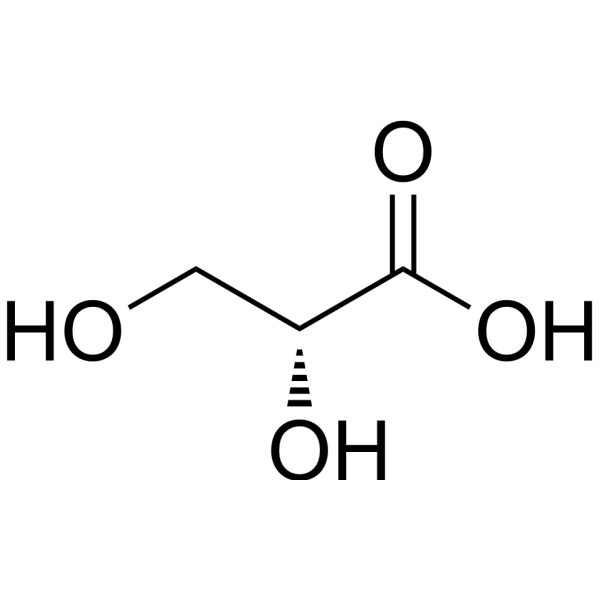
D-Glyceric acid
D-Glyceric acid is an endogenous metabolite present in urine that can be used for the research of primary hyperoxaluria type I and glutaric acidemia type 2.
Nos produits utilisent uniquement pour la recherche. Nous ne vendons pas aux patients.
- CAS No.: 6000-40-4
- Formule: C3H6O4
- Masse moléculaire:106.08
-
Stockage:
Please store the product under the recommended conditions in the Certificate of Analysis.

To place orders, for customer services and technical support, please contact: MedChemExpress USA
Tel: 609-228-6898 E-mail: [email protected] [email protected]


-
 Activité biologique
-
Chemical Information
- Pureté et documentation
- Références
-
 Help & FAQs


Voir tous les produits spécifiques à Isoform Endogenous Metabolite
More

Activité biologique
Description
In Vitro
Endogenous metabolites is defined as those that are annotated by Kyoto Encyclopedia of Genes and Genomes as substrates or products of the ~1900 metabolic enzymes encoded in our genome. It is clear in the body of literature that there are documented toxic properties for many of these metabolites[1].
MedChemExpress (MCE) has not independently confirmed the accuracy of these methods. They are for reference only.


Chemical Information
-
CAS No. 6000-40-4
-
Masse moléculaire 106.08
-
Formule C3H6O4
-
SMILES
O=C(O)[C@H](O)CO
-
Structure Classification
-
Initial Source
-
Livraison
Room temperature in continental US; may vary elsewhere.
-
Stockage
Please store the product under the recommended conditions in the Certificate of Analysis.


Pureté et documentation
-
Fiche technique (265 KB)
-
SDS (252 KB)
- Français - FR (252 KB)
- Deutsch - DE (252 KB)
- Norwegian - NO (252 KB)
- Español - ES (252 KB)
- Swedish - SV (252 KB)
- Italian - IT (252 KB)
- Korean - KR (252 KB)
- Portuguese - PT (252 KB)
-
Instruction de manipulation (2659 KB)
Références
[1]. Lee N, et al. Endogenous toxic metabolites and implications in cancer therapy. Oncogene. 2020 Aug;39(35):5709-5720. [Content Brief]
[2]. Dietzen DJ, et al. Extraction of glyceric and glycolic acids from urine with tetrahydrofuran: utility in detection of primary hyperoxaluria. Clin Chem. 1997 Aug;43(8 Pt 1):1315-20. [Content Brief]
[3]. Chlebeck PT, et al. Long-term prognosis in primary hyperoxaluria type II (L-glyceric aciduria). Am J Kidney Dis. 1994 Feb;23(2):255-9. [Content Brief]

Calculators
Concentration (start) × Volume (start) = Concentration (final) × Volume (final)


D-Glyceric acid Related Classifications
HY-139070 Related Classifications
 Powered by Bioz