



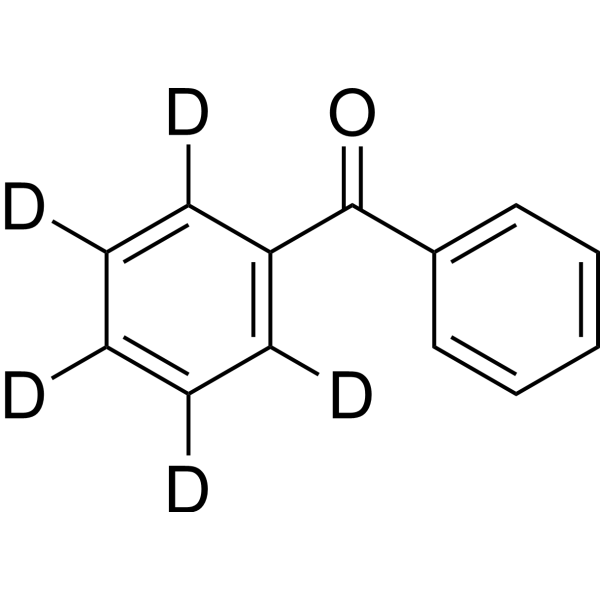
Benzophenone-d5

Based on 1 Customer Validation
Benzophenone-d5 is the deuterium labeled Benzophenone (HY-Y0546). Benzophenone is an endogenous metabolite. Benzophenone is a photosensitizer, that absorbs UV light, transfers its energy to DNA, and triggers DNA damage. Benzophenone can be used as the fragrance enhancer, ultraviolet curing agent, additive in plastics, or the flavor ingredient. Benzophenone can also be used in the manufacturing of insecticides, agricultural chemicals, hypnotics, antihistamines, and other pharmaceuticals. Benzophenone exhibits certain carcinogenicity in mouse/rat models under long term exposure. Benzophenone exhibits estrogenic activity.
For research use only. We do not sell to patients.
- Purity : 99.98%
- CAS No.: 2694-78-2
- Formula: C13H5D5O
- Molecular Weight:187.25
-
Storage:Powder -20°C, 3 years , 4°C, 2 years ; In solvent -80°C, 6 months , -20°C, 1 month

To place orders, for customer services and technical support, please contact: MedChemExpress USA
Tel: 609-228-6898 E-mail: [email protected] [email protected]


-
 Biological Activity
-
Chemical Information
-
Solvent & Solubility
- Protocols
- Purity & Documentation
- References
-
 Help & FAQs


All Endogenous Metabolite Isoforms
More

Biological Activity
Description
In Vitro
Stable heavy isotopes of hydrogen, carbon, and other elements have been incorporated into drug molecules, largely as tracers for quantitation during the drug development process. Deuteration has gained attention because of its potential to affect the pharmacokinetic and metabolic profiles of drugs[1].
MedChemExpress (MCE) has not independently confirmed the accuracy of these methods. They are for reference only. Further protocols information, click here.
Application
1. This compound can be used as a tracer
2. This compound can be used as an internal standard for quantitative analysis by NMR, GC-MS, or LC-MS.


Chemical Information
-
CAS No. 2694-78-2
-
Unlabeled CAS 119-61-9
-
Appearance Solid
-
Molecular Weight 187.25
-
Formula C13H5D5O
-
Color White to off-white
-
SMILES
O=C(C1=CC=CC=C1)C2=C([2H])C([2H])=C([2H])C([2H])=C2[2H]
-
Shipping
Room temperature in continental US; may vary elsewhere.
-
Storage
Powder -20°C 3 years 4°C 2 years In solvent -80°C 6 months -20°C 1 month


Solvent & Solubility
In Vitro:
DMSO : 100 mg/mL (534.05 mM; Need ultrasonic and warming; Hygroscopic DMSO has a significant impact on the solubility of product, please use newly opened DMSO)
Please refer to the solubility information to select the appropriate solvent. Once prepared, please aliquot and store the solution to prevent product inactivation from repeated freeze-thaw cycles.
Storage method and period of stock solution: -80°C, 6 months; -20°C, 1 month. When stored at -80°C, please use it within 6 months. When stored at -20°C, please use it within 1 month.
Please refer to the solubility information to select the appropriate solvent. Once prepared, please aliquot and store the solution to prevent product inactivation from repeated freeze-thaw cycles.
Storage method and period of stock solution: -80°C, 6 months; -20°C, 1 month. When stored at -80°C, please use it within 6 months. When stored at -20°C, please use it within 1 month.
Concentration (start) × Volume (start) = Concentration (final) × Volume (final)

Protocols
-
Carcinogenicity Bioassay
A carcinogenicity bioassay detects whether long-term exposure to a test substance increases benign or malignant tumor incidence, changes tumor spectrum, or shortens tumor latency in experimental animals; the classical rodent design exposes rats and/or mice to multiple dose levels for most of their lifespan, followed by complete necropsy and histopathologic diagnosis of neoplastic and non-neoplastic lesions. The readout is tumor incidence by organ, sex, species, dose group, and survival status; interpretation requires concurrent controls, dose-response assessment, survival-adjusted tumor statistics, and pathology review because mortality, spontaneous tumor background, and body-weight effects can influence apparent tumor rates.
-
Genotoxicity/Mutagenicity Study
The bacterial reverse mutation assay detects point mutations that restore amino-acid prototrophy in auxotrophic Salmonella typhimurium or Escherichia coli tester strains; after exposure to a test article, mutagenic activity is read out as an increased number of revertant colonies on minimal agar compared with the vehicle control. The assay uses tester strains with different mutation targets so that base-substitution and frameshift mutagens can be detected, and testing is performed with and without exogenous mammalian metabolic activation because some chemicals require biotransformation to become mutagenic.


Purity & Documentation
-
Data Sheet (274 KB)
-
SDS (393 KB)
- English - EN (393 KB)
- Français - FR (393 KB)
- Deutsch - DE (393 KB)
- Norwegian - NO (393 KB)
- Español - ES (393 KB)
- Swedish - SV (393 KB)
- Italian - IT (393 KB)
- Korean - KR (393 KB)
- Portuguese - PT (393 KB)
-
Handling Instructions (2659 KB)
References
[1]. EFSA Panel on Food Contact Materials, Enzymes, Flavourings and Processing Aids (CEF); Silano V, et al., Safety of benzophenone to be used as flavouring. EFSA J. 2017 Nov 14;15(11):e05013. [Content Brief]
[2]. Rhodes MC, et al., Carcinogenesis studies of benzophenone in rats and mice. Food Chem Toxicol. 2007 May;45(5):843-51. [Content Brief]


Complete Stock Solution Preparation Table
Please refer to the solubility information to select the appropriate solvent. Once prepared, please aliquot and store the solution to prevent product inactivation from repeated freeze-thaw cycles.
Storage method and period of stock solution: -80°C, 6 months; -20°C, 1 month. When stored at -80°C, please use it within 6 months. When stored at -20°C, please use it within 1 month.
| Optional Solvent | Concentration Solvent Mass | 1 mg | 5 mg | 10 mg | 25 mg |
|---|---|---|---|---|---|
| DMSO | 1 mM | 5.3405 mL | 26.7023 mL | 53.4045 mL | 133.5113 mL |
| 5 mM | 1.0681 mL | 5.3405 mL | 10.6809 mL | 26.7023 mL | |
| 10 mM | 0.5340 mL | 2.6702 mL | 5.3405 mL | 13.3511 mL | |
| 15 mM | 0.3560 mL | 1.7802 mL | 3.5603 mL | 8.9008 mL | |
| 20 mM | 0.2670 mL | 1.3351 mL | 2.6702 mL | 6.6756 mL | |
| 25 mM | 0.2136 mL | 1.0681 mL | 2.1362 mL | 5.3405 mL | |
| 30 mM | 0.1780 mL | 0.8901 mL | 1.7802 mL | 4.4504 mL | |
| 40 mM | 0.1335 mL | 0.6676 mL | 1.3351 mL | 3.3378 mL | |
| 50 mM | 0.1068 mL | 0.5340 mL | 1.0681 mL | 2.6702 mL | |
| 60 mM | 0.0890 mL | 0.4450 mL | 0.8901 mL | 2.2252 mL | |
| 80 mM | 0.0668 mL | 0.3338 mL | 0.6676 mL | 1.6689 mL | |
| 100 mM | 0.0534 mL | 0.2670 mL | 0.5340 mL | 1.3351 mL |


Benzophenone-d5 Related Classifications
HY-Y0546S1 Related Classifications
 Powered by Bioz