



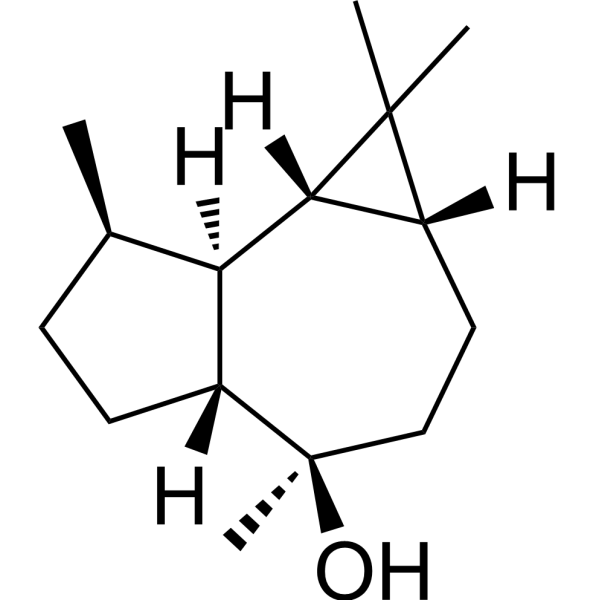
Globulol

Based on 1 Customer Validation
Globulol is a terpenoid metabolite and Antimicrobial agent. Globulol can be isolated from Alpinia oxyphylla Miq. Globulol binds to PAK4, reduces the expression level of PAK4 in cancer cells, decreases the phosphorylation of AKT, and downregulates the expressions of STAT3, phosphorylated STAT3, and PD-L1. Globulol promotes the secretion of CCL4 by cancer cells. Globulol reduces the viability and proliferation ability of cancer cells, induces G0/G1 cell cycle arrest and Apoptosis in cancer cells, and inhibits cancer cell migration and the integrity of 3D tumor spheres. Globulol enhances the relevant effects of anti-PD-1 agents in the cancer cell microenvironment. Globulol exhibits anticancer activity against liver cancer. Globulol inhibits the mycelial growth of phytopathogenic fungi and the growth of phytopathogenic bacteria. Globulol can be used in studies related to hepatocellular carcinoma.
商品は「研究用試薬」です。人や動物の医療用・臨床診断用・食品用の製品ではありません。
研究用途以外に使用した場合、当社は一切の責任を負いかねます。
- 純度 : 99.74%
- CAS 番号: 489-41-8
- 分子式: C15H26O
- 分子量:222.37
-
保管条件:
4°C, protect from light
* In solvent : -80°C, 6 months; -20°C, 1 month (protect from light)

To place orders, for customer services and technical support, please contact: MedChemExpress USA
Tel: 609-228-6898 E-mail: [email protected] [email protected]


-
 生物活性
生物活性
-
化学情報
- プロトコル
- 純度とドキュメンテーション
- 参考文献
-
 Help & FAQs




生物活性
製品説明
IC50 & Target
[1]|
PAK4 |
STAT3 |
体外実験
Globulol (0-320 μM; 24 h) reduces the viability of Huh1 and Huh7 hepatocellular carcinoma cells in a concentration-dependent manner, with IC50 values of 136.6 μM and 141.5 μM, respectively[1].
Globulol (40-120 μM; 24 h) induces G0/G1 cell cycle arrest in Huh1 and Huh7 hepatocellular carcinoma cells[1].
Globulol (40-120 μM) induces apoptosis in Huh1 and Huh7 hepatocellular carcinoma cells in a dose-dependent manner[1].
Globulol (40-120 μM; 12 h) inhibits the migratory capacity of Huh1 and Huh7 hepatocellular carcinoma cells in 3D tumor spheroid models[1].
Globulol (80 μM) enhances the migratory capacity of activated CD8+ T cells toward Huh1 and Huh7 hepatocellular carcinoma cells by upregulating the expression of CCL4 during a 24-hour co-cultivation process[1].
Globulol (80 μM; 24 h) enhances CD8+ T cell-mediated cytotoxicity against 3D spheroids of Huh7 hepatocellular carcinoma cells during a 24-hour co-culture process[1].
Globulol (40-120 μM) inhibits the PAK4-pAKT-STAT3 pathway and reduces the expression of PD-L1 protein in wild-type, PAK4-overexpressing and PAK4-knockdown Huh7 hepatocellular carcinoma cells[1].
Globulol inhibits the growth of Xanthomonas vesicatoria and Bacillus subtilis, with an IC50 of 158.0 μg mL−1 against the former and 737.2 μg mL−1 against the latter[2].
MedChemExpress (MCE) has not independently confirmed the accuracy of these methods. They are for reference only.
-
Cell Line:Huh1, Huh7, LX-2 human hepatic stellate cells
-
Concentration:0-320 μM (Huh1, Huh7); 30-160 μM (LX-2)
-
Incubation Time:24 h
-
Result:Significantly reduced the viability of Huh1 and Huh7 cells in a concentration-dependent manner, with IC50 values of 136.6 μM (Huh1) and 141.5 μM (Huh7) (P < 0.001).
Caused no notable viability changes in LX-2 cells at concentrations ranging from 30 to 160 μM (P > 0.05).
-
Cell Line:Huh1, Huh7 hepatocellular carcinoma cells
-
Concentration:40-120 μM
-
Incubation Time:24 h
-
Result:Caused a substantial, dose-dependent increase in the G0/G1 phase fraction of both Huh1 and Huh7 cells compared to controls (P < 0.001).
-
Cell Line:Huh1, Huh7 hepatocellular carcinoma cells
-
Concentration:40-120 μM
-
Incubation Time:12 h
-
Result:Reduced the density of migrating cells from tumor spheroids in a dose-dependent manner.
Made tumor spheroid boundaries well-defined with few migrating cells at 120 μM.
Significantly reduced the relative invasion area in both Huh1 (P < 0.01) and Huh7 (P < 0.001) cells compared to controls.
-
Cell Line:Huh7 hepatocellular carcinoma cells (wild-type, PAK4-overexpressing, and PAK4-knockdown)
-
Concentration:40-120 μM (wild-type cells); 120 μM (PAK4-overexpressing and PAK4-knockdown cells)
-
Incubation Time:A certain period of time
-
Result:Dose-dependently reduced protein levels of PAK4, p-AKT (Ser473), STAT3, p-STAT3 (Y705), and PD-L1 in wild-type Huh7 cells, with no notable effect on total AKT levels.
Reduced protein levels of PAK4, p-AKT (Ser473), STAT3, p-STAT3 (Y705), and PD-L1 in PAK4-overexpressing Huh7 cells.
Further reduced protein levels of PAK4, STAT3, p-STAT3 (Y705), and PD-L1 in PAK4-knockdown Huh7 cells compared to the knockdown-only group.
- Research Protocol for Infectious Diseases
- RNA extraction experimental
- Western Blot
- Scratch/Wound-Healing Migration Assay
- Annexin V plus membrane-impermeant dye apoptosis staining
- BrdU Incorporation Assay
- Cell migration
- Neural Crest/Neuronal Cell Migration Explant Assay
- Protocol for Cell Cycle
- Liver Cancer Modeling
- Cell Viability Determination by MTT Colorimetric Assay
- Kinase activity and phosphorylation assays
- Detection of Apoptosis
- TUNEL staining for apoptotic DNA fragmentation
- Flow cytometric DNA-content cell-cycle staining
- Zigmond Chamber Chemotaxis Assay
- Under-Agarose Cell Migration Assay
- Transwell/Boyden Chamber Migration Assay
- Apoptosis Solutions
- 3D Collagen/Hydrogel Matrix Migration Assay
- Filamentous Fungal Mold Culture and Sporulation
- Protocol for Kinase activity and phosphorylation assays
- Cell-Exclusion Zone Migration Assay
- Dunn/Insall Chamber Chemotaxis Assay


化学情報
-
CAS 番号 489-41-8
-
性状 Solid
-
分子量 222.37
-
分子式 C15H26O
-
Color White to off-white
-
SMILES
CC1([C@@]2([H])[C@@]3([H])[C@](CC[C@H]3C)([H])[C@](O)(CC[C@]21[H])C)C
-
Structure Classification
-
Initial Source
-
輸送条件
Room temperature in continental US; may vary elsewhere.
-
保管条件
4°C, protect from light
* In solvent : -80°C, 6 months; -20°C, 1 month (protect from light)


純度とドキュメンテーション
-
データシート (285 KB)
-
SDS (252 KB)
- English - EN (252 KB)
- Français - FR (252 KB)
- Deutsch - DE (252 KB)
- Norwegian - NO (252 KB)
- Español - ES (252 KB)
- Swedish - SV (252 KB)
- Italian - IT (252 KB)
- Korean - KR (252 KB)
- Portuguese - PT (252 KB)
-
取扱説明書 (2659 KB)
参考文献
[1]. Wang Z, et al. Globulol from Alpinia oxyphylla Miq. Enhances the pharmacological effects of anti-PD-1 drugs in combination by reducing PD-L1 expression in hepatocellular carcinoma. Front Pharmacol. 2026 Feb 20;17:1728692. [Content Brief]
[2]. Tan M, et al. Antimicrobial activity of globulol isolated from the fruits of Eucalyptus globulus Labill. Nat Prod Res. 2008 May 10;22(7):569-75. [Content Brief]

Calculators
濃度 (開始) × 体積 (開始) = 濃度 (終了) × 体積 (終了)


Globulol 関連分類
HY-N8389 関連分類
 Powered by Bioz