



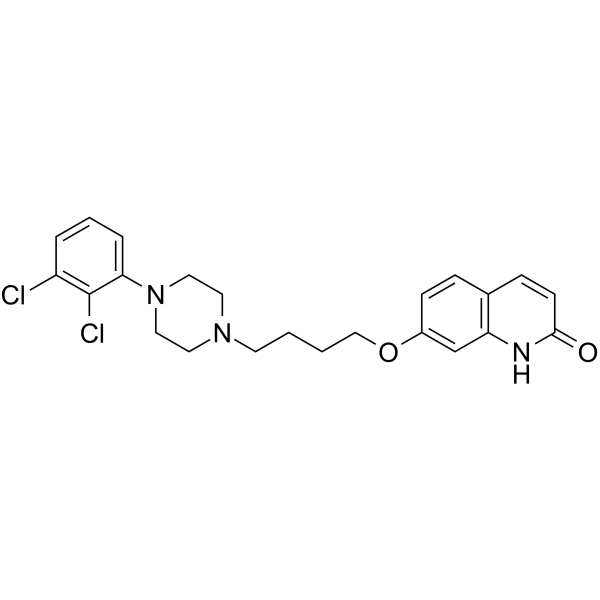
Dehydroaripiprazole
Based on 1 publication(s) in Google Scholar
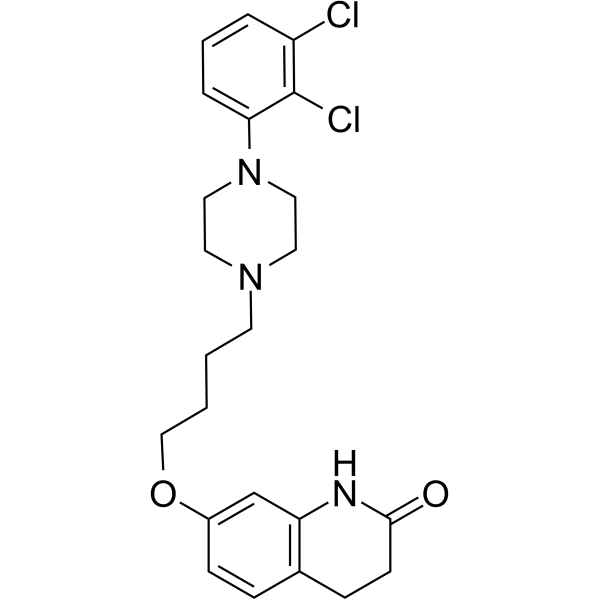
Dehydroaripiprazole (OPC-14857) is an active metabolite of Aripiprazole (HY-14546) and dopamine D2/D3 receptor partial agonist. Dehydroaripiprazole also has certain affinity for serotonin 5-HT1A, 5-HT2A and 5-HT2B receptors. Dehydroaripiprazole has antipsychotic activity equivalent to Aripiprazole.
Nur für Forschungszwecke. Wir verkaufen nicht an Patienten.
- Reinheit : 99.95%
- CAS. Nr.: 129722-25-4
- Formel: C23H25Cl2N3O2
- Molecular Weight:446.37
-
Speicherung:
4°C, protect from light
* In solvent : -80°C, 6 months; -20°C, 1 month (protect from light)

To place orders, for customer services and technical support, please contact: MedChemExpress USA
Tel: 609-228-6898 E-mail: [email protected] [email protected]


-
 Biologische Aktivität
-
Chemical Information
-
Lösungsmittel & Löslichkeit
- Reinheit & Dokumentation
- Verweise
-
 Help & FAQs


Publications Citing Use of MedChemExpress (MCE) Dehydroaripiprazole
MoreAlle 5-HT Receptor Isoform-spezifische Produkte anzeigen
MoreAlle Dopamine Receptor Isoform-spezifische Produkte anzeigen
More

Biologische Aktivität
Beschreibung
|
D3 Receptor |
5-HT1A Receptor 4.2 nM (Ki) |
5-HT2A Receptor |
5-HT2B Receptor |
Cellular Effect
|
Cell Line

|
Type | Value | Description | References |
|---|---|---|---|---|
| HEK-293T | EC50 |
158 nM
Compound: 29
|
Agonist activity at human D2L receptor expressed in HEK293T cells coexpressing Gi subunit assessed as inhibition of isoproterenol-stimulated cAMP production by luminescence assay
Agonist activity at human D2L receptor expressed in HEK293T cells coexpressing Gi subunit assessed as inhibition of isoproterenol-stimulated cAMP production by luminescence assay
|
[PMID: 22845053] |
In Vitro
Dehydroaripiprazole (0.1-30 μM; 5 min) shows a concentration-dependent inhibitory effect on BCRP-mediated [3H]-MTX uptake in BCRP-expressing membrane vesicles, with an IC50 value of 0.52 μM[5].
Dehydroaripiprazole acts as a dopamine D2/D3 receptor partial agonist in Chinese hamster ovary (CHO) cell[6].
MedChemExpress (MCE) has not independently confirmed the accuracy of these methods. They are for reference only.


Chemical Information
-
CAS. Nr. 129722-25-4
-
Appearance Solid
-
Molecular Weight 446.37
-
Formel C23H25Cl2N3O2
-
Color White to off-white
-
SMILES
O=C1NC2=C(C=CC(OCCCCN3CCN(C4=CC=CC(Cl)=C4Cl)CC3)=C2)C=C1
-
Synonyms
OPC-14857; DM-14857
-
Versand
Room temperature in continental US; may vary elsewhere.
-
Speicherung
4°C, protect from light
* In solvent : -80°C, 6 months; -20°C, 1 month (protect from light)


Publications (1)
-
Journal Impact Factor
-
Most Recent
-
Korean J Physiol Pharmacol
2020 Nov 1;24(6):545-553. PMID: 33093275


Lösungsmittel & Löslichkeit
In Vitro:
DMSO : 20 mg/mL (44.81 mM; Need ultrasonic; Hygroscopic DMSO has a significant impact on the solubility of product, please use newly opened DMSO)
Please refer to the solubility information to select the appropriate solvent. Once prepared, please aliquot and store the solution to prevent product inactivation from repeated freeze-thaw cycles.
Storage method and period of stock solution: -80°C, 6 months; -20°C, 1 month (protect from light). When stored at -80°C, please use it within 6 months. When stored at -20°C, please use it within 1 month.
Please refer to the solubility information to select the appropriate solvent. Once prepared, please aliquot and store the solution to prevent product inactivation from repeated freeze-thaw cycles.
Storage method and period of stock solution: -80°C, 6 months; -20°C, 1 month (protect from light). When stored at -80°C, please use it within 6 months. When stored at -20°C, please use it within 1 month.
Konzentration (Stammlösung) × Volumen (Stammlösung) = Konzentration (Ziellösung) × Volumen (Ziellösung)
In Vivo:
Select the appropriate dissolution method based on your experimental animal and administration route.
- For the following dissolution methods, please ensure to first prepare a clear stock solution using an In Vitro approach and then sequentially add co-solvents:
- To ensure reliable experimental results, the clarified stock solution can be appropriately stored based on storage conditions. As for the working solution for In Vivo experiments, it is recommended to prepare freshly and use it on the same day.
- The percentages shown for the solvents indicate their volumetric ratio in the final prepared solution. If precipitation or phase separation occurs during preparation, heat and/or sonication can be used to aid dissolution.
Add each solvent one by one: 10% DMSO 40% PEG300 5% Tween-80 45% Saline
Solubility: ≥ 2 mg/mL (4.48 mM); Clear solution
This protocol yields a clear solution of ≥ 2 mg/mL (saturation unknown).
Taking 1 mL working solution as an example, add 100 μL DMSO stock solution (20.0 mg/mL) to 400 μL PEG300, and mix evenly; then add 50 μL Tween-80 and mix evenly; then add 450 μL Saline to adjust the volume to 1 mL.
Preparation of Saline: Dissolve 0.9 g sodium chloride in ddH₂O and dilute to 100 mL to obtain a clear Saline solution.
In Vivo Dissolution Calculator
Please enter the basic information of animal experiments:
-
-
-
-
Recommended: Prepare an additional quantity of animals to account for potential losses during experiments.
Please enter your animal formula composition:
-
%DMSO +
Recommended: Keep the proportion of DMSO in working solution below 2% if your animal is weak.
-
%+
-
+%Tween-80 + +
-
%Saline +
The co-solvents required include: DMSO, . All of co-solvents are available by MedChemExpress (MCE). , Tween 80. All of co-solvents are available by MedChemExpress (MCE).
Working solution concentration: 0.22 mg/mL
Method for preparing stock solution: mg drug dissolved in μL DMSO. Stock solution concentration: mg/mL. * In solvent : -80°C, 6 months; -20°C, 1 month (protect from light)
1. Take μL DMSO stock solution;
2. Add μL .
μL , mix evenly;
3. Then add μL Tween 80, mix evenly;
4. Then add μL
Please ensure that the stock solution in the first step is dissolved to a clear state, and add co-solvents in sequence. You can use ultrasonic heating (ultrasonic cleaner, recommended frequency 20-40 kHz), vortexing, etc. to assist dissolution.


Reinheit & Dokumentation
-
Data Sheet (280 KB)
-
SDS (393 KB)
- English - EN (393 KB)
- Français - FR (393 KB)
- Deutsch - DE (393 KB)
- Norwegian - NO (393 KB)
- Español - ES (393 KB)
- Swedish - SV (393 KB)
- Italian - IT (393 KB)
- Korean - KR (393 KB)
- Portuguese - PT (393 KB)
-
Handling Instructions (2659 KB)
Verweise
[1]. Kirschbaum KM, et al. Serum levels of aripiprazole and dehydroaripiprazole, clinical response and side effects. World J Biol Psychiatry. 2008;9(3):212-8. [Content Brief]
[2]. Lin SK, et al. Aripiprazole and dehydroaripiprazole plasma concentrations and clinical responses in patients with schizophrenia. J Clin Psychopharmacol. 2011 Dec;31(6):758-62. [Content Brief]
[4]. Stip E, Tourjman V. et al. Aripiprazole in schizophrenia and schizoaffective disorder: A review. Clin Ther. 2010;32 Suppl 1:S3-20. [Content Brief]
[5]. Nagasaka Y, et al. Effects of aripiprazole and its active metabolite dehydroaripiprazole on the activities of drug efflux transporters expressed both in the intestine and at the blood-brain barrier. Biopharm Drug Dispos. 2012 Sep;33(6):304-15. [Content Brief]
[6]. Tadori Y, et al. In vitro pharmacology of aripiprazole, its metabolite and experimental dopamine partial agonists at human dopamine D2 and D3 receptors. Eur J Pharmacol. 2011 Oct 15;668(3):355-65. [Content Brief]
[7]. Nagasaka Y, et al. Impact of genetic deficiencies of P-glycoprotein and breast cancer resistance protein on pharmacokinetics of aripiprazole and dehydroaripiprazole. Xenobiotica. 2014 Oct;44(10):926-32. [Content Brief]
[8]. Picada JN, et al. Neurobehavioral and genotoxic parameters of antipsychotic agent aripiprazole in mice. Acta Pharmacol Sin. 2011 Oct;32(10):1225-32. [Content Brief]


Complete Stock Solution Preparation Table
Please refer to the solubility information to select the appropriate solvent. Once prepared, please aliquot and store the solution to prevent product inactivation from repeated freeze-thaw cycles.
Storage method and period of stock solution: -80°C, 6 months; -20°C, 1 month (protect from light). When stored at -80°C, please use it within 6 months. When stored at -20°C, please use it within 1 month.
| Optional Solvent | Concentration Solvent Mass | 1 mg | 5 mg | 10 mg | 25 mg |
|---|---|---|---|---|---|
| DMSO | 1 mM | 2.2403 mL | 11.2015 mL | 22.4029 mL | 56.0073 mL |
| 5 mM | 0.4481 mL | 2.2403 mL | 4.4806 mL | 11.2015 mL | |
| 10 mM | 0.2240 mL | 1.1201 mL | 2.2403 mL | 5.6007 mL | |
| 15 mM | 0.1494 mL | 0.7468 mL | 1.4935 mL | 3.7338 mL | |
| 20 mM | 0.1120 mL | 0.5601 mL | 1.1201 mL | 2.8004 mL | |
| 25 mM | 0.0896 mL | 0.4481 mL | 0.8961 mL | 2.2403 mL | |
| 30 mM | 0.0747 mL | 0.3734 mL | 0.7468 mL | 1.8669 mL | |
| 40 mM | 0.0560 mL | 0.2800 mL | 0.5601 mL | 1.4002 mL |


Dehydroaripiprazole Related Classifications
HY-100665 Related Classifications
 Powered by Bioz